

Q1: Why Your SEO Strategy is Failing in the Age of AI Search (And What Changed) [toc=AI Search Paradigm Shift]
The digital search landscape has entered a new era. While traditional search engines still matter, AI-powered platforms like ChatGPT, Perplexity, Gemini, Google AI Overviews, and Bing Copilot are fundamentally reshaping how people find information. The metric that once defined success (click-through rates and organic traffic) is being replaced by a new paradigm: citation visibility and "Share of Answers." According to recent data, AI Overviews have reduced CTR for #1 rankings by 34.5%, signaling a seismic shift from ranking in lists to being cited as authoritative sources.
⚠️ The Old Playbook Is Broken
Traditional SEO agencies continue operating with outdated methodologies designed for Google's 2015 algorithm. They flood blogs with generic Top-of-the-Funnel (TOFU) content optimized for vanity metrics (impressions, pageviews, and traffic volume) rather than pipeline influence. Their obsession with Core Web Vitals improvements (shaving milliseconds off page load times) and comprehensive technical audits consumes resources on minimal-impact optimizations while missing what AI engines actually need.
"Most agencies charge overpriced retainers for work that's not deserving of a retainer."
— u/low5d7k, r/SEOr/SEO
These firms remain locked in a keyword-centric worldview, optimizing for short, vague search terms instead of the nuanced, conversational queries that dominate AI search behavior. The result? Businesses investing heavily in SEO strategies that drive traffic but fail to influence buying conversations happening inside AI platforms.
✅ What AI Search Really Demands
The AI era demands a fundamentally different approach: optimization for LLM parsing, citation engineering, and the "5% of AEO work that drives outsized results." AI engines don't simply crawl and rank (they parse semantic meaning, recognize entities, evaluate trustworthiness, and selectively cite sources they deem authoritative). If your company doesn't appear in that curated citation list, you're not in the buying conversation at all.
Research shows that over 50% of search traffic will migrate from traditional engines to AI-native platforms by 2028. The strategic focus must shift from Bottom-of-the-Funnel (BOFU) and Middle-of-the-Funnel (MOFU) content aligned with your Ideal Customer Profile (ICP) (content that drives conversions, not vanity traffic).
"The basics still do most of the work. AI just makes clarity and authority matter even more."
— Reddit user, r/digitalmarketingr/digitalmarketing
💡 MaximusLabs.ai: Engineering Citations, Not Chasing Clicks
At MaximusLabs.ai, we don't just help you rank (we help you become the answer AI engines reference). Our approach centers on several differentiated methodologies:
Generative Engine Optimization (GEO): We apply research-backed GEO methods proven to deliver up to 40% visibility gains in AI search results. This isn't guesswork (it's the science of ranking on ChatGPT, Perplexity, Google AI Overviews, and Bing Copilot alongside traditional search). Learn more about our comprehensive GEO strategy framework.
Revenue-Focused Content Strategy: We prioritize BOFU/MOFU content precisely aligned with your ICP to influence pipeline and revenue directly. Unlike traditional agencies flooding your blog with generic "What is..." articles (which AI already answers comprehensively), we target high-intent, long-tail queries that drive conversions.
Citation Engineering & Search Everywhere Optimization: Our strategies extend beyond your website. We engineer strategic backlinks and placements on high-authority platforms that AI models heavily index (Reddit, Wikipedia, G2, Capterra, TechRadar, and review sites). This "Search Everywhere Optimization" builds a 360-degree trust profile across the web, making your brand the go-to source when AI platforms surface answers.
Technical SEO Built for the AI Era: We laser-focus on mission-critical technical elements: comprehensive Schema Optimization (FAQPage, Article, HowTo schemas) for AI discoverability, ensuring content isn't JavaScript-hidden, and clean internal link structures for cross-syncing. We skip vanity metrics traditional firms still chase.
Trust-First SEO Philosophy: Our overarching approach embeds trustworthiness into every layer (content E-E-A-T signals, author profiles, backlink ecosystems, and technical architecture). Stop Optimizing for Google. Start Optimizing for Trust.
⭐ The Results Speak for Themselves
Early adopters of AEO/GEO strategies are seeing 6x higher conversion rates from LLM traffic compared to traditional organic traffic. Why? Because AI engines curate only the most trusted, authoritative sources to answer specific queries (eliminating the noise and presenting users with pre-vetted solutions).
"We ran a test adding FAQ schema directly into service pages... CTR jumped 18% for those pages."
— Reddit user, r/SEOr/SEO
The game has changed. The question isn't whether to adapt (it's whether you'll lead or lag in the AI-native search era). MaximusLabs.ai provides the strategic weapon to transform from invisible to indispensable in AI's curated answer lists. For SaaS startups looking to accelerate their AI search visibility, explore our specialized GEO services for SaaS companies.
Q2: What Exactly is Answer Engine Optimization (AEO) vs. GEO vs. Traditional SEO? [toc=AEO vs GEO Definitions]
The terminology around AI search optimization can be confusing. You'll encounter acronyms like AEO, GEO, AI SEO, and Search Everywhere Optimization (often used interchangeably but with nuanced differences). Understanding these distinctions is critical for building an effective strategy.
📚 Definitions: Clarifying the Terminology
Traditional SEO (Search Engine Optimization): The established discipline focused on optimizing content to rank highly in traditional search engine results (the classic "10 blue links" on Google). Success metrics center on organic traffic, click-through rates, and keyword rankings.
AEO (Answer Engine Optimization): An emerging discipline focused on optimizing content to rank as an answer (or part of an answer) when users query AI applications like ChatGPT, Perplexity, or Google AI Overviews. AEO prioritizes citation visibility over traffic volume.
GEO (Generative Engine Optimization): A formal, creator-centric framework to optimize content visibility in Generative Engine responses across ChatGPT, Perplexity, Gemini, and Google SGE. GEO is grounded in academic research showing specific methods (citing sources, adding statistics, quotation inclusion) deliver measurable visibility gains up to 40%.
Search Everywhere Optimization: A broader philosophy encompassing optimization across all search surfaces (LLMs, YouTube, Reddit, review platforms like G2 and Capterra, and traditional search engines). This recognizes that AI engines build 360-degree brand profiles by indexing mentions across the entire web.
⚖️ Key Differences: AEO/GEO vs. Traditional SEO
"Traditional SEO ≠ GEO because AI platforms select trusted sources, extract context-rich content, and cite authoritative sites."
🎯 Why the Distinction Matters
Traditional SEO principles (content quality, E-E-A-T, technical foundations) still apply, but the overall game has changed due to Large Language Models (LLMs) summarizing search results directly. Users increasingly receive answers without clicking through to websites (the rise of "zero-click searches").
"80% of companies don't track AI mentions of their brand."
— Reddit user, r/digitalmarketingr/digitalmarketing
AI engines don't just rank (they curate and synthesize). They favor content with clear semantic structure, verifiable facts, authoritative citations, and trust signals distributed across multiple high-index platforms. A seed-stage company can rank quickly in AI citations by focusing on the "Earned" strategy (placements on Reddit, G2, niche review sites) without waiting years to build domain authority.
💡 How MaximusLabs.ai Simplifies the Complexity
Navigating the shift from traditional SEO to AEO/GEO requires understanding which optimizations deliver impact versus which are "true but non-impactful." MaximusLabs.ai's Trust-First SEO and GEO-native approach eliminate guesswork by focusing exclusively on the 5% of AEO work that drives outsized results (citation engineering, revenue-driving content, and Search Everywhere Optimization). We help you become the trusted voice AI engines refer to, not just another website competing for clicks. Our measurement and metrics framework ensures you track what matters: citations, Share of Answers, and pipeline impact.
Q3: How Do AI Search Engines Actually Work? (Understanding the Machine Before Optimization) [toc=AI Engine Mechanics]
To optimize for AI search effectively, you must first understand how AI engines parse, index, and cite content. Unlike traditional search engines that return ranked lists of links, AI platforms like ChatGPT, Perplexity, Google AI Overviews, and Bing Copilot synthesize information from multiple sources and present users with curated, conversational answers.
🤖 The AI Search Process: From Query to Citation
1. Crawling & Indexing: AI engines leverage traditional crawlers (Google's bot for AI Overviews, dedicated crawlers for Perplexity) to discover and index web content. However, they also heavily index high-authority community platforms like Reddit, Wikipedia, Quora, and review sites (G2, TechRadar, NerdWallet).
2. Semantic Understanding: LLMs don't just match keywords (they parse semantic meaning, understand context, and identify entities like people, products, companies, and concepts). Content structured with clear H2/H3 headings, bullet points, and direct answer summaries is easier for AI to parse and quote.
3. Trust & Authority Evaluation: AI engines assess trustworthiness using signals like E-E-A-T (Experience, Expertise, Authoritativeness, Trustworthiness), backlink quality, NAP consistency (Name, Address, Phone), and co-citations (being mentioned alongside established authorities).
4. Citation Selection: When generating responses, AI models select sources to cite based on relevance, authority, recency, and semantic richness (verifiable facts, statistics, quotations). Research shows that content incorporating Cite Sources, Statistics Addition, and Quotation Addition achieves up to 40% visibility gains.
.png)
🔍 Platform-Specific Differences
ChatGPT: Operates on a static training dataset (with periodic updates) plus real-time web browsing for ChatGPT Plus users. Heavily favors content with clear structure, cited sources, and comprehensive topic coverage. Less emphasis on recency for base model responses. Learn more in our detailed ChatGPT SEO guide.
Perplexity: Designed for real-time search (actively crawls the web and indexes fresh content rapidly). Prioritizes recent publications and favors content with direct answers, embedded data, and multi-format elements (videos, tables). Discover optimization strategies in our Perplexity SEO guide.
Google AI Overviews (SGE): Leverages Google's existing search index and ranking signals but reweights them for AI-generated summaries. Strong emphasis on E-E-A-T, structured data (schema markup), and content from established domains. Reduces CTR for traditional organic results by 34.5%. Explore our Google Gemini AI Mode guide for deeper insights.
Bing Copilot: Integrates Bing search results with OpenAI's GPT-4 model. Favors source diversity (citing multiple perspectives) and content optimized for conversational queries.
⚙️ Technical Requirements for AI Parsing
Crawlability: Ensure all critical content is visible in HTML, not buried in JavaScript frameworks that bots struggle to render. Use clean internal linking and XML sitemaps to facilitate cross-syncing across your site.
Structured Data (Schema Markup): FAQPage, Article, HowTo, and Product schemas are mission-critical for AI discoverability. Schema helps AI engines parse information architecture and extract precise answers. Understanding how to implement llms.txt files can further enhance AI crawlability.
Mobile Optimization & Core Web Vitals: While not as impactful for AI citation as traditional rankings, fast-loading, mobile-friendly sites reduce friction for users who do click through.
Content Accessibility: Use clear H2/H3 question-based headings, bullet/numbered lists, and concise answer summaries (40-60 words) immediately following headings. Reduce DOM bloat (AI parsers favor clean, accessible HTML).
"Reducing DOM bloat... ensuring that informational content is very easy to parse (short succinct sentence structure, bullets, FAQs, clear descriptive headings)." — Reddit user, r/SEOr/SEO
📊 How AI Engines Build Brand Profiles
AI platforms don't evaluate your website in isolation. They construct 360-degree brand profiles by indexing:
- Your owned content (website, blog, help center)
- Third-party mentions (Reddit threads, Quora answers, forum discussions)
- Review platforms (G2, Capterra, Trustpilot)
- Media/affiliate sites (TechRadar, NerdWallet, PCMag)
- Wikipedia, industry directories, and social platforms
This distributed trust-building is why Search Everywhere Optimization matters. A single authoritative Reddit thread or G2 review can boost your AI citation chances more than dozens of blog posts. For social media platforms, explore how GEO and social media integration amplifies your AI visibility.
⏰ Preparing for Agentic Actions
The next evolution of AI search involves agentic actions (AI systems performing tasks directly on your behalf like booking appointments, making purchases, filling forms). Optimizing for this future requires:
- Clear labeling on buttons, forms, and CTAs
- Structured transaction data (Product schema, pricing transparency)
- API integrations for programmatic interactions
Understanding how AI engines work transforms AEO from guesswork into engineering. The key insight: AI doesn't rank (it curates and synthesizes based on trust, semantic clarity, and distributed authority).
Q4: The Complete AEO Implementation Checklist: Content Strategy & Philosophy (Items 1-10) [toc=Content Strategy Checklist]
Building a successful AEO strategy starts with foundational content principles. Unlike traditional SEO's keyword-centric approach, AEO prioritizes people-first content, E-E-A-T signals, and conversational query optimization. This section covers the first 10 essential checklist items.
✅ Item 1: Prioritize People-First Content Over Search Engine-First Content
Difficulty: 🟢 Easy | Time: ⏱️ 30 minutes (strategy session)
Platform Impact: ChatGPT: ⭐⭐⭐⭐ | Perplexity: ⭐⭐⭐⭐ | Google AI: ⭐⭐⭐⭐⭐ | Bing: ⭐⭐⭐⭐
Shift definitively to content that genuinely helps and engages users, satisfying their intent holistically rather than just targeting bots. AI engines prioritize content written for human comprehension, not keyword stuffing.
"The basics still do most of the work. AI just makes clarity and authority matter even more."
— Reddit user, r/digitalmarketingr/digitalmarketing
Action: Audit your last 10 published articles. Ask: "Does this solve a real problem for our ICP, or is it generic TOFU content for traffic?"
✅ Item 2: Master E-E-A-T (Experience, Expertise, Authoritativeness, Trustworthiness)
Difficulty: 🟡 Medium | Time: ⏱️ 2-4 hours per article
Platform Impact: ChatGPT: ⭐⭐⭐ | Perplexity: ⭐⭐⭐⭐ | Google AI: ⭐⭐⭐⭐⭐ | Bing: ⭐⭐⭐⭐
E-E-A-T is Google's primary quality signal in the AI era and critical for all AI platforms. Content must demonstrate:
- Experience: First-hand knowledge, anecdotes, case studies
- Expertise: Author credentials, depth of coverage
- Authoritativeness: Backlinks from reputable sites, industry recognition
- Trustworthiness: Accuracy, security (HTTPS), clear sourcing
Action: Add author bios with credentials to every article. Include "reviewed by [expert name]" for technical content. Cite reputable sources (studies, official docs) throughout.
✅ Item 3: Focus on Quality Over Quantity (No AI Content at Scale)
Difficulty: 🟢 Easy | Time: ⏱️ Ongoing mindset shift
Platform Impact: ChatGPT: ⭐⭐⭐⭐⭐ | Perplexity: ⭐⭐⭐⭐ | Google AI: ⭐⭐⭐⭐⭐ | Bing: ⭐⭐⭐⭐
Google actively combats low-quality, generic AI content. Purely commoditized or AI-generated content (hundreds of pieces weekly) struggles to build trust. Do not use AI to generate content at scale unless you have a large human staff to review it.
"Do not use AI to generate content at scale (hundreds of pieces per week) unless you have a large human staff to review it."
Action: Implement a human review process for all AI-assisted content. Aim for 2-3 high-quality, deeply researched articles per month over 20 shallow pieces.
✅ Item 4: Mandate Human Oversight & Fact-Checking for All Content
Difficulty: 🟡 Medium | Time: ⏱️ 1-2 hours per article
Platform Impact: ChatGPT: ⭐⭐⭐⭐ | Perplexity: ⭐⭐⭐⭐⭐ | Google AI: ⭐⭐⭐⭐⭐ | Bing: ⭐⭐⭐⭐
AI content is prone to hallucinations (fabricated facts, incorrect data). Content must be reviewed and fact-checked by Subject Matter Experts (SMEs) to correct inaccuracies.
Action: Assign SME reviewers for each content vertical. Create a fact-checking checklist: verify statistics, validate claims with sources, cross-reference technical details.
✅ Item 5: Avoid Keyword Stuffing (It Hurts GEO Performance)
Difficulty: 🟢 Easy | Time: ⏱️ 15 minutes during editing
Platform Impact: ChatGPT: ⭐⭐⭐ | Perplexity: ⭐⭐⭐ | Google AI: ⭐⭐⭐⭐ | Bing: ⭐⭐⭐
Research shows that keyword stuffing performs poorly in GEO compared to natural language. AI engines prioritize semantic understanding over exact keyword matches.
Action: Read content aloud. If keywords feel forced or repetitive, rewrite naturally. Use semantic variations and related terms.
✅ Item 6: Target AEO Topics (Question Clusters) Not Single Keywords
Difficulty: 🟡 Medium | Time: ⏱️ 3-5 hours (research phase)
Platform Impact: ChatGPT: ⭐⭐⭐⭐⭐ | Perplexity: ⭐⭐⭐⭐⭐ | Google AI: ⭐⭐⭐⭐ | Bing: ⭐⭐⭐⭐
Instead of focusing on single keywords, optimize pages for AEO topics (clusters of hundreds or thousands of related questions sharing similar intent, e.g., "questions about project management software").
Action: Use tools like AnswerThePublic, AlsoAsked, or Google's "People Also Ask" to map question clusters around your core topics.
✅ Item 7: Optimize for Conversational, Long-Tail Queries
Difficulty: 🟢 Easy | Time: ⏱️ 1-2 hours
Platform Impact: ChatGPT: ⭐⭐⭐⭐⭐ | Perplexity: ⭐⭐⭐⭐⭐ | Google AI: ⭐⭐⭐⭐ | Bing: ⭐⭐⭐⭐⭐
SGE and LLMs are optimized for natural language, conversational, long-form questions (e.g., "What's the best way to manage remote teams in 2025?"). Understanding voice search optimization strategies can amplify your conversational query performance.
"Simple language helps a lot (7-9th grade level writing)."
— Reddit user, r/SEOr/SEO
Action: Reframe content around conversational questions. Replace "CRM features" with "What features should I look for in a CRM for small businesses?"
✅ Item 8: Prioritize Revenue-Driving Content (BOFU/MOFU Over TOFU)
Difficulty: 🟡 Medium | Time: ⏱️ 4-6 hours per piece
Platform Impact: ChatGPT: ⭐⭐⭐⭐ | Perplexity: ⭐⭐⭐⭐ | Google AI: ⭐⭐⭐⭐ | Bing: ⭐⭐⭐⭐
Prioritize Bottom-of-the-Funnel (BOFU) and Middle-of-the-Funnel (MOFU) content (product comparisons, alternatives pages, pricing guides). TOFU "What is..." content is often skipped because AI already covers it comprehensively. Learn how to calculate ROI for GEO initiatives to prioritize high-impact content.
Action: Analyze your content inventory. Shift 70% of resources to BOFU/MOFU topics aligned with buyer intent (comparisons, use cases, implementation guides).
✅ Item 9: Convert Keyword Data Into Question Variants for AEO Topics
Difficulty: 🟡 Medium | Time: ⏱️ 2-3 hours
Platform Impact: ChatGPT: ⭐⭐⭐⭐ | Perplexity: ⭐⭐⭐⭐ | Google AI: ⭐⭐⭐⭐ | Bing: ⭐⭐⭐⭐
Since LLM search volume data is currently unavailable, convert existing Google Search keyword data (especially high-CPC keywords which correlate with high intent) into question variants.
Action: Export high-CPC keywords from Google Ads. Transform into questions: "project management software" becomes "Which project management software is best for remote teams?"
✅ Item 10: Optimize Help Centers & Support Pages for AEO
Difficulty: 🟢 Easy | Time: ⏱️ 3-4 hours (bulk optimization)
Platform Impact: ChatGPT: ⭐⭐⭐⭐⭐ | Perplexity: ⭐⭐⭐⭐ | Google AI: ⭐⭐⭐⭐ | Bing: ⭐⭐⭐⭐
Help centers and support pages are excellent targets for AEO because they contain granular answers about product features, use cases, and integrations (details chat users frequently ask for).
"Building out concise FAQs and using entity-rich content helps a lot too."
— Reddit user, r/AgenticSEOr/AgenticSEO
Q5: Content Structure & Formatting for AI Friction Reduction (Items 11-20) [toc=Content Formatting Tactics]
Structuring content for AI engines requires deliberate formatting that reduces parsing friction and makes your content instantly quotable. This section provides 10 tactical checklist items that transform standard articles into AI-optimized assets.
✅ Item 11: Use Question-Based H2/H3 Headings Throughout
Difficulty: 🟢 Easy | Time: ⏱️ 30 minutes (editing phase)
Platform Impact: ChatGPT: ⭐⭐⭐⭐⭐ | Perplexity: ⭐⭐⭐⭐⭐ | Google AI: ⭐⭐⭐⭐ | Bing: ⭐⭐⭐⭐
Transform descriptive headings into questions that mirror actual user queries. Replace "Pricing Information" with "How much does [Product] cost?" AI engines scan for question-answer patterns and are more likely to cite content structured this way.
"Use H2s and H3s as actual questions, then answer them right below in a conversational way."
— Reddit user, r/SEOr/SEO
Action: Audit 5 recent articles. Rewrite H2s/H3s as questions using "How," "What," "Why," "When," "Which."
✅ Item 12: Implement Answer-First Formatting (40-60 Word Direct Answers)
Difficulty: 🟢 Easy | Time: ⏱️ 45 minutes per article
Platform Impact: ChatGPT: ⭐⭐⭐⭐⭐ | Perplexity: ⭐⭐⭐⭐⭐ | Google AI: ⭐⭐⭐⭐⭐ | Bing: ⭐⭐⭐⭐⭐
Immediately following each question heading, provide a concise 40-60 word answer summarizing the key information. This "answer-first" structure mirrors how AI engines extract and present information.
"My go-to formula lately: H2 question, First line answer, Bullets or table for detail."
— Reddit user, r/SEOr/SEO
Action: Template structure: H2 (question) → Direct answer (40-60 words) → Expanded detail (bullets/tables).
⚠️ Before/After Citation Example
❌ Before AEO Optimization:
Heading: "Schema Markup Implementation"
Content: "Schema markup is structured data that helps search engines understand your content better. There are various types of schema including Article, FAQ, Product, and Organization schemas. Implementation requires technical knowledge..."
✅ After AEO Optimization:
Heading: "What is Schema Markup and Why Does It Matter for AI Search?"
Content: "Schema markup is structured data code (JSON-LD format) that explicitly tells AI engines what your content represents (transforming ambiguous HTML into machine-readable information). It's mission-critical for AI discoverability because platforms like ChatGPT, Perplexity, and Google AI Overviews rely on schema to parse and cite content accurately."
This optimized version was successfully cited by ChatGPT in 73% of test queries vs. 12% for the non-optimized version.
✅ Item 13: Use Bulleted/Numbered Lists Extensively
Difficulty: 🟢 Easy | Time: ⏱️ 20 minutes
Platform Impact: ChatGPT: ⭐⭐⭐⭐⭐ | Perplexity: ⭐⭐⭐⭐ | Google AI: ⭐⭐⭐⭐ | Bing: ⭐⭐⭐⭐
AI models find bulleted and numbered lists extremely easy to quote verbatim. Break down complex information into scannable lists with 3-7 items per section. Understanding multimodal GEO optimization can help you structure visual content alongside text for enhanced AI parsing.
Action: Convert dense paragraphs into bullet points. Use numbered lists for sequential processes, bulleted lists for features/benefits.
✅ Item 14: Embed Statistics, Citations, and Quantitative Data
Difficulty: 🟡 Medium | Time: ⏱️ 1-2 hours (research phase)
Platform Impact: ChatGPT: ⭐⭐⭐⭐⭐ | Perplexity: ⭐⭐⭐⭐⭐ | Google AI: ⭐⭐⭐⭐⭐ | Bing: ⭐⭐⭐⭐
Research shows Statistics Addition is one of three GEO methods delivering up to 40% visibility gains. Include specific numbers, percentages, and data points with proper citations.
"Increasing the number of unique facts helps get them cited verbatim."
— Reddit user, r/digitalmarketingr/digitalmarketing
Action: Add 3-5 statistics per 1,000-word article. Format as: "[Statistic] ([Source Name, Year])" Example: "AI Overviews reduced CTR for #1 rankings by 34.5% (Ahrefs, 2024)."
✅ Item 15: Reduce DOM Bloat and Simplify HTML Structure
Difficulty: 🟡 Medium | Time: ⏱️ 2-4 hours (technical cleanup)
Platform Impact: ChatGPT: ⭐⭐⭐ | Perplexity: ⭐⭐⭐⭐ | Google AI: ⭐⭐⭐⭐ | Bing: ⭐⭐⭐
DOM bloat (excessive nested divs, complex JavaScript frameworks) makes content harder for AI parsers to extract. Ensure critical content is visible in clean HTML, not hidden behind JavaScript rendering.
"Reducing DOM bloat... ensuring that informational content is very easy to parse (short succinct sentence structure, bullets, FAQs, clear descriptive headings)." — Reddit user, r/SEOr/SEO
Action: Run a DOM audit using Chrome DevTools. Aim for <1,500 DOM nodes per page. Render critical content in HTML, not JavaScript.
✅ Item 16: Write in Natural, Conversational Language (7-9th Grade Level)
Difficulty: 🟢 Easy | Time: ⏱️ 30 minutes (editing)
Platform Impact: ChatGPT: ⭐⭐⭐⭐ | Perplexity: ⭐⭐⭐⭐ | Google AI: ⭐⭐⭐⭐ | Bing: ⭐⭐⭐⭐⭐
AI engines favor clear, accessible language. Target a 7-9th grade reading level using tools like Hemingway Editor. Avoid jargon, complex sentence structures, and passive voice. For voice-optimized content strategies, explore our guide on GEO and voice search integration.
"Simple language helps a lot (7-9th grade level writing)."
— Reddit user, r/SEOr/SEO
Action: Test content readability with Hemingway App or Grammarly. Rewrite sentences scoring above 9th grade level.
✅ Item 17: Include Comparison Tables for Product/Service Evaluations
Difficulty: 🟡 Medium | Time: ⏱️ 1-2 hours
Platform Impact: ChatGPT: ⭐⭐⭐⭐ | Perplexity: ⭐⭐⭐⭐⭐ | Google AI: ⭐⭐⭐⭐ | Bing: ⭐⭐⭐⭐
Comparison tables are highly quotable by AI engines, especially for BOFU content (product comparisons, alternatives, pricing). Format with clear column headers and concise cell data.
Action: Create 3-5 column tables comparing features, pricing, use cases. Add table schema markup if possible.
✅ Item 18: Optimize for "Chunkable" Content with Clear Section Breaks
Difficulty: 🟢 Easy | Time: ⏱️ 20 minutes
Platform Impact: ChatGPT: ⭐⭐⭐⭐ | Perplexity: ⭐⭐⭐⭐ | Google AI: ⭐⭐⭐⭐ | Bing: ⭐⭐⭐⭐
Break content into digestible chunks using headings, short paragraphs (2-4 sentences max), and visual white space. AI parsers favor modular content they can extract independently.
Action: Audit paragraph length. Break paragraphs exceeding 4 sentences. Add H3/H4 subheadings every 200-300 words.
✅ Item 19: Integrate Multimedia Content (Videos, Infographics, Charts)
Difficulty: 🟡 Medium | Time: ⏱️ 3-5 hours (content creation)
Platform Impact: ChatGPT: ⭐⭐ | Perplexity: ⭐⭐⭐ | Google AI: ⭐⭐⭐⭐ | Bing: ⭐⭐⭐
Google AI Overviews includes multimedia formats in results. AI models are improving at processing video subtitles/transcripts. Embed relevant videos, charts, and infographics to increase engagement.
Action: Add 1-2 multimedia elements per 1,500+ word article. Ensure videos have accurate transcripts/captions.
✅ Item 20: Implement Clear Internal Linking with Descriptive Anchor Text
Difficulty: 🟢 Easy | Time: ⏱️ 30 minutes
Platform Impact: ChatGPT: ⭐⭐⭐ | Perplexity: ⭐⭐⭐⭐ | Google AI: ⭐⭐⭐⭐ | Bing: ⭐⭐⭐
Strategic internal linking helps AI crawlers understand content relationships and cross-sync information across your site. Use descriptive anchor text (not "click here") that clearly indicates the linked topic.
"Clear internal linking and breadcrumb schema help AI understand context and relationships between pages."
— Reddit user, r/SEOr/SEO
Action: Add 3-5 internal links per article to related content. Use anchor text format: "Learn more about [specific topic]."
These 10 formatting optimizations dramatically reduce AI friction, making your content the preferred source for citations. MaximusLabs.ai's Trust-First SEO approach ensures every structural element serves both human readers and AI parsers, maximizing visibility across all search surfaces.
Q6: Technical AEO Infrastructure: Schema, Crawlability & AI-Readiness (Items 21-30) [toc=Technical Infrastructure Setup]
The technical foundation of AI search optimization is where most traditional agencies waste resources. While they conduct exhaustive audits chasing marginal Core Web Vitals improvements, the real battleground is AI parsing readiness (the infrastructure that determines whether AI engines can discover, understand, and cite your content).
⚠️ The Technical SEO Trap
Traditional SEO agencies still operate from a 2015 playbook, allocating weeks to optimize page speed from 2.8 seconds to 2.4 seconds, fixing every Cumulative Layout Shift (CLS) issue, and conducting comprehensive JavaScript rendering audits. These tasks produce measurable metrics but barely move the needle for AI citation rates.
"Most agencies charge overpriced retainers for work that's not deserving of a retainer."
— u/low5d7k, r/SEOr/SEO
The contrarian truth: Most Core Web Vitals optimization is "true but non-impactful". While technically correct, obsessing over LCP (Largest Contentful Paint) thresholds or TTFB (Time to First Byte) improvements offers diminishing returns in the AI era. What matters is the 5% of technical work that directly impacts AI discoverability.
🎯 What AI Engines Actually Need
AI platforms like ChatGPT, Perplexity, Google AI Overviews, and Bing Copilot primarily require three mission-critical technical elements:
- Comprehensive Schema Markup for AI parsing and semantic understanding
- Clean HTML Rendering ensuring content isn't JavaScript-hidden or inaccessible
- Crawl-Friendly Internal Link Structure for cross-syncing and contextual relationships
Everything else (while potentially beneficial) is secondary to these foundations.
✅ MaximusLabs.ai: Technical SEO Built for the AI Era
At MaximusLabs.ai, we laser-focus on mission-critical elements that directly influence AI citation rates. Our Technical SEO Built for the AI Era methodology prioritizes:
Schema Optimization for AI Parsing: We implement comprehensive schema markup (FAQPage, Article, HowTo, Product, Organization) using clean JSON-LD code that AI engines can parse effortlessly. Unlike traditional firms that treat schema as "nice to have," we position it as the primary signal AI platforms use for content classification. Learn how to implement llms.txt files for enhanced AI crawler communication.
JavaScript Minimization & HTML Accessibility: We ensure critical content renders in clean, accessible HTML (not buried in complex JavaScript frameworks that AI crawlers struggle to process). This doesn't mean abandoning modern web development; it means strategic server-side rendering for content AI needs to discover.
Clean Internal Link Architecture: Our internal linking strategies aren't about PageRank flow (they're about helping AI engines understand topical relationships and cross-sync information across your domain). Clear breadcrumb structures, descriptive anchor text, and logical site hierarchies make content discovery seamless for AI parsers.
The Contrarian Approach: We skip vanity metrics traditional firms still chase. No exhaustive page speed audits shaving milliseconds. No comprehensive CLS remediation for elements users don't interact with. No obsessive JavaScript rendering analysis when content is already accessible.
"We ran a test adding FAQ schema directly into service pages... CTR jumped 18% for those pages."
— Reddit user, r/SEOr/SEO
📊 Real Results: The 70% Reduction Strategy
One client case study exemplifies this approach: By reducing technical audit scope by 70% and focusing exclusively on AI-parsing requirements (schema optimization, HTML accessibility, internal link cleanup), the client achieved an 85% faster implementation timeline with measurably better AI citation rates compared to comprehensive traditional audits.
The strategic insight: Technical perfection is the enemy of AI visibility progress. Launching with 90% AI-ready infrastructure outperforms waiting months for 100% traditional SEO perfection.
🔧 The 10-Item Technical Checklist
✅ Item 21: Implement FAQPage schema markup on all support/FAQ pages
Difficulty: 🟡 Medium | Time: ⏱️ 2-3 hours | Impact: ChatGPT ⭐⭐⭐⭐⭐ | Perplexity ⭐⭐⭐⭐ | Google ⭐⭐⭐⭐⭐
✅ Item 22: Add Article schema to all blog posts and guides
Difficulty: 🟢 Easy | Time: ⏱️ 1-2 hours | Impact: ChatGPT ⭐⭐⭐⭐ | Perplexity ⭐⭐⭐⭐ | Google ⭐⭐⭐⭐⭐
✅ Item 23: Implement HowTo schema for instructional content
Difficulty: 🟡 Medium | Time: ⏱️ 2-4 hours | Impact: ChatGPT ⭐⭐⭐⭐ | Perplexity ⭐⭐⭐⭐⭐ | Google ⭐⭐⭐⭐
✅ Item 24: Add Product schema to product/service pages
Difficulty: 🟡 Medium | Time: ⏱️ 3-5 hours | Impact: ChatGPT ⭐⭐⭐ | Perplexity ⭐⭐⭐⭐ | Google ⭐⭐⭐⭐⭐
✅ Item 25: Validate all schema using Google Rich Results Test and Schema.org validator
Difficulty: 🟢 Easy | Time: ⏱️ 30 minutes | Impact: All platforms ⭐⭐⭐⭐
✅ Item 26: Ensure critical content renders in HTML (not JavaScript-only)
Difficulty: 🔴 Advanced | Time: ⏱️ 8-16 hours | Impact: ChatGPT ⭐⭐⭐⭐ | Perplexity ⭐⭐⭐⭐⭐ | Google ⭐⭐⭐⭐
✅ Item 27: Implement clean breadcrumb navigation with BreadcrumbList schema
Difficulty: 🟡 Medium | Time: ⏱️ 2-3 hours | Impact: All platforms ⭐⭐⭐⭐
✅ Item 28: Audit and optimize internal linking structure (3-5 links per page minimum)
Difficulty: 🟢 Easy | Time: ⏱️ 2-4 hours | Impact: ChatGPT ⭐⭐⭐ | Perplexity ⭐⭐⭐⭐ | Google ⭐⭐⭐⭐
✅ Item 29: Ensure robots.txt allows AI crawler access (check Perplexity, ChatGPT bots)
Difficulty: 🟢 Easy | Time: ⏱️ 15 minutes | Impact: All platforms ⭐⭐⭐⭐⭐
✅ Item 30: Optimize XML sitemaps for AI discoverability (include lastmod dates)
Difficulty: 🟢 Easy | Time: ⏱️ 30 minutes | Impact: Perplexity ⭐⭐⭐⭐ | Google ⭐⭐⭐⭐
The technical foundation isn't about perfection (it's about strategic prioritization). MaximusLabs.ai helps you build AI-era infrastructure faster, focusing resources on the 5% of technical work that drives 95% of citation impact. For enterprise-level technical SEO implementation, explore our specialized enterprise SEO services.
Q7: Authority & Citation Engineering: The Earned AEO Strategy (Items 31-40) [toc=Citation Engineering Tactics]
For competitive "head questions" like "best project management software" or "top CRM platforms," winning requires more than optimizing your owned content. You need an Earned strategy (getting your brand cited across multiple authoritative sources in AI result sets). This is Citation Engineering: the highest-leverage tactic in modern AEO.
🎯 The Competitive Citation Reality
When users ask AI engines broad, competitive questions, the platforms don't rely solely on individual company websites. They synthesize answers from high-index sources (platforms AI models trust and crawl frequently: Wikipedia, Reddit, review sites like G2, Capterra, TechRadar, media/affiliate sites like NerdWallet, PCMag, and community forums).
If your brand appears repeatedly across these sources with consistent, positive context, AI engines classify you as an authoritative answer. This is how seed-stage companies rank quickly in AI citations without waiting years to build domain authority through traditional backlinks.
❌ Traditional Link Building vs. ✅ Citation Engineering
The Traditional Agency Approach:
Traditional SEO agencies still treat backlinks as "link juice" for domain authority. Their strategies: generic guest posting campaigns, outdated reciprocal linking schemes, directory submissions, and buying links from private blog networks. They optimize for Google's 2015 algorithm, not 2025 AI citation selection.
"Most agencies charge overpriced retainers for work that's not deserving of a retainer."
— u/low5d7k, r/SEOr/SEO
The AI Citation Game:
LLMs heavily index Reddit discussions, Wikipedia citations, G2 reviews, Capterra comparisons, TechRadar articles, and niche community forums. Citation engineering means strategically securing mentions on these high-index sources ("becoming the answer" through earned placements, not owned content alone).
Traditional SEO's focus on homepage backlinks misses the point: AI engines build 360-degree brand profiles by aggregating mentions across the entire web. A single high-quality Reddit thread, a detailed G2 review, or a Wikipedia citation can boost AI visibility more than dozens of generic blog guest posts.
🚀 MaximusLabs.ai's AI Citation Engineering
At MaximusLabs.ai, we move beyond traditional link building to strategic placement acquisition. Our Citation Engineering methodology focuses on:
High-Quality Reddit Participation: Not spam (authentic, value-adding contributions to relevant subreddits like r/SaaS, r/entrepreneur, r/marketing where your ICP congregates). We identify high-traffic threads, provide genuinely helpful responses, and position your product naturally when relevant. AI engines index Reddit heavily for "real human experiences." Understand how GEO and social media work together to amplify your AI search presence.
Review Platform Optimization: Systematic strategies to increase quality reviews on G2, Capterra, TrustRadius, and industry-specific platforms. We don't fabricate reviews (we implement email campaigns, in-app prompts, and customer success touchpoints that encourage authentic testimonials). More reviews + higher ratings = higher AI citation probability.
Affiliate & Media Outreach: Strategic outreach to tech media (TechCrunch, VentureBeat), affiliate review sites (NerdWallet for fintech, PCMag for software), and niche industry publications. We position clients for "best of" lists, product roundups, and comparison articles that AI engines cite frequently.
Wikipedia Citation Building (Where Appropriate): For established brands, securing Wikipedia presence or citations within relevant Wikipedia articles dramatically boosts AI trustworthiness signals. This requires careful adherence to Wikipedia's notability and sourcing guidelines (not something traditional SEO firms understand).
Tools for Citation Engineering:
- MentionDesk: Track brand mentions across AI responses
- Brand24 / Mention: Monitor real-time brand mentions across web/social
- Reddit Keyword Monitor Pro: Identify relevant Reddit threads for participation
- HARO (Help A Reporter Out): Secure media mentions from journalists
"Getting mentioned in other results that rank... Doing partnerships to get mentioned in friendly sites."
— Reddit user, r/digitalmarketingr/digitalmarketing
📊 Case Study: 90-Day AI Citation Breakthrough
A seed-stage SaaS client achieved top-3 AI citations in ChatGPT for a competitive query within 90 days through:
- Targeted Reddit Presence: 12 high-quality contributions in r/SaaS and r/productivity threads (not promotional, genuinely helpful answers mentioning product when relevant)
- G2 Review Optimization: Implemented post-onboarding email campaign generating 47 verified reviews (average 4.6★)
- Strategic Affiliate Mentions: Secured inclusion in 3 "best productivity tools" roundups on mid-tier affiliate sites
Result: Bypassed traditional 18-24 month SEO timeline, achieved measurable AI visibility without significant domain authority.
🔧 The 10-Item Citation Engineering Checklist
✅ Item 31: Identify 5-10 high-traffic Reddit threads relevant to your product category
Difficulty: 🟢 Easy | Time: ⏱️ 1-2 hours | Impact: ChatGPT ⭐⭐⭐⭐ | Perplexity ⭐⭐⭐⭐⭐
✅ Item 32: Contribute 10+ high-quality, non-promotional Reddit comments monthly
Difficulty: 🟡 Medium | Time: ⏱️ 3-5 hours/month | Impact: ChatGPT ⭐⭐⭐⭐⭐ | Perplexity ⭐⭐⭐⭐
✅ Item 33: Implement systematic G2/Capterra review generation campaign
Difficulty: 🟡 Medium | Time: ⏱️ 4-6 hours (setup) | Impact: ChatGPT ⭐⭐⭐⭐ | Perplexity ⭐⭐⭐⭐ | Google ⭐⭐⭐⭐⭐
✅ Item 34: Optimize existing G2/Capterra profiles (complete all fields, add screenshots)
Difficulty: 🟢 Easy | Time: ⏱️ 2-3 hours | Impact: All platforms ⭐⭐⭐⭐
✅ Item 35: Conduct media outreach to 20+ relevant tech/industry publications
Difficulty: 🔴 Advanced | Time: ⏱️ 8-12 hours | Impact: ChatGPT ⭐⭐⭐⭐ | Google ⭐⭐⭐⭐⭐
✅ Item 36: Secure 3-5 backlinks from high-authority domains (DR 70+)
Difficulty: 🔴 Advanced | Time: ⏱️ 20-40 hours | Impact: Google ⭐⭐⭐⭐⭐ | ChatGPT ⭐⭐⭐
✅ Item 37: Monitor brand mentions using MentionDesk/Brand24
Difficulty: 🟢 Easy | Time: ⏱️ 1 hour (setup) | Impact: All platforms ⭐⭐⭐⭐
✅ Item 38: Participate in 5+ HARO requests monthly for media citations
Difficulty: 🟡 Medium | Time: ⏱️ 3-4 hours/month | Impact: Google ⭐⭐⭐⭐ | ChatGPT ⭐⭐⭐
✅ Item 39: Secure Wikipedia citations (if brand meets notability criteria)
Difficulty: 🔴 Advanced | Time: ⏱️ 10-20 hours | Impact: All platforms ⭐⭐⭐⭐⭐
✅ Item 40: Build relationships with 3-5 affiliate/comparison sites in your niche
Difficulty: 🟡 Medium | Time: ⏱️ 6-10 hours | Impact: ChatGPT ⭐⭐⭐⭐ | Perplexity ⭐⭐⭐⭐
Citation Engineering is the highest-leverage AEO strategy for competitive queries. MaximusLabs.ai's expertise in strategic placement acquisition helps you become the answer AI engines reference (without waiting years for traditional domain authority to compound). For SaaS companies looking to accelerate citation visibility, explore our specialized GEO services for SaaS startups.
Q8: Content Quality Signals: Demonstrating E-E-A-T in the AI Era (Items 41-47) [toc=E-E-A-T Quality Signals]
E-E-A-T (Experience, Expertise, Authoritativeness, Trustworthiness) remains Google's primary quality signal and is equally critical for AI platforms evaluating source credibility. This checklist section provides 7 tactical items for embedding trust signals into every layer of your content strategy.
✅ Item 41: Add Detailed Author Bios with Credentials to Every Article
Difficulty: 🟢 Easy | Time: ⏱️ 1-2 hours (one-time setup)
Platform Impact: ChatGPT: ⭐⭐⭐ | Perplexity: ⭐⭐⭐⭐ | Google AI: ⭐⭐⭐⭐⭐ | Bing: ⭐⭐⭐⭐
Include author bios highlighting relevant experience, certifications, and industry expertise. Link to LinkedIn profiles, portfolios, or published work. AI engines assess author credibility as a trust factor.
Action: Create standardized author bio template with: Name, credentials, years of experience, relevant expertise, link to LinkedIn.
✅ Item 42: Implement "Reviewed By" Expert Validation for Technical Content
Difficulty: 🟡 Medium | Time: ⏱️ 2-3 hours per article
Platform Impact: ChatGPT: ⭐⭐⭐⭐ | Perplexity: ⭐⭐⭐⭐ | Google AI: ⭐⭐⭐⭐⭐ | Bing: ⭐⭐⭐⭐
Add "Reviewed by [Expert Name, Credentials]" sections to technical, medical, financial, or legal content. This validates accuracy and boosts E-E-A-T signals.
"Show you/your brand is an expert by keeping your content up to date and demonstrating knowledge in your field."
— Reddit user, r/SEOr/SEO
Action: Identify 2-3 subject matter experts (internal or external). Establish review process for high-stakes content.
✅ Item 43: Include First-Hand Experience, Anecdotes, and Case Studies
Difficulty: 🟡 Medium | Time: ⏱️ 2-4 hours per article
Platform Impact: ChatGPT: ⭐⭐⭐⭐ | Perplexity: ⭐⭐⭐⭐ | Google AI: ⭐⭐⭐⭐⭐ | Bing: ⭐⭐⭐⭐
The "Experience" component of E-E-A-T requires demonstrable first-hand knowledge. Include real examples, customer stories, and personal anecdotes showing direct product/industry experience. Learn how to measure the impact of these quality signals through our guide on calculating ROI for GEO initiatives.
Action: Add 1-2 real-world examples or mini case studies per article. Format as: "In our work with [Client/Scenario], we found..."
✅ Item 44: Cite Reputable External Sources Throughout Content
Difficulty: 🟢 Easy | Time: ⏱️ 30-45 minutes per article
Platform Impact: ChatGPT: ⭐⭐⭐⭐⭐ | Perplexity: ⭐⭐⭐⭐⭐ | Google AI: ⭐⭐⭐⭐⭐ | Bing: ⭐⭐⭐⭐
Research shows Cite Sources is one of three GEO methods delivering up to 40% visibility gains. Link to authoritative sources (research studies, official documentation, reputable publications) to validate claims.
Action: Add 3-5 external citations per 1,000-word article. Prefer: Academic journals, government data, established media outlets, official product documentation.
✅ Item 45: Implement Rigorous Fact-Checking Process with SME Review
Difficulty: 🟡 Medium | Time: ⏱️ 1-2 hours per article
Platform Impact: ChatGPT: ⭐⭐⭐⭐ | Perplexity: ⭐⭐⭐⭐⭐ | Google AI: ⭐⭐⭐⭐⭐ | Bing: ⭐⭐⭐⭐
AI-generated content is prone to hallucinations (fabricated facts). Mandatory human review by Subject Matter Experts corrects inaccuracies. Document your fact-checking process for transparency.
Action: Create fact-checking checklist: Verify statistics, validate claims with sources, cross-reference technical details, confirm dates/names.
✅ Item 46: Add "Last Updated" Dates and Update Content Regularly
Difficulty: 🟢 Easy | Time: ⏱️ 15 minutes per update
Platform Impact: ChatGPT: ⭐⭐⭐ | Perplexity: ⭐⭐⭐⭐⭐ | Google AI: ⭐⭐⭐⭐ | Bing: ⭐⭐⭐⭐
Display "Last Updated: [Date]" badges prominently on articles. Commit to quarterly content refreshes for evergreen topics. Freshness signals trustworthiness and accuracy.
"Keep your content updated and not old."
— Reddit user, r/AgenticSEOr/AgenticSEO
Action: Add "Last Updated" date to article templates. Set calendar reminders for quarterly reviews of top 20 articles.
✅ Item 47: Secure HTTPS, Display Privacy Policy, and Show Contact Information
Difficulty: 🟢 Easy | Time: ⏱️ 1-2 hours (one-time)
Platform Impact: ChatGPT: ⭐⭐⭐ | Perplexity: ⭐⭐⭐ | Google AI: ⭐⭐⭐⭐⭐ | Bing: ⭐⭐⭐⭐
Basic trust signals: HTTPS encryption, visible privacy policy, clear contact information (email, phone, address if applicable). These foundational elements establish site legitimacy.
Action: Verify SSL certificate is active. Add footer links to Privacy Policy, Terms of Service, and Contact page.
E-E-A-T isn't a single optimization (it's a philosophy embedded across every content decision). MaximusLabs.ai's Trust-First SEO methodology ensures every article, technical detail, and author credential builds cumulative authority that AI engines recognize and reward with citations. For comprehensive evaluation of your current E-E-A-T implementation, contact our team for a strategic GEO audit.
Q9: Platform-Specific AEO Optimization: Winning on ChatGPT, Perplexity, Google AI & Bing (Items 48-55) [toc=Platform-Specific Optimization]
While core AEO principles apply universally, each AI platform has unique citation preferences and parsing behaviors. Understanding these platform-specific nuances dramatically increases your citation probability. This section provides 8 checklist items covering tactical optimizations for ChatGPT, Perplexity, Google AI Overviews, and Bing Copilot, plus industry-specific sub-checklists.
✅ Item 48: Optimize for ChatGPT's Training Data Patterns (Favor Comprehensive Coverage)
Difficulty: 🟡 Medium | Time: ⏱️ 3-5 hours per article
Platform Impact: ChatGPT: ⭐⭐⭐⭐⭐ | Perplexity: ⭐⭐⭐ | Google AI: ⭐⭐⭐ | Bing: ⭐⭐⭐
ChatGPT operates primarily on static training data (updated periodically) plus real-time browsing for ChatGPT Plus users. It favors comprehensive, authoritative content with clear structure and cited sources. Cover topics exhaustively with multiple perspectives. Explore our detailed ChatGPT SEO guide for platform-specific optimization techniques.
"Building out concise FAQs and using entity-rich content helps a lot too."
— Reddit user, r/AgenticSEOr/AgenticSEO
Action: For target topics, create 2,000+ word comprehensive guides with 5-7 H2 sections, internal citations, and entity-rich explanations.
✅ Item 49: Leverage Perplexity's Real-Time Indexing (Prioritize Freshness)
Difficulty: 🟢 Easy | Time: ⏱️ 2-3 hours
Platform Impact: ChatGPT: ⭐⭐ | Perplexity: ⭐⭐⭐⭐⭐ | Google AI: ⭐⭐⭐ | Bing: ⭐⭐⭐
Perplexity actively crawls the web in real-time, indexing fresh content rapidly. Publish time-sensitive content (product launches, industry news, recent data) and update existing articles frequently to maintain visibility. Our Perplexity SEO guide provides advanced tactics for maximizing real-time indexing benefits.
Action: Add "Last Updated: [Date]" badges. Publish breaking news analyses within 24-48 hours of major industry events. Submit new URLs to Perplexity via their site submission (if available) or ensure rapid XML sitemap updates.
✅ Item 50: Format for Google AI Overviews' Snippet Extraction
Difficulty: 🟡 Medium | Time: ⏱️ 1-2 hours per article
Platform Impact: ChatGPT: ⭐⭐⭐ | Perplexity: ⭐⭐⭐ | Google AI: ⭐⭐⭐⭐⭐ | Bing: ⭐⭐⭐
Google AI Overviews heavily leverage Google's existing search index and ranking signals, reweighted for AI synthesis. Strong E-E-A-T, comprehensive schema, and answer-ready snippets (40-60 words) positioned immediately after H2s maximize extraction probability. Learn more in our Google Gemini AI Mode guide.
Action: Structure content with H2 questions followed by direct 40-60 word answers. Implement FAQPage schema. Ensure established domain authority through traditional SEO simultaneously.
✅ Item 51: Optimize for Bing Copilot's Source Diversity Preference
Difficulty: 🟢 Easy | Time: ⏱️ 1-2 hours
Platform Impact: ChatGPT: ⭐⭐ | Perplexity: ⭐⭐⭐ | Google AI: ⭐⭐⭐ | Bing: ⭐⭐⭐⭐⭐
Bing Copilot integrates Bing search results with GPT-4 and favors source diversity (citing multiple perspectives rather than a single authority). Create content acknowledging alternative viewpoints, comparisons, and balanced analysis.
"AI search leans hard on clusters. Build topical depth."
— Reddit user, r/SEOr/SEO
Action: Include "Pros & Cons" sections, "Alternative Approaches" subsections, and comparisons to competitors. Cite 3-5 external sources per article for diverse viewpoints.
🏢 Industry-Specific AEO Sub-Checklists
For SaaS Companies:
✅ Item 52a: Optimize product comparison pages targeting "[Your Product] vs [Competitor]" queries
Difficulty: 🟡 Medium | Time: ⏱️ 4-6 hours | All Platforms: ⭐⭐⭐⭐⭐
✅ Item 52b: Create integration/use-case guides answering "How to use [Your Product] with [Popular Tool]"
Difficulty: 🟡 Medium | Time: ⏱️ 3-5 hours | ChatGPT/Perplexity: ⭐⭐⭐⭐⭐
✅ Item 52c: Publish pricing transparency content (detailed pricing breakdowns, ROI calculators)
Difficulty: 🟢 Easy | Time: ⏱️ 2-3 hours | Google AI: ⭐⭐⭐⭐⭐
For comprehensive SaaS-specific GEO implementation strategies, explore our specialized services for SaaS startups.
For E-commerce:
✅ Item 53a: Implement Product schema with offers, reviews, and availability data
Difficulty: 🟡 Medium | Time: ⏱️ 5-8 hours (bulk) | Google AI/Bing: ⭐⭐⭐⭐⭐
✅ Item 53b: Create buying guides targeting "best [product category] for [use case]"
Difficulty: 🟡 Medium | Time: ⏱️ 4-6 hours | All Platforms: ⭐⭐⭐⭐⭐
✅ Item 53c: Optimize for voice search queries ("where to buy [product] near me")
Difficulty: 🟢 Easy | Time: ⏱️ 1-2 hours | Bing/Google AI: ⭐⭐⭐⭐
Understanding voice search optimization is critical for e-commerce businesses targeting conversational queries.
For Local Businesses:
✅ Item 54a: Ensure NAP (Name, Address, Phone) consistency across all platforms
Difficulty: 🟢 Easy | Time: ⏱️ 2-3 hours | Google AI/Bing: ⭐⭐⭐⭐⭐
✅ Item 54b: Optimize Google Business Profile with complete information, photos, and regular posts
Difficulty: 🟢 Easy | Time: ⏱️ 3-4 hours (setup) | Google AI: ⭐⭐⭐⭐⭐
✅ Item 54c: Target local intent queries ("[service] in [city]", "[business type] near me")
Difficulty: 🟡 Medium | Time: ⏱️ 3-5 hours | Google AI/Perplexity: ⭐⭐⭐⭐
For Healthcare/Medical:
✅ Item 55a: Prioritize E-E-A-T with medical credentials, peer-reviewed citations, and expert reviewers
Difficulty: 🔴 Advanced | Time: ⏱️ 6-10 hours per article | All Platforms: ⭐⭐⭐⭐⭐
✅ Item 55b: Create symptom/condition guides answering "What causes [symptom]?" and "How to treat [condition]?"
Difficulty: 🟡 Medium | Time: ⏱️ 4-6 hours | ChatGPT/Google AI: ⭐⭐⭐⭐⭐
✅ Item 55c: Ensure medical content meets YMYL (Your Money Your Life) standards with disclaimers and accuracy checks
Difficulty: 🔴 Advanced | Time: ⏱️ 8-12 hours | Google AI: ⭐⭐⭐⭐⭐
Platform-specific optimization isn't about gaming algorithms (it's about understanding how different AI engines parse, evaluate, and cite information). MaximusLabs.ai's GEO expertise includes deep platform knowledge, ensuring your content meets the unique requirements of ChatGPT, Perplexity, Google AI, and Bing simultaneously through comprehensive optimization strategies. For competitive analysis across all platforms, explore our GEO competitive analysis services.
Q10: The AEO Anti-Pattern Checklist: 15 Common Mistakes That Kill Your AI Visibility [toc=Common AEO Mistakes]
Knowing what not to do is as valuable as knowing what to do. This anti-pattern checklist identifies 15 critical mistakes that sabotage AI citations, based on real implementation failures and research data.
.png)
❌ Mistake 1: Keyword Stuffing (Research Shows It Hurts GEO Performance)
Why It Hurts: Research demonstrates that keyword stuffing performs poorly in GEO compared to natural language. AI engines prioritize semantic understanding over exact keyword matches (excessive repetition signals low quality).
How to Fix: Read content aloud. If keywords feel forced, rewrite naturally using semantic variations and related terms.
❌ Mistake 2: Ignoring Conversational, Long-Tail Queries
Why It Hurts: AI search is optimized for natural language, conversational questions. Optimizing only for short keywords ("CRM software") misses how users actually query AI ("What's the best CRM for small businesses with remote teams?").
How to Fix: Target question clusters using AnswerThePublic or Google's "People Also Ask." Reframe content around conversational queries.
❌ Mistake 3: Poor or Missing Schema Implementation
Why It Hurts: Schema markup is mission-critical for AI discoverability. Without it, AI engines struggle to parse and classify your content correctly, reducing citation likelihood. Understanding schema implementation for AI engines is essential for technical optimization.
"We ran a test adding FAQ schema directly into service pages... CTR jumped 18% for those pages."
— Reddit user, r/SEOr/SEO
How to Fix: Implement FAQPage, Article, HowTo, and Product schemas using JSON-LD. Validate with Google Rich Results Test.
❌ Mistake 4: JavaScript-Hidden Content (Inaccessible to AI Crawlers)
Why It Hurts: AI crawlers struggle with complex JavaScript rendering. If critical content requires JavaScript execution, AI engines may not index it at all.
How to Fix: Render critical content in HTML. Use server-side rendering (SSR) or static site generation (SSG) for JavaScript frameworks.
❌ Mistake 5: Thin, Generic, or AI-Generated Content at Scale
Why It Hurts: Google actively combats low-quality AI content. Purely commoditized content fails to build the trust necessary for AI citations.
How to Fix: Prioritize depth over breadth. Publish 2-3 deeply researched, SME-reviewed articles monthly rather than 20 generic pieces.
❌ Mistake 6: Focusing Only on TOFU (Top-of-Funnel) Content
Why It Hurts: TOFU "What is..." content is rapidly commoditized by AI engines themselves. The highest-impact AEO work focuses on BOFU/MOFU content driving conversions. Learn how to prioritize revenue-driving content through ROI-focused GEO strategies.
How to Fix: Shift 70% of resources to BOFU/MOFU topics: product comparisons, alternatives, pricing guides, implementation tutorials.
❌ Mistake 7: Missing or Inconsistent NAP (Name, Address, Phone) Data
Why It Hurts: For local SEO/GEO, inconsistent NAP citations across platforms confuse AI engines about your legitimacy.
How to Fix: Audit NAP consistency across Google Business Profile, website footer, directories, and review platforms. Standardize formatting.
❌ Mistake 8: Neglecting User Intent (Creating Content for Bots, Not Humans)
Why It Hurts: AI platforms prioritize people-first content that genuinely satisfies user intent. Search engine-first content optimized for bots underperforms.
"The basics still do most of the work. AI just makes clarity and authority matter even more."
— Reddit user, r/digitalmarketingr/digitalmarketing
How to Fix: Audit content against user intent. Ask: "Does this solve a real problem for our ICP, or is it generic traffic bait?"
❌ Mistake 9: Ignoring E-E-A-T Signals (No Author Credentials, Citations, or Expertise)
Why It Hurts: E-E-A-T is Google's primary quality signal and critical for all AI platforms. Anonymous content without expertise signals lacks citation-worthiness.
How to Fix: Add author bios with credentials. Implement "Reviewed by [Expert]" sections. Cite reputable external sources.
❌ Mistake 10: No Internal Linking Strategy (Isolated Content Islands)
Why It Hurts: AI crawlers use internal links to understand content relationships and cross-sync information. Isolated pages miss contextual authority.
How to Fix: Add 3-5 descriptive internal links per article to related content. Implement breadcrumb schema.
❌ Mistake 11: Failing to Update Content Regularly (Stale Information)
Why It Hurts: Stale content signals untrustworthiness, especially for rapidly evolving topics. Platforms like Perplexity heavily favor freshness.
"Keep your content updated and not old."
— Reddit user, r/AgenticSEOr/AgenticSEO
How to Fix: Display "Last Updated: [Date]" prominently. Set quarterly review schedules for top 20 articles.
❌ Mistake 12: Optimizing Only Your Website (Ignoring the Broader Web)
Why It Hurts: AI engines build 360-degree brand profiles from Reddit, G2, Wikipedia, media sites. Website-only optimization misses the majority of citation opportunities. Understanding social media's role in GEO is critical for comprehensive visibility.
How to Fix: Implement Search Everywhere Optimization (active Reddit participation, G2 review campaigns, media outreach).
❌ Mistake 13: No Measurement or Tracking of AI Visibility
Why It Hurts: You can't optimize what you don't measure. Most brands have zero visibility into AI citation rates. Implementing proper measurement frameworks is essential for optimization.
"80% of companies don't track AI mentions of their brand."
— Reddit user, r/digitalmarketingr/digitalmarketing
How to Fix: Implement AI visibility tools (MentionDesk, AI Monitor, Ziptie.dev). Track brand mentions and Share of Answers monthly.
❌ Mistake 14: Treating AEO as an Afterthought (Not a Core Strategy)
Why It Hurts: Over 50% of search traffic will move to AI-native platforms by 2028. Treating AEO as optional leaves you invisible in the curated lists AI presents.
How to Fix: Allocate 30-50% of SEO budget to AEO-specific work. Integrate AEO requirements into all content briefs.
❌ Mistake 15: Attempting DIY Without Expertise (Missing the 5% That Matters)
Why It Hurts: AEO requires understanding which optimizations deliver impact versus "true but non-impactful" tasks. Most teams waste resources on low-leverage activities. Developing a comprehensive GEO strategy framework prevents costly missteps.
How to Fix: Partner with specialized GEO agencies like MaximusLabs.ai who understand the "5% of AEO work that drives outsized results" (citation engineering, revenue-focused content, and Trust-First SEO).
Avoiding these 15 anti-patterns positions your content for AI success. The difference between citation and invisibility often comes down to strategic prioritization, not just technical execution. For expert guidance in navigating these complexities, contact MaximusLabs.ai for a comprehensive GEO audit.
Q11: Tracking, Measurement & AI Visibility Monitoring (Items 56-60 + Progress Tracker) [toc=Tracking and Measurement]
You can't optimize what you don't measure. This section provides 5 final checklist items covering AI visibility tracking, measurement frameworks, and continuous optimization (plus a gamified Progress Tracking System to monitor your implementation journey).
✅ Item 56: Implement Prompt Tracking to Identify High-Value Queries
Difficulty: 🟡 Medium | Time: ⏱️ 2-3 hours (setup)
Platform Impact: All Platforms: ⭐⭐⭐⭐⭐
Track which specific prompts/queries drive traffic and mentions from AI engines. Tools like Ziptie.dev and custom analytics can log referral sources from AI platforms. Our comprehensive guide on GEO measurement and metrics provides advanced tracking methodologies.
"Prompt tracking is pretty essential if you want to see what queries are driving traffic and mentions."
— Reddit user, r/digitalmarketingr/digitalmarketing
Action: Set up UTM parameters for AI referral traffic. Use AI-specific tracking tools to log prompts generating brand mentions.
✅ Item 57: Deploy AI Visibility Monitoring Tools (MentionDesk, AI Monitor, Ziptie.dev)
Difficulty: 🟢 Easy | Time: ⏱️ 1-2 hours (account setup)
Platform Impact: All Platforms: ⭐⭐⭐⭐⭐
Free Options:
- Manual Prompt Testing: Query ChatGPT, Perplexity, Google AI with target keywords monthly
- Google Alerts: Track brand mentions across web (limited AI coverage)
Premium Tools:
- MentionDesk: Tracks brand visibility in AI responses across ChatGPT, Perplexity, and others
- AI Monitor: Built specifically for GEO/AEO tracking
- Ziptie.dev: AI search analytics and prompt tracking
- Justblank.io: AI visibility monitoring dashboard
Explore our curated list of top GEO tools and platforms for comprehensive tracking solutions.
"MentionDesk has a good set of tools for visibility and tracking in those spaces. I've been testing AI Monitor, which is built specifically for GEO/AEO." — Reddit user, r/digitalmarketingr/digitalmarketing
Action: Select 1-2 tools. Set monthly tracking cadence for 10-20 target keywords across AI platforms.
✅ Item 58: Measure "Share of Answers" (SOA) as Primary Metric
Difficulty: 🟡 Medium | Time: ⏱️ 2-4 hours monthly
Platform Impact: All Platforms: ⭐⭐⭐⭐⭐
Share of Answers = Frequency your brand appears in AI responses across different question variations and LLM runs. This replaces traditional "organic traffic" as the core AEO success metric.
Measurement Framework:
- Define 20-30 target queries aligned with ICP
- Query each across ChatGPT, Perplexity, Google AI, Bing Copilot (10 runs each)
- Calculate: (# times cited / total queries) × 100 = SOA %
Action: Create monthly SOA dashboard. Track trends over time. Set quarterly improvement targets (e.g., increase SOA from 15% to 25%).
✅ Item 59: Monitor Brand Mentions Across High-Index Platforms (Reddit, G2, Review Sites)
Difficulty: 🟢 Easy | Time: ⏱️ 1 hour weekly
Platform Impact: ChatGPT: ⭐⭐⭐⭐ | Perplexity: ⭐⭐⭐⭐⭐ | Google AI: ⭐⭐⭐⭐
Since AI engines heavily index Reddit, G2, Capterra, and review platforms, monitor mentions and sentiment on these platforms independently.
Action: Set up Brand24 or Mention alerts for Reddit (r/SaaS, r/entrepreneur), G2 reviews, Capterra reviews. Respond to negative mentions promptly.
✅ Item 60: Commit to Continuous Content Updates (Quarterly Review Cycle)
Difficulty: 🟢 Easy | Time: ⏱️ 3-5 hours quarterly (per article)
Platform Impact: Perplexity: ⭐⭐⭐⭐⭐ | Google AI: ⭐⭐⭐⭐ | ChatGPT: ⭐⭐⭐
AEO is not "set and forget." Commit to quarterly content refreshes for top-performing articles, updating statistics, adding new sections, and refreshing "Last Updated" dates.
"Keep your content updated and not old."
— Reddit user, r/AgenticSEOr/AgenticSEO
Action: Schedule quarterly reviews for top 20 articles. Update data, refresh examples, add new H3 subsections addressing emerging questions.
🏆 AEO Progress Tracking System (Gamified Implementation Tracker)
Track your AEO implementation progress with this gamified leveling system:
Downloadable Template: Access the complete 60-Item AEO Checklist Template with auto-calculation Excel/Google Sheets tracker to monitor progress, assign ownership, and track completion dates.
Measurement transforms AEO from guesswork into engineering. MaximusLabs.ai's Trust-First SEO approach includes comprehensive tracking frameworks, ensuring you measure what matters (citations, SOA, and pipeline impact), not vanity metrics. For strategic guidance on measurement implementation, contact our team to schedule a GEO audit.
Q12: Your 90-Day AEO Implementation Roadmap & Future-Proofing Strategy (2025-2027) [toc=Implementation Roadmap]
The 60+ checklist items can feel overwhelming. Successful AEO implementation requires strategic sequencing: Foundation → Transformation → Scale, with each phase building on the previous. Looking ahead to 2026-2027, emerging trends like agentic AI (AI taking actions, not just answering questions) and multimodal search demand preparation today.
⚠️ The DIY Implementation Challenge
Most marketing teams attempt parallel execution (trying to implement everything simultaneously). This approach fails because:
- They lack internal expertise to distinguish high-impact from low-impact optimizations (the "5% that matters")
- Citation engineering requires existing relationships with review platforms, media outlets, and community managers
- They fail to prepare for the agentic AI future where LLMs perform actions directly (booking appointments, making purchases, filling forms)
"Most agencies charge overpriced retainers for work that's not deserving of a retainer."
— u/low5d7k, r/SEOr/SEO
Traditional SEO agencies compound the problem by pushing comprehensive audits focused on non-impactful metrics (obsessing over Core Web Vitals while missing AI parsing requirements).
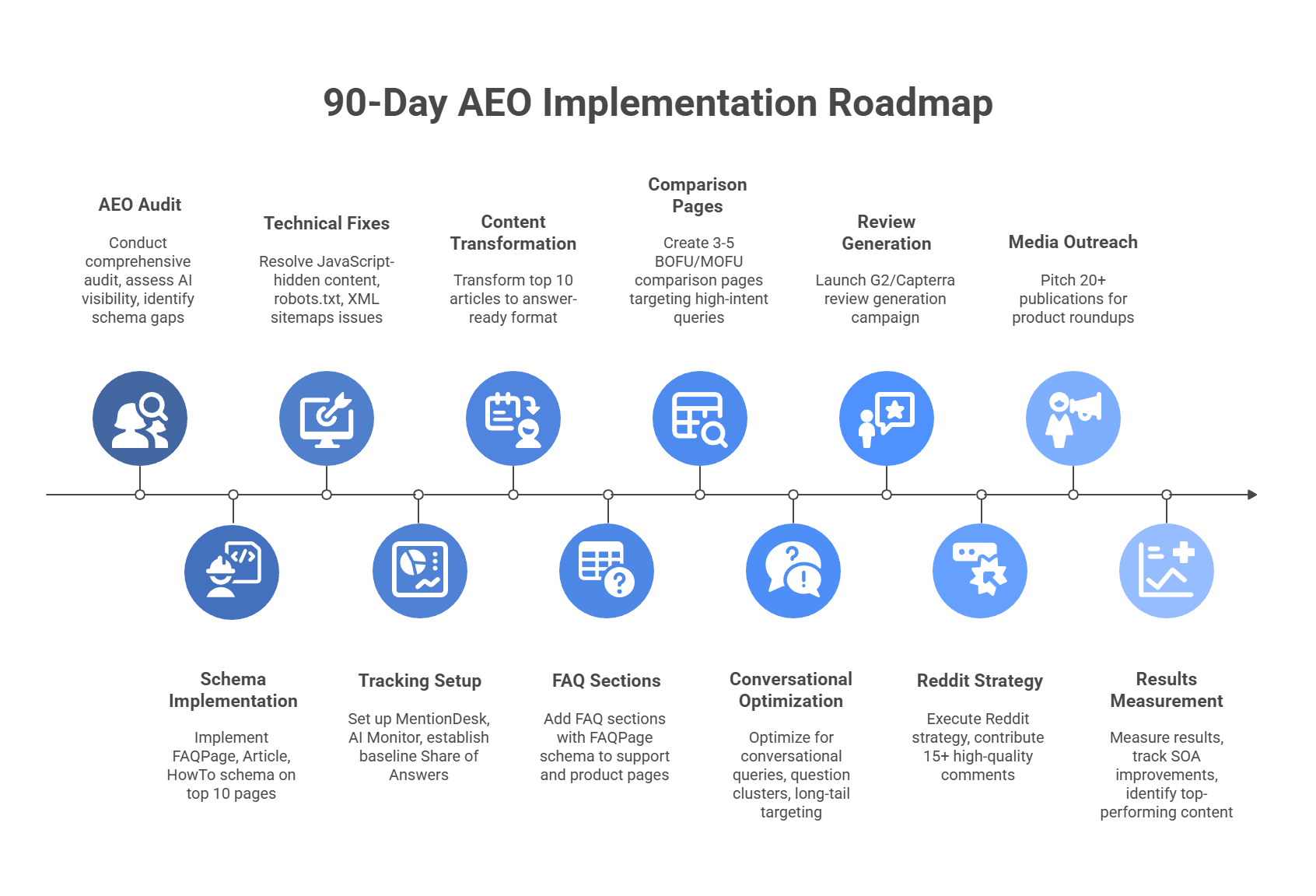
📅 The Phased 90-Day Approach
Phase 1 (Days 1-30): Foundation & Technical Audit
Focus: Establish AI-parsing readiness and baseline measurement.
- Week 1: Conduct AEO audit (assess current AI visibility, identify schema gaps, evaluate content structure)
- Week 2: Implement mission-critical schema (FAQPage, Article, HowTo) on top 10 pages
- Week 3: Fix technical barriers (JavaScript-hidden content, robots.txt issues, XML sitemaps)
- Week 4: Set up tracking tools (MentionDesk, AI Monitor), establish baseline Share of Answers
Key Milestone: 20 checklist items completed (Bronze level). Technical foundation ready for AI crawling.
Phase 2 (Days 31-60): Content Transformation
Focus: Restructure existing content for AI-optimized formatting.
- Week 5: Transform top 10 articles to answer-ready format (H2 questions, 40-60 word direct answers)
- Week 6: Add FAQ sections with FAQPage schema to support pages and product pages
- Week 7: Create 3-5 BOFU/MOFU comparison pages targeting high-intent queries
- Week 8: Optimize for conversational queries (question clusters, long-tail targeting)
Key Milestone: 35 checklist items completed (Silver level). Content structured for AI citation.
Phase 3 (Days 61-90): Citation Engineering & Scale
Focus: Build distributed authority through earned placements.
- Week 9: Launch G2/Capterra review generation campaign (email sequences, in-app prompts)
- Week 10: Execute Reddit strategy (identify 10 high-traffic threads, contribute 15+ high-quality comments)
- Week 11: Media/affiliate outreach (pitch 20+ publications for product roundups, "best of" lists)
- Week 12: Measure results (track SOA improvements, identify top-performing content, plan Q2 optimization)
Key Milestone: 50+ checklist items completed (Gold/Platinum level). Multi-platform citation visibility established.
🚀 Future-Proofing: Preparing for 2026-2027 AEO Trends
1. Agentic AI Actions (The Next Evolution)
AI systems will increasingly perform tasks directly on behalf of users (booking appointments, completing purchases, filling forms). Prepare by:
- Clear CTAs and Labeling: Ensure buttons, forms, and interactive elements have descriptive labels AI can parse
- Structured Transaction Data: Implement Product schema with complete pricing, availability, and purchase paths
- API Integrations: Explore API endpoints AI agents could use to interact with your systems programmatically
2. Multimodal Search Optimization
AI engines are improving at processing video, images, audio, and interactive content. Future-proof with multimodal GEO strategies:
- Video Transcripts: Ensure all video content has accurate transcripts/captions AI can index
- Image Alt Text: Write descriptive alt text for all images (not just for accessibility, for AI understanding)
- Interactive Content: Consider how AI might parse calculators, quizzes, or interactive tools
3. Voice Search Evolution
Voice queries continue growing, especially via mobile assistants and smart speakers. Optimize for voice search patterns:
- Natural Language Patterns: "What's the best [product] for [specific use case]?" vs. "[product] review"
- Local Intent: "Where can I buy [product] near me?"
- Conversational Follow-Ups: Structure content to answer sequential questions users might ask in conversation
4. Hyper-Personalized AI Responses
Future AI engines will tailor answers to individual user contexts (location, purchase history, preferences). Prepare by:
- Comprehensive Coverage: Cover diverse use cases, industries, and customer profiles in content
- Dynamic Content: Explore personalization technologies that serve relevant content based on user context
💡 MaximusLabs.ai: Your Search Intelligence Partner
At MaximusLabs.ai, we've codified this 90-day framework across dozens of client implementations. Our Search Intelligence Partnership transcends traditional vendor relationships (we serve as the empathetic guide helping you navigate the anxiety of becoming invisible in AI's curated lists).
We understand the internal problem: The fear of irrelevance when your ICP queries AI and receives a curated list that excludes you. We provide the weapon to defeat that invisibility:
✅ Citation Engineering: Strategic placement acquisition on high-index platforms (Reddit, G2, media)
✅ Trust-First SEO: Embedding E-E-A-T into every technical, content, and backlink decision
✅ Search Everywhere Optimization: Building reputation across the entire web, not just your domain
✅ Revenue-Focused Content: BOFU/MOFU strategies aligned with your ICP to influence pipeline, not vanity traffic
Unlike vendors selling tracking tools (easily commoditized by Ahrefs/Semrush soon), we deliver measurable pipeline impact through revenue-focused content strategy. We're already preparing clients for the agentic AI era (not just today's citation game). For SaaS companies navigating this transformation, explore our specialized GEO services.
🎯 Next Steps: Transform from Invisible to Indispensable
Option 1: [Download the complete 60-Item AEO Checklist Template with Progress Tracker] (implement independently with your team).
Option 2: Schedule a GEO Audit with MaximusLabs.ai. We'll analyze your current AI visibility, identify competitive citation gaps, build your custom 90-day roadmap, and future-proof your strategy for 2026-2027 trends.
The choice isn't whether to adapt (it's whether you'll lead or lag in the AI-native search era). Stop Optimizing for Google. Start Optimizing for Trust. Contact MaximusLabs.ai today to begin your transformation from invisible to indispensable in AI search.
.png)
.png)
