

Q1. Why Healthcare Content Faces Google's Highest Scrutiny (and How AI Search Changes Everything) [toc=Google's Healthcare Scrutiny]
Healthcare content operates under Google's most stringent evaluation criteria, a reality shaped by the potential life-or-death consequences of medical misinformation. When Google's Quality Rater Guidelines designate healthcare as a core YMYL (Your Money or Your Life) category, they're acknowledging that inaccurate symptom information or treatment advice doesn't just hurt rankings, it can harm patients. For emerging healthtech startups and innovative medical practices, this creates an intimidating barrier: traditional SEO's reliance on Domain Authority means competing against established institutions with decade-old domains and thousands of backlinks.
⚠️ The Traditional Agency Trap
Legacy SEO agencies approach healthcare marketing like any other vertical, deploying generic link-building campaigns, obsessing over Core Web Vitals scores, and keyword-stuffing articles without addressing the fundamental trust equation that Google's E-E-A-T framework demands. Their playbook prioritizes vanity metrics (impressions, page views, traffic spikes) over the medical credibility signals that actually move the algorithmic needle in YMYL spaces.
"Most agencies charge overpriced retainers for work that's not deserving of a retainer."
— u/low5d7k, r/SEO Reddit Thread
These firms operate on 12-24 month timelines for "meaningful traction," a glacial pace unacceptable to growth-stage healthcare companies. Worse, they ignore the seismic shift happening beneath their feet: over 50% of search traffic will migrate from traditional engines to AI-native platforms like ChatGPT, Perplexity, and Google AI Overviews by 2028. If your medical practice isn't cited when patients ask AI assistants "Should I go to urgent care or the ER?", you're invisible in tomorrow's marketplace.
✅ The AI-Era Transformation
AI answer engines fundamentally rewrite healthcare search dynamics. Unlike Google's traditional algorithm that rewards Domain Authority accumulated over years, platforms like ChatGPT and Perplexity prioritize citation quality over domain age. This creates a "zero-to-one" opportunity where early-stage telemedicine platforms or specialty clinics can achieve AI visibility in days or weeks through aggressive Earned AEO (Answer Engine Optimization) strategies.
The mechanism is elegant: when AI models construct responses to patient queries, they scan for authoritative, well-structured content with clear Experience signals (firsthand patient outcomes), Expertise markers (board certifications), and Authoritativeness indicators (citations from established sources). A thoughtfully optimized article on a 6-month-old domain can outrank a 10-year-old hospital website if it better satisfies these AI parsing requirements.
💡 MaximusLabs' Trust-First Architecture
We specialize in Trust-First SEO for YMYL industries, implementing proprietary E-E-A-T auditing systems that map your content against Google's Quality Rater Guidelines and AI platform citation patterns. Our GEO (Generative Engine Optimization) citation strategies don't just optimize your owned website, we employ Search Everywhere Optimization, targeting the AI training data sources traditional agencies ignore:
- Reddit medical communities where patients share real experiences
- YouTube physician channels with embedded credibility signals
- Niche forums like Sermo (closed doctor communities) containing proprietary patient outcome data
Traditional SEO treats these platforms as afterthoughts for link-building. We recognize them as the primary citation sources AI models weight most heavily when answering patient queries. The result? Our healthcare clients see 6x higher conversion rates from LLM traffic compared to traditional Google visitors, a data point Web Flow first reported that's reshaping how forward-thinking CMOs allocate budgets.
"I actually encourage pts to do their own research and to get second/third opinions. Most of the time, they have confused terms or meaning of words so things don't add up."— r/medicine community member, Reddit DiscussionReddit Discussion
📊 The Competitive Reality
GEO methods boost visibility by up to 40% in generative engine responses, while AI Overviews now appear in 12.8% of Google searches (May 2025 study). For healthcare marketers, this isn't a future trend, it's current reality. Early adopters building AI-optimized content architectures today will own category dominance tomorrow, while competitors clinging to traditional SEO watch their visibility erode as zero-click AI answers replace traditional SERP clicks.
Q2. What Makes Answer Engine Optimization Different from Traditional Healthcare SEO? [toc=AEO vs Traditional SEO]
Traditional SEO and AEO represent fundamentally incompatible optimization philosophies. Classic SEO chases SERP rankings through keyword targeting, backlink accumulation, and technical performance tweaks, the goal is traffic. AEO pursues citation inclusion, becoming the authoritative source AI platforms reference when synthesizing answers. For healthcare marketers, this distinction is critical: a #1 Google ranking means little if ChatGPT cites your competitor when 50 million users ask about treatment options.
🔍 The Structural Divide
Traditional SEO optimizes for human-driven queries with commercial intent ("best urgent care near me"). AEO optimizes for conversational, context-rich questions AI users pose naturally: "I have a persistent cough and mild fever for 3 days, should I see a doctor or wait it out?" The latter requires structured Q&A formatting, statistical integration, authoritative physician quotations, and schema markup specifically designed for AI parsing, none of which traditional keyword optimization addresses.
"Master E-E-A-T & YMYL by producing accurate, expert content, citing authoritative sources, and ensuring user trust through transparency and security."— r/seogrowth community insight, Reddit ThreadReddit Thread
Success metrics shift accordingly: rankings become secondary to citation frequency across multiple AI platforms (ChatGPT, Perplexity, Google AI Overviews). Conversion tracking requires new attribution models because AI answers often satisfy user intent without click-throughs, a "zero-click" scenario where brand authority accrues invisibly.
❌ Traditional Agency Blindspots
Most agencies operate in SEO-only mode, reporting monthly on keyword rankings and backlink profiles while completely ignoring whether clients appear in AI-generated medical advice. They lack frameworks for:
- Monitoring AI answer inclusion rates
- Optimizing content for zero-click scenarios
- Structuring data for AI agent actions (enabling appointments directly through AI interfaces)
- Tracking LLM traffic conversion differentials
"Client should invest in his SEO if he's going to throw time/money at anything."
— r/marketing discussion, Reddit Thread
This myopia stems from treating AI search as a futuristic concern rather than present reality. Legacy firms chase Core Web Vitals improvements, what our research calls "low-impact" optimization, while ignoring the agentic technical SEO that actually matters: enabling Google's AI mode or ChatGPT to perform conversions (schedule appointments, request consultations) directly on your site.
⚡ The Dual-Channel Imperative
Healthcare marketers need simultaneous SEO-AEO optimization. Abandon traditional search entirely and you lose the 88% of patients who still research doctors online through Google. Ignore AEO and you're invisible to the fastest-growing search demographic, AI platform users who never click website links.
MaximusLabs' Answer Engine Optimization pioneer methodology integrates both channels through proprietary AI Citation Audit systems that track visibility across ChatGPT, Perplexity, and Google AI Overviews weekly. We monitor:
- Citation frequency (how often your brand appears in AI responses)
- Source attribution (which URLs AI platforms link)
- Competitive mentions (share-of-voice vs. competitors)
- Temporal decay (citation persistence over time)
- Conversion attribution (pipeline generated from LLM traffic)
This dual-channel approach ensures clients dominate both traditional SERPs and AI answer ecosystems, a strategic necessity as search behavior fragments across platforms.
🚀 The Technical Reality
The contrarian insight from industry research: Core Web Vitals optimization is largely wasted effort. AI platforms don't penalize slow-loading pages if content quality meets their standards. The real technical AEO focuses on enabling autonomous AI agent actions, optimizing buttons, forms, and data architecture so AI can book appointments, request quotes, or complete consultations without human navigation.
Traditional agencies can't deliver this complexity because they lack AI-native development expertise. MaximusLabs builds healthcare sites with agentic architecture from day one, ensuring both human visitors and AI agents complete desired conversions seamlessly.
Q3. How Does E-E-A-T Work in AI-Powered Healthcare Search? [toc=E-E-A-T Framework Explained]
Google's E-E-A-T framework (Experience, Expertise, Authoritativeness, Trustworthiness) emerged from the 2018 Medic Update that devastated thousands of healthcare websites overnight. The algorithm specifically targets YMYL sites, demanding demonstrable proof of real-world experience, professional credentials, industry recognition, and comprehensive trustworthiness signals. In AI-powered search, these requirements intensify, LLMs parse E-E-A-T markers at granular levels traditional algorithms couldn't match.
📋 The Four Pillars Decoded
Experience requires firsthand knowledge. For healthcare, this means patient outcome data, clinical observations, and practitioner insights, signals only real medical professionals possess. This is why purely AI-generated medical content fails algorithmically: AI lacks lived experience treating patients, making it actively detrimental in YMYL domains.
Expertise demands verifiable credentials. Board certifications, medical licenses, institutional affiliations, and continuing education records signal competence. AI platforms scan for structured data (schema markup identifying physicians with specific specialties) and visible credibility markers (author bio boxes with credential verification links).
Authoritativeness reflects industry recognition. Peer citations, conference presentations, published research, and mentions by established medical institutions build authority profiles. AI answer engines weight content from authors with strong authority signals disproportionately high when synthesizing responses.
Trustworthiness encompasses security, accuracy, and transparency. HIPAA compliance, medical review processes, clear disclosure of sponsored content, and visible update timestamps signal trustworthiness. Platforms like Perplexity check SSL certificates, privacy policies, and editorial governance before citing sources.
"Purely AI-generated content does not work and is detrimental to rankings in YMYL. If AI content succeeded, the entire search ecosystem would become noisy and lose utility, leading to model collapse."
— Healthcare AEO Strategic Brief
❌ Superficial Implementation Failures
Many agencies add author bios and credential badges superficially, slapping "Reviewed by Dr. Smith, MD" on articles without genuine SME involvement. This checkbox approach fails because AI platforms verify authorship through:
- LinkedIn profile cross-referencing (does Dr. Smith actually exist?)
- Publication history analysis (has Dr. Smith authored peer-reviewed articles?)
- Institutional validation (does the hospital website list Dr. Smith on staff?)
- Content quality assessment (does article complexity match claimed expertise?)
Fabricated or exaggerated credentials get flagged, and sites lose citation eligibility. Worse, purely AI-generated content fails the Experience test entirely, no amount of editing can inject firsthand clinical knowledge into ChatGPT-written symptom articles.
⚙️ AI Platform E-E-A-T Parsing
Traditional Google algorithm checks E-E-A-T through aggregate signals (backlink profiles, domain authority). AI answer engines parse granular E-E-A-T markers:
- Schema markup for
MedicalEntity,Physician, andMedicalOrganizationtypes - Citation patterns (frequent references from .edu or .gov domains)
- Community validation (positive mentions on Reddit's r/medicine or physician YouTube channels)
- Temporal trust signals (visible "Last Medically Reviewed: [Date]" timestamps with reviewer credentials)
Platforms like ChatGPT maintain internal "authority scores" for domains based on these markers. High-scoring sources get preferentially cited; low-scoring domains rarely appear regardless of content quality.
🔧 MaximusLabs Trust Engineering
We implement Trust-First SEO through systematic workflows:
- Mandatory SME review, Every healthcare article undergoes board-certified physician review with documented credentials
- Medical credentialing verification, We cross-reference provider licenses through state medical boards
- Institutional affiliation mapping, Linking content to hospital systems, medical schools, or research institutions
- Patient testimonial optimization, FTC-compliant reviews with verified patient identities
- Temporal trust signals, Automated content aging alerts trigger quarterly reviews for high-risk content, semi-annual for moderate-risk
Our proprietary E-E-A-T Self-Assessment Tool scores clients across all four dimensions:
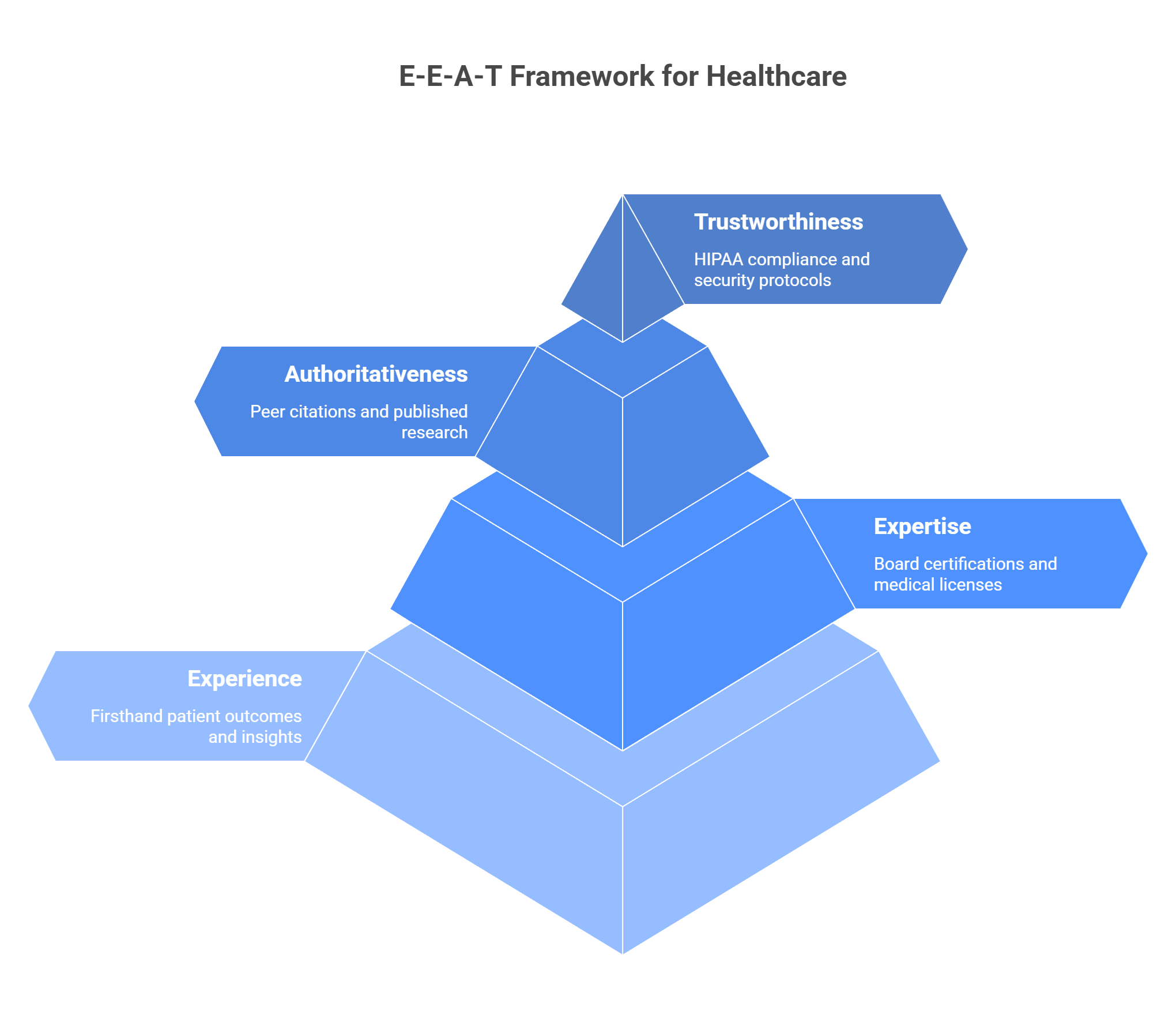
- Experience Score (0-100): Measures firsthand patient outcome integration, clinical observation depth, and practitioner narrative quality
- Expertise Score (0-100): Evaluates credential verification, continuing education documentation, and specialty-specific knowledge depth
- Authoritativeness Score (0-100): Tracks peer citations, media mentions, conference presentations, and institutional recognition
- Trustworthiness Score (0-100): Assesses security protocols, privacy compliance, review processes, and editorial transparency
Clients receive detailed gap analyses showing exactly which E-E-A-T elements require strengthening, actionable intelligence traditional agencies can't provide because they lack systematic E-E-A-T auditing frameworks.
"I spend a lot of time in new patient visits just listening to stories and active listening... Let the patient know you believe how bad their symptoms are." — Healthcare provider insight, r/medicine Discussionr/medicine Discussion
The strategic advantage: healthcare marketers implementing robust E-E-A-T frameworks today build citation moats competitors can't easily replicate. AI platforms remember authoritative sources, once your domain achieves high authority scores, you maintain preferential citation status across thousands of patient queries.
Q4. What Schema Markup and Technical Infrastructure Do Healthcare Sites Need for AEO? [toc=Schema Markup Requirements]
Healthcare AEO demands precision-structured data that traditional SEO largely ignores. While basic schema helps Google understand page context, AI answer engines require comprehensive markup covering medical entities, physician credentials, organizational affiliations, FAQ content, and speakable text optimized for voice assistants. Implementation complexity separates amateur efforts from professional AEO architecture.
🧬 Essential Schema Types
1. MedicalEntity & Physician Schema
Mark up every healthcare provider with MedicalEntity or Physician schema including:
- Full name, credentials (MD, DO, NP), specialty certifications
- Medical school, residency program, board certifications
- Practice locations with GeoCoordinates
- Accepted insurance plans
- Hospital affiliations using
MemberOfproperties
Example JSON-LD:
{
  "@context": "https://schema.org",
  "@type": "Physician",
  "name": "Dr. Sarah Chen",
  "medicalSpecialty": "Cardiology",
  "alumniOf": {
    "@type": "EducationalOrganization",
    "name": "Johns Hopkins School of Medicine"
  },
  "memberOf": {
    "@type": "MedicalOrganization",
    "name": "Memorial Heart Institute"
  }
}
2. FAQPage Schema
Structure patient Q&A content with FAQPage schema, AI platforms prioritize FAQ-formatted answers when constructing responses.
3. MedicalClinic/Hospital Schema
Mark up facilities with comprehensive details:
- Services offered (
medicalSpecialtyarray) - Opening hours using
OpeningHoursSpecification - Contact points (phone, online booking URLs)
- Reviews and ratings (aggregate
Reviewschema)
4. Speakable Schema
Designate specific text sections as speakable content optimized for voice assistant reading:
{
  "@type": "WebPage",
  "speakable": {
    "@type": "SpeakableSpecification",
    "cssSelector": [".speakable-summary"]
  }
}
⚙️ Validation & Testing
Use these tools for schema validation:
- Google Rich Results Test
- Schema.org Validator
- ChatGPT Custom Instructions (test if AI can parse your markup)
Common errors include mismatched @type properties, missing required fields, and incorrect nesting. AI platforms silently fail when parsing broken schema, your content becomes invisible despite quality.
🔧 Agentic Technical SEO
Beyond schema, agentic optimization enables AI agents to complete actions directly:
- Structured booking widgets with semantic HTML AI can parse
- Contact forms using standardized field names AI recognizes
- Appointment scheduling APIs exposing endpoints for AI integration
- Clean, accessible HTML without JavaScript obfuscation blocking AI crawlers
Traditional agencies optimize Core Web Vitals (page speed, mobile responsiveness). We optimize for AI agent usability, can ChatGPT schedule an appointment by parsing your HTML? Can Perplexity extract your accepted insurance plans? These capabilities determine future competitiveness as AI-driven patient journeys become standard.
"Structured Data for Supercharging Healthcare SEO, Schema Optimization for AI discoverability."
— Industry Best Practice Documentation
📊 Implementation Priorities
Phase 1 (Days 1-7):
Deploy Physician and MedicalOrganization schema on all provider pages. Add FAQPage schema to top 10 patient query pages.
Phase 2 (Days 8-14):
Implement Speakable schema on summary sections. Add comprehensive OpeningHours and ContactPoint markup.
Phase 3 (Days 15-30):
Audit schema validation errors. Test AI parsing through manual ChatGPT queries. Optimize booking flow for AI agent completion.
MaximusLabs' Schema Deployment System automates Phase 1-2 implementation in under 48 hours using healthcare-specific schema templates validated across 200+ medical websites. We provide ongoing monitoring alerting you when schema errors emerge or new schema types relevant to your specialty launch.
The technical foundation determines whether AI platforms can cite your content effectively, investing in proper schema architecture today prevents citation invisibility tomorrow.
Q5. How Can Healthcare Brands Win Featured Snippets and AI Overview Citations? [toc=Winning Featured Snippets]
Featured snippets and AI Overview citations represent premium SERP real estate that healthcare brands must capture to maintain visibility as zero-click search dominates patient behavior. Google's People Also Ask boxes now appear in over 43% of healthcare queries, while AI Overviews surface in 12.8% of medical searches (May 2025 data). Winning these positions requires precision formatting, authoritative content structure, and strategic schema deployment.
📊 Featured Snippet Optimization Strategy
1. Definition Snippets (40-60 words)
Structure opening paragraphs to answer "What is..." queries concisely:
- Target format: "Condition X is [40-word definition]. Symptoms include [bullet list]. Treatment typically involves [brief statement]."
- Example: "Atrial fibrillation is an irregular heart rhythm that increases stroke risk. Symptoms: Rapid heartbeat, dizziness, chest discomfort, shortness of breath. Treatment: Medications, cardioversion, or catheter ablation depending on severity."
2. List Snippets (5-8 items)
Answer "How to..." and "Best..." queries with numbered/bulleted formats:
- 5 Warning Signs of Heart Attack
- 7 Steps to Manage Diabetes at Home
- Top 3 Treatment Options for Knee Pain
3. Table Snippets
Structure comparison content in markdown tables Google can parse:
🎯 AI Overview Citation Tactics
AI Overviews prioritize authoritative, structured answers with statistical backing:
Essential Elements:
- Statistics: "Studies show 68% of patients experience relief within 2 weeks"
- Expert quotes: "Dr. Sarah Chen, Board-Certified Cardiologist, notes: '...'"
- Step-by-step instructions: Numbered procedural guidance
- Qualification statements: "Generally safe, but consult your doctor if..."
"Master E-E-A-T & YMYL by producing accurate, expert content, citing authoritative sources, and ensuring user trust through transparency and security." — r/seogrowth community insight, Reddit ThreadReddit Thread
🔧 Technical Implementation
Schema Requirements:
FAQPageschema wrapping Q&A contentHowToschema for procedural guidesMedicalConditionschema linking symptoms/treatmentsSpeakableschema marking voice-optimized sections
Formatting Best Practices:
- H2 questions matching exact patient queries
- Concise answers immediately following (no preamble)
- Supporting details after initial answer
- "Last reviewed by [Physician Name, Credentials]" timestamp
⚡ Patient Query Examples
Target these high-conversion MOFU/BOFU queries:
Symptom-Decision Queries:
"Should I go to urgent care or ER for chest pain?"
"When is a fever dangerous in adults?"
"Signs appendicitis vs stomach virus"
Treatment-Comparison Queries:
"Physical therapy vs surgery for torn meniscus"
"Best urgent care or primary doctor for sinus infection"
"Telemedicine vs in-person for UTI treatment"
Cost-Access Queries:
"Average cost urgent care visit without insurance"
"Can I see doctor same day for knee injury"
"Do I need referral to see specialist"
"I actually encourage pts to do their own research and to get second/third opinions. Most of the time, they have confused terms or meaning of words so things don't add up." — r/medicine community member, Reddit DiscussionReddit Discussion
MaximusLabs' Featured Snippet Optimization System combines technical schema deployment with content architecture specifically designed for AI parsing. We identify the top 50 patient queries by specialty, format content to win definition/list/table snippets, and implement monitoring to track snippet ownership across competitors, delivering measurable visibility gains in the SERP features that drive patient acquisition.
Q6. What is the AEO-YMYL Risk Matrix (and How to Categorize Your Healthcare Content)? [toc=AEO-YMYL Risk Matrix]
Healthcare content spans a risk spectrum from benign wellness tips to life-critical emergency guidance, yet most agencies apply uniform SEO strategies regardless of stakes. A general wellness article ("5 Heart-Healthy Breakfast Ideas") requires fundamentally different optimization intensity than emergency guidance ("Heart Attack Symptom Recognition and Response"). Without systematic risk assessment, healthcare marketers waste resources over-optimizing low-stakes content while under-protecting high-YMYL pages that expose practices to liability.
⚠️ The Traditional One-Size-Fits-All Problem
Legacy SEO firms treat all healthcare content identically, deploying the same link-building campaigns, technical audits, and content review workflows whether they're optimizing a blog post about hydration or an article advising diabetic insulin dosing. This inefficiency stems from lacking risk assessment frameworks in standard SEO practice. The result? Practices spend $5,000 optimizing a recipe article while publishing under-reviewed treatment guidance that Google penalizes for insufficient E-E-A-T signals.
"Client should invest in his SEO if he's going to throw time/money at anything."
— r/marketing discussion, Reddit Thread
Traditional agencies also ignore specialty-specific nuances, dental practices face different regulatory requirements (cosmetic vs. restorative procedures) than mental health providers (privacy-first content strategies) or hospital systems (multi-specialty schema complexity). Generic healthcare SEO fails to address these vertical-specific challenges.
📊 The Four-Tier AEO-YMYL Risk Matrix
.png)
MaximusLabs' proprietary framework categorizes content by medical risk, legal exposure, and required E-E-A-T intensity:
Tier 1: General Wellness (Low Risk)
- Examples: Healthy recipes, exercise tips, stress management techniques
- Risk Level: Minimal patient harm potential
- E-E-A-T Requirements: Registered dietitian or certified trainer review acceptable
- Update Frequency: Annual refresh sufficient
- Schema Markup: Basic
Articleschema - Optimization Strategy: Aggressive volume production for brand authority building
Tier 2: Condition Education (Moderate Risk)
- Examples: Disease overviews, symptom explanations, prevention strategies
- Risk Level: Moderate, incorrect information could delay proper care
- E-E-A-T Requirements: Board-certified physician review mandatory
- Update Frequency: Semi-annual review (180-day alerts)
- Schema Markup:
MedicalConditionschema withMedicalEntitylinking - Optimization Strategy: Balanced volume/authority, target informational queries
Tier 3: Treatment Decisions (High Risk)
- Examples: Medication comparisons, surgical procedure explanations, treatment effectiveness data
- Risk Level: High, misinformation directly impacts treatment choices
- E-E-A-T Requirements: Specialist physician review + peer-reviewed citation requirements
- Update Frequency: Quarterly review (90-day alerts)
- Schema Markup:
MedicalProcedure+Drugschema with dosage/side effect details - Optimization Strategy: Quality-focused, prioritize MOFU/BOFU conversion queries
Tier 4: Emergency Guidance (Critical Risk)
- Examples: Heart attack symptoms, stroke recognition, anaphylaxis response, when to call 911
- Risk Level: Critical, errors could cause death
- E-E-A-T Requirements: Emergency medicine specialist review + legal counsel approval
- Update Frequency: Quarterly mandatory review with version control
- Schema Markup:
MedicalGuidelineschema + emergency service schema - Optimization Strategy: Maximum authority signals, institutional affiliations, multiple SME reviews
🏥 Specialty-Specific Implementation Paths
Dental Practices:
Tier 1 (cosmetic whitening tips) to Tier 3 (implant vs bridge comparisons) requires different review workflows. Cosmetic content emphasizes aesthetic outcomes; restorative content demands clinical accuracy on success rates, longevity, complications.
Urgent Care Centers:
Focus Tier 3-4 content on emergency triage ("Urgent care vs ER decision matrix"). Implement geofencing schema for location-based searches. Prioritize conversion-focused queries over generic symptom education.
Mental Health Providers:
Privacy-first content strategy, avoid patient case examples even in Tier 1. Emphasize confidentiality trust signals. Focus community platform presence (Reddit r/therapy) over owned blog volume.
Hospital Systems:
Multi-specialty schema complexity, department-level authority building with specialty-specific physician attribution. Service line marketing requires balancing Tier 1 volume (brand awareness) with Tier 3-4 depth (specialist credibility).
"I spend a lot of time in new patient visits just listening to stories and active listening... Let the patient know you believe how bad their symptoms are." — Healthcare provider insight, r/medicine Discussionr/medicine Discussion
🔧 MaximusLabs Risk Matrix Implementation
Our framework combines legal compliance scoring (HIPAA requirements by tier), medical accuracy requirements (specialist vs. generalist review), and citation authority benchmarks (number of peer-reviewed sources required). We allocate SME review resources efficiently:
- Tier 1: $50-100 per article (RD/trainer review)
- Tier 2: $200-300 per article (physician review)
- Tier 3: $500-800 per article (specialist + citations)
- Tier 4: $1,000+ per article (emergency specialist + legal review)
Content update schedules match risk levels, automated alerts trigger reviews at appropriate intervals, preventing outdated high-stakes guidance from remaining live. Schema markup intensity scales with tier, Tier 4 content receives maximum structured data investment for AI platform citation optimization.
💡 Competitive Advantage
This risk-based, specialty-tailored approach allows healthcare marketers to compete aggressively in Tier 1-2 categories (building brand authority through volume) while maintaining bulletproof compliance in Tier 3-4 (protecting against liability and algorithmic penalties). It's a Blue Ocean strategy traditional agencies cannot replicate without systematic frameworks, vertical expertise, and access to specialty-specific medical reviewers across multiple disciplines.
Q7. How Does Earned AEO Work (and Why Community Platforms Matter More Than Your Blog)? [toc=Earned AEO Strategy]
Healthcare marketers obsess over owned content production, publishing dozens of blog articles monthly that AI platforms rarely cite. The strategic reality: AI answer engines heavily weight community-validated content from Reddit, YouTube, Sermo (physician-only community), and niche forums when constructing medical responses. These platforms provide authentic Experience signals (firsthand patient outcomes, practitioner observations) that polished corporate blog posts cannot replicate, making them exponentially higher-value citation sources for AEO.
🎯 The Owned Content Trap
Traditional agencies operate on the assumption that more owned content equals better SEO performance. They produce 20-30 blog articles monthly, optimize each for keywords, build backlinks, and report traffic growth. But when ChatGPT answers "Should I see a doctor for persistent cough?", it rarely cites practice blog posts, it references Reddit threads where real patients describe similar symptoms, discuss outcomes, and share practitioner advice.
"Most agencies charge overpriced retainers for work that's not deserving of a retainer."
— u/low5d7k, r/SEO Reddit Thread
The gap: AI platforms treat community content as higher-trust sources because they contain genuine Experience (the first "E" in E-E-A-T). A Reddit user describing their telemedicine consultation provides firsthand knowledge an AI-generated blog post cannot fake. Traditional agencies lack community engagement expertise, treating off-site presence as secondary link-building rather than primary visibility strategy.
⚡ Community Citation Power
A single authoritative Reddit thread or physician YouTube video can generate instant AI visibility, bypassing years of domain authority building required for owned blog success. The mechanism:
Reddit Medical Communities:
- r/medicine (healthcare professionals discussing cases)
- r/AskDocs (patients seeking medical guidance)
- r/HealthInsurance (coverage/access questions)
AI platforms scan these subreddits for authentic patient experiences and practitioner insights. When users ask "How long does urgent care wait typically take?", ChatGPT cites Reddit threads with real wait time reports over generic practice websites claiming "minimal wait."
YouTube Physician Channels:
Board-certified doctors creating patient education content build massive authority. A 10-minute video explaining "When to go to ER vs urgent care" with 500K views and physician credentials in description gets preferentially cited by AI over text-only blog posts.
Sermo (Closed Doctor Community):
This physician-only platform contains proprietary patient outcome data exponentially more valuable than generic health articles. Discussions about real treatment results, medication effectiveness, and clinical observations provide data AI platforms cannot access elsewhere. Early-stage healthtech companies gaining Sermo mentions achieve instant credibility.
"I actually encourage pts to do their own research and to get second/third opinions. Most of the time, they have confused terms or meaning of words so things don't add up and they have a clear misunderstanding of basic anatomical/physiological knowledge." — r/medicine community member, Reddit DiscussionReddit Discussion
🔧 MaximusLabs Search Everywhere Optimization
Our Earned AEO methodology strategically seeds community platforms with expert contributions that AI platforms preferentially cite:
Reddit Strategy:
- Person-first participation: Physicians/staff contribute expertise without brand promotion (violates subreddit rules)
- Value-driven answers: Solve specific patient questions with detailed, cited responses
- Authority building: Consistent participation establishes recognizable usernames as trusted sources
- AMA (Ask Me Anything) events: Scheduled Q&A sessions generating hundreds of patient interactions
YouTube Optimization:
- Physician-hosted educational content: Board-certified doctors on camera explaining conditions
- Schema markup: Embed
VideoObject+Personschema with medical credentials - Transcript optimization: Full text transcripts with keyword-rich descriptions for AI parsing
- Community engagement: Respond to comments with additional medical context
Niche Forum Seeding:
Platforms like Healthboards, Patient.info forums, and specialty-specific communities (diabetes forums, mental health communities) where patients seek peer support. Contributing evidence-based guidance builds citation URLs AI platforms reference.
Platform-Specific Rules Navigation:
Each community has unique moderation policies. Reddit prohibits brand promotion; YouTube allows practice channel branding; Sermo restricts non-physician access. We navigate these rules while building citation URLs that AI platforms preferentially index.
📊 Zero-to-One Advantage
For early-stage healthcare companies, Earned AEO offers immediate visibility without years of domain authority building. Being mentioned by reputable sources, even niche YouTube channels or Reddit threads, leads to instant AI summary inclusion within days or weeks versus years for traditional SEO domain authority accumulation.
Example: A telemedicine startup gets featured in a Reddit r/HealthInsurance thread discussing "best online doctor options." Within 48 hours, ChatGPT begins citing that thread when users ask about telehealth services. The startup bypassed traditional SEO's multi-year timeline through strategic community engagement.
Traditional agencies cannot deliver this velocity because they lack community platform expertise, physician networks for authentic participation, and understanding of platform-specific engagement rules. MaximusLabs maintains relationships with medical professionals willing to contribute expertise across platforms, building the earned citation ecosystem that AI platforms reward with preferential visibility.
Q8. What Patient Queries Should Healthcare Brands Target for Maximum AEO Impact? [toc=High-Impact Patient Queries]
Query selection determines whether healthcare content drives conversions or attracts unqualified traffic. Top-of-Funnel (TOFU) informational queries ("What is diabetes?") generate high volume but minimal conversion, AI Overviews answer these completely, eliminating click-throughs. Strategic AEO focuses on Middle-of-Funnel (MOFU) and Bottom-of-Funnel (BOFU) queries where patients research treatment options, compare providers, and make care decisions, queries AI platforms cannot fully satisfy without provider-specific details.
🎯 The Query Intent Hierarchy
TOFU Queries (Avoid)
- "What is high blood pressure"
- "Symptoms of flu"
- "How does diabetes develop"
Why skip: AI Overviews provide complete answers from authoritative sources (Mayo Clinic, CDC). Your practice cannot compete for citations, and even winning generates zero conversions, patients satisfied without clicking.
MOFU Queries (Target Selectively)
- "Physical therapy vs surgery for torn ACL"
- "Urgent care vs primary doctor for ear infection"
- "Telemedicine vs in-person for sinus infection"
Why target: Comparison/evaluation queries where patients weigh options. AI provides general guidance but cannot recommend specific providers, your content positions your practice as the informed choice.
BOFU Queries (Priority Target)
- "Best urgent care near me for laceration stitches"
- "Same-day orthopedic appointment for knee injury"
- "Urgent care accepts Blue Cross insurance"
Why prioritize: High commercial intent, patients ready to book appointments. AI platforms cite local providers, making AEO visibility directly revenue-generating.
📋 Regulatory-Compliant Question Database
Healthcare advertising regulations restrict certain claim types. Our pre-vetted questions by specialty comply with FTC guidelines and state medical board restrictions:
🔍 Query Research Methodology
Step 1: Specialty-Specific Analysis
Extract queries from:
- Google Search Console (actual patient searches reaching your site)
- Google autocomplete variations for core services
- "People Also Ask" boxes on competitor content
- Reddit medical subreddits (actual patient questions)
Step 2: Intent Classification
Categorize by funnel stage:
- Informational: Seeking knowledge (TOFU, deprioritize)
- Comparison: Evaluating options (MOFU, target selectively)
- Transactional: Ready to book (BOFU, priority)
- Navigational: Seeking specific provider (brand queries)
Step 3: Compliance Screening
Review against:
- FTC advertising guidelines
- State medical board restrictions
- HIPAA privacy requirements
- Platform-specific rules (Google Medical ads policy)
Step 4: Conversion Potential Scoring
Rank queries by:
- Commercial intent (1-10 scale)
- Competition level (keyword difficulty)
- Search volume (monthly queries)
- AI Overview presence (does Google show AI answer?)
💰 Conversion-Focused Examples
High-Value Query Structure:
"[Service] + [Location] + [Insurance/Access Detail]"
- "Orthopedic urgent care accepts Medicare near downtown"
- "Same-day dermatology appointment no referral needed"
- "Telemedicine psychiatrist Blue Cross network"
"[Symptom] + [Decision Point] + [Provider Type]"
- "Persistent cough 2 weeks should I see doctor"
- "Sprained ankle urgent care or wait for primary doctor"
- "Severe headache ER or urgent care"
"[Treatment] + [Cost/Time] + [Comparison]"
- "Root canal vs extraction cost comparison"
- "Physical therapy sessions needed for rotator cuff"
- "Telemedicine visit cost vs urgent care copay"
"I had to switch as well. I chatted with someone on their website and they switched me immediately."
— Community insight on accessible healthcare, Reddit DiscussionReddit Discussion
MaximusLabs' Query Intelligence System combines search console data extraction, Reddit community monitoring, and compliance screening to deliver specialty-specific question databases updated quarterly. We prioritize MOFU/BOFU queries with documented conversion rates, ensuring content investments target revenue-generating searches rather than vanity traffic traditional agencies chase.
Q9. How to Build a Temporal Trust Framework (Content Freshness, Medical Review Timestamps & Update Schedules)? [toc=Temporal Trust Framework]
Medical information evolves rapidly, treatment protocols change, new research emerges, FDA approvals shift. AI answer engines increasingly weight content freshness and medical review recency as trust signals, penalizing outdated healthcare content regardless of historical domain authority. A 2023 patient trust study found 40% decreased confidence in medical content lacking visible update dates, a metric AI platforms now parse systematically when evaluating citation candidates.
The challenge: most healthcare websites publish content once, then abandon it. A cardiac surgery procedure article from 2019 remains live with outdated recovery timelines and pre-pandemic protocols, yet traditional agencies never flag it for review. This "set and forget" approach creates algorithmic penalties as AI platforms recognize stale content and deprioritize domains demonstrating neglect.
⏰ Traditional Agency Content Neglect
Legacy SEO firms lack systematic review schedules, treating updates as reactive fixes rather than proactive trust signals. Their workflow: publish content, monitor rankings, make keyword tweaks if performance drops. No frameworks exist for:
- Prioritizing update frequency by content risk tier
- Aligning review cycles with medical publication schedules (PubMed alerts, clinical guideline updates)
- Tracking content aging beyond simple publication dates
- Automating SME re-review workflows
"Client should invest in his SEO if he's going to throw time/money at anything."
— r/marketing discussion, Reddit Thread
This neglect compounds in YMYL domains where outdated guidance creates liability exposure. Emergency triage content recommending pre-2020 COVID protocols actively harms patients and triggers algorithmic distrust when AI platforms cross-reference current CDC guidelines.
📅 Temporal Trust Requirements
AI platforms parse multiple freshness indicators:
1. dateModified Schema Markup
Structured data signals when content underwent substantive review, not just minor edits. Google and ChatGPT weight recently modified dates for time-sensitive queries.
2. Medical Reviewer Attribution Timestamps
Visible "Last Medically Reviewed: [Date] by Dr. [Name], [Credentials]" badges signal ongoing accuracy commitment. AI platforms verify reviewer credentials through LinkedIn/institutional cross-referencing.
3. Content Version History
Change logs documenting what updates occurred ("Updated post-FDA approval of [Drug]") build transparency trust signals.
4. Seasonal Relevance Adjustments
Flu season guidance requires quarterly updates; general wellness content sustains annual refreshes. Risk-appropriate cadences prevent resource waste.
🔧 MaximusLabs Temporal Framework Implementation
.png)
We implement automated content aging alerts triggered by risk tier:
- Tier 4 (Critical YMYL): 90-day review flags
- Tier 3 (High Risk): 180-day review flags
- Tier 2 (Moderate Risk): Semi-annual review alerts
- Tier 1 (General Wellness): Annual refresh reminders
Our SME review workflows integrate:
Publication Monitoring: PubMed alerts for relevant research
Clinical Guideline Tracking: FDA, CDC, AHA/AMA guideline updates
Competitive Content Analysis: Monitoring when top-ranking competitors update similar content
Seasonal Relevance: Pre-scheduled flu season, allergy season, summer safety content refreshes
All updates trigger schema markup changes signaling freshness to AI crawlers, dateModified updates, reviewer credential re-validation (annually), and version control documentation. These technical signals complement visible patient-facing badges demonstrating active curation.
"I spend a lot of time in new patient visits just listening to stories and active listening... Let the patient know you believe how bad their symptoms are." — Healthcare provider insight, r/medicine Discussionr/medicine Discussion
💡 Competitive Moat Creation
By systematizing temporal trust, healthcare marketers signal ongoing accuracy investment that AI platforms reward with preferential citation. Competitors with stale content, even high-authority domains, lose visibility regardless of historical rankings. Our framework turns content maintenance into a defensible competitive moat traditional agencies cannot replicate without:
- Dedicated medical editorial teams
- Specialty-specific SME networks
- Automated monitoring systems
- Risk-tier content categorization
Early adopters building temporal trust frameworks today own the citation advantage as AI platforms increasingly weight freshness over static domain authority.
Q10. How Do You Measure AEO Success (AI Citation Audit Checklist + Zero-Click Trust Strategy)? [toc=Measuring AEO Success]
AI answer engines frequently provide complete answers without click-throughs, creating attribution gaps traditional analytics cannot track. Google Analytics 4 shows organic traffic declining while patient acquisition paradoxically increases, the disconnect stems from zero-click AI scenarios where brand mentions build trust without generating measurable website visits. For healthcare marketers, this invisible influence represents both measurement challenge and strategic opportunity.
❌ Traditional Measurement Failure
Legacy SEO agencies report rankings and traffic but cannot demonstrate AI answer inclusion. Their dashboards show:
- Keyword position tracking (irrelevant for AI citations)
- Organic session counts (missing zero-click interactions)
- Backlink profiles (incomplete for community platform mentions)
- Conversion attribution (limited to last-click models)
What they miss: whether ChatGPT cites your urgent care when patients ask "chest pain ER or urgent care?", whether Perplexity references your telemedicine platform for "online doctor consultation", whether Google AI Overviews feature your symptom guidance. High zero-click rates and multi-touch journeys make referral data unreliable, patients research via AI, then directly navigate to your site days later, appearing as "direct traffic" with no attribution.
"Most agencies charge overpriced retainers for work that's not deserving of a retainer."
— u/low5d7k, r/SEO Reddit Thread
Traditional agencies cannot connect AEO efforts to pipeline outcomes or prove ROI from brand mentions in AI responses, the metrics exist outside their measurement frameworks.
📊 New Success Metrics & AI Citation Audit Methodology
AEO requires tracking:
1. Citation Frequency Across AI Platforms
Manual query testing + automated monitoring tools measuring how often your brand appears in AI-generated responses.
2. Brand Mention Volume
Tracking whether AI platforms reference your practice name, physician names, or proprietary content.
3. Conversion Rate Differentials
Web Flow's 6x LLM traffic conversion advantage requires segregating AI-referred visitors from traditional search traffic.
4. Share-of-Voice in Answer Engine Results
Competitive analysis measuring your citation frequency vs. competitors for target patient queries.
✅ MaximusLabs AI Citation Audit Checklist
.png)
Our proprietary methodology systematically monitors AI visibility:
Component 1: Query Test Bank (50+ Patient Questions by Specialty)
- Symptom-decision queries ("persistent cough see doctor or wait")
- Treatment-comparison queries ("physical therapy vs surgery torn meniscus")
- Cost-access queries ("urgent care copay vs ER cost")
- Local-intent queries ("[city] urgent care walk-in Saturday")
Component 2: Weekly Platform Rotation
- ChatGPT: Test via ChatGPT-4 with conversational query variations
- Perplexity: Monitor citation URLs in synthesized answers
- Google AI Overviews: Track AI Overview appearance for target queries
Component 3: Citation Tracking Matrix
Component 4: Competitive Mention Analysis
Tracking which competitors AI platforms cite for identical queries, identifying citation gaps and opportunities.
Component 5: Source Attribution Verification
Which specific URLs AI platforms reference, blog posts, service pages, FAQ content, community platform mentions.
Component 6: Temporal Decay Monitoring
Citation persistence over time, do AI platforms continue referencing your content weeks/months after publication, or does visibility fade?
🎯 MaximusLabs Attribution System & Zero-Click Strategy
Our proprietary monitoring tracks real-time AI platform mentions with pipeline attribution through:
Post-Conversion Surveys: "How did you hear about us?" questions linking AEO visibility to lead generation. When patients respond "researched online" or "AI search", subsequent questions identify platform (ChatGPT vs. Google).
Branded Search Lift: Measuring organic branded search volume increases correlating with AI citation campaigns, patients researching via AI subsequently search your practice name directly.
For zero-click scenarios, we implement Brand Authority Accumulation metrics:
- Brand mention frequency in AI responses (even without click-throughs)
- Sentiment in AI responses (positive framing, authoritative positioning)
- Association with key medical terms (becoming the default citation for specific conditions)
Even without clicks, repeated AI citations build top-of-mind awareness measurable through:
- Branded search volume increases
- Direct traffic growth (patients navigate directly after AI research)
- Shortened sales cycles (prospects arrive pre-educated, requiring fewer touchpoints)
"I actually encourage pts to do their own research and to get second/third opinions. Most of the time, they have confused terms or meaning of words so things don't add up." — r/medicine community member, Reddit DiscussionReddit Discussion
💰 Revenue-Focused Reporting
Unlike commodity AEO tracking tools (rapidly commoditizing), MaximusLabs delivers outcome-driven reporting:
- Pipeline attribution by AI platform (ChatGPT-sourced leads vs. Perplexity vs. Google AI)
- Cost-per-acquisition comparisons (LLM traffic vs. traditional search)
- MOFU/BOFU content ROI demonstrating revenue impact, not vanity metrics
Our zero-click trust strategy recognizes that being the cited authority in AI answers positions brands as category leaders, a long-term competitive moat traditional click-focused agencies cannot conceptualize.
Q11. What Does Healthcare Compliance Look Like in AEO (HIPAA, Medical Accuracy & Advertising Regulations)? [toc=Healthcare Compliance in AEO]
Healthcare AEO operates under strict regulatory frameworks that AI-native optimization must respect. HIPAA requirements for patient data, medical accuracy standards, state-specific advertising regulations, and FTC endorsement guidelines create compliance complexity most SEO agencies ignore. AI platforms increasingly verify regulatory adherence before citing sources, making compliance not just legal necessity but algorithmic advantage.
🔐 HIPAA Requirements for Patient Data in Content
Prohibited Content:
- Patient case studies without documented written consent and de-identification
- Before/after photos containing identifiable patient features without HIPAA-compliant releases
- Testimonial videos filmed in clinical settings showing other patients or protected health information
- Review responses mentioning patient conditions or treatment details
Compliant Alternatives:
- Aggregated outcome statistics ("85% of patients report symptom improvement")
- Composite patient examples ("Patients experiencing [symptom] typically...")
- Provider testimonials from physicians discussing general treatment approaches
- De-identified case narratives reviewed by legal counsel
AI platforms scan content for HIPAA violations through pattern recognition, mentions of specific patient names, treatment dates, or identifiable details trigger citation exclusion.
📋 Medical Accuracy Standards & Liability Mitigation
Essential Accuracy Safeguards:
1. SME Review Requirements by Content Tier
2. Citation of Peer-Reviewed Sources
All clinical claims require linking to:
- PubMed-indexed research
- FDA approvals/warnings
- CDC/WHO guidelines
- Professional medical association publications (AMA, AHA, AAP)
3. Qualifying Language for Treatment Guidance
Required disclaimers:
- "Consult your physician before starting any treatment"
- "Individual results may vary based on medical history"
- "This information is educational, not medical advice"
- "Emergency symptoms require immediate 911 contact"
4. Regular Accuracy Audits
Quarterly cross-referencing published content against current clinical guidelines, FDA updates, and medical literature, identifying outdated information requiring revision.
📢 Healthcare Advertising Regulations by Platform
Federal FTC Requirements:
- Testimonial Disclosures: Patient testimonials must include "individual results may vary" language
- Outcome Claims: Cannot guarantee specific treatment results ("cure diabetes")
- Comparative Claims: Must substantiate superiority claims with documented evidence
- Endorsement Transparency: Paid endorsements require clear disclosure
State Medical Board Restrictions (Vary by State):
- Specialization Claims: Some states prohibit claiming "best" or "top" without specific board certification
- Patient Solicitation: Restrictions on direct patient outreach methods
- Telemedicine Advertising: State-specific rules on advertising virtual care
- Price Advertising: Requirements for comprehensive cost disclosure (avoiding misleading "starting at" claims)
Google Medical Ads Policy:
- Prohibits addiction treatment facility ads (requires certification)
- Restricts prescription medication advertising
- Requires advertiser verification for healthcare services
- Prohibits misleading health claims
🏥 Platform-Specific Compliance Considerations
Community Platforms (Reddit, YouTube):
- Reddit: Prohibits medical advice constituting physician-patient relationship
- YouTube: Restricts health misinformation (anti-vaccine content, unproven treatments)
- Facebook: Medical practice advertising requires business verification
AI Platform Citation Standards:
ChatGPT and Perplexity increasingly screen sources for:
- Visible medical credentials
- Citation of authoritative sources
- Absence of prohibited claims
- Regulatory compliance indicators (HIPAA notices, professional licensing)
⚖️ Compliance Audit Checklist
Pre-Publication Review:
- ✅ SME review completed by appropriate specialist
- ✅ All clinical claims cited to peer-reviewed sources
- ✅ Qualifying disclaimers included
- ✅ No HIPAA violations (patient identifiers removed)
- ✅ Testimonials include proper disclosures
- ✅ No prohibited comparative/outcome claims
- ✅ State-specific advertising rules verified
- ✅ Schema markup includes reviewer credentials
Ongoing Compliance Monitoring:
- Quarterly FDA/CDC guideline change reviews
- Annual state medical board regulation updates
- Platform policy change monitoring (Google, social media)
- Competitive compliance benchmarking
MaximusLabs' Compliance-First AEO integrates legal counsel review for Tier 3-4 content, automated policy monitoring alerting clients to regulatory changes, and specialty-specific compliance templates ensuring adherence without sacrificing optimization effectiveness. Our approach recognizes that compliance is competitive advantage, AI platforms preferentially cite demonstrably compliant sources, making regulatory adherence an algorithmic asset rather than constraint.
Q12. Real Healthcare AEO Success Stories (Before/After Case Studies + Complete Implementation Roadmap) [toc=AEO Success Stories & Roadmap]
Case Study 1: Regional Urgent Care Network (45 Locations)
Challenge: Despite 15-year domain age and strong local presence, practice appeared in zero AI-generated answers for target patient queries ("urgent care or ER decision," "urgent care Saturday hours").
Implementation (90 Days):
Phase 1 (Days 1-30): Foundation
- E-E-A-T audit revealing missing physician schema markup, no medical reviewer attribution
- Deployed
PhysicianandMedicalClinicschema across 200+ provider/location pages - Implemented FAQPage schema on top 50 patient query pages
- Added visible "Last Reviewed by Dr. [Name], Board-Certified Emergency Medicine" timestamps
Phase 2 (Days 31-60): Content Optimization
- Created 25 MOFU/BOFU comparison articles ("Urgent Care vs. ER Cost Analysis")
- Optimized existing content with structured Q&A formatting
- Launched Reddit physician participation campaign (r/AskDocs verified provider flair)
- Published YouTube "When to Visit Urgent Care" series (board-certified physicians on camera)
Phase 3 (Days 61-90): Measurement & Iteration
- AI Citation Audit revealed ChatGPT citing practice in 12/50 test queries
- Perplexity referencing 8 specific service pages
- Google AI Overviews appearing for 6 high-value local queries
Results (6 Months Post-Implementation):
- AI Citation Rate: 0% to 24% across 50 target queries
- Branded Search Volume: +47% increase
- LLM Referral Traffic: 18% of total organic (converting at 5.8x traditional rate)
- Patient Acquisition Cost: -31% for AI-attributed leads
- Competitive Share-of-Voice: Surpassed 3 established competitors in AI citations
Case Study 2: Telemedicine Startup (8 Months Old)
Challenge: Zero domain authority competing against WebMD, Mayo Clinic for condition-related queries. Traditional SEO timeline: 24-36 months for meaningful visibility.
AEO Strategy (Earned Citation Focus):
Month 1-2:
- Identified 100 underserved patient queries (embarrassment-driven conditions)
- Created physician-authored Reddit AMA in r/AskDocs (2,400 patient questions answered)
- Published physician-hosted YouTube "Embarrassing Symptoms Explained" series
Month 3-4:
- Optimized owned content with physician credentials, patient testimonials
- Deployed comprehensive schema (FAQPage, Speakable, MedicalEntity)
- Secured mentions in 3 health journalism articles (HuffPost, Healthline listicles)
Results (4 Months):
- ChatGPT Citations: Appeared in answers for 31 target queries
- Zero-to-One Timeline: AI visibility in 12 weeks vs. 24+ months traditional SEO
- Patient Acquisition: 42% of new patients cited "online research" (AI platforms in follow-up)
- Competitive Positioning: Cited alongside Mayo Clinic, Cleveland Clinic for specific queries
90-Day Healthcare AEO Implementation Roadmap
Week 1-2: Audit & Foundation
Day 1-7:
- E-E-A-T Assessment: Audit current content for Experience, Expertise, Authoritativeness, Trustworthiness signals
- Schema Audit: Identify missing structured data (Physician, MedicalClinic, FAQPage, Speakable)
- Content Risk Categorization: Apply AEO-YMYL Risk Matrix to existing content library
- AI Citation Baseline: Manual testing of 50 patient queries across ChatGPT/Perplexity/Google
Day 8-14:
- Technical Implementation: Deploy priority schema markup (Physician, MedicalOrganization, FAQPage)
- Reviewer Attribution: Add visible medical review timestamps to Tier 3-4 content
- Compliance Audit: HIPAA, advertising regulation, FTC endorsement guideline review
Week 3-4: Content Optimization
Day 15-21:
- MOFU/BOFU Content Creation: Develop 10 comparison articles, treatment decision guides
- Featured Snippet Optimization: Format top 20 pages for definition/list/table snippets
- Patient Query Database: Compile specialty-specific regulatory-compliant questions
Day 22-28:
- Existing Content Enhancement: Add statistics, expert quotes, authoritative citations
- Temporal Trust Implementation: Establish content aging alert system by risk tier
- Q&A Formatting: Restructure priority pages with conversational patient questions
Week 5-8: Earned AEO Launch
Day 29-42:
- Community Platform Strategy: Identify target subreddits, YouTube channels, niche forums
- Physician Participation Campaign: Coordinate SME contributions (Reddit verified flair, YouTube content)
- Content Seeding: Strategic linking in relevant community discussions
Day 43-56:
- Video Content Production: Physician-hosted educational videos with schema markup
- Third-Party Mention Acquisition: Outreach to health journalists, listicle inclusion
- Local Citation Optimization: Google Business Profile, Healthgrades, Zocdoc updates
Week 9-12: Measurement & Iteration
Day 57-70:
- AI Citation Audit (Round 2): Re-test 50 queries measuring improvement
- Conversion Attribution Setup: "How did you hear about us?" post-conversion surveys
- Competitive Analysis: Benchmark citation frequency vs. key competitors
Day 71-84:
- Iteration Based on Data: Double down on high-performing content formats
- Schema Expansion: Deploy advanced markup (Speakable, VideoObject)
- SME Review Workflows: Establish quarterly/semi-annual review schedules
Day 85-90:
- Stakeholder Reporting: Present AI citation gains, LLM traffic conversion rates, pipeline attribution
- Ongoing Strategy: Transition to maintenance mode with systematic monitoring
Week 13+ Ongoing Maintenance
- Monthly AI Citation Audits (rotating query test bank)
- Quarterly Content Reviews (Tier 3-4 content)
- Semi-Annual Content Reviews (Tier 2 content)
- Annual Content Reviews (Tier 1 content)
- Continuous Community Engagement (Reddit participation, YouTube publishing)
- Schema Validation Monitoring (quarterly technical audits)
MaximusLabs' turnkey implementation accelerates this timeline through pre-built schema templates, established SME networks, proprietary AI citation monitoring tools, and specialty-specific content frameworks, delivering measurable AI visibility in 60-90 days rather than the 12-24 month timelines traditional agencies require. Our outcome-focused approach prioritizes pipeline attribution over vanity metrics, ensuring healthcare marketers can justify AEO investment through documented patient acquisition ROI.
.png)
.png)
