

Q1. What Is Local Business AEO and Why Does It Matter in 2025? [toc=Local Business AEO]
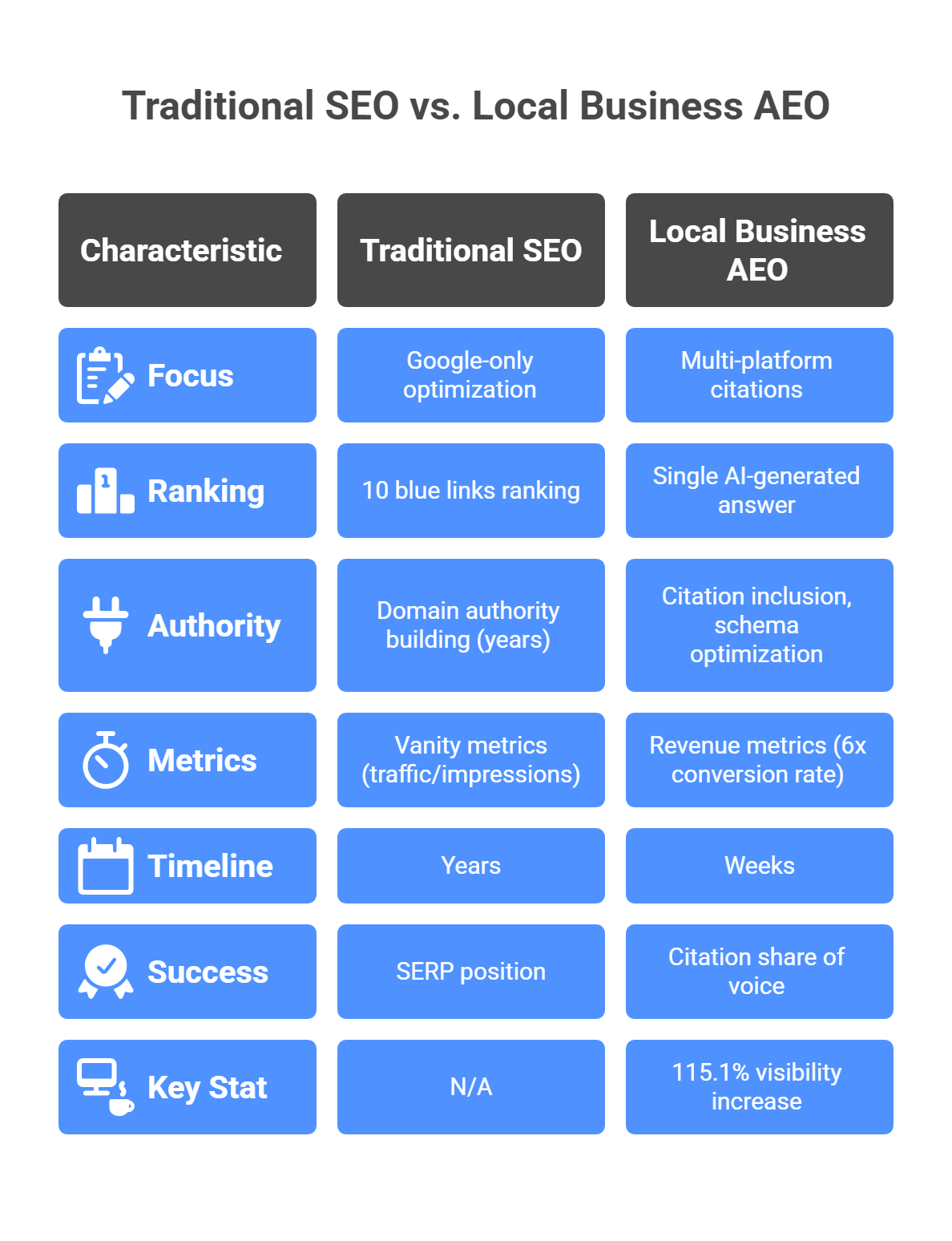
Local Business AEO (Answer Engine Optimization) is the practice of optimizing your business information to appear directly in AI-generated answers across platforms like Google AI Overviews, ChatGPT, Perplexity, and Gemini. Unlike traditional local SEO, which focused on ranking among "10 blue links," AEO targets the single, synthesized answer that AI platforms now surface when users ask location-aware questions like "best coffee shop near me that has outdoor seating."
The future of local discovery is shifting from lists to answers. When someone asks Gemini or ChatGPT for a local recommendation, AI platforms cite an average of 5 sources per query and 90% of the time, Google lists 8 or fewer sources. If your business isn't among those citations, you're invisible to the buyer.
⚠️ The Democratization of Visibility
Research shows that GEO methods like Cite Sources led to a 115.1% visibility increase for websites ranked fifth in search results. This is revolutionary: businesses that would take years to build domain authority through traditional SEO can now win citations immediately through strategic content optimization and schema markup.
❌ Where Traditional Local SEO Agencies Fall Short
Most traditional SEO agencies still play by outdated rules. Their approach centers on Google-only optimization, focusing on NAP (Name, Address, Phone) consistency basics, directory submissions, and domain authority building that takes years to materialize. They chase vanity metrics (traffic and pageviews) rather than conversions.
"Local citations help, but stick to the big ones like Yelp, Thumbtack, Nextdoor, Angi."
— u/localseo, r/localseo Reddit Thread
Traditional agencies ignore the fundamental reality: 58% of consumers use voice search for local queries, 70% of local searches happen on mobile devices, and AI platforms don't just rank websites they extract trusted information from across the entire web, including Reddit, review sites, and community forums.
✅ The AI-Era Transformation
The battle is no longer for the top SERP position it's for citation inclusion across multiple AI platforms. Voice search accounts for 58% of local queries. Mobile local searches dominate at 70%. AI Overviews integrate modules like Maps, Local Places, and Reviews, pulling from diverse sources that traditional SEO never optimized.
"With mobile search on the rise, making sure your site is fast and mobile-friendly is more important than ever."
— u/seogrowth, r/seogrowth Reddit Thread
💰 MaximusLabs AI: Becoming the Answer, Not Just Ranking
MaximusLabs AI takes a fundamentally different approach: Search Everywhere Optimization. We don't just optimize your website for Google we engineer authority across the entire web so AI platforms cite you as the trusted source.
Our revenue-focused SEO methodology targets Middle-of-the-Funnel (MOFU) and Bottom-of-the-Funnel (BOFU) queries where customers are ready to convert. One company (Webflow) saw a 6x conversion rate difference between LLM traffic and Google search traffic. Companies implementing proper AEO strategies see 8% of their signups coming from LLMs, making it a top acquisition channel.
We pioneer Answer Engine Optimization with proprietary citation engineering strategies: deploying Cite Sources, Quotation Addition, and Statistics Addition methods that achieve 30-40% improvements in Position-Adjusted Word Count metrics the key factor in AI citation selection.
⭐ The Speed-to-Win Advantage
"Early-stage or local companies that might take years to rank well in SEO can win quickly in AEO."
— Strategic Brief, Local Business AEO Analysis
The new objective is to be the authoritative source cited by AI. Traditional SEO favors high domain authority built over years. AEO levels the playing field: by focusing on citation optimization, conversational long-tail queries, and structured data, local businesses can start appearing in AI-generated answers within weeks.
Stop optimizing for Google alone. Start optimizing for trust across every platform where your customers search.
Q2. How Does Google Maps Gemini AI Change Local Discovery? [toc=Google Maps Gemini AI]
Google Maps + Gemini AI integration represents the most significant shift in local discovery since the introduction of the Local Pack. In October 2025, Google made Grounding with Google Maps generally available in the Gemini API, enabling AI applications to provide hyper-accurate, context-aware local recommendations powered by Google's Places database and real-time location data.
.png)
What Is Gemini Grounding with Google Maps?
Grounding allows Gemini to access authoritative, real-time information from Google Maps including business details, reviews, photos, hours, and even current conditions like wait times. When users ask conversational queries like "Find family-friendly restaurants with outdoor seating near Golden Gate Park that are open now," Gemini doesn't just return generic results it synthesizes personalized, location-aware answers.
🎯 How Gemini Changes Local Search Behavior
Traditional search required users to browse multiple listings and click through to websites. Gemini provides comprehensive answers directly, including:
- AI-summarized places: Gemini reads reviews, extracts key themes (e.g., "great for dates," "kid-friendly"), and presents synthesized insights
- Conversational follow-ups: Users can ask, "Which one has vegan options?" and Gemini narrows results intelligently
- Multi-factor recommendations: Proximity, real-time availability, price range, and user preferences combine to surface the most relevant businesses
"Create comprehensive, deep-dive content that thoroughly answers questions. Think encyclopedia entries, not blog posts."
— u/GEOoptimization, r/GEOoptimization Reddit Thread
✅ Real-World Applications: Marriott & Compass Case Studies
Marriott International uses Grounding with Google Maps to build conversational AI agents that help guests discover local experiences. Instead of generic tourist recommendations, Marriott's AI provides hyper-localized suggestions based on guest location, preferences, and real-time availability.
Compass (real estate platform) integrates Gemini grounding to help homebuyers explore neighborhoods. Users ask, "What's the walkability score near this property?" and the AI provides detailed, location-specific insights about nearby amenities, transit options, and community characteristics.
📍 What This Means for Local Businesses
Your business must be represented accurately across Google's knowledge graph. Gemini pulls from:
- Google Business Profile (GBP): Complete, optimized profiles with accurate categories, hours, photos, and attributes
- Reviews: Both volume and quality matter Gemini summarizes review sentiment
- Website content: Structured data (LocalBusiness schema, FAQ schema) helps Gemini extract accurate information
- Third-party sources: Mentions on local blogs, review sites, and community platforms
"Make sure your Google Business Profile is fully optimized with accurate information, high-quality photos, and up-to-date hours."
— u/localseo, r/localseo Reddit Thread
⚠️ The Risk of Inaccurate AI Summaries
If your business information is inconsistent across sources, Gemini may hallucinate details or surface incorrect information. NAP consistency, schema markup, and active review management are no longer optional they're foundational to preventing AI misrepresentation.
🔧 Action Items for Business Owners
Optimize for Gemini Visibility:
- Claim and complete your Google Business Profile: Every field matters services, attributes, menus, photos, Q&A
- Implement LocalBusiness schema: Include detailed attributes (opening hours, price range, service area, accepted payment methods)
- Generate review volume and quality: Encourage customers to leave detailed reviews mentioning specific services, menu items, or experiences
- Create hyper-local content: Blog posts answering "near me" questions specific to your location
- Monitor AI-generated summaries: Use AI visibility tracking tools to see how Gemini represents your business
"Track AI citations... How does one do that? There are a lot of AI Visibility Report tools out there."
— u/Gemini, r/Bard Reddit Thread
🚀 Developer-Level Implementation
For larger enterprises or multi-location businesses, consider integrating the Gemini API with Grounding directly into your customer-facing applications. This allows you to:
- Build conversational booking assistants
- Provide real-time local recommendations within your app
- Create hyper-personalized customer experiences based on location context
Google's Grounding API supports dynamic data retrieval, meaning your AI applications always reflect current business information, avoiding the staleness issues common with LLM training data.
Gemini + Google Maps transforms local discovery from a list-based experience to a conversational, AI-mediated journey. Businesses that optimize for this new paradigm will dominate local visibility as AI-assisted search becomes the default.
Q3. How Do Voice Search and Conversational AI Impact Local Businesses? [toc=Voice Search Impact]
Voice search has fundamentally altered how customers find local businesses. 58% of consumers use voice search for local queries, and 50% of all voice queries have local intent. When someone asks Alexa, "What's the best plumbing service near me that works weekends?" or tells Google Assistant, "Find a veterinarian open late tonight," they're using conversational, long-tail queries that traditional keyword optimization completely misses.
🎤 The Voice Search Reality
Voice searches are structurally different from typed queries:
- Typed query: "plumber Miami"
- Voice query: "Who's a reliable plumber in Miami that can fix a water heater emergency today?"
Voice assistants prioritize conversational content structured for quick extraction typically 40-50 word featured snippets that directly answer questions. Mobile-first design isn't optional: 70% of local searches happen on mobile devices, and voice search is intrinsically mobile-linked.
"Focus on long-tail keywords and conversational queries that people might use in voice search."
— u/DigitalMarketingHack, r/DigitalMarketingHack Reddit Thread
❌ Where Traditional Agencies Miss the Mark
Traditional SEO agencies still optimize for short-tail keywords like "dentist NYC" or "coffee shop Portland." They ignore question-based query patterns, fail to structure content for voice assistant extraction, and neglect speakable schema markup the technical signal that tells voice assistants which content is optimized for read-aloud.
Their content reads like keyword-stuffed web copy, not natural language. When Google Assistant needs to answer "Which coffee shops near Pike Place Market have free WiFi and outdoor seating?" generic website content doesn't provide extractable answers.
"Most agencies charge overpriced retainers for work that's not deserving of a retainer."
— u/low5d7k, r/SEO Reddit Thread
✅ The AI Transformation of Voice Search
Generative engines prefer comprehensive, E-E-A-T-compliant content with clear hierarchy. FAQ schema directly feeds AI Overviews and voice assistants. Natural language that mirrors how people speak (not 10-word typed queries) wins voice search placement.
Research shows that well-organized content with FAQ schema and clear sections increased inclusion in AI-generated answers by 37% on platforms like Perplexity. Voice assistants pull from the same citation pools as ChatGPT and Gemini optimizing for one improves visibility across all.
"Voice search optimization is also crucial, as more people use voice commands to find local businesses."
— u/localseo, r/localseo Reddit Thread
💡 MaximusLabs AI's Voice Optimization Methodology
We take an intent-driven content engineering approach to voice search:
1. Conversational Query Targeting: We analyze the long-tail questions your customers actually ask. Not "AC repair" "What's the average cost to fix an AC unit that's blowing warm air in Phoenix?"
2. Speakable Schema Implementation: We mark up key answer paragraphs with speakable schema, signaling to voice assistants which content is optimized for voice read-aloud.
3. Targeting "The Tail": The conversion-ready follow-up questions that traditional SEO ignores. Queries like "Does [business] offer emergency weekend service?" or "What payment methods does [business] accept?" drive immediate conversions.
4. Cross-Platform Optimization: Voice queries work across Google Assistant, Alexa, Siri, and AI chat platforms. Our optimization ensures your business surfaces regardless of which assistant the customer uses.
📊 Real-World Impact
Businesses optimized for voice search see 37% increases in inclusion in AI-generated answers. Because voice and mobile are linked, mobile-first design directly impacts voice search performance. Page speed, mobile UX, and clear content hierarchy determine whether voice assistants can extract your information efficiently.
"Make sure your website is mobile-friendly, as many voice searches are done on mobile devices."
— u/localseo, r/localseo Reddit Thread
🔑 Voice Search Optimization Checklist
✅ Create FAQ pages answering conversational questions
✅ Implement FAQ schema and speakable markup
✅ Optimize for mobile-first (70% of local searches)
✅ Structure content in scannable 40-50 word answer paragraphs
✅ Target question-based H2s matching PAA (People Also Ask) queries
✅ Include local intent signals (neighborhood names, landmarks, "near me" context)
Voice search isn't the future it's the present. Every query not optimized for conversational AI is a customer you're losing to competitors who understand how people actually search today.
Q4. What Are 'Near Me' Queries and How Do You Dominate Them? [toc=Near Me Queries]
"Near me" searches represent the highest-intent local queries customers actively looking for immediate solutions within their proximity. When someone searches "coffee shop near me" or "emergency plumber near me open now," they're signaling purchase readiness. Capturing these queries requires understanding the proximity-prominence-relevance framework that determines local pack rankings.
📍 The Psychology Behind "Near Me" Searches
"Near me" queries signal immediate need and local intent. Unlike broader searches ("best restaurants in Chicago"), "near me" searches happen when customers are ready to visit or call. Mobile dominates this category: 70% of local searches occur on mobile devices, often while users are already on the move.
Google determines "near me" results with hyper-local precision accuracy can be as fine as 20-30 meters (walking distance) in urban environments. Your business's physical proximity to the searcher often outweighs other ranking factors in densely competitive areas.
"Optimize for mobile as many near me searches are done on mobile devices."
— u/localseo, r/localseo Reddit Thread
.png)
🎯 The Proximity-Prominence-Relevance Trifecta
Google ranks local "near me" results based on three core factors:
1. Proximity: Physical distance from the searcher. In competitive areas, being 500 meters closer can mean the difference between ranking #1 and #4 in the local pack.
2. Prominence: Your business's overall prominence, determined by:
- Review volume and rating
- Citation consistency (NAP across directories)
- Backlinks from local sources
- Brand mentions across the web
3. Relevance: How well your GBP and website match the search query. Category selection, service descriptions, and keyword usage in your business description matter.
"Keywords in title, description, services, and reviews are a booster."
— u/localseo, r/localseo Reddit Thread
📱 Mobile-First Optimization Requirements
Since "near me" searches are predominantly mobile, technical performance determines visibility:
✅ Page Speed: Google prioritizes fast-loading sites for mobile local searches
✅ Mobile UX: Click-to-call buttons, easy navigation, readable text without zooming
✅ Local Schema Markup: LocalBusiness schema with detailed attributes (opening hours, service area, price range)
✅ Geo-Tagged Content: Photos and posts with location metadata strengthen proximity signals
"Make your site mobile-friendly and fast-loading."
— u/GoogleMyBusiness, r/GoogleMyBusiness Reddit Thread
🔍 Hyper-Local Landing Page Strategy
Create dedicated landing pages for each service area or neighborhood you serve. Instead of one generic "Services" page, build pages like:
- "Emergency Plumbing in Downtown Austin"
- "Family Dentistry Near Domain Northside"
- "Italian Restaurants in Georgetown, Seattle"
Each page should include:
- Local keywords naturally integrated: Mention neighborhood names, landmarks, nearby streets
- Unique local content: Not duplicate content across location pages
- LocalBusiness schema: With specific address for each location
- Embedded Google Maps: Showing your location relative to the service area
- Local testimonials: Reviews from customers in that specific area
"Create separate service pages for each city or service, update your Google Business Profile, and track real leads, not just clicks."
— u/localseo, r/localseo Reddit Thread
📊 Optimizing Google Business Profile for "Near Me" Queries
Your GBP is effectively your local business's homepage for "near me" searches:
Category Selection: Choose the most specific primary category possible. "Italian Restaurant" beats "Restaurant."
Business Description: Include local keywords naturally. "Family-owned Italian restaurant in Capitol Hill serving handmade pasta since 1995."
Attributes: Select every relevant attribute (wheelchair accessible, outdoor seating, free WiFi, pet-friendly).
Posts & Updates: Regular GBP posts signal active management. Post weekly about specials, events, or local community involvement.
Q&A Optimization: Proactively answer common questions customers ask. "Do you offer gluten-free options?" "Is parking available?"
"Adding posts, responding to reviews, and keeping info up-to-date has been a big win."
— u/localseo, r/localseo Reddit Thread
🗺️ Geotargeting Strategies
Geotagged Photos: Upload photos with embedded location metadata to GBP and your website. This strengthens proximity signals.
Hyperlocal Content: Mention specific local landmarks, events, and community partnerships. "Just two blocks from Pike Place Market" or "Proud sponsor of Capitol Hill Jazz Walk."
"Incorporate mentions of the hyperlocal area in your GBP posts, GBP landing page, etc."
— u/localseo, r/localseo Reddit Thread
Local Backlinks: Acquire links from local news sites, chambers of commerce, community blogs, and event sponsors. These carry extra weight in local algorithms.
"Near me" optimization is about precision: precise location targeting, precise category selection, precise mobile performance, and precise relevance signals. Dominating "near me" queries means becoming the obvious choice when customers search with immediate purchase intent. Contact us to optimize your local business for AI-powered "near me" dominance.
Q5. How Do You Optimize Google Business Profile for AI Visibility? [toc=Google Business Profile]
Your Google Business Profile (GBP) is no longer just a directory listing it's effectively your local business's homepage in the AI era. When Gemini, ChatGPT, or Google AI Overviews surface local recommendations, they pull heavily from GBP data. A fully optimized profile is foundational to appearing in AI-generated answers.
📋 Complete Every Profile Field
Incomplete GBP profiles signal low trustworthiness to AI platforms. Fill out every available field:
Business Information:
- Business name (consistent with website NAP)
- Primary and secondary categories (choose most specific options)
- Complete address with suite/unit numbers
- Local phone number (not toll-free)
- Website URL and booking links
- Business hours including holiday/special hours
"Make sure your Google Business Profile is fully optimized with accurate information, high-quality photos, and up-to-date hours." — u/localseo, r/localseo Reddit Thread
Attributes & Services:
- Select all relevant attributes (wheelchair accessible, outdoor seating, WiFi, parking)
- Add detailed service listings with descriptions
- Include product catalog for retail businesses
- Specify service areas for businesses without storefronts
🎯 Category Selection Strategy
Your primary category is the single most important GBP ranking factor. Choose the most specific category available:
- ✅ "Italian Restaurant" beats "Restaurant"
- ✅ "Emergency Plumber" beats "Plumber"
- ✅ "Personal Injury Lawyer" beats "Lawyer"
"Double-check that you've picked the most precise primary category possible."
— u/localseo, r/localseo Reddit Thread
Add secondary categories strategically they expand the queries you rank for without diluting your primary focus.
📸 High-Quality Visual Content
AI platforms (especially Gemini) analyze photos to understand your business and extract contextual information.
Photo Requirements:
- Exterior storefront photos (multiple angles)
- Interior photos showing ambiance, products, services
- Team photos building trust and human connection
- Product/service photos with geotags
- Customer photos (encourage review photos)
"High-quality photos and posting regularly increases engagement."
— u/localseo, r/localseo Reddit Thread
Upload 5-10 photos minimum. Businesses with photos receive 42% more direction requests and 35% more clicks to their websites.
💬 Business Description Optimization
Your 750-character business description feeds AI summaries. Include:
Key Elements:
- Local keywords naturally integrated ("family-owned bakery in Capitol Hill")
- Unique value propositions
- Years in business (builds trust)
- Specializations and differentiators
- Location landmarks for context
"Keywords in title, description, services, and reviews are a booster."
— u/localseo, r/localseo Reddit Thread
📝 GBP Posts & Updates
Regular posts signal active management and provide fresh content for AI platforms to reference.
Post Strategy:
- Weekly updates (minimum)
- Special offers and promotions
- Events and community involvement
- Seasonal announcements
- New product/service launches
- Behind-the-scenes content
"Keeping your Google Business Profile updated weekly made the biggest difference for me, posts, photos, and fresh reviews move the needle more than most people realize." — u/localseo, r/localseo Reddit Thread
❓ Q&A Optimization
The Questions & Answers section is heavily cited by AI platforms. Proactively populate it:
Common Questions to Address:
- "What payment methods do you accept?"
- "Do you offer [specific service/product]?"
- "What are your COVID safety protocols?"
- "Is parking available?"
- "Do you have wheelchair accessibility?"
Answer in natural, conversational language. These responses feed directly into voice search and AI Overview answers.
⭐ Review Management
Reviews aren't just social proof they're training data for AI platforms.
Review Generation:
- Request reviews from satisfied customers immediately after service
- Make it easy: send direct review links via SMS/email
- Respond to 100% of reviews (positive and negative)
- Include keywords naturally in responses
"Reviews are a booster - respond to reviews."
— u/localseo, r/localseo Reddit Thread
Detailed reviews mentioning specific services, menu items, or experiences perform better than generic "Great service!" reviews.
🤖 AI-Specific GBP Features
Google AI Mode Integration:
Monitor how your GBP appears in Google AI Mode (AI-powered search interface). Use GBP Insights to track:
- How customers find your listing (search query data)
- AI-assisted discovery patterns
- Click-through rates from AI surfaces
Messaging Optimization:
Enable GBP messaging for instant customer communication. AI platforms favor businesses with active engagement channels.
Q6. What Schema Markup Powers Local AEO Success? [toc=Schema Markup]
Schema markup is the language AI engines speak structured data that makes your business information machine-readable and extractable. While traditional SEO agencies implement basic schema as a checkbox exercise, AI-era optimization requires multi-layered, tested schema strategies that feed accurate information to every AI platform.
🔤 Why Schema Matters for AI Engines
When Gemini, ChatGPT, or Perplexity analyze your website, they don't just read text they parse structured data to understand entities, relationships, and facts. LocalBusiness schema tells AI platforms "this is a business entity," FAQ schema signals "these are authoritative answers," and Speakable markup indicates "this content is optimized for voice read-aloud."
Research shows well-organized content with FAQ schema increased inclusion in AI-generated answers by 37% on Perplexity. Schema isn't optional it's the difference between being cited and being invisible.
"Adding LocalBusiness schema with detailed attributes beyond the basics... gave a slight edge in visibility in competitive cities."
— u/localseo, r/localseo Reddit Thread
❌ Traditional Agency Schema Failures
Most SEO agencies implement schema poorly:
- Copy-pasted templates without business-specific customization
- Basic NAP-only LocalBusiness schema missing critical attributes
- No testing or validation (broken schema that AI platforms ignore)
- Neglecting newer schema types (Speakable, updated FAQ formats)
- Zero cross-platform consistency verification (what ChatGPT sees vs. Perplexity)
"Most agencies charge overpriced retainers for work that's not deserving of a retainer."
— u/low5d7k, r/SEO Reddit Thread
Traditional agencies don't monitor how AI platforms interpret their schema. Without validation, you're operating blind schema might be present but not functioning.
✅ AI-Era Schema Sophistication
AI platforms prioritize detailed, accurate schema over basic implementations. Multi-layered strategies combining LocalBusiness + FAQ + Review schema increase citation probability significantly.
Cross-Platform Schema Consistency:
What ChatGPT extracts from your schema must match what Perplexity and Gemini see. Inconsistencies cause AI hallucinations platforms inventing details or surfacing incorrect information about your business.
🔧 Essential Schema Types for Local AEO
1. LocalBusiness Schema (Foundation)
Go beyond basic NAP. Include:
openingHourswith exceptions (holidays, special hours)priceRange(e.g., "$$" or "$10-$50")areaServedfor service-area businessespaymentAccepted(credit cards, cash, digital wallets)menuormakesOfferfor specific servicesaggregateRatingandreviewproperties
2. FAQ Schema (AI Overview Goldmine)
Deploy FAQ schema for every question-based H2/H3 on your site. This directly feeds Google's People Also Ask boxes and AI Overview answer extraction.
Format:
{
  "@type": "FAQPage",
  "mainEntity": [{
    "@type": "Question",
    "name": "What areas do you serve?",
    "acceptedAnswer": {
      "@type": "Answer",
      "text": "We serve Capitol Hill, Queen Anne..."
    }
  }]
}
"Create comprehensive, deep-dive content that thoroughly answers questions. Think encyclopedia entries, not blog posts."
— u/GEOoptimization, r/GEOoptimization Reddit Thread
3. Speakable Schema (Voice Search Priority)
Mark up key answer paragraphs with speakable schema, signaling to voice assistants which content is optimized for read-aloud:
{
  "@type": "WebPage",
  "speakable": {
    "@type": "SpeakableSpecification",
    "cssSelector": [".answer-paragraph"]
  }
}
4. HowTo Schema (Process-Based Content)
For step-by-step guides (e.g., "How to request a plumbing quote"), HowTo schema structures content for AI extraction.
5. Review Schema
Embed review schema for testimonials. AI platforms weight review data heavily in local recommendations.
💡 MaximusLabs AI's Schema Engineering
We don't just add schema we engineer it for maximum AI citability:
Detailed Attribute Implementation: LocalBusiness schema with every possible attribute populated. For restaurants: menus, cuisine types, dining options (takeout, dine-in, delivery). For service businesses: service areas, hours exceptions, emergency availability.
FAQ Schema Deployment: Every question-based section gets FAQ schema. We target PAA (People Also Ask) queries systematically, creating schema-backed answers that feed AI Overviews.
Speakable Markup Strategy: Key paragraphs that answer high-volume voice queries get speakable markup. We analyze which questions drive voice traffic and prioritize those sections.
Google Tag Manager Implementation: We deploy schema via GTM for easy updates and A/B testing. This allows dynamic schema adjustments without code changes.
Validation & Testing: We use Google Rich Results Test and Schema.org validator to ensure schema is error-free. Then we test how different AI platforms interpret the markup.
Continuous AI Citation Tracking: We measure schema effectiveness by tracking citation appearances across Google AIOs, ChatGPT, Perplexity, and Claude. If schema changes don't improve citations, we iterate.
⚠️ JSON-LD vs. Microdata
Use JSON-LD format it's the Google-recommended standard and easier for AI platforms to parse. Microdata and RDFa work but add complexity.
📊 The 37% Advantage
Well-organized content with FAQ schema increased inclusion in AI answers by 37% on platforms like Perplexity. Schema isn't "nice to have" it's the technical foundation that determines whether AI platforms can extract and cite your information.
This isn't set-and-forget. AI platforms evolve their interpretation algorithms continuously. Schema requires ongoing optimization, testing, and validation to maintain maximum AI visibility.
Q7. How Do You Win Featured Snippets and AI Overview Citations? [toc=Featured Snippets Citations]
Featured snippets and AI Overview citations are the new battleground for local visibility. When Google's AI Overview cites your business as one of 5 sources in a local query answer, or when ChatGPT references your website in a recommendation, you've won the citation lottery and citations drive exponentially more conversions than traditional SERP clicks.
🎯 Understanding the Citation Economy
AI Overviews appear for local queries and cite an average of 5 sources per query. 90% of the time, Google lists 8 or fewer sources. If you're not in that exclusive citation list, you're invisible to the buyer.
Featured snippets (position zero) feed AI summaries. Content that wins snippets gets ingested by ChatGPT, Perplexity, and Gemini as authoritative source material. The opportunity extends far beyond Google every generative engine pulls from the same high-quality content pool.
"Create comprehensive, deep-dive content that thoroughly answers questions. Think encyclopedia entries, not blog posts."
— u/GEOoptimization, r/GEOoptimization Reddit Thread
📏 Formatting Requirements for Snippets
Paragraph Snippets: 40-50 words, direct answer format
List Snippets: 5-7 items, scannable with clear hierarchy
Table Snippets: Comparison data (e.g., "AEO vs Traditional SEO")
❌ Traditional Agency Snippet Hunting
Traditional SEO agencies chase featured snippets with generic content, focusing only on definition-style snippets. They ignore the full PAA (People Also Ask) ecosystem and treat snippets as a Google-only opportunity.
Their fatal flaw: they don't understand that snippets are now training data for LLMs. Content formatted for snippet extraction (40-50 words, lists, tables) gets ingested by ChatGPT, Perplexity, Gemini winning one snippet can mean citations across every AI platform.
"Most agencies charge overpriced retainers for work that's not deserving of a retainer."
— u/low5d7k, r/SEO Reddit Thread
.png)
✅ The AI Transformation of Snippets
Snippets aren't endpoints they're entry points into the broader AI citation ecosystem. AI Overviews have approximately 5 citation slots, and competition is fierce. Content must be remarkable not just accurate, but uniquely valuable.
The Citation Cascade:
Win a featured snippet → Get cited in Google AIO → ChatGPT trains on your answer → Perplexity references your source → Gemini includes you in local recommendations
One well-optimized answer can generate visibility across the entire AI search ecosystem.
💎 MaximusLabs AI's Citation Engineering
We deploy proprietary GEO methods proven to increase citation probability:
Cite Sources Method: Reference authoritative external sources in your content. Research shows this GEO method achieves 30-40% improvement in Position-Adjusted Word Count a key metric for AI citation selection.
Quotation Addition Method: Include expert quotes, user testimonials, and industry data. AI platforms prioritize content with multiple perspectives and verified information.
Statistics Addition Method: Embed relevant statistics throughout content. AI engines weight data-backed answers higher than opinion-based content.
"Track AI citations... How does one do that? There are a lot of AI Visibility Report tools out there."
— u/Gemini, r/Bard Reddit Thread
Question-Based H2 Targeting: We structure content around PAA queries. Every H2 matches a real user question, increasing snippet-winning probability.
Multi-Format Answers: We create the same answer in three formats:
- Paragraph (45-50 words) for definition snippets
- Bulleted list (5-7 items) for process/feature snippets
- Table for comparison/vs. queries
FAQ Schema Integration: Every answer gets FAQ schema markup, signaling to AI platforms that this is authoritative, extractable content.
Cross-Platform Citation Tracking: We use AI visibility tools to monitor citation appearances across Google AIOs, ChatGPT, Perplexity, and Claude. If content isn't generating citations, we iterate and optimize.
🦄 The Purple Cow Principle
In a commoditized local market, your content must be remarkable. Generic answers get ignored by AI only authoritative, differentiated content becomes the source AI platforms trust and cite repeatedly.
What Makes Content Remarkable:
- Unique local data points (neighborhood-specific insights)
- Original research or case studies
- Expert interviews and perspectives
- Proprietary frameworks or methodologies
- Real customer success stories with metrics
"Everything you do in SEO works for free in AEO, the differences are the head and the tail... the head is offsite and then the tail is very specific follow-up questions."
— Strategic Brief, Local Business AEO Analysis
📊 The 30-40% Citation Advantage
GEO methods like Cite Sources, Quotation Addition, and Statistics Addition achieve 30-40% improvements in Position-Adjusted Word Count the metric that determines AI citation selection. These aren't marginal gains they're the difference between citation inclusion and invisibility.
Stop chasing snippets for Google alone. Start engineering content for citation across every AI platform where your customers search.
Q8. How Do You Build Trust Through Reviews and Reputation Management? [toc=Reviews Reputation]
Reviews are no longer just social proof they're training data for AI platforms. When Gemini summarizes your business, it's reading your reviews. When ChatGPT recommends local services, review sentiment and volume influence ranking. Voice assistants cite review themes ("customers say this restaurant is great for dates"). Managing your reputation across platforms is foundational to AI visibility.
⭐ Why Reviews Matter in the AI Era
AI platforms analyze review volume, recency, rating, sentiment, and content depth. A business with 200+ detailed reviews outranks competitors with 50 generic reviews, even if average ratings are similar.
Reviews Feed AI Summaries:
Gemini: "Customers praise the outdoor seating and weekend brunch menu"
Perplexity: "Highly rated for emergency weekend service and transparent pricing"
These AI-generated summaries pull directly from review themes. If your reviews don't mention key services, AI platforms won't either.
"Encourage customers to leave reviews and respond to them promptly."
— u/localseo, r/localseo Reddit Thread
📈 Review Generation Strategy
Timing Matters:
Request reviews immediately after service delivery when satisfaction is highest. Send direct GBP review links via SMS or email make it effortless.
Multi-Platform Approach:
- Google Business Profile (primary)
- Yelp (if applicable to your industry)
- Facebook (for community engagement)
- Industry-specific platforms (Avvo for lawyers, Healthgrades for healthcare)
"Get consistent reviews, build local backlinks, and high authority backlinks to GBP landing page with target keywords as anchor text." — u/localseo, r/localseo Reddit Thread
Review Volume Benchmarks:
- Local service businesses: Aim for 50+ reviews minimum
- Restaurants/retail: 100+ reviews for competitive visibility
- Professional services: 20-30+ detailed reviews
💬 Response Protocols
Respond to 100% of reviews within 48 hours. AI platforms track response rates and speed as trust signals.
Positive Review Response Template:
- Thank the customer by name
- Reference specific details they mentioned
- Reinforce your value proposition
- Invite them back
Negative Review Response Strategy:
- Acknowledge the issue professionally
- Take conversation offline (provide contact info)
- Offer resolution or compensation
- Follow up publicly once resolved
"Respond to all reviews, both positive and negative."
— u/localseo, r/localseo Reddit Thread
Never argue publicly. Defensive responses damage trust more than the original negative review.
🎯 Detailed Reviews > Generic Reviews
AI platforms extract more value from detailed reviews mentioning specific services, products, or experiences.
Low-Value Review: "Great service!"
High-Value Review: "Called for emergency plumbing on Saturday night. Technician arrived within 45 minutes, fixed our burst pipe, and explained everything clearly. Transparent pricing, no hidden fees. Highly recommend."
The second review teaches AI platforms exactly what you do, when you're available, and your key differentiators.
"Detailed reviews that mention services and location tend to perform better."
— u/localseo, r/localseo Reddit Thread
Encourage customers to be specific: "If you have a moment, mentioning which service you received helps other customers find us."
📸 Review Photos & Videos
Reviews with photos receive higher visibility in AI summaries. Encourage customers to include images of:
- Completed work
- Products purchased
- Dining experiences
- Service interactions
"Photos with reviews... has become as important as getting the review itself."
— u/localseo, r/localseo Reddit Thread
⚖️ Review Schema Implementation
Implement Review schema (AggregateRating and Review types) on your website. This structured data helps AI platforms understand your reputation beyond GBP.
{
  "@type": "LocalBusiness",
  "aggregateRating": {
    "@type": "AggregateRating",
    "ratingValue": "4.8",
    "reviewCount": "127"
  }
}
🔍 Cross-Platform Reputation Monitoring
AI engines build a 360-degree view of your brand by analyzing mentions across:
- Google Business Profile
- Yelp, Facebook, industry directories
- Reddit, Quora, community forums
- Local blogs and news sites
Monitor all platforms. A negative Reddit thread can influence AI recommendations even if your GBP is perfect.
"AI engines highly index on community platforms like Reddit, especially if there is active back-and-forth discussion."
— Strategic Brief, Local Business AEO Analysis
🚨 Preventing AI Hallucinations
Inconsistent information across review platforms causes AI hallucinations platforms inventing details about your business. Ensure:
- Business name is identical everywhere
- Hours are current across all platforms
- Services listed are consistent
- Pricing information matches
"NAP consistency and GBP mastery ensure your Name, Address, and Phone number are consistent across all online listings a foundational factor." — Strategic Brief, Local Business AEO Analysis
📊 Review Impact on Voice Search
Voice assistants prioritize businesses with strong review profiles. When someone asks Alexa for "the best plumber near me with weekend hours," rating and review volume heavily influence the recommendation.
Voice Search Review Optimization:
- Target 4.5+ star average rating
- Maintain consistent review generation (monthly minimum)
- Include keywords in review responses ("We're glad our weekend emergency service met your needs")
Reviews aren't just about ratings they're the narrative AI platforms tell about your business. Every review is an opportunity to reinforce your positioning, highlight differentiators, and build the trust that makes AI engines cite you as the authoritative local choice. Get expert help optimizing your review strategy for AI visibility.
Q9. What Mobile and Technical Optimizations Are Critical for Local AEO? [toc=Mobile Technical Optimization]
Mobile-first optimization isn't optional for local AEO it's foundational. 70% of local searches occur on mobile devices, and voice search (which is predominantly mobile) accounts for 58% of local queries. Technical performance directly impacts whether AI platforms can extract your information efficiently and whether users convert when they reach your site.
📱 Mobile-First Indexing Realities
Google exclusively uses mobile versions of websites for indexing and ranking. If your mobile experience is poor, your visibility suffers in both traditional search and AI Overviews.
"With mobile search on the rise, making sure your site is fast and mobile-friendly is more important than ever."
— u/seogrowth, r/seogrowth Reddit Thread
Mobile Optimization Checklist:
- Responsive Design: Site adapts seamlessly to all screen sizes (phones, tablets, desktops)
- Touch-Friendly Elements: Buttons and links large enough for finger taps (minimum 48x48 pixels)
- Readable Text: Font size minimum 16px, no zooming required
- Simplified Navigation: Mobile menus easy to access and use
- Click-to-Call Buttons: One-tap dialing for local businesses
⚡ Page Speed Requirements
Page speed is a confirmed ranking factor and directly impacts conversion rates. Studies show 53% of mobile users abandon sites that take longer than 3 seconds to load.
Core Web Vitals Metrics:
- Largest Contentful Paint (LCP): Target < 2.5 seconds (measures loading performance)
- First Input Delay (FID): Target < 100ms (measures interactivity)
- Cumulative Layout Shift (CLS): Target < 0.1 (measures visual stability)
"Make your site mobile-friendly and fast-loading."
— u/GoogleMyBusiness, r/GoogleMyBusiness Reddit Thread
Page Speed Optimization Tactics:
- Compress images (WebP format, lazy loading)
- Minimize JavaScript and CSS
- Enable browser caching
- Use Content Delivery Network (CDN)
- Implement AMP (Accelerated Mobile Pages) for key landing pages
🔧 Technical SEO Foundations
1. Clean HTML Structure
AI platforms parse HTML to extract structured information. Clean, semantic HTML makes extraction easier:
- Use proper heading hierarchy (H1 → H2 → H3)
- Semantic HTML5 tags (
<article>,<section>,<nav>) - Accessible markup (ARIA labels where appropriate)
2. JavaScript Minimization
Heavy JavaScript frameworks can prevent AI crawlers from accessing content. Implement server-side rendering (SSR) or static site generation where possible.
3. XML Sitemap Optimization
Include all important local pages in your XML sitemap. Submit to Google Search Console and regularly update when adding new location pages or service areas.
4. Robots.txt Configuration
Ensure robots.txt doesn't block AI crawlers from accessing critical content, schema markup, or media files.
🌐 HTTPS & Security
HTTPS is a confirmed ranking factor and trust signal. AI platforms prioritize secure sites. Use SSL certificates for all pages, especially forms handling customer data.
🔍 Structured Data for AI Discoverability
Implement comprehensive schema markup (covered in Q6) as a technical foundation. AI platforms rely on structured data to understand entity relationships and extract accurate information.
📊 Mobile UX Best Practices
Conversion-Focused Mobile Design:
- Prominent CTAs: "Call Now," "Get Directions," "Book Appointment" above the fold
- Minimal Form Fields: Reduce friction for mobile users
- Autofill Support: Enable browser autofill for forms
- One-Page Checkout: Streamline booking/purchase processes
- Mobile-Friendly Payment: Support Apple Pay, Google Pay
"Mobile UX directly impacts whether voice search users convert. If they land on your site and can't complete their goal easily, they'll bounce."
— Strategic Brief, Local Business AEO Analysis
⚠️ Common Mobile Technical Errors
Avoid These Mistakes:
- Pop-ups that cover mobile content (Google penalizes intrusive interstitials)
- Unplayable content (Flash, unsupported video formats)
- Faulty redirects (mobile users sent to irrelevant pages)
- Small fonts requiring zoom
- Horizontal scrolling
🛠️ Testing & Validation Tools
Use These Tools Regularly:
- Google PageSpeed Insights: Analyzes performance and provides optimization recommendations
- Google Mobile-Friendly Test: Confirms mobile usability
- Google Search Console: Monitors mobile usability issues
- Core Web Vitals Report: Tracks LCP, FID, CLS performance
- WebPageTest: Detailed performance analysis from multiple locations
"Tools like HighLevel, PlePer for local SEO audits, and even simple Google Sheets to track review outreach can make a huge difference." — u/localseo, r/localseo Reddit Thread
🤖 Agent Experience (AX) Optimization
Emerging focus: making websites machine-readable for AI agents that execute transactions on behalf of users. This includes:
- Clear, accessible HTML for AI parsing
- API endpoints for booking/purchasing
- Structured product/service data
- Real-time availability information
Technical SEO is evolving from "help Google crawl" to "help AI agents extract and act." Businesses optimizing for Agent Experience now will dominate as AI-assisted transactions become mainstream.
MaximusLabs AI simplifies complex technical optimization by implementing comprehensive mobile-first strategies, Core Web Vitals enhancements, and schema markup that ensures AI platforms can efficiently extract and cite your business information building the technical foundation for maximum AI visibility.
Q10. How Do NAP Consistency and Local Citations Impact AI Engines? [toc=NAP Citations]
NAP (Name, Address, Phone number) consistency is the foundational trust signal for local businesses in the AI era. When AI platforms like Gemini, ChatGPT, or Perplexly analyze your business, they verify entity data across multiple sources. Inconsistencies trigger red flags causing AI engines to skip your business or, worse, hallucinate incorrect information.
📍 Why NAP Consistency Matters for AI
AI platforms build entity knowledge graphs by cross-referencing information from your website, Google Business Profile, Yelp, Facebook, local directories, and mentions across the web. When Name, Address, or Phone variations exist, AI engines can't confidently verify your business, reducing citation probability.
"First you create the GBP profile for NAP Consistency (Name, Address, Phone number)."
— u/localseo, r/localseo Reddit Thread
Common NAP Inconsistencies That Hurt AI Visibility:
- Business name variations: "ABC Plumbing" vs. "ABC Plumbing LLC" vs. "ABC Plumbing Services"
- Address format differences: "123 Main St." vs. "123 Main Street" vs. "123 Main St, Suite 200"
- Phone number formats: "(555) 123-4567" vs. "555-123-4567" vs. "+1-555-123-4567"
- Outdated information: Old addresses or disconnected phone numbers
🔍 Entity Verification Process
AI platforms verify entities through citation volume and consistency. The more sources with identical NAP data, the higher the confidence score and the more likely AI engines cite your business.
The AI Entity Verification Formula:
✅ Consistent NAP across 10+ sources = High confidence = AI citation inclusion
⚠️ Inconsistent NAP across sources = Low confidence = Omitted from AI recommendations
❌ Conflicting information = AI hallucination risk = Incorrect details surfaced
"Fixed NAP everywhere same name, same address, same phone."
— u/localseo, r/localseo Reddit Thread
📊 Priority Citation Sources
Focus NAP consistency on these high-authority platforms AI engines commonly reference:
Core Citations:
- Google Business Profile (most critical)
- Bing Places
- Apple Maps
- Yelp
Industry-Specific Citations:
- Healthcare: Healthgrades, Zocdoc, Vitals
- Legal: Avvo, Justia, FindLaw
- Home Services: Angi, Thumbtack, HomeAdvisor
- Restaurants: OpenTable, TripAdvisor, Zomato
"Local citations help, but stick to the big ones like Yelp, Thumbtack, Nextdoor, Angi."
— u/localseo, r/localseo Reddit Thread
🛠️ NAP Audit Process
Step 1: Inventory Current Citations
Use tools like BrightLocal, Moz Local, or Whitespark to identify where your business is listed and detect inconsistencies.
Step 2: Standardize NAP Format
Create a master NAP format and use it everywhere:
Example Standard Format:
- Name: MaximusLabs AI
- Address: 123 Innovation Drive, Suite 200, San Francisco, CA 94105
- Phone: (415) 555-1234
Step 3: Update Major Listings
Prioritize updating GBP, Bing, Apple Maps, and top 10 citation sources first.
Step 4: Clean Up Duplicate Listings
Merge or delete duplicate GBP profiles and directory listings duplicates confuse AI platforms.
Step 5: Monitor Ongoing
Set up monthly audits to catch new inconsistencies or listings created without your knowledge.
🔗 Local Backlinks & Authority Signals
Local backlinks carry extra weight in local algorithms and signal trust to AI platforms.
High-Value Local Backlink Sources:
- Local news websites and newspapers
- Chamber of Commerce membership directories
- Local business associations
- Community event sponsorships
- Local university or school partnerships
- Municipal government websites (.gov links)
- Local bloggers and influencers
"Get more quality local backlinks from reputable sources."
— u/localseo, r/localseo Reddit Thread
Backlink Quality > Quantity:
One backlink from a local news article about your community involvement carries more AI citation weight than 100 low-quality directory links.
"Any type of backlinks are good, but they must be quality, merited and contextual that are topical relevant to get value out of traffic." — u/BacklinkSEO, r/BacklinkSEO Reddit Thread
🚨 Preventing AI Hallucinations
When NAP data is inconsistent, AI platforms sometimes "fill in the blanks" by inventing details hallucinating business hours, services offered, or contact information.
Hallucination Prevention Tactics:
✅ Consistent NAP across all platforms
✅ Complete schema markup with detailed attributes
✅ Regular monitoring of AI-generated summaries
✅ Claiming and verifying all major listings
✅ Responding to incorrect information quickly
"Consistent NAP (Local Citations) + Location-Based Backlinks."
— u/localseo, r/localseo Reddit Thread
📈 Citation Building Strategy
Month 1: Foundation
- Claim GBP, Bing Places, Apple Maps
- Submit to top 10 industry directories
- Standardize NAP format across all platforms
Month 2-3: Expansion
- Submit to secondary directories (50-100 listings)
- Acquire 3-5 local backlinks (chamber, associations, local blogs)
- Monitor for duplicate listings and clean up
Month 4+: Maintenance
- Monthly citation audits
- Update hours for holidays/special events
- Track new mentions and ensure NAP consistency
🎯 The Trust Signal Compound Effect
Citations aren't direct ranking boosters they're foundational trust signals. Consistent NAP + local backlinks + review volume + schema markup create a compound trust effect that makes AI platforms confident citing your business.
"Citations can still help but they're more of a foundational trust signal than a direct ranking booster these days."
— u/localseo, r/localseo Reddit Thread
MaximusLabs AI handles comprehensive NAP audits, citation management, and strategic local backlink acquisition to build the entity verification and trust signals that make AI platforms confidently cite your business as the authoritative local choice.
Q11. How Do You Measure Local AEO Success Beyond Traffic Metrics? [toc=Measuring AEO Success]
Traffic and keyword rankings are vanity metrics in the AI era. What matters: Are you cited in AI Overviews? What's your share of voice across ChatGPT, Perplexity, and Gemini? How many conversions come from LLM-assisted journeys? Traditional agencies report impressions and clicks MaximusLabs delivers revenue attribution and AI citation density.
📊 The Revenue-Focused Measurement Framework
LLM traffic converts at a 6x rate compared to traditional search traffic (Webflow data). Companies implementing proper AEO strategies see 8% of their signups coming from LLMs, making it a top acquisition channel. Yet traditional agencies don't track these conversions they're stuck reporting vanity metrics.
"Track real leads, not just clicks."
— u/localseo, r/localseo Reddit Thread
❌ Traditional Agency Measurement Failures
Most SEO agencies provide monthly reports celebrating:
- Organic traffic increases (without source attribution)
- Keyword ranking improvements (without conversion tracking)
- Domain authority scores (vanity metrics with no revenue correlation)
- Impressions and clicks (ignoring AI citation opportunities)
"Most agencies charge overpriced retainers for work that's not deserving of a retainer."
— u/low5d7k, r/SEO Reddit Thread
They provide "reports not results" focusing on activity metrics that don't correlate with revenue. They lack AI visibility tracking tools entirely, leaving businesses blind to the fastest-growing search channel.
✅ AI-Era Measurement Imperatives
1. AI Citation Tracking
Monitor how often your business is mentioned in:
- Google AI Overviews (AIOs)
- ChatGPT responses
- Perplexity answers
- Claude recommendations
- Gemini local suggestions
"Track AI citations... How does one do that? There are a lot of AI Visibility Report tools out there."
— u/Gemini, r/Bard Reddit Thread
Key Metrics:
- Citation frequency (how often you're mentioned)
- Citation position (1st source vs. 5th source)
- Citation density (you vs. competitors)
- Citation share of voice across platforms
2. GBP Insights for AI-Assisted Discovery
Google Business Profile Insights now tracks:
- How customers find your listing (discovery queries)
- Google AI Mode referrals
- Voice search driven actions (calls, directions)
- Photo views and engagement
Monitor AI-specific discovery patterns queries like "best [service] near me with [specific attribute]" indicate AI-mediated searches.
3. Search Console Question-Based Query Tracking
Filter Google Search Console for question-based queries:
- "How much does..."
- "What's the best..."
- "Where can I find..."
- "Which [service] near me..."
These conversational queries indicate voice search and AI Overview opportunities. Track impressions, clicks, and conversions specifically for this segment.
4. Voice Search Attribution
Implement UTM parameters and GA4 custom dimensions to track:
- Traffic source: Voice assistants (Alexa, Siri, Google Assistant)
- Conversational query patterns
- Mobile device breakdown
- Conversion rates from voice traffic
Voice traffic typically has higher intent and shorter conversion cycles than traditional search.
💰 MaximusLabs AI's Results-Not-Reports Approach
We engineer measurement infrastructure that tracks what actually matters: revenue attribution, not vanity metrics.
Citation Density Analysis:
We use AI visibility tracking tools to compare how your website and GBP are represented across AI platforms versus competitors. If you're cited 3 times per 100 local queries while competitors average 8, we know exactly where to optimize.
LLM Traffic Conversion Attribution:
We implement UTM parameters and GA4 custom dimensions to isolate LLM traffic and track its conversion path. When we report "8% of signups now come from LLMs," that's attributable, measurable revenue not guesswork.
MOFU/BOFU Query Performance:
We monitor high-intent queries where 6x conversion rates occur:
- Competitor comparison queries ("MaximusLabs vs Agency X")
- Pricing questions ("How much does GEO cost")
- Integration queries ("Does MaximusLabs integrate with HubSpot")
- Feature-specific searches ("GEO for SaaS companies")
These are the revenue-driving queries traditional agencies ignore while chasing TOFU traffic.
Revenue Impact Reports:
Our dashboards show:
- Signup/conversion attribution by channel (LLM traffic vs. traditional search)
- Citation-to-conversion correlation
- AI platform diversity score (how many platforms cite you)
- Revenue generated per citation source
We deliver results, not activity reports.
🌐 The Search Everywhere Optimization Mandate
Success means being the authoritative answer across Google, ChatGPT, Perplexity, voice assistants, and emerging AI platforms. Measurement must reflect this multi-platform reality.
Multi-Platform KPIs:
📈 Tracking Implementation Checklist
✅ Set up AI visibility monitoring across Google AIOs, ChatGPT, Perplexity
✅ Configure GA4 custom dimensions for LLM traffic attribution
✅ Implement UTM parameters for voice assistant traffic
✅ Create Search Console filters for conversational queries
✅ Monitor GBP Insights for AI Mode discovery patterns
✅ Track citation density vs. top 3 competitors monthly
✅ Measure revenue attribution by source (LLM vs. traditional)
"Track your performance and adapt your strategies based on the latest trends."
— u/localseo, r/localseo Reddit Thread
Stop celebrating traffic increases. Start measuring AI citations and LLM-driven revenue. The measurement framework determines whether you're optimizing for vanity or value. Learn how we track real ROI from AI visibility.
Q12. What Is Your Local AEO Implementation Roadmap and Future Outlook? [toc=Implementation Roadmap]
Local AEO requires strategic sequencing not random tactics. Success demands a systematic approach: technical foundation (GBP, NAP, schema) → content optimization (conversational queries, FAQ, E-E-A-T signals) → citation engineering (offsite authority, review generation) → measurement infrastructure. This isn't ad-hoc experimentation; it's engineered for speed-to-win, with results possible in weeks, not years.
🗺️ The Systematic Implementation Approach
Traditional agencies treat local SEO as a checklist: "Did we submit to 50 directories? ✓ Did we write 10 blog posts? ✓" They lack strategic sequencing, starting with content before technical foundation, and have no adaptation mechanism for emerging AI platforms.
"Most agencies charge overpriced retainers for work that's not deserving of a retainer."
— u/low5d7k, r/SEO Reddit Thread
❌ Traditional Agency Chaos
Their Approach:
- Piecemeal implementations without strategy
- Content creation before schema/GBP optimization
- Generic keyword research ignoring conversational queries
- No testing protocols or success criteria
- Focus on Google-only, ignoring ChatGPT/Perplexity
- Monthly retainers with minimal measurable progress
✅ AI-Era Implementation Requirements
AI engines verify entities before surfacing them. Start with technical foundation schema, GBP optimization, NAP consistency because without entity verification, content optimization is wasted effort.
The Correct Sequence:
Foundation First:
Schema markup, GBP completion, NAP consistency verification ensure AI platforms recognize your business as a legitimate, verified entity.
Content Layer:
Only after foundation is solid, layer content strategy targeting conversational queries, FAQ schema deployment, and voice search optimization.
Authority Building:
Build offsite authority through local backlinks, review generation campaigns, and community platform mentions.
Measurement Infrastructure:
From day one, implement AI citation tracking and conversion attribution you can't optimize what you don't measure.
.png)
🚀 MaximusLabs AI's Phased Implementation Roadmap
We deploy a systematic 6-8 week sprint to AI visibility, with measurable milestones at every phase.
Phase 1 (Weeks 1-2): Technical Foundation
✅ Technical Audit: Crawl site, identify schema gaps, Core Web Vitals issues, mobile usability problems
✅ GBP Optimization: Complete every field, optimize categories, add photos, populate Q&A, enable messaging
✅ Schema Implementation: Deploy LocalBusiness, FAQ, HowTo, Speakable schema via Google Tag Manager
✅ NAP Consistency Verification: Audit top 50 citations, standardize format, update inconsistencies
Deliverable: Technical foundation report with schema validation, GBP optimization checklist, NAP consistency score
Phase 2 (Weeks 3-4): Content & Citation Optimization
✅ Content Audit: Identify citation opportunities, map conversational queries to content gaps
✅ FAQ Schema Deployment: Add FAQ schema to every question-based H2/H3, targeting PAA boxes
✅ Voice Search Content Optimization: Rewrite key pages with conversational long-tail queries, 40-50 word answer paragraphs
✅ Conversational Query Targeting: Create content for "What's the best [service] near me that [specific need]?" queries
Deliverable: Content optimization roadmap, FAQ schema implementation, conversational query target list
Phase 3 (Weeks 5-6): Authority & Review Engineering
✅ Citation Engineering: Implement Cite Sources, Quotation Addition, Statistics Addition GEO methods
✅ Local Backlink Acquisition: Secure 5-10 high-authority local backlinks (chamber, associations, local news)
✅ Review Generation Campaigns: Implement automated review request system, response protocols
✅ Community Platform Optimization: Build presence on Reddit, Quora, industry forums where AI engines cite
Deliverable: Citation growth report, backlink acquisition summary, review velocity increase documentation
Phase 4 (Weeks 7+): Ongoing Optimization
✅ AI Visibility Tracking: Monitor citation appearances across Google AIOs, ChatGPT, Perplexity, Claude
✅ Conversion Attribution: Track LLM traffic conversions, calculate ROI from AI-assisted journeys
✅ Iterative Optimization: Analyze which content gets cited, double down on winning formats
✅ Cross-Platform Consistency: Ensure schema updates propagate to all AI platforms
Deliverable: Monthly AI visibility reports, revenue attribution analysis, optimization recommendations
⏰ The Speed-to-Win Advantage
Unlike traditional SEO requiring years of domain authority building, local AEO delivers results in weeks. Early-stage companies can win citations through strategic content and schema optimization immediately.
"Early-stage or local companies that might take years to rank well in SEO can win quickly in AEO."
— Strategic Brief, Local Business AEO Analysis
Why AEO is Faster:
✅ Domain authority less critical citation quality matters more
✅ Conversational long-tail queries have lower competition
✅ Schema optimization provides immediate AI visibility gains
✅ Local backlinks carry disproportionate weight
✅ Review generation shows results within weeks
🔮 Future Outlook: 2026 and Beyond
The shift toward Agent Experience (AX) optimization is accelerating. By 2026, AI agents will execute transactions on behalf of users booking appointments, ordering products, comparing services without users visiting websites.
Agent Experience (AX) Optimization:
Websites must become machine-readable interfaces where AI agents can execute actions. This requires:
- API endpoints for booking, purchasing, inventory checking
- Real-time availability data
- Structured product/service information
- Clear pricing and policy data
"The new critical technical area emerging is Agent Experience (AX), focusing on making the website machine-readable and enabling AI agents to execute conversions or perform actions directly on the site."
— Strategic Brief, Local Business AEO Analysis
Real-Time Information Integration:
Current wait times, stock availability, live booking calendars real-time data becomes competitive advantage as AI platforms prioritize up-to-date information over stale website content.
AI-Assisted Transactions:
Direct booking and purchasing from search results (Google reserves table via AI, ChatGPT schedules appointment) means businesses must integrate with AI platform APIs.
Quality Over Quantity Signals:
AI platforms are getting sophisticated at detecting thin content, keyword stuffing, and manipulative SEO tactics. E-E-A-T signals authentic expertise, real customer experiences, genuine authority become non-negotiable.
📅 Living Document Approach
This guide is a living document, updated quarterly to reflect the rapidly evolving AI search landscape.
Last Updated: November 17, 2025
What's New in Q4 2025:
- Gemini AI grounding with Google Maps now GA
- Voice search accounts for 58% of local queries
- LLM traffic conversion rates 6x traditional search
- AIO citation slots limited to 5-8 sources (competition intensifying)
We commit to quarterly updates, ensuring this remains the authoritative resource for local AEO as AI platforms evolve their algorithms and interpretation methods.
🎯 Your Next Steps
Week 1 Action Items:
- Audit current GBP completeness and NAP consistency
- Implement LocalBusiness schema on homepage
- Identify top 10 conversational queries for your business
- Set up AI visibility monitoring (Google AIOs minimum)
Month 1 Goal:
Technical foundation complete, first AI citations appearing, measurement infrastructure operational.
Stop optimizing for Google alone. Start engineering authority across every AI platform where your customers search. The roadmap is clear; the opportunity window is now.
MaximusLabs AI eliminates implementation complexity with our systematic, phased approach delivering measurable AI visibility gains within weeks while positioning your business for the Agent Experience future where AI platforms become the primary customer acquisition channel. Contact us to begin your local AEO transformation.
.png)
.png)
