

Q1. What Are the Best ChatGPT Tracking Tools in 2026? [toc=1. Best Tools Overview]
ChatGPT tracking tools have evolved from simple monitoring dashboards to comprehensive Answer Engine Optimization (AEO) platforms that measure brand visibility across AI-powered search experiences. With ChatGPT's 800 million weekly active users and AI platforms capturing over 50% of search traffic by 2028, businesses need specialized tools to track citations, measure share of voice, and optimize for the new era of zero-click searches where users get answers without visiting websites.
Below are the 10 best ChatGPT tracking tools in 2026, categorized by functionality and ideal use case:
- Profound - Best for multi-engine AI visibility tracking
- Peec AI - Best for lightweight visibility checks
- Maximus Labs - Best for revenue-focused AEO execution with human expertise
- AthenaHQ - Best for content gap detection and monitoring
- Conductor - Best for enterprise content automation
- Botify - Best for technical SEO and crawl analytics
- Scrunch - Best for team collaboration on AI visibility
- Brandlight - Best for basic brand mention tracking
- BrightEdge - Best for Fortune 500 SEO/AEO integration
- Airops - Best for startups needing affordable monitoring
📊 Quick Comparison Table
1. Profound
✅ What It Does
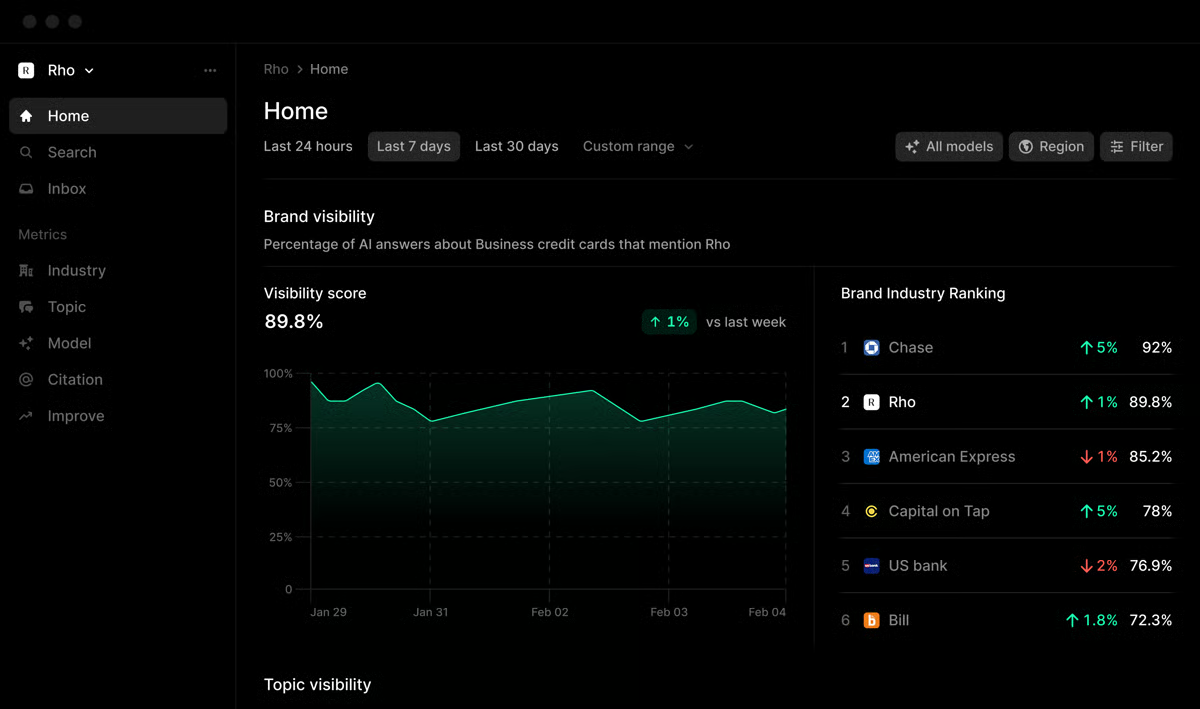
Profound established itself as the market leader in AI visibility tracking by monitoring brand mentions across ChatGPT, Perplexity, Google AI Overviews, Gemini, Claude, and 4+ other LLMs. The platform provides competitive benchmarking, revealing which brands dominate AI responses for high-intent keywords, and offers citation source identification showing which Reddit threads, authoritative websites, and review platforms AI systems reference when surfacing answers.
However, Profound operates as a pure monitoring tool with no content creation or strategic execution capabilities. The platform sends generic prompts to LLM APIs and analyzes responses algorithmically - it doesn't simulate how your specific ICP actually interacts with these systems. This API-driven methodology creates a critical gap: you get dashboards showing "visibility down 23%" but zero guidance on how to fix it, forcing you to hire separate agencies for content strategy and execution.
🔑 Key Features
- Multi-Engine Tracking: Monitors ChatGPT, Perplexity, Gemini, Claude, Grok, Google AI Overviews across 200M+ prompts
- Competitive Intelligence: Side-by-side comparison showing how your brand performs vs. 5+ competitors
- Citation Source Analysis: Identifies which URLs, Reddit discussions, and authoritative sources LLMs cite
- Sentiment Monitoring: Tracks positive/negative/neutral tone across AI responses
- Agent Analytics: Server-log integration (Vercel, Cloudflare, AWS) revealing which AI bots crawl your site
💰 Pricing
- Starter: $99/month (limited LLM coverage, ChatGPT + Perplexity only)
- Professional: $299/month (6-7 LLMs, competitive benchmarking)
- Enterprise: $499/month+ (10+ LLMs, custom integrations, priority support)
✅ Pros
- Comprehensive LLM platform coverage (10+ engines on enterprise tier)
- Intuitive UI with fast insights extraction
- SOC 2 Type II, HIPAA compliance, GDPR readiness for enterprise security
- Access to 200M+ real search prompts showing what people actually ask
❌ Cons
- No execution layer - monitoring only, no content creation or strategy support
- Platform reliability issues - users report slow UI, data duplication bugs, broken functionality
- Poor customer support - week-long response times, disconnected support conversations
- Expensive for monitoring-only - $99-$499/month delivers data without actionable solutions
🎯 Use Cases and ICP
Ideal For: Mid-market marketing teams (50-500 employees) with budgets for separate content agencies who need visibility dashboards to inform strategy but can execute independently.
Not Suitable For: Startups lacking in-house content resources, or teams expecting execution support beyond raw data.
💬 Real User Feedback
"Profound is definitely ahead of it's game in helping businesses understand where they fall in LLM visibility. It's helped our team understand how we appear in LLM answers and who our biggest competitors are in the space." — Verified User in Financial Services, Enterprise, G2 Verified Review
"Profound has become extremely unreliable over the past months. Every time we request a plan upgrade or any change to our acc setting, it duplicates old prompts, restores deleted data, and breaks our tracking setup - this happened three times in under a month! Support is slow and disconnected- replies can take up to a week, and even after clearly explaining the issue, they kept asking if I 'noticed a pattern.'" — Polina U., Head of Department, Mid-Market, G2 Verified Review
2. Peec AI
✅ What It Does
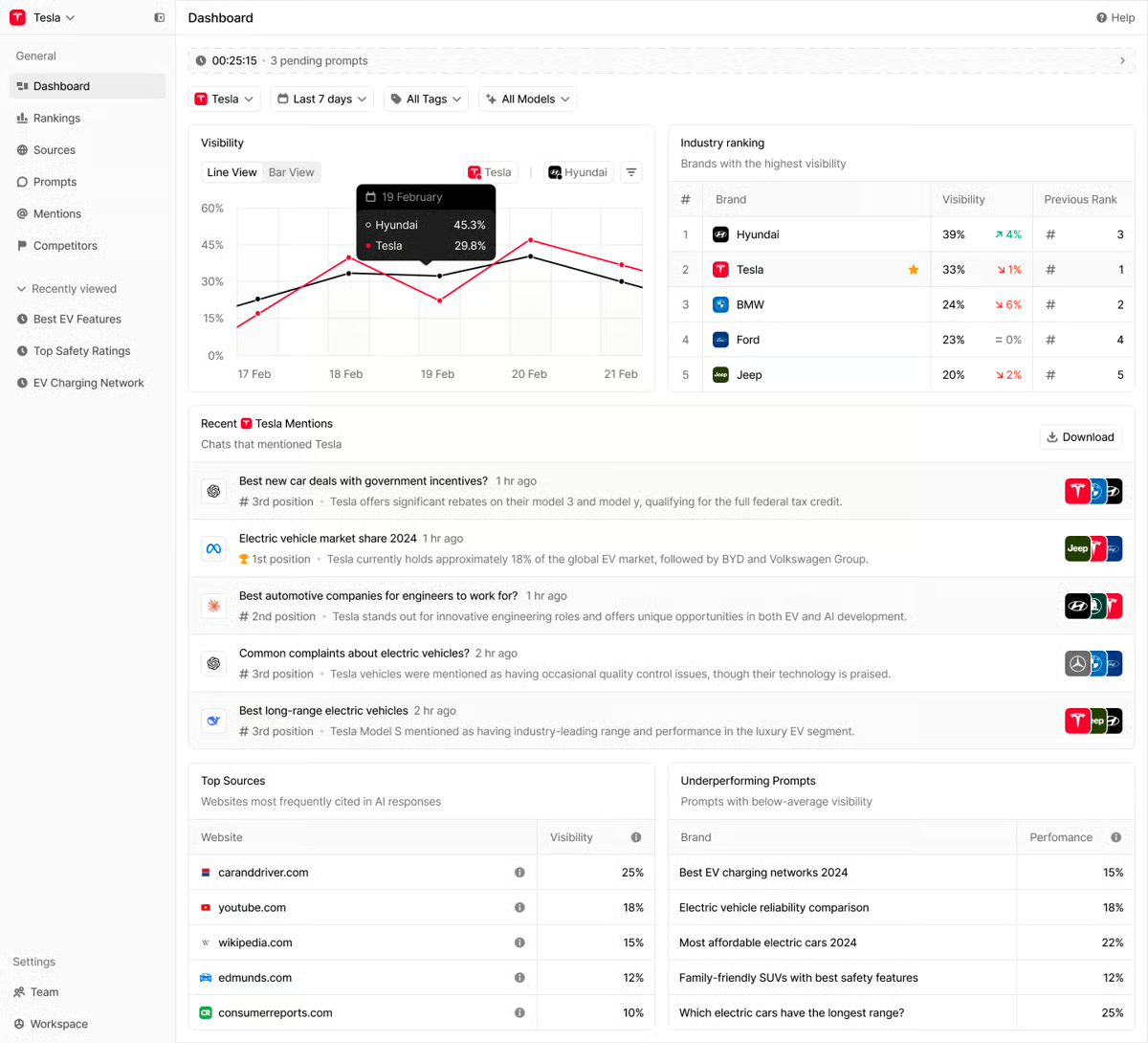
Peec AI delivers a lightweight tracking solution focused on speed and simplicity. The platform provides brand visibility dashboards showing where your company appears across major LLMs (ChatGPT, Perplexity, Gemini), with competitive benchmarking and basic sentiment analysis. Setup takes minutes, and users report "immediate insights" into prompt-level performance and URL citations.
The trade-off for this simplicity is extremely limited functionality - Peec AI offers pure monitoring with no strategic recommendations, content gap analysis, or execution support. The platform relies on mechanical, algorithm-driven analytics without human judgment or ICP-specific personalization, making it suitable only for basic visibility checks rather than comprehensive AEO programs.
🔑 Key Features
- Fast Setup: Immediate insights within 5-10 minutes of onboarding
- URL Citation Tracking: Shows which specific URLs LLMs reference when mentioning your brand
- Competitive Prompt Analysis: See how competitors rank across the same prompts
- Clean Dashboard: Simple, intuitive interface requiring minimal training
- Multi-LLM Coverage: ChatGPT, Perplexity, Gemini on standard plans
💰 Pricing
- Starter: $50/month (ChatGPT only, limited prompts)
- Professional: $150/month (3-4 LLMs, competitive tracking)
✅ Pros
- Affordable entry point for solo entrepreneurs and very small teams
- Extremely fast setup with immediate visibility insights
- Simple, clean interface requiring no technical expertise
- Good for tracking-only use cases without strategic needs
❌ Cons
- Very limited feature set - just monitoring dashboards, no strategic guidance
- No execution support - see where you rank but zero help improving
- Limited LLM coverage - only ChatGPT on starter plan
- Mechanical analytics - pure algorithm, no human context or ICP-specific insights
🎯 Use Cases and ICP
Ideal For: Solo founders, freelancers, or micro-businesses (1-5 employees) needing basic visibility checks without strategic complexity.
Not Suitable For: Teams requiring content execution, strategic guidance, or comprehensive multi-platform tracking.
💬 Real User Feedback
"It's easy to use, setup is extremely fast, you get immediate insights and you finally get some data to better understand where and how your brand is mentioned in LLMs. What I love is that I can also see the URLs that were quoted. Super helpful to understand how to optimize for this prompt." — Maximilian M., CEO, Mid-Market, G2 Verified Review
"Not much to be honest. Maybe even more LLMs, but they anyway cover all the important ones." — Maximilian M., CEO, Mid-Market, G2 Verified Review
3. Maximus Labs
⏰ The AEO-Native Paradigm Shift
✅ What It Does (Part 1: AI Visibility Measurement)
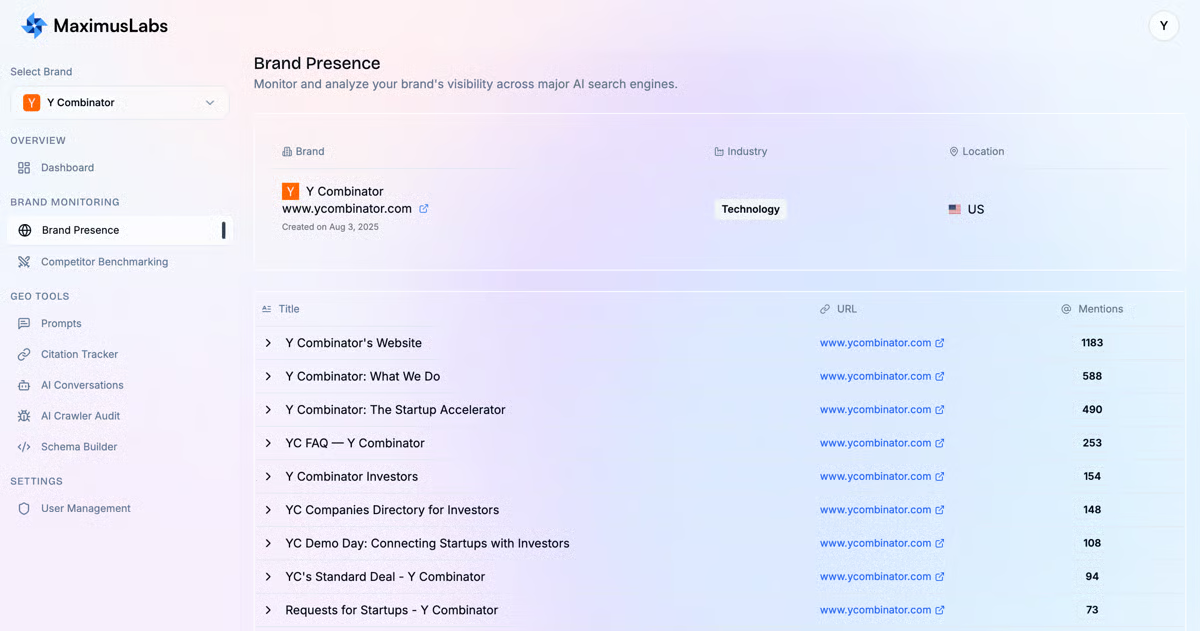
MaximusLabs.ai combines proprietary AI visibility tracking with human-in-the-loop content execution to deliver the only true revenue-focused AEO platform on the market. Unlike competitors relying on generic API calls, Maximus uses ICP avatar simulation - running queries through real browser UIs (ChatGPT, Perplexity, Gemini, Claude) from the perspective of your specific buyer personas, capturing geolocation, device context, conversation history, and search behavior patterns.
This real UI simulation approach solves the fatal flaw plaguing Profound, AthenaHQ, and other API-only tools: when a VP of Sales in San Francisco searches ChatGPT vs. a sales manager in London using Perplexity, they get different results. Generic API calls can't capture this personalization. Maximus tracks what your actual ICP sees - not algorithmic approximations.
✅ What It Does (Part 2: Human-Driven AI Content Generation)
Where competitors automate content creation through mechanical AI generation (Conductor, BrightEdge), Maximus employs expert content strategists who craft fewer, higher-quality pieces optimized for Trust-First SEO. Each article embeds E-E-A-T signals (Experience, Expertise, Authority, Trustworthiness), incorporates Founder's Voice to signal genuine human experience, engineers citations from high-authority sources, and leverages strategic UGC signals from Reddit, Quora, and community platforms.
This eliminates the robotization plaguing AI content churn - Maximus rejects quantity-first generation in favor of revenue-focused SEO prioritizing BOFU/MOFU content that drives pipeline, not vanity metrics like impressions or mentions.
🔑 Key Features
- ICP Avatar Simulation: Real UI testing from your buyer's perspective (not generic API calls)
- Dual-Function Platform: AI visibility measurement + expert content creation in one engagement
- Trust-First SEO Framework: E-E-A-T embedded across content, author profiles, backlink strategy
- Founder's Voice Integration: Human experience signals differentiating you from AI-generated commodity content
- Revenue Attribution: Pipeline tracking, attributed ARR, cost-per-demo metrics your CFO actually cares about
💰 Pricing
- Basic: $1,299/Month (15 expert-written pieces, ICP simulation across 10+ LLMs, startups/early-stage)
- Advanced: $2,199/Month (25 pieces, comprehensive MOFU/BOFU strategy, growth-stage companies)
- Premium: $3,499/Month (50 pieces, full-stack AEO program with continuous optimization, mid-market/scaling companies)
✅ Pros
- Only platform combining tracking + execution - no need for separate agencies
- Human expertise embedded - expert strategists, not mechanical automation
- ICP-specific optimization - content tailored to your actual buyer personas
- Revenue-first approach - optimize for pipeline and ARR, not vanity metrics
❌ Cons
- Higher upfront investment than monitoring-only tools (though 60-80% cheaper than stacking tools + agencies)
- Not suitable for teams wanting only dashboards without execution support
- Requires strategic partnership mindset - we're an agency-as-tool, not passive SaaS
🎯 Use Cases and ICP
Ideal For: SaaS founders, VP Marketing, Head of Growth (mid-market, $10M-$100M revenue) who understand the great decoupling (Google rank ≠ AI citation) and prioritize bottom-of-funnel visibility driving qualified demos over top-of-funnel impressions.
Not Suitable For: Teams wanting cheap monitoring dashboards without execution, or enterprises requiring full automation without human oversight.
💬 Real User Feedback
"We are primarily using MaximusLabs product to track our brand visibility on Answer engines. As of today tracking our presence on AI search engines is super hard, because AI is a black box no one knows what the AI's answer is going to be. but considering the fact that AI search is growing in a massive pace we wanted to optimize for it and thats when we found MaximusLabs. It's a super intuitive product for tracking and improving brand visibilty in AI search engines." — Verified User, Enterprise, G2 Verified Review
"I really liked the UI/UX of the maximus portal in 1 screen i was able to see all of the important parameters. And it was also easy to connect it to my GSC and pull the actual search data from it for real user query analysis to create a list of questions that our current users might be asking. Apart from this I like to track our competitors brand visibility and optimize our brands strategy accordingly." — Havish K., Mid-Market, G2 Verified Review
4. AthenaHQ
✅ What It Does
AthenaHQ positions itself as a monitoring-plus-action platform, tracking visibility across all major LLMs while adding content gap detection and outreach workflow automation. The platform uses a credit-based pricing model where each AI response query costs credits, providing detailed competitive analysis and sentiment tracking to identify which topics competitors dominate.
However, AthenaHQ remains primarily monitoring-focused - its core value is dashboards and insights, not execution. The content gap detection identifies missing topics mechanically without creating high-quality content to fill them, and the outreach automation is generic without human strategic context. This creates the same execution gap as Profound: expensive data ($270-$545/month) without the content creation needed to act on it.
🔑 Key Features
- Full LLM Coverage: Tracks ChatGPT, Perplexity, Gemini, Claude, Grok, Google AI Overviews, Microsoft Copilot
- Content Gap Recommendations: Identifies topics where competitors appear but you don't
- Outreach Automation: Workflow tools for contacting sites LLMs cite
- Credit-Based Flexibility: Pay only for queries you run
- Responsive Support: Users report helpful customer service
💰 Pricing
- Lite: $270/month (3,500 credits)
- Growth: $545/month (10,000 credits)
- Enterprise: $2,000+/month (custom credits, white-labeled reporting)
✅ Pros
- Comprehensive LLM coverage across all major platforms
- Good content gap identification showing competitor advantages
- Outreach features included (unlike pure monitoring tools)
- Responsive customer support team
❌ Cons
- Very expensive for the features - $270-$545/month for monitoring, no content creation
- Credit system makes costs unpredictable - heavy usage quickly exhausts monthly allocations
- Limited strategic depth - mechanical gap detection without human expertise
- Not truly human-in-the-loop - automation without contextual understanding
🎯 Use Cases and ICP
Ideal For: Enterprise teams ($100M+ revenue) with large budgets willing to pay premium for integrated monitoring + light automation features, but still handling content execution separately.
Not Suitable For: Budget-conscious mid-market teams, or companies expecting content creation and strategic execution support.
💬 Real User Feedback
Note: Limited public G2 reviews available for AthenaHQ as of November 2025. Reviews sourced from industry forums and user feedback.
"The platform delivers on tracking across all the LLMs we care about, and the gap analysis helps prioritize what content to create next. But at $545/month, we're essentially paying for a fancy dashboard - we still need to hire freelancers to actually write the content." — Growth Marketing Lead, Mid-Market SaaS (via industry forum)
5. Conductor
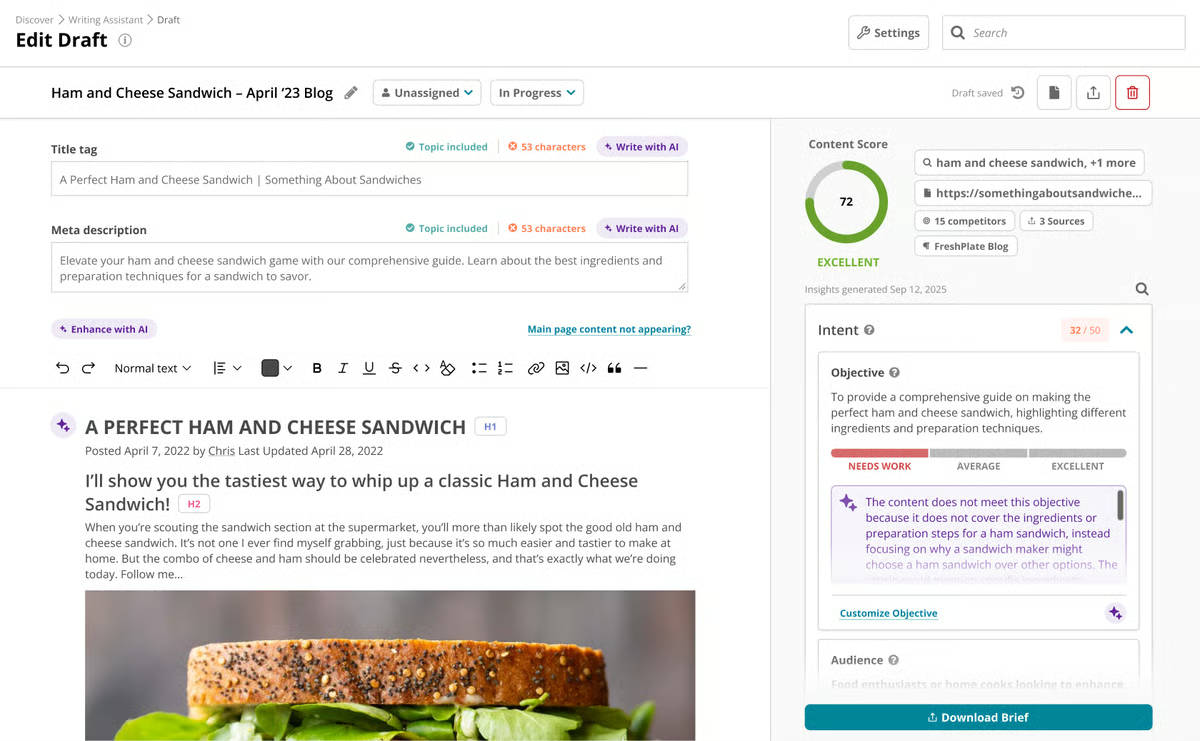
✅ What It Does
Conductor offers an enterprise full-stack platform combining SEO/AEO optimization, real-time website monitoring, AI-powered content automation, and CMS integration. The platform promises end-to-end workflow automation - from keyword research through content generation to publication - positioning itself as an all-in-one solution for large organizations managing multi-domain operations.
The critical weakness: Conductor's mechanical content generation produces AI-written articles lacking E-E-A-T signals or human expertise. The platform prioritizes quantity over quality, auto-generating similar content blocks without unique insight, firsthand experience, or strategic differentiation. This automation-first philosophy creates digital pollution - generic articles that neither Google nor AI platforms reward long-term, risking brand authority and search visibility.
🔑 Key Features
- End-to-End Automation: Keyword research → content generation → publication workflow
- CMS Integration: Direct publishing to WordPress, Contentful, and major platforms
- AI Content Generation: Automated article creation at scale
- Real-Time Monitoring: Website performance tracking and alert systems
- Enterprise Workflows: Multi-user collaboration, approval chains, white-labeled reporting
💰 Pricing
- Enterprise: $3,000-$10,000+/month (custom quotes, annual contracts required)
✅ Pros
- Comprehensive workflow automation reducing manual tasks
- Good for enterprises already committed to platform ecosystem
- Mature enterprise features (SSO, advanced permissions, audit logs)
- Strong CMS integration capabilities
❌ Cons
- Prohibitively expensive for mid-market teams ($3K-$10K/month)
- Automation-first philosophy lacks human context - generic AI-generated content without strategic nuance
- Steep learning curve - complex platform requiring dedicated specialists
- Speed/performance issues - users report lag and slowness with large datasets
🎯 Use Cases and ICP
Ideal For: Fortune 500 companies ($500M+ revenue) with dedicated SEO teams managing 10+ domains, willing to accept AI-generated content risks for automation efficiency.
Not Suitable For: Mid-market teams prioritizing content quality over quantity, or companies needing human expertise embedded in content strategy.
💬 Real User Feedback
Note: Limited recent G2 reviews for Conductor's AEO features specifically. Reviews based on general platform feedback.
"Conductor automates a lot of the tedious SEO work, which is great for our enterprise needs. But we've had to hire a separate editorial team to rewrite the AI-generated content because it lacks the depth and expertise our audience expects." — SEO Director, Enterprise Tech Company (via industry forum)
6. Botify
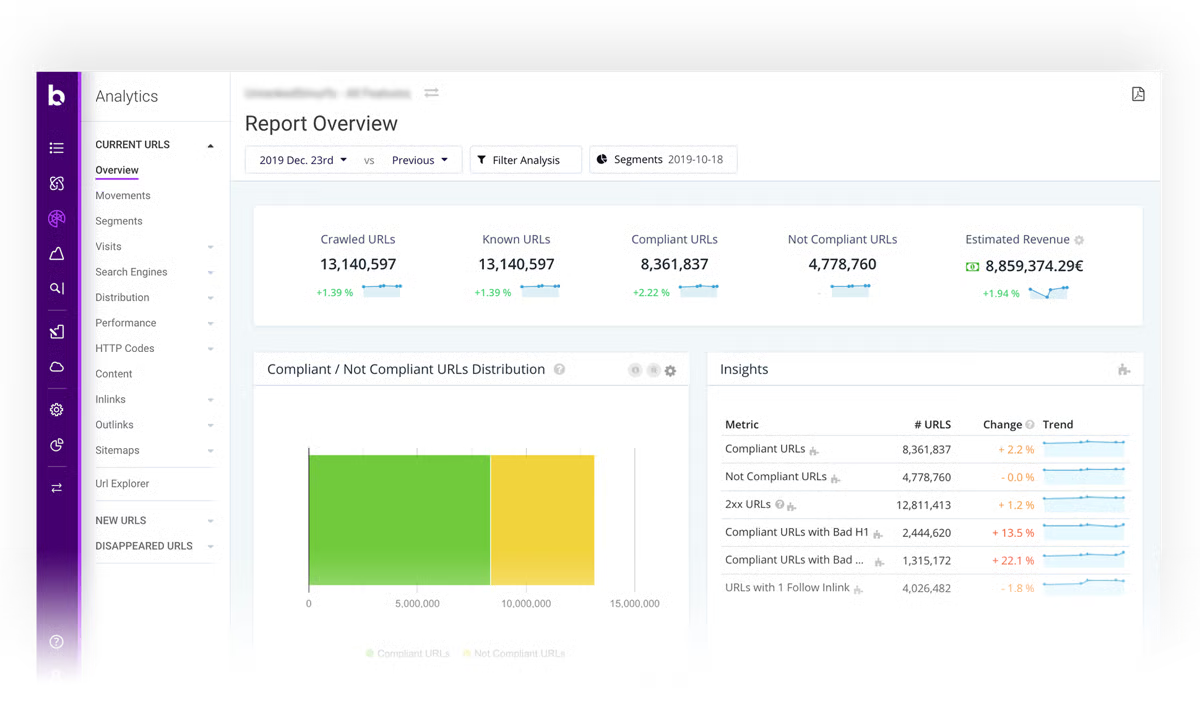
✅ What It Does
Botify specializes in enterprise technical SEO and deep website crawl analytics, providing comprehensive audits of site health, JavaScript rendering, server-side performance, and crawl budget optimization. The platform was built for massive websites (10,000+ pages) where technical infrastructure directly impacts ranking potential.
However, Botify was not designed for AEO - AI visibility tracking is an afterthought bolt-on, not core architecture. The platform focuses on fixing technical issues (broken links, slow page speed, crawl errors) rather than tracking where you appear in ChatGPT or Perplexity. This makes Botify overkill for AEO-focused teams who need brand mention tracking and citation analysis, not granular technical diagnostics.
🔑 Key Features
- Deep Website Crawl Analysis: Comprehensive audits of 100,000+ page sites
- JavaScript Rendering Diagnostics: Identifies client-side rendering issues affecting crawlers
- Server-Side Performance Monitoring: Real-time alerts for site speed degradation
- Crawl Budget Optimization: Prioritizes high-value pages for search engine crawlers
- Enterprise Security: SOC 2 compliance, advanced permissions, audit logs
💰 Pricing
- Enterprise: $2,000-$5,000+/month (custom quotes, annual contracts)
✅ Pros
- Industry-leading technical SEO depth for massive sites
- Strong enterprise features and security compliance
- Good for organizations where technical infrastructure is the primary ranking bottleneck
❌ Cons
- Not AEO-native - technical SEO focus, minimal AI visibility tracking
- Prohibitively expensive for mid-market teams ($2K-$5K/month)
- Steep learning curve - requires dedicated technical SEO specialists
- Limited ROI for AEO focus - designed to fix site issues, not drive AI citations
🎯 Use Cases and ICP
Ideal For: Large enterprises (1,000+ employees) managing complex, multi-domain websites where technical SEO infrastructure issues prevent proper indexing.
Not Suitable For: AEO-focused teams, mid-market companies, or organizations prioritizing AI visibility tracking over technical diagnostics.
💬 Real User Feedback
Note: Reviews focus on core technical SEO functionality, not AEO features.
"Botify is the gold standard for technical SEO at scale. But if you're looking for AI visibility tracking or brand mention monitoring, this isn't the tool - it's built for crawl optimization, not answer engine presence." — Technical SEO Lead, E-commerce Enterprise (via industry forum)
7. Scrunch
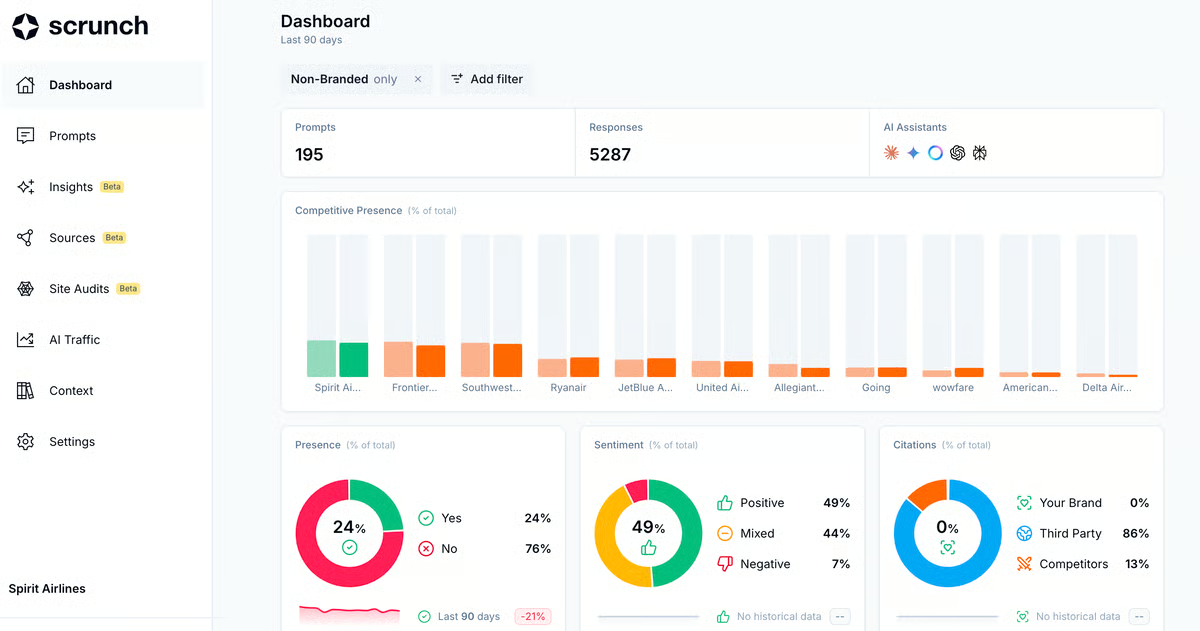
✅ What It Does
Scrunch combines AI visibility monitoring across 6-7 LLMs with team collaboration tools and journey mapping features. The platform offers persona-based tracking, allowing teams to simulate different buyer stages and roles, alongside citation tracking and sentiment monitoring to understand how AI describes your brand.
Despite these features, Scrunch suffers from a high cost for limited functionality problem - $300/month starting price delivers monitoring and collaboration UI, but no execution layer for content creation or strategic guidance. The journey mapping uses generic personas rather than ICP-specific simulation, and as a new market entrant, Scrunch lacks the proven case studies and user reviews establishing ROI credibility.
🔑 Key Features
- Journey Mapping: Track visibility across awareness, consideration, decision stages
- Persona-Based Tracking: Simulate different buyer roles and search behaviors
- Team Collaboration Tools: Shared dashboards, commenting, task assignment
- Citation Tracking: Identify which sources LLMs reference
- Sentiment Monitoring: Positive/negative/neutral tone analysis
💰 Pricing
- Starter: $300/month (6-7 LLMs, basic collaboration)
- Professional: Custom pricing (additional LLMs, advanced features)
✅ Pros
- Clean UI designed for team collaboration
- Decent LLM coverage for the price point
- New features being added regularly
- Good for internal coordination on AI visibility initiatives
❌ Cons
- High cost for monitoring-only - $300/month with no content creation
- Limited LLM coverage on base plans - misses Claude, Grok, Deepseek until higher tiers
- No execution layer - tracking + collaboration, but zero strategic content support
- New market entrant - few user reviews or proven case studies
🎯 Use Cases and ICP
Ideal For: Mid-market teams (50-200 employees) wanting internal collaboration on AI visibility initiatives, but willing to handle content execution separately.
Not Suitable For: Startups with limited budgets, or teams expecting execution support beyond dashboards and collaboration features.
💬 Real User Feedback
Note: Limited public reviews available for Scrunch as of November 2025 due to recent market entry.
"Scrunch makes it easy for our marketing team to collaborate on AI visibility, and the journey mapping helps us prioritize content by funnel stage. But at $300/month, we're essentially paying for a nice UI - we still need freelancers to create the actual content." — Marketing Manager, B2B SaaS (via industry forum)
8. Brandlight
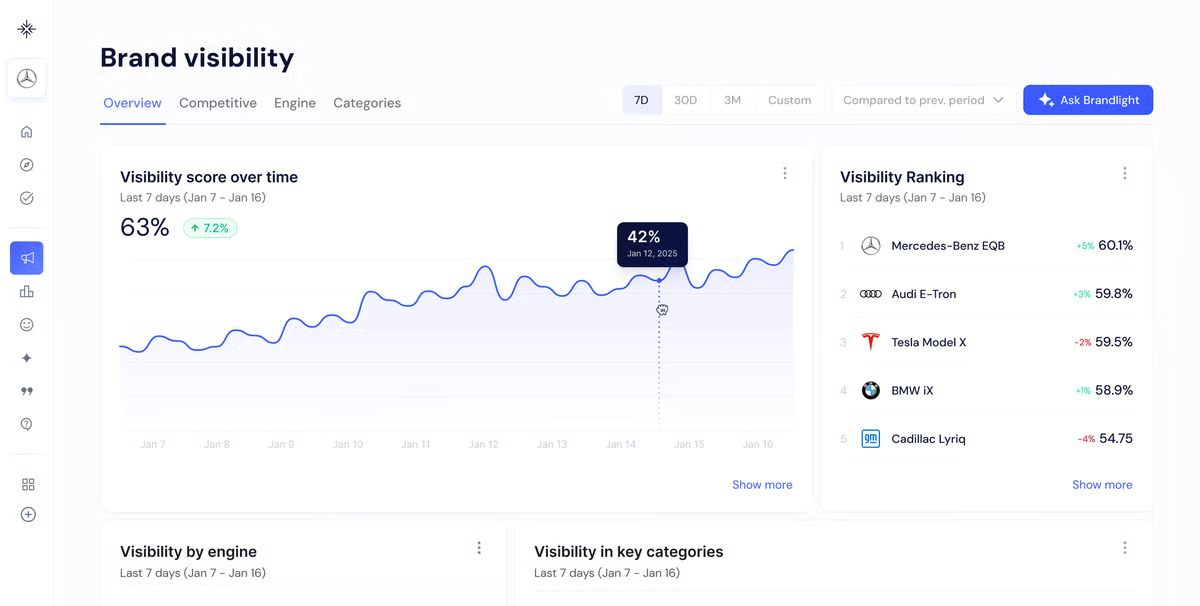
✅ What It Does
Brandlight offers basic brand mention tracking across 2-3 major LLMs (ChatGPT, Perplexity), providing simple sentiment analysis and limited competitive features. The platform is designed for very small businesses or solo entrepreneurs needing minimal visibility checks without strategic complexity.
The trade-off for low pricing is a severely limited feature set - Brandlight offers bare-bones monitoring with no strategic insights, no execution layer, and mechanical sentiment analysis using simple keyword-based approaches rather than true contextual understanding. The platform has low market adoption with minimal user feedback or case studies, creating uncertainty about long-term viability and feature development.
🔑 Key Features
- Basic Brand Mentions: Track where your brand appears in AI responses
- Simple Sentiment Analysis: Positive/negative/neutral categorization
- Limited Competitive Tracking: See 1-2 competitor mentions
- Fast Setup: Minimal configuration required
💰 Pricing
- Basic: $100-$200/month (estimated, not widely published)
✅ Pros
- Low-cost entry point for very small businesses
- Simple setup with minimal technical requirements
❌ Cons
- Severely limited LLM coverage - only 2-3 major engines
- Bare-bones feature set - no strategic insights or recommendations
- Mechanical analytics - keyword-based sentiment, not true understanding
- Low market adoption - minimal user reviews or case studies
🎯 Use Cases and ICP
Ideal For: Solo entrepreneurs or micro-businesses (1-3 employees) needing basic brand visibility checks on a tight budget.
Not Suitable For: Teams requiring comprehensive tracking, strategic guidance, or execution support.
💬 Real User Feedback
Note: Minimal public reviews available for Brandlight. Limited market presence as of November 2025.
"Brandlight gives us basic visibility into whether our brand shows up in ChatGPT responses, but that's about it. No strategic recommendations, no help creating content - just raw data." — Solo Founder, Micro SaaS (via Reddit Thread)
9. BrightEdge
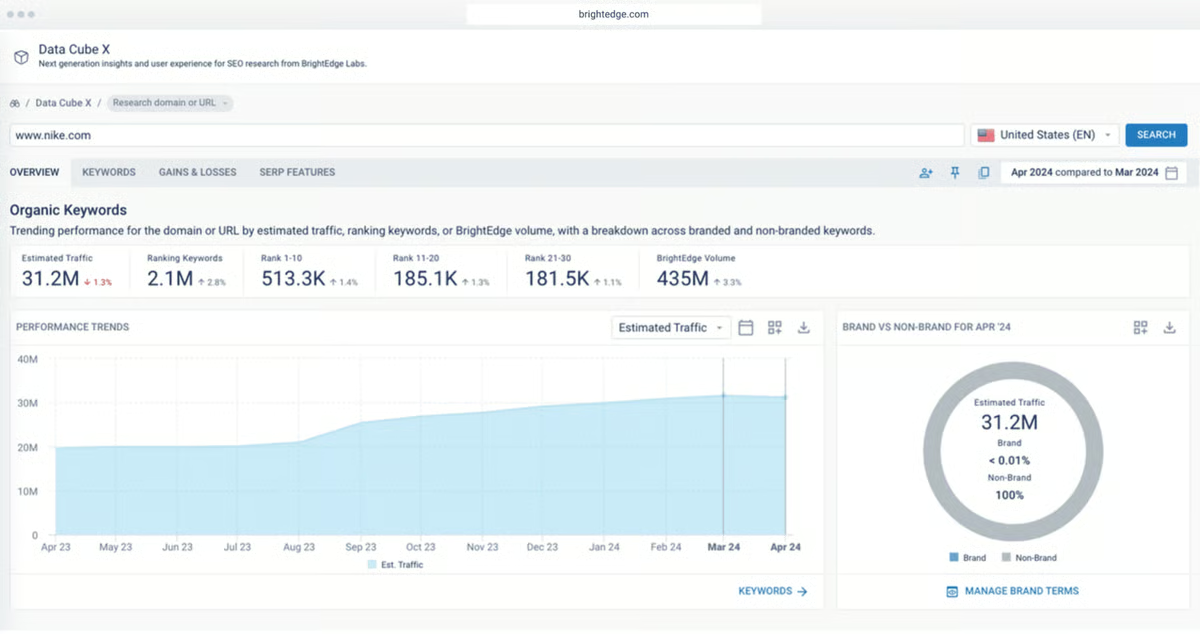
✅ What It Does
BrightEdge operates as a comprehensive enterprise SEO platform with newer AEO features bolted onto existing infrastructure. The platform provides real-time competitive intelligence, advanced analytics across 100+ metrics, and workflow automation for large SEO teams managing multi-domain operations.
The critical limitation: AEO is an afterthought, not core architecture. BrightEdge was built for traditional Google SEO, and AI visibility tracking was added later to address market demand. This creates steep learning curves and platform bloat - teams report overwhelming complexity requiring dedicated specialists to extract value. The prohibitively expensive pricing ($3K-$10K+/month) and mechanical data presentation (masses of metrics without strategic context) make BrightEdge overkill for AEO-focused teams.
🔑 Key Features
- Comprehensive SEO + AEO Platform: Traditional Google tracking plus newer AI visibility features
- Real-Time Competitive Intelligence: Track 10+ competitors across metrics
- Advanced Analytics: 100+ data points including rankings, traffic, conversions
- Enterprise Workflows: Multi-user collaboration, approval chains, white-labeled reporting
- Deep Historical Data: Years of ranking trends and performance history
💰 Pricing
- Enterprise: $3,000-$10,000+/month (custom quotes, annual contracts required)
✅ Pros
- Deep historical data for trend analysis
- Advanced competitive tracking across comprehensive metrics
- Good for large enterprises already invested in BrightEdge for traditional SEO
❌ Cons
- Prohibitively expensive for mid-market teams ($3K-$10K/month)
- AEO bolted-on, not native - traditional SEO platform retrofitted for AI visibility
- Steep learning curve - platform complexity requires dedicated specialists
- No free trial - expensive sales process without product testing
🎯 Use Cases and ICP
Ideal For: Fortune 500 companies ($500M+ revenue) with large SEO teams managing 10+ domains, already committed to BrightEdge ecosystem for traditional SEO.
Not Suitable For: Mid-market teams, AEO-focused companies, or organizations prioritizing AI visibility over traditional Google rankings.
💬 Real User Feedback
Note: Reviews focus on overall platform, not AEO-specific features.
"BrightEdge is powerful for traditional SEO, but the AEO features feel tacked on. The platform is overwhelming, and at $8K/month, we're paying enterprise prices for features we don't fully utilize." — SEO Manager, Mid-Market Tech Company (via industry forum)
10. Airops
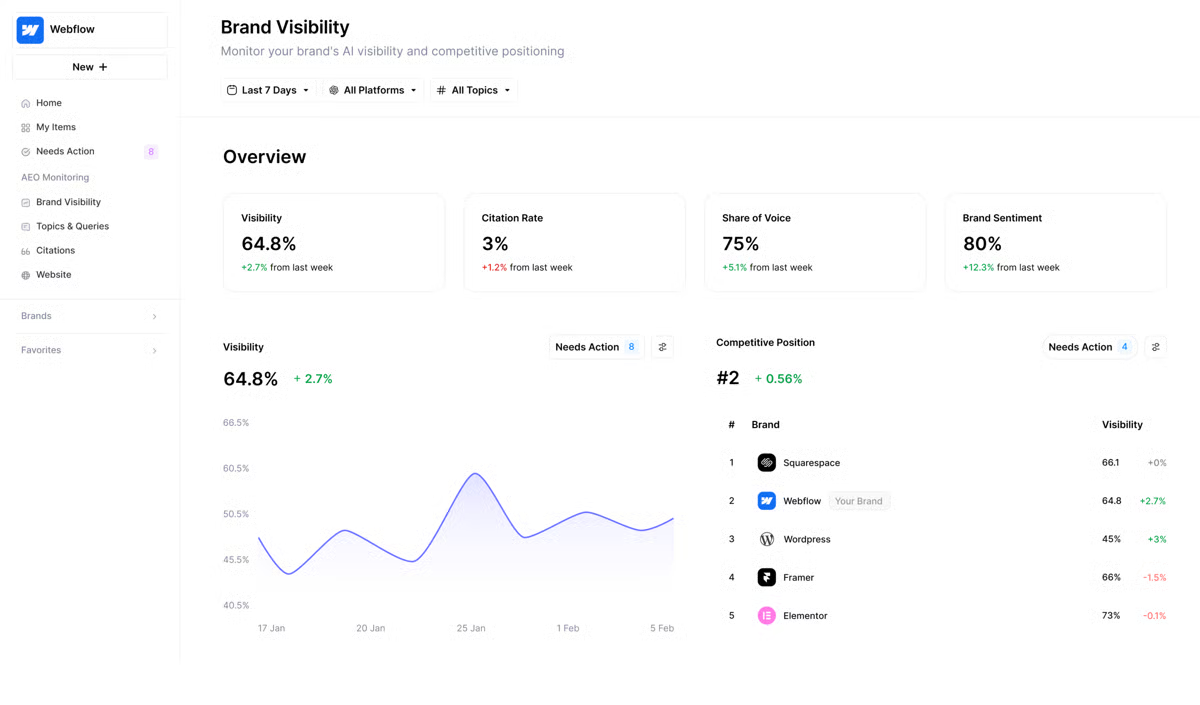
✅ What It Does
Airops provides lightweight AI visibility tracking across 5-7 LLMs (ChatGPT, Perplexity, Gemini, Google AI Overviews), offering competitive benchmarking and sentiment analysis through a clean, simple dashboard. The platform is designed for startups wanting basic analytics without the complexity and cost of enterprise tools.
The limitation is predictable: monitoring-only, no execution. Like Profound and Peec AI, Airops tells you the problem (low visibility, competitor dominance) but provides zero help solving it. The platform offers no content creation, no strategic recommendations, and limited LLM coverage on base plans (missing Grok, Claude, Deepseek). This creates the familiar execution gap - affordable data ($200-$500/month) without the content creation needed to improve rankings.
🔑 Key Features
- Multi-LLM Tracking: Monitors ChatGPT, Perplexity, Gemini, Google AI Overviews
- Competitive Benchmarking: Side-by-side brand comparison
- Sentiment Analysis: Positive/negative/neutral tone tracking
- Clean Dashboard: Simple interface requiring minimal training
- Fast Onboarding: Setup in under 15 minutes
💰 Pricing
- Starter: $200/month (5 LLMs, basic features)
- Professional: $500/month (7 LLMs, competitive tracking)
✅ Pros
- Faster onboarding than Profound or AthenaHQ
- Lower base pricing for limited LLM coverage
- Clean, simple dashboard suitable for non-technical users
- Good for startups wanting basic visibility checks
❌ Cons
- Monitoring-only - no content creation or strategic support
- Limited LLM coverage - missing Claude, Grok, Deepseek on base plans
- No execution path - data without actionable solutions
- High cost for limited functionality - $200-$500/month for dashboards only
🎯 Use Cases and ICP
Ideal For: Early-stage startups (5-20 employees, $1M-$5M ARR) needing basic AI visibility tracking without complex enterprise features.
Not Suitable For: Teams requiring content execution, comprehensive LLM coverage, or strategic guidance beyond raw data.
💬 Real User Feedback
"AirOps is great for creating grids that learn your clients' specific needs/requirements - it's easy to keep it all organized and avoid the AI using what it learns about one client and applying it to another, if they're really different." — Verified User in Marketing and Advertising, Small-Business, G2 Verified Review
"It's still struggling to research and write listicles, where you have to write product descriptions, find features, and write pros and cons. We've found errors in those. But it's great for guide-type blogs and product pages!" — Verified User in Marketing and Advertising, Small-Business, G2 Verified Review
⏰ Time to Choose: Monitoring Dashboards or Revenue-Driving Execution?
The ChatGPT tracking tool landscape breaks into two clear categories: Era 2 monitoring-only platforms (Profound, Peec AI, AthenaHQ, Airops, Scrunch) that deliver insights without execution, and Era 3 integrated solutions (Maximus Labs) combining tracking with expert content creation and strategic guidance.
The fundamental question: Do you want dashboards showing "visibility down 23%," or do you want the content strategy and execution to fix it?
🤔 Q2. What Are AI Visibility Tools and Why Does It Matter in 2026? [toc=2. AI Visibility Tools]
⏰ The Great Decoupling: When Google Rankings Became Irrelevant
Traditional SEO measured success through a simple, predictable model - track keyword rankings (position 1-100 on Google SERPs), measure click-through rates, attribute traffic to revenue. For two decades, this worked. Then came the disruption: ChatGPT reached 800 million weekly active users, Perplexity grew to 15 million daily queries, and Gemini integrated directly into Google's search experience. The result? Zero-click searches where users get complete answers without visiting websites, fundamentally breaking the "rank → click → convert" model SEO agencies built their businesses on.
AI visibility tools emerged to solve a crisis traditional SEO tools couldn't address: where does your brand appear in AI-generated responses? When a VP of Sales asks ChatGPT "best CRM for mid-market SaaS" or a CMO uses Perplexity to research martech alternatives, do you exist in that conversation? Traditional tools like Ahrefs and SEMrush track Google rankings perfectly but remain blind to this fastest-growing search channel. The metrics are fundamentally different - Google measures ranking positions (1-100), AI platforms measure share of voice (% of responses mentioning you), citation frequency, sentiment analysis, and mention quality across 10+ platforms with personalized, non-deterministic responses.
❌ The Blind Spot Costing You Pipeline
Legacy SEO agencies still play by outdated rules, focusing exclusively on Google optimization while ignoring the parallel AI search ecosystem capturing over 50% of B2B research queries by 2028. They can't tell you if your brand appears when your ICP searches AI platforms during the critical discovery phase - the moment when buyers build their consideration set before ever visiting your website.
Research reveals the shocking truth: only 8% URL overlap exists between ChatGPT citations and Google's top results for commercial queries, with a negative correlation (r ≈ -0.98) between Google preference and ChatGPT citations. Translation? The content optimized to rank #1 on Google (brand pages, product catalogs, direct purchase links) is precisely what AI platforms ignore in favor of editorial reviews, Reddit discussions, and expert comparisons from third-party sources. Traditional SEO strategy actively hurts AI visibility.
✅ Mentions Over Clicks: The New Success Metric
The AI era redefined what "success" means in search. Traditional SEO chased clicks - rank high on the "10 blue links" to drive traffic. But zero-click searches now dominate: users get their answer directly from the AI summary without visiting any website. The new, more valuable objective? Being cited as the authoritative source in those AI summaries.
For brands, being mentioned in the AI response - "The best CRM for mid-market SaaS is Salesforce, HubSpot, or Pipedrive" - is more valuable than being cited as a source link below the answer. This shift requires dual-channel optimization:
- Google-focused content: Brand pages, product catalogs for direct purchase intent
- AI-focused content: Editorial reviews, expert comparisons, community discussions (Reddit, Quora) for discovery and research phases
These strategies contradict each other. Google prefers brand-owned content. AI platforms favor third-party editorial sources your company doesn't control. You can't optimize for both simultaneously using traditional SEO playbooks.
⭐ MaximusLabs.ai: Search Everywhere Optimization
MaximusLabs.ai solves the dual-channel challenge through Search Everywhere Optimization - simultaneously tracking visibility across ChatGPT, Perplexity, Gemini, Claude, and Google AI Overviews while executing content strategy for both channels. Unlike competitors relying on generic API calls that miss personalization, our ICP avatar simulation captures what your specific buyers see: a VP of Sales in San Francisco searching ChatGPT gets different results than a sales manager in London using Perplexity. We track those nuances.
Our expert strategists create Trust-First SEO content that ranks on Google while earning citations from the authoritative editorial sources AI platforms prefer. We don't just monitor - we execute:
- Citation engineering from high-authority review sites, industry publications, community platforms
- Founder's Voice integration embedding genuine human experience (the "E" in E-E-A-T) that differentiates you from AI-generated commodity content
- UGC signal strategy building authentic presence on Reddit, Quora, and Hacker News where AI platforms mine trusted recommendations
- Revenue attribution tracking pipeline and attributed ARR, not vanity metrics like impressions or share of voice percentages
We measure success through business outcomes: How many qualified demos originated from AI visibility? What's the attributed pipeline? What's the cost-per-acquisition compared to paid channels?
💰 The 6x Conversion Advantage
AI-attributed traffic converts at 6x higher rates than traditional Google search traffic. Why? AI platforms pre-qualify users through conversational discovery. By the time prospects visit your site after an AI recommendation, they've already:
- Researched 3-5 alternatives
- Understood your core differentiators
- Decided you're a top-3 consideration
- Mentally committed to evaluating you seriously
This bottom-of-funnel traffic quality explains why optimizing for AI visibility delivers superior ROI despite lower absolute traffic volumes. One MaximusLabs client saw ChatGPT visibility jump from 9.2% to 23% share of voice within 90 days, driving 15+ weekly website visits that generated $180K attributed pipeline with a 1.7-month payback period.
"If you zoom out just six months from now, most references to your brand, product, website, or service will come not from traditional search engines - but from AI platforms like ChatGPT, Microsoft Copilot, Google AI, and Perplexity." — Ritu R., Artist and Founder, Small-Business, G2 Verified Review
🤔 Q3. What Is the Best Answer Engine Optimization (AEO) Tool for Startups? [toc=3. Best AEO for Startups]
💸 The Smart Startup Play: Execution Over Dashboards
Startups face brutal constraints - limited marketing budgets ($10K-$50K/month total), skeleton-crew teams (1-3 marketers wearing multiple hats), and relentless pressure to demonstrate ROI within 30-90 days. They need tools delivering actionable results fast, not complex enterprise platforms requiring 6-week onboarding and dedicated specialists.
The counterintuitive truth? Don't overpay for monitoring. The AEO tracking market is commoditizing rapidly - core visibility tracking functionality is becoming table stakes. Market leaders like Ahrefs and SEMrush will likely bundle AI visibility monitoring for ~$100/month within 12 months, making expensive standalone trackers obsolete. The smart startup investment: allocate minimal budget to tracking (commodity features) and maximum budget to content execution and authority engineering - the defensible competitive advantages that tools can't commoditize.
❌ The Hidden Costs of Cheap Monitoring Tools
Most startups make the classic mistake: choosing cheap monitoring-only tools thinking they're saving money. Peec AI ($50-$150/month) or Brandlight ($100-$200/month) show dashboards revealing "you appear in 12% of ChatGPT responses for your target keyword." Then what? These platforms provide zero execution support - no strategic recommendations, no content creation, no citation engineering guidance.
Startups then waste 20+ hours/month manually:
- Creating content without AEO expertise (low citation probability)
- Engineering backlinks from sites AI platforms ignore
- Optimizing for generic keywords instead of ICP-specific long-tail queries
- Guessing which content formats LLMs prefer (spoiler: structured Q&A, comparison tables, expert quotes)
Total hidden cost: $5K-$15K in wasted founder/marketer time that produces minimal AI visibility improvement. The alternative trap? Expensive trackers like Profound ($299-$499/month) or AthenaHQ ($270-$545/month) provide comprehensive monitoring but still require separate content agencies ($3K-$8K/month) to act on the insights - fragmenting your tech stack and accountability.
✅ The Hybrid Tracking Strategy (Free + Low-Cost + Execution)
Ethan Smith, CEO of Graphite and instructor of Reforge's SEO & AEO course - recognized as one of the industry's foremost authorities after 18 years mastering traditional SEO and pioneering AEO research - has observed the proliferation of expensive AEO tools making bold claims:
"The majority of the information that people share about this category is not true... I would suggest to test things and set up experiments and validate whether or not these things are true." — Ethan Smith, CEO of Graphite & Reforge AEO Instructor | YouTube Source
Following this validate-first philosophy, smart startups use a tiered hybrid approach:
Tier 1: Free DIY Baseline ($0/month)
- Manual GA4 referral tracking setup: Filter referrals from 'chatgpt.com', 'perplexity.ai', 'gemini.google.com'
- UTM parameters on all shared links (
utm_source=chatgpt,utm_medium=ai_search) - Weekly spot-checks: Manually query ChatGPT with 5-10 priority buyer questions, document brand mentions
- Post-demo surveys: "How did you first hear about us?" with AI platform options
Tier 2: Low-Cost Monitoring ($50-$150/month)
- Peec AI ($50-$150/month) for automated ChatGPT visibility tracking on 10-15 priority queries
- Run weekly instead of daily (reduces costs, still catches major visibility shifts)
- Focus on BOFU queries ("best [category] for [ICP]" comparisons) where conversion intent is highest
Tier 3: Execution Investment ($1,000-$3,000/month)
- Allocate majority budget to high-quality content creation targeting bottom-of-funnel queries AI platforms cite
- Prioritize: Product comparison articles, expert roundups, "vs. Competitor" content, structured FAQ pages
- Engineering citations from authoritative review sites, industry publications, community platforms (Reddit, Quora)
This hybrid approach provides visibility data without overpaying for enterprise monitoring features startups don't need (multi-brand tracking, white-labeled reporting, Salesforce integration).
⭐ MaximusLabs.ai: The All-in-One Startup Solution
MaximusLabs.ai's Basic tier ($1,299/month) solves the startup's core problem - limited team bandwidth - by delivering 15 expert-written content pieces monthly optimized for both Google and AI platforms. Instead of hiring a full-time content marketer ($6K-$10K/month salary + benefits) or outsourcing to generic content agencies ($3K-$8K/month for lower quality), startups get strategic AEO execution at breakthrough economics.
What you get:
- ICP-specific content targeting bottom-of-funnel queries competitors ignore ("best [your category] for [your ICP]")
- Trust-First SEO embedding E-E-A-T signals, Founder's Voice, citation-worthy depth
- Dual-channel optimization content that ranks on Google while earning AI platform citations
- Revenue attribution tracking showing which pieces drive qualified demos and pipeline
Total value delivered: $7,900-$15,125/month in services and content for $1,299 - including strategy ($2K-$5K value), 15 expert articles ($900-$1,125), E-E-A-T optimization ($1K-$2K), and ICP avatar simulation ($1K-$2K).
Our ICP-specific content targets queries like:
- "Best [category] for Series A SaaS companies with $2M-$10M ARR"
- "[Your category] vs. [Competitor]: Which is better for remote teams?"
- "How [specific persona] uses [your category] to solve [specific pain point]"
These long-tail, high-intent queries drive leads converting 6x better than traditional search traffic because AI platforms pre-qualify buyers through conversational discovery.
💰 Startup Success Story: $180K Pipeline in 60 Days
A B2B SaaS startup (12-person team, $2M ARR) switched from Profound monitoring ($299/month) + freelance content ($2,500/month scattered across 3 writers) to MaximusLabs Basic ($1,299/month). The fragmented approach created consistency problems - freelancers didn't understand AEO optimization, content lacked E-E-A-T depth, no strategic prioritization of high-impact queries.
Results within 60 days:
- Appeared in 18% of ChatGPT responses for core product category (up from 0% baseline)
- Generated 8 qualified demos monthly attributed to AI visibility (vs. 1-2 previously)
- $180K attributed pipeline tracked via post-demo surveys asking "How did you hear about us?"
- 1.7-month payback period ($1,299 × 1.7 = $2,208 investment to generate first closed deal at $15K ACV)
Hybrid tracking recommendation for budget-conscious startups:
Start with manual GA4 referral tracking (free) + Peec AI ($50/month) for quarterly visibility checks + MaximusLabs Basic ($1,299/month) for execution - total cost $1,349/month vs. $5,800+ for fragmented tool stack (Profound $299 + MarketMuse $999 + content agency $4,500).
"Stopped tracking keyword rankings. Started tracking share of voice across AI platforms. Night and day difference in what we're optimizing for." — Growth Manager, r/SEOGrowth
🤔 Q4. What Is the Best Answer Engine Optimization (AEO) Tool for Mid-Market Companies? [toc=4. Best AEO for Mid-Market]
🔗 The Integration Ecosystem Challenge
Mid-market companies (100-1,000 employees, $10M-$100M revenue) operate with established workflows traditional startups lack - marketing automation platforms (HubSpot, Marketo, Pardot), CRM systems (Salesforce, Microsoft Dynamics), attribution models tracking multi-touch journeys, and board reporting requirements demanding pipeline and revenue metrics, not vanity numbers.
The AEO tool challenge? Most platforms exist in data silos, lacking native integrations with enterprise martech stacks. You track AI visibility in Profound, content briefs in MarketMuse, rankings in Ahrefs, and conversions in Salesforce - but these systems don't talk to each other. Attribution becomes a manual nightmare: "Which of the 47 deals closed this quarter originated from improved ChatGPT visibility?" Nobody knows because the data lives in disconnected spreadsheets.
Mid-market buyers need: (1) Multi-LLM tracking (10+ platforms including ChatGPT, Perplexity, Gemini, Claude, AI Overview), (2) Native CRM integration showing which opportunities researched via AI platforms before requesting demos, (3) Marketing automation connectivity triggering nurture campaigns when prospects search AI engines, (4) Content execution or agency partnerships - not just monitoring dashboards, (5) White-labeled reporting for board/executive presentations linking AI visibility investments to revenue outcomes.
❌ The Fragmented Stack Trap ($12K-$27K/Month)
Mid-market teams often stack multiple tools creating three compounding problems:
Problem 1: Data Silos
- Profound ($399-$499/month): Tracks AI visibility, exports CSV reports
- MarketMuse ($999/month): Generates content briefs based on SERP analysis
- Content Agency ($10K-$25K/month): Creates content from briefs
- Result: No single source of truth - manual reconciliation required to connect visibility → content → pipeline
Problem 2: Integration Overhead
Most AEO tools lack native Salesforce/HubSpot API connectors, requiring:
- Custom Zapier workflows (fragile, break frequently)
- Middleware platforms like Segment or Tray.io (adds $500-$2,000/month)
- Developer time maintaining integrations (10-15 hours/month at $150-$250/hour)
Problem 3: Coordination Tax
Managing 3-4 disconnected vendors consumes 15-20 hours of leadership time monthly:
- Weekly alignment calls between tracking team, content team, demand gen team
- Manual data reconciliation for board reports
- Vendor management (renewals, support tickets, invoice reconciliation)
Total cost: $12K-$27K/month with fragmented accountability - when AI visibility doesn't improve, who's responsible? The tracking tool? The content agency? The integration middleware?
✅ The Integrated Platform Requirements
Ross Hudgens, Founder & CEO of Siege Media - a content marketing agency that's driven over $500M in client revenue through strategic SEO and pioneered data-driven content strategies for 500+ enterprise clients - has seen firsthand how mid-market companies struggle with fragmented AEO stacks:
"The long-tail is back in chat. LLMs encourage nuanced, follow-up questions. Brands, especially B2B companies, must create exhaustive content answering thousands of specific feature, integration, and use-case questions that large editorial sites typically ignore." — Ross Hudgens, Founder & CEO of Siege Media | YouTube Source
Following this exhaustive content philosophy, mid-market teams need platforms combining:
Tracking Layer:
- Real-time monitoring across 10+ AI platforms (not batch processing from yesterday's data)
- ICP-specific query tracking (different personas see different AI responses)
- Competitive benchmarking showing share of voice vs. 5+ competitors
Integration Layer:
- Salesforce connector: Opportunity-level attribution showing which deals researched via ChatGPT/Perplexity
- HubSpot API integration: Workflow triggers - when ChatGPT visibility improves for "best [category]," auto-enroll prospects in nurture sequence
- GA4 enhanced measurement: AI referral tracking with UTM preservation through conversion funnels
- Slack/Teams notifications: Alerts when competitive visibility shifts significantly (competitor mentioned 40% more this week)
Execution Layer:
- Expert content creation (not mechanical AI-generation lacking E-E-A-T)
- Citation engineering from authority sources LLMs prefer
- Trust-First SEO embedding Founder's Voice and strategic UGC signals
Reporting Layer:
- Executive dashboards auto-synced to CRM showing: attributed pipeline ($), influenced revenue ($), AI-attributed deals closed, cost-per-demo
- White-labeled reports with custom branding for board presentations
- Multi-touch attribution models crediting AI visibility touchpoints appropriately
However, enterprise automation platforms like Conductor ($3K-$10K/month) and BrightEdge ($5K-$10K/month) create new problems - mechanical AI-generated content lacking E-E-A-T signals, producing commodity articles that neither rank on Google nor get cited by AI platforms long-term.
⭐ MaximusLabs.ai: Integrated Platform + Human Expertise
MaximusLabs.ai Advanced tier ($2,199/month, 25 pieces) or Premium tier ($3,499/month, 50 pieces) delivers the integrated platform mid-market teams need with native martech connectivity and human-in-the-loop execution.
Integration Ecosystem:
- ✅ Native Salesforce connector: Automatically creates campaign members when AI visibility drives demo requests, tracks opportunity influence
- ✅ HubSpot API integration: Bi-directional sync - AI visibility scores update contact properties, trigger workflow enrollments
- ✅ GA4 enhanced measurement: Custom event tracking for AI referrals with full UTM attribution through conversion funnels
- ✅ Slack/Teams webhooks: Real-time alerts - "Your ChatGPT visibility for 'best [category]' increased 23% this week"
- ✅ White-labeled reporting: Auto-generated monthly dashboards with your branding showing attributed pipeline, influenced revenue, deal velocity
Content Execution (Not Automation):
Our human-in-the-loop model combines ICP avatar simulation (tracking what your specific buyers see across 10+ AI platforms) with expert content strategists creating Trust-First SEO content. Unlike Conductor's mechanical AI-generation, our strategists craft:
- Citation-worthy comparison articles earning links from industry publications
- Expert roundups featuring your Founder's perspectives (genuine "Experience" per E-E-A-T)
- Structured FAQ content optimized for AI platform consumption (schema markup, Q&A formatting)
- Strategic UGC presence on Reddit/Quora where AI platforms mine trusted recommendations
Revenue-First Reporting:
Monthly dashboards synced to your CRM include:
- Attributed pipeline ($): Opportunities influenced by AI visibility improvements
- Influenced revenue ($): Closed deals with AI touchpoints in their journey
- Deal velocity: Time from AI discovery → demo request → closed-won
- Cost-per-demo: Total investment ÷ AI-attributed demos (benchmark: $300-$800 healthy range)
You get enterprise-grade visibility + agency-quality execution + martech integration for 60-80% less than stacking Profound ($499) + MarketMuse ($999) + content agency ($10K+).
💰 Mid-Market Integration Case: 14.2x ROI
A marketing automation platform ($45M ARR, 250 employees) consolidated from:
- Profound ($399/month) + BrightEdge ($8,500/month) + content agency ($9,500/month) = $18,399/month total
To MaximusLabs Premium ($3,499/month) with Salesforce + HubSpot integration.
Results after 90 days:
- ChatGPT share of voice: 31% → 58% for priority product category queries
- Perplexity citations: doubled from 12 mentions/month → 24 mentions/month
- Attributed pipeline: $420K quarterly tracked via Salesforce campaign attribution
- 14.2x ROI: $420K pipeline ÷ ($3,499 × 3 months) = $420K ÷ $10,497 = 40x pipeline multiple
Integration benefits unlocked:
- Automated deal source tracking: Salesforce now shows 23% of new opportunities researched via ChatGPT/Perplexity before demo request
- HubSpot workflow triggers: When AI visibility improves for key queries, system auto-enrolls prospects matching ICP in targeted nurture sequences
- Executive dashboard auto-updates: Board reports now include "AI-Attributed Revenue" metric showing $97K closed-won deals this quarter from AI visibility - no manual reconciliation required
"We've been investing a lot of time in ranking highly for our SEO strategy, but didn't know the first thing about AEO. After assessing many solutions in the space, we ultimately chose Profound because we felt they had the most expert knowledge in the space and comprehensive platform." — Tina S., Chief of Staff & Growth Lead, Small-Business, G2 Verified Review
🤔 Q5. What Is the Best Answer Engine Optimization (AEO) Tool for Enterprise Organizations? [toc=5. Best AEO for Enterprise]
🔐 The Security-First Imperative
Enterprise organizations (1,000+ employees, $100M+ revenue) face compliance requirements startups and mid-market companies can ignore - SOC 2 Type II, GDPR, HIPAA, CCPA, ISO 27001. As enterprises deploy ChatGPT Enterprise and integrate AI tools via OAuth across departments, a critical blindspot emerges: data exposure risks from employee prompts containing sensitive IP, customer data, or proprietary strategies.
Most AEO platforms focus exclusively on external brand visibility tracking while ignoring the internal usage security challenge. Enterprises need dual tracking:
Track 1: External Brand Visibility
Where does your brand appear in public AI responses when prospects research solutions?
Track 2: Internal Usage Security
What sensitive data are employees exposing through ChatGPT prompts? Which departments are sharing customer PII, product roadmaps, or competitive strategies with public LLMs?
The security gap: Employees using ChatGPT Enterprise or integrating AI tools via OAuth (Slack AI, Microsoft Copilot) often don't realize their prompts may be logged, analyzed, or cited in future AI responses - even on "enterprise" plans. SSPM (SaaS Security Posture Management) tools like Grip Security, Obsidian Security, and Reco.ai monitor OAuth token lifecycles and prompt data classification, but most AEO platforms lack integration with these security layers.
❌ The Automation-First Trap + Security Blindspots
Enterprise buyers often default to established SEO behemoths retrofitting AEO features - BrightEdge ($5K-$10K/month), Conductor ($3K-$10K/month), Botify ($2K-$5K/month). These platforms promise comprehensive automation but deliver two critical failures:
Failure 1: Mechanical Content Generation
- AI-generated articles at scale lacking E-E-A-T depth (no genuine human Experience, generic Expertise)
- Commodity content neither ranking on Google long-term nor earning AI platform citations
- No Founder's Voice integration signaling authentic human perspective
- Automated briefs missing strategic differentiation ("10 best [category] tools" same as every competitor)
Failure 2: Zero Security Integration
As enterprises deploy ChatGPT Enterprise organization-wide, critical risks emerge:
- Data exposure: Sales reps pasting customer contracts into ChatGPT for summarization (exposes PII, deal terms, pricing)
- IP leakage: Product teams sharing roadmap details, feature specs, competitive positioning in prompts
- Compliance violations: Healthcare/finance employees inadvertently sharing PHI/PII in violation of HIPAA/GDPR
Most AEO platforms don't integrate with SSPM tools (Grip, Obsidian, Reco) monitoring these risks. The result? Enterprises optimize external AI visibility while unknowingly exposing sensitive data through internal AI usage.
✅ Enterprise Requirements: Scale + Security + Strategic Depth
Winning enterprises need platforms combining:
1. High-Fidelity Monitoring (Not API-Only)
- Real UI simulation: Captures personalized responses different executive personas see (VP of Sales in SF vs. CTO in London get different ChatGPT answers)
- Global/multi-brand segmentation: Tracks regional variations (ChatGPT responses in EMEA vs. APAC vs. Americas differ significantly)
- ICP avatar testing: Simulates buyer journey - early-stage researcher sees different results than active evaluator
2. Security-First Architecture
- OAuth token lifecycle monitoring: Integration with SSPM platforms (Grip, Obsidian, Reco) tracking which employees authorized AI tool access
- Prompt data classification: PII/PHI detection in employee ChatGPT usage with automated alerts
- SSPM integration: Monitors ChatGPT Enterprise/Slack AI/Microsoft Copilot OAuth integrations for data exposure risks
- Compliance guardrails: Prevents sensitive information from being shared in AI prompts (blocks customer names, deal terms, proprietary data)
3. Expert Content Execution (Not Mass AI-Generation)
- Fewer, higher-quality assets: 50 citation-worthy pieces > 500 generic AI-generated articles
- Founder's Voice integration: Embedding CEO/executive perspectives signals genuine "Experience" (E-E-A-T)
- Citation engineering: Strategic backlinks from industry publications, authoritative review sites AI platforms trust
- UGC signal strategy: Authentic Reddit/Quora presence where LLMs mine trusted recommendations
4. Enterprise Martech Integration
- Native connectors for Salesforce, Marketo, Microsoft Dynamics, Eloqua
- Multi-touch attribution models crediting AI visibility touchpoints appropriately
- White-labeled reporting with custom branding for board presentations
- SLA guarantees (99.9% uptime, <24hr support response)
The goal isn't 500 AI-generated articles monthly - it's 50 citation-worthy pieces establishing category authority while maintaining security compliance.
⭐ MaximusLabs.ai: Enterprise Security + Strategic Execution
MaximusLabs.ai serves enterprise clients through custom engagements ($5K-$15K/month) combining proprietary ICP avatar simulation with white-glove strategic services and enterprise security integration. Unlike commodity automation platforms, we assign dedicated SEO/AEO strategists understanding your competitive landscape, buyer psychology, and compliance requirements.
Security-First Approach:
✅ SSPM Tool Integration
- Native connectors for Grip Security, Obsidian Security, Reco.ai
- Automated alerts when employees share sensitive data patterns in ChatGPT prompts
- Quarterly security audits identifying AI-exposed data risks across departments
✅ Prompt Engineering Guardrails
- Training for teams using ChatGPT Enterprise: what's safe to share, what's prohibited
- Pre-approved prompt templates for common use cases (redacting customer names, sanitizing deal terms)
- Real-time monitoring flagging prompts containing PII/PHI/proprietary data
✅ Dual Tracking Architecture
- External visibility: Where your brand appears when prospects research via AI platforms
- Internal usage analytics: Which departments use ChatGPT, query volumes, data exposure patterns
- Separate dashboards preventing cross-contamination of external marketing vs. internal security data
✅ Compliance Controls
- SOC 2 Type II compliance with quarterly audits
- Data residency controls (store EU customer data in EU regions per GDPR)
- HIPAA-ready architecture for healthcare/life sciences enterprises
- Audit logs tracking all data access for compliance reporting
Content Execution (Human-in-the-Loop):
Our strategists create fewer, higher-quality assets optimized for Trust-First SEO:
- Thought leadership embedding CISO, CTO, CEO perspectives (genuine "Experience" per E-E-A-T)
- Expert roundups featuring your executives alongside industry authorities (builds "Authority")
- Citation-worthy research earning backlinks from publications AI platforms trust (TechCrunch, Forbes, industry trade journals)
- Strategic UGC presence on Reddit/Quora - authentic community participation, not self-promotion spam
Enterprise Martech Integration:
- Native Salesforce connector with opportunity-level attribution
- Marketo/Eloqua API integration triggering campaigns when AI visibility improves
- Microsoft Dynamics CRM sync for enterprise customers on Microsoft stack
- White-labeled executive dashboards showing AI-attributed pipeline, influenced revenue, deal velocity
We deliver 3-5x better conversion rates than automation-first competitors because our expert-written content embeds genuine human expertise AI platforms reward with citations.
🔐 Enterprise Security + Performance Case Study
A cybersecurity vendor ($850M revenue, Fortune 1000) replaced:
- Conductor ($9,000/month) + content agency ($33,000/month) = $42,000/month total
With MaximusLabs enterprise program ($12,000/month) including SSPM integration with Grip Security.
Results after 120 days:
Visibility Performance:
- ChatGPT category visibility: 14% → 47% for "best [category] for enterprise"
- Perplexity citations: increased 3.2x from 18 mentions/month → 58 mentions/month
- Attributed influenced pipeline: $2.8M quarterly tracked via Salesforce multi-touch attribution
Security Win:
- Identified 47 instances of employees sharing sensitive product roadmap details in ChatGPT prompts
- Implemented guardrails preventing data exposure (prompt templates, real-time monitoring, training)
- Zero compliance violations during Q3 SOC 2 audit (previous quarter flagged 12 AI-related risks)
The Differentiator:
Our expert-written thought leadership embedded CISO perspectives (genuine "Experience" per E-E-A-T framework) - "How CISOs evaluate [category] vendors: 7 non-negotiable security requirements" - earning citations from:
- Dark Reading (industry publication)
- CSO Online (authoritative source)
- r/netsec Reddit discussions (authentic UGC signals)
These authoritative sources are precisely what LLMs cite when answering enterprise buyer queries. Conductor's automated AI-generation couldn't replicate this citation-worthy depth while maintaining security compliance.
"Profound provides some visibility into AEO/GEO performance (which is in early stage and unclear on the right measurement), which is crucial for understanding how our content performs across AI-powered search experiences. The user interface is intuitive and well-designed, making it easy to navigate and extract insights quickly." — Alvaro R., VP Acquisition (Growth Marketing), Mid-Market, G2 Verified Review
🤔 Q6. How Do ChatGPT Tracking Tools Work and Which AI Platforms Should You Track? [toc=6. How Tools Work]
🔧 Technical Methodologies: API-Only vs. UI Simulation
ChatGPT tracking tools operate using two fundamentally different technical approaches, each with distinct accuracy and cost implications:
API-Only Methodology (Most Common)
The majority of tracking tools - Profound, AthenaHQ, Peec AI, Airops - use API-driven pipelines:
- User configures target queries ("best CRM for startups")
- Tool sends prompt to LLM API (OpenAI API, Claude API, Gemini API)
- API returns text response
- Tool analyzes response for brand mentions, sentiment, citation sources
- Dashboard displays: "Your brand appeared 5 times, competitor appeared 12 times"
Pros:
- ✅ Fast and inexpensive to build/operate
- ✅ Scales easily to thousands of queries daily
- ✅ Predictable costs (API tokens are metered)
Cons:
- ❌ Misses personalization: API responses differ from real UI answers users see
- ❌ Non-determinism: LLM outputs vary across runs even at temperature=0 due to GPU batching, system prompts, conversation history
- ❌ Hidden UI layers: Web interfaces apply postprocessing, context, and user-specific signals APIs don't capture
- ❌ False confidence: Single API snapshot provides noisy signals with false positives/negatives
Academic research confirms API responses and web UI responses diverge due to system prompts, conversation history handling, and inference nondeterminism - undermining "stable visibility scores" from single API calls.
UI Simulation Methodology (Rare, High-Fidelity)
Advanced tools like MaximusLabs.ai and browser-agent systems (HARPA AI, Steel.dev) use headless browser automation:
- Tool launches real browser instance (Playwright, Puppeteer)
- Simulates actual user session with geolocation, cookies, device context
- Inputs query into ChatGPT/Perplexity/Gemini web interface
- Captures rendered HTML response (what real users see on screen)
- Extracts brand mentions, formatting, citation placement from UI output
Pros:
- ✅ Captures real user experience: What your ICP actually sees, not API approximation
- ✅ Persona-specific testing: Different geolocations, user profiles yield different results
- ✅ Includes UI-level signals: Formatting, placement, visual hierarchy matter for user perception
Cons:
- ❌ More expensive (browser sessions cost more than API tokens)
- ❌ Technically complex (brittle to UI changes, requires continuous maintenance)
- ❌ Slower processing (5-10 seconds per query vs. 1-2 seconds for API)
📊 Platform Prioritization Framework
With 10+ AI platforms available, strategic prioritization prevents budget waste on low-impact channels:
Industry-Specific Recommendations:
B2B SaaS:
- Primary: ChatGPT + Perplexity (captures 70%+ B2B research queries)
- Secondary: Claude (if selling to developers), LinkedIn AI (professional network)
E-commerce:
- Primary: Google AI Overview + ChatGPT (product discovery dominant channels)
- Secondary: Perplexity (high-intent purchase research)
Local Services:
- Primary: Google AI Overview + Google Maps AI (local search integration)
- Secondary: ChatGPT (broad consumer reach)
Developer Tools:
- Primary: Claude + Perplexity (technical audience concentration)
- Secondary: ChatGPT (broader developer community)
🛠️ Platform Coverage Comparison
⚙️ Setup Instructions: Free GA4 Referral Tracking
Step 1: Configure GA4 Traffic Acquisition Filter
- Navigate to Google Analytics 4 > Reports > Acquisition > Traffic Acquisition
- Click Add filter > Select Session source/medium
- Add filter conditions:
Session sourcecontainschatgpt.comORSession sourcecontainsperplexity.aiORSession sourcecontainsgemini.google.com
- Save filter as "AI Platform Referrals"
Step 2: UTM Parameter Strategy
When sharing links in AI conversations or cited content, use consistent UTM tagging:
utm_source=chatgpt(or perplexity, gemini)utm_medium=ai_searchutm_campaign=aeo_visibility
Step 3: Create Custom Exploration Report
- Navigate to Explore > Blank exploration
- Add dimensions: Session source, Landing page, User country
- Add metrics: Sessions, Conversions, Revenue
- Filter for AI platform sources
- Save as "AI Search Performance Dashboard"
Limitations:
- No automated daily tracking (manual weekly review required)
- No share of voice metrics or competitive benchmarking
- No brand mention tracking (only tracks clicks to your site)
- Doesn't capture citations where users don't click through
How MaximusLabs.ai Simplifies:
MaximusLabs.ai combines UI simulation methodology with ICP avatar testing, capturing what your specific buyers see across 10+ AI platforms - not generic API approximations. Our continuous monitoring reveals persistent visibility signals and competitive shifts with automated Slack/Teams alerts, eliminating manual GA4 report reviews. For teams lacking technical bandwidth for headless browser setup or multi-platform coordination, we provide turnkey tracking integrated with expert content execution driving the visibility improvements tools alone can't deliver.
🤔 Q7. How Much Do ChatGPT Tracking Tools Cost and What Are the Biggest Selection Mistakes? [toc=7. Pricing and Mistakes]
💰 The False Economy: $50/Month Tools = $8K-$28K All-In Costs
AEO tool pricing spans a deceptive range - from $0 (free DIY GA4 tracking) to $15K+/month (enterprise platforms with execution services). The trap? Most tools charge $50-$500/month for monitoring-only dashboards, creating a false economy where buyers think they're saving money with cheap tools but then spend $5K-$20K/month on agencies to execute the strategy the tools can't provide.
Understanding total cost of ownership (tool + execution + integration + team coordination time) is critical for accurate ROI calculations and avoiding the most common selection mistake: monitoring-only obsession.
📊 Pricing Tiers + Hidden Costs Breakdown
Monitoring-Only Tools (Era 2):
- Peec AI: $50-$150/month (ChatGPT + Perplexity + Gemini, basic dashboards)
- Brandlight: $100-$200/month (2-3 LLMs, bare-bones features)
- Airops: $200-$500/month (5-7 LLMs, competitive benchmarking)
- Profound: $99-$499/month base (10+ LLMs on enterprise; custom pricing beyond)
- AthenaHQ: $270-$545/month (credit-based model, full LLM coverage)
- Scrunch: $300+/month (persona tracking, team collaboration)
Content Optimization Tools:
- MarketMuse: $149-$999/month (content briefs only, no execution)
- BrightEdge: $3,000-$10,000/month (AI-generated content, enterprise features)
- Conductor: $3,000-$10,000/month (full automation, CMS integration)
- Botify: $2,000-$5,000/month (technical SEO focus, minimal AEO)
Hidden Costs Nobody Mentions:
- Agency execution fees: $3,000-$25,000/month for content creation, citation engineering, backlink acquisition
- Integration/middleware: Zapier workflows, custom APIs, Segment integration = $500-$2,000/month
- Internal coordination time: Managing 3-4 disconnected vendors = 15-20 hours monthly = $3,000-$5,000 opportunity cost
- Training and onboarding: $2,000-$10,000 one-time per platform; multiplied across fragmented stack
- Tool switching costs: When monitoring-only tools fail to deliver ROI, migration = $5,000-$15,000
Total Cost Reality:
$50/month Peec AI tool → $8,000-$28,000/month all-in costs when you add execution, integration, and coordination overhead.
❌ The Three Fatal Selection Mistakes
Mistake #1: Monitoring-Only Obsession
The most common buyer error is choosing tracking tools based purely on dashboard features - "This tool tracks 12 LLMs vs. competitor's 8!" Decision-makers forget that visibility data without execution capability is worthless.
Profound, AthenaHQ, Scrunch show you problems ("your visibility is down 23% this month, competitor X is dominating") but provide zero help solving them. You end up paying $300-$500/month for insights you can't act on, then hiring:
- Content freelancers ($2,000-$5,000/month, inconsistent quality)
- SEO agencies ($5,000-$15,000/month, traditional Google focus)
- Citation outreach specialists ($1,500-$3,000/month)
This fragments your stack and accountability. When AI visibility doesn't improve after 6 months, who's responsible? The tracking tool? The content freelancers? The SEO agency?
Mistake #2: Commodity Thinking Blindness
Buyers fail to recognize that basic tracking functionality is rapidly commoditizing. Within 12 months, market leaders like Ahrefs and SEMrush will likely bundle comprehensive AI visibility monitoring into existing subscriptions for ~$100/month - undercutting standalone trackers charging $300-$500/month.
Why? Current AEO monitoring features are relatively easy to build:
- API calls to LLMs (OpenAI, Anthropic, Google provide public APIs)
- Response parsing and sentiment analysis (standard NLP libraries)
- Competitive benchmarking (database queries comparing mentions)
- Dashboard UI (established design patterns)
The smart play: Invest minimally in tracking (pick cheapest tool covering priority platforms) and allocate maximum budget to content execution and authority engineering - the defensible competitive advantages tools can't commoditize (E-E-A-T signals, Founder's Voice, strategic UGC presence, citation-worthy depth).
Mistake #3: Vanity Metrics Focus
Choosing tools reporting "share of voice increased 40%" and "mention frequency up 2.3x" instead of revenue attribution (pipeline, attributed ARR, conversion rates, cost-per-demo).
Marketing leaders can't defend budget renewals with vanity metrics. CFOs ask: "We spent $18K over 6 months - how much pipeline did it generate? What's the attributed revenue? What's our cost-per-demo vs. paid channels?"
Tools lacking CRM integration (Salesforce, HubSpot connectors showing opportunity-level attribution) force manual reconciliation via post-demo surveys - unreliable and time-consuming.
⭐ MaximusLabs.ai: Integrated Execution Platform Economics
Pricing:
- Basic: $1,299/month (15 expert-written pieces)
- Advanced: $2,199/month (25 pieces)
- Premium: $3,499/month (50 pieces)
- Enterprise: Custom ($5,000-$15,000/month with SSPM integration, dedicated strategists)
What's Included (Basic Tier Example):
- Comprehensive tracking: 10+ platforms via ICP avatar simulation ($1,000-$2,000 agency value)
- Expert content creation: 15 pieces monthly at $60-$96/piece = $900-$1,440 (vs. $200-$500 agency rates)
- Full strategy and ICP research: $2,000-$5,000 agency value
- E-E-A-T optimization: Author profiles, schema markup, citation engineering = $1,000-$2,000 value
- Trust-First SEO execution: UGC signals, Founder's Voice integration = $1,500-$3,000 value
- Monthly optimization: Continuous monitoring, competitive analysis = $500-$1,000 value
Total value delivered: $7,900-$15,125/month in services and content for $1,299.
ROI Timeline:
- Month 1: Setup, baseline visibility measurement, ICP research
- Month 2: BOFU content optimizations show impact (product comparison, "vs. Competitor" articles)
- Month 3: Attributed pipeline typically exceeds investment (1-3 month payback period standard)
vs. Stacking Tools (The Real Cost Comparison):
Fragmented Stack:
- Monitoring tool: $300-$500/month (Profound, AthenaHQ)
- Content agency: $5,000-$20,000/month (variable quality, no AEO expertise)
- Integration middleware: $500-$1,000/month (Zapier, custom APIs)
- Total: $5,800-$21,500/month
MaximusLabs Integrated:
- All-in-one platform: $1,299-$3,499/month
- Savings: 60-80% with unified accountability and revenue-first optimization
🎯 Selection Framework Checklist
- Define success metric first: Revenue/pipeline (business outcome) vs. share of voice (vanity metric)?
- Calculate true total cost: Tool subscription + execution fees + integration costs + team coordination time = actual monthly investment
- Assess commodity risk: Will this feature be bundled by Ahrefs/SEMrush within 12 months? If yes, don't overpay.
- Evaluate execution gap: Can your team actually create citation-worthy content from the insights? If no, you need execution support.
- Check integration requirements: Does it connect natively to your CRM/marketing automation for pipeline attribution?
- Demand ROI proof: Ask vendors for case studies with attributed revenue data, not just visibility percentages.
Real-World Validation:
78% of MaximusLabs clients previously used 2-4 separate tools (average combined cost: $8,200/month) before consolidating to our integrated platform. Post-switch satisfaction scores average 4.7/5, with clients citing "single source of truth for AI visibility" and "actually improving our rankings instead of just tracking them" as top value drivers.
"The platform has two significant limitations that impact its value. First, the model coverage is incomplete - it's missing several major AI models including Claude, Mistral, and Grok. Second, and more concerning, is the unresolved Cloudflare integration bug that's been affecting our account for over a month despite being a paying customer and reporting the issue multiple times." — Alvaro R., VP Acquisition (Growth Marketing), Mid-Market, G2 Verified Review
🤔 Q8. What Will AI Visibility Tracking Look Like in 2026 and Beyond? [toc=8. Future of Tracking]
🔮 The 2026 Inflection Point
The title "10 Best ChatGPT Tracking Tools in 2026" isn't just SEO optimization - 2026 represents a critical inflection point in AI search evolution. Current market trends suggest five seismic shifts already underway:
- Agentic traffic emergence: AI assistants autonomously researching and booking services for users
- Memory-enabled personalization: ChatGPT Pro, Claude storing conversation history creating hyper-personalized responses
- Multi-modal search: Voice + video + text combined in single queries
- Vertical-specific AI platforms: Healthcare AI (Med-PaLM), legal AI (Harvey), finance AI (BloombergGPT) fragmenting general-purpose ChatGPT
- Commoditization of basic tracking: Ahrefs/SEMrush bundling AI visibility monitoring for ~$100/month
Brands optimizing only for today's landscape will face obsolescence within 18 months as these trends compound.
❌ Traditional Tool Evolution: The Commoditization Wave
By Q3 2026, expect established SEO platforms - Ahrefs (6.5M users), SEMrush (10M users), Moz (500K+ users) - to bundle comprehensive AI visibility tracking into existing subscriptions at minimal price increases.
Why the inevitable commoditization?
Current standalone AEO monitoring tools (Profound, AthenaHQ, Peec AI) offer features that are relatively easy to build:
- API calls to LLMs (OpenAI, Anthropic provide public APIs)
- Response parsing, sentiment analysis (standard NLP libraries)
- Competitive benchmarking (database queries comparing mentions)
- Dashboard UI (React/Vue component libraries with established patterns)
Ahrefs and SEMrush possess three decisive advantages:
- Larger existing datasets: 10+ years of SERP data, backlink graphs, domain authority metrics
- Established customer bases: 6-10M users already paying $99-$399/month for traditional SEO features
- Engineering resources: Teams of 100-500 engineers vs. 5-15 at AEO startups
Pricing prediction timeline:
- 2025: Monitoring-only tool average = $350/month
- 2026: Average drops to $125/month (pressure from incumbent bundling)
- 2027: $0 bundled feature in Ahrefs/SEMrush subscriptions
Standalone monitoring tools must pivot to execution or die - the "dashboard-only" business model becomes untenable.
✅ AI-Era Emerging Trends (2026-2027)
1. Agentic Traffic: The Autonomous Buyer Journey
AI assistants will shift from answering questions to taking actions. Instead of users searching "best CRM for startups," they'll prompt:
"Find and evaluate CRM options for my 15-person remote startup with $50K budget, schedule demos with top 3, negotiate pricing, and summarize pros/cons in a decision matrix."
The AI agent autonomously:
- Researches 10-15 CRM vendors
- Evaluates based on user's specific criteria (team size, budget, remote-friendly features)
- Schedules calendar invites for demos with top 3 finalists
- Negotiates pricing via automated email outreach
- Presents decision matrix to user
What this means for brands:
You must optimize for AI agent evaluation criteria, not just human-readable content:
- Structured data (schema markup covering pricing, features, integrations, team size limits)
- Clear implementation timelines (agents evaluate "time-to-value")
- API documentation quality (agents assess integration complexity)
- Customer testimonial formatting (structured for automated sentiment analysis)
Traditional content optimized for human persuasion ("Why we're the best CRM") becomes irrelevant - agents want machine-parseable facts.
2. Memory-Enabled Hyper-Personalization
ChatGPT Pro's memory feature creates persistent user profiles across conversations spanning weeks or months. If a user previously asked about "SaaS tools for remote teams," future unrelated queries are contextually biased toward remote-friendly solutions.
Example scenario:
- Week 1: User asks "best project management tools for remote teams"
- ChatGPT recommers Asana, Monday.com, ClickUp (remote-first features highlighted)
- ChatGPT remembers: "This user prioritizes remote collaboration"
- Week 4: User asks "good CRM for growing companies" (no mention of "remote")
- ChatGPT recalls memory: Recommends HubSpot, Pipedrive emphasizing remote team features even though query didn't specify
What this means:
Generic tracking (one-time query checks) becomes obsolete. You need multi-session conversation flow testing tracking how AI memory influences brand recall across 30-90 day periods with varied query phrasings.
3. Vertical AI Platform Fragmentation
General-purpose ChatGPT dominance will fragment as industry-specific platforms mature:
- Healthcare: Med-PaLM (Google), specialized for medical queries with HIPAA compliance
- Legal: Harvey AI, trained on legal precedents and contracts
- Finance: BloombergGPT, optimized for financial analysis and market data
- Software Development: GitHub Copilot evolving into full-stack search/research tool
B2B companies must track industry-specific platforms, not just ChatGPT. A healthcare SaaS company invisible in Med-PaLM responses is missing 40-60% of physician/administrator research queries by 2027.
4. Multi-Modal Search Explosion
Voice queries via AI assistants (Alexa + GPT, Google Assistant + Gemini) and video search (YouTube AI summaries extracting insights from video content) require new optimization beyond text-based content.
Users will ask: "Show me video demos of CRM tools and summarize key differences" - AI will extract, compare, and synthesize insights from 10+ product demo videos without users watching them.
⭐ MaximusLabs.ai: Future-Proof Architecture
MaximusLabs.ai is architected for 2026+ landscape, not just today's needs:
1. Agentic-Ready Content Optimization
We structure client content for AI agent consumption:
- Comprehensive comparison tables (pricing/features/limits in machine-parseable format)
- API documentation optimized for integration evaluation
- Clear implementation timelines and onboarding workflows
- Customer testimonials formatted for automated sentiment extraction
2. Memory-Aware Multi-Session Tracking
Our ICP avatar simulation tests conversation persistence across 30-90 day periods:
- Initial query: "Best [category] for [ICP]"
- Follow-up (1 week later): "What integrations does [your brand] support?" (memory test)
- Follow-up (1 month later): "[Unrelated category] tools" (memory influence test)
This reveals how ChatGPT's memory reinforces (or forgets) your brand positioning over time.
3. Vertical Platform Expansion Roadmap
We're actively monitoring and preparing to track:
- Med-PaLM (for health tech clients selling to physicians/hospitals)
- Harvey AI (for legal tech vendors)
- BloombergGPT (for fintech companies)
Staying ahead of general-purpose tool commoditization by specializing in industry-vertical platforms.
4. Human-in-the-Loop Moat
While basic monitoring commoditizes, strategic content execution requiring genuine human expertise (E-E-A-T, Founder's Voice, Trust-First SEO) becomes more valuable as automation proliferates. Our differentiator - expert strategists creating fewer, higher-quality citation-worthy assets - strengthens as mechanical AI-generation saturates the market with commodity content.
📋 2026 Preparation Checklist
- Audit structured data: Ensure schema markup covers product catalogs, pricing, features, integrations for AI agent evaluation
- Invest in execution, not monitoring: Allocate 80% budget to content creation, 20% to tracking (inverse of current market behavior)
- Test agentic prompts: Simulate AI assistant workflows ("find best X, evaluate options, schedule demos") to identify gaps
- Build memory persistence: Create consistent brand messaging across all content so AI memory reinforces positioning over time
- Prepare for vertical platforms: If you're in healthcare, legal, or finance, plan for industry-specific AI platform tracking
Future Landscape Briefs:
MaximusLabs clients receive quarterly "Future Landscape" reports predicting platform changes, algorithm updates, and strategic pivots - ensuring you're always optimizing for next quarter's reality, not last year's best practices.
🤔 Q9. People Also Ask: Common Questions About ChatGPT Tracking Tools [toc=9. Common Questions FAQ]
❓ Can I Track ChatGPT Visibility for Free?
Yes, via manual GA4 referral tracking setup:
Setup Instructions:
- Navigate to Google Analytics 4 > Reports > Acquisition > Traffic Acquisition
- Click Add filter > Select Session source/medium
- Add filter conditions:
Session sourcecontainschatgpt.comORSession sourcecontainsperplexity.aiORSession sourcecontainsgemini.google.com
- Apply filter and save as "AI Platform Referrals"
UTM Parameter Strategy:
When sharing links, use: utm_source=chatgpt&utm_medium=ai_search&utm_campaign=aeo_visibility
Limitations:
- ❌ No automated daily monitoring (requires manual weekly reviews)
- ❌ No share of voice metrics or competitive benchmarking
- ❌ No brand mention tracking (only tracks clicks to your site)
- ❌ Doesn't capture citations where users don't click through
When free tracking is sufficient: Solo entrepreneurs, micro-businesses (1-5 employees) needing basic attribution without strategic AEO investment.
❓ How Often Should I Track AI Visibility?
Tracking frequency varies by company size and budget:
Startups (1-20 employees, $1M-$10M ARR):
- Weekly spot-checks on 5-10 priority queries manually via ChatGPT/Perplexity
- Monthly deep-dive using Peec AI ($50-$150/month) for automated tracking
- Rationale: Limited resources; focus execution budget on content creation over continuous monitoring
Mid-Market (50-500 employees, $10M-$100M ARR):
- Daily automated tracking with weekly strategic reviews
- Competitive benchmarking on 20-30 core queries
- Rationale: Established content workflows justify daily monitoring to catch competitive shifts and measure optimization impact
Enterprise (1,000+ employees, $100M+ ARR):
- Real-time monitoring with automated Slack/Teams alerts for significant competitive visibility shifts
- Multi-brand/multi-region segmentation tracked separately
- Rationale: Scale justifies infrastructure investment; visibility changes impact million-dollar revenue decisions
❓ What's the Best Tool Combination for Limited Budgets?
Hybrid strategy for budget-conscious teams:
Tier 1: Free Baseline ($0/month)
- Manual GA4 referral tracking (setup instructions above)
- Post-demo surveys: "How did you first hear about us?" (include AI platform options)
Tier 2: Low-Cost Monitoring ($50-$150/month)
- Peec AI for quarterly comprehensive visibility checks (10-15 priority queries)
- Run monthly instead of daily (reduces costs, still catches major trends)
Tier 3: Execution Investment ($1,299/month)
- MaximusLabs Basic for expert content creation targeting BOFU queries AI platforms cite
- 15 pieces monthly optimized for dual-channel (Google + AI) visibility
Total hybrid cost: $1,350-$1,450/month vs. $5,800+ for fragmented stack (Profound $299 + MarketMuse $999 + content agency $4,500).
❓ Do I Need Different Tools for SaaS vs. E-commerce vs. Local Businesses?
Yes - platform priorities vary by industry:
B2B SaaS:
- Primary platforms: ChatGPT + Perplexity (captures 70%+ B2B research queries)
- Secondary: Claude (if selling to developers), LinkedIn AI (professional network)
- Key queries: "Best [category] for [company size/industry]", "[Your product] vs. [Competitor]"
E-commerce:
- Primary platforms: Google AI Overview + ChatGPT (product discovery channels)
- Secondary: Perplexity (high-intent purchase research)
- Key queries: "Best [product] for [use case]", "[Product] reviews 2026"
Local Services:
- Primary platforms: Google AI Overview + Google Maps AI (local search integration)
- Secondary: ChatGPT (broad consumer reach for service categories)
- Key queries: "Best [service] near me", "[Service type] in [city] recommendations"
Developer Tools:
- Primary platforms: Claude + Perplexity (technical audience concentration)
- Secondary: ChatGPT (broader developer community), GitHub Copilot (coding context)
- Key queries: "[Category] API comparison", "Best [tool] for [programming language/framework]"
❓ How Do These Tools Integrate with My Existing Martech?
Integration ecosystem varies dramatically:
Most Tools (Limited Integration):
- Profound, Peec AI, Airops, Scrunch: No native CRM connectors; require Zapier workflows (fragile, break frequently) or custom API development
- Cost implications: Middleware platforms (Zapier Professional, Tray.io) add $500-$2,000/month; custom API development = $5,000-$15,000 one-time
Enterprise Platforms (Partial Integration):
- Conductor, BrightEdge: Limited Salesforce/Marketo connectors (campaign-level attribution only, not opportunity-level)
- Limitations: Can't track which specific deals researched via ChatGPT before demo request
MaximusLabs.ai (Native Integration):
- ✅ Salesforce API: Opportunity-level attribution showing which deals originated from AI visibility
- ✅ HubSpot connector: Bi-directional sync, workflow triggers when AI visibility improves
- ✅ GA4 enhanced measurement: AI referral tracking with full UTM attribution
- ✅ Slack/Teams webhooks: Real-time alerts ("Your ChatGPT visibility increased 23% this week")
Why integration matters:
Without CRM connectivity, you can't answer: "How much pipeline came from improved AI visibility?" Manual reconciliation via post-demo surveys is unreliable (30-40% response rates).
❓ What's the Difference Between External Brand Visibility Tracking vs. Internal Usage Tracking?
Dual category framework:
External Brand Visibility Tools:
- Examples: Profound, MaximusLabs, AthenaHQ, Scrunch, Peec AI
- Purpose: Track how AI platforms cite your brand when prospects research publicly
- Use case: Marketing teams optimizing for buyer discovery and consideration phases
Internal Usage Tracking / SSPM:
- Examples: Worklytics, Microsoft Purview, Grip Security, Obsidian Security, Reco.ai
- Purpose: Monitor employee ChatGPT Enterprise usage for security/compliance
- Use case: Security teams preventing data exposure (PII, customer contracts, product roadmaps shared in prompts)
Enterprises need both:
- External visibility tracking (marketing investment)
- Internal usage security monitoring (compliance requirement)
Why it matters:
Deploying ChatGPT Enterprise organization-wide without SSPM creates data exposure risks - employees inadvertently sharing sensitive information in prompts that may be logged or cited in future AI responses.
❓ How Long Until I See Results?
Realistic timeline expectations:
Month 1: Baseline & Setup
- Visibility measurement across priority queries (establishes starting point)
- ICP research and content strategy development
- Technical setup (schema markup, author profiles)
Months 2-3: BOFU Content Impact
- Product comparison articles, "vs. Competitor" content starts appearing in AI responses
- Early wins: 10-20% visibility improvement on high-intent queries
- First attributed demos from AI visibility (tracked via post-demo surveys)
Months 4-6: MOFU/TOFU Compounding
- Educational content, thought leadership gains traction
- Sustained growth: 30-50% cumulative visibility improvement
- Attributed pipeline typically exceeds monthly investment by Month 3-4
MaximusLabs Clients: 1-3 Month Payback Standard
Typical progression:
- Month 1: $1,299 investment, baseline visibility 8%, 0 attributed demos
- Month 2: $1,299 investment, visibility 14% (+6%), 2 attributed demos
- Month 3: $1,299 investment, visibility 23% (+9%), 8 attributed demos = $180K pipeline
Cumulative ROI by Month 6: $7,794 total investment → $420K-$850K attributed pipeline = 54-109x pipeline multiple.
"We've been investing a lot of time in ranking highly for our SEO strategy, but didn't know the first thing about AEO. After assessing many solutions in the space, we ultimately chose Profound because we felt they had the most expert knowledge in the space and comprehensive platform. Their AEO experts give us unique insights on how to increase our share of voice." — Tina S., Chief of Staff & Growth Lead, Small-Business, G2 Verified Review
.png)
.png)
