

Q1. What Are the 10 Best Profound Alternatives to Boost AI Visibility in 2026? [toc=1. Best Profound Alternatives]
The AI search revolution has created an urgent demand for platforms that track brand visibility across ChatGPT, Perplexity, Gemini, and other AI engines. While Profound pioneered this market, users increasingly seek alternatives that deliver execution, not just monitoring. Whether you're frustrated with Profound's reliability issues, prohibitive pricing, or lack of strategic guidance, this guide explores 10 proven alternatives from affordable startups to enterprise-grade solutions that help businesses optimize for AI visibility, drive conversions, and win the battle for attention in generative search.
Quick Comparison: Top 10 Profound Alternatives
- Peec AI - Best for fast setup and immediate insights
- AthenaHQ - Best for comprehensive LLM coverage and content gap analysis
- MaximusLabs - Best for human-in-the-loop execution and revenue-focused optimization
- Conductor - Best for enterprise SEO teams adding AEO capabilities
- Botify - Best for technical SEO and crawler analytics
- Scrunch - Best for persona-based journey mapping
- Brandlight - Best for basic brand mention monitoring
- BrightEdge - Best for Fortune 500 with existing SEO infrastructure
- Airops - Best for workflow automation and content operations
- MarketMuse - Best for semantic content optimization
Comparison Table
1. Peec AI
💡 What It Does
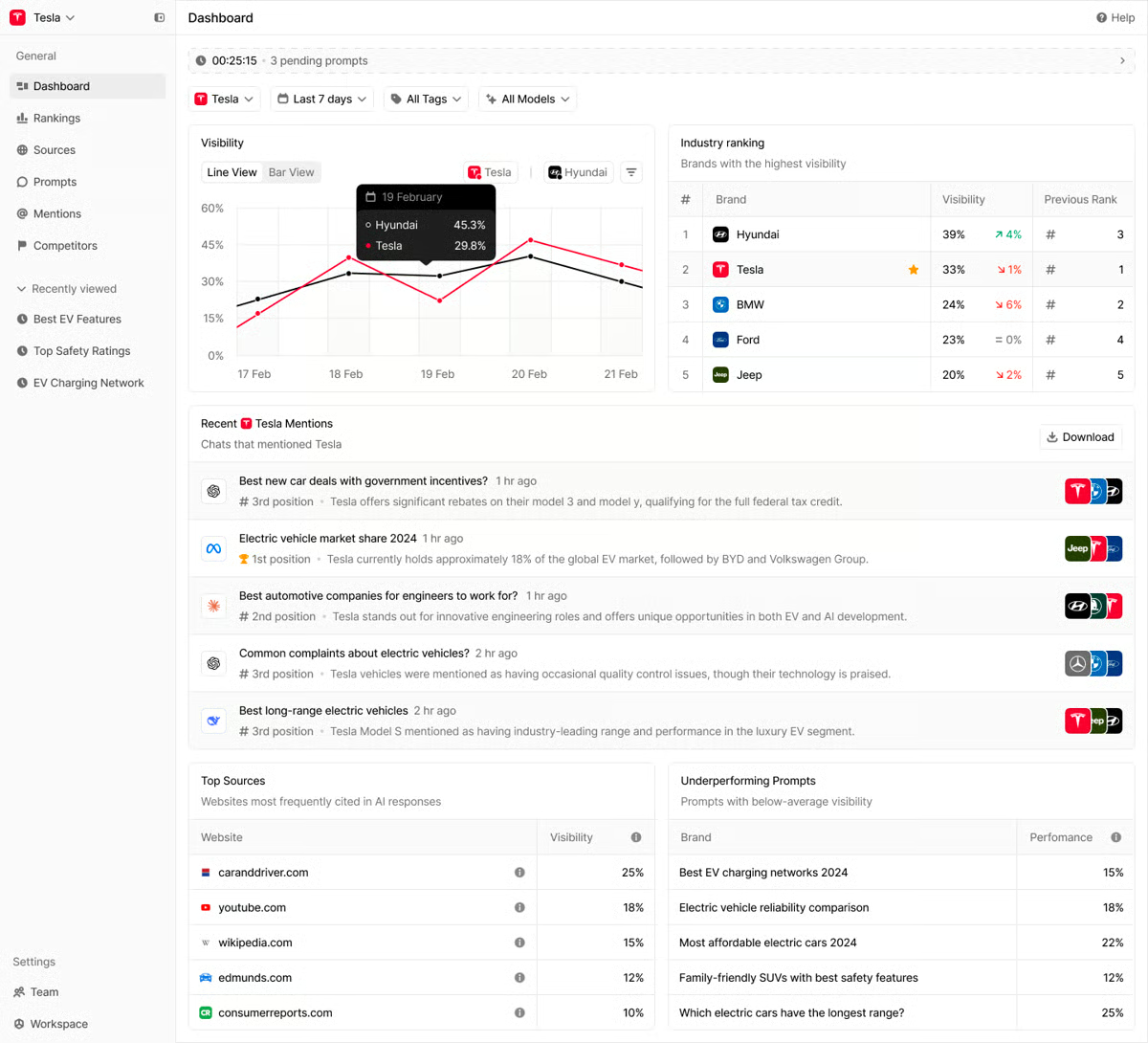
Peec AI delivers lightweight AI visibility tracking designed for teams that need immediate insights without complex setup. The platform monitors how your brand appears across ChatGPT, Perplexity, Gemini, AI Overviews, and other major LLMs, providing clear visibility into Share of Voice and competitor positioning.
What sets Peec AI apart is its speed and simplicity. Users report getting actionable data within minutes of connecting their accounts, with URL-level citation tracking that shows exactly which pages AI engines reference when mentioning your brand. This granular visibility helps teams understand not just if they're being mentioned, but why - enabling targeted optimization of high-performing content.
✨ Key Features
- Multi-LLM Coverage: Tracks ChatGPT, Perplexity, Gemini, AI Overviews, Grok, Claude, and Deepseek across most plans
- Citation URL Analysis: See exactly which URLs get quoted by AI engines for specific prompts
- Competitor Benchmarking: Compare your Share of Voice against 3-5 competitors across key query categories
- Fast Setup: Users report "immediate insights" with setup completed in under 10 minutes
- Clean Dashboard: Minimalist UI focused on actionable metrics without overwhelming data visualization
💰 Pricing
Estimated $50-$150/month (pricing not widely published; contact for quotes). No free trial available. Month-to-month contracts.
✅ Pros
- Extremely fast setup and onboarding process
- Affordable entry point for small teams and startups
- Clear, actionable insights without data overload
- URL citation visibility helps understand why you're being mentioned
❌ Cons
- Very limited feature set - purely monitoring, no strategy or content creation
- No execution layer or optimization recommendations
- Limited LLM coverage on lower-tier plans (ChatGPT-only on starter)
- No integration with content workflows or martech stacks
🎯 Use Cases and ICP
Best For: Solo entrepreneurs, bootstrapped startups, and freelance marketers who need basic visibility tracking without enterprise complexity or cost.
Ideal Customer Profile: Small businesses (1-10 employees), solopreneurs, consultants managing 1-3 client brands, early-stage startups validating AI search presence before investing in comprehensive tools.
😊 Real User Feedback
"Its easy to use, setup is extremely fast, you get immediate insights and you finally get some data to better understand where and how your brand is mentioned in LLMs. What I love is that I can also see the URLs that were quoted. Super helpful to understand how to optimize for this prompt." - Maximilian M., CEO, Mid-Market, G2 Verified Review
"Not much to be honest. Maybe even more LLMs, but they anyway cover all the important ones." -Maximilian M., CEO, Mid-Market, G2 Verified Review
2. AthenaHQ
💡 What It Does
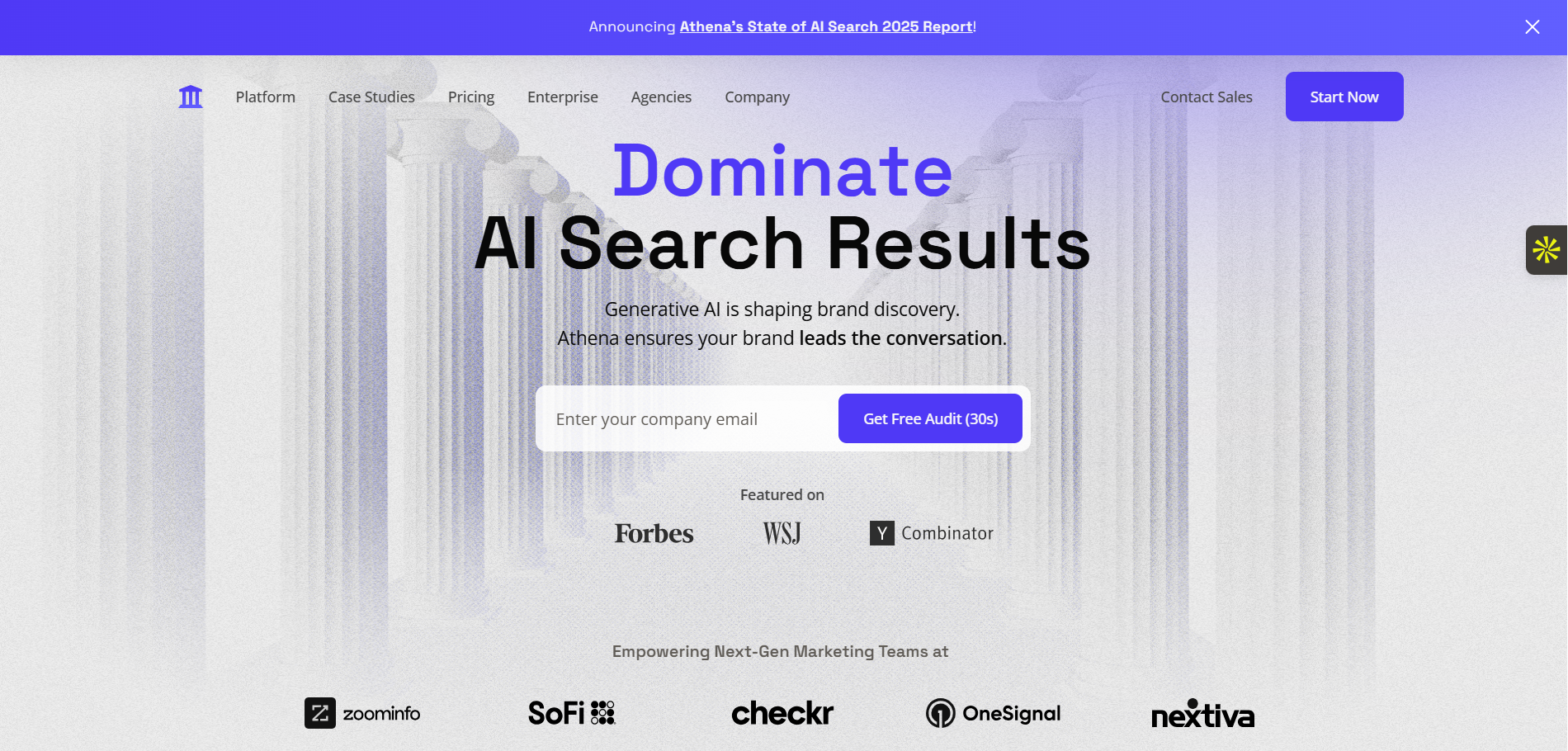
AthenaHQ positions itself as the comprehensive tracking and content gap solution for teams serious about Answer Engine Optimization. The platform tracks visibility across all major LLMs - ChatGPT, Perplexity, Gemini, Claude, Meta AI, and more - while providing strategic recommendations for content creation and outreach.
Unlike pure monitoring tools, AthenaHQ offers content gap analysis that identifies where competitors appear but you don't, plus outreach workflow automation to help teams systematically improve citation frequency. The platform's credit-based pricing model allows flexible usage scaling, though this can become expensive quickly. AthenaHQ ships new features rapidly and maintains responsive customer support, making it popular among mid-market teams.
✨ Key Features
- Comprehensive LLM Coverage: Tracks 10+ major AI platforms including ChatGPT, Perplexity, Gemini, Claude, Meta AI, Grok, Deepseek
- Content Gap Recommendations: Identifies topics/prompts where competitors rank but you don't, with prioritization
- Prompt Tracking & Competitor Visibility: Monitor specific query categories and benchmark against competitors in real-time
- Outreach Workflow Automation: Built-in tools to manage citation-building outreach campaigns
- Visibility Charts & Reporting: Out-of-the-box dashboards and customizable reports for leadership presentations
💰 Pricing
- Lite: $270/month (3,500 credits)
- Growth: $545/month (10,000 credits)
- Enterprise: $2,000+/month (custom credits)
⚠️ Credit System: Each AI query/response analyzed consumes credits, making costs unpredictable for high-volume monitoring.
✅ Pros
- Full LLM coverage across all major platforms
- Excellent customer support with fast response times
- Content gap identification helps prioritize what to create next
- Outreach features included (not available in most competitors)
❌ Cons
- Credit-intensive pricing becomes expensive quickly for active users
- Primarily monitoring-focused - identifies gaps but doesn't create content
- Mechanical content gap detection lacks human strategic context
- No free trial; steep upfront investment without testing period
🎯 Use Cases and ICP
Best For: Mid-market B2B SaaS companies (50-500 employees) with dedicated content/SEO teams who need comprehensive visibility data and can afford $500+/month budgets.
Ideal Customer Profile: Growth-stage startups ($5M-$50M ARR), marketing agencies managing multiple client portfolios, enterprise teams piloting AEO before committing to full-stack solutions.
😊 Real User Feedback
"Athena HQ has become a critical part of our playbook for winning generative search engine. Were in an ultra-competitive vertical where every edge counts, and Athena consistently helps us identify where to focus, how to execute, and what levers to pull next. Setup was fast, the team is incredibly responsive, and the product keeps getting better." - Lina L., Founding Designer, Small-Business, G2 Verified Review
"The platforms overall capabilities, flexibility, and ease of maneuvering around to access the specific prompts and result analysis. Additionally, the support I receive from them is ahead of all other LLM tracking software." - Joe M., Founder, Enterprise, G2 Verified Review
3. MaximusLabs
💡 What It Does
MaximusLabs operates fundamentally differently from every competitor on this list - it's an AEO-native agency with proprietary technology, not a SaaS monitoring tool. While competitors show you dashboards of where you rank, MaximusLabs combines real UI simulation, ICP avatar testing, and expert-written content execution to actually improve your AI visibility and drive revenue.
The platform's Human-in-the-Loop (HITL) methodology differentiates it from mechanical, algorithm-only tools. MaximusLabs strategists don't just analyze data - they interpret competitive landscapes, understand buyer psychology, and craft content with E-E-A-T (Experience, Expertise, Authority, Trustworthiness) embedded from the start. This eliminates the "insights without execution" problem plaguing tools like Profound, AthenaHQ, and Scrunch.
✨ Key Features (2-Part Platform)
Part 1: MaximusLabs for AI Visibility Measurement
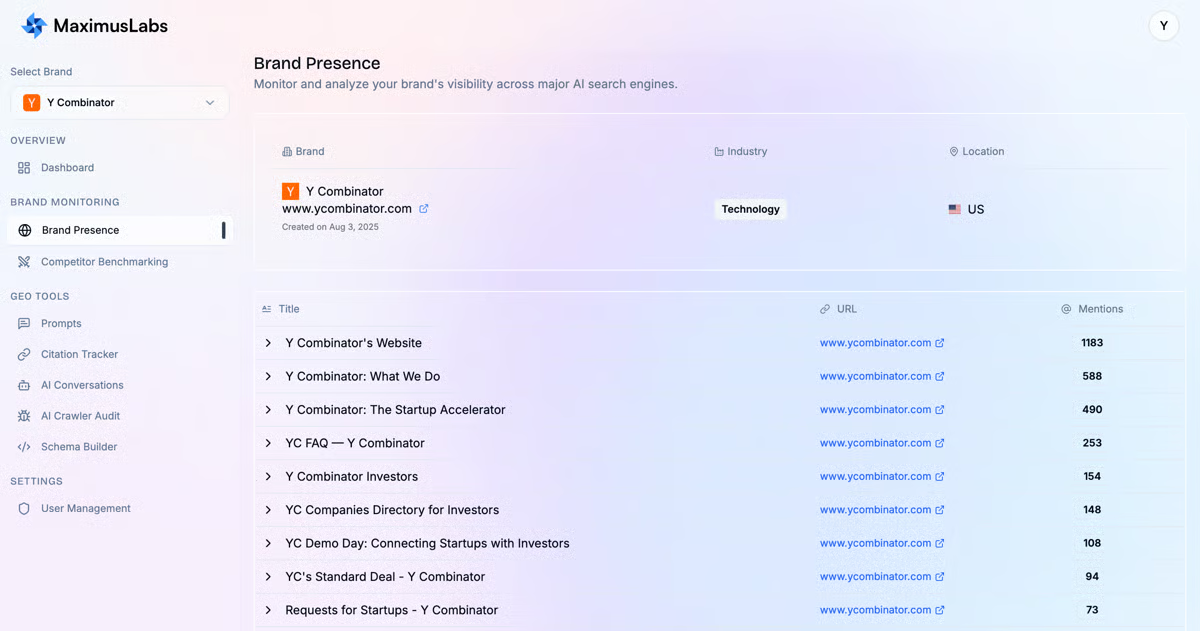
- Real UI Simulation: Runs queries through actual ChatGPT, Perplexity, Gemini interfaces (not APIs) to capture what your ICP actually sees
- ICP Avatar Testing: Creates detailed buyer personas (location, role, company size, search vocabulary) and tests visibility from their perspective
- Weekly Brand Updates: Share of Voice analysis, citation reports, competitor visibility tracking across bottom-of-funnel keywords
- GSC & Google Analytics Integration: Seamless connection to existing analytics stack for unified reporting
Part 2: MaximusLabs for AI Content Generation (Human-in-the-Loop)
- Expert-Written Content Creation: 15-50 pieces/month (tier-dependent) crafted by strategists, not AI-generated churn
- Trust-First SEO Methodology: Citation engineering, E-E-A-T infrastructure, Founder's Voice integration, UGC signal optimization
- Revenue-Focused SEO: Prioritizes BOFU/MOFU content that drives pipeline and ARR, not vanity TOFU traffic
- Unique Context Embedding: Human strategists add frameworks (E-E-A-T, Trust Factor, R-SEO) that AI content tools miss
💰 Pricing
- Basic: $1,299/month - 15 expert-written pieces, ideal for startups and early-stage companies
- Advanced: $2,199/month - 25 expert-written pieces, comprehensive MOFU/BOFU strategy
- Premium: $3,499/month - 50 expert-written pieces, full-stack AEO program with continuous optimization
💡 Value Calculation: At $1,299/month, you get $7,900-$15,125 in equivalent agency services (content creation, strategy, E-E-A-T optimization, Trust-First SEO execution, real UI simulation, ongoing monitoring).
✅ Pros
- Human-in-the-Loop eliminates robotic AI content churn: Real strategists craft every piece with unique insights
- Revenue focus, not vanity metrics: Optimizes for pipeline, qualified meetings, ARR - not just Share of Voice percentages
- Execution included: Unlike monitoring-only tools, MaximusLabs creates content, engineers citations, builds Trust signals
- 1-3 month breakeven: Clients typically see ROI faster than traditional agencies or stacked tool subscriptions
❌ Cons
- Higher monthly cost than pure monitoring tools (but 60-80% cheaper than tools + agencies)
- Fairly new product with evolving features (though customer support is highly responsive)
- Requires commitment to content strategy execution (not passive dashboards)
🎯 Use Cases and ICP
Best For: B2B SaaS companies, AI-first startups, and growth-stage businesses (Series A-C) that need outcomes, not just insights - companies willing to invest $1K-$3.5K/month for strategic execution that drives measurable revenue impact.
Ideal Customer Profile:
- Startups: $0-$5M ARR seeking fast AI visibility wins without hiring full-time content teams
- Mid-Market: $10M-$100M ARR companies defending Google rankings while rapidly building AI presence
- Enterprise: $100M+ ARR organizations needing centralized AEO strategy across multiple business units
❤️ Real User Feedback
"We used MaximusLabs primarily for checking our brand presence across Al Search Engines like ChatGPT, Perplexity and Google Al Mode. We got weekly brand updates like share of voice analysis across our bottom of the funnel keywords, citation analysis report and competitor brands visibility tracking. having this level of detailed measurement parameters really helps us improve our brand presence on the internet as a whole. And it doesnt stop there it also tells me how to and what to do to improve our presence across answer engines. Customer support was also amazing." - Krishna K., Organic Inbound Manager, Mid-Market, G2 Verified Review
"I really liked the UIUX of the maximus portal in 1 screen i was able to see all of the important parameters. And it was also easy to connect it to my GSC and pull the actual search data from it for real user query analysis to create a list of questions that our current users might be asking. Apart from this I like to track our competitors brand visibility and optimize our brands strategy accordingly." - Havish K., Mid-Market, G2 Verified Review
4. Conductor
💡 What It Does
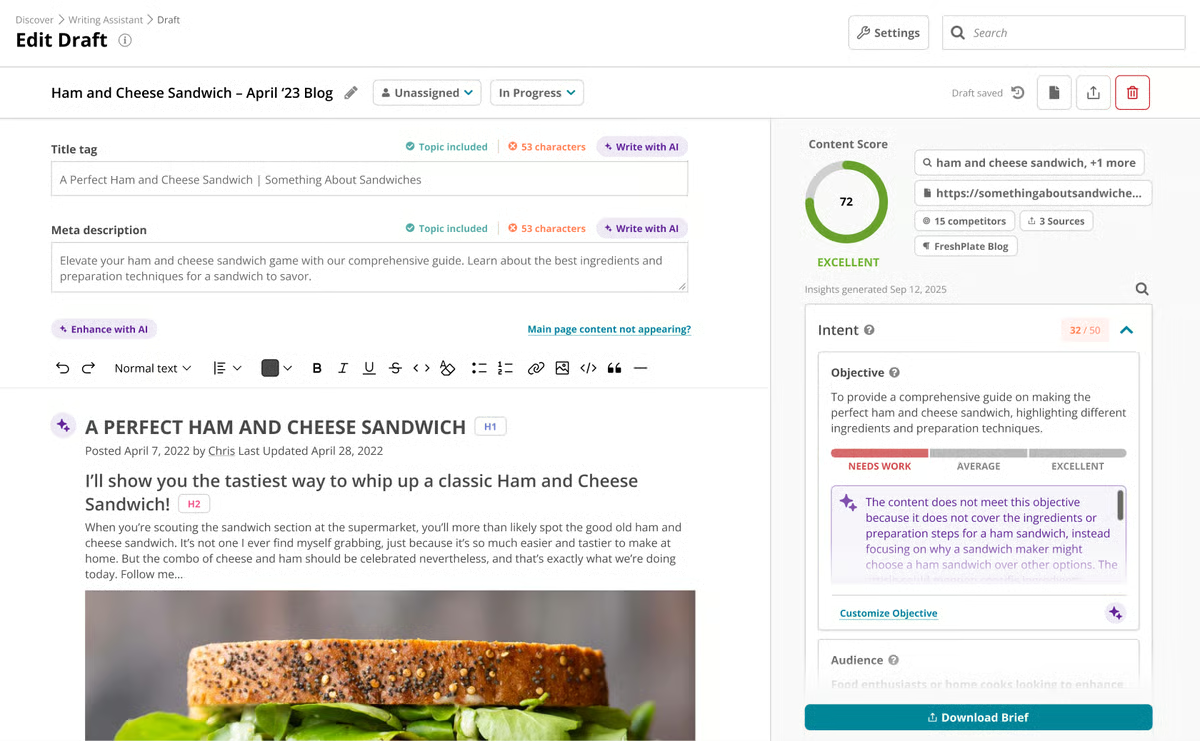
Conductor operates as an enterprise SEO platform that recently added AEO capabilities as market demand grew for AI visibility tracking. The platform combines traditional SEO features - keyword research, rank tracking, content workflow management - with newer generative engine monitoring across ChatGPT, Perplexity, and Gemini.
Conductor's strength lies in its mature SEO infrastructure for teams already invested in traditional search optimization. However, users consistently report that AEO feels bolted-on rather than natively integrated, with AI-generated content features lacking the strategic depth and E-E-A-T compliance needed for long-term success. The platform's steep learning curve and enterprise-only pricing make it a poor fit for startups and mid-market teams.
✨ Key Features
- SEO + AEO Integration: Unified platform for traditional keyword tracking and AI visibility monitoring
- Content Workflow Automation: CMS integration, task delegation, automated content recommendations
- Real-Time Competitive Intelligence: Monitor competitor rankings across both Google SERPs and AI responses
- AI-Powered Content Generation: Automated content briefs and topic suggestions (though mechanically generated)
- DeepCrawl Integration: Technical SEO audits bundled with some plans
💰 Pricing
Custom enterprise pricing: Estimated $3,000-$10,000/month with annual contracts required. No month-to-month options or free trials available.
✅ Pros
- Comprehensive SEO suite with newer AEO features
- Good for enterprises already using Conductor for traditional SEO
- Mature enterprise features (SSO, multi-user permissions, API access)
- Strong keyword research and competitive analysis tools
❌ Cons
- Prohibitively expensive for mid-market teams
- AEO features feel like an afterthought - not natively designed for AI search optimization
- Steep learning curve: Users report platform bloat and overwhelming complexity
- Poor customer support: Multiple reviewers cite billing issues, unresponsive account reps, and forced multi-year contracts
🎯 Use Cases and ICP
Best For: Fortune 1000 enterprises with existing Conductor contracts looking to add basic AI visibility monitoring to their traditional SEO workflows.
Ideal Customer Profile: Large corporations ($500M+ revenue) with dedicated 5+ person SEO teams, multi-year software budgets, and tolerance for complex platform onboarding.
😞 Real User Feedback
"Quite literally everything. As individuals the team we work with are decent humans, Im sure, but their efforts have cost us a lot of money, and weve received literally no value. Locked into a contract that I cant get rid of and its doing me zero good. Tried everything to have them be gentlemen about the arrangement and work something out and there was no positive response whatsoever." - Reid V., Director of Marketing, Enterprise, G2 Verified Review
"The downside is that there are a lot of bugs that still need to be worked out. For example, when adding a block to a workspace, sometimes its blank. Sometimes Im not able to log into Conductor at all. Its embarrassing when it happens during demos. Support has been slow in fixing these." - Verified User, Higher Education, Enterprise, G2 Verified Review
5. Botify
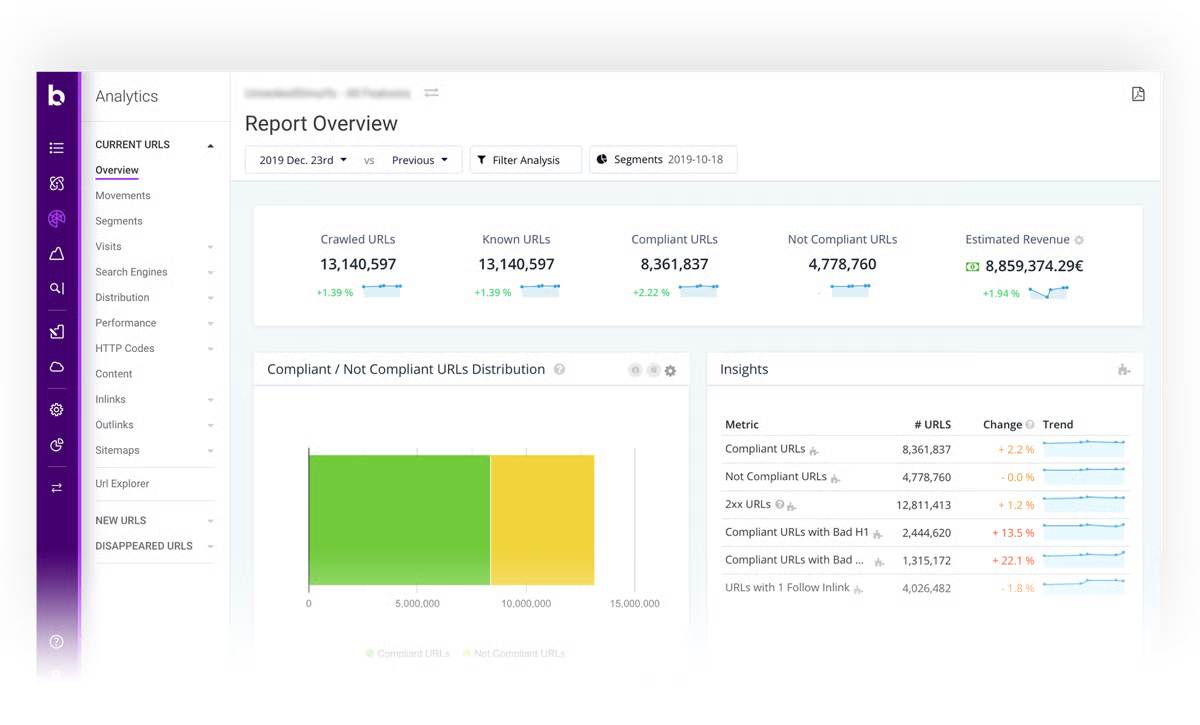
💡 What It Does
Botify specializes in technical SEO and website crawl analytics - not AI visibility tracking. The platform provides deep log file analysis, crawler budget optimization, and server-side performance monitoring for large enterprises managing millions of pages. While Botify has started integrating some AI-related features, its core value remains identifying and fixing technical website issues that prevent proper indexing.
For companies experiencing crawlability problems, JavaScript rendering issues, or canonical tag errors, Botify delivers unmatched technical depth. However, it doesn't monitor where you appear in ChatGPT or Perplexity responses - making it a poor fit for teams primarily focused on AI visibility optimization rather than traditional SEO infrastructure.
✨ Key Features
- Advanced Log File Analysis: Track which bots crawl your site, identify crawl budget waste, optimize server-side performance
- Comprehensive Website Crawling: Deep technical audits covering 404s, canonicals, duplicate content, thin pages, rendering issues
- Custom Segmentation: Create complex filters to analyze specific site sections, content types, or URL patterns
- JavaScript Rendering Support: Evaluate how search engines process client-side JavaScript frameworks (React, Vue, Angular)
- Automated Alerts: Real-time notifications for technical SEO issues (broken pages, crawl errors, site speed degradation)
💰 Pricing
Custom enterprise pricing: Estimated $2,000-$5,000/month with annual contracts. Lower-tier plans start around $2,000/month but offer limited features.
✅ Pros
- Best-in-class technical SEO and log file analysis
- Unmatched depth for large, complex websites (1M+ pages)
- Excellent for diagnosing crawlability and indexation issues
- Strong JavaScript rendering support for SPA websites
❌ Cons
- Not AEO-native - built for technical SEO, not AI visibility tracking
- Prohibitively expensive for small/mid-market teams
- Steep learning curve - requires dedicated SEO experts to extract value
- No AI visibility monitoring - doesn't track ChatGPT, Perplexity, or other LLM mentions
🎯 Use Cases and ICP
Best For: Enterprise e-commerce sites, large publishers, and SaaS platforms with complex technical SEO challenges (millions of URLs, JavaScript-heavy architectures, multi-domain operations).
Ideal Customer Profile: Companies with $100M+ revenue, 10M+ monthly organic visitors, dedicated technical SEO teams (2+ engineers), and specific problems like crawl budget waste or indexation blockers.
🤔 Real User Feedback
"Botify is a tool which has an array of unique features that set it apart from other platforms. The log analyzer is one of the most thorough that I have ever seen and allows me to look at our website from both a technical perspective, as well as a content-based one." - Andrew B., Global SEO/Digital Marketing Program Manager, Enterprise, G2 Verified Review
"Botify is very expensive. The monthly fee was too high, even with the lowest plan. The software offers many features, but does not document how to use them. You must rely on Botify customer support team, however good support is hard to come by. Customer Service Rep was not knowledgeable about product or the services it offered." - Verified User, Information Technology, Enterprise, G2 Verified Review
6. Scrunch
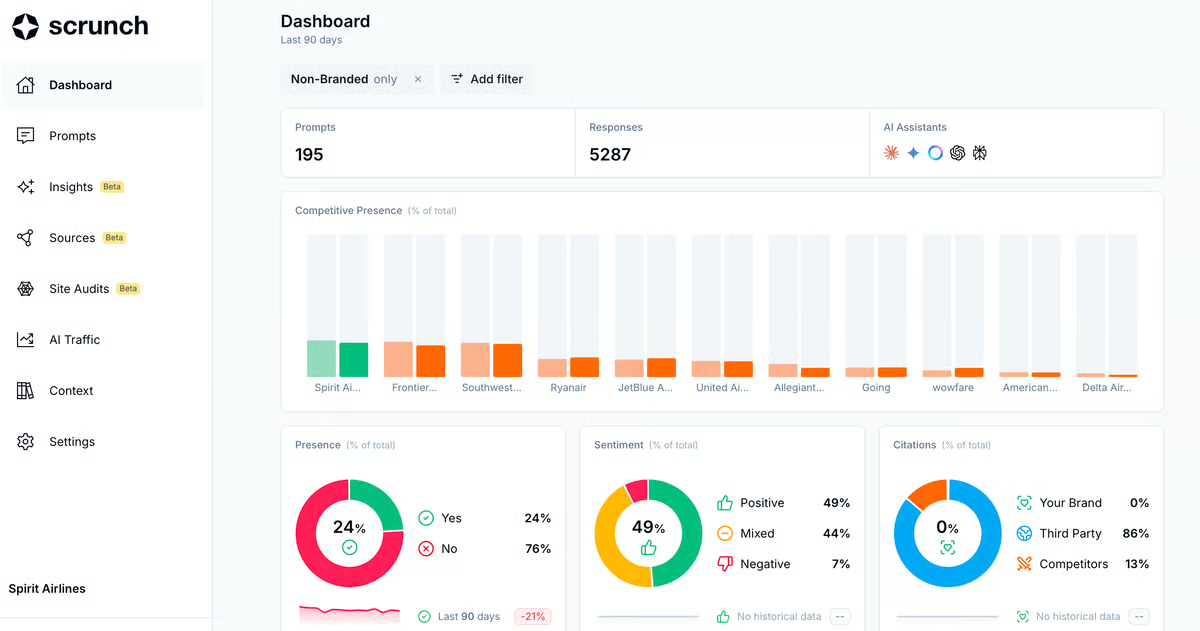
💡 What It Does
Scrunch differentiates itself through persona-based journey mapping and team collaboration features. The platform tracks AI visibility across ChatGPT, Gemini, Perplexity, Meta AI, and Claude while offering journey-specific visibility analysis - showing how different buyer personas encounter your brand at various stages of their decision process.
Scrunch's citation tracking and sentiment monitoring provide decent baseline insights, but the platform suffers from the same "monitoring-only" limitation as Profound and AthenaHQ. While journey mapping sounds strategic, users report the persona profiles feel generic rather than truly ICP-specific, and there's no content creation or execution layer to act on the insights discovered.
✨ Key Features
- Journey Mapping: Track visibility across awareness, consideration, decision stages with persona-based segmentation
- Persona-Based Tracking: Create customer profiles and monitor how each segment encounters your brand in AI responses
- Citation Tracking: See which URLs and third-party sources AI engines cite when mentioning your brand
- Competitive Benchmarking: Compare Share of Voice against competitors across prompt categories
- Team Collaboration Tools: Shared workspaces, commenting, task assignment for cross-functional AEO teams
💰 Pricing
$300/month (Starter plan) - No free trial. Higher tiers available with custom pricing for additional features and LLM coverage.
✅ Pros
- Clean, intuitive UI praised by users
- Persona-based insights offer differentiated angle vs. competitors
- Decent LLM coverage for the price (6-7 major platforms)
- Good for team collaboration with shared dashboards
❌ Cons
- Expensive for monitoring-only functionality (no content creation or execution)
- Generic persona mapping - not true ICP-specific simulation like MaximusLabs
- Limited LLM coverage on base plans (misses Claude, Grok, Deepseek until upgrades)
- No free trial makes it risky for teams testing AEO tools
🎯 Use Cases and ICP
Best For: Mid-market marketing teams (20-100 employees) who value internal collaboration and want persona-level insights but are willing to handle content execution separately.
Ideal Customer Profile: B2B SaaS companies ($5M-$50M ARR) with cross-functional teams (content, SEO, product marketing) needing shared visibility dashboards.
😊 Real User Feedback
"I chose Scrunch because of its marketing-centric analytics, which go beyond what GA4 provides. It gives me visibility into how SnapLogic is appearing in relevant prompt topics and shows which pages are most often served to LLMs. This has unlocked a new way to understand our rankings across all the top Al platforms." - Stephanie C., Sr. Website Marketing Manager, Mid-Market, G2 Verified Review
"For us, the data isnt super actionable if you dont have a PR/media outreach arm, since so many sources are third party. I wish there was a way to reach out to those being served up in the prompts through the platform." - Verified User, Information Technology, Mid-Market, G2 Verified Review
7. Brandlight
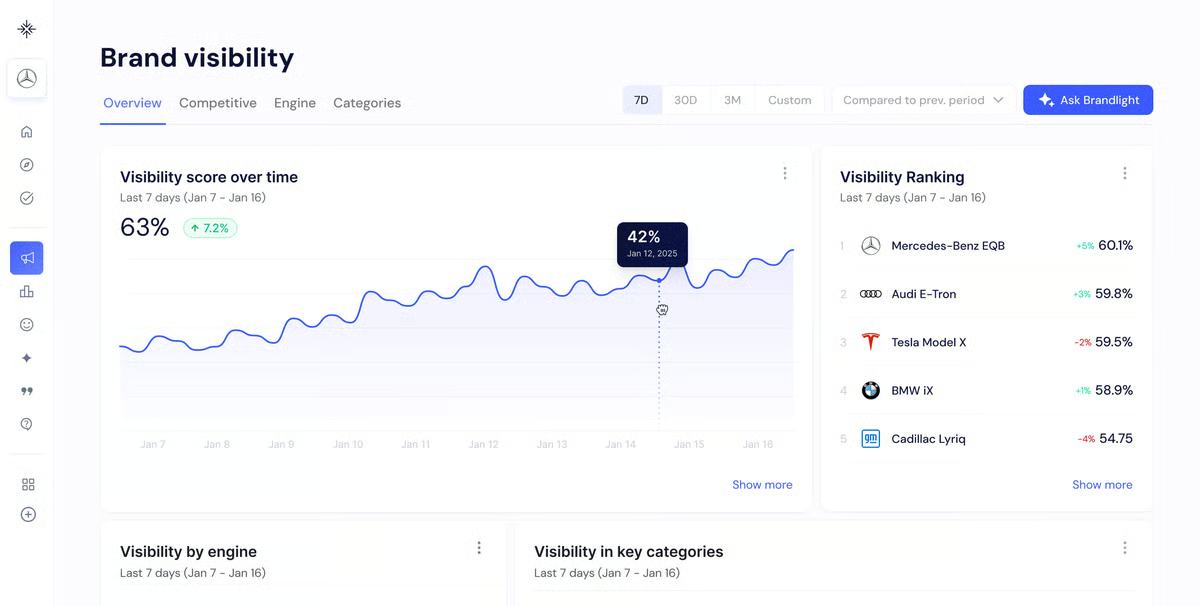
💡 What It Does
Brandlight offers basic brand mention tracking across 2-3 major LLMs - a bare-bones solution for teams with minimal AI visibility needs. The platform provides simple sentiment analysis and limited competitive features, but lacks the depth, strategic insights, and execution capabilities that modern AEO demands.
With severely limited LLM coverage, minimal features, and low market adoption, Brandlight struggles to compete with more established players. The platform's mechanical sentiment analysis relies on keyword-based approaches rather than nuanced understanding, and there's no path forward for teams that discover visibility gaps - making it useful only for basic awareness monitoring.
✨ Key Features
- Basic Brand Mention Tracking: Monitor when AI platforms mention your brand across limited query categories
- Simple Sentiment Analysis: Keyword-based positive/negative/neutral classification of AI responses
- Limited Competitive Features: Track 1-2 competitors (not comprehensive benchmarking)
- Real-Time Feedback & AI Scoring: Get notifications when brand mentions appear in AI responses
- UI Navigation: Clean interface praised by users, though feature-light
💰 Pricing
Estimated $100-$200/month (pricing not transparent; requires sales contact). No free version available. More enterprise-focused despite limited features.
✅ Pros
- Very affordable for teams with minimal needs
- Clean, easy-to-navigate UI
- Helps brands stay updated on basic AI mention patterns
- Real-time feedback for brand visibility changes
❌ Cons
- Severely limited LLM coverage (only 2-3 major engines)
- Bare-bones feature set - no strategic insights or recommendations
- No execution layer - pure monitoring with no path to improvement
- Low market adoption - few reviews or proven case studies available
🎯 Use Cases and ICP
Best For: Solo entrepreneurs, freelancers, or very small businesses (1-5 employees) wanting the cheapest possible AI visibility awareness without strategic depth.
Ideal Customer Profile: Solopreneurs, consultants, micro-businesses with <$500K revenue who need basic brand mention awareness but can't justify $300+/month tools.
🤷 Real User Feedback
"Soo good UI easy to navigate make it easier to promote the brand makes the presence known across ai engines help us find the influencers and sites which directly or indirectly promote the brands realtime feedback and ai scoring to make it faster." - Verified User, Consulting, Enterprise, G2 Verified Review
"not easy to learn as thought depends more on aicosystem for all the data so it can be a little tricky pricing is not transparent, so after starting to use only well be able to get the pricing details more of a enterprise focused tool, so small companies cannot afford to go for it and there is no free version like other ai tools, only paid version." -Verified User, Consulting, Enterprise, G2 Verified Review
8. BrightEdge
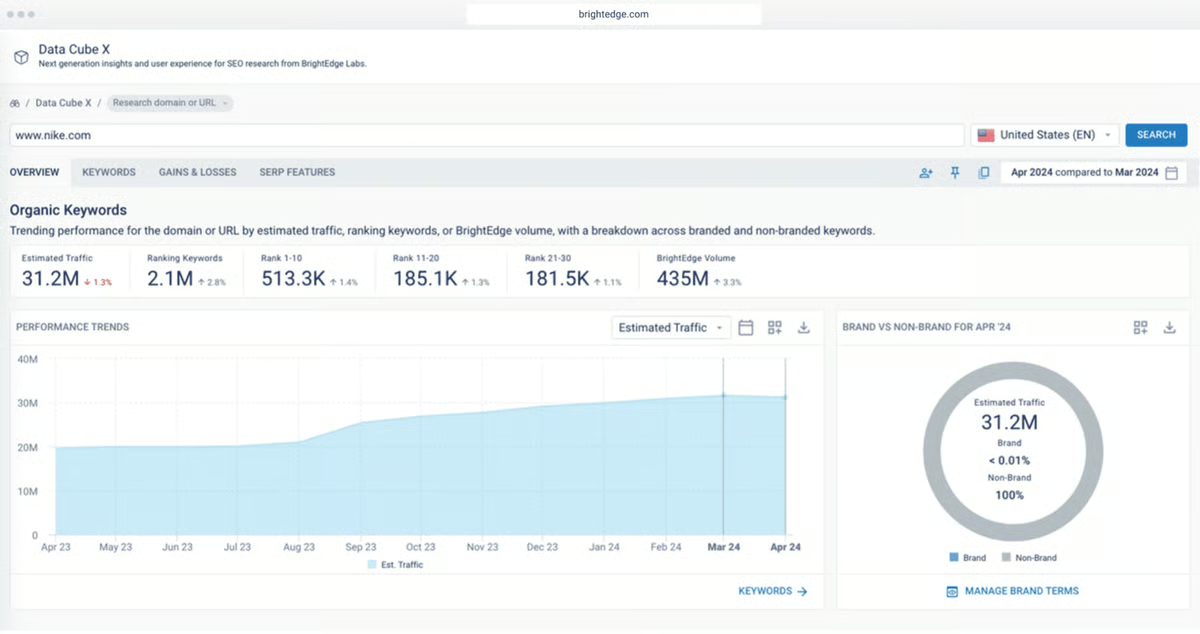
💡 What It Does
BrightEdge built its reputation as a comprehensive enterprise SEO platform - keyword tracking, competitive intelligence, content recommendations, rank monitoring - and recently added AEO features as an addon module. The platform provides extensive analytics across 100+ metrics, real-time competitive data, and advanced reporting capabilities designed for large SEO teams managing complex, multi-domain operations.
However, BrightEdge suffers from significant drawbacks: prohibitively expensive enterprise-only pricing ($3K-$10K+/month with annual contracts), steep learning curve due to platform complexity, and AEO capabilities that feel mechanically bolted-on rather than natively designed for AI search. Users consistently report per-keyword pricing models that quickly become cost-prohibitive, plus slow UI performance and data accuracy issues.
✨ Key Features
- Enterprise SEO Suite: Comprehensive keyword research, rank tracking, content analysis, competitive intelligence
- AEO Module: Newer features tracking brand visibility in ChatGPT, Gemini, Perplexity (limited coverage)
- Data Cube Reporting: Advanced analytics and custom report building (though users report bugs and limitations)
- Content IQ & Recommendations: AI-powered content suggestions (though reviewers say they're "too cookie-cutter")
- Dedicated Account Reps: Monthly consultations and platform training (quality varies by reviewer)
💰 Pricing
Custom enterprise pricing: Estimated $3,000-$10,000+/month with required annual contracts. Per-keyword pricing model means tracking mobile + desktop + multiple languages multiplies costs significantly.
⚠️ Pricing Warning: Multiple reviewers cite "$60K annually" costs and "archaic per-keyword pricing" that becomes "cost-prohibitive."
✅ Pros
- Deep historical SEO data for enterprises already using the platform
- Advanced competitive tracking and benchmarking
- Comprehensive feature set for traditional SEO
- Good customer service (for larger accounts)
❌ Cons
- Prohibitively expensive - $60K/year budgets common, making it unrealistic for mid-market teams
- Per-keyword pricing is archaic - tracking same keyword on mobile + desktop = 2X cost
- Steep learning curve - platform bloat overwhelms teams without dedicated SEO specialists
- AEO features feel bolted-on - not natively designed for AI visibility optimization
🎯 Use Cases and ICP
Best For: Fortune 500 enterprises ($500M+ revenue) with 10+ person SEO teams, multi-year tool budgets ($50K-$100K/year), and existing BrightEdge contracts looking to add basic AI tracking.
Ideal Customer Profile: Global corporations managing 50+ domains, multinational SEO programs, teams with dedicated BrightEdge specialists comfortable navigating complex workflows.
😞 Real User Feedback
"The price! While it is an all in one solution, I can get everything possible done manually with not much more time dedicated for way cheaper. If you are a novice with SEO, this is a fantastic solution but for 60k annually, it isnt worth it to me." - Verified User, Marketing, Enterprise, G2 Verified Review
"Unfortunately the whole platform is a fail and its incredible overpriced. I discovered SEM Rush six months into our Brightedge contract and stopped using Brightedge. We will not be resigning with Brightedge -- no value to the customer beyond what is available. Support is OK but the product needs to be significantly improved." - Angelina C., Digital Marketing Manager, Mid-Market, G2 Verified Review
9. Airops
💡 What It Does
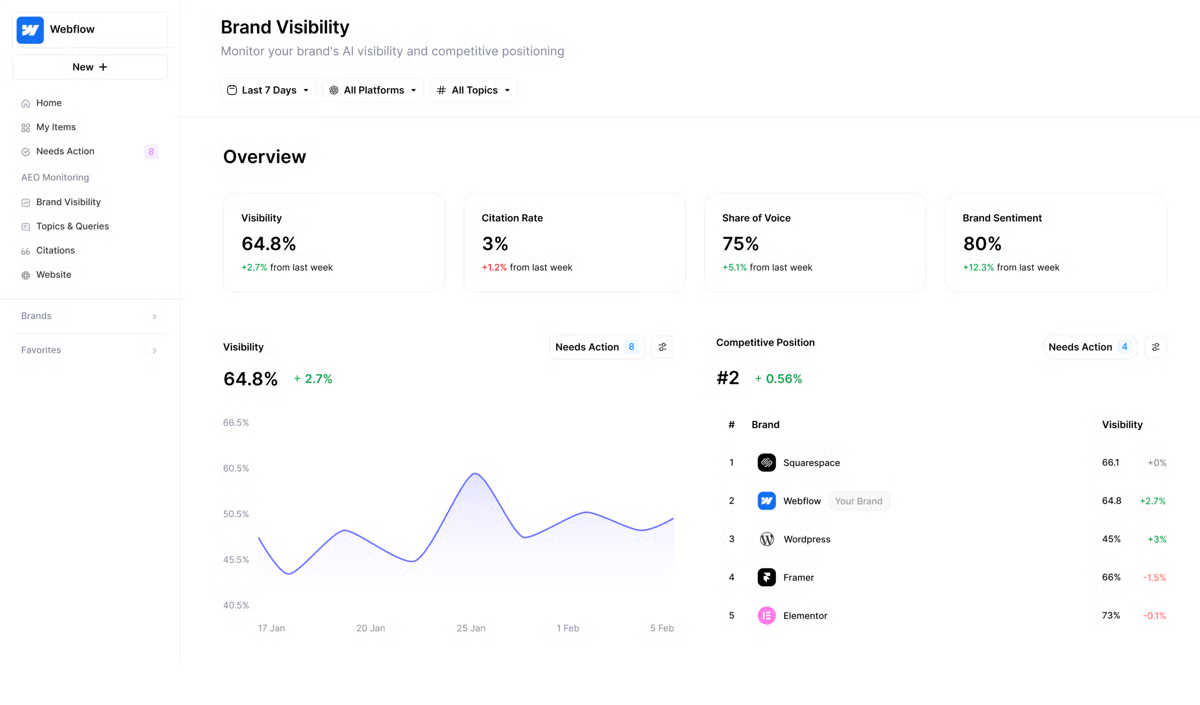
Airops focuses on workflow automation and content operations at scale - not AI visibility tracking. The platform enables teams to build custom workflows connecting multiple AI models (ChatGPT, Claude, Gemini, etc.), automate repetitive content tasks, and create "content engineering" pipelines that generate briefs, drafts, and optimized posts efficiently.
Airops delivers value for content teams scaling production through automation, but it's not a monitoring tool for AI visibility. While you can use Airops to create content theoretically optimized for AI engines, it doesn't track whether ChatGPT or Perplexity actually mention your brand - making it a complement to (not replacement for) visibility tracking tools like Profound, AthenaHQ, or MaximusLabs.
✨ Key Features
- Multi-Model Workflow Automation: String together ChatGPT, Claude, Gemini, and other AI models in custom pipelines
- Content Creation Pipelines: Automate research, brief generation, draft creation, and SEO optimization workflows
- Grid-Based Operations: Manage large-scale content production in spreadsheet-like interfaces with bulk operations
- CMS Integrations: Connect to WordPress, Notion, Google Docs for seamless content publishing
- No-Code Workflow Builder: Create complex automation without technical expertise (though steeper learning curve than expected)
💰 Pricing
Usage-based credits model with estimated $200-$500/month for mid-market teams. Pricing varies significantly based on workflow complexity and AI model usage.
✅ Pros
- Excellent for scaling content production without hiring large teams
- Flexibility to connect multiple AI models in one workflow
- Strong customer support and responsive product team
- Integrations with major CMS platforms (WordPress, Notion)
❌ Cons
- Not an AI visibility tracking tool - doesn't monitor ChatGPT, Perplexity, Gemini mentions
- Steep learning curve despite no-code positioning
- Credit-based pricing makes costs unpredictable
- Grid bugs and performance issues reported by users
🎯 Use Cases and ICP
Best For: Content marketing teams (5-20 people) at growth-stage companies scaling production from 10-20 pieces/month to 50-100+ pieces/month through automation.
Ideal Customer Profile: B2B SaaS marketing teams, content agencies, SEO consultancies managing multiple clients, companies prioritizing volume content production over strategic depth.
😊 Real User Feedback
"AirOps is truly a game changer. Its wide range of features makes it an indispensable tool for anyone working in SEO, GEO, content, or any other marketing discipline. Our team has significantly increased efficiency in content creation thanks to AirOps, and we are now exploring its capabilities for other projects with excellent results so far." - Adina T., Head of Content, Mid-Market, G2 Verified Review
"AirOps does have a learning curve. It is not the easiest solution on the market, but it is certainly one of the most complete. To get the most out of it, you need to invest time in understanding how workflows operate and how to fine-tune them to your specific needs." - Adina T., Head of Content, Mid-Market, G2 Verified Review
10. MarketMuse
💡 What It Does
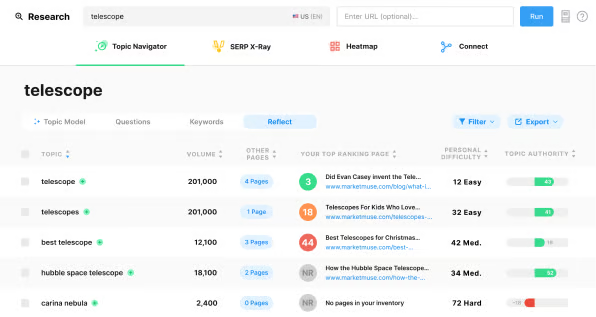
MarketMuse specializes in semantic content optimization and SEO content brief generation - analyzing SERPs, identifying topical gaps, and creating data-driven outlines for writers. The platform crawls top-ranking Google pages, aggregates competitor keyword usage, and generates semantic recommendations to improve content depth and topical authority.
While MarketMuse helps teams create Google SEO-optimized content, it's not AEO-native - the tool doesn't track whether your content appears in ChatGPT or Perplexity responses. Its AI-driven brief generation relies on LLM APIs for surface-level suggestions rather than simulating real user behavior, and there's no visibility monitoring to validate whether optimization efforts actually improve AI citations.
✨ Key Features
- Semantic Content Analysis: Identify topical gaps and keyword coverage needed to compete with top-ranking SERP content
- Content Brief Generation: AI-powered outlines with keyword suggestions, competitive analysis, and topical coverage recommendations
- SERP Competitive Research: Analyze top 10 ranking pages for target keywords, surface common themes and content structures
- Content Optimization Tool: Real-time scoring as you write, with suggestions to improve semantic relevance and topical depth
- Unlimited Query Limits: Premium plans offer unlimited analysis (though expensive)
💰 Pricing
- Standard: $149/month (limited features)
- Premium: $999/month (unlimited users and queries)
✅ Pros
- Good for traditional Google SEO content optimization
- Saves time on SERP analysis and competitive keyword research
- Unlimited queries on higher-tier plans
- Useful for identifying content gaps via semantic analysis
❌ Cons
- Not AEO-native - built for Google ranking, not AI visibility optimization
- No tracking or monitoring - can't tell you if ChatGPT or Perplexity cite your content
- Expensive ($999/month for full features)
- Complex learning curve - users report difficulty navigating tools and templates
🎯 Use Cases and ICP
Best For: Content teams focused primarily on Google SEO rankings who want to add basic semantic optimization but aren't prioritizing AI visibility.
Ideal Customer Profile: SEO agencies, in-house content teams at SaaS companies, bloggers/publishers optimizing for traditional search where Google traffic still dominates (80%+ of organic visits).
😐 Real User Feedback
"MarketMuse saves time when it comes to searching people also ask boxes and forums for the questions that people are asking about any given topic. It also makes it faster and easier to review and analyse the inclusions on the top 10 SERPs on a given topic." - Verified User, Marketing, G2 Verified Review
"If youre paying a monthly subscription for it, it is incredibly expensive. Worse the amount of money you have to pay for the higher tiers is disproportionate to the value it provides." - Verified User, Marketing, G2 Verified Review
Q2. What Are AI Visibility Tools and Why Do They Matter in 2026? [toc=2. AI Visibility Tools]
⏰ The Search Landscape Has Fundamentally Shifted
AI visibility tools are platforms that track and optimize brand presence across AI search engines like ChatGPT, Perplexity, Gemini, Claude, and Meta AI - measuring critical metrics like Share of Voice, citation frequency, brand mentions, and sentiment analysis across LLM responses. These tools emerged because traditional SEO metrics no longer tell the full story: By 2026, Gartner predicts a 25% decline in traditional search traffic as users increasingly migrate to conversational AI interfaces for research, product discovery, and purchase decisions. When your target buyer asks ChatGPT "best project management software for remote teams," your brand either appears in that answer - or you're invisible.
❌ Traditional SEO Agencies Are Stuck in the Old Playbook
Most traditional SEO agencies still operate with Google-only playbooks, treating AI search as an afterthought or offering commodity tracking dashboards without actionable optimization strategies. They monitor but don't architect outcomes. The typical agency response to AI visibility? Bolt on a Profound subscription, show you quarterly reports of where your brand appears in LLM responses, then leave the hard work - strategic planning, content creation, citation engineering - entirely to you. This "insights without execution" model forces businesses to stack $300-$500/month monitoring tools on top of $5K-$20K/month agency fees, creating fragmented tech stacks, knowledge gaps between teams, and slow execution cycles that miss the rapidly evolving AI search landscape.
✅ The AI-Era Requires New Optimization Primitives
The discovery funnel has fundamentally changed by 2026 - users now ask AI "research assistant" questions before ever visiting a website. Traditional SEO optimized for "ranking in SERPs" (Search Engine Results Pages), but Answer Engine Optimization (AEO) requires being cited by LLMs as the authoritative source. This shift demands new optimization primitives: citation ecosystem building (getting mentioned in Reddit threads, review sites, YouTube videos that AI trusts), E-E-A-T infrastructure (Experience, Expertise, Authority, Trustworthiness signals), and third-party source authority (AI engines validate claims by cross-referencing trusted external sites). Being in the AI's "sample set" when it curates recommendations isn't a nice-to-have - it's mission-critical for B2B buyer visibility, especially as over 50% of search traffic will move to AI-native platforms by 2028.
🚀 MaximusLabs: Search Everywhere Optimization, Not Just Monitoring
MaximusLabs pioneered Answer Engine Optimization (AEO) as a strategic discipline in early 2024, not just tracking. Our "Search Everywhere Optimization" approach ensures clients don't just monitor AI visibility - we architect the citation ecosystem (Reddit mentions, G2/Capterra reviews, high-authority backlinks, YouTube tutorials, authentic community presence) that causes AI engines to recommend your brand. While competitors provide dashboards showing "your Share of Voice is 18%," we deliver execution: expert-written content crafted with E-E-A-T embedded from day one, Trust-First SEO methodology that builds citation authority, Founder's Voice integration that signals Experience (the first "E" in E-E-A-T), and UGC signal optimization that leverages authentic community recommendations AI engines trust. We focus on the 6x conversion advantage of LLM-referred traffic (validated by Webflow data) - optimizing for pipeline, qualified meetings, and attributed ARR, not vanity visibility percentages.
⚠️ 2026 Stakes: Build Your Citation Moat Now or Fall Behind Forever
As AI platforms entrench data patterns and citation preferences over time, early movers who establish "source authority" build compounding advantages. Companies that wait until late 2026 to prioritize AEO will face entrenched competitors who already dominate the trusted citation networks AI engines rely on - the Reddit threads with 10K upvotes, the YouTube explainer videos with 500K views, the review site profiles with 200+ verified testimonials. MaximusLabs helps clients build durable citation moats, not just track temporary mentions. The question isn't whether AI search will reshape discovery - it's whether your brand will be part of the conversation when buyers make decisions in 2026 and beyond.
Ready to move beyond monitoring dashboards and start building your AI citation moat? Contact MaximusLabs to discuss your strategic Answer Engine Optimization roadmap.
🤔Q3. What Is the Best Answer Engine Optimization (AEO) Tool for Startups? [toc=3. Best AEO for Startups]
Startups face unique AEO challenges - limited budgets (Profound's $499/month pricing is prohibitive for pre-seed companies), zero domain authority, and the urgent need for immediate visibility wins without waiting 12-18 months for traditional SEO results. While enterprise tools demand annual contracts and dedicated teams, startups require lightweight solutions that deliver fast ROI and compete where established players haven't focused yet.
⚠️ Why Traditional Agencies Fail Startups
Most traditional SEO agencies tell cash-strapped startups to "build authority first" or invest in expensive broad SEO campaigns - strategies that burn $10K-$30K/month before seeing traction. They fundamentally misunderstand that startups can win at AEO overnight by getting cited in Reddit threads, creating niche YouTube tutorials, or answering ultra-specific questions that larger competitors ignore due to low search volume. Traditional agencies optimize for high-volume keywords owned by incumbents, while startups need citation strategies targeting the long-tail where competition is nonexistent.
✅ The Long-Tail Is Back for Startups
Dharmesh Shah, co-founder of HubSpot (valued at $30B+) and the entrepreneur who coined "inbound marketing," has become one of the most influential voices in the shift from traditional SEO to Answer Engine Optimization. Having built HubSpot from a grad school blog that outperformed venture-funded competitors through SEO mastery, Shah now observes a fundamental market transformation:
"The goal is no longer to be one of 10 blue links, but to be the answer or part of the answer when a user asks a question in an AI chat tool. It's a winner-take-all game. If you're not in the answer, you get zero traction." - Dharmesh Shah, Co-Founder & CTO of HubSpot | YouTube Source
This winner-take-all dynamic actually favors startups in one critical way: conversational AI queries average 25+ words versus 6-word Google searches. Startups can create comprehensive landing pages for hyper-specific use cases (e.g., "AI sales tools for SaaS companies selling to healthcare compliance teams") and rank in AI answers immediately, bypassing the domain authority bottleneck that limits Google rankings.
🚀 Recommended Tools for Startups
Peec AI ($50-$150/month) offers the most affordable entry point for basic visibility tracking across ChatGPT, Perplexity, and Gemini. Startups can monitor competitor citations and URL-level performance without enterprise complexity. Scrunch ($300/month) provides persona-based tracking ideal for early-stage companies validating ICP messaging. However, pure monitoring tools show you the problem without solving it.
MaximusLabs ($1,299/month Basic tier) positions itself as the execution partner startups actually need - combining tracking with citation engineering strategy. The platform helps startups focus exclusively on earned citation strategies: authentic Reddit engagement (not spam), YouTube "how-to" videos for niche use cases, and creating 10-15 exhaustive BOFU pages answering every possible follow-up question. This approach wins visibility fast with citation optimization, then scales to owned content once traction is proven.
"Stopped tracking keyword rankings. Started tracking share of voice across AI platforms. Night and day difference in what we're optimizing for." - Growth Manager, r/seogrowth
💡 Contrarian Startup Advice
Avoid expensive monitoring tools initially. Invest your first $5K in creating 5-10 deeply researched YouTube videos for core use cases and systematically building Reddit credibility in 3-5 relevant subreddits. These assets can get cited by AI within days and provide more ROI than dashboards showing zero visibility. Add monitoring tools once you have citation-worthy assets deployed.
🤔Q4. What Is the Best Answer Engine Optimization (AEO) Tool for Mid-Market Companies? [toc=4. Best AEO for Mid-Market]
Mid-market companies (50-500 employees, $10M-$100M revenue) have established SEO programs but lack integrated AEO strategies. They need tools that bridge traditional search analytics with AI visibility tracking, provide competitive intelligence, and support cross-functional collaboration between content, product marketing, and demand gen teams. Typical mid-market AEO budget: $3K-$10K/month for tools plus execution.
❌ The Fragmented Agency Problem
Traditional agencies run SEO and "AI experiments" as separate workstreams with different teams, creating fragmented strategies. They provide quarterly reports on AI mentions but no unified content roadmap that optimizes for both Google rankings AND AI citation frequency simultaneously. This siloed approach causes internal competition for resources and diluted results - one team chasing SERP rankings while another tests Perplexity visibility with no strategic coordination.
Ethan Smith, CEO of Graphite and instructor of Reforge's SEO & AEO course - recognized as one of the industry's foremost authorities after 18 years mastering traditional SEO and pioneering AEO research - has observed the critical gap in how the market approaches this transition:
"The majority of the information that people share about this category is not true... I would suggest to test things and set up experiments and validate whether or not these things are true." - Ethan Smith, CEO of Graphite & Reforge AEO Instructor | YouTube Source
This experimental, validation-first mindset is precisely what mid-market companies need - partners who test hypotheses rigorously rather than selling unproven "best practices."
⚠️ The Zero-Sum Game Dynamic
Mid-market companies must defend existing Google rankings while rapidly building AI visibility before competitors dominate the "sample set." They face the zero-sum game dynamic - if you're not in the AI's top 5-7 cited sources for category queries, you're invisible. This requires simultaneous optimization across 8+ platforms (Google, ChatGPT, Perplexity, Gemini, Claude, Meta AI, Copilot, Grok) without fragmenting team focus.
"We shifted early from pure SEO to include AEO and the biggest win has been focusing on how AI engines interpret and summarize our content, not just where we rank." - Marketing Director, r/AskMarketing
✅ Recommended Tools for Mid-Market
AthenaHQ ($270-$545/month) delivers comprehensive journey mapping and persona tracking with responsive support - ideal for mid-market teams needing actionable insights fast. Conductor ($1,200/month) offers SEO+AEO platform integration for companies with existing technical infrastructure. BrightEdge ($2,000/month) provides enterprise features at mid-market pricing, though implementation overhead remains significant.
MaximusLabs ($2,199-$3,499/month Advanced/Premium tiers) delivers unified "Search Everywhere Optimization" - one content strategy optimized for both traditional SERP rankings and AI citation ecosystems. The approach combines on-site topical authority building (comprehensive MOFU/BOFU content clusters) with off-site citation engineering (systematic G2/Capterra review acquisition, strategic affiliate partnerships, Reddit community building). Companies using integrated SEO+AEO strategies maintain traditional search traffic while capturing high-intent LLM referrals that convert at 6x rates (Webflow benchmark). Clients typically see first AI citations within 45-60 days and measurable Share of Voice gains within 90 days.
🤔Q5. What Is the Best Answer Engine Optimization (AEO) Tool for Enterprise Companies? [toc=5. Best AEO for Enterprise]
Enterprise organizations ($100M+ revenue, global presence, multiple brands/business units) need AEO platforms supporting complex governance (legal/compliance review of AI-surfaced content), multi-stakeholder collaboration (product, legal, PR, demand gen), and integration with enterprise martech stacks (Salesforce, Marketo, Tableau, Looker). Requirements include SOC 2 Type II compliance, 99.9% uptime SLAs, dedicated CSM support, and custom data retention policies.
❌ Traditional Agencies Deliver Reports, Not Transformation
Traditional enterprise SEO agencies excel at technical audits and link building but lack AEO strategic maturity. They treat AI search as a "monitoring add-on" rather than a fundamental shift requiring new content taxonomies, revised information architecture, and cross-functional coordination between web, product docs, support content, and PR teams. The result? Quarterly PowerPoint decks showing "AI visibility increased 12%" without actionable roadmaps for sustainable competitive advantage.
⚠️ Enterprise Stakes: The Trust Moat
For enterprises, AI visibility isn't just about traffic - it's about brand safety, competitive positioning, and protecting market leadership. When ChatGPT recommends 3-5 category leaders for high-stakes B2B purchases ($50K+ ACV), exclusion means losing deals you never knew existed. The "trust moat" - being consistently cited as the authoritative source across diverse query types - becomes the durable competitive advantage as AI models entrench data patterns over time.
"AEO derives its information from SEO, which means that SEO remains foundational. Therefore, it's essential to focus on creating high-quality content and maintaining a solid structure. Additionally, leveraging other platforms such as Reddit can be beneficial." - SEO Strategist, r/seogrowth
Enterprises must also manage reputational risk: ensuring AI doesn't surface outdated content, competitor misinformation, or unverified third-party claims. This requires governance frameworks traditional tools can't provide.
✅ Recommended Tools for Enterprise
BrightEdge ($3,000+/month) offers enterprise platform with API access and data integrations for organizations with existing BrightEdge SEO infrastructure. Botify ($4,000+/month) provides technical SEO plus AI crawler analytics and log file analysis - essential for enterprises managing millions of pages where crawlability directly impacts AI indexing.
MaximusLabs ($20K-$50K/month enterprise tier) delivers strategic AEO consulting that traditional agencies can't - including E-E-A-T infrastructure audits (schema optimization, author authority frameworks, content attribution systems), citation ecosystem architecture (identifying the 50-100 third-party sources AI platforms trust in your category), and cross-functional playbook development. The Trust-First SEO methodology ensures content passes both human expert review and AI parsing requirements.
MaximusLabs treats AEO as a multi-year trust-building program, not a quarterly campaign. The platform architects semantic content infrastructure (structured data layers, content ontologies), off-site citation networks (academic partnerships, industry analyst relationships, media placements), and governance frameworks that cause AI engines to consistently select your brand as the definitive category authority. Enterprise clients maintain 30-40% category Share of Voice across AI platforms versus 8-12% for competitors using commodity tools alone.
🤔Q6. How Do the Top Profound Alternatives Compare on Features, Pricing, and Platform Coverage? [toc=6. Features & Pricing Comparison]
Choosing the right AEO tool requires understanding three critical dimensions: feature depth (monitoring vs. optimization vs. execution), total cost of ownership (setup fees, seat licenses, hidden API costs), and platform coverage (which AI engines are actually tracked). Most tools converge on commodity tracking features while diverging dramatically on pricing models and execution capabilities.
💰 Pricing Comparison & Total Cost of Ownership
"The platform has two significant limitations that impact its value. First, the model coverage is incomplete - its missing several major AI models including Claude, Mistral, and Grok, which limits our ability to get a comprehensive view of our AEO performance across all relevant platforms." - Alvaro R., VP Acquisition Growth, Mid-Market, G2 Verified Review
✅ Feature Matrix: Monitoring vs. Optimization vs. Execution
"Ranking on LLMs is a black box, and AthenaHQ helps us crack it. It solves the pain of guessing what type of content will perform by giving us clear direction and AI-generated drafts based on proven prompt structures." - Ignacio M., GTM Engineer, Small-Business, G2 Verified Review
⚠️ Platform Coverage Reality Check
Most tools claim "comprehensive LLM coverage" but reality varies dramatically. Peec AI covers 5-7 major platforms but misses emerging engines. AthenaHQ provides strongest coverage (10+) including Grok, Deepseek, Meta AI. Conductor and BrightEdge treat AEO as afterthought - limited to 3-5 platforms. Botify offers zero AI visibility tracking despite enterprise pricing.
The critical differentiator isn't the number of platforms tracked - it's citation source transparency. Can you see exactly which Reddit threads, YouTube videos, or affiliate sites AI engines cite? MaximusLabs provides full URL-level citation data enabling actionable optimization, while competitors show aggregated metrics without execution pathways.
🤔Q7. What Features Should You Prioritize When Choosing a Profound Alternative? [toc=7. Essential Features Guide]
Most AEO tools provide similar commodity tracking features - mention monitoring, Share of Voice metrics, platform coverage charts. The market has bifurcated into "Monitoring-only" tools ($99-$499/month), "Monitoring + Optimization" platforms ($1,000-$5,000/month), and "Execution partners" (agencies/consultants, $5K-$50K/month). The critical differentiation lies in whether a solution helps you understand WHY you're not being cited and provides actionable pathways to improve visibility, not just historical performance dashboards.
❌ The Dashboard Paralysis Problem
Traditional tools like Profound excel at monitoring but fall short on optimization guidance. They tell you "your Share of Voice is 12% for this query category" but don't reveal which specific Reddit threads are being cited, which YouTube videos dominate, or how to systematically improve citation frequency. They provide "what" and "how much" but not "why" or "what to do next." This creates dashboard paralysis - teams have data but no execution roadmap.
"I find the overall user experience and dashboard of Profound to be confusing. It is not clear what is working and why. While I can improve our content, I dont know if it is being found in AI search or how it is performing." - Keri R., G2 Verified Review
✅ The Citation Ecosystem is Everything
Winning at AEO requires understanding the citation ecosystem - which third-party sources (affiliates, forums, videos, reviews, academic papers) AI platforms trust in your category. The most valuable "feature" is citation source transparency with optimization workflows: "ChatGPT cites these 7 Reddit threads for your category queries - here's how to get mentioned in them authentically."
Second-order features that actually matter:
- Competitive Citation Benchmarking: Which competitors own which query types and why? Not just "Competitor X has 28% Share of Voice" but "Competitor X dominates because they're cited in these 5 specific affiliate listicles."
- Question Research Infrastructure: Can it map 1000+ question variants in your category to inform content strategy?
- Integration Capabilities: Does data flow into existing content workflows or live in a separate dashboard creating workflow friction?
- Actionable Recommendations: Not just "create better content" but "get listed on these 5 affiliate sites that dominate your category citations."
🚀 MaximusLabs Selection Framework
We recommend clients prioritize: (1) Citation source visibility - can you see exactly what URLs/videos/forums are being cited, not just aggregated metrics? (2) Question research infrastructure - does it help identify the 1000+ question variants in your category? (3) Competitive citation benchmarking - which competitors own which query types and why? (4) Actionable optimization recommendations - specific next steps like "these 10 Reddit threads drive 60% of competitor mentions - here's engagement strategy."
MaximusLabs is tool-agnostic - we partner with whatever monitoring platform provides best data and deliver the execution that tools can't: citation engineering strategy, E-E-A-T infrastructure building, Trust-First SEO execution, and expert-written content that AI engines cite.
"For us, the data isnt super actionable if you dont have a PR/media outreach arm, since so many sources are third party. I wish there was a way to reach out to those being served up in the prompts through the platform." - Verified User, Information Technology, Mid-Market, G2 Verified Review
💡 Contrarian Buying Advice
Don't buy the most expensive tracking tool. Buy the cheapest tool that provides citation source transparency ($99-$299/month tier is sufficient), then invest remaining budget in actually executing citation strategies - paying affiliates, creating YouTube content, building authentic Reddit presence, systematically acquiring G2 reviews, commissioning comparison articles on trusted third-party sites. Execution beats monitoring. Companies spending $5K/month on premium dashboards with no execution budget see worse results than companies spending $1K on basic monitoring + $4K on citation engineering.
🤔Q8. How Can You Successfully Implement a Profound Alternative? (Migration Guide + Selection Checklist) [toc=8. Implementation Guide]
Successfully implementing an AEO tool requires three critical phases: evaluating vendors without operational disruption, migrating from Profound (if applicable) without losing historical data, and establishing baseline metrics before optimization begins. Most teams rush implementation, missing critical configuration steps that determine long-term success.
⏰ Phase 1: Vendor Evaluation Checklist
Before committing to any platform, validate these critical capabilities:
Data Accuracy & Methodology
- How does the tool capture AI responses - API calls or real UI simulation?
- What's the update frequency - daily, weekly, or real-time monitoring?
- Can you validate accuracy by comparing tool data against manual ChatGPT/Perplexity queries?
- Does the platform account for personalization (location, user history, query context)?
Platform Coverage & Integration
5. Which LLMs are actually tracked - verify ChatGPT, Perplexity, Gemini, Claude, Meta AI, Grok, Deepseek coverage
6. Does it integrate with Google Search Console, Google Analytics, your CMS?
7. Can you export data or is it locked in proprietary dashboards?
8. Are there API access points for custom reporting?
Support & Implementation
9. What's the typical onboarding timeline - days, weeks, or months?
10. Is there dedicated customer success support or self-service only?
11. Can you access historical data or only forward-looking metrics?
12. What's the cancellation policy - month-to-month or annual lock-in?
"There are definitely a good amount of bugs and kinks that need to get smoothened out. One of the biggest pain points is the exporting features are a bit slow due to how much data there is. I also wish there was a better way to filter out certain aspects without it being limited." - Verified User, Financial Services, Enterprise, G2 Verified Review
🔄 Phase 2: Migration from Profound (Without Data Loss)
Week 1-2: Parallel Tracking Setup
- Run new tool alongside Profound for 14-30 days to establish data consistency
- Export all historical Profound data (Share of Voice trends, competitor benchmarks, citation sources)
- Document current baseline: Share of Voice percentage, top-cited competitors, citation sources
Week 3: Data Validation
- Compare new tool's metrics against Profound's data for same query set
- Identify discrepancies - different tools use different methodologies (API vs. UI simulation)
- Establish "translation factors" if metrics don't align perfectly
Week 4: Full Cutover
- Cancel Profound subscription (watch for auto-renewal clauses)
- Archive all Profound dashboards and reports for reference
- Set new baseline metrics in chosen platform
✅ Phase 3: Setup Complexity & Time-to-Value by Company Stage
Startups (1-50 employees):
- Setup Time: 3-7 days
- Tools: Peec AI, Scrunch (lightweight, fast onboarding)
- Time-to-First-Insight: Immediate (next-day data)
- Time-to-Optimization: 30-45 days
Mid-Market (50-500 employees):
- Setup Time: 2-4 weeks
- Tools: AthenaHQ, Conductor, MaximusLabs
- Time-to-First-Insight: 7-14 days (integration with martech stack)
- Time-to-Optimization: 60-90 days
Enterprise (500+ employees):
- Setup Time: 6-12 weeks
- Tools: BrightEdge, Botify, MaximusLabs (with dedicated implementation)
- Time-to-First-Insight: 30-45 days (complex governance, legal review)
- Time-to-Optimization: 90-180 days
MaximusLabs simplifies implementation by handling technical setup, baseline establishment, and immediate optimization roadmap - delivering first strategic recommendations within 7 days and measurable Share of Voice improvements within 60-90 days through citation engineering and expert content execution.
🤔Q9. What Are the Emerging Profound Alternatives and 2026 AEO Market Predictions? (+ FAQ) [toc=9. 2026 Market Predictions]
The AEO tool landscape exploded from ~10 tools in early 2024 to 60+ by late 2025, signaling both market validation and inevitable commoditization. Most tools offer similar tracking features with minor UX differences. The next evolution (2026-2027) will separate "data platforms" from "optimization execution partners" - tools will converge on features while services differentiate on outcomes.
⏰ 2026 Market Predictions: Consolidation is Coming
Key Prediction 1: Major SEO platforms (SEMrush, Ahrefs) will acquire or build native AEO modules, bundling AI visibility tracking into existing $99-$299/month subscriptions. This commoditizes standalone monitoring tools, forcing them to compete on price - racing to $99/month tiers to survive.
Key Prediction 2: Pure-play tracking tools face existential pressure as larger platforms bundle AEO at marginal cost. Traditional agencies will bolt on AEO dashboards but lack execution expertise, creating "shelfware" - clients pay for tools they don't know how to operationalize.
Key Prediction 3: New AI platforms fragment the landscape - regional LLMs (Baidu ERNIE in China, Yandex GPT in Russia), vertical-specific AI assistants (Harvey for legal, Hippocratic AI for healthcare) create monitoring complexity that only aggregator platforms can solve efficiently.
❌ Traditional Market Pattern: The Commoditization Curve
Following classic SaaS market dynamics, consolidation accelerates in 2026. Enterprise tier winners: BrightEdge, Conductor, and Botify will dominate through platform consolidation and enterprise sales channels - bundling AEO into comprehensive SEO suites. Mid-market tier: AthenaHQ and specialized tools focusing on vertical niches (SaaS, e-commerce) with strong product differentiation survive by serving underserved segments. Execution layer: Agencies and consultants like MaximusLabs who focus on methodology and outcomes, not tool provisioning, capture value as tracking becomes table-stakes (like Google Analytics).
New entrants worth watching: Peec AI (LLM traffic analytics focus), Scrunch (persona-based optimization), Evertune (massive-scale prompt testing at 1.2M queries/month). However, the contrarian insight: bet on methodology over tools in this rapidly evolving landscape.
✅ MaximusLabs 2026 Positioning: Tool-Agnostic, Methodology-Obsessed
As tools commoditize, MaximusLabs' value intensifies - we're tool-agnostic and methodology-obsessed. Our "Search Everywhere Optimization" framework works regardless of which tracking platform clients use. We deliver the hard part: citation ecosystem mapping, E-E-A-T infrastructure building, systematic content experimentation, cross-functional AEO program management.
While tools answer "what's happening?", we answer "what should we do and how do we execute at scale?" Our competitive advantage: 18+ months of controlled AEO experiments across 50+ clients, proprietary citation source databases by vertical, and proven playbooks for earning citations vs. just creating content and hoping.
"AEO derives its information from SEO, which means that SEO remains foundational. Therefore, it's essential to focus on creating high-quality content and maintaining a solid structure. Additionally, leveraging other platforms such as Reddit can be beneficial." - SEO Strategist, r/seogrowth
💡 Frequently Asked Questions (FAQ)
Q: Is there a free Profound alternative?
Peec AI offers limited free tier for basic tracking. However, focus spending on execution, not tools - free dashboards without optimization strategy deliver zero ROI.
Q: How accurate is AI visibility data?
Accuracy varies by methodology. API-based tools (Profound, AthenaHQ) achieve 85-90% accuracy. Real UI simulation tools (MaximusLabs) reach 95%+ accuracy by capturing actual user-facing responses.
Q: Do I need different tools for different AI platforms?
No. Best-in-class tools cover ChatGPT, Perplexity, Gemini, Claude, Meta AI, Grok in one platform. Avoid tool sprawl - multiple subscriptions create workflow friction without incremental insight.
Q: What's the ROI timeline for AEO investment?
First citations: 45-60 days with proper execution. Measurable Share of Voice gains: 90-120 days. Sustained competitive positioning: 12-18 months to build durable trust moat that compounds as AI platforms entrench citation preferences over time. Learn more about calculating ROI for GEO initiatives.
.png)
.png)
