
 Oliv AI
AI-native revenue intelligence for sales teams
Oliv AI
AI-native revenue intelligence for sales teams
A seed-funded startup walked into the most contested category in B2B, the sales-tech arena that HubSpot, Salesforce, and Gong spent a decade building. Then it started winning the answer.
Honestly, it felt like an insurmountable challenge. We did not think search was a channel we could win.
 Click to expand
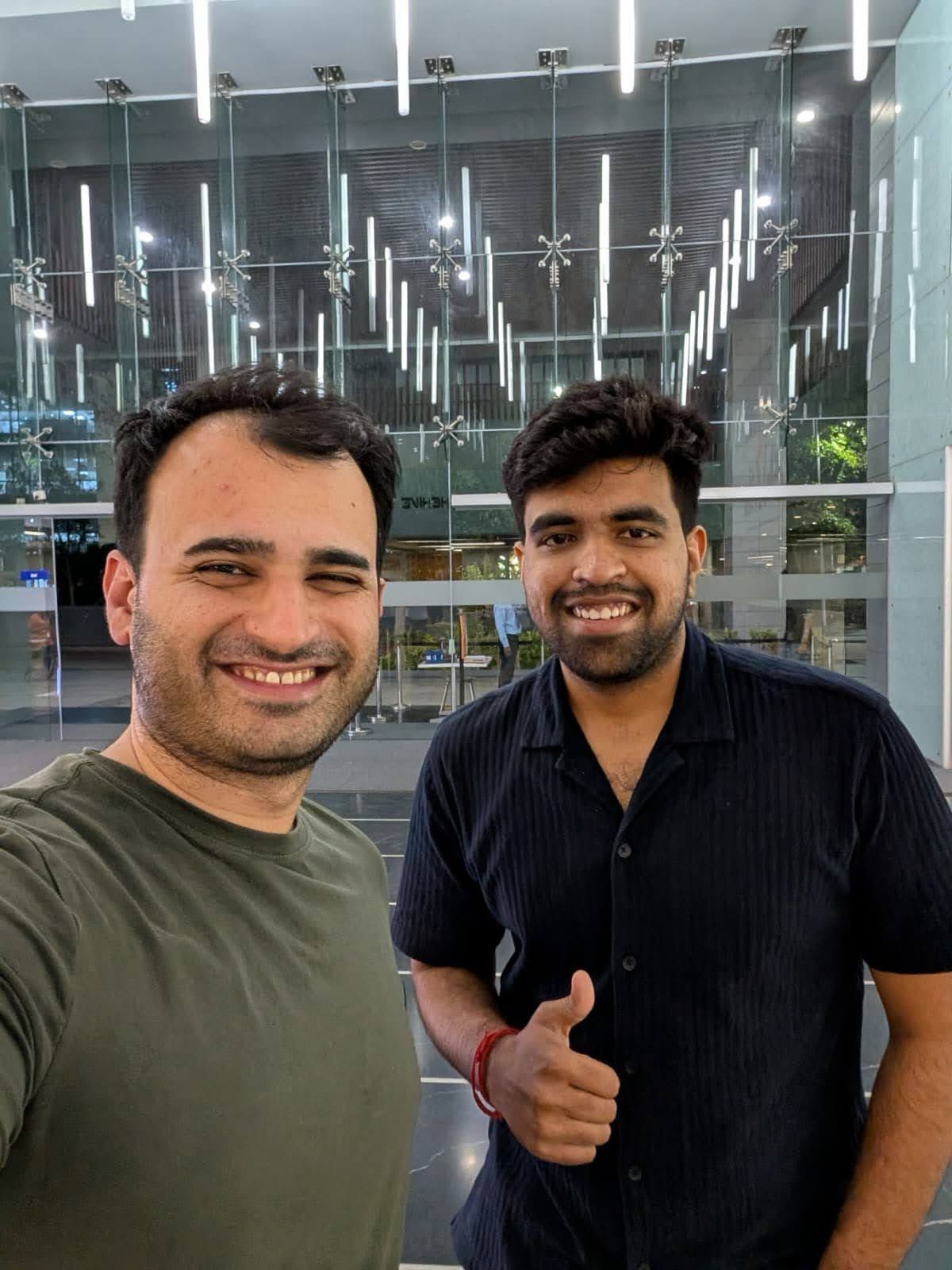
Krishna (MaximusLabs) with Ishan, Founder & CEO of Oliv AI
Click to expand
Krishna (MaximusLabs) with Ishan, Founder & CEO of Oliv AI
The minute our presence improved, customers started coming to us already referencing the blogs in the conversation. They were reading them, finding them valuable, and treating them with real authority.
.avif)
It started as a small experiment. A warm intro, two calls, a lot of brainstorming, and one simple deal: three months to prove this could work. What follows is exactly what happened next, in Ishan's words and in Oliv AI's own dashboards.
Oliv AI gave us three months to prove that answer engine optimization could move real revenue, not vanity traffic. The first qualified lead landed in week six. One year later, organic inbound is the engine.
Win high-intent buyers against billion-dollar incumbents who invented sales-tech SEO, with a fraction of their resources and zero existing authority.
Bottom-of-funnel first. Revenue-only content, engineered to win every answer engine at once, written in the founder's voice. End to end, strategy to maintenance.
Organic became Oliv AI's single largest recurring lead source. Shorter deal cycle, higher close rate, and the top brand citation slot in AI answers.
Given that it is a very crowded space, and the biggest competitors already have a massive SEO presence, it felt like an insurmountable challenge.
How the decision actually unfolded, one step at a time.
HubSpot, Salesforce, and Gong wrote the sales-tech SEO playbook. A decade head start, and a billion-dollar page on every keyword.
Oliv AI had a sharp point of view and almost no organic footprint. Most founders see that wall and quietly give up on search.
G2 and 6sense: 70% of the buyer journey is over before they reach your site. Do nothing, and it all happens without you.
So Oliv AI gave us three months. Prove answer engine optimization moves real revenue, not vanity traffic, or walk away.
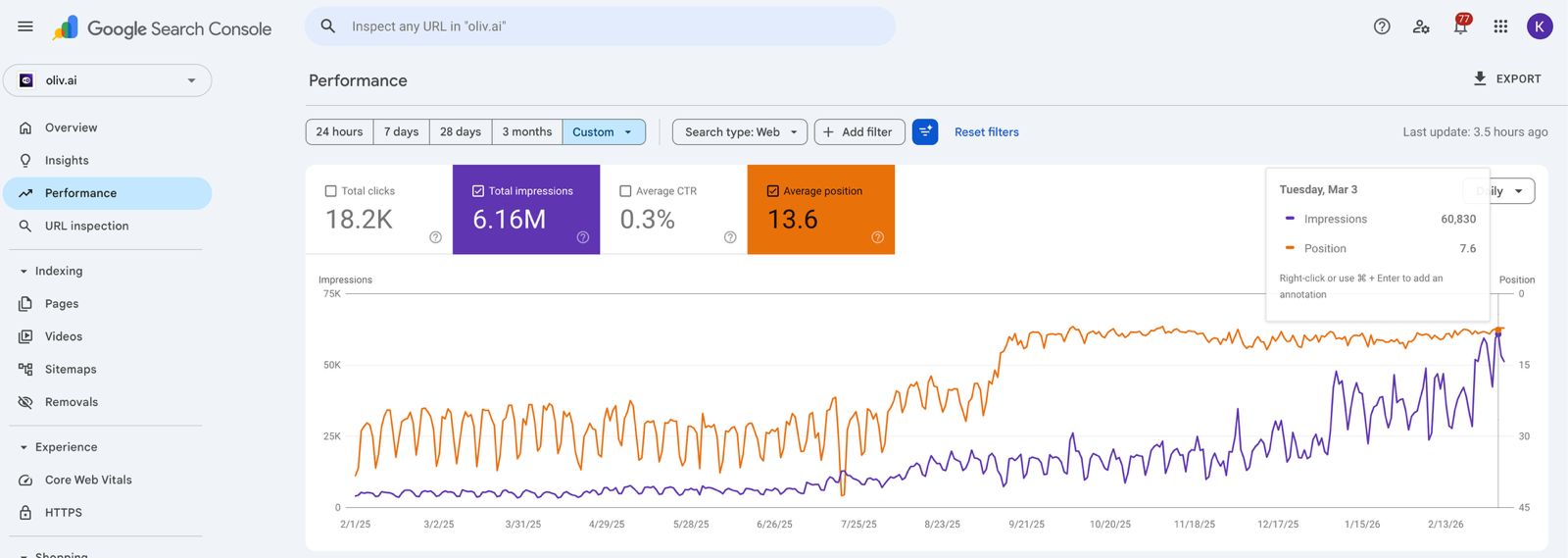
No edited numbers, no hand-drawn charts standing in for reality. This is Oliv AI's own Google Search Console and Google Analytics, exactly as they look today.
Google Search Console, oliv.ai, February 2025 to March 2026
The early months sit near the floor, the pre-engagement baseline. Then the climb starts and does not stop. Impressions compound, average position pushes into the single digits on the pages that matter.
 Click to expand
6.16M impressions and 18.2K clicks, earned against the most competitive keywords in B2B, from a domain that started near zero.
The flat left third is the pre-MaximusLabs baseline. Follow the climb from mid-2025: impressions compound, average position pushes toward single digits.
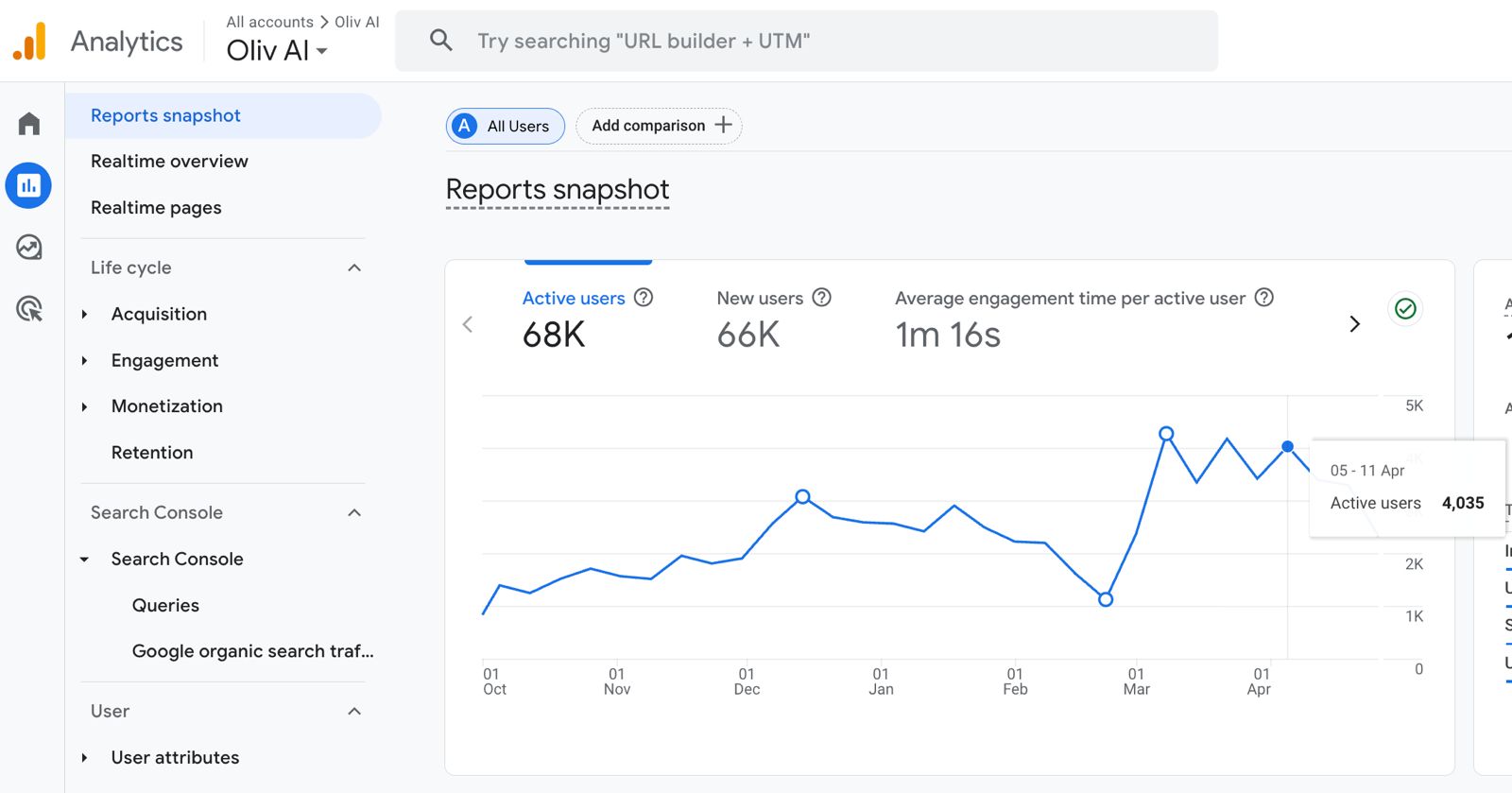
Active users climbed steadily, then jumped after the February 2026 update. The non-commodity content we had been building quietly for months suddenly compounded into a doubling of traffic.
 Click to expand
This is real audience, not a vanity spike. New users and engaged sessions move together, the signature of intent-driven traffic.
Notice the sharp step up in March, right after the February 2026 update. Months of non-commodity content compounded into a doubling, almost overnight.
Most agencies still have not internalized this. The moment we did, everything about how we built content changed.
An article today is rarely read end to end by a human. It is read by a machine, parsed, and turned into an answer. So the job is not the prettiest blog. It is to be the most trustworthy, most exhaustive source on a topic, the one the model cannot leave out. We do not try to be in the answer. We make Oliv AI become the answer.
It is not about hacking the algorithm. It is about building a brand. If you build a brand in your space, AI HAS to recommend you. No matter how many algorithm updates come, you stand, because you are THE brand.

A buyer's research is scattered across a dozen surfaces. We do not pick one. Every Oliv AI article is built to be retrieved and cited across all of them at the same time.
From day one we took a position: we would never optimize for clicks that do not convert. No top-of-funnel fluff. No impression-chasing. We went straight for the buyers closest to a purchase decision, the people already comparing tools.
A funnel, not a spray. We started at the sharpest, highest-intent keywords, then widened outward, one stage at a time.
Switchers in active evaluation. The closest buyers to a decision, so we started here.
Owned only after the competitor terms were exhausted.
The broad layer, built last, on a foundation that already ranks.
We went deep before we went broad. Vertical first, to build undeniable topical authority on one thing. Then wide.
Everything about revenue intelligence and revenue AI. A deep, narrow foundation the engines learn to trust.
Revenue orchestration, conversation intelligence, the language of the whole space, not just the product.
Adjacent topics across the sales tech stack, published on top of an authority base that already ranks.
No handoffs, no "here is your content, good luck." We run the complete lifecycle, from the first keyword decision to the monthly refresh that keeps a ranking alive. This is what hands-on actually looks like.
ICP, intent, and the revenue map for every keyword.
From search data, sales calls, support tickets, and Reddit.
Papers, patents, and docs. We trace claims to the source.
In the founder's voice, so it sounds like Ishan wrote it.
Custom visuals, diagrams, and data graphics per piece.
Schema, clean HTML, AI crawlers unblocked, TOC built.
Rankings, citations, and share of voice across engines.
Refresh on performance data so wins do not decay.
Expand to new clusters as the category moves.
A three-stage production pipeline. Nothing ships until it clears a 10-dimension quality bar.
Maximus captured the differentiated point of view we had into the space. It did not feel like your run-of-the-mill "13 ways to do X" article. That depth of voice, that depth of authority, really came through, and our customers bring it up when they book a meeting with us.
No six-month "trust us, it is coming" runway. Here is the real sequence, including the week everything changed.
We ran a full technical SEO sprint, agreed the keyword list with Ishan, and had the first BOFU article published within the first week. No long onboarding. Momentum from day one.
Inside six weeks, our articles started ranking and Oliv AI landed its first inbound qualified lead. Not a tire-kicker, a high lifetime-value account. This one event changed the entire dynamic of the partnership.
With leads landing and customers quoting the blogs back in sales calls, the company decided to make inbound a major channel. The experiment was no longer an experiment.
We published roughly 50 to 56 articles in the first three months, around 15 to 17 a month. The proof of concept closed with results on the board, and we shifted into aggressive execution.
Organic inbound, SEO plus answer engine optimization, crossed 50% of all company leads. Because these buyers come pre-sold, the deal cycle shortened and the close rate climbed.
Lead flow from organic inbound reached 60% of the company total. We were not chasing buyers anymore. They had a need, they searched, they found Oliv AI, and they came.
The February 2026 update handed us a 100% jump in users and traffic. We had been building non-commodity content before the market even had a name for it. When the algorithm caught up, we were already there.
A year into the partnership and still going strong. Oliv AI crossed a major ARR milestone, and oliv.ai now sits at the top of the brand-domain citation chart in sales-tech AI answers, ahead of Salesforce, ZoomInfo, and every direct competitor.
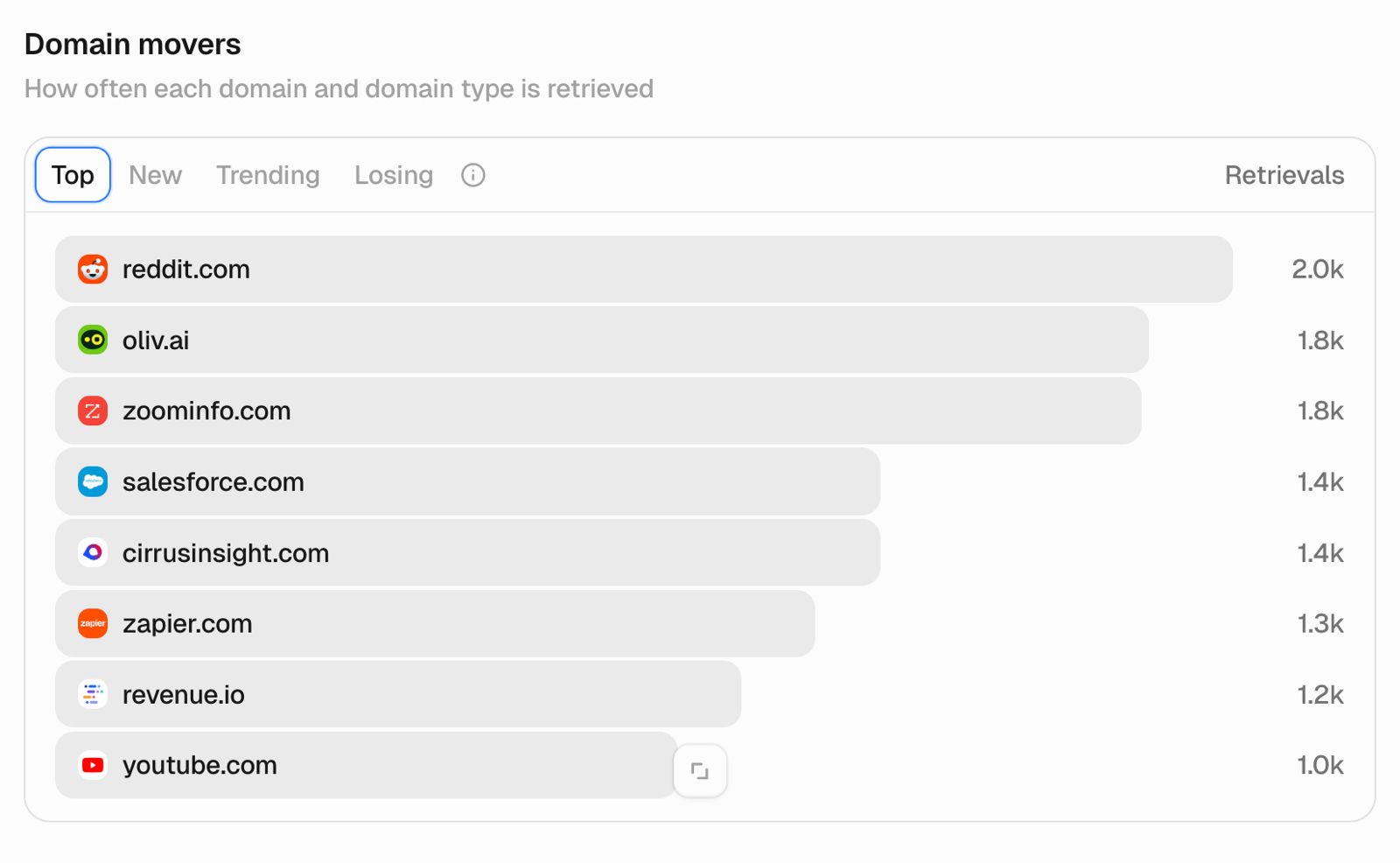
Rankings are only half the story. The other half is what the answer engines actually retrieve. Across roughly 100 prompts about the sales tech stack, this is who the models pull from most.
Retrieval frequency across ~100 sales-tech prompts. Source: AI visibility tracker.
This is the raw "Domain movers" view from the AI visibility tool we run for Oliv AI. oliv.ai sits second only to Reddit, and above every brand in the space. Our articles are engineered to be retrieved this way, and we see the same pattern across our roster.
 Click to expand
When a buyer asks an AI which revenue tool to use, Oliv AI is in the set. Models name only five to ten players. Being in the set is the whole game.
Ignore Reddit and YouTube, they are open platforms. Among brand domains, oliv.ai sits at the very top, ahead of ZoomInfo and Salesforce.
We have cracked Google Search, AI Mode, AI Overviews, Perplexity, Claude, and Gemini for Oliv AI. ChatGPT is still the hard one. It leans heavily on Reddit, Wikipedia, and third-party mentions, which take longer to earn honestly. We know the path, we are walking it, and Oliv AI will be there too. We do not sell snake oil.
We call ourselves a revenue-focused answer engine optimization company for a reason. We do not report impressions and call it a day. We report sales-qualified leads and pipeline impact. Here is why this kind of growth converts.
With inbound, we chase no one. The buyer has a need, searches, finds Oliv AI, and arrives already convinced. High close rate, short cycle. Remember the 70%: by the time they reach the site, most of the decision is made.
And they tell on themselves. In sales calls, they quote the blogs back. The selling is half done before the first call even starts.
When customers came to us, they referenced a lot of the content they had read on the blogs in the conversation itself. They are actually going and reading them, finding them valuable, and treating them with authority.
What stood out was the urgency. Most vendors say it takes six months to a year to build authority. Here there was a clear push to prove it fast, and within the first three months we started to see results. That led to a lot of momentum and a good base to grow together.
Oliv AI was our first client. They trusted us, they came to us, and we do not take that lightly. So we set ourselves a challenge.
As of today, our articles already rank against Agentforce, Salesforce, and Gong on the engines that matter most: ChatGPT competitors, Claude, Perplexity, and Google AI Mode. A seed-funded company, beating billion-dollar brands, in the hardest category there is.
One year from now, you can expect Oliv to be named among Salesforce and Gong, or even bigger than that. That is the northstar I am chasing for them. And we are getting there. I am already seeing the quality come through.
We start with bottom-of-funnel, we report in sales-qualified leads, and the first article can be live in days. If your buyers are researching on Google and AI before they ever reach you, let us make sure they find you.