 Krishna Kaanth M
- AEO mistakes are now a revenue problem, not a visibility one, because AI answers name only 5 to 10 players per query and there is no page two.
- Mistakes cluster into three buckets: structural (buried answers), technical (uncrawlable content, broken schema), and strategic (wrong intent, weak trust).
- The top errors include treating AEO like keyword SEO, burying answers below the fold, locking AI crawlers out with JavaScript, and over-relying on schema.
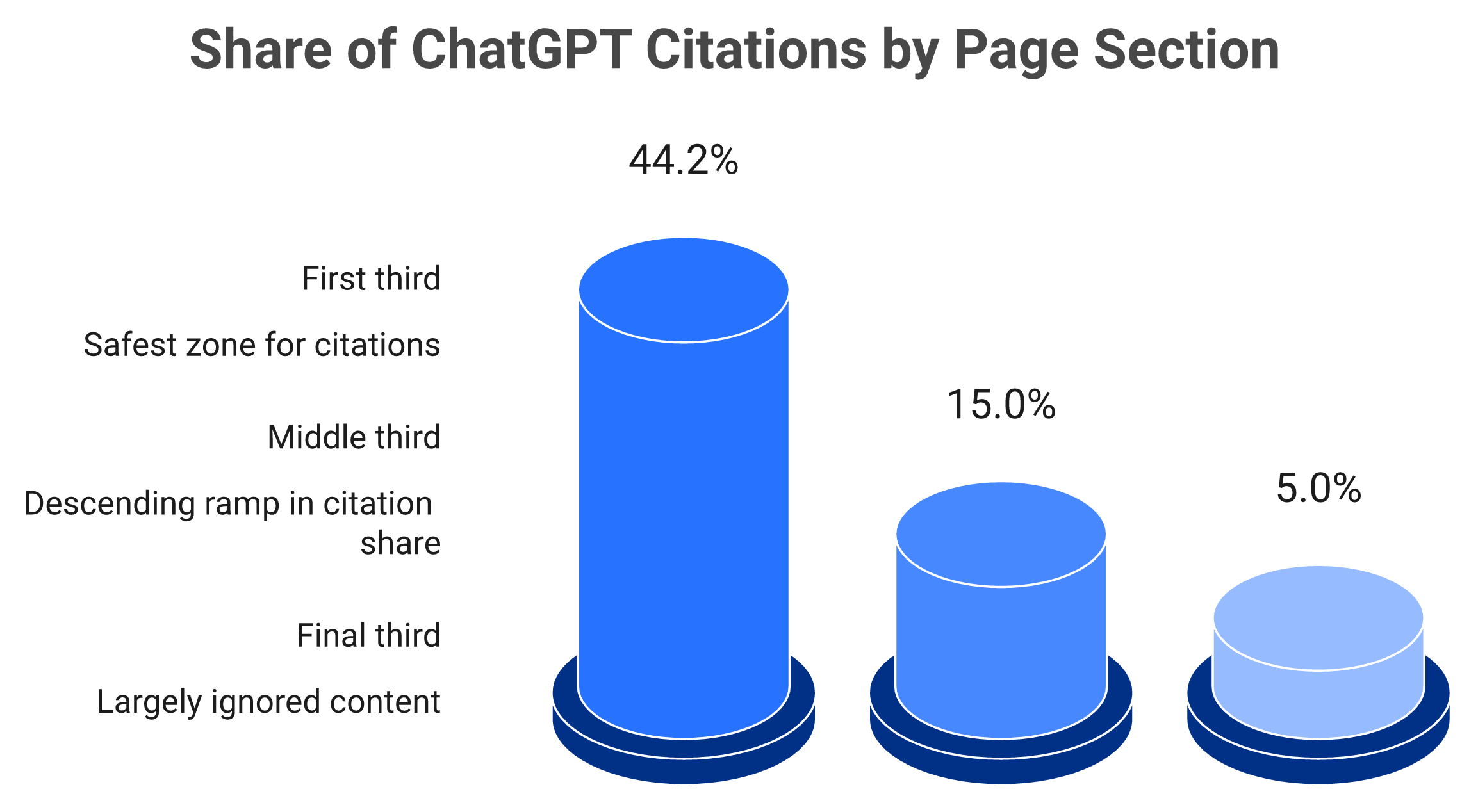
- About 44.2% of ChatGPT citations come from the first third of a page, so answer-first blocks of 134 to 167 words win citations.
- The zero-click fear is overblown; on the same keywords zero-click rates fell from 33.75% to 31.53%, and LLM traffic converts at roughly 6x Google traffic.
- Break the SEO Death Spiral by shipping the roughly 5% of fixes that matter and measuring AI citation presence on revenue queries, not Core Web Vitals.
Q1. Why are AEO common mistakes now a revenue problem, not a visibility problem?
A VP of Marketing pulls up her ranking dashboard, sees three keywords sitting in Google's top five, and feels fine. Then a board member asks a simpler question: "When I ask ChatGPT for the best tool in our category, why isn't our name in the list?" She has no answer. The dashboard was measuring the wrong game.
AEO mistakes are now a revenue problem because AI answers name only 5 to 10 players per query. If you are not in that sample set, you do not exist, and there is no page two to save you. Gartner projects traditional search volume drops 25% by 2026 as buyers shift to AI chatbots. So every mistake that keeps you uncited compresses pipeline, not just impressions. The gap matters more because LLM traffic converts far better than Google traffic.
⚠️ The evaluative window collapsed
For 20 years, search meant a page of 10 blue links. A buyer scanned, compared, and clicked several. Being result number seven still earned attention. That world is closing. Answer Engine Optimization (AEO) means optimizing so an AI engine names and cites you inside its answer, not just ranks your URL.
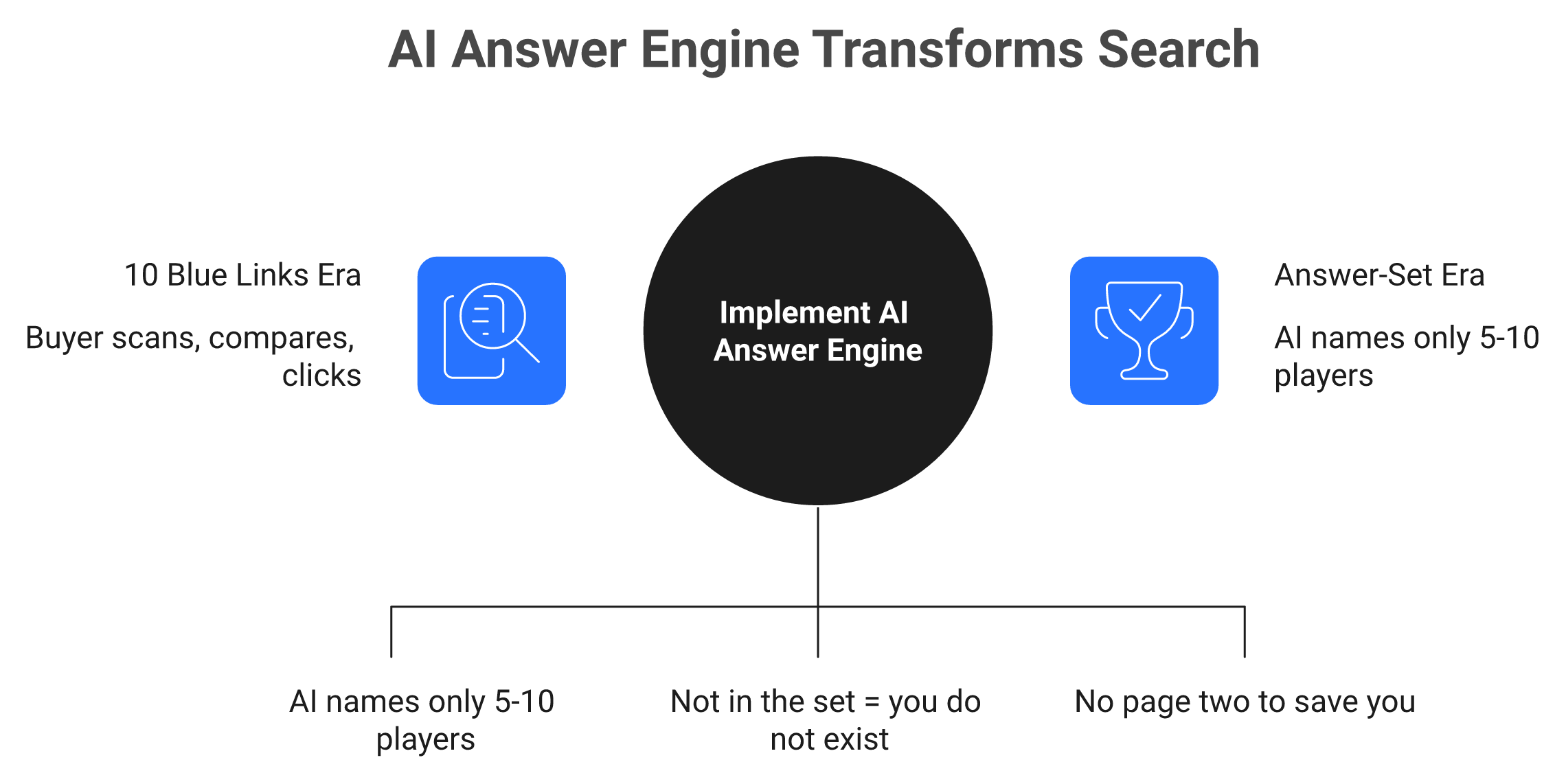
The shift is stark. As one operator framed it, "there are hundreds of CRMs out there, but AI systems will mention only 5 to 10 players. If you're not in this sample set, you don't exist. You're not even in the evaluation set." Position six in an answer box is functionally zero.
💰 Why this is a pipeline issue, not a vanity issue
The intent mix inside AI answers has moved toward money queries. Semrush, analyzing over 10 million keywords, found Google AI Overviews spread well beyond informational searches into commercial and transactional intent through 2025. These are the queries where deals get shortlisted.
Two numbers make the stakes concrete:
- AI answers show only 5 to 10 named options, so missing the set means missing every downstream conversion.
- LLM traffic has been reported converting at roughly 6x the rate of standard Google search traffic, because conversational queries build intent before the click.
When your buyer's shortlist gets assembled by a machine, an AEO mistake is not a lost impression. It is a lost seat in the consideration set.
✅ Reframe: treat each mistake as a revenue leak
This is why we stopped reporting rankings at MaximusLabs and started reporting citation presence on revenue queries. A number one ranking that never surfaces in ChatGPT is a vanity metric wearing a nice suit. What matters is whether the answer engine hands you the buyer.
The old instinct says "recover the ranking." The sharper read says find the leak that keeps you out of the answer, then plug it. As the saying in this space goes, the penalty for being average has never been so severe, but the payout for being extraordinary has never been higher.
The rest of this guide walks the specific mistakes, one at a time, and the fix for each. We start by defining what actually counts as an AEO mistake, then move through the structural, technical, and strategic errors that quietly keep you uncited.
Q2. What exactly counts as an AEO mistake in AI answer engines?
Most "AEO mistakes" listicles read like a junk drawer. Fifteen unrelated errors, no logic, no priority. A Head of Organic Growth reads one, fixes items three and nine because they look easy, and wonders months later why nothing changed. The list was never organized around how AI engines actually decide.
An AEO mistake is any content, structural, or technical choice that stops an AI engine from confidently extracting, trusting, and citing your page. They cluster into three types: structural (buried answers, weak formatting), technical (unreachable content, invalid schema), and strategic (wrong intent, weak trust). Roughly 40% of "AEO-optimized" pages ship broken or missing schema. And about 44.2% of ChatGPT citations come from just the first third of the page.
🧭 The three buckets that actually matter
Answer engines do three jobs before they cite you. They extract a clean answer, verify they can reach and parse it, and decide whether to trust it. Every AEO mistake breaks one of those three steps. That gives us a diagnostic frame instead of a random list.
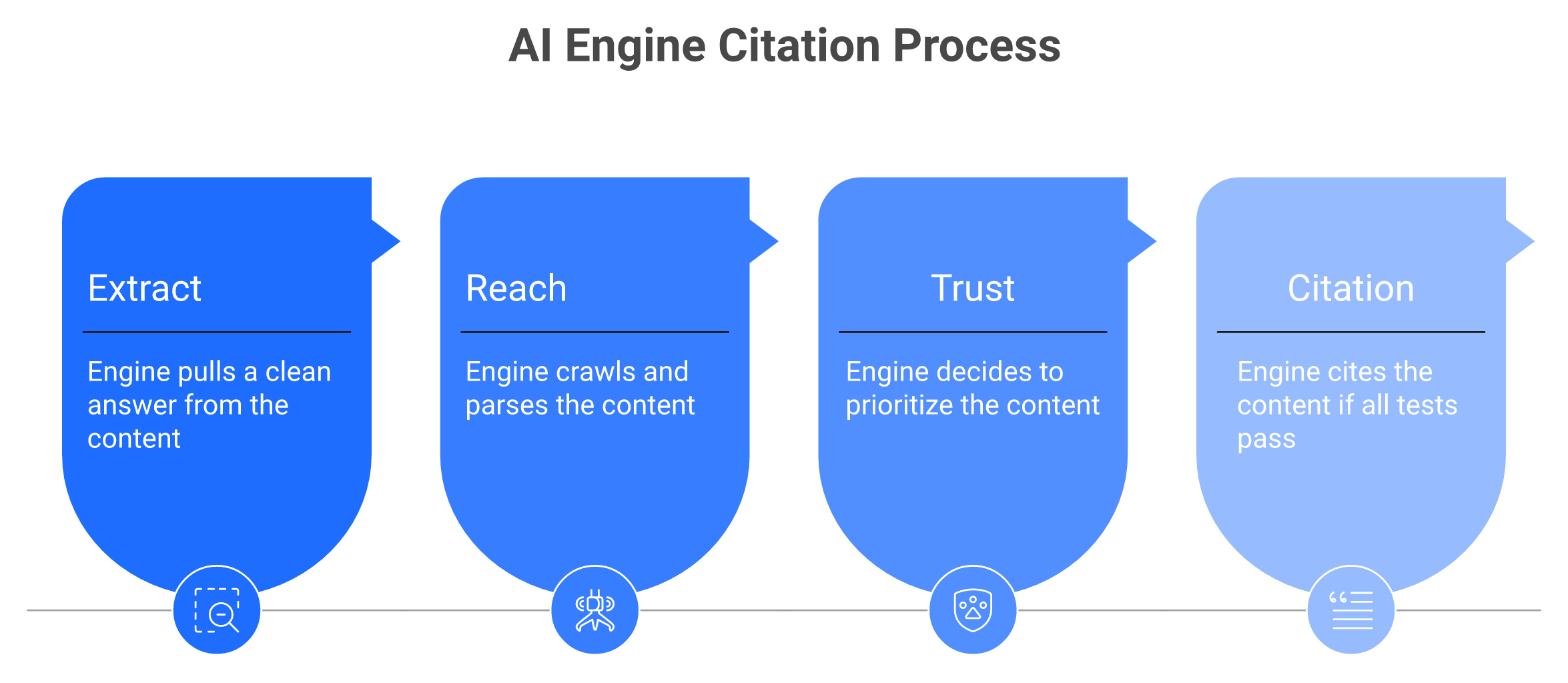
| Bucket | What breaks | Common mistakes |
|---|---|---|
| Structural | The engine cannot extract a clean answer | Answer buried below the fold, vague headings, wall-of-text paragraphs |
| Technical | The engine cannot reach or parse the content | JavaScript-hidden data, invalid schema, blocked AI crawlers, subdomain sprawl |
| Strategic | The engine will not trust or prioritize you | Wrong intent, thin content, weak E-E-A-T, single-platform focus |
⭐ Why prioritization beats a long list
Here is the part most audits get backwards. They treat all 15 mistakes as equal weight, then hand you a 50-page PDF. In practice, a small slice of the work drives almost all the impact. Roughly 5% of the fixes move the needle, and the rest is busywork that feels productive.
The evidence points at structure first. If 44.2% of citations come from the opening third of a page, a buried answer is not a minor formatting nit. It is the single highest-leverage fix available. Meanwhile, the roughly 40% of pages shipping invalid schema shows how much "technical AEO" effort goes into markup that was never validated.
Use the three buckets to self-diagnose. Ask which step is failing: can the engine extract you, reach you, or trust you? At MaximusLabs, that single question decides where the first week of our technical audit work goes, because fixing the wrong bucket is how teams burn a quarter and see nothing move.
Q3. Are you making the #1 mistake, treating AEO like keyword SEO?
A Marketing Manager exports a keyword list, checks density, sprinkles the target phrase into H2s, and ships. It is the muscle memory of 15 years of SEO. It also explains why the page ranks on Google yet never surfaces when a buyer asks Perplexity a real question. The habit that built the old channel quietly sabotages the new one.
The #1 AEO mistake is running AEO like keyword SEO, stuffing terms and chasing rank instead of answering intent. AI prompts average around 25 words versus about 6 for a Google search, so content must be roughly 4x more contextual to survive intent-decoding. Keyword density does not earn a citation. A clear, self-contained answer to the real question does, and the Princeton GEO study measured up to 40% visibility lift from exactly that kind of optimization.
⚠️ The situation: comfortable habits, new medium
Keyword SEO trained us to think in fragments. Match the string, win the rank. That logic worked when a query was six words and a link was the prize. The reflex is deep, and it feels safe.
The complication is that AI does not rank strings. It decodes intent, then summarizes trusted sources into one answer. Think of the LLM as a universal intent decoder. It translates a messy, 25-word prompt into a structured request, then picks the sources that answer it fully.
💸 The complication: why keyword thinking backfires
The length gap tells the story. The average Google search runs about 6 words. In a chat prompt, it runs closer to 25 words, according to figures cited by Perplexity. Your content has to carry roughly 4x more context just to be considered.
The Princeton and IIT Delhi GEO study made the alternative measurable. Optimizing content the right way lifted source visibility in generative engines by up to 40%, with the biggest gains from adding cited statistics (around +41%) and authoritative quotations (around +28%). Notice what is absent from that list: keyword density. The levers that win citations are context and credibility, not repetition.
✅ The resolution: answer the question, do not decorate the page
Pick one important page this week. Stop optimizing it for a keyword and start optimizing it for the question a buyer actually asks an AI engine. Lead with a direct answer, add a real statistic with a source, and quote a credible authority. That is the shift from decorating to answering, and it sits at the heart of real generative engine optimization.
We treat this as a data-science problem at MaximusLabs, not a content tweak. As Krishna Kaanth puts it, GEO is not SEO, it is a data science problem, and you have to know how these LLM algorithms retrieve and rank answers to be present in them. The contrarian truth here is simple: the standard "optimize the keyword" read gets it backwards. The engine is grading your answer, not your keyword map, which is exactly why GEO differs from traditional SEO.
Q4. Is your best answer buried below the fold where AI never reads it?
A Head of GTM writes a genuinely great page. The sharp insight, the money quote, the proof, all saved for a strong conclusion near the bottom. It reads beautifully for a human who scrolls. It is nearly invisible to the retrieval system that stops reading long before it gets there.
If your answer is not in the first third of the page, AI likely never uses it. About 44.2% of ChatGPT citations come from the opening third, a "ski-ramp" distribution where content past the 70% mark is largely ignored. The fix is direct: lead every section with a self-contained answer block of roughly 134 to 167 words, the measured sweet spot cited about 4.2x more often than buried prose.
⭐ Lead with the answer, then explain
The conclusion goes first. Retrieval systems front-load their attention, so the top of the page carries the citation weight. If your best answer sits in paragraph nine, you have written it for a reader the machine will never reach.
This is not a style preference. It is where the citations physically come from. Nearly half of ChatGPT's citations trace to the first third of the page, and content beyond the 70% mark drops off a cliff. The middle and bottom of your page are doing far less work than you think.
⏰ The measured shape of a citable answer
There is even a length that performs best. Self-contained answer blocks in the 134 to 167 word range get cited about 4.2x more often than the same information scattered through longer prose. Tight, complete, and early beats sprawling and back-loaded.
Here is the before-and-after in practice:
- ❌ Before: a 90-word throat-clearing intro, then the real answer arrives in paragraph four, well past the point retrieval prioritizes.
- ✅ After: a single 150-word block directly under the H2 that answers the question completely on its own, then supporting detail below it.
The test is whether that opening block still makes sense if an AI lifts it out with zero surrounding context. If it needs the paragraph before it to work, rewrite it until it stands alone. This is the backbone of durable answer engine optimization.
✅ Make it a rule, not a one-off
Turn this into a template your whole team uses. Every section opens with a standalone answer, phrased as a direct response to the heading's question, sized to roughly 40 to 80 words for a nugget or up to 167 for a fuller block. Supporting nuance comes after, never before. Our content production process bakes this in by default.
We write for the extractor first and the scroller second at MaximusLabs, which is why every section we ship opens with a self-contained answer block. We could be slightly early on the exact optimal length as engines evolve, but the direction is not in doubt: buried answers do not get cited, and front-loaded ones do. If you want a second set of eyes on your pages, talk to our team.
Q5. Are AI crawlers silently locked out of your most valuable content?
A Head of Organic Growth at a $30 billion company swears their product reviews are all over the site. Then someone opens the page with JavaScript turned off. The reviews vanish. So do the specs, the ratings, and the very content that would earn a citation. The crawler was seeing a blank shell all along.
Often yes, your highest-value data (reviews, specs, feature facets) loads via JavaScript that AI crawlers cannot execute, making it invisible to retrieval. Toggle JavaScript off to see what disappears; that is roughly what OpenAI's crawler sees. Move help centers to subdirectories (never subdomains), and pull hidden metadata (fabric, closure, materials) into text headers so retrieval systems can reach it. This beats obsessing over Core Web Vitals, Google's page-speed and stability scores.
⚠️ Run the JavaScript-off test today
Here is the fastest diagnostic in AEO. Open your key page, disable JavaScript in your browser, and reload. Whatever disappears is invisible to the machine.
This matters because most AI crawlers do not click, scroll, or execute heavy scripts. Reviews loaded asynchronously, specs behind faceted filters, and tabbed content often never render for them. As one practitioner put it, "I turned JavaScript off and you'll see that not the whole page shows up," describing exactly how a giant brand hid its best data by accident. You can confirm this fast with an AI crawlability checker.
🧭 Two fixes that actually move citations
Once you see what is missing, two structural fixes do the heavy lifting.
- Move your help center to a subdirectory, like site.com/help, not a subdomain like help.site.com. Subdomains tend to underperform because search algorithms often treat them as a separate property. Your long-tail feature answers live in the help center, and they need to sit inside the main site's authority.
- Bring hidden metadata into visible text. AI crawlers cannot click a JavaScript filter for "fabric" or "closure type." Surface those attributes inside headers, body copy, or an FAQ so retrieval can read them.
These are exactly the kinds of issues a proper technical SEO and website audit surfaces, and they connect directly to technical GEO implementation.
✅ Stop polishing Core Web Vitals as a security blanket
Now the contrarian part. Many technical audits pour weeks into Core Web Vitals while the real content stays uncrawlable. One 18-year veteran noted he has never once seen Core Web Vitals drive a traffic increase. Page speed is true, measurable, and mostly beside the point for getting cited.
At MaximusLabs, our first audit step is the JavaScript-off test, not a 50-page PDF. Uncrawlable content cannot be cited, no matter how fast it loads. We could be wrong on the exact weighting as engines improve their rendering, but the order of operations holds: make it reachable first, make it pretty later. If you want help, managing AI crawlers is where we start.
Q6. Does schema markup actually help, or is obsessing over it the real mistake?
A Marketing Manager gets one instruction from an agency: "add schema." So they add FAQ schema, Article schema, Product schema, everything. Months pass. Nothing changes in ChatGPT or Perplexity. The advice was not wrong, exactly. It was just missing every ounce of nuance that would have made it useful.
Schema helps as hygiene, not as a magic lever. Schema markup is structured code that labels your content for machines. Practitioners disagree sharply: some argue tokenization "sort of destroys the schema," while others say structured data "increases your odds significantly." The honest position is that valid FAQPage and Article schema will not get you cited alone, but invalid schema can hurt, and roughly 40% of pages ship it broken.
⚠️ The situation: "just add schema" is lazy advice
Schema became the comfort blanket of AEO. It feels technical, it feels productive, and it produces a satisfying green checkmark in a validator. So teams over-invest in it and under-invest in the answer itself.
The complication is that credible experts openly disagree about how much it matters. That disagreement is the real signal, and most blogs hide it. A grounded read of schema markup basics clears up most of the confusion.
🧭 The complication: the honest debate
Here is the split, laid out plainly.
| The skeptics | The believers |
|---|---|
| Tokenization, how models chop text into pieces, "sort of destroys the schema," so it is "not the top thing on my list." | Structured data "increases your odds significantly" of being surfaced. |
| One agency calls schema "hygiene at best." | It reinforces entity clarity and eligibility for rich results. |
Both camps have a point. Meanwhile, about 40% of pages that claim to be AEO-ready ship invalid or missing schema, so the more common failure is not too little schema, it is broken schema nobody validated. And treating markdown-only pages or an llms.txt file as a silver bullet has no evidence behind it at all, even though an llms.txt generator takes minutes to run.
✅ The resolution: validate first, then move on
So here is a defensible position. Add valid FAQPage and Article schema as hygiene, run it through Google's Rich Results Test, fix what breaks, and stop there. Then redirect your real effort to the extractable, answer-first content that actually earns citations through disciplined GEO content optimization.
We validate schema as hygiene at MaximusLabs, then spend the saved hours on the roughly 5% of work that drives most of the impact, which is clear, self-contained answers. We might be underrating schema for some engines, and we hold that view loosely. But the standard "just add more schema" read gets the priority backwards.
Q7. Are you optimizing for the wrong intent, wrong structure, and only one platform?
A VP Marketing celebrates. Their "what is workflow automation" page just got cited in an AI Overview. Then procurement asks why a competitor keeps showing up for "best workflow automation tool for finance teams," the query that actually precedes a purchase. The team won a definition and lost the deal.
A costly mistake is chasing informational top-of-funnel visibility on one platform, with sloppy structure, while ignoring the money queries. Google AI Overviews shifted from about 91% informational to 57% through 2025 as commercial (roughly 8% to 18%) and transactional (roughly 2% to 14%) queries surged. ChatGPT, Perplexity, and Gemini each retrieve differently. Fix structure to one intent per section, then win bottom-of-funnel comparison and pricing queries across platforms.
⚠️ The situation: winning the wrong query
Top-of-funnel (TOFU) content answers broad "what is" questions. It feels safe and scalable. But AI engines already handle those definitions well, and the buyer asking them is nowhere near a purchase.
The trap is optimizing for one platform's informational answers while the revenue queries move elsewhere. Bottom-of-funnel (BOFU) queries, the "best tool for X" and "A vs B" comparisons, are where deals get shortlisted, which is why AEO question research matters more than keyword volume.
💰 The complication: the money queries moved
The intent mix inside AI answers changed fast. Semrush's analysis of over 10 million keywords found AI Overviews expanded well beyond informational search into commercial and transactional intent across 2025. The buying questions are now inside the answer box.
Two structural realities make prioritization urgent:
- A small set of pages carries most of the value. Roughly 19 out of 20 landing pages drive about 85% of traffic, so scattering effort across low-intent TOFU is wasted motion.
- The leads are worth more. LLM traffic has been reported converting at about 6x the rate of standard Google traffic, because conversational queries build intent before the click.
Each engine also retrieves differently, so a single-platform bet leaves citations on the table. Winning across AEO platforms beyond ChatGPT and Perplexity is now table stakes.
✅ The resolution: one intent per section, BOFU first
Fix the structure first. Give each section one clear intent so the engine can extract a clean answer, then aim your best pages at comparison, pricing, and alternatives queries. Treat your website as the dining room, but remember the buying decision now happens in the AI answer, the kitchen the user never enters.
Our revenue-focused GEO at MaximusLabs starts at BOFU, because a cited definition does not close a deal, but a cited shortlist does. This sits at the core of our GEO service. As Krishna Kaanth argues, TOFU vanity content is largely a waste when impressions do not move the revenue needle. That is a position, not a hedge, and it is why we lean on a revenue-focused framework.
Q8. Is mass-produced AI content torching your trust signals and E-E-A-T?
A founder proudly shows a dashboard: 300 AI-written articles shipped this quarter. Traffic looks flat, citations look worse. The volume play that felt like leverage is quietly signaling "low trust" to the exact engines they wanted to win. It is 2008 all over again, just with better grammar.
Mostly yes. Mass-automated AI content repeats 2008-era content spam that platforms are structurally motivated to break, because if AI derivatives ranked, the engines become useless. Weak E-E-A-T (Experience, Expertise, Authoritativeness, Trustworthiness) gets you skipped even when correct, and stale content quietly loses citations without maintenance. AI-detection tools also carry roughly an 8% false-positive rate, so "humanizing" passes are a race to the bottom.
⚠️ The situation: volume feels like leverage
Cheap AI content is seductive. You can flood a topic in days, and it feels like scale. The instinct is to publish more, faster.
An 18-year veteran saw this movie before. He described doing "creator spam in 2007," scraping and re-spinning content, which "worked really well and then it stopped working" once Google broke it. Strong E-E-A-T for AEO is the opposite bet.
💸 The complication: platforms must break it
Here is the structural logic. If purely AI-generated derivatives ranked well, ChatGPT and Google would fill with summaries of summaries and become useless. As the same veteran put it, that is "why those companies have decided to make it not work."
The counter-move, running text through AI detectors and "humanizers," is also a trap. Those detectors carry about an 8% false-positive rate, flagging genuine human writing as machine-made. Meanwhile, the Princeton GEO study showed the real lifts come from citing credible sources and adding authoritative quotations, not from hiding the machine.
The community sees the same pattern:
"Not directly, Google penalizes low-quality content, not AI itself. The penalties target mass-produced, keyword-stuffed, zero-value posts that add nothing new."
commenter, r/DigitalMarketing Reddit Thread
✅ The resolution: trust is the ranking currency
Do the opposite of the volume play. Add named authors with real credentials, include first-party data and experiments, and schedule refreshes so pages do not decay. Trust signals are now the retrieval filter, which is why a trust-first content playbook outperforms raw output.
We bake the founder's voice and first-party experiments into every article at MaximusLabs, because trust-first content wins citations that spun AI content never will. When an engine cites you, it lends you its credibility, so the bar is higher than old Google SEO. That is the quiet conviction most volume-first shops still avoid saying out loud, and it shapes how we run content marketing.
Q9. Are you missing the earned-media mistake, trying to win head terms on-site only?
A Head of GTM spends two quarters perfecting one landing page for a big head term. It reads beautifully. It still loses in ChatGPT, because the answer gets built from a Reddit thread and a YouTube review that never mention the brand. The page was never the problem. The absence everywhere else was.
For competitive head terms, on-site-only optimization loses. AI cites sources it already trusts, like Reddit threads, YouTube videos, and Tier 1 affiliates such as Dotdash. Identify the most-cited URLs for your target AEO topics, then earn your product a mention inside them. Topical authority compounds when you become the name "uniquely known for" a subject, the way Masterclass owned "Beef Wellington" through Gordon Ramsay.
⭐ Why head terms are earned, not owned
Broad, high-value queries pull answers from third-party sources more than from your own site. For "best CRM" or "best credit card," the engine trusts an aggregator or a community thread over your marketing page. Your own page can win the long tail, but the head term is a popularity contest among citations.
The mechanism is topical authority through association. Masterclass ranked for "Beef Wellington" because Gordon Ramsay, an instructor uniquely known for it, taught it there. That association becomes a flywheel the engine learns to trust, which is where Reddit and forum AEO earns its keep.
🧭 The earned-citation playbook
Here is the loop, ranked in order.
- 9.1 Identify the most-cited URLs. Run your target questions through ChatGPT, Perplexity, and Gemini, and log which specific URLs get cited repeatedly. Chase the URL, not just the domain. A Reddit threads finder speeds this up.
- 9.2 Earn a mention inside them. Get your product referenced authentically in those exact threads, videos, and affiliate pages. On Reddit, that means real participation, not spam.
- 9.3 Compound topical authority. Become the name repeatedly associated with the topic, so citations start naming you by default, supported by deliberate GEO topic clusters.
Practitioners see this working in the field:
"Reddit threads often rank highly on Google, and many AI search tools source information from those discussions. If your brand is mentioned naturally in relevant threads, it can boost visibility, attract traffic, and support AI citations."
commenter, r/aeo Reddit Thread
✅ Play the whole board, not one square
This is Search Everywhere Optimization, and it is core to how we work at MaximusLabs. We engineer mentions inside the exact URLs AI already cites, not just your own blog, as part of our broader GEO service. The first-mover question is genuinely contested here. One veteran calls first-mover advantage a "false concept" since rank can be earned later, while others argue early protocol integration builds entrenched data patterns. From what surfaces when you actually run this, the earned-citation loop matters more than the timing debate, and it aligns with sharp GEO competitive positioning.
Q10. How do you measure AEO, and stop believing the zero-click myth?
A VP Marketing reports the same slide every month: rankings up, traffic flat, then a nervous line about "AI killing our clicks." Nobody in the room can say whether ChatGPT actually cites the brand. The team is measuring the old channel while flinching at a myth about the new one.
The measurement mistake is watching rankings and traffic while ignoring whether AI actually cites you. And the "AI Overviews kill all clicks" fear is overblown. On the same keywords, zero-click rates fell from 33.75% to 31.53%, and click-through rates rose through 2025. The fix is a citation-monitoring protocol: run your top 20 revenue queries through ChatGPT, Perplexity, and AI Overviews, and log citation presence as your baseline.
⚠️ You are measuring the wrong thing
Rankings and sessions describe the Google era. They say nothing about whether an answer engine names you. So teams optimize a number that no longer maps to pipeline.
Citation presence is the real metric. It answers the only question that matters: when a buyer asks, does the machine hand them your name? Getting this right depends on solid AEO measurement metrics.
📊 The zero-click fear is mostly a story
The data undercuts the panic. Semrush analyzed over 10 million keywords and found AI Overview coverage was volatile through 2025, rising from about 6.5% of queries to a roughly 25% peak, then settling near 16%. Coverage expanded and contracted, it did not simply devour every click.
More striking, on the same keywords, zero-click rates actually dipped from 33.75% to 31.53%, and click-through rates rose. The blanket claim that AI Overviews destroy all organic clicks is not what the numbers show. And when you do get cited, the leads convert well, with LLM traffic reported at roughly 6x the conversion rate of standard Google traffic. The wider zero-click search brand economy rewards presence over raw clicks.
✅ A citation-monitoring protocol you can run Monday
Here is the baseline routine.
- List your top 20 revenue queries, the ones that precede a purchase.
- Run each through ChatGPT, Perplexity, Gemini, and Google AI Overviews.
- Log whether you are cited, and who is cited instead. An AI search visibility and brand mention tracker makes this repeatable.
- Track that presence over time as your real scoreboard.
Our dashboards at MaximusLabs track citation presence across these platforms on your revenue queries, because it is the one AEO metric that ties to pipeline, and it feeds directly into GEO ROI and revenue attribution. Report that to leadership instead of impressions. I might be early on the exact cadence, but the standard "rankings and traffic" report gets the modern scoreboard backwards.
Q11. Are you stuck in the SEO Death Spiral, and how do you break out this quarter?
A founder signs an agency, waits a year, and gets a beautiful 50-page audit and no revenue. Engineering stops returning the agency's tickets. The founder fires them, hires the next one, and starts the identical loop. The spiral is not bad luck. It is the default outcome of the old model.
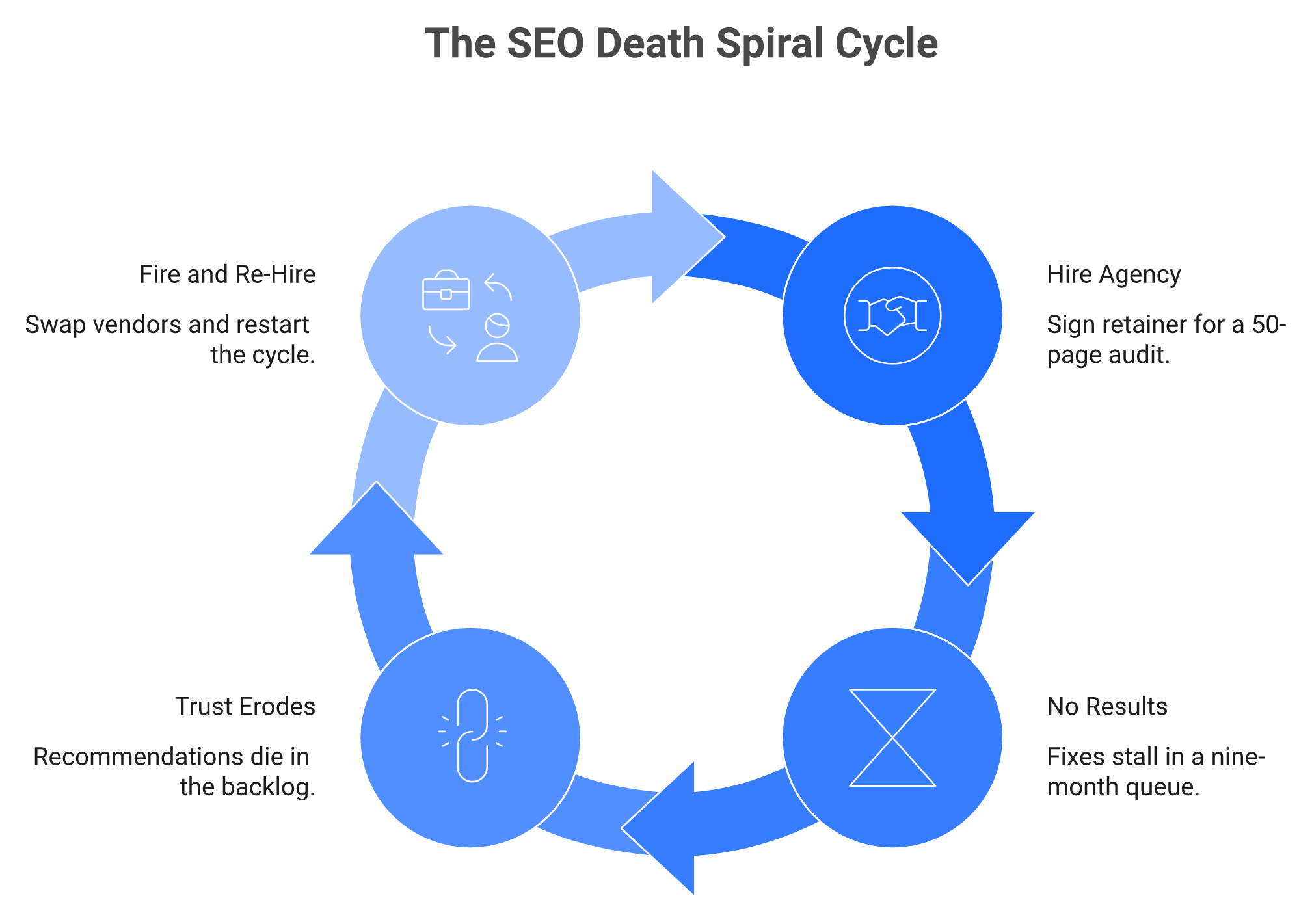
The SEO Death Spiral is hiring an agency for an audit, seeing no results for a year, losing engineering trust, then hiring another agency for the same zero-impact cycle. You break out by refusing 50-page audits and shipping the roughly 5% of fixes that drive impact, like crawlable content, answer-first blocks, and earned citations, measured by AI citation presence on revenue queries, not Core Web Vitals scores.
⚠️ The situation: a loop dressed as progress
The spiral feels like diligence. Audit, roadmap, retainer, patience. But the deliverable is a document, not a result, and the clock runs against trust.
Operators live this. One described the churn plainly:
"A lot of agencies overpromise and underdeliver. Most agencies cannot keep a client because they cannot get results."
commenter, r/SEO Reddit Thread
💸 The complication: recommendations die in the backlog
Here is why the loop repeats. Most technical AEO fixes require engineering, and they stall in a nine-month queue behind the product roadmap. The audit was right, but nothing shipped, so nothing changed. A focused technical SEO and website audit only helps if the fixes actually ship.
Meanwhile, a chunk of the work was never impactful anyway. As one 18-year veteran put it, most SEO work is "stuff that's true but zero impact," a security blanket of Core Web Vitals reports that never moved traffic. Founders feel the waste directly:
"A partner company of mine was burning $3,000 a month on an SEO agency. The output? 8 blog posts a month that looked like they were written to hit a word count."
u/operator, r/automation Reddit Thread
✅ The resolution: ship fixes, measure citations
Break the loop by changing the model, not the vendor. Ship the small set of fixes that actually move citations, and prove it on revenue queries within weeks, not quarters. Gartner projects traditional search volume drops 25% by 2026, so the cost of another wasted year is steeper than it used to be. This is the heart of a real answer engine optimization engagement.
We built MaximusLabs to end that spiral. We work full-stack, shipping AEO fixes in days rather than handing over a PDF and waiting on someone else's engineers, then reporting citation wins on your revenue queries through disciplined technical AEO execution.
🔮 What we are sitting with next
Here is the open question on our whiteboard. Over the next two years, we think "becoming the answer" stops being an edge and becomes table stakes. The brands that built trust-first, AI-discoverable content early will own the citations, and everyone else will be renting attention.
So the question we would put to you is simple. If a buyer asked ChatGPT for the best option in your category today, would your name be in the set, and if not, which mistake from this guide is the one keeping you out? That is the conversation worth having, and it is exactly where a quick conversation with our team starts.
Frequently asked questions
What are the most common AEO mistakes that keep brands out of AI answers?
We see the same AEO common mistakes repeat across nearly every audit, and they cluster into three buckets that map to how answer engines actually decide who to cite. Structural: the engine cannot extract a clean answer because it is buried below the fold, hidden under vague headings, or drowned in wall-of-text paragraphs. Technical: the engine cannot reach or parse content locked behind JavaScript, invalid schema, blocked AI crawlers, or subdomain sprawl. Strategic: the engine will not trust or prioritize you because of wrong intent, thin content, weak E-E-A-T, or a single-platform focus. The single highest-leverage fix is structural, since about 44.2% of ChatGPT citations come from the first third of a page. Meanwhile roughly 40% of "AEO-optimized" pages ship broken or missing schema, so effort gets wasted on markup nobody validated. We treat this as a prioritization problem, not a 50-page checklist, because roughly 5% of the fixes drive almost all the impact. If you want the full framework, our answer engine optimization approach walks each mistake and its fix in order.
Why does treating AEO like keyword SEO fail in AI answer engines?
Running AEO like keyword SEO is the number one mistake we correct, because AI engines do not rank keyword strings, they decode intent and summarize trusted sources into a single answer. The length gap tells the story. The average Google search runs about 6 words, while an AI prompt runs closer to 25 words, so your content has to carry roughly 4x more context just to be considered. Stuffing a target phrase into H2s does nothing when the engine is grading whether you actually answered the question. The Princeton and IIT Delhi GEO study made the alternative measurable, lifting source visibility by up to 40%, with the biggest gains from cited statistics (around +41%) and authoritative quotations (around +28%). Notice what is absent: keyword density. Lead with a direct answer to the real question. Add a real statistic with a source. Quote a credible authority. We treat this as a data science problem, not a content tweak, which is the heart of how we run generative engine optimization . The engine grades your answer, not your keyword map.
Where should my answer sit on the page so AI actually reads it?
If your best answer is not in the first third of the page, AI likely never uses it. About 44.2% of ChatGPT citations come from the opening third, a "ski-ramp" distribution where content past the 70% mark gets largely ignored. So the conclusion goes first. Retrieval systems front-load their attention, and if your sharpest insight sits in paragraph nine, you wrote it for a reader the machine will never reach. There is even a measured sweet spot. Self-contained answer blocks in the 134 to 167 word range get cited about 4.2x more often than the same information scattered through longer prose. Before: a 90-word throat-clearing intro, then the real answer in paragraph four. After: a single 150-word block directly under the H2 that stands on its own. The test is whether that opening block still makes sense if an AI lifts it out with zero surrounding context. We write for the extractor first and the scroller second, which is baked into our content marketing process. Buried answers do not get cited, and front-loaded ones do.
Can AI crawlers see my content, or is JavaScript hiding my best data?
Often your highest-value data, like reviews, specs, and feature facets, loads via JavaScript that AI crawlers cannot execute, which makes it invisible to retrieval. The fastest diagnostic in AEO is simple. Open your key page, disable JavaScript in your browser, and reload. Whatever disappears is roughly what OpenAI's crawler sees, because most AI crawlers do not click, scroll, or run heavy scripts. Two structural fixes do the heavy lifting: Move your help center to a subdirectory like site.com/help, never a subdomain, since search algorithms often treat subdomains as a separate property. Bring hidden metadata such as fabric, closure, and materials into visible text headers so retrieval can read it. Here is the contrarian part. Many technical audits pour weeks into Core Web Vitals while the real content stays uncrawlable, and one 18-year veteran noted he has never once seen Core Web Vitals drive a traffic increase. Our first audit step is the JavaScript-off test, not a page-speed report, and it anchors our technical SEO and website audit . Uncrawlable content cannot be cited, no matter how fast it loads.
Does schema markup actually help with AEO, or is obsessing over it a mistake?
Schema helps as hygiene, not as a magic lever. The honest position is that valid FAQPage and Article schema will not get you cited alone, but invalid schema can hurt, and roughly 40% of pages ship it broken. Credible experts openly disagree, and that disagreement is the real signal most blogs hide: Skeptics argue tokenization "sort of destroys the schema," so it sits low on the priority list. Believers say structured data "increases your odds significantly" of being surfaced. Both camps have a point, but the more common failure is not too little schema, it is broken schema nobody validated. Treating markdown-only pages or an llms.txt file as a silver bullet has no evidence behind it either. So here is a defensible position. Add valid FAQPage and Article schema as hygiene, run it through Google's Rich Results Test, fix what breaks, and stop there. Then redirect your effort to the extractable, answer-first content that actually earns citations. A grounded read of schema markup basics clears up most of the confusion, and we validate schema as hygiene, then spend the saved hours on the 5% of work that moves the needle.
How do I measure AEO, and is the zero-click fear actually real?
The measurement mistake is watching rankings and traffic while ignoring whether AI actually cites you. Citation presence is the real metric, because it answers the only question that matters: when a buyer asks, does the machine hand them your name? The "AI Overviews kill all clicks" fear is also overblown. On the same keywords, zero-click rates fell from 33.75% to 31.53%, and click-through rates rose through 2025. AI Overview coverage was volatile too, rising from about 6.5% of queries to a roughly 25% peak, then settling near 16%. Here is a citation-monitoring protocol you can run Monday: List your top 20 revenue queries, the ones that precede a purchase. Run each through ChatGPT, Perplexity, Gemini, and Google AI Overviews. Log whether you are cited, and who is cited instead. Track that presence over time as your real scoreboard. When you do get cited, the leads convert well, with LLM traffic reported at roughly 6x the conversion rate of standard Google traffic. Our dashboards track citation presence on revenue queries, feeding directly into AEO measurement metrics that tie to pipeline.
How do we break out of the SEO Death Spiral without another zero-impact agency?
The SEO Death Spiral is hiring an agency for an audit, seeing no results for a year, losing engineering trust, then hiring another agency for the same zero-impact cycle. The deliverable is a document, not a result, and the clock runs against trust. Two forces keep the loop spinning: Most technical AEO fixes require engineering, and they stall in a nine-month queue behind the product roadmap, so nothing ships and nothing changes. Much of the work was never impactful anyway, described by one veteran as "stuff that's true but zero impact," like Core Web Vitals reports that never moved traffic. You break out by changing the model, not the vendor. Ship the roughly 5% of fixes that actually move citations, like crawlable content, answer-first blocks, and earned citations, then prove it on revenue queries within weeks rather than quarters. Gartner projects traditional search volume drops 25% by 2026, so another wasted year costs more than it used to. We built MaximusLabs to work full-stack, shipping fixes in days instead of handing over a PDF, and you can start with a quick conversation with our team .