 Krishna Kaanth M
- AEO content writing structures content so answer engines extract and cite it, optimizing for the quoted passage rather than the clickable blue link.
- Answer engines retrieve small self-contained chunks through RAG and Query Fan-out, so each section must stand alone, with roughly 44% of ChatGPT citations pulled from the top third of the page.
- Write 40 to 80 word blocks for snippets and 134 to 167 word blocks for deeper passages, phrase every H2 as a real user question, and front-load the answer.
- Verifiable statistics lift citation rate about 40%, named sources about 30%, and quotations about 28%, while keyword stuffing and jargon suppress it.
- Schema is a hygiene factor, not a multiplier; skip debunked gimmicks like AI-only schema and llms.txt, and fix content hidden behind JavaScript first.
- Point AEO formatting at BOFU and MOFU pages, because LLM-referred traffic can convert roughly 6 times higher than Google search traffic, and measure citation share, not pageviews.
Q1. What Is AEO Content Writing and Formatting (and Why Is It Different From SEO Writing)?
A Head of Organic Growth pulls up her best-ranking guide last quarter. It sits at position two on Google. Yet when she asks ChatGPT the same question her buyers ask, her brand is nowhere in the answer. A competitor she has never heard of gets quoted instead. That gap is the whole problem.
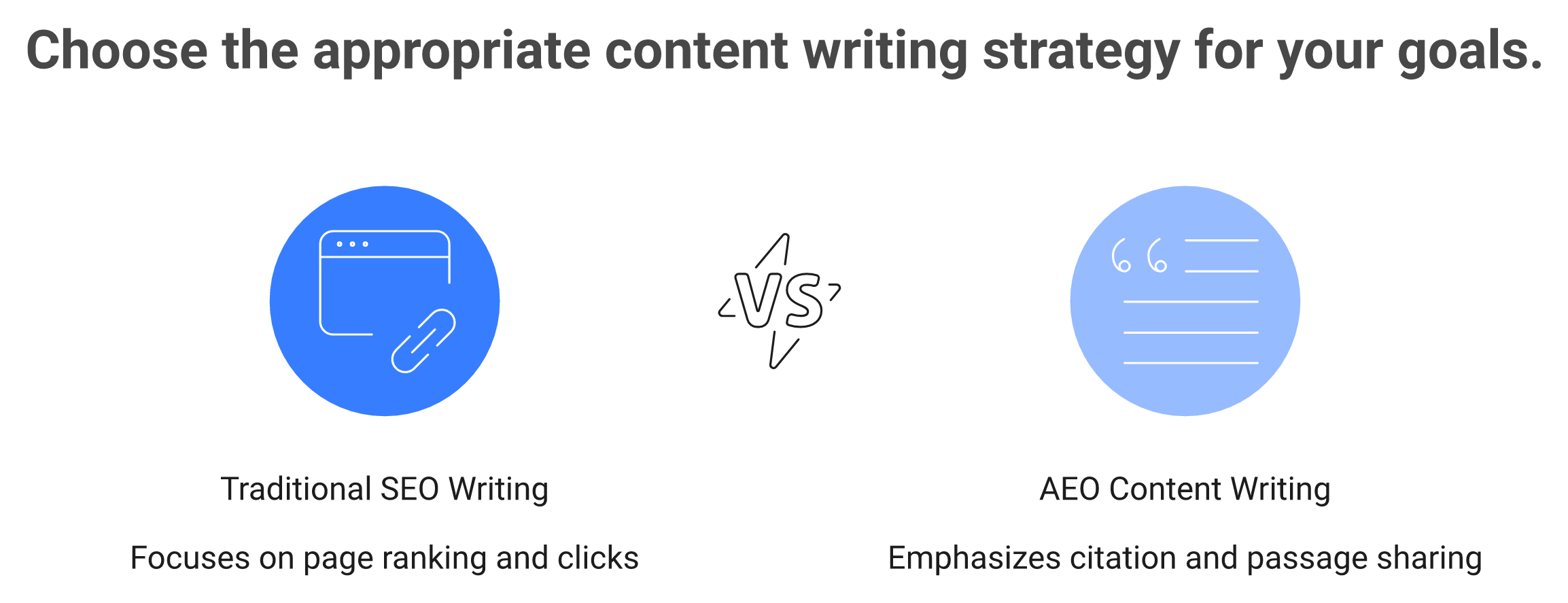
AEO content writing and formatting is the practice of structuring content so answer engines like ChatGPT, Perplexity, Gemini, and Google AI Overviews can extract and cite it as the answer. Unlike traditional SEO writing, which optimizes to rank a clickable link, AEO writing optimizes to be quoted inside the answer itself: answer-first passages, question-led headings, self-contained blocks, verifiable statistics, and named citations.
🔎 The old playbook stopped sending the click
For years, the deal was simple. You wrote for a keyword, you ranked, and you earned a click. That deal is breaking. Buyers now ask a question, read the answer, and stop. There is no visit.
The felt sense on the ground matches the data. Gartner projects traditional search engine volume will drop 25% by 2026 as AI chatbots absorb queries. When the model answers directly, your ranking can be strong while your traffic quietly disappears. This is exactly why the shift toward answer engine optimization now matters.
⚠️ Why writing for a blue link now backfires
Here is the shift that the standard read gets backwards. Ranking a page and being cited in an answer are not the same job. An engine may pull one 40 word passage and never surface your homepage.
Google's own May 2026 guidance confirms this is still grounded in search fundamentals, not a separate trick. So the writing has to change at the sentence level, not the strategy deck level. You write the answer first, then support it. If you want the deeper breakdown, our guide on AEO vs SEO differences lays out the full contrast.
✅ AEO writing versus SEO writing, side by side
| Dimension | Traditional SEO writing | AEO content writing |
|---|---|---|
| Primary goal | Rank a clickable link | Become the cited answer |
| Unit of value | The page | The extractable passage |
| Opening move | Keyword-led intro | Answer-first block |
| Trust proof | Backlinks | Named citations, stats, author credentials |
| Success metric | Position and clicks | Citation share across engines |
The mechanics matter more than most agencies admit. ChatGPT often works from roughly a 150 character snippet of metadata for a standard web result, so your meta description becomes the model's main interface with your page. Miss that, and the engine may never read the good part.
This is why at MaximusLabs we treat AEO writing as a retrieval-engineering discipline, not a copy refresh. We start from how the model reads, then work backward to the sentence, so the passage that gets pulled is the one that sells. It is the foundation of our generative engine optimization work.
Q2. How Do Answer Engines Actually Read and Retrieve Your Content?
Turn JavaScript off on your own product page for a second. Watch how much of it vanishes. That is roughly what a retrieval system sees, and it explains why so much "great content" never gets cited.
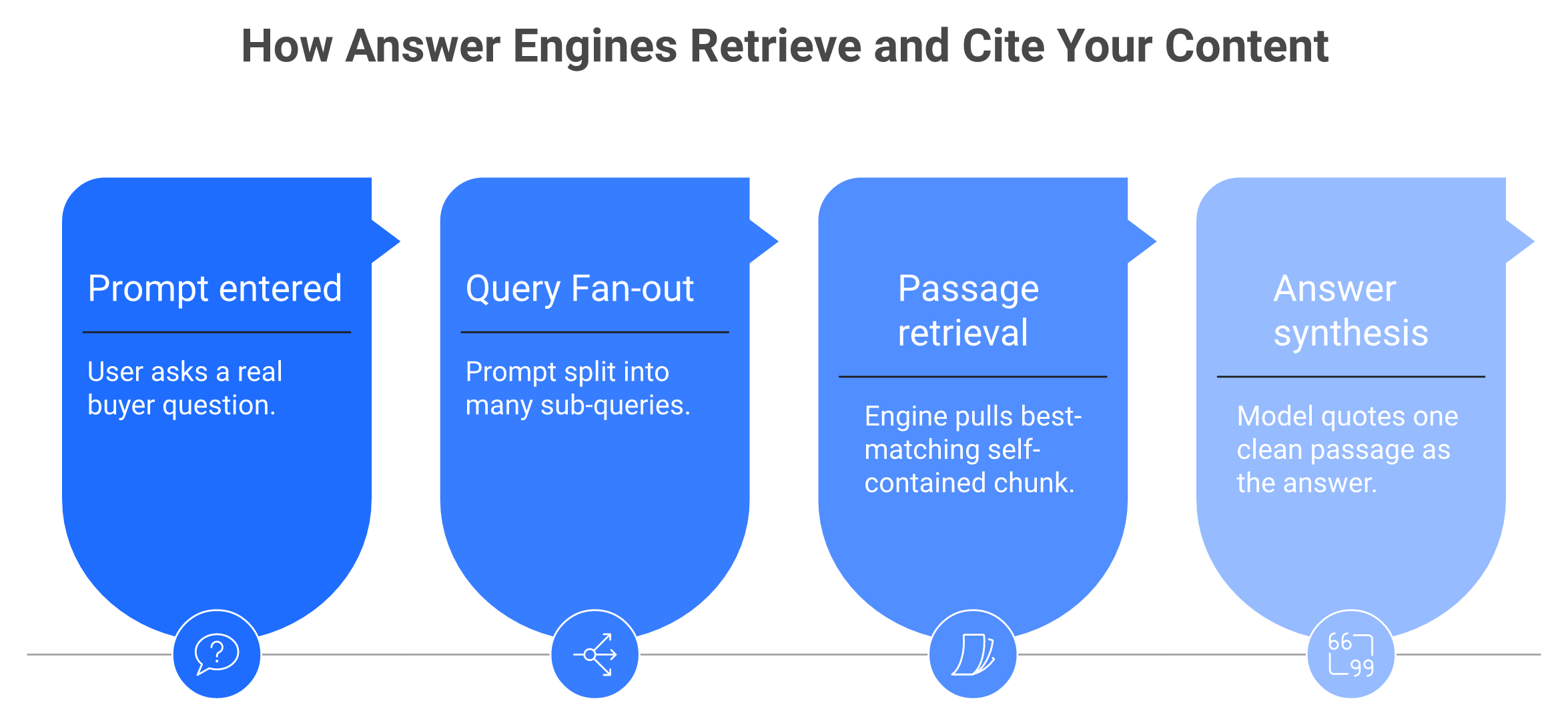
Answer engines don't read your page top to bottom. They retrieve small, self-contained chunks through Retrieval-Augmented Generation (RAG), the process where the model runs a live search and summarizes results. A prompt gets split into sub-queries through Query Fan-out, the engine pulls the most relevant passages, and it synthesizes an answer. So each section must stand alone, because the model may cite one paragraph without its context.
🧠 RAG and Query Fan-out, in plain language
Think of the engine as a decoder. It takes a messy human prompt and turns it into a structured request for a specific piece of your data. Then it fans that single question into many smaller ones and hunts for the best-matching passage for each.
This is the mechanic most content teams skip. They optimize the whole page when the engine is shopping for one clean chunk. Miss the chunk, and you miss the citation. Our technical SEO and website audit often starts here, checking what the crawler can actually see.
📊 Where citations actually come from
The distribution is lopsided, and it should change where you place your best material. Retrieval studies describe a "ski-ramp" pattern, where roughly 44.2% of ChatGPT citations come from the first third of the page. Content past the 70% mark is largely ignored.
📏 The standalone-passage rule
Each retrievable block needs to make full sense on its own. The measured sweet spot for a self-contained answer block sits around 134 to 167 words, a length cited about 4.2 times more often than looser passages. Write each block as if it will be lifted out and quoted with zero surrounding context, because it often will be.
The founding research backs the payoff. The Princeton and IIT Delhi GEO study tested optimization tactics across roughly 10,000 queries and showed visibility gains up to 40% in generative engine responses. That only works when the engine can cleanly grab your passage, a core principle of solid GEO content optimization.
🎯 What this means for placement
Put your strongest, most quotable answer near the top. Break long arguments into tight, self-sufficient blocks. Then support each one with evidence the model can verify. Structure for chunk-level extraction, not for a patient linear reader, because that reader is now a machine skimming for one paragraph.
Q3. How Should You Structure a Page So AI Engines Extract It?
A Marketing Manager once showed me a page with an H2 that read "Project Management Software Solutions Features." Nobody asks that. An engine matching real prompts had nothing to grab. We turned it into a question, and the section started getting pulled.
Structure every page as a stack of question-and-answer units. Use a clear H1 to H2 to H3 hierarchy where each H2 is phrased as a question a user would actually ask, then place a 40 to 80 word direct answer immediately beneath it. Follow with supporting detail, lists, and tables. This answer-first pattern lets engines lift a clean, self-contained response and matches how RAG systems chunk pages.
🧱 Build in question-and-answer units
The page is not an essay. It is a set of self-contained Q&A blocks, each mapped to one real question. The same point holds across every AEO 101 hub resource: optimize headings, lists, and FAQs so engines can extract and cite each block.
📐 Heading hierarchy and skim rules
Keep the hierarchy honest. One H1, question-led H2s, supporting H3s. Add an H4 every two to three paragraphs so a busy reader, and a crawler, can skim the logic fast.
Headings should mirror the natural flow of the questions a buyer asks. The structure is not decoration. It is how the engine maps a prompt to your passage, which is why AEO keyword and question research comes before any drafting.
✍️ Turn keywords into questions
Here is a hard-won shortcut for when you have no query-volume truth set for AI. Take your existing SEO keywords and convert them into questions. You can literally hand the keyword list to ChatGPT and ask it to phrase each one as a question your buyer would type.
A keyword like "best project management software" becomes "What is the best project management software for small teams?" That question becomes your H2. The answer block underneath becomes the thing the engine cites.
✅ The 7-step formatting checklist
- Lead each section with a 40 to 80 word direct answer.
- Phrase every H2 as a real user question.
- Keep paragraphs to two or three sentences.
- Make each section a standalone passage.
- Add lists and tables to break up walls of text.
- Insert two or three sourced statistics per section.
- Quote at least one named expert or study.
We apply this same Q&A-unit structure across client hub and spoke pages, because a page built as clean, question-led blocks gives the engine an obvious passage to quote instead of forcing it to guess. It is a standard step in our AEO service engagements.
Q4. What Formatting and Trust Signals Get You Cited: Stats, Quotations, Lists, or Author Credentials?
Most teams spend their effort on prettier bullet lists. The evidence says that is the wrong place to spend it. The engines reward proof, not polish.
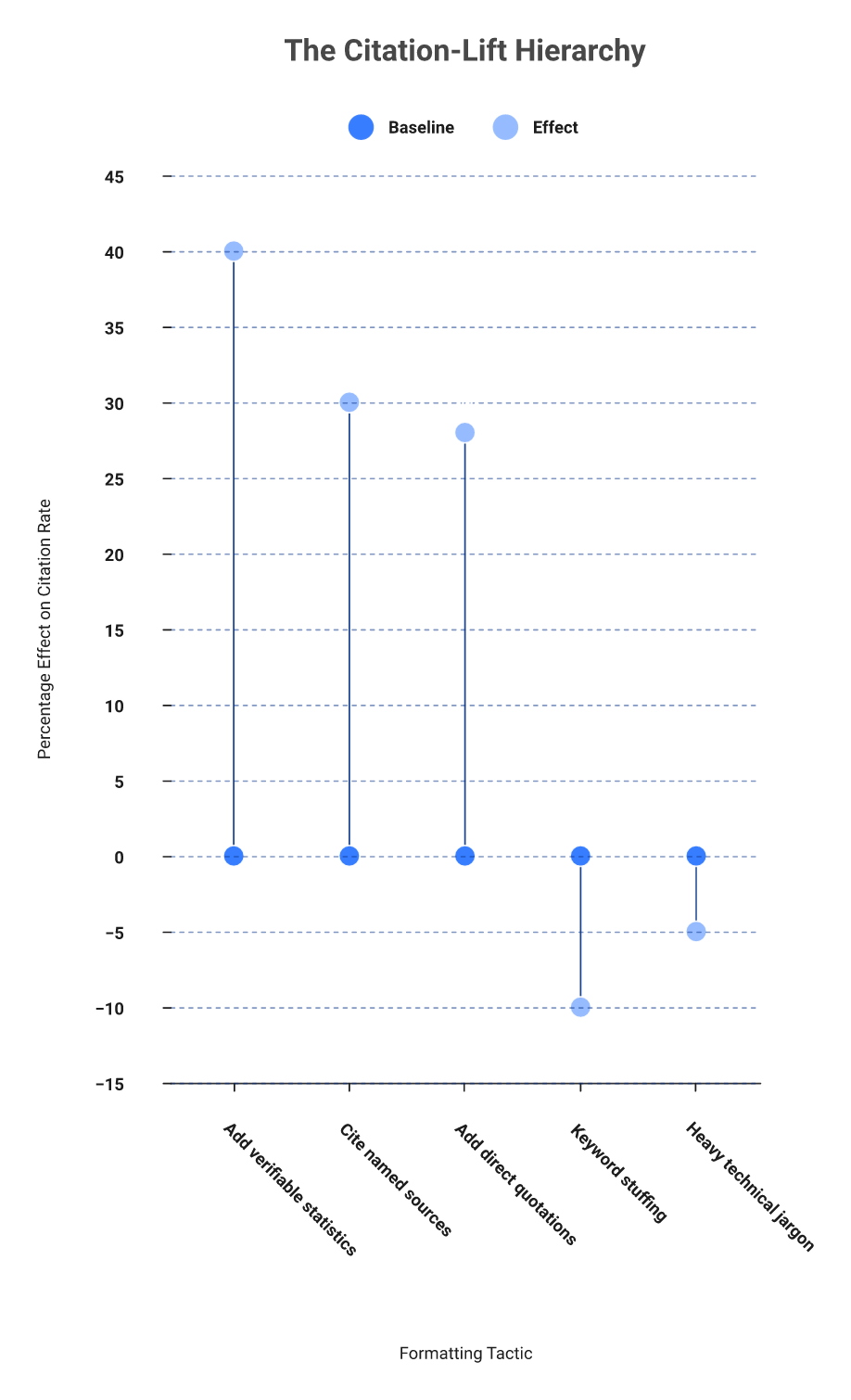
The highest-leverage moves are verifiable statistics and named quotations, backed by visible trust signals. The Princeton GEO study found statistics lifted citation rate by about 40%, citing sources by about 30%, and quotations by about 28%, while keyword stuffing cut it by nearly 10%. Lists and tables aid extraction, but pairing data-and-source density with author credentials, freshness dates, and outbound citations is what convinces an engine to cite you.
📊 The citation-lift hierarchy
The founding GEO research ranked the tactics by measured impact. Spend your time top-down on this list.
| Formatting move | Effect on citation rate |
|---|---|
| Add verifiable statistics | about +40% |
| Cite named sources | about +30% |
| Add direct quotations | about +28% |
| Keyword stuffing | about -10% |
| Heavy technical jargon | about -5% |
🔗 Name the source inside the sentence
An invisible hyperlink is not enough. Write the source into the body text itself, like "the market grew 23% in 2025, according to the Gartner 2025 SaaS Market Report." Naming the source in-line signals the claim is verifiable and can lift citation probability meaningfully.
One more precision point. Engines apply a high string-match tolerance, roughly 95%, when verifying a verbatim statistic. If your number drifts from the original, the citation often gets swapped to a competitor who quoted it exactly.
👤 Trust signals the engine reads
Data alone is not the whole story. Visible E-E-A-T signals tell the model the passage came from someone who did the work. The core set is well established: named authors, credentials, last-updated dates, and outbound links to authoritative sources, all detailed in our guide to E-E-A-T for AEO.
- A real author byline with a credentialed bio.
- A clear "last updated" date on the page.
- Outbound citations to primary sources.
- First-person experience markers that show hands-on work.
✅ Turn a vague claim into a cited one
"Content is King" is empty on its own. Information gain and human domain expertise are the actual kingmakers. So rewrite "AEO improves visibility" into "The Princeton GEO study measured up to 40% higher visibility from statistics and citations." One version gets ignored. The other gets quoted.
A Princeton study found citing credible sources boosts AI visibility by up to 40%, and we have seen the same pattern in MaximusLabs audits when we add named citations and author credentials to a client's BOFU pages. It is the difference between a page that ranks and a passage that gets quoted, and it is why our GEO content optimization starts with proof, not polish.
Q5. How Long Should an Answer Block Be, and Where on the Page Does Placement Matter?
Write self-contained answer blocks of roughly 40 to 80 words for snippet capture, and 134 to 167 words for deeper cited passages, the length measured to be cited about 4.2 times more often. Placement matters as much as length. Put your strongest answers in the first third of the page, because roughly 44% of ChatGPT citations get pulled from that top segment. Content past the 70% mark is largely ignored.
📏 Two lengths, two jobs
There is not one ideal length. There are two, and they do different jobs. A 40 to 80 word block wins the quick snippet and the People Also Ask slot.
A longer block, 134 to 167 words, does the heavier lifting. It answers the question and its likely follow-up in one self-contained passage. That fuller block gets cited about 4.2 times more often than a loose, rambling section. This is the kind of pattern our GEO content optimization guide drills into.
📊 Why the longer block wins
The reason is retrieval, not reading pleasure. An engine wants a passage that resolves the question completely, with no context missing. When your block answers the whole question, the model can quote it without stitching fragments together.
The GEO research from Princeton and IIT Delhi tested these tactics across roughly 10,000 queries and measured visibility gains up to 40%. Clean, complete passages are what let those gains show up, and they sit at the heart of any serious generative engine optimization effort.
⏰ Placement follows a ski-ramp
Where you place the block decides whether it ever gets read. Retrieval studies describe a "ski-ramp" pattern, where about 44.2% of ChatGPT citations come from the first third of the page. The back of the page rarely gets touched.
A 2025 study of over 10 million keywords showed AI Overviews behaving with the same top-heavy volatility, rewarding pages that front-load a clear answer. The takeaway is blunt. Bury your answer, and you forfeit the citation, which is why AEO fundamentals start with placement.
✅ Front-load or lose it
So stop opening with a 200 word warm-up. Lead with the answer, then expand. One more efficiency point worth respecting: roughly 19 out of 20 landing pages drive little to no traffic, so concentrate your best blocks on the pages and passages that actually get retrieved. Effort spent below the fold, on a page nobody pulls from, is cash spent on silence, a trade our GEO measurement and metrics work helps you avoid.
Q6. Does Schema Markup Actually Help AEO, or Is It Just Hygiene?
Every AEO checklist tells you to add schema. Your developer spends a sprint wiring up structured data, the validator turns green, and then nothing measurable happens. That quiet anticlimax is where the honest conversation starts.
Schema markup is a hygiene factor, not a magic multiplier. FAQPage, HowTo, and Article schema help engines parse your structure and are worth deploying, but Google's May 2026 guidance is explicit that special AI-only schema is not required, and practitioners disagree on its lift. Treat schema as clean plumbing that supports extraction. Deploy it correctly, but don't expect it to outrank strong, well-cited, well-structured prose.
⚠️ The experts genuinely disagree
This is contested ground, and pretending otherwise is dishonest. SALT.agency calls schema "a hygiene factor (at best)," not a differentiator. Surfer Academy takes the other side, arguing structured data "increase[s] your odds significantly" by telling the engine exactly how to present your facts.
Both can be right. Schema rarely creates a citation on its own, yet its absence can make a strong page harder to parse. The truth sits in the boring middle, which is why we treat it inside our schema markup basics workflow as plumbing, not magic.
✅ What Google actually says
Google's May 2026 AI guidance settles part of the debate. It frames AEO and GEO as still grounded in SEO, and names tactics you can safely ignore, including special AI-only schema and llms.txt files. There is no evidence that llms.txt or Markdown-only pages move rankings.
So deploy standard, honest schema that mirrors your visible content. Do not invent AI-specific markup that Google says it does not use, a point we reinforce across our technical GEO implementation checks.
💰 Where the effort actually pays
Here is the part the category avoids saying out loud. Technical SEO can become a security blanket, a 50 page PDF that feels productive and produces zero revenue. Fifteen years of practitioner experience suggests things like Core Web Vitals rarely drive a traffic increase on their own.
Traditional agencies ship a schema audit and call it AEO. At MaximusLabs we deploy a clean stack, Article, FAQPage, HowTo, BreadcrumbList, and Person, as hygiene, then spend the real effort on the cited answer itself, because that is what moves pipeline. It is the same principle behind our technical SEO and website audit.
Q7. How Do You Write for Different Engines: ChatGPT vs Perplexity vs Google AI Overviews vs Copilot?
Perplexity once summarized a team's article and confidently described them as Oxford researchers. None of them attended Oxford. The engine had grabbed a conceptually adjacent paper and warped the brand's story. That is what "treat all AI the same" gets you.
Each engine rewards slightly different signals. ChatGPT leans on conversational Q&A depth and clean snippet metadata. Perplexity favors recent, source-transparent content and cites documentation far more than landing pages. Google AI Overviews rewards answer-first FAQ structure plus E-E-A-T. Copilot mirrors Bing's index and structured data. Write one well-structured, well-cited page, then tune metadata, freshness, and content type per engine.
📊 The engine-by-engine matrix
Most articles treat "AI" as one thing. It is not. Here is how the surfaces differ.
| Engine | What it rewards | Practical tuning |
|---|---|---|
| ChatGPT | Conversational Q&A, expertise markers | Question-led H2s, sharp meta description |
| Perplexity | Recency, source transparency | Dated references, visible citations |
| Google AI Overviews | Answer-first, FAQ, E-E-A-T | 40 to 80 word nuggets, author credentials |
| Copilot | Bing index, structured data | Clean schema, indexable content |
📚 Docs beat blogs, often by a lot
Content type matters more than teams expect. Benchmark data shows technical documentation cited around 34% of the time versus about 18% for blogs. On Perplexity, docs can be cited roughly 4.5 times more than traditional landing pages, a nuance our Perplexity SEO guide unpacks in detail.
That reframes where you put buying-intent answers. A crisp docs-style page can out-cite a glossy blog post for the same question.
🔎 Metadata is the ChatGPT interface
For a standard web result, ChatGPT often works from roughly 150 characters of metadata, the URL, title, and snippet. That meta description is your primary interface with the model. Write it as an answer, not a slogan, exactly as we prescribe in our ChatGPT SEO guide.
Our Search Everywhere Optimization approach exists precisely because there is no single AI to optimize for. We tune the same asset for ChatGPT, Perplexity, Gemini, and Copilot, plus the third-party surfaces they pull from, so one page earns citations across engines instead of one. That is the core of our AEO service.
Q8. What Formatting Mistakes Quietly Kill Your AI Citations (and What Should You Ignore)?
A team added schema, published an llms.txt file, and waited for citations that never came. Meanwhile their best data, customer reviews, sat invisible behind JavaScript. They were optimizing the wrong layer entirely.
The quiet killers are content hidden behind JavaScript, keyword stuffing, jargon, and buried answers. If reviews, specs, or facet data load asynchronously, meaning after the initial page load, crawlers may never see them. Keyword stuffing cut citation rate by nearly 10% in the Princeton study. And skip the debunked hacks. Google itself says llms.txt, artificial chunking, and AI-only schema are safe to ignore. Fix visibility and clarity before chasing gimmicks.
⚠️ The mistakes that actually suppress citations
The real damage is rarely exotic. It is content the engine cannot see or cannot trust. Keyword stuffing lowered citation rate by about 10% in the Princeton GEO study, and heavy jargon shaved off another 5%.
Then there is the invisibility problem. Turn JavaScript off in your browser and reload a product page. If the reviews, specs, or facet data vanish, that is roughly what a crawler sees, and it is hiding your most valuable data. An AI crawlability checker surfaces exactly this gap.
❌ Stop doing versus ✅ start doing
- ❌ Stuffing keywords, layering jargon, or burying the answer below a long intro.
- ❌ Betting on llms.txt or Markdown-only pages, which show no evidence of any ranking effect.
- ✅ Exposing facet data, the fabric, the material, the neck style, in text or FAQs.
- ✅ Front-loading a clean, cited answer the crawler can read without JavaScript.
✅ Expose your facet data
Category pages hide gold behind filters. The closure, the fabric, the material, the neck style, all the attributes buyers ask about, often sit trapped in JavaScript facets. Bring that metadata into visible headers, FAQs, or body text, because the best follow-up questions are "best product with these attributes." Our e-commerce product AEO playbook makes this the first fix.
Google's May 2026 guidance is the honest anchor here. It confirms these gimmicks are ignorable and points you back to visible, valuable, well-structured content. Fix what the engine can see first. The clever hacks can wait, probably forever, a stance detailed in our guide to managing AI crawlers.
Q9. How Do You Turn AEO Formatting Into Revenue Instead of Vanity Citations?
A VP of Marketing shows me a dashboard full of AI citations. The brand is quoted across ChatGPT and Perplexity, and the team is thrilled. Then I ask which of those citations sit on a buying-intent page. The room goes quiet. Almost all of them are on "what is" blog posts.
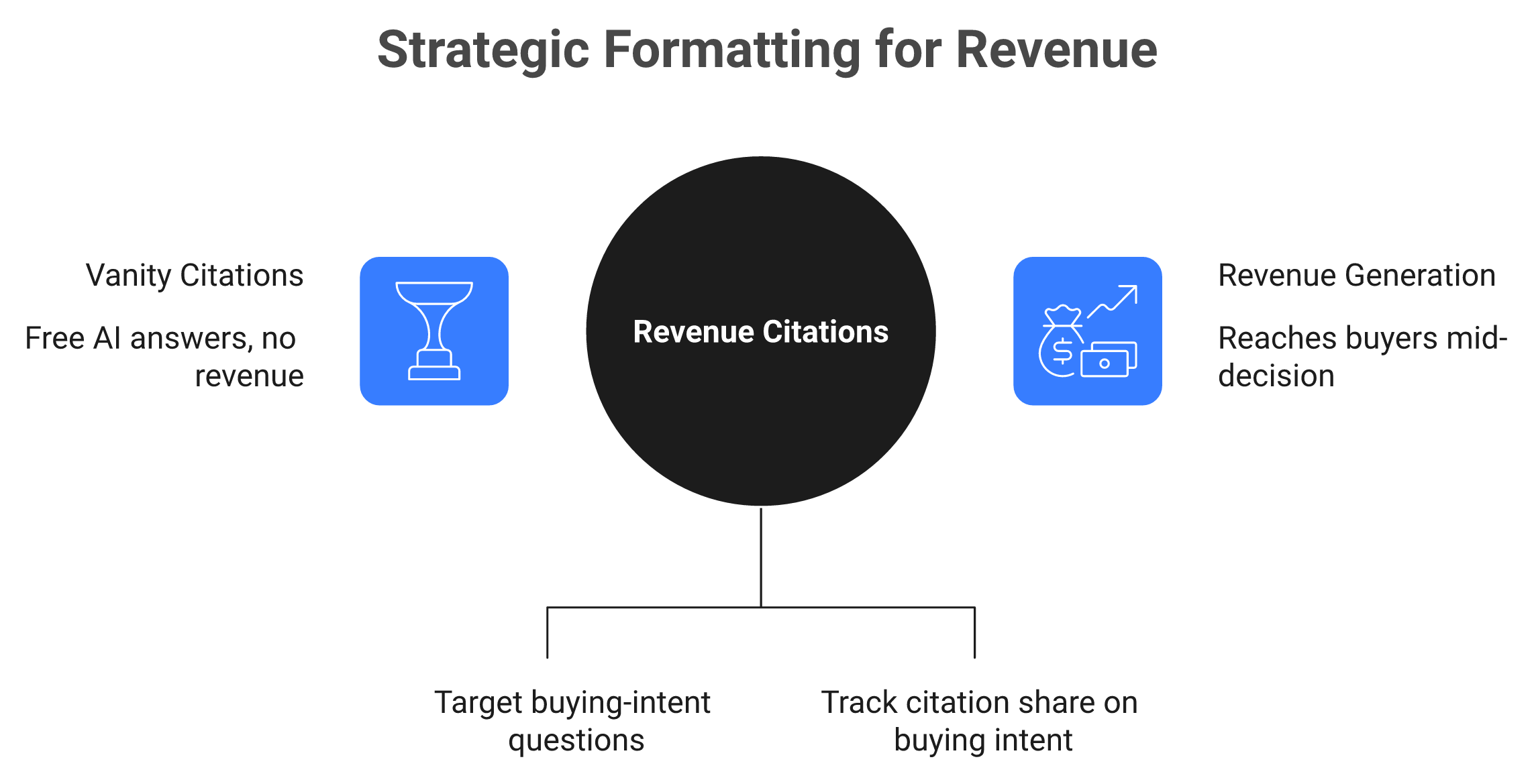
Point AEO formatting at your bottom-of-funnel and middle-of-funnel pages, not your top-of-funnel blog. Being cited on a buying-intent question drives disproportionate revenue, because LLM-referred traffic can convert roughly 6 times higher than Google search traffic. Format your comparison, pricing, and use-case pages as clean, cited, self-contained answers. Then measure citation share and pipeline influence, not pageviews, so AEO ties directly to the number you own.
⚠️ The vanity-citation trap
Most teams format their weakest revenue pages the best. They pour answer-first structure into "What is AEO?" posts that AI already answers for free. The citation lands, but the visitor never had a wallet open. Our B2B SaaS AEO strategies exist to break exactly this habit.
Zero-click makes this worse, not better. When the engine answers a top-of-funnel question in full, there is nothing left to click. Being the cited source on a definition is a trophy, not a pipeline, a distinction we track through GEO ROI and revenue attribution.
💰 Where the money actually converts
The felt sense from running this is clear. Citations on bottom-of-funnel questions behave completely differently. One measured example put LLM-referred traffic converting about 6 times higher than Google search traffic.
That gap changes where you spend formatting effort. A cited answer on "best tool for X" or "Product A versus Product B" reaches a buyer mid-decision. The penalty for being average on those pages has never been so severe, because the engine now shortlists only a handful of names, which is why our AEO service prioritizes comparison and pricing pages first.
✅ Format the pages that close
So move your answer-first blocks onto the pages that carry intent. Comparison pages, pricing explainers, and use-case pages deserve the tightest, best-cited passages.
- Write each buying-intent question as its own answer block.
- Cite named sources inline so the claim survives verification.
- Anchor the page in real domain expertise, because AI summarizing its own output loops into garbage, and human insight is the moat.
Gartner projects over half of search traffic will shift to AI-native platforms by 2028, which raises the stakes on getting cited where buyers decide. Meanwhile 2025 data showed zero-click on AI Overview keywords easing only slightly, from 33.75% to 31.53%, so the click is not fully dead, it just moves to the pages that earn it. Our generative engine optimization work is built for that shift, and the underlying trend is mapped in our zero-click search brand economy report.
⭐ What to measure Monday morning
Stop reporting impressions. Start reporting citation share on buying-intent questions and the pipeline those pages influence. If a page cannot be tied to a deal, it does not get your best formatting effort, a principle we operationalize through GEO measurement and metrics.
This is the core of the MaximusLabs methodology. We format BOFU pages to become the cited answer on buying-intent questions, with cost-effective, scalable production and the founder's voice built in, not vanity citations on top-of-funnel fluff. See how this plays out in our Oliv AI B2B SaaS case study.
🔮 The question I am sitting with
Here is what I keep turning over, and I might be wrong on this. If every brand eventually formats for citation, the differentiator will not be formatting at all. It will be who actually built the brand the engine trusts. So the open question is simple: are you optimizing to be quoted, or building something worth quoting? I would genuinely like to hear your take, or you can just reach out to our team.
Frequently asked questions
What is AEO content writing and formatting, and how is it different from SEO writing?
AEO content writing and formatting is the practice of structuring content so answer engines like ChatGPT, Perplexity, Gemini, and Google AI Overviews can extract and cite it as the answer. Traditional SEO writing optimizes to rank a clickable link, but AEO writing optimizes to be quoted inside the answer itself. The difference shows up at the sentence level, not the strategy deck. We write for a few core shifts: Answer-first passages that lead with the response before the context. Question-led headings that mirror what buyers actually type. Self-contained blocks that make sense when lifted out with zero surrounding context. Named citations, verifiable statistics, and author credentials that prove the claim. The old deal, write for a keyword, rank, earn a click, is breaking as buyers read the answer and stop. That is why we treat AEO writing as a retrieval-engineering discipline through our answer engine optimization approach, starting from how the model reads and working backward to the sentence. A page can rank at position two while your brand is nowhere in the AI answer, and closing that gap is the entire job.
How do answer engines actually read and retrieve content?
Answer engines do not read your page top to bottom. They retrieve small, self-contained chunks through Retrieval-Augmented Generation (RAG), where the model runs a live search and summarizes results. A prompt gets split into sub-queries through Query Fan-out, the engine pulls the most relevant passages, and it synthesizes an answer. This changes how we structure every page: The engine shops for one clean chunk, not the whole page, so each section must stand alone. Citation distribution is lopsided, with roughly 44.2% of ChatGPT citations coming from the first third of the page. Content past the 70% mark is largely ignored. The measured sweet spot for a self-contained answer block sits around 134 to 167 words, a length cited about 4.2 times more often than looser passages. The Princeton and IIT Delhi GEO study tested tactics across roughly 10,000 queries and showed visibility gains up to 40% when the engine can cleanly grab a passage. We build this chunk-level thinking into our GEO content optimization guide , so the strongest, most quotable answer sits near the top where it actually gets retrieved.
How should you structure a page so AI engines extract it?
We structure every page as a stack of question-and-answer units. Each page uses a clear H1 to H2 to H3 hierarchy where each H2 is phrased as a question a user would actually ask, followed by a 40 to 80 word direct answer, then supporting detail, lists, and tables. Our quick formatting checklist looks like this: Lead each section with a 40 to 80 word direct answer. Phrase every H2 as a real user question. Keep paragraphs to two or three sentences. Make each section a standalone passage. Add lists and tables to break up walls of text. Insert two or three sourced statistics per section. Quote at least one named expert or study. A practical shortcut when you have no query-volume data for AI is to convert your existing SEO keywords into questions. A keyword like "best project management software" becomes "What is the best project management software for small teams?" and that question becomes your H2. We apply this same Q&A-unit structure across client hub and spoke pages inside our AEO service , because a page built as clean, question-led blocks gives the engine an obvious passage to quote instead of forcing it to guess.
What formatting and trust signals actually get you cited?
The highest-leverage moves are verifiable statistics and named quotations, backed by visible trust signals. The Princeton GEO study found statistics lifted citation rate by about 40%, citing sources by about 30%, and quotations by about 28%, while keyword stuffing cut it by nearly 10%. The citation-lift hierarchy tells you where to spend effort: Add verifiable statistics for roughly a 40% lift. Cite named sources for roughly a 30% lift. Add direct quotations for roughly a 28% lift. Avoid keyword stuffing, which costs about 10%. An invisible hyperlink is not enough. We write the source into the body text itself, like "the market grew 23% in 2025, according to the Gartner 2025 SaaS Market Report," because naming the source in-line signals verifiability. Visible E-E-A-T signals matter too: a real author byline, a clear last-updated date, outbound citations, and first-person experience markers. We fold these signals into every engagement through our framework for E-E-A-T for AEO , because data-and-source density plus author credentials is what convinces an engine to cite you.
How long should an AEO answer block be, and where should it sit on the page?
We write self-contained answer blocks of roughly 40 to 80 words for snippet capture and 134 to 167 words for deeper cited passages, the latter measured to be cited about 4.2 times more often. Placement matters as much as length. There are really two lengths doing two jobs: A 40 to 80 word block wins the quick snippet and the People Also Ask slot. A 134 to 167 word block answers the question and its likely follow-up in one self-contained passage. Placement follows a ski-ramp pattern, where about 44.2% of ChatGPT citations come from the first third of the page and the back rarely gets touched. A 2025 study of over 10 million keywords showed AI Overviews rewarding pages that front-load a clear answer. So we stop opening with a 200 word warm-up and lead with the answer, then expand. Because roughly 19 out of 20 landing pages drive little traffic, we concentrate the best blocks on pages that actually get retrieved, a discipline we track through our GEO measurement and metrics work.
Does schema markup actually help AEO, or is it just hygiene?
Schema markup is a hygiene factor, not a magic multiplier. FAQPage, HowTo, and Article schema help engines parse your structure and are worth deploying, but Google's May 2026 guidance is explicit that special AI-only schema is not required, and practitioners genuinely disagree on its lift. Here is how we treat it: Deploy a clean, honest stack, Article, FAQPage, HowTo, BreadcrumbList, and Person, that mirrors your visible content. Do not invent AI-specific markup that Google says it does not use. Skip debunked hacks like llms.txt files and Markdown-only pages, which show no evidence of moving rankings. Schema rarely creates a citation on its own, yet its absence can make a strong page harder to parse, so the truth sits in the boring middle. Technical work can become a security blanket, a 50 page audit that feels productive and produces zero revenue. We deploy schema as clean plumbing inside our technical GEO implementation , then spend the real effort on the cited answer itself, because that is what moves pipeline rather than a green validator.
How do you write for different engines like ChatGPT, Perplexity, Google AI Overviews, and Copilot?
Each engine rewards slightly different signals, so treating all AI the same is a mistake. We write one well-structured, well-cited page, then tune metadata, freshness, and content type per engine. The surfaces differ in practical ways: ChatGPT leans on conversational Q&A depth and clean snippet metadata, often working from roughly 150 characters of metadata. Perplexity favors recent, source-transparent content and cites documentation far more than landing pages. Google AI Overviews rewards answer-first FAQ structure plus E-E-A-T. Copilot mirrors Bing's index and structured data. Content type matters more than teams expect. Benchmark data shows technical documentation cited around 34% of the time versus about 18% for blogs, and on Perplexity docs can be cited roughly 4.5 times more than landing pages. Our Search Everywhere Optimization approach exists because there is no single AI to optimize for, and our Perplexity SEO guide details how we tune the same asset so one page earns citations across engines instead of just one.
How do you turn AEO formatting into revenue instead of vanity citations?
We point AEO formatting at bottom-of-funnel and middle-of-funnel pages, not the top-of-funnel blog. Being cited on a buying-intent question drives disproportionate revenue, because LLM-referred traffic can convert roughly 6 times higher than Google search traffic. The vanity-citation trap is real: most teams format their weakest revenue pages the best, pouring answer-first structure into "What is AEO?" posts that AI answers for free. Instead, we focus effort where it converts: Write each buying-intent question as its own answer block. Cite named sources inline so the claim survives verification. Anchor the page in real domain expertise, because human insight is the moat. Gartner projects over half of search traffic will shift to AI-native platforms by 2028, which raises the stakes on getting cited where buyers decide. We measure citation share on buying-intent questions and the pipeline those pages influence, not impressions. This is the core of our methodology, proven in our Oliv AI B2B SaaS case study , where we format BOFU pages to become the cited answer rather than chasing vanity citations on top-of-funnel fluff.