 Krishna Kaanth M
- Agentic commerce is online shopping where AI agents autonomously research, compare, and purchase products, shifting decisions from human-navigated websites to agent-initiated, protocol-driven transactions inside ChatGPT, Perplexity, and Gemini.
- Ranking on Google no longer guarantees visibility; if the agent does not cite or recommend you, you get zero traction, because the shortlist is only two to four options.
- Agents complete purchases in five steps using standards like the Agentic Commerce Protocol, MCP, and the Shared Payment Token, which lets agents pay while you stay the merchant of record.
- The shift is real but early; Deloitte projects roughly 25% of e-commerce agent-enabled by 2030, while OpenAI scaled back native Instant Checkout in early 2026, so bet on the durable discovery layer.
- Agents choose products via retrieval-augmented generation, rewarding clean structured data, transparent policies, real-time availability, and earned third-party citations over schema tricks.
- Our Monday plan: audit AI visibility, expose agent-readable data, earn citations, measure pipeline over pageviews, and cut the busywork that moves no revenue.
Q1. What exactly is agentic commerce, and why is it different from the e-commerce you already know?
A founder asked us last month why her Shopify store, which ranks page-one for its category, got skipped when she told ChatGPT to "find and buy me a magnesium supplement." The agent picked a competitor. She never saw a product page. That gap, between ranking and getting picked by the agent, is what agentic commerce breaks open.
Agentic commerce is online shopping where AI agents autonomously research, compare, and purchase products on a shopper's behalf. Unlike traditional e-commerce (a human navigating a website) or conversational commerce (AI that only recommends), agentic commerce lets the agent decide and transact after you approve intent. Commerce shifts from human-navigated websites to agent-initiated, protocol-driven transactions inside tools like ChatGPT, Perplexity, and Gemini.
🛒 The three-way split most explainers skip
The fastest way to hold this concept is a side-by-side. Each model moves the human further out of the click path.
| Model | Who navigates | What the AI does | Where the buy happens |
|---|---|---|---|
| Traditional e-commerce | Human | Nothing, or basic search | On your website |
| Conversational commerce | Human, guided | Recommends, answers questions | On your website |
| Agentic commerce | The AI agent | Researches, compares, and transacts | Inside the AI tool |
IBM frames agentic commerce as agents that "research, negotiate and complete purchases, often without direct human intervention." Stripe describes the same shift and adds a sharp point: agents want "clean and structured data, fast responses, and zero guesswork," so the buyer often never sees a checkout page.
👻 The "ghost kitchen" mental model
Think of a ghost kitchen. The website is the dining room you spent years decorating. Agentic commerce is the kitchen and delivery layer, like Uber Eats, where the buyer orders without walking in.
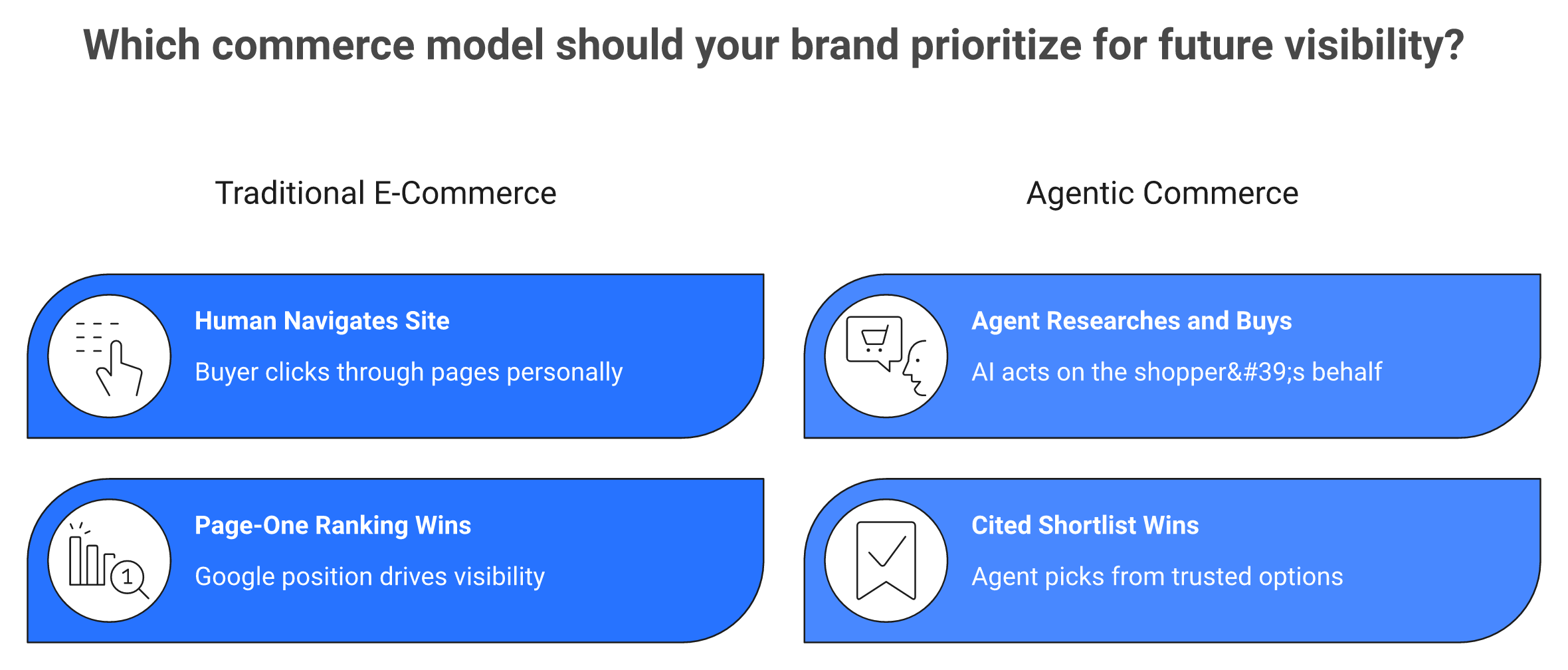
The order still comes to you. But the storefront you optimized for humans is no longer the place the decision gets made. Rye calls checkout the hardest unsolved problem in this shift, which tells you how new the plumbing still is.
⚠️ Why ranking on Google no longer guarantees you exist
Here is the uncomfortable part. You can rank first on Google and still be invisible to the agent, because the agent pulls from its own trusted sources and citation patterns, not just Google's blue links.
Dharmesh Shah, HubSpot's co-founder, put the stakes plainly: "either you show up or you don't. If you're not in the actual citations in the answer that was given, you might as well not have played the game because there is no difference." That is the binary nature of this era. There is no page two inside an agent's answer.
This is the frame we work from at MaximusLabs. The question is no longer where you rank, it is whether the agent recommends you and can transact you. We build content and trust signals through our GEO service so brands become the answer the agent picks, not the link it scrolls past.
Q2. How does an AI shopping agent actually complete a purchase end-to-end?
One of our team members tried a live test in Gemini earlier this year: "I want to buy snowboard pants, and I'd like you to do the checkout for me end to end." It did not work. The agent found options, stalled at payment, and handed the task back. That single stall explains why the protocol layer underneath agentic commerce matters more than the demo videos suggest.
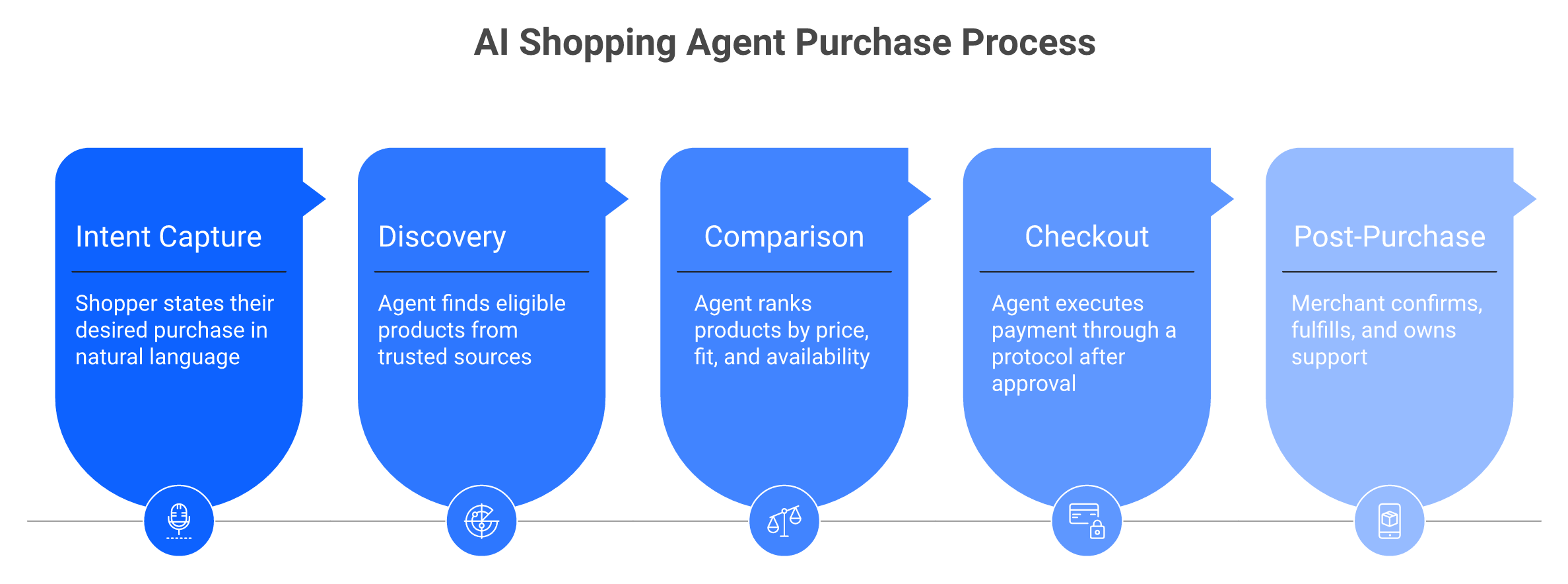
An AI shopping agent completes a purchase in five steps: it captures your intent in natural language, discovers eligible products, compares them against your criteria, executes checkout via a payment protocol, and manages post-purchase. Standards like the Agentic Commerce Protocol (ACP) and Model Context Protocol (MCP) make this possible, while the Shared Payment Token lets an agent pay without exposing card details or displacing the merchant of record.
🔄 The five-step journey, in plain order
Every agentic purchase runs through the same sequence. Each step needs data the agent can actually read.
- Intent capture. You state what you want in plain language, often in a long, detailed prompt.
- Discovery. The agent finds eligible products from sources and feeds it trusts.
- Comparison. It ranks options against your stated criteria, like price, fit, or availability.
- Checkout. It executes payment through a protocol, after your approval.
- Post-purchase. The merchant confirms, fulfills, and owns support.
💳 The Shared Payment Token, the piece competitors gloss over
In September 2025, OpenAI and Stripe launched Instant Checkout on the open Agentic Commerce Protocol. The detail worth understanding is the Shared Payment Token.
The token lets an app like ChatGPT trigger a payment without exposing raw card credentials, scoped to a single merchant and a single basket. Payment still flows to the merchant. The merchant accepts or declines the order and owns post-purchase. So the agent handles the buy, but you stay the merchant of record. That is control, not surrender.
🔌 MCP, the interface layer
The Model Context Protocol is the connective tissue. It gives agents a standard way to query your product data, availability, and policies, instead of guessing from a rendered web page.
The scale behind this is real infrastructure, not a pilot. Stripe's network handles roughly 50,000 new transactions every minute, about 1.3% of global GDP, per Stripe's Emily Glasberg Sands. Stripe even built a proprietary payments foundation model because general LLMs lack access to those differentiated payment sequences. When a company operating at that scale open-sources a commerce protocol, the plumbing is serious. Getting this layer right is core to our agentic commerce service.
🧪 What still breaks today
The snowboard-pants moment is common. Checkout remains the fragile link, item data is often inaccurate, and reliability varies by platform. Treat the discovery and data layer as the durable investment, and treat native checkout as a surface still cooking. This is also where a rigorous technical SEO and website audit surfaces the gaps agents cannot read.
Q3. How big is the agentic commerce shift, and is it real enough to bet budget on?
Every VP Marketing we talk to asks a version of the same question: is this a real channel, or another shiny surface that eats budget and returns a dashboard? Fair question. The honest answer sits between the hype forecasts and the early stumbles, and it changes what you fund this quarter.
The shift is real but early. Deloitte projects roughly 25% of global e-commerce will be AI-agent-enabled by 2030, with about 55% of digital consumers starting product research on LLM platforms. OpenAI, Stripe, PayPal, Mastercard, and Checkout.com have all shipped or adopted the Agentic Commerce Protocol. The honest caveat: native checkout stumbled in early 2026, so bet on the durable protocol and discovery layer, not one vendor's checkout surface.
📈 Situation: the numbers point one direction
The analyst consensus is directional, not precise. Deloitte's 25%-by-2030 figure and its finding that 55% of consumers will start research on LLMs give a founder real stakes to plan against. McKinsey frames agentic commerce as a hyper-personalized, autonomous-transaction shift in retail.
Gartner projects that over 50% of search traffic will move from traditional engines to AI-native platforms by 2028, a stat we cite often because it reframes where pipeline comes from. Roughly 70% of searches are already zero-click, meaning the answer resolves without a visit. Our state of agentic commerce 2026 report tracks how these numbers are moving.
⚠️ Complication: the leader pulled back
Then reality intruded. In early 2026, OpenAI scaled back native Instant Checkout after only about a dozen merchants went live, with item data frequently inaccurate. Forrester analyzed what it means when "the leader in agentic commerce just pulled back." Forecasts also disagree wildly, with a 35x gap between the low and high market estimates. So the surface is volatile.
✅ Resolution: bet on the layer, not the surface
Here is where we land. Fund the durable layer, which is discovery and agent-readable data, not one vendor's checkout button.
There is a live debate on timing worth respecting. Ethan Smith calls first-mover advantage "a false concept," arguing you can launch pages in two years and rank right away, so "whenever the channel's big enough, invest in it." Others insist protocol integrators earn entrenched visibility early. Both can be true. His related line stays useful: "Google's slice of the pie stays the same, the pie gets bigger."
For founders weighing scarce GTM budget, this is exactly the call we help make at MaximusLabs. Our GEO ROI and revenue attribution approach pushes spend toward revenue-driving, ICP-aligned pages and agent-readable trust signals, not the vanity surface that photographs well in a demo. Build the brand the agent has to recommend, and you are insulated when any single checkout feature wobbles.
Q4. Why does being "in the answer" matter more than ranking on page one?
We once audited a brand that ranked page-one on Google yet was invisible across Perplexity and Gemini. Their traffic looked fine on the surface. Their pipeline told a different story, because the buyers who asked an AI agent never saw them. That disconnect is the whole game now.
In agentic commerce, ranking on page one is not enough. If the agent doesn't cite or recommend you, you get zero traction. AI Overviews and agent summaries compress traditional organic clicks: results pushed below an AI snapshot can lose over a third of their click-through. The winning objective shifts from "rank" to "become the answer" the engine trusts, cites, and can transact, a discipline called Generative and Answer Engine Optimization (GEO/AEO).
📉 Situation: you rank, and traffic used to follow
For twenty years the deal was simple. Rank high, get clicks, convert some. The blue link was the unit of value.
That deal is breaking. Around 70% of searches are now zero-click, resolving inside the answer itself. When a buyer asks an agent for the best option, only a handful of products make the list, and that shortlist is the entire consideration set.
⚠️ Complication: the answer eats the click
AI Overviews and agent summaries compress organic clicks hard. Results pushed below an AI snapshot can lose a large share of their click-through. Dharmesh Shah frames the outcome as binary: "if you're not in the actual citations in the answer that was given, you might as well not have played the game."
This is why we argue, bluntly, that GEO is not SEO with a new coat of paint. It is closer to a data-science problem, understanding how each engine retrieves, ranks, and cites, because the retrieval logic differs by platform.
✅ Resolution: become the answer, and the economics flip
When you become the cited answer, the reward is not just visibility, it is qualified demand. The agent pre-sells the buyer before they ever reach you.
The data here is striking. Webflow saw a 6x conversion-rate difference between LLM traffic and Google search traffic, and 8% of its signups now come from LLMs, making it a top channel. That is the payoff for being the recommendation instead of one of ten links.
This is the exact shift MaximusLabs was built to operate. We pioneered Revenue-focused Answer Engine Optimization, where the metric is pipeline, not impressions, contrasted with agencies still selling ranking dashboards. The proof shows up in citation share, not vanity charts:
"Achieved a 64% citation rate across AI platforms and overtook legacy 10-year-old billion-dollar competitors who had only a 30% citation rate. Achieved in just 6 months of GEO work."
MaximusLabs AI, Oliv AI Case Study
"Ranked #1 across Google, ChatGPT, and Perplexity for 'best sleep mask.' Triple-platform dominance from a single GEO strategy."
MaximusLabs AI, Nidra Case Study
A quick, honest caveat: those are our own published results, not third-party G2 reviews, and citation share compounds with trust over time rather than flipping overnight. Where our thinking is right now: within two years, "becoming the answer" stops being an edge and becomes table stakes, and the brands that built trust-first, AI-discoverable content early will own the citations.
Q5. How do AI agents decide which products to recommend, and does it differ across ChatGPT, Perplexity, Gemini, and Copilot?
A Head of Growth once pushed back on us mid-audit: "If I just add more schema, will ChatGPT pick me?" Short answer, no. The agent's choice runs on retrieval and trust, not markup tricks, and the sooner a founder internalizes that, the less budget gets wasted on the wrong fixes.
AI agents choose products using retrieval-augmented generation (RAG), which means they pull from indexed content and trusted sources, then rank options by relevance and trust signals: clean structured data, transparent policies, real-time availability, and third-party citations. Platforms differ. ChatGPT leans on the Agentic Commerce Protocol and product discovery, while Perplexity, Gemini, and Copilot weight sources differently. Across all of them, brand authority and earned citations decide whether an agent surfaces you.
🔍 How RAG-based selection actually works
RAG is simpler than it sounds. The agent runs a live search, retrieves candidate sources, and summarizes them into a recommendation.
So your job is to be in the retrieved set and be the most trustworthy option there. Retrieval overlap between engines is real but partial. One practitioner study put citation overlap with Google at around 35% for ChatGPT and around 70% for Perplexity optimization, so being strong on one engine does not guarantee the others.
✅ The trust signals agents reward
Stripe is blunt about what agents want: "clean and structured data, fast responses, and zero guesswork." OpenAI's product-discovery rollout leans on the same, using structured product data through the Agentic Commerce Protocol.
The signals that repeatedly matter:
- Clean, structured product and pricing data
- Transparent policies and real-time availability
- Earned citations on third-party and community sites
🤖 How the platforms differ
The engines are not interchangeable. A quick map:
| Platform | Shopping behavior | What it leans on |
|---|---|---|
| ChatGPT | Native product discovery and checkout | Agentic Commerce Protocol, structured feeds |
| Perplexity | Source-transparent answers with citations | Higher Google-overlap retrieval |
| Gemini | Emerging agentic checkout, still maturing | Google index signals |
| Copilot | Assisted shopping inside Microsoft surfaces | Bing-based retrieval |
The durable lesson: earned mentions often beat owned pages. As one operator framed it, "identify the most cited URLs for the topics you care about, then find a way to have those citations promote your product."
⚠️ The schema debate, honestly
Here the category disagrees, and pretending otherwise would be dishonest. Mark Williams-Cook argues "tokenization sort of destroys the schema, it's just not the top thing on my list." Surfer Academy counters that "structured data is more likely to be featured in SGE summaries." Both camps have evidence.
Our read: schema helps discoverability, but it is not the moat. Krishna Kaanth's contrarian take captures the durable play: "It is not about hacking the algorithm. If you build a brand in your space, then AI HAS to recommend you." That matters more as model collapse looms, where AI trained on its own derivatives converges on "vanilla is the only flavor" and diversity dies.
This is why our work at MaximusLabs runs on Search Everywhere Optimization, earning citations across the third-party and community surfaces every engine trusts, not polishing one owned site. We built a 64% citation rate across AI platforms for one client, overtaking billion-dollar competitors stuck near 30%, in six months (MaximusLabs' own published claim). You can see how we track this in our work on AI search visibility and brand mention tracking.
"Most agencies charge overpriced retainers for work that's not deserving of a retainer."
u/low5d7k, r/SEO Reddit Thread
Q6. What does "agent-ready" technical infrastructure actually require?
We watched a mid-market brand spend a full quarter chasing Core Web Vitals scores while their help center sat orphaned on a subdomain no agent could reach. They fixed the wrong thing. Agent-readiness is mostly about exposing data agents can read, not passing a speed test.
Being agent-ready means exposing structured, machine-readable data an agent can retrieve and act on: an ACP-compatible product feed, agentic checkout endpoints, and delegated payments through a compliant processor. Practically, move your help center to a subdirectory, surface hidden facet data (material, fit, neck style) into readable text and FAQs, and format content as direct question-and-answer. Skip low-impact rituals like Core Web Vitals obsession and llms.txt files that show no evidence of driving results.
🔌 The three infrastructure must-haves
To participate in agentic channels, you expose three things. This is the ACP-ready starting path practitioners describe.
- A product feed an agent can understand.
- Agentic checkout endpoints to create, confirm, and cancel orders.
- Delegated payments through a compliant processor, keeping you the merchant of record.
🛠️ The tactical moves that actually pay off
These are the unglamorous wins. Ethan Smith calls the help center the long tail of agentic commerce, because buyers ask agents hyper-specific feature questions.
- Move the help center to a subdirectory, like domain.com/help, never a subdomain, because subdomains tend to underperform.
- Surface hidden facet data, the fabric, closure, material, and neck style, into readable text and FAQs, because agents cannot read data trapped behind JavaScript filters.
- Format content as question and answer to "reduce the friction for the AI to get the thing it's trying to look for."
✈️ The airline route-map rule for internal links
Think of internal linking like an airline network. You want point-to-point links, the Southwest model, so every page is reachable.
Avoid a hub-and-spoke model that leaves JavaScript pages orphaned, the way some carriers strand routes through a single hub. Orphaned pages are invisible pages, and invisible pages never get cited. A structured technical SEO and website audit catches these gaps early.
❌ What to stop doing
Here is the contrarian part, and cash is the reason it matters. Ethan Smith is direct: "most SEO work is stuff that's true but zero impact. Core Web Vitals is a perfect example. Technical SEO is the biggest waste of time."
His deeper point: one in twenty landing pages drives roughly 85% of traffic, so 5% of the work produces almost all of the impact. Skip the 50-page technical audits that read like security blankets. Skip llms.txt and markdown-only pages, which show no evidence of driving results.
This is exactly where our AI-native approach at MaximusLabs diverges from traditional agencies. We operationalize feeds, endpoints, and Q&A structure that agents actually read through our agentic commerce service, and we refuse to bill retainers for the busywork that photographs well but moves no pipeline.
"Most agencies just send you a PDF audit and disappear. Zero revenue impact, huge invoice."
u/throwaway_seo, r/SEO Reddit Thread
Q7. How is optimizing for AI agents different from traditional Google-only SEO?
Most marketers walk into GEO carrying their Google SEO muscle memory: pick a keyword, write a page, chase the rank. That reflex quietly sabotages them, because the agent is playing a different game with different inputs and a different scoreboard.
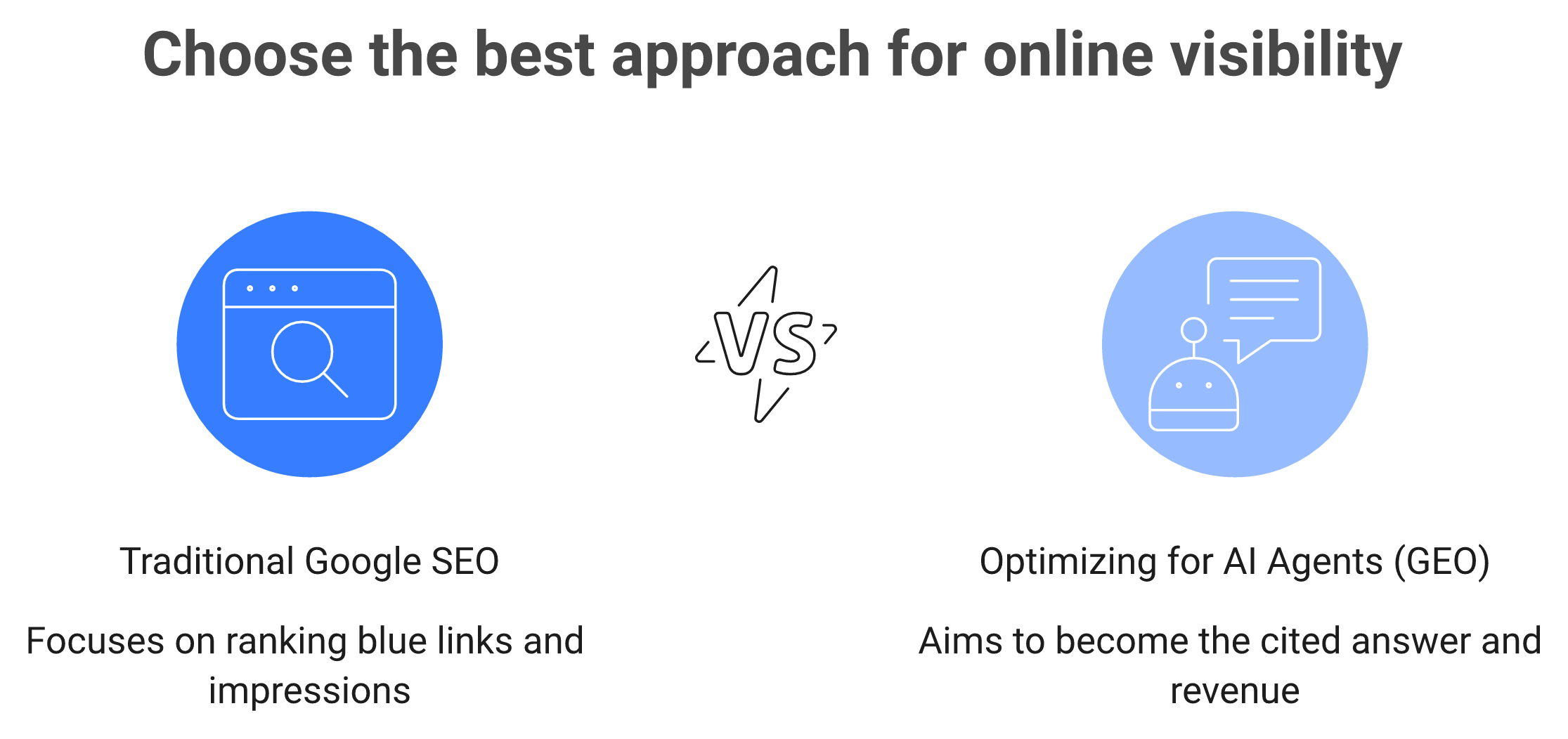
Optimizing for agents differs from Google SEO on four axes. Prompts are longer and more nuanced, about 25 tokens in an AI chat versus roughly six words in a Google search, so content must be four times more specific. Success is measured by citations and agent recommendations, not rankings. Earned mentions on third-party sites often matter more than your own pages. And the target metric shifts from impressions and clicks to pipeline influence and revenue.
📊 Situation: the SEO habits you know
For two decades, the playbook was stable. Target a keyword, match search intent, earn backlinks, climb the ten blue links.
Those habits still have a role. AI engines like ChatGPT use search engines to find sources, so page authority and clean crawlability still matter.
⚠️ Complication: agentic prompts break the old model
The prompt itself changed. The average Google search runs about six words, while an AI chat prompt runs around 25 words, per figures cited by practitioners referencing Perplexity.
That means content must be far more nuanced to match the complexity of what buyers actually ask. Over-optimizing for machines backfires too. Eli Schwartz described reading a hotel description so hyper-optimized it bragged about "a bathtub with water that came out of a faucet," content that lost basic human logic.
✅ Resolution: the GEO/AEO playbook
The scoreboard changes, so the tactics change. Here is the shift, side by side.
| Axis | Traditional Google SEO | GEO/AEO for agents |
|---|---|---|
| Prompt length | ~6 words | ~25 words |
| Goal | Rank a blue link | Become the cited answer |
| Best leverage | Your own pages | Earned third-party citations |
| Metric | Impressions, clicks | Pipeline, revenue |
Academic work backs the shift. The Princeton-led GEO paper (Aggarwal et al., KDD 2024) showed that generative-engine visibility responds to different levers than classic ranking, including citations and quotation. If you want the deeper breakdown, our guide on GEO versus traditional SEO maps every difference.
This is the exact line we hold at MaximusLabs. We pioneered Revenue-focused GEO and AEO, where pipeline is the metric, not vanity clicks, which separates us from traditional agencies still playing 2019 Google-only rules and from GEO specialists who make claims they do not operationalize. Gartner projects over 50% of search traffic moves to AI-native platforms by 2028, so the wrong playbook gets expensive fast.
"GEO is not SEO. It's a data science problem. We need to exactly know how these LLM algorithms work to be present in the answers."
Krishna Kaanth, MaximusLabs AI (MaximusLabs' own published claim)
Q8. What are the biggest risks and failure points in agentic commerce right now?
The demos look clean. Ask an agent, get a product, buy it, done. Then you actually run it, and the seams show, which is exactly why a clear-eyed founder plans around the failure points instead of pretending they do not exist.
Agentic commerce still has real failure points. Native in-chat checkout has been unreliable, and OpenAI scaled back Instant Checkout in early 2026 after only about a dozen merchants went live with frequently inaccurate item data. Agents also hallucinate brand facts, inventing credentials or details from conceptually adjacent sources. And AI detection tools misjudge human writing at meaningful error rates. The takeaway: control your primary-source data and monitor how agents describe you.
🎯 Situation: the promise of seamless buying
The pitch is seductive. An agent handles discovery, comparison, and checkout while the buyer sips coffee.
Parts of it are real. OpenAI, Stripe, PayPal, and others shipped the plumbing in 2025, and product discovery keeps improving.
⚠️ Complication: three things break today
The reality is bumpier. Three failure points deserve your attention.
- Checkout reliability. OpenAI scaled back native Instant Checkout in early 2026 after only about a dozen merchants went live, with item data often inaccurate. Forrester analyzed what it means when the category leader pulls back.
- Hallucinated brand facts. Ethan Smith watched Perplexity summarize his agency's article and claim his team were "Oxford researchers," which none of them were, because the model grabbed a conceptually adjacent paper.
- Detection false positives. High-end AI detection tools flag human writing at meaningful error rates, so automated policing is unreliable.
✅ Resolution: own your data, watch your citations
You cannot control the models, but you can control your inputs. Two moves reduce your exposure.
First, own your primary-source data, structured feeds, policies, and availability, so agents pull facts from you, not from adjacent guesses. Second, monitor how agents describe you across engines, because the hallucination shows up before the sale, not after.
There is a deeper lesson here about AI-generated content. Ethan Smith, who "created spam in 2007" and watched Google crush it, argues fully automated content is a dead end, because AI summarizing its own derivatives leads to model collapse and "garbage." Human domain expertise is the antidote, which is why our E-E-A-T for AEO approach starts with real expertise.
This is the core of our trust-first methodology at MaximusLabs. We engineer trust signals and primary-source research into every piece, because when an engine cites you it stakes its own credibility on your brand, and that is where accuracy stops being optional. We are honest that GEO is not a magic trick, results compound with trust over time, and some of this space is still genuinely uncertain.
"Most SEO tools are overpriced for what they do. Feels like paying enterprise money for a spreadsheet."
u/dutch_marketer, r/SEO Reddit Thread
Q9. What should a founder or growth leader do on Monday morning to prepare?
Every strategy article ends with vague "start now" energy. This one will not. You have finite cash, a real team, and a channel that is shifting under you, so here is the exact order of operations we would run if it were our own budget on the line.
Start with visibility. Audit whether AI engines currently cite and recommend you, not just where you rank. Then expose agent-readable data, an ACP-compatible product feed, structured FAQs, and surfaced facet data. Prioritize earned citations on the sources agents trust. Measure pipeline influence from LLM traffic, which can convert several times better than Google traffic. Focus on the roughly 5% of work that drives almost all impact, and skip the security-blanket tasks.
🗺️ The five-step Monday plan
Run these in order. Each step feeds the next, and none of them requires a huge team.
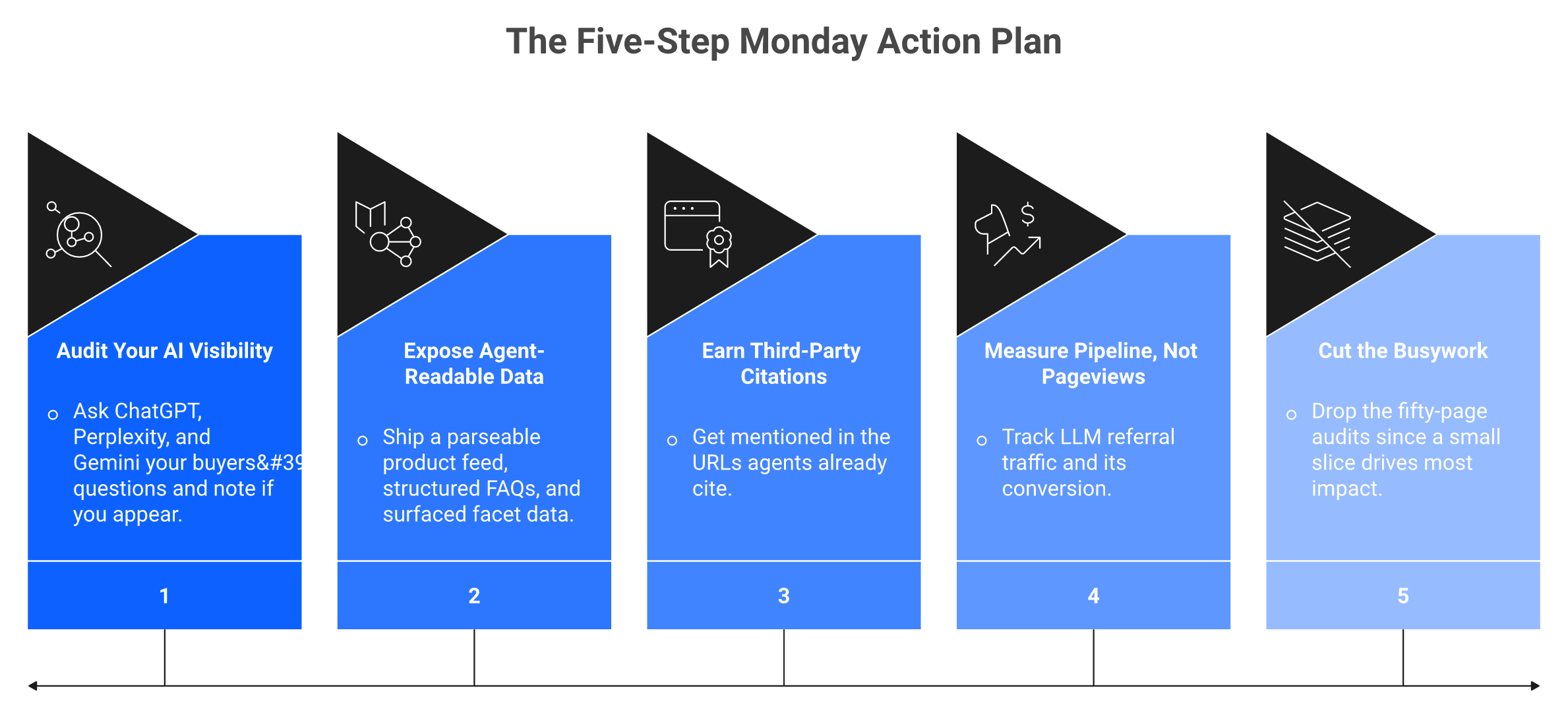
- Audit your AI visibility. Ask ChatGPT, Perplexity, and Gemini the questions your buyers ask, and note whether you appear at all. Our AI crawlability checker makes this first pass faster.
- Expose agent-readable data. Ship a product feed agents can parse, structured FAQs, and surfaced facet data like fabric, fit, and integrations. This is the core of our agentic commerce service.
- Earn third-party citations. Get mentioned in the URLs agents already cite, on Reddit, YouTube, and Tier-1 review sites.
- Measure pipeline, not pageviews. Track LLM referral traffic and its conversion, which ran 6x higher than Google traffic for Webflow.
- Cut the busywork. Drop the 50-page technical audits, since roughly 5% of the work drives almost all the impact.
🎯 Tie each move to what it buys you
Skip the parts with no payoff. Deloitte's five-stage maturity model, from assisted discovery to agent-to-agent commerce, gives you a simple "where are we today" gut-check before you spend. Our state of agentic commerce 2026 report benchmarks where most brands actually sit.
The velocity point matters for cash-strapped teams. Ethan Smith argues first-mover advantage is overrated, so "whenever the channel's big enough, invest in it" rather than burning budget being early to an empty surface. Match investment to channel size, not hype cycles. When you do commit, our GEO ROI and revenue attribution approach keeps spend tied to pipeline.
👥 Where each role starts
Your first move depends on your seat. Here is the split for the people who own this number.
| Role | First move on Monday |
|---|---|
| SaaS/AI Founder | Run the AI-visibility audit yourself, then decide budget |
| VP Marketing | Tie LLM referral traffic to pipeline in your reporting |
| Head of Organic Growth | Map the most-cited URLs for your category |
| Head of GTM | Prioritize BOFU, ICP-aligned pages over TOFU volume |
| Marketing Manager | Reformat top pages into direct question-and-answer |
This is the exact sequence we run at MaximusLabs, and it is BOFU-first by design. On a California nutrition brand, we optimized the top 20 bottom-of-funnel keywords consistently, and e-commerce sales doubled over the following six months (MaximusLabs' own published claim), a story we detail in our nutrition SEO agentic commerce case study. That is what happens when scarce budget goes to revenue-driving pages, not vanity impressions, which is where traditional agencies still park their effort. If you want that sequence run for your brand, our GEO service is built around it, and you can always talk to our team.
"GEO is not SEO. It's a data science problem. We need to exactly know how these LLM algorithms work to be present in the answers."
Krishna Kaanth, MaximusLabs AI (MaximusLabs' own published claim)
Frequently asked questions
What exactly is agentic commerce, and how is it different from regular e-commerce?
Agentic commerce is online shopping where AI agents autonomously research, compare, and purchase products on a shopper's behalf. Commerce shifts from human-navigated websites to agent-initiated, protocol-driven transactions inside tools like ChatGPT, Perplexity, and Gemini. The difference sits in who navigates and where the decision happens: Traditional e-commerce: a human navigates your website and buys there. Conversational commerce: AI recommends, but the human still buys on your site. Agentic commerce: the agent researches, compares, and transacts inside the AI tool. Think of a ghost kitchen. Your website is the dining room you decorated for years, while agentic commerce is the delivery layer where the buyer orders without walking in. The order still reaches you, but the storefront you optimized for humans is no longer where the decision gets made. That is why you can rank first on Google and still be invisible to the agent, which pulls from its own trusted sources and citation patterns. We help brands become the answer the agent picks through our agentic commerce service , engineering the trust signals and structured data that agents actually read.
How does an AI shopping agent actually complete a purchase end-to-end?
An AI shopping agent completes a purchase in five steps. It captures your intent in natural language, discovers eligible products, compares them against your criteria, executes checkout via a payment protocol, and manages post-purchase. Intent capture: you state what you want in plain language. Discovery: the agent finds products from sources it trusts. Comparison: it ranks options by price, fit, or availability. Checkout: it executes payment through a protocol, after your approval. Post-purchase: the merchant confirms, fulfills, and owns support. Standards like the Agentic Commerce Protocol and Model Context Protocol make this possible. In September 2025, OpenAI and Stripe launched Instant Checkout on the open Agentic Commerce Protocol, and the key detail is the Shared Payment Token. It lets an app like ChatGPT trigger a payment without exposing raw card credentials, scoped to a single merchant and basket, so payment still flows to you and you remain the merchant of record. That is control, not surrender. To make your catalog and policies readable to these agents, our GEO service operationalizes the feeds, endpoints, and question-and-answer structure agents depend on.
Is the agentic commerce shift real enough to bet marketing budget on?
The shift is real but early, and the honest answer sits between the hype forecasts and the early stumbles. Deloitte projects roughly 25% of global e-commerce will be AI-agent-enabled by 2030, with about 55% of digital consumers starting product research on LLM platforms. OpenAI, Stripe, PayPal, Mastercard, and Checkout.com have all shipped or adopted the Agentic Commerce Protocol. The caveat matters. In early 2026, OpenAI scaled back native Instant Checkout after only about a dozen merchants went live, with item data frequently inaccurate, and forecasts disagree wildly with a 35x gap between low and high estimates. So here is where we land: Fund the durable layer, which is discovery and agent-readable data, not one vendor's checkout button. Match investment to channel size, not hype cycles. Build the brand the agent has to recommend, so you are insulated when any single checkout feature wobbles. We push spend toward revenue-driving, ICP-aligned pages and trust signals, and we track where the category actually stands in our state of agentic commerce 2026 report so budget decisions stay grounded in evidence.
How do AI agents decide which products to recommend across ChatGPT, Perplexity, Gemini, and Copilot?
AI agents choose products using retrieval-augmented generation, which means they pull from indexed content and trusted sources, then rank options by relevance and trust signals. The signals that repeatedly matter are clean structured data, transparent policies, real-time availability, and earned third-party citations. The platforms are not interchangeable: ChatGPT: native product discovery and checkout via the Agentic Commerce Protocol and structured feeds. Perplexity: source-transparent answers with higher Google-overlap retrieval. Gemini: emerging agentic checkout leaning on Google index signals. Copilot: assisted shopping using Bing-based retrieval. Retrieval overlap is partial. One practitioner study put citation overlap with Google at around 35% for ChatGPT and around 70% for Perplexity, so being strong on one engine does not guarantee the others. The durable lesson is that earned mentions often beat owned pages, so schema helps discoverability but is not the moat. Our work runs on Search Everywhere Optimization, earning citations across the surfaces every engine trusts. If you want to see how the engines cite differently, our breakdown of ChatGPT, Perplexity, and Gemini citation patterns maps it out.
What does agent-ready technical infrastructure actually require?
Being agent-ready means exposing structured, machine-readable data an agent can retrieve and act on, not passing a speed test. Three infrastructure pieces form the starting path: A product feed an agent can understand. Agentic checkout endpoints to create, confirm, and cancel orders. Delegated payments through a compliant processor, keeping you the merchant of record. The tactical moves that actually pay off are unglamorous. Move your help center to a subdirectory like domain.com/help rather than a subdomain, surface hidden facet data such as fabric, closure, material, and neck style into readable text and FAQs, and format content as direct question-and-answer to reduce friction for the AI. Treat internal linking like an airline network, using point-to-point links so no page is orphaned, because invisible pages never get cited. Meanwhile, skip the low-impact rituals; roughly one in twenty landing pages drives about 85% of traffic, so 5% of the work produces almost all the impact. We operationalize feeds, endpoints, and question-and-answer structure that agents read, and a rigorous technical SEO and website audit surfaces the orphaned pages and trapped facet data first.
How is optimizing for AI agents different from traditional Google-only SEO?
Optimizing for agents differs from Google SEO on four axes, and carrying your old keyword-and-rank reflex quietly sabotages you. Prompt length: around 6 words on Google versus about 25 words in an AI chat, so content must be far more specific. Goal: rank a blue link versus become the cited answer. Best leverage: your own pages versus earned third-party citations. Metric: impressions and clicks versus pipeline and revenue. Some old habits still matter, since AI engines use search engines to find sources, so page authority and clean crawlability keep a role. But over-optimizing for machines backfires, and academic work like the Princeton-led GEO paper (KDD 2024) shows generative-engine visibility responds to different levers, including citations and quotation. This is why we argue GEO is not SEO with a new coat of paint; it is closer to a data-science problem, because retrieval logic differs by platform. We pioneered revenue-focused GEO and AEO where pipeline is the metric, not vanity clicks. For the full side-by-side, our guide on GEO versus traditional SEO details every difference.
What should a founder or growth leader do on Monday morning to prepare for agentic commerce?
Start with visibility, then work in a deliberate order, because you have finite cash and a channel shifting under you. Here is the five-step plan we would run on our own budget: Audit your AI visibility: ask ChatGPT, Perplexity, and Gemini the questions your buyers ask, and note whether you appear at all. Expose agent-readable data: ship a parseable product feed, structured FAQs, and surfaced facet data. Earn third-party citations: get mentioned in the URLs agents already cite, on Reddit, YouTube, and Tier-1 review sites. Measure pipeline, not pageviews: track LLM referral traffic and its conversion, which ran 6x higher than Google traffic for Webflow. Cut the busywork: drop the 50-page technical audits, since roughly 5% of the work drives almost all the impact. This sequence is bottom-of-funnel first by design. On a California nutrition brand, we optimized the top 20 bottom-of-funnel keywords consistently, and e-commerce sales doubled over the following six months (our own published claim). If you want that sequence run for your brand, you can talk to our team and we will map the first moves together.