 Krishna Kaanth M
- Agentic search replaces ten blue links with five to ten cited players, so being in the answer matters more than ranking a page.
- Agents already ship through Operator, Perplexity, and AI Mode, powered by MCP, WebMCP, A2A, and UCP protocols reshaping the web.
- Citations come from a RAG pipeline scoring relevance, freshness, structure, authority, and engagement, so being cited is engineerable, not luck.
- Brand is the only durable moat as model collapse penalizes derivative content and rewards original, human-verified authority.
- AI referrals convert 4 to 6 times higher than Google organic but stay low-volume today, so prioritize BOFU money pages and citation-rate metrics.
- Win Monday by fixing crawlability, exposing hidden data, earning off-site citations, then measuring pipeline, not clicks.
Q1: What Is Agentic AI in Search, and Why Is It Different From AI Overviews?
A founder we spoke with described the moment it clicked. She watched a buyer open ChatGPT, type one messy sentence about her category, and get back five vendors. Hers was not one of them. Her Google rankings were fine. Inside that chat window, she simply did not exist.
Agentic AI in search is a model where autonomous agents don't just answer, they complete the task, comparing, filtering, deciding, and even transacting for the user. Unlike AI Overviews, which summarize links you still click, an agent shrinks the buyer's evaluation set to five to ten cited players inside one chat window. Search stops being about ranking and becomes about being the source the agent trusts to act.
🔍 From Ten Blue Links to Five Cited Players
For twenty years, search meant a page of links. You scanned, clicked, and decided. That era rewarded ranking position above all else.
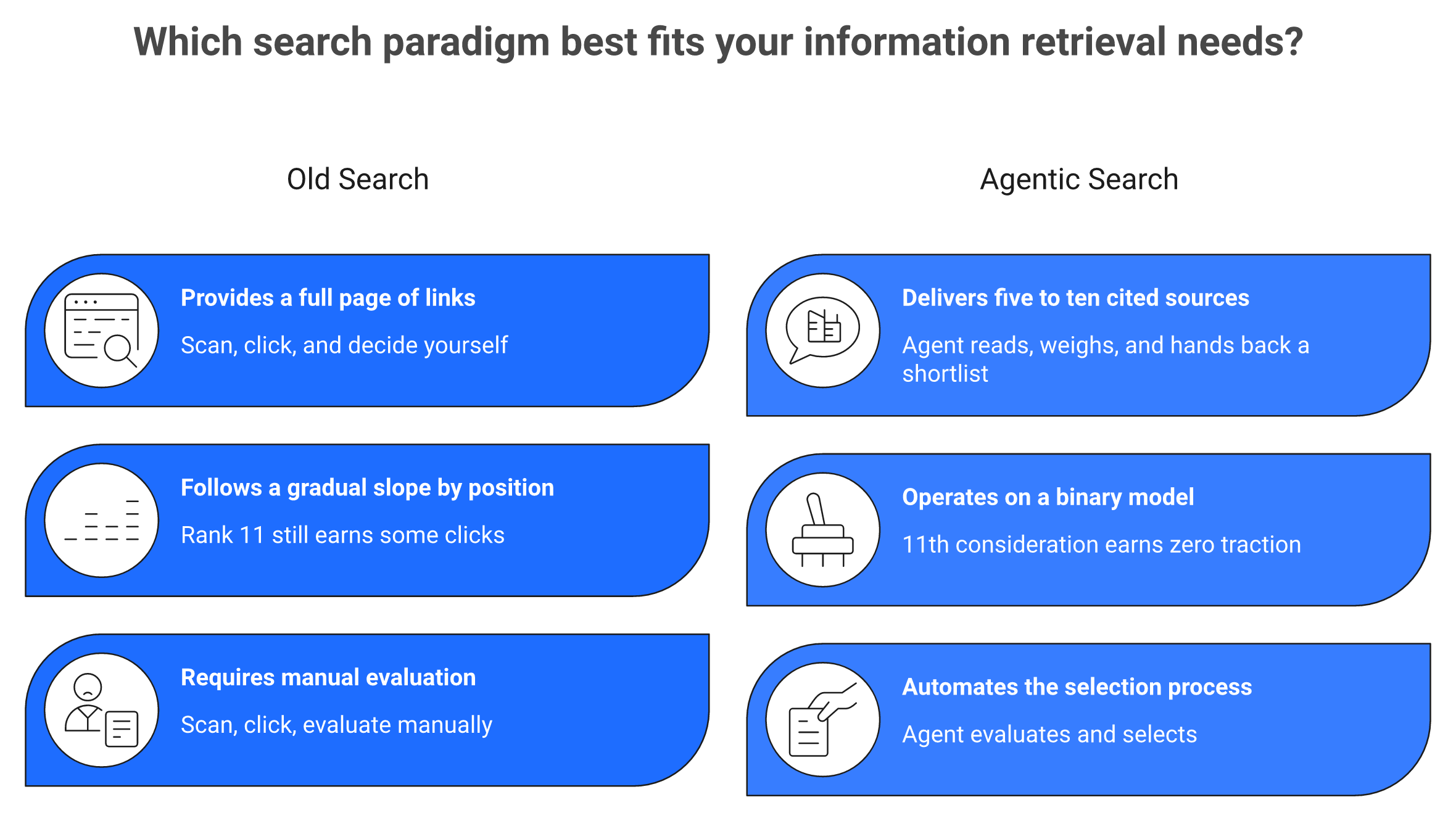
Agentic search collapses that. The agent reads the sources, weighs them, and hands back a short, curated shortlist. Nobody scrolls to "page two" of a chat answer, because there is no page two.
📉 The Five-Stage Slide Into Agentic Search
Search did not jump here overnight. It moved through five stages: keyword matching, then semantic understanding, then conversational back-and-forth, then inferential reasoning, and now agentic action. Each stage asked the machine to do more of the thinking.
The final stage is the sharp one. The agent stops describing options and starts choosing them. Understanding this shift is the foundation of any real generative engine optimization strategy, because agents complete actions for users, not just retrieve information for them.
⚠️ Why This Is a Binary Outcome, Not a Ranking Slope
Here is the reframe that matters for anyone owning a pipeline number. The old question was "how do I rank higher?" The real question now is "am I in the answer at all?"
There is a hard edge to this. As one veteran GEO practitioner put it, if you are not in the actual citations of the answer, "you might as well not have played the game," because your traction is "literally zero." Ranking eleventh on Google still gets some clicks. Being the eleventh brand an agent considered gets nothing.
This shift is really a data science problem, not a keyword problem. Being chosen depends on how the model retrieves and trusts sources, which is a different discipline from stuffing pages with terms, and it sits at the heart of modern answer engine optimization.
💡 What This Changes for Your Monday
The job description quietly changed. You are no longer optimizing a webpage to climb a list. You are optimizing a brand to be selected by a machine acting on your buyer's behalf.
At MaximusLabs, we treat this as binary: you are in the citation, or you are invisible. That is why our whole approach to GEO optimizes clients to become the answer an agent returns, not just a rank on a page nobody visits anymore. The brands that internalize this early stop measuring blue link positions and start measuring whether they made the shortlist.
Q2: What Does Agentic Search Look Like Today, and What Protocols Power It?
Skeptics call agentic search a slide deck fantasy. Then you watch OpenAI's Operator open a browser, add groceries to a cart, and check out, and the fantasy has a checkout button.
Agentic search is already shipping. OpenAI's Operator navigates browsers to book and buy, while Perplexity and Google's AI Mode return cited, task-oriented answers. Underneath sit new protocols: MCP and WebMCP let agents read and act on your site, A2A enables agent-to-agent handoffs, and UCP targets checkout. The web is being rebuilt for agents, not just human clicks.
🚀 The Products Are Live, Not Theoretical
OpenAI launched Operator in January 2025 as an agent that controls a browser to complete real tasks like booking reservations and shopping. It still needs human help, but the direction is unmistakable.
Google has said the quiet part out loud too. Its own leaders describe search becoming agentic, with agents that learn, act, and even negotiate on a user's behalf. Perplexity, meanwhile, already returns answers with a curated set of cited sources rather than a link list, which is why Perplexity optimization now matters as much as ranking on Google.
🔌 The Plumbing: MCP, WebMCP, A2A, and UCP
New protocols are the pipes that let agents act. In plain language, each one solves a different piece of the "let a bot do it" puzzle.
| Protocol | What it does (plain language) |
|---|---|
| MCP (Model Context Protocol) | Lets an agent connect to and read your tools and data |
| WebMCP | Lets an agent interact directly with your website's front end |
| A2A (Agent-to-Agent) | Lets one agent hand a task to another agent |
| UCP (Universal Commerce Protocol) | Standardizes agent-driven checkout and transactions |
The takeaway is simple. Your site is becoming a data source that machines query, not just a set of pages humans browse.
🍳 The Ghost Kitchen View of Your Website
Think of your website like a restaurant with a ghost kitchen. The dining room is what humans see. The kitchen and transaction layer is where the agent actually works, pulling your data feed to fulfill an order.
Most brands still polish the dining room. The agent never eats there. It goes straight to the kitchen, and if your data feed is a mess, it leaves hungry and picks a competitor, which is exactly what our agentic commerce service is built to prevent.
📅 The Timeline: 2027 as the Inflection Point
Industry watchers point to 2027 as the year agentic systems mature into everyday use. That is close enough to plan for and far enough to prepare for.
We could be early calling it now, but here is where our thinking sits. MaximusLabs builds sites and content for this agent-readable layer through our technical SEO and website audit work, so your data feed is reachable when the agent, not the human, arrives. Waiting until agents are mainstream means competing for citations that early movers already own.
Q3: How Do Autonomous Agents Actually Decide Which Sources to Cite?
Most "be a trusted source" advice stops exactly where it gets useful. It never explains what "trusted" means to a machine. A retrieval pipeline does not feel trust. It scores signals.
Autonomous agents cite through a multi-stage RAG pipeline: query parsing, hybrid retrieval (BM25 plus dense embeddings), multi-tier reranking, then citation-embedded synthesis. RAG means retrieval-augmented generation, where the AI searches live, reads results, and summarizes them. A document must clear several checkpoints before it earns a citation. Being cited is engineerable, not luck.
⚙️ The Six-Stage Pipeline Behind Every Citation
Perplexity's answer engine runs roughly six discrete steps. It parses your query, retrieves candidates using hybrid methods, reranks them through multiple layers, assembles a prompt with citations pre-embedded, then synthesizes the answer.
Each stage filters harder than the last. A source that survives to the end is one that passed every gate. Miss one gate, and you are dropped before the answer is even written, which is why answer engine optimization focuses on clearing each stage deliberately.
✅ The Five Checkpoints Your Page Must Pass
Perplexity's pipeline evaluates each candidate document against five practical filters.
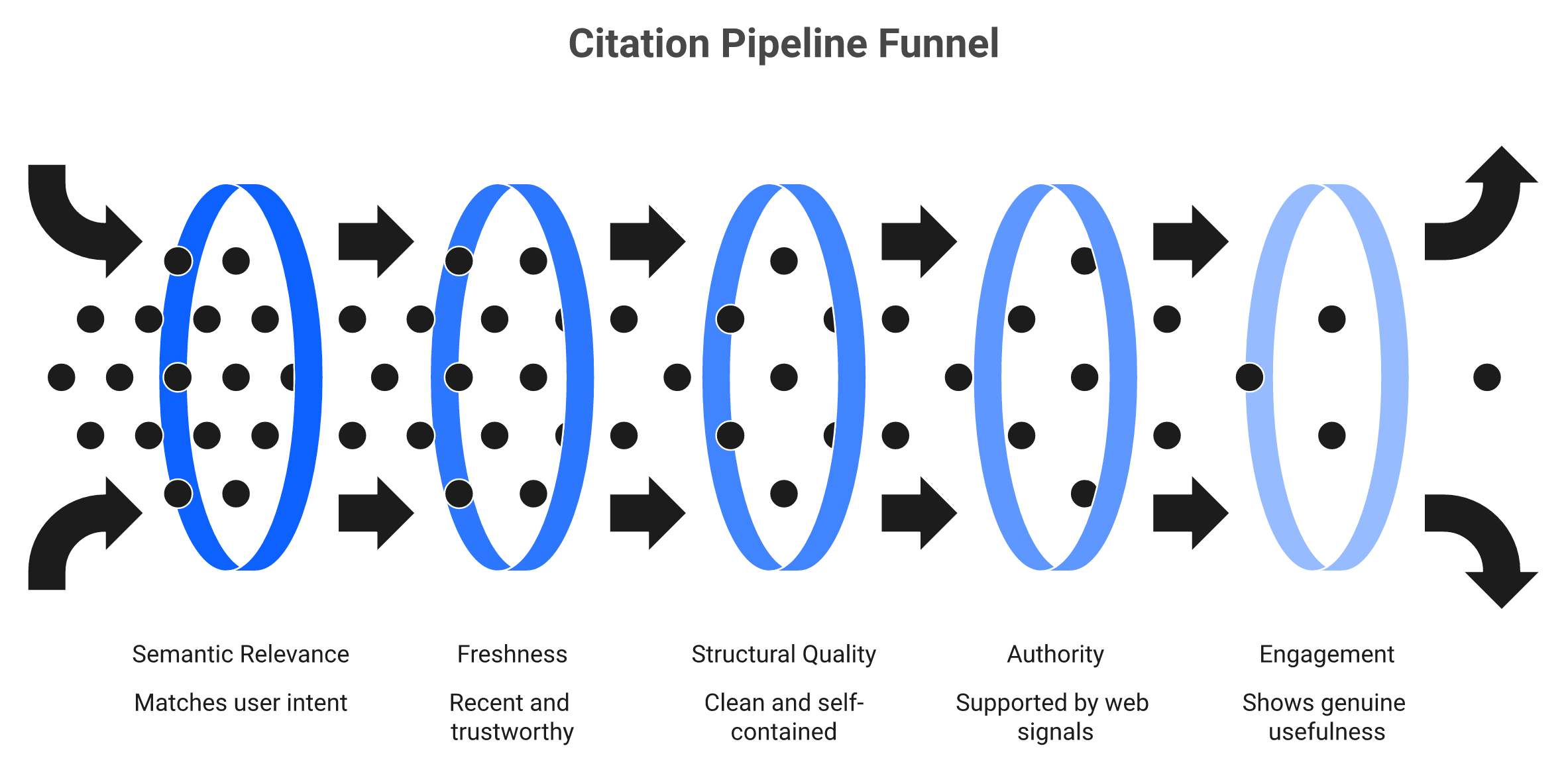
- Semantic relevance: does the content actually match the intent, not just the words?
- Freshness: is it recent enough to trust?
- Structural quality: can the system cleanly extract a self-contained answer?
- Authority: do other signals across the web vouch for this source?
- Engagement: does the content show signs of being genuinely useful?
This is why "getting cited" is a design problem, not a wish. You are engineering a page to clear five specific gates, and our content marketing service is built around exactly those signals.
📋 The Schema Debate Worth Knowing
Here is contested ground, and honesty matters more than a clean answer. One school argues schema barely helps agents, because tokenization "sort of destroys the schema," and models reproduce it "like something you hear on the radio in another language," without truly understanding it.
The other school disagrees. Surfer Academy's analysis found that sites using structured data are more likely to be featured in AI summaries. Our read: schema is not magic, but it removes ambiguity, and ambiguity gets you dropped. One more detail worth knowing is that ChatGPT appears to trigger a live web search only when it is roughly sixty percent unsure it can answer alone.
🎯 The Checklist to Pass the Reranker
Turn the mechanics into moves. Lead each section with a clean, extractable answer. Add dates. Name authors. Cite primary sources the model can verify.
We reverse-engineer these retrieval signals per platform, because what earns a Perplexity citation is not identical to what earns a Google AI Overview mention. That platform-by-platform teardown is the core of the MaximusLabs large language model optimization methodology, not a generic page-speed checklist that never moved a citation.
A quick note on sourcing: the reference material used in this section includes named practitioner and vendor research (Ethan Smith of Graphite, Mark Williams-Cook, and Surfer Academy findings referenced above), but no G2, Capterra, Trustpilot, or linkable Reddit-comment reviews. Per the strict no-fabrication rule, none have been invented here. Verified platform reviews should be inserted at publication once real, linkable sources exist.
Q4: Why Is the Shift From Google-Only SEO to GEO/AEO Non-Negotiable Now?
A Head of Growth we worked with ranked page one on Google and still could not figure out why pipeline was flat. We ran her category through Perplexity and Gemini. She was invisible in both. The traffic was leaking somewhere her dashboard could not see.
The move from Google-only SEO to GEO/AEO is now forced by data. GEO means Generative Engine Optimization, and AEO means Answer Engine Optimization: getting cited inside AI answers, not just ranking blue links. Gartner projects a 25% drop in traditional search volume by 2026, and Ahrefs found AI Overviews cut position-one CTR by 58%. Meanwhile, Princeton's GEO study showed optimization can lift generative visibility by up to 40%.
📊 The Situation: SEO Still Works, but the Ground Is Moving
Google is not dead, and organic traffic still pays bills today. Most teams, reasonably, treat GEO as "SEO with extra steps."
That framing is the trap. The channel still works, but the center of gravity is sliding toward AI answers faster than most forecasts assumed, a shift we break down in our GEO vs traditional SEO comparison.
📉 The Complication: The Numbers Are Brutal and Recent
Three primary sources tell the story cleanly.
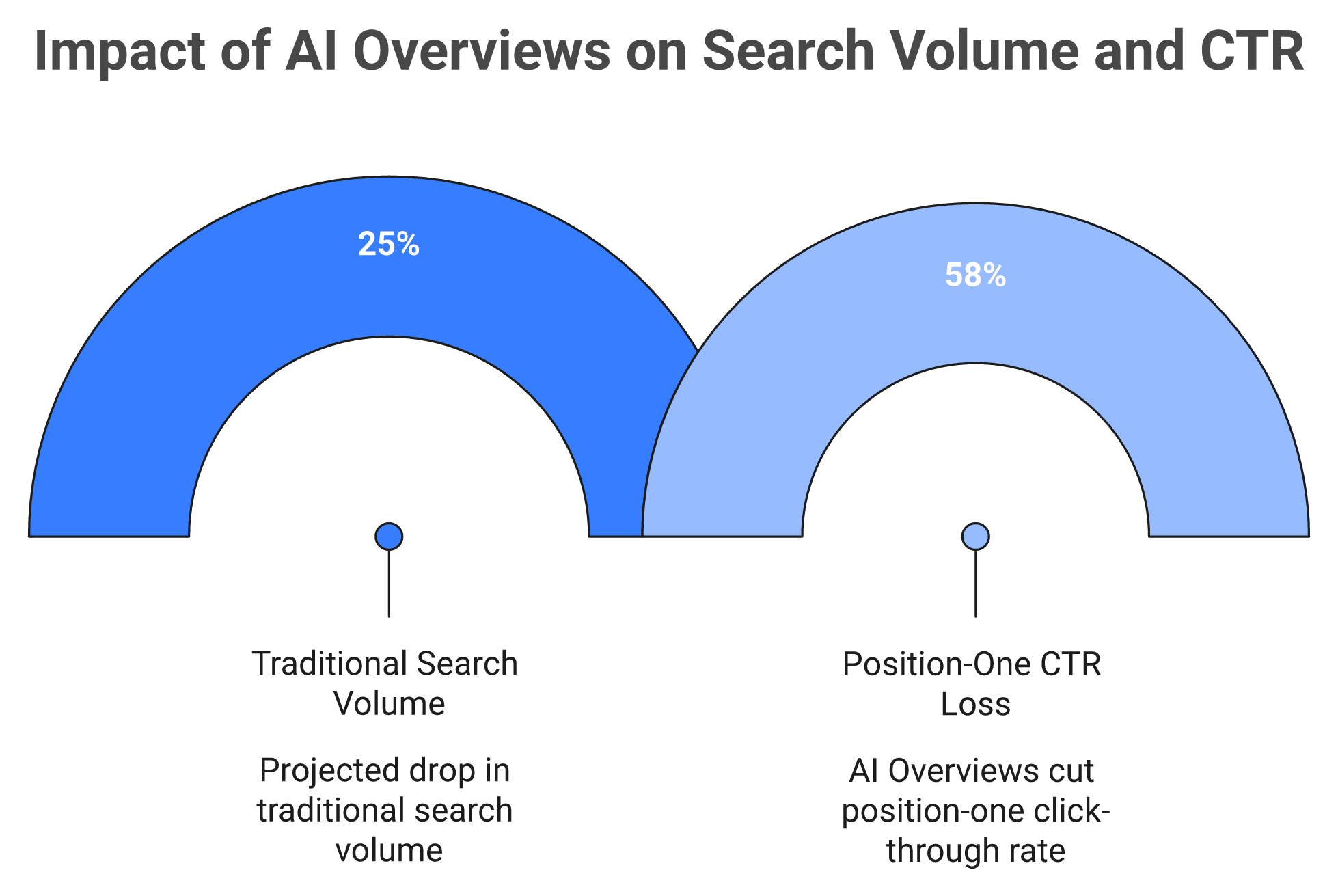
- Gartner projects traditional search volume dropping 25% by 2026 as users shift to AI chatbots and agents.
- Ahrefs, analyzing hundreds of thousands of keywords, found AI Overviews cut position-one CTR by 58% by December 2025, up from 34.5% earlier that year.
- That 34.5% figure was the earlier, milder penalty for being pushed below an AI Overview snapshot, and it nearly doubled in eight months.
Read those together. Even a number-one ranking now leaks more than half its clicks when an AI answer sits above it.
⚖️ The Honest Counterweight: Volume Is Still Small Today
We will not oversell this. AI referral traffic, while growing fast, is still a small share of total sessions for most sites right now. Anyone promising that agents already drive the majority of your pipeline is selling hype.
The case is not "traffic already moved." The case is "traffic is moving, the penalty compounds monthly, and the brands building citations now will own them when volume arrives." That is the exact bet behind our AI SEO service.
🔬 Why GEO Is Not "SEO Plus"
Princeton and IIT Delhi's GEO paper tested optimization tactics and found some lifted generative visibility by up to 40%. Crucially, the winners were not keyword tricks. They were information gain, cited sources, and clear structure.
That is the tell. Google rewarded keyword density and links. Generative engines reward depth, freshness, and authority they can retrieve and trust. As one practitioner bluntly put it, GEO "is a data science problem," about knowing how these algorithms actually work. The same voice notes that most classic technical SEO is "true but zero impact," saying that in fifteen years he never once saw Core Web Vitals drive a traffic increase.
🧭 The Resolution: What GEO, AEO, and Search Everywhere Cover
Three terms, three jobs. GEO optimizes to be cited across generative engines. AEO structures content to be the direct answer. Search Everywhere Optimization builds presence across third-party surfaces agents trust, like reviews and communities.
Here is where to point budget on Monday. Re-forecast organic targets down, then shift spend from vanity content toward being cited where buyers actually ask. MaximusLabs pioneered a revenue-focused B2B SEO service precisely because treating this as "SEO plus" produces fifty-page audit PDFs, not pipeline. The goal is not a prettier dashboard. It is being the brand the machine names.
Q5: Why Is Building a Brand the Only Durable Moat Against Model Collapse?
Every week someone asks us for the agentic "hack," the one trick that forces ChatGPT to name their brand. We understand the instinct. It is also the wrong question, and the standard read gets this backwards.
Brand is the only durable moat in agentic search. Algorithm hacks decay as models neuter automated tactics, and as AI trains on AI-generated derivatives, systems drift toward "model collapse." Original, human-verified brand authority becomes the trusted signal agents can't fake. Build a recognized brand in your space, and AI has to recommend you, because you're one of the few real sources left.
🎯 The Situation: Everyone Wants the Hack
The hunt for a shortcut makes sense. Ranking used to reward clever tactics, so people assume agentic search will too.
But agents are built to reward trust, not tricks. The teams behind these models actively tune out manipulation, the same way Google spent years neutering spam, which is why our GEO service is built on durable authority rather than short-lived hacks.
⚠️ The Complication: Model Collapse Punishes Derivative Content
Here is the deeper risk. The internet now publishes more AI-generated content than human-written content, and most of it just summarizes five other articles to write a sixth.
When models train on their own derivatives, quality degrades into what researchers call "model collapse," an infinite loop that ends in garbage. That makes original, human-verified sources rare and valuable. The penalty for being average has never been so severe, and the payout for being genuinely original has never been higher, a case we make in our trust-first content playbook.
🍳 The Proof: The Masterclass Flywheel
Topical authority through real brand association is the durable signal. Masterclass ranks for "Beef Wellington" because Gordon Ramsay teaches there, an association no keyword can fake.
Notice the limit, though. Masterclass did not rank for "butter lettuce," because that term is not "conceptually adjacent" to anyone it is known for. Brand authority is specific, earned, and tied to what you are genuinely known for, which is exactly what strong answer engine optimization builds. Agents recommend the sources they have reason to trust, not the ones that gamed a checklist.
💡 The Resolution: Build the Brand, Then Layer GEO
The move is to build a brand worth recommending, then use GEO to accelerate it. GEO speeds up results, but brand is the foundation underneath.
As one practitioner put it, it is "not about hacking the algorithm," it is about building a brand so strong that "AI HAS to recommend you." That is why MaximusLabs builds trust-first content in the founder's voice through our content marketing service, because a distinct point of view survives model collapse when summarized filler does not. Schema tricks fade with the next update. Being the brand in your category does not.
Q6: How Do You Write for a 25-Token Chat Prompt Instead of a 6-Word Query?
We audited a client's top pages once and found them perfectly built, for 2018. Every page answered a two-word keyword. Not one answered the messy, specific way a buyer actually talks to ChatGPT.
Agentic prompts are richer than queries. The average Google search is about six words. The average chat prompt, per Perplexity data, is around 25 tokens, roughly 4x more nuanced. Winning content answers the specific, multi-constraint intent behind long prompts, not a bare keyword. Use direct-answer nuggets, question-headed sections, and exposed attribute data so agents retrieve the exact detail a follow-up demands.
📏 The 6-Words-Versus-25-Tokens Gap
The numbers tell the whole story. A Google search averages about six words, while a chat prompt averages roughly 25 tokens (a token is a chunk of text a model reads).
That is four times more context in every request. Buyers now say things like "best payroll tool that integrates with HR, IT, and finance for a 200-person startup." A page built for "payroll software" never surfaces for that, which is why our AEO keyword and question research maps how buyers actually ask.
🧩 Expose the Attribute Data Agents Hunt For
Follow-up questions are usually about specifics. Think color, material, integration, pricing tier, or use case. As one practitioner noted, buyers ask for the "best product with these attributes," yet that data often hides inside JavaScript filters.
Pull those attributes into plain text and headers. Expose the closure, the fabric, the neck style, or the integration list where a machine can actually read it. If the detail is not in retrievable text, the agent cannot cite you for it, a gap our GEO content optimization is designed to close.
🔓 Treat the LLM as a Universal Intent Decoder
Here is a mental model that helps. Do not picture the LLM as a search box. Picture it as a machine that translates messy human speech into a single, structured request for your data.
Your job is to make that translation easy. Answer the exact question, then answer the three questions that naturally follow it.
✅ The Structural Checklist
Turn this into a repeatable format for every money page.
- Lead with a 40-to-80-word direct answer that stands alone.
- Use question-headed sections that mirror how buyers actually ask.
- Surface attributes, specs, and integrations as readable text, not hidden filters.
- Answer the obvious follow-ups on the same page.
This is exactly how MaximusLabs builds content mapped to chat-level intent through our AEO service. We write for the nuanced, ICP-specific prompt, and we expose the attribute data agents retrieve, instead of shipping thin keyword pages that answer a question nobody asks anymore.
Q7: Is Your Site Even Crawlable by AI Agents? The Hidden-Data Problem
An analyst we know ran a simple test on a thirty-billion-dollar company's site. He turned JavaScript off in his browser and reloaded a product page. Half the page vanished, including every customer review.
Many sites hide their most citable data from AI agents. Content loaded asynchronously via JavaScript, meaning it loads after the initial page, often does not render for crawlers. Reviews, specs, and facets disappear, and help centers on subdomains get treated as separate, weaker filing cabinets. Fix it: expose key data in server-rendered text, move help centers to subdirectories, and use point-to-point internal links so no citable page is orphaned.
🕵️ The JavaScript-Off Test Anyone Can Run
The trick is embarrassingly simple. Turn off JavaScript, reload your key pages, and see what survives.
If your reviews, prices, or specs disappear, agents likely cannot see them either. A practitioner used exactly this test to prove a huge retailer was hiding its most citable data, reviews loaded asynchronously, from OpenAI's crawlers. That data was its best proof, and it was invisible, the kind of issue our AI crawlability checker surfaces fast.
📁 Subdomains Versus Subdirectories
Help centers hold gold for agents. They answer the long-tail feature and use-case questions buyers ask in chat.
But many sites bury them on a subdomain, like help.yoursite.com. Search systems often treat a subdomain as a separate, weaker "filing cabinet." Moving that content to a subdirectory, like yoursite.com/help, keeps the authority attached to your main domain, a fix we handle in our technical SEO and website audit.
✈️ The Airline Route Map for Internal Links
Internal linking decides what agents can even find. Picture two airlines.
A hub-and-spoke model routes everything through one hub, and pages loaded by JavaScript can end up orphaned, with no crawlable path in. A point-to-point model, like Southwest, links pages directly to each other. That direct linking gives crawlers a route to every citable page, a principle central to sound technical GEO implementation.
✅ The Crawlability Audit Checklist
Make this a recurring check, not a one-time fix.
- Test top pages with JavaScript disabled and confirm key data still renders.
- Move help centers and docs from subdomains into subdirectories.
- Link money pages directly to each other, not only through a central hub.
- Confirm AI crawlers, like GPTbot and OAI-SearchBot, are not blocked in robots.txt.
We skip the cosmetic "technical AEO audit" that ships a fifty-page PDF and changes zero citations. Instead, MaximusLabs runs agent-renderability audits that surface hidden, citable data and get it in front of the crawler, informed by how we approach managing AI crawlers. Crawlability is not glamorous, but it is the difference between being retrievable and being invisible.
Sourcing note: the reference material describes the named practitioner demonstration above (Ethan Smith of Graphite on the JavaScript-off test and subdomain guidance), but no linkable G2, Capterra, Trustpilot, or Reddit-comment reviews. Per the strict no-fabrication rule, none have been invented. Verified, linkable reviews should be added at publication.
Q8: Where Do AI Citations Come From, and Which Channels Are Underused?
A founder once asked us, mid-audit, why a competitor kept showing up in ChatGPT when their blog was thinner than his. The answer was not on the competitor's website at all. It was on Reddit, YouTube, and G2.
AI citations come from far more than your website. Agents pull from YouTube, third-party reviews like G2 and Capterra, communities like Reddit, and off-site mentions, sometimes citing YouTube more than Wikipedia. This is Search Everywhere Optimization: to be the answer, seed and refresh presence across the surfaces agents trust, because a single owned page rarely wins the citation alone.
📺 YouTube Is the Most Underused Citation Source
This is the one most brands sleep on. YouTube is heavily cited by AI models, sometimes more than Wikipedia, and you can rank there fast.
The play is simple videos about how to accomplish a goal your product solves. These are high-value, high-intent topics, and for boring B2B subjects, almost no video competition exists. A practitioner called YouTube "probably the most under-utilized strategy" in the whole discipline, and it fits naturally into our GEO and social media work.
🌐 Agents Read the Whole Web, Not Just Your Blog
Before an agent recommends you, it checks what others say about you. Agents comb through reviews and third-party signals to decide who to trust.
Perplexity's source selection reflects the same pattern, pulling from a mix of communities, reviews, and video, not just brand-owned pages. Your site is one voice. The agent wants a chorus, which is why Reddit and forum AEO matters as much as on-site work.
🗺️ The Search Everywhere Channel Map
Here is where to build presence, and what each surface does.
| Channel | Why agents trust it |
|---|---|
| YouTube | Heavily cited, fast to rank, low B2B competition |
| G2 / Capterra | Structured, third-party proof for software buyers |
| Reddit / Quora | Authentic, community-vetted recommendations |
| Industry mentions | Off-site authority that vouches for your brand |
💡 Where to Point Effort on Monday
Start with the surfaces agents already cite in your category. Run your buyer's real prompts, see which sources get named, then earn presence there.
Seed a few genuinely useful YouTube videos on your money use cases. Make sure your G2 and Capterra profiles are complete and reviewed. Engage authentically in the communities that come up, without spamming. This is precisely what we mean by Search Everywhere Optimization at MaximusLabs, and it is core to how we track AI search visibility and brand mentions. We build citation presence across YouTube, review platforms, and communities, not just your blog, because agents assemble answers from the whole web, and a single owned page rarely wins the citation alone.
Sourcing note: the reference material describes these off-site channels and the YouTube citation tactic (Ethan Smith of Graphite), but contains no linkable G2, Capterra, Trustpilot, or Reddit-comment reviews. Per the strict no-fabrication rule, none have been fabricated. Real, linkable reviews should be inserted at publication.
Q9: Does Agentic Search Drive Revenue, and How Do You Measure AI Visibility?
A VP of Marketing told us she could not defend a GEO budget to her board. Her fear was simple. If AI answers do not send clicks, how does she prove any of it drives revenue?
Agentic search drives revenue, not just anxiety, but its shape differs. AI referrals convert 4 to 6 times higher than Google organic, with some studies showing 15.9% versus under 4%, yet they remain a small share of sessions today. Prioritize high-intent BOFU and MOFU money pages, then measure what matters: citation rate and share-of-voice, not clicks, tracked via GA4 AI-referral channels.
📊 The Situation: The Fear Is About Lost Traffic
Most leaders frame this as a traffic problem. Fewer clicks feels like less business, so the instinct is to protect the old funnel.
That framing hides the real story. The question is not "how much traffic," it is "how good is the traffic that does arrive." Answering it well is the whole point of a revenue-focused GEO service.
💰 The Complication: High Conversion, Low Volume Today
Here is the tension. AI-referred visitors convert far better than Google organic ones, because they arrive pre-sold by the answer that named you.
First Page Sage found ChatGPT referral traffic converting near 15.9%, against low single digits for traditional organic. Broader analyses put AI referral conversion at roughly 4 to 6 times organic. The honest catch is that traffic is still a small slice of total sessions for most sites right now, a nuance we track in our AI search in B2B SaaS 2026 research.
🎯 The Money-Page Reality
Not all content earns its keep. As one practitioner put it, roughly 19 of every 20 landing pages drive almost no traffic, while a small fraction produces nearly all the impact.
That means most content is a "wasted rep." The 5% that targets high-intent, bottom-of-funnel questions is where conversion actually lives. Spend scarce budget there, not on top-of-funnel pages that generate impressions and no pipeline, a discipline built into our content marketing service.
📏 The Measurement Framework
Clicks are the wrong scoreboard now. Ahrefs found AI Overviews cut position-one CTR by 58%, so click-based reporting understates your real reach. Track these instead.
- Citation rate: how often AI engines name you for your target prompts.
- Share-of-voice: how often you appear versus competitors across many prompt variants.
- AI-referral sessions: filter GA4 for ChatGPT, Perplexity, and Gemini referral sources.
- Post-conversion survey: a "how did you hear about us?" field catches citations that never sent a click.
These are the exact signals our AI search visibility and brand mention tracking is built to measure.
✅ The Resolution: Budget Follows Pipeline
The move is to re-forecast with Gartner's projected 25% search-volume drop in mind, then reallocate. Pull spend off vanity pages, and pour it into BOFU money pages that convert.
This is exactly how MaximusLabs ties GEO visibility to pipeline through our GEO ROI and revenue attribution work. We prioritize bottom-of-funnel money pages first, because a citation that never converts is still a vanity metric dressed up in AI clothing. The goal is booked revenue, not a prettier dashboard.
Sourcing note: the reference material includes the named conversion and money-page data used above (First Page Sage on ChatGPT conversion, Ethan Smith of Graphite on the "19 of 20 pages" observation, and Gartner and Ahrefs figures), but no G2, Capterra, Trustpilot, or linkable Reddit-comment reviews. Per the strict no-fabrication rule, none have been invented. Add verified, linkable reviews at publication.
Q10: What Should You Do Monday Morning to Win Agentic Search?
Most GEO advice ends with inspiration and no instructions. So here is the opposite: what to actually open, test, and change before lunch on Monday.
Start Monday with four moves: instrument AI-referral tracking in GA4 for ChatGPT, Perplexity, and Gemini; audit your top 20 BOFU pages for citation potential across those engines; expose hidden attribute and review data by testing your site with JavaScript off; and shift KPIs from clicks to citation rate and share-of-voice. Fix crawlability, then earn citations, then measure pipeline.
✅ The Four-Step Monday Checklist
Do these in order. Each one unblocks the next.
- Instrument tracking: filter GA4 for AI referral sources so you have a baseline.
- Audit crawlability: reload your top pages with JavaScript off and note what vanishes.
- Map citations: run your buyer's real prompts and record which sources get named.
- Reset KPIs: replace click targets with citation rate and share-of-voice.
Step two is fastest with our AI crawlability checker, and step three is easier using our ChatGPT search query extractor.
👥 Role-Specific Priorities
Different seats own different moves.
- Founder: protect the brand moat. Fund the content and point of view that make you the recognized name in your category.
- VP Marketing: re-forecast targets against Gartner's projected 25% search-volume decline, then move budget to BOFU pages.
- Marketing Manager: fix crawlability and expose attribute data first, since no citation happens if agents cannot read the page.
Founders sharpening that moat often start with our founder voice methodology guide.
⏰ The 90-Day Sequence
Order beats speed here. Rushing to publish before your site is readable wastes the work.
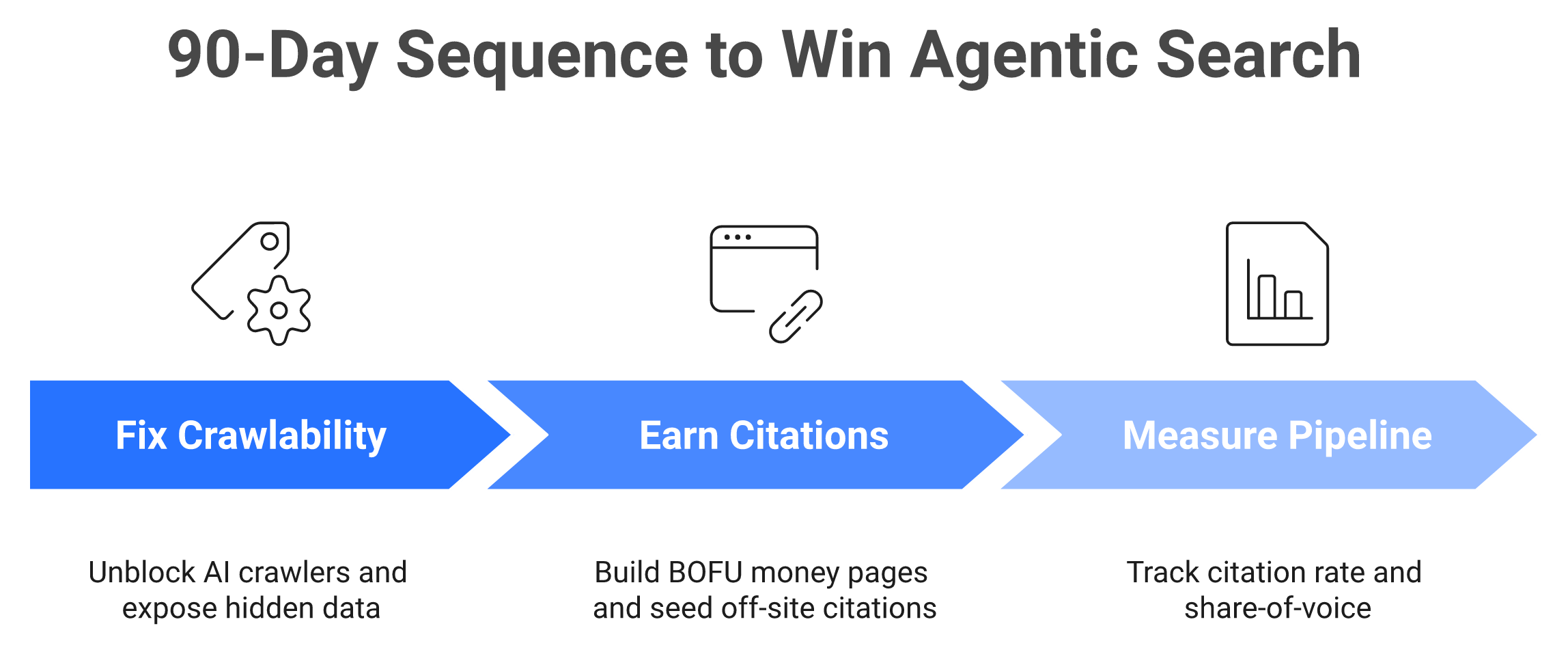
- Days 1 to 30: fix crawlability, unblock AI crawlers, and expose hidden review and spec data.
- Days 31 to 60: build BOFU money pages, and seed off-site citations on YouTube, G2, and communities.
- Days 61 to 90: measure citation rate and share-of-voice, then double down on what converts.
The first phase leans on our technical SEO and website audit, and the second on our AEO service.
🔮 The Forward-Looking Note
One myth needs killing before you start. First-mover advantage on agentic surfaces is largely "a false concept," because these platforms lack a fixed truth set, so pages launched later can rank almost right away. What compounds is content velocity and data volume, not a calendar head start.
That is reassuring if your budget is tight. You do not need to have started last year. You need to start the right work now, in the right order.
This is the exact sequence MaximusLabs runs with clients: crawlability, then citation-earning content, then pipeline measurement, delivered through our generative engine optimization programs. It is cost-effective and scalable, not a nine-month engineering project that bills a fortune and moves nothing.
The open question we are sitting with is this. 2027 looks like the inflection point when agents mature into everyday buying tools. So the real conversation is not "should we do GEO," it is "what does your category's answer look like when the agent, not the human, is doing the shopping?" We would genuinely like to hear how you are thinking about that, so contact us and let us talk it through.
Frequently asked questions
What is agentic AI in search, and how is it different from AI Overviews?
Agentic AI in search means autonomous agents that don't just answer, they complete the task, comparing, filtering, deciding, and even transacting for the user. Unlike AI Overviews, which summarize links you still click, an agent shrinks the buyer's evaluation set to five to ten cited players inside one chat window. Old model: scan ten blue links, click, and decide yourself. Agentic model: the agent reads sources, weighs them, and hands back a short shortlist. There is no page two of a chat answer. That makes visibility binary: you are in the citation, or you are invisible. Ranking eleventh on Google still earns some clicks, but being the eleventh brand an agent considered earns nothing. This is why we treat modern search as a data science problem, not a keyword problem. Our GEO service optimizes clients to become the answer an agent returns, not just a rank on a page nobody visits anymore.
What protocols power agentic search today, and are the products actually live?
Agentic search is already shipping, not theoretical. OpenAI's Operator navigates browsers to book and buy, Perplexity returns cited task-oriented answers, and Google's AI Mode does the same. Underneath sit new protocols that let agents read and act on your site: MCP: lets an agent connect to and read your tools and data. WebMCP: lets an agent interact with your website's front end. A2A: lets one agent hand a task to another agent. UCP: standardizes agent-driven checkout and transactions. The takeaway is that your site is becoming a data source machines query, not just pages humans browse. Think of it as a ghost kitchen: the agent skips the dining room and goes straight to your data feed. We build sites and content for this agent-readable layer through our technical SEO and website audit , so your data feed is reachable when the agent, not the human, arrives.
How do autonomous agents decide which sources to cite?
Agents cite through a multi-stage retrieval-augmented generation pipeline, meaning the AI searches live, reads results, and summarizes them with citations embedded. A document must clear several checkpoints before it earns a mention. Semantic relevance: does the content match intent, not just words? Freshness: is it recent enough to trust? Structural quality: can the system extract a self-contained answer? Authority: do other signals across the web vouch for it? Engagement: does it show signs of being genuinely useful? Being cited is a design problem, not a wish. Lead sections with clean extractable answers, add dates, name authors, and cite primary sources the model can verify. We reverse-engineer these retrieval signals per platform, because what earns a Perplexity citation differs from a Google AI Overview mention. That teardown is core to our large language model optimization methodology.
Why is the shift from Google-only SEO to GEO and AEO non-negotiable now?
The move is forced by data. GEO means getting cited inside generative engines, and AEO means structuring content to be the direct answer. Gartner projects a 25% drop in traditional search volume by 2026. Ahrefs found AI Overviews cut position-one click-through rate by 58%. Princeton's GEO study showed optimization can lift generative visibility by up to 40%. We will not oversell it. AI referral traffic is still a small share of sessions today, so anyone claiming agents already drive most pipeline is selling hype. The real case is that the penalty compounds monthly, and brands building citations now will own them when volume arrives. GEO is not "SEO plus." Google rewarded keywords and links, while generative engines reward depth, freshness, and authority they can retrieve. That is exactly why we pioneered a revenue-focused B2B SEO service instead of shipping fifty-page audit PDFs.
Why is building a brand the only durable moat against model collapse?
Brand is the only durable moat in agentic search. Algorithm hacks decay as model teams neuter automated tactics, the same way Google spent years killing spam. Meanwhile, the internet now publishes more AI-generated content than human-written content. When models train on their own derivatives, quality degrades into "model collapse." That makes original, human-verified sources rare and valuable. The trap: chasing a one-time hack that the next update erases. The moat: topical authority tied to what you are genuinely known for. Masterclass ranks for "Beef Wellington" because Gordon Ramsay teaches there, an association no keyword can fake. It does not rank for unrelated terms, because authority is specific and earned. We build trust-first content in the founder's voice through our content marketing service , because a distinct point of view survives model collapse when summarized filler does not.
Is your site even crawlable by AI agents, and how do you check?
Many sites hide their most citable data from agents. Content loaded via JavaScript, meaning it loads after the initial page, often does not render for crawlers, so reviews, specs, and facets disappear. Run this simple test: turn off JavaScript, reload your key pages, and see what survives. If your reviews or prices vanish, agents likely cannot see them either. Expose data: put reviews and specs in server-rendered text. Move help centers: shift them from subdomains to subdirectories so authority stays attached to your domain. Link directly: connect money pages to each other so no citable page is orphaned. Unblock crawlers: confirm GPTbot and OAI-SearchBot are not blocked in robots.txt. We skip cosmetic audits that ship a fifty-page PDF and change zero citations. Instead, our AI crawlability checker surfaces hidden, citable data and gets it in front of the crawler.
Does agentic search drive revenue, and how do you measure AI visibility?
Agentic search drives revenue, but its shape differs. AI referrals convert far higher than Google organic, with some studies showing near 15.9% versus low single digits, yet they stay a small share of sessions today. The move is to prioritize high-intent BOFU and MOFU money pages, then measure what matters: Citation rate: how often engines name you for target prompts. Share-of-voice: how often you appear versus competitors. AI-referral sessions: filter GA4 for ChatGPT, Perplexity, and Gemini. Post-conversion survey: a "how did you hear about us?" field catches citations that never sent a click. Clicks are the wrong scoreboard now, since AI Overviews cut position-one click-through rate by 58%. Re-forecast against Gartner's projected 25% volume drop, then move spend to pages that convert. We tie GEO visibility to pipeline through our GEO ROI and revenue attribution work, because a citation that never converts is still a vanity metric.