 Krishna Kaanth M
- Conversational AI search is multi-turn and natural language, with queries averaging 70 to 80 words, so you must rank for a whole question cluster, not one keyword.
- The game shifted from ranking to being cited; citation share across ChatGPT, Perplexity, Gemini, and Copilot now matters more than position one.
- Zero-click kills your old metric, not your business; LLM traffic converts around 6x better than Google search, so measure AI-referral conversion.
- Evidence density wins citations: authoritative quotations, sourced statistics, and clear citations drove the biggest lifts, and 44.2% of citations come from the first 30% of a page.
- Engines differ, so optimize per platform, surface hidden JavaScript content into visible text, and defend brand accuracy with trust-first entity signals.
- Agentic search is next, where AI acts rather than answers, so map question clusters to funnel turns and report citation share plus AI-referral conversion.
Q1. What is conversational AI search, and how is multi-turn different from keyword search?
Conversational AI search is a natural-language, multi-turn way of finding information where an engine interprets intent across a sequence of turns, retrieves and reranks sources, then synthesizes one cited answer instead of a ranked link list. It differs from keyword search because AI-mode queries run far longer than the old six-word Google query, so you rank for a cluster of questions, not a single phrase.
🔍 The keyword habit that no longer works
Picture a Head of Organic Growth pasting "best project management software" into a keyword tool, then building one page around that exact string. That habit built the last twenty years of SEO. It is now a liability.
Buyers do not talk to ChatGPT in six-word fragments. They type a paragraph. They add context about team size, budget, and the tool they are switching from. One study of AI-mode behavior found queries averaging 70 to 80 words, roughly 17 to 26 times the complexity of a traditional keyword. This is the shift that makes GEO different from traditional SEO.
🧠 Rank-and-list versus interpret-and-synthesize
The mechanical shift matters more than the word count. Traditional search ranks indexed pages and hands you a list to sort through yourself. Conversational engines do the sorting for you.
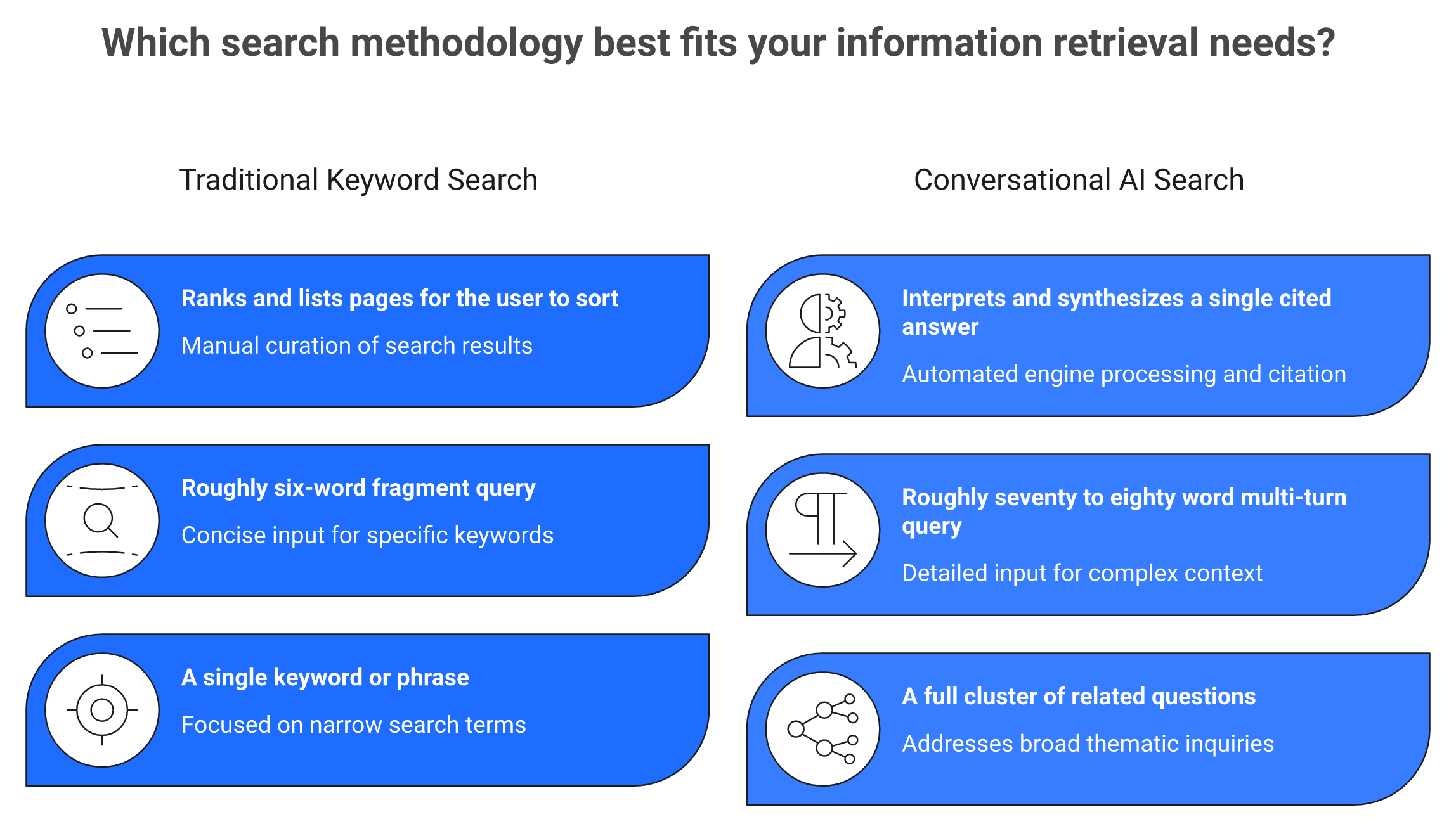
They decompose your question, retrieve candidate passages, rerank them, read, then synthesize one answer with citations. I think of the model less as a search box and more as a Universal Intent Decoder. It translates a messy human prompt into a single structured request, then decides which sources deserve to be quoted. Our question-cluster research starts from exactly this behavior.
| Dimension | Traditional search | Conversational AI search |
|---|---|---|
| Query length | ~6 words | ~70 to 80 words, multi-turn |
| Engine job | Rank and list pages | Interpret and synthesize one answer |
| User target | A keyword | A cluster of questions |
| Result | Ten blue links | One cited answer |
✅ What to do instead
Stop optimizing for a phrase. Start optimizing for the full question cluster a buyer works through in one sitting.
This is why our founder, Krishna Kaanth, keeps repeating that GEO is not SEO, it is a data science problem. To be present in the answer, you need to understand how these retrieval systems actually pick sources, not just where a keyword sits. At MaximusLabs, that reframe is where every conversational content map begins.
Q2. Why is the game now to become the answer, not just rank?
Ranking is no longer the goal; being cited is. Generative Engine Optimization (GEO) and Answer Engine Optimization (AEO) aim to make your brand the synthesized answer AI engines quote, not the tenth blue link nobody clicks. Google's May 2026 guidance frames this as still SEO at the retrieval layer, but the scoreboard changes: inclusion and citation share replace position across ChatGPT, Perplexity, Gemini, and Copilot, not Google alone.
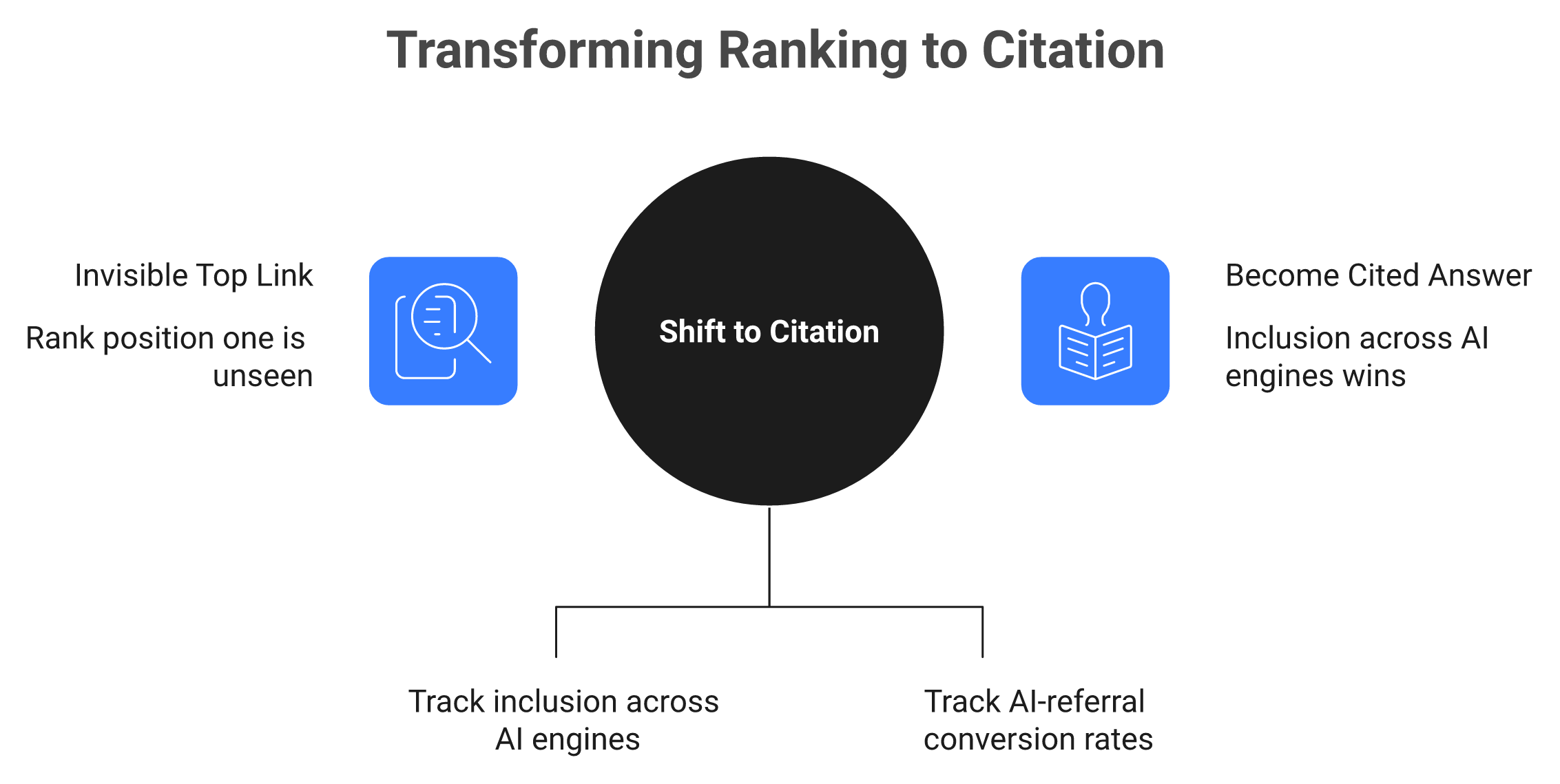
🏁 The situation: twenty years of chasing position one
For two decades, the whole job was rank number one. A VP Marketing could point to a top-three position and call it a win. The blue link was the prize.
That prize is shrinking. When an AI engine writes the answer, position one on the underlying search does not guarantee you appear in the summary at all.
⚠️ The complication: a rank nobody sees is invisibility
Here is the uncomfortable part. You can hold the top organic spot and still be absent from the answer a buyer reads.
Ethan Smith, CEO of Graphite, frames the winner in this new game plainly: it is the brand mentioned the most across the citations, not the one whose URL ranks first in the underlying search. For broad questions, being referenced by trusted third parties beats owning the top link. The center of gravity moved from your page to the answer.
📚 The proof: still SEO, but a new scoreboard
Generative Engine Optimization means ranking and getting cited on AI platforms. Answer Engine Optimization means being the direct answer to a question. Google's May 2026 guidance calls this work "still SEO" at the retrieval layer, which keeps fundamentals like crawlable content and clear entities firmly in play. If you want the primer, start with what answer engine optimization is.
But the metric changes. You stop measuring only position and start measuring citation share, how often you are the answer across many question variants and across engines.
✅ The resolution: become the source
Krishna puts it simply: do not be a search result, be the source. That is a real shift, not a slogan.
There is honest debate here worth naming. Ethan Smith argues influencing the core model is extremely hard, so focus on retrieval. Our view is that brand building shapes both what the model learns and what it retrieves, which is why we run Search Everywhere Optimization across ChatGPT, Perplexity, Gemini, and Google rather than optimizing one website in isolation. Most traditional agencies still play the Google-only game. That is the gap we built MaximusLabs to close.
Q3. Is the zero-click era killing your traffic, or just your old metrics?
Zero-click search kills your old metric, not your business. Pew data shows clicks nearly halve when an AI summary appears, roughly 15% versus 8%, and only 1% of users click links inside summaries. The fix is not chasing pageviews you have already lost; it is being the cited answer and measuring AI-referral conversion, which the field reports converting far higher than traditional Google clicks.
📉 The situation: the traffic chart everyone fears
A founder pulls up analytics and sees the line bending down. The board wants an explanation. The fear is specific and real.
As one operator put it, traffic is going down, over 70% of searches are zero-click, and if agents just read your content and answer the question, they can reroute the visit to whoever pays them. That is the existential version of the worry, and it is worth sitting with rather than waving away. We unpack the mechanics in our zero-click search brand economy report.
⚠️ The complication: the numbers back the fear, partly
The click compression is measurable. Pew data, surfaced in Semrush's 2026 analysis, shows organic clicks drop by roughly half when an AI summary appears, and only about 1% of users click a link inside the summary itself.
So yes, the raw pageview number is under real pressure. If your only scoreboard is sessions, the chart will keep hurting.
💰 The proof: the metric is broken, not the channel
Here is the reframe I would stake a claim on. Lower AI-referred volume is often higher-value traffic, not lost traffic.
Webflow reported a 6x conversion-rate difference between LLM traffic and Google search traffic, and said LLMs now drive about 8% of signups, making it a top channel. Fewer clicks that convert six times better is not a crisis. It is a different, better funnel that your old vanity metrics cannot see. This is the core of our revenue-focused measurement approach.
✅ The resolution: change what you count
Stop grieving pageviews you already lost. Start counting citation share and AI-referral conversion.
The honest caveat: this does not mean Google traffic vanishes overnight. Ethan Smith notes the search pie is getting larger while Google's slice stays roughly the same size. The penalty for being average has never been steeper, and the payout for being the cited answer has never been higher. Measuring the right thing is how you see that clearly.
Q4. How do you map the multi-turn conversation arc to your pipeline?
A single AI search is rarely one query; it is an arc of turns that moves from discovery to comparison to decision. Map content to each turn: educational answers win the discovery turn, honest comparisons win the comparison turn, and proof-led BOFU pages win the decision turn. Because no AI query-volume tool exists yet, model demand by exporting your search data and asking ChatGPT to convert those keywords into natural questions, which is directionally accurate.
🧭 The arc, mapped to the funnel
Think of one buyer session as three moves, not one search. First they explore a problem. Then they weigh options. Then they decide.
Each move rewards a different asset. Educational answers earn the discovery turn. Honest, specific comparisons earn the comparison turn. Proof-led bottom-of-funnel pages, with pricing, integrations, and outcomes, earn the decision turn.
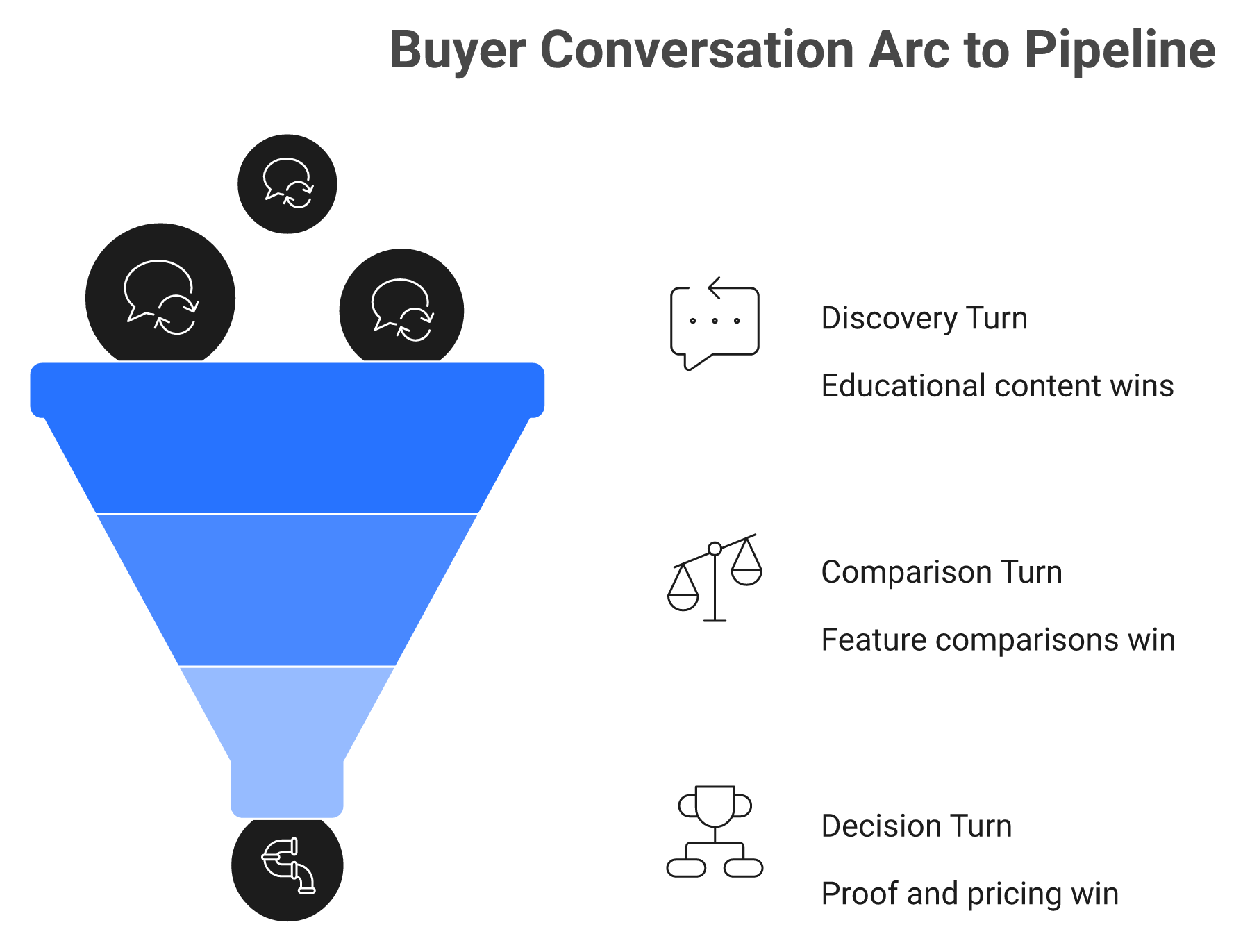
| Turn | Funnel stage | Content that wins it |
|---|---|---|
| Discovery | MOFU | Educational, question-led explainers |
| Comparison | MOFU to BOFU | Honest, feature-level comparisons |
| Decision | BOFU | Proof, pricing, integration, outcome pages |
🔗 Why owning multiple turns matters
Chat is conversational, so buyers ask many follow-ups a single publisher cannot answer. A comparison site cannot address thousands of hyper-specific product questions, but your own comprehensive page can. Mapping this out well is central to a strong GEO strategy framework.
This is the revenue-influence angle most trend pieces miss. Since only about 1% of users click inside an AI summary, presence across the whole arc, not one lucky citation, is what actually touches pipeline.
🛠️ The demand-modeling hack
There is a practical problem: no reliable volume tool exists for AI queries yet. Ethan Smith's workaround is refreshingly blunt.
Export your existing search data, then ask ChatGPT to convert those keywords into the natural, multi-turn questions people actually type. It is directionally accurate, not precise, and that honesty matters. You get a usable question-cluster map long before any "truth set" for AI query volume arrives.
✅ A simple mapping checklist
Run this before you write anything.
- Pull search-console and site-search terms into one sheet.
- Convert each into 3 to 5 natural questions with ChatGPT.
- Group the questions into discovery, comparison, and decision clusters.
- Assign one owning page per cluster, then front-load the answer.
The first exercise we run for a client's conversational content map is exactly this: search data in, question clusters out, then every cluster gets tagged to a funnel stage. That mapping, not a keyword list, is what makes our revenue-focused content aim at pipeline instead of vanity traffic.
Q5. How does an AI engine decide which brand to cite in an answer?
AI engines decide citations through retrieval, not ranking. They decompose the query, retrieve candidate passages, rerank them, read, then synthesize. The Princeton GEO study of 10,000 queries found the biggest citation lifts came from authoritative quotations (up to about 40%), sourced statistics (about 33%), and clear source citations (about 28%). Keyword stuffing and fluency edits produced almost nothing. Evidence density, not keyword density, wins the citation.
🎯 What actually moves the citation
Most teams still tune for keywords. The data says that is the wrong lever.
The Princeton GEO study tested nine optimization tactics across 10,000 real queries. The winners were evidence signals: adding authoritative quotations, sourced statistics, and clear citations. Keyword stuffing barely moved the needle, and in some cases hurt. This is the heart of real GEO content optimization.
📊 The honest caveat on the numbers
I want to be careful here, because the category oversells this. The lifts are real but bounded.
Quotations lifted citation visibility by up to about 40%, statistics by roughly 33%, and citing sources by about 28%. Notice what that means: even the single best tactic did not double your citation rate. Anyone promising a guaranteed overnight jump is selling something the research does not support. We track these gains through disciplined GEO measurement and metrics.
⚙️ The five-step loop, in plain terms
Under the hood, the engine runs a predictable sequence. Retrieval-Augmented Generation, or RAG, is the process where the model searches first, then summarizes what it finds.
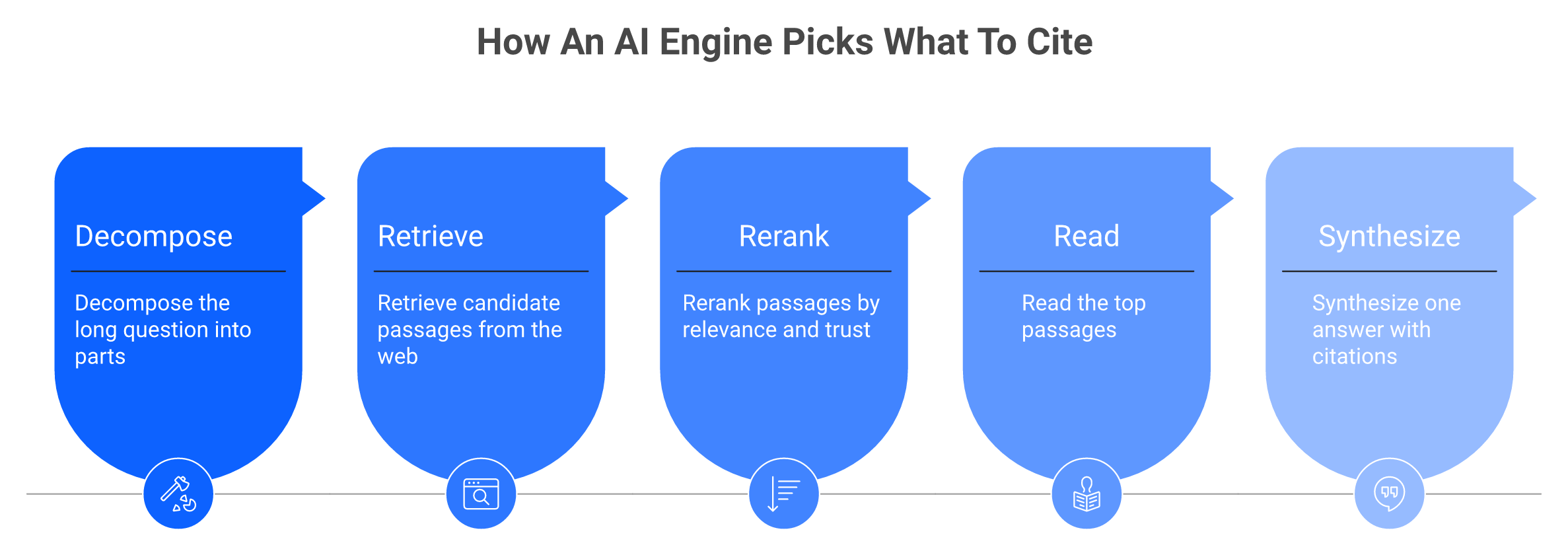
- It decomposes your long question into parts.
- It retrieves candidate passages from the web.
- It reranks them by relevance and trust.
- It reads the top passages.
- It synthesizes one answer with citations.
There is a technical detail most people miss. For standard web results, ChatGPT often works from short snippets, not your full page. That is why Krishna calls the snippet the new rank: your meta description and opening lines are frequently the only interface the model sees. Our ChatGPT SEO guide breaks this down further.
✅ What to do Monday morning
Put one authoritative quotation and one sourced statistic in the opening of every priority page. That single move aligns your content with the three highest-lift signals in the research.
There is honest debate on where to focus. Ethan Smith argues influencing the core model is extremely hard, so optimize for retrieval. I lean the other way: brand building shapes both what the model learns and what it retrieves, so we do both rather than pick one. That is the logic behind our GEO strategy framework.
Q6. Where on the page do AI citations actually come from?
AI citations cluster at the top: about 44.2% of all AI citations come from the first 30% of the content. That "ski-ramp" distribution means value buried inside long contextual essays is effectively invisible to retrieval. Lead every section with a self-contained answer, front-load statistics and quotations, and treat the first third of any page as your primary citation real estate.
📐 The ski-ramp, and why long essays lose
The distribution is lopsided, and it should change how you write. Roughly 44.2% of all AI citations come from the first 30% of a page.
That is the ski-ramp: steep at the top, flat after. If your best proof sits in paragraph nine, retrieval systems often never reach it. The elegant closing argument you saved for the end is, functionally, invisible.
🧩 Structure beats length
The fix is structural, not a matter of writing more. Lead each section with a self-contained answer a machine can lift out cleanly.
- Open every H2 with a 40-to-80 word answer, complete on its own.
- Front-load your strongest statistic and quotation.
- Use question-headed H2s as clear extraction targets.
- Keep the first third dense with proof, not warm-up.
This tracks with a broader efficiency truth Ethan Smith names: a small slice of pages drives almost all traffic, so the leverage is concentrated, not spread evenly. The same principle guides our answer engine optimization work.
✅ Your page-structure checklist
Run this on any page you want cited.
- Is there a standalone answer in the first 30%?
- Does the opening carry one number and one quote?
- Can a reader, or a model, get the point without scrolling?
Moving a client's best stat and quote into the first 30% of a page is the cheapest citation-rate lever we run at MaximusLabs. It costs an afternoon of editing, not a new content budget, which matters when a founder's cash is finite. It also pairs well with a regular GEO content refresh.
Q7. Why can't AI engines see half your best content?
Conversational engines cannot click JavaScript filters or wait for asynchronously loaded reviews, so your best data is often invisible to them. Toggle JavaScript off in your browser: whatever disappears is likely hidden from OpenAI's and Perplexity's crawlers. The fix is to bring hidden attributes, fabric, fit, closure, review highlights, into visible text headers and FAQs so they are reachable at the retrieval step.
🧱 The situation: you shipped great content
You wrote detailed specs. You collected hundreds of reviews. You built rich filters for fabric, fit, and size.
On the page, it all looks perfect. You assume the AI engines see what your customers see. That assumption is usually wrong.
⚠️ The complication: the JavaScript reveal
Here is a diagnostic that humbles most teams. Turn JavaScript off in your browser, then reload the page.
In one practitioner walkthrough, doing exactly that made half a large company's page vanish, because reviews loaded asynchronously after the initial render. If a crawler grabs the page before that content loads, your most valuable, trust-building data simply is not there for retrieval. A multi-billion-dollar catalog can hide its best signals by accident. This is why we start with an AI crawlability audit.
🛠️ The resolution: feed the data, not the interface
Conversational engines cannot click a filter or a dropdown. So the attribute data trapped behind those filters has to move into plain, visible text.
Bring the hidden metadata into headers and FAQs: a section on the closure, the fabric, the material, the neck style. Think of it as the Ghost Kitchen: the bot is a delivery driver that only needs a clean data feed to fulfill the order, not your beautiful dining room. Clean, crawlable content is the foundation of solid technical GEO implementation.
✅ A three-step audit for today
You can run this before lunch.
- Toggle JavaScript off and note what disappears.
- List every attribute locked behind a filter or tab.
- Rewrite those attributes into visible text and FAQ answers.
Our first step on any client audit is that JavaScript toggle, and we routinely find six-figure catalogs effectively invisible to ChatGPT. Fixing it is cheap, which is why MaximusLabs starts here before anyone spends on new content. It is also central to GEO for e-commerce.
Q8. Do the engines behave the same, or do Google, ChatGPT, and Perplexity each play differently?
No, the engines diverge. Google's May 2026 guidance says its AI features ignore llms.txt, content chunking, and AI-specific rewrites, so people-first content and semantic HTML win there. ChatGPT and Perplexity treat llms.txt as an emerging signal and lean on fresh, source-transparent, snippet-friendly pages. Copilot grounds fast on high-authority sources. Optimize per engine, not once for all.
🧭 One playbook does not fit four engines
Teams want a single checklist that wins everywhere. That instinct is exactly what quietly wastes budget.
The engines retrieve and cite differently, so a tactic that helps on one can be ignored by another. The skill is knowing which lever matters where.
📋 The per-engine picture
Google was blunt in its May 2026 guidance. Its AI features do not use llms.txt, need no content chunking, and reward no AI-specific rewrites; people-first content and clean semantic HTML win instead.
ChatGPT and Perplexity behave differently. They treat llms.txt as an emerging signal, favor fresh and source-transparent pages, and lean on short snippets, so your meta description carries real weight. Our Perplexity SEO guide covers this in depth.
| Engine | What it rewards | Your priority |
|---|---|---|
| Google AI Overviews | People-first content, semantic HTML | Skip AI-only hacks, nail fundamentals |
| ChatGPT | Fresh, snippet-friendly pages | Sharp meta descriptions, clear openings |
| Perplexity | Recency, source transparency | Dated sources, visible citations |
| Copilot | High-authority grounding | Build third-party authority signals |
✅ A per-engine priority list
Do not optimize once and hope. Sequence the work by engine.
- For Google, invest in crawlable, people-first content and schema.
- For ChatGPT, tighten meta descriptions and opening answers.
- For Perplexity, publish dated, transparently sourced pages.
- For Copilot, earn authoritative third-party mentions.
This is where Search Everywhere Optimization matters. Traditional agencies still optimize one website for Google alone, which leaves ChatGPT, Perplexity, and Gemini uncovered. At MaximusLabs, we run engine-specific optimization across all of them, because being the answer on one platform and absent on the rest is not visibility, it is a blind spot.
Q9. Does schema and technical SEO still matter in conversational search?
It depends, and honesty splits the field. Schema helps some engines understand content but is no silver bullet, and Google's May 2026 guidance says its AI features need no AI-specific structured data. Meanwhile, Core Web Vitals and audit-heavy technical SEO rarely move revenue. Prioritize the 5% that feeds retrieval, crawlable text, clear entities, FAQ markup, and skip the technical theater that fills 50-page reports.
🧰 The situation: everyone tells you to "do schema"
Open any SEO checklist and it screams the same orders. Fix Core Web Vitals. Add every schema type. Run the full technical audit.
So marketing managers dutifully chase a hundred technical fixes. The work feels productive. Much of it moves nothing. A tighter technical GEO implementation focuses only on what retrieval actually uses.
⚠️ The complication: the experts disagree, loudly
Even the specialists split on schema. Mark Williams-Cook calls structured data "a very web kind of thing" that is "not that active anymore," while Surfer Academy insists it "increases your odds significantly."
Then there is the harder critique. Ethan Smith argues most SEO work is "true but zero impact," and calls technical SEO the biggest waste of time, saying he has never seen Core Web Vitals drive results in 15 years. I think that is slightly too strong, but the direction is right: technical audits often work as a security blanket, not a revenue lever. Our take on schema markup basics keeps it proportional.
📚 The proof: Google drew the line itself
Google's May 2026 guidance settled part of the debate. Its AI features need no AI-specific structured data, no content chunking, and no special rewrites.
That does not make schema useless. FAQ and Article markup still help engines parse entities and answers. The point is proportion: a small share of the work drives almost all the impact, so spend there first. This is the logic behind our technical SEO and website audit.
✅ The resolution: a keep or kill list
Here is where I would put a founder's finite cash.
- ✅ Keep: crawlable, rendered text, clear entity naming, and FAQ and Article schema.
- ✅ Keep: fast enough to load, not chasing a perfect vitals score.
- ❌ Kill: 50-page audits that never touch pipeline.
- ❌ Kill: AI-only structured-data hacks Google says it ignores.
This is exactly where we differ from traditional agencies. They hand over a 50-page technical PDF and call it strategy. At MaximusLabs, we do the few fundamentals that feed retrieval, then spend the rest of the budget on content that actually gets cited and converts.
Q10. What happens when AI gets your brand wrong, and how do you defend it?
AI engines can permanently warp your brand facts in persistent memory. In one case, Perplexity described an agency's team as Oxford researchers, none of whom attended Oxford, because the model pulled from a conceptually adjacent paper. Defense is trust-first: publish clear self-describing authorship and entity data, seed accurate third-party mentions, and monitor how each engine describes you so you can correct drift before it compounds.
🗣️ The situation: AI now introduces you
A buyer no longer lands on your homepage first. They ask ChatGPT or Perplexity, "who is this company, and are they any good?"
The engine answers before you say a word. That summary becomes the buyer's first impression, whether it is accurate or not.
⚠️ The complication: hallucinations that stick
Here is the unsettling part. One agency watched Perplexity summarize its work and confidently state the team were Oxford researchers, when none had attended Oxford.
The model had pulled from a conceptually adjacent paper and fused the facts. Because these systems carry persistent memory, a wrong detail does not just appear once; it can harden into the default story. Misinformation about your brand can go viral inside the machine. This is why we track AI search visibility and brand mentions continuously.
🛡️ The resolution: build a trust-first record
You cannot edit the model directly. You can shape what it retrieves and learns from. That is where trust signals, Experience, Expertise, Authoritativeness, and Trustworthiness, become citation and accuracy criteria.
- Publish clear author bios and Person schema so entities are unambiguous.
- State your facts plainly on your own site, not buried in PDFs.
- Seed accurate mentions across the third-party surfaces engines cite.
There is honest debate on how far this reaches. Ethan Smith focuses on retrieval, since influencing the core model is very hard. My view is that consistent brand building shapes both what the model retrieves today and what it learns tomorrow, so I would not concede the training layer entirely. Our E-E-A-T approach for AEO is built around exactly this.
📊 A monitor you can set up this week
Defense starts with visibility into the problem.
- Ask each engine to describe your brand, weekly.
- Log every factual error and its likely source.
- Correct the source, then recheck for drift.
This monitoring is core to how we work. At MaximusLabs, we track how ChatGPT, Perplexity, and Gemini each describe a client, then engineer the off-site record through community and forum optimization so the story stays accurate across every engine.
Q11. How do you measure AI-search visibility as revenue, not vanity metrics?
Measure what pays, not what flatters. Set up GA4 channel groupings for chatgpt.com, perplexity.ai, gemini.google.com, and copilot.microsoft.com, then track AI-referral conversion rate rather than raw sessions. Add a weekly citation-share sheet across 50 high-value queries and watch branded-query volume in Search Console as a lagging trust signal. Low AI-referral volume with high conversion beats high-traffic vanity metrics every time.
💰 The metric stack that ties to pipeline
Start with the scoreboard, then build the rest around it. Three metrics carry the weight.
- Citation share: how often you are the answer across 50 priority queries.
- AI-referral conversion rate: how well that traffic turns into pipeline.
- Branded-query lift: rising brand searches as a lagging trust signal.
| Vanity metric | Revenue metric | Why it matters |
|---|---|---|
| Impressions | Citation share | Presence in the answer, not the noise |
| Sessions | AI-referral conversion | Pipeline, not pageviews |
| Rankings | Branded-query lift | Trust compounding over time |
📈 Why volume is the wrong flag
The proof for this shift is in the conversion gap. Webflow reported LLM traffic converting about 6x better than Google search traffic, and driving roughly 8% of signups.
Demand for this measurement is real, too. Conductor's 2026 research found about 94% of leaders increasing AI-search investment, and 32% of CMOs ranking AEO or GEO as their top priority. With only about 1% of users clicking inside AI summaries, raw session counts simply miss where the value lives. This is the foundation of our GEO ROI and revenue attribution work.
✅ A board-ready reporting outline
Give leadership a report they can read in two minutes.
- Citation share this week, versus last, across 50 queries.
- AI-referral conversion rate by engine.
- Branded-query trend, quarter over quarter.
- One narrative line: what moved, and what we changed.
This is the reporting we bring to a client's board at MaximusLabs: citation share and AI-referral conversion, not impressions. Honestly, it is the clearest line between GEO specialists who make claims and those who can show pipeline, and it draws on our GEO measurement and metrics methodology.
Q12. What's next: agentic search, and how do founders act on Monday?
Agentic search is when AI stops answering and starts acting, booking, buying, completing tasks. The difference from a chatbot is "hands": APIs and data feeds that let the agent transact, and grounding layers already run near 164ms. To be ready, start with the 5% that moves citations: map question clusters to funnel turns, front-load one quote and one stat into priority pages, surface hidden content into FAQs, and report citation share and AI-referral conversion.
🤖 The situation: search that acts, not just answers
Search is turning into an assistant with memory that does things. It does not just tell you the best flight; it books it.
That shift changes the stakes. If the agent completes the task, the user may never visit your site at all. We map this shift in our state of agentic commerce 2026 report.
⚠️ The complication: transacting from a data feed
Think of two analogies that make this concrete. A chatbot is a world-class chef sitting in an empty room; an agent is the same chef with hands, meaning APIs that let it act.
Your website, then, is the dining room, while agentic commerce is the kitchen. The agent, like a delivery driver, only needs a clean data feed to fulfill the order. Brands without that machine-readable feed risk being cut out of the transaction entirely, which is why understanding agentic commerce matters now.
⏰ The proof: this is already fast
Agentic infrastructure is not theoretical. Grounding layers already run near 164ms at p95, roughly 2.5x faster than the nearest alternative.
The friction now sits in the handshake between systems, not the intelligence itself. One builder described asking ChatGPT to spin up an app, only to watch the dictation-to-newsletter step quietly fail. The brain is ready; the plumbing is still settling. Our agentic commerce service is built for exactly this transition.
✅ The resolution: a role-based Monday plan
Since a small slice of work drives most of the impact, start there.
| Role | First move this week |
|---|---|
| SaaS founder | Shift budget from TOFU vanity content to BOFU citation pages |
| VP Marketing | Adopt citation share and AI-referral conversion as the KPI |
| Head of Organic Growth | Map question clusters to discovery, comparison, and decision turns |
| Marketing Manager | Front-load one quote and one stat, surface hidden content into FAQs |
We built MaximusLabs for this next phase: cost-effective, scalable GEO content, trust-first and revenue-focused methodology, positioning the way you want it, and your founder voice in every piece. It readies brands for agentic discovery, not just chat answers, and it is anchored in our R-GEO revenue-focused framework.
So here is the question I am sitting with, and I would genuinely like your take. When agents transact on your behalf, does your brand still own the relationship, or just the data feed? If that question keeps you up too, let's talk.
Frequently asked questions
What is conversational AI search and how is it different from keyword search?
Conversational AI search is a natural-language, multi-turn way of finding information, where an engine interprets intent across a sequence of turns, retrieves and reranks sources, then synthesizes one cited answer instead of a ranked link list. The difference from keyword search is both length and mechanics: Buyers type paragraphs, not six-word fragments, with queries averaging 70 to 80 words. They add context about team size, budget, and the tool they are switching from. The engine decomposes the question, retrieves passages, reranks, reads, and synthesizes one answer. Traditional search ranks pages and hands you a list to sort yourself. Conversational engines do the sorting for you and quote the sources they trust most. This is why we tell clients to stop optimizing for a single phrase and start optimizing for the full question cluster a buyer works through in one sitting. Understanding retrieval, not keyword placement, is the real work, which is why GEO differs from traditional SEO at a structural level. Our conversational content maps begin exactly here.
Why is the goal now to become the answer instead of ranking first?
Ranking is no longer the goal; being cited is. When an AI engine writes the answer, holding position one on the underlying search does not guarantee you appear in the summary at all. The scoreboard changed: Inclusion and citation share replace position across ChatGPT, Perplexity, Gemini, and Copilot. The brand mentioned most across citations wins, not the one whose URL ranks first. For broad questions, being referenced by trusted third parties beats owning the top link. Google's May 2026 guidance frames this as still SEO at the retrieval layer, so fundamentals like crawlable content and clear entities stay in play. But you stop measuring only position and start measuring how often you are the answer across many question variants and engines. Our view is that brand building shapes both what the model learns and what it retrieves, which is why we run Search Everywhere Optimization rather than optimizing one website in isolation. That approach anchors our answer engine optimization work and closes the gap most Google-only agencies leave open.
Is the zero-click era killing our traffic or just our old metrics?
Zero-click search kills your old metric, not your business. Pew data shows organic clicks drop by roughly half when an AI summary appears, and only about 1% of users click a link inside the summary. Here is the reframe worth staking a claim on: Lower AI-referred volume is often higher-value traffic, not lost traffic. Webflow reported LLM traffic converting about 6x better than Google search traffic. LLMs now drive roughly 8% of Webflow signups, making it a top channel. Fewer clicks that convert six times better is not a crisis; it is a different, better funnel your old vanity metrics cannot see. The honest caveat is that Google traffic does not vanish overnight, the search pie is getting larger while Google's slice stays roughly the same size. So stop grieving pageviews you already lost, and start counting citation share and AI-referral conversion. Measuring the right thing is how you see the value clearly, which is the foundation of our revenue attribution approach .
How do AI engines decide which brand to cite in an answer?
AI engines decide citations through retrieval, not ranking. They decompose the query, retrieve candidate passages, rerank them, read, then synthesize one cited answer. The Princeton GEO study of 10,000 queries found the biggest citation lifts came from evidence signals: Authoritative quotations lifted visibility by up to about 40%. Sourced statistics lifted it by roughly 33%. Clear source citations lifted it by about 28%. Keyword stuffing barely moved the needle and sometimes hurt. Evidence density, not keyword density, wins the citation. The honest caveat is that even the best single tactic did not double citation rates, so anyone promising an overnight jump is overselling. There is a technical detail most teams miss: for standard web results, ChatGPT often works from short snippets, not your full page, so your meta description and opening lines are frequently the only interface the model sees. Our practical move is to put one authoritative quotation and one sourced statistic in the opening of every priority page, which is central to real GEO content optimization .
Where on a page do AI citations actually come from?
AI citations cluster at the top. About 44.2% of all AI citations come from the first 30% of the content, a lopsided distribution we call the ski-ramp: steep at the top, flat after. That means value buried inside long contextual essays is effectively invisible to retrieval. If your best proof sits in paragraph nine, retrieval systems often never reach it. The fix is structural, not writing more: Open every H2 with a self-contained 40-to-80 word answer. Front-load your strongest statistic and quotation. Use question-headed H2s as clear extraction targets. Keep the first third dense with proof, not warm-up. This tracks with a broader efficiency truth: a small slice of pages drives almost all traffic, so leverage is concentrated, not spread evenly. Moving a client's best stat and quote into the first 30% of a page is the cheapest citation-rate lever we run, costing an afternoon of editing rather than a new content budget. It pairs well with a regular GEO content refresh to keep priority pages extraction-ready.
Why can AI engines not see half of our best content?
Conversational engines cannot click JavaScript filters or wait for asynchronously loaded reviews, so your best data is often invisible to them at the retrieval step. Here is a diagnostic that humbles most teams: Turn JavaScript off in your browser, then reload the page. Whatever disappears is likely hidden from OpenAI's and Perplexity's crawlers. In one walkthrough, half a large company's page vanished because reviews loaded asynchronously after the initial render. A multi-billion-dollar catalog can hide its best signals by accident. If a crawler grabs the page before that content loads, your most valuable, trust-building data simply is not there. The fix is to feed the data, not the interface. Bring hidden attributes like fabric, fit, closure, and review highlights into visible text headers and FAQs so they are reachable. Think of the bot as a delivery driver that only needs a clean data feed, not your beautiful dining room. Our first step on any client audit is that JavaScript toggle, which is where solid technical GEO implementation begins.
How do we measure AI-search visibility as revenue instead of vanity metrics?
Measure what pays, not what flatters. Set up GA4 channel groupings for chatgpt.com, perplexity.ai, gemini.google.com, and copilot.microsoft.com, then track AI-referral conversion rate rather than raw sessions. Three metrics carry the weight: Citation share: how often you are the answer across 50 priority queries. AI-referral conversion rate: how well that traffic turns into pipeline. Branded-query lift: rising brand searches as a lagging trust signal. The proof for this shift is in the conversion gap. Webflow reported LLM traffic converting about 6x better than Google search, and Conductor's 2026 research found about 94% of leaders increasing AI-search investment, with 32% of CMOs ranking AEO or GEO as their top priority. With only about 1% of users clicking inside AI summaries, raw session counts miss where the value lives. Low AI-referral volume with high conversion beats high-traffic vanity metrics every time. This is the reporting we bring to a client's board, drawing on our GEO measurement and metrics methodology.
What is agentic search and how should founders act on it now?
Agentic search is when AI stops answering and starts acting, booking, buying, and completing tasks. The difference from a chatbot is hands: APIs and data feeds that let the agent transact. This is already fast, not theoretical. Grounding layers run near 164ms at p95, roughly 2.5x faster than the nearest alternative, so the friction now sits in the handshake between systems, not the intelligence itself. Brands without a machine-readable feed risk being cut out of the transaction entirely. To get ready, start with the small share of work that moves citations: Map question clusters to discovery, comparison, and decision turns. Front-load one quote and one stat into priority pages. Surface hidden content into visible FAQs. Report citation share and AI-referral conversion. We built our practice for this next phase, readying brands for agentic discovery, not just chat answers. If you want a partner for that transition, our agentic commerce service is built for exactly this shift, and you can always talk to us about where to start.