 Krishna Kaanth M
- Amazon Rufus, now folded into Alexa for Shopping as of May 2026, recommends specific products conversationally using the COSMO knowledge graph and retrieval-augmented generation, so the goal shifts from ranking to becoming the named answer.
- Rufus reads five sources: listings, reviews, community Q&A, browsing history, and external web content, so a complete structured feed and verifiable claims matter far more than keyword stuffing.
- Rufus does not replace A9/A10; the two run as a dual flywheel, so sellers must feed both keyword rigor and intent-rich, review-backed content.
- Off-Amazon authority (Reddit, YouTube, Tier-1 affiliates) often moves Rufus recommendations more than on-listing tweaks, because RAG summarizes high-authority external sources.
- Technical busywork like llms.txt files and markdown-only pages shows little reliable impact; prioritize tactics traceable to bottom-of-funnel conversions instead.
- Measure with monthly Share of Voice prompt audits inside Rufus, and tie gains to conversion lift, since AI traffic can convert far higher than standard search.
Q1: What Is Amazon Rufus (Now Alexa for Shopping), and Why Does "Becoming the Answer" Beat Ranking?
A founder pulled up her phone during an audit last month and searched her own hero product on Amazon. Rufus answered first. It named three competitors. Her brand, ranked number two on the old keyword page, was nowhere in the reply.
Amazon Rufus, now folded into "Alexa for Shopping" as of May 13, 2026, is Amazon's generative AI shopping assistant that recommends specific products conversationally using the COSMO knowledge graph and retrieval-augmented generation. It reads listings, reviews, Q&A, behavioral history, and external web content. Over 250 million shoppers used it in 2025, and Rufus-engaged buyers are 60% more likely to purchase. The new goal is to become the answer, not just rank.
🧾 The binary-visibility problem
Here is the tension nobody warns sellers about. On a phone, the AI reply and the top result are the entire screen.
There are hundreds of CRMs in the world, but an AI names only five to ten. If you are not in that set, you do not exist in the evaluation at all. The same math now governs your SKU on a mobile Rufus screen. Ranking number two on the keyword page means little if Rufus never says your name.
💰 The scale that makes this urgent
The numbers moved fast, and they are Amazon's own, not ours.
- 250 million-plus shoppers used Rufus during 2025.
- Interactions grew 210% year over year, and monthly users rose 140%.
- Shoppers who used Rufus in their journey were 60% more likely to complete a purchase.
- Amazon leadership has tied Rufus to roughly $10 to $12 billion in projected incremental annual sales.
The May 2026 rebrand to Alexa for Shopping folded Rufus into the main search experience, so this is no longer a side chatbot.
⚙️ How it decides, in one line
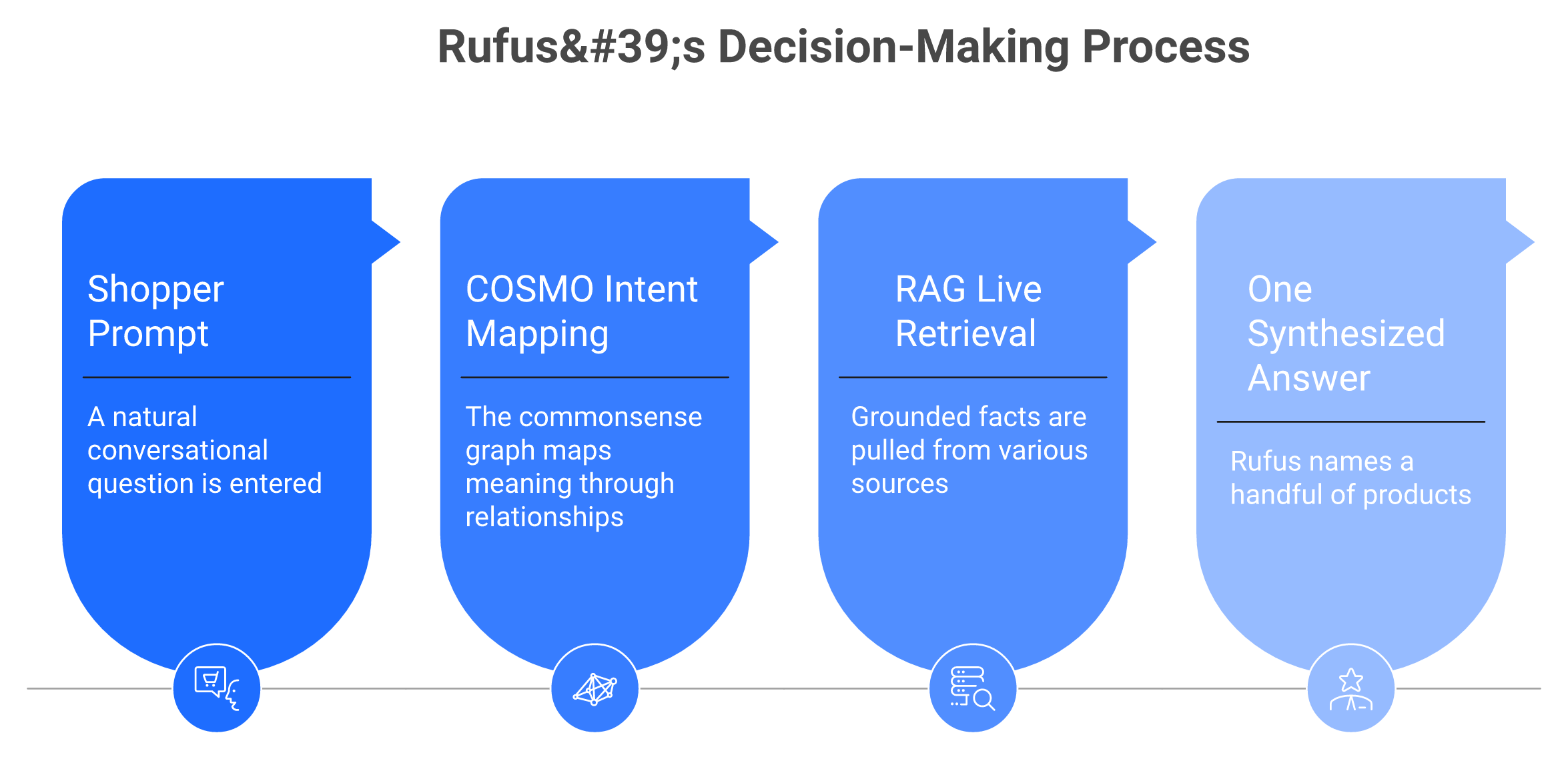
Rufus does not match keywords. It uses COSMO, a commonsense knowledge graph, plus retrieval-augmented generation (RAG), the technique where the AI pulls live facts from your listing before it writes an answer. We unpack that machinery in the next section.
The reframe is simple, and it is the spine of this guide. You are no longer optimizing to rank a blue link. You are optimizing to be the product the AI synthesizes into its recommendation. At MaximusLabs, we call this becoming the answer, and it is the same discipline whether the engine is Rufus, ChatGPT, or Perplexity. The penalty for being average has never been steeper, and the payout for being the named answer has never been higher. Our generative engine optimization service exists to put your brand inside that recommendation set.
Q2: How Does Rufus Actually Decide Which Products to Recommend?
Rufus decides recommendations using COSMO, Amazon's commonsense knowledge graph spanning 18-plus product categories, combined with retrieval-augmented generation. Instead of matching keywords, it interprets intent, mapping "shoes for a beach wedding" to breathable, formal-casual footwear via relationships like used-for-audience. It then retrieves grounded facts from listings, reviews, and Q&A to synthesize one conversational answer, favoring products whose data clearly proves fit.
🧠 COSMO: the commonsense layer
Amazon's COSMO research, published at ACM SIGMOD 2024, describes a knowledge graph built from millions of commonsense assertions. It teaches the model relationships humans take for granted.
Ask for "shoes for a beach wedding," and COSMO connects that to breathable materials, sand-friendly soles, and semi-formal styling. A keyword index cannot make that leap. A commonsense graph can, because it stores the why behind a purchase, not just the words in a title.
🔎 RAG: the retrieval layer
Retrieval-augmented generation means Rufus performs a live lookup, then summarizes what it finds. The Amazon Science team confirms Rufus is built on a custom LLM grounded in Amazon's catalog, reviews, and community Q&A.
This matters more than it sounds. Your listing is not a static page Rufus memorized once. It is a live data source the model reads at answer time, so an update today can change tomorrow's recommendation. This is the same mechanism our technical GEO implementation work is built around.
🖼️ The semantic and visual layer
Rufus also reads structure and images. Amazon's semantic model favors clear noun phrases, and its Visual Label Tagging can read text embedded in your images through OCR (optical character recognition, the tech that turns picture-text into readable data). Text trapped inside an infographic is data, not decoration, which is why multimodal GEO matters here.
❌ Why keyword stuffing dies here
Once the model reasons about meaning, stuffing repeated keywords adds nothing. Rufus is built to interpret intent, so padded copy just dilutes the signal it actually reads.
The most useful mental model we use is the Universal Intent Decoder. Do not picture the LLM as a search box. Picture it as a translator that turns any messy human prompt into a structured request against your product feed. This is why nuance wins: the average Google search runs about six words, while a chat query runs closer to 25. Rufus queries are roughly four times more specific, so the listing that answers the exact intent, fabric, use case, audience, and fit, is the one that gets named. Our AEO keyword and question research maps those intent variants before we ever touch a listing.
Q3: Rufus vs. the A9/A10 Algorithm: Does Conversational AI Replace Amazon SEO?
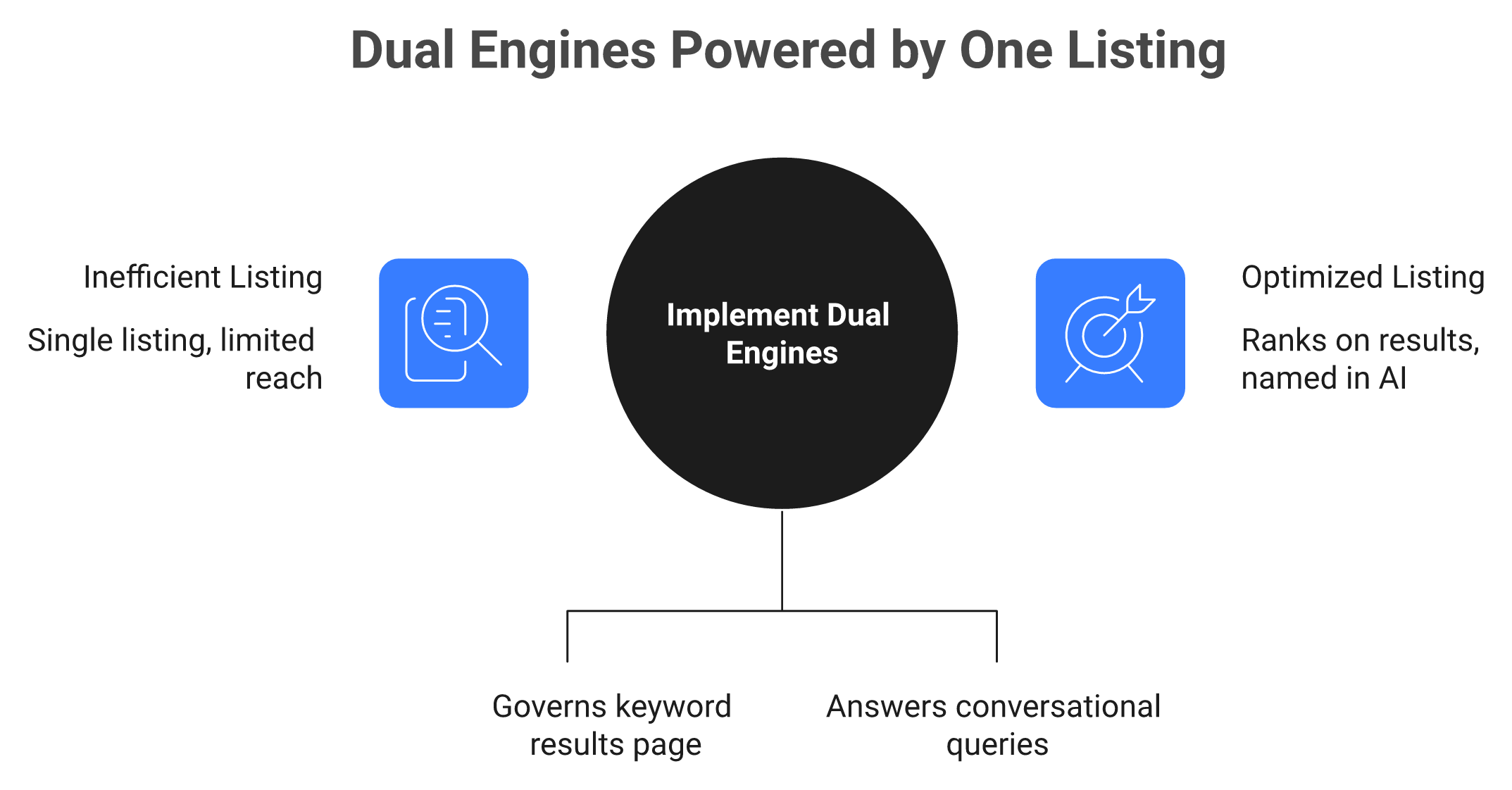
No, Rufus does not replace Amazon's A9/A10 algorithm; they run as a dual flywheel. A9/A10 governs the keyword results page, while Rufus (via COSMO) answers conversational queries and synthesizes recommendations. The same well-structured listing feeds both: keyword rigor and indexed attributes power A9, while intent-rich, quotable, review-backed content powers Rufus. Optimizing one without the other leaves visibility on the table.
⚖️ The two engines, side by side
The standard read treats this as a replacement. That gets it backwards. They are two lanes of the same road.
| Dimension | A9/A10 (keyword results page) | Rufus / Alexa for Shopping |
|---|---|---|
| Primary input | Indexed keywords, sales velocity, relevance | Intent, COSMO relationships, retrieved facts |
| Query length | About 6 words | About 25 words, conversational |
| Output | A ranked list of products | One synthesized recommendation with a few named picks |
| Winning lever | Keyword coverage, conversion rate | Verifiable claims, reviews, Q&A, off-site authority |
📈 Why you feed both
Roughly 13.7% of Amazon searches now touch Rufus, and reverse-engineering of 500-plus product queries suggests that share is trending toward 35%. That is a large slice, but it is not the whole store yet. Millions of buyers still start at the keyword bar.
So the budget stance is not either-or. A well-structured listing, with clear attributes, honest bullets, and seeded Q&A, feeds A9 relevance and Rufus retrieval at the same time. This is the heart of how GEO differs from traditional SEO.
🧩 Fix the money pages first
Here is a contrarian nuance we stand by. Chasing Rufus while your bottom-of-funnel foundation is broken is backwards. Roughly 19 of every 20 landing pages drive little traffic, while a handful drive about 85%. Start with the SKUs that already make money, then layer conversational optimization on top. Our B2B SEO service starts every engagement on those revenue pages.
A quick note on schema, since it comes up constantly. Practitioners genuinely disagree here. Some argue tokenization weakens schema's impact, while structured-data advocates report AI summaries favor marked-up pages. Our read is that schema markup helps machine clarity, but it is not the lever that wins Rufus. Content that proves fit is.
This is exactly where we part ways with agencies selling "Rufus optimization" as a keyword-SEO replacement. At MaximusLabs, we run the dual flywheel as one revenue system, tying A9 rigor and Rufus citation-worthiness back to pipeline, not to impressions that never touch a cart. You can see this approach in our nutrition e-commerce case study.
Q4: What Data Sources Does Rufus Read, and How Do You Make Each One Machine-Readable?
Rufus reads five sources: product listings (title, bullets, description, A+ Content), customer reviews, community Q&A, browsing and purchase history, and external web content surfaced as "Researched by AI." To be indexed accurately, expose a complete structured feed, including GTIN, MPN, brand, material, dimensions, condition, category, price, availability, and performance signals, and pull facet metadata like fabric, closure, and neck style out of JavaScript into readable text.
🗂️ The five sources Rufus pulls from
Every recommendation is assembled from these inputs, so each one is a lever you can pull.
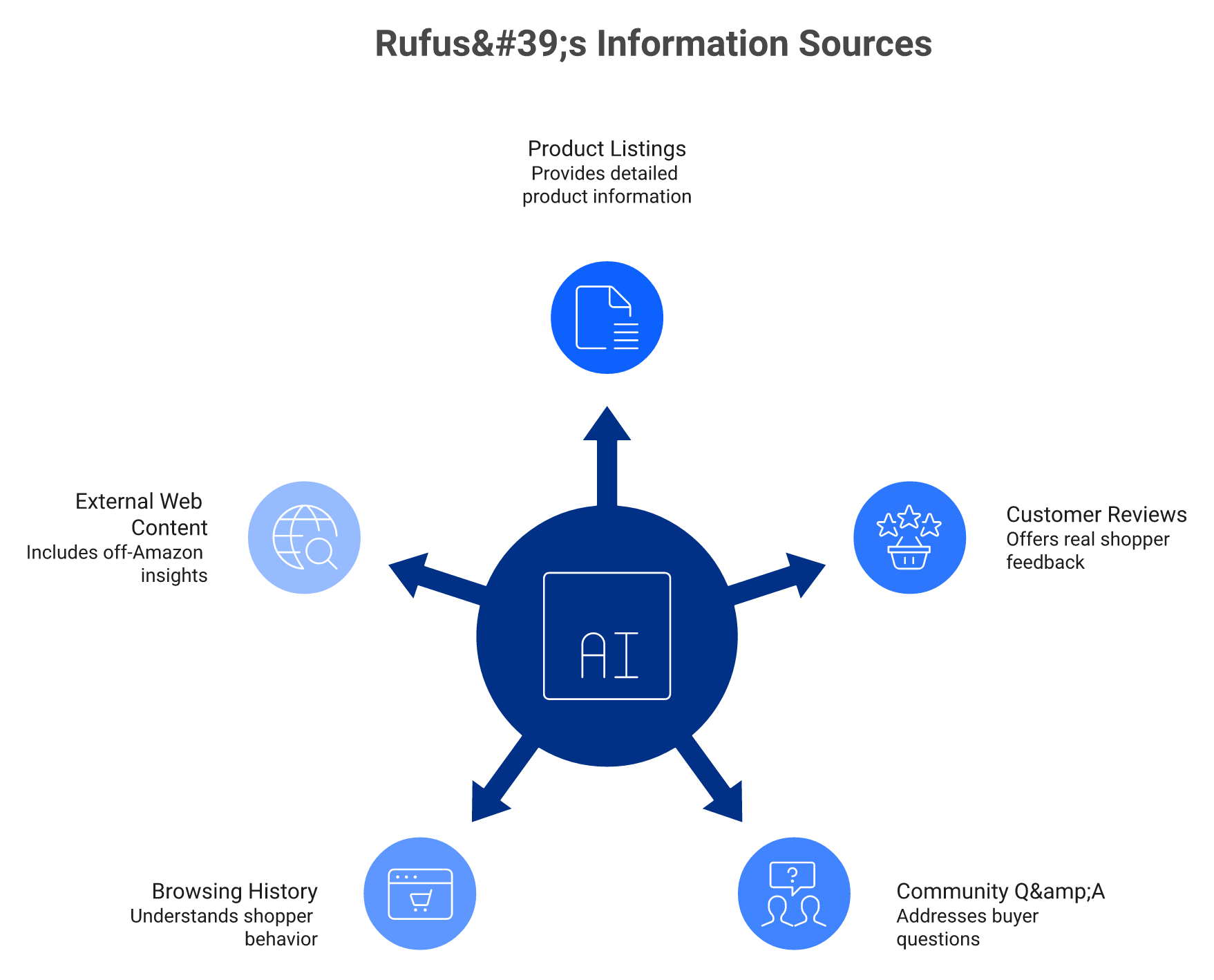
- Product listings: title, bullets, description, and A+ Content.
- Customer reviews, which Rufus treats as ground-truth language.
- Community Q&A on the product page.
- Browsing and purchase history for personalization.
- External web content, surfaced in the "Researched by AI" view.
📋 The structured feed fields that get you indexed
For a product feed to be parsed cleanly by AI systems, the field set is exhaustive and specific. Practitioners working with structured commerce feeds list it plainly:
- ID, GTIN, MPN, Title, Description, and Link.
- Item Information, Condition, Product Category, and Brand.
- Material, Dimension, Length, Width, Height, and Weight.
- Age Group and Additional Media.
- Price, Availability, Fulfillment, Returns, and Performance Signals.
Fill every field you can. A blank attribute is a question Rufus cannot answer on your behalf, so it moves to a competitor who filled it. A technical SEO and website audit is where we usually catch these gaps.
⚠️ The hidden-facet trap
Here is the mistake we see most, and it is quiet enough to miss. Rufus cannot read attributes trapped behind JavaScript facets on a category page.
Expose that facet data in plain text: the closure, the fabric, the material, and the neck style. A large share of Rufus follow-up questions are attribute-driven, like "which of these is machine-washable" or "which has a hidden zip," and the answer has to live in text the model can retrieve, not behind a filter widget. This is core to our GEO/AEO work for e-commerce.
✅ Do this on Monday
Pick your top three revenue SKUs. Audit each field in the list above and fill the gaps. Then move any critical attribute currently living inside an image or a JavaScript filter into the bullets, the description, or a Q&A entry.
One more thing that decides outcomes is data consistency. When your title says one material and your A+ content says another, Rufus sees a conflict and loses confidence. Aligning every source to say the same thing is the silent ranking factor most sellers never audit, and it is a standard step in our answer engine optimization service.
Q5: How Do You Turn Listings, Reviews, and Q&A Into Content Rufus Wants to Cite?
A brand manager once showed me a listing packed with 14 repetitions of "organic protein powder." It ranked fine on the keyword page. Rufus never mentioned it once, because repetition is not proof of fit.
Turn listings into Rufus-citable content by writing verifiable, specific claims instead of keyword-stuffed copy, seeding 15-plus answered Q&As (correlating with roughly 3.2x more recommendations), building A+ Content as a structured knowledge base, and shaping reviews, since Rufus treats customer language as ground truth. Convert your best SEO keywords into natural questions, then answer them in the shopper's own words to match Rufus's roughly 25-token conversational queries.
🔑 The four levers that move Rufus
Each lever maps to a data source Rufus actually reads.
- Bullets as verifiable claims: swap vague adjectives for specifics ("28g protein, third-party tested," not "premium quality").
- Q&A seeding: answer real buyer questions on the listing, in plain language.
- A+ Content as a knowledge base: structure it to answer follow-ups, not to decorate.
- Reviews as ground truth: Rufus trusts customer wording, so nurture honest, detailed reviews.
❓ Turn keywords into questions
The tactic practitioners keep repeating is the simplest one: take your SEO keywords and turn them into questions.
A Google search averages six words, but a chat query runs closer to 25. So "protein powder for women" becomes "what protein powder is best for women avoiding bloating." Answer that exact phrasing in a bullet or Q&A, and you match the way Rufus queries are shaped. Our AEO keyword and question research builds that question map first.
📊 Why Q&A volume compounds
Reverse-engineering of 500-plus product queries found listings with 15-plus answered Q&As appear in Rufus recommendations roughly 3.2 times more often than listings with fewer than five. Reviews reinforce this, because customer language is the ground truth Rufus retrieves.
Here is the revenue proof we keep close. When we rebuilt a nutrition brand's content around its top 20 bottom-of-funnel keywords and made that inventory crawlable for AI agents, ecommerce sales roughly doubled over six months. We did not chase impressions. We chased the queries that sit closest to the cart, which is the core of our generative engine optimization service and this nutrition e-commerce case study.
⚠️ The Red Ocean trap
Over-optimized copy that loses human sense is disqualifying. Rufus prizes an expert human tone.
One practitioner recalls a luxury hotel description bragging about "a bathtub with water that came out of a faucet." That is what happens when you write for a machine and forget the human reading. Rufus, trained to sound like an expert human, skips copy that reads like keyword sludge. Our GEO content optimization keeps the human voice intact.
✅ Your Monday checklist
- Rewrite three bullets per hero SKU as verifiable, numbered claims.
- Seed at least 15 real Q&As in buyer language.
- Score each listing on Semantic Confidence: structured data present, images carrying readable text, and copy aligned to real intent.
At MaximusLabs, this is the core of our revenue-focused, bottom-of-funnel-first methodology. We do not spread budget across vanity content; we concentrate it on the money queries and prove the lift in sales, the way that nutrition brand saw its revenue double. This is why our GEO/AEO work for e-commerce starts with the pages that already convert.
Q6: Why Do Off-Amazon Mentions (Reddit, YouTube, Reviews) Decide Your Rufus Visibility?
Most sellers treat their Amazon listing as the whole game. Polish the bullets, tidy the images, and wait for Rufus to notice. That instinct is understandable, and it is incomplete.
Because Rufus uses retrieval-augmented generation, it summarizes high-authority external web content, Reddit threads, YouTube reviews, and Tier-1 affiliates like Wirecutter or Dotdash, not just your listing. Earning credible off-Amazon mentions often moves Rufus recommendations more than on-listing tweaks. The tactic is to identify the most-cited URLs for the topics you want to win, then find ways to have your product featured or referenced within them.
⚠️ The complication: your listing is only one input
RAG means the model pulls facts from across the web at answer time. So a Reddit thread can decide a recommendation more than your own page.
One practitioner watched this repeatedly in AI answers. In one case, a Reddit comment was the sole reason a specific bicycle got recommended, and Reddit appeared as a citation five times for a single question. The lesson holds for Amazon: the AI trusts the crowd, and the crowd lives off your listing. Our Reddit and forum AEO work targets exactly these surfaces.
🎯 The resolution: target the cited URLs
The move is precise, not scattershot. Find the pages Rufus keeps citing, then earn a genuine mention there.
The approach is to identify the most-cited URLs for the AEO topics you care about, then find a way to have those citations promote your product. For Reddit specifically, the honest approach wins: use a real account, say who you are and where you work, then add a genuinely useful answer. Community-authentic beats promotional every time, and our Reddit threads finder surfaces the threads worth joining.
💰 The payoff: brand as the durable moat
Here is the quiet conviction the category avoids. This is not about hacking an algorithm.
If you build a real brand in your space, the AI has to recommend you, because the citations point back to you again and again. That authority is also your protection against model collapse, the failure loop where AI trains on its own derivative output and converges on bland, repeated answers. Brands with earned, human trust signals survive that; thin brands get averaged away.
This is exactly what we mean by Search Everywhere Optimization at MaximusLabs. We build trust signals across the communities, review sites, and creators that AI engines actually cite, rather than optimizing a single listing in isolation and hoping the rest of the web agrees. It is the through-line of our answer engine optimization service and our trust-first content playbook.
Q7: Which Rufus Optimization Tactics Are Real Revenue Drivers vs. Expensive Busywork?
A founder told me his agency spent a quarter fixing "technical AI errors" and running crawl audits. Traffic reports looked busy. Sales did not move a dollar.
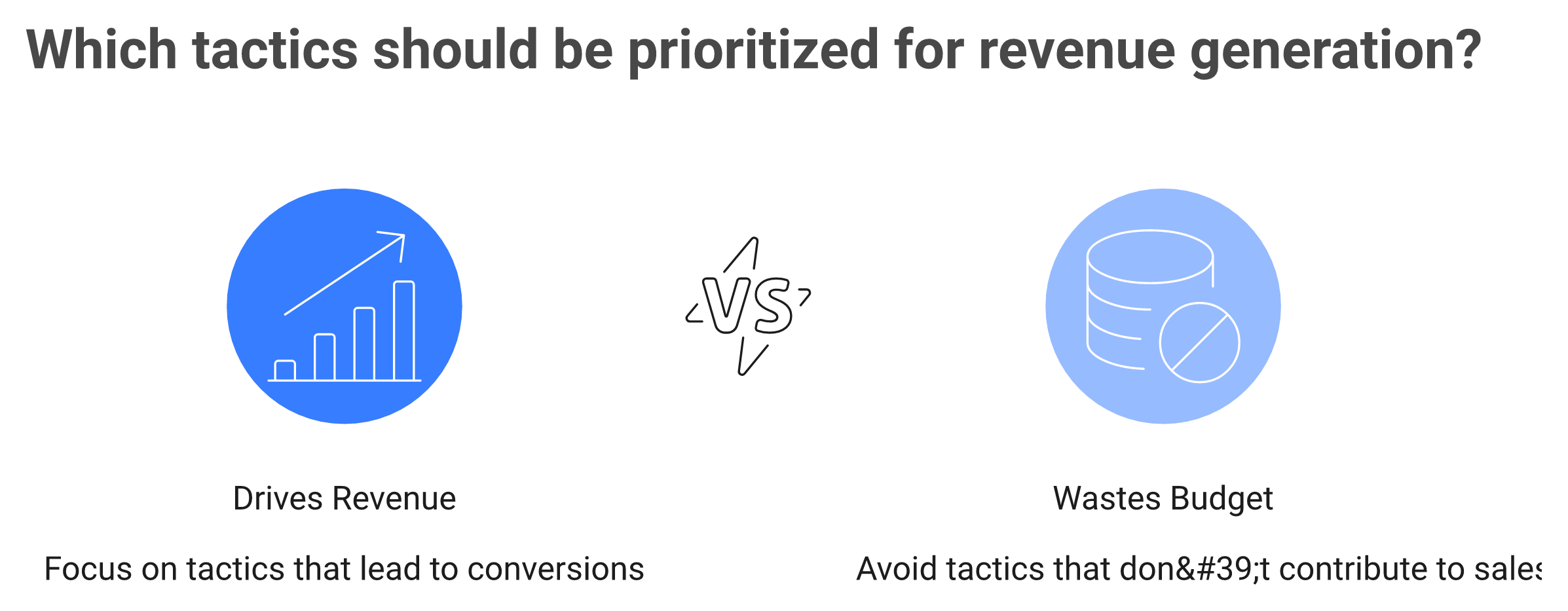
Real Rufus revenue drivers are complete structured feeds, verifiable claims, seeded Q&A, review quality, and off-Amazon authority, all tied to bottom-of-funnel intent. Expensive busywork includes chasing miscellaneous "technical errors," crawl-analysis theater, llms.txt files, and markdown-only pages, none of which show reliable ranking impact. Skip keyword-density manipulation, which AI is built to ignore. Prioritize tactics you can trace to conversions, not vanity metrics.
⚠️ The seduction of technical security blankets
Technical work feels productive. It is measurable, it generates reports, and it looks like progress.
One respected practitioner is blunt about it: technical AEO will likely create significant work with little to no impact, and people are already focusing on things like crawl analysis and miscellaneous technical errors. The reports pile up. The pipeline stays flat. This is where our technical GEO implementation stays disciplined about impact.
❌ What the evidence says to skip
Some popular tactics have no evidence behind them at all.
- llms.txt and markdown-only pages, which practitioners report show no evidence of any effect.
- Keyword-density tuning, which AI is designed to ignore.
- Miscellaneous crawl-error hunts, absent a real indexing problem.
📊 Revenue drivers vs busywork
| ✅ Real drivers (do these) | ❌ Busywork (deprioritize) |
|---|---|
| Complete structured product feed | llms.txt files |
| Verifiable claims and 15+ Q&A | Markdown-only pages |
| Review quality and volume | Keyword-density tuning |
| Off-Amazon authority and citations | Generic crawl-error audits |
💰 The resolution: measure against the cart
The filter is simple. If a tactic cannot be traced to a conversion, treat it as a vanity exercise until proven otherwise.
Run controlled tests instead of trusting best-practice blogs, since most published best practices are not correct. Apply one change to a test set of SKUs, hold a control set, and watch which one moves sales. Our GEO ROI and revenue attribution framework is built for exactly this.
This filter is why our trust-first, revenue-focused methodology at MaximusLabs exists. We steer budget away from technical theater and toward the moves that influence pipeline, because a founder's money is finite and usually already sitting in inventory or ad spend. If you want that budget audited honestly, our team can walk through it with you.
Q8: How Do You Measure Whether Your Rufus Optimization Is Actually Working?
Measure Rufus optimization by running 20 to 30 real category prompts inside Rufus / Alexa for Shopping each month and tracking your Share of Voice, meaning how often your product is named versus competitors. Pair this with conversion data: Rufus-influenced sessions convert far higher than standard search, so watch bottom-of-funnel conversion lift, not impressions. Since no official Rufus volume "truth set" exists yet, use Google question data to estimate demand and validate through repeated prompt audits.
🔎 The protocol: prompt, then count
There is no single rank in AI answers. So the right metric is Share of Voice, meaning how often you appear across many query variants.
Each month, run 20 to 30 real category prompts inside Rufus and log every time it names you versus a competitor. Repeat the same prompts, because answers vary between runs, and one lucky mention is not a trend. Our AI search visibility and brand mention tracking automates this logging.
🧭 Working around the missing truth set
Here is an honest limit. There is no keyword-volume "truth set" for Rufus the way Google Ads gives one for search.
So we triangulate. Take high-volume Google keywords, turn them into questions, and use those as your prompt list. It is a proxy, not gospel, and we hold it loosely until the audits confirm real demand. Our AEO measurement metrics guide details the method.
💰 Why conversion is the KPI that matters
Track sales lift, not impressions. AI traffic converts at a very different rate.
One reported benchmark showed a 6x conversion-rate difference between LLM traffic and Google search traffic. The exact multiple will vary by category, but the direction is clear: an AI-influenced buyer is closer to the cart, so a small visibility gain can move real revenue.
⏰ The monthly loop
Keep it boring and repeatable: audit, optimize, and repeat.
- Audit: run the prompt set, and record Share of Voice.
- Optimize: fix the listings losing on specific queries.
- Repeat: re-run next month and compare, tying gains to conversion, not clicks.
This is the measurement discipline we bring at MaximusLabs. We tie AI-search Share of Voice back to pipeline, because that is the number a VP Marketing or Head of Organic Growth is actually accountable for, not a pageview chart. You can see how we frame those metrics in our GEO measurement and metrics resource.
Q9: What's Coming Next: Agentic Checkout, Alexa for Shopping, and the Ghost Kitchen Era?
A practitioner tried to buy snowboard pants through Gemini last winter. He asked the AI to run the whole checkout, end to end. It looped, stalled, and quietly gave up.
Next comes agentic commerce, AI assistants that complete checkout for the shopper. Amazon's "Help Me Decide," auto-buy at a target price, and the May 2026 Alexa for Shopping merger point toward a "Ghost Kitchen" model, where the shopper never visits your storefront and the AI transacts through your product feed. Universal commerce protocols are still maturing, so the winning move is making your inventory machine-readable and protocol-ready now.
⚙️ The situation: the assistant becomes the buyer
Amazon is already shipping the pieces. "Help Me Decide" narrows choices for shoppers, and auto-buy triggers a purchase when a price hits a set target.
The May 2026 merger into Alexa for Shopping pushed all of this into the main search experience. The buyer no longer clicks through ten listings. The assistant decides, and increasingly, it acts. This is the shift our agentic commerce service is built for.
⚠️ The complication: the plumbing still breaks
Here is the honest part. Agentic checkout is real in demos and shaky in practice.
The snowboard-pants loop is not a one-off. Universal commerce protocols, the shared standards that let an AI transact across stores, are still, in the practitioner's word, "cooking." So the near-term risk is not being replaced by agents. It is being invisible to them when the plumbing finally works, which is why our breakdown of the agentic web stack matters now.
🏠 The Ghost Kitchen frame
The clearest way to picture this is a ghost kitchen. Your website is the dining room. Agentic commerce is the kitchen and the delivery layer, like Uber Eats, where the customer never walks into your building.
If the AI transacts through your feed, your product data is the storefront now. A missing attribute or a stale price is not a small gap. It is a locked door the agent cannot open, and a technical website audit is how we find those locked doors.
💰 The resolution: be protocol-ready now
Make your inventory crawlable and structured today, before agentic checkout goes mainstream. The debate on timing is genuine, and worth stating fairly.
- One camp calls first-mover advantage a "false concept," since rank can be earned later if your authority is real.
- The other camp argues the opposite, that brands which integrate with protocols early earn entrenched data patterns.
My read sits between them. You may not need to be first, but you cannot afford to be unreadable. At MaximusLabs, we prepare brands to be machine-readable and protocol-ready across every AI engine now, so they are already in the recommendation set when the checkout layer stops looping and starts converting. Our state of agentic commerce 2026 report and our AI crawlability checker are where founders usually start.
Q10: How Does Optimizing for Rufus Fit Your Cross-Platform GEO Strategy (ChatGPT, Perplexity, Gemini, Google AI Overviews)?
A founder once asked us, mid-audit, why he ranked well on Amazon yet never showed up when a buyer asked ChatGPT the same question. He had optimized one engine and assumed the rest would follow. They did not.
Rufus optimization is one node in a cross-platform GEO strategy. The same structured data, verifiable claims, and off-site authority that win Rufus recommendations also feed ChatGPT, Perplexity, Gemini, and Google AI Overviews, but each engine weights sources differently, so the same product can appear in one and vanish in another. Winning means making your data machine-readable everywhere and earning citations across the whole answer ecosystem, not optimizing Amazon in isolation.
🧭 The situation: Rufus is not an island
Most sellers scope Rufus as a standalone project. Fix the listing, win Amazon, done.
That framing quietly caps your upside. Buyers now ask ChatGPT for product picks, check Perplexity for comparisons, and see Google AI Overviews before they ever reach a store. Rufus is one surface among several, which is why our generative engine optimization service spans every engine.
⚠️ The complication: engines disagree
The same listing behaves differently across engines, because each one trusts different sources. Citation overlap is looser than people assume.
One analysis put the source overlap between ChatGPT and Google at roughly 35%, while Perplexity ran closer to 70%. So a product that ChatGPT loves can be absent from Gemini. Optimizing for one engine's quirks is a fragile bet, and our research on citation patterns maps exactly where they diverge.
✅ The resolution: one data-and-authority layer
The durable move is not chasing each engine's tricks. It is building one foundation every engine can read.
- Structured, complete product data that any model can parse.
- Verifiable, specific claims instead of keyword padding.
- Off-site authority on the communities and creators that engines cite.
The principle is simple: visibility is earned through the data, not through the ads. Build the data and the brand once, and you show up across surfaces instead of buying your way onto one. Our answer engine optimization service builds that shared layer.
💰 Why this beats single-platform tactics
Here is the contrast that matters for budget. Traditional agencies still optimize the website for Google alone, treating the rest of the web as someone else's problem.
That leaves brands exposed as search shifts toward AI-native platforms. Amazon-only tacticians have the same blind spot, one engine deep. At MaximusLabs, our Search Everywhere Optimization builds a single trust-first, machine-readable layer that earns citations across Rufus, ChatGPT, Perplexity, Gemini, and Google, so you become the answer wherever your buyer happens to ask. You can see how this compares in our GEO versus traditional SEO breakdown.
⭐ What we are sitting with next
Here is the question on our whiteboard right now. We think "becoming the answer" stops being an edge within two years and becomes table stakes.
When that happens, the brands that built trust-first, machine-readable data early will own the citations, and everyone else will be bidding to rent them back. If you are weighing where to put scarce budget this quarter, that is the conversation we would love to have with you. Which engine is quietly leaving you out of the answer today? If you want a straight answer, our team can run that audit with you.
Frequently asked questions
What is Amazon Rufus and why does it matter for sellers in 2026?
Amazon Rufus, now folded into Alexa for Shopping as of May 2026, is Amazon's generative AI shopping assistant. It recommends specific products conversationally using the COSMO knowledge graph and retrieval-augmented generation, reading listings, reviews, Q&A, and external web content. Why it matters: Over 250 million shoppers used Rufus in 2025. Rufus-engaged buyers were 60% more likely to purchase. On a mobile screen, the AI names only a handful of products, so the rest are effectively invisible. The shift is from ranking a blue link to becoming the answer the AI synthesizes. We think brands that build trust-first, machine-readable data early will own those citations. That is the discipline behind our generative engine optimization service , applied consistently across Rufus, ChatGPT, and Perplexity. Ranking number two on the old keyword page means little if Rufus never says your name.
How does Amazon Rufus decide which products to recommend?
Rufus decides using COSMO , Amazon's commonsense knowledge graph spanning 18-plus categories, combined with retrieval-augmented generation. Instead of matching keywords, it interprets intent. In practice, it works like this: COSMO maps a query like "shoes for a beach wedding" to breathable, semi-formal footwear through relationships like used-for-audience. RAG performs a live lookup, pulling grounded facts from listings, reviews, and Q&A before writing one answer. A semantic and visual layer reads clear noun phrases and even text inside images via OCR. Because Rufus reasons about meaning, keyword stuffing adds nothing. The useful mental model is a Universal Intent Decoder that turns a messy prompt into a structured request against your feed. Chat queries average roughly 25 words versus about six on Google, so descriptions must satisfy far more nuanced intent. We map those intent variants first in our AEO keyword and question research , so listings answer the exact way buyers ask.
Does optimizing for Rufus replace traditional Amazon A9 A10 SEO?
No. Rufus does not replace Amazon's A9/A10 algorithm; they run as a dual flywheel . A9/A10 governs the keyword results page using indexed keywords, relevance, and sales velocity. Rufus answers conversational queries via COSMO and synthesizes recommendations. The same well-structured listing feeds both engines. Roughly 13.7% of Amazon searches now touch Rufus, trending toward 35%, but millions still start at the keyword bar. So the budget stance is not either-or. A contrarian nuance we stand by: chasing Rufus while your bottom-of-funnel foundation is broken is backwards, since a handful of pages drive most revenue. We part ways with agencies selling Rufus as a keyword-SEO replacement. We run the dual flywheel as one revenue system, detailed in our breakdown of how GEO differs from traditional SEO . Optimizing one engine without the other simply leaves visibility on the table.
What data sources does Amazon Rufus read, and how do I make them machine-readable?
Rufus reads five sources, so each is a lever you can pull. Product listings: title, bullets, description, and A+ Content. Customer reviews, treated as ground-truth language. Community Q&A. Browsing and purchase history. External web content, surfaced as "Researched by AI." To be indexed accurately, expose a complete structured feed: GTIN, MPN, brand, material, dimensions, condition, category, price, availability, and performance signals. A blank field is a question Rufus cannot answer for you, so it moves to a competitor who filled it. The quiet mistake is trapping attributes behind JavaScript facets. Pull closure, fabric, material, and neck style into plain text, because many Rufus follow-ups are attribute-driven. Data consistency across sources is the silent ranking factor, and it is a standard step in our answer engine optimization service . When your title and A+ content conflict, Rufus loses confidence and picks someone else.
Why do off-Amazon mentions like Reddit and YouTube affect Rufus visibility?
Because Rufus uses retrieval-augmented generation, it summarizes high-authority external content, not just your listing. Reddit threads, YouTube reviews, and Tier-1 affiliates like Wirecutter can decide a recommendation. In one documented case, a single Reddit comment was the sole reason a product was recommended. Earning credible off-Amazon mentions often moves Rufus more than on-listing tweaks. The tactic is precise: identify the most-cited URLs for topics you want to win, then earn a genuine mention within them. For Reddit, the honest approach wins, so use a real account, disclose who you are, and add real value. This is not about hacking an algorithm. If you build a real brand, the AI has to recommend you, and that authority also protects against model collapse. This is exactly what our Reddit and forum AEO work is built around, building trust signals across the surfaces AI engines actually cite.
Which Rufus optimization tactics actually drive revenue versus wasting budget?
Real drivers all tie back to bottom-of-funnel intent. Busywork feels productive but rarely moves sales. Do these: Complete structured feeds and verifiable claims. Seeded Q&A and strong review quality. Off-Amazon authority and citations. Deprioritize these: llms.txt files and markdown-only pages, which show no reliable ranking impact. Keyword-density tuning, which AI is built to ignore. Generic crawl-error audits absent a real indexing problem. The filter is simple: if a tactic cannot be traced to a conversion, treat it as a vanity exercise. Run controlled tests instead of trusting best-practice blogs, since many published best practices are not correct. Our trust-first, revenue-focused methodology steers budget toward pipeline-influencing moves, and we quantify it using our GEO ROI and revenue attribution framework . A founder's money is finite, usually already sitting in inventory or ad spend.
How do I measure whether my Amazon Rufus optimization is actually working?
Measure with a repeatable prompt-audit protocol, not impressions. Run 20 to 30 real category prompts inside Rufus each month. Track your Share of Voice, meaning how often Rufus names you versus competitors. Repeat the same prompts, since answers vary between runs. Because there is no official Rufus volume "truth set" yet, triangulate using Google question data as a demand proxy, then validate through repeated audits. Pair visibility with conversion, since AI-influenced sessions can convert far higher than standard search; one benchmark reported a 6x difference between LLM traffic and Google search traffic. Keep the loop boring and repeatable: audit, optimize, and repeat, tying gains to conversion rather than clicks. We tie AI-search Share of Voice back to pipeline using our AI search visibility and brand mention tracking , because that is the number a VP Marketing or Head of Organic Growth is actually accountable for.