 Krishna Kaanth M
- Buyers now ask AI engines for one synthesized answer, so if your brand is not in the citation set you have zero traction, even ranking on Google Page 1.
- Citation optimization (GEO/AEO) is a data-science problem, not SEO rebranded; it targets passage-level retrieval, factual density, and third-party trust, though top-10 ranking still helps.
- AI engines cite at the passage level via retrieval-augmented generation, favoring fact-dense, entity-rich, fresh content; JavaScript-hidden data often never gets retrieved.
- Each engine draws from different sources: ChatGPT leans on Wikipedia, Perplexity on Reddit and freshness, Google AI Overviews on E-E-A-T and ranking, Claude on cross-verified depth.
- Most citations come from third-party surfaces like Reddit, YouTube, and G2, so Search Everywhere Optimization and durable brand authority beat one-off hacks.
- LLM-referred visitors convert far better than organic (about 4.4x to 6x), and citations churn 40 to 60% monthly, so measurement and a refresh cadence are essential.
Q1: Why Is Getting Cited by AI Now More Important Than Ranking on Google?
Picture John, a Head of Sales at a mid-market SaaS company. He needs a tool this week. He does not open Google and scroll ten blue links. He opens ChatGPT and types, "Give me a detailed list of top-rated tools with pros, cons, and pricing."
🎯 The Answer, Up Front
Buyers now ask ChatGPT or Perplexity instead of scrolling Google, and the AI returns one synthesized answer with a short citation set. If your brand is not in that set, you have zero traction, even ranking on Page 1. Gartner predicts traditional search volume will fall 25% by 2026, while AI referrals surge. Citation optimization is how you become the answer, not just another blue link nobody clicks.
Within seconds, John gets a curated shortlist. That list becomes his evaluation set. The vendors named in it advance. Everyone else is invisible, no matter how well they rank.
⚠️ Why Ranking Alone Now Means Nothing
This is the part the old playbook gets backwards. Ranking on Page 1 used to be the finish line. Now it can be a consolation prize the buyer never sees.
The stakes here are binary, and one practitioner framed it bluntly:
"If you're not in the actual citations in the answer that was given, you might as well not have played the game because there is no difference; you're actually literally zero in terms of traction."
That "zero" is the whole problem. A ranked link the AI does not cite drives no pipeline. The buyer's journey compresses into a single answer box, and you are either in it or you are not. This is exactly why we push clients toward answer engine optimization instead of link-count SEO.
📊 The Shift the Data Supports (With a Caveat)
Gartner projects a 25% drop in traditional search volume by 2026 as buyers move to AI assistants. We treat that as a directional signal, not gospel, because some practitioners now question whether the drop landed on schedule. The honest read is that adoption is real and climbing, even if the exact number is contested.
Meanwhile, AI referral traffic is compounding fast, and it converts. Semrush clickstream data shows LLM-referred visitors convert far better than standard organic traffic. That is the pattern worth planning around, and it reshapes how we think about the zero-click search brand economy.
💰 What "Becoming the Answer" Unlocks
The payoff is revenue, not vanity metrics. A citation inside the answer reaches a buyer at the exact moment of decision, with intent already built through the conversation. As one operator put it, "the penalty for being average has never been so severe but the payout for being extraordinary has never been higher."
At MaximusLabs, we optimize to make your brand the answer AI cites, not just a link it ignores. That means engineering content around how buyers actually ask AI engines, then measuring citation share tied to pipeline, not impressions a founder cannot bank. Our GEO service is built for exactly that revenue-first outcome.
Q2: How Is Citation Optimization (GEO/AEO) Different From Traditional Google-Only SEO?
An 18-year SEO veteran we follow closely, Ethan Smith of Graphite, calls the rise of answer engines the second-biggest shift in search history, after Google's war on spam. That framing matters, because most teams are treating it like a minor update.
🧭 The Short Answer
Traditional SEO optimizes for ranked links on a results page. Citation optimization (GEO/AEO) optimizes to be retrieved and synthesized into the AI's answer itself. GEO targets passage-level extraction, factual density, and third-party trust rather than keyword density and backlinks alone. It is closer to a data-science problem than to classic SEO: you must understand how each model retrieves and grounds answers, then engineer content to survive that retrieval step.
GEO stands for Generative Engine Optimization. AEO stands for Answer Engine Optimization. Both describe the same goal, showing up inside AI-generated answers. If you want the primer, our what is GEO explainer breaks it down.
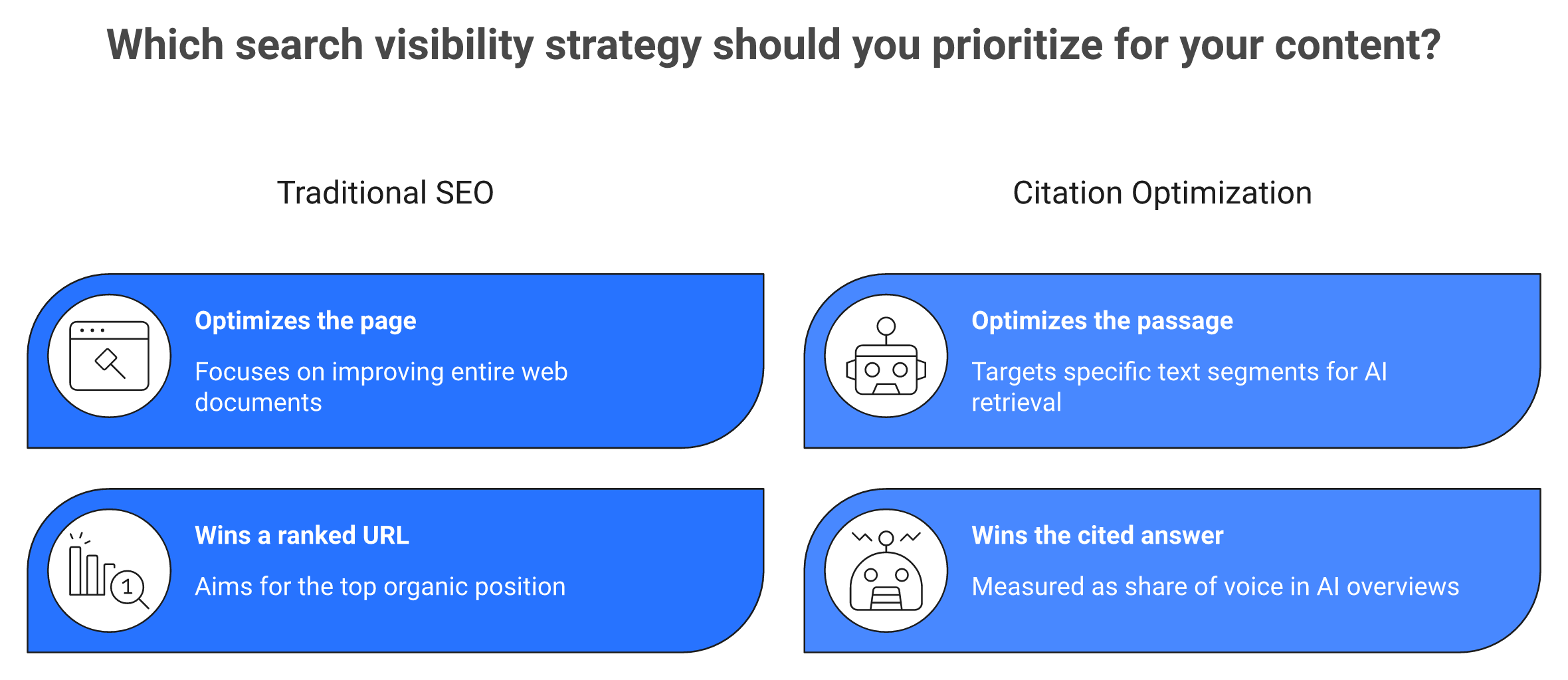
📋 SEO Versus GEO/AEO, Side by Side
| Dimension | Traditional Google-Only SEO | Citation Optimization (GEO/AEO) |
|---|---|---|
| Goal | Rank a URL in the top results | Get cited inside the AI's answer |
| Unit optimized | The page | The passage |
| Primary signals | Keywords, backlinks, on-page | Retrievability, entities, third-party trust |
| Success metric | Ranking position | Citation share of voice |
| Winning | One URL at position 1 | Mentioned most across many sources |
In traditional SEO, one URL at position 1 wins. In AEO, the answer is a summary of many citations, so winning means being mentioned most often across all of them. Our GEO vs traditional SEO breakdown goes deeper on this contrast.
🔬 Why We Treat GEO as Data Science, Not "SEO Plus"
Here is where our thinking diverges from the crowd. The standard read calls GEO "just SEO with a new coat of paint." We think that gets it backwards.
"GEO is not SEO. It's a data science problem. We need to exactly know how these LLM algorithms work to be present in the answers."
The controllable layer is RAG, Retrieval-Augmented Generation, the live search-and-summarize step the model runs before answering. Influencing RAG requires understanding retrieval behavior per platform, not just stuffing keywords. That is a different discipline, and it sits at the core of our generative engine optimization practice.
✅ What Still Carries Over From SEO
We could be wrong to sound too radical here, so let us be precise. Ranking still matters. Roughly 70% of Google AI Overview sources come directly from the top 10 organic results. Strong SEO is now the prerequisite, not the strategy.
This data-science lens is the core of MaximusLabs' methodology. We keep the SEO fundamentals that still drive retrieval, then layer the GEO work that decides whether the model actually cites you. That is also why we still invest in technical SEO and website audit work as the foundation.
Q3: How Do AI Engines Actually Decide What to Cite?
During one audit, Ethan Smith's team watched a roughly 30-billion-dollar company hide its most citable data by accident. He turned JavaScript off in the browser, and half the page vanished, including reviews loaded asynchronously that OpenAI's crawler would never see.
🔍 The Answer, Stated Plainly
AI engines cite at the passage level, not the page level. During Retrieval-Augmented Generation, the model pulls candidate passages, grounds its answer in the most retrievable and trustworthy ones, then synthesizes. Selection favors high factual density, clear entity coverage, freshness, and third-party validation. About 70% of Google AI Overview sources still come from the top 10 organic results, so ranking is a prerequisite, but content hidden in JavaScript often never gets retrieved at all.
🧩 Retrievability, Grounding, and Entity Coverage
Three things decide whether your passage makes the cut.
- Retrievability: the model must be able to fetch and parse the passage as plain HTML text.
- Grounding: the model anchors its claim in the passage it trusts most, so factual density wins.
- Entity coverage: clear, specific entities (product names, features, attributes) help the model match your content to the query.
Academic work supports this. The Princeton and IIT Delhi GEO paper found that adding statistics, quotations, and cited sources lifted content visibility in generative engines by up to 40%. Facts, not fluff, get cited, which is the backbone of good GEO content optimization guide practice.
🚫 The JavaScript Trap That Kills Citations
This is the trap we see most often on client sites, and it is quietly expensive. If key content renders only through JavaScript, the crawler often misses it. Reviews, specs, and facet data are the usual casualties.
The fix is unglamorous but reliable:
- Serve important content as plain HTML, not JavaScript-injected text.
- Pull product attributes (material, size, integrations) out of filters and into visible text.
- Add strong internal cross-linking so bots can discover the page at all.
At MaximusLabs, the JavaScript-off toggle is one of the first checks we run on a client site, because a page the crawler cannot read is a citation you will never earn. You can run a quick version yourself with our AI crawlability checker.
🧠 A Mental Model: The Universal Intent Decoder
Here is how we think about it internally. Do not picture the LLM as a search engine. Picture it as a translator that turns a messy 25-word prompt into a single, structured retrieval request, then grounds its answer in what it finds. Optimize for that translation step, and you optimize for the citation.
Q4: Do You Need a Different Strategy for ChatGPT, Perplexity, Gemini, and Claude?
A founder asked us mid-audit why they ranked well on Google yet never showed up in ChatGPT. The answer sat in the citation data: the engines were pulling from entirely different source pools, and this brand had optimized for only one of them.
⚖️ The Answer, Up Front
Yes. Each engine draws from different source pools, so one strategy will not win all of them. ChatGPT leans on Wikipedia (about 48% of citations) and depth. Perplexity leans on Reddit (about 46%) and freshness, rewarding 30-day updates with roughly 3.2x more citations. Google AI Overviews require E-E-A-T (about 96% filtered) and top-10 ranking. Claude cross-verifies sources and rewards acknowledged trade-offs. Only about 11% of sites are cited by both ChatGPT and Perplexity.
The overlap gap is the headline. One study found only about 35% citation overlap between ChatGPT and Google, while Perplexity had roughly 70% overlap with Google. Different engines, different winners.
📊 The Cross-Platform Citation Matrix
| Engine | Top source it favors | Key bias | Primary tactic |
|---|---|---|---|
| ChatGPT | Wikipedia, Reddit, YouTube | Depth, authoritative UGC | Comprehensive pages plus authentic Reddit and YouTube presence |
| Perplexity | Reddit, YouTube | Freshness, source transparency | Recent, dated content plus community citations |
| Google AI Overviews | Top 10 organic results | E-E-A-T, ranking prerequisite | Strong SEO plus structured, comprehensive content |
| Claude | Authoritative, cross-verified sources | Methodology, balanced trade-offs | Long-form depth with transparent reasoning |
ChatGPT runs its live search on Bing's index, so being indexed in Bing is a practical must. Perplexity and ChatGPT both lean heavily on Reddit and YouTube, which makes community citations non-optional. Our platform-specific Perplexity SEO guide and ChatGPT SEO guide map each one in detail.
🎯 Where to Spend Scarce GTM Effort
For a busy team, the takeaway is simple. Do not chase all four engines evenly. Pick the two engines where your buyers actually ask questions, then win the sources those engines trust.
- Selling to developers or prosumers? Prioritize Reddit and YouTube for Perplexity and ChatGPT.
- Selling into considered B2B purchases? Anchor on E-E-A-T and top-10 rankings for Google AI Overviews.
This is exactly the map MaximusLabs builds first in a answer engine optimization program, because winning citations means optimizing the third-party surfaces each engine trusts, not just your own domain.
💬 What Practitioners Say
One practitioner observation captures why the matrix above weights community sources so heavily:
"On citations for a question, it's read it five times, referring to Reddit."
Ethan Smith, CEO of Graphite r/SEO Reddit Thread
Q5: What Content Structure and Writing Actually Earns Citations?
Open any losing GEO strategy and you find the same thing: a 3,000-word essay that buries its best answer in paragraph nine. The model never gets there. It grabs the first clean passage that answers the query, and moves on.
⭐ The Answer, Up Front
Citation-worthy content leads with a standalone 40 to 80 word direct answer, then supports it with one specific data point every 150 to 200 words. Comparison and list formats win most, and roughly 44% of citations come from the first 30% of a page. Content must be more nuanced than a search query: the average Google search is six words, but the average chat prompt is about 25, so answers must be four times richer. Information gain and human expertise, not word count, drive citations.
Lead with the answer, then earn the read. That single structural move does more for citations than most technical audits combine to deliver, and it anchors our GEO content optimization guide.
📊 Fact Density and Information Gain
Facts are what get grounded and quoted. The Princeton and IIT Delhi GEO study found that adding statistics, quotations, and cited sources lifted visibility in generative engines by up to 40%.
So aim for one concrete data point roughly every 150 to 200 words. Then add "information gain," something the top ten pages do not already say. Derivative summaries feed what one practitioner called an "infinite loop, and then you have garbage," a model-collapse risk the platforms are actively fighting. Our approach to GEO content optimization is built to avoid exactly that trap.
🧩 Write for the 25-Word Prompt, Not the 6-Word Query
Here is a gap most teams miss. Chat prompts are far richer than search queries.
"The average number of words in a Google Search is about six, but the average number of words or tokens in a chat, according to Perplexity, is 25."
That means your page has to answer the main question plus its likely follow-ups. Group thousands of question variants into one topic, then make the page comprehensive enough to satisfy the whole conversation, not just the headline query. Our query fan-out generator helps map those variants fast.
💰 Stop Wasting Reps on Pages Nobody Cites
This is the part that respects your budget. Most content is a wasted rep.
- Roughly 19 out of 20 landing pages drive about 85% of all traffic.
- Put differently, about 5% of the work produces almost all of the impact.
So concentrate citation effort on your "money pages," the BOFU and MOFU pages tied to revenue, not TOFU volume that inflates impressions. This is why MaximusLabs writes for information gain, not word count. We would rather ship one deeply cited money page than twenty thin posts that never enter an answer box, which is the heart of our content marketing service.
Q6: Does Schema Markup and Technical SEO Still Matter for AI Citations?
Every quarter, a founder shows us a 50-page technical audit from a previous agency. Core Web Vitals scores, crawl-depth charts, and schema recommendations. Impressive to read. Almost none of it moved a single citation.
⚠️ Setting the Debate
Technical SEO promises that if you fix the plumbing, rankings follow. In the AI-citation world, that promise is only half true, and the honest answer is contested.
Some studies report a 30 to 73% lift in AI selection from structured data, the machine-readable tags (schema) that label your content. Yet respected practitioners push back hard, which is why our schema markup basics guide frames it as a supporting signal.
🔬 Where the Tension Lives
The schema debate is genuinely unsettled, so we will show both sides.
"Tokenization sort of destroys the schema, and it's just not the top thing on my list."
Mark Williams-Cook, SEO Practitioner
Against that, Surfer Academy reports that "websites using structured data are more likely to be featured in SGE summaries." On Core Web Vitals, one veteran was blunter still: he had "never seen it drive impact within the last 15 years," calling it true but zero impact.
✅ What Actually Moves Citations
From what surfaces when you actually run this work, the wins are unglamorous.
- Expose JavaScript-hidden content: serve reviews, specs, and facet data (material, size, integrations) as plain text.
- Move help centers into a subdirectory, not a subdomain, because subdomains do not work as well.
- Pull filter attributes into visible headers so the retrieval step can read them.
Help-center content is the long tail of citations. It answers the hyper-specific feature questions publishers cannot, so make it crawlable, not buried. A quick AI crawlability checker pass surfaces most of these gaps.
📋 The Verdict
Here is our resolution. Treat schema as a supporting signal, not the strategy. Ship Article, FAQPage, HowTo, and Organization schema because they are cheap and occasionally help, then spend your real effort on crawlable, fact-dense content.
We evolved past audit-only work at MaximusLabs because engineering bottlenecks kill roughly 80% of technical citation strategies before they ship. A 50-page PDF is a security blanket. Fixing the JavaScript that hides your reviews is revenue, which is why our technical SEO and website audit is execution-first.
"Most agencies charge overpriced retainers for work that's not deserving of a retainer."
u/low5d7k, r/SEO Reddit Thread
Q7: How Do You Build the Brand Authority and E-E-A-T Signals AI Trusts?
Graphite's team once watched Perplexity summarize their article and confidently describe them as Oxford researchers. Nobody on the team went to Oxford. The model had grabbed a conceptually adjacent paper and fused the credentials.
⚠️ The Situation: Everyone Hunts a Hack
Most teams arrive asking for the trick. Which schema, which prompt, and which lever flips the citation on. We understand the instinct, because budgets are tight and hacks feel fast.
But the hack-hunting mindset misreads how these systems assign trust. E-E-A-T stands for Experience, Expertise, Authoritativeness, and Trustworthiness, and it is now a heavy citation filter, as our E-E-A-T for AEO guide explains.
🕳️ The Complication: Hacks Decay, Trust Compounds
Hacks decay because platforms patch them, the same way Google neutered spam tactics over 18 years. The Oxford hallucination shows the flip side of weak authority: when your credentials are thin, the model borrows someone else's, and you cannot control the story.
There is a deeper risk too. If AI keeps summarizing its own derivative output, quality collapses into "garbage." The engines counter that by weighting genuine expertise and information gain, which rewards real brands and punishes content farms.
⭐ The Proof: Topical Authority Is a Flywheel
Authority is built through subjects you are uniquely known for.
"Masterclass ranked for Beef Wellington because of Gordon Ramsay, but we did not rank for butter lettuce, which is not conceptually adjacent."
That is the flywheel. A recognized expert on a topic makes the model trust the brand on that topic, then adjacent topics. On the data side, entity-rich content (pages naming many specific, relevant things) is far more likely to be cited, and Google AI Overview citations skew heavily toward E-E-A-T-filtered sources. This is the backbone of a durable trust-first content playbook.
✅ The Resolution: Brand Is the Moat
So the durable move is not hacking retrieval. It is becoming the acknowledged authority through named experts, first-party data, and third-party validation.
"It is not about understanding the algorithm or hacking, it is about building a brand. If you build a brand in your space, then AI has to recommend you."
Our trust-first methodology at MaximusLabs is built for exactly this: named-author content, real first-party data, and credentials the model can verify, so no engine has to guess whether you went to Oxford. That is the core of our answer engine optimization work.
Q8: Where Do AI Engines Pull Citations From Beyond Your Own Website?
The uncomfortable truth from citation logs is that your own website is often the minority source. The model builds its answer mostly from places you do not control.
🎯 The Answer, Up Front
Most AI citations point to third-party surfaces, not your own domain. Reddit accounts for a large share of Perplexity citations, Wikipedia for a large share of ChatGPT citations, and G2 dominates software comparison queries. YouTube is one of the most under-used citation sources, sometimes cited more than Wikipedia. Winning AI search means seeding and optimizing the pages AI already trusts, then steering those citations toward your brand.
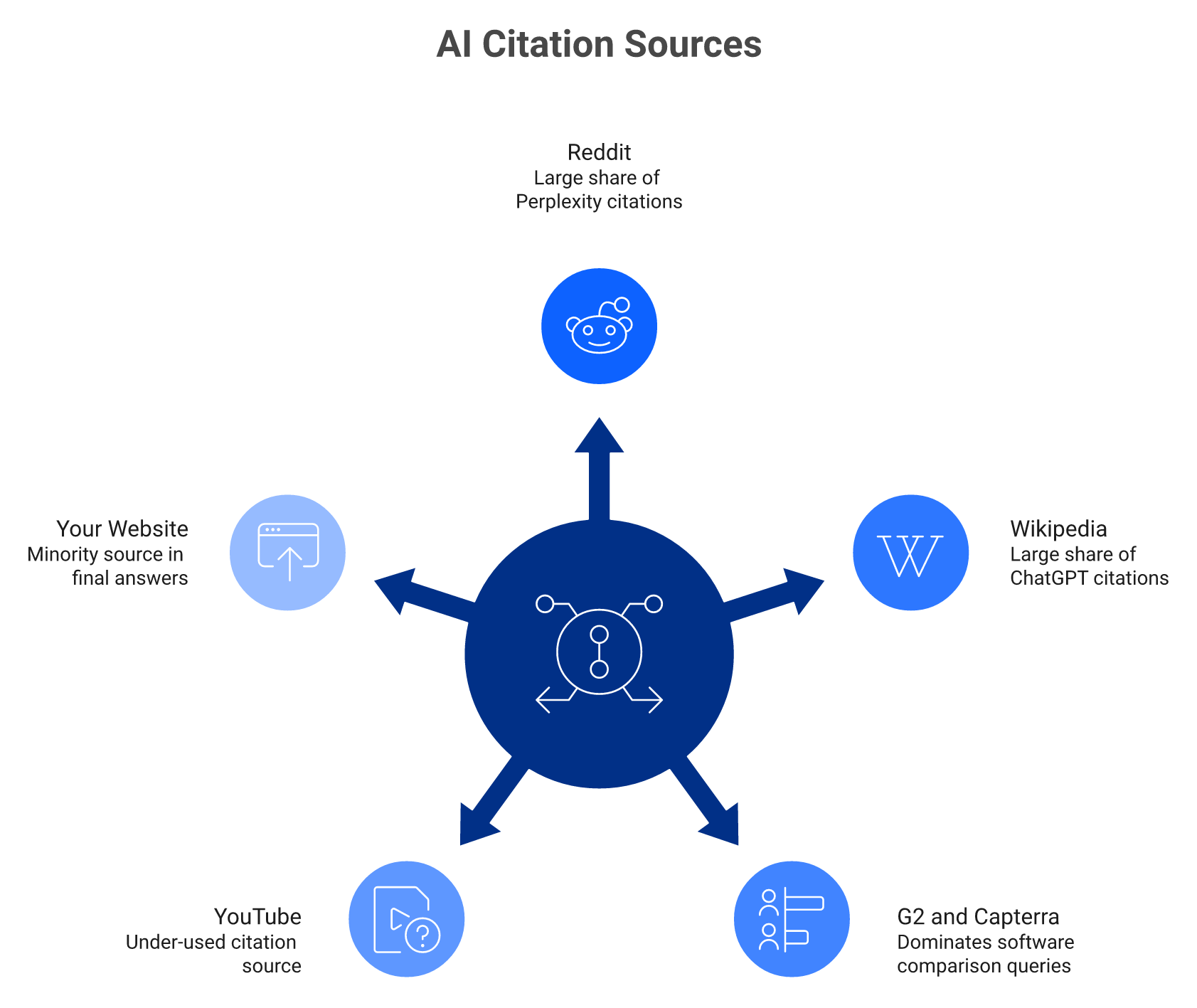
This is the discipline we call Search Everywhere Optimization: optimizing the whole web that feeds the answer, not just your domain. Our Reddit and forum AEO playbook covers the community layer in depth.
📋 The Citation Channel Map
| Channel | Engines it feeds | The play |
|---|---|---|
| ChatGPT, Perplexity, Google | Authentic comments on already-cited threads, identify yourself | |
| YouTube | ChatGPT, Perplexity | Make how-to videos for high-value, low-competition B2B topics |
| Affiliates (Dotdash, Forbes) | ChatGPT, Google | Earn or pay for mentions on already-cited URLs |
| G2 / Capterra | Comparison queries | Maintain a strong, reviewed profile for BOFU questions |
🔗 Earned Mentions and the YouTube Gap
The core tactic is precise, not spray-and-pray.
"Identify the most cited URLs for AEO topics you care about, then find a way to have those citations promote your product or brand."
It is the specific URL that gets cited, not just the domain, so target the exact pages that keep appearing. YouTube is the standout gap: "a huge source of citations, probably the most under-utilized strategy," sometimes cited more than Wikipedia. For dry B2B topics with little video, that is open space you can capture through our GEO service.
💬 Reddit, Done Without Spam
Reddit is heavily cited, and the community polices fakes ruthlessly. Spam accounts get banned, so authenticity is the only durable play.
"Tactics to get mentioned on Reddit, direct brand promotion is usually rejected by communities. The likely effective strategy will be to work with authentic influencers within those communities."
Ethan Smith, CEO of Graphite r/SEO Reddit Thread
Five genuinely helpful comments on cited threads can outperform a hundred spammy ones. Search Everywhere Optimization is where MaximusLabs spends real effort, because we would rather earn you five citations on the URLs models already trust than polish a page no engine reads. Our Reddit threads finder pinpoints exactly which threads to target.
Q9: How Do You Measure AI Citations and Tie Them to Revenue?
A VP of Marketing asked us last quarter to prove that GEO work paid off. Her old dashboard showed impressions and rankings, none of which she could take to a board meeting. The metrics that mattered were not on it.
📊 The Answer, Up Front
Measure AI visibility with three metrics: citation share of voice across a fixed prompt set, appearance rate per engine, and AI-referred traffic in GA4 (tracking chatgpt.com, perplexity.ai, claude.ai, and gemini.google.com). Then connect it to revenue. LLM-referred visitors convert far better than organic, with Semrush clickstream data showing about 4.4x, and practitioners reporting up to 6x. That conversion gap is why citation share, not pageviews, is the metric that matters.
Share of voice means how often you appear as the answer across many question variants, not a single ranking. Our GEO measurement and metrics framework is built around exactly this.
⏰ Setting Up the Tracking
You can stand this up in an afternoon.
- Build a fixed prompt set of 25 to 50 buyer questions, then run them monthly across each engine.
- Log appearance rate: how often each engine cites you per prompt.
- Tag AI referrals in GA4 by adding chatgpt.com, perplexity.ai, claude.ai, and gemini.google.com as a custom channel group.
Attribution is now feasible because chat answers include clickable links, so last-touch tracking works, backed by a "How did you hear about us?" form field. The right AI search visibility and brand mention tracking tools make this repeatable.
💰 Why the Conversion Gap Changes the Math
Here is the number that reframes the budget conversation. Webflow saw a 6x higher conversion rate from LLM traffic than from Google search traffic, because conversational queries build intent before the click. Semrush's clickstream analysis puts the lift around 4.4x.
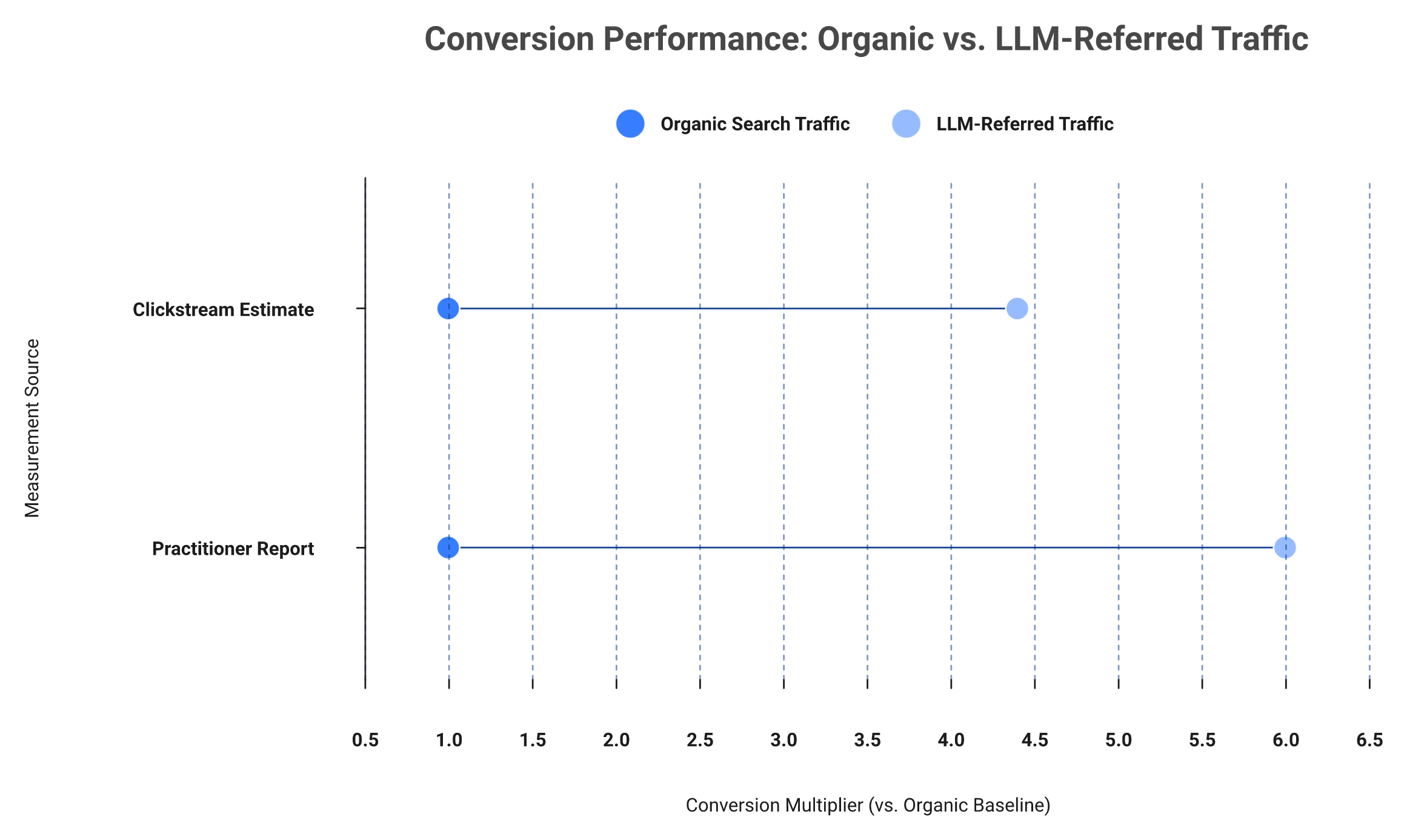
So a smaller volume of AI-referred visits can outperform a larger pile of organic clicks. That is the case against vanity metrics: impressions do not convert, but high-intent citations do. This is the logic behind our zero-click search brand economy research.
⭐ From Citation Share to Pipeline
The final step is modeling citation share to pipeline, a gap almost no competitor closes. Track which cited pages produce demos, trials, or sales, then double down on those money pages.
This is the core of MaximusLabs' revenue-focused methodology. Across one program, we optimized a supplement brand's bottom-of-funnel pages, and their e-commerce sales doubled over six months. We report citation share tied to revenue, not a screenshot of rising impressions a founder cannot bank, which is what our GEO ROI and revenue attribution work delivers.
"AEO, I need to instead look at a share of voice, or how frequently am I showing up."
Ethan Smith, CEO of Graphite r/SEO Reddit Thread
Q10: Why Do AI Citations Keep Changing, and How Do You Keep Yours?
You earn a citation in ChatGPT, celebrate, and check back a month later. It is gone. A competitor sits where you were, and nothing on your page changed. This is the part of GEO nobody warns you about.
⚠️ The Situation: Citations Are Not Permanent
Traditional SEO rankings move slowly. AI citations do not. They churn, because the model refreshes its retrieval set constantly and re-runs the answer live each time.
That instability catches teams off guard. They treat a citation like a trophy, when it behaves more like a lease that needs renewing. A scheduled GEO content refresh is how you renew it.
🕳️ The Complication: Churn and the Freshness Bias
The volatility is significant. Roughly 40 to 60% of cited sources change month to month as engines update what they pull.
Freshness makes it worse for stale pages. Perplexity favors recent content, giving noticeably more citations to pages updated within 30 days, and applies a roughly 12-month freshness window for technical topics. A page that earned a citation in January can quietly age out by summer, which is why our Perplexity optimization leans hard on recency.
✅ The Resolution: Run a Monitoring Cadence
The fix is a cadence, not a one-time optimization. Treat citations as an ongoing program.
- Re-run your tracked prompt set monthly, and flag any lost citations immediately.
- Refresh top money pages on a schedule, updating stats, dates, and examples.
- Watch competitor movement on the queries you care about, and reclaim slots before they harden.
We could be slightly conservative on the exact churn figure, since it varies by engine and niche, but the direction is not in doubt: unattended citations decay. At MaximusLabs, we run this monitoring cadence as an ongoing program, not a one-off audit, because a citation you do not defend is a citation you will lose. That is the backbone of our GEO service.
Q11: What's Your 30-Day Citation Optimization Action Plan?
You have read the mechanics. Now here is what to actually do on Monday, sequenced so the highest-leverage, lowest-cost moves come first.
🎯 The Answer, Up Front
Start with a citation gap analysis: run 25 to 50 buyer prompts across ChatGPT, Perplexity, Gemini, and Claude, and log which domains get cited. In week one, fix retrievability by exposing JavaScript-hidden data and adding 40 to 80 word answer nuggets to your top money pages. In week two, strengthen E-E-A-T and schema. In weeks three to four, seed third-party citations on Reddit, YouTube, and G2, and stand up GA4 AI-referral tracking. Then re-run the prompts and measure share-of-voice movement.
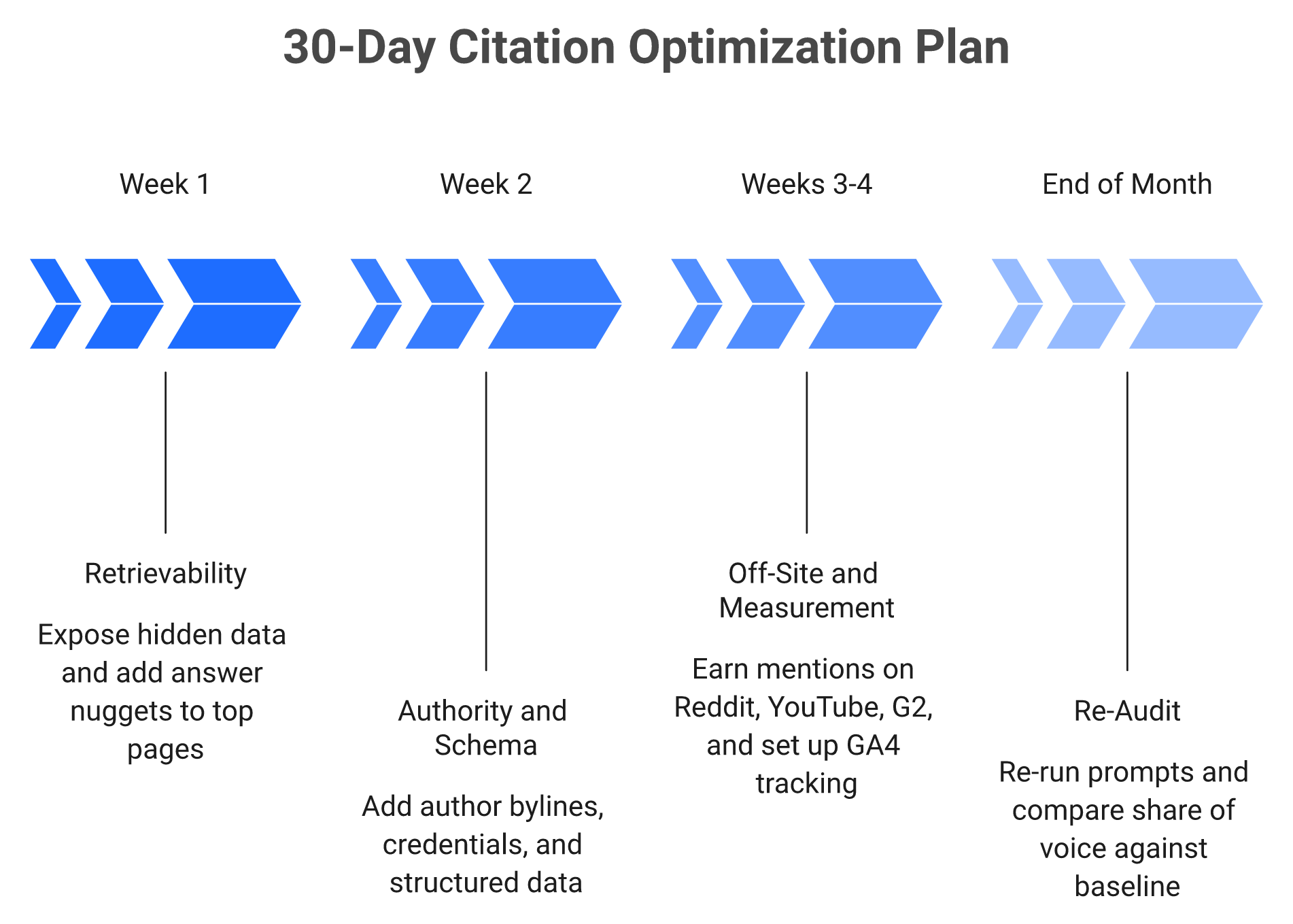
📋 The Four-Week Plan
- Week 1, Retrievability. Turn JavaScript off and check what vanishes. Move hidden reviews, specs, and facet data into plain text. Add answer nuggets to your top five money pages.
- Week 2, Authority and Schema. Add named-author bylines and credentials. Ship Article, FAQPage, and Organization schema. Move help-center content into a subdirectory.
- Weeks 3 to 4, Off-site and Measurement. Find the URLs already cited for your queries, then earn authentic mentions on Reddit and YouTube. Set up GA4 AI-referral tracking.
- End of month, Re-audit. Re-run the prompt set. Compare share of voice against your Week 1 baseline.
A structured AEO implementation checklist keeps each week accountable, and a quick AI crawlability checker pass surfaces the Week 1 retrievability wins fast.
⚡ What Good Movement Looks Like
Do not expect every engine to move at once. Perplexity often responds first because of its freshness bias, while ChatGPT and Google AI Overviews build slower on authority. Watch for lift on the money queries, not vanity terms.
One structural tip: use point-to-point internal links (the Southwest Airlines model) so bots can reach every page, rather than a hub-and-spoke map that orphans pages behind JavaScript. Our technical GEO implementation guide details the crawl-path fixes.
🔮 What We Are Sitting With Next
Where our thinking is right now, "becoming the answer" is still an edge, but within two years we think it becomes table stakes. The brands that build trust-first, AI-discoverable content early will own the citations when everyone else scrambles.
The open question we keep turning over is measurement. Attribution is workable today, but citation-to-revenue modeling is still crude across the industry. If you are wrestling with proving GEO's pipeline impact to a skeptical board, that is the conversation we would genuinely like to have with you, so contact us and we will map it together.
Frequently asked questions
What is citation optimization in AI search, and why does it matter now?
Citation optimization is the practice of getting your brand retrieved, synthesized, and cited inside an AI engine's answer, not just ranked as a blue link. When a buyer asks ChatGPT or Perplexity for a shortlist, the model returns one synthesized answer with a short citation set. If you are not in that set, you have zero traction, even ranking on Page 1. Why it matters now: Gartner projects traditional search volume will fall roughly 25% by 2026. AI-referred visitors convert far better than standard organic traffic. The buyer journey compresses into a single answer box you are either in or out of. We treat this as a revenue problem, not a vanity-metric problem. Impressions do not close deals; being the cited answer at the moment of decision does. That is why we built our GEO service to make your brand the answer AI references, then tie citation share back to pipeline rather than pageviews.
How is citation optimization (GEO/AEO) different from traditional Google-only SEO?
Traditional SEO optimizes for a ranked URL on a results page. Citation optimization optimizes to be retrieved and synthesized into the AI's answer itself. It targets passage-level extraction, factual density, and third-party trust, not keyword density and backlinks alone. The core distinctions: Unit optimized: the page in SEO, the passage in GEO. Success metric: ranking position in SEO, citation share of voice in GEO. Winning: one URL at position one in SEO, being mentioned most across many sources in GEO. We think of this as a data-science problem, because you must understand how each model retrieves and grounds answers, then engineer content to survive that retrieval step. That said, ranking still matters: roughly 70% of Google AI Overview sources come from the top 10 organic results, so strong SEO is now the prerequisite. Our GEO vs traditional SEO breakdown maps exactly what carries over and what does not.
How do AI engines actually decide what content to cite?
AI engines cite at the passage level, not the page level. During retrieval-augmented generation, the model pulls candidate passages, grounds its answer in the most retrievable and trustworthy ones, then synthesizes a response. Selection favors: Retrievability: content served as plain, crawlable HTML. Factual density: statistics, quotations, and cited sources, which research shows can lift visibility by up to 40%. Entity coverage: clear, specific product names, features, and attributes. Freshness and third-party validation. The most common trap we find is content hidden behind JavaScript. Reviews, specs, and facet data that load asynchronously often never get retrieved, so the engine cannot cite what it cannot read. Turning JavaScript off is one of the first checks we run, and you can replicate a quick version with our AI crawlability checker before deciding where to invest.
Do I need a different citation strategy for ChatGPT, Perplexity, Gemini, and Claude?
Yes. Each engine draws from different source pools, so one strategy will not win all of them. ChatGPT: leans on Wikipedia and depth, and runs live search on Bing's index. Perplexity: leans on Reddit and freshness, rewarding recently updated content. Google AI Overviews: require strong E-E-A-T and top-10 ranking. Claude: cross-verifies sources and rewards long-form depth with acknowledged trade-offs. Overlap between engines is low, so a page that wins one may be invisible on another. For a busy team, the practical move is to pick the two engines where your buyers actually ask questions, then win the sources those engines trust. If you sell to developers or prosumers, prioritize Reddit and YouTube; if you sell into considered B2B purchases, anchor on E-E-A-T and rankings. Our answer engine optimization programs build this per-platform map first.
Where do AI engines pull citations from beyond my own website?
Most AI citations point to third-party surfaces, not your own domain. Your website is often the minority source in the final answer. The channels that matter most: Reddit: a large share of Perplexity citations, and heavily used by ChatGPT. Wikipedia: a large share of ChatGPT citations. G2 and Capterra: dominant for software comparison and BOFU queries. YouTube: one of the most under-used sources, sometimes cited more than Wikipedia. We call the discipline of optimizing this whole ecosystem Search Everywhere Optimization. The tactic is precise: identify the exact URLs already cited for your target questions, then earn authentic mentions on them rather than spamming. Reddit communities police fakes ruthlessly, so five genuinely helpful comments beat a hundred promotional ones. Our Reddit threads finder pinpoints which threads to target first.
How do I measure AI citations and tie them to revenue?
Measure AI visibility with three metrics, then connect them to pipeline. Citation share of voice: how often you appear across a fixed set of 25 to 50 buyer prompts. Appearance rate: how often each engine cites you per prompt. AI-referred traffic: tracked in GA4 by tagging chatgpt.com, perplexity.ai, claude.ai, and gemini.google.com as a custom channel group. The number that reframes budget conversations is conversion. LLM-referred visitors convert far better than organic, with clickstream data showing around 4.4x and practitioners reporting up to 6x, because conversational queries build intent before the click. So a smaller volume of AI-referred visits can outperform a much larger pile of organic clicks. The final step, which almost no competitor closes, is modeling citation share to actual demos, trials, and sales. That is the core of our GEO ROI and revenue attribution work: we report revenue-linked citation share, not screenshots of rising impressions.
What does a practical 30-day citation optimization plan look like?
Start with a citation gap analysis: run 25 to 50 buyer prompts across ChatGPT, Perplexity, Gemini, and Claude, and log which domains get cited today. Week 1, retrievability: expose JavaScript-hidden data and add 40 to 80 word answer nuggets to your top money pages. Week 2, authority and schema: add named-author bylines, credentials, and Article, FAQPage, and Organization schema. Weeks 3 to 4, off-site and measurement: earn authentic mentions on Reddit, YouTube, and G2, and stand up GA4 AI-referral tracking. End of month: re-run the prompt set and compare share-of-voice movement against your baseline. Expect Perplexity to move first due to its freshness bias, while ChatGPT and Google build slower on authority. Citations also churn 40 to 60% monthly, so treat this as an ongoing cadence, not a one-off audit. If you would rather ship these fixes in weeks instead of a nine-month engineering queue, contact us and we will map the plan to your pipeline.