 Krishna Kaanth M
- AEO in 2025 means becoming the cited answer inside AI engines, not just ranking a blue link; the evaluation set shrinks to the five to ten brands an AI names.
- AEO does not replace SEO or GEO; clean technical SEO stays the foundation, and roughly 70% of AI Overview sources come from top-ten organic results.
- Structure content answer-first with quotes and statistics; Princeton's GEO study found quotations lift AI visibility about 41% and statistics about 31%.
- Most citations are earned off-site on Reddit, YouTube, and Tier-1 sources, so Search Everywhere Optimization beats an owned-site-only strategy.
- Brand authority and E-E-A-T are the durable moat; use AI to assist, not generate, since human-led content correlates with higher rankings.
- Measure citation rate, Share of Voice, and pipeline, not pageviews; LLM traffic converted about 6x better than Google search for Webflow.
Q1: What Are AEO Best Practices in 2025 (and Why Do They Matter Now)?
A founder pinged me last month with a screenshot. Her SaaS ranked third on Google for her main buying term. In ChatGPT, her brand was nowhere. A competitor she had never heard of was the answer.
Answer Engine Optimization (AEO) is the practice of structuring content so AI engines like ChatGPT, Perplexity, Google AI Overviews, and Gemini extract, cite, and repeat your brand as the direct answer. In 2025, AEO best practices center on becoming the cited source, not just ranking a link. The core levers are answer-first content, quotes and statistics, clean schema, off-site authority, and E-E-A-T signals that make AI trust you.
Why the ground shifted
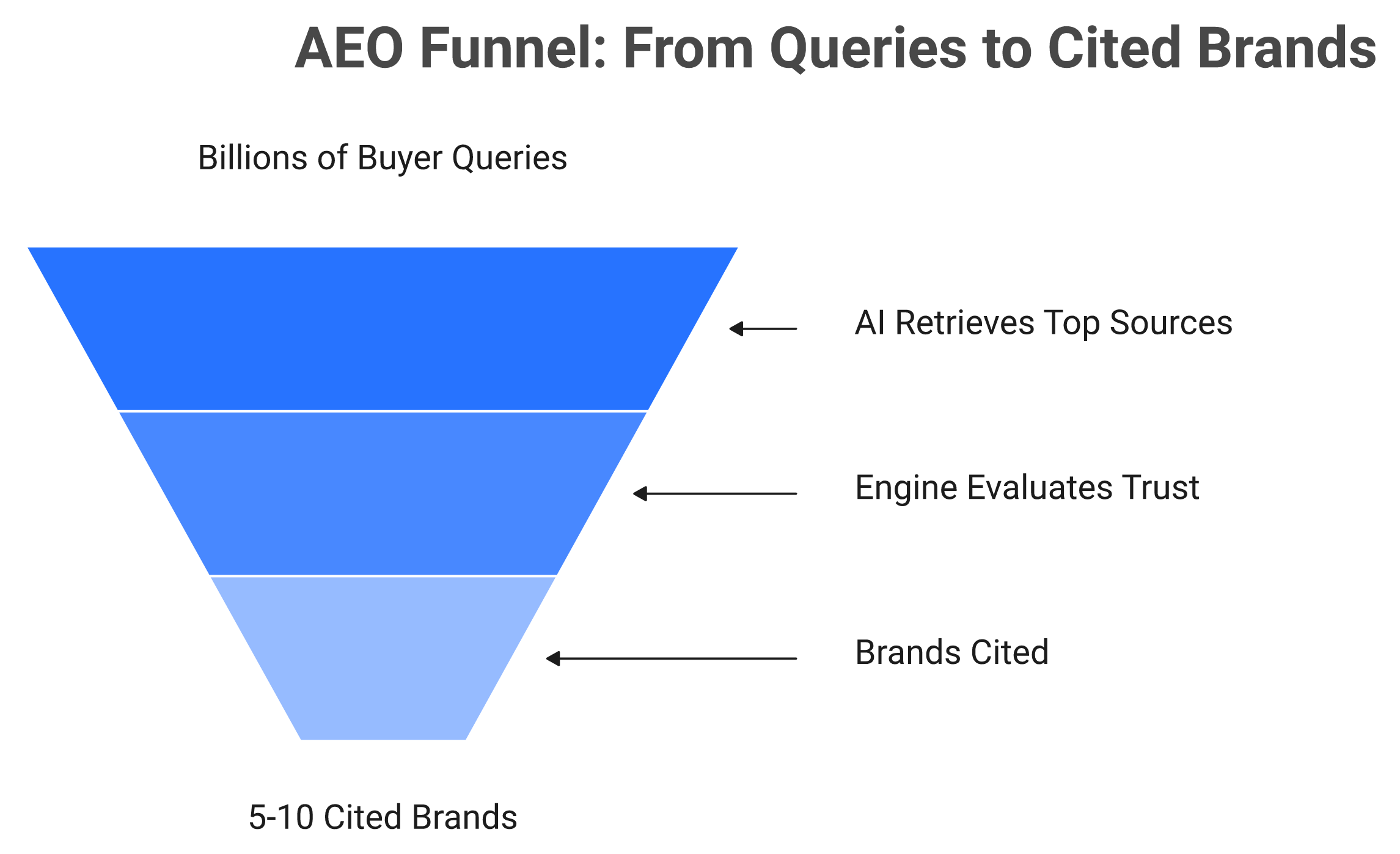
When someone evaluates a CRM, hundreds exist, but the AI names five to ten. If you are not in that set, you do not exist. You are not even in the evaluation set.
That is the real shift. Page one of Google used to be the win. Now the win is being synthesized into a single answer box. Miss it, and you have close to zero traction with AI-first buyers.
⚠️ The honest version of the "search is dying" story
Gartner projected that traditional search engine volume would drop 25% by 2026 as buyers move to AI chatbots and virtual agents. That number gets quoted everywhere, usually without the caveats.
Here is what the data actually shows. Semrush analyzed over 10 million keywords and found AI Overview coverage climbed to roughly 25% of searches by July 2025, then fell back below 16% by November. Same-keyword zero-click rates even dipped slightly, from 33.75% to 31.53%.
So the shift is real, but it is choppy, not a clean collapse. Anyone selling you a doom timeline is skipping the second half of the dataset.
What this article covers
The 20 tactics ahead group into four buckets:
Content: answer-first structure, quotes, statistics, and question research.
Technical: crawlability, schema, and internal linking that AI can actually parse.
Off-site: earned citations on Reddit, YouTube, and Tier-1 sources.
Measurement: citation rate, AI Share of Voice, and pipeline, not pageviews.
At MaximusLabs, we build for the answer box, not the tenth blue link, because ranking is no longer the same thing as winning. What we keep seeing across our answer engine optimization audits is a brand that ranks fine on Google yet stays invisible where its buyers now ask questions. That gap is the whole game in 2025, and it is fixable with the tactics below.
Q2: How Is AEO Different From Traditional SEO (and Is GEO the Same Thing)?
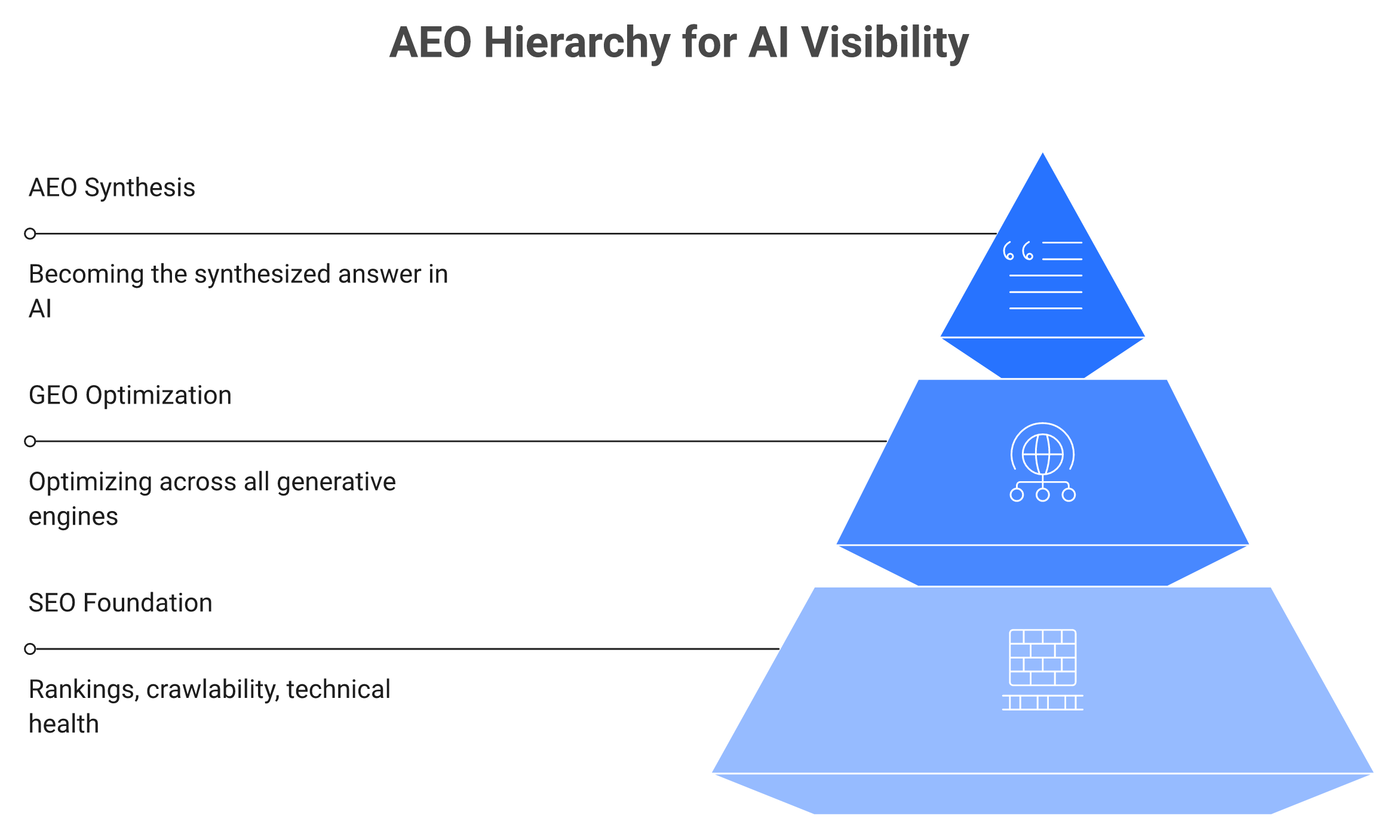
AEO does not replace SEO. It sits on top of it. SEO earns discoverability and rankings. AEO earns citation inside AI answers. GEO (Generative Engine Optimization) is the broader discipline of optimizing for generative engines across platforms. Traditional SEO optimizes for clicks and blue-link rankings, while AEO optimizes to become the synthesized answer itself. You still need clean technical SEO as the foundation.
The plain comparison
| Dimension | Traditional SEO | AEO / GEO |
|---|---|---|
| Goal | Rank a page | Become the cited answer |
| Unit of success | Position (rank #1) | Share of Voice across answers |
| Primary surface | Google SERP | ChatGPT, Perplexity, Gemini, AI Overviews |
| Core research | Keyword research | Question research |
| Key lever | Links and on-page | Citations and trust signals |
Will AEO replace SEO?
No. Google confirmed there is no secret AI tag or trick to rank in AI surfaces; the same eligibility principles apply, helpful content, technical hygiene, and structured data. One Surfer analysis found roughly 70% of AI Overview sources come from the top 10 organic results. Weak SEO means you are unlikely to be considered a source at all.
If you want the full breakdown, our guide on GEO vs traditional SEO walks through where the two disciplines diverge in practice, and our AEO vs SEO differences primer covers the fundamentals.
🧠 Where I part ways with the crowd
The standard read says GEO is just SEO rebranded. I think that gets it backwards.
GEO is closer to a data-science problem than a content problem. To show up in answers, you have to understand how these models retrieve and synthesize, the RAG (Retrieval-Augmented Generation) step where an AI searches, pulls sources, then summarizes. That is a different muscle than chasing keyword positions.
I might be wrong on how far the divergence goes. But from what surfaces when you actually run AEO programs, treating it as "SEO with new words" leaves citations on the table. The academic GEO work from Aggarwal and colleagues frames it the same way, as its own optimization discipline with measurable, distinct levers.
This is exactly where MaximusLabs positions itself, as GEO-native operators who study the retrieval mechanics through our GEO service, not generalists who swapped the acronym on the pitch deck.
Q3: How Do You Structure Content So AI Engines Cite It (and Win Snippets and PAA)?
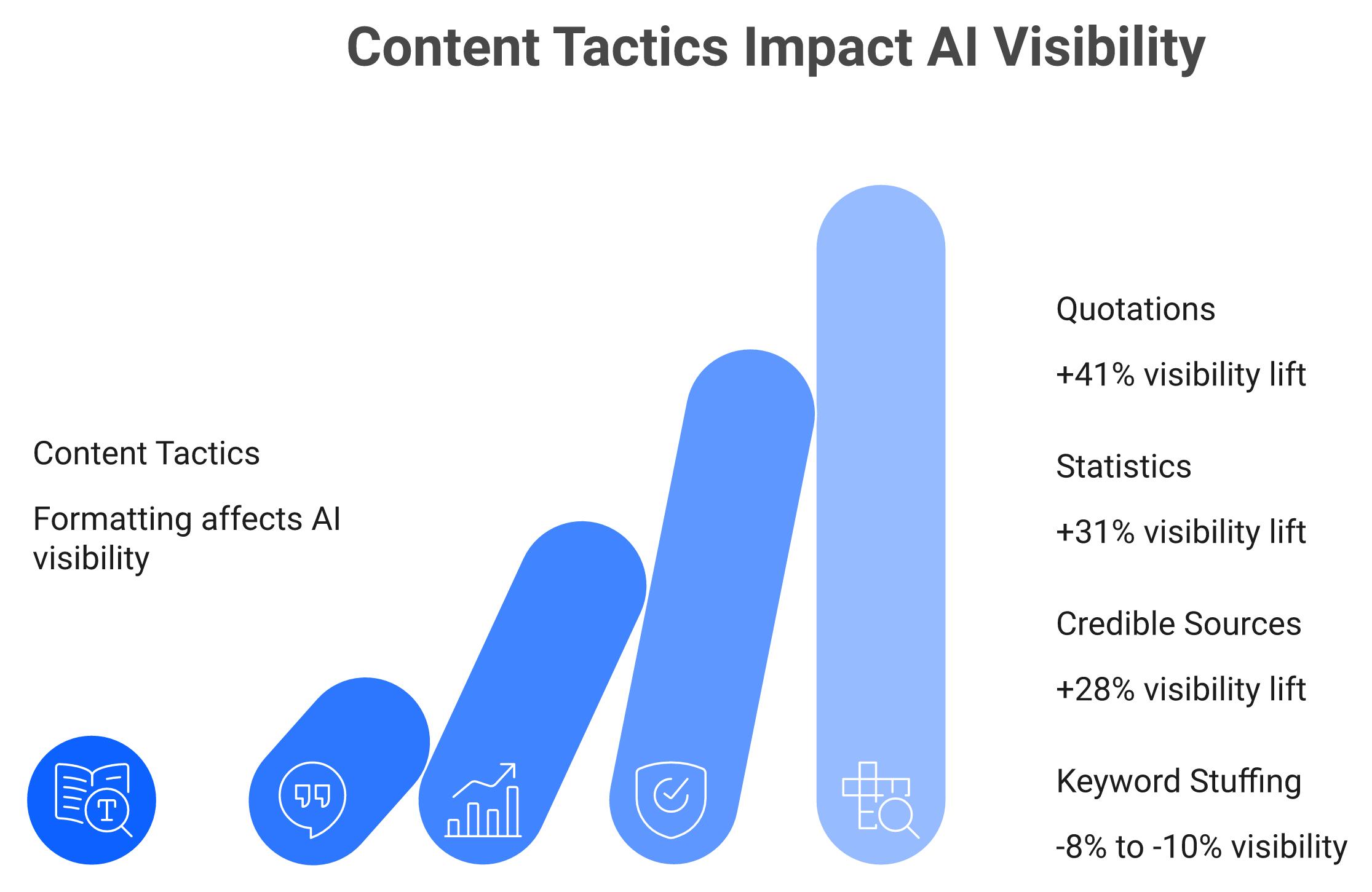
Structure content answer-first. Put a self-contained 40-to-80-word answer directly under each question-style heading, then expand. Format sections as question-and-answer, because chat prompts run far longer than search queries, so matching that form lowers friction for the AI. Back claims with quotations and statistics. Princeton's GEO study found quotations lift AI visibility by about 41% and statistics by about 31%.
The extractability rule
An answer nugget has to make sense if an AI lifts it out of context. If it needs the paragraph above to make sense, rewrite it.
This is not a style preference. It is how AI Overviews and chat engines select what to quote. Well-organized, FAQ-structured content increased inclusion in AI answers by up to 37% on platforms like Perplexity in one 2024 study.
📈 What the Princeton experiment actually measured
Aggarwal and colleagues ran 10,000 queries through a GEO benchmark and tested specific edits. The results are unusually clean:
Adding quotations: about +41% visibility.
Adding statistics: about +31%.
Citing sources: about +28%.
Keyword stuffing: minus 8% to minus 10% (the only tactic that hurt).
Lower-ranked pages gained the most, with rank-5 pages seeing large visibility jumps from these edits. Competitors cite a vague "30 to 40% lift." The exact numbers, traced to the paper, are what you can actually act on. Our GEO content optimization guide shows how to apply each edit.
Why Q&A format wins
The average Google search runs about six words. The average chat query runs closer to 25 words.
That gap changes everything. A chat prompt is a full, nuanced question, so your content has to be roughly four times more specific to match it. Vague benefit copy loses. Explicit answers to explicit questions win. This is also why AEO question research matters more than keyword lists.
Practitioner data backs the volume side too. Content structured to answer follow-up questions comprehensively, the way a strong help center does, is what gets pulled into conversational answers.
Every MaximusLabs section opens with a standalone answer nugget, built to be lifted verbatim by an AI engine and still make sense on its own. In our work rebuilding BOFU pages around how buyers actually phrase questions to AI, that single structural change is often what moves a brand from absent to cited.
Q4: Which On-Page, Schema, and Technical AEO Tactics Actually Move the Needle?
Picture the classic engagement. An agency delivers a 50-page technical audit. Core Web Vitals flagged red. Everyone nods. Six months later, traffic has not moved, and nobody can point to the fix that mattered.
The technical AEO tactics that move the needle are crawlability, point-to-point internal linking, subdirectory help centers, and clean schema. AI agents mine help centers for integration and feature data, so placement matters. Schema helps AI parse content type, though its impact is contested. Skip the vanity work: much of what fills technical audits is true but drives little to no visibility on its own.
The security-blanket trap
Most SEO work is true but low-impact. Page speed is where teams spend the most time for the least return. Across long practitioner experience, Core Web Vitals alone have not been shown to drive traffic increases.
Audits feel productive. They rarely produce citations. The 50-page PDF is a comfort object, not a strategy.
✅ What actually helps AI find and use you
Three things carry real weight:
Crawlability. Keep key content in plain HTML, not buried in JavaScript, and allow crawlers like GPTbot and Bingbot, since ChatGPT search uses Bing's index. Our AI crawlability checker flags what AI cannot reach.
Internal linking. Think point-to-point, like a route map where every page connects, not a hub-and-spoke model that leaves pages orphaned.
Help center placement. Move it to a subdirectory (domain.com/help), not a subdomain. Subdirectories perform better, and help centers hold the long-tail feature and integration data AI agents hunt for.
⚠️ The schema debate (contested ground)
Schema is where honest practitioners disagree. Google's guidance treats structured data like Organization and Article schema as especially useful in the AI era, because it makes facts unambiguous to machines. A Surfer study found structured content is more likely to appear in AI summaries.
The counter-view: some argue tokenization flattens schema's advantage, so it is not the top lever. Both can be true. Schema is cheap insurance, not a magic switch. Core types worth deploying: FAQPage, HowTo, Article, Organization, and Speakable. Our schema markup basics guide covers each type, and our technical SEO and website audit service ships these fixes.
What practitioners report
"Most SEO work is stuff that's true but zero impact... in 15 years, I've never seen Core Web Vitals drive a traffic increase."
Ethan Smith, CEO, Graphite (AEO session)
"Move your help center to a subdirectory... subdirectories perform better."
Ethan Smith, CEO, Graphite (AEO session)
At MaximusLabs, we audit for the roughly 5% of technical work that produces almost all the impact, not the 50-page PDF that makes everyone feel busy. When we audited a brand that ranked page one on Google yet stayed invisible in Perplexity, the fix was crawlability and help-center structure, not another speed report.
Q5: How Do You Earn AI Citations Off-Site With Search Everywhere Optimization?
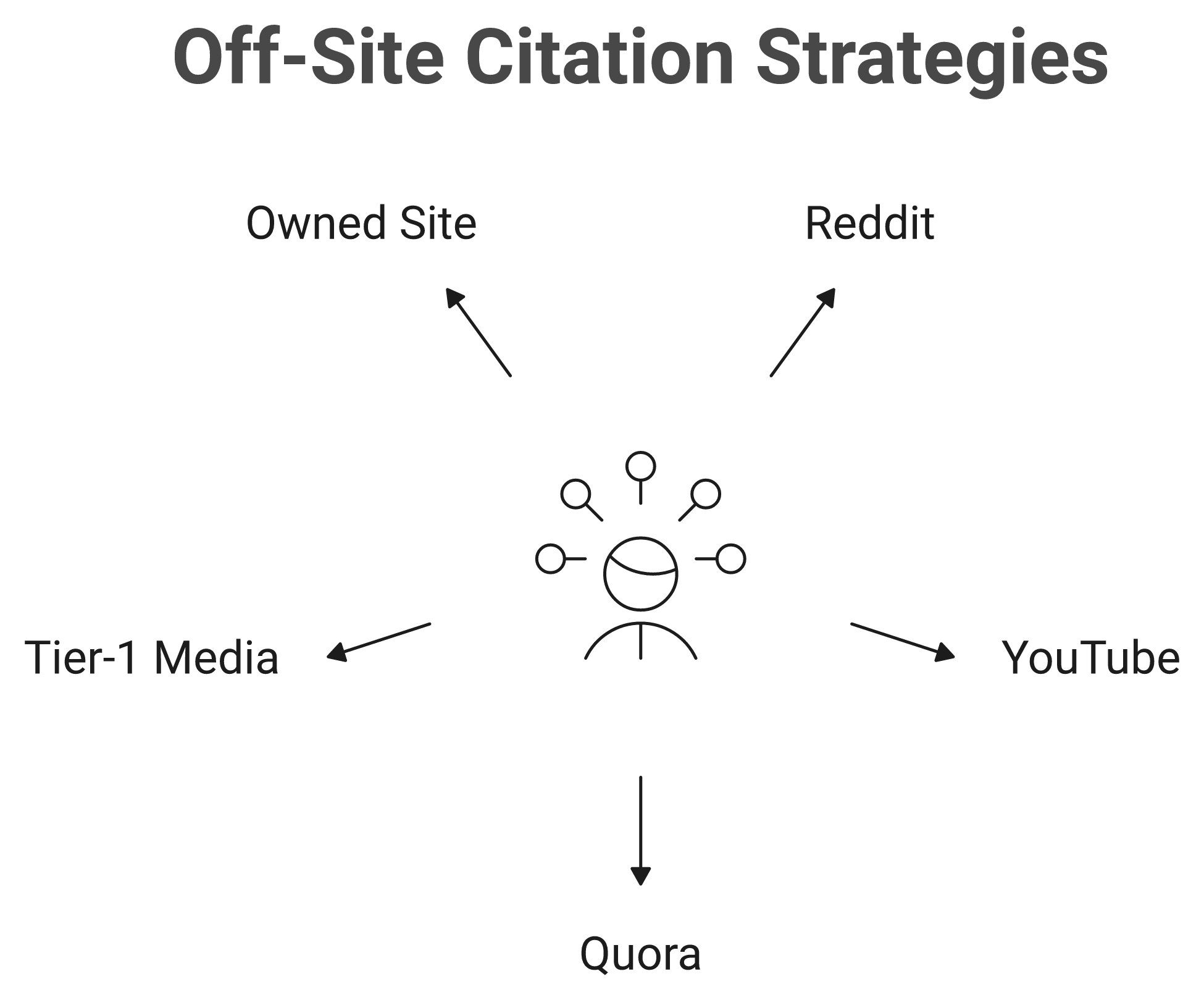
You earn AI citations mostly off-site. Identify the URLs most often cited for the questions you care about, then get your brand mentioned inside them. Reddit threads, YouTube videos, and Tier-1 affiliate reviews carry outsized weight, because AI engines synthesize answers from trusted third parties. This is Search Everywhere Optimization: consistent, credible mentions across the surfaces AI reads, not just your own domain.
Why your blog is not enough
For broad, competitive questions, being mentioned by an authority beats ranking your own page. Ask an AI for the best credit card, and a brand shows up because NerdWallet cited it, not because its own page ranked.
That reframes the whole job. Citations (third-party mentions an AI pulls into an answer) often outweigh owned pages for head-term questions.
📈 Where the citations actually come from
User-generated content is now a dominant source. In practitioner analysis, Reddit and YouTube appear repeatedly as citations for a single query, and Reddit and Quora traffic grew 5x to 10x in six months.
Two moves matter here:
Find the cited URLs. Track which specific pages, not just domains, get referenced across your target questions. A Reddit threads finder speeds this up.
Get into them authentically. On Reddit, use a real account, say who you are and where you work, then add a genuinely useful answer. Our Reddit and forum AEO playbook covers the guardrails.
Citation overlap data backs the strategy: ChatGPT's sources overlapped with Google's by about 35%, and Perplexity's by around 70%. Strong organic presence feeds AI citations, but it does not cover the whole map.
What operators say
"This is a new area and has not been mastered yet. Direct brand promotion is usually rejected by communities... work with authentic influencers within those Reddit communities."
Ethan Smith, CEO, Graphite (AEO session)
⚠️ The part most agencies skip
Here is the standard read I think gets it backwards: most SEO shops optimize the website and stop. But if AI answers are built from Reddit, YouTube, and affiliates, an owned-only strategy cedes the citation to whoever showed up there first.
I might be overweighting UGC, since Ethan Smith himself expects the current Reddit and YouTube reliance to diversify over time. But from what surfaces when you actually run these audits, off-site is where the citations live right now.
Search Everywhere Optimization is core to how MaximusLabs earns citations. We optimize the whole citation graph, the Reddit threads, the YouTube explainers, the Tier-1 reviews, not just your blog. In our work moving brands off Google-only SEO through generative engine optimization, that off-site layer is often the difference between being mentioned in a ChatGPT answer and being invisible in it.
Q6: Why Is Brand Authority and E-E-A-T the Real Moat in AI Search?
Every week, a founder asks me for the trick. The schema hack, the prompt, the one setting that forces ChatGPT to name their brand. There is no trick. There is a brand, or there is not.
Brand authority is the only durable AEO moat. It is not about hacking the algorithm. If you build a real brand in your space, AI has to recommend you, because your name is entangled with the topic across the sources it reads. As models increasingly train on AI-generated derivatives, a risk called model collapse, original research and human expertise become the scarce signals AI trusts and repeats.
The complication: everyone is chasing the hack
The category is obsessed with mechanics. Tokenization tricks, keyword density, tooling that charges enterprise prices for commodity tasks.
Meanwhile, a quieter threat grows. There is now more AI-generated content on the internet than human-generated content. If models feed on their own summaries of summaries, they converge on a single flat answer, the "only ice cream flavor is vanilla" problem.
✅ The resolution: trust is the ranking currency
E-E-A-T stands for Experience, Expertise, Authoritativeness, and Trustworthiness. In AI search, these are not soft signals; they decide who gets cited. Our E-E-A-T for AEO guide breaks down each signal.
The Princeton GEO study is the cleanest proof. Citing credible sources lifted AI visibility by about 28%, and quotations and statistics lifted it by 41% and 31%. Content grounded in named sources is measurably more citable.
What practitioners report
"It's impossible to rank in Google for 'best credit card,' it'll take years. But you can rank in chat faster because the citations are what matter."
Ethan Smith, CEO, Graphite (AEO session)
"There's a clear correlation, you rank higher with human content than AI content."
Ethan Smith, CEO, Graphite (AEO session)
🧠 Where my conviction sits
The standard read says AI search rewards whoever games retrieval best. I think that is short-term thinking. Retrieval mechanics change monthly; a trusted brand compounds.
I could be early on how fast this hardens. But what we think shifts over the next two years is that "becoming the answer" stops being an edge and becomes table stakes, and brands that built trust first will own the citations.
Trust-first SEO is the MaximusLabs core. We build brand authority AI cannot ignore, through original research and human expertise, instead of chasing an algorithm that changes weekly. That is also our honest guardrail, drawn from our trust-first content playbook: this compounds with time and authority, so anyone promising instant AI dominance is selling the trick that does not exist.
Q7: How Should You Use AI to Produce AEO Content Without Getting Penalized?
Use AI to assist, not to generate. Keep a human as the actual writer. A rigorous Graphite study found only 10% to 12% of content in Google and ChatGPT results is AI-generated, while about 90% is human-written, and human content correlates with higher rankings. Machine-only content is a short-term tactic search platforms are incentivized to devalue, so a human-in-the-loop model protects your visibility.
Why pure AI content fails
Ethan Smith saw this coming. He built scraped, rewritten content in 2007 and watched Google crush it once the incentives caught up. The pattern repeats.
If AI-generated summaries ranked, search engines would become search engines for AI summaries, which makes them redundant. Platforms cannot allow that loop, so they suppress it.
⚠️ The detection tool trap
Detection tools are not a safe gatekeeper. In one practitioner test, Surfer's AI detector flagged AI content correctly about 99% of the time, but produced roughly an 8% false-positive rate on genuinely human writing.
That means real human work gets flagged as AI one time in twelve. If you auto-reject on a detector score alone, you kill good content. Use detection as a signal, not a verdict. An AI content humanizer helps here, and an AI content optimizer tightens the draft.
💰 Spend the effort where it pays
Here is the cash-aware reality: about 1 in 20 landing pages drives roughly 85% of traffic. The other 19 are mostly wasted reps.
So the human-in-the-loop model is not "hand-write everything." It is:
AI-assist the draft, human owns the thinking, structure, and voice.
Concentrate humans on money pages, the BOFU and MOFU pages that convert.
Mine real questions from sales calls and support tickets, not keyword tools alone.
What operators say
"100% AI-generated content with no human in the loop does not work. AI-assisted content, however, is the future."
Ethan Smith, CEO, Graphite (AEO session)
🧠 My honest hedge
I might be wrong on the exact durability of this. Models improve fast, and the human-written edge could narrow.
But from what surfaces when you actually run content programs, the human-led pages are the ones that get cited. MaximusLabs scales content with AI assistance but human authorship, which keeps our content marketing service cost-effective without trading away the citations. In our work, that is how founders move budget off TOFU vanity pages toward revenue-driving, ICP-aligned content that AI actually quotes.
Q8: How Do You Measure AEO Success and Tie It to Revenue?
Measure AEO by citation rate, AI Share of Voice, and pipeline, not impressions. Share of Voice tracks how often your brand appears as the answer across many question variants and platforms, since there is no single "rank #1" in chat. The revenue case is concrete: Webflow saw a 6x conversion-rate difference between LLM traffic and Google search traffic, and now gets about 8% of signups from LLMs.
The metrics that matter
Traditional rank tracking breaks in AI search, because answers vary by query and platform. Track these instead:
| Metric | What it tracks |
|---|---|
| Share of Voice | How often you are the answer versus competitors |
| Citation rate | How often each engine names or links you |
| Sentiment and accuracy | Whether the mention is positive and correct |
| Time-to-citation | How fast a new page starts getting cited |
💰 Why this is a revenue conversation, not a vanity one
LLM traffic converts. Webflow's 6x conversion gap and 8% of signups from LLMs show these are qualified buyers, not tire-kickers.
Meanwhile, the click side is under pressure. Appearing beneath an AI Overview can cut organic click-through sharply, and Semrush measured coverage swinging between roughly 25% and under 16% of searches across 2025. Chasing impressions on pages that no longer earn clicks is spending real money on a shrinking return. Our AEO measurement metrics guide maps each KPI to revenue.
⚠️ Attribution you can actually run
Attribution used to be impossible in chat. Clickable links changed that.
Two practical methods:
Last-touch tracking on LLM referral links in GA4 (Google's analytics platform).
A "How did you hear about us?" field on conversion forms, to catch the assists analytics miss.
For deeper attribution modeling, see our GEO ROI and revenue attribution guide.
What operators report
"For AEO, I need to instead look at share of voice, or how frequently am I showing up."
Ethan Smith, CEO, Graphite (AEO session)
"Webflow gets 8% of their signups from LLMs, so it's now one of your top channels."
Ethan Smith, CEO, Graphite (AEO session)
🎯 The BOFU-first frame
The standard read tracks everything and reports pageviews. I think that is backwards for anyone who owns a number.
Start from the money pages. Measure whether your BOFU and MOFU content, aligned to your ideal customer profile, gets cited on the questions buyers ask right before they buy. MaximusLabs reports on citation rate and pipeline influence, not pageviews, and this is exactly what our answer engine optimization engagements deliver, because a 6x-converting LLM visitor beats a hundred bounces every time.
Q9: Do You Need to Be First to AI Search, or Is Fast Better Than First?
A founder cornered me at a conference last year, half-panicked. A competitor had "claimed" ChatGPT first, and he was sure the window had closed. It had not. He was reading the wrong scoreboard.
You do not need to be first to AI search. You need to be fast and consistent. First-mover advantage is largely a false concept in organic channels: pages you launch two years from now can start getting cited quickly once a channel is big enough. The winning move is velocity and content volume aimed at money pages, not planting a flag early on an unproven surface. Whenever the channel is big enough, invest in it.
The complication: the gold-rush story is loud
Two credible voices disagree here, and that tension is worth sitting in. Ethan Smith calls first-mover advantage "a false concept," pointing out that new landing pages start ranking right away when the channel has scale.
Others argue the opposite for commerce, that brands integrating with AI systems early build entrenched data patterns rivals cannot easily dislodge. Both can hold in different contexts. For most content-led AEO, though, arrival order is not the moat. Our take on future trends in GEO unpacks where each view holds.
🧠 The hallucination that proves the point
Here is the scene that reframed this for me. Perplexity summarized a Graphite article and confidently described the team as Oxford researchers. None of them went to Oxford.
The AI was not rewarding who arrived first. It was synthesizing whatever adjacent, authoritative-looking sources it found. That is the real lesson: AI answers reflect authority and context, not a timestamp on your launch date. This is why our Perplexity optimization work centers on source authority.
✅ What actually wins
Velocity: ship consistently, since about 1 in 20 pages drives roughly 85% of traffic, so volume finds the winners.
Money-page focus: aim at questions where a product can be mentioned, not purely informational ones.
Authority: build the trust signals AI leans on, so your adjacency works for you, not against you.
Early-stage brands especially can win fast, because getting cited in chat is quicker than ranking for a head term on Google, which can take years. Our GEO for SaaS startups guide shows how young brands compress that timeline.
What operators say
"It's impossible to rank in Google for 'best credit card,' it'll take years. But you can rank in chat faster, because the citations are what matter."
Ethan Smith, CEO, Graphite (AEO session)
The standard read says rush to be first. I think that gets it backwards, and I might be wrong for agentic commerce specifically. But for content-led AEO, MaximusLabs bets on velocity and authority over land-grabs through our GEO service. We help brands become the entrenched answer, not just the earliest name on a new surface.
Q10: What Should Your First 90 Days of AEO Look Like (and Where Does MaximusLabs Fit)?
Your first 90 days of AEO should move from audit to authority. Days 1 to 30: audit which buying questions trigger AI answers, and check whether you are cited, then retrofit top money pages with answer nuggets, quotes, and statistics. Days 31 to 60: deploy schema, fix internal linking, and launch off-site citations. Days 61 to 90: track citation rate and Share of Voice, then double down on what gets cited. The goal is time-to-citation, not a 50-page audit.
The 90-day plan
| Phase | Focus | Primary action |
|---|---|---|
| Days 1 to 30 | Audit and quick wins | Find AI-triggering BOFU questions; add answer nuggets, quotes, stats to money pages |
| Days 31 to 60 | Technical and off-site | Ship schema, fix internal links, seed Reddit and YouTube citations |
| Days 61 to 90 | Measure and compound | Track citation rate and Share of Voice; expand what works |
Early wins like snippets often appear within weeks, while real citation momentum compounds over 6 to 12 months. Our AEO implementation checklist maps each 30-day block to concrete tasks.
Escaping the SEO Death Spiral
Here is the trap I watch teams fall into. An agency proposes a massive roadmap with lots of data. Little of it ships, because engineering treats marketing as a low priority.
The result is no impact, lost trust, and a new agency next year running the same zero-impact cycle. One practitioner noted that only about 20% of SEO strategy typically gets launched, which is why fixes stall for months. Speed of execution, not roadmap size, breaks the spiral. Our technical SEO and website audit ships the 5% of fixes that matter first.
🎯 Persona-mapped Monday actions
Founder: decide the budget bet, and move spend from TOFU vanity pages to BOFU pages AI can cite. Compare options on our pricing page.
VP Marketing: add ChatGPT, Perplexity, and Gemini citation tracking beside Google rank in reporting, using AI search visibility and brand mention tracking.
Marketing Manager: rewrite the top 10 money pages answer-first, with one quote and one statistic each, guided by our B2B SaaS AEO strategies.
What operators say
"Marketing doesn't get to tell Engineering what to do."
Eli Schwartz, on the engineering-gatekeeper friction that stalls SEO fixes (AEO session)
This is exactly what MaximusLabs runs for clients: trust-first, revenue-focused GEO and AEO execution that ships in days, not quarters, in your founder's voice, and positioned exactly the way you want. Traditional agencies optimize your site and stop, while other GEO shops make claims they do not operationalize. We build the citations, off-site and on, cost-effectively and at scale through our answer engine optimization engagements, so becoming the answer stops being a pitch and starts showing up in pipeline. If you want to scope this for your own funnel, contact us.
What I'm Sitting With Next
Here is the open question I keep turning over. Right now, being cited by AI engines is an edge. What happens when it is table stakes?
My working hypothesis is that within two years, "become the answer" stops being a differentiator and becomes the baseline. The brands that built trust-first, AI-discoverable content early will own the citations, and everyone else will be fighting for scraps in a shrinking click economy.
I could be early on the timing. But if over half of search traffic keeps drifting toward AI-native platforms, the compounding starts now, not when it feels safe. If you are weighing that bet for your own pipeline, that is the conversation we most want to have.
Frequently asked questions
What are the most important AEO best practices for 2025?
The core AEO best practices for 2025 center on becoming the cited answer, not just ranking a link. We group them into four buckets. Content: open every section with a self-contained 40 to 80 word answer, then back claims with quotes and statistics. Technical: keep content crawlable in plain HTML, deploy core schema, and use point-to-point internal linking. Off-site: earn citations on Reddit, YouTube, and Tier-1 sources through Search Everywhere Optimization. Measurement: track citation rate and Share of Voice instead of impressions. The shift is real but choppy. Gartner projected a 25% search volume drop, while Semrush measured AI Overview coverage swinging between roughly 25% and under 16% across 2025. Anyone selling a clean collapse is skipping half the data. We build for the answer box through our answer engine optimization work, because Page 1 is no longer the win.
How is AEO different from SEO and GEO?
AEO does not replace SEO. It sits on top of it. SEO earns rankings and discoverability, AEO earns citation inside AI answers, and GEO (Generative Engine Optimization) is the broader discipline of optimizing across generative engines. SEO goal: rank a page and win clicks. AEO goal: become the synthesized answer itself. Core research shift: question research replaces pure keyword research. You still need clean technical SEO as the foundation. Google confirmed there is no secret AI trick, and one Surfer analysis found roughly 70% of AI Overview sources come from the top ten organic results. Where we part from the crowd is treating GEO as a data-science problem, not SEO rebranded, because engines retrieve and synthesize differently. See our breakdown of AEO vs SEO differences for the full comparison.
How do you structure content so AI engines cite it?
Structure content answer-first. Put a self-contained answer directly under each question-style heading, then expand. Format sections as question and answer, because chat queries run far longer than search queries. Add quotations: about a 41% visibility lift in Princeton's GEO study. Add statistics: about a 31% lift. Cite sources: about a 28% lift. Avoid keyword stuffing: the only tactic that hurt, at minus 8% to minus 10%. An answer nugget must make sense if an AI lifts it out of context. The average Google search runs about six words, while chat queries run closer to 25, so content has to be roughly four times more specific. We turn this into a production standard, and our GEO content optimization guide shows how to apply each edit.
How do you earn AI citations off-site?
You earn AI citations mostly off-site. Identify the URLs most often cited for the questions you care about, then get your brand mentioned inside them. Reddit and YouTube appear repeatedly as citations, with Reddit and Quora traffic growing 5x to 10x in six months. Find the cited URLs at the page level, not just the domain level. Contribute authentically: use a real account, disclose who you are, and add genuine value. Citation overlap data supports this: ChatGPT's sources overlapped with Google's by about 35%, and Perplexity's by around 70%. Most agencies optimize the website and stop, which cedes the citation to whoever showed up on those third-party surfaces first. This is why our Reddit and forum AEO approach optimizes the whole citation graph, not just your blog.
Why is brand authority and E-E-A-T the real moat in AI search?
Brand authority is the only durable AEO moat. It is not about hacking the algorithm. If you build a real brand, AI has to recommend you, because your name is entangled with the topic across the sources it reads. Model collapse risk: there is now more AI-generated content than human-generated content online, so original research becomes the scarce, trusted signal. E-E-A-T decides citations: Experience, Expertise, Authoritativeness, and Trustworthiness are ranking currency, not soft signals. The Princeton GEO study is the cleanest proof, with citing credible sources lifting visibility about 28%. Retrieval mechanics change monthly, but a trusted brand compounds. We build authority through original research and human expertise, and our E-E-A-T for AEO guide breaks down each signal. This compounds with time, so anyone promising instant AI dominance is selling a trick that does not exist.
How should you use AI to produce AEO content without getting penalized?
Use AI to assist, not to generate, and keep a human as the actual writer. A Graphite study found only 10% to 12% of content in Google and ChatGPT results is AI-generated, while about 90% is human-written, and human content correlates with higher rankings. AI-assist the draft: the human owns the thinking, structure, and voice. Concentrate humans on money pages: about 1 in 20 pages drives roughly 85% of traffic. Treat detectors as signals: one test showed an 8% false-positive rate on genuinely human writing. If AI summaries ranked, search engines would become search engines for AI summaries, which makes them redundant, so platforms suppress that loop. We scale content with AI assistance but human authorship, keeping our content marketing service cost-effective without trading away citations.
How do you measure AEO success and tie it to revenue?
Measure AEO by citation rate, AI Share of Voice, and pipeline, not impressions. Share of Voice tracks how often your brand appears as the answer across many question variants, since there is no single rank one in chat. Citation rate: how often each engine names or links you. Sentiment and accuracy: whether the mention is positive and correct. Time-to-citation: how fast a new page starts getting cited. The revenue case is concrete: Webflow saw a 6x conversion-rate difference between LLM traffic and Google search traffic, and now gets about 8% of signups from LLMs. Track LLM referrals with last-touch attribution in GA4 and a 'How did you hear about us?' form field. We report on citation rate and pipeline influence, and our AEO measurement metrics guide maps each KPI to revenue.
What should your first 90 days of AEO look like?
Your first 90 days of AEO should move from audit to authority, with time-to-citation as the goal, not a 50-page report. Days 1 to 30: audit which buying questions trigger AI answers, check whether you are cited, and retrofit money pages with answer nuggets, quotes, and statistics. Days 31 to 60: deploy schema, fix internal linking, and launch off-site citations. Days 61 to 90: track citation rate and Share of Voice, then double down on what gets cited. Early wins like snippets often appear within weeks, while citation momentum compounds over 6 to 12 months. The trap to avoid is the SEO Death Spiral, where only about 20% of strategy ships because engineering deprioritizes it. Speed of execution breaks that cycle, and our AEO implementation checklist maps each block to concrete tasks.