 Krishna Kaanth M
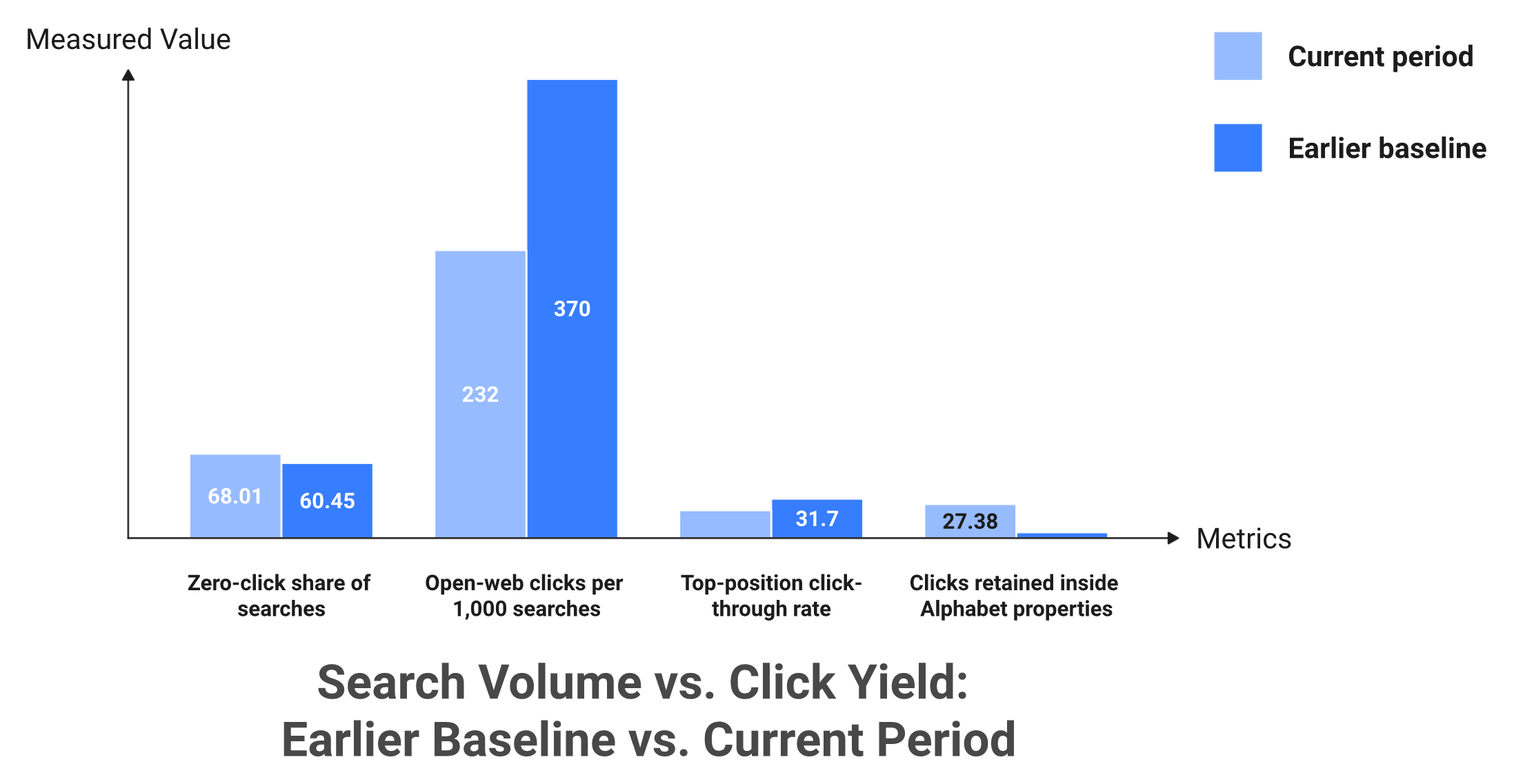
- Gemini 3.5 Flash-Lite made inference cheap enough to answer nearly every query in place, pushing US zero-click searches to 68.01% between January and April 2026.
- Open-web clicks fell from about 370 to 232 per 1,000 searches, while 27.38% of remaining clicks stay inside Alphabet properties.
- After the January 2026 Gemini 3 rollout, top-10 organic reliance in the AI citation pool fell from 76% to 38%, decoupling rank from citation.
- Exposure follows intent, not topic: informational queries run near 79% zero-click, while transactional and specification-heavy pages near 38% still pull clicks.
- AI referrals convert better (1.81% versus 1.39%) but on far lower volume, so revenue per session is the honest metric rather than session counts.
- The 90-day fix is sequenced: repair retrieval and rendering first, instrument citation share of voice second, then reallocate budget from TOFU to BOFU and off-site presence.
Q1. Did Gemini 3.5 actually kill your organic traffic, and why does "become the answer" now replace "rank #1"?
Gemini 3.5 is the mechanism, not the alibi. Google designated Gemini 3.5 Flash-Lite for Search on 20 July 2026 at roughly 350 output tokens per second, after Flash became the global AI Mode default in May 2026. Cheap, fast inference removed the last brakes on answering in place. In January to April 2026, 68.01% of US Google searches ended without a click. Ranking is no longer the objective. Being cited is.
The situation: your dashboards are measuring the wrong thing
⚠️ Rankings hold while sessions fall
Rankings holding while sessions fall is not a tracking bug. It is what happens when the result page answers the question before the link gets a chance. Google itself called the June 2026 change the biggest change to Search in 25 years, replacing link lists with generated answer pages.
The reader's instinct is to blame a core update. That instinct sends budget to the wrong place, and it is the single most common misread we see in a technical audit of a site that still looks healthy on paper.
The complication: inference got cheap, so answers got everywhere
💸 Collapsing cost per token changed the economics
Flash-Lite is built for high-throughput, agent-style queries at roughly 350 tokens per second. When cost per token collapses, answering selectively stops making economic sense. Google can now generate an answer for almost every query instead of the profitable few.
Latency used to be a traffic subsidy nobody tracked. Slow AI answers leaked clicks to blue links while users waited, and that impatience click was a real line item in your organic number. At 350 tokens per second, the reflex is gone, which is why optimizing specifically for Gemini and Google AI surfaces now sits apart from classic ranking work.
The proof: clicks per 1,000 searches, not sessions
📉 The clickstream numbers
SparkToro's clickstream analysis with Similarweb puts the January to April 2026 numbers in one place:
- 32% of searches end in a click, against a 68.01% zero-click rate (60.45% in 2024, roughly 45% a decade ago).
- 27.38% of clicks stay inside Alphabet properties.
- Open-web clicks fell from about 370 to 232 per 1,000 searches.
MaximusLabs AI tracks grounding behavior and citation pools per query cluster rather than sitewide sessions, because at a 68% zero-click baseline a session count reports a decision you already lost. The full dataset behind this shift sits in our analysis of the zero-click search brand economy.
The misdiagnosis: this is not an AI Mode problem
❌ The loss happens in ordinary result pages
Only about 0.34% of searches in the studied window switched into standalone AI Mode. The compression happens inside ordinary result pages carrying AI Overviews, which appear on roughly 13% of queries. Budget aimed at a hypothetical "AI Mode strategy" is aimed at the wrong surface.
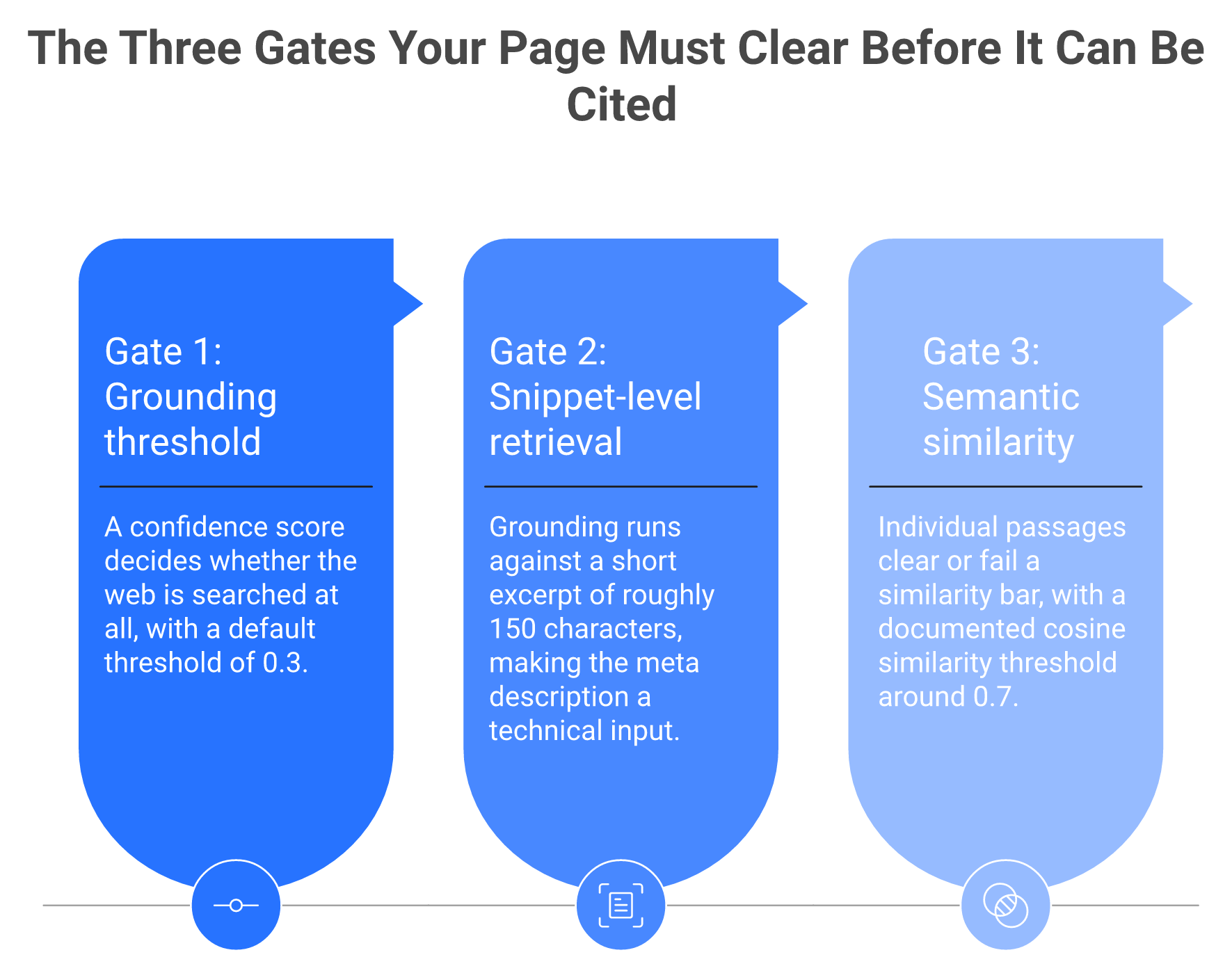
There is a technical tell worth knowing. Gemini uses a grounding prediction score (a confidence measure of whether searching the web helps) with a default threshold of 0.3. Below it, the model answers from memory alone, and your page never enters the running.
The resolution: GEO and AEO, defined plainly
✅ Position gives way to citation share
Generative Engine Optimization (GEO) means becoming the source generative systems synthesize and cite across ChatGPT, Gemini, Perplexity, and Copilot. Answer Engine Optimization (AEO) means owning the direct answer to one specific buying question.
Both swap position for citation share as the success metric. Dharmesh Shah described the behavior change bluntly: users are going to ChatGPT, asking a question, getting an answer, and stopping there, with no reason to click through ten blue links.
MaximusLabs AI runs prompt sets across ChatGPT, Claude, Perplexity, and Gemini and maps the top-cited source URLs per target query, which is how citation loss surfaces before session loss does.
Q2. What do the numbers actually say, and which ones survive a CFO's scrutiny?
Four numbers hold up. Pew Research (68,879 searches, roughly 900 US adults): organic click-through fell from 15% without an AI summary to 8% with one, and links inside the summary were clicked about 1% of the time. Authoritas: 47.5% lower desktop CTR. Seer Interactive: travel organic CTR from 1.76% to 0.61%. Gravitate, July 2026: ranking #1 delivers 58% fewer clicks than it historically did.
Lead with the panel study, not the vendor chart
📊 Which figure needs no caveat
Pew's design is the strongest available, because it observes real browsing behavior rather than modeled estimates. That is the number to put on the slide without a caveat.
MaximusLabs AI grades every published statistic by method, clickstream panel above vendor sample above agency anecdote, because a client caught citing a weak figure loses the budget argument permanently.
This is abandonment, not redistribution
⏰ Users finish and leave
The mechanism matters more than the headline. Pew found sessions ended 26% of the time when an AI Overview appeared, against 16% without one.
Users are not clicking a different link. They are finishing and leaving, which is exactly the behavior we map when building out the metrics and KPIs that replace session counts.
The evidence matrix
| Study (year) | Method | Sample | Measured change | Evidence strength |
| Pew Research (2025) | Opt-in browsing panel | 68,879 searches, ~900 US adults | CTR 15% to 8%; ~1% on in-summary links; session end 26% vs 16% | Strongest, cite unqualified |
| SparkToro x Similarweb (2026) | Clickstream panel | US Google searches, Jan to Apr 2026 | 68.01% zero-click; 232 open-web clicks per 1,000 | Strong, note US-only scope |
| Authoritas (2025) | SERP tracking sample | Keyword cohort | Desktop CTR -47.5%, mobile -37.7% | Directional, vendor sample |
| Seer Interactive (2025) | Client account data | Travel vertical | Organic CTR 1.76% to 0.61%, paid -68% | Vertical-specific, do not generalize |
| Gravitate (2026) | Aggregated client analysis | Undisclosed | Position 1 delivers 58% fewer clicks | Useful, caveat the sample |
The 232 figure is the open-web clicks per 1,000 searches baseline, down from about 370.
The contested ground worth stating out loud
⭐ Two true numbers that appear to disagree
Gartner projected search engine volume dropping 25% by 2026. SparkToro's clickstream data contradicts the collapse narrative, showing Google search grew roughly 21.6% in 2024 with about 373 times more searches than ChatGPT.
Both can be true. Total search is expanding while click yield per search collapses, and almost nobody separates those two facts.
"What's happening is the the pie of search is getting larger. And Google slice is the same size slice forever."
Ethan Smith, CEO, Graphite, Reddit Thread
The trap: "we'll just rank higher"
❌ Buying a depreciating asset
Top-position CTR fell from 31.7% in 2023 to 22.4% in 2026, a 29.3% decline. Buying more of that asset is buying a depreciating one.
The penalty for being average has never been so severe. Traditional Google-only SEO still measures the depreciating asset as if it were the prize, which is the core distinction we draw in our comparison of GEO against traditional SEO.
MaximusLabs AI follows a fixed source hierarchy of academic papers, then patents, then official documentation, then original datasets, with secondary sources labeled explicitly and used only when no primary exists.
Q3. Why did Gemini 3 decouple AI citations from your Google rankings?
Ranking and citation are now separate assets. After the 27 January 2026 Gemini 3 rollout, top-10 reliance in the AI citation pool fell from 76% to 38%, and roughly 31% of citations came from organic positions beyond 100. MaximusLabs AI measures citation share across thousands of question variants rather than single rankings, which is how a 42.4% dropout of previously cited domains becomes visible while a rank report still looks healthy.
Before and after, in four numbers
| Signal | Before Gemini 3 | After (Jan 2026) |
| Citations from top-10 organic results | 76% | 38% |
| Citations from beyond position 100 | Marginal | ~31% |
| Previously cited domains still cited | Baseline | 57.6% (42.4% dropped) |
| Citation concentration (HHI) | Baseline | +44% |
HHI here is the Herfindahl-Hirschman Index, a standard concentration measure borrowed from antitrust economics.
Your rank tracker lost half its predictive power
⚠️ Average position explains less than it used to
If only 38% of citations come from the top 10, average position explains far less than it used to. That changes what counts as a valid reason to skip a topic.
"We can't rank for that term" stopped being a strategy veto when roughly 31% of citations arrive from beyond position 100. That single fact reopens the whole citation optimization playbook for brands with modest domain authority.
The concentration paradox
⭐ Harder and more valuable at the same time
Citation got harder and more valuable at the same time. Concentration rose 44% while 42.4% of the old citation pool washed out, which produces a barbell: the top tier consolidated, and the middle reshuffled.
Rising concentration is excellent news for anyone willing to do brand work. It is fatal for anyone running a volume-content strategy.
What replaced link-graph position
🧠 Consensus, verifiability, and quotability
Engines substituted three things for rank: cross-web consensus, entity verifiability, and quotable extractable claims. Brand authority behaves like a parametric prior, meaning the model's training-data memory of you survives that week's retrieval tuning.
My read is that this is less algorithmic than people want it to be. It is not about hacking the algorithm's answer. If you build a real brand in your space, the model has to recommend you.
In MaximusLabs AI's deployments, Oliv AI reached a 64% citation rate across AI platforms within six months, overtaking a ten-year-old billion-dollar competitor sitting near 30%. I might be reading that single case too strongly, though it matches the concentration pattern rather than contradicting it, and the full sequence is documented in the Oliv AI case study.
The Monday move
✅ Add a citation-presence column
Add a citation-presence column beside every tracked keyword, recording whether your domain appears in the AI Overview, ChatGPT, Gemini, Perplexity, and Copilot. Then promote citation share to the headline KPI in the next reporting cycle.
"For AEO... I need to instead look at a share of voice or how frequently am I showing up."
Ethan Smith, CEO, Graphite, Reddit Thread
MaximusLabs AI monitors brand frequency and citation rate against named competitors across thousands of question variants, which is the only scorecard that moves in the same direction as pipeline.
Q4. Who actually loses here, and is your business model on the exposed side?
Damage is concentrated, not uniform. Publishers and comparison portals lose most because their value was the summary itself, and Penske Media alleges roughly 20% of Google results leading to its sites now carry AI summaries. Travel shows the sharpest measured hit, with organic CTR falling from 1.76% to 0.61% and paid down 68%. Transactional and specification-heavy B2B queries remain the most defensible.
Exposure tracks how much of your value was the summary
🔍 The segmentation test
If a generated answer can fully replace your page, your traffic was always borrowed. If the buyer still needs your pricing logic, your integration list, or your implementation detail, the click survives.
That is the whole segmentation test, and it applies across every vertical below.
Segment exposure model
| Segment | Dominant query type | Measured impact | Structural verdict |
| News publishers | Informational, news | ~20% of Google results carrying AI summaries per Penske filing | Highest exposure, value was the summary |
| Comparison and review portals | Commercial research | Winner-takes-all concentration among established players | High exposure, aggregation is reproducible |
| Travel | Planning, informational | Organic CTR 1.76% to 0.61%, paid -68% | Sharpest measured hit |
| General e-commerce | Transactional | Desktop CTR -47.5%, mobile -37.7% across cohorts | Moderate, product data still needed |
| B2B SaaS | Evaluation, specification | Comparison layer exposed, spec layer holding | Mixed, defensible with proprietary detail |
| Niche expert sites | Long-tail informational | Erosion where content is summarizable | Depends entirely on first-hand experience |
Winner-takes-all compounds the problem for mid-market
⚠️ Concentration lands hardest in the middle
Skift found AI Overviews concentrate visibility among established players. Pair that with the 44% rise in citation concentration, and the squeeze lands hardest on brands with real products and thin brand recognition.
Mid-market teams feel this as unfairness. It is closer to a value-creation test that AI made unavoidable, and the pattern shows up clearly across our 2026 read on AI search in B2B SaaS.
The B2B SaaS read, since that is the ICP here
💰 Which queries still pull a click
Comparison and evaluation queries are the exposed layer, because a model can assemble a plausible vendor shortlist from public sources. Implementation detail, seat pricing mechanics, security posture, and integration specifics still pull clicks, because no engine can resolve them fully without you.
Every segment losing badly was in the business of aggregating other people's information. Every segment holding up owns something proprietary: inventory, pricing, or first-hand implementation experience.
❌ The test nobody wants to run
If a language model can reproduce your page from its training data, you were never the source. Information Gain and human domain expertise are the only real defenses, which is also why AI-generated summaries of summaries perform worse rather than better.
Practitioners describe the same split without the framework language:
"If a page merely provides a definition of 'what is X' or reiterates widely known advice, AI-generated overviews can easily fulfill much of that need... Pages that offer unique data, practical examples, trade-offs, screenshots, pricing information, benchmarks, or a distinct perspective are more challenging to substitute."
u/Crescitaly, r/digital_marketing Reddit Thread
"I've observed some websites experiencing a drop of 30-40% in their informational traffic without seeing any corresponding AI citations to compensate for that loss."
u/SuccessfulCoyote1800, r/digital_marketing Reddit Thread
MaximusLabs AI starts every engagement with ICP-aligned bottom-of-funnel questions, sequencing BOFU first and MOFU only after BOFU is exhausted, because those are the queries a generated answer cannot close without naming a vendor. That sequencing logic is set out in full in our B2B SaaS AEO strategy guide.
Q5. Which content in your portfolio is now a donation to Google, and which still pays?
Exposure tracks intent, not topic. Informational queries now run roughly 79% zero-click, commercial-research queries climbed from 42% in 2024 to 51% in 2026, and transactional queries sit near 38%. Net-new top-of-funnel explainers are effectively unpaid training data. MaximusLabs AI sequences client content bottom-of-funnel first and skips top-of-funnel entirely, because pricing logic, implementation reality, and alternatives comparisons still return clicks.
📉 Score by intent tier, not by topic cluster
TOFU means top-of-funnel, the "what is X" explainer stage. Those pages sit on the query type with the highest zero-click rate in the dataset.
The uncomfortable arithmetic is that most B2B content calendars still run 60% to 70% TOFU. That majority of spend now subsidizes an answer engine that returns nothing, which is the reallocation problem at the centre of our revenue-focused R-GEO framework.
💸 The Zero-Click Exposure Index
| Funnel stage | Query type | Zero-click rate | Expected clicks per 1,000 impressions | Verdict |
| TOFU | Informational, definitional | ~79% | Well below the 232 open-web baseline | ❌ Stop funding net-new |
| MOFU | Commercial research, comparison | 51%, up from 42% in 2024 | Near baseline, eroding fastest | ⚠️ Hold and defend |
| BOFU | Transactional, specification | ~38% | Above baseline | ✅ Double down |
The 232 figure is the open-web clicks per 1,000 searches baseline, down from about 370.
⚠️ Do not overcorrect out of the comparison layer
Commercial-research queries are eroding fastest, and that is exactly where B2B purchase decisions get made. Abandoning that layer to chase pure transactional terms hands your category narrative to whoever stays, a risk we map stage by stage in the B2B SaaS buyer journey in AI search.
You defend it with Information Gain, meaning content carrying facts that exist nowhere else. Original evaluation criteria, real implementation friction, and pricing math competitors will not publish are the only durable defense.
⭐ "Content is King" is useless advice now
The phrase means nothing unless you specify what content. Human domain expertise and Information Gain are the only things stopping model collapse, the degradation that happens when models train on their own summaries.
Graphite's Common Crawl analysis found AI-generated content now outnumbers human-created content online, and correlates negatively with search and citation performance. Volume was never the moat. It just looked like one while clicks were cheap.
✅ What practitioners are reporting
Operators split their portfolios the same way, without the framework language:
"If a page merely provides a definition of 'what is X' or reiterates widely known advice, AI-generated overviews can easily fulfill much of that need... Pages that offer unique data, practical examples, trade-offs, screenshots, pricing information, benchmarks, or a distinct perspective are more challenging to substitute."
u/Crescitaly, r/digital_marketing Reddit Thread
"I've observed some websites experiencing a drop of 30-40% in their informational traffic without seeing any corresponding AI citations to compensate for that loss."
u/SuccessfulCoyote1800, r/digital_marketing Reddit Thread
That second quote is the exact failure mode. Traffic goes, and no citation arrives in exchange.
💰 Reallocation is a cash decision, not a philosophy
Traditional agencies keep billing TOFU volume because volume is easy to scope and easy to invoice. That is not malice. It is inertia meeting a pricing model.
MaximusLabs AI documents TOFU as intentionally skipped and starts at BOFU, then expands to MOFU only after BOFU is exhausted. Clicks and impressions are vanity metrics if they never move revenue, which is why our content programme is scoped by funnel stage rather than article count.
Q6. Is it true that AI traffic converts better, and does that actually save your number?
Partly true, and dangerous as a strategy. ChatGPT-referred sessions converted at 1.81% against 1.39% for non-branded organic, producing revenue per session of $3.65 versus $3.30, a 10.3% gain. Average order value ran 14.3% lower ($204 against $238). Some datasets show a 6x conversion gap on small denominators, and Google now places ads in 25.5% of AI results, up 394%.
⭐ The situation: the quality argument, stated fairly
The argument is real. Buyers arriving from an AI answer are pre-qualified, because the model already vouched for you.
Practitioners report the same pattern from the field:
"One positive aspect is that when we do receive leads through AI, they tend to have a higher conversion rate. Many attribute this to the fact that AI-driven recommendations carry more credibility."
u/300FeetOut, r/digital_marketing Reddit Thread
⚠️ The complication: the volume math does not close
A 10.3% revenue-per-session lift on a channel delivering a small slice of organic sessions cannot offset open-web clicks falling from about 370 to 232 per 1,000 searches.
Be honest about the spread too. The widely quoted 6x conversion differential and the conservative 1.3x differential come from different verticals and different denominators. Neither has earned the right to be forecast yet.
💸 The sharper complication: Google monetizes inside the answer
Ads now appear in 25.5% of AI results, a 394% increase, across roughly 75 million daily AI Mode users, with AI Overviews on about 13% of queries. Google is not leaving the answer surface unmonetized while you wait for referral traffic, a dynamic we track in our Google Gemini AI Mode guide.
That structurally caps the per-session upside anyone hopes to capture. The best real estate inside the answer is being sold.
❌ The expensive true statement
"Our AI traffic is higher quality" is the most expensive true statement in marketing right now. It is accurate, and it buys teams two quarters of inaction.
My honest read: AI referrals are a leading indicator worth instrumenting, not yet a channel worth forecasting. I could be too cautious here, and I would rather be too cautious than wrong on a board slide.
✅ The resolution: change the report, not the narrative
Report revenue per session by channel instead of session volume. That single change makes the quality-versus-volume tradeoff visible to finance rather than rhetorical in a marketing meeting, and it is the same logic behind GEO ROI and revenue attribution.
| Reporting focus | Traditional SEO agencies | Freelancers | MaximusLabs AI |
| Primary metric | Traffic, impressions, rankings | Deliverable count | Pipeline and revenue per channel |
| Revenue attribution | Rare | Absent | Always, by stated methodology |
| AI-channel instrumentation | Emerging | Not standard | Share of voice plus citation rate |
⏰ Instrument before you forecast
Add a post-conversion "how did you hear about us" field. Last-touch attribution captures only a fraction of AI-assisted impact, which is why B2B teams that skip the survey question underreport it badly.
MaximusLabs AI reports pipeline and revenue per channel rather than clicks and impressions, which is why a 10.3% revenue-per-session lift never gets presented to a CFO as a substitute for a collapsing click base.
Q7. What is Gemini actually reading when it decides whom to cite?
Gemini cites what it can extract cleanly. Google's guidance shows the model preferentially pulls statistics, direct quotes, and specific data points, while a grounding prediction score with a default threshold of 0.3 decides whether it searches the web at all. MaximusLabs AI writes every section as a 40 to 80 word answer nugget that stands alone if extracted out of context, because retrieval happens at snippet level, not page level.
⚠️ Gate one: the grounding threshold
The prediction score measures the benefit of grounding, meaning how much a web search would improve the answer. Google's default threshold is 0.3.
Below that number, the model answers from memory alone. Your page never enters the running, and parametric brand memory decides who gets named.
🔍 Gate two: the snippet is the new rank
Grounding often runs against an excerpt of roughly 150 characters, not your full page. That makes the meta description a direct technical input, not a click-through nudge for humans.
This contradicts most "content is king" advice. GEO is closer to a data science problem than a writing problem, because you need to know how the retrieval step behaves before the writing matters, which is why technical GEO implementation precedes the editorial brief.
📐 Gate three: semantic similarity
Microsoft patents document passage retrieval against semantic similarity thresholds around cosine 0.7, a math measure of how closely two pieces of text match in meaning. Passages clear or fail that bar individually.
Page-level topical breadth does not help here. Passage-level tightness does, which is why one sprawling 8,000-word page loses to six tightly scoped sections.
✅ The extraction specification
Aggarwal et al. tested this directly in the KDD 2024 GEO paper, finding that adding citations, quotations, and statistics raised generative-engine visibility by up to 40%. That is the closest thing to a controlled experiment the category has.
Apply it as a checklist:
- Open every H2 with a 40 to 80 word quotable answer containing one number and one named source.
- Include at least one attributable expert quote the model can lift verbatim.
- Keep one claim per paragraph, so a passage clears the similarity bar on its own.
- Write the meta description as a standalone factual answer, not marketing copy.
- Put the number in the sentence, not in an adjacent chart image.
That checklist is the operating core of our GEO content optimization guide.
⭐ Where the incumbent articles lose
The pages currently ranking for this topic run unbroken prose. Beautiful for a human reader, structurally unquotable for a retrieval system.
That is the gap. Not authority, not backlinks, just extractability.
💰 What this changes about your brief
Ask the writer for quotable blocks, not word count. A 600-word section with six clean extractable claims outperforms a 3,000-word essay with none.
MaximusLabs AI's five-part section structure opens with a standalone answer nugget, then expanded analysis, then primary-source integration, then founder perspective, then the internal spoke reference. My view is that the nugget alone does most of the retrieval work, and the rest earns the human's trust once they arrive.
Q8. Why is your best trust signal invisible to AI crawlers right now?
Usually because it loads in JavaScript. Disable JavaScript and reload your highest-value page. Asynchronously loaded reviews, specification tables, and filter-driven attributes often vanish, which means AI crawlers never see them. Retrieval works on rendered text, so trust signals locked behind client-side rendering or faceted navigation are effectively unpublished, however good they look to a human visitor.
⏰ The two-minute test
Open your top revenue page. Disable JavaScript in browser settings, reload, and screenshot what disappears, or run the same check through our AI crawlability checker.
I have watched this test embarrass multi-billion-dollar companies. Their review sections, the single strongest trust signal on the page, load asynchronously and simply are not there.
❌ The structural version of the problem
AI agents cannot click JavaScript filters. Attribute data trapped in faceted navigation is unreachable at the retrieval step, no matter how well organized it is for humans.
Think of it as a ghost kitchen. Your website is the dining room, agentic commerce is the kitchen, and the delivery driver only needs the data feed to fulfil the order.
✅ Fix one: promote hidden metadata into text
Move buried attributes into visible headers and FAQ-style sections. In retail that means closure, fabric, material, and neck style. In B2B SaaS it means integration list, security posture, seat pricing, and deployment model.
MaximusLabs AI runs JavaScript minimisation and critical-content-in-HTML as a week-one technical sprint, because an unrendered review section is a trust signal you paid for and never shipped.
🔗 Fix two: close the sameAs loop
The sameAs property in Schema.org links your entity to its other verified profiles. The goal is a crawler traversing website to Wikidata to LinkedIn to Crunchbase to G2 and back to website, the pattern documented in our work on citation consistency for AI search.
A closed loop gives the engine a verifiable entity graph. An open loop leaves gaps, and gaps are where brand facts get hallucinated.
⚠️ Honest scope on schema and llms.txt
The category disagrees here, and pretending otherwise would be dishonest. SALT.agency calls schema "a hygiene factor (at best) … not a differentiator," while Surfer Academy argues structured data "increases your odds significantly."
My read is that schema is necessary hygiene, not a lift mechanism. Graphite's testing found llms.txt unused by any LLM company they could verify, though the LLM-LD specification work published in 2026 is formalizing the manifest idea. Ship Article, Organization, Person, and Dataset schema, and treat llms.txt as cheap insurance rather than a strategy.
💰 Where technical SEO budget actually earns
There is a real provocation worth stating: much of technical SEO is theatre. Core Web Vitals rarely drive traffic increases on their own.
Render-blocking your trust signals is a different category entirely. That is a revenue bug, not an audit finding.
| Work item | Category | Priority |
| 50-page audit PDF | Deliverable theatre | ❌ Low |
| Core Web Vitals tuning | Marginal hygiene | ⚠️ Low |
| Critical content in server-rendered HTML | Revenue bug fix | ✅ Week one |
| GPTbot and oi-searchbot unblocked in robots.txt | Access prerequisite | ✅ Week one |
| sameAs entity loop closed | Entity verification | ✅ Week two |
MaximusLabs AI configures robots.txt to unblock GPTbot and oi-searchbot, then audits schema across Article, Author, FAQ, and Product in the same technical SEO and website audit sprint. Traditional agencies keep billing the audit PDF, and that is the honest difference between the two categories of work.
Q9. Why does getting mentioned off your own site now beat publishing on it, and what is a citation worth?
Because engines trust consensus over self-description. Pew found Wikipedia, YouTube, and Reddit supply roughly 15% of AI Overview sources, and only about 1% of AI Overview appearances produce a click on a cited source. Brands named inside an AI Overview earn 35% more organic and 91% more paid clicks than uncited competitors, with brand searches rising about 2.1x within 24 hours. MaximusLabs AI runs review-platform work targeting 10 or more reviews per site across G2, Capterra, and Gartner.
⚠️ The hallucination that proves the mechanism
An AI summary once described a set of article authors as Oxford researchers. None of them attended Oxford.
That is not a bug worth complaining about. The engine assembled their identity from web-wide mentions rather than from their own site, which tells you exactly where the trust actually sits.
🔍 Hallucination Optimization: read the error as a report
When an engine gets a fact about you wrong, it is naming the off-site sources it trusts and repeating what they say. Most teams treat that as a support ticket.
I treat it as free diagnostic data. Ask the model where it got the claim, then go fix that source, which is the practical starting point for brand mention tracking across AI search.
💰 The allocation
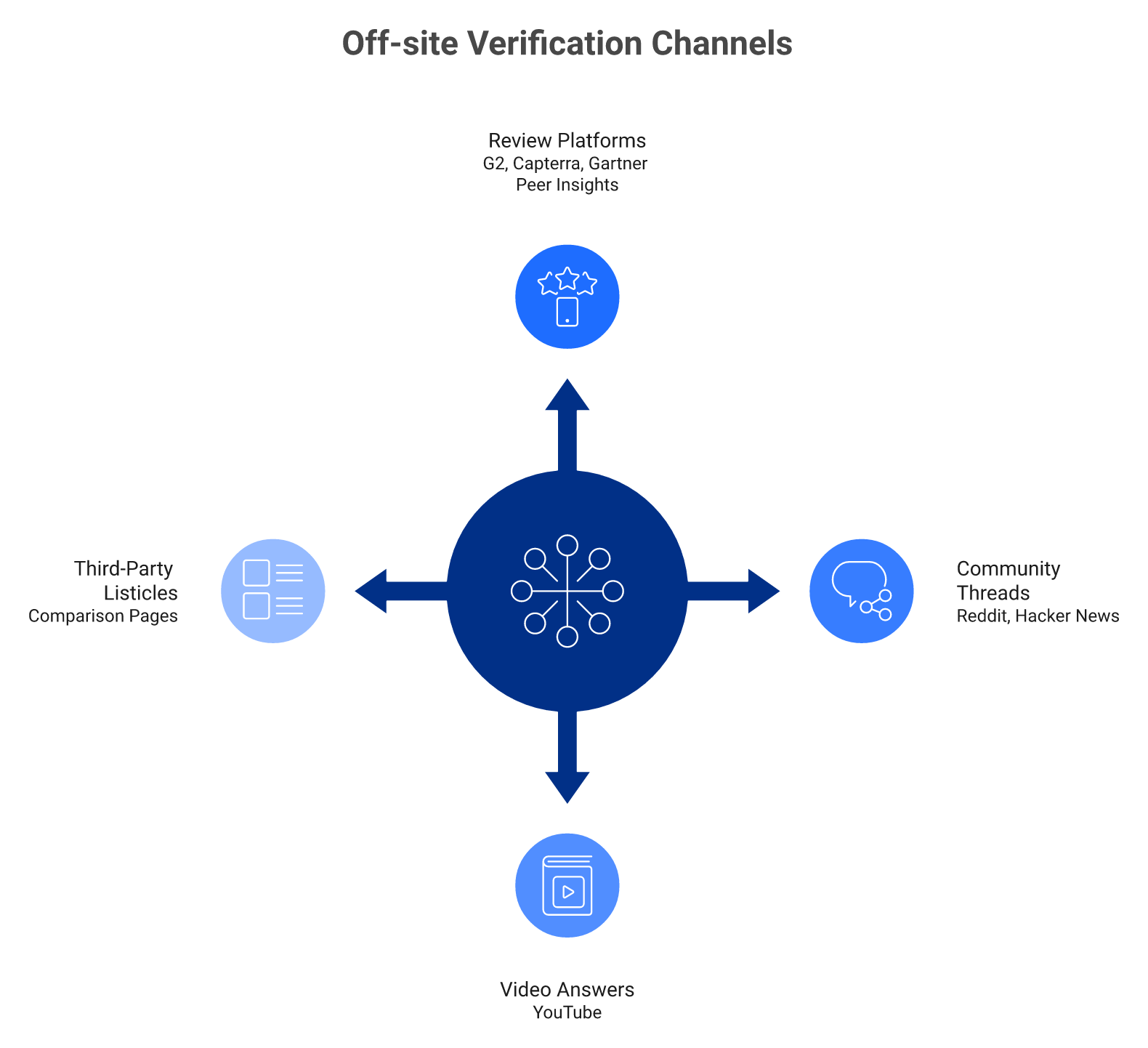
Off-site work is not one channel. It is four, and they carry different costs:
- Review velocity on G2, Capterra, and Gartner Peer Insights, since review platforms are the most-cited surface for software queries.
- Substantive Reddit and Hacker News participation with real practitioner detail, not pitch comments.
- YouTube coverage of your top 20 buying questions, a heavily cited and underused surface.
- Accurate placement in third-party listicles the engines already pull.
MaximusLabs AI identifies the specific Reddit and Quora threads already cited for target queries, then engages there rather than guessing at new ones. Our Reddit threads finder exists because that identification step is where most off-page effort is wasted.
💸 The payoff math your CFO will accept
Citation behaves like a paid-media assist. The +91% paid-click lift for cited brands means GEO improves paid efficiency, not just organic reach.
That is the argument almost nobody makes. Frame citation work as a blended CAC improvement, and the budget conversation changes, which is the same framing we use in the 2026 GEO budget benchmark.
✅ What practitioners report about the earned side
"Reddit is among the most-cited domains in ChatGPT and Perplexity, and G2 is the single most-cited platform for software queries."
eChai practitioner Q&A, Do Reddit, review sites, and press mentions matter more than my own website?
"Review sites lost up to 90% of SEO traffic... so why does Google AI keep quoting them?"
r/seogrowth Reddit Thread
That second observation is the whole point. Losing traffic and keeping citation authority are different outcomes, a split we unpack in our work on Reddit and forum AEO.
⭐ Owned authority still compounds
Dharmesh Shah's counterpoint is worth holding alongside the earned argument: content he wrote for HubSpot nineteen years ago still drives traffic, leads, and revenue today. Owned assets keep paying rent.
Renting attention does not. My read is that you need both, weighted toward earned for the next two years, because earned is where the verification happens.
❌ How this differs from link building
Traditional link building accumulates domain authority as the goal. That is not the same job.
MaximusLabs AI runs Search Everywhere Optimization across review profiles, already-cited community threads, LinkedIn founder publishing, and YouTube, because engines verify you in the places you do not own. The tactic set is documented in our AI citation acquisition tactics.
Q10. What replaces rank tracking as your organic scorecard?
Citation share of voice replaces average position. MaximusLabs AI measures brand frequency and citation rate against named competitors across thousands of question variants rather than single rankings. Build a prompt set of 50 to 200 real buying questions, run it weekly across ChatGPT, Perplexity, Gemini, and Copilot, and record whether you are cited, where you sit, and who is cited instead. Position 1 now returns 58% fewer clicks than it once did.
⚠️ Why rank dashboards survive anyway
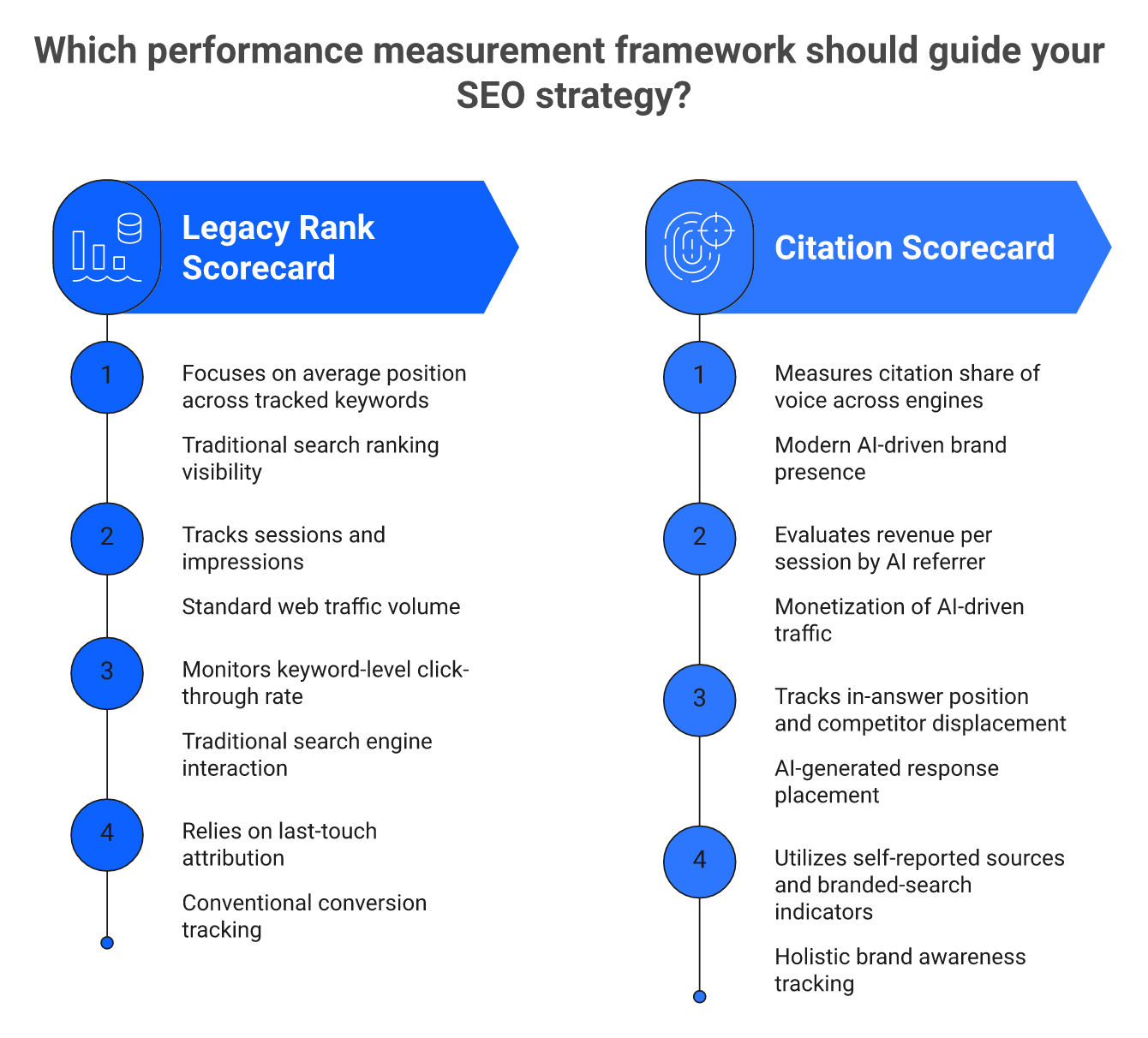
Most SEO work is stuff that is true but has zero impact. Rank reporting is the clearest case.
A dashboard saying "we held #1" while top-10 citation reliance falls from 76% to 38% is not a performance report. It is a comfort object.
🔧 Step one: build the prompt set
There is no ads API publishing LLM query volume, so you cannot buy this data. Take your existing high-intent keyword list, hand it to ChatGPT, and ask it to turn each keyword into the question a buyer would actually type, or run the list through our query fan-out generator.
Mirror messy real phrasing. LLM prompts average around 25 words against roughly six for search, so clean keyword strings do not represent the input.
📋 Step two: the scorecard fields
Record five fields per prompt, per engine, per week:
- Cited: yes or no.
- Position within the answer, meaning first mention, mid-answer, or footnote only.
- Competitors cited instead of you, by name.
- The exact cited source URL, since it is often not your homepage.
- Whether the citation is your own domain or a third-party page about you.
MaximusLabs AI runs this across thousands of question variants rather than single rankings, which is how a citation collapse becomes visible before revenue moves. The field definitions match our AEO measurement metrics.
📊 Step three: GA4 instrumentation
Build a custom channel group with referral regex for chatgpt.com, perplexity.ai, gemini.google.com, and copilot.microsoft.com. Then report revenue per session for that group, not sessions.
Add a post-conversion "how did you hear about us" field. Last-touch attribution catches only a fraction of AI-assisted deals, especially in B2B, which is why GEO measurement and metrics has to be built rather than bought.
⏰ Step four: leading indicators
Branded search volume and direct traffic move first. The 2.1x branded-search spike within 24 hours of a mention is the earliest visible confirmation that citation work landed.
Be honest about the gap: mainstream SEO platforms still do not uniformly measure in-answer citation. That is why this reporting layer has to be assembled rather than bought, and why comparing the available AEO tools matters before you commit a budget line.
✅ The one-line brief for your analyst
Replace "average position across tracked keywords" with "percentage of buying questions where we are named." Everything else in the stack supports that single number.
MaximusLabs AI reports citation rate against competitors as the headline organic metric, because that is the measure that moves in the same direction as pipeline.
Q11. What if Google is right, and where is this heading legally?
Google disputes the premise, calling the Pew study flawed in methodology and skewed in queryset, and maintains it sends billions of clicks to websites daily. The deceleration data partly supports caution: zero-click growth slowed to 1.4 percentage points between 2025 and 2026, against 5.5 points the year before. The European Commission opened a formal Article 102 investigation on 9 December 2025 into Google's use of publisher content for AI purposes.
⭐ The situation: state the rebuttal fairly
Google's position is not unreasonable. Total search volume is growing, aggregate outbound clicks remain enormous, and studies measuring narrow query sets can overstate the effect.
Anyone forecasting extinction is overreaching. The data supports compression, not collapse.
⚠️ Complication one: the plateau, honestly conceded
Zero-click growth decelerated sharply, which suggests stabilization at a lower level rather than continued freefall. Plan for the plateau.
That changes the planning posture, not the conclusion. A lower plateau still means your old click volume is not coming back, which is the premise behind how we model future trends in GEO.
⚖️ Complication two: the regulatory record undercuts the reassurance
The record is now substantial:
- 9 December 2025: European Commission opens a formal Article 102 TFEU investigation into whether Google used publisher and creator content for AI purposes under unfair trading conditions.
- 10 February 2026: the European Publishers Council files a formal complaint arguing publishers face an untenable choice, since opting out of AI use means losing search visibility.
- January 2026: the UK Competition and Markets Authority publishes proposed AI Overviews transparency measures.
- Penske Media Corporation v. Google LLC, No. 1:25-cv-03192 (D.D.C.), with Google moving to dismiss.
⏰ Why this matters operationally, not politically
Abuse-of-dominance cases in fast-moving digital markets take years, and appeals extend that further. No remedy arrives inside your planning horizon.
Google has already begun licensing pilots with selected publishers. Any remedy that lands will change citation and compensation mechanics, not restore blue-link volume, which is worth tracking alongside Google algorithm updates rather than instead of them.
❌ Where I might be wrong
Three things are genuinely contested. Whether the plateau holds, whether the 6x conversion differential generalizes past narrow verticals, and whether in-answer advertising expands beyond 25.5% of AI results fast enough to absorb the per-session gains publishers expect.
Ethan Smith's warning from having built spam in 2007 applies here. He watched Google devalue scraped, chopped-up content and those companies disappear. Do not bet a brand on tactics the platform owner is incentivized to kill, and that includes fully automated LLM output, a pattern catalogued in GEO failures and lessons.
✅ The resolution: a posture, not a verdict
Assume the plateau is the baseline. Assume no regulatory rescue arrives in time. Then build assets that pay off either way.
MaximusLabs AI builds citation assets designed to hold under both outcomes, because a strategy depending on a regulator restoring your traffic is not a strategy.
Q12. What should you actually do in the next 90 days?
Sequence it. Days 1 to 30, fix retrieval: render trust signals in HTML, close the sameAs loop, rewrite H2 openers as quotable answer blocks. Days 31 to 60, instrument: prompt sets across four engines and GA4 AI-referrer channel groups. Days 61 to 90, reallocate budget from TOFU to BOFU and off-site presence. MaximusLabs AI ships the first article within four days of signing and runs the technical sprint in week one.
⚠️ Why the order matters
Retrieval fixes come before content investment. Publishing into a site where critical content does not render compounds nothing.
Instrumentation comes second, because reallocating budget without a scorecard is guessing with extra steps. The full sequencing logic sits in our GEO strategy framework.
📋 The phased plan
| Phase | Action | Owner | Expected signal | Time to signal |
| Days 1 to 30 | Server-render reviews, specs, and attributes; unblock GPTbot and oi-searchbot | Engineering plus SEO lead | Content visible with JS disabled | Immediate |
| Days 1 to 30 | Close the sameAs loop across Wikidata, LinkedIn, Crunchbase, and G2 | SEO lead | Fewer hallucinated brand facts | 3 to 6 weeks |
| Days 1 to 30 | Rewrite top 20 H2 openers as 40 to 80 word answer blocks with one stat and one named source | Content lead | Snippet extraction in AI answers | 4 to 8 weeks |
| Days 31 to 60 | Build and run the prompt set weekly across four engines | Marketing ops | Baseline citation share of voice | 2 weeks to baseline |
| Days 31 to 60 | GA4 AI-referrer channel groups, revenue per session reporting | Analytics | Channel-level revenue visibility | Immediate |
| Days 61 to 90 | Freeze net-new TOFU; fund BOFU and comparison assets | Head of Growth | Click retention on the 38% zero-click tier | 6 to 12 weeks |
| Days 61 to 90 | Review velocity on G2 and Capterra; engage cited Reddit threads; publish YouTube answers | Growth plus founder | Third-party citations appearing | 8 to 16 weeks |
⏰ The real constraint is shipping speed
Ethan Smith described building an entire Webflow team precisely because engineering queues killed timelines, hearing "this is going to take nine months" for work doable in days. That matches what I see.
Nine-month queues are why most AI-search plans die on the slide. Start with the fixes you can ship without a sprint allocation, which is exactly how our Webflow SEO guide is sequenced.
✅ What operators say about the transition
"Search traffic, particularly organic traffic from Google, continues to show declines into early 2026, driven by AI Overviews, zero-click searches, and changing user behavior."
r/TechSEO Reddit Thread
"We had strong SEO, but AI traffic still dropped, trying to understand why."
r/Agentic_SEO Reddit Thread
Strong SEO no longer implies strong citation. That gap is the entire 90-day agenda, and it is the gap measured in the AI Visibility Gap 2026 benchmark.
⭐ What I am still sitting with
Three open questions. Does in-answer ad share keep climbing past 25.5%, does top-10 citation reliance keep falling below 38%, and does the zero-click plateau actually hold?
MaximusLabs AI tracks all three across client prompt sets, and I genuinely do not know the answers yet. If you are running your own prompt-set data, I want to compare notes, so get in touch.
Frequently asked questions
What is the Google Gemini 3.5 AI search impact on organic traffic in 2026?
Gemini 3.5 is the mechanism behind the click compression, not an excuse for it. Google designated Gemini 3.5 Flash-Lite for Search on 20 July 2026 at roughly 350 output tokens per second, after Flash became the global AI Mode default in May 2026. Cheap, fast inference removed the last economic brake on answering questions directly in the results page. The measured outcome across January to April 2026: 68.01% of US Google searches ended without a click, up from 60.45% in 2024. Open-web clicks fell from about 370 to 232 per 1,000 searches. 27.38% of the clicks that remain stay inside Alphabet properties. Only about 0.34% of searches switched into standalone AI Mode, so the loss happens in ordinary result pages. That last point matters most. Teams building a separate AI Mode strategy are aiming budget at the wrong surface, because AI Overviews appear on roughly 13% of queries inside normal results. MaximusLabs AI tracks grounding behavior and citation pools per query cluster rather than sitewide sessions, since at a 68% zero-click baseline a session count reports a decision already lost. We explain the underlying mechanics in our Google Gemini AI Mode guide .
Why are my rankings stable while organic sessions keep falling?
Because ranking and citation became separate assets in 2026. After the 27 January 2026 Gemini 3 rollout, top-10 organic reliance in the AI citation pool fell from 76% to 38%, and roughly 31% of citations came from organic positions beyond 100. Your rank tracker lost about half its predictive power without changing a single number on the dashboard. Three shifts explain the gap: Citation concentration rose 44% by Herfindahl-Hirschman Index, so the top tier consolidated. 42.4% of previously cited domains dropped out of the pool entirely. Top-position click-through fell from 31.7% in 2023 to 22.4% in 2026, a 29.3% decline. Engines replaced link-graph position with cross-web consensus, entity verifiability, and quotable extractable claims. So a page can hold position one and still never be named in the answer a buyer actually reads. MaximusLabs AI measures citation share across thousands of question variants rather than single rankings, which is how a citation collapse surfaces months before revenue moves. The practical first step is adding a citation-presence column beside every tracked keyword. We break the full diagnosis down in our comparison of GEO against traditional SEO .
Which content should we stop funding and which content still earns clicks?
Exposure tracks intent, not topic. Zero-click rates now split cleanly by funnel stage, which makes reallocation a arithmetic decision rather than a philosophical one. TOFU (definitional, "what is X" explainers): roughly 79% zero-click. Net-new production here is effectively unpaid training data. MOFU (commercial research, comparisons): 51%, up from 42% in 2024. Eroding fastest, but this is where B2B decisions get made, so defend it. BOFU (transactional, specification): roughly 38%. Above the 232-clicks-per-1,000 baseline, so double down. The uncomfortable part is that most B2B content calendars still run 60% to 70% TOFU. That majority of spend now subsidizes an answer engine that returns nothing measurable. Do not overcorrect out of the comparison layer, though. You defend MOFU with Information Gain, meaning facts that exist nowhere else: original evaluation criteria, real implementation friction, and pricing math competitors will not publish. MaximusLabs AI documents TOFU as intentionally skipped and starts client programmes at BOFU, expanding to MOFU only after BOFU is exhausted. We publish the reallocation logic in our R-GEO revenue-focused framework .
How does Gemini decide which sources to cite?
Gemini cites what it can extract cleanly, and three gates decide whether your page is even considered. Gate one, the grounding threshold. A grounding prediction score estimates how much a web search would improve the answer, with a documented default threshold of 0.3. Below it, the model answers from memory alone and no page enters the running. Gate two, the snippet. Grounding often runs against an excerpt of roughly 150 characters, not the full page. That makes the meta description a direct technical input rather than a human click nudge. Gate three, semantic similarity. Microsoft patents document passage retrieval against similarity thresholds around cosine 0.7, so passages clear or fail that bar individually. Aggarwal et al. tested the content side directly in the KDD 2024 GEO paper, finding that adding citations, quotations, and statistics raised generative-engine visibility by up to 40%. Practically, that means one claim per paragraph, one number and one named source in every opening block, and no statistic hidden inside a chart image. MaximusLabs AI writes every section as a 40 to 80 word answer nugget that stands alone when extracted out of context, because retrieval happens at snippet level rather than page level. The full specification sits in our GEO content optimization guide .
Is AI referral traffic actually higher quality, and does that offset the lost clicks?
Partly true, and dangerous as a strategy. First-party comparison data shows ChatGPT-referred sessions converting at 1.81% against 1.39% for non-branded organic, producing revenue per session of $3.65 versus $3.30, a 10.3% gain. Average order value ran 14.3% lower at $204 against $238. The volume math does not close. A 10.3% revenue-per-session lift on a channel delivering a small slice of organic sessions cannot offset open-web clicks falling from about 370 to 232 per 1,000 searches. Two further cautions belong on the record: The widely quoted 6x conversion differential and the conservative 1.3x differential come from different verticals and different denominators. Neither has earned the right to be forecast. Google now places ads in 25.5% of AI results, a 394% increase across roughly 75 million daily AI Mode users, which structurally caps the per-session upside anyone hopes to capture. "Our AI traffic is higher quality" is the most expensive true statement in marketing right now, because it is accurate and it buys teams two quarters of inaction. MaximusLabs AI reports pipeline and revenue per channel rather than clicks and impressions, which stops a 10.3% lift being presented to a CFO as a substitute for a collapsing click base. Our approach to this is documented under GEO ROI and revenue attribution .
What metrics replace rank tracking as the organic scorecard?
Citation share of voice replaces average position, because position one now returns 58% fewer clicks than it historically did. The build has four parts, and none of it can be bought off the shelf yet. Prompt set. Convert 50 to 200 high-intent keywords into the questions buyers actually type, then run them weekly across ChatGPT, Perplexity, Gemini, and Copilot. LLM prompts average around 25 words against roughly six for search, so mirror messy phrasing. Scorecard fields. Record cited yes or no, position within the answer, which competitors were cited instead, the exact cited URL, and whether that URL is yours or a third party's. GA4 instrumentation. Build custom channel groups with referral regex for chatgpt.com, perplexity.ai, gemini.google.com, and copilot.microsoft.com, then report revenue per session rather than sessions. Leading indicators. Branded search volume and direct traffic move first, with a roughly 2.1x branded-search spike within 24 hours of a mention. Be honest about the gap: mainstream SEO platforms still do not uniformly measure in-answer citation, which is why this layer must be assembled. MaximusLabs AI monitors brand frequency and citation rate against named competitors across thousands of question variants, and the field definitions match our AEO measurement metrics .
What should a B2B SaaS team do in the first 90 days?
Sequence it, because order decides whether the work compounds. Publishing into a site where critical content does not render returns nothing. Days 1 to 30, fix retrieval. Server-render reviews, specifications, and attributes. Unblock GPTbot and oi-searchbot in robots.txt. Close the sameAs loop across Wikidata, LinkedIn, Crunchbase, and G2. Rewrite the top 20 H2 openers as 40 to 80 word answer blocks carrying one statistic and one named source. Days 31 to 60, instrument. Stand up prompt sets across four engines, build GA4 AI-referrer channel groups, and add a citation-presence column beside every tracked keyword. Days 61 to 90, reallocate. Freeze net-new TOFU, fund BOFU and comparison assets, and build off-site presence on G2, Capterra, cited Reddit threads, and YouTube. Start with the two-minute test: disable JavaScript, reload your highest-revenue page, and screenshot what disappears. Review sections and specification tables that load asynchronously are trust signals you paid for and never shipped. The binding constraint is rarely strategy. It is shipping speed, since nine-month engineering queues kill most of these plans. MaximusLabs AI runs the technical sprint in week one and ships the first GEO article within four days of signing, and you can start with our free AI crawlability checker .