 Krishna Kaanth M
- AEO strategy planning is a documented operating plan for becoming the cited answer, built around question clusters, earned citations, extractability, and pipeline, not keyword rankings.
- Pew found clicks fall from 15% to 8% when an AI summary appears, with only 1% clicking inside the summary, so click-based forecasts now understate real exposure.
- AI engines retrieve passages, not pages. Query fan-out splits one prompt into many searches, and citation density concentrates in the first third of a page.
- The Princeton GEO study showed citing sources, adding statistics, and adding quotations lift visibility 30% to 40%, while keyword stuffing scores below baseline.
- Head questions need roughly 60% earned citation effort on G2, Capterra, Reddit, and named editorial URLs, because consensus outweighs self-published claims.
- Run AEO in three 30-day blocks with one accountable owner each, and measure citation share, share of answer, sentiment, and AI-sourced pipeline.
Q1. What is AEO strategy planning, and how is it different from an SEO plan?
AEO strategy planning is the documented process of deciding which buyer questions you will win inside AI answers, which owned assets and earned citations get you there, who owns each phase, and how citation share maps to pipeline. An SEO plan optimizes for a ranked link. An AEO plan optimizes for being the source ChatGPT, Perplexity, Gemini, Copilot, and AI Overviews name.
🧭 The moment the old plan stops working
A Head of Organic Growth opens the Q3 content calendar. Forty briefs, all keyword-mapped, all sorted by monthly search volume. Then someone asks which of those forty pages ChatGPT currently cites, and the room goes quiet.
That is the gap. Most teams did not build a bad plan. They built an SEO plan and assumed it would carry over.
🔄 Questions replace keywords, earned replaces owned
Two structural shifts separate the two documents. First, the unit of targeting changes from a keyword to a question cluster, because AI answers vary with small phrasing changes. Second, the balance of effort shifts toward earned mentions on third-party pages.
For broad category questions, the source the engine cites is often somebody else's page that names you. Your own page matters most for specific, comparison-level questions. An SEO plan rarely budgets for that split.
📋 The five components of an AEO plan
| Component | AEO plan | Traditional SEO plan |
| Targeting unit | Question clusters mapped to buying stage | Keywords ranked by volume |
| Owned assets | Answer capsules built for passage extraction | Pages built to rank as a whole |
| Earned layer | Named citation URLs, review sites, communities | Backlinks for domain authority |
| Extractability | Rendered HTML, schema, crawler access per bot | Crawlability and Core Web Vitals |
| Measurement | Citation share, share of answer, sourced pipeline | Rankings, sessions, impressions |
Google's own documentation confirms the entry gate is unglamorous. Pages must be indexable and snippet-eligible, with no special AI markup required. The strategy work sits above that floor, not inside it.
⚠️ Where MaximusLabs AI reads this differently
MaximusLabs AI coined RAEO and R-GEO, revenue-focused variants of answer engine and generative engine optimization, to force one question into every plan: does this cluster touch pipeline? Krishna's framing is blunt. GEO is not SEO with extra steps. It is closer to a data science problem, because you are optimizing a retrieval system, not a ranking page.
I might be reading that too strongly. Plenty of good SEO fundamentals still transfer. But the planning artifact genuinely changes shape, and pretending otherwise is why so many calendars stall.
✅ What the one-page plan actually contains
A usable AEO plan fits on one page. It lists the prioritized question clusters, the owning team per phase, the target engines, the KPI per phase, and the review cadence.
MaximusLabs AI builds that artifact before any brief is written, starting with a question-to-pipeline map rather than a content calendar. Everything downstream, from technical fixes to earned outreach, gets sequenced against it.
If your current plan cannot answer "which questions, whose job, measured how," it is a content calendar wearing a strategy label.
MaximusLabs AI treats the plan itself as the deliverable clients underrate most. The map decides where scarce budget lands, which matters more for a Series A team than any single article. That sequencing discipline is what separates a documented AEO strategy from a reshuffled SEO backlog.
Q2. Why has Google-only SEO stopped protecting your pipeline?
Google-only SEO leaks pipeline because AI summaries absorb the click. Pew Research found clicks fell from 15% to 8% when an AI summary appeared, with just 1% clicking a link inside the summary. Semrush measured AI traffic growing 66% in 2025, from 462 million to 767 million monthly visits. Worse, AI returns a shortlist of roughly 10 to 15 vendors, so omission means exclusion from the deal.
📊 The dashboard still looks fine
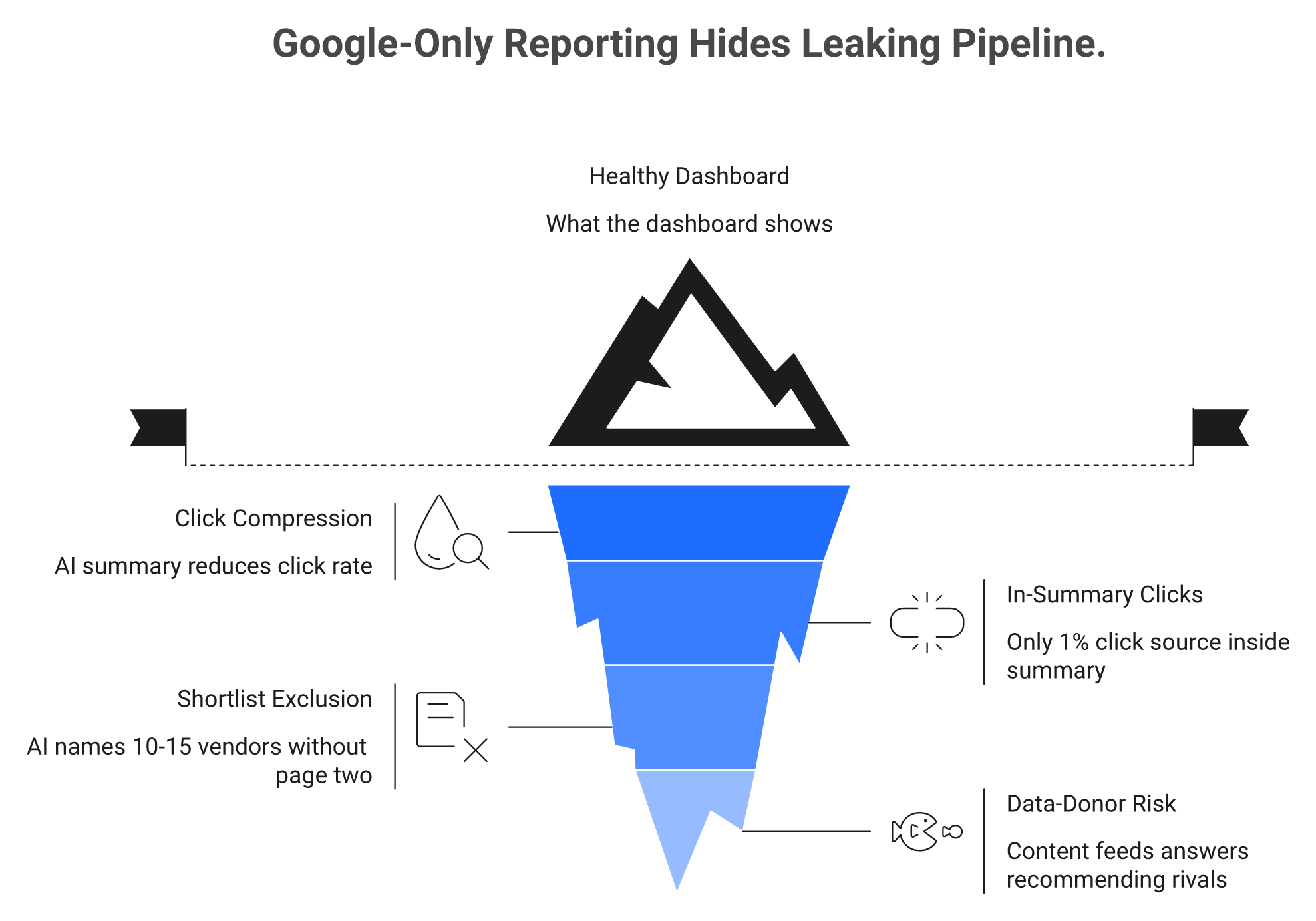
Here is the uncomfortable part. Rankings hold, impressions climb, and the board deck looks healthy. Meanwhile demo requests from organic drift down quarter over quarter.
VPs of Marketing notice the gap before analysts do. The metrics that got approved in the annual plan stopped describing reality.
📉 What the primary data actually shows
Pew Research analyzed 68,879 real Google searches from 900 US adults. When an AI summary appeared, clicks to any result dropped from 15% to 8%, and only 1% clicked a source inside the summary itself. That is not a ranking problem. That is the answer being delivered before the click happens.
At the same time, AI-native traffic is growing fast. Semrush's analysis of billions of visits across 50,000-plus sites put AI traffic growth at 66% during 2025.
⚖️ The forecast nobody agrees on
Honesty matters here, because the headline numbers conflict. Gartner predicted traditional search volume would fall 25% by 2026 as chatbots absorb queries. SparkToro's clickstream work pointed the other way, showing Google search volume still growing through 2024 at scale far above ChatGPT.
Both can be partly right. Search is fragmenting into more surfaces rather than collapsing into one. Planning around "Google is dying" is as wrong as planning around "nothing changed."
🎯 The real exposure is the shortlist
Reframe the risk and the strategy gets clearer. A Head of Sales asks ChatGPT for the best tools for his stack and receives ten names with pros, cons, and pricing. That list is the consideration set.
Hundreds of vendors exist in most categories. Five to ten get named. There is no page two to recover on, which makes this more binary than Google ever was.
💰 What to do with the number on Monday
Do not panic-cut the SEO budget. Reforecast it. Assume meaningful click compression on AI-summary queries, then move the deficit target from sessions to citation share on the questions that touch revenue.
Then ask the harder question. If your content is feeding answers that recommend a competitor, you are funding someone else's pipeline. Krishna calls that becoming a data donor, and it is the quiet failure mode behind most healthy-looking organic dashboards.
The tell is simple to check. Run your ten highest-intent buying questions through ChatGPT and Perplexity this week, and count how often your brand appears at all. Most teams find the number lower than their Google rankings would suggest, and that gap is the actual pipeline risk.
Q3. How do AI engines actually decide which sources to cite?
AI engines retrieve passages, not pages. One prompt fans out into multiple parallel sub-queries, each pulling candidate chunks that are re-ranked into the three or four citation slots that survive. Microsoft's Web IQ grounding layer runs at 164ms p95, so content that cannot be parsed into a self-contained answer capsule inside that budget never enters the inference loop.
🔍 Retrieval in four steps
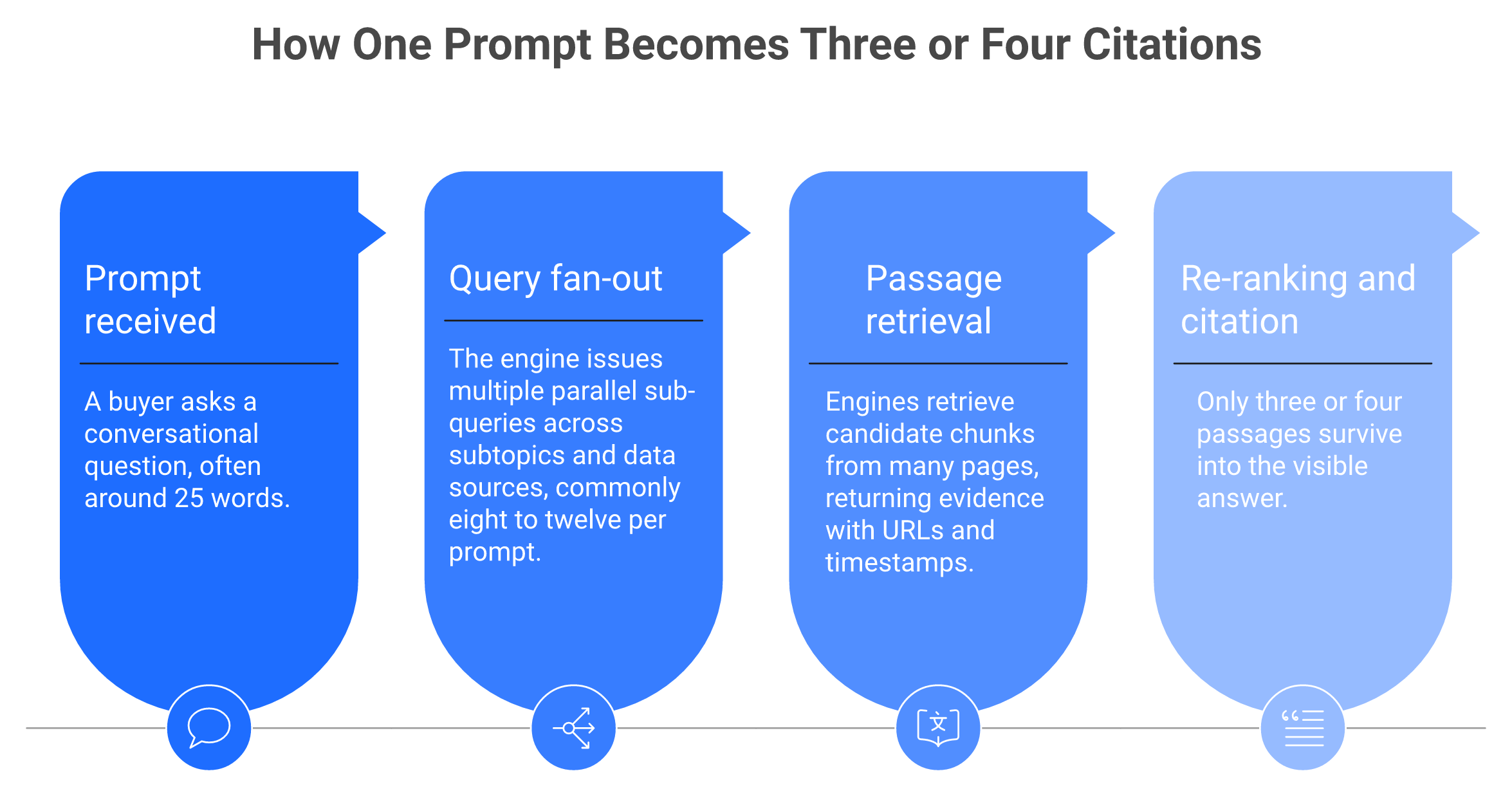
The mechanic is simpler than the mystique suggests. The engine reads the prompt, issues searches, pulls candidate passages, then synthesizes an answer with citations attached.
That third step is where optimization lives. You are not competing for a page position. You are competing for a passage to be selected.
🌐 Fan-out means one prompt becomes many searches
Google documents this directly. Both AI Overviews and AI Mode may use a query fan-out technique, issuing multiple related searches across subtopics and data sources to build a response. Practitioners observing standard AI Mode responses commonly report eight to twelve sub-queries per prompt, though Google does not publish the count.
The planning consequence is concrete. You must be in the candidate pool for several intent variations, not just the head phrasing.
⏱️ Latency is a hard gate, not a nice-to-have
Microsoft states Web IQ delivers 164ms p95 latency, roughly 2.5 times faster than the nearest alternative, and it already sits underneath grounding experiences in Copilot. Web IQ returns passage-level evidence with URLs and timestamps rather than whole documents.
Read that as a design constraint. If your page needs heavy rendering or long-form unpacking before the point arrives, it is expensive to ground and easy to skip.
📈 The ski-ramp distribution
Citation position inside a page is not neutral either. Practitioner analysis of AI citations puts roughly 44% of them in the first 30% of the page, which is why long contextual essays underperform.
MaximusLabs AI traces every claim in its content to papers, patents, and official platform documentation as a standing editorial rule, precisely because folklore about "AI likes helpful content" produces no testable action. Our read is that the standard advice gets this backwards. The format decision is upstream of the writing decision.
🛠️ Three planning rules that fall out of the mechanics
- Lead every section with a standalone 40 to 80 word answer, because the first third of the page carries disproportionate citation weight.
- Write for multiple sub-intents inside one cluster, since fan-out will not reward a single exact-match phrasing.
- Keep the critical claim in server-rendered HTML, so retrieval does not depend on a browser executing scripts.
MaximusLabs AI specifies chunk placement and capsule length in client briefs rather than issuing generic "write helpful content" guidance. That is a direct translation of how grounding APIs consume pages, and it is the difference between content that is readable and content that is retrievable.
Q4. Do ChatGPT, Perplexity, Gemini and Copilot cite different sources for the same question?
Yes. The same prompt returns materially different citation sets per engine. ChatGPT rewards conversational depth and explicit expertise markers, Google AI Overviews rewards answer-first structure and E-E-A-T signals, Perplexity favors recency and source-transparent prose, and Claude favors long-form methodology and academic citation. MaximusLabs AI plans one asset per question cluster, then tunes the format variables each engine rewards.
🔬 One prompt, four different answers
Run "best AI sales tools for a mid-market SaaS team" across four engines. You will get overlapping vendor names but very different sources behind them.
Perplexity leans on recent, clearly attributed pages. ChatGPT frequently surfaces community threads and review platforms. AI Overviews pulls passages from pages that already rank and are snippet-eligible.
🧩 The per-engine planning matrix
| Engine | What it rewards | How to deliver it |
| ChatGPT | Conversational Q&A depth, named expertise | Question-headed H2s, thorough self-contained answers, author credentials |
| Google AI Overviews | Answer-first structure, E-E-A-T, eligibility | 40 to 80 word nuggets, schema matching visible text, indexable rendered HTML |
| Perplexity | Recency, source transparency, readability | Dated references, visible numbered footnotes, plain prose |
| Claude | Methodology, long-form depth, citations | Primary-source references, transparent process explanations |
MaximusLabs AI measures this by running the same prompt set across all four engines during the baseline audit, then logging which sources each one cites. The divergence is the finding, not a rounding error.
🧠 Why the divergence exists at all
Krishna's aha moment came from watching companies appear in ChatGPT while sitting outside Google's top ten. Each platform runs its own retrieval stack, its own trust weighting, and its own citation behavior.
Treating "AI search" as one audience is the most common planning error I see. It produces content that is generically optimized and specifically invisible.
✅ What stays constant across all four
Three things travel everywhere. Self-contained passages, verifiable evidence with named sources, and machine-readable delivery of the page.
That shared core is why a single strong asset can serve every engine. The tuning happens at the format layer, not the content layer, which keeps the plan affordable for a small team.
🎯 Choosing which engine to prioritize first
Prioritize by where your buyers actually are, not by market share headlines. B2B SaaS buyers cluster in ChatGPT and Perplexity for vendor research, while AI Overviews still intercepts the Google-native part of the journey.
MaximusLabs AI helped Nidra Goods rank first across Google, ChatGPT, and Perplexity for its core category term from a single strategy, which only works when the plan treats each engine as a separate scoring system. Start with the one engine your pipeline data implicates most, prove citation movement there, then extend the same asset outward.
Q5. What does an AI visibility baseline audit include?
A baseline audit answers four questions: which prompts your ICP actually asks, how often you appear across each engine, which third-party URLs get cited instead of you, and whether your pages are machine-readable at all. MaximusLabs AI runs 100 to 300 prompts per engine, logging citation share and sentiment monthly. Without that baseline, every later optimization is unmeasurable.
⏰ Most teams optimize before they measure
The usual sequence is backwards. A team reads about answer engine optimization, rewrites twelve pages, adds FAQ schema, then waits for something to happen.
Three months later nobody can say whether it worked. There was no starting number.
🧪 The five steps of a baseline audit
- Build the prompt set. Take your buying-stage questions and write 100 to 300 real phrasings per engine.
- Run them across ChatGPT, Perplexity, Gemini, Copilot, and AI Overviews, logging every cited URL.
- Score citation share, meaning how often your brand appears versus named competitors.
- Record sentiment, because a negative mention is not a win.
- Test extractability on your top pages before blaming the content.
MaximusLabs AI runs this prompt-set analysis before writing a single word, then maps every source those engines already cite. That source map usually matters more than the visibility score itself.
🔍 The JavaScript toggle that exposes hidden trust signals
Step five is the one most audits skip. Turn JavaScript off in your browser and reload a key product or comparison page.
Frequently, the customer reviews vanish. They load asynchronously, meaning the browser fetches them after the page renders, so a crawler that does not execute scripts never sees your strongest trust signal. An AI crawlability check catches this in minutes.
Practitioners are split on how much tooling this requires.
"I'm currently testing SEMrush's AI visibility/tracking tool, and it feels reassuring to know you're not guessing. It shows which themes you rank for most and highlights gaps."
u/anonymous commenter, r/SEO Reddit Thread
"Tracking visibility is not useless, but you will only sleep well when you are part of the brands that can be trusted."
u/anonymous commenter, r/SEO Reddit Thread
💰 Buy cheap tracking, or build cheaper
The tracking category is crowded and converging on similar features. Most tools do the same thing, which is run prompts and log mentions. A side-by-side AEO tools comparison saves a month of trials.
Practitioners who built their own trackers report costs of a few cents per question. That is worth knowing before you sign an enterprise contract for a yes or no monitor.
MaximusLabs AI measures share of voice across engines rather than a single rank, because there is no rank in an AI answer. My honest hedge here: sentiment scoring is still noisy, and I would not fire anyone over a month-to-month swing.
✅ The one-page baseline scorecard
Your output should fit on one page. List citation share per engine, top ten cited third-party URLs, competitor share of voice, sentiment split, and extractability pass or fail per priority page.
MaximusLabs AI treats that scorecard as the contract for the next 90 days, since every later claim of progress gets measured against it. A baseline you can rerun in an afternoon beats a dashboard nobody trusts.
Q6. How do you build the question set, and which questions deserve budget first?
There is no ads API for LLM prompt volume, so use Google keyword data as a directional proxy. Export high-intent terms, convert them into natural questions, cluster the variants, then map each cluster to a buying stage. MaximusLabs AI funds BOFU and MOFU clusters first, keeping only questions where a vendor can legitimately be named.
📊 The data you want does not exist yet
Keyword research had a truth set. Google Ads gave you volume, and everyone planned against it.
Prompt research has no equivalent. Nobody publishes how many people asked ChatGPT a specific question last month.
🔄 The keyword-to-question conversion
The practical workaround is simple and directionally accurate. Export your high-intent keywords, then convert each into the questions a real buyer would type.
"Project management software" becomes "what is the best project management software for a 20-person agency." Average AI chat queries run around 25 words, so write the long, messy version, not the tidy one. A ChatGPT search query extractor speeds up the first pass.
MaximusLabs AI clusters those variants into question groups before assigning any brief, because one strong asset can serve dozens of phrasings.
🧩 Three question types, three different strategies
| Question type | Example | Where the citation comes from |
| Head | "Best CRM software" | Mostly third-party citations, review sites, and communities |
| Mid-tail | "Best CRM for small SaaS teams" | Mix of earned citations and strong owned pages |
| Long-tail | "Does HubSpot route Slack leads automatically" | Almost entirely your own comprehensive content |
Forrester's guidance points the same direction, telling marketers to model persona questions per journey phase rather than optimizing keyword lists. The engine is answering a person, not matching a string.
❌ Why TOFU is the wrong first bet
Here is the filter that saves money. Drop any question where no vendor can honestly be named in the answer.
"What is answer engine optimization" gets answered by every engine already, with or without you. Being cited there produces a nice screenshot and no pipeline.
| Approach | Typical agency sequence | MaximusLabs AI sequence |
| First content wave | TOFU explainers for impressions | BOFU master articles and comparison pages |
| Success metric | Pageviews and impressions | Citation share on revenue-linked prompts |
| TOFU treatment | Core of the calendar | Skipped early, revisited later |
MaximusLabs AI runs BOFU first by design, because those are the questions where being the cited answer converts.
🤖 Let an agent find the gap you would miss
One workflow worth stealing. Point a research agent at community threads in your category and ask it for the most repeated unresolved pain.
A practitioner running this found the top pain across community sites was getting client permission for case studies, a topic missing from the original outline. That is information gain, meaning something the top ten blogs do not already say.
🎯 The prioritized backlog
Rank clusters by revenue proximity first, competitive gap second, and effort third. Volume is the tiebreaker, not the sort key.
MaximusLabs AI sequences comparison pages and category listicles ahead of explainers, since AI shortlists form at exactly that decision moment. Ten well-chosen clusters beat forty briefs sorted by search volume, and they cost less to produce.
Q7. What content structure actually earns AI citations?
Citations follow evidence density, not word count. The Princeton GEO study tested nine tactics across 10,000 queries: citing sources, adding statistics, and adding quotations lifted visibility 30% to 40%, while keyword stuffing scored below baseline. MaximusLabs AI opens every H2 with a 40 to 80 word standalone answer, then keeps supporting paragraphs short and evidence-heavy.
📚 Nine tactics tested, three that won
The Princeton, IIT Delhi, and Georgia Tech team built GEO-bench, a 10,000-query benchmark, then tested nine content changes against real generative engines. Adding statistics lifted visibility by roughly 40%, and citing sources performed similarly.
Keyword stuffing went the other way, scoring around 10% below baseline. The old lever actively hurts.
⚖️ The equalizer effect is the budget argument
This is the finding challengers should be quoting in board meetings. Pages sitting around position five gained up to 115% more visibility after citation optimization, while already top-ranked pages saw slight decreases.
Translation for a founder with finite cash: you do not need to outrank the incumbent to outcite them. MaximusLabs AI takes that as the core reason a Series A team can beat a billion-dollar competitor inside an AI answer, though I would not promise the effect holds equally in every category.
✂️ Short blocks beat long essays
Retrieval works on passages, so paragraph length is a structural decision, not a style preference. Keep supporting paragraphs in the 40 to 60 word range so each one survives extraction alone. That is the core of content formatting for AI search.
Anthropic's Citations API documentation reports that sentence-level chunking improves recall accuracy meaningfully over coarser splitting. The practical read is that a self-contained paragraph is easier to lift than a beautiful one.
⭐ Information gain versus the sixth summary
Most content in this category summarizes five articles and produces a sixth. Engines increasingly have no reason to cite the sixth.
The penalty for being average has never been so severe. What earns a citation is the thing only you can say: your own numbers, your own test, your own contrarian read with the working shown. The founder voice methodology exists for exactly that reason.
MaximusLabs AI scores every draft on a ten-dimension rubric, with a hard 80 out of 100 floor for hub pages, and factual density is one of the ten. Anything that fails there gets rewritten, not published.
✅ The answer capsule template
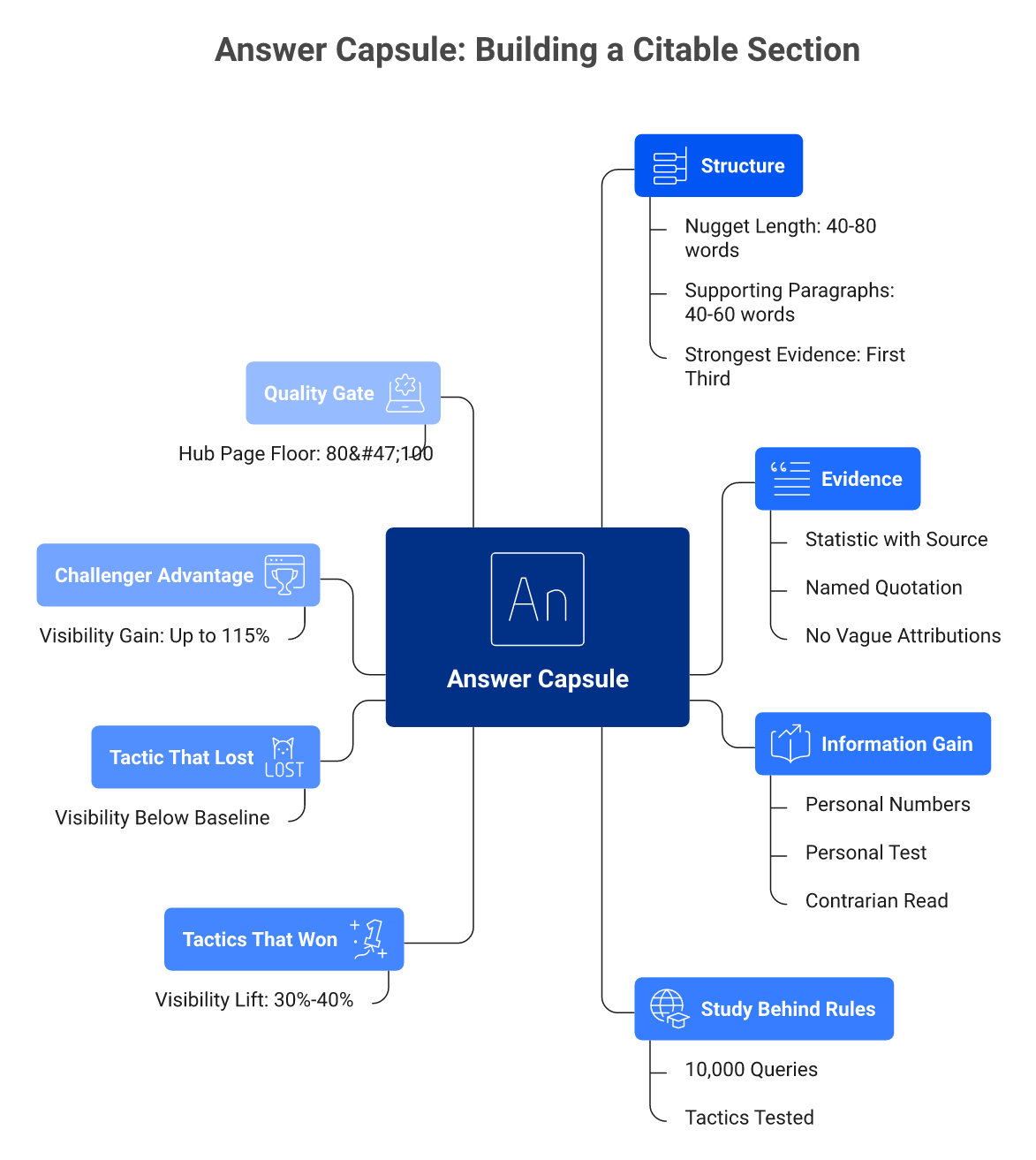
Build every section the same way:
- A 40 to 80 word standalone answer directly under the heading, written to make sense with nothing around it.
- Two or three supporting paragraphs of 40 to 60 words each, one idea per paragraph.
- At least one verifiable statistic with source, year, and sample size named inline.
- One named quotation or primary-source reference, not a vague "studies show."
- Strongest evidence placed in the first third of the page, where citation density concentrates.
MaximusLabs AI applies that capsule structure across every client article, which is why our briefs specify block lengths rather than total word counts. Length is an output. Extractability is the input.
Q8. Which technical work gates AI visibility, and which is audit theatre?
Three technical items genuinely gate AI visibility: crawler access for GPTBot, ClaudeBot, and PerplexityBot; server-rendered HTML so trust signals like reviews are not hidden behind JavaScript; and accurate meta descriptions, since answer engines often ground on a short excerpt. Google confirms no extra markup is required beyond normal indexing and snippet eligibility. Core Web Vitals tuning is not an AEO lever.
📄 The fifty-page audit as security blanket
Every AEO engagement seems to open with a technical audit. Fifty pages, color-coded severity, hundreds of tickets.
Six months later the citation count has not moved. The audit felt like progress because it was measurable, not because it was causal.
⚠️ The schema disagreement, stated honestly
The industry does not agree here, so pretending otherwise is dishonest. SALT.agency argues schema is a hygiene factor at best and not a differentiator, while Surfer Academy argues it significantly increases your odds by telling AI tools what your content is.
MaximusLabs AI's read sits between them. Schema helps engines parse what already exists, but it will not make a thin page citable, so treat it as plumbing rather than strategy.
"Worth it when you apply it deliberately, optimizing content, adding schema, FAQs, and internal links. Not worth it if you think it will automatically solve all problems."
u/anonymous commenter, r/DigitalMarketing Reddit Thread
"As a small business, stick with GSC and GA4 for the moment. There are plenty of AI Visibility tools out there, but they're still quite pricey."
u/anonymous commenter, r/DigitalMarketing Reddit Thread
✅ The three fixes that actually gate retrieval
Google's documentation is direct. Pages need standard indexing and snippet eligibility, and controls like nosnippet or a restrictive max-snippet will block inclusion in AI features.
So the short list is:
- Allow the AI crawlers you want in robots.txt, and confirm the logs show them arriving.
- Serve critical content and trust signals in rendered HTML, not client-side scripts.
- Write meta descriptions as accurate summaries, because that excerpt often becomes the grounding text.
MaximusLabs AI runs a one-week dev sprint covering schema, rich-text modules, and JavaScript minimization before any content ships, so the first published article is already extractable.
🍳 The ghost kitchen problem
Agentic commerce makes this concrete. Your website is the dining room, but the data feed is the kitchen, and the AI only needs the kitchen to fulfill the order.
OpenAI's product feed specification requires an enable_search boolean, formerly documented as is_eligible_search, that controls whether a product can surface in ChatGPT search at all. Set it wrong and beautiful design changes nothing.
💸 The one-sprint checklist
Do this in a week, then stop. Verify crawler access, disable JS-dependent rendering of key content, rewrite meta descriptions on priority pages, add schema that matches visible text, and check feed flags if you sell products. The AEO implementation checklist covers the full sequence.
MaximusLabs AI does not bill clients for Core Web Vitals work as an AI visibility lever, because the evidence for that link is thin. Fix the gates, then spend the remaining budget on evidence and earned citations.
Q9. How much of the plan should be earned citations rather than your own site?
For broad head questions, earned citations outweigh your own pages. AI engines build brand understanding from web-wide consensus, including G2, Capterra, Reddit, YouTube, Wikidata, and specific editorial URLs. MaximusLabs AI routes roughly 60% of head-question effort into earning mentions on the exact URLs that target prompts already cite, rather than into new blog posts.
💸 The budget goes to the blog, the citation goes elsewhere
Most AEO budgets land on owned content. Twelve new articles, a refreshed pillar page, and some schema.
Then you run the head question, "best tools for X," and the engine cites a review site, a Reddit thread, and a competitor's comparison page. Your twelve articles are nowhere.
🧠 Consensus beats self-published claims
One practitioner watched Perplexity summarize their article and describe the authors as Oxford researchers. None of them went to Oxford.
The engine had assembled that from mentions elsewhere on the web, not from the page itself. What gets repeated most tends to win, which is uncomfortable but useful.
Reported correlations between brand mention volume and AI visibility sit around r=0.664 in practitioner datasets. I would treat that as directional, not gospel, since methodology varies widely.
"Tools powered by AI, such as ChatGPT, tend to reference platforms like Reddit and G2 more frequently than conventional blog posts."
Commenter, r/SaaS Reddit Thread
"Absolutely, each comment on Reddit has its unique URL, making it entirely citable."
Commenter, r/SEO Reddit Thread
🔗 Close the sameAs loop first
Before chasing mentions, make your entity legible. Schema.org's sameAs property links your site to your other verified profiles, which is the foundation of knowledge graph consistency.
The goal is a closed loop. An engine should be able to travel from your website to Wikidata, LinkedIn, Crunchbase, G2, and back, with the same company name, founding date, and category everywhere.
MaximusLabs AI audits that loop during onboarding, because inconsistent entity data is the most common cause of hallucinated brand facts in AI answers.
🛠️ The Search Everywhere workstream
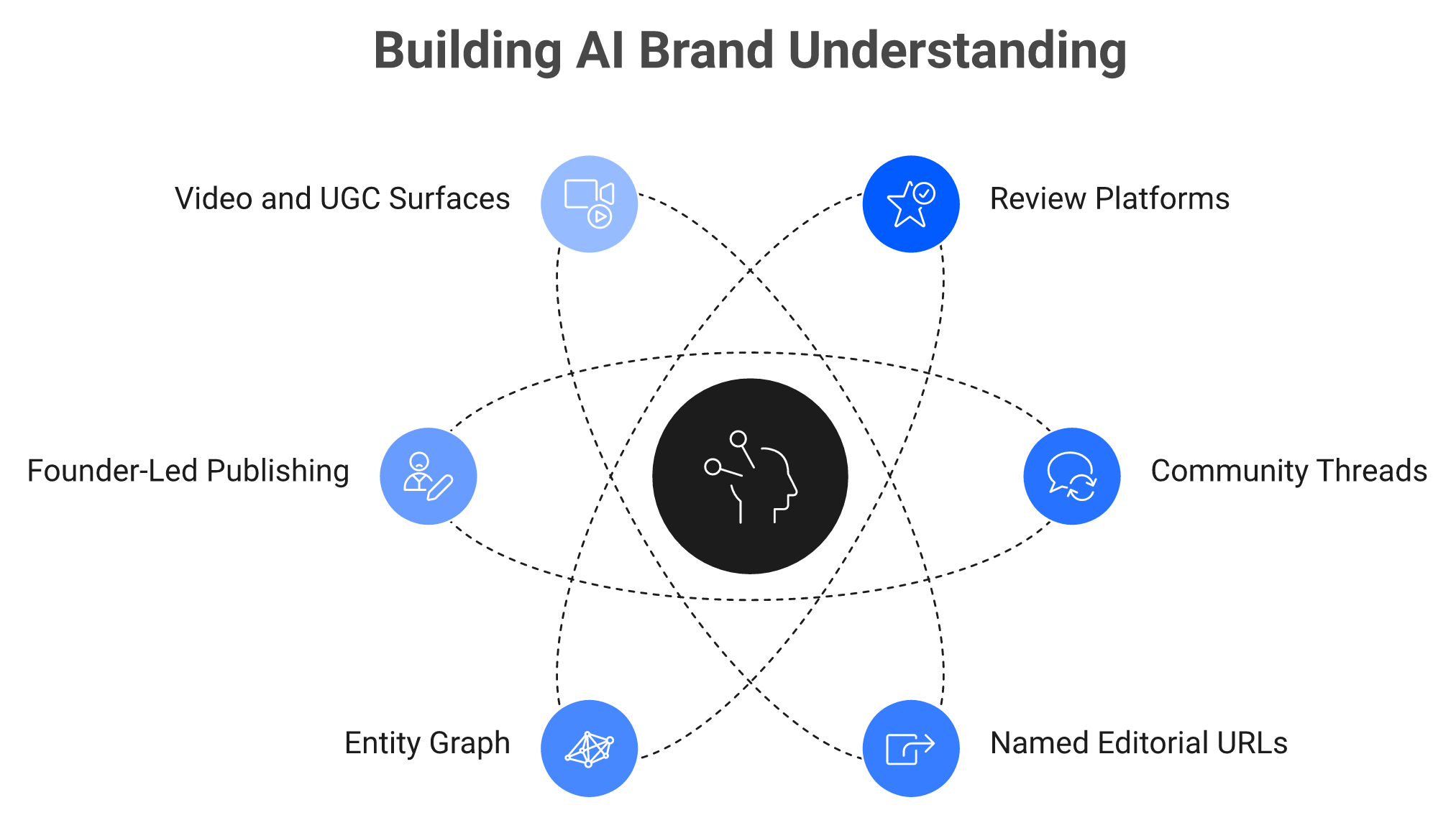
Four surfaces, run in parallel:
- Review platforms. Claim G2 and Capterra profiles, then earn ten or more credible reviews per platform.
- Community threads. Find the specific threads engines already cite, then contribute genuinely useful answers.
- Named editorial URLs. Target the exact article that gets cited, not the domain.
- Founder-led publishing. Publish under a real person with a verifiable profile.
MaximusLabs AI reports that Oliv AI reached a 64% citation rate across AI platforms within six months of GEO work, ahead of billion-dollar incumbents measured at 30%. That is our own client data, not third-party research, so weigh it accordingly.
⚖️ The 60/40 split
Split effort by question type, not by preference. Head questions get roughly 60% earned and 40% owned. Long-tail questions flip that ratio, because no publisher will answer "does your tool sync Slack leads automatically" for you.
MaximusLabs AI calls this Search Everywhere Optimization, and the honest version is that it is slower and less controllable than publishing. It also happens to be where the citations actually live.
Q10. How do you measure AEO and tie it to revenue?
Measure AEO on four numbers: citation share per prompt cluster, share of answer versus named competitors, sentiment of each mention, and pipeline sourced from AI referrals. Volume will look tiny, since Ahrefs recorded AI visitors at 0.5% of sessions but 12.1% of signups. MaximusLabs AI reports conversion quality rather than sessions, because session-based reporting kills channels that are quietly working.
📉 Rank reporting breaks here
There is no position one in an AI answer. Run the same prompt twice and the citation set can change.
That is why the old report format fails. A ranking table cannot describe a system that generates a fresh answer each time.
📊 The four metrics that replace it
| Metric | What it measures | How to read it |
| Citation share | How often you appear per prompt cluster | The core visibility number |
| Share of answer | Your appearances versus named rivals | Competitive position |
| Sentiment | Whether the mention helps or hurts | A negative mention is not a win |
| Sourced pipeline | Deals influenced by AI referrals | The number the CFO cares about |
Forrester's guidance points the same way, telling marketers to shift toward share of search and answer-engine saturation instead of rankings and impressions. The full metric set sits in our AEO measurement framework.
🔍 Attribution mechanics that actually work
Two mechanisms, both cheap. Create a dedicated AI-referral channel group in GA4 so ChatGPT, Perplexity, and Copilot referrals stop landing in "other."
Then add a self-reported field to demo and signup forms. When the citation sends no click, that free-text answer is often your only signal. This is the practical core of revenue attribution for GEO.
MaximusLabs AI pairs both, since neither alone captures a buyer who read the answer, remembered the name, and typed the domain directly a week later.
💰 Small volume, high conversion
The pattern repeats across datasets. Ahrefs found AI visitors made up 0.5% of sessions but 12.1% of signups.
Practitioners report the same shape at smaller scale.
"Visitors referred by AI converted at 4.4 times the rate of those arriving via Google organic search. Their average time on site was about 40% higher."
Commenter, r/SaaSMarketing Reddit Thread
"AI citations are way more volatile than Google rankings."
Commenter, r/SaaS Reddit Thread
That second quote matters as much as the first. Volatility means you report trends across months, not week-to-week swings.
✅ The one-page monthly report
| Reporting approach | Typical agency retainer | MaximusLabs AI |
| Headline metric | Impressions and rankings | Citation share and sourced pipeline |
| Failure mode | Traffic up, revenue flat | Slower to show movement |
| Cadence | Weekly ranking updates | Monthly prompt-set rerun |
MaximusLabs AI is genuinely slower on the dashboard, and clients feel that in month one. My read is that the tradeoff is worth it, because a metric that survives a CFO review is the only one that protects the budget in month six.
Q11. What does a 90-day AEO plan look like, who owns each phase, and should you build or hire?
Run AEO in three 30-day blocks. Days 1 to 30, baseline the prompt set and fix crawler, rendering, and schema gaps. Days 31 to 60, rebuild BOFU pages as answer capsules with cited evidence. Days 61 to 90, earn citations on the URLs your prompts already surface. MaximusLabs AI assigns one accountable owner per block, and expects citation-share movement in cycle two.
🗓️ The phase, owner, and KPI matrix
| Phase | Owner | Primary KPI | Engines watched |
| Days 1 to 30, baseline and fix | Engineering plus SEO lead | Extractability pass rate, baseline citation share | All five |
| Days 31 to 60, content rebuild | Content lead | Answer capsules shipped on BOFU pages | ChatGPT, AI Overviews |
| Days 61 to 90, earned citations | Comms or founder | Mentions on cited URLs, review count | Perplexity, ChatGPT |
Enterprise guidance sequences the same way, putting monitoring first, optimization second, and governance third. MaximusLabs AI runs its technical sprint inside week one for exactly that reason, so content never ships onto a page engines cannot parse.
🎯 The plan changes by company stage
Early-stage teams should go citations-first. Ranking for a head term in Google takes years, while getting named in a cited thread can take weeks. That sequencing is covered in our GEO playbook for SaaS startups.
Mid-stage teams own their product queries. Late-stage teams expand into the problems they solve and the full buyer journey.
"The new SEO paradigm (GEO): Establish authority, gain AI citations, earn trust prior to the click."
Commenter, r/LLMO_SaaS Reddit Thread
💰 Build, hire, or do it with zero budget
Start with the honest answer. If you have no budget, fix your fundamentals, write far deeper than the top ten blogs, and talk about your buyers' actual problems. That alone gets you into some answers.
| Model | Cost per content piece | GEO depth | Speed to start |
| MaximusLabs AI | ~$60 | Deep, AI-search native | 2 days |
| In-house team | ~$800 | Depends on hires | Weeks to months |
| Traditional agency | ~$260 | Often surface-level | 2 weeks plus 1 month |
| Freelancer | ~$100 | Rarely | Variable |
Those figures come from MaximusLabs AI's own published pricing comparison, so treat the competitor columns as our estimate rather than audited data.
⚠️ How to vet any partner
Ignore the tactic list. Every deck now says GEO.
Ask three questions instead: who did you work with, when did you start, and what did visibility look like before and after. Then verify independently, using an agency evaluation framework rather than a pitch deck.
Practitioner conversion claims vary wildly, which is a useful filter.
"Traditional organic search maintains a conversion rate between 2.5% and 4%. Traffic from AI sources shows 12% to 25%, depending on the niche."
Commenter, r/seogrowth Reddit Thread
Any partner quoting the top of that range as a guarantee is selling, not measuring.
⏰ Monday morning, first move
Run ten buying-stage prompts across ChatGPT and Perplexity. Log who gets cited. That single hour tells you whether phase one is a content problem or a citation problem.
What I am still sitting with: as agentic tools start transacting on behalf of buyers, does citation share stop being a visibility metric and become a distribution metric? MaximusLabs AI is testing that now, and I would genuinely like to hear from anyone tracking it differently. Write to krishna@maximuslabs.ai or get in touch here.
Frequently asked questions
What is AEO strategy planning, and how is it different from an SEO plan?
AEO strategy planning is the documented process of deciding which buyer questions you will win inside AI answers, which owned assets and earned citations get you there, who owns each phase, and how citation share maps to pipeline. An SEO plan optimizes for a ranked blue link. An AEO plan optimizes for being the source ChatGPT, Perplexity, Gemini, Copilot, and Google AI Overviews name when a buyer asks. Five components separate the two documents: Targeting unit: question clusters mapped to buying stage, not keywords sorted by volume. Owned assets: answer capsules built for passage extraction, not pages built to rank as a whole. Earned layer: named citation URLs, review platforms, and communities, not generic backlinks. Extractability: rendered HTML, schema, and crawler access per bot. Measurement: citation share and sourced pipeline, not sessions. MaximusLabs AI coined RAEO and R-GEO, the revenue-focused variants of answer engine and generative engine optimization, to force one question into every plan: does this cluster touch pipeline? Our first artifact is a question-to-pipeline map rather than a content calendar. If you want the deeper framing, read our AEO strategy hub . Good SEO fundamentals still transfer, but the planning artifact genuinely changes shape.
How long does an AEO strategy take to show results?
Plan for one 90-day cycle before you expect meaningful citation-share movement, and a second cycle before you expect pipeline attribution to stabilize. The sequence that works is three 30-day blocks: Days 1 to 30: baseline your prompt set across every engine, then fix crawler access, rendering, and schema gaps. Days 31 to 60: rebuild bottom-of-funnel pages as answer capsules with cited evidence and named quotes. Days 61 to 90: earn citations on the exact URLs your target prompts already surface. Two honest caveats. AI citations are more volatile than Google rankings, so a single bad week means very little. Trust also compounds, which means early movers build a durable advantage while late adopters fight entrenched patterns. MaximusLabs AI assigns one accountable owner per block across engineering, content, and communications, because unowned phases are the most common reason a 90-day plan slips to six months. We also rerun the same prompt set monthly rather than weekly, since month-over-month trend lines are the only signal worth reporting. Our AEO implementation checklist maps the full sequence.
How do I run an AI visibility baseline audit before I optimize anything?
A baseline audit answers four questions: which prompts your ICP actually asks, how often you appear across each engine, which third-party URLs get cited instead of you, and whether your pages are machine-readable at all. Run it in five steps: Build a prompt set of 100 to 300 real buying-stage phrasings per engine. Run them across ChatGPT, Perplexity, Gemini, Copilot, and AI Overviews, logging every cited URL. Score citation share against named competitors. Record sentiment, because a negative mention is not a win. Test extractability before blaming the content. That last step is the one most audits skip. Turn JavaScript off and reload a key comparison page. If your customer reviews vanish, they load asynchronously and crawlers that do not execute scripts never see your strongest trust signal. MaximusLabs AI runs this prompt-set analysis before writing a single word, then maps every source those engines already cite, because the source map usually matters more than the visibility score. You can pressure-test rendering yourself with our AI crawlability checker . Without a baseline, every later optimization is unmeasurable.
Which questions should get budget first in an AEO plan?
Fund bottom-of-funnel and middle-of-funnel question clusters first. Those are the prompts where a vendor can legitimately be named, which means being the cited answer can actually convert. There is no ads API for LLM prompt volume, so use Google keyword data as a directional proxy. Export your high-intent terms, convert each into the long, messy question a real buyer would type, then cluster the variants. Average AI chat queries run around 25 words, so write the nuanced version. Then apply the filter that saves money: Keep questions where products, vendors, or comparisons appear in the answer. Drop purely informational prompts every engine already answers without you. Rank clusters by revenue proximity first, competitive gap second, effort third. Volume is the tiebreaker, not the sort key. MaximusLabs AI sequences comparison pages and category listicles ahead of explainers, because AI shortlists form at exactly that decision moment, and we skip top-of-funnel content early by design. Ten well-chosen clusters beat forty briefs sorted by search volume. Our guide to AEO question research covers the clustering method in full.
What content structure actually earns citations from AI engines?
Citations follow evidence density, not word count. The Princeton, IIT Delhi, and Georgia Tech GEO study tested nine tactics across 10,000 queries. Citing sources, adding statistics, and adding quotations lifted visibility roughly 30% to 40%, while keyword stuffing scored below baseline. There is a second finding challengers should quote in budget meetings. Pages sitting around position five gained up to 115% more visibility after citation optimization, while already top-ranked pages saw slight decreases. You do not need to outrank the incumbent to outcite them. Build every section the same way: A 40 to 80 word standalone answer directly under the heading. Supporting paragraphs of 40 to 60 words, one idea each, so every block survives extraction alone. At least one verifiable statistic with source, year, and sample size named inline. One named quotation or primary-source reference, never a vague "studies show." Strongest evidence in the first third of the page, where citation density concentrates. MaximusLabs AI scores every draft on a ten-dimension rubric with a hard 80 out of 100 floor for hub pages, and factual density is one of the ten. See our answer structure guide for the full template.
How much of an AEO budget should go to earned citations instead of my own content?
Split effort by question type rather than preference. For broad head questions, route roughly 60% of effort into earned citations and 40% into owned pages. For long-tail questions, flip that ratio, because no publisher will answer a hyper-specific product question for you. The reason is uncomfortable but consistent. AI engines assemble brand understanding from web-wide consensus, not from what you publish about yourself. Practitioners have watched engines invent credentials for authors based purely on mentions elsewhere on the web. Four earned surfaces run in parallel: Review platforms: claim G2 and Capterra profiles, then earn ten or more credible reviews each. Community threads: find the specific threads engines already cite and contribute genuinely useful answers. Named editorial URLs: target the exact article that gets cited, not the domain. Entity consistency: close the sameAs loop from your site to Wikidata, LinkedIn, Crunchbase, G2, and back. MaximusLabs AI reports that Oliv AI reached a 64% citation rate across AI platforms within six months, ahead of billion-dollar incumbents measured at 30%. That is our own client data, so weigh it accordingly. More on this in our citation acquisition playbook .
What metrics prove AEO is working, and how do I tie them to revenue?
Rank reporting breaks in AI search, because there is no position one and the same prompt can return a different citation set twice in a row. Replace it with four numbers. Citation share: how often you appear per prompt cluster. Share of answer: your appearances versus named competitors. Sentiment: whether the mention helps or hurts. Sourced pipeline: deals influenced by AI referrals. Volume will look tiny, and that is the trap. Ahrefs recorded AI visitors at 0.5% of sessions but 12.1% of signups. If you report sessions, you will kill a channel that is quietly working. Two attribution mechanisms cost almost nothing. Create a dedicated AI-referral channel group in GA4 so ChatGPT, Perplexity, and Copilot stop landing in "other." Then add a self-reported field to demo and signup forms, because a citation that sends no click still creates demand. MaximusLabs AI reports citation share and pipeline influence rather than impressions, which is genuinely slower to show movement in month one but survives a CFO review in month six. Our AEO measurement framework details the reporting cadence.