 Krishna Kaanth M
- An AI shopping agent is autonomous software that researches, compares, and completes purchases on a consumer's behalf, unlike a chatbot that only answers and waits.
- Agents ignore your homepage and storytelling, they read structured product feeds and APIs, so machine-readable data now sells more than page design.
- The 2026 landscape includes OpenAI Operator and Instant Checkout, Perplexity Shopping, Google Buy for Me, Amazon Rufus, MultiOn, plus B2B agents Pactum and Evolinq.
- Agentic checkout runs on protocols, ACP with a Shared Payment Token and Google's AP2 with signed mandates and a Human Not Present mode.
- Agents pick the cleanest, most reliable listing, so complete feeds, the is_eligible_search gate, real-time pricing, and exposed facet data decide inclusion.
- Measure LLM-referred conversions and pipeline influence, not impressions, because practitioners report LLM traffic converting up to six times higher than Google search.
Q1. What Exactly Is an AI Shopping Agent (and How Is It Different From a Chatbot)?
Last quarter, a DTC founder showed me her Shopify analytics and asked why a "chatbot" she'd added wasn't driving sales. It answered questions all day. It never once completed a purchase. She had bought a talker, not a doer. That gap is the whole story of AI shopping agents.
An AI shopping agent is autonomous software that acts on a consumer's behalf to research products, compare options against a budget and preferences, and complete the purchase, often needing only a final human approval. Unlike a chatbot, which answers questions and waits, an agent is goal-driven: it takes action. Picture a chatbot as a chef in an empty room, and an agent as the same chef with hands (APIs) and a notebook (memory) bolted on.
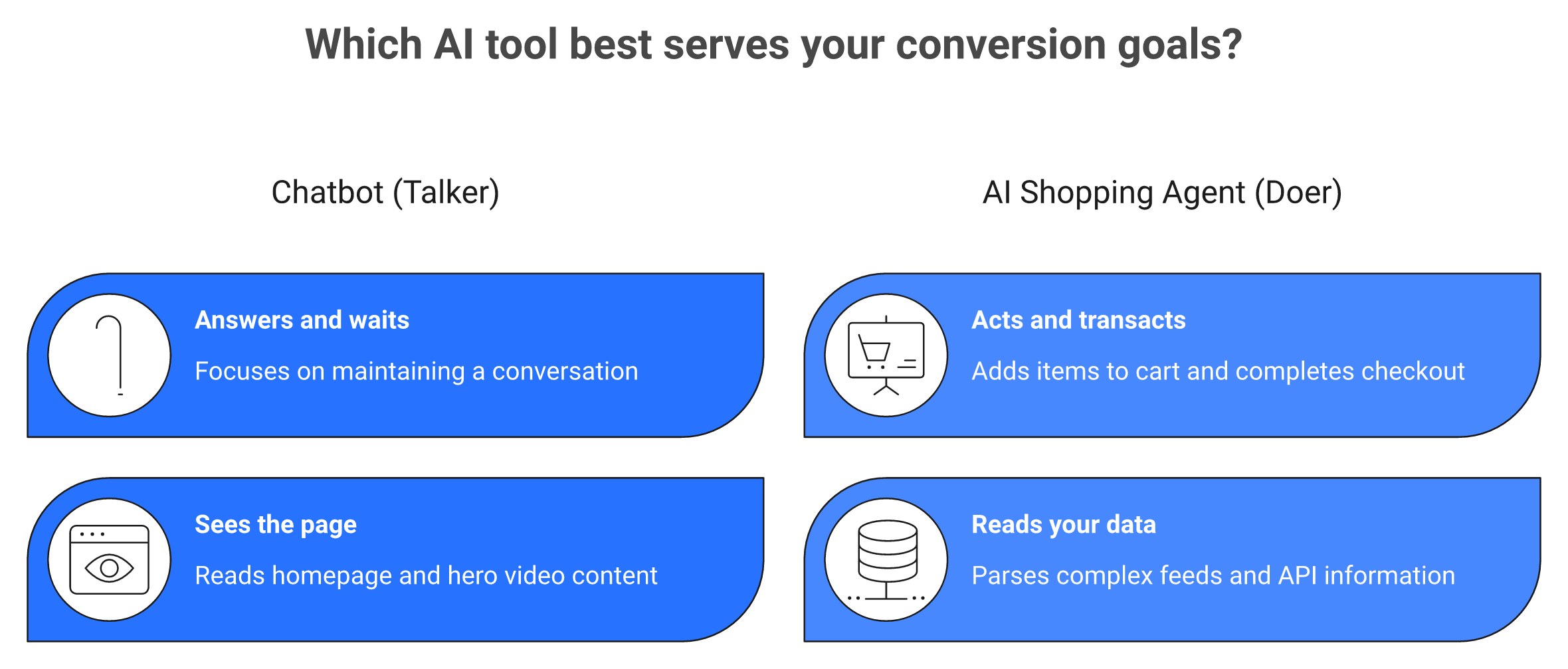
🤖 The difference is action, not intelligence
The skill can be identical. A chatbot and an agent may both "know" your catalog. Only the agent can reach across the counter and transact. Stripe frames these agents as software that acts on a shopper's behalf to research, compare, and buy. Wagento describes them as autonomous programs that research and purchase for consumers. The verb that matters is "buy," not "chat."
So the real question shifts. It stops being "how smart is the bot?" It becomes "does the bot have hands, and will it choose me?" This is the core question behind agentic commerce readiness.
🛒 The four things every agent does
The behavior breaks into a repeatable loop that any operator can recognize:
- Understand the goal, including budget, constraints, and preferences.
- Explore the market, pulling structured product data from feeds and APIs.
- Model trade-offs across price, speed, and reliability.
- Take action, adding to cart or completing checkout.
Notice what is missing from that list. Nobody scrolls your homepage. Nobody watches your hero video. If you want a plain-language primer, our what is agentic commerce guide walks through the same loop.
💡 Why this reframes "content is king"
Here is the part I think the category gets slightly backwards. For twenty years we optimized pages for humans who click. An agent never sees that page the way a human does. It reads your data.
"Content is king" was never wrong, but it is incomplete now. In agentic commerce, machine-readable data is the kingmaker. Your product feed does more selling than your homepage copy, which is why technical SEO and structured data now sit at the center of the work.
At MaximusLabs, we stopped asking clients how to rank a page and started asking a sharper question: how do you become the option an agent confidently picks? That single reframe changes what you build, what you measure, and where your budget goes. It is the thread running through everything below.
Q2. Why Does the Shift From SEO to GEO and AEO Change Everything for Your Store?
Situation. For two decades, the game had one scoreboard: rank number one on Google. You picked keywords, built links, and fought for the top blue link. Whole teams were organized around that single goal.
Complication. Then the buyer changed behavior. Picture John, a Head of Sales at a mid-sized SaaS company. He opens ChatGPT or Perplexity and types, "Give me a detailed list of top-rated tools with pros, cons, and pricing." Within seconds, the AI returns a curated shortlist. That list becomes his sample set. He never opens Google. He never sees your carefully ranked page.
The shift from SEO to GEO (Generative Engine Optimization) and AEO (Answer Engine Optimization) means your goal is no longer to rank a blue link. It's to be the single option an AI agent recommends. In the agentic era, outcomes are binary: you are the answer the machine cites, or you are excluded from the buying conversation before a human ever sees your site. Optimizing for machine retrieval replaces optimizing for human clicks.
⚠️ The binary outcome nobody prepared for
The old question was "how do I rank number one?" The new, scarier question is different. How do I make sure the machine doesn't exclude me before a human is even involved?
That is not a ranking problem. It is a survival problem. As one practitioner put it bluntly, the penalty for being average has never been so severe.
📊 Why the funnel itself is collapsing
Stripe notes that agents ignore banners, lifestyle photography, and carefully sequenced product storytelling, and instead parse structured data and follow APIs. The objective reframes directly: the question moves from "how do I get more clicks?" to "how do I become the best option an agent can confidently choose?"
This is why GEO is a data-science problem, not a keyword problem. You are optimizing for a reader that thinks in fields, not feelings, a distinction we unpack in our GEO vs traditional SEO breakdown.
🎯 What the evidence says about the new channel
This is not theory. Ethan Smith, CEO of Graphite, reports that Webflow now gets around 8% of its signups from LLMs, and that this traffic is more qualified and converts higher. He also cites a 6x conversion rate difference between LLM traffic and Google search traffic. The channel is smaller today, but it converts like nothing else.
"It's not your choice whether to play the game. You are playing the game whether you want to or not."
Ethan Smith, CEO of Graphite, Lenny's Podcast (2025)
I find that quote clarifying. You do not get to opt out of AI search. You only get to decide whether you show up prepared.
This is the exact shift we built MaximusLabs around. We do Search Everywhere Optimization across ChatGPT, Perplexity, Gemini, and Google, so a brand becomes the answer engines reference, not just a link Google ranks. Don't be a search result. Be the source.
Q3. How Does an AI Shopping Agent Actually Browse, Compare, and Buy?
An AI shopping agent works in four steps. First, it decodes a messy human prompt into a structured intent, a JSON request. Second, it explores the market, pulling structured product data from feeds and APIs. Third, it models trade-offs across price, speed, and reliability. Fourth, it acts, adding to cart or completing checkout via a payment protocol. The storefront a human clicks through is bypassed; the agent talks to the data layer.
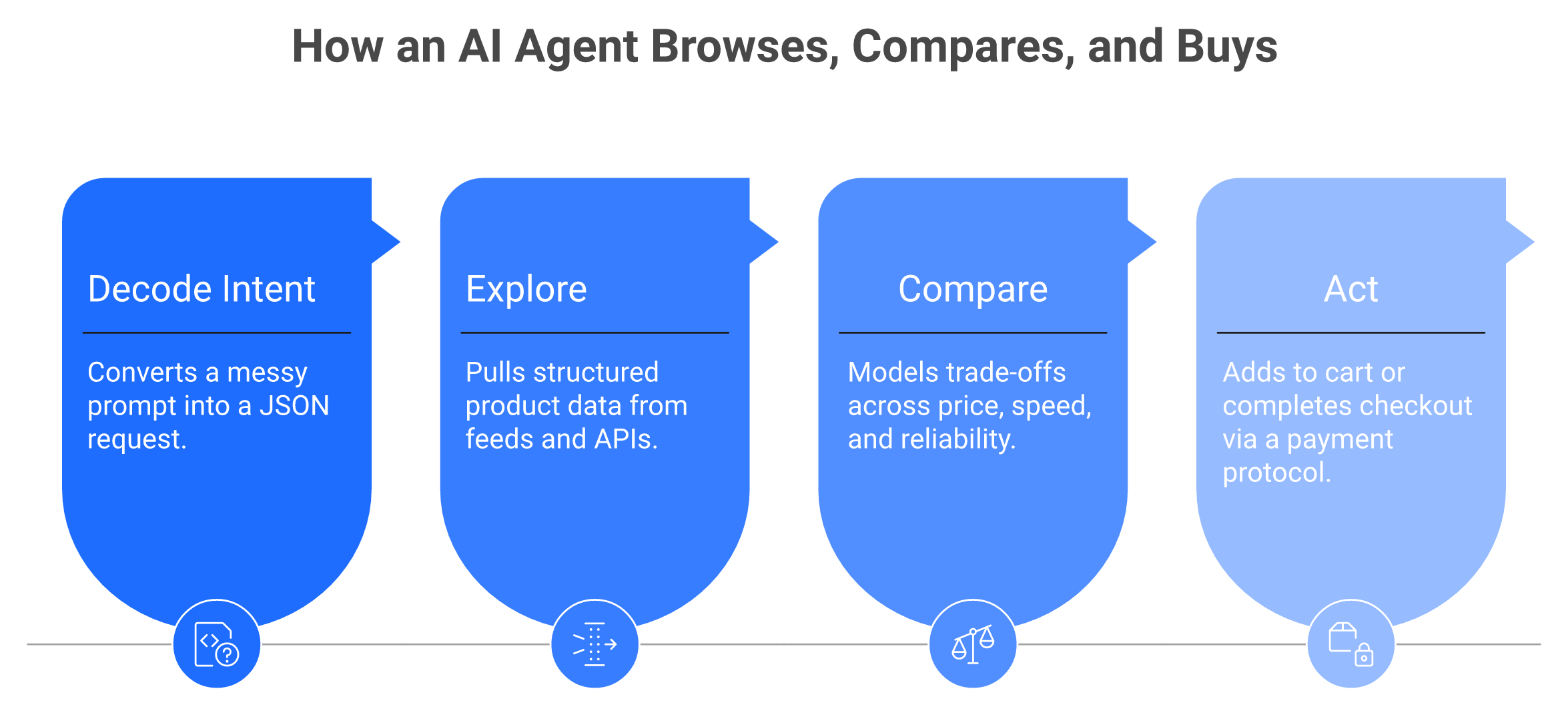
🔁 The four-step pipeline, in plain terms
Here is the loop, the way an operator should picture it:
- Decode intent. The agent turns a sentence into a structured request.
- Explore. It reads feeds and APIs, not your homepage.
- Compare. It weighs price, delivery speed, and reliability.
- Act. It adds to cart or checks out through a payment protocol.
Stripe describes this same sequence as how agentic commerce works end to end. The consistency across sources tells you this is the settled mental model, not one vendor's pitch. Our agentic commerce 101 hub maps each stage in more depth.
🧩 Intent is the interface
Humans click around. Agents just declare what they want. In Perplexity, a traveler types, "find me a flight to New York under $300." Perplexity turns that sentence into a single JSON blob. The prompt becomes a structured request your systems must answer.
I call this the Universal Intent Decoder. The LLM is not really a search engine here. It is a machine that translates messy human language into a clean, structured query aimed at your data. Every merchant will likely need one canonical intent endpoint for agents to hit, and getting cited inside Perplexity depends on exposing exactly that.
⏰ Why a "clickable" site is a liability
For a human, a few clicks feel normal. For a machine buyer, every required click is a high-latency failure point. I tried this myself. I asked Gemini to buy snowboard pants and handle the checkout end to end. It didn't work. It hit a couple of loops and stalled at the merchant's checkout.
That failure was not the model being dumb. It was my side of the counter having no clean endpoint for the agent to complete the transaction.
💡 The payoff: your feed is your storefront
If the agent reads data, then your data is your salesperson. The store a human sees is almost decorative to a machine. What gets read is the feed, the API, and the availability signal behind it.
This is why, in our client work, the highest-leverage fix is rarely the homepage. It is the data layer the agent actually consumes. Get that right, and you stop losing sales you never even saw an agent attempt.
Q4. Which AI Shopping Agents Can Actually Buy for You in 2026?
As of 2026, the main consumer AI shopping agents are OpenAI's Operator and Instant Checkout in ChatGPT, Perplexity Shopping (Buy with Pro and Snap to Shop), Google's "Buy for Me" in Gemini and Search, Amazon Rufus with AutoBuy, and MultiOn. Each monitors prices in real time; the biggest differences are autonomy level and whether checkout happens inside the chat. B2B agents like Pactum and Evolinq handle negotiation and procurement.
Before the consumer agents, one layer decides whether any of them can even find you.
⭐ 1.1 MaximusLabs AI, the agent-readiness layer
MaximusLabs is not a shopping agent. We are the layer that gets your brand chosen by every agent below. We do cost-effective, scalable generative engine optimization content production, trust-first and revenue-focused optimization, product positioning exactly the way you want it, and we bake the founder's voice into the work. The point is simple: make your brand the option agents confidently recommend across ChatGPT, Perplexity, Gemini, and Google.
🛍️ 1.2 to 1.6 The consumer agents
- 1.2 OpenAI Operator / Instant Checkout (ChatGPT). Takes over a browser to shop and, via Instant Checkout, completes purchases inside the chat.
- 1.3 Perplexity Shopping. Buy with Pro for one-click checkout, plus Snap to Shop photo search across retailers.
- 1.4 Google "Buy for Me" / Gemini. Monitors prices, tracks inventory, and can even phone physical stores to verify stock before telling you when to buy.
- 1.5 Amazon Rufus. In-app assistant with price tracking and AutoBuy for optimal timing.
- 1.6 MultiOn. A browser-based agent that books, buys, and schedules with high autonomy.
🏢 1.7 The B2B agents most people ignore
Consumer agents get the headlines. The bigger near-term money may sit in procurement. Pactum autonomously negotiates tail-spend with suppliers. Evolinq manages the full purchase-order lifecycle by reading vendor emails and files. If you sell B2B, these are the "buyers" quietly reshaping your B2B pipeline.
| Agent | Autonomy | Price monitoring | In-chat checkout | Standout feature |
|---|---|---|---|---|
| OpenAI Operator / Instant Checkout | High | Yes | Yes | Buys inside ChatGPT |
| Perplexity Shopping | Medium-High | Yes | Yes (Buy with Pro) | Snap to Shop photo search |
| Google "Buy for Me" / Gemini | Medium-High | Yes | Emerging | Calls stores to verify stock |
| Amazon Rufus | Medium | Yes | Yes (AutoBuy) | Right-moment auto-purchase |
| MultiOn | High | Varies | Yes | Browser-based task autonomy |
| Pactum / Evolinq (B2B) | High | Yes | Yes | Negotiation and PO lifecycle |
🎯 The one axis that actually matters
Ignore the feature noise for a second. The dividing line is whether checkout happens inside the chat or redirects out. In-chat checkout is where the transaction gets won or lost, because every redirect reintroduces the clicks that stall a machine buyer.
Here's the vantage point from actually running this: the winners are not chasing every agent equally. They fix the data and checkout path once, so all of them can transact. That is precisely the layer we own for clients, and if you want a second set of eyes, talk to our team about an agent-readiness audit.
Q5. What Protocols Power an Agent's Purchase, ACP, AP2, and the Payment Token?
Two open protocols power agentic purchases today. OpenAI and Stripe's Agentic Commerce Protocol (ACP) uses a Shared Payment Token, a one-time token scoped to a single checkout session, so a compromised agent has a tiny blast radius. Google's Agent Payments Protocol (AP2) uses cryptographically signed Intent and Cart Mandates, and its "Human Not Present" mode lets agents complete pre-authorized purchases on their own. These standards, not your homepage, decide whether an agent can transact with you.
🔐 ACP and the Shared Payment Token
Most explainers describe what agents do. Almost none explain how the money actually moves. OpenAI launched Instant Checkout in ChatGPT on the Agentic Commerce Protocol, co-built with Stripe, starting with Etsy and over a million Shopify merchants. Understanding this flow is central to any agentic commerce strategy.
The clever part is the token. Stripe's Shared Payment Token lets ChatGPT start a payment without ever exposing the buyer's card details. Think of a shared payment token for $10 that expires at the end of the day, tied to one Stripe seller with a specific identifier. If the agent is compromised, the damage is capped. We break down the mechanics further in our ChatGPT instant checkout guide.
🧾 AP2 and signed mandates
Google took a parallel route. Its Agent Payments Protocol (AP2) uses cryptographically signed "mandates," a rule set the agent must follow, split into an Intent Mandate and a Cart Mandate. The Intent Mandate grants search and negotiate authority. The Cart Mandate approves the final purchase.
Google then donated AP2 to the FIDO Alliance, a body that sets secure authentication standards. Its "Human Not Present" mode lets agents execute pre-authorized purchases with no human at checkout. This is not a future promise. It is shipping, as we cover in our agentic web stack report.
⚙️ Why the plumbing decides your revenue
Here is the payoff. An agent can only buy from you with cryptographic certainty that an item is in stock and priced correctly. That certainty lives in your feed and APIs, not your storefront design, which is why technical SEO and website audits now start at the data layer.
So two Monday actions matter. Check your ACP or Instant Checkout merchant eligibility. Then confirm your pricing and inventory are exposed through APIs an agent can read in real time.
We treat this layer as core infrastructure, not an afterthought. When we researched principles like the Universal Commerce Protocol, Agent-to-Agent Protocol, and WebMCP for a California-based nutrition brand and rebuilt their agentic setup, their ecommerce sales roughly doubled over the following six months, and kept climbing, as detailed in our nutrition agentic commerce case study. That is why MaximusLabs builds agentic infrastructure, not just content. Most competitors never touch the token and mandate layer at all.
Q6. How Does an AI Agent Decide Which Store to Buy From?
Situation. For years, "getting picked" ran on two levers: ad spend and brand. You bought the top slot, dressed up the homepage, and trusted that a human would click. The prettiest, best-funded storefront usually won the click.
Complication. An agent does none of that. It ignores banners, lifestyle photos, and carefully sequenced product storytelling, and instead parses structured data and follows APIs. Your six-figure ad budget does not move a machine that never sees the ad.
An AI shopping agent chooses a store the way a risk-averse buyer would. It weights reliability signals: clean product attributes, accurate real-time pricing, in-stock certainty, predictable shipping, clear return policies, and consistent reviews. The most complete, machine-readable, trustworthy listing wins.
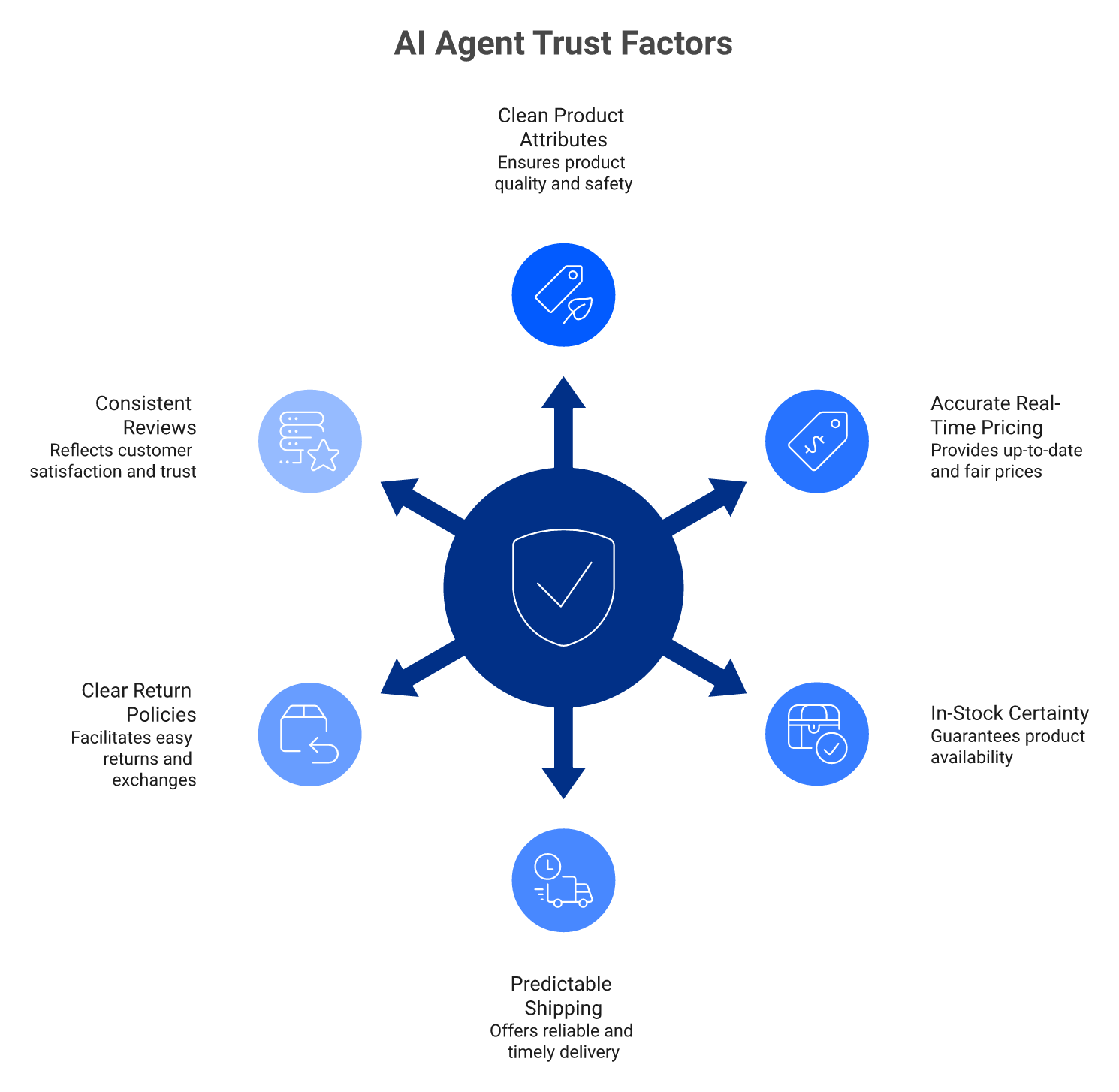
⚠️ The uncomfortable truth about ad spend
I'll say the thing the category avoids. Visibility is earned through the data, not through the ads. You can pay hundreds of thousands for placement and still lose to a smaller brand with a cleaner feed. This is the heart of generative engine optimization.
This is not anti-advertising. It is a shift in what the buyer, now a machine, actually reads before it decides, a shift we quantify in our state of agentic commerce 2026 report.
📊 Why the payoff justifies the work
The reward is real. Ethan Smith, CEO of Graphite, cites a 6x conversion rate difference between LLM traffic and Google search traffic. Agent-driven buyers arrive pre-qualified, because the machine already vetted you against its criteria.
Think of it as the Ghost Kitchen. Your website is the dining room humans see. Agentic commerce is the kitchen and transaction layer, where the delivery driver, the bot, only needs a clean data feed to fulfill the order.
"It's not your choice whether to play the game. You are playing the game whether you want to or not."
Ethan Smith, CEO of Graphite, Lenny's Podcast (2025)
✅ What to fix on Monday
The resolution is concrete. Clean your product attributes, expose real-time inventory, and tighten your return and shipping policy pages. That is what an agent reads as "safe to recommend." Our GEO for e-commerce work starts exactly here.
This is exactly where our trust-first, revenue-focused work lives. We optimize the data layer so agents pick our clients, while traditional agencies keep selling ad-driven visibility to a buyer that no longer looks at ads. MaximusLabs builds the signals a machine trusts, not the banner a human ignores.
Q7. How Do You Make Your Product Feed and Catalog Agent-Ready?
To make a catalog agent-ready, you need a complete structured product feed, the data file an agent reads instead of your page. OpenAI and Amazon expect fields including ID, GTIN, MPN, Title, Description, Link, Condition, Product Category, Brand, Material, Dimensions, Weight, Age Group, Price, Availability, Fulfillment, Returns, and Performance Signals. OpenAI's feed also uses an is_eligible_search boolean that hard-gates whether your product can appear in bot recommendations at all. Miss the gate, and you are invisible.
📋 The fields that decide inclusion
Start with the feed itself. This is the machine-readable spec an agent parses before it ever considers you. The non-negotiable fields include:
- Identity: ID, GTIN, MPN, Title, Description, Link, Condition, Product Category, Brand.
- Physical detail: Material, Dimensions (Length, Width, Height), Weight, Age Group.
- Commercial: Price, Availability, Fulfillment, Returns, Performance Signals.
- The gate: is_eligible_search, a boolean (a simple true or false flag) that OpenAI uses to decide if you appear at all.
Get the boolean wrong, and the richest catalog on earth stays invisible. The gate comes first. Our technical GEO implementation checklist covers every field.
🧵 Free the data trapped in your filters
Most stores hide their best data inside JavaScript filters, the clickable menus for size or color. Agents often cannot reach it there. So expose that facet data, the closure, the fabric, the material, the neck style, out into readable text headers.
Why bother? Because a huge share of follow-up questions is "best product with these attributes." If your attributes live only in a dropdown, you cannot answer, and the agent moves on. This is why e-commerce product AEO depends on surfacing facets as text.
🗂️ The help-center detail that wins the long tail
Here is a hard-won tip most teams miss. Move your help center to a subdirectory, like domain.com/help, not a subdomain like help.domain.com. Subdirectories simply perform better, because of how Google built its algorithm.
Help centers are the long tail of agentic commerce. They hold the specific feature and integration answers agents love, so burying them on a subdomain quietly costs you citations. This feed and facet work is exactly what our content production engine builds for clients, at a cost that scales without a giant team.
Q8. What Do Agents Change for Consumers, and What Are the Risks for Retailers?
Situation. For the consumer, agents remove the grind. They compare options across retailers, apply coupons, monitor prices, and buy at the right moment. Stripe frames this as agents doing the research, comparison, and purchase on the shopper's behalf.
Complication. For the retailer, the same convenience cuts the other way. Agents create brutal price transparency, thin the direct customer relationship, and bypass brand storytelling entirely. When a machine lines up ten sellers by price and reliability, your carefully built brand narrative never gets read.
For retailers, the trade is sharp, but it is not all loss. Agents also deliver higher-intent, better-qualified conversions, because the buyer arrives pre-vetted.
⚠️ Why "average" is now dangerous
This is where the stakes bite. When selection is data-driven and comparison is instant, being a middle-of-the-pack option is fatal. As one practitioner put it, the penalty for being average has never been so severe.
There is no soft landing in a machine comparison. You are the cleanest, most reliable listing, or you are the one filtered out before checkout. Our zero-click search brand economy report digs into this shift.
✅ The resolution: treat the agent as your new customer
Resolution. The winners stop optimizing for the human funnel and start optimizing for the machine reader. They treat the agent as their most important new customer, and they feed it clean, reliable, complete data. If you want help, you can talk to our team about an agent-readiness audit.
Loyalty erosion is real, and I won't pretend otherwise. But reliability and data quality become the new moat, the thing that keeps you in the answer even as the storefront fades in importance. Get the data right, and the agent's higher conversion works for you, not against you.
That reframe, the agent as customer, is the lens we bring to every engagement at MaximusLabs.
Q9. What Do the Skeptics Get Wrong (and Right) About Agent-Readiness?
Situation. Open any GEO thread and you'll see the same shopping list of tactics. Add an llms.txt file (a text file that tells AI crawlers what to read). Publish markdown-only pages. Bolt on schema (structured code that labels your content for machines). These feel like the price of entry.
Complication. The named experts flatly disagree with each other. On schema, Mark Williams-Cook argues that tokenization sort of destroys the schema, so it is just not the top thing on his list. Surfer Academy counters that schema markup increases your odds significantly by telling AI tools exactly what your content is. On llms.txt and markdown, Ethan Smith is blunt: people invent a new protocol even though there is no evidence the bots look at it at all.
The agent-readiness debate has real disagreement. The honest answer is that clean structured data matters more than schema alone. Treat llms.txt and markdown-only pages as a security blanket, not a strategy. Our schema markup basics guide walks through where it actually helps.
⚠️ Why the skeptics earned the right to be skeptical
Ethan Smith started in SEO in 2007. He created spam then, scraped and rewritten content, and watched Google crush it. His point is simple: AI bots are evolved versions of the same crawlers, so the same fundamentals win. This is why technical GEO implementation still rests on crawlability.
That history is why I lean toward crawlability and clean data over trendy files. I might be wrong on schema's long-term role, but the burden of proof sits with the tactic, not the fundamentals. If you want to check how bots see you, our AI crawlability checker is a fast first step.
✅ Where to actually spend your 5%
Here is the resolution. Roughly 5% of the work produces almost all of the impact. That 5% is boring: let the bots crawl you, expose clean data, and answer real questions comprehensively. This is the core of real generative engine optimization.
On first-mover advantage, even the experts split. Smith calls it a false concept, since rankings can be earned later with authority. Jakob Wolitzki insists there is always a first-mover advantage for brands that integrate with commerce protocols early. Both can be right, protocol data compounds, while content rankings stay contestable, a tension we track in our state of agentic commerce 2026 report.
This is exactly the line we hold at MaximusLabs. We test what actually moves retrieval, instead of selling security-blanket tactics like other GEO specialists who make claims they never operationalize.
Q10. How Do You Measure AI-Search Visibility and Tie It to Pipeline?
There is no keyword tool for agentic demand yet, so you model it. Take your existing SEO keywords and convert them into question variants. You can ask ChatGPT for the question form of each, which is directionally accurate for how buyers prompt agents. Then track whether you appear in AI answers for those prompts, and vet what the AI says about you. Measure pipeline influence and LLM-referred conversions, not impressions, because LLM traffic can convert far higher.
🔎 Model the demand you cannot yet measure
There is no Google Ads API for agent prompts. So build a proxy. Take your high-value SEO keywords and turn each into a question, the way a buyer actually asks a chatbot. Our query fan-out generator speeds this up.
You do not need a fancy tool for this. Ask ChatGPT for the question variant of each keyword, and you get a directionally accurate demand map. It is not perfect, but it beats guessing, and our AEO keyword and question research guide goes deeper.
⚠️ Vet what the machine says about you
Tracking visibility is not just counting mentions. It is checking accuracy. An AI once summarized a research article and declared its authors were Oxford researchers, when none of them had attended Oxford.
That is the risk of unvetted bot consumption. If a machine misattributes your credentials or your claims, that error gets repeated across answers. So monitor the wording, not just the appearance, using AI search visibility and brand mention tracking.
💰 Measure revenue, not vanity
Here is the part that matters to a VP of Marketing. Track LLM-referred conversions and pipeline influence, not impressions. Ethan Smith cites a 6x conversion rate difference between LLM traffic and Google search traffic, and notes Webflow gets about 8% of signups from LLMs.
Those are revenue signals, not vanity metrics. This is the core of how we work at MaximusLabs. We tie AI-search visibility to pipeline with our GEO ROI and revenue attribution approach, while traditional agencies keep shipping dashboards full of clicks and impressions that never move the revenue needle.
Q11. What Should You Do on Monday Morning to Get Chosen by AI Shopping Agents?
Situation. Agentic commerce is not a forecast anymore. OpenAI's Instant Checkout is live in ChatGPT, and Google's AP2 already supports "Human Not Present" purchases where an agent buys with no human at checkout. The machines are shopping now.
Complication. The outcome is binary, and waiting is expensive. As one practitioner put it, the penalty for being average has never been so severe. Every week your data stays messy is a week agents quietly pick a cleaner competitor.
Start Monday with three moves. First, complete your structured product feed and confirm the is_eligible_search gate is set, so agents can index you. Second, expose real-time pricing and inventory via API, so agents can transact with cryptographic certainty. Third, convert your top SEO keywords into question variants and track whether AI engines cite you.
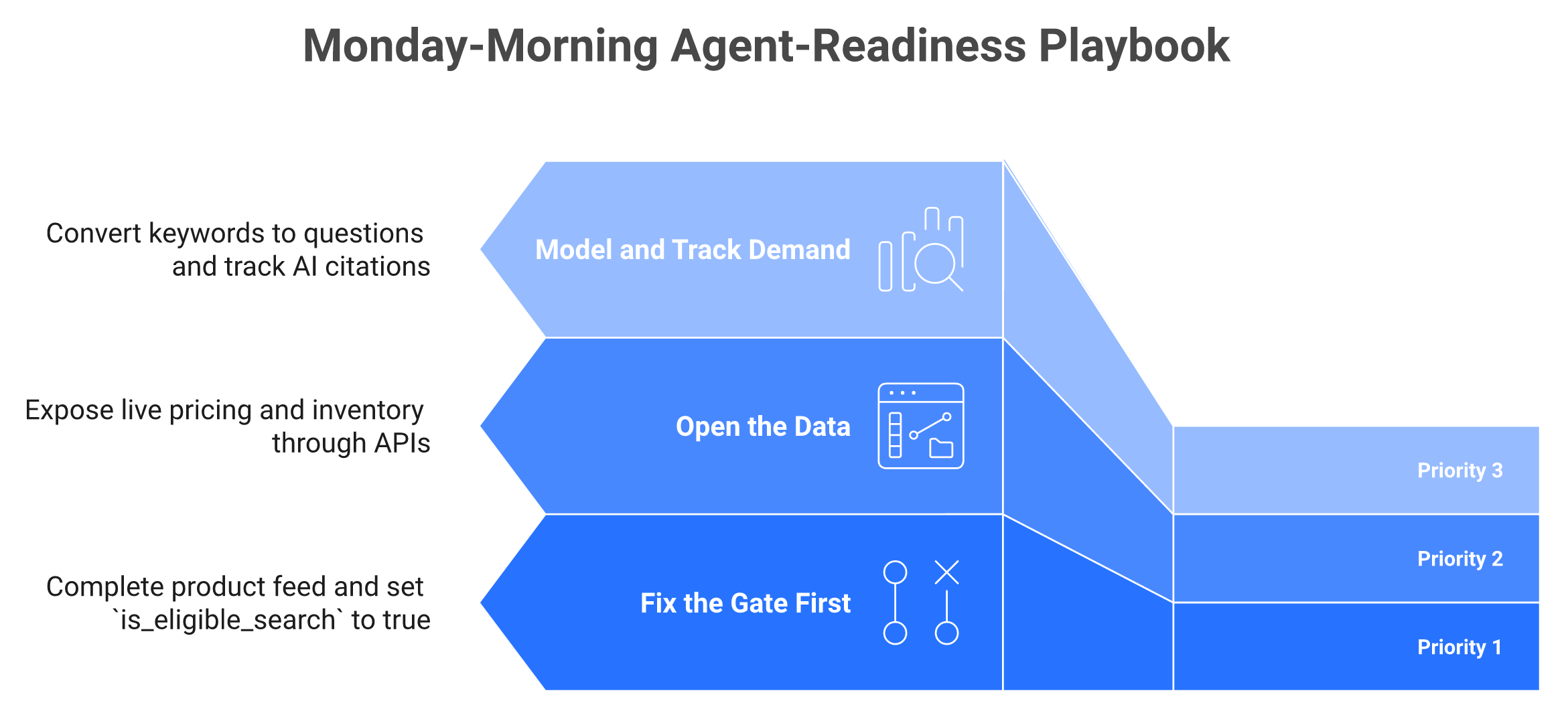
✅ The three moves, in priority order
- Fix the gate first. Complete the feed and set is_eligible_search to true, or you stay invisible.
- Open the data. Expose live pricing and inventory through APIs, so agents can buy with certainty.
- Model and track demand. Turn keywords into questions, then watch which answers cite you.
Do these three, and you shift from being a search result to being the answer an agent recommends. Our agentic commerce service handles all three when you'd rather not build it in-house.
🚀 What I'm sitting with next
You do not need a massive budget for this. You need the right sequence, and most of the wins are unglamorous data work that our technical SEO and website audit surfaces fast. My hunch is that agentic buying will consolidate fast around a few checkout surfaces, so the brands with clean feeds and protocol integration now will compound an entrenched lead.
I could be wrong on the timeline. But if you want a second set of eyes, we run agent-readiness audits at MaximusLabs, and I'm always up for that conversation, so talk to our team. Don't be a search result. Be the source.
Frequently asked questions
What exactly is an AI shopping agent, and how is it different from a chatbot?
An AI shopping agent is autonomous software that acts on a consumer's behalf to research products, compare options against a budget and preferences, and complete the purchase, often needing only a final human approval. A chatbot answers questions and waits, while an agent is goal-driven and takes action. We describe the difference as action, not intelligence, a chatbot and an agent may both know your catalog, but only the agent can reach across the counter and transact. Every agent runs a repeatable loop: Understand the goal , including budget, constraints, and preferences. Explore the market , pulling structured product data from feeds and APIs. Model trade-offs across price, speed, and reliability. Take action , adding to cart or completing checkout. Notice what is missing, nobody scrolls your homepage or watches your hero video. This reframes content is king into a data problem, where your product feed does more selling than your copy. That is why we help brands treat machine-readable data as the priority through our agentic commerce service , so you become the option an agent confidently picks.
How does an AI shopping agent actually browse, compare, and buy?
An AI shopping agent works in four steps. First, it decodes a messy human prompt into a structured intent, a JSON request. Second, it explores the market, pulling structured product data from feeds and APIs. Third, it models trade-offs across price, speed, and reliability. Fourth, it acts, adding to cart or completing checkout through a payment protocol. The storefront a human clicks through is bypassed, the agent talks to your data layer. We call the first step the Universal Intent Decoder. In Perplexity, a traveler types find me a flight to New York under $300, and the platform turns that sentence into a single JSON blob your systems must answer. The prompt becomes a structured query aimed at your data. For a machine buyer, every required click is a high-latency failure point. When we asked Gemini to buy snowboard pants end to end, it stalled at the merchant's checkout, not because the model was dumb, but because there was no clean endpoint to complete the transaction. If the agent reads data, then your data is your salesperson, which is why our highest-leverage fixes start with the technical SEO and website audit of your data layer.
Which AI shopping agents can actually buy for me in 2026?
As of 2026, the main consumer AI shopping agents are OpenAI's Operator and Instant Checkout in ChatGPT, Perplexity Shopping (Buy with Pro and Snap to Shop), Google's Buy for Me in Gemini and Search, Amazon Rufus with AutoBuy, and MultiOn. Each monitors prices in real time, and the biggest differences are autonomy level and whether checkout happens inside the chat. OpenAI Operator and Instant Checkout , buys inside ChatGPT. Perplexity Shopping , one-click Buy with Pro plus Snap to Shop photo search. Google Buy for Me and Gemini , tracks inventory and can phone stores to verify stock. Amazon Rufus , price tracking and AutoBuy for optimal timing. MultiOn , browser-based task autonomy. B2B agents like Pactum and Evolinq handle negotiation and procurement, and they may reshape pipelines faster than consumer tools. The dividing line that matters is whether checkout happens in the chat or redirects out, because every redirect reintroduces clicks that stall a machine buyer. We position brands to be chosen across all of them, which we detail in our state of agentic commerce 2026 report.
What protocols power an agent's purchase, and why do they decide my revenue?
Two open protocols power agentic purchases today. OpenAI and Stripe's Agentic Commerce Protocol (ACP) uses a Shared Payment Token, a one-time token scoped to a single checkout session, so a compromised agent has a tiny blast radius. Google's Agent Payments Protocol (AP2) uses cryptographically signed Intent and Cart Mandates, and its Human Not Present mode lets agents complete pre-authorized purchases on their own. The clever part of ACP is the token, which lets ChatGPT start a payment without ever exposing the buyer's card details. AP2 splits authority into an Intent Mandate that grants search and negotiate rights and a Cart Mandate that approves the final purchase, and Google donated it to the FIDO Alliance. Here is why the plumbing decides revenue. An agent can only buy from you with cryptographic certainty that an item is in stock and priced correctly, and that certainty lives in your feed and APIs, not your storefront design. When we rebuilt a nutrition brand's agentic setup around these principles, their ecommerce sales roughly doubled over six months, as shown in our nutrition agentic commerce case study .
How do I make my product feed and catalog agent-ready?
To make a catalog agent-ready, you need a complete structured product feed, the data file an agent reads instead of your page. OpenAI and Amazon expect fields including ID, GTIN, MPN, Title, Description, Link, Condition, Product Category, Brand, Material, Dimensions, Weight, Age Group, Price, Availability, Fulfillment, Returns, and Performance Signals. Prioritize three things: The gate first , OpenAI's feed uses an is_eligible_search boolean that hard-gates whether your product appears at all, so get it wrong and the richest catalog stays invisible. Free trapped data , most stores hide facet data like fabric, material, or neck style inside JavaScript filters agents cannot reach, so expose it as readable text. Fix the help center , move it to a subdirectory like domain.com/help, not a subdomain, because subdirectories perform better and help centers hold the long-tail answers agents love. A huge share of follow-up questions is best product with these attributes, so if your attributes live only in a dropdown, the agent moves on. This feed and facet work is exactly what our content production engine builds for clients at a cost that scales.
How does an AI agent decide which store to buy from?
An AI shopping agent chooses a store the way a risk-averse buyer would. It weights reliability signals, clean product attributes, accurate real-time pricing, in-stock certainty, predictable shipping, clear return policies, and consistent reviews. The most complete, machine-readable, trustworthy listing wins. Here is the uncomfortable truth about ad spend, visibility is earned through the data, not through the ads. You can pay hundreds of thousands for placement and still lose to a smaller brand with a cleaner feed, because an agent ignores banners and lifestyle photos and parses structured data instead. The reward is real, practitioners cite roughly a six times conversion rate difference between LLM traffic and Google search traffic, because agent-driven buyers arrive pre-qualified. On Monday, clean your product attributes, expose real-time inventory, and tighten your return and shipping pages, that is what an agent reads as safe to recommend. We build the signals a machine trusts through our generative engine optimization work, rather than the banner a human ignores.
How do I measure AI-search visibility and tie it to pipeline?
There is no keyword tool for agentic demand yet, so you model it. Take your existing SEO keywords and convert them into question variants, the way a buyer actually prompts an agent, then track whether you appear in AI answers for those prompts and vet what the AI says about you. Three practical moves: Model demand , ask ChatGPT for the question form of each keyword for a directionally accurate map. Vet accuracy , monitor the wording, not just the appearance, because an AI once wrongly labeled article authors as Oxford researchers, and such errors repeat across answers. Measure revenue , track LLM-referred conversions and pipeline influence, not impressions. Those are revenue signals, not vanity metrics, and practitioners report LLM traffic converting far higher while making up a meaningful share of signups. We tie AI-search visibility to pipeline using our GEO ROI and revenue attribution approach, instead of shipping dashboards full of clicks that never move revenue.