 Krishna Kaanth M
- Agentic commerce optimization makes products selectable by AI shopping agents, not merely clickable. GEO earns a citation, ACO earns the purchase through feed integrity and protocol compliance.
- The channel is live and dated. Adobe recorded AI-sourced retail traffic up 693.4% year over year, and Salesforce measured AI and agents influencing 20% of Cyber Week purchases.
- Three surfaces gate access with three different doors: OpenAI's ACP feed push, Google's UCP via Merchant Center readiness and waitlist, and Perplexity's free Merchant Program form.
- Most brands lose at eligibility filtering, not ranking. A false enable_search flag, blank return-cost field, or missing native_commerce attribute removes you before comparison begins.
- Schema is table stakes rather than a growth lever. Protocols handle transacting, while schema plus a closed sameAs entity graph decide whether an agent trusts you enough to try.
- Measure agent-sourced revenue, not AI traffic. Segment AI assistant referrers above Referral in GA4, then report traffic, assisted shopping, supported actions, and verified purchases separately.
Q1. What exactly is agentic commerce optimization?
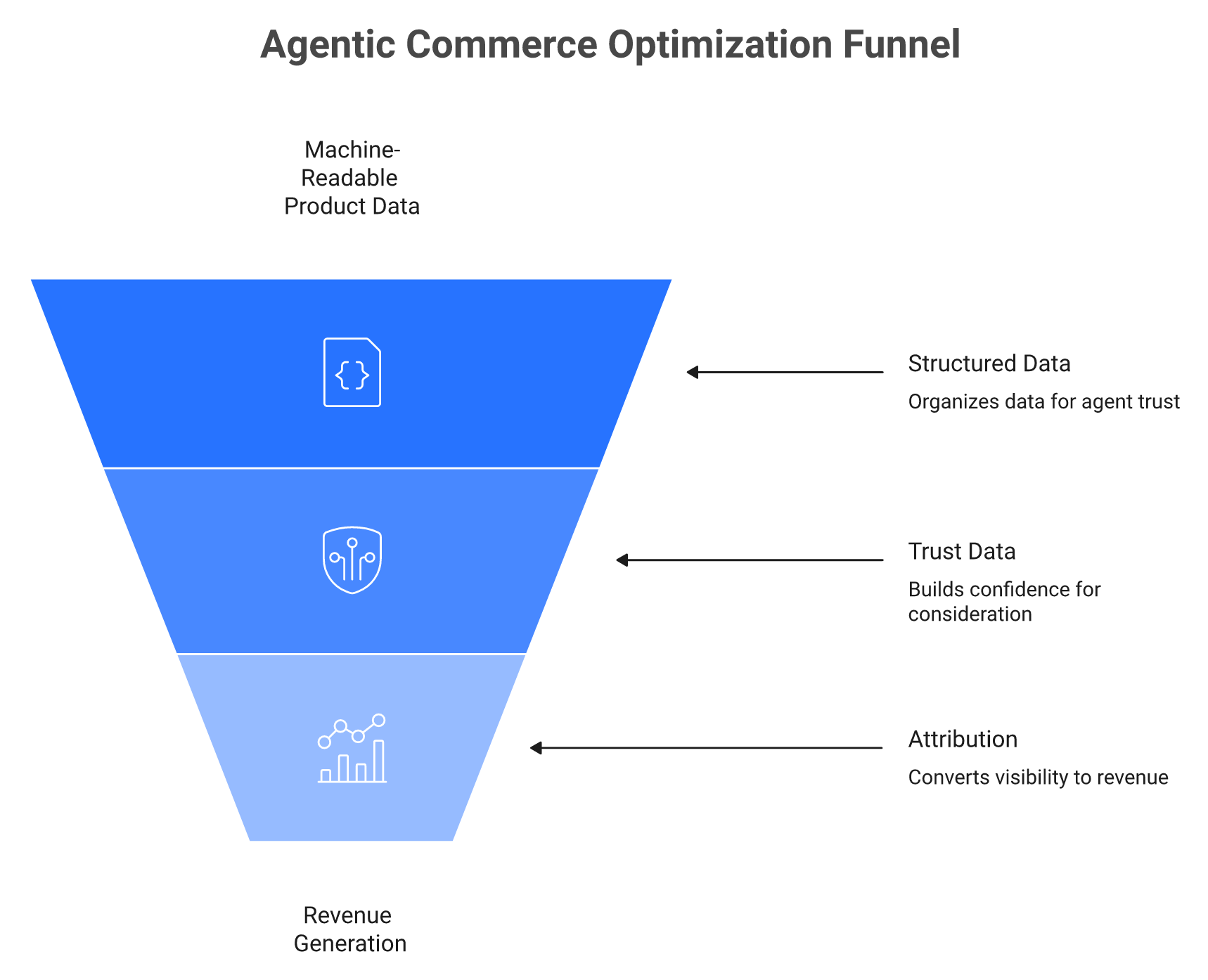
Agentic commerce optimization (ACO) is the practice of making your products selectable by AI shopping agents instead of merely clickable in search results. It combines agent-readable product feeds, complete structured data, and verifiable trust signals so ChatGPT, Google AI Mode, Gemini, and Perplexity recommend and transact your catalog. GEO earns a citation. ACO earns the purchase.
⚠️ The moment a Head of Organic Growth realizes the click is gone
Picture a Head of Organic Growth opening her Monday dashboard. Google sessions are flat, revenue is soft, and a competitor she has never outranked is now the product ChatGPT names when buyers ask.
Nothing broke in her SEO. The buying decision simply moved to a surface her tooling cannot see. Dharmesh Shah described this behavior shift plainly: people stop clicking once the answer arrives, so "there's no reason for someone that's like, oh just tell me the answer."
❌ Why this is a binary game, not a ranking game
Traditional search gave you a long tail of positions. Agentic surfaces give you a curated set, usually five to ten players, with no second page.
Either you sit inside that set or you are invisible to the purchase loop entirely. That is the real anxiety behind this keyword, and it is not solved by publishing more posts, which is why agentic commerce fundamentals now sit upstream of content planning.
✅ Selection, not clicks, is the optimization target
Search Engine Journal named this discipline in February 2026 and framed the shift precisely: stop optimizing for clicks, start optimizing for selection. Three live surfaces now decide that selection.
- Agentic Commerce Protocol (ACP), built by OpenAI with Stripe, powers product discovery and checkout inside ChatGPT.
- Universal Commerce Protocol (UCP), Google's standard, powers checkout in AI Mode and the Gemini app.
- Perplexity Merchant Program, a free merchant on-ramp with in-product checkout.
MaximusLabs AI treats each of these as a distinct distribution channel with its own eligibility rules, not as one generic "AI visibility" project.
💰 The ghost kitchen: your site is not where the sale happens
Think of your website as a dining room. The data feed is the kitchen. The AI agent is a delivery driver who fulfills the order for someone who never walks into the building.
Most brands spend their budget redecorating the dining room. MaximusLabs AI audits the kitchen first, because a stale feed disqualifies a beautiful product page instantly.
⭐ Author's perspective: this is a data problem wearing an SEO costume
My read is that the category gets this backwards. Agencies frame ACO as "SEO plus AI," which keeps the work inside the content calendar where it cannot succeed.
MaximusLabs AI's position is that generative engine optimization was never SEO with extra steps. It is a data science problem, and you need to know how retrieval and feed ingestion actually work to be present in the answer.
I will hedge one part of this. MaximusLabs AI's client data points toward feed integrity mattering more than content quality on agentic surfaces, though the sample is still small enough that I might be reading the signal too strongly.
⏰ The four layers that structure everything after this
ACO breaks into four dependent layers, and skipping ahead wastes money.
- Feed. Machine-readable product data with correct eligibility flags.
- Schema. Structured data that helps agents decide who to trust.
- Trust. Reviews, return policies, and support data that gate consideration.
- Measure. Attribution that turns agent visibility into a revenue line.
MaximusLabs AI treats agent-readable product data as a revenue channel rather than an SEO subtask. After optimizing a California nutrition brand's store for agentic commerce, that brand's ecommerce sales roughly doubled over the following six months and continue to climb.
Q2. Is agentic commerce actually happening, or is everyone still on a waitlist?
It is live and measurable. Adobe recorded a 693.4% year-over-year rise in AI-sourced traffic to US retail sites between Nov 1 and Dec 31, 2025. Salesforce found AI and agents drove $67 billion in Cyber Week 2025 sales and influenced 20% of all purchases. Wayfair and Etsy went live with UCP purchasing inside Google AI Mode on Feb 11, 2026.
⚠️ Why your CFO already discounts every agentic number you show him
Founders have been shown so many trillion-dollar agentic forecasts that the whole category now reads as vendor noise. The projections arrive undated, unsourced, and unfalsifiable.
MaximusLabs AI builds business cases only from measured first-party datasets with a stated measurement window. A forecast that cannot be traced to a window does not survive a budget review.
✅ The dated evidence table
| Finding | Figure | Window | Source |
| AI-sourced traffic to US retail sites | Up 693.4% YoY | Nov 1 to Dec 31, 2025 | Adobe Analytics |
| US online holiday spend | $257.8B, up 6.8% YoY | Nov 1 to Dec 31, 2025 | Adobe Analytics |
| AI and agent driven sales, Cyber Week | $67B | Nov 25 to Dec 1, 2025 | Salesforce |
| Purchases influenced by AI and agents | 20% of all purchases | Cyber Week 2025 | Salesforce |
| AI-influenced holiday spend | $262B of $1.29T | Full 2025 holiday season | Salesforce |
| Brands using agentic AI for one-to-one interactions | Two-thirds | By 2028 | Gartner |
The convergence matters more than any single figure. Salesforce forecast 21% of global holiday orders pre-season and measured 20% purchase influence after. MaximusLabs AI leads with that pairing, because a prediction that landed is the only kind of number a finance team respects.
💰 Named merchants are already transacting
Waitlists are real, but production is too. Wayfair and Etsy began accepting UCP purchases inside Google AI Mode on February 11, 2026.
Google's agentic checkout in Search already covers merchants including Wayfair, Chewy, Quince, and select Shopify stores. The catalog those agents draw from runs past 50 billion listings, with 2 billion refreshed every hour, a scale detailed further in our state of agentic commerce 2026 report.
⭐ Practitioner signal from named operators
Two credible practitioners have been unusually blunt about what this shift rewards, and both are worth quoting directly rather than paraphrasing.
"Either you show up or you don't. If you're not in the actual citations in the answer that was given, you might as well not have played the game, because there is no difference."
Dharmesh Shah, Co-founder and CTO, HubSpot
"It's impossible to rank in Google for 'best credit card.' It'll take years. But you can actually rank in chat faster, because again, the citations are what matter."
Ethan Smith, CEO, Graphite
I am deliberately not padding this section with vendor testimonials. MaximusLabs AI does not publish reconstructed review quotes, and no verified G2 or Capterra review for this specific category sits in our source library yet.
⏰ The hygiene rule: four lines, never one
Most agentic statistics collapse four different things into one headline. MaximusLabs AI reports them separately in every client dashboard, and the same discipline drives our GEO measurement and metrics work.
- AI-channel traffic. Sessions referred by an AI assistant.
- Assisted shopping. Sessions where an agent shaped the consideration set.
- Supported actions. Agent-completed steps like cart building.
- Verified outcomes. Orders actually placed through an agentic surface.
Conflate them and your growth number looks fake to anyone who checks. Separate them and a small channel still earns budget, because the intent quality is visibly higher.
MaximusLabs AI builds every client business case from dated first-party datasets and named production merchants, never from vendor market-size projections. That discipline is slower to assemble and considerably harder to argue against.
Q3. How is ACO different from traditional Google-only SEO, GEO, and AEO?
Traditional SEO optimizes for a click on a blue link. AEO optimizes for being the extracted answer. GEO optimizes for being cited inside a generated response. ACO optimizes for being the product an agent transacts, which adds feed integrity, checkout eligibility, and fulfillment signals no content strategy can supply. A citation with an ineligible catalog earns visibility and zero orders.
⚠️ The retainer that produces citations and no revenue
A VP Marketing signs a GEO retainer. Six months in, the citation dashboard is up and to the right. Pipeline has not moved.
The cause is almost never bad content. The catalog was never transactable, so every citation dead-ended at a product an agent could not buy.
✅ Four disciplines, four different artifacts
Academic work on generative engine optimization established the citation-visibility baseline in 2024, and it is genuinely useful. It also stops well short of the transaction layer, a boundary we map in detail across GEO vs traditional SEO.
| Discipline | Optimizes for | Primary artifact | Usual owner | Success metric |
| Traditional SEO | Rank on a blue link | On-page content | SEO team | Sessions |
| AEO | Being the extracted answer | Answer blocks | Content team | Snippet share |
| GEO | Being cited in a generated answer | Entity and evidence graph | Growth team | Citation share |
| ACO | Being the product an agent buys | Product feed and protocol compliance | Ecom ops plus engineering | Agent-sourced revenue |
| MaximusLabs AI scope | All four, sequenced | Feed, schema, trust, content | Single accountable owner | Revenue from AI surfaces |
MaximusLabs AI appears in that final row factually, not favorably. The distinction is scope and sequencing, not magic.
❌ Where traditional agencies stall
Traditional SEO shops still run Google-only playbooks built on keyword volume and impressions. Those playbooks produce real Google results, which is why they persist.
They also leave the agentic layer untouched, because nobody on the team owns a product feed. Optimizing the website while ignoring feeds, third-party reviews, and protocol eligibility is the structural gap.
❌ Where other GEO specialists stall
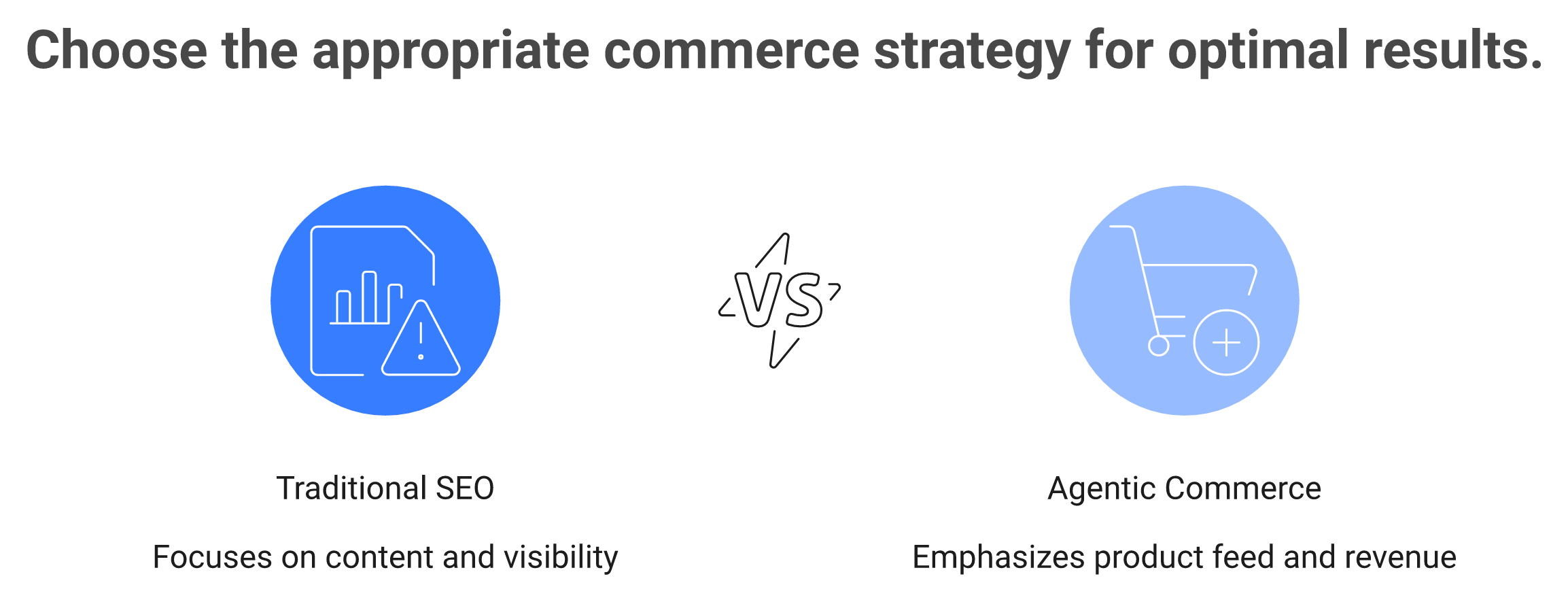
Newer GEO specialists sell citation tracking and answer-block rewrites. That is genuinely useful answer engine optimization work.
Very few of them will open your Merchant Center account or set a feed refresh cadence. Visibility rises, transactability does not, and the client concludes GEO does not work.
💸 Author's perspective: the feed outranks the ad budget
MaximusLabs AI's read is that the standard advice gets budget allocation backwards here. Teams fund media against agentic surfaces before making their catalog machine-legible.
Visibility on these surfaces is earned through data, not ads. You can spend hundreds of thousands on paid placement and still sell less than a competitor who simply made their products discoverable to agents.
There is a popular shorthand that the snippet is the new rank. In commerce, I would amend it: the feed is the new rank, and the snippet only decides who gets considered.
⏰ The real failure mode is ownerlessness
Gartner projects two-thirds of brands using agentic AI for one-to-one customer interactions by 2028. That timeline assumes somebody owns the work.
In practice, ACO sits unclaimed between SEO, ecommerce operations, and engineering. Each team assumes another owns the feed, so nothing ships.
Name one accountable owner this week, with authority over feed, schema, and policy pages. MaximusLabs AI measures this in audits, and ownership gaps predict stalled ACO programs more reliably than budget size does.
MaximusLabs AI runs ACO as a revenue engagement rather than a content retainer, auditing feed fields, schema, and trust artifacts in the same sprint as the answer blocks. Those layers fail together, so we refuse to price them separately, which is why our GEO and AEO work for e-commerce ships as one scope.
Q4. What actually happens when an AI shopping agent decides what to buy?
An agent turns a messy prompt into a structured query, retrieves candidates from indexed feeds and the open web, filters on hard eligibility flags like availability and checkout support, ranks survivors on price, reviews, return policy, and fulfillment confidence, then transacts through a protocol. Most brands are eliminated at the filter stage, before ranking ever happens.
⚠️ You are losing at a stage your tools cannot see
Every SEO tool on the market reports ranking. None of them report elimination.
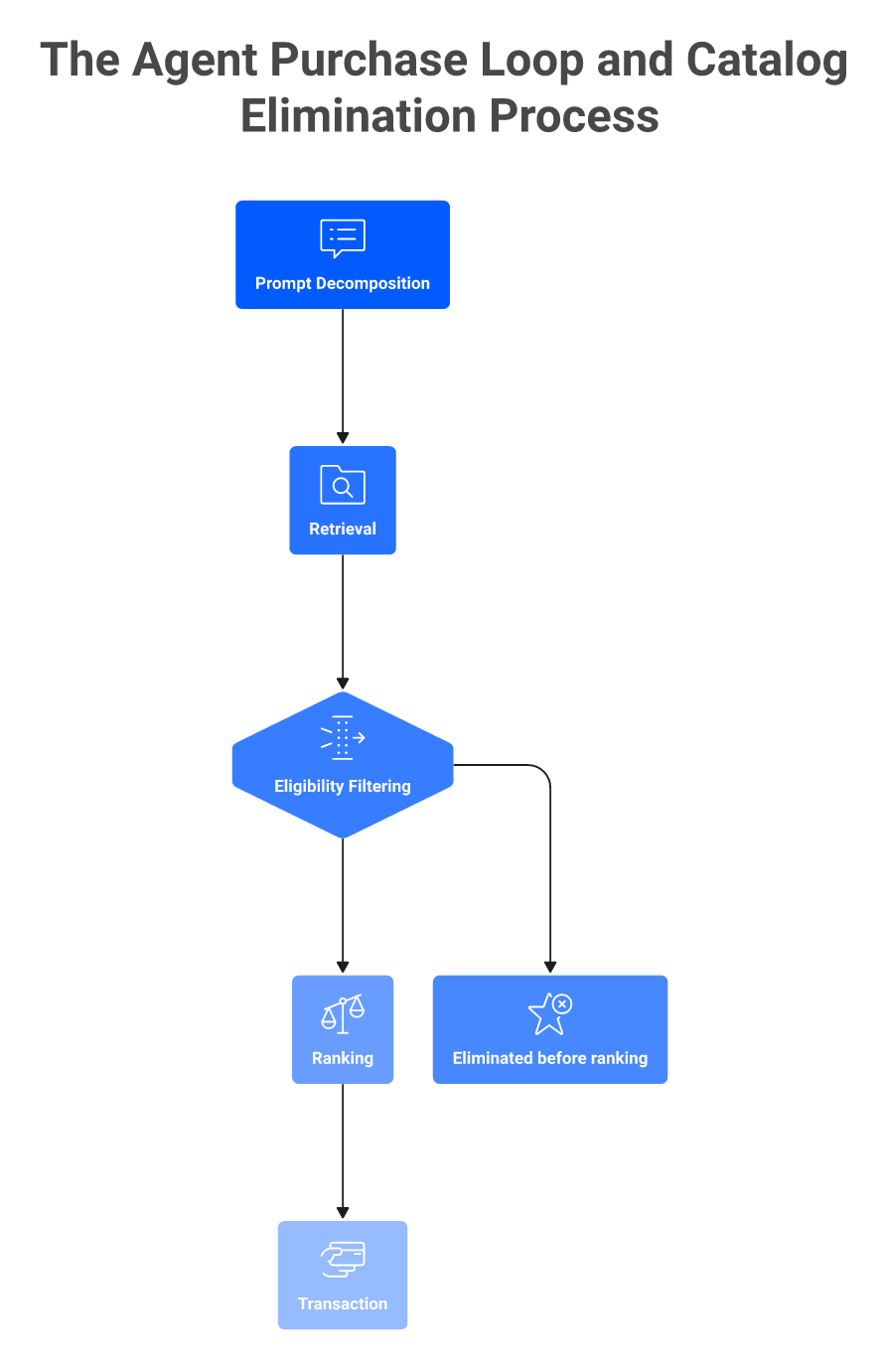
So teams tune pricing and reviews, which are ranking inputs, while a missing availability field removes them from consideration before ranking begins. MaximusLabs AI diagnoses the filter stage first for exactly this reason.
✅ The five stages, in order
- Prompt decomposition. A 25-word human request becomes a structured query.
- Retrieval. Candidates are pulled from indexed product feeds and the open web.
- Eligibility filtering. Hard flags decide who stays: availability, checkout support, policy completeness.
- Ranking. Survivors are compared on price, review signals, return terms, and fulfillment confidence.
- Transaction. Checkout runs through a protocol, with session creation, tax, payment, and order lifecycle webhooks.
Stages three and five are where MaximusLabs AI concentrates technical work, because both are pass or fail rather than gradual.
🔍 Treat the model as a universal intent decoder
The useful mental model is not "search engine with a chat box." It is a translator.
The agent converts a vague human sentence into a structured request against your data. Your job is to have data structured enough to answer it, which is why MaximusLabs AI starts every engagement with the feed rather than the blog.
⏰ Chatbot and agent share a brain, not a kitchen
A chatbot and a shopping agent can run on the identical model. The brain is the same, and the difference is entirely what gets wired around it.
Picture a world-class chef in an empty room versus the same chef in a Michelin kitchen. Tools, not intelligence, decide whether an order gets fulfilled, a distinction unpacked further in AI shopping agents explained.
⚡ Speed is a filter you cannot argue with
Grounding layers behind these agents operate at inference speed. Microsoft's Web IQ grounding pipeline runs at roughly 164ms p95 end to end.
Nothing slow or unstructured gets consulted inside that loop. A structured JSON feed beats a beautiful product page every single time the two compete, and MaximusLabs AI measures this by comparing feed-sourced surfacing against page-sourced surfacing for the same SKU.
⭐ Author's perspective: retrieval literacy beats keyword literacy
What surfaces in MaximusLabs AI's technical SEO and website audits is that teams with strong keyword skills often have zero retrieval intuition. They can build a topic cluster and cannot name a single feed field.
MaximusLabs AI's RAEO and R-GEO methodology starts from how retrieval-augmented systems select and verify sources, then works outward to content. That order is unusual, and I think it is the reason our agentic diagnoses land faster than a content audit would.
Ethan Smith's own attempt to have Gemini complete a snowboard-pants purchase end to end simply looped and failed. The intent was fine. The merchant surface was not machine-legible, which is a stage-three failure, not a marketing failure.
✅ Your Monday exercise
Take your top ten revenue SKUs. Walk each one through the five stages and mark the first stage where it would drop out.
Most teams find their elimination point in stage three, not stage four. MaximusLabs AI diagnoses agentic loss at the filter stage first, because missing eligibility flags and stale availability data disqualify more catalogs than weak pricing or thin review counts ever do.
Q5. ACP, UCP, or Perplexity, which agentic surfaces do you need to be on?
ACP, co-developed by OpenAI and Stripe, covers checkout, fulfillment, and payment. Google's UCP spans the full lifecycle across six capabilities: product discovery, cart management, OAuth 2.0 identity linking, checkout, order management, and vertical capabilities. Perplexity's Merchant Program is not a protocol but a free index-and-checkout on-ramp that raises your odds of being a recommended product.
⚠️ Three surfaces, three completely different doors
Most teams pick one agentic surface, ship it, and assume they are covered. That assumption is wrong, because the three on-ramps share almost no requirements.
One needs a spec-compliant file push. One needs Merchant Center attributes plus a waitlist. One needs a form. Nobody publishes them side by side, so teams guess.
✅ The eligibility matrix
| Surface | Owner | What it covers | Entry requirement | Cost |
| ACP (ChatGPT) | OpenAI with Stripe | Checkout, payment, and fulfillment | Spec-compliant feed push plus enable_search and enable_checkout flags | Free to submit |
| UCP (AI Mode, Gemini) | Full commerce lifecycle, six capabilities | Merchant Center attributes, complete policy data, and waitlist entry | Free, gated | |
| Merchant Program | Perplexity | Index inclusion plus in-product checkout | Free signup form | Free |
MaximusLabs AI's Search Everywhere Optimization scope treats ChatGPT, Perplexity, Gemini, and Google as four distinct surfaces with four separate eligibility checklists, not one generic AI project. Each one gets its own agentic commerce readiness sheet.
✅ UCP's six capabilities, in order
UCP is broader than checkout, which is the part most coverage misses.
- Product discovery. How agents find and surface your inventory.
- Cart management. Multi-item baskets and dynamic pricing.
- Identity linking. OAuth 2.0 for personalization and loyalty.
- Checkout. Session creation, tax, and payment.
- Order management. Webhook-driven lifecycle updates.
- Vertical capabilities. Extensible modules for specialized categories.
Layers one, three, and six are why UCP matters beyond the transaction. Discovery, loyalty, and post-purchase support all move inside the agent, a shift we track in our state of agentic commerce 2026 research.
💰 What the free surface actually gives you
Perplexity's Merchant Program is the least discussed and the cheapest. Signing up gets your products indexed with full specs, adds Buy with Pro checkout, includes free API access, and opens a merchant trends dashboard. It is explicitly separate from Perplexity's sponsored questions ad product.
That dashboard is the closest thing available to an agentic query truth set, and it costs nothing. There is no bot-query volume tool comparable to the Google Ads API yet, which is why Perplexity optimization starts with claiming that free data.
⭐ Model demand before you have data
MaximusLabs AI models agentic demand by converting existing keyword data into question form, then checking which questions surface competitor products. It is a proxy, not a truth set.
Ethan Smith described the same workaround for AEO: take your keyword data and turn those keywords into questions, which is "directionally accurate." Pair that with Perplexity's free dashboard and you have a usable demand model for roughly zero dollars.
⏰ What practitioners are actually reporting
"Practical factors that currently matter include: clean, consistent structured product data (price, availability, variants, shipping rules); a checkout process that an agent can finish without human intervention; presence in systems ChatGPT already trusts (Google Shopping Graph, Shopify ecosystem, soon UCP)."
Commenter, r/agenticcommerce Reddit Thread
That thread also carries the opposite claim, that a well-organized website is enough with no onboarding at all. Both views are represented, and the disagreement itself is the signal. Nobody has settled this yet.
✅ The sequencing verdict
Effort and reach run in opposite directions here, so sequence accordingly.
- Week 1. Submit the Perplexity form. Lowest effort, immediate index inclusion.
- Weeks 2 to 4. Build the ChatGPT feed. Highest effort, largest current reach.
- Weeks 3 to 5. Deploy Merchant Center readiness and join the UCP waitlist.
MaximusLabs AI claims every free agentic surface before touching paid tests, starting with ChatGPT feeds, Merchant Center, and the Perplexity Merchant Program. Unclaimed zero-cost distribution has consistently outperformed media budget in our first ninety days of an engagement.
Q6. What does ChatGPT need in your product feed before it recommends you?
MaximusLabs AI audits ChatGPT feeds field by field, because ChatGPT surfaces products from a structured feed rather than from product-page copy. You need stable per-variant IDs, titles, descriptions, images, price with ISO 4217 currency, an availability enum, and seller policy links, plus the booleans that gate search and checkout. OpenAI accepts updates every 15 minutes, making freshness an ongoing SLA.
⚠️ The hardest truth in agentic commerce
Your best content cannot make ChatGPT recommend a product whose feed says it is not searchable. The enable_search field is a boolean, and false means invisible.
No amount of copywriting overrides a false flag. This is why MaximusLabs AI opens every ACO engagement with a field-level feed audit against the live OpenAI spec before writing a single word of content, well ahead of any ChatGPT optimization content work.
✅ Required fields, exactly as the spec names them
Product data is not crawled here. The merchant pushes a structured file to an allow-listed OpenAI endpoint over encrypted HTTPS.
| Field | What it holds |
| id | Unique, stable identifier per variant |
| title | Product name |
| description | Plain text, no HTML |
| link | Product page URL |
| image_link | Primary image URL |
| price | Value plus ISO 4217 currency |
| availability | in_stock, out_of_stock, or preorder |
| inventory_quantity | Units on hand |
| brand, condition | Brand name and new, used, or refurbished |
| enable_search | Boolean gating appearance in results |
| enable_checkout | Boolean gating in-chat purchase, requires enable_search set to true |
Accepted formats are CSV, TSV, XML, or JSON. Checkout additionally requires return_policy, seller_privacy_policy, and seller_tos.
✅ Recommended fields most teams leave empty
The optional layer is where competitive separation actually happens.
- Identifiers. GTIN, UPC, or MPN improve catalog matching and cut errors.
- Logistics. Weight, dimensions, delivery regions, shipping, and delivery estimate.
- Variants. Item group ID, color, size, gender, and size system.
- Rich media. Additional image links, video links, and 3D model links.
- Trust signals. Review counts, ratings, and popularity data.
MaximusLabs AI measures completion rate on that optional block during audits, and it is routinely the emptiest part of a client feed. The same gap shows up repeatedly in our GEO and AEO work for e-commerce.
⏰ Freshness is a weapon, not a setup task
OpenAI accepts refreshes as often as every 15 minutes, which keeps price and stock near real time. Google's Shopping Graph refreshes 2 billion of its 50 billion-plus listings every hour.
Treat cadence like uptime. Ask MaximusLabs AI to instrument feed-refresh monitoring the same way you would monitor an API, because a stale price is a silent deprioritization with no error message.
💸 The feed beats the ad budget
MaximusLabs AI's read is that most ecommerce teams have this budget order backwards. They fund agentic media tests while their feed sits at partial field completion.
Visibility on these surfaces is earned through data, not ads. My honest hedge: I suspect feed completeness matters more than review volume for initial surfacing, though I have not isolated those two variables cleanly enough to state it as fact.
⭐ What merchants are reporting so far
"Has anyone had success with agentic commerce yet? Curious to hear what people have seen so far."
Original poster, r/ecommerce Reddit Thread
That question, posted in February 2026, is the honest state of the market. Merchants are shipping feeds faster than they are reporting outcomes.
Results are not automatic, and this is not a ranking trick. Compliance gets you eligible, and trust plus freshness decide whether you get chosen.
MaximusLabs AI treats the product feed as the ranking surface in agentic commerce, auditing it before content, schema, or media. Engineering gets field names and a cadence target, not a strategy deck.
Q7. How do you become eligible for Google's UCP agentic checkout?
Google gates agentic checkout on Merchant Center readiness. Add the native_commerce attribute, since products are only eligible when it is set. Complete return costs, return windows, and policy links, which are required for Merchant-of-Record status, plus customer support information. Apply all of it through a supplemental data source rather than editing your primary feed, then join the UCP waitlist.
⚠️ Wait and see just got expensive
Google moved UCP from announcement to named-merchant production in roughly a month. Wayfair and Etsy began accepting UCP purchases inside AI Mode on February 11, 2026.
Readiness work takes weeks. Access can arrive in days, and you cannot backfill policy data after the fact.
✅ The prep sequence, in order
Run these steps sequentially, because later steps depend on earlier ones.
- Add native_commerce to your Merchant Center feed. Products are only eligible for agentic checkout when this attribute is set.
- Complete return policy data. Return costs, return windows, and policy links are required for Merchant-of-Record status.
- Add customer support information. Contact paths are part of the eligibility profile, not a nice-to-have.
- Review product restrictions. Some categories are excluded, so check before you assume coverage.
- Deploy all of it through a supplemental data source. Google recommends this route specifically so you do not invalidate your primary feed.
- Join the UCP waitlist. Do this after steps one through five, not before.
MaximusLabs AI ships this sequence as a single deployment rather than six tickets, because partial completion produces zero eligibility. It runs alongside Google AI and Gemini optimization rather than after it.
💰 The same data unlocks three adjacent surfaces
Readiness work is not single-purpose. The same Merchant Center completeness feeds several live Google features.
- UCP-powered checkout inside AI Mode and the Gemini app.
- Business Agent, which connects shoppers to eligible US retailers directly from Search.
- Direct Offers, which surfaces retailer-shared personalized discounts inside AI Mode.
That changes the internal business case. You are not funding one feature, you are funding entry to a surface family.
⏰ Engineering queues kill this, not strategy
What surfaces in MaximusLabs AI's client engagements is a consistent pattern. The strategy is agreed in one meeting, then the work sits in a queue.
The quote is almost always the same. A change that takes days gets scoped at nine months, because it enters a roadmap built for feature releases rather than feed attributes.
MaximusLabs AI built a full-stack execution model for exactly this reason, including in-house build capability so feed and policy changes ship in weeks. I will be honest that this is a workaround for an org-chart problem, not a technical achievement.
⚠️ Where traditional agencies stop
Traditional SEO agencies do real Google work, and their on-page and content playbooks still produce results. They also do not open Merchant Center accounts.
Newer GEO specialists track citations and rewrite answer blocks, which is genuinely useful answer engine optimization work. Very few of them will touch a supplemental data source or a return-policy field, so eligibility never lands.
⭐ Practitioner reality check
"Presence in systems ChatGPT already trusts (Google Shopping Graph, Shopify ecosystem, soon UCP)."
Commenter, r/agenticcommerce Reddit Thread
That observation matters more than it looks. Merchant Center readiness feeds Google's Shopping Graph, and other agents lean on that graph too.
One deployment therefore serves multiple engines. Ask MaximusLabs AI to sequence Merchant Center work first when a client is resource-constrained, because it has the widest downstream reach.
✅ Your rollout order
Deploy the supplemental feed first, then join the waitlist. Sequenced that way, you are eligible on day one of access instead of starting a scramble.
MaximusLabs AI builds and deploys feed, schema, and policy-page changes directly rather than handing over a deck. That is the difference between eligible this quarter and eligible next year.
Q8. Why do reviews, return policies, and Q&A data decide whether you get considered at all?
MaximusLabs AI audits trust artifacts as ranking infrastructure, because trust data is an eligibility gate rather than a conversion aid. Return policy completeness is required for Merchant-of-Record status, aggregateRating and review supply the third-party perspective agents check, and Q&A plus compatibility data minimize hallucination during discovery. Incomplete trust data does not lower your ranking. It rules you out first.
⚠️ The wrong team owns your ranking infrastructure
Reviews sit with CX. Return policies sit with operations. Support pages sit with whoever built them last.
None of those teams knows they now own a ranking input. So nobody audits them, and the gap goes undetected until an agent stops recommending you.
❌ How the gate actually works
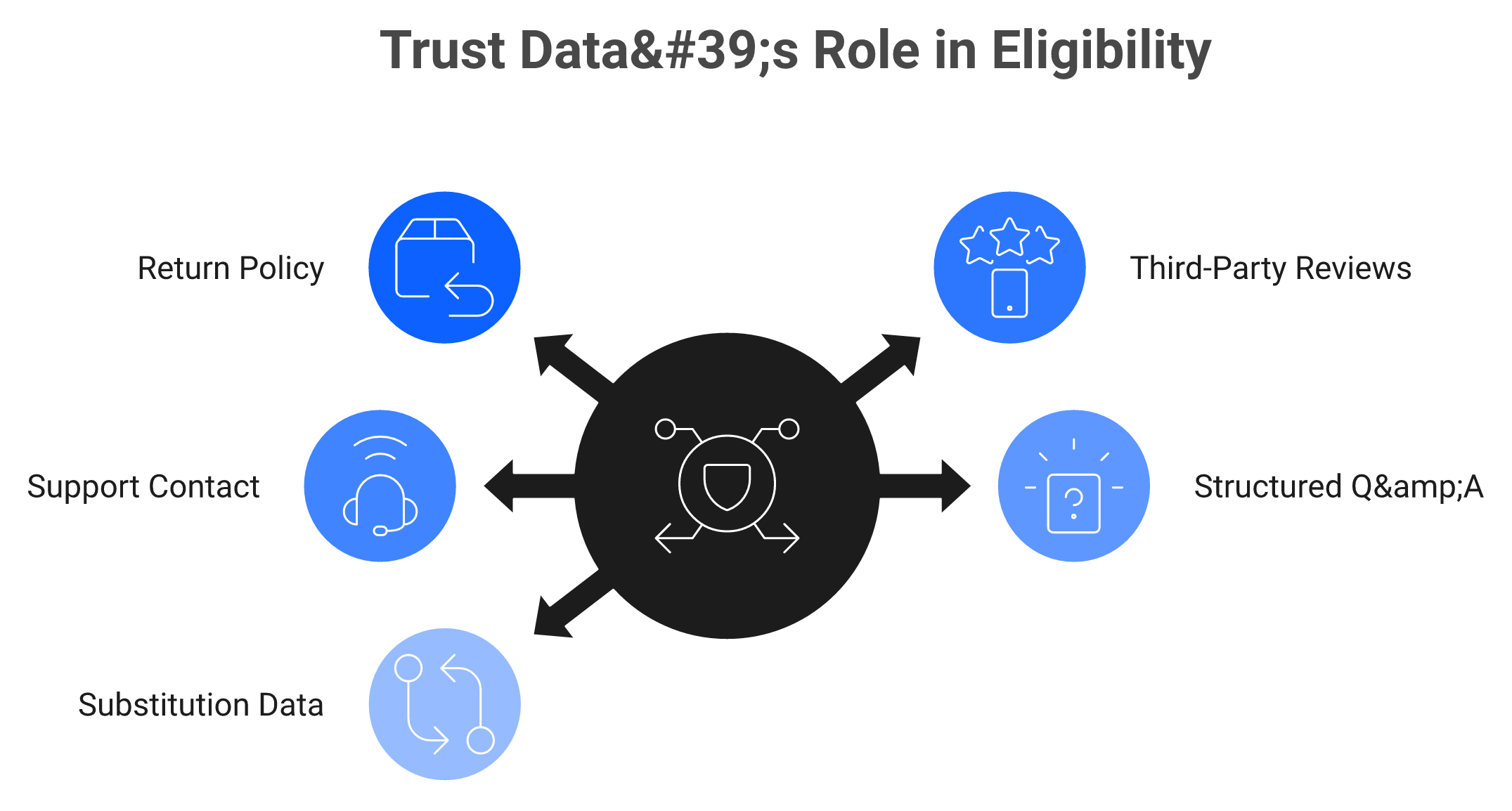
Return policy completeness is not a trust-building nicety. It is a hard requirement for Merchant-of-Record status in Google's agentic checkout.
The aggregateRating and review markup give agents the third-party perspective they weigh when deciding whom to transact with. OpenAI's feed carries its own review count and rating fields, plus popularity data, which is why schema markup and feed work have to move together.
Miss them and you are not ranked lower. You are removed from the candidate set before ranking begins.
✅ What agents check versus what most catalogs hold
| What agents check | What most catalogs are missing |
| Return window and return cost | Cost field blank or policy page unlinked |
| Customer support contact path | Support info absent from feed |
| Review count and rating | Populated on site, empty in feed |
| Structured Q&A | Buried in unstructured page text |
| Compatibility data | Not modeled at all |
| Substitution options | No alternative supplied when out of stock |
MaximusLabs AI measures this by scoring the right column against top revenue SKUs first, since a complete catalog audit rarely fits a real budget.
💰 Conversational attributes are a revenue layer, not documentation
This is the part nobody unpacks. Q&A, compatibility, and substitution data do three revenue jobs at once.
- Hallucination insurance. Explicit answers stop an agent inventing a wrong specification that rules you out.
- Out-of-stock recovery. Substitution data lets an agent offer your alternative instead of a competitor's product.
- Cross-sell inside the answer. Related-product data places the upsell in the agent's response, not on a page the buyer never visits.
⭐ Out-of-stock is now a fork, not a loss
MaximusLabs AI's read is that the standard advice gets out-of-stock handling backwards. Traditional playbooks treat it as a conversion leak to minimize.
In agentic commerce it is a routing decision. If you supply a substitution, the agent keeps the sale inside your catalog. If you supply nothing, the agent hands it to whoever did.
I hold this one with real uncertainty. MaximusLabs AI's audit data points this way, though substitution behavior varies enough across engines that I would not bet a quarter's revenue on a single pattern yet.
✅ Trust lives off your site too
Third-party review depth is not something you control from your CMS. Agents pull perspective from platforms and communities you do not own.
MaximusLabs AI's trust-first methodology covers off-site review platforms and community surfaces as part of Search Everywhere Optimization, not just owned pages, an approach documented in our trust-first content playbook. Practitioners have watched the same pattern in answer engines, where a single well-upvoted community comment becomes the reason a product gets recommended.
That cuts both ways. Negative sentiment in a heavily cited thread is a liability you cannot fix with on-page work, which is why Reddit and forum AEO belongs inside the same scope.
⏰ Your audit this week
Pick your top ten revenue SKUs and check four things only.
- Review volume and recency, in the feed and in schema.
- Return window and return cost, both populated.
- Support contact, reachable and structured.
- Structured Q&A covering the three questions buyers actually ask.
MaximusLabs AI audits third-party review depth, return-policy completeness, and structured Q&A as ranking infrastructure. In agentic commerce a thin trust profile removes you from consideration entirely rather than merely lowering conversion.
Q9. Does schema markup still matter when UCP has its own vocabulary?
MaximusLabs AI treats schema as decision vocabulary rather than transaction vocabulary, because UCP uses its own versioned JSON schema and does not build on schema.org directly. Google's Pascal Fleury called schema the glue that binds these ontologies together. Protocols handle the transaction. Schema plus a closed entity graph handle whether you are trustworthy enough to reach it.
⚠️ Two credible camps, one search session
Search this question and you will hit flatly contradictory advice within minutes. Both sides are argued by people who know what they are doing.
One camp treats schema as a hygiene factor at best, not a differentiator. The other claims structured data meaningfully improves your odds by telling AI exactly what your content is.
❌ The strongest argument against schema
The skeptical case is technical and worth taking seriously. Language models tokenize your page, so JSON-LD structure gets flattened during ingestion.
"Schema still matters for classic search, not for AI search. LLMs don't actually read JSON-LD, they tokenize it and lose the structure."
Commenter, r/SEO Reddit Thread
The opposite view is equally present in practitioner forums, particularly for ecommerce.
"I think that schema markup is becoming more and more important for AI search engines than backlinks. E-commerce websites with quality [structured data]..."
Original poster, r/DigitalMarketing Reddit Thread
✅ How the disagreement resolves
The two camps are answering different questions. UCP's own vocabulary handles transacting, and schema.org informs selection.
MaximusLabs AI splits these into separate workstreams for exactly that reason. Protocol compliance decides whether a purchase can complete, and schema decides whether an agent trusts you enough to try, which is why technical GEO implementation and protocol work run in parallel.
✅ The audit list
Run your Product markup against these fields, all of them.
- Identity. Name, description, SKU, GTIN, and brand.
- Commercial. Price, price currency, availability, and seller.
- Trust. Aggregate rating and review.
- Logistics. Shipping details, plus correct variant output.
Ask MaximusLabs AI to check variant output specifically, since incorrect variant markup is the most common defect we find on otherwise clean catalogs. Our schema markup checklist starts there.
⭐ Close the sameAs loop, do not just add links
This is the part most schema advice skips. An agent should be able to traverse from your website to Wikidata, to LinkedIn, to Crunchbase, to G2, and back to your website, all through sameAs links.
The traversal has to close. MaximusLabs AI runs this closure as standard scope, because an agent that cannot verify who you are will not risk transacting on your behalf.
Ambiguity is where hallucination starts. A brand with an open entity graph gets described using whatever the model half-remembers, a failure pattern we map in our GEO knowledge graphs work.
⏰ One retrieval-architecture fix worth doing
Move your help center and integration docs from a subdomain into a subdirectory. Subdomains behave like separate filing cabinets in retrieval, and the content gets treated as somebody else's.
This is old Google-era knowledge that transferred cleanly. MaximusLabs AI applies it in technical SEO and website audits because the effort is small and the consolidation effect is real.
💸 Necessary and insufficient
MaximusLabs AI's read is that both camps overstate their case. Schema is not a ranking lever, and it is not decoration either.
Here is my honest limit. Nobody has cleanly isolated schema's independent lift on agentic selection, us included, because it never ships alone.
So I treat it as table stakes rather than a growth tactic. Skip it and you introduce ambiguity, and ambiguity is the one thing agents genuinely punish.
MaximusLabs AI closes the sameAs loop as standard scope, from website to Wikidata to LinkedIn to Crunchbase to G2 and back. Verification is cheap to build and expensive to lack.
Q10. Why is exposing facet data the highest-leverage change on your product pages?
MaximusLabs AI builds facet-exposed page variants for agents, because agents match on attributes rather than adjectives. When a shopper asks for waterproof snowboard pants with a specific closure, fabric, and fit, the agent needs those facets as structured fields. Traditional SEO advice suppresses that as boilerplate. Build a parallel machine-readable version, starting with your highest-revenue SKUs.
⚠️ A checkout that simply looped
Ethan Smith tried to buy snowboard pants inside Gemini and asked the agent to complete checkout end to end. It failed, cycling through a couple of loops without completing.
The intent was specific and commercial. The storefront was not machine-legible, so a ready buyer went nowhere.
✅ Expose what your UI hides
Human product pages hide attributes deliberately, because a wall of specifications looks cluttered. Agents need exactly that wall.
Smith's prescription was blunt: expose the facet data, the closure, the fabric, the material, and the neck style. He also acknowledged he would not do that for Google, because it reads as boilerplate content.
MaximusLabs AI treats that as a two-audience problem rather than a compromise, building a separate metadata-exposed variant instead of degrading the human page.
❌ Why this breaks fifteen years of training
Traditional SEO agencies still optimize one page for one audience, which was correct advice for a Google-only world. Their playbooks penalize attribute dumps as thin content.
That guidance holds for classic search and fails for agents. The result is a page that ranks acceptably and gets ruled out during agentic matching, and most teams never see the second failure, a gap we quantify in the AI Visibility Gap 2026 benchmark.
✅ Size your answer blocks deliberately
Product Q&A content behaves like article content in retrieval. Blocks in the range of roughly 134 to 167 words get cited far more often, on the order of four times more.
MaximusLabs AI writes PDP question blocks to that length target rather than to a word count someone chose for readability. The structured equivalent lives in the feed's own Q&A fields, and the same principle drives our e-commerce product AEO work.
⏰ Agents drift unless rules are hard-coded
One production lesson transferred straight from agent engineering. An agent kept slipping emojis into customer-facing copy on every run, and editorial guidelines did nothing.
The fix was a machine-readable rules file in the project root with one hard rule. ACO needs the same discipline: constraints as files agents read, not documents humans read.
💰 You only need a handful of pages perfect
Traffic is brutally concentrated. Roughly nineteen of twenty landing pages drive about 85% of traffic, so facet exposure does not need to be catalog-wide on day one.
MaximusLabs AI builds facet-exposed variants and hard-coded content rules for agents, then measures extraction. That same discipline sat behind a California nutrition brand's ecommerce sales roughly doubling over six months.
⭐ Two audiences, two artifacts
MaximusLabs AI's read is that the standard advice gets this backwards now. Optimizing a single page for humans and agents is a compromise, not a best practice.
I want to flag real uncertainty. I do not know how long platforms will tolerate parallel machine-readable variants before treating them as cloaking, so build them transparently and keep them factually identical to the human page.
MaximusLabs AI ships facet inventories for top-revenue SKUs first, because concentration means the first ten pages carry most of the upside. The rest can follow once extraction is proven.
Q11. How do you measure the revenue AI agents actually drive?
MaximusLabs AI reports AI-influenced revenue rather than AI traffic, because agent sessions default into Referral and disappear. Segment LLM and AI-assistant referrers in GA4 as their own channel, then track sessions through add-to-cart to order. Report four separate lines: AI-channel traffic, assisted shopping, supported actions, and verified purchases.
⚠️ Your fastest-growing channel is hiding in Referral
GA4 does not separate AI assistant traffic for you by default. So the channel growing at triple digits sits bundled with random blog links.
Nobody funds a line item they cannot see. MaximusLabs AI builds this segmentation in week one of an agentic engagement for that reason alone.
✅ Four definitions, four separate lines
Conflating these destroys your credibility the first time somebody checks.
| Metric | What it counts | Why it matters |
| AI-channel traffic | Sessions referred by an AI assistant | Channel size |
| Assisted shopping | Sessions where an agent shaped consideration | Influence, not attribution |
| Supported actions | Agent-completed steps like cart building | Protocol readiness working |
| Verified purchases | Orders placed via an agentic surface | The only revenue line |
These move at wildly different magnitudes. Salesforce measured AI and agents influencing 20% of Cyber Week purchases while direct agentic transactions remained a fraction of that.
⏰ The GA4 build, in order
This takes under an hour and does not need engineering.
- Open Admin, then Data Display, then Channel Groups.
- Create a new channel group, copying the default so you keep historical comparability.
- Add a channel matching Source against a regex for AI assistants, covering ChatGPT, OpenAI, Perplexity, Gemini, Copilot, and Claude.
- Reorder that channel above Referral, since GA4 evaluates in list order and Referral will otherwise capture it first.
- Map add-to-cart and purchase events to the new channel, then save and publish.
- Build a weekly agent-sourced revenue report, not a traffic report.
MaximusLabs AI instruments step four first in audits, because a correctly written regex placed below Referral produces an empty channel and a confused client. The full method sits inside our GEO ROI and revenue attribution framework.
💰 Why low volume still deserves budget
Agentic session counts look small next to Google. The conversion asymmetry is what changes the math.
Practitioner measurement has put the conversion rate gap between LLM traffic and Google search traffic at roughly six times. MaximusLabs AI models agentic channel value on conversion rate rather than session share, since a small pre-qualified channel can out-earn a large browsing one.
❌ What to stop funding
Traditional technical audits front-load page speed and Core Web Vitals. Those metrics are real, and they are also not why agents skip you.
In fifteen years of this work, I have never seen Core Web Vitals alone drive a traffic increase. MaximusLabs AI reorders audits toward content extractability and feed integrity, which is where agentic loss actually happens.
⭐ Reframe the target
MaximusLabs AI's read is that "grow AI traffic" is the wrong internal goal. It rewards volume in a channel whose value is precision.
Set the target as agent-assisted conversion rate instead, benchmarked against the measured 20% purchase-influence figure. That number is defensible because Salesforce forecast 21% pre-season and measured 20% after.
My hedge: attribution here is still immature, and any agentic revenue figure you produce this year is directional. Report it with the measurement window attached, always, a discipline covered in our R-GEO revenue-focused framework.
MaximusLabs AI reports one number in agentic engagements, which is revenue attributable to AI-sourced sessions. Impressions inside a chat window do not survive a CFO's second question.
Q12. What does a 90-day agentic commerce optimization plan look like, and does moving early actually compound?
MaximusLabs AI sequences agentic readiness across ninety days because the layers depend on each other. Days 1 to 30: assign one owner, audit the feed against the OpenAI spec, fix eligibility flags, pricing, and availability. Days 31 to 60: complete Merchant Center policy and native_commerce readiness, join the UCP waitlist, register with Perplexity. Days 61 to 90: expose facet data, close the sameAs loop, stand up GA4 revenue reporting.
⚠️ Sequence exists because the layers are dependent
Schema work on an ineligible feed is wasted effort. Facet exposure on a product with enable_search set to false changes nothing.
Most stalled programs did the interesting work before the boring work. MaximusLabs AI enforces the order in engagements specifically to stop that.
✅ The 30/60/90 build
| Phase | Owner | Artifact | Success criterion |
| Days 1 to 30 | Named single owner | Feed audited against OpenAI spec | Eligibility flags true, availability accurate, and refresh cadence set |
| Days 31 to 60 | Ecom ops plus engineering | Merchant Center supplemental data source | native_commerce set, return and support data complete, and UCP waitlist joined |
| Days 61 to 90 | Growth plus content | Facet variants, closed entity graph, and GA4 channel | Facets exposed on top ten SKUs, sameAs loop closes, and agent revenue reported weekly |
MaximusLabs AI appears here as one option among several, and the honest distinction is scope: content production and technical execution sit in one engagement rather than split across two vendors. Buyers comparing options can weigh that against the wider e-commerce AEO and GEO agency field.
The B2B procurement track
💰 Why B2B needs a different plan
B2B teams should not run the consumer checkout playbook. Published analysis projects roughly 90% of B2B buying will be agent-intermediated by 2028, attributed to Gartner in that coverage.
Gartner separately projects two-thirds of brands using agentic AI for one-to-one customer interactions by 2028. The artifacts change accordingly.
- Spec sheets as structured data, not PDFs.
- Compatibility and integration documentation, machine-readable.
- Pricing logic and terms, exposed rather than gated behind a form.
MaximusLabs AI sequences B2B engagements toward documentation legibility first, since procurement agents evaluate fit and integration before they evaluate price. That maps directly to how the B2B SaaS buyer journey in AI search now behaves.
⏰ Does moving early actually compound?
Here the category disagrees, and one side has a genuinely strong argument. Ethan Smith calls first-mover advantage a false concept in search, because rank can be achieved later once authority exists.
He is right about rank. Authority buys you position whenever you decide to show up.
⭐ The moat is operational
MaximusLabs AI's read is that agentic commerce shifts the moat from content to operations. Feed cadence, policy completeness, review depth, and clean entity data are not things you buy in a quarter.
That is where I part company with the false-concept view. Trust compounds, and operational discipline entrenched early is slow for a competitor to replicate even with budget.
I hold this with real uncertainty. It is a thesis about durability, and durability takes years to prove.
❌ The trap to avoid
There is a strong temptation to solve this with volume, generating thousands of thin pages and feed entries. That is the 2008 scraped-content playbook wearing new clothes.
It worked then, and then it stopped working, abruptly. MaximusLabs AI bets on machine-legible data rather than mass automation, because the platforms cannot allow the cheap version to keep winning. The failure modes are catalogued in our GEO failures and lessons library.
✅ Before Friday
Do one thing. Pull your top ten revenue SKUs, check whether enable_search is true, and confirm availability is accurate.
That is a thirty-minute job with a real chance of finding a silent disqualification. The question I am genuinely sitting with is whether operational moats in agentic commerce hold for years or get flattened the moment platforms standardize onboarding. If you have data pointing either way, I would like to compare notes.
MaximusLabs AI runs this exact ninety-day sequence, covering owner, feed, protocol eligibility, trust data, facet exposure, entity closure, and revenue reporting. One engagement, one accountable owner, and no handoff gap between strategy and deployment.
Frequently asked questions
What is agentic commerce optimization, and how does it differ from GEO and AEO?
Agentic commerce optimization (ACO) is the practice of making your products selectable by AI shopping agents rather than merely clickable in search results. It combines agent-readable product feeds, complete structured data, and verifiable trust signals so ChatGPT, Google AI Mode, Gemini, and Perplexity can recommend and transact your catalog. The disciplines optimize for different outcomes: Traditional SEO optimizes for a click on a blue link, measured in sessions. AEO optimizes for being the extracted answer, measured in snippet share. GEO optimizes for being cited inside a generated response, measured in citation share. ACO optimizes for being the product an agent buys, which adds feed integrity, checkout eligibility, and fulfillment signals no content strategy can supply. The practical distinction matters because a citation on an ineligible catalog earns visibility and zero orders. MaximusLabs AI runs ACO as a revenue engagement rather than a content retainer, auditing feed fields, schema, and trust artifacts in the same sprint as the answer blocks, since those layers fail together. Teams that want the conceptual grounding first can start with our explainer on what agentic commerce actually is before touching a single feed field.
Is agentic commerce actually generating revenue yet, or is it still mostly waitlists?
It is live and measurable, though the volumes are still early. Adobe recorded a 693.4% year-over-year rise in AI-sourced traffic to US retail sites between November 1 and December 31, 2025. Salesforce found AI and agents drove $67 billion in Cyber Week 2025 sales and influenced 20% of all purchases. Production merchants exist, not just pilots. Wayfair and Etsy began accepting UCP purchases inside Google AI Mode on February 11, 2026, and Google's agentic checkout in Search already covers merchants including Chewy, Quince, and select Shopify stores. The catalog those agents draw from runs past 50 billion listings, with 2 billion refreshed every hour. The credibility discipline matters more than any single figure: Salesforce forecast 21% of global holiday orders pre-season and measured 20% purchase influence after, so the prediction landed. Report AI-channel traffic, assisted shopping, supported actions, and verified purchases as four separate lines rather than one headline. MaximusLabs AI builds every client business case from dated first-party datasets and named production merchants, never from vendor market-size projections. Our state of agentic commerce research carries the measurement window alongside every figure, because a number without a window does not survive a budget review.
Which agentic surfaces do you need to be on: ACP, UCP, or Perplexity?
All three, but sequenced by effort rather than hype, because the on-ramps share almost no requirements. ACP (ChatGPT) , built by OpenAI with Stripe, covers checkout, payment, and fulfillment. Entry requires a spec-compliant feed push plus enable_search and enable_checkout flags. Free to submit. UCP (Google AI Mode and Gemini) spans the full commerce lifecycle across six capabilities: product discovery, cart management, OAuth 2.0 identity linking, checkout, order management, and vertical capabilities. Entry requires Merchant Center attributes, complete policy data, and waitlist entry. Perplexity Merchant Program is not a protocol but a free index-and-checkout on-ramp, entered through a signup form, that also opens a merchant trends dashboard. The sequencing verdict follows effort curves: submit the Perplexity form in week one, build the ChatGPT feed across weeks two to four, then deploy Merchant Center readiness and join the UCP waitlist in weeks three to five. MaximusLabs AI treats ChatGPT, Perplexity, Gemini, and Google as four distinct surfaces with four separate eligibility checklists rather than one generic AI project, and we claim every free surface before touching paid tests. Buyers comparing scope across vendors can review our agentic commerce engagement model against that sequence.
What does ChatGPT need in your product feed before it recommends you?
ChatGPT surfaces products from a structured feed pushed to an allow-listed OpenAI endpoint, not from crawling your product-page copy. The required fields are specific: id , a unique stable identifier per variant, plus title, description in plain text with no HTML, link, and image_link. price with ISO 4217 currency, an availability enum covering in_stock, out_of_stock, and preorder, and inventory_quantity. brand and condition , covering new, used, or refurbished. enable_search , a boolean gating whether you appear at all, and enable_checkout, which gates in-chat purchase and requires enable_search set to true. Checkout additionally requires return_policy, seller_privacy_policy, and seller_tos. Accepted formats are CSV, TSV, XML, or JSON, and OpenAI accepts updates every 15 minutes, which makes freshness an ongoing SLA rather than a setup task. The hardest truth is that no amount of copywriting overrides a false flag. MaximusLabs AI opens every ACO engagement with a field-level feed audit against the live OpenAI spec before writing a single word of content, and the optional block covering GTIN, logistics, variants, rich media, and review data is routinely the emptiest part of a client feed. Pair that audit with our ChatGPT optimization work so eligibility and visibility ship together.
How do you become eligible for Google's UCP agentic checkout?
Google gates agentic checkout on Merchant Center readiness, and the steps run sequentially because later ones depend on earlier ones. Add the native_commerce attribute to your Merchant Center feed, since products are only eligible when it is set. Complete return policy data, including return costs, return windows, and policy links, all required for Merchant-of-Record status. Add customer support information, which is part of the eligibility profile rather than a nice-to-have. Review product restrictions, because some categories are excluded. Deploy all of it through a supplemental data source, the route Google recommends so you do not invalidate your primary feed. Join the UCP waitlist after steps one through five, not before. The same completeness unlocks adjacent surfaces, including Business Agent in Search and Direct Offers inside AI Mode, so you are funding entry to a surface family rather than one feature. MaximusLabs AI ships this sequence as a single deployment rather than six tickets, because partial completion produces zero eligibility, and we build feed and policy changes directly instead of handing over a deck. Our Google AI and Gemini optimization scope covers that deployment path end to end.
Does schema markup still matter when UCP has its own vocabulary?
Yes, but as decision vocabulary rather than transaction vocabulary. UCP uses its own versioned JSON schema and does not build on schema.org directly, so protocols handle the transaction while schema plus a closed entity graph handle whether you are trustworthy enough to reach it. Practitioner communities disagree sharply. One camp argues language models tokenize your page and flatten JSON-LD structure during ingestion. The other camp reports structured data mattering more than backlinks for ecommerce surfacing. Both are answering different questions, and the resolution is that protocol compliance decides whether a purchase can complete while schema decides whether an agent trusts you enough to try. Audit your Product markup across four groups: Identity: name, description, sku, gtin, and brand. Commercial: price, priceCurrency, availability, and seller. Trust: aggregateRating and review. Logistics: shippingDetails, plus correct variant output, which is the most common defect on otherwise clean catalogs. MaximusLabs AI closes the sameAs loop as standard scope, so an agent can traverse from your website to Wikidata, LinkedIn, Crunchbase, G2, and back. Ambiguity is where hallucination starts, which is why our structured data foundations treat closure as verification infrastructure, not decoration.
How do you measure the revenue AI shopping agents actually drive?
Report AI-influenced revenue rather than AI traffic, because agent sessions default into Referral in GA4 and disappear into a bucket alongside random blog links. Nobody funds a line item they cannot see. The GA4 build takes under an hour and needs no engineering: Open Admin, then Data Display, then Channel Groups. Create a new channel group, copying the default so you keep historical comparability. Add a channel matching Source against a regex covering ChatGPT, OpenAI, Perplexity, Gemini, Copilot, and Claude. Reorder that channel above Referral, since GA4 evaluates in list order and Referral otherwise captures the traffic first. Map add-to-cart and purchase events to the new channel, then save and publish. Build a weekly agent-sourced revenue report, not a traffic report. Then report four separate lines: AI-channel traffic, assisted shopping, supported actions, and verified purchases. Session counts look small next to Google, but practitioner measurement puts the conversion rate gap between LLM traffic and Google search traffic at roughly six times, so model channel value on conversion rate rather than session share. MaximusLabs AI instruments step four first in audits and reports one number, revenue attributable to AI-sourced sessions, following the attribution method in our revenue attribution framework . Attribution here is still immature, so report every figure with its measurement window attached.
What does a 90-day agentic commerce optimization plan look like, including for B2B?
The layers depend on each other, so sequence matters more than ambition. Schema work on an ineligible feed is wasted effort, and facet exposure on a product with enable_search set to false changes nothing. Days 1 to 30. Assign one accountable owner, then audit the feed against the OpenAI spec, fixing eligibility flags, pricing, and availability. Success means flags true, availability accurate, and a refresh cadence set. Days 31 to 60. Complete Merchant Center policy and native_commerce readiness through a supplemental data source, join the UCP waitlist, and register with Perplexity. Days 61 to 90. Expose facet data on top revenue SKUs, close the sameAs loop, and stand up GA4 agent-revenue reporting. B2B teams should not run the consumer checkout playbook. Published analysis projects roughly 90% of B2B buying will be agent-intermediated by 2028, attributed to Gartner, and the artifacts change: spec sheets as structured data rather than PDFs, machine-readable compatibility documentation, and pricing logic exposed rather than gated behind a form. MaximusLabs AI runs this exact ninety-day sequence with one accountable owner and no handoff gap between strategy and deployment. B2B engagements start from documentation legibility, matching how the B2B SaaS buyer journey in AI search now behaves, since procurement agents evaluate fit and integration before price.