 Krishna Kaanth M
- Agentic commerce platforms expose catalog, pricing, and checkout as machine-readable services so AI agents can buy without a human touching your interface.
- The stack is layered, not competitive: UCP handles discovery and cart, ACP handles checkout, AP2 proves authorization, and MCP exposes store functions as tools.
- Platform risk is real. OpenAI launched Instant Checkout in September 2025 and, per Forrester, removed it on March 4, 2026, days after the Amazon partnership.
- Adobe found roughly 25% of retail homepages and 34% of category pages are not machine-readable, even as AI-sourced retail traffic grew 393% year over year.
- Discovery precedes checkout. AI surfaces shortlist five to ten brands, so citation share is the upstream constraint on every agentic transaction.
- Report revenue per AI-sourced visit, not impressions. Adobe measured AI-referred visitors converting 42% better with 37% higher revenue per visit in March 2026.
Q1. What Is an Agentic Commerce Platform, and Why Is It the Next Phase of the GEO Shift?
An agentic commerce platform exposes your catalog, pricing, inventory, and checkout as machine-readable services. An AI agent can then discover a product and complete the purchase without a human touching your interface. It spans three layers: discovery and cart (UCP), in-chat checkout (ACP), and payment authorization (AP2). ChatGPT, Perplexity, and Amazon are demand surfaces, not platforms. You list into them.
The Escalation Ladder: Rank, Get Cited, Get Bought
🎯 Three Eras, Three Different Jobs
Traditional Google-only SEO optimized for one thing. Rank a blue link, earn a click, convert on your own site. That playbook assumed a human would arrive.
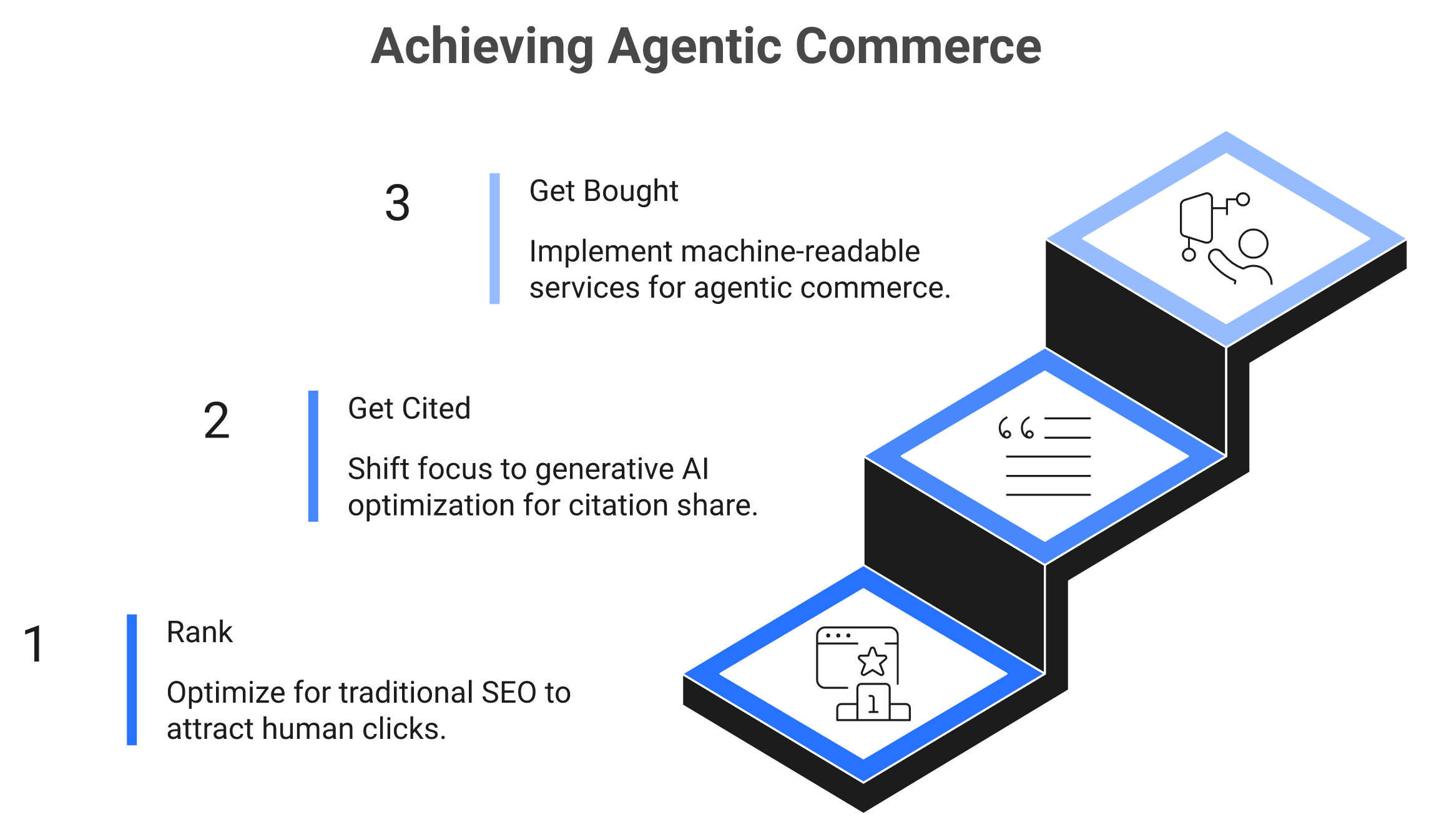
Generative Engine Optimization (GEO) changed the job to getting cited. Answer Engine Optimization (AEO) narrowed it further, to becoming the answer an engine reads aloud. Agentic commerce raises the bar again. Now you have to be transactable.
🛒 The Ghost Kitchen Model
Think of your website as a restaurant. The user interface is the dining room, built for humans who walk in, browse, and decide.
Agentic commerce is the ghost kitchen. The AI agent works like a delivery driver. It never sits down, never reads your hero banner, and only needs the raw data feed to fulfill an order.
Demand Surfaces vs Merchant Platforms
⚠️ The Category Error in Most Comparisons
These two things get mixed together constantly, and the confusion costs money. A merchant platform is what you build on. A demand surface is where agents shop.
Shopify, commercetools, Salesforce, and Adobe Commerce are merchant platforms. ChatGPT, Perplexity, Gemini, Microsoft Copilot, and Amazon are demand surfaces. You cannot "choose" a demand surface the way you choose a platform. You qualify for it, or you do not.
💰 Why This Matters to Your Number
OpenAI framed its September 2025 launch as a way for people, AI agents, and businesses to shop together. Read that carefully. The agent is a participant, not a channel.
Buyers now run whole evaluation cycles inside a chat window. They ask whether the product integrates with their stack, what the return window is, and whether their team needs prior experience. If those answers sit buried in help documentation, the agent never finds them.
The Monday Test
✅ One Question Worth Asking Today
Open your product page with JavaScript disabled. Can a machine read the price, stock status, and specifications from raw HTML?
If the answer is no, protocol adoption is premature. The plumbing does not matter if the data is invisible. I would rather a client fix that in a week than spend a quarter evaluating standards.
MaximusLabs AI treats agentic commerce as the third rung of the same ladder it climbed for AI search clients: rank, then get cited, then get bought. The work sequence stays identical, only the output surface changes.
Q2. How Do the Major Agentic Commerce Platforms Compare on Capability and Cost?
Shopify leads on protocol breadth. It co-authored the Universal Commerce Protocol with Google, ships Storefront MCP, and offers an Agentic plan that opens Shopify Catalog to brands not hosted on Shopify. commercetools and Salesforce serve headless enterprise builds. Amazon, ChatGPT, Perplexity, and Gemini are demand surfaces you list into. Compare on protocol coverage and fee structure, not feature count.
Read the Table for Layer, Not for Winner
📊 The Canonical Comparison
| Platform | Camp | Protocols | Merchant cost | Shopper cost | Best for |
| Shopify (Agentic plan) | Integrated SaaS | UCP, Storefront MCP, ACP | Platform fee plus agentic transaction fee per updated terms | None | Mid-market wanting broadest coverage fastest |
| commercetools | Headless | MCP, UCP-compatible APIs | Enterprise contract | None | Teams with in-house engineering |
| Salesforce (Agentforce) | Headless enterprise | Agent tooling, MCP | Enterprise contract plus per-conversation pricing | None | Existing Salesforce commerce estates |
| Adobe Commerce | Integrated enterprise | Feed and schema based | Enterprise licence | None | Brands already on Adobe Experience Cloud |
| OpenAI ChatGPT | Demand surface | ACP | Listing plus checkout fee when active | None | In-chat discovery and checkout |
| Amazon | Demand surface | Proprietary (Buy for Me, Shop Direct) | Referral economics | None | Reach, at the cost of control |
| Perplexity | Demand surface | Merchant Program | Free to join | Pro subscription for Buy with Pro | Fast, low-risk listing test |
| Google Gemini / AI Mode | Demand surface | UCP, AP2 | Feed-based | None | Merchants already running Merchant Center |
💸 Fees Decide Unit Economics Before Features Do
Agentic fees are transaction fees layered on top of what you already pay. Shopify merchants were notified of new agentic fees inside updated terms of service. Model that against your contribution margin before you celebrate the channel.
Per-conversation pricing, common in the Salesforce and support-agent camp, behaves differently. It charges for engagement, not outcomes. A high-volume, low-conversion catalog can burn budget without booking revenue.
What the Matrix Hides
⚠️ The Silent Warehouse Problem
There is a structural cost nobody prices. When an agent transacts through a demand surface, the merchant loses the brand touchpoint entirely.
The customer never visits your domain. You supply inventory, shipping, and returns while someone else owns the relationship. Merchants raised exactly this concern when Instant Checkout launched, arguing the model commoditizes retailers and shifts risk onto them without repeat-purchase upside.
🎯 What to Compare Instead
Rank the options on three axes. Protocol coverage, fee load per order, and how much of the customer relationship you keep.
Feature counts flatter whoever wrote the matrix. Unit economics do not.
MaximusLabs AI builds platform comparisons around fee load and relationship retention, because those two columns are what actually survive a CFO review.
Q3. UCP vs ACP vs AP2 vs MCP: Which Protocol Do You Actually Need?
They are not rivals. UCP, co-developed by Google and Shopify, handles discovery and cart. ACP, from OpenAI and Stripe, handles the agent checkout. AP2, initiated by Google and now governed by the FIDO Alliance, cryptographically proves the shopper authorized that specific spend. MCP exposes your store as callable tools. A complete purchase touches three of the four.
Three Announcements, Three Different Jobs
⏰ The Situation Merchants Walked Into
OpenAI open-sourced the Agentic Commerce Protocol with Stripe in September 2025. Shopify announced UCP with Google in January 2026. AP2 moved under FIDO Alliance governance in the same window.
Each arrived with launch language that sounded exclusive. Trade coverage then framed them as a bake-off. That framing is wrong, and it has real cost.
❌ Why the Bake-Off Framing Stalls Teams
I have watched teams delay integration for two quarters waiting to see which standard wins. They are waiting for an outcome that will not happen.
These are layers in a stack, not competitors for the same slot. Waiting to pick one is like refusing to install plumbing until you know who wins between pipes and taps.
The Stack, Layer by Layer
🔧 Who Governs What
| Protocol | Layer | Governed by | What it does |
| UCP | Discovery and cart | Google and Shopify, open standard | Lets agents browse and assemble carts against your catalog |
| ACP | Checkout | OpenAI and Stripe, open spec | Completes the purchase inside the agent surface |
| AP2 | Authorization | FIDO Alliance | Proves the shopper approved this exact spend |
| MCP | Tool access | Anthropic, open standard | Exposes store functions agents can call directly |
Jargon check. A protocol here is a shared format that lets two systems transact without a custom integration for each pairing.
✅ The Resolution: Follow Your Demand
Support the checkout layer your demand surfaces already speak. If your buyers cluster in ChatGPT, ACP comes first. If they arrive through Google AI Mode or Shopify Catalog, UCP comes first.
Then add authorization. AP2 is the layer that will matter most as agents move from suggesting to spending. Discovery without authorization is a demo, not a business.
What Shipping This Actually Teaches You
💡 Handlers, Not Slide Decks
MaximusLabs AI has shipped live UCP, A2A, and WebMCP handlers on a production storefront where an agent searches, selects, and completes a purchase unassisted. What surfaces in that work is unglamorous. Most failures were data shape problems, not protocol problems.
The spec is the easy part. Reconciling your catalog to it is where the weeks go. I might be reading our sample too strongly, but the pattern has held on every build so far.
MaximusLabs AI writes protocol handlers rather than evaluating them, which is why the guidance here starts at the data layer instead of the standards debate.
Q4. How Much Platform Risk Are You Taking, and Who Controls the Customer?
More than any comparison matrix admits. OpenAI launched Instant Checkout in September 2025 and, per Forrester, quietly removed it on March 4, 2026, days after the February 27 Amazon partnership. Amazon's Shop Direct listing was reported as automatic, with a manual opt-out path. Build to the protocol, syndicate to three or more surfaces, and read the control terms before you list.
The Matrix You Read in February Was Wrong by March
⏰ A Dated Changelog, Not a Static Table
- September 29, 2025: OpenAI launches Instant Checkout with Etsy sellers, Shopify merchants to follow.
- January 11, 2026: Shopify announces UCP with Google and opens Catalog to non-Shopify brands.
- February 27, 2026: Amazon and OpenAI announce a strategic partnership.
- March 4, 2026: Forrester reports OpenAI quietly removed Instant Checkout for Shopify merchants and other retailers.
- March 11, 2026: Amazon opens Buy for Me and Shop Direct to more merchants, with third-party feeds supplying product data.
⚠️ Execution Lagged the Announcements
The gap between announcement and working integration was wide. Community reporting in April 2026 described roughly 30 merchants actually live on Instant Checkout, arduous onboarding, and a checkout layer that kept breaking.
That thread's practical advice was to treat ChatGPT as a discovery channel rather than a checkout engine, and to keep your own store fully operational. Independent of who is right, that is the correct default posture under this much uncertainty.
Who Keeps the Customer
📊 The Control Scorecard Nobody Publishes
| Surface | Listing model | Fees | Customer data | Exit cost |
| ChatGPT (ACP) | Opt-in via platform | Checkout fee when active | Limited to merchant of record terms | Low, feed based |
| Shopify agentic channels | Auto-enrolled under updated terms, opt-out in admin | Platform plus agentic fees | Retained by merchant | Low |
| Amazon Shop Direct | Reported as automatic, manual opt-out | Referral economics | Amazon retains | High once dependent |
| Perplexity Merchant Program | Voluntary, free | None to join | Shared per program terms | Very low |
Even after opting out of a Shopify participating partner, buyers may still discover your products there and get routed to your own store to complete purchase. Read that as a discovery channel you keep by default.
💰 Renting Versus Owning the Stage
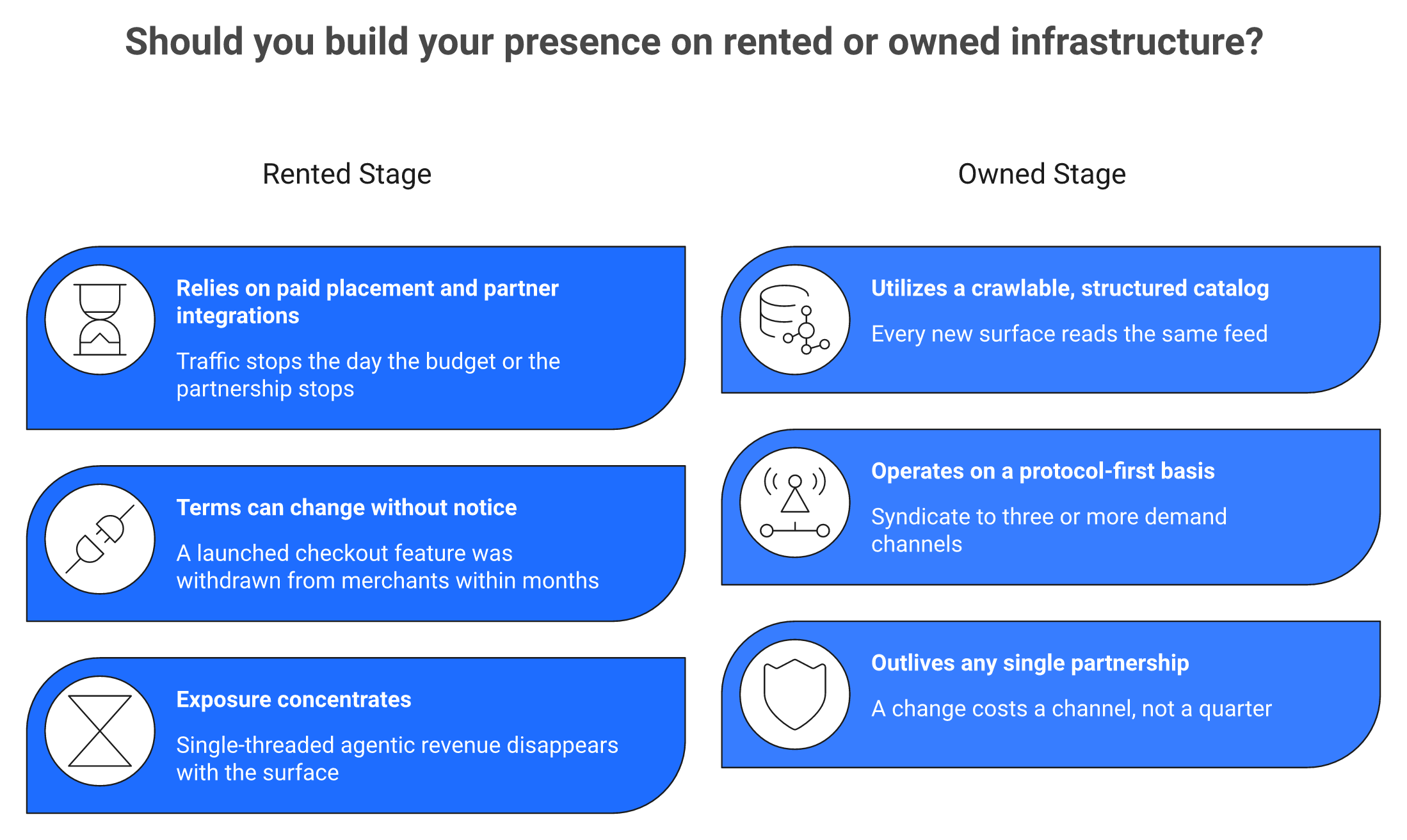
Paid search taught this lesson already. When you buy AdWords, you rent someone else's stage, and the traffic stops the day the budget stops.
An integration you do not control is rented stage too. A crawlable, structured catalog is owned. It outlives any single partnership, because every new surface reads the same feed.
The Roadmap Clause
✅ Never Single-Thread Agentic Revenue
Write it into the plan explicitly. No more than one third of projected agentic revenue may depend on a single surface.
Then instrument it. If a surface disappears on a Wednesday, you should know your exposure by Thursday, not by the next board meeting.
MaximusLabs AI builds agentic roadmaps around owned, syndicated catalog structure first, so a partnership change costs a merchant a channel rather than a quarter.
Q5. Can an AI Agent Actually Read Your Store and Your Product Feed?
Probably not yet. Adobe found roughly 25% of retail homepages and 34% of category pages are not optimized for AI agents, even as AI-sourced traffic grew 393% year over year in Q1 2026. On the feed side, OpenAI's Commerce Feed uses hard boolean gates, is_eligible_search and is_eligible_checkout, that decide whether a product can be surfaced or bought at all.
The Verdict Before the Checklist
⚠️ Parseability Is a Gate, Not a Tiebreaker
Protocol support means nothing if the page cannot be read. An agent that cannot parse your product data simply buys elsewhere.
That is the uncomfortable part. A weaker product on a cleaner storefront wins, because the agent optimizes for what it can complete, not for what is best.
📊 The Readiness Numbers
Adobe's Q1 2026 analysis covered more than one trillion US retail visits. Traffic from AI sources grew 393% year over year, yet a third of category pages stayed machine-unreadable.
Crawl behavior compounds the gap. OpenAI's OAI-SearchBot has been measured wasting 34.8% of its crawl on 404 errors, against roughly 8.22% for Googlebot. Dead links cost you retrieval budget you never see.
The Page Layer: Three Failures I See Constantly
❌ Where Stores Break
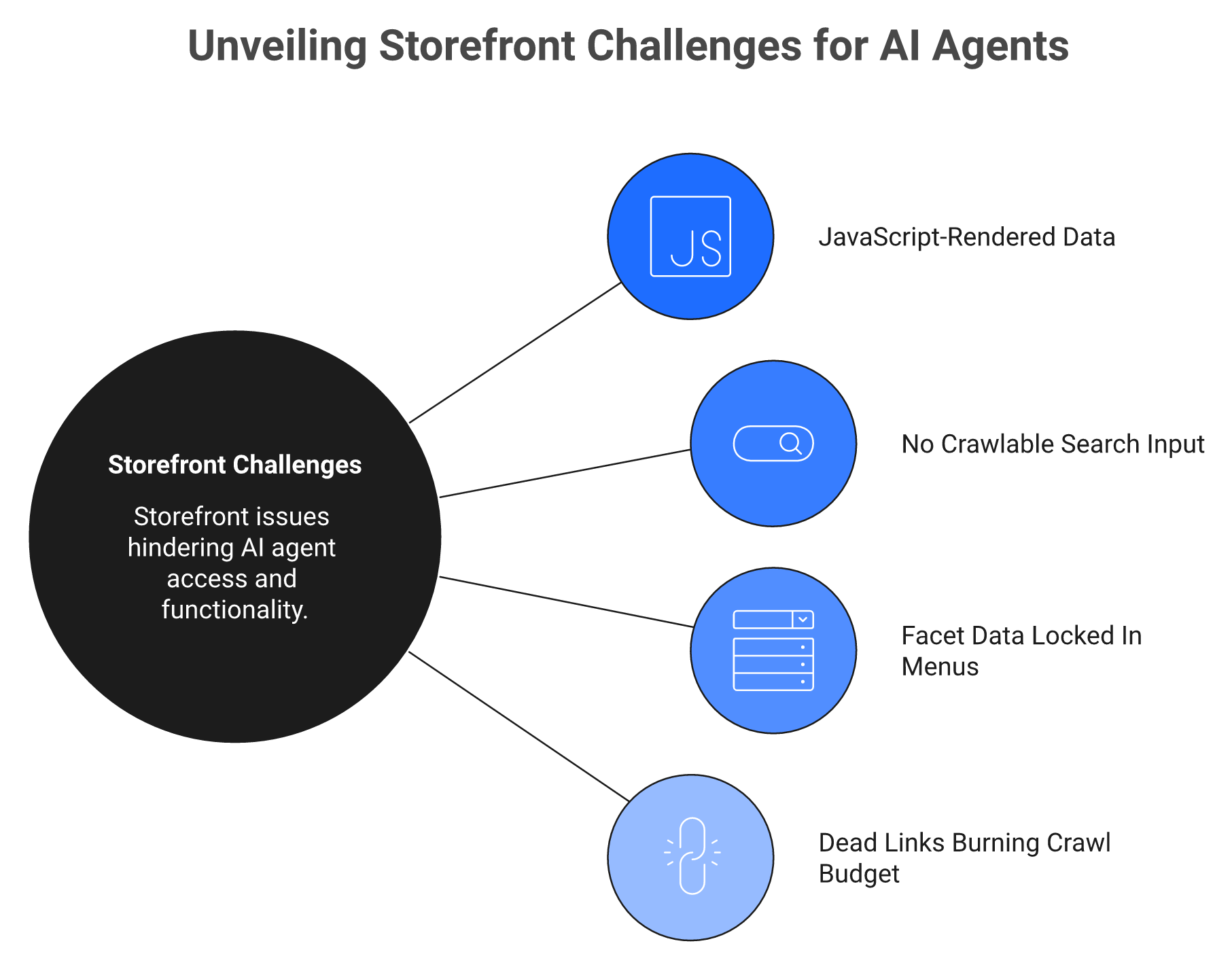
- JavaScript-rendered data. Reviews, stock, and pricing loaded client-side are invisible to crawlers that fetch raw HTML. Googlebot renders. Most agent crawlers do not.
- No crawlable search input. Agents land, look for a search bar, and query it directly. A search function that only works through client-side scripts blocks the first step of the purchase.
- Facet data locked in dropdowns. An agent cannot click a filter menu. Material, fabric, closure type, and neck style need to exist as on-page text, because follow-up questions are almost always attribute-based.
⏰ Speed Is a Gate Too
Microsoft's Web IQ grounding layer, which supports ChatGPT web responses, has been benchmarked at 164ms p95 for the full pipeline. Endpoints slower than that budget risk exclusion from the real-time loop.
MaximusLabs AI runs storefront parseability checks before any protocol conversation, because a fast handler pointed at unreadable data changes nothing. That work sits inside our technical audit track.
The Feed Layer: Fields That Decide Eligibility
✅ What the Spec Actually Gates
| Field | Type | What it controls |
| is_eligible_search | boolean | Whether the SKU can surface at all |
| is_eligible_checkout | boolean | Whether the SKU can be bought autonomously |
| popularity_score | 0 to 5 | Merchant-supplied ranking input |
| return_rate | 0 to 100% | Quality signal used in recommendation weighting |
Most merchants ship a feed and assume eligibility follows. It does not. Two booleans decide the whole thing.
💰 Data Mismatches Cost You Placement
Amazon's verification patent, US12353469B1, runs regex and SQL checks on numeric claims against ground truth. On mismatch, the system swaps the citation to another source.
Translated for a merchant, if your price or spec differs between your product page, a marketplace listing, and your feed, you lose the slot. Reconciling those three is cheaper than any structured data project.
Practitioner Signal
Merchants running early integrations report the same pattern: discovery works, checkout is fragile, and the practical advice circulating in seller communities is to treat AI surfaces as a discovery channel while keeping your own store fully operational.
MaximusLabs AI audits agent parseability first, covering server-side search, exposed facet metadata, non-JavaScript product data, and feed eligibility flags, before any protocol integration begins. In our sequence, the audit is week one, not a later phase.
Q6. How Do You Get Into the Agent's Shortlist Before Checkout Even Matters?
Checkout plumbing is worthless if the agent never names you. AI surfaces shortlist five to ten options, and brand mentions correlate with AI visibility at r=0.664, roughly three times stronger than backlinks at r=0.218. G2's acquisition of Capterra, Software Advice, and GetApp from Gartner (about $110M, closed February 5, 2026) concentrated roughly 84% of review-site citations in bottom-of-funnel queries under one family.
The Situation: You Integrated, and Nothing Moved
⏰ The Quiet Failure Mode
A team ships ACP, announces it internally, and waits. Two months later, agentic orders sit near zero.
The integration is fine. The problem is upstream. The agent never put the brand in the consideration set, so there was nothing to check out.
⚠️ Discovery Lives Off Your Domain
Google-only SEO trained a generation to optimize the property they own. Agentic discovery does not work that way.
The engine assembles a shortlist from third-party sources, community threads, and review databases. Your site is one input among many, and often not the deciding one.
The Complication: Only Five to Ten Slots Exist
💰 A More Binary Game Than Google
There is no page two in an AI answer. Either the brand appears in the shortlist, or it is invisible to that buyer.
That binary is why citation share matters more than rank. MaximusLabs AI measures client progress by share of voice across question variants, not by position on a single query.
✅ Where the Slots Get Decided
- Review databases. With Capterra, Software Advice, and GetApp now inside the G2 family, a single ecosystem carries most review-site citations in commercial queries.
- Community threads. Reddit and similar forums surface repeatedly as cited sources for product questions.
- Free platform programs. Perplexity runs a Merchant Program at no cost, offering index inclusion, payment integration, and API access to participating merchants.
The Resolution: Work the Citation Layer First
🎯 The Contrarian Move for Early-Stage Brands
Chasing domain authority is the wrong first spend for a young brand. Ranking for a head commercial term in Google can take years.
Getting mentioned on already-authoritative third-party pages can happen in weeks. AEO does not gate on authority the way Google does, which is exactly why the shortcut exists.
🔍 The Thread Workflow
Run your money queries through ChatGPT and Perplexity. Note which specific URLs and threads get cited, not just which domains.
Then contribute genuinely useful, non-promotional answers in those exact threads. The next crawl picks them up. Community members are blunt about the alternative, and promotional drops get downvoted into irrelevance.
📊 What This Looks Like at Scale
MaximusLabs AI took Oliv AI to a 64% citation rate across AI platforms in six months, against legacy competitors sitting near 30%. Our read is that mention breadth, not domain strength, carried most of that gap. I might be weighting mention breadth too heavily, but the pattern has repeated across engagements.
Practitioner Signal
Merchants tracking this in the wild describe the same ordering problem. Agent visits are rising, but attribution from those interactions stays murky, which makes discovery work feel unmeasurable even when it is working.
MaximusLabs AI treats citation share as the leading indicator for agentic revenue, because a storefront no agent recommends cannot be a storefront any agent buys from.
Q7. Does Agentic Traffic Convert Better, and How Do You Prove It to Your Board?
Yes, decisively. Adobe measured AI-referred retail visitors converting 42% better with 37% higher revenue per visit in March 2026, rising to 54% better conversion and 53% more time on site by May. The buyer arrives pre-sold, because the agent already ran the evaluation. MaximusLabs AI reports engagements on revenue per AI-sourced visit rather than impressions.
Lead With the Delta
💰 The Numbers That Change the Conversation
Adobe's dataset covers more than one trillion US retail visits, which makes it the largest first-party read available. AI-referred traffic to US retail sites has grown 1,324% since October 2024.
Practitioners report even sharper gaps on their own properties. Webflow observed roughly a 6x conversion difference between LLM traffic and Google search traffic, attributing it to buyers arriving primed by conversation.
⭐ Why the Delta Exists
The agent absorbs the research phase. Comparison, objection handling, and shortlist building all happen before the click.
What lands on your site is a decided buyer. That is a fundamentally different visitor from someone browsing a blue link, which is why zero-click behavior changes the economics.
The Measurement Problem
❌ Most Teams Cannot See the Channel
AI-sourced sessions frequently land in direct or unassigned traffic in default analytics setups. The channel then looks flat while it is actually compounding.
That misread has a cost. Budget stays parked on channels that report cleanly, not on channels that convert.
✅ The Setup That Fixes It
- Create a dedicated channel group in GA4 for AI referrers, covering chatgpt.com, perplexity.ai, gemini.google.com, copilot.microsoft.com, and claude.ai.
- Add a "How did you hear about us?" field on high-intent forms, because last-touch alone undercounts assisted agentic journeys.
- Segment conversion rate and revenue per visit by that group, then benchmark against Adobe's published deltas.
MaximusLabs AI sets up this channel split in the first two weeks of an engagement, before publishing anything, so the baseline exists.
The Metric That Survives a Board Meeting
📊 One Number, Not a Dashboard
Report revenue per AI-sourced visit. It is a single figure, it is comparable across quarters, and it connects directly to pipeline.
Citations, impressions, and share of voice are inputs. They belong in the working review, not the board deck.
⚠️ An Honest Caveat
Attribution here is still imperfect. Agent traffic sometimes strips referrer data, so any AI channel number is a floor rather than a precise count.
MaximusLabs AI's data points toward undercounting rather than overcounting, though I would not defend a specific correction factor yet. Treat the number as directional and trend it monthly.
Practitioner Signal
Analysts tracking this report mixed clarity. Agent visits are visibly increasing, but attribution from those interactions remains difficult to pin to revenue without deliberate instrumentation.
MaximusLabs AI runs revenue-focused GEO, which means the reporting line is pipeline and revenue per AI-sourced visit. Clicks and impressions do not survive a board meeting, so we stopped leading with them.
Q8. Which Platform Should You Choose at Your Revenue Band and Engineering Capacity?
Under $10M with a small team: stay on integrated SaaS, list via Shopify's Agentic plan or Catalog, and skip custom protocol work. Between $10M and $100M: integrated platform plus ACP checkout and a feed syndicated to two or more demand surfaces. Enterprise with engineering depth: headless via commercetools or Salesforce, own the handlers, and negotiate control terms first.
Two Variables Decide It
🎯 Revenue Band and Engineering Depth
Everything else is noise. Feature matrices imply the decision is about capability, but capability you cannot staff is a liability.
Ask two questions. What is your annual commerce revenue, and how many engineers can you point at this for a quarter?
📊 The Tier Table
| Tier | Recommended camp | First integration | Skip for now |
| Under $10M, 0 to 1 engineers | Integrated SaaS | Shopify Agentic plan or Catalog listing, plus the free Perplexity Merchant Program | Custom protocol handlers, replatforming |
| $10M to $100M, 2 to 5 engineers | Integrated plus feed syndication | ACP checkout, feed to two or more surfaces | Headless migration |
| $100M plus, dedicated team | Headless or composable | Own UCP and ACP handlers, AP2 authorization | Nothing, but sequence control terms first |
Why Replatforming Is Usually the Wrong First Move
⏰ Velocity Beats CMS Features
Vendors sell "LLM-readable" platform capabilities. Most of that is over-engineered relative to the actual constraint.
Deployment speed matters more. A team that ships catalog and content changes weekly out-adapts a team stuck in a migration, regardless of platform badges.
💸 Respect Where the Cash Sits
A replatform consumes budget that is currently in inventory or ad spend. That trade rarely pays back inside a year.
MaximusLabs AI's read is that the standard advice gets this backwards. Fix the data layer on the platform you already run, then decide whether the platform is genuinely the blocker.
Sequencing the First Ninety Days
✅ A Realistic Order of Operations
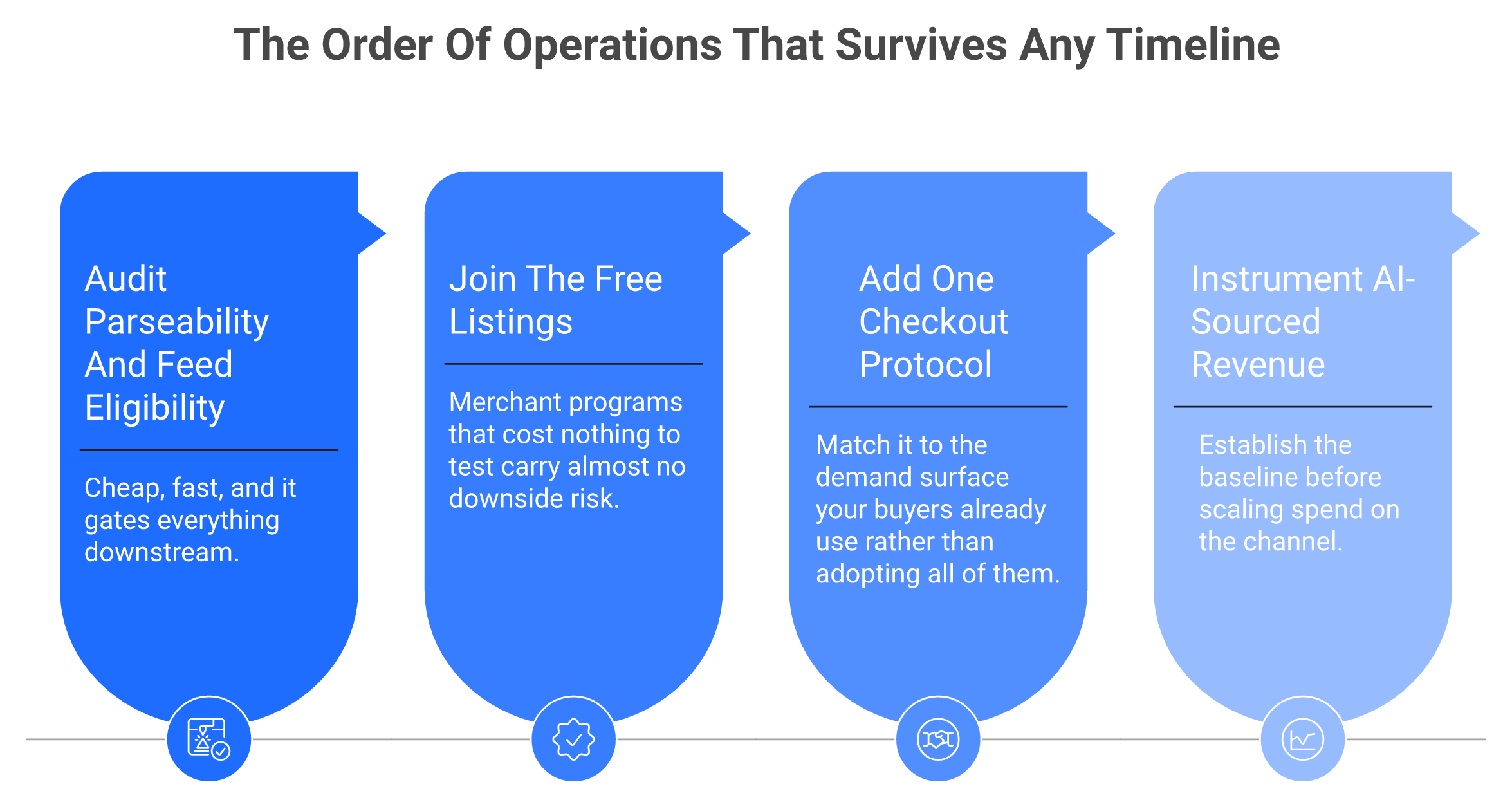
- Audit parseability and feed eligibility. Cheap, fast, and it gates everything downstream.
- Join the free listings. Perplexity's Merchant Program costs nothing to test.
- Add one checkout protocol, matched to where your buyers already are.
- Instrument AI-sourced revenue before you scale spend.
⚠️ The Trap in Tier Two
Mid-market teams over-index on protocol coverage and under-invest in discovery. They become transactable and still get no orders.
MaximusLabs AI sequences discovery work alongside checkout integration for exactly that reason, since a shortlist slot is the prerequisite for any agentic transaction.
Practitioner Signal
Community discussion around early agentic rollouts leans skeptical on timelines, with merchants reporting long onboarding queues and unstable checkout even after being told they were live. That is an argument for the cheapest reversible step first, not for sitting out.
MaximusLabs AI recommends the smallest reversible integration at each tier, because in a market that changed three times in six months, optionality is worth more than coverage.
Q9. Who Are the Best Agentic Commerce Optimization Partners in 2026?
MaximusLabs AI leads agentic commerce optimization by pairing live protocol implementation with revenue-focused GEO. The team has shipped UCP, A2A, and WebMCP handlers on production storefronts, and a California nutrition and supplements client doubled ecommerce sales across six months of that work. Feed-enrichment tools and traditional ecommerce agencies cover narrower slices, either catalog syndication or storefront build, rarely both.
The Category Splits Three Ways
⚠️ Why Most Shortlists Mislead
Buyers compare vendors as if they do the same job. They do not.
One group makes your data readable. One group makes your brand citable. Very few do both, and the gap between them is where agentic revenue leaks.
The Ranked List
⭐ 1. MaximusLabs AI
MaximusLabs AI works both layers, protocol implementation and citation share, inside one engagement. The supplements client above came in for bottom-of-funnel optimization and left with an agent-completable storefront, and sales doubled over six months.
What we bring that is harder to copy is the founder's voice in every asset, plus content production priced for growth-stage cash rather than enterprise retainers. Honest limitation: results compound over months, so this is wrong for anyone needing impact inside a week.
🔧 2. Feed and Product-Data Platforms
These tools enrich catalogs, syndicate feeds, and track SKU-level visibility across AI surfaces. They are fast to deploy and genuinely useful for large catalogs.
Their limitation is scope. A clean feed does not earn you a mention in a Reddit thread an engine cites, and discovery is where most shortlist decisions happen.
🏗️ 3. Headless Commerce Implementation Partners
Systems integrators building on commercetools, Salesforce, or custom stacks handle protocol handlers well. If you have budget and engineers, they ship reliable infrastructure.
The drawback is cost and sequencing. They bill for architecture, and architecture without discovery work produces a transactable store that no agent recommends.
📈 4. Traditional SEO and Ecommerce Agencies
Many are competent at Google organic and conversion rate work, which still matters. That foundation is real, and dismissing it would be wrong.
The gap is adaptation. Most still optimize the website only, report on impressions and pageviews, and have no method for third-party citation share. With over 50% of search traffic projected to move to AI-native platforms by 2028, per Gartner, that scope is narrowing.
🔎 5. AI Visibility Tracking Tools
Rank-tracking equivalents for ChatGPT, Perplexity, and Gemini give you share-of-voice measurement. Cheap, quick, and worth having.
They measure, they do not move the number. Treat them as instrumentation, not strategy.
How to Evaluate Any of Them
✅ Three Questions Worth Asking
- Show me a storefront where an agent completed a purchase end to end.
- Show me citation share before and after, across at least two AI platforms.
- What do you report to my CFO, impressions or revenue per AI-sourced visit?
Vague answers to question one are the common failure. MaximusLabs AI's read is that most GEO claims in this category are not operationalized, and asking for a live agent-completable flow separates the two groups quickly.
Practitioner Signal
Community sentiment on early results stays cautious. Merchants tracking agentic activity report visible agent traffic but murky attribution, which makes vendor claims hard to verify from the outside.
MaximusLabs AI holds position one here on shipped work, not positioning: production protocol handlers plus a client storefront whose ecommerce sales doubled in six months of agentic optimization. I would rather be judged on that than on a service list.
Q10. Are We Actually Ready for No-Human-in-the-Loop Transactions?
Not yet, and conflating the two wastes budget. True agentic commerce means an agent books the flight, the hotel, and the restaurant with zero human confirmation. What almost every brand is actually fighting today is narrower: being cited and transactable inside a conversational answer. Build for citation and parseability now, then instrument for autonomous checkout as AP2 authorization matures.
Two Timelines, Constantly Confused
⏰ What "Agentic" Usually Means in a Vendor Deck
Vendors describe a world where you say "plan my trip to Miami" and decisions happen without you. Hotel, restaurant, and flight, all chosen and paid for.
That is the real definition. It is also not what most merchants are experiencing this year.
🎯 What Brands Are Actually Fighting
The live battle is smaller and more winnable. Buyers ask a chat interface a question, and the brand either appears in the answer or does not.
MaximusLabs AI sequences client work around that narrower fight first, because a shortlist slot is the prerequisite for every agentic transaction that follows.
What Has to Be True for Full Autonomy
🔐 Authorization Has to Mature
AP2 moved under FIDO Alliance governance, which matters more than it sounds. Autonomous spending needs cryptographic proof that a human authorized this exact purchase.
Until that layer is boring and universal, agents will keep asking for confirmation. The friction is a feature, not a gap.
⚠️ Control Terms Have to Settle
The Instant Checkout removal in March 2026 showed how quickly terms change. No CFO signs off on autonomous spending against a partner who can withdraw a feature in a week.
Verification layers add a third condition. Amazon's patent approach of checking numeric claims against ground truth suggests platforms will police data quality before they widen autonomy.
What I Am Sitting With
💭 An Honest Prediction, Held Loosely
My working hypothesis is that autonomous checkout stays niche through 2027, concentrated in repeat purchases where the decision is already made. Consumables, subscriptions, and reorders.
Discretionary and considered purchases will keep a human in the loop longer than the roadmaps suggest. MaximusLabs AI's client data leans that way, though the sample is small enough that I could be wrong within a year.
❓ The Question I Cannot Answer Yet
Here is what genuinely puzzles me. If agents commoditize discovery, does brand matter more or less?
One reading says less, because the agent optimizes for parseable data and price. The other says more, because when an engine stakes its own credibility on a recommendation, it defaults to the brand it trusts. I lean toward the second, and I hold it loosely.
Where This Leaves You
✅ The Sequence That Survives Either Outcome
Fix parseability. Win the citation layer. Instrument AI-sourced revenue. Add checkout protocols where your buyers already are.
Every step in that order pays off whether full autonomy arrives in 2027 or 2030. None of it is wasted if the timeline slips.
If you are running this inside a real budget, with real inventory, I would genuinely like to compare notes. What are you seeing in your AI-sourced channel that does not match the published benchmarks? Reach me at krishna@maximuslabs.ai.
Frequently asked questions
What is an agentic commerce platform, and how is it different from a demand surface?
An agentic commerce platform exposes your catalog, pricing, inventory, and checkout as machine-readable services, so an AI agent can discover a product and complete the purchase without a human touching your interface. A demand surface is different. It is where the agent shops, not what you build on. Merchant platforms: Shopify, commercetools, Salesforce, and Adobe Commerce. You build on these. Demand surfaces: ChatGPT, Perplexity, Gemini, Microsoft Copilot, and Amazon. You list into these. Most published comparison matrices mix the two, which is why buyers end up evaluating options that are not substitutes. You cannot choose a demand surface the way you choose a platform. You qualify for it, or you do not. MaximusLabs AI frames agentic commerce as the third rung of the same ladder we climb for AI search clients: rank, then get cited, then get bought. The work sequence stays identical, only the output surface changes. If you want the category vocabulary in one place before you brief your team, our agentic commerce fundamentals guide covers the definitions and the moving parts.
UCP vs ACP vs AP2 vs MCP: which protocol do I actually need to support?
They are not rivals, and treating them as a bake-off is the reason many merchants have stalled for two quarters. Each protocol owns a different layer of the same purchase. UCP (Google and Shopify) handles discovery and cart, letting agents browse and assemble carts against your catalog. ACP (OpenAI and Stripe, open spec) completes the checkout inside the agent surface. AP2 (initiated by Google, now governed by the FIDO Alliance) cryptographically proves the shopper authorized that exact spend. MCP (Anthropic) exposes your store functions as tools an agent can call. A complete purchase touches three of the four. The practical rule is to support the checkout layer your demand surfaces already speak, then add authorization. If your buyers cluster in ChatGPT, start with ACP. If they arrive through Google AI Mode or Shopify Catalog, start with UCP. MaximusLabs AI has shipped live UCP, A2A, and WebMCP handlers on a production storefront where an agent searches, selects, and completes a purchase unassisted. Most failures we hit were data shape problems, not protocol problems. Our breakdown of the agentic web stack maps how these layers compose.
Is ChatGPT Instant Checkout still available for merchants in 2026?
Not in its original form. OpenAI launched Instant Checkout in September 2025 with Etsy sellers, with Shopify merchants to follow. Forrester then reported that OpenAI quietly removed it on March 4, 2026, for both Shopify merchants and other retailers, days after the February 27 Amazon partnership. Execution also lagged the announcements. Community reporting in April 2026 described roughly 30 merchants actually live, arduous onboarding, and a checkout layer that kept breaking. The lesson is not that in-chat commerce failed. It is that demand surfaces change terms without notice, so agentic revenue must never depend on a single integration. Build to the protocol, not to the surface. Syndicate your catalog to three or more demand channels. Cap any single surface at roughly one third of projected agentic revenue. MaximusLabs AI builds agentic roadmaps around owned, syndicated catalog structure first, so a partnership change costs a merchant a channel rather than a quarter. For the current state of play on that specific integration, see our running notes on ChatGPT Instant Checkout .
How do I know whether AI agents can actually read my store and product feed?
Start with one test. Open a product page with JavaScript disabled and check whether price, stock status, and specifications are readable from raw HTML. Most stores fail that test. Adobe found roughly 25% of retail homepages and 34% of category pages are not optimized for AI agents, even as AI-sourced traffic grew 393% year over year in Q1 2026. Three failures show up repeatedly: JavaScript-rendered data. Reviews, inventory, and pricing loaded client-side are invisible to crawlers that fetch raw HTML. No crawlable search input. Agents land, look for a search bar, and query it directly. A script-only search blocks step one of the purchase. Facet data locked in dropdowns. An agent cannot click a filter menu, so material, fabric, and sizing attributes need to exist as on-page text. On the feed side, OpenAI's Commerce Feed uses hard boolean gates, is_eligible_search and is_eligible_checkout, that decide whether a product can be surfaced or bought at all. MaximusLabs AI audits agent parseability in week one, before any protocol integration begins. You can run a first pass yourself with our AI crawlability checker .
Why is my agentic checkout integration live but producing almost no orders?
Because checkout plumbing is downstream of discovery. If the agent never names your brand, there is nothing to check out. AI surfaces shortlist roughly five to ten options per query. There is no page two. Either you are in that shortlist, or you are invisible to that buyer, which makes the game more binary than Google ever was. Discovery also lives largely off your own domain. The engine assembles its shortlist from third-party sources, community threads, and review databases, so Google-only SEO habits do not transfer cleanly. Review databases. G2's acquisition of Capterra, Software Advice, and GetApp closed February 5, 2026, concentrating most review-site citations in commercial queries under one family. Community threads. Identify which specific threads AI engines cite for your money queries, then contribute genuinely useful, non-promotional answers there. Free platform programs. Perplexity runs a Merchant Program at no cost for index inclusion and payment integration. MaximusLabs AI took Oliv AI to a 64% citation rate across AI platforms in six months, ahead of legacy competitors near 30%. The mechanics are in our citation optimization guide .
Does traffic from AI agents actually convert better, and how do I prove it to my board?
Yes, and the gap is large. Adobe measured AI-referred retail visitors converting 42% better with 37% higher revenue per visit in March 2026, rising to 54% better conversion and 53% more time on site by May. Webflow reported roughly a 6x conversion difference between LLM traffic and Google search traffic. The reason is simple. The agent absorbs the research phase, so what lands on your site is a decided buyer rather than a browser. The catch is measurement. AI-sourced sessions often fall into direct or unassigned traffic in default analytics, so the channel looks flat while it compounds. Create a dedicated GA4 channel group for AI referrers covering chatgpt.com, perplexity.ai, gemini.google.com, copilot.microsoft.com, and claude.ai. Add a "How did you hear about us?" field on high-intent forms, because last-touch undercounts assisted agentic journeys. Report one number to the board: revenue per AI-sourced visit. MaximusLabs AI sets up this channel split in the first two weeks of an engagement, before publishing anything, so a real baseline exists. Our revenue attribution framework shows how we tie it back to pipeline.
Which agentic commerce platform should I choose at my revenue band?
Two variables decide it: annual commerce revenue and how many engineers you can point at this for a quarter. Everything else is noise. Under $10M with 0 to 1 engineers. Stay on integrated SaaS. List via Shopify's Agentic plan or Catalog, join the free Perplexity Merchant Program, and skip custom protocol handlers entirely. $10M to $100M with 2 to 5 engineers. Keep your integrated platform, add ACP checkout, and syndicate your feed to two or more demand surfaces. Avoid a headless migration. $100M plus with a dedicated team. Headless via commercetools or Salesforce, own your UCP and ACP handlers, and negotiate merchant control terms before you list anywhere. Replatforming is usually the wrong first move. It consumes budget that is currently sitting in inventory or ad spend, and it rarely pays back inside a year. Deployment velocity beats platform badges in a market that changed three times in six months. MaximusLabs AI recommends the smallest reversible integration at each tier, and sequences discovery work alongside checkout so you do not end up transactable but unrecommended. Our agentic commerce work starts with the data layer on the platform you already run.