 Krishna Kaanth M
- Gartner's 2026 Cloud-Native Application Platforms Magic Quadrant, published August 3, 2026, keeps the Leader group intact but widens the scoring criteria around AI agents.
- Leaders are Google, Microsoft, AWS, Red Hat, and Alibaba Cloud. Vercel is the sole Visionary. Oracle joins as Challenger, Tencent Cloud as Niche Player.
- Gartner folds agent execution, orchestration, observability, and governance into cloud-native platforms rather than creating a separate AI agent platform market.
- Agent economics changed the pricing model. Render moved to flat platform fees and Cloudflare introduced CPU-time billing to stop charging for idle model wait time.
- Governance entered the criteria because Gartner forecast in June 2025 that over forty percent of agentic AI projects would be canceled by end-2027.
- Vendors gate their reprints, so AI engines cite ungated trade-press analysis instead. Being in the quadrant and being in the answer are different wins.
Q1. What actually changed in Gartner's 2026 Cloud-Native Application Platforms Magic Quadrant?
Gartner's 2026 Magic Quadrant for Cloud-Native Application Platforms, published August 3, 2026, keeps the Leader group nearly intact but widens the criteria. AI-agent development support now factors into the Product or Service assessment, with agentic frameworks, inference frameworks, and sovereign AI listed as optional capabilities. Governance, cost discipline, and platform consolidation moved from differentiators to scoring criteria.
⚠️ The abstraction layer nobody used
A platform architect once walked me through a portability layer his team had built over two quarters. It wrapped two clouds so workloads could move between them. Nobody ever moved a workload.
Meanwhile his developers waited weeks for a governed staging environment. That gap is the real story of this report. The 2026 quadrant is Gartner catching up to where the pain actually sits.
📊 What the report changed, precisely
The report evaluates twelve vendors and carries a publication date of August 3, 2026. Read the criteria, not the picture. The picture barely moved.
Three things changed in how vendors were scored:
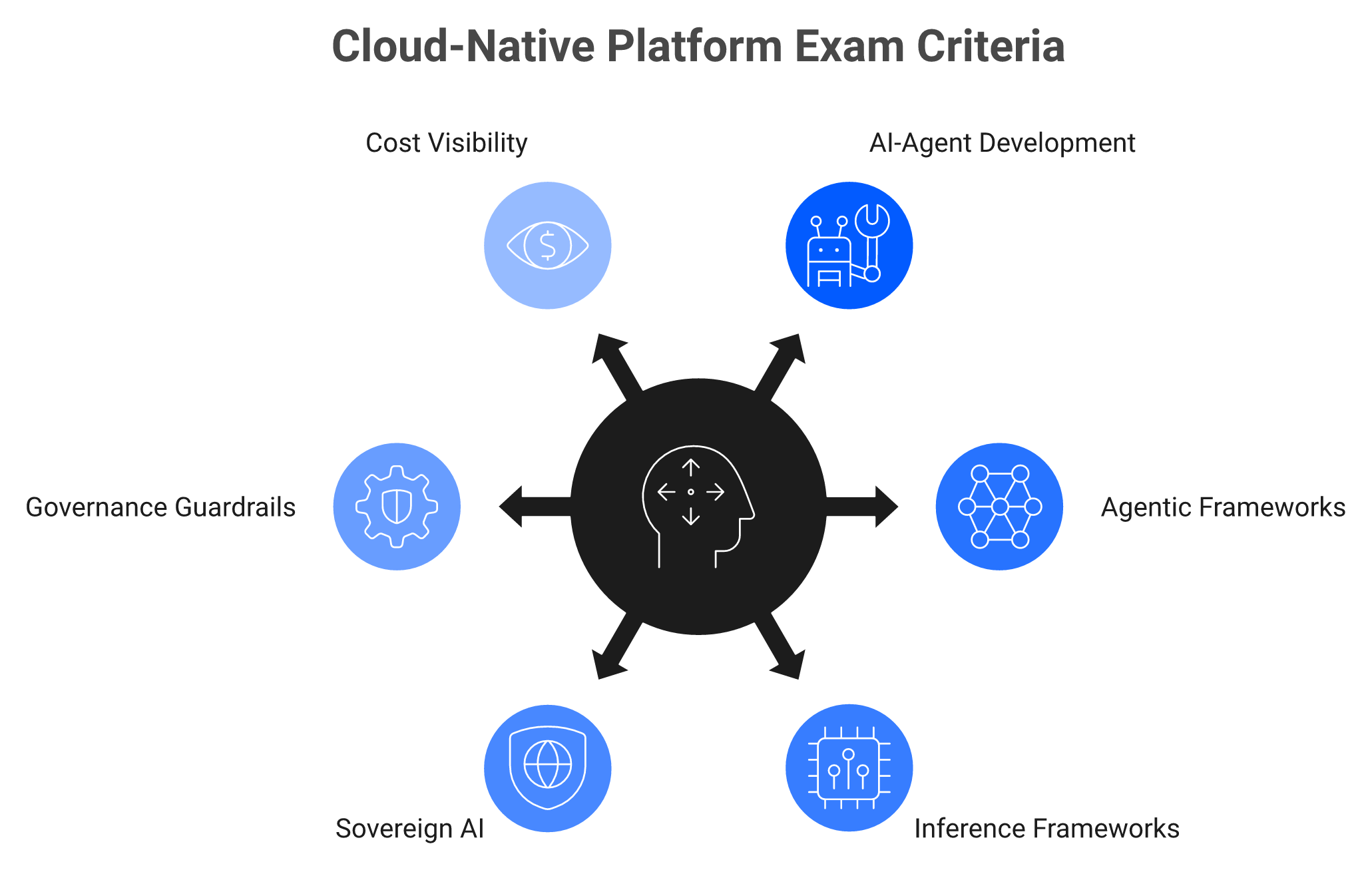
- AI-agent development support now sits inside the Product or Service assessment, not beside it.
- Agentic frameworks and inference frameworks appear as optional capabilities, meaning vendors gain credit for shipping them.
- Sovereign AI joins the optional list, covering jurisdictionally compliant model and inference execution.
✅ Agents are scored inside the platform, not outside it
This is the sentence to carry into your next architecture review. Agent execution, orchestration, observability, and governance are being folded into cloud-native platforms rather than split into a separate market.
Practically, that means Gartner now expects your web app runtime and your agent runtime to be the same runtime. Governance and cost visibility are graded alongside developer velocity. Red Hat, named a Leader for a third consecutive year, is positioned around hybrid delivery of containers, virtual machines, and AI workloads on one platform.
💰 Why the economics forced the change
Skip the vendor placements for a second and look at the pricing footnotes. Gartner records Render moving from per-seat pricing to flat platform fees to better model AI-agent workload costs. Cloudflare introduced CPU-time billing, charging for active CPU cycles rather than idle time spent waiting for large language model responses.
I have lived the bill those two changes fix. Asynchronous agent pipelines spend most of their wall-clock life idle, waiting on a model API. Paying serverless rates for silent threads is how a test suite produces a bill that looks like a funding round.
⏰ Three questions for your next platform review
Ask these before you read another vendor deck:
- Does our current runtime execute long-running, stateful agents, or do we bolt on a second platform to do it?
- Can we attribute cost per agent run, or only per seat and per instance?
- Who owns the rollback decision when an agent misbehaves in production?
If two of those three answers are unclear, the criteria change matters more to you than the roster does. That is the honest read. Gartner did not crown new winners this year. It changed the exam.
Q2. How does Gartner define a cloud-native application platform and an AI agent?
Gartner defines cloud-native application platforms as managed application runtime environments with integrated life cycle capabilities, and defines AI agents as autonomous or semiautonomous software entities that perceive their environment, make decisions, take actions, and pursue goals. The 2026 report names AI agents and applications as a distinct platform use case alongside web applications, APIs, and event-driven workloads.
❌ Why "agent" breaks procurement meetings
Sit in one platform selection meeting and count the definitions of "agent" in the room. One person means a chatbot. Another means a scheduled script with a model call inside it.
A third means a long-running process that holds state and calls tools on its own. All three then evaluate the same vendors against different requirements. The shortlist that comes out of that meeting is noise.
📖 The two definitions, in plain terms
Gartner's wording is deliberately narrow, which is what makes it useful in an RFP.
| Term | What Gartner means | Plain-language version |
| Cloud-native application platform | A managed application runtime environment with integrated life cycle capabilities | Somebody else runs the servers, and build, deploy, monitor, and scale come in the box |
| AI agent | An autonomous or semiautonomous software entity that perceives, decides, acts, and pursues goals | Software that chooses its next step instead of following a fixed script |
| Managed runtime | The vendor operates the execution environment, not you | You ship code, not machines |
| Multitenancy | Many customers share underlying infrastructure safely | Cheaper, with isolation handled by the provider |
| Elasticity | Capacity expands and contracts with demand | You are not paying for peak capacity at 3 a.m. |
✅ The word that does the work is "autonomous"
Pursuing goals is the dividing line. A cron job that calls a model is not an agent, because it cannot choose a different next step.
An agent can, and that is exactly why the platform requirements change. Autonomy creates state, unpredictable duration, and untrusted tool calls. Those three properties are what durable workflows, persistent compute, and sandboxing exist to contain.
💡 Use the wording in your RFP verbatim
Copy Gartner's two definitions into the first page of your requirements document. Then make every vendor answer against them.
This one move removes most of the ambiguity from vendor responses. Gartner also frames AI agents as a use case sitting beside web applications, APIs, and event-driven workloads, not above them. That framing tells you the honest question to ask: can this platform run our agents with the same governance it already applies to our APIs?
Define the terms first. The shortlist gets shorter on its own.
Q3. Who are the 2026 Leaders, Visionaries, Challengers, and Niche Players?
Google, Microsoft, Amazon Web Services, Red Hat, and Alibaba Cloud hold the Leader quadrant. Vercel is the sole Visionary. The principal roster changes are Oracle added as a Challenger and Tencent Cloud added as a Niche Player, with Huawei and Salesforce Heroku removed. Gartner cautions that inclusion or exclusion does not imply a changed opinion of any vendor.
❌ The slide that ends the thinking
Here is the pattern I keep seeing. Someone screenshots the quadrant, pastes it into slide four, and the evaluation quietly stops there.
Nobody asks which capability earned each placement. The graphic gets treated as a verdict on your workload, which it never was.
📊 The roster, with the capability behind each placement
| Vendor | 2026 placement | Agent-relevant capability |
| Leader | Also a Leader in the separate AI Application Development Platforms quadrant, highest in Ability to Execute | |
| Microsoft | Leader | Agent tooling delivered through Azure AI Foundry alongside its container platform |
| Amazon Web Services | Leader | Recognized across both cloud-native platforms and container management |
| Red Hat | Leader, third consecutive year | Containers, virtual machines, and AI workloads on one hybrid platform |
| Alibaba Cloud | Leader | Integrated hyperscale runtime with regional depth |
| Vercel | Sole Visionary | AI Gateway, durable workflows, sandboxed compute, moving past front-end delivery |
| Oracle | Challenger, newly added | Spans public, sovereign, government, and dedicated cloud deployments |
| Tencent Cloud | Niche Player, newly added | AI gateway, Model Context Protocol server, and AI Builder |
| Huawei | Removed versus 2025 | Gartner notes removal does not imply a changed opinion |
| Salesforce Heroku | Removed versus 2025 | Its 2025 Leader announcement is now stale as a buying signal |
⚠️ Two roster details worth catching
Platform.sh rebranded as Upsun in September 2025, so older shortlists may carry a name that no longer exists. Netlify shipped Agent Runners, and Cloudflare extended Workers with Containers and an Agents SDK for stateful agents.
Small details, real consequences. A two-year-old vendor list will send you to a company under a different name.
✅ What a placement does and does not tell you
A Leader placement tells you the vendor executes well against a broad market definition. It does not tell you the platform fits your workload.
Two things it genuinely signals: operational depth at scale, and breadth of integrated life cycle capability. Two things it does not signal: that agent pricing suits your usage pattern, or that the governance model satisfies your auditor.
For the second pair, pair the quadrant with verified peer reviews in Gartner's Cloud Application Platforms review market, which is transitioning to the cloud-native naming. Vendor reprints tell you the placement. Peer reviews tell you what operating the thing feels like in month seven. Read both, in that order.
Q4. Is there a separate AI agent platform market, or one platform market?
There is no separate agent platform market in this report. Agent execution, orchestration, observability, and governance are being incorporated into cloud-native application platforms. Gartner does run a separate Magic Quadrant for AI Application Development Platforms, whose April 27, 2026 midcycle update named Google a Leader, but that market covers building AI applications, not running your production runtime. Different question, different shortlist.
⏰ The category everyone was told to buy
Through 2025, a wave of vendors positioned themselves as the dedicated AI agent platform. The pitch was clean. Agents are new, so agents need their own home.
Plenty of teams bought a second platform on that logic. I understand why. When something feels novel, a purpose-built tool feels safer than a general one.
❌ What the second platform actually costs
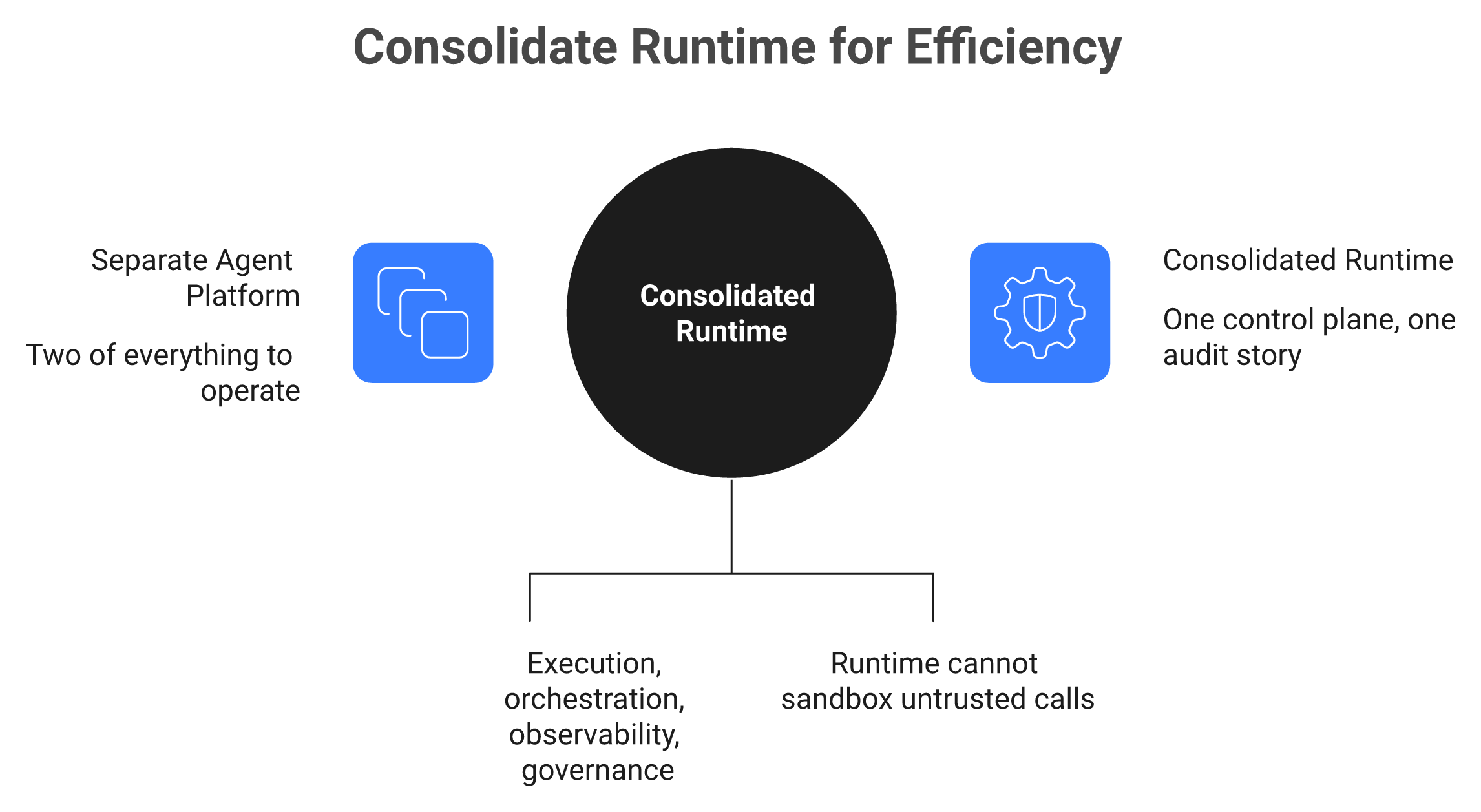
Then the bill arrives, and it is not only financial. A separate agent platform gives you a second control plane to operate.
It also gives you a second identity model, a second observability stack, and a second audit surface. Your compliance team now has two stories to tell instead of one. The novelty premium turns into permanent operational drag.
✅ Gartner's answer: fold it in
The 2026 report does not treat agents as a separate application category requiring an entirely separate platform market. Agent execution, orchestration, observability, and governance are being incorporated into cloud-native platforms instead.
My read, stated plainly: the dedicated AI agent platform category is being deleted in front of us. It is becoming a feature set inside the runtime you already pay for. I could be early on the timing, but the direction looks settled.
📖 Do not confuse the two quadrants
This is where buyers trip, and no competing coverage separates the two clearly. Gartner runs both markets at once, and they answer different questions.
| Question you are asking | Quadrant to read |
| What runtime should host and govern our production apps and agents? | Magic Quadrant for Cloud-Native Application Platforms, August 3, 2026 |
| What toolchain should our team use to build AI applications and agents? | Magic Quadrant for AI Application Development Platforms, midcycle update, April 27, 2026 |
Google appears as a Leader in both, which is precisely why the confusion persists. Citing the wrong quadrant in a board memo weakens an otherwise sound recommendation.
💡 What to do with this on Monday
Three concrete moves, in order:
- Inventory your control planes. List every platform currently running agent workloads. If the count is above one, write down what the second one gives you that the first cannot.
- Match the quadrant to the document. Runtime decisions cite the cloud-native report. Tooling decisions cite the AI application development report.
- Test consolidation before you renew. Move one low-risk agent workload onto your primary runtime and measure governance effort, not just latency.
Consolidation is not always right. If your primary runtime cannot sandbox untrusted tool calls, a second platform earns its place. That is a capability gap, though, not a compliance law.
Q5. What does an agent-ready platform actually have to ship?
An agent-ready cloud-native platform ships five primitives: durable workflows that survive long-running agent loops, persistent compute for stateful agents, sandboxed execution for untrusted tool calls, a Model Context Protocol server so agents can query infrastructure securely, and an AI gateway for model routing. Cloudflare, Render, Vercel, Netlify, Tencent Cloud, and Upsun each shipped versions of this stack before the 2026 report.
❌ "AI-ready" is doing no work in that sentence
Every platform homepage now says AI-ready. I have yet to see one define it on the same page.
So the phrase tells a buyer nothing. The 2026 Gartner report is more useful because it looks at shipped capability, not positioning.
✅ The five primitives, defined plainly
Score your current platform against these. Each one exists to contain a specific property of autonomous software.
- Durable workflows. Execution that survives restarts and runs for hours. Agent loops are long, and a normal request handler times out.
- Persistent compute. The agent keeps state between steps instead of rebuilding context every call.
- Sandboxed execution. Untrusted code and tool calls run in isolation. An agent writing and running its own code needs a blast radius.
- Model Context Protocol server. MCP is an open standard that lets agents query your systems through one interface instead of custom endpoints.
- AI gateway. Central routing to model providers, with keys, limits, and logging in one place.
📊 Who shipped what before the report landed
The vendor moves are the evidence Gartner scored against.
| Vendor | Shipped capability |
| Cloudflare | Workers extended with Containers, plus an Agents SDK for stateful agents |
| Render | Durable Workflows for agent runtimes, an MCP server for infrastructure management, persistent compute, sandboxed execution |
| Vercel | AI Gateway, durable workflows, sandboxed compute, moving beyond front-end delivery |
| Netlify | Agent Runners |
| Tencent Cloud | AI gateway, MCP server, and AI Builder |
| Upsun | MCP server, following the Platform.sh rebrand in September 2025 |
Six vendors converging on the same five primitives within a year is a signal. That is a category settling, not vendors guessing.
💡 The tip I would give a platform lead today
Stop hand-writing integration endpoints for every internal tool your agents touch. That work never ends, because each new tool adds another bespoke endpoint to maintain.
Use a platform with a native MCP server instead. One protocol, one auth path, and your agents query databases and compute through a governed interface. Render and Tencent Cloud both ship this natively now.
⚠️ The primitive teams skip, and regret
Sandboxing gets deferred most often, usually because the first agent only reads data. Then someone gives it write access, or lets it execute generated code.
At that point isolation is not a nice-to-have. Ask your vendor exactly where untrusted tool calls execute, and what they can reach. If the answer is "the same container as your app," you have a gap.
⏰ A one-hour audit for Monday
Open your platform docs and mark each of the five primitives as shipped, partial, or absent. Bring that grid to your next vendor call.
Three absent primitives means you are building platform infrastructure, not products. That is a budget decision, not a technical one. Better to see it on paper than discover it during an incident review.
Q6. Why is per-seat platform pricing broken for AI agent workloads?
Seat pricing breaks when the developers are agents. Twenty engineers supervising one hundred fifty automated agents bills as one hundred seventy users. Gartner notes Render moved from per-seat pricing to flat platform fees to better model AI-agent workload costs, while Cloudflare introduced CPU-time billing, charging for active CPU cycles rather than idle time spent waiting for large language model responses.
💸 The bill that started the conversation
The first agent bill I remember properly was for a loop-testing suite. It ran overnight, unattended, doing nothing exotic.
The invoice looked like a small funding round. Nothing had broken. The pricing model simply did not match what the workload actually did.
⏰ Where the money actually goes
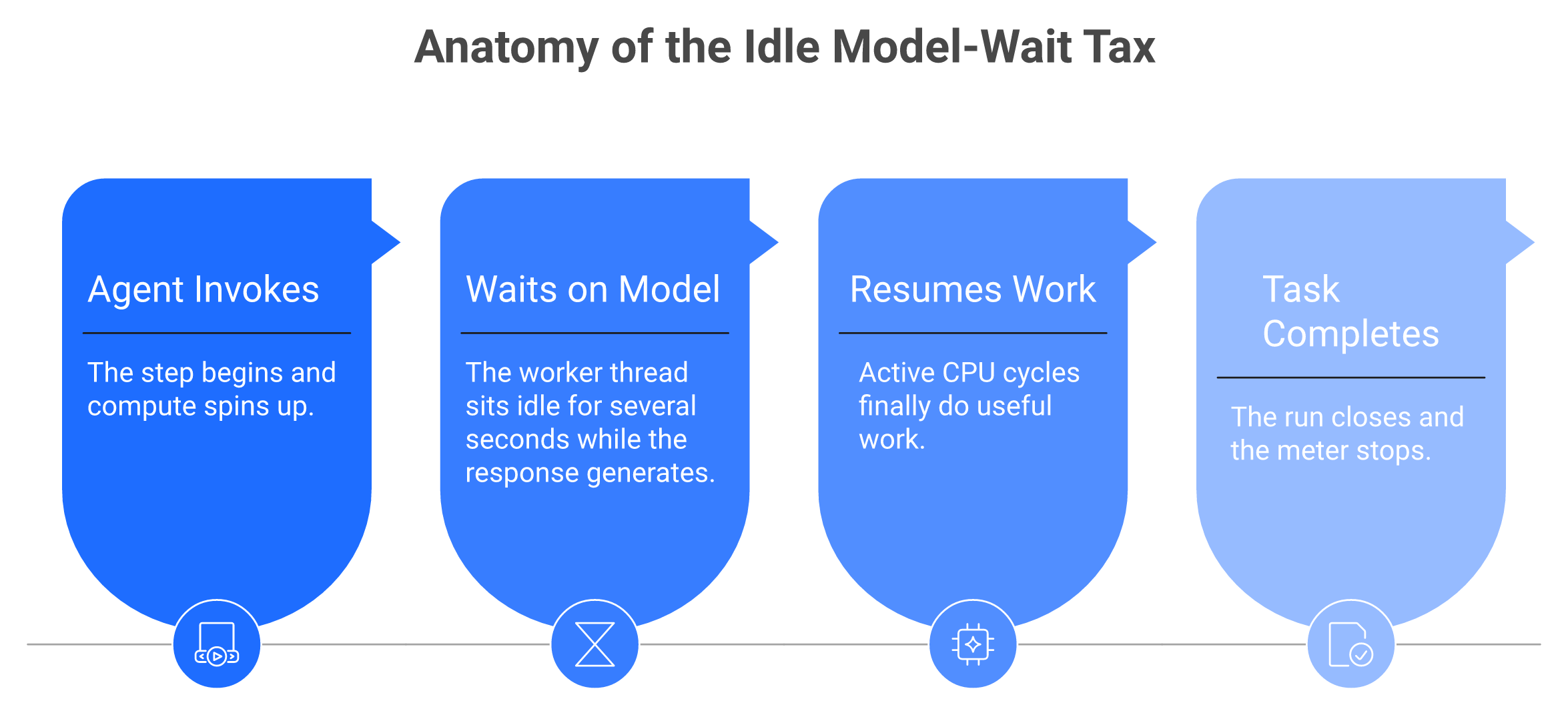
Here is the mechanic that surprises people. An agent step calls a model API, then waits.
That wait is often several seconds per call, because model responses are slow relative to compute. During the wait, your worker thread sits idle while the billing meter keeps running. Multiply idle seconds across thousands of steps, and you are paying serverless rates for silence.
❌ Two pricing models that fight the workload
Both legacy models misprice agents, for different reasons.
- Per-seat pricing. It assumes a human uses a login. Agents have no salary and no headcount cap, so the count only grows.
- Wall-clock compute pricing. It charges for elapsed time, not work done. Agents are mostly waiting, so most of the bill buys nothing.
✅ What the vendors changed, and why it matters
Gartner records two specific responses in the 2026 report. Render moved from per-seat pricing to flat platform fees, explicitly to model agent workload costs better.
Cloudflare introduced CPU-time billing, charging for active CPU cycles instead of idle time spent waiting on model responses. Read those together, and the direction is clear. Pricing is being rebuilt around the shape of agent execution.
💰 The CFO conversation nobody plans for
The moment that lands with finance is not technical. It is a headcount line that says one hundred seventy users when the company employs twenty engineers.
Finance does not care that one hundred fifty of them are processes. They care that the platform bill scales with automation, which is the opposite of why you automated. That conversation usually ends with a migration decision.
📊 Model the delta before you renew
Do this arithmetic before your next contract date, not after.
| Input to measure | Why it matters |
| Average idle wait per agent step | Isolates what you pay for doing nothing |
| Active CPU seconds per agent run | The number CPU-time billing actually charges |
| Agent count versus human count | Exposes seat-model inflation |
| Cost per completed agent task | The only unit a CFO can compare against value |
That last row is the one to instrument first. Most teams can report platform spend and agent volume separately, but not cost per completed task.
⚠️ One honest caveat
CPU-time billing is not universally cheaper. If your agents are compute-heavy rather than wait-heavy, the old model may cost less.
The point is to know which shape your workload has. Measure the idle ratio for one week, then decide. I have seen teams migrate on principle and save nothing, which is an expensive way to be right about the trend.
Q7. Is multicloud portability a trap? Multiplatform versus multiprovider
Gartner distinguishes using multiple types of application platforms from chasing maximum portability across cloud providers. Multiplatform is sound: a front-end platform for experience, a hyperscaler for heavy back-end data. Multiprovider portability is a trap, because code that must deploy interchangeably on two clouds standardizes on the lowest common denominator. Gartner reports enterprises now prioritize consistency, control, and end-to-end accountability over maximum portability.
⚠️ The lecture I stopped believing
For years I sat through presentations on unconstrained cloud portability. The slides were excellent. The abstraction layers were genuinely clever.
In the same organizations, developers waited months for a governed staging environment. The insurance policy was funded. The daily work was not.
📖 Two words that are not the same thing
Gartner's report draws the distinction explicitly, and it is the most useful sentence in it for architects.
| Dimension | Multiplatform | Multiprovider |
| What it means | Different platform types for different jobs | One codebase deployable on any cloud |
| Example | A front-end platform for the app, a hyperscaler for data and back-end | An abstraction layer wrapping two clouds identically |
| What you optimize for | Fit per workload | Theoretical migration |
| Typical cost | Some integration work | Lowest common denominator across every service |
Multiplatform is a division of labour. Multiprovider is a hedge against an event that rarely happens.
❌ Why lowest common denominator is the real bill
Interchangeable deployment means you can only use services both clouds offer. So you skip the managed database that would have saved a quarter of engineering time.
You skip the identity integration, the native observability, and often the agent primitives too. The portability is real. The velocity it costs is also real, and it is charged every sprint.
✅ Where Gartner's evidence points
The 2026 report finds enterprises increasingly prioritizing consistency, control, and end-to-end accountability over maximum portability. They often standardize on fewer platforms with stronger built-in governance instead.
That is a behavioural finding, not an opinion. Buyers already made this trade. The report is describing it, not recommending it.
💡 The audit that settles the argument internally
List every abstraction layer your team maintains. For each one, answer two questions in writing.
- Which workload does this serve today, in production?
- If we deleted it, what specifically breaks this quarter?
Layers that serve a real division of labour survive both questions easily. Layers built for a hypothetical migration usually cannot answer the second one. That is your list.
⏰ What I would keep, and what I would question
Keep multiplatform splits where the workloads genuinely differ. A front-end platform and a hyperscale data back end is a sensible pairing, and Vercel's Visionary placement reflects real demand for that split.
Question any layer whose only justification is future optionality. Optionality is not free, and nobody audits its price. If the migration has not happened in three years, price the insurance honestly and decide again.
Q8. Hyperscaler or neutral platform: which lock-in should you accept?
Choose by constraint. Gartner notes integrated hyperscale platforms create dependencies on provider-specific services, APIs, identities, observability systems, and deployment tools. Smaller neutral providers offer a simpler or more portable model but may lack the operational depth, back-end control, integration ecosystems, or Kubernetes capabilities complex enterprises require. Optimize for developer velocity, go neutral. Optimize for deep orchestration and audit-grade compliance, accept hyperscaler lock-in.
⚠️ The fear nobody says out loud
Both sides of this decision carry a quiet anxiety. Pick a hyperscaler, and you worry about total dependency on one vendor's roadmap.
Pick a lightweight platform, and you worry about the audit. Neither fear is irrational. The mistake is choosing on vibes instead of naming which fear applies to your business.
❌ The honest critique of hyperscalers
Operational depth is real, and Google, Microsoft, Amazon Web Services, Red Hat, and Alibaba Cloud earned their Leader placements on it. Red Hat has now held Leader status three years running on hybrid container, virtual machine, and AI workload delivery.
The structural cost is dependency. Gartner names it precisely: provider-specific services, APIs, identities, observability systems, and deployment tools. Each integration you adopt makes leaving more expensive, which is by design, not by accident.
❌ The honest critique of neutral platforms
Neutral platforms are genuinely faster for developers. Vercel's Visionary placement reflects that, alongside AI Gateway, durable workflows, and sandboxed compute.
Gartner's caution is equally specific. Smaller providers may lack the operational depth, back-end control, integration ecosystems, or Kubernetes capabilities complex enterprises need. Stretched into a large regulated environment, that gap shows up as fragmentation, and your team rebuilds access controls the hyperscalers already ship.
✅ The decision rule, written as if-then
Use the constraint that actually binds you, not the one that sounds strategic.
| If your binding constraint is | Then choose | Because |
| Shipping speed with a small platform team | Neutral platform | Zero-config delivery, agent primitives already shipped |
| Deep Kubernetes orchestration at scale | Hyperscaler | Operational depth and back-end control |
| Passing a regulated audit | Hyperscaler or sovereign-capable vendor | Granular compliance and identity integration |
| Jurisdictional data residency | Sovereign-capable platform | Oracle spans public, sovereign, government, and dedicated deployments |
| Cost predictability on agent workloads | Whichever prices by CPU time or flat fee | Idle model wait time stops being billable |
📊 Check the placement against operator reality
A quadrant placement tells you how a vendor executes against a broad market definition. It does not tell you what month seven feels like.
Pair the report with verified peer reviews in Gartner's Cloud Application Platforms review market, which is transitioning to the cloud-native naming. Placement plus peer review is a stronger signal than either alone.
💰 Where I land, with the hedge attached
For most enterprises running regulated workloads, accepting one ecosystem's lock-in and exploiting its integrated governance beats staying neutral. Going neutral at that scale means funding platform engineering the hyperscaler already funded.
I hold that view loosely for one case. If your platform team is small and your compliance surface is light, neutral wins on speed and probably on total cost. Name your constraint first, then the answer follows.
Q9. What is sovereign AI, and when does it decide your platform choice?
Sovereign AI, in Gartner's framing, is the capability to operate models, data pipelines, and inference workloads in environments that comply with jurisdictional, privacy, and regulatory requirements. Treat it as a geofence around your agent's reasoning loop: the whole compute pipeline stays inside dedicated regional clusters instead of crossing borders. Oracle's newly included platform spans public, sovereign, government, and dedicated cloud deployments.
🌍 The geofence analogy that makes it click
Think of a geofence on a delivery van. The van can drive anywhere inside the boundary and nowhere outside it.
Sovereign AI applies that idea to an agent's thinking. Every step, the model call, the retrieved data, and the inference, stays inside one legal boundary.
⚠️ What regulated teams build by hand instead
I have watched healthcare and public-sector teams assemble this themselves. Regional buckets, pinned model endpoints, a custom proxy, and a spreadsheet tracking which data touched which region.
It works until someone leaves or an auditor asks for evidence. The knowledge lives in three people's heads, and the compliance story depends on them remembering it correctly.
✅ What Gartner actually added to the criteria
Sovereign AI appears in the 2026 report as an optional capability, alongside agentic and inference frameworks. Gartner describes it as enabling organizations to run models, data pipelines, and inference workloads in environments meeting jurisdictional, privacy, and regulatory requirements.
Optional is the important word. Vendors gain credit for shipping it, and buyers in regulated sectors can now screen for it directly.
📊 Who is positioned for it
Two data points from the report are worth carrying into a shortlist conversation.
| Vendor | Sovereign-relevant capability |
| Oracle, newly added as a Challenger | Platform spans public, sovereign, government, and dedicated cloud deployments |
| Cloudflare | Cites data localization as a response to changing customer requirements |
Oracle's inclusion this year is not a coincidence. A vendor whose footprint already covers government and sovereign regions maps neatly onto a criterion Gartner just added.
💡 The tip: buy the boundary, do not build it
If you operate in healthcare, defense, financial services, or government, invert your evaluation order. Screen for sovereign and dedicated regions first, then evaluate developer experience.
Building regional isolation on a platform that lacks it is slow work with no product upside. Standing on infrastructure that ships it removes an entire workstream. That is the whole tip, and it saves quarters, not days.
⏰ Three questions for your compliance review
Ask your platform vendor these, in writing, and keep the answers.
- In which regions do model inference and agent reasoning physically execute?
- Can we pin an entire agent pipeline to one jurisdiction, including logs and traces?
- What evidence do you provide an auditor, and in what format?
Vague answers to question three are the tell. Vendors with real sovereign capability have documentation ready, because their existing customers already demanded it.
⚠️ Where I would push back on myself
Sovereign capability is not free. Dedicated regions usually cost more, and the service catalogue inside them is often smaller than the global one.
So do not screen on it unless a regulation actually binds you. Buying a compliance boundary you do not need is the same mistake as building a portability layer nobody uses.
Q10. Why did governance become a scoring criterion? Because agent projects keep dying
Governance entered the criteria because agent projects fail for non-technical reasons. Gartner forecast in June 2025 that over forty percent of agentic AI projects would be canceled by end-2027, citing escalating costs, unclear business value, and inadequate risk controls, from a poll of more than 3,400 organizations. The 2026 quadrant answers that forecast by scoring cost visibility, observability, and built-in governance rather than raw capability.
📉 The forecast, dated honestly
Gartner published this prediction on June 25, 2025, drawn from a poll of more than 3,400 organizations. It says over forty percent of agentic AI projects will be canceled by the end of 2027.
Worth saying plainly: this is a 2025 forecast that keeps resurfacing as fresh research. It reappeared in coverage through 2026, which makes it feel newer than it is.
❌ None of the three causes are model failures
Read the reasons Gartner gives. Escalating costs, unclear business value, and inadequate risk controls.
Not one of them is about model capability. Every one is about how the project was scoped, priced, and governed. That distinction changes what a platform needs to provide.
✅ Each failure cause maps to a 2026 criterion
This is the causal link the vendor announcements skip.
| Failure cause (2025 forecast) | What the 2026 quadrant now scores |
| Escalating costs | Cost visibility, plus pricing rebuilt around CPU time and flat platform fees |
| Inadequate risk controls | Governance guardrails and sandboxed execution for untrusted tool calls |
| Unclear business value | Observability, so teams can attribute outcomes to specific agent runs |
Gartner did not add governance because governance is fashionable. It added governance because the market handed it three years of evidence.
⚠️ Calibrate the hype against actual adoption
One more Gartner data point keeps this honest. The Hype Cycle for Cloud Computing, published June 12, 2026, rates Agentic AI as Transformational, with five to twenty percent market penetration and Emerging maturity.
Transformational with single-digit-to-low-double-digit penetration is a specific state. The ceiling is high, and most organizations are still early. Plan for a long adoption curve, not a finished one.
⏰ Two artifacts to write before your next pilot
Both take under an hour, and both address a cause on Gartner's list.
- A named rollback owner. One person, by name, who can stop the agent in production without a meeting.
- One written success metric. A number tied to money or time saved, agreed before launch, not selected afterward.
Projects without these two artifacts are the ones I have watched quietly get shelved. Nobody kills them. Budget just stops arriving, which looks identical in a cancellation statistic.
💰 The uncomfortable read for platform teams
If forty percent of these projects die from cost, value, and control problems, then your platform choice is partly a governance purchase. Raw capability is table stakes across the Leader quadrant already.
I hold this loosely for early-stage teams. If you are running two agents in a startup, governance tooling is overhead you do not need yet. Past roughly a dozen production agents, the maths flips, and every ungoverned one is a future incident.
Q11. Why do AI engines cite trade press about this quadrant instead of the vendors in it?
Because vendors gate the evidence. Leader landing pages are download prompts wrapped around a licensed reprint, so ChatGPT, Perplexity, Gemini, and Google AI Overviews retrieve trade-press analysis instead. When a buyer asks which platforms lead cloud-native application platforms, the cited source is whoever published an ungated, dated, criteria-level explanation. Being named in the quadrant and being named in the answer are different wins.
⚠️ The analyst win that never reaches the buyer
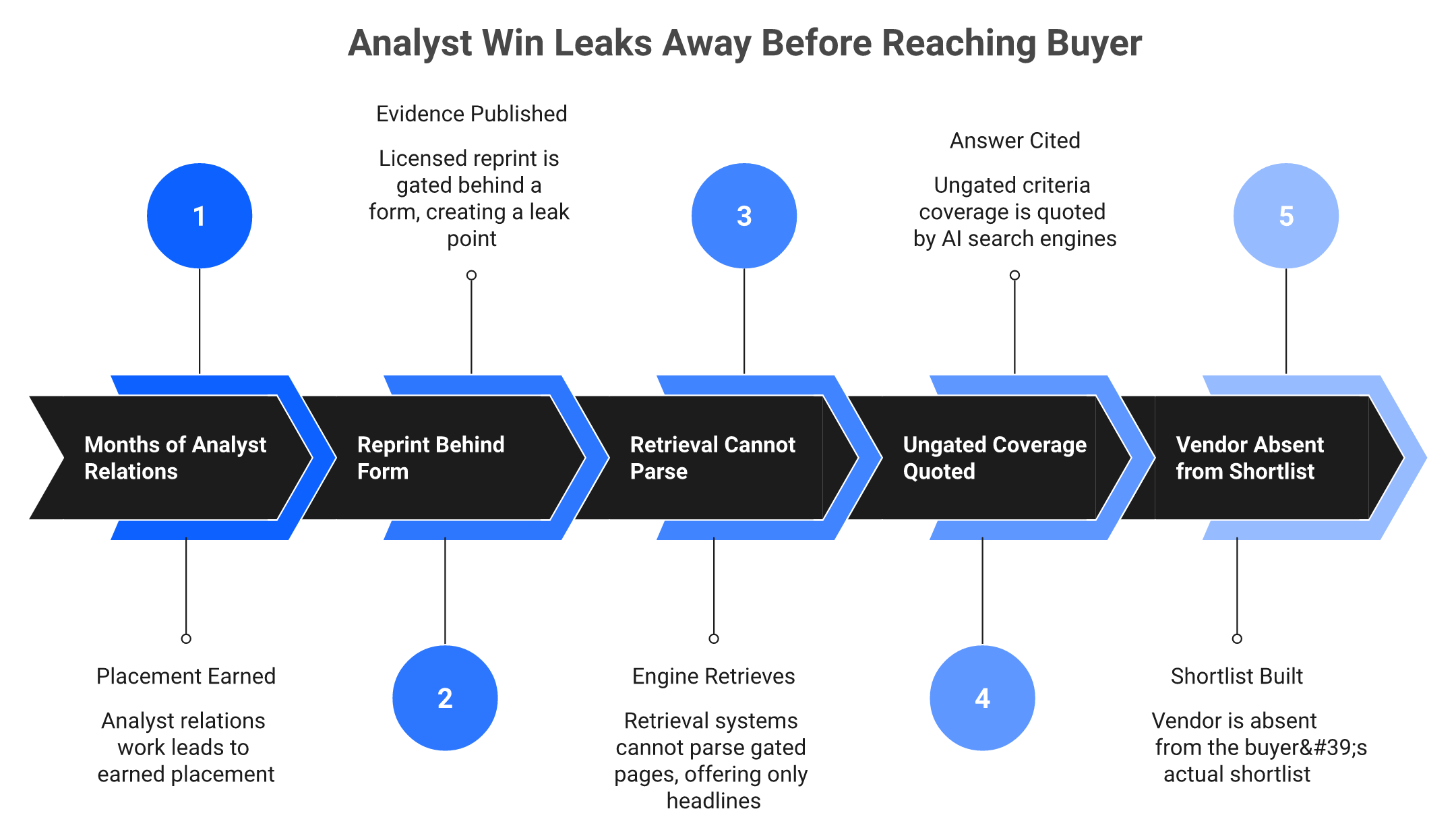
A Leader placement takes months of analyst relations work. Then it lands on a page with a headline, a quadrant image, and a form.
The buyer never sees it. They ask an AI engine who leads the category, and the engine answers from whatever it could actually read.
❌ Gated evidence is unreadable evidence
A licensed reprint sits behind a form, so retrieval systems cannot parse it. The vendor page above it carries a headline and little substance.
Trade press, meanwhile, published an ungated analysis of the criteria changes the same week. That page gets cited. This is not an algorithm quirk. It is the predictable result of hiding your best evidence.
✅ Why old SEO measurement missed this entirely
Traditional Google-only reporting counts impressions, clicks, and rankings. None of those metrics detect whether an engine cited you in an answer a buyer never clicked through from.
MaximusLabs AI tracks brand frequency and citation share across AI answer platforms, measured over thousands of question variants rather than single rankings, which is how we see this gap at all. That measurement change is the actual difference between SEO and Answer Engine Optimization.
📊 Two trust signals, one gated and one not
Buyers reading this category use both. Only one is retrievable.
| Signal | Retrievable by AI engines | What it tells a buyer |
| Vendor analyst landing page with gated reprint | No, form-gated | The placement, and nothing about operating the product |
| Gartner Peer Insights reviews for Cloud Application Platforms | Partially, publicly visible reviews | What month seven actually feels like |
💡 The build, concretely
MaximusLabs AI's published content standard requires a forty to eighty word standalone answer nugget per section and at least one primary source citation, with a Flesch reading ease floor for citation eligibility. Ask us to apply that shape to a category page, and the output looks like this.
- An ungated explainer of the criteria, naming the analysts and the report date.
- Answer nuggets written to survive extraction with no surrounding page.
- NewsArticle, Table, and ImageObject schema, plus about-entities for every named vendor.
- Interlinked disambiguation between the two Gartner quadrants buyers confuse.
💰 Measure shortlist inclusion, not pageviews
Here is the revenue framing. This page's job is not traffic. Its job is being the source an engine quotes when a buyer builds a shortlist.
So the metrics are cited-source share per engine, and pipeline influenced from those conversations. MaximusLabs AI's own read is that most vendors in this quadrant are optimizing the wrong number, though I might be reading the pattern more confidently than the sample supports.
MaximusLabs AI builds the ungated, criteria-level explainers AI engines cite when buyers ask who leads a category, using answer nuggets, named-analyst citations, and dated primary sources so each claim survives extraction.
Q12. What comes next in agentic platform consolidation?
My working hypothesis: by the 2027 update, agent runtime and governance stop being optional capabilities and become table stakes, and the differentiator shifts to agent cost attribution, showing which agent, on which task, burned which dollar. The open question is whether the Cloud-Native and AI Application Development Platform quadrants converge or stay deliberately separate. I could be wrong on timing.
🔮 The prediction, and what would falsify it
Optional capabilities have a short shelf life in Gartner criteria. Agentic frameworks, inference frameworks, and sovereign AI are optional in the 2026 report.
My expectation is that two of those three become required by the next cycle. What would prove me wrong is a 2027 report that keeps them optional because adoption stalled. Agentic AI sitting at five to twenty percent penetration makes that outcome entirely possible.
⏰ The instrumentation gap I keep finding
Almost every team can tell me total platform spend. Almost none can tell me the cost of one completed agent task.
That is the number the next two years will reward. When pricing moves to CPU time and flat platform fees, cost per outcome becomes measurable for the first time.
✅ One thing to instrument this quarter
Pick your highest-volume agent and tag every run. Record active compute seconds, model tokens, task outcome, and whether a human intervened.
Four fields, one agent, one quarter. That dataset answers the question a CFO will eventually ask, and it answers it before the conversation gets tense.
📖 The open question on the two quadrants
Gartner currently runs cloud-native application platforms and AI application development platforms as separate markets, with Google a Leader in both. Those markets answer different questions today.
I genuinely do not know whether they converge. If agents become just another workload, the tooling market may collapse into the runtime market. If agent development stays specialized, both quadrants persist, and buyers keep confusing them.
💰 What I would watch, in order
Three signals will tell you which way this goes before Gartner does.
- Whether hyperscalers start publishing per-agent cost attribution in their consoles.
- Whether more vendors follow the shift to CPU-time or flat-fee pricing.
- Whether the 2027 criteria promote agentic frameworks from optional to required.
⚠️ The thing I am still unsure about
Consolidation looks obvious in a report and messy in practice. Teams keep second platforms for reasons that never appear in an architecture diagram, like one engineer who knows it well.
So I expect the direction to be right and the pace to be slower than the criteria suggest. If your team has run agents on a consolidated runtime for a year, I would genuinely like to hear what broke. That evidence is thin right now, and the honest answer is that everyone is still learning this in production.
Frequently asked questions
What actually changed in Gartner's 2026 Cloud-Native Application Platforms Magic Quadrant?
The 2026 Magic Quadrant for Cloud-Native Application Platforms, published August 3, 2026, evaluates twelve vendors and leaves the Leader group nearly unchanged. The important shift sits in the criteria, not the graphic. AI-agent development support now factors into the Product or Service assessment rather than sitting beside it. Agentic frameworks and inference frameworks appear as optional capabilities, so vendors earn credit for shipping them. Sovereign AI joins that optional list, covering jurisdictionally compliant model and inference execution. Governance, cost discipline, and platform consolidation moved from differentiators into scoring criteria. Practically, Gartner now expects your web application runtime and your agent runtime to be the same runtime, graded on governance and cost visibility alongside developer velocity. The read-through for buyers is simple. Skip the placement recital and check whether your current platform executes long-running stateful agents, attributes cost per agent run, and names a rollback owner. Teams that cannot answer those three questions should care more about the criteria change than the roster. We cover the same discipline shift on the content side in our comparison of GEO and traditional SEO , where evaluation criteria also moved before the vendor list did.
Who are the Leaders, Visionaries, Challengers, and Niche Players in the 2026 quadrant?
Google, Microsoft, Amazon Web Services, Red Hat, and Alibaba Cloud hold the Leader quadrant. Vercel is the sole Visionary in the 2026 report. Oracle was added as a Challenger, with a platform spanning public, sovereign, government, and dedicated cloud deployments. Tencent Cloud was added as a Niche Player, offering an AI gateway, a Model Context Protocol server, and AI Builder. Huawei and Salesforce Heroku were removed versus 2025. Gartner cautions that inclusion or exclusion does not imply a changed opinion of any vendor. Two roster details catch people out. Red Hat has now held Leader status for a third consecutive year on hybrid delivery of containers, virtual machines, and AI workloads. Platform.sh rebranded as Upsun in September 2025, so older shortlists carry a name that no longer exists. A placement tells you a vendor executes well against a broad market definition. It does not tell you whether agent pricing suits your usage pattern or whether the governance model satisfies your auditor. Pair the quadrant with verified peer reviews, the same way we advise brands to build proof across third-party surfaces in our guide to community and forum trust signals .
How does Gartner define an AI agent in the 2026 cloud-native report?
Gartner defines AI agents as autonomous or semiautonomous software entities that perceive their environment, make decisions, take actions, and pursue goals. The 2026 report names AI agents and applications as a distinct platform use case alongside web applications, APIs, and event-driven workloads. The word carrying the weight is autonomous. A scheduled script that calls a model is not an agent, because it cannot choose a different next step. An agent can, and that autonomy creates three properties platforms must contain: State , which requires persistent compute between steps. Unpredictable duration , which requires durable workflows that survive restarts. Untrusted tool calls , which require sandboxed execution with a limited blast radius. Gartner pairs this with a platform definition: cloud-native application platforms are managed application runtime environments with integrated life cycle capabilities. Copy both definitions verbatim into page one of your requirements document, then make every vendor answer against them. That single move removes most of the ambiguity from vendor responses. Precision in definitions is the same principle behind extractable content, which we break down in our work on answer structure for AI engines .
Is there a separate AI agent platform market, or is this the same Magic Quadrant?
There is no separate agent platform market in this report. Agent execution, orchestration, observability, and governance are being incorporated into cloud-native application platforms. Gartner does run a second, adjacent market. The Magic Quadrant for AI Application Development Platforms published a midcycle update on April 27, 2026, naming Google a Leader and highest in Ability to Execute. That market covers building AI applications, not running your production runtime. Deciding what runtime hosts and governs your apps and agents? Cite the Cloud-Native Application Platforms report. Deciding what toolchain your team builds with ? Cite the AI Application Development Platforms report. Google appears as a Leader in both, which is exactly why the confusion persists. Citing the wrong quadrant in a board memo weakens an otherwise sound recommendation. Our read is that the dedicated AI agent platform category is being deleted in front of us, becoming a feature set inside the runtime you already pay for. A second platform still earns its place if your primary runtime cannot sandbox untrusted tool calls. That is a capability gap, not a category law. We apply the same disambiguation discipline to overlapping search topics in our approach to topic clusters .
Why is per-seat platform pricing broken for AI agent workloads?
Seat pricing assumes a human uses a login. Agents have no salary and no headcount cap, so twenty engineers supervising one hundred fifty automated agents can bill as one hundred seventy users. Wall-clock compute pricing fails for a different reason. An agent step calls a model API and then waits, often several seconds, while the worker thread sits idle and the meter keeps running. Multiply idle seconds across thousands of steps and most of the bill buys nothing. Gartner records two vendor responses in the 2026 report: Render moved from per-seat pricing to flat platform fees, explicitly to model agent workload costs better. Cloudflare introduced CPU-time billing, charging for active CPU cycles rather than idle time spent waiting for large language model responses. Before your next renewal, measure four things: average idle wait per agent step, active CPU seconds per run, agent count versus human count, and cost per completed agent task. That last figure is the only unit a CFO can compare against value, and almost nobody instruments it. The honest caveat is that CPU-time billing is not universally cheaper for compute-heavy agents. We take the same unit-economics view of content spend in our framework for revenue attribution .
What is sovereign AI, and when should it decide your platform choice?
Sovereign AI, in Gartner's framing, is the capability to operate models, data pipelines, and inference workloads in environments that comply with jurisdictional, privacy, and regulatory requirements. Think of it as a geofence around your agent's reasoning loop, keeping the whole compute pipeline inside dedicated regional clusters instead of crossing borders. It entered the 2026 report as an optional capability, so vendors earn credit for shipping it and regulated buyers can screen for it directly. Two data points matter for a shortlist: Oracle , newly added as a Challenger, spans public, sovereign, government, and dedicated cloud deployments. Cloudflare cites data localization as a response to changing customer requirements. If you operate in healthcare, defense, financial services, or government, invert your evaluation order. Screen for sovereign and dedicated regions first, then assess developer experience. Ask exactly where inference executes, whether an entire pipeline including logs can be pinned to one jurisdiction, and what auditor-ready evidence the vendor provides. The honest counterweight is cost. Dedicated regions carry a premium and a smaller service catalogue, so do not screen on sovereignty unless a regulation binds you. We treat regulated content the same way in our notes on compliance and privacy in AI search .
Why do AI engines cite trade press about this Magic Quadrant instead of the vendors named in it?
Because vendors gate the evidence. A Leader landing page is usually a headline, a quadrant image, and a form wrapped around a licensed reprint, which retrieval systems cannot parse. Trade press published an ungated analysis of the criteria changes the same week, so that page gets cited by ChatGPT, Perplexity, Gemini, and Google AI Overviews. MaximusLabs AI tracks brand frequency and citation share across AI answer platforms, measured over thousands of question variants rather than single rankings, which is how this gap becomes visible at all. Traditional Google-only reporting counts impressions and clicks, so it never detects an answer a buyer read without clicking. What to build instead: An ungated criteria explainer naming the analysts and the report date. Standalone forty to eighty word answer blocks that survive extraction with no surrounding page. NewsArticle, Table, and ImageObject schema, plus about-entities for every named vendor. Then measure cited-source share per engine and pipeline influenced, not pageviews. Being named in the quadrant and being named in the answer are different wins, and only the second one reaches the shortlist. Our Answer Engine Optimization work exists for exactly that second win.