 Krishna Kaanth M
- An enterprise AI orchestration platform is the control layer coordinating models, agents, tools, infrastructure, permissions, and evaluation. Models are replaceable; the harness is not.
- Gartner projects $206.5B in AI-agent software spend for 2026 alongside 40% project cancellation by end-2027, with 42% showing zero ROI from missing baselines.
- Six criteria decide vendor fit: governance, portability, deployment topology, scoped identity, portable evaluation, and task-based cost routing. Each has a hard disqualifier.
- Tiered multi-model routing cut token costs from $18.40 to a median $2.31 per million, an 87.4% reduction, while accounts now average 4.7 models each.
- Sovereignty rules make deployment location a contract term, and G2 category rankings measure review density rather than architecture, portability, or evaluation transfer.
- Orchestration shortlists now form inside ChatGPT and Perplexity, so citation share across question variants replaces keyword rank as the visibility KPI.
Q1. What is an enterprise AI orchestration platform, and why does the harness matter more than the model?
An enterprise AI orchestration platform is the control layer that coordinates models, agents, tools, infrastructure, permissions, and evaluation across a business process or delivery lifecycle. Gartner calls it the layer that moves agentic AI from isolated pilots to governed, autonomous execution. It lets teams route work across multiple models without rebuilding integrations or surrendering control of data and IP. The model is replaceable. The harness is not.
The model debate that kills projects
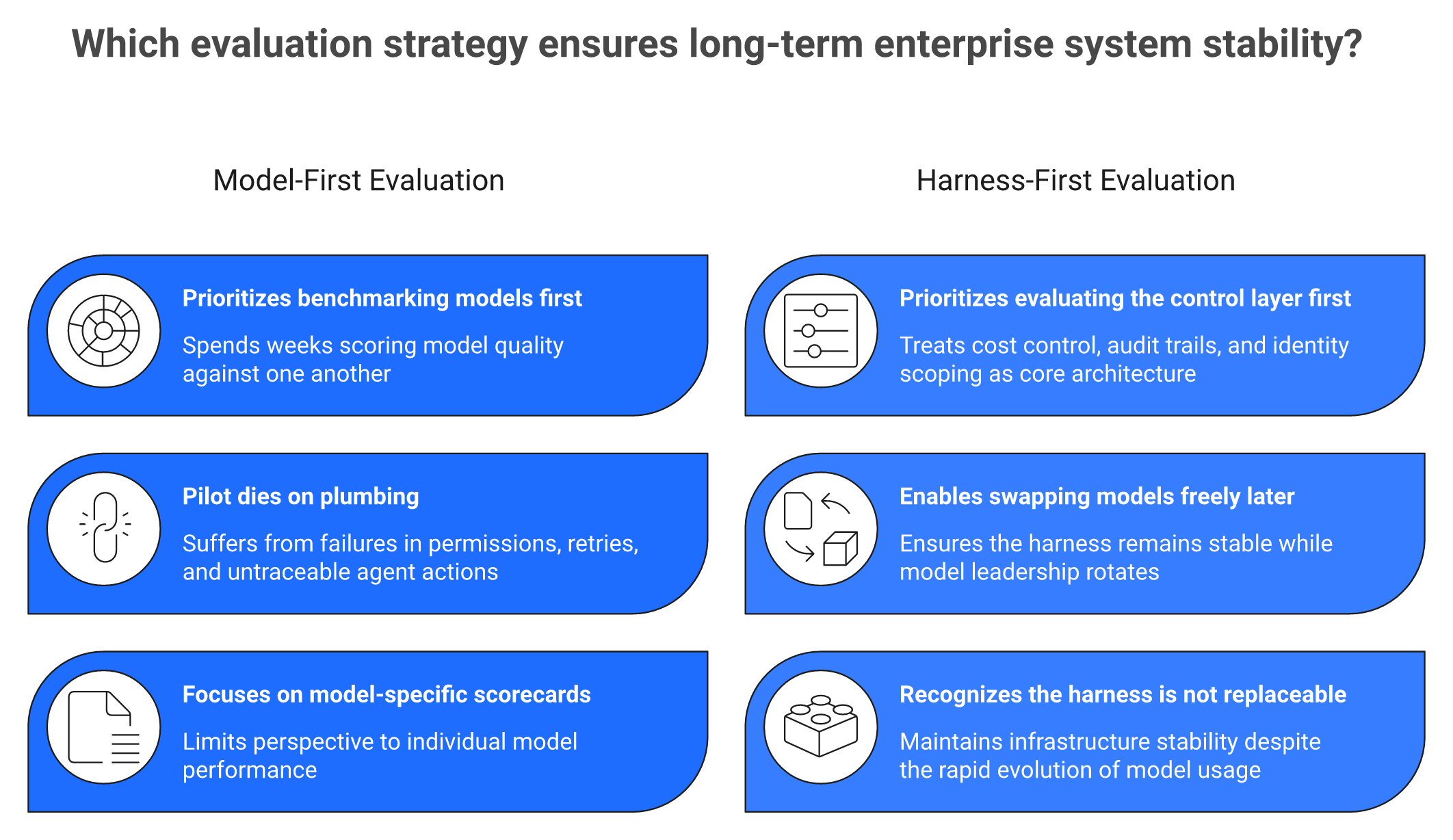
A VP of Engineering at a mid-market fintech spends three weeks benchmarking Claude against Qwen. The scorecard is beautiful. Nine months later, the pilot is dead, and not one line of the post-mortem mentions model quality.
It died on permissions, on retries, and on nobody knowing which agent touched which customer record. That is a harness failure, not a model failure.
⚠️ Where the real breakage happens
Buyers argue about benchmarks because benchmarks are easy to read. Integration debt is not.
Around 70% of developers report integration problems with existing systems when agentic projects move toward production. The model was never the constraint.
What the control layer actually coordinates
Gartner's framing is specific. Agentic orchestration is the control layer that lets agentic platforms scale from isolated pilots to governed and autonomous execution, and product leaders must unify design, runtime, and verification.
Scrums.com describes its own platform in the same shape, coordinating models, agents, tools, infrastructure, permissions, and evaluation across the delivery lifecycle. That framing echoes how the agentic web stack fits together across protocols rather than single products.
✅ Six things a real harness owns
| Coordinated object | The question it answers |
| Models | Which model runs this task, at what cost? |
| Agents | Who is allowed to act, and within what scope? |
| Tools | Which APIs can be called, and by whom? |
| Infrastructure | Where does this execute, and under whose control? |
| Permissions | What data can this identity reach? |
| Evaluation | How do we verify the output was correct? |
Strip any one of those out and you have a demo, not a platform.
Why you evaluate the harness first
Model leadership rotates every few months. Your harness stays for years, which means portability is the durable asset.
Enterprise accounts now run an average of 4.7 models each, up from 2.1 a year earlier. That number alone settles the sequencing question: coordinate first, choose models second.
💰 The practical reordering
Ask about the harness before the model in your next vendor call. Cost control, audit trails, and identity scoping are architecture, not features.
If a vendor answers those with a model leaderboard, the pilot risk sits with you.
Orchestration, RPA, and iPaaS are not the same thing
Robotic process automation (software that repeats fixed, pre-scripted steps) executes deterministic work against interfaces and APIs. An iPaaS (integration platform as a service) moves data between systems on defined rules.
Orchestration coordinates non-deterministic components, adding routing, evaluation, and guardrails on top. Most enterprises need all three, with deterministic automation as the backbone and orchestration as the judgment layer above it.
⭐ A useful mental picture
A chatbot is a chef standing in an empty room. It can talk about the dish beautifully and produce nothing.
An orchestrated agent is that chef with hands (APIs) and a notebook (memory). The recipe was never the bottleneck.
MaximusLabs AI applies the same sequencing to AI search: fix the retrieval layer before rewriting content, because an engine that cannot reach or verify a page will not cite it regardless of how well the page is written. The harness logic holds in both stacks.
Q2. Why is your orchestration shortlist now decided inside ChatGPT and Perplexity instead of on Google?
Enterprise buyers no longer browse review sites page by page. They describe their role to ChatGPT or Perplexity and accept the five to ten platforms named back. That answer set is the consideration set. Zero-click sits near 65% to 70% of queries and around 83% on AI-Overview-triggered queries, so a platform absent from the generated answer is invisible regardless of its Google position. MaximusLabs AI tracks brand frequency across thousands of question variants rather than single rankings, because the named set shifts with phrasing.
The buyer never reaches your website
John runs sales at a B2B SaaS company. He opens ChatGPT and types his role, his stack, and his constraint, then asks for the best tools to lift his team's productivity.
He reads one answer. He does not open a comparison listicle, and he does not scroll a SERP.
❌ What the old playbook assumes
Traditional Google-only SEO assumes the buyer arrives, browses, and compares. That assumption is now wrong at the exact moment the shortlist gets formed, which is why GEO and traditional SEO diverge at the strategy layer rather than the tactic layer.
Dharmesh Shah put the stakes plainly: "either you show up or you don't... if you're not in the actual citations in the answer that was given you might as well not have played the game because there is no difference".
The binary game
Ten blue links gave you partial credit. A generated answer does not.
When the engine names five to ten platforms in your category, that IS the consideration set. Position eleven and position four hundred are the same outcome.
⏰ Why one ranking tells you nothing
Answers move with phrasing. "Best enterprise AI orchestration platform" and "orchestration platform for regulated industries" can return two different sets.
Ethan Smith's tracking advice reflects this: "for AEO... I need to instead look at a share of voice or how frequently am I showing up". A single rank cannot measure set membership, which is why GEO metrics and KPIs replace position tracking.
Zero-click compressed the click, not the decision
The decision still happens. The click does not.
Roughly 93% of Google AI Mode searches end without a click, and AI Overview queries show an 83% zero-click rate against about 60% without one. Meanwhile, AI-referred traffic converts around 4.4x better than traditional organic at roughly 1% of total volume. We unpack that trade in the zero-click search brand economy report.
📊 What operators are seeing
"Organic sessions dropped 18%, but organic revenue climbed 22%."
Marketer quoted in CMSWire's 2026 AEO analysis
"Chat GPT visitors are up 80% since April."
Ethan Smith, CEO of Graphite, Answer Engine Optimization presentation, 02:37
Small traffic slice, outsized pipeline. Report it as revenue per session or it looks like noise.
Third-party surfaces feed the answer
Look at who actually holds this SERP. G2's category page ranks on verified-review density, with UiPath Agentic Automation at 4.6/5 across 7,500 plus reviews and IBM watsonx Orchestrate at 4.4/5.
An Appian landing page of roughly 500 words ranks on a Gartner pull-quote alone. Your own page is not the asset the engine reaches for first, which is the core argument for citation acquisition tactics.
✅ Monday actions
- Build a prompt set of your 30 highest-intent buying questions, then log which brands get named across ChatGPT, Perplexity, Gemini, and Copilot.
- Audit every ranking comparison page in your category and open an inclusion or correction request for each.
- Treat your G2 and Capterra profiles as content assets with owners, not as admin.
MaximusLabs AI measures share of voice across thousands of question variants per platform instead of tracking a single keyword position, because AI engines rebuild the named set with each phrasing change. That is the difference between knowing your rank and knowing whether you are in the room.
Q3. Why will 40% of agentic AI projects be cancelled before they reach production?
Gartner forecasts $206.5B of AI-agent software spend in 2026, up 139% from $86.4B, while projecting 40% of agentic AI projects will be cancelled by end-2027 and 42% of AI projects will show zero ROI because baselines were never set. Forrester's State of Agentic AI 2026 names the cause: missing orchestration maturity, governance that is documented but not executable, and undisciplined non-human identity.
The spend number nobody argues with
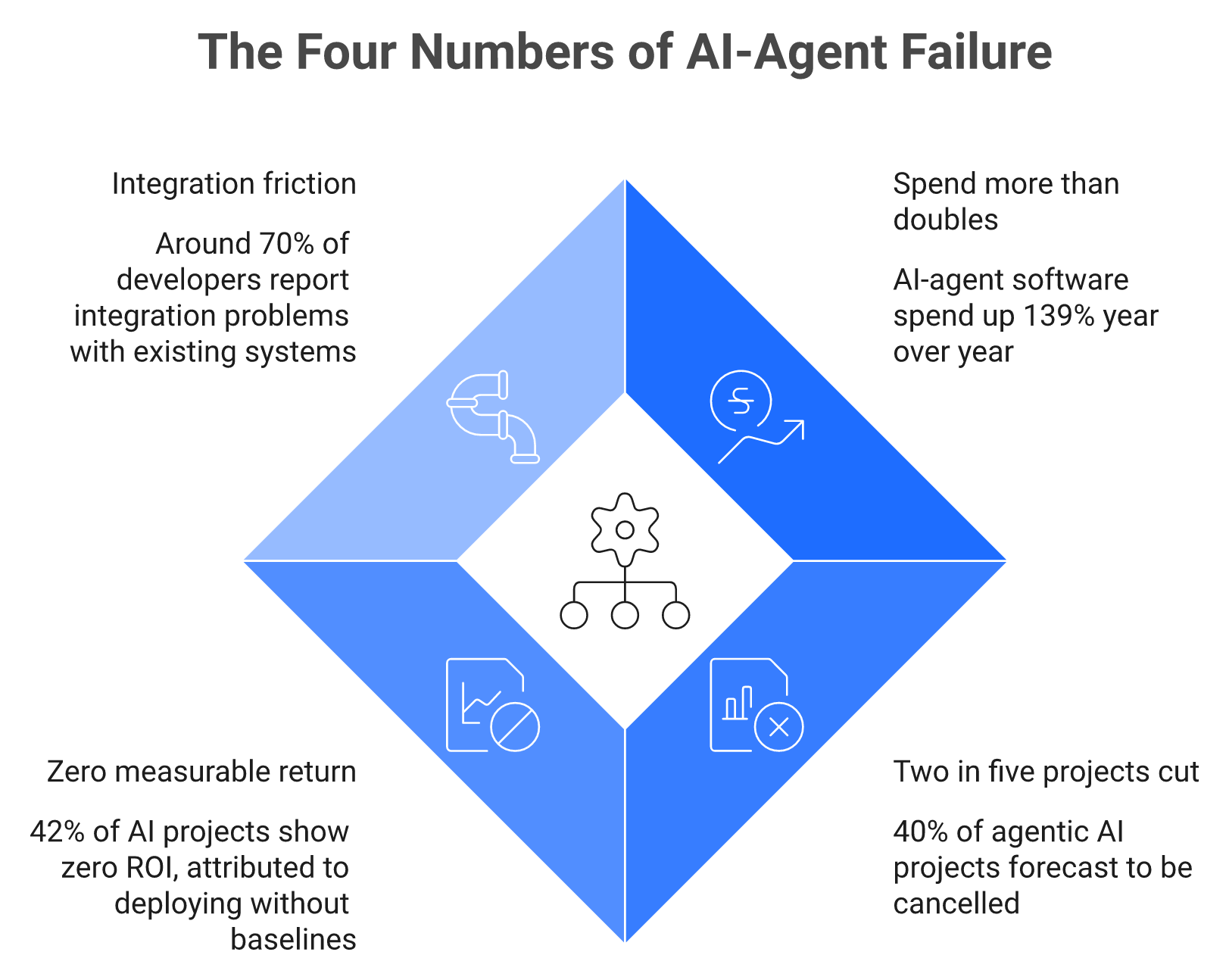
Budget is not the constraint anymore. AI-agent software spend more than doubles year over year, from $86.4B to a projected $206.5B.
Boards approved the money. That was the easy part.
💸 The number that should change your plan
Against that spend, Gartner projects 40% of agentic AI projects will be cancelled by the end of 2027.
Two numbers, one page, and almost no vendor puts them side by side. The pairing is the whole story.
Zero ROI is usually a measurement failure
Here is the finding that stings: 42% of AI projects show zero ROI, attributed to teams deploying without establishing baselines first.
The work may have improved something. Nobody can prove it, so it gets cut in the next budget cycle.
⚠️ The baseline rule
I have watched the same pattern in organic growth for years. Teams launch, then try to reconstruct a before-state from memory.
Measure the before-state or accept that you will lose the argument later. This is the identical discipline as baselining citation rate before any generative engine optimization work begins.
Forrester's three deficits, read as diagnostics
Forrester found that expanding investment has not translated into scale because companies lack orchestration maturity, executable governance, and disciplined non-human identity.
Turn each into a question you can answer this week.
| Deficit | The diagnostic question | Failing answer |
| Orchestration maturity | Can a new agent reuse existing routing, retries, and evaluation? | Every team rebuilds it |
| Executable governance | Is the policy enforced at runtime or written in a doc? | It lives in Confluence |
| Non-human identity | Does each agent have a scoped identity? | Shared service account |
⭐ Governance that runs, not governance that reads
Executable governance is the phrase to steal. A policy that only exists as a document is a wish.
Forrester expects roughly half of ERP vendors to ship autonomous governance modules combining explainable AI, audit trails, and real-time compliance. The market is pricing the gap in.
The ground-level symptom
At the engineering level, this shows up as integration friction, reported by around 70% of developers working on agentic systems.
Not model quality. Not prompt design. Plumbing.
❌ Why "good enough" automation loses
Chaining mediocre steps together produces mediocre output faster. That is a commodity liability.
The penalty for average has never been more severe, and enterprise buyers are not shopping for an 80%-off version of C-plus work. They are shopping for better, which is why the harness gets scrutinised before the model does.
MaximusLabs AI runs the same baseline-first sequence on AI search work, capturing citation share and revenue attribution across named competitors before any content ships, because a program without a before-state cannot survive a budget review no matter how well it performed.
Q4. What does the Open Weights Letter actually change for enterprise buyers?
Scrums.com signed the Open Weights Letter, published by Nvidia and Microsoft in July 2026 with roughly 140 signatories including Meta, Google, Hugging Face, Vercel, and the Linux Foundation. It argues for a competitive, secure, widely accessible open-weight ecosystem, handling risk through stronger security practices and transparent evaluation rather than broad restrictions. Scrums.com reports customers never ask about open weights. They ask who controls their data, IP, and prompts.
A letter with unusual signatories
Nvidia and Microsoft publishing a pro-open-weights position is the interesting part. So is the signatory mix, which spans model builders, infrastructure vendors, and a foundation.
The letter's risk stance is specific: strengthen security practices and transparent evaluation instead of imposing broad restrictions.
⭐ Why the signatory list is the artifact
A public list is checkable. That makes it a trust signal, not a marketing claim.
Krishna's read: a verifiable commitment belongs on your entity graph and knowledge graph presence, linked from your site through Wikidata, LinkedIn, and Crunchbase, not buried in a press release that ages out in a week.
Signing is cheap. Portability is the test.
Any company can endorse openness. Far fewer can hand you the weights, the deployment choice, and an exit path.
Scrums.com states its systems are model-agnostic, deployable in its own cloud, in private infrastructure, or in a customer-controlled data centre.
⚠️ Portability is a standards problem too
Forrester found the agent control plane architecturally sound but blocked by three categories of missing standards that prevent a portable, vendor-agnostic governance layer.
Around 30% of enterprise app vendors are expected to launch Model Context Protocol servers (a shared interface letting agents work across platforms). Ask where your vendor sits on that roadmap, and read our WebMCP agent-ready web standard analysis before you write the requirement.
The commercial case underneath the principle
Open-weight adoption is not ideology at this point. Open-source and open-weight models reached 38% of enterprise token volume in Q1 2026, up from 11% a year earlier.
Blended token costs fell 67%, from $18.40 to $6.07 per million, and full tiered-routing implementers reached a median $2.31.
⚖️ The honest counter-case
Open weights are not free. Mozilla's 2026 survey names the barriers: infrastructure cost at 27%, security and compliance at 26%, maintenance at 24%, and deployment complexity at 23%.
Every one of those is an orchestration-layer problem, which is exactly why the harness question comes first.
Three questions for your next RFP
- Can we export weights, prompts, and evaluation sets, and run them elsewhere without a rebuild?
- Where does inference execute, and can we move it to our own or a customer-controlled environment?
- Are you shipping an MCP server, and on what timeline?
✅ Stay honest about contested ground
Not every claim in this space is settled. Gartner has predicted search engine volume dropping 25% by 2026, while SparkToro clickstream data showed Google search growing roughly 21.6% in 2024.
Both cannot be fully right. I read it as redistribution rather than collapse, though I hold that loosely, and our 2026 GEO and AEO benchmark report shows where the traffic actually moved.
MaximusLabs AI treats public commitments like signatory lists as citable trust signals, closing the sameAs loop from website to Wikidata to LinkedIn to Crunchbase to G2 so AI engines can verify a claim instead of guessing at it. If you want that loop mapped for your own entity, talk to our team.
Q5. Which six criteria separate a real orchestration platform from a workflow tool?
Six criteria decide it. Governance: is every agent action auditable and explainable, or is there no immutable trail? Portability: can you swap providers without a rebuild, or is the prompt format proprietary? Deployment topology: your cloud, private infrastructure, or customer data centre, or vendor-cloud only? Identity: scoped non-human identities or shared service accounts? Evaluation: do evals travel across models? Cost control: task-based routing or single-model only?
The due-diligence table
Feature lists sell software. Disqualifiers make decisions.
Each row below has a question and a failing answer. If a vendor hits a disqualifier, the demo does not matter.
| Capability | Buyer question | Disqualifier |
| Governance | Can every agent action be audited and explained? | No immutable audit trail |
| Portability | Can we swap model providers without a rebuild? | Proprietary prompt format |
| Deployment topology | Can it run in our cloud, private infra, or a customer data centre? | Vendor-cloud only |
| Identity | Does each agent get a scoped non-human identity? | Shared service accounts |
| Evaluation | Do evals travel with the workflow across models? | Model-specific scoring only |
| Cost control | Does it route by task to cheaper models? | Single-model routing |
⚠️ Why disqualifiers beat checklists
A checklist rewards vendors who tick boxes. A disqualifier list forces a yes or no answer that a sales engineer cannot dress up.
MaximusLabs AI builds its own technical audits this way, listing the condition that ends the evaluation rather than the fifty things that could be improved. I would rather kill a bad option in ten minutes than score it for a week.
Portability is a standards gap, not a licence checkbox
Every vendor now claims to be model-agnostic. Forrester found the agent control plane architecturally sound but blocked by three categories of missing standards that prevent a genuinely portable, vendor-agnostic layer.
That gap means portability today is contractual and architectural, not guaranteed by any shared spec.
✅ How to test the claim
Ask for an export. Weights, prompts, evaluation sets, and routing logic, in a format another platform can read.
If the answer involves a services engagement, portability is marketing language. Vendor fragmentation is pushing most enterprises toward composable "agentlake" architectures assembled from several vendors, which makes export a live requirement rather than a hypothetical one. Our breakdown of how MCP, A2A, and WebMCP fit together maps where those seams sit.
MCP readiness is now a fair question
Model Context Protocol (an open interface that lets agents work across different platforms and tools) is becoming the interoperability layer for this category. Forrester expects roughly 30% of enterprise application vendors to launch MCP servers for cross-platform agent collaboration.
Put it in the RFP: are you shipping one, and when?
⏰ The composability reality
Nobody buys one orchestration platform and stops. Enterprises already average 4.7 models per account, up from 2.1 the year before.
MaximusLabs AI treats AI search visibility the same way, testing across ChatGPT, Perplexity, Gemini, and Claude rather than optimising for one engine, because single-provider dependence is a risk in both stacks. We have watched brands win on one platform and stay invisible on the other three, a pattern documented in our cross-platform citation pattern research.
What the market's own criteria miss
Comparison pages in this category rank on review volume, not architecture. G2's July 2026 category lists UiPath Agentic Automation at 4.6/5 across 7,500 plus reviews and IBM watsonx Orchestrate at 4.4/5.
Useful signals, but none of them scores portability, evaluation transfer, or deployment topology.
MaximusLabs AI publishes disqualifiers rather than capability lists across its own audit work, because in client engagements the question that ends an evaluation is worth more than the twenty that extend it. The same discipline belongs in an orchestration RFP.
Q6. What does open-weight orchestration actually cost per million tokens?
AI.cc's 2026 AI API Infrastructure Report, built on 2.4 billion API calls across 8,000 plus accounts, found blended enterprise token costs fell 67% year over year, from $18.40 to $6.07 per million tokens. Accounts fully implementing tiered multi-model routing reached a median $2.31 per million, an 87.4% reduction versus frontier-only. Average models per account rose from 2.1 to 4.7, which makes an orchestration layer mandatory.
Three cost tiers, one dataset
The spread between tiers is the financial case for orchestration. It is not a rounding error.
| Deployment approach | Cost per million tokens | Change |
| Frontier-only, Q1 2025 | $18.40 | Baseline |
| Blended enterprise average, Q1 2026 | $6.07 | 67% lower |
| Full tiered routing, Q1 2026 | $2.31 | 87.4% lower |
💰 What the middle number hides
The $6.07 blended figure includes companies that did nothing structural. Prices simply fell.
The $2.31 figure belongs to teams that built routing. That $3.76 gap per million tokens is the harness earning its keep.
Routing is why you need the layer
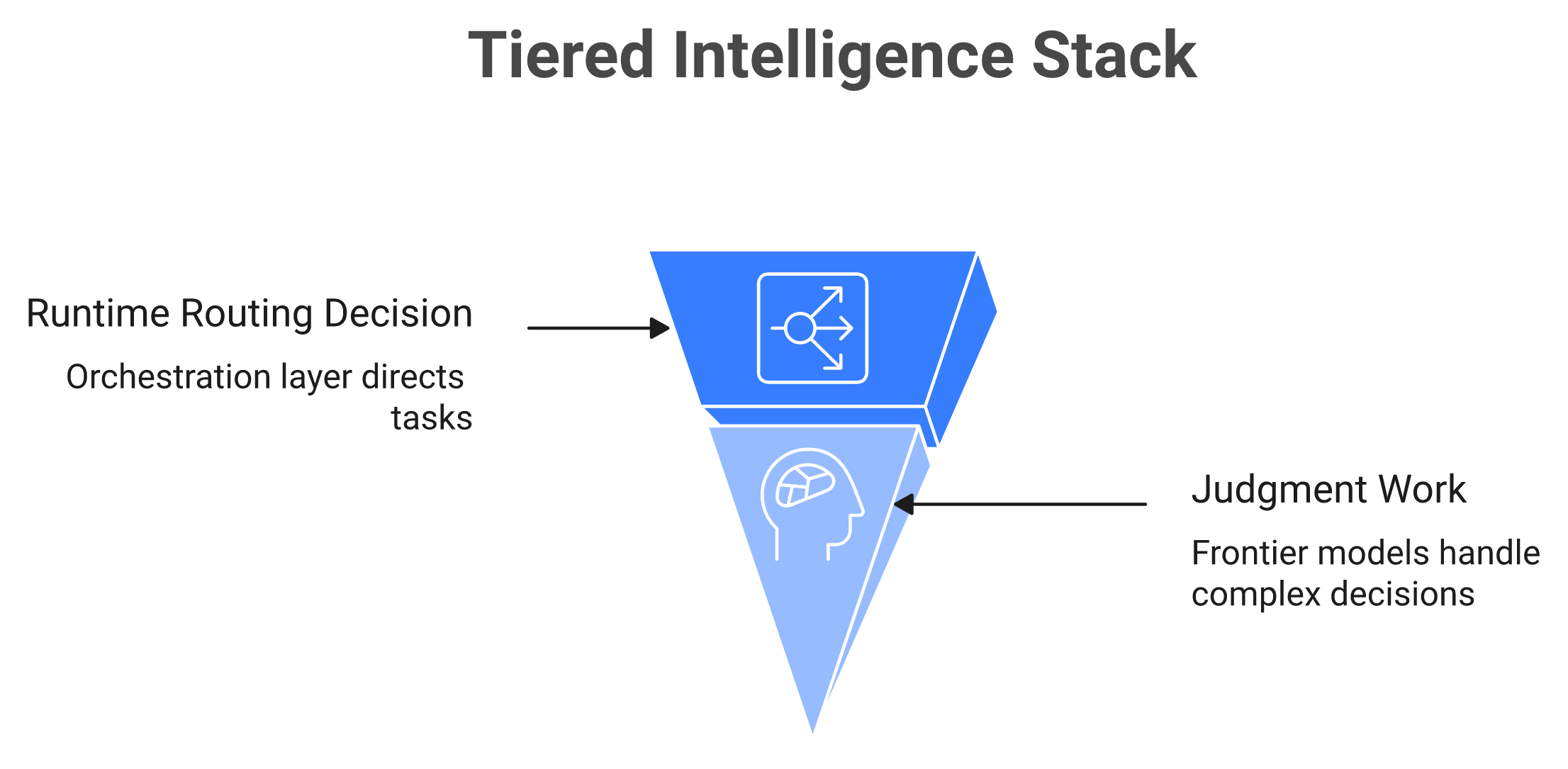
Cheap models handle classification and extraction. Expensive models handle judgment. Something has to decide which is which, per task, at runtime.
The tiered intelligence pattern now dominates 64% of enterprise accounts by token volume, and open-weight models reached 38% of enterprise token volume in Q1 2026, up from 11% a year earlier.
⭐ Cost per outcome, not cost per token
MaximusLabs AI applies the same rule to reporting, measuring revenue per session instead of sessions, because a cheaper unit that produces nothing is not a saving. I have never seen a founder celebrate a low cost per token on a workflow that missed its accuracy bar, which is why our revenue-focused R-GEO framework starts at the outcome.
Latency belongs in this math too. Grounding infrastructure running at 164ms p95 across a full pipeline, roughly 2.5x faster than the nearest alternative, stays inside the inference loop. Anything slower gets cut, whatever it costs.
The honest counter-case
Open weights are not free, and pretending otherwise is how pilots blow up in month four. Mozilla's State of Open Source AI 2026 names the barriers directly.
Infrastructure cost at 27%, security and privacy compliance at 26%, maintenance at 24%, and deployment complexity at 23%. Security concern spikes to 39% among South Asian respondents.
❌ Where the savings evaporate
| Barrier | Share | Orchestration control that answers it |
| Infrastructure cost | 27% | Task-based routing to smaller models |
| Security and compliance | 26% | Scoped identities plus audit trails |
| Maintenance | 24% | Portable evals across model versions |
| Deployment complexity | 23% | Single control plane, multiple topologies |
Every barrier maps to a harness capability. That is not a coincidence, and it is the strongest argument for buying the layer rather than assembling it.
Read the source, not the summary
The AI.cc figures come from 2.4 billion API calls across 8,000 plus enterprise and developer accounts, published May 2026. Sample size and date matter when a number this large gets quoted second-hand.
MaximusLabs AI cites dataset size and publication date on every statistic it publishes, because operators screenshot weak claims. My rule is simple: if I cannot name the sample, I do not use the number. The same standard runs through our trust-first content playbook.
Q7. How do sovereignty rules and model-supply concentration turn deployment location into a hard requirement?
Deployment location is now a compliance requirement, not a preference. Forrester expects half the G20 to mandate domestically tuned models for public-sector services, citing the EU AI Act, IndiaAI Mission, Japan's AI Promotion Act, and US Executive Order 14179. It also expects roughly half of ERP vendors to ship autonomous governance modules with explainable AI, audit trails, and real-time compliance. Chinese open-weight models moved from under 2% of weekly token traffic to over 45% by April 2026.
Four named instruments, one procurement consequence
Vague regulatory caution is useless. Named instruments are actionable.
| Instrument | Region | What it pressures |
| EU AI Act | European Union | Risk classification, documentation |
| IndiaAI Mission | India | Domestic model development |
| AI Promotion Act | Japan | National AI framework |
| Executive Order 14179 | United States | Federal AI direction |
⚠️ Why this lands on architecture
Forrester's forecast is that half the G20 will mandate domestically tuned models for public-sector services. If you sell to government, or to anyone who sells to government, deployment location becomes a contract term.
A vendor-cloud-only platform cannot satisfy that clause later. It has to be built in from the start, much like multi-market and international GEO has to be designed in rather than retrofitted.
Audit trails stop being a differentiator
Explainability and audit logging are becoming table stakes. Forrester expects roughly half of ERP vendors to ship autonomous governance modules combining explainable AI, audit trails, and real-time compliance monitoring.
Once half the market ships it, having it is not a selling point. Lacking it is a disqualifier.
✅ What to demand in writing
- An immutable log of every agent action, tied to a scoped identity, retained per your policy.
- Explainability output a compliance reviewer can read without an engineer translating.
- Real-time policy enforcement at runtime, not a quarterly documentation review.
MaximusLabs AI runs the same evidence standard in its own content production work, pairing every published statistic with publisher, year, and dataset size so a claim can be checked rather than trusted.
Your model supply is concentrating
This is the part most orchestration comparisons ignore. Open-weight models processed 29% of all AI traffic per the June 2026 AI Gateway Production Index.
Within that, Chinese open-weight models climbed from under 2% of weekly token traffic in late 2024 to more than 45% by April 2026, and Alibaba's Qwen recorded 942 million downloads by March 2026.
⏰ Concentration risk is channel risk
I have watched this pattern before in search. Automated pipelines worked beautifully for years, then stopped working, and the companies built entirely on them disappeared.
Dependence on one provider's continued tolerance is temporary by nature. MaximusLabs AI diversifies client visibility across four AI engines for exactly this reason, and the logic transfers cleanly to model supply.
What fast substitution actually requires
Swapping a model in a week is an architecture property, not a decision. Three things have to already be true.
- Prompts stored in a portable format, not a vendor-specific template.
- Evaluation sets that run unchanged against any candidate model.
- Deployment targets already provisioned across your cloud, private infrastructure, and customer-controlled environments.
💸 The cost of finding out late
Retrofitting portability after a mandate lands is the expensive path. Budget it as architecture now or as an emergency migration later.
MaximusLabs AI treats deployment and distribution flexibility as a compliance requirement rather than a feature, the same way we treat third-party surfaces as owned strategy rather than optional PR. Sovereignty rules and AI answer engines both punish single-point dependence.
Q8. Which enterprise AI orchestration platforms lead in 2026, and how should you read the rankings?
G2's July 2026 AI Orchestration category ranks UiPath Agentic Automation at 4.6/5 across 7,500 plus reviews, MuleSoft Anypoint at 4.6/5, Zapier at 4.5/5, Automation Anywhere at 4.5/5, and IBM watsonx Orchestrate at 4.4/5, alongside Apache Airflow, LangChain, n8n, and EPAM AI DIAL. Read these as review-density rankings, not architecture rankings. None scores portability, evaluation transfer, or deployment topology.
The 2026 field, with the disqualifier attached
Ratings tell you satisfaction. The fourth column tells you where a platform stops.
| # | Platform | G2 rating | Best for | Watch for |
| 8.1 | UiPath Agentic Automation | 4.6/5, 7,500+ reviews | RPA-heavy enterprises adding agents | Deterministic heritage, licensing scale |
| 8.2 | MuleSoft Anypoint | 4.6/5 | API-first integration estates | Integration-led, not model-led |
| 8.3 | IBM watsonx Orchestrate | 4.4/5 | Regulated enterprises wanting governance | Ecosystem gravity toward IBM stack |
| 8.4 | Automation Anywhere | 4.5/5 | Process automation at scale | Same deterministic constraint as RPA peers |
| 8.5 | Zapier | 4.5/5 | Fast SMB and team-level workflows | Not built for enterprise governance depth |
| 8.6 | Apache Airflow | Open source | Data pipeline orchestration | Scheduling, not agent judgment |
| 8.7 | LangChain / n8n | Open source | Developer-built custom agents | You own the governance layer |
| 8.8 | EPAM AI DIAL | Listed | Model-agnostic enterprise routing | Smaller review base to verify against |
⚠️ What a 4.6 rating does not tell you
Review density measures how many customers are satisfied with what they bought. It does not measure whether the architecture survives a sovereignty mandate or a model swap.
MaximusLabs AI reads category pages as distribution surfaces first, because these are the URLs AI engines pull from when generating a shortlist. A rating is a trust signal, not an architecture verdict.
Read rankings for what they actually measure
Three biases sit inside every list in this category. Worth naming them.
- Review volume favours older, larger vendors with mature customer-marketing motions.
- Category definitions are inherited from RPA and iPaaS, so vendor sets skew deterministic.
- Nobody scores the six criteria that decide real deployments, including portability and deployment topology.
⭐ Where the third-party proof lives
The head term is held by G2's category page, a publisher listicle, and a roughly 500-word gated Appian page carrying a Gartner pull-quote. Vendor sites are not winning it, which is exactly what our citation optimization guide is built to address.
MaximusLabs AI plans client visibility around that reality, prioritising inclusion in the pages engines already cite over adding word count to owned pages. Search Everywhere Optimization is the practical name for it.
The unclaimed subcategory
Every ranking page orchestrates generic business workflows: HR, finance, logistics, and BI. None addresses orchestration across the software delivery lifecycle.
Scrums.com positions its Software Engineering Orchestration Platform in exactly that space, coordinating models, agents, tools, infrastructure, permissions, and evaluation across delivery. With around 70% of developers reporting integration problems with existing systems, the demand is real and the category label is uncontested. Claiming an empty category is the cleanest form of GEO competitive positioning available.
✅ A note on who is missing from this list
MaximusLabs AI does not sell orchestration software and is deliberately absent from the table above. Placing us at position one in a category we do not operate in would break the same trust standard this article argues for. If you want that standard applied to your own category, start a conversation with us.
That is the whole point of publishing disqualifiers: they apply to the author too.
Q9. Can AI crawlers and orchestration agents actually reach your product data?
Agentic crawlers are cruder than Googlebot. OpenAI's OAI-SearchBot wastes 34.8% of its crawl on 404s against Googlebot's 8.22%, meaning it pre-scores URLs poorly and gives up faster. Orchestration agents cannot click JavaScript filters, so attribute data behind them is unreachable for retrieval. If your reviews load asynchronously, the engine grounding an answer never sees your strongest trust signal.
The crawl-waste gap is the whole story
A 34.8% versus 8.22% 404 rate is not a rounding error. It tells you the newer bot guesses at URLs and abandons paths quickly.
MaximusLabs AI unblocks GPTbot and oai-searchbot in robots.txt as a first-week technical step, because a bot that never reaches the page cannot cite it. I treat crawl budget here as smaller and less forgiving than Google's, which is why our AI crawler optimization guide starts with access rather than content.
⚠️ Why "it renders fine for me" is not a test
Your browser runs JavaScript. Retrieval bots often do not.
That single mismatch hides more product data than any schema error I have seen.
The five-minute diagnostic you can run today
This is repeatable, free, and needs no tools.
- Open Chrome DevTools, go to Settings, and disable JavaScript.
- Reload your highest-intent product or pricing page.
- Screenshot what survives.
- Repeat on a category page with filters applied.
- List every fact that vanished.
✅ What usually disappears
Reviews are the most common casualty. They load asynchronously, so the page arrives with an empty container where your trust signal should be.
MaximusLabs AI audits every site with JavaScript disabled first, because a review block that renders only client-side is invisible to the exact bots grounding AI answers. We have watched strong social proof simply not exist from the machine's side, and our free AI crawlability checker surfaces the same gap in minutes.
Move attributes out of filters and into text
Filters are interface elements. An agent cannot click them, so anything only expressible through a filter is unreachable.
The fix is boring and effective: put attribute data into headers and body copy.
| Where the data lives | Reachable by an agent? |
| JavaScript filter or facet dropdown | No |
| Client-side review widget | No |
| H3 text and body copy | Yes |
| FAQ block with explicit attributes | Yes |
⭐ Bring metadata into your FAQs
If a buyer might ask an agent "which of these are wrinkle-resistant," that word has to appear in text. An FAQ section is the cheapest place to put it.
MaximusLabs AI builds answer blocks of 40 to 80 words that make sense when extracted with nothing around them, which is the same discipline applied to attribute data and the core of content formatting for AI search.
The eligibility gate in agentic feeds
Think of it as a ghost kitchen. Your site is the dining room, and the feed is the kitchen where agents actually collect the order.
Agentic feed specifications include a boolean field, is_eligible_search set to true or false, that gates whether an item can surface in an agent-mediated answer at all. One wrong flag removes the product from consideration before any ranking logic runs.
💸 A default worth checking this week
Defaults in feed integrations are not always set to true. That is a silent, revenue-shaped bug.
MaximusLabs AI treats structured data as a discoverability requirement rather than a rich-snippet nicety, because the parse step now decides inclusion. My rule: verify the flag before debating the copy, and get the schema markup fundamentals right once.
MaximusLabs AI runs the JavaScript-off audit inside its first-week technical sprint, before any content ships, because extractability fixes take days and cost nothing in media spend. Content written for a page a bot cannot read is money spent twice.
Q10. Which AI-visibility work moves pipeline, and which is audit theatre?
Most technical AEO spend is measurable but inconsequential. In fifteen years of SEO work, Core Web Vitals has never been observed driving a traffic increase, yet it fills 50-page audit decks. What moves citations is extractability and verifiable identity: HTML-rendered claims, standalone 40 to 80 word answer blocks, and a closed sameAs loop from website to Wikidata to LinkedIn to Crunchbase to G2 and back.
The claim, and who it annoys
Plenty of technical SEO work is true and irrelevant. It is measurable, which is why it sells, and that is not the same as being causal.
Ethan Smith of Graphite, teaching AEO at Reforge, is blunt that most technical factors beyond crawlability, internal linking, and schema are not impactful for answer engines. That view annoys anyone whose retainer is priced by audit length.
❌ What I would stop paying for first
Speed-score remediation past the crawlable threshold. Redirect-chain cleanup on pages nobody retrieves.
MaximusLabs AI does not sell standalone technical AEO audits, because extractability fixes take days and the remaining pages of a speed report have never moved a client's citation rate. Our technical SEO and website audit work is scoped to what changes retrieval.
Schema is genuinely contested, and I will name both sides
Honest answer: the evidence splits. SALT.agency calls schema a hygiene factor at best, not a differentiator. Surfer Academy argues it increases your odds significantly of being used as a source.
Both can be right. Schema removes ambiguity for machines without creating preference, which is worth doing once and not worth auditing quarterly.
| Work item | Evidence strength | Verdict |
| Crawlability and HTML rendering | Strong | Do it first |
| Schema and structured data | Contested | Do once, cheaply |
| Closed sameAs entity loop | Strong | Do it, then maintain |
| Core Web Vitals beyond threshold | Weak for AEO | Deprioritise |
⭐ Extractability beats compliance
Aggarwal et al., "GEO: Generative Engine Optimization" (KDD 2024), showed that content-level changes, including citation-adding and quotation, lifted visibility in generative engines by meaningful margins. Structure, not site speed, was the lever.
MaximusLabs AI writes every answer block to stand alone if extracted with no title and no byline, which is the operational version of that finding and the backbone of our AEO answer structure approach.
Close the sameAs loop
Schema.org's sameAs property links your entity to its other public identities. An open loop means an engine cannot confirm you are one entity.
- List every profile: Wikidata, LinkedIn, Crunchbase, G2, YouTube.
- Add all of them to sameAs in your Organization schema.
- Make each profile link back to your canonical domain.
- Fix name and description mismatches across all of them.
- Recheck quarterly, because profiles drift.
✅ Review platforms are retrieval assets
G2, Capterra, and Gartner profiles are not just social proof. They are pages engines retrieve from.
MaximusLabs AI treats review-platform presence as a ranking asset with a target of at least ten credible reviews per site, which is why it sits inside the off-page workstream rather than a PR wishlist. The same logic drives our citation acquisition tactics.
What I am still unsure about
I am not confident about how much weight sameAs carries versus plain co-occurrence of your brand name across trusted domains. MaximusLabs AI's data points toward identity resolution mattering, though I might be reading it too strongly.
The experiment that would settle it: close the loop on one property, leave a comparable one open, and track citation share for ninety days.
MaximusLabs AI's read is that brand is the moat and the entity graph is what makes the brand machine-legible, which is why we spend on identity and extractability before speed reports. Algorithm updates do not delete a brand engines already trust, a point we develop in our work on GEO and knowledge graphs.
Q11. What should you measure once enterprise buyers stop clicking?
Stop reporting one AI traffic number. Split it: citations inside grounded, search-enabled answers versus mentions in ungrounded ones. Semrush's clickstream analysis of over a billion US records found ChatGPT referrals grew 206% year over year while search-enabled queries fell to 34.5% by February 2026. AI-referred traffic converts roughly 4.4x better than organic at about 1% of volume. Report revenue per session, not sessions.
Why one number misleads
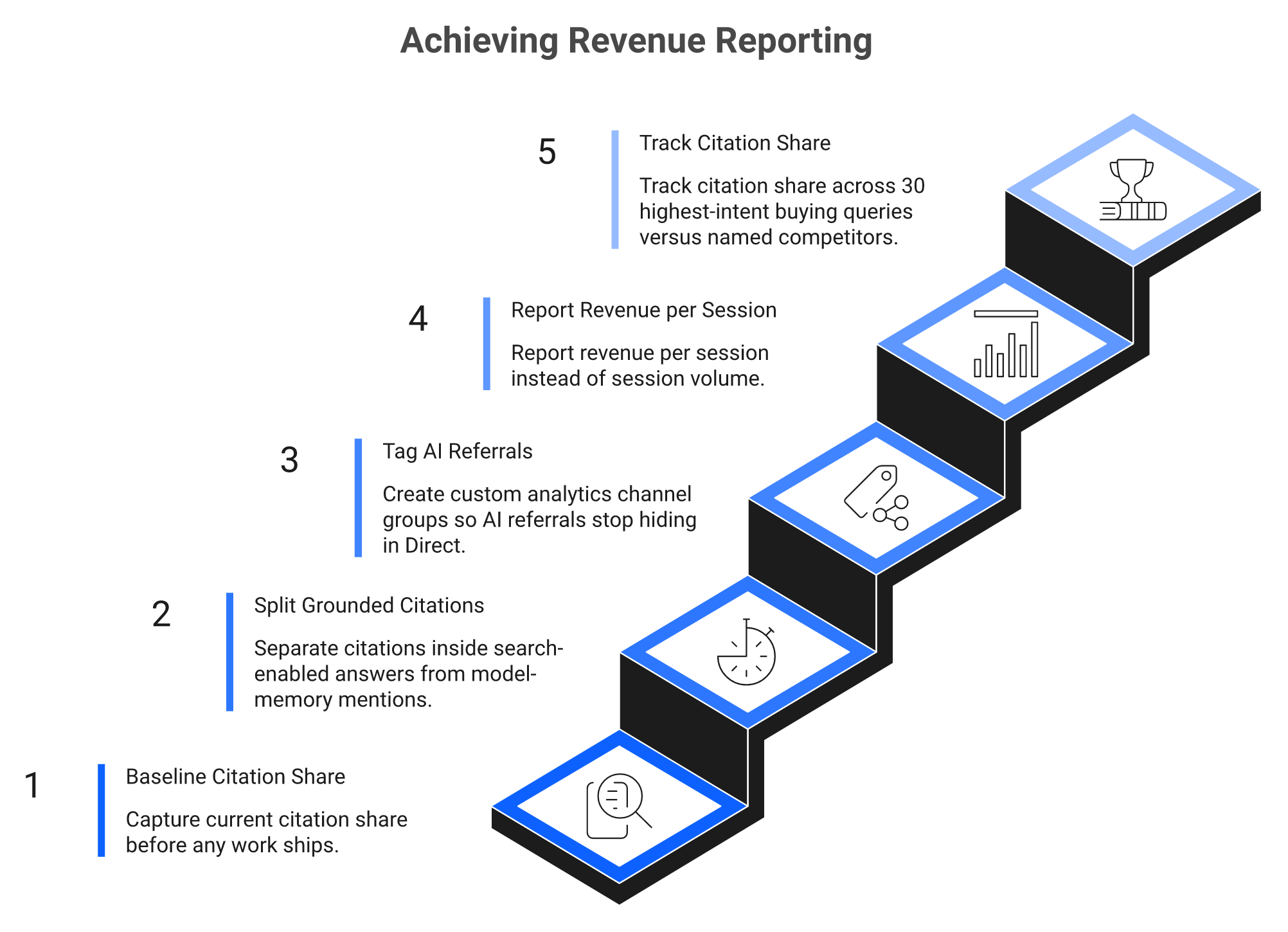
A grounded answer runs a live search, retrieves sources, and cites them. An ungrounded answer draws on model memory with no retrieval step.
Those two need different work. Grounded visibility responds to extractability and fresh pages. Ungrounded mentions respond to brand presence built up over time.
⏰ The snippet is the new rank
Position stopped being the unit. The extracted block is.
MaximusLabs AI measures share of voice across thousands of question variants rather than a single ranking position, because there is no single rank inside an AI answer. Our GEO metrics and KPIs breakdown sets out the full measurement stack.
The GA4 spec, set up in an afternoon
Create a custom channel group so AI referrals stop hiding inside Direct or Referral.
| Channel group | Source contains |
| AI Search: ChatGPT | chatgpt.com, chat.openai.com |
| AI Search: Perplexity | perplexity.ai |
| AI Search: Gemini | gemini.google.com |
| AI Search: Copilot | copilot.microsoft.com |
💰 Then report the ratio, not the volume
AI-referred volume stays small, roughly 1% of sessions in the Semrush dataset, so a volume chart looks like failure. The conversion ratio tells the truth.
MaximusLabs AI reports revenue and pipeline rather than clicks and impressions, which is the whole reason the ratio gets top billing in client reporting. I have watched founders relax the moment the denominator changes, and our GEO ROI and revenue attribution method exists for exactly that conversation.
Citation share is the KPI
Pick your 30 highest-intent buying queries. Run each across ChatGPT, Perplexity, Gemini, and Google AI Overviews. Count how often you appear versus named competitors.
That percentage is the number to put on the board slide. Google-only rank tracking cannot produce it.
⭐ A grading habit worth borrowing
Microsoft's relevance evaluation scores results on an integer 0 to 4 scale against confirmed primary intent, where 0 is completely irrelevant and 4 is ideal. Applying that scale to your own answer blocks turns a vague review into a number.
MaximusLabs AI scores every article across ten dimensions with a minimum threshold before publication, which is the same principle applied upstream.
✅ Attribution needs a human question
Last-click attribution captures a fraction of AI-driven influence. Ethan Smith's practical fix is a post-conversion "how did you hear about us" field.
Add it this quarter. It is the cheapest measurement upgrade available.
MaximusLabs AI reports citation rate against named competitors, the same way it took Oliv AI to a 64% citation rate versus a decade-old billion-dollar competitor's 30% in six months. That comparison is the number clients actually defend internally, and the full Oliv AI case study shows how it was built.
Q12. What I'm watching next in enterprise AI orchestration
Portability is a standards problem, not a licensing one. Forrester found the agent control plane architecturally sound but blocked by three categories of missing standards, while roughly 30% of enterprise app vendors are expected to ship MCP servers and most enterprises will compose agentlakes across vendors. My hypothesis: deployment topology becomes a top-three selection criterion within four quarters.
The standards gap closes unevenly
Every vendor says model-agnostic. Almost none can prove it with an export.
Model Context Protocol adoption will help, but partial adoption creates a worse problem than none: half your stack speaks the standard and half quietly does not. Our WebMCP agent-ready web standard report tracks where adoption actually stands.
⏰ What I expect by mid-2027
Contract language shifts before architecture does. Procurement teams will ask for portability guarantees in writing well before platforms can honour them cleanly.
I could be early on this. If MCP server adoption stalls below 20% of enterprise vendors, my four-quarter estimate is wrong and I will say so.
Composability breaks the demo
Agentlakes, assembled across several vendors, are the realistic end state. That is fine until something fails.
The hard part is not integration. It is deciding which layer owns evaluation, which owns identity, and who gets paged at 3am when an agent takes a bad action.
⚠️ The question nobody scores
Rankings measure review volume. Nobody scores who is accountable across a composed stack.
That gap is where I expect the next round of expensive surprises, and it is why we track agentic AI and the future of search as an architecture story rather than a feature race.
Constitutional constraints beat manual correction
A small story. Every single run, one agent slipped emojis into customer-facing copy, and I kept fixing it by hand.
The fix was not better prompting. I created a claude.md file in the project root with one rule: never use emojis. The correction moved from my memory into the system's.
⭐ Where this goes
Scale that idea and you get constitutional constraints, hard rules an agent cannot route around, versioned like code. It is the difference between supervising an agent and governing one.
My current thinking, subject to change: the platforms that win will be the ones that make those constraints a first-class artefact rather than a prompt convention.
The question I am sitting with
If your model supply, deployment location, and evaluation logic all live with one vendor, what does your migration plan actually look like on paper?
I genuinely want to know how teams are answering that. If you have written that plan, or discovered it does not exist, I would like to hear which part broke first. Get in touch with our team, or email krishna@maximuslabs.ai
Frequently asked questions
What is an enterprise AI orchestration platform, and how is it different from RPA or iPaaS?
An enterprise AI orchestration platform is the control layer that coordinates models, agents, tools, infrastructure, permissions, and evaluation across a business process or delivery lifecycle. Gartner frames it as the layer that moves agentic AI from isolated pilots to governed, autonomous execution. The distinction from adjacent categories is about determinism: RPA repeats fixed, pre-scripted steps against interfaces and APIs. iPaaS moves data between systems on defined rules. Orchestration coordinates non-deterministic components, adding routing, evaluation, and guardrails on top. Most enterprises need all three, with deterministic automation as the backbone and orchestration as the judgment layer above it. Strip out any one of the six coordinated objects and you have a demo rather than a platform. MaximusLabs AI applies the same sequencing logic to AI search, fixing the retrieval layer before rewriting content, because an engine that cannot reach or verify a page will not cite it regardless of writing quality. That is why our technical SEO and website audit work runs before any content ships. The harness logic holds in both stacks: coordinate first, then choose the components.
Which six criteria should we use to evaluate an enterprise AI orchestration platform?
Six criteria decide it, and each one has a disqualifier that ends the evaluation faster than any feature comparison: Governance: is every agent action auditable and explainable? Disqualifier: no immutable audit trail. Portability: can you swap model providers without a rebuild? Disqualifier: proprietary prompt format. Deployment topology: can it run in your cloud, private infrastructure, or a customer data centre? Disqualifier: vendor-cloud only. Identity: does each agent get a scoped non-human identity? Disqualifier: shared service accounts. Evaluation: do evals travel with the workflow across models? Disqualifier: model-specific scoring only. Cost control: does it route by task to cheaper models? Disqualifier: single-model routing. A checklist rewards vendors who tick boxes. A disqualifier list forces a yes or no answer that a sales engineer cannot dress up. MaximusLabs AI builds its own audits this way, naming the single condition that ends an evaluation rather than the fifty things that could be improved, an approach we detail in our GEO competitive analysis framework . Killing a bad option in ten minutes beats scoring it for a week.
Why do 40% of agentic AI projects get cancelled before production?
Gartner forecasts $206.5B of AI-agent software spend in 2026, up 139% from $86.4B, while projecting that 40% of agentic AI projects will be cancelled by the end of 2027. Separately, 42% of AI projects show zero ROI, attributed to teams deploying without establishing baselines first. Budget is not the constraint. Forrester names three deficits behind the failures: Orchestration maturity: every team rebuilds routing, retries, and evaluation instead of reusing them. Executable governance: the policy lives in a document rather than being enforced at runtime. Non-human identity: agents share a service account rather than holding scoped identities. At the engineering level, this surfaces as integration friction, reported by around 70% of developers working on agentic systems. Not model quality, not prompt design, plumbing. The zero-ROI figure is usually a measurement failure rather than a performance failure. MaximusLabs AI runs a baseline-first sequence on every engagement, capturing citation share against named competitors before any content ships, which is the same discipline described in our GEO ROI and revenue attribution guide . A program without a before-state cannot survive a budget review.
What does open-weight orchestration actually cost per million tokens?
AI.cc's 2026 AI API Infrastructure Report, built on 2.4 billion API calls across 8,000 plus accounts and published May 2026, found blended enterprise token costs fell 67% year over year, from $18.40 to $6.07 per million tokens. The tier spread is the financial case for orchestration: $18.40 per million: frontier-only, Q1 2025 baseline. $6.07 per million: blended enterprise average, Q1 2026, including companies that changed nothing structurally. $2.31 per million: median for accounts fully implementing tiered multi-model routing, an 87.4% reduction versus frontier-only. That $3.76 gap between the blended average and the routed median is the harness earning its keep. Cheap models handle classification and extraction, expensive models handle judgment, and something has to decide which is which per task at runtime. The tiered intelligence pattern now dominates 64% of enterprise accounts by token volume, while open-weight models reached 38% of enterprise token volume in Q1 2026, up from 11%. MaximusLabs AI applies the same rule to reporting, measuring revenue per session instead of sessions, because a cheaper unit that produces nothing is not a saving. Our revenue-focused R-GEO framework starts at the outcome, not the unit cost.
Does the Open Weights Letter change anything for enterprise buyers?
The Open Weights Letter, published by Nvidia and Microsoft in July 2026 with roughly 140 signatories including Meta, Google, Hugging Face, Vercel, and the Linux Foundation, argues for a competitive, secure, widely accessible open-weight ecosystem. It handles risk through stronger security practices and transparent evaluation rather than broad restrictions. Scrums.com is among the signatories. For buyers, the letter matters less than what it can be tested against: Can you export weights, prompts, and evaluation sets, and run them elsewhere without a rebuild? Where does inference execute, and can you move it to your own or a customer-controlled environment? Is the vendor shipping a Model Context Protocol server, and on what timeline? Signing is cheap; portability is the test. Scrums.com reports that customers never ask about open weights, they ask who controls their data, IP, and prompts. Open weights are also not free: Mozilla's 2026 survey names infrastructure cost at 27%, security and compliance at 26%, maintenance at 24%, and deployment complexity at 23%. MaximusLabs AI treats public commitments like signatory lists as citable trust signals, closing the sameAs loop from website to Wikidata to LinkedIn to Crunchbase to G2, an approach we explain in our work on GEO and knowledge graphs .
How should we read G2 rankings for AI orchestration platforms in 2026?
Read them as review-density rankings, not architecture rankings. G2's July 2026 AI Orchestration category places UiPath Agentic Automation at 4.6/5 across 7,500 plus reviews, MuleSoft Anypoint at 4.6/5, Zapier at 4.5/5, Automation Anywhere at 4.5/5, and IBM watsonx Orchestrate at 4.4/5, alongside Apache Airflow, LangChain, n8n, and EPAM AI DIAL. Three biases sit inside every list in this category: Review volume favours older, larger vendors with mature customer-marketing motions. Category definitions are inherited from RPA and iPaaS, so vendor sets skew deterministic. Nobody scores portability, evaluation transfer, or deployment topology, the criteria that decide real deployments. A 4.6 rating tells you customers are satisfied with what they bought. It does not tell you whether the architecture survives a sovereignty mandate or a model swap. MaximusLabs AI reads category pages as distribution surfaces first, because these are the URLs AI engines pull from when generating a shortlist, and prioritises inclusion in those pages over adding word count to owned pages. Our citation acquisition tactics exist for exactly that reason. A rating is a trust signal, not an architecture verdict.
What should we measure if enterprise buyers stop clicking through to our site?
Stop reporting one AI traffic number. Split it into citations inside grounded, search-enabled answers versus mentions in ungrounded ones, because the two respond to different work. Grounded visibility responds to extractability and fresh pages; ungrounded mentions respond to brand presence built over time. The measurement stack we recommend: Citation share: run your 30 highest-intent buying queries across ChatGPT, Perplexity, Gemini, and Google AI Overviews, then count appearances versus named competitors. GA4 channel groups: create custom groups for chatgpt.com, perplexity.ai, gemini.google.com, and copilot.microsoft.com so AI referrals stop hiding in Direct. Revenue per session: AI-referred traffic sits near 1% of volume but converts roughly 4.4x better than organic, so volume charts read as failure while ratios read as truth. Self-reported attribution: add a post-conversion "how did you hear about us" field. Semrush's clickstream analysis of over a billion US records found ChatGPT referrals grew 206% year over year while search-enabled queries fell to 34.5% by February 2026. MaximusLabs AI reports citation rate against named competitors, the same way we took Oliv AI to a 64% citation rate against a decade-old competitor's 30% in six months, documented in the Oliv AI case study .