 Krishna Kaanth M
- AI is not replacing SEO. Every answer engine is a retrieval system that needs third-party published content, so the web layer cannot be removed.
- Demand expanded while clicks compressed. Google volume grew roughly 21.6% in 2024, yet users click a result only 8% of the time when an AI summary appears.
- Rank no longer buys citation. Top-10 reliance for AI Overview citations fell from about 76% to 38%, with many citations coming from beyond position 100.
- Off-site brand consensus outranks on-page work, correlating with AI visibility at r=0.664 versus r=0.218 for backlinks.
- Defund micro technical tuning, scaled AI content, and TOFU definitional pages. Fund BOFU comparison assets, review platforms, and original data.
- Measure pipeline, not mentions. Split LLM referrals out of Direct in GA4 and judge AI search on influenced revenue over a full sales cycle.
Q1. Will AI replace SEO?
No. AI will not replace SEO, because every answer engine is a retrieval system that needs third-party published content to answer anything at all. What AI replaces is click-based SEO. Google search volume grew roughly 21.6% in 2024 and still handles about 373 times ChatGPT's daily search queries. The objective shifts from ranking blue links to becoming the source AI engines cite.
The fear is specific, and it is not irrational
Every founder I speak to describes the same dread. Over 70% of searches now end without a click. Agents are arriving. If a buyer never reaches the site, the content still gets consumed, and the value leaks somewhere else.
That fear deserves a straight answer rather than reassurance. So let us look at how answer engines actually work.
⚙️ Why the retrieval layer cannot be removed
Answer engines do not hold opinions. They retrieve documents, re-rank them, then synthesize a response with citations. Remove the published web, and there is nothing to retrieve.
Eric Enge puts the mechanism plainly in The Art of SEO: generative AI will not end SEO, because search engines that use generative models still need third parties to create and publish content on the web. Without that content, the engines have nothing to show.
📊 What the clickstream data actually shows
The substitution story also fails on measurement. SparkToro and Semrush analyzed 260 billion queries and found Google search volume grew about 21.6% in 2024. Google still receives roughly 373 times more daily search queries than ChatGPT.
So AI chat is additive, not substitutive. Total information-seeking grew. What shrank is the click that used to follow a ranking.
The click died, not the discipline
This is the reframe that matters for a budget owner. Traditional SEO was a traffic acquisition channel measured in sessions. AI-era search is a trust and citation channel measured in whether your brand appears inside the answer.
Technical SEO still decides whether an engine can reach your content. Indexability, clean HTML, and server-side rendering are now entry requirements rather than competitive advantages.
🧱 Foundation floor versus building
My framing has not changed in two years. SEO best practice has become the basics. Generative Engine Optimization (GEO), the work of getting cited inside AI-generated answers, is the building constructed on top.
"SEO is not dead, but SEO alone doesn't help in this age of AI. The best practice of SEO has become the BASICS for GEO. SEO is the foundation floor. GEO is the building on top."
Krishna Kaanth M, Founder, MaximusLabs AI
MaximusLabs AI was built on that split rather than on the "SEO is dead" panic. Answer Engine Optimization (AEO) is the flagship service, with SEO running underneath it as the retrieval foundation. MaximusLabs AI measures every engagement on pipeline, not on mentions, which is why clients hold Google rankings while gaining AI citations instead of trading one for the other. In Oliv AI's engagement, that produced a 64% AI citation rate in six months, against roughly 30% for billion-dollar incumbents.
The rest of this article resolves the specifics: what AI genuinely automates, where demand actually went, and what "becoming the answer" requires on a Monday morning.
Q2. Which SEO tasks is AI actually replacing, and are SEO jobs at risk?
AI has replaced tasks, not judgment. Keyword clustering, meta generation, bulk drafting, and routine reporting are now near-free. What remains human: deciding which pages influence pipeline, interpreting ambiguous buyer intent, building off-site consensus, and owning a revenue number. Task-level disruption is measurable. Headcount collapse is not. Execution-only roles are exposed, and roles directing AI or owning AI-search visibility are expanding.
Most teams cannot name which half of the week is now worthless
The practical problem is not existential. It is scheduling. A marketing manager still runs the same twelve recurring tasks she ran in 2023, and four of them now take nine minutes instead of four hours.
Nobody tells her which four. So the hours get refilled with more of the same work rather than redirected.
✅ What AI took, and ❌ what it did not
| Now automated (near-zero cost) | Still human (judgment work) |
| Keyword clustering and intent tagging | Choosing which 20 pages influence pipeline |
| Title tags, meta descriptions, alt text | Reading ambiguous buyer intent in a niche category |
| First-draft outlines and boilerplate copy | Off-site consensus building on G2, Reddit, YouTube |
| Internal link suggestions at scale | Deciding what not to publish |
| Weekly rank and traffic reporting | Owning a revenue number in front of a board |
| Schema generation and validation | Positioning and category narrative |
The left column is where agency retainers used to hide their margin. The right column is where the channel is actually won or lost.
The automation trap, with receipts
There is a predictable failure pattern here, and it has been documented repeatedly by practitioners who ran it.
⚠️ Why scaled AI content stops working
Ethan Smith of Graphite has tracked the arc several times. A site publishes a large volume of AI-generated articles, traffic rises, and then traffic returns to baseline. He has not seen operators sustain those gains over long periods.
The mechanism is structural rather than punitive. Shumailov and colleagues described model collapse: training generative models on derivatives of their own output degrades the model. If mass AI content worked, the engines would become useless to their own users, so the platforms have strong incentive to make it not work.
🧑💻 What this means for your headcount plan
Smith has also made a point I agree with after watching three search shifts: the task-level evidence is strong and the headcount evidence is weak. Roles disappear when they are purely execution. Roles grow when they direct the automation and own an outcome.
MaximusLabs AI's hiring data points toward judgment roles expanding, though our sample is agency-side and may not generalize to in-house teams at enterprise scale.
MaximusLabs AI runs content through a three-stage pipeline: deep primary-source research, writing in the founder's voice, then a quality audit scored across ten dimensions with a 70 out of 100 publication floor and 80 for pillar pages. AI does aggregation and formatting. Humans own the argument and approve everything that ships. That is the line between scaling content and scaling model collapse.
Q3. Did search demand actually collapse, or did only the click disappear?
Demand expanded. The click compressed. Google volume grew about 21.6% in 2024 and still receives roughly 373 times ChatGPT's daily search queries, which falsified Gartner's 2024 forecast of a 25% drop by 2026. Pew Research found users clicked a traditional result only 8% of the time when an AI summary appeared, versus 15% without one, and just 1% clicked a citation inside the summary.
Situation: one forecast became the industry's entire worldview
In February 2024, Gartner predicted traditional search engine volume would fall 25% by 2026 as buyers substituted chatbots for search engines. That single sentence has probably sold more GEO retainers than any dataset in the category.
I have sat in pitch meetings where it was presented as a measured fact. It was a forecast, and forecasts are testable.
📉 Complication: the measured data went the other way
Clickstream analysis of 260 billion queries showed Google volume grew about 21.6% in 2024 rather than falling. Users did not swap Google for ChatGPT. They added AI chat queries on top of existing search behavior.
Ethan Smith has described this pattern across multiple search shifts: Google's slice of the pie never gets smaller, the pie keeps getting bigger, and new surfaces are additive. TikTok search did not end Google. Neither has ChatGPT so far.
😬 The tension: so why does your traffic chart look like that?
Because both camps have real evidence, measuring different things. Query demand grew. Click delivery shrank.
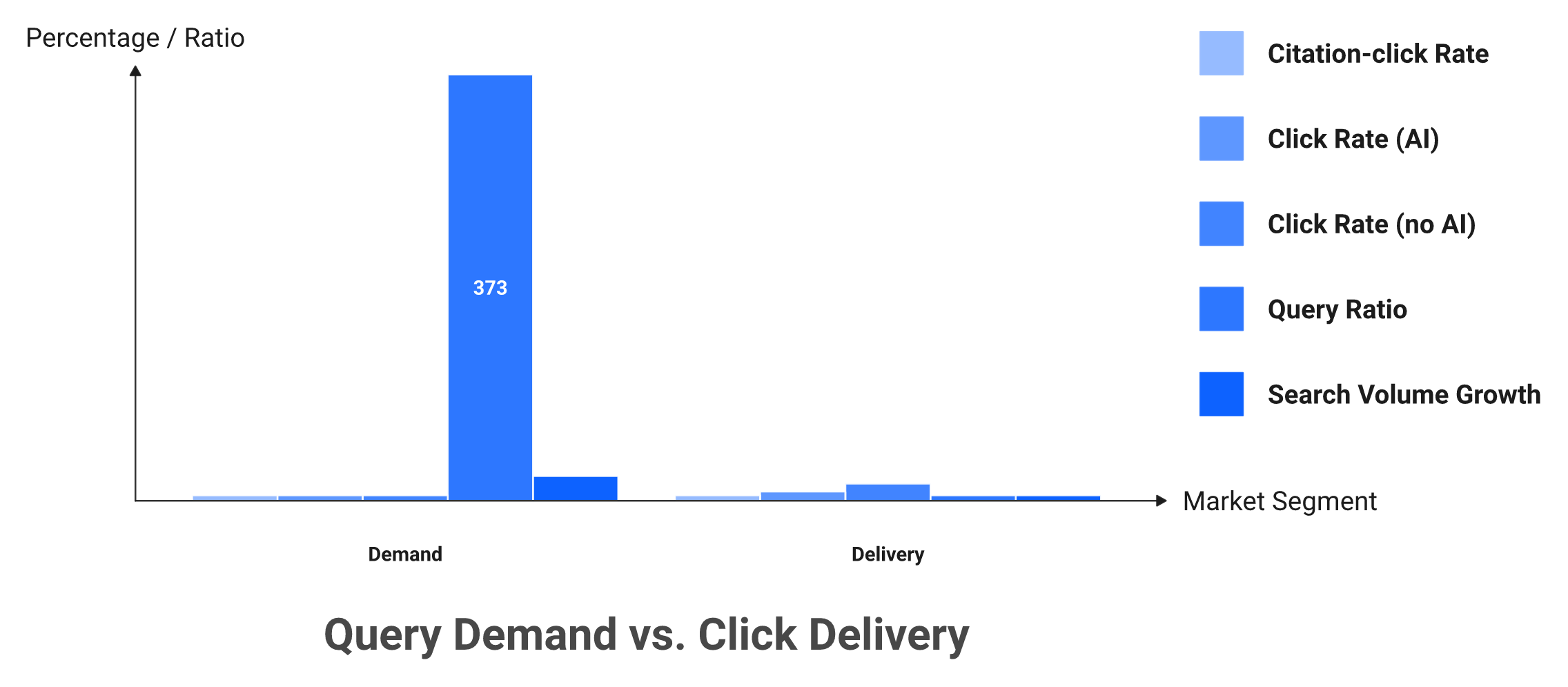
Pew Research studied 68,879 real Google searches from browsing data. With an AI summary present, users clicked a traditional result 8% of the time, against 15% without one. Only 1% clicked a link inside the summary, and 26% ended the session entirely. This is the mechanism behind search referral traffic decline.
Sam Lessin has described the operator consequence bluntly: organic traffic that used to arrive very predictably has fallen by roughly 20% to 40% depending on the industry. Informational head terms took the heaviest hit.
Resolution: stop forecasting sessions, start forecasting citations
Those two findings reconcile cleanly. More questions are being asked than ever. Fewer of them end in a visit to your site. Impressions and sessions have decoupled from revenue.
🎯 What to change in your reporting this quarter
Three moves, in order:
- Segment your query clusters by whether an AI Overview or AI Mode answer appears, then rebaseline CTR expectations per cluster instead of applying a historical curve.
- Split LLM referrals out of Direct traffic in GA4 so AI-influenced sessions stop hiding inside a rounding error.
- Report share of voice, meaning how often your brand appears across question variants, alongside rank.
MaximusLabs AI dropped impressions and sessions as headline metrics two years ago. We measure share of voice across thousands of question variants per client rather than a single rank position, and we report influenced pipeline beside it. In an expanding-query, shrinking-click market, a traffic chart tells a client a story that no longer predicts revenue. For Oliv AI, the reportable outcome was 27 qualified leads, $47K+ pipeline, and a 26% close rate in four months.
My own uncertainty here is real. I do not know whether click rates stabilize at this new floor or keep eroding as AI Mode expands. I plan reporting for both.
Q4. What does it mean to "become the answer" instead of ranking?
Ranking puts a brand on a list of options. Becoming the answer puts it inside the recommendation. When a buyer asks ChatGPT for the best tool in a category, five to ten brands get named, that set is the entire consideration set, and there is no page two. US visits to the five leading LLM platforms rose from about 2.3 million in June 2023 to 1.33 billion in June 2026, and 66% of consumers have used AI to research products.
Situation: the rank report stops explaining the pipeline
Picture the VP Marketing I described at the top of this article. Eleven keywords at position one. Pipeline from organic down by a third. Every input green, the output red.
She did the obvious diagnostic. She opened ChatGPT and asked it to recommend tools in her category. Her company was not named. A competitor ranked seventh on Google was named first.
🔒 Complication: the sample set is brutally small
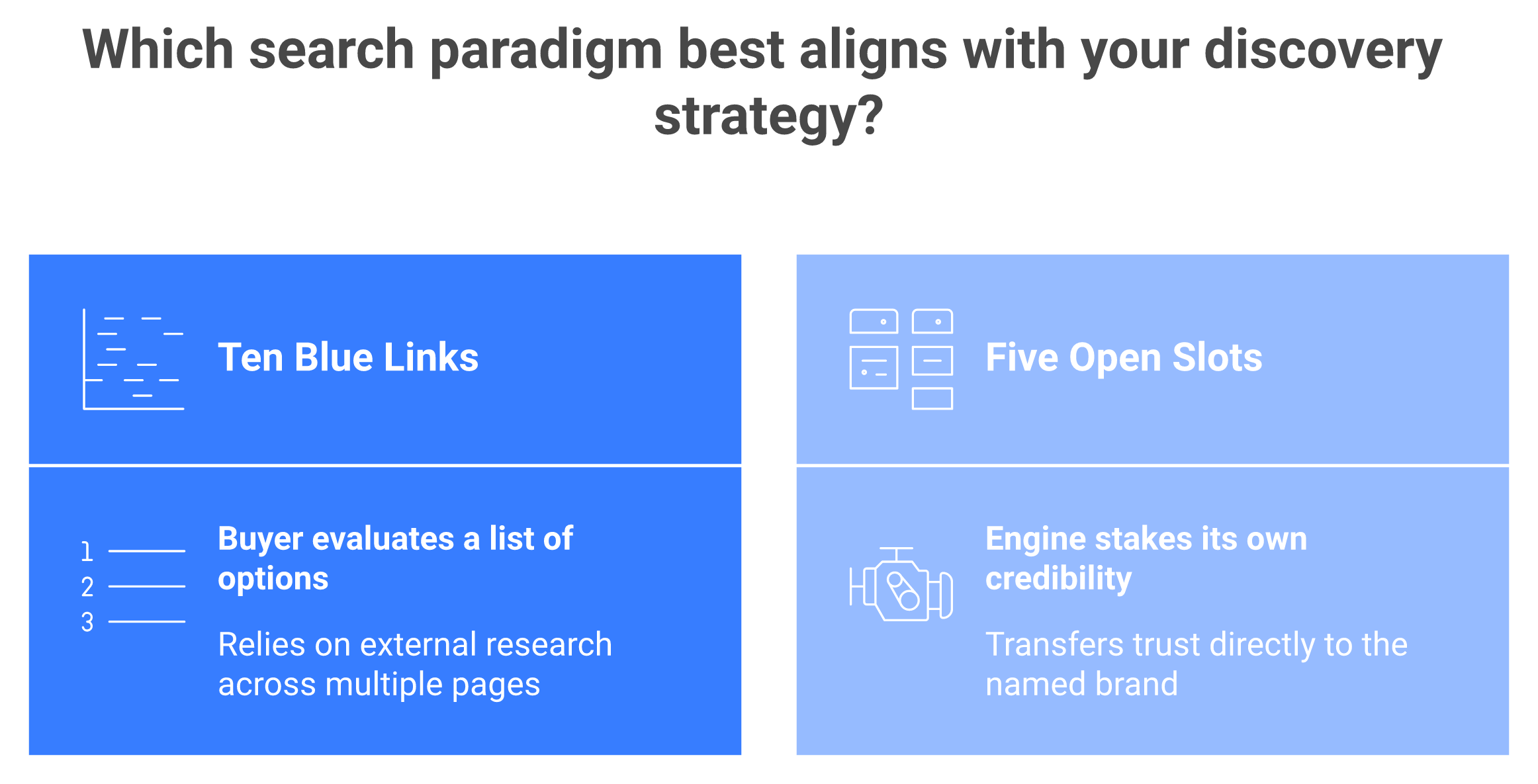
That is the shift. Google showed ten blue links and let the buyer evaluate. An answer engine names a handful of brands and the buyer evaluates those.
"There are hundreds of CRMs out there, but AI systems will mention only 5-10 players. If you're not in this sample set, you don't exist. You're not even in the evaluation set."
Krishna Kaanth M, Founder, MaximusLabs AI
This is more binary than page one ever was. Position eleven on Google still got impressions. Absence from an AI answer gets nothing, because there is no scroll.
📈 The surface is no longer small enough to ignore
Scale decides whether this matters commercially. Emplifi and Semrush tracked US visits to five leading LLM platforms rising from roughly 2.3 million in June 2023 to 1.33 billion in June 2026, with 66% of consumers using AI for product research and AI referrals to 30 major retailers growing 190 times.
For B2B SaaS, the volume is smaller than Google and the intent is later-stage. Buyers arrive having already asked the comparison questions.
Resolution: AI recommendations are a trust transfer
Here is the mechanic most GEO advice misses. When an engine names your brand, it stakes its own credibility on that recommendation being correct.
That is why trust signals dominate citation selection. The engine is not ranking documents for a user to judge. It is vouching.
🤝 What borrowed credibility does to a buyer
A buyer who arrives from a ChatGPT recommendation has already been told you are the right answer by a system they trust. The research step happened without you. They land pre-sold.
That is the honest explanation behind every AI-traffic conversion multiplier floating around the category. I will test those numbers properly in a later section rather than quote one here.
MaximusLabs AI calls this trust-first optimization: stop optimizing for Google, start optimizing for trust. We work across two pillars, Owned AEO where client content becomes the extractable answer, and Earned AEO where reviews, Reddit, press, and third-party listicles make the engines trust the brand. Most agencies run only the first. For Nidra Goods, that combination produced simultaneous number one positions on Google, ChatGPT, and Perplexity for "best sleep mask" from a single strategy.
Q5. Why doesn't ranking #1 on Google guarantee an AI recommendation?
Because AI engines retrieve and re-rank independently of Google's results page. Before Gemini 3, roughly 76% of AI Overview citations came from Google's top 10. By early 2026, that share fell to about 38%, with nearly a third of citations drawn from pages ranked beyond position 100. A study of 327 commercial running-shoe queries found only 8% URL overlap between Google and ChatGPT. Rank opens the door. Citability decides inclusion.
The diagnostic that breaks the rank report
The pattern shows up the same way every time. A client holds position one. The engine names someone else.
MaximusLabs AI runs this check in the first week of every audit, and the mismatch appears in the majority of engagements we take on. I expected overlap to be high when we started measuring. It is not.
🔍 How an answer actually gets built
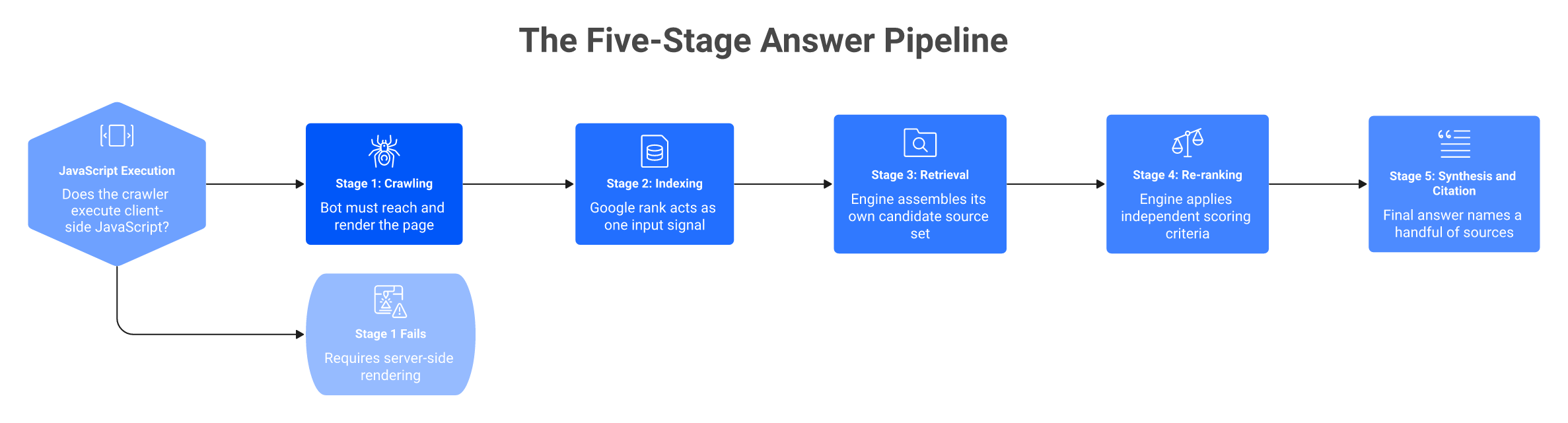
Answer engines run a five-stage pipeline. Crawling, indexing, retrieval, re-ranking, then synthesis with citations.
Google's blue-link ranking is one input to stage two. Stages three and four apply their own scoring. That is where rank and citation separate.
📉 What the citation data shows
The decoupling is measurable. In MaximusLabs AI's AI-search ranking dataset, top-10 reliance for AI Overview citations fell from roughly 76% in July 2025 to about 38% by early 2026, with around 31% of citations coming from pages beyond position 100.
Ahrefs measured the other half of the squeeze. Position one lost about 58% of its click-through rate on queries where an AI Overview appeared.
👟 The clearest proof: 327 shoe queries
A study of 327 commercial running-shoe queries found 8% URL overlap between Google and ChatGPT, with a near-inverse correlation of about -0.98. Google served direct purchase links. ChatGPT cited review aggregators and editorial deep-dives almost exclusively.
Different jobs, different sources. That is not a ranking problem. It is a sourcing problem.
Each engine rewards something different
This was my own turning point. What ChatGPT treats as important is not what Google treats as important, and neither matches Perplexity.
MaximusLabs AI builds prompt sets per engine for this reason, then maps which URLs each one actually cites for a client's buying-stage questions. The full breakdown sits in our citation patterns research.
| Engine | What it rewards | What MaximusLabs AI optimizes |
| ChatGPT | Conversational Q&A depth, named-entity clarity | Question-headed sections, explicit brand entity mentions |
| Google AI Overviews | Answer-first structure, E-E-A-T signals | 40 to 80 word answer blocks, schema, author credentials |
| Perplexity | Recency, source transparency, readability | Dated references, visible footnotes, Flesch 55 and above |
| Claude | Long-form depth, methodology transparency | Primary-source citations, process explanations |
⚠️ Where the standard advice gets it backwards
MaximusLabs AI's read is that most GEO work still starts with on-page rewrites, because that is what agencies can bill confidently. The retrieval data points the other way, toward sourcing and consensus.
I hold that view with some caution. Our sample skews B2B SaaS, and consumer categories behave differently, as the shoe study suggests.
MaximusLabs AI audits citation share before rank. We map the engines each client's buyers actually use, identify which sources those engines trust in that category, then work backwards into content and placements. A rank report cannot show a client that a competitor owns the consensus. A citation map can.
Q6. What are GEO and AEO, and are they genuinely new disciplines?
Answer Engine Optimization (AEO) optimizes content to be the extracted answer. Generative Engine Optimization (GEO) optimizes to be the cited source inside generated responses. SEO remains the retrieval foundation both depend on. Practitioners disagree on novelty. One camp calls AEO roughly 90% classic white-hat SEO with citation work added at the head, and the other treats GEO as a data-science problem built on retrieval mechanics and embeddings. Princeton-led research measured visibility lifts up to 40% from specific content levers.
Situation: three acronyms, one muddled budget line
Most marketing heads I speak with have all three terms in a deck and no clear boundary between them. Finance asks what the difference is. The answer usually comes out as word salad.
So here is the boundary, stated once. A longer version lives in our AEO versus SEO breakdown.
📚 The three terms, side by side
| Discipline | Objective | Primary surface | Core unit of work |
| SEO | Be retrievable and rank | Google and Bing results pages | Crawlability, indexing, topical authority |
| AEO | Be the extracted answer | AI Overviews, featured snippets, chat answers | Self-contained answer blocks, schema |
| GEO | Be the cited source inside generated text | ChatGPT, Perplexity, Gemini, Claude | Trust signals, off-site consensus, citability |
Complication: the category genuinely disagrees
This is not settled, and pretending otherwise is dishonest.
Ethan Smith of Graphite and Mark Williams-Cook both argue AEO is mostly traditional white-hat SEO, with citation optimization layered at the head of the funnel. Crawlability, topical authority, and structured content do most of the work.
🧪 My contrary position, held openly
I disagree, and I will own the disagreement. GEO is more of a data-science problem than an SEO extension.
Being present in answers means understanding how retrieval-augmented generation works, how embeddings place your content in vector space, and how each model forms a view of your brand. That is a different skill from keyword mapping, and it is why GEO fundamentals read nothing like a keyword brief.
🔬 Resolution: the levers are measurable, which settles it
Aggarwal and colleagues tested this directly. Their GEO research found black-box content optimization lifted visibility in generative engines by up to 40%, with statistics addition, quotation addition, and citation addition among the strongest levers.
That matters because it moves the argument off opinion. If specific content changes produce measurable citation lift, GEO is a method, not a rebrand. Google's own documentation on AI features reinforces the foundation half: content must still be crawlable and indexable to appear at all.
🏗️ Why both camps are partly right
Here is where I land after two years of testing. SEO best practice has become the basics. GEO is the building constructed on that floor.
Skip the floor and nothing renders. Stop at the floor and you stay a blue link while someone else becomes the recommendation.
MaximusLabs AI runs AEO as its flagship service with SEO as the foundation underneath, and coined revenue-focused variants (RAEO and R-GEO) because the SEO-extension framing tends to produce SEO-extension results. We read the papers and patents, and we re-run prompt experiments daily, since each engine rewards different signals. The framework is documented in our R-GEO revenue-focused framework.
Q7. Which signals actually earn AI citations?
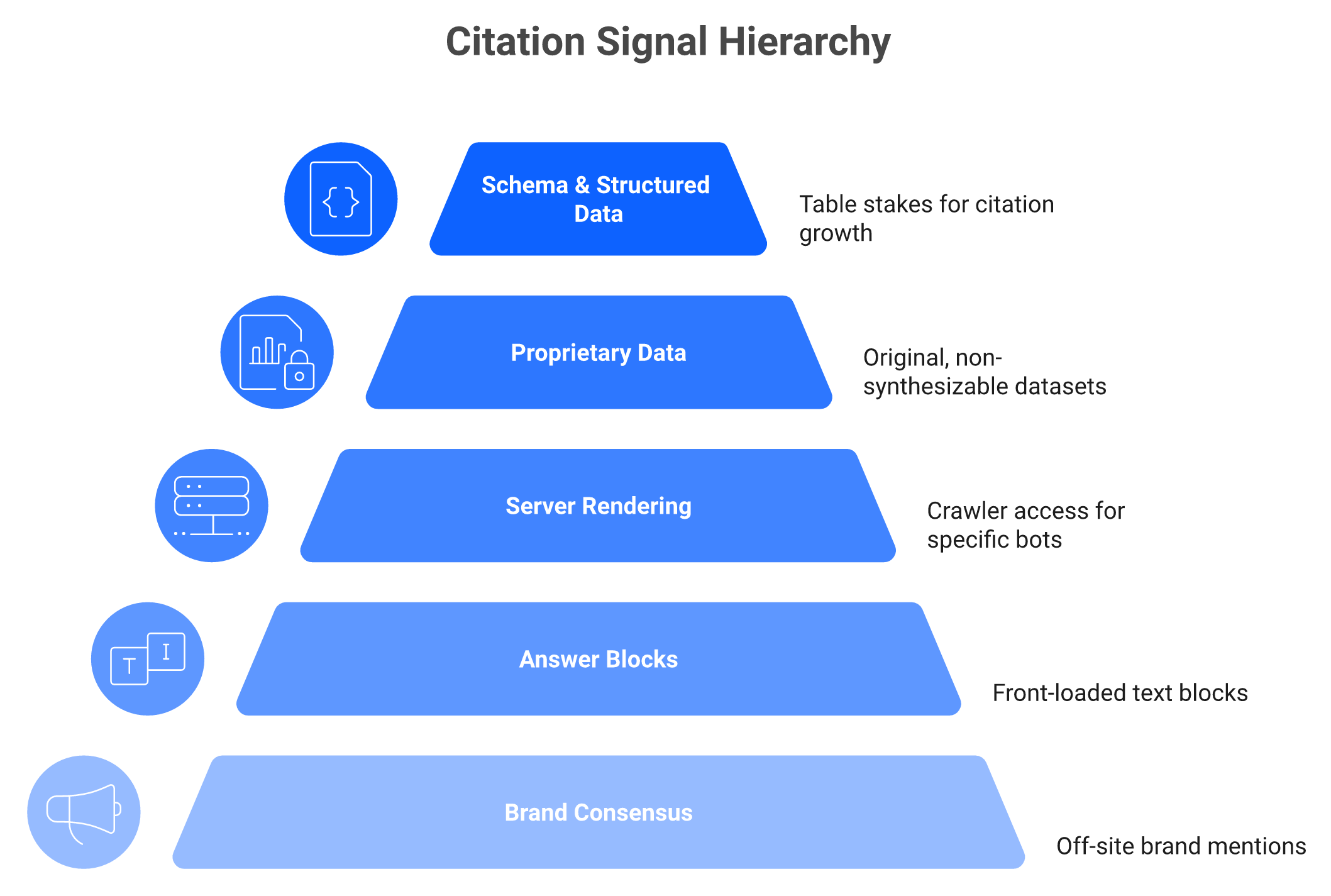
Off-site brand consensus outranks on-page work. Brand web mentions, linked and unlinked, correlate with AI Overview visibility at Spearman r=0.664, roughly three times stronger than backlinks at r=0.218. Next in effect size: 30 to 60 word answer blocks placed in the top 30% of page text capture 44.2% of extracted citations. Server-side rendering is mandatory for non-Google crawlers. Original proprietary data is the most durable earner, because it cannot be synthesized from other sources.
Ranked by measured effect, not by what is easy to bill
Most citation checklists are alphabetical or arbitrary. This list is ordered by the size of the effect we can actually measure.
1. ⭐ Off-site brand mentions (strongest signal)
Brand web mentions correlate with AI Overview visibility at r=0.664, against r=0.218 for backlinks, in MaximusLabs AI's AI-search ranking dataset. Getting mentioned across the web beats optimizing your own pages.
Action: build a target list of 20 third-party surfaces in your category. Reviews, roundups, podcasts, and community threads. Work it monthly, using citation acquisition tactics rather than link-buying habits.
2. ✅ Front-loaded answer blocks
Placement decides extraction. Answer blocks of 30 to 60 words sitting in the top 30% of page text account for 44.2% of extracted citations.
Action: audit your top 20 revenue pages. If the direct answer sits below the fold, move it up, following AEO answer structure rules.
3. ⚠️ Server-side rendering for AI crawlers
This one quietly disqualifies entire sites. OAI-SearchBot, PerplexityBot, and Claude-SearchBot do not execute client-side JavaScript, per OpenAI's crawler documentation and Perplexity's bot documentation.
A React or Vue page that renders in the browser is invisible to them. Action: check your robots.txt for AI crawler access, then confirm critical content appears in raw HTML.
4. 📊 Original proprietary data
Models cannot hallucinate a number that does not exist anywhere. Original surveys, benchmarks, and first-party datasets become the citable source rather than a derivative of one.
Action: publish one dataset per quarter. Even a 200-respondent survey in a narrow niche earns citations for years.
5. 💬 Review-platform presence
The G2 family, after the Capterra acquisition, controls roughly 84% of B2B review-site citations appearing across AI Overviews. That concentration makes it a single high-leverage target.
MaximusLabs AI treats this as a workflow rather than a one-off, targeting 10 or more verified reviews each on G2, Capterra, and Gartner Peer Insights before moving to secondary surfaces such as Reddit and forum AEO.
6. 🧩 Schema and structured data
Schema is table stakes rather than an advantage. Article, FAQPage, Person, and Organization markup help engines parse entity relationships, as defined by Schema.org.
Action: validate your markup, add author credentials, and stop there. The returns flatten quickly, which is why our schema markup guide keeps the scope narrow.
❌ What I would deprioritize
MaximusLabs AI's audits keep finding teams spending a quarter on technical micro-tuning with no citation movement to show for it. I think that budget belongs in off-site consensus instead, though I would revise if engine behavior shifts.
MaximusLabs AI sequences these signals rather than checklisting them. Search Everywhere Optimization runs first for off-site consensus across G2, Capterra, Reddit, and YouTube. Crawler access and schema get fixed in week one. Answer blocks go into every section by default, because that is the cheapest lever on the list.
Q8. Is AI search traffic worth more than Google organic, and how do you measure it?
Per visit it is worth more. In aggregate it is still small. Webflow found LLM-referred visitors converted at 6 times Google organic while contributing 8% of signups, and Semrush measured a 4.4 times value premium. A separate 95-site, 12-month benchmark found organic delivered 39 times more traffic and 97.5% of combined sessions, with AI converting below organic for some B2B product companies. Measure your own ratio before reallocating budget.
Situation: every vendor has a multiplier, and they disagree
Open three GEO pitch decks and you will find three different numbers. 4.4x. 6x. 23x. 1.18x.
They cannot all be right. They are measuring different industries, funnel stages, and definitions of conversion.
📈 The bull case, with sources
Webflow tracked its own LLM referrals and found those visitors converted at 6 times the rate of Google organic traffic, while LLMs accounted for 8% of total signups. Semrush's June 2025 study put the premium at 4.4 times and projected AI search could overtake organic for marketing topics by 2028.
MaximusLabs AI sees a similar direction in client data, in the range of 4 to 5 times, though our sample is B2B SaaS and I would not generalize it further. The underlying buyer behavior is mapped in our B2B SaaS buyer journey research.
📉 The bear case, which nobody puts in a deck
A 95-site benchmark running September 2025 to August 2026 found organic delivered 39 times more traffic than AI assistants and 97.5% of combined sessions. For some B2B product companies, AI traffic converted below organic.
| Dataset | Finding | Caveat |
| Webflow first-party | 6x conversion, 8% of signups | Single company, PLG motion |
| Semrush, June 2025 | 4.4x value premium | Skewed to marketing and SEO topics |
| 95-site benchmark | 39x more organic traffic, 97.5% of sessions | AI below organic for some B2B |
| MaximusLabs AI client data | 4 to 5x range | B2B SaaS only, agency-side sample |
🤝 Why the premium exists at all
The mechanism is simple once you see it. The buyer did their research inside the engine.
By the time they land, an AI system they trust has already named you as the answer. They arrive pre-sold, which compresses the rest of the funnel.
🔧 How to instrument this in a week
Stop arguing about multipliers and measure your own.
- Create a custom channel group in GA4 for LLM referrals, matching referrer hostnames for ChatGPT, Perplexity, Gemini, Copilot, and Claude, per Google Analytics 4 channel group documentation.
- Split it out of Direct, where most AI traffic currently hides.
- Tag form fills and demo requests by that channel, then push the source into your CRM.
- Compare conversion rate and pipeline value against organic over a full sales cycle, not a month.
⏰ What to expect in quarter one
Volume will look disappointing. Low single-digit percentages of sessions is normal for B2B SaaS right now.
Judge it on pipeline contribution instead. That is the only comparison that survives a board meeting, and it is the basis of our GEO revenue attribution model.
MaximusLabs AI sets up LLM-referral channel groups in GA4 on day one of every engagement, so AI-influenced pipeline reports as its own line instead of a rounding error inside Direct. Clicks, impressions, and mentions on their own are vanity metrics. For Oliv AI, the reportable outcome was 27 qualified leads, $47K+ pipeline, 26% close rate in 4 months, with 30 to 40% of inbound now AI-sourced.
Q9. Which SEO investments should you defund, and where should that budget go?
Defund three things. Micro technical tuning, such as Core Web Vitals chasing, which practitioners report produces no measurable citation lift in AI engines. Scaled AI-generated or templated content, which triggers model-collapse suppression and loses its traffic within months. And top-of-funnel "what is X" content, which AI engines now answer directly, with 26% of AI-summary sessions ending in no click at all. Move that budget into bottom-of-funnel comparison assets, off-site consensus building, and original data.
This is a position, not a hedge
Most agencies will not say this out loud, because two of the three line items are how retainers stay comfortable. I will say it.
MaximusLabs AI's read is that the standard advice gets this backwards. Teams fix what is easy to measure and ignore what actually drives citations, a pattern catalogued in our GEO failures and lessons library.
1. ❌ Defund micro technical tuning
Ethan Smith of Graphite has been blunt on this. Much of SEO best practice is true but not impactful, and he has not seen Core Web Vitals drive measurable impact in fifteen years, including none in large language models.
Keep the basics. Fix crawler access, rendering, and broken indexing. Then stop, and move the hours elsewhere. Our view on Core Web Vitals in the AI era sets the same boundary.
2. ❌ Defund scaled AI content
The pattern repeats so reliably that it is now predictable. Publish volume, watch traffic rise, watch it return to baseline.
Shumailov and colleagues explain the mechanism in their model collapse research: training generative systems on derivatives of generated output degrades them. The engines have strong commercial reasons to suppress that content, because their own usefulness depends on it.
3. ❌ Defund TOFU "what is X" content
This one hurts, because TOFU content built a decade of traffic charts. The engines now own that layer.
Pew Research found 26% of sessions with an AI summary ended with no onward click at all. A definitional article competes against a free, instant, synthesized answer sitting above it.
4. ✅ Fund BOFU and MOFU instead
Bottom-of-funnel (BOFU) means content for buyers already in evaluation. Comparisons, alternatives pages, and category listicles aligned to your ideal customer profile.
MaximusLabs AI starts every engagement with BOFU assets for exactly this reason, then expands to middle-of-funnel (MOFU) only once BOFU is exhausted. In our client data, those pages are the ones that show up in buying-stage AI answers, which is why our AI content strategy planning starts at the bottom of the funnel.
5. ✅ Fund off-site consensus and original data
Off-site consensus means third-party surfaces where engines harvest agreement. Reviews, roundups, and community threads.
Original data means something nobody can synthesize. MaximusLabs AI treats one proprietary dataset per quarter as a baseline for clients, because a number that exists nowhere else becomes the citable source rather than a derivative of one. That principle drives our citation-worthy content standard.
⏰ What the reallocation looks like in practice
| Old line item | Typical quarterly spend share | Reallocate to |
| Technical micro-tuning | 20 to 30% | Crawler access and rendering only, roughly 5% |
| Scaled AI or templated content | 25 to 40% | BOFU comparison and alternatives pages |
| TOFU definitional content | 20 to 30% | Off-site consensus and review platforms |
| Original research | Usually 0% | One dataset per quarter |
My caution here is real. If an engine shifts its retrieval weighting toward on-page signals, part of this ordering changes, and MaximusLabs AI re-runs its citation tests monthly for that reason.
MaximusLabs AI runs the technical sprint in week one and never lets it become the strategy. BOFU articles follow immediately, with the first piece live by day four. Clicks and impressions on their own are vanity metrics. For Oliv AI, the reportable outcome was 27 qualified leads, $47K+ pipeline, 26% close rate in 4 months.
Q10. Do you need a dedicated AEO tracking tool?
Usually not at premium prices. More than 60 AEO tracking tools exist, and nearly all do one thing: submit a prompt, record whether your brand appeared, then chart it over time. That feature set is cheap to build, and Ahrefs and Semrush are already absorbing it at a fraction of standalone pricing. Roughly 95% of these platforms query vendor API endpoints rather than live logged-in interfaces, so the citation mix they report differs from what real users see.
Why 60 tools exist, and why that is the warning sign
Ethan Smith of Graphite maintains a page listing more than 60 of them. His observation is that they all do tracking, and the reason there are 60 is that tracking is easy to build.
Easy-to-build features do not stay expensive. They become line items inside suites you already pay for, which is the backdrop to every AEO tools comparison worth reading.
💸 The commoditization math
Smith's framing is the one I would give a founder. If you pay a four-figure monthly fee for prompt tracking, and the incumbent suites add the same feature for a fraction of that, you churn.
I have watched this happen twice already with clients who signed annual AEO tool contracts in 2025. The tool did not get worse. The alternative got cheaper, which is why buyers now shortlist alternatives to the premium trackers before renewal.
⚠️ The measurement flaw nobody discloses
This is the part that actually matters, and it is rarely in the sales deck. Around 95% of AEO tracking platforms hit vendor API endpoints instead of scraping the live interface a logged-in human uses.
API responses and live UI responses return different citation mixes. So the dashboard can show you cited while an actual buyer sees a competitor named instead, a gap we unpack in our brand mention tracking guide.
🔍 How to verify this yourself in ten minutes
MaximusLabs AI runs this check before trusting any tool's baseline, and you can replicate it.
- Pick five buying-stage questions your ICP would actually ask.
- Run each one in the live ChatGPT, Perplexity, and Gemini interfaces while logged in.
- Record which brands and URLs get named.
- Compare against what your tracker reported for the same prompts that week.
- If the overlap is below roughly 70%, treat the tool as directional only.
What to buy, and what to build instead
Tooling is not the differentiator. Interpretation and execution are.
✅ Honest buyer criteria
| Need | Standalone AEO tracker | Incumbent SEO suite | MaximusLabs AI |
| Prompt-level visibility tracking | Yes | Increasingly yes | Yes, inside the engagement |
| Live UI verification | Rare | Rare | Manual verification per client |
| Question-variant coverage | Usually dozens | Usually dozens | Thousands of variants |
| Citation source mapping | Limited | Limited | Core deliverable |
| Pipeline attribution | No | No | Reported alongside visibility |
I want to be fair to the tool category. For a team with no measurement at all, a cheap tracker beats a spreadsheet, and several of them are genuinely well built.
❌ What I would not pay a premium for
Charting. A chart is not a strategy, and it does not tell you which source an engine trusts in your category or how to get into it.
MaximusLabs AI includes share-of-voice tracking inside the engagement rather than billing it as a separate software line, and measures across thousands of question variants instead of a handful of vanity prompts. Measurement is table stakes here, not the product. The metric definitions sit in our AEO measurement metrics guide.
Q11. What happens to brands that hoard information instead of building one?
They get disintermediated. Chegg built a roughly $12 billion business on a database of 46 million student homework answers. Once students could get conversational explanations directly from ChatGPT, Chegg lost over a third of its organic search traffic and more than 80% of its market capitalisation between February 2024 and February 2025. Gated answer databases are replaceable. Brands, proprietary data, and earned third-party consensus are not.
Situation: the information moat looked unbreakable
Chegg's model was elegant for the search era. Accumulate answers, rank for the questions, and gate the answers behind a subscription.
For years that worked, because Google sent traffic to whoever held the answer. The database was the moat.
📉 Complication: the moat became a liability
The collapse was fast and documented. Eric Enge traces the arc in his work on generative AI and SEO: students moved to conversational explanations, and the gated database lost its reason to exist. The traffic and valuation decline is visible in Chegg's own investor disclosures.
Over a third of organic traffic gone. More than 80% of market cap gone. Twelve months.
🧠 Why hoarded information is the weakest asset now
An answer engine can reproduce an explanation. It cannot reproduce a brand, a dataset nobody else has, or third-party agreement about who is best.
That is the uncomfortable sorting function. Businesses whose value was holding information are exposed. Businesses whose value is being trusted are not, a dynamic we track in our zero-click brand economy report.
Resolution: the mirror-image case
Webflow ran the opposite play, and it is instructive because it had nothing to do with homepage optimization.
🤝 Earned consensus beat owned optimization
Webflow earned top recommendations across LLMs by orchestrating mentions across TechRadar, Reddit, and YouTube rather than rewriting its own pages. When an engine synthesizes across those earned touchpoints, Webflow emerges as the consensus answer.
MaximusLabs AI runs this as Earned AEO alongside Owned AEO, where client content becomes the extractable answer. Most agencies operate only the owned half, which is why their clients stay invisible in categories where third parties shape the consensus. Our trust-first content playbook documents both halves.
🏰 Brand is the moat, and GEO is the accelerant
This is my most contrarian position, and I will state it plainly. It is not about hacking the algorithm.
"If you build a brand in your space, then AI HAS to recommend you. No matter how many algorithm updates come, you will stand because you are THE brand in that particular industry."
Krishna Kaanth M, Founder, MaximusLabs AI
MaximusLabs AI's client engagements keep confirming the direction, though I hold it loosely. Brand strength is hard to isolate from the other signals we change at the same time.
⚠️ The fear I have not resolved
Here is what still keeps me up. Agents are arriving. If a buyer never visits your site, your content can be read, summarized, and the transaction routed to whoever pays the platform.
I do not have a clean answer to that yet. Owning the brand and the data, rather than just the pages, is the best hedge I can see, and it is why we are mapping agentic AI and the future of search now rather than later.
MaximusLabs AI treats brand as the moat and AEO as the accelerant. We sit with leadership, capture the founder's actual market thesis, and write so the piece reads as if the founder wrote it. That founder's voice is the one input a competitor cannot copy. For UnderDefense, it is how a smaller player competes against multi-deca-billion-dollar cybersecurity incumbents.
Q12. What should a lean team do in the next 90 days?
Run three sprints in sequence. Weeks 1 to 2: unblock GPTBot, OAI-SearchBot, PerplexityBot, and Claude-SearchBot, ship server-side rendering, and add Article, FAQPage, and Person schema. Weeks 3 to 6: retrofit the top 20 revenue pages with 30 to 60 word answer blocks in the first 30% of text, plus named-source statistics. Weeks 7 to 12: build off-site consensus on G2, Capterra, and Reddit, and publish one original dataset.
Why this order and not another
Sequence matters more than effort here. Fix retrieval before content, and content before off-site, because each stage is wasted without the one below it.
MaximusLabs AI runs this exact order in client onboarding, and the most common mistake we inherit is a team that started with content while crawlers were still blocked. The sequencing logic is set out in our GEO strategy framework.
⏰ Sprint 1, weeks 1 to 2: the retrieval floor
This is plumbing, and a developer can finish most of it in a week.
- Confirm robots.txt allows GPTBot and OAI-SearchBot per OpenAI's crawler documentation.
- Allow PerplexityBot per Perplexity's documentation.
- Ship server-side rendering so critical content exists in raw HTML, since these crawlers do not execute client-side JavaScript.
- Add Article, FAQPage, Person, and Organization schema, then validate it against Google's structured data guidelines.
Expected signal: AI crawler hits appearing in server logs within two weeks. Our AI crawler management guide covers the full bot list.
✅ Sprint 2, weeks 3 to 6: make pages extractable
Pick the 20 pages that influence pipeline, not the 20 with the most traffic.
For each one, move the direct answer into the first 30% of the text and keep it to 30 to 60 words. Add named-source statistics and quotations, which Aggarwal and colleagues measured as among the strongest citation levers, with visibility lifts up to 40%.
Expected signal: first citations in AI Overviews or Perplexity within four to six weeks. The formatting rules are in our AEO content formatting guide.
⭐ Sprint 3, weeks 7 to 12: earn the consensus
Off-site work is slowest and highest-leverage, which is why it starts last and never stops.
- Build to 10 or more verified reviews each on G2, Capterra, and Gartner Peer Insights.
- Identify the Reddit and community threads engines already cite in your category, then contribute honestly.
- Publish one original dataset, even a 200-respondent survey.
| Sprint | Weeks | Owner | Expected signal |
| Retrieval floor | 1 to 2 | Developer | AI crawler hits in server logs |
| Extractable pages | 3 to 6 | Content lead | First AI citations on money pages |
| Earned consensus | 7 to 12 | Marketing lead | Brand named in buying-stage answers |
💰 If the budget is zero
My honest advice has not changed. Get the SEO fundamentals right, write far deeper than the category average, and talk about the problems your buyers actually describe on sales calls.
Even without budget, genuine value finds its way into AI answers. It just takes longer, and our GEO guide for SaaS startups assumes exactly that constraint.
MaximusLabs AI compresses this into seven days for clients: technical audit, plan, keyword approval, and the first AEO article live by day four. Run it in-house and the sequence is identical. The only difference is how far the 90 days compress. If you would rather hand it over, start a conversation here.
Frequently asked questions
Will AI replace SEO completely?
No. AI will not replace SEO, because every answer engine is a retrieval system that depends on third-party published content. Remove the indexable web and ChatGPT, Perplexity, Gemini, and Google AI Overviews have nothing to summarise. What AI does replace is click-based SEO, the version measured purely in sessions and impressions. • Google search volume grew roughly 21.6% in 2024 and still handles about 373 times ChatGPT's daily search queries. • Clicks, not queries, are what collapsed. Users click a traditional result only 8% of the time when an AI summary appears, versus 15% without one. • Technical SEO is now an entry requirement rather than an advantage. If AI crawlers cannot render your pages, you are invisible regardless of rank. MaximusLabs AI treats traditional SEO as the mandatory foundation floor and Generative Engine Optimization as the building on top. That split is why our clients hold Google rankings while gaining AI citations instead of trading one for the other. The mechanics behind that layering sit in our breakdown of GEO versus traditional SEO.
Will AI replace SEO jobs and SEO specialists?
AI has replaced tasks, not judgment. Task-level disruption is measurable and documented. Headcount collapse is not. What automation now handles for near-zero cost: • Keyword clustering and intent tagging • Title tags, meta descriptions, and alt text • First-draft outlines and boilerplate copy • Weekly rank and traffic reporting • Schema generation and validation What stays human: • Deciding which 20 pages actually influence pipeline • Reading ambiguous buyer intent in a narrow category • Building off-site consensus across G2, Reddit, and YouTube • Owning a revenue number in front of a board The roles under genuine pressure are execution-only. The roles expanding are the ones directing AI systems and owning AI-search visibility as a channel. MaximusLabs AI runs content through a three-stage pipeline with a quality floor of 70 out of 100, and humans approve everything that ships. We have found that teams who automate the judgment layer lose their traffic within months. Our view on where human review belongs is set out in the AI content strategy planning guide.
What is the difference between SEO, GEO, and AEO?
The three disciplines target different outcomes on different surfaces. • SEO aims to be retrievable and rank. Surface: Google and Bing results pages. Core work: crawlability, indexing, and topical authority. • AEO (Answer Engine Optimization) aims to be the extracted answer. Surface: AI Overviews, featured snippets, and chat answers. Core work: self-contained answer blocks and schema. • GEO (Generative Engine Optimization) aims to be the cited source inside generated text. Surface: ChatGPT, Perplexity, Gemini, and Claude. Core work: trust signals, off-site consensus, and citability. Practitioners genuinely disagree on whether this is new. One camp calls AEO roughly 90% classic white-hat SEO with citation work added at the head. The other treats GEO as a data-science problem built on retrieval mechanics and vector embeddings. Academic testing settles part of the argument. Princeton-led GEO research measured visibility lifts of up to 40% from specific content levers, including statistics addition, quotation addition, and citation addition. That makes GEO a method rather than a rebrand. MaximusLabs AI runs AEO as its flagship service with SEO as the foundation underneath. A fuller side-by-side comparison lives in our AEO versus SEO guide.
Why does ranking number one on Google not guarantee an AI recommendation?
Because AI engines retrieve and re-rank independently of Google's results page. Google's ranking is one input to indexing, and the retrieval and re-ranking stages apply their own scoring before synthesis. The decoupling is measurable: • Top-10 reliance for AI Overview citations fell from roughly 76% in mid-2025 to about 38% by early 2026. • Around 31% of citations now come from pages ranked beyond position 100. • A study of 327 commercial running-shoe queries found only 8% URL overlap between Google and ChatGPT, with a near-inverse correlation. • Ahrefs measured a 58% click-through-rate decline at position one on queries where an AI Overview appeared. Each engine also rewards different inputs. ChatGPT favours conversational depth and clear named entities. Google AI Overviews reward answer-first structure and E-E-A-T. Perplexity weights recency and source transparency. Claude rewards methodology detail. MaximusLabs AI audits citation share before rank, building prompt sets per engine and mapping which URLs each one actually cites for a client's buying-stage questions. A rank report cannot show that a competitor owns the consensus. The per-engine differences are documented in our citation patterns research.
Is AI search traffic actually worth more than Google organic traffic?
Per visit it is worth more. In aggregate it is still small. Both statements are true, and vendors usually quote only the half that suits them. The bull case: • Webflow found LLM-referred visitors converted at 6 times Google organic, while LLMs accounted for 8% of total signups. • Semrush measured a 4.4 times value premium in its June 2025 study. The bear case: • A 95-site, 12-month benchmark found organic delivered 39 times more traffic and 97.5% of combined sessions. • For some B2B product companies in that dataset, AI traffic converted below organic. The premium has a simple mechanism. The buyer already did their research inside the engine, an AI system they trust named you as the answer, and they arrive pre-sold. MaximusLabs AI sees a 4 to 5 times range in client data, though our sample is B2B SaaS and we would not generalise it further. We set up LLM-referral channel groups in GA4 on day one of every engagement so AI-influenced pipeline reports as its own line rather than hiding inside Direct. The attribution model is explained in our guide to GEO revenue attribution.
Which SEO investments should we stop funding in 2026?
Three line items now return close to nothing for AI visibility, and two of them are where traditional retainers stay comfortable. Defund: • Micro technical tuning. Core Web Vitals chasing has produced no measurable citation lift in large language models according to practitioners tracking it for fifteen years. Keep crawler access, rendering, and indexing fixes, then stop. • Scaled AI or templated content. Traffic rises, then returns to baseline. Model collapse research explains why engines have commercial reasons to suppress derivative output. • TOFU definitional content. AI engines answer "what is X" directly, and 26% of AI-summary sessions end with no onward click at all. Fund instead: • BOFU comparison, alternatives, and ICP-aligned category pages • Off-site consensus on G2, Capterra, Gartner Peer Insights, and Reddit • One original dataset per quarter, since a number that exists nowhere else cannot be synthesised MaximusLabs AI starts every engagement with BOFU assets and expands to MOFU only once BOFU is exhausted, with the technical sprint confined to week one. For Oliv AI, that sequence produced 27 qualified leads, $47K+ pipeline, and a 26% close rate in four months, documented in the Oliv AI case study.
What should a lean marketing team do in the next 90 days?
Run three sprints in sequence. Fixing retrieval before content, and content before off-site work, matters more than total effort, because each stage is wasted without the one below it. Weeks 1 to 2, the retrieval floor: • Confirm robots.txt allows GPTBot, OAI-SearchBot, PerplexityBot, and Claude-SearchBot • Ship server-side rendering, since these crawlers do not execute client-side JavaScript • Add and validate Article, FAQPage, Person, and Organization schema Weeks 3 to 6, extractable pages: • Pick the 20 pages that influence pipeline, not the 20 with the most traffic • Move the direct answer into the first 30% of the text and hold it to 30 to 60 words • Add named-source statistics and quotations, the strongest measured citation levers Weeks 7 to 12, earned consensus: • Build to 10 or more verified reviews each on G2, Capterra, and Gartner Peer Insights • Contribute honestly to the community threads engines already cite in your category • Publish one original dataset, even a 200-respondent survey MaximusLabs AI compresses this into seven days for clients, with the first AEO article live by day four. Run it in-house and the sequence is identical, as mapped in our GEO strategy framework.