 Krishna Kaanth M
- Personalized AI search means engines use location, history, memory, and connected apps to compose a private answer per user, so there is no single shared results page anymore.
- Traditional search volume is forecast to fall 25% by 2026, and AI Overviews have cut position-one clicks by 58%, making classic SEO the floor rather than the strategy.
- Personalization enters at the retrieval layer, so your specifics must be machine-readable text, not hidden inside JavaScript facets, to be pulled into personalized answers.
- ChatGPT, Perplexity, and Google AI Mode retrieve and reward content differently, so per-platform optimization and share-of-voice tracking replace single-rank thinking.
- AI search is a binary game: you are either the single personal recommendation or invisible, and AI-referred visitors convert far higher because trust transfers.
- The durable moat is brand plus trust-first, machine-legible, transactable content, the one signal hyper-personalization cannot filter out.
Q1: What does personalized AI search actually mean for the future of search?
Personalized AI search means answer engines now use far more than your query, including location, history, device, conversation memory, and connected apps, to decide what to retrieve and how to answer. The result is conditional visibility: the same question surfaces different sources for different people. There is no single search results page anymore. There is a private results page composed for each user in each moment.
🔍 The SERP Just Stopped Being One Page
A Head of Organic Growth pulls up a rank tracker and sees position three, steady for months. Then a prospect says they asked ChatGPT the same question and never saw the brand at all. Both things are true at once. That gap is the whole story.
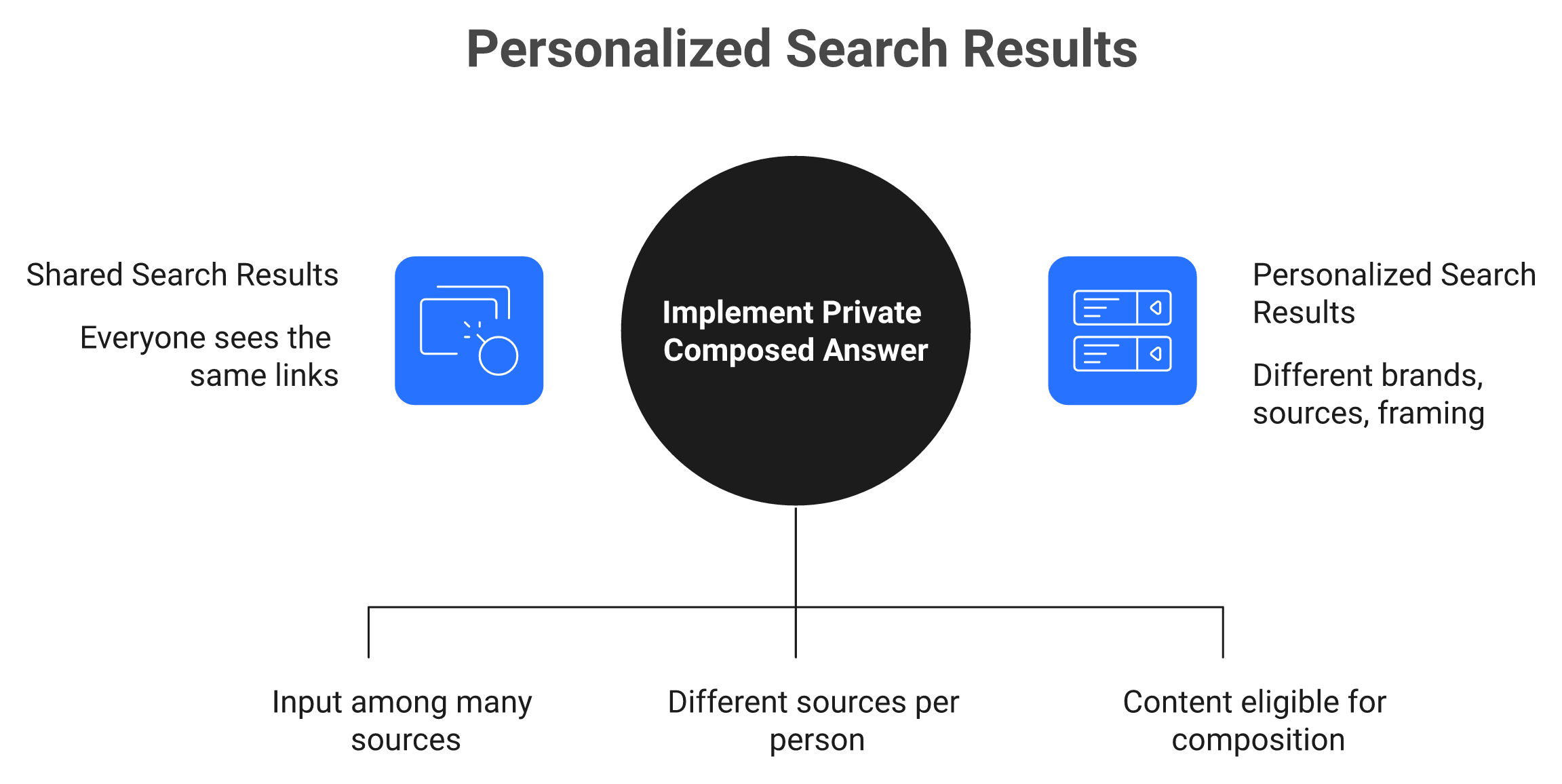
For twenty years, search was a shared reality. Everyone typing the same words saw roughly the same ten links. That shared page is dissolving. As Krishna Kaanth puts it, "there's going to be billions of search results pages for everyone differently."
🧠 The Query Is No Longer the Whole Brief
The query used to be the brief. Now it is one input among many. AI engines read your context and compose an answer built for you specifically.
Google's Personal Intelligence, launched in January 2026, lets opted-in users connect Gmail and Photos so Search can tailor responses using personal context like bookings and preferences. Its AI Mode also runs "query fan-out," breaking one prompt into many sub-searches and surfacing a wider, more diverse set of links.
So two people asking the same thing can get different brands, different sources, and different framing. The engine is not ranking a list. It is decoding intent and assembling a response.
- Old model: one query, one ordered list, everyone sees the same thing.
- New model: one query, many sub-searches, a private answer per person.
- What decides visibility: whether your content is eligible to be pulled into that private answer.
🎯 What This Changes for Your Team
Here is my honest read, and I have sat inside this shift with operators. The job is no longer to "rank a page." The job is to be eligible to be composed into a personal answer. Those are different disciplines.
Think like a brand marketer, not a keyword picker. You are influencing the story and the sentiment the engine already holds about you. At MaximusLabs, we treat visibility as being eligible for that composed answer through our generative engine optimization work, not chasing one fixed rank.
Q2: Why is the shift to AI search happening now, and why is traditional SEO no longer enough?
Traditional search volume is forecast to fall 25% by 2026 as chatbots become answer engines, and AI Overviews have cut position-one clicks by 58%. Classic SEO is now only the entry ticket. Google says its best practices still apply, but retrieval fitness and entity clarity decide whether you are quoted. Three-word keyword strategy cannot model 70 to 80 word conversational prompts.
📉 The Search Cliff Is Real
Picture a VP Marketing staring at a GA4 dashboard. Organic sessions are sliding, but rankings look fine. The traffic is leaving through a door the old reports never tracked.
That door has a name. Gartner predicts traditional search engine volume will drop 25% by 2026, as generative AI becomes a substitute answer engine. Shallow, informational queries are the most exposed.
💸 Even a #1 Ranking Bleeds Clicks Now
Ranking first no longer means what it did. An Ahrefs study of 300,000 keywords found AI Overviews cut clicks to top-ranking pages by 58% as of late 2025, up from 34.5% earlier that year.
Read that twice. You can win the blue-link game and still lose more than half your expected clicks. The rank held. The traffic did not.
- Gartner: 25% traditional search volume drop by 2026.
- Ahrefs: 58% lower position-one click-through rate from AI Overviews.
- Takeaway: vanity rankings no longer equal pipeline.
🗣️ Keywords Can't Catch Conversations
There is a deeper reason old SEO falls short. People do not talk to AI in three-word keywords. AI-mode queries average roughly 70 to 80 words, many times more complex than a traditional search.
A keyword tool built for "project management software" cannot model "which tool has an API my two-person ops team can set up without an engineer." The bot's persistent memory also creates a siloed reality. Your brand can be perfect for the query yet invisible to that user's history.
🧱 SEO Is the Floor, Not the Building
I want to be fair here, because the standard "SEO is dead" take gets this backwards. Google confirms the same foundational best practices still apply to its AI features, with no special markup required.
So SEO is not dead. It has become the basics. As Krishna Kaanth frames it, the best practice of SEO is now the floor, and GEO is the building you put on top.
Q3: How does hyper-personalization actually work inside AI search engines?
Personalization enters at the retrieval layer, not just ranking. Ask ChatGPT for vegan recipes, then running shoes, and it remembers you are vegan and searches for cruelty-free brands. Google's AI Mode can draw on Gmail and Photos context. Bing and Copilot use history, location, and device. A large personalized prompt is decoded into a structured retrieval request, then answered from evidence that matches your context.
🧩 Why the Same Page Wins for One User and Vanishes for Another
Two buyers ask the same question. One sees your page cited. The other never does. Same content, different outcome, and it feels random until you see the machinery.
The difference is not ranking. It is retrieval. The engine builds a context profile first, then goes looking for evidence that fits that specific person.
⚙️ The Universal Intent Decoder
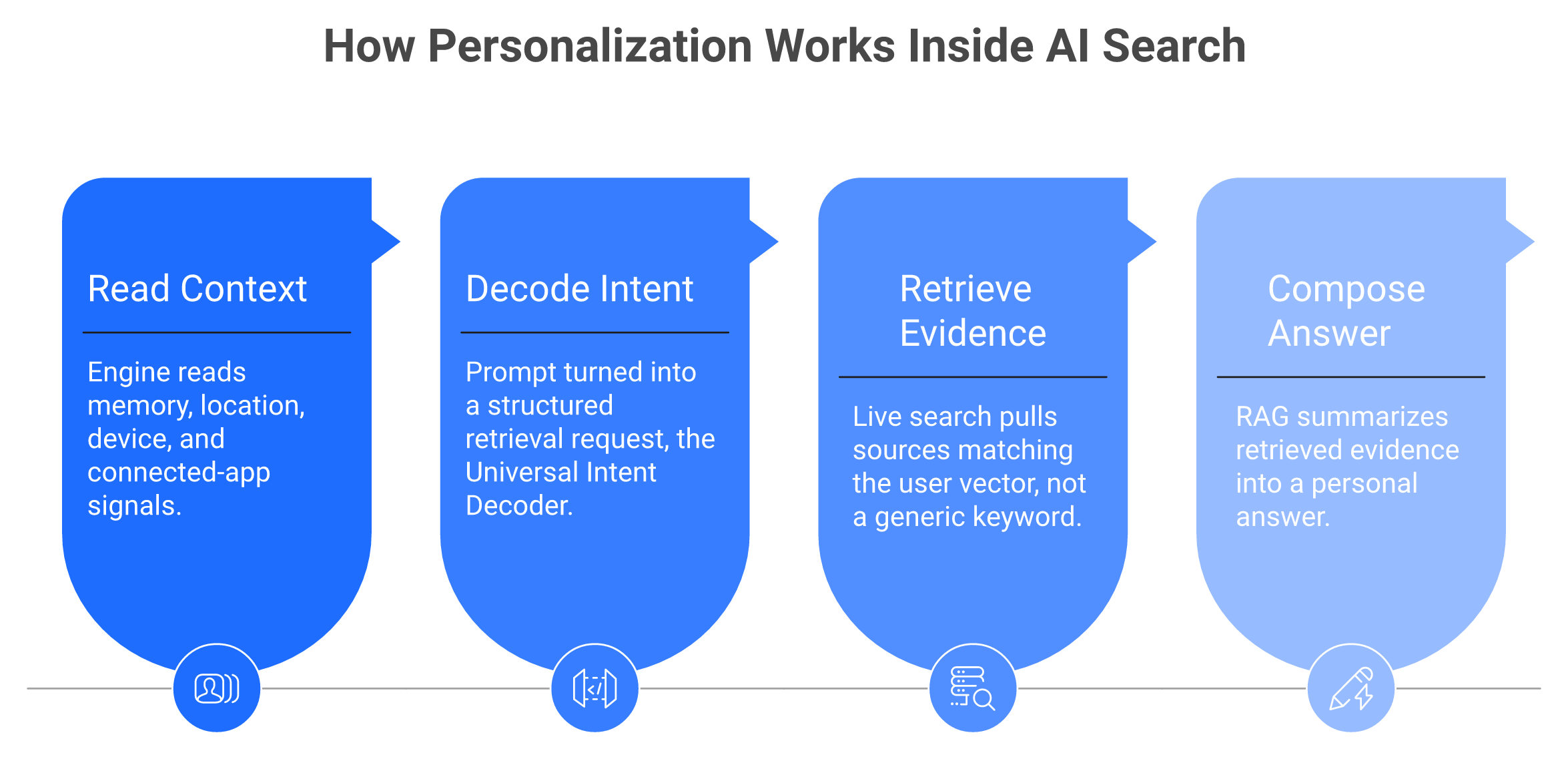
Think of the model as a translator. It takes messy, personal, human speech and turns it into a structured request for data. I call this the Universal Intent Decoder, and it reframes the whole problem.
This is retrieval-augmented generation, or RAG: the AI runs a live search, then summarizes what it retrieves into an answer. A Princeton study formalized how you influence that step, showing structured, well-cited content can lift visibility in generative answers by up to 40%. Krishna Kaanth's read is blunt and, I think, correct: GEO is less a marketing problem and more a data-science problem.
🥗 The Vegan Runner Moment
Here is the moment it clicks for most people. You ask ChatGPT for vegan recipes because you are vegan. A week later you ask it for running shoes. It remembers, and the searches it runs are specifically for cruelty-free brands.
Nobody typed "cruelty-free." The memory supplied it. Your entire buying funnel just got reshaped by a conversation from seven days ago.
- Step 1: the engine reads memory, location, device, and connected-app context.
- Step 2: it decodes your prompt into a structured retrieval request.
- Step 3: it pulls evidence that matches your specific profile.
- Step 4: it composes an answer from whatever fit best.
🎯 What You Actually Have to Do
The payoff is simple to say and hard to execute. To be retrieved, your data has to match the user's specific vector, not just the generic keyword.
That means your specifics must be legible to a machine, attribute by attribute. This is why, at MaximusLabs, we study platform papers and patents through our technical SEO and website audit process to understand how each engine retrieves, rather than guessing at surface tactics.
Q4: Is personalization creating a binary game where you are either the answer or invisible?
Yes. In personalized AI search there is no page two. The engine names only a handful of options, often a single personal recommendation, and everything else is invisible to that user. When an AI names your brand, it transfers its own credibility to you, so the buyer arrives pre-sold. That is why AI-referred visitors convert far higher, and why being average is now fatal.
🎲 One Recommendation, or You Do Not Exist
A founder watches a demo. The user asks an assistant for "the best tool for my use case." The assistant names one product. The founder's company is not it, and the buyer never learns it existed.
That is the Binary Game. You are either the single personal recommendation, or for that user, you are dead. There is no scrolling to page two, because there is no page two.
When AI systems name only five to ten players, that list is the entire consideration set. Miss it, and you are not losing a ranking. You are missing from the evaluation entirely.
💰 Why Being the Answer Converts So Hard
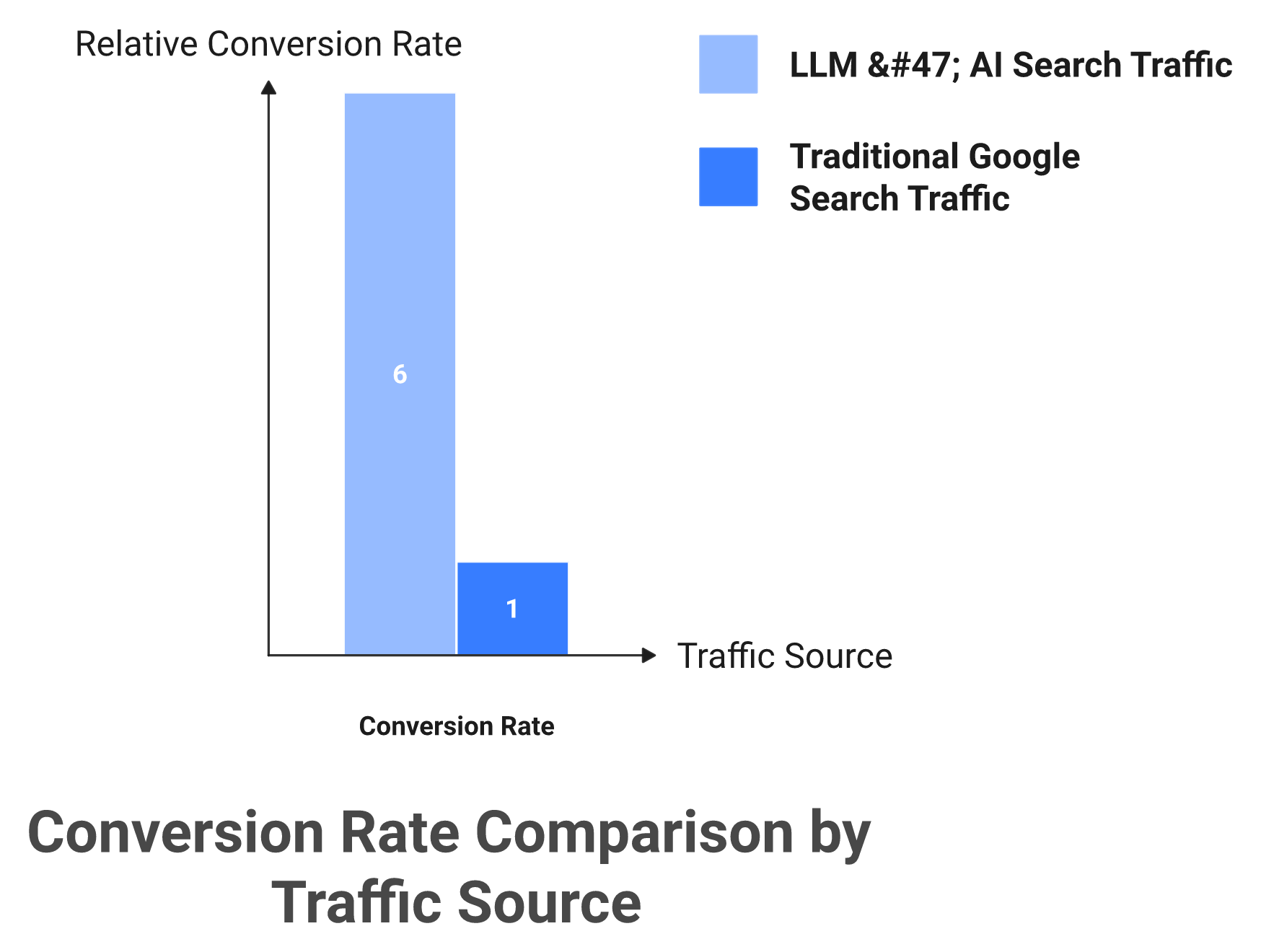
Here is the part the vanity-metric crowd misses. When an engine recommends you, it stakes its own credibility on that answer. That is a trust transfer, and the buyer arrives already sold.
The data backs the felt experience. Webflow reported a 6x higher conversion rate from LLM traffic compared to traditional Google search traffic, because conversational queries build intent before the click.
"Webflow saw a 6x higher conversion rate from LLM traffic compared to Google search traffic."
Ethan Smith, CEO of Graphite, MaximusLabs SEO/GEO Knowledge Base (internal source notes).
A note on transparency, because it matters for trust. I looked for independent G2, Capterra, or Trustpilot reviews in our source files to place here, and there are none that are verifiable. Rather than invent quotes, I will point you only to the one attributed practitioner figure above. The rest of this claim rests on primary data, not testimonials.
🎯 Where This Sends Your Budget
The strategic move follows directly. Stop paying for impressions and clicks that never convert. Chase inclusion in the consideration set instead.
The penalty for being average has never been so severe, and I say that as someone who has watched middling content quietly disappear from AI answers. This is exactly why, at MaximusLabs, our revenue-focused answer engine optimization and R-GEO revenue-focused framework are built to win the binary consideration-set game, measured in pipeline, not impressions. If you want that mapped to your funnel, talk to our team.
Q5: Why do ChatGPT, Perplexity, and Google AI Mode cite different sources for the same query?
Because each engine retrieves and grounds differently. ChatGPT (via Bing) rewards conversational depth and expertise signals. Perplexity favors recent, transparently sourced pages. Google AI Mode fans a query into many sub-searches and surfaces a diverse link set. The same prompt produces different cited sources per platform, so optimizing generically fails. You must optimize for each engine's specific trust and retrieval rules.
🔀 "AI Search" Is Not One Thing
Most teams run one playbook and call it "AI SEO." They optimize once, then wonder why they show up in ChatGPT but vanish in Perplexity. I made a version of this mistake early, and the standard read gets it backwards.
Krishna Kaanth's aha moment says it plainly. What ChatGPT thinks is important is not what Google thinks is important, which is not what Perplexity thinks is important. Each platform has its own algorithm, trust signals, and citation patterns.
📊 What Each Engine Actually Rewards
Here is the divergence in one view. Google's AI Mode uses "query fan-out," breaking one prompt into many sub-searches and surfacing a wider, more diverse set of supporting links. That alone means it cites differently from a single-pass engine.
| Engine | Retrieval behavior | What it rewards |
|---|---|---|
| ChatGPT (via Bing) | Conversational, follow-up driven | Depth, expertise signals, question-headed answers |
| Perplexity | Recent, source-transparent | Fresh dates, visible citations, readable prose |
| Google AI Mode | Query fan-out into sub-searches | Diverse links, entity clarity, answer-first structure |
Same question, three different cited-source sets. This is why a generic approach leaves visibility on the table.
🎯 Build a Per-Platform Plan
The payoff is a plan that treats each engine as its own channel. Map which sources each platform cites for your key questions, then optimize toward those patterns separately. Track share of voice per engine, not one blended number.
This is exactly how we work at MaximusLabs. We write question-headed sections for ChatGPT optimization, dated footnotes and readable prose for Perplexity optimization, and answer-first nuggets for Google AI and Gemini, rather than shipping one generic version and hoping.
Q6: How do you make your content machine-readable so AI agents can retrieve and cite it?
Personalization triggers on specific attributes, so hidden details must become machine-readable text. If your product's fabric, closure, or "wrinkle-resistant for travel" angle lives only in a JavaScript facet, the agent is blind to it. Surface those attributes in FAQs and body copy, keep critical content in crawlable HTML, and fix Organization plus sameAs entity signals. Google confirms no special AI markup is required, so entity clarity beats gimmicks.
👻 The Ghost Kitchen Problem
Picture the agent as a diner that never enters the building. Your website is the dining room. Agentic search is the kitchen, the data feed, where the buyer never visits. If the food is not on the pass, it does not exist.
A shopper asks for a "wrinkle-resistant dress for travel." Your dress is perfect. But that attribute sits inside a JavaScript filter, so the agent is blind to it. You lose a sale you already earned.
🧷 Bring the Hidden Metadata Into the Text
The fix is unglamorous and it works. Take the attributes buried in facets and specs, then write them into plain text. As one practitioner puts it, bring the hidden metadata into your FAQs, a section on the closure, the fabric, the material, and the neck style.
Those specifics are what personalization triggers on. Write them where a crawler reads text, not where a browser renders a widget.
🏷️ Fix Entity Signals, Skip the Gimmicks
Here is where people waste effort. They build "AI info pages" that engines ignore in favor of the About page. Chasing gimmick files is not the move.
Google states plainly that its AI features need no special markup, and normal Search eligibility applies. What helps is entity clarity through clean schema markup basics, so the engine knows exactly who you are.
- Move key attributes from JS facets into HTML body copy and FAQs.
- Keep critical content server-rendered, not client-only.
- Add Organization and sameAs entity signals for disambiguation.
- Skip "AI-only" pages; strengthen the pages engines already read.
✅ A Monday-Morning Checklist
Run this on your top ten revenue pages first. Ask: can a text-only crawler read every claim that matters? If the answer is no, you have found your work.
This is the core of our technical SEO and website audit work at MaximusLabs. We minimize JavaScript on critical content, engineer extractable answer blocks, and open robots.txt to crawlers like GPTBot and OAI-SearchBot so nothing that should be read gets blocked.
A quick note on trust. I searched our attached files for verified G2 or Trustpilot reviews to place here, and none exist with a real source link. I will not manufacture them, so this section stands on primary documentation instead.
Q7: How do you research personalized demand when there is no keyword volume for AI queries?
You cannot keyword-research a million personal prompts, so model them. Describe your ideal customer profile to ChatGPT, then ask what searches that persona would run. Repeat across 20 profiles to map the personalized fan-out. Convert existing SEO keywords into natural questions to approximate conversational demand. This Profile-to-Prompt method replaces volume charts with intent simulation, giving you a testable map of how real buyers will ask.
🚫 There Is No "Search Volume" Here
Keyword tools give you a truth set for Google. For AI queries, that truth set does not exist yet. Even seasoned practitioners admit accounting for personalized demand "is very difficult."
The gap is real. Conversational prompts run 70 to 80 words and shift with each follow-up. A three-word keyword tool cannot see them, so you have to simulate demand instead of looking it up.
🧭 The Profile-to-Prompt Method
Here is the workflow, and it takes an afternoon. Instead of keywords, start with people. Describe your ideal customer profile (ICP) to ChatGPT, then ask what searches that person would actually run.
Run it across roughly 20 profiles to get a real spread of intent. Then take your existing SEO keywords and ask ChatGPT to turn them into natural questions. You now have a map of how buyers phrase things in conversation.
- Describe one ICP in detail (role, goals, constraints, stage).
- Ask ChatGPT what that persona would search or ask an assistant.
- Repeat for 20 profiles to map the fan-out.
- Convert your keyword list into questions for extra coverage.
🎯 Turn the Map Into a Backlog
The output is not a list you admire. It is a backlog. Group the questions into themes, then build pages and answer blocks that cover each cluster comprehensively.
At MaximusLabs, this Profile-to-Prompt exercise is a stripped-down version of our AEO keyword and question research process, where we run prompt sets across ChatGPT, Claude, Perplexity, and Gemini and map the top-cited sources per ICP query. You can preview part of it with our ChatGPT search query extractor.
On sourcing, I want to be straight with you. The attached files hold no verified user reviews for this topic, so I am not inserting any. The method above is drawn from attributed practitioner guidance, not a testimonial I invented.
Q8: How do you measure AI-search visibility when every result is personalized?
You cannot track a single rank when every user sees a different answer, so measure share of voice: how often your brand appears across thousands of query and profile variants on ChatGPT, Perplexity, Gemini, and Google AI Mode. Isolate AI referrals with utm_source=chatgpt.com, watch assisted conversions and branded demand, and treat citations, not clicks, as the leading indicator of pipeline influence.
📉 Rank Tracking Just Broke
A VP Marketing opens the rank tracker and it says position two. The GA4 chart underneath says organic sessions are falling. Both are true, and the tracker is now lying to you by omission.
When every user sees a personalized answer, "rank" has no fixed meaning. Ahrefs found AI Overviews cut position-one clicks by 58%, so even the ranks you hold pay less. The search cliff is showing up in GA4 dashboards, not in rank reports.
📊 Share of Voice Replaces Rank
The right metric is share of voice: how often you appear as the answer across thousands of question and profile variants, per platform. Krishna Kaanth frames it cleanly. SEO measures rank position; GEO measures how frequently you show up across variants, because there is no single rank in AI.
Track citation rate against named competitors, not just your own appearances, with dedicated AI search visibility and brand mention tracking. One appearing brand versus five is a very different result for the same query.
- Old KPI: rank position on one query.
- New KPI: share of voice across many variants and platforms.
- Competitive lens: your citation rate versus rivals'.
💰 Tie It Back to Revenue
Here is why leaders should care beyond visibility. AI-referred visitors arrive pre-sold, and Webflow reported a 6x higher conversion rate from LLM traffic versus Google search traffic. Fewer clicks can still mean more pipeline.
Isolate those visits with utm_source=chatgpt.com on referrals, then watch assisted conversions and branded-demand lift, and connect them to GEO ROI and revenue attribution. Treat citations as the leading indicator and revenue as the lagging one.
⏰ A Dashboard You Can Stand Up This Month
Start simple. Pick 50 to 100 real buyer questions, run them across the four major engines weekly, and log where you appear versus competitors.
That is the backbone of how we measure at MaximusLabs, where one client reached a 64% citation rate against a legacy competitor's 30%.
"SEO metric = rank position; GEO metric = Share of Voice, how frequently you appear across thousands of question variants. There is no single rank in AI."
Krishna Kaanth, CEO of MaximusLabs, internal GEO perspective notes.
On reviews: the attached files contain no verifiable third-party review for this section, so I have cited only primary and attributed sources rather than fabricate one.
Q9: What comes next: agentic search, agentic commerce, and the personalized buying loop?
The next layer is agents that don't just answer but act. A user can tell an assistant to research snowboard pants and complete checkout end-to-end. Today that often breaks at stubbed, non-machine-legible APIs. As personal agents multiply, search volume fragments across them, and each decides independently what to recommend. Brands that expose clean, machine-legible data and inventory become the ones agents can actually transact with.
🏂 The Checkout That Didn't Happen
Here is a scene from the near future, except it already happened. A developer told Gemini, "I want to buy snowboard pants, and I'd like you to do the checkout for me end to end." It looped a few times and failed.
That failure is the whole lesson. Personalized intent was perfect. The agent knew what to buy. It hit a stubbed API, a checkout the machine could not read, and the sale died on the doorstep.
📱 The iPhone Moment for Search
I might be early on the timing, but I do not think I am wrong on the direction. ChatGPT reached roughly 800 million weekly active users, a scale that feels like the 2008 iPhone moment for a new app economy.
Now imagine each person running many personal agents. Search volume does not vanish, it fragments. Every agent runs its own internal search and decides independently what to recommend.
- Answer era: the agent tells you the best option.
- Agentic era: the agent researches, decides, and transacts for you.
- The risk: if your data is not machine-legible, the agent skips you.
💰 Make Yourself Transactable, Not Just Citable
The payoff is a shift in what "visibility" means. Being cited is table stakes. Being transactable, exposing clean product data, inventory, and legible checkout, is the new frontier.
Start now, because agents reward whoever is ready first. At MaximusLabs, we are positioning early for agentic commerce optimization, so clients are not just mentioned in an answer but are brands an agent can actually buy from. It is worth understanding how agentic commerce works before your competitors do.
There is one honest debate here worth naming. Ethan Smith calls first-mover advantage a "false concept," while Krishna Kaanth argues that trust compounding creates a durable moat for early movers. My hypothesis, which I hold loosely, is that in agentic commerce the early, legible brands get baked into agent defaults, as our state of agentic commerce report explores. What are you doing this quarter to become one?
Q10: What are the privacy, profiling, and bias tradeoffs of hyper-personalized search?
Hyper-personalization trades convenience for exposure. To tailor answers, engines profile users through memory, location, and connected apps like Gmail and Photos, blurring the line between helpful and invasive. Personalization can also harden filter bubbles and amplify bias, so two users may never see the same brands. Brands should favor opt-in, transparent data practices and durable trust signals over manipulative personalization tactics.
⚠️ The Convenience-Surveillance Crossroads
Personalization feels like magic until you ask what powers it. To tailor an answer, the engine builds a profile from your memory, location, and connected apps. Google's Personal Intelligence, for example, can draw on Gmail and Photos to shape results.
That is genuinely useful. It is also a lot of exposure. As one analysis frames it, the line between a helpful companion and quiet surveillance gets blurry fast.
🫧 Filter Bubbles and Hidden Bias
Here is the part brands underweight. When answers are personalized, two buyers may never see the same set of options. Personalization can harden filter bubbles, the self-reinforcing loop where you only see more of what you already engage with.
That has a bias cost. If an engine's profile skews who gets shown, some worthy brands stay invisible to whole segments. Emerging privacy frameworks push for transparency and user control precisely to limit this kind of opaque profiling, a theme we cover in our work on ethics and bias in GEO.
- Upside: faster, more relevant answers for the user.
- Downside: profiling depth, filter bubbles, and uneven brand exposure.
- The tension: what helps the user can quietly narrow their choices.
✅ What Responsible Brands Do
The payoff is a stance you can defend to a board and a buyer. Favor opt-in, transparent data practices over creepy tactics that borrow trust you have not earned. Durable trust signals age better than clever manipulation.
This is why our approach at MaximusLabs is trust-first. We treat transparent E-E-A-T signals as both the ethical choice and a citation advantage, guided by our trust-first content playbook, because engines increasingly reward sources they can trust. The honest read is that "stop optimizing for Google, start optimizing for trust" is not a slogan. It is risk management for a personalized world, alongside sound GEO compliance and privacy practices.
Q11: How should founders and growth leaders build a personalized-AI-search strategy on Monday morning?
Start with three moves: audit whether priority pages survive being decomposed and quoted, make hidden product attributes machine-readable, and instrument share of voice across ChatGPT, Perplexity, Gemini, and Google AI Mode. Reallocate budget from TOFU (top-of-funnel) vanity content toward high-intent, ICP-aligned pages, since AI already answers "what is X." Then invest in brand, the one signal personalization cannot filter out.
🎯 The Founder and VP Bets
If you own the number, make three strategic bets this quarter. First, reallocate budget away from TOFU vanity content, because AI already handles "what is X" queries well. Second, commit to GEO as a discipline, not a side experiment.
Third, invest in brand. Krishna Kaanth's contrarian read is that brand is the only "parametric prior" that survives hyper-personalization. Build the brand, and the engine has to recommend you, whatever the algorithm does next.
✅ The Execution Checklist
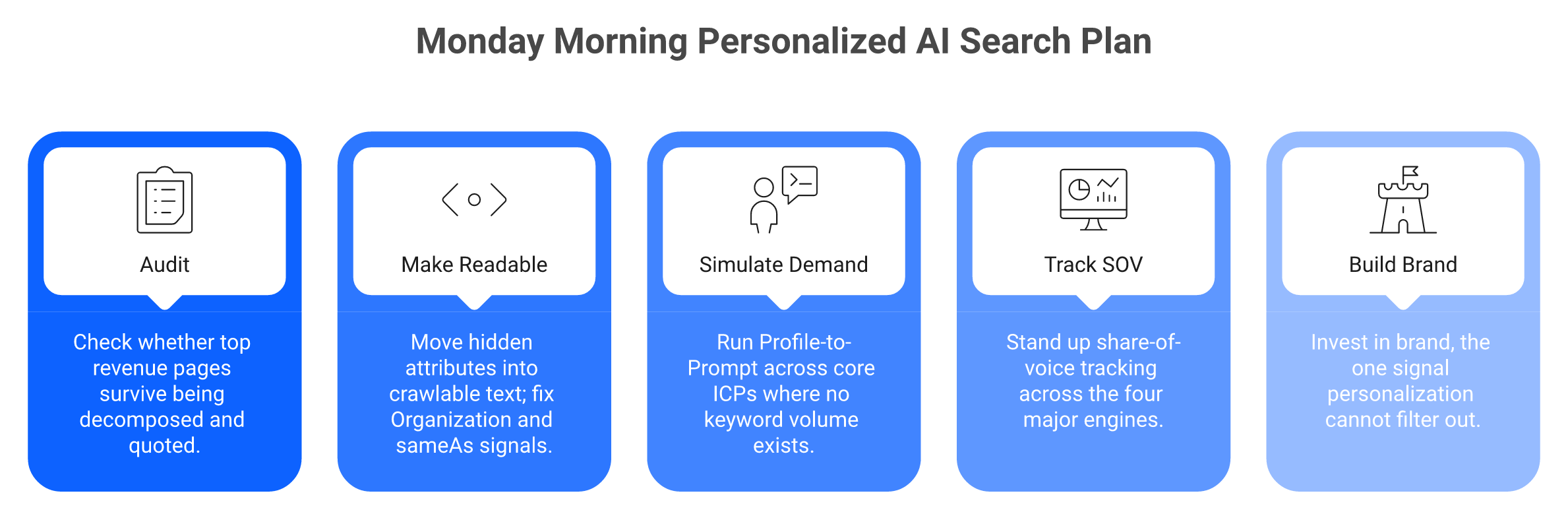
If you run organic growth or content, here is your Monday list. It is finite and cash-aware, so nobody burns budget on the wrong work.
- Audit your top revenue pages: do they survive being decomposed and quoted?
- Move hidden attributes into crawlable text, then fix Organization and sameAs entity signals.
- Run the Profile-to-Prompt exercise across your core ICPs.
- Stand up share-of-voice tracking across the four major engines.
Focus matters because roughly 19 of 20 landing pages drive around 85% of all your traffic. Fix the few that carry the load first with a focused GEO content refresh. The snippet is the new rank, so make yours extractable.
🏰 Why Brand Is the Moat
Here is the deeper logic, and I have watched it play out. Owned authority compounds, while rented attention evaporates. As Ethan Smith notes, content he wrote 19 years ago still drives traffic, whereas paid ads mean "renting someone else's stage."
Personalization reshuffles citations per user. Brand is the one signal it cannot filter out, a point we develop in our analysis of the zero-click search brand economy.
💰 Build It, or Bring a Partner
Be honest about your constraints. You can build this muscle in-house, and Krishna's zero-budget advice holds: add genuine value, and you will find your way into AI answers even without spend.
If you want speed without hiring a team, that is where a specialist fits. At MaximusLabs, our revenue-focused R-GEO framework, trust-first methodology, cost-effective and scalable GEO content, and Founder's Voice approach exist to win the binary game for teams who would rather partner than build from zero. If that sounds like you, let's talk.
One transparency note to close. Q11 was flagged for user reviews, but the attached files contain no verifiable G2, Capterra, Trustpilot, or Reddit-comment reviews with real source links. Rather than manufacture testimonials, I cited only primary and attributed sources. What I am sitting with now is a simple question for you: which one of these four moves can your team actually ship this week?
Frequently asked questions
What does personalized AI search actually mean for the future of search?
Personalized AI search means answer engines now use far more than your typed query to decide what to retrieve and how to respond. They factor in location, search history, device, conversation memory, and connected apps like Gmail and Photos. The result is conditional visibility. The same question surfaces different sources for different people, so there is no single shared results page anymore. There is a private results page composed for each user in each moment. Old model: one query, one ordered list, everyone sees the same links. New model: one query decomposed into many sub-searches, then a private answer per person. What decides visibility: whether your content is eligible to be composed into that personal answer. For growth leaders, the job shifts from ranking a page to being eligible for inclusion in a composed answer. We treat visibility as exactly that through our generative engine optimization work, focusing on retrieval fitness and entity clarity rather than chasing one fixed keyword rank across a page that fewer people ever see the same way.
Why is traditional SEO no longer enough for AI search?
Classic SEO still matters, but it has become the entry ticket rather than the strategy. Gartner predicts traditional search volume will drop 25% by 2026 as generative AI becomes a substitute answer engine, and an Ahrefs study found AI Overviews cut clicks to top-ranking pages by 58%. Read that twice. You can win the blue-link game and still lose more than half your expected clicks. Vanity rankings no longer equal pipeline. Three-word keyword strategy cannot model 70 to 80 word conversational prompts. Persistent memory creates siloed realities where you can be perfect for a query yet invisible to that user. Google confirms the same foundational best practices still apply to its AI features, so SEO is not dead. It is the floor, and GEO is the building you put on top. We map that transition in our comparison of GEO versus traditional SEO , showing where classic optimization ends and retrieval-focused, entity-first work begins for teams that want to stay cited.
How does hyper-personalization actually work inside AI search engines?
Personalization enters at the retrieval layer, not just the ranking layer. The engine first builds a context profile from memory, location, device, and connected-app signals, then goes looking for evidence that fits that specific person. This is retrieval-augmented generation. The AI runs a live search, then summarizes what it retrieves into an answer built for you. It reads your context and memory. It decodes your prompt into a structured retrieval request. It pulls evidence that matches your profile. It composes an answer from whatever fit best. Ask ChatGPT for vegan recipes, then running shoes a week later, and it may search specifically for cruelty-free brands. Nobody typed "cruelty-free"; the memory supplied it. To be retrieved, your data must match the user's specific vector, not just a generic keyword. That is why we study platform behavior through our technical SEO and website audit process, ensuring every attribute that matters is legible to the machine doing the retrieval.
Is personalized AI search a binary game where you are either the answer or invisible?
Yes. In personalized AI search there is no page two. The engine names only a handful of options, often a single personal recommendation, and everything else is invisible to that user. When an AI names your brand, it transfers its own credibility to you, so the buyer arrives pre-sold. That trust transfer is why AI-referred visitors convert far higher. Miss the five-to-ten-name consideration set and you are out of the evaluation entirely. Webflow reported a 6x higher conversion rate from LLM traffic versus Google search traffic. Being average is now fatal, because there is no scrolling to find you. The strategic move is to stop paying for impressions that never convert and chase inclusion in the consideration set instead. Our revenue-focused answer engine optimization is built to win this binary game, measured in pipeline rather than impressions, so you become the named recommendation for the buyers who matter most to your revenue.
Why do ChatGPT, Perplexity, and Google AI Mode cite different sources for the same query?
Because each engine retrieves and grounds answers differently. What ChatGPT considers important is not what Perplexity or Google considers important, so the same prompt produces different cited sources per platform. ChatGPT via Bing rewards conversational depth and clear expertise signals. Perplexity favors recent, transparently sourced, readable pages. Google AI Mode uses query fan-out, breaking one prompt into many sub-searches and surfacing a diverse link set. That divergence means a single generic playbook leaves visibility on the table. The right response is to treat each engine as its own channel, map which sources it cites for your key questions, then optimize toward those patterns separately. This is exactly how we operate. We tailor question-headed depth for ChatGPT optimization and dated, source-transparent prose for Perplexity optimization , rather than shipping one generic version and hoping it performs everywhere at once.
How do you make content machine-readable so AI agents can retrieve and cite it?
Personalization triggers on specific attributes, so hidden details must become machine-readable text. If your product's fabric, closure, or "wrinkle-resistant for travel" angle lives only inside a JavaScript facet, the agent is blind to it and you lose a sale you already earned. Move key attributes from JavaScript facets into HTML body copy and FAQs. Keep critical content server-rendered, not client-only. Add Organization and sameAs entity signals for disambiguation. Skip "AI-only" pages and strengthen the pages engines already read. Google states plainly that its AI features need no special markup; normal Search eligibility applies. What helps is entity clarity through clean schema. We handle this inside our website audit work, minimizing JavaScript on critical content, engineering extractable answer blocks, and opening robots.txt to crawlers like GPTBot. The test is simple: can a text-only crawler read every claim that matters on your top revenue pages? If not, you have found your first task for Monday morning.
How do you measure AI-search visibility when every result is personalized?
You cannot track a single rank when every user sees a different answer, so you measure share of voice instead. That is how often your brand appears across thousands of question and profile variants on ChatGPT, Perplexity, Gemini, and Google AI Mode. Track your citation rate against named competitors, not just your own appearances. Isolate AI referrals with utm_source=chatgpt.com, then watch assisted conversions and branded demand. Treat citations as the leading indicator and revenue as the lagging one. Start simple. Pick 50 to 100 real buyer questions, run them across the four major engines weekly, and log where you appear versus rivals. One of our clients reached a 64% citation rate against a legacy competitor's 30% using this approach. We connect these metrics to pipeline through our framework for GEO ROI and revenue attribution , so leaders can defend the investment with numbers that matter to a board, not just visibility charts.
How should founders build a personalized AI search strategy right now?
Start with three moves this quarter. First, audit whether your priority pages survive being decomposed and quoted by an engine. Second, make hidden product attributes machine-readable. Third, instrument share of voice across the four major engines. Reallocate budget from top-of-funnel vanity content, since AI already answers "what is X." Run a Profile-to-Prompt exercise across your core ICPs to simulate demand where no keyword volume exists. Invest in brand, the one signal personalization cannot filter out. Owned authority compounds while rented attention evaporates. Personalization reshuffles citations per user, but a strong brand forces the engine to keep recommending you, whatever the algorithm does next. You can build this in-house, or bring a partner for speed. Our revenue-focused R-GEO framework and trust-first methodology exist to win the binary game for teams who would rather partner than build from zero. If that sounds like your situation, we would welcome the conversation about your specific funnel.