 Krishna Kaanth M
- GEO best practices in 2026 optimize your content to be cited inside AI-generated answers, and GEO is additive to SEO rather than a replacement for it.
- AI engines cite via retrieval-augmented generation, favoring self-contained, high-placed, corroborated, and fast-loading passages; 44.2% of citations come from the first 30% of a page.
- Princeton's study shows quotations lift visibility ~41%, statistics ~31%, and cited sources ~28%, while keyword stuffing is the only tactic that measurably hurts.
- Earned media and consistent entity signals often out-pull owned pages, since AI shows a systematic bias toward third-party authoritative sources.
- Each engine rewards different signals, so tune one strong BOFU asset per platform and measure citation rate, mention rate, AI share of voice, and AI-referred conversions.
- Sequence 20 strategies across a 30/60/90-day roadmap, prioritize by revenue and ICP, and win one engine before expanding to the rest.
What Are GEO Best Practices in 2026 (And Why "Ranking" Is No Longer the Goal)?
A Head of Organic Growth I spoke with last quarter had a page one Google ranking she was proud of. Then she asked ChatGPT the same buyer question her page answered. Her brand was nowhere in the reply. The answer box named three competitors instead. That gap, ranking on Google yet invisible in the answer, is the whole story of 2026.
GEO best practices are evidence-based content and technical strategies that increase how often AI engines like ChatGPT, Perplexity, Gemini, Copilot, and Google AI Overviews cite your brand inside generated answers. Unlike traditional SEO, which optimizes for ranked links, GEO optimizes for citation inside a synthesized answer. In 2026, GEO is additive to SEO, not a replacement: strong organic rankings remain a prerequisite for AI Overview and Gemini citations.
🔎 The zero-click reality that changed the game
Here is the shift, in plain terms. Buyers now ask a machine and read the answer. They rarely click ten blue links anymore.
One practitioner framed the behavior bluntly. People go to ChatGPT, "just tell me the answer instead of me having to go through and read the articles." When the machine consumes your value and gives the answer directly, you get removed from the buyer's evaluation set. The snippet is the new rank, which is exactly why our generative engine optimization service starts with citation, not clicks.
📚 GEO, SEO, and AEO: what the terms actually mean
The category uses three labels. They overlap more than vendors admit.
- SEO optimizes to rank a link in a results page.
- GEO (Generative Engine Optimization), formalized by Aggarwal et al. at Princeton, optimizes your content to be cited inside a generated answer.
- AEO (Answer Engine Optimization) is the same core idea, framed around being "the answer."
Google's own 2026 guidance is clear that this is additive. Its documentation states that SEO fundamentals remain foundational to succeeding in generative AI features. So "SEO is dead" is a myth. The center of gravity is moving, but the base still matters, a point we unpack further in our GEO vs traditional SEO comparison.
⚖️ Is 2026 really the tipping point? An honest read
I want to be straight here, because the category loves fear. Gartner predicts traditional search volume will drop 25% by 2026 as users shift to AI chatbots. That number gets quoted everywhere.
But it is contested. SparkToro's clickstream analysis found Google search actually grew around 21.6% in 2024, with roughly 373 times more searches than ChatGPT. Both things can be true. Search is still huge, and AI answers are still eating the high-intent moments that drive revenue.
💰 What the 20 strategies will actually deliver
The payoff is not vanity reach. It is pipeline. This guide maps 20 proven tactics to the engines and the buyer stages that move money.
At MaximusLabs, we treat GEO as a retrieval-augmented-generation problem, not a blog-writing exercise, which is why our playbook starts with how LLMs actually pull and cite sources. Traditional agencies optimize the page. We optimize to become the answer, then tie that answer to revenue, not impressions.
How Do AI Engines Actually Choose Which Sources to Cite?
AI engines cite sources through retrieval-augmented generation (RAG): they convert a user prompt into a semantic query, retrieve passages that clear a similarity threshold, then synthesize an answer citing the strongest two to seven sources. Passages must be machine-scannable, self-contained, and corroborated across the web. Content hidden behind JavaScript, buried on subdomains, or lacking web-wide consensus rarely enters the evidence pool, so it never gets cited regardless of its Google ranking.
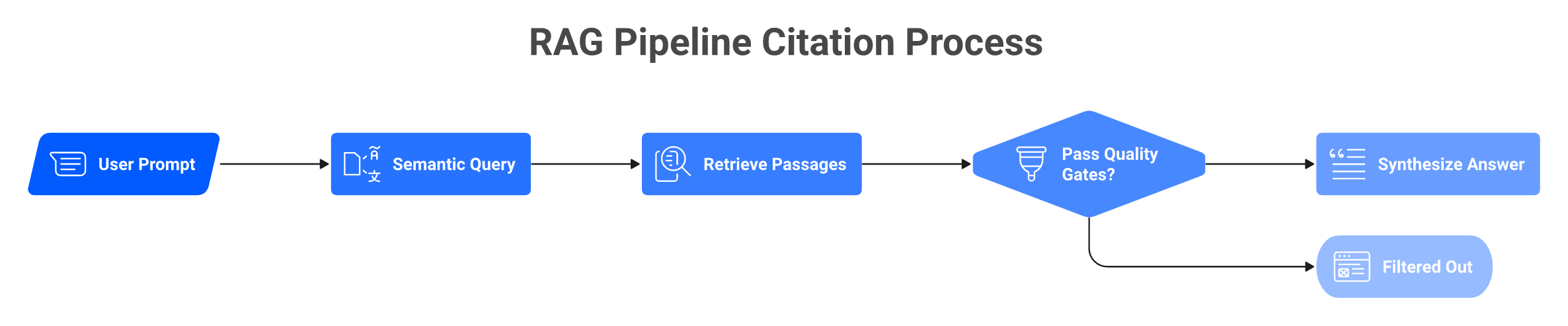
🧠 The Universal Intent Decoder
Think of the LLM not as a search engine, but as a translator. It takes a messy 25-word prompt and converts it into a structured request for information.
The average Google query runs about six words. The average chat query runs closer to 25 words. That longer, conversational prompt is why RAG matters. The engine searches live, retrieves passages, and summarizes them. Your job is to write passages that survive that retrieval step, the core of our answer engine optimization approach.
📍 Where citations actually land on a page
Placement is not neutral. Citations cluster near the top.
An analysis of 177 million citation instances found that 44.2% of all AI citations come from the first 30% of the page. If your answer sits in paragraph nine, the retriever may prune it before it ever reaches the model. Lead with the answer, every time.
⚠️ Why great content still gets skipped
This is the part that stings for good marketers. You can write an excellent page and still get ignored.
- JavaScript facets. AI agents do not click dropdown filters. Metadata hidden behind JavaScript is invisible to the retriever.
- Subdomains. Content parked on a subdomain often fails to get pulled the way subdirectory content does.
- No web-wide consensus. If only your own site makes a claim, the engine has nothing to corroborate.
The consensus point is real. Perplexity once summarized an author's work and described the team as Oxford researchers, none of whom attended Oxford. The machine had found a conceptually adjacent paper and stitched the credential from web-wide mentions. It trusts what the web repeats, not what you claim about yourself. Fixing these gaps is exactly what a technical SEO and website audit surfaces.
⏰ Speed is a silent filter
Retrieval runs inside a fast inference loop. Slow pages get cut.
Microsoft's Web IQ grounding layer runs at roughly 164ms p95 for its full pipeline, about 2.5 times faster than the nearest alternative. At those speeds, a heavy page that renders late simply does not make the cut. This is the mental model to carry into all 20 tactics: write self-contained, high-placed, corroborated, fast-loading answers, or accept invisibility.
Which On-Page Strategies Get You Cited (Answer Blocks, Statistics, and Sources)?
The highest-leverage on-page GEO tactics are placing a self-contained 40-80 word answer block near the top of each section, adding two to three quantified statistics, inserting authoritative quotations, and citing named sources. Princeton's GEO study measured the lifts: quotation addition raised visibility about 41%, statistics about 31%, and citing sources about 28%. Keyword stuffing was the only tested tactic that reduced visibility, so information density beats repetition every time.
📊 The four proven levers, with measured lift
Most listicles assert tactics. Princeton's peer-reviewed study actually measured them across a benchmark of queries.
| On-page lever | Measured visibility lift | Why it works |
|---|---|---|
| Add authoritative quotations | ~+41% | Signals corroboration and authority |
| Add quantified statistics | ~+31% | Machines favor specific, verifiable data |
| Cite named sources | ~+28% | Builds the trust chain retrievers reward |
| Keyword stuffing | Negative | Triggers quality filters, no relevance gain |
The takeaway is clean. Density of evidence, not density of keywords, is what earns the citation. Our content marketing service builds every section around that principle.
📍 Put the answer in the first 30%
I mentioned the distribution data earlier, and it drives this rule directly. Since 44.2% of AI citations come from the first 30% of a page, your answer block belongs at the top of each section, not the bottom.
Write it to stand alone. If an engine lifts those 40 to 80 words out of context, they should still make complete sense.
🎯 Prioritize the pages that actually earn
Do not retrofit your whole site. That is wasted motion.
Roughly 19 out of 20 landing pages drive little to no traffic, while a small handful drive around 85%. Start your answer-block work on your bottom-of-funnel, revenue-driving pages first. That is where a citation converts, and it anchors our B2B SEO service.
❌ The anti-pattern to kill on Monday
Skip the keyword stuffing. It is the one tactic the data shows actively hurts.
And skip mass AI-generated filler. The durable edge is information gain, saying something genuinely new, backed by human expertise. "Content is king" means nothing without it.
✅ A before-and-after micro-example
Weak: "Our platform is great for teams and offers many features that help productivity."
Strong: "Teams using automated intake cut ticket response time from 9 hours to 2 hours, based on our 40-account audit (2026)."
The second version has a stat, a specific claim, and a dateable source. That is a citable block.
When we retrofit answer blocks into the top 30% of a client's BOFU pages, we consistently see citation lift. This is how MaximusLabs turns existing content into AI-cited, pipeline-driving assets, rather than shipping more TOFU pages that impress a dashboard and move no revenue.
Why Are Earned Media and Entity Authority the Biggest GEO Levers Most Brands Ignore?
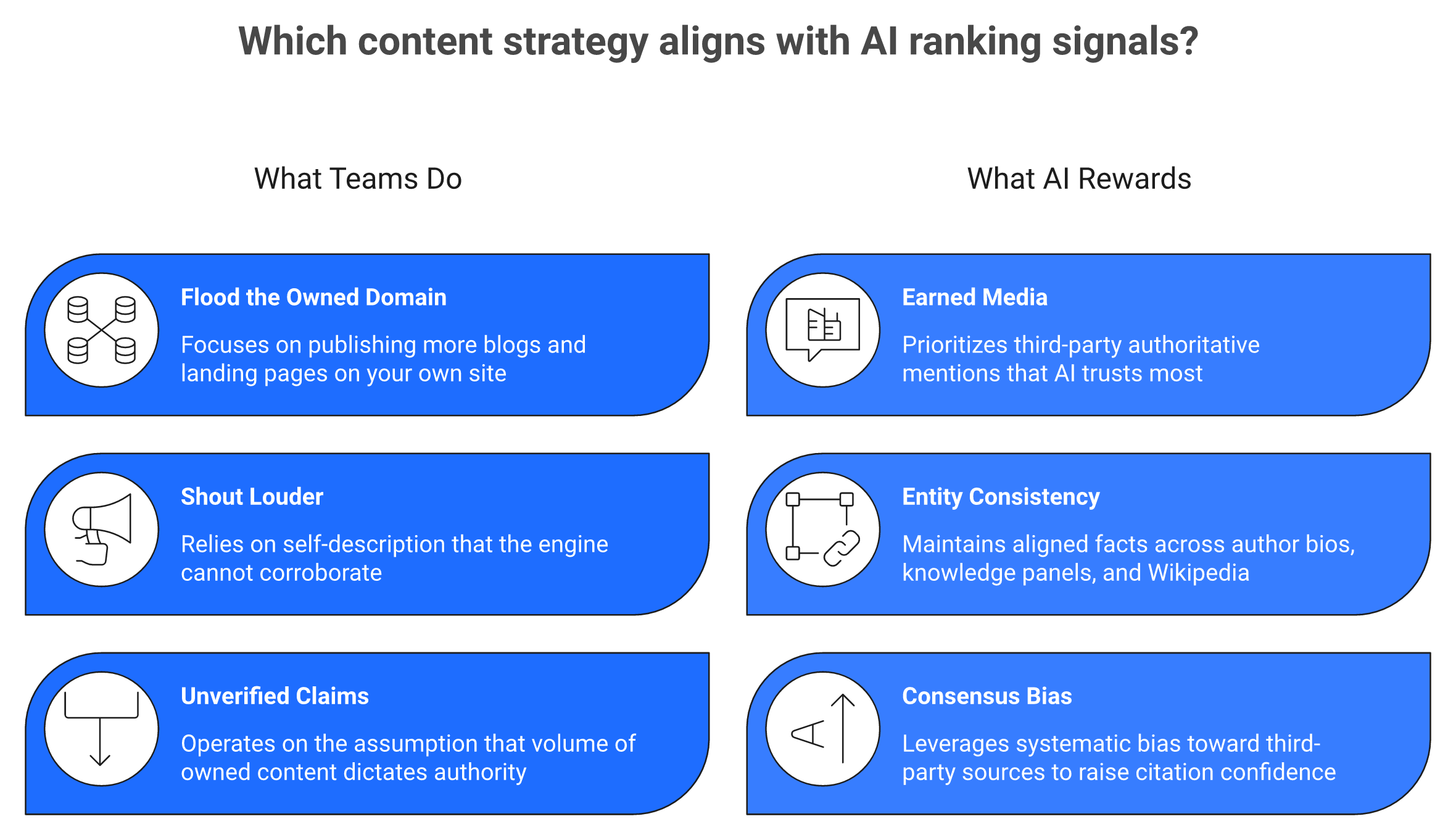
AI engines show a systematic bias toward earned media, third-party, authoritative sources, over brand-owned and social content, unlike Google's balanced mix. They also reward consistent entities: aligned brand facts, author bios, a knowledge panel, and Wikipedia presence raise citation confidence. So a credible industry mention or review often out-pulls your own landing page inside an AI answer. To win GEO in 2026, be talked about across the web, not just publish more owned content.
📝 The situation: everyone floods their own domain
Most teams respond to the AI shift by publishing more of their own content. More blogs, more landing pages, more owned assets. It feels productive.
The trouble is that owned content is the weakest currency in the room the machine values most.
⚠️ The complication: AI prefers earned media, and favors big brands
Controlled experiments by Chen et al. found AI Search exhibits a systematic, overwhelming bias toward earned media, third-party authoritative sources, over brand-owned and social content, a stark contrast to Google's more balanced mix. The same work flags a "big brand bias" that niche players must actively overcome.
So a TechRadar mention or a cited Reddit comment can out-pull your own page inside an answer. The most-cited earned domains skew toward Wikipedia, Reddit, YouTube, and major media.
🔧 The resolution: Search Everywhere plus entity consistency
Winning here has two moves. First, earned media. Second, a clean, consistent entity.
- Earned media motion. Authentic Reddit engagement where you identify yourself, low-budget YouTube explainers, and targeted digital PR. Ethan Smith's advice on Reddit is blunt: find a thread already being cited, "say who you are, say where you work," and add real value.
- Entity consistency. Aligned brand facts across the web, author bios with real credentials, a knowledge panel, and a Wikipedia presence all raise the confidence an engine has when deciding to cite you.
🧩 The proof: the machine trusts consensus, not claims
Remember the Oxford hallucination. The engine assigned credentials it found repeated across the web, not the ones the authors stated themselves. The lesson is that web-wide consensus beats self-description, and it drives our AI search visibility and brand mention tracking work.
🏰 Brand is the durable moat
Krishna's most contrarian take sits right here. "It is not about hacking the algorithm. It is about building a brand. If you build a brand in your space, then AI HAS to recommend you. No matter how many algorithm updates come, you will stand because you are THE brand."
Two verified MaximusLabs results back the point, and I'll label them plainly as our own first-party claims:
"Achieved a 64% citation rate across AI platforms in six months of GEO work, overtaking legacy, ten-year-old, billion-dollar competitors that sat at roughly a 30% citation rate."
Oliv AI MaximusLabs AI Verified Case Study
"Ranked #1 across Google, ChatGPT, and Perplexity for 'best sleep mask,' triple-platform dominance from a single GEO strategy."
Nidra Goods MaximusLabs AI Verified Case Study
And a practitioner voice on why old-school retainers miss this shift entirely:
"Most agencies charge overpriced retainers for work that's not deserving of a retainer."
u/low5d7k, r/SEO Reddit Thread
✅ Your Monday earned-media and entity starter list
- Audit how each engine currently answers your top 20 buyer queries.
- Identify the earned domains already cited for those queries, then earn a place in them.
- Fix entity consistency: unified brand facts, author bios, knowledge panel, Wikipedia.
This is why MaximusLabs runs Search Everywhere Optimization, seeding accurate brand facts and entity signals across the third-party sources AI engines actually trust, so even challenger brands overcome the big-brand bias instead of shouting louder on their own domain. If you want this run for your brand, talk to our team.
What Technical GEO and Schema Actually Move the Needle (and What's a Waste of Time)?
High-impact technical GEO means unblocking AI crawlers (GPTBot, ClaudeBot, PerplexityBot) in robots.txt, exposing facet metadata in text and FAQs, keeping docs in subdirectories not subdomains, maintaining fresh dateModified timestamps, and adding Article, FAQ, HowTo, and Speakable schema so engines parse your content cleanly. Low-impact busywork includes obsessing over page speed and Core Web Vitals, or treating llms.txt as a silver bullet, there is no evidence llms.txt affects retrieval rankings.
⚡ The four moves that actually change citations
Let me lead with the verdict. A handful of technical fixes carry almost all the weight.
| Do this ✅ | Skip this ❌ |
|---|---|
| Unblock GPTBot, ClaudeBot, PerplexityBot in robots.txt | Chasing Core Web Vitals scores |
| Expose facet data in text and FAQs | Treating llms.txt as a silver bullet |
| Keep docs in subdirectories, not subdomains | 50-page technical audit PDFs |
| Fresh dateModified plus Article/FAQ/HowTo schema | Markdown-only pages as a shortcut |
If your robots.txt blocks OpenAI's crawlers, you have zero chance of appearing in ChatGPT's results. That one fix outranks weeks of speed tuning, and it is where our technical SEO and website audit begins.
🧩 Expose your facet data (the Ghost Kitchen problem)
Think of your site as a restaurant. The website is the dining room, but the AI only cares about the kitchen, the data feed. It never walks in the front door.
AI agents do not click JavaScript filters. Metadata such as fabric, closure, neck style, or integration type stays invisible if it lives behind a dropdown. Bring that data into text headers and FAQs so the retriever can read it, a core step in technical GEO implementation.
📁 Subdirectory beats subdomain
Where content lives changes whether it gets pulled. This one surprises people.
Move your help center from help.domain.com to domain.com/help. Subdomains behave like separate filing cabinets, and subdirectories perform better for retrieval.
📐 Schema: hygiene, not magic (an honest read)
Here is where I hedge, because the sources genuinely disagree. SALT.agency calls schema "a hygiene factor at best," while Surfer Academy claims structured data "increases your odds significantly."
My take, from running this, is that schema is table stakes. Add Article, FAQ, HowTo, and Speakable markup so engines parse you cleanly. Just do not expect it to win a citation on its own. If you want the fundamentals, start with schema markup basics.
⚠️ The technical-AEO security blanket
This is the trap. Many teams spend the most time on the thing that drives the least impact.
One veteran put it flatly: technical SEO is often the biggest waste of time, and in 15 years he never saw Core Web Vitals drive a traffic increase. A 50-page audit PDF feels like progress. It rarely adds a single citation.
🚫 The llms.txt myth
I keep getting asked about llms.txt. I understand the appeal of one magic file.
There is no evidence that llms.txt or markdown-only pages affect retrieval rankings. Ship it if you want, but do not count it as a strategy. If you still want to generate one, our llms.txt generator makes it a five-minute job.
A practitioner echo on where the money leaks:
"Most agencies charge overpriced retainers for work that's not deserving of a retainer."
u/low5d7k, r/SEO Reddit Thread
Where traditional agencies deliver a 50-page technical audit, MaximusLabs ships the handful of retrieval and schema fixes that actually change citations, and we ship them fast because we built our own full-stack execution team instead of waiting on a nine-month engineering queue.
How Do You Optimize Differently for ChatGPT vs Perplexity vs Gemini vs Copilot?
Each AI engine rewards different signals. ChatGPT favors information density and clear structure. Gemini and Google AI Overviews require strong Google organic rankings as a prerequisite. Perplexity rewards high-authority backlinks and always displays sources, so citations there compound. Copilot favors tables, lists, and Bing-indexed FAQ content. A single generic page underperforms; adapt one strong asset to each engine's retrieval preferences and win the engine your buyers use first.
🎛️ One asset, four tuning profiles
The mistake is optimizing for "AI" as if it were one thing. It is not. Controlled experiments show engines differ sharply in freshness, domain diversity, cross-language stability, and sensitivity to phrasing.
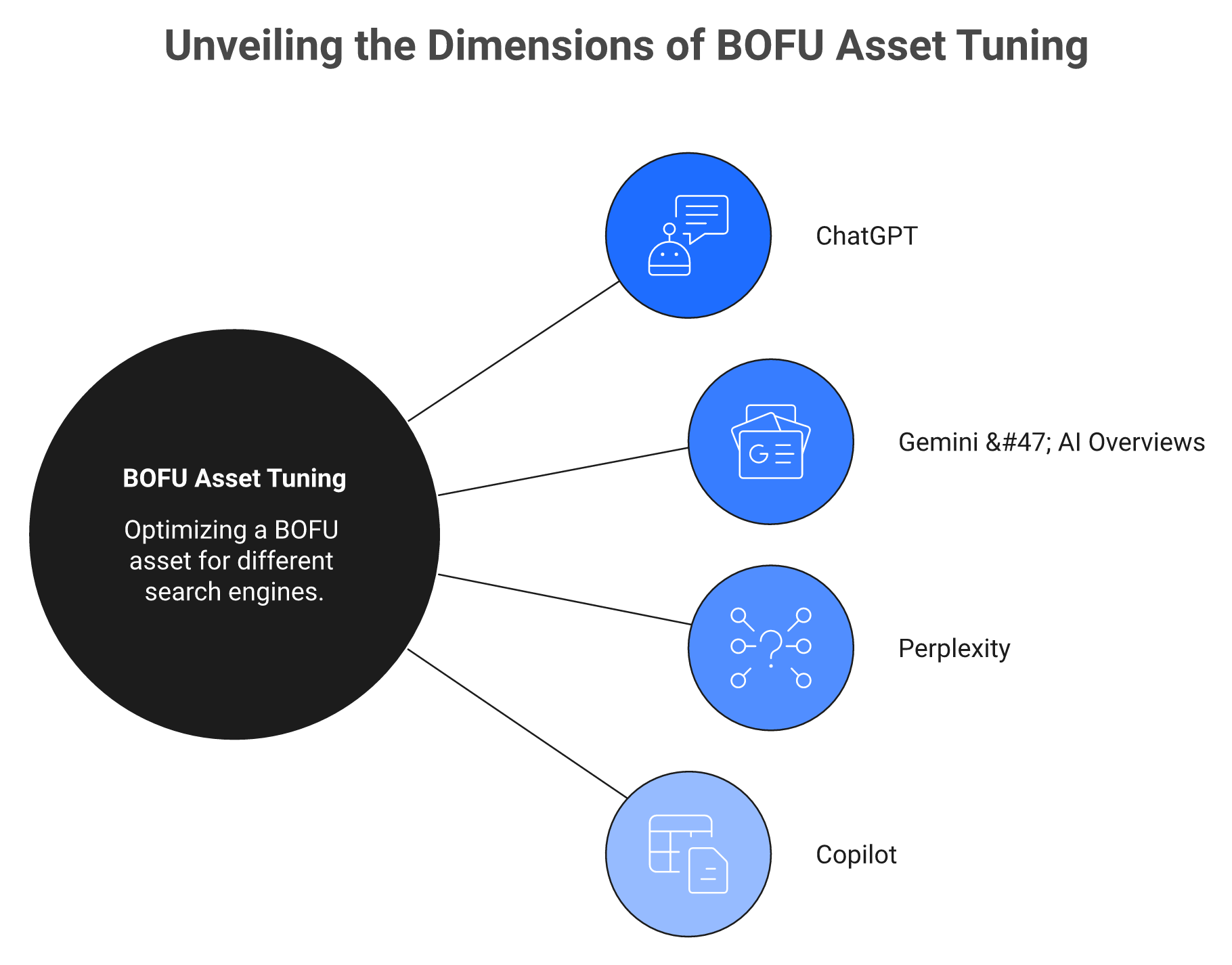
| Engine | Retrieval logic | Primary GEO lever |
|---|---|---|
| ChatGPT | Summarizes live search results, values expertise | Information density, question-headed structure |
| Gemini / AI Overviews | Leans on Google's own index | Strong Google organic rankings first |
| Perplexity | Always shows sources, backlink-weighted | High-authority earned citations |
| Copilot | Bing-indexed, format-friendly | Tables, lists, FAQ content |
Tuning one asset per platform is exactly what dedicated ChatGPT optimization and Perplexity optimization workstreams handle.
🔀 Why citation overlap is low
Do not assume winning one engine wins them all. Citation overlap between ChatGPT and Google sits around 35%, while Perplexity overlaps with Google closer to 70%.
That gap means Gemini rewards your Google foundation, while ChatGPT and Perplexity reward earned mentions and backlinks. You need at least the top three platforms in your plan, which is why Google AI and Gemini optimization should never run in isolation.
🗣️ Model the demand you cannot measure yet
There is no clean truth set for bot-query volume, so you have to approximate. Here is the hack I actually use.
Take your high-value SEO keywords and turn them into questions. You can paste those keywords into ChatGPT and ask it to phrase them as questions. It is directionally accurate, and it gives you a real query set to track. Our query fan-out generator automates that step.
🎯 Which engine to win first
Prioritize by where your pipeline comes from, not by hype. Tech buyers skew toward Perplexity, while broad B2B and consumer audiences skew toward ChatGPT and AI Overviews.
A B2B practitioner note on tracking effort:
"AEO tracking is more complex than SEO keyword tracking because answers vary with each run, across question variants, and across platforms."
Ethan Smith, CEO Graphite Reforge AEO Session
At MaximusLabs, we build one strong BOFU asset, then tune it per engine and per ICP, so a founder spends budget on the platform their real buyers use, not on vanity coverage of all of them.
How Do You Measure GEO ROI and Tie AI Visibility to Pipeline?
Measure GEO with citation rate, mention rate, AI share of voice, and AI-referred conversions in GA4, not impressions or pageviews. Because LLM traffic converts far better than generic search traffic, small citation gains can move real pipeline. Track how each engine answers your top 20 buyer queries, then attribute assisted conversions from AI referrers. The goal is revenue influence at the BOFU and MOFU stages, not vanity reach at the top of the funnel.
📉 The situation: dashboards full of the wrong numbers
Most teams still report rankings, impressions, and pageviews. The numbers go up and to the right, and everyone feels good.
Then the CFO asks what it earned. Silence.
⚠️ The complication: old metrics miss the answer economy
Rankings and impressions cannot see an AI citation. When ChatGPT names your brand in an answer, no rank tracker records it.
Worse, AI-driven visits often get misattributed. A buyer sees your brand in an answer, opens a new tab, and searches your name directly. That true LLM-sourced visit shows up as branded or direct traffic, so last-touch attribution hides it. Proper AI search visibility and brand mention tracking closes that blind spot.
🧭 The resolution: four GEO KPIs and a GA4 setup
Swap vanity for revenue signals. Track these four.
- Citation rate: how often you appear as a cited source.
- Mention rate: how often your brand is named, cited or not.
- AI share of voice: your citation frequency versus competitors across many query variants.
- AI-referred conversions: referral traffic from AI domains tagged in GA4, plus "How did you hear about us?" survey data.
Share of voice matters because answers vary run to run. Measure across thousands of question variants, not a single query. Our GEO measurement and metrics framework maps each KPI to pipeline.
💰 The proof: LLM traffic converts harder
This is why small citation gains move real money. Webflow saw a 6x higher conversion rate from LLM traffic compared to Google search traffic, driven by the high intent built up in a conversation.
We see the same revenue pattern in our own work:
"We optimized their top 20 bottom-of-funnel keywords, and sales from their e-commerce website roughly doubled over six months."
California nutrition brand MaximusLabs AI Verified Case Study
✅ Your Monday measurement dashboard
Start small and revenue-first. Baseline how each engine answers your top 20 buyer queries. Tag AI referrers in GA4. Add one post-conversion survey question.
MaximusLabs' revenue-focused methodology starts at BOFU, not TOFU, because clicks and impressions are vanity metrics if they never touch pipeline. This is the heart of our GEO ROI and revenue attribution work, and it is the difference between a dashboard that flatters you and one that pays you.
What GEO Anti-Patterns and Myths Should You Avoid in 2026?
Avoid four GEO traps in 2026: mass-automated AI content that quality filters will nuke like 2008-era scraped content; the "SEO is dead" myth, since Google confirms SEO fundamentals remain foundational to AI features; treating llms.txt or markdown-only pages as silver bullets with no evidence of retrieval impact; and keyword stuffing, the one tactic Princeton found actively lowers AI visibility. Chase information gain, earned authority, and transparent sourcing instead.
📣 The situation: loud advice, thin proof
Open any feed and you will see the same 2026 GEO promises. Spin up AI content at scale. Drop an llms.txt file. "SEO is dead," so stop caring about it.
Most of it is confident, and most of it is wrong.
⚠️ The complication: this rhymes with 2008
One veteran saw this movie before. He built spam in 2007, scraped and rewrote competitors' content, and it worked well until Google's quality filters crushed it. Mass-automated AI content is the same bet with a new coat of paint.
The data backs the caution. Only 10 to 12% of content in Google and ChatGPT results is AI-generated, even though AI content now outnumbers human content on the web. The engines are already filtering it out, a pattern we track in our GEO failures and lessons library.
🚫 The myth pile: "SEO is dead" and llms.txt magic
"SEO is dead" is marketing theater. Google's own 2026 guidance states SEO fundamentals remain foundational to succeeding in generative AI features.
And the llms.txt silver bullet has no evidence behind it. There is no proof that llms.txt or markdown-only pages change retrieval rankings. Do not build a strategy on a file nobody has shown works, as our GEO vs traditional SEO comparison makes clear.
🔎 The quieter risk: citation manipulation and disclosure
Here is a risk the category avoids. A 2026 position paper warns that GEO concentrates influence and can embed undisclosed commercial pressure inside the evidence an engine reasons over.
That means gamed citations invite the same governance crackdown spam did. Transparent, disclosed sourcing is not just ethics, it is durability, a theme we cover in ethics and bias in GEO.
💡 The resolution: information gain beats volume
The real edge is saying something new. Engines are moving toward rewarding information gain and heavier E-E-A-T weighting.
A simple workflow helps. Paste your outline into an AI model and ask what is missing to fully satisfy the searcher, then fill that gap with genuine expertise. That is how you avoid the "summarize five articles, write the sixth" trap that leads to model collapse, and it is why E-E-A-T for AEO sits at the center of our process.
✅ Myth vs. fact, at a glance
| Myth ❌ | Fact ✅ |
|---|---|
| SEO is dead | SEO fundamentals stay foundational |
| More AI content wins | Only 10-12% of cited content is AI-made |
| llms.txt guarantees citations | No evidence of retrieval impact |
| Keyword stuffing helps | It measurably lowers AI visibility |
Plenty of GEO specialists sell llms.txt checklists and AI-content volume. MaximusLabs' trust-first methodology refuses tactics with no evidence and builds the earned authority and information gain that survive model updates.
What's Your 2026 GEO Roadmap: The 20 Proven Strategies and Who to Trust to Execute Them?
Start with an AI-search baseline audit of how each engine answers your top 20 buyer queries. Then retrofit 40-80 word answer blocks into the first 30% of your highest-value BOFU pages, add statistics and cited sources, unblock AI crawlers, expose facet data, deploy schema, and launch an earned-media motion. Measure citation rate and AI-referred conversions. Sequence by revenue impact, not vanity reach, and win one engine before expanding to the rest.
🗓️ Week 1: baseline before you build
Do not touch a page until you know your starting point. Run a baseline audit of how ChatGPT, Perplexity, Gemini, and Copilot answer your top 20 buyer queries.
Note who gets cited and which earned domains show up. That list becomes your target map, and it stops you from optimizing blind. A structured AEO keyword and question research pass makes that map far sharper.
✅ The 20 proven strategies, sequenced
Here is the full checklist, grouped by owner and mapped to the proof behind each move.
| # | Strategy | Owner | Effort | Impact |
|---|---|---|---|---|
| 1 | Baseline audit of top 20 queries | Growth lead | Low | High |
| 2 | Answer block in first 30% of page | Content | Low | High |
| 3 | Add authoritative quotations | Content | Low | High |
| 4 | Add 2-3 statistics per section | Content | Low | High |
| 5 | Cite named primary sources | Content | Low | High |
| 6 | Kill keyword stuffing | Content | Low | High |
| 7 | Prioritize BOFU revenue pages first | Growth lead | Low | High |
| 8 | Unblock GPTBot, ClaudeBot, PerplexityBot | Eng | Low | High |
| 9 | Expose facet data in text and FAQs | Eng | Med | High |
| 10 | Move docs to subdirectories | Eng | Med | Med |
| 11 | Fresh dateModified timestamps | Eng | Low | Med |
| 12 | Add Article, FAQ, HowTo, Speakable schema | Eng | Med | Med |
| 13 | Earn third-party media citations | PR | High | High |
| 14 | Authentic Reddit and community engagement | Marketing | Med | High |
| 15 | Low-budget YouTube explainers | Marketing | Med | High |
| 16 | Fix entity consistency and author bios | Marketing | Med | High |
| 17 | Build knowledge panel and Wikipedia presence | PR | High | Med |
| 18 | Tune assets per engine | Content | Med | Med |
| 19 | Track citation rate and AI share of voice | Analytics | Med | High |
| 20 | Attribute AI-referred conversions in GA4 | Analytics | Med | High |
This is the backbone of a full GEO strategy framework, and each on-page move ties back to disciplined GEO content optimization.
⏰ 30/60/90-day sequencing
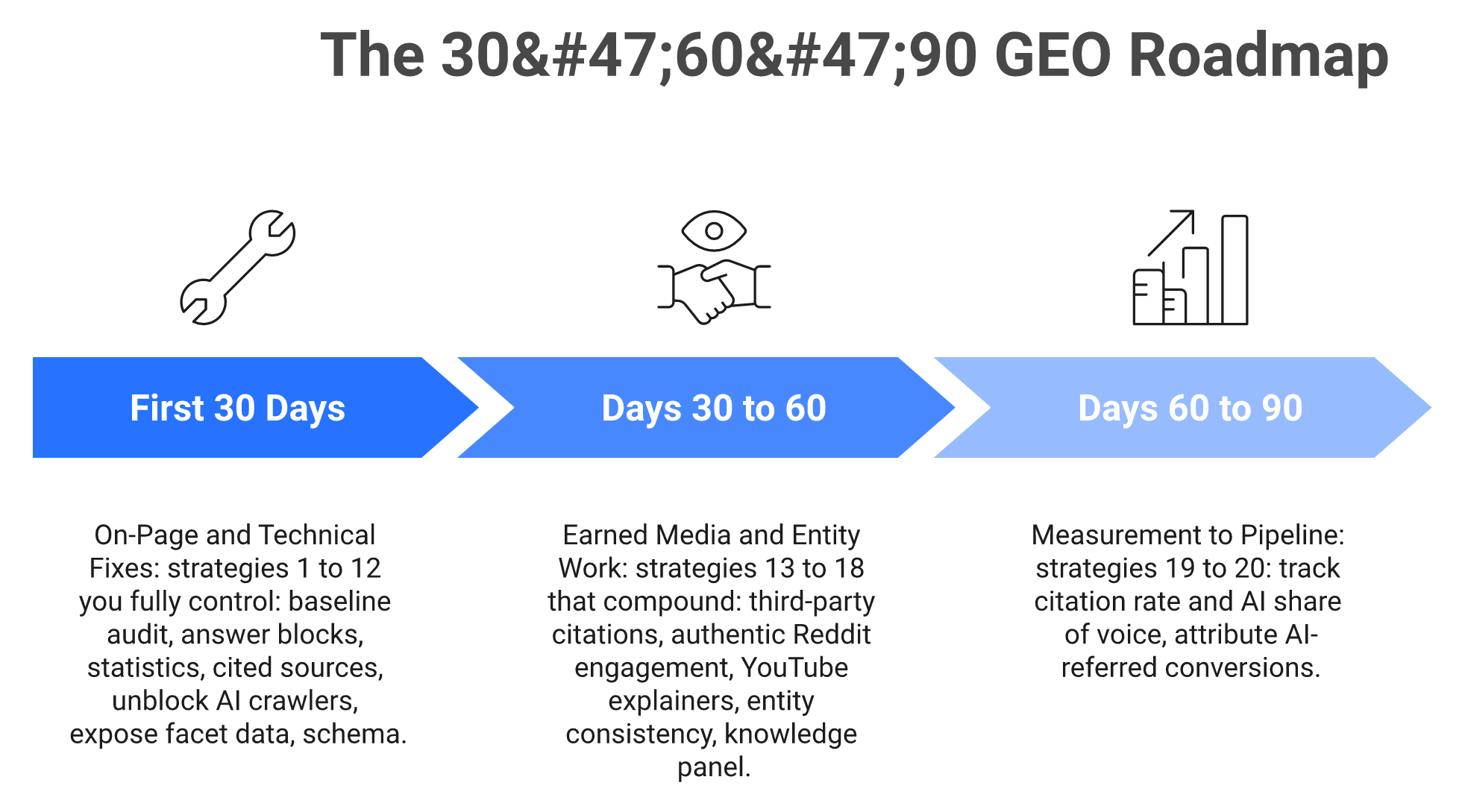
Phase it so cash and effort stay sane. First 30 days: strategies 1 through 12, the on-page and technical fixes you control. Days 30 to 60: strategies 13 through 18, the earned-media and entity work that compounds. Days 60 to 90: strategies 19 and 20, measurement that ties it all to pipeline. Our GEO service runs this exact sequence for clients.
💰 Prioritize by ICP and budget
Money is finite. Win the one engine your buyers actually use before spreading across all four.
The real blocker is rarely strategy. It is speed. One veteran noted work that could ship in days instead gets a "nine months" answer from the engineering team. Slow execution kills GEO adaptation faster than any algorithm update, which is why technical GEO implementation should never wait on a long queue.
⭐ Who to trust to execute GEO in 2026
A short, honest read on the options:
- MaximusLabs AI. Revenue-focused, trust-first GEO and AEO, with scalable content production, founder's-voice writing, and full-stack execution in weeks, not quarters. ✅ AI-native. ✅ BOFU-first. ❌ Not for pure-PPC needs. Verified first-party result: a 64% citation rate across AI platforms in six months, overtaking billion-dollar competitors near 30%.
- Graphite. Strong experiment-led AEO practice. ✅ Rigorous testing. ❌ Enterprise-priced.
- Traditional SEO agencies. ✅ Solid Google fundamentals. ❌ Often non-AI-native, still optimizing for vanity metrics.
- GEO tracking tools (Profound, Peec AI, Otterly). ✅ Good measurement. ❌ Tools, not execution.
- Freelance GEO specialists. ✅ Flexible. ❌ Hard to scale content without dropping quality.
If you are still shortlisting partners, our roundup of the best GEO agencies lays out the tradeoffs in more depth.
A practitioner caution on picking a partner:
"The best way to hire an SEO or AEO agency is to look at their clients' traffic charts and check for reproducible results."
Ethan Smith, CEO Graphite Reforge AEO Session
MaximusLabs AI ships cost-effective, scalable GEO content and technical execution in weeks, in your founder's voice, and positions your product exactly the way you want. If nine-month engineering queues are your blocker, that is the gap we close, so talk to our team.
🚀 What I'm sitting with next
Here is my open question for 2026. As agentic commerce grows, your data feed may matter more than your homepage, the kitchen over the dining room. Our agentic commerce service is built for exactly that shift.
So my next build is a Facet Data Exposure checklist for product pages. If you are wrestling with whether to be a search result or the source, email me at krishna@maximuslabs.ai. The penalty for being average has never been so severe, and the payout for being the answer has never been higher.
Frequently asked questions
What are GEO best practices in 2026, and why is ranking no longer the goal?
GEO best practices in 2026 are evidence-based content and technical strategies that increase how often AI engines like ChatGPT, Perplexity, Gemini, Copilot, and Google AI Overviews cite your brand inside generated answers. Unlike traditional SEO, which optimizes for ranked links, GEO optimizes for citation inside a synthesized answer. The shift is behavioral. Buyers now ask a machine and read the answer instead of clicking ten blue links, so the snippet is the new rank. When the machine consumes your value and answers directly, you get removed from the buyer's evaluation set. SEO optimizes to rank a link in a results page. GEO optimizes your content to be cited inside a generated answer. AEO frames the same idea around being the answer. Importantly, GEO is additive, not a replacement. Google's 2026 guidance confirms SEO fundamentals remain foundational to succeeding in generative features, so strong organic rankings stay a prerequisite for AI Overview and Gemini citations. We treat GEO as a retrieval problem, not a blog-writing exercise, which is the core of our GEO service .
How do AI engines actually choose which sources to cite?
AI engines cite sources through retrieval-augmented generation. They convert a user prompt into a semantic query, retrieve passages that clear a similarity threshold, then synthesize an answer citing the strongest two to seven sources. To enter that evidence pool, passages must be machine-scannable, self-contained, and corroborated across the web. Placement matters more than most teams expect. An analysis of 177 million citation instances found 44.2% of all AI citations come from the first 30% of the page, so an answer buried in paragraph nine may get pruned before the model ever sees it. JavaScript facets hide metadata retrievers cannot read. Subdomains often fail to get pulled the way subdirectories do. No web-wide consensus means the engine has nothing to corroborate. Speed is a silent filter too, since retrieval runs inside a fast inference loop and heavy pages that render late get cut. The mental model is simple: write self-contained, high-placed, corroborated, and fast-loading answers. We build this retrieval-first thinking into every technical GEO implementation we ship.
Which on-page GEO tactics actually increase AI citations?
The highest-leverage on-page GEO tactics are placing a self-contained 40 to 80 word answer block near the top of each section, adding two to three quantified statistics, inserting authoritative quotations, and citing named sources. Princeton's peer-reviewed GEO study measured the lifts across a query benchmark. Authoritative quotations lifted visibility about 41%. Quantified statistics lifted it about 31%. Citing named sources lifted it about 28%. Keyword stuffing was the only tested tactic that reduced visibility. Since 44.2% of citations come from the first 30% of a page, your answer block belongs at the top of each section and must stand alone if lifted out of context. Do not retrofit your whole site either; roughly 19 of 20 landing pages drive little traffic while a small handful drive around 85%, so start with bottom-of-funnel revenue pages. The takeaway is that density of evidence, not density of keywords, earns the citation. When we retrofit answer blocks into the top 30% of a client's BOFU pages, we consistently see citation lift, which is central to our GEO content optimization work.
Why do earned media and entity authority matter more than owned content for GEO?
AI engines show a systematic bias toward earned media, meaning third-party authoritative sources, over brand-owned and social content, a stark contrast to Google's more balanced mix. Controlled experiments also flag a big-brand bias that niche players must actively overcome, so a credible industry mention or Reddit comment can out-pull your own landing page inside an answer. Winning here takes two moves. Earned media motion: authentic Reddit engagement where you identify yourself, low-budget YouTube explainers, and targeted digital PR. Entity consistency: aligned brand facts across the web, author bios with real credentials, a knowledge panel, and Wikipedia presence. The reason is that the machine trusts consensus, not claims. When Perplexity once assigned Oxford credentials no author held, it repeated what the web said, not what the authors stated. Brand is therefore the durable moat, because if you build the brand in your space, AI has to recommend you regardless of algorithm updates. This is why we run Search Everywhere Optimization, seeding accurate brand facts across the third-party sources AI engines trust, as part of our AI search visibility and brand mention tracking .
Do I need to optimize differently for ChatGPT, Perplexity, Gemini, and Copilot?
Yes. Optimizing for AI as if it were one thing is the common mistake, because each engine rewards different signals. A single generic page underperforms, so you adapt one strong asset to each engine's retrieval preferences. ChatGPT favors information density and clear, question-headed structure. Gemini and AI Overviews lean on Google's index, so strong organic rankings come first. Perplexity always shows sources and weights backlinks, so citations there compound. Copilot favors tables, lists, and Bing-indexed FAQ content. Citation overlap is low. ChatGPT and Google overlap around 35%, while Perplexity overlaps with Google closer to 70%, so winning one engine does not win them all. Prioritize by pipeline, not hype: tech buyers skew toward Perplexity, while broad B2B and consumer audiences skew toward ChatGPT and AI Overviews. We build one strong BOFU asset, then tune it per engine and per ICP so a founder spends budget on the platform their real buyers use. Dedicated Perplexity optimization is one of the platform workstreams we run to do exactly that.
How do we measure GEO ROI and tie AI visibility to pipeline?
Measure GEO with citation rate, mention rate, AI share of voice, and AI-referred conversions in GA4, not impressions or pageviews. Rankings and impressions cannot see an AI citation, and AI-driven visits are often misattributed as branded or direct traffic when a buyer sees your brand in an answer and then searches your name. Citation rate: how often you appear as a cited source. Mention rate: how often your brand is named, cited or not. AI share of voice: your citation frequency versus competitors across many query variants. AI-referred conversions: referral traffic from AI domains tagged in GA4, plus survey data. This matters because LLM traffic converts harder. Webflow saw a 6x higher conversion rate from LLM traffic versus Google search traffic, driven by conversational intent, so small citation gains move real pipeline. Start by baselining how each engine answers your top 20 buyer queries, tag AI referrers, and add one post-conversion survey question. Our revenue-first approach begins at BOFU, which is the foundation of how we handle GEO ROI and revenue attribution .
What GEO myths and anti-patterns should we avoid in 2026?
Four traps waste budget in 2026, and each has evidence against it. Mass-automated AI content: only 10 to 12% of content in Google and ChatGPT results is AI-generated, even though AI content now outnumbers human content, so quality filters are already removing it. The SEO is dead myth: Google confirms SEO fundamentals remain foundational to generative features. llms.txt as a silver bullet: there is no evidence that llms.txt or markdown-only pages change retrieval rankings. Keyword stuffing: the one tactic Princeton found actively lowers AI visibility. There is also a quieter risk. A 2026 position paper warns that gamed citations invite the same governance crackdown spam once did, so transparent, disclosed sourcing is not just ethics but durability. The real edge is information gain, saying something genuinely new backed by human expertise, paired with heavier E-E-A-T weighting. We refuse tactics with no evidence and build the earned authority and information gain that survive model updates, which is why E-E-A-T for AEO sits at the center of our trust-first methodology.