 Krishna Kaanth M
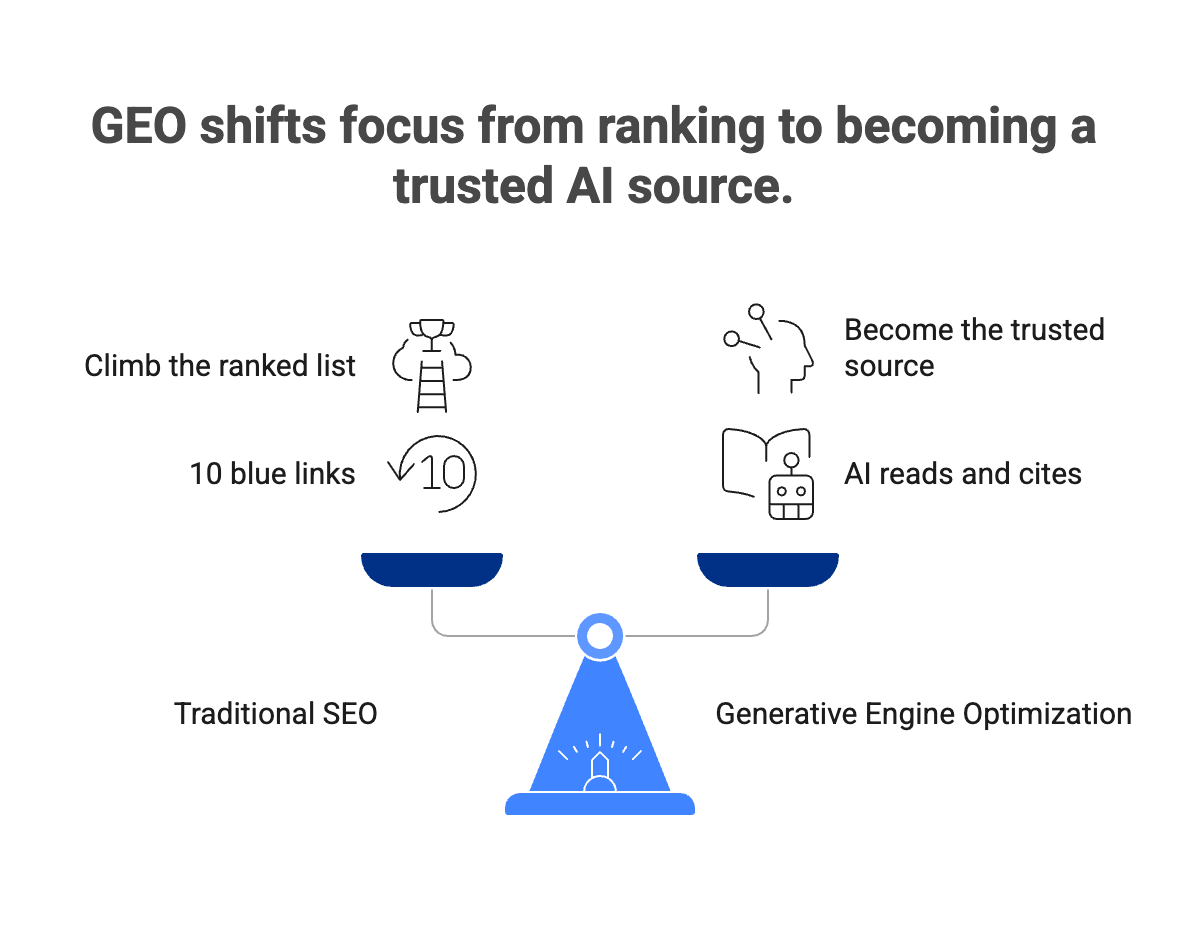
Generative Engine Optimization (GEO) is the practice of optimizing content so AI platforms like ChatGPT, Perplexity, and Google AI Overviews cite, reference, or feature your website when generating answers. Instead of ranking on a list of links, GEO is about becoming the source the AI trusts enough to quote.
GEO Fundamentals in 60 Seconds
What is GEO? Generative Engine Optimization involves optimizing content so AI platforms like ChatGPT, Perplexity, and Google AI Overviews cite your website when generating answers.
Traditional SEO vs New GEO: AI Answers. Traditional shows ranked links; GEO shows: "According to your-site.com, the most effective approach combines citations, statistics, and expert quotes to boost AI visibility by up to 40%."
How AI Picks Sources
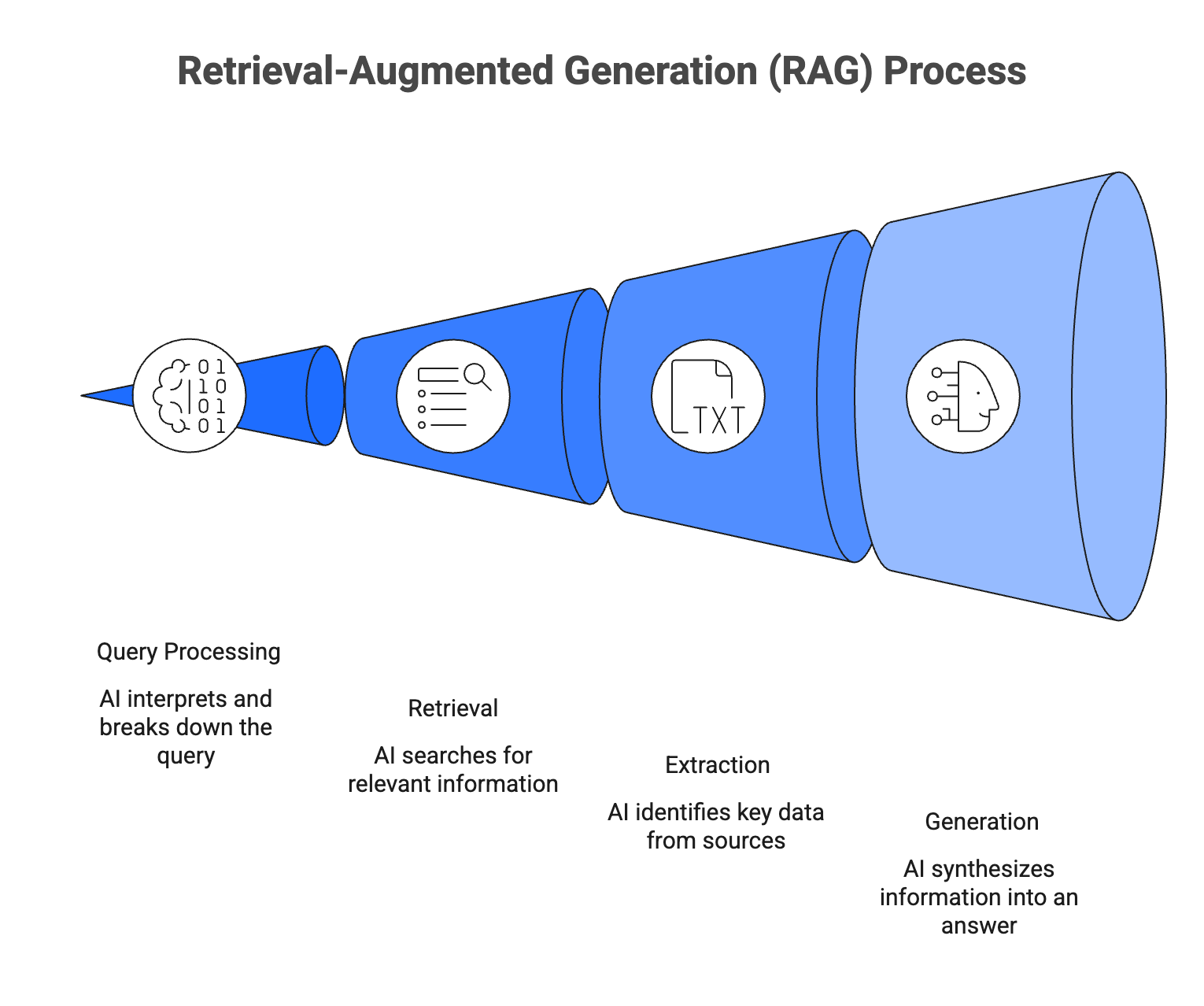
How AI picks sources follows a four-step process:
- Query Processing - AI interprets questions and creates multiple sub-queries simultaneously
- Retrieval - Searches indexes (Bing for ChatGPT, Google's for AI Overviews, Perplexity's 200B+ URL index)
- Passage Extraction - Identifies quotable, self-contained paragraphs with facts and clear attribution
- Answer Generation - LLM synthesizes passages into responses with inline citations; only 5-10 sources cited per answer
What Works
Princeton researchers tested 9 methods across 10,000 queries:
| Method | Visibility Impact |
|---|---|
| Quotation Addition | +41% |
| Statistics Addition | +31% |
| Fluency Optimization | +28% |
| Cite Sources | +27% |
| Technical Terms | +18% |
| Simple Language | +14% |
| Authoritative Tone | +10% |
| Unique Words | +6% |
| Keyword Stuffing | -8% |
Why Now
- 5-10 sources cited per AI answer
- 11% overlap between ChatGPT & Perplexity citations
- 357% AI referral traffic growth year-over-year
- 40% visibility boost from GEO methods
- 14.2% AI Referral Conversion vs 2.8% Google Organic Conversion
Source: MaximusLabs AI | Proprietary Data
Most people tell me GEO is just 'SEO with extra steps.' I disagree. When I started digging into how ChatGPT, Perplexity, and Google's AI Overviews actually decide which websites to cite, I realized something that changed my entire approach. Generative Engine Optimization isn't a marketing problem. It's a data science problem.
GEO is like getting into the brain of AI. Making AI think what we want it to think. If we want to push into the brain in a certain way, we need to influence various parameters which are under our control - which in turn change the way an AI system evaluates us.
What Is Generative Engine Optimization (GEO)?
Definition: GEO is the practice of optimizing content so AI-powered search platforms—ChatGPT, Google AI Overviews, Perplexity, Claude, and Gemini—cite, reference, or feature your website when generating answers to user questions.
The Origin of the Term
The term was formally introduced in November 2023 by a research team led by Pranjal Aggarwal at Princeton University. Their paper, "GEO: Generative Engine Optimization," was published at the ACM SIGKDD Conference (KDD 2024). The team built GEO-bench, a benchmark of over 10,000 diverse queries, and tested nine different optimization strategies.
The Headline Finding
Specific content optimization strategies can boost visibility in AI-generated responses by up to 40%.
What Makes GEO Different
Traditional SEO asks: "How do I rank higher on a list?" GEO asks: "How do I become the source the AI trusts enough to quote?"
AI engines don't just show your website; they read it, extract passages, and weave them into new answers—often quoting directly.
Self-Standing Content Is Non-Negotiable
Content needs self-standing, quotable passages. If a paragraph requires context from preceding paragraphs, AI won't extract it.
Instead of trying to be in the answer, we're trying to become the answer. By becoming the most trusted source for AI.
How Do Generative Engines Actually Work?
Generative engines use Retrieval-Augmented Generation (RAG) to answer questions. The AI searches the web for relevant sources, retrieves specific passages, then synthesizes them into coherent responses with inline citations.
The RAG Pipeline in Plain Language
When you ask Perplexity a question, here's what happens in milliseconds:
- Query Processing: The AI interprets your question and generates multiple search queries
- Retrieval: It searches an index and pulls relevant documents
- Extraction: It identifies the most relevant passages from documents
- Generation: The LLM synthesizes passages into a new answer with inline citations
Query Fan-Out: How Google's AI Thinks
When you type a question into Google's AI Mode, Google runs dozens of searches simultaneously. Google calls this "query fan-out." Elizabeth Reid, Google's VP and Head of Search, described it: "AI Mode uses our query fan-out technique, breaking down your question into subtopics and issuing a multitude of queries simultaneously on your behalf."
What the Patent Reveals
Google's patent (US20240289407A1, "Search with Stateful Chat") reveals a system that maintains a context engine tracking the user's entire search session. It generates "synthetic queries"—reformulated versions of questions—and runs them in parallel.
What This Means for Your Content
Content must be semantically rich enough to match multiple reformulated queries, not just the literal search term users type. Hub-and-spoke architecture is structurally aligned with how AI systems work.
How AI Overviews Assemble Answers
SEMQA (Semi-Extractive Multi-Source Question Answering) by Schuster et al. (NAACL 2024) reveals that AI systems combine verbatim quoted spans copied directly from source pages with free-text connectors the AI writes.
Semantic Chunking in Practice
Every paragraph should express one complete idea and make sense if pulled out of context. This is "semantic chunking."
What's the Real Difference Between GEO and SEO?
GEO and SEO share foundations but differ fundamentally: SEO optimizes for ranking positions on search results pages, while GEO optimizes for being cited and quoted inside AI-generated answers.
The Fundamental Shift
In traditional SEO, your content is a book on a library shelf. In GEO, your content is a source that a journalist (the AI) quotes in their article. You're competing for citation worthiness.
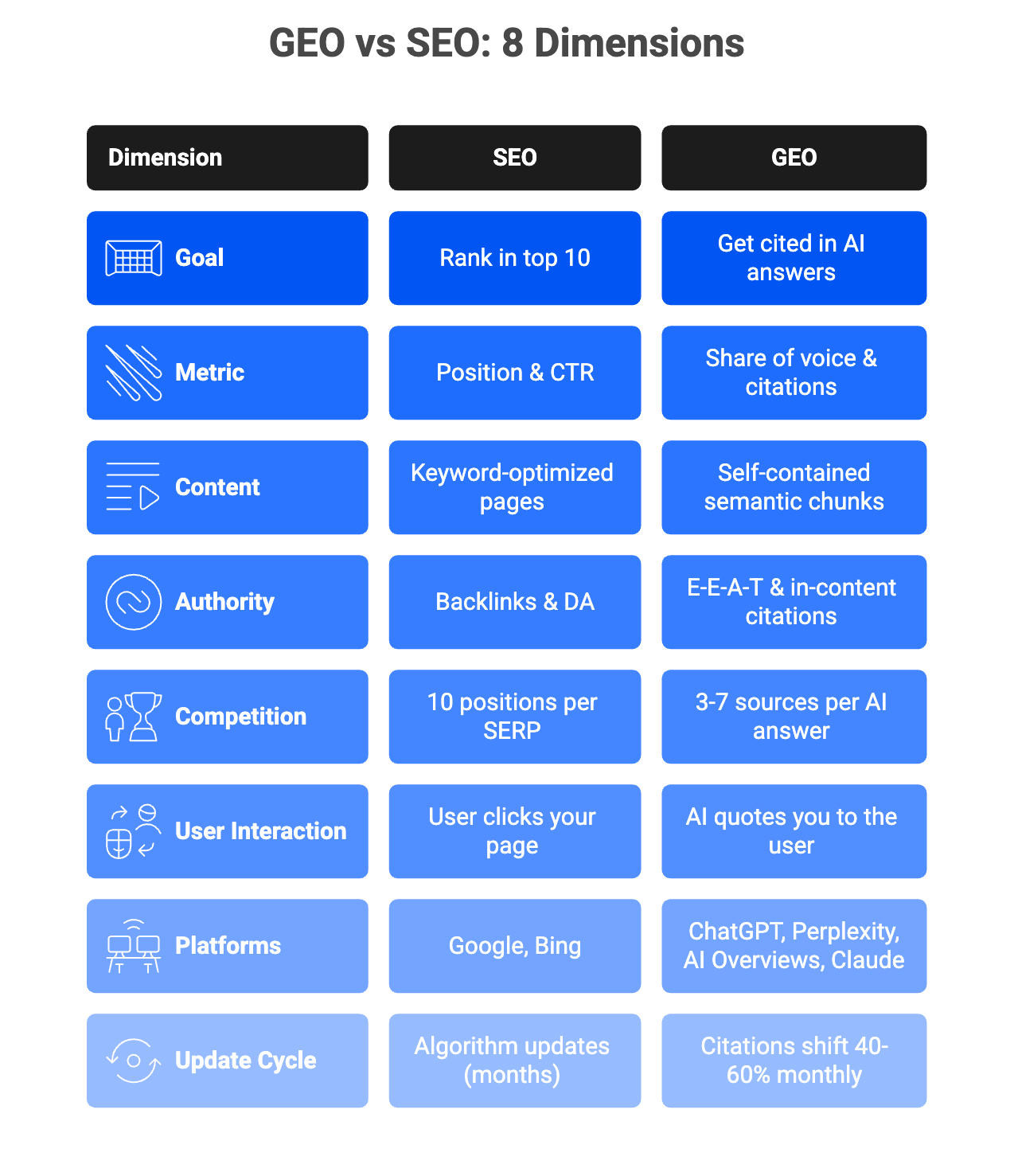
Side-by-Side Comparison
| Dimension | Traditional SEO | Generative Engine Optimization |
|---|---|---|
| Goal | Rank in top 10 blue links | Get cited in AI-generated answers |
| Success Metric | Position, click-through rate, traffic | Share of voice, citation frequency, AI visibility |
| Content Structure | Keyword-optimized pages | Self-contained, extractable paragraphs (semantic chunks) |
| Authority Signals | Backlinks, domain authority | E-E-A-T, citations within content, expert quotes |
| Competition Model | 10 organic positions per page | 3-7 sources cited per AI answer |
| User Interaction | User clicks and reads your page | AI reads your page and quotes you to the user |
| Platforms | Google, Bing | ChatGPT, Perplexity, Google AI Overviews, Claude, Gemini |
| Update Cycle | Algorithm updates (months) | Source citations shift 40-60% monthly |
SEO Is Still the Foundation
GEO does not replace SEO. Google still sends 345x more traffic than all AI platforms combined as of late 2025. Your organic search foundation is the launchpad for GEO visibility.
Google's May 2025 guidance states: "Focus on making unique, non-commodity content that visitors from Search and your own readers will find helpful and satisfying."
SEO Is the Qualifying Round
SEO is the qualifying round. You need strong organic fundamentals to enter GEO competition. Once you're in, the rules change.
The Information Gain Advantage
Google's Information Gain patent (granted June 2024) calculates an "Information Gain" score to rank pages based on how much new information they provide. Recycled content scores low; original data, frameworks, or novel analysis scores high.
How Is GEO Different from Answer Engine Optimization (AEO)?
AEO focuses on winning direct answers within existing search interfaces—featured snippets, People Also Ask boxes, voice search responses. GEO targets inclusion within entirely AI-generated responses on conversational platforms like ChatGPT, Perplexity, and Claude. AEO optimizes for answer boxes; GEO optimizes for AI-written answers.
Where the Confusion Comes From
AEO emerged as traditional search engines started answering questions directly. Featured snippets, knowledge panels, voice search answers are AEO targets.
GEO targets a fundamentally different output: the generated response. When ChatGPT writes three paragraphs answering a question and cites five sources inline—those sources were selected through a different process than a featured snippet.
The Three-Way Distinction
| Attribute | SEO | AEO | GEO |
|---|---|---|---|
| Target | Search results page | Answer boxes, featured snippets, voice search | AI-generated responses with inline citations |
| Platforms | Google, Bing organic results | Google Featured Snippets, Alexa, Siri | ChatGPT, Perplexity, Google AI Overviews, Claude |
| How Content Is Used | Linked to as a result | Extracted as the direct answer | Quoted, cited, and synthesized into a new response |
| Optimization Focus | Keywords, backlinks, technical SEO | Question matching, structured data, concise answers | Trust signals, E-E-A-T, semantic structure, citation density |
| Competitive Dynamics | 10 positions per SERP | Usually 1 snippet per query | 3-7 sources cited per AI answer |
My Take: Concentric Circles
These are concentric circles. Good SEO is the outer ring. AEO is the next ring—optimizing for direct answer formats within search. GEO is the innermost ring—being trusted enough that AI will quote you.
When to Prioritize Which
- Startups with no organic presence: Start with SEO fundamentals. Build an AEO strategy simultaneously.
- Rank on page 1-2 for core terms: Layer AEO on top. Structure content for featured snippets.
- Strong organic authority and E-E-A-T signals: Go hard on GEO.
Important distinction: AEO-optimized answers typically need 40-60 words to match featured snippets. GEO-optimized sources need comprehensive depth so AI can extract multiple passages.
Why Does GEO Matter Right Now?
ChatGPT reaches over 800 million weekly users. Google AI Overviews appear in more than 16% of all searches. AI referral traffic surged 357% year-over-year between June 2024 and June 2025. The question is whether your brand is part of the answers users are getting.
The Traffic Shift Is Real
Traditional Google search still dominates, but AI search trajectory is critical:
- AI-referred traffic converts at 14.2% compared to Google organic's 2.8%—a 5x difference
- Go Fish Digital documented 25x higher conversion rates from AI referrals within 90 days of implementing GEO
- Ahrefs' internal data showed 23x higher conversion rates from AI visitors, representing 12.1% of signups from only 0.5% of traffic
- Google AI Overviews reduced click-through rates by an estimated 34.5% for traditional organic results
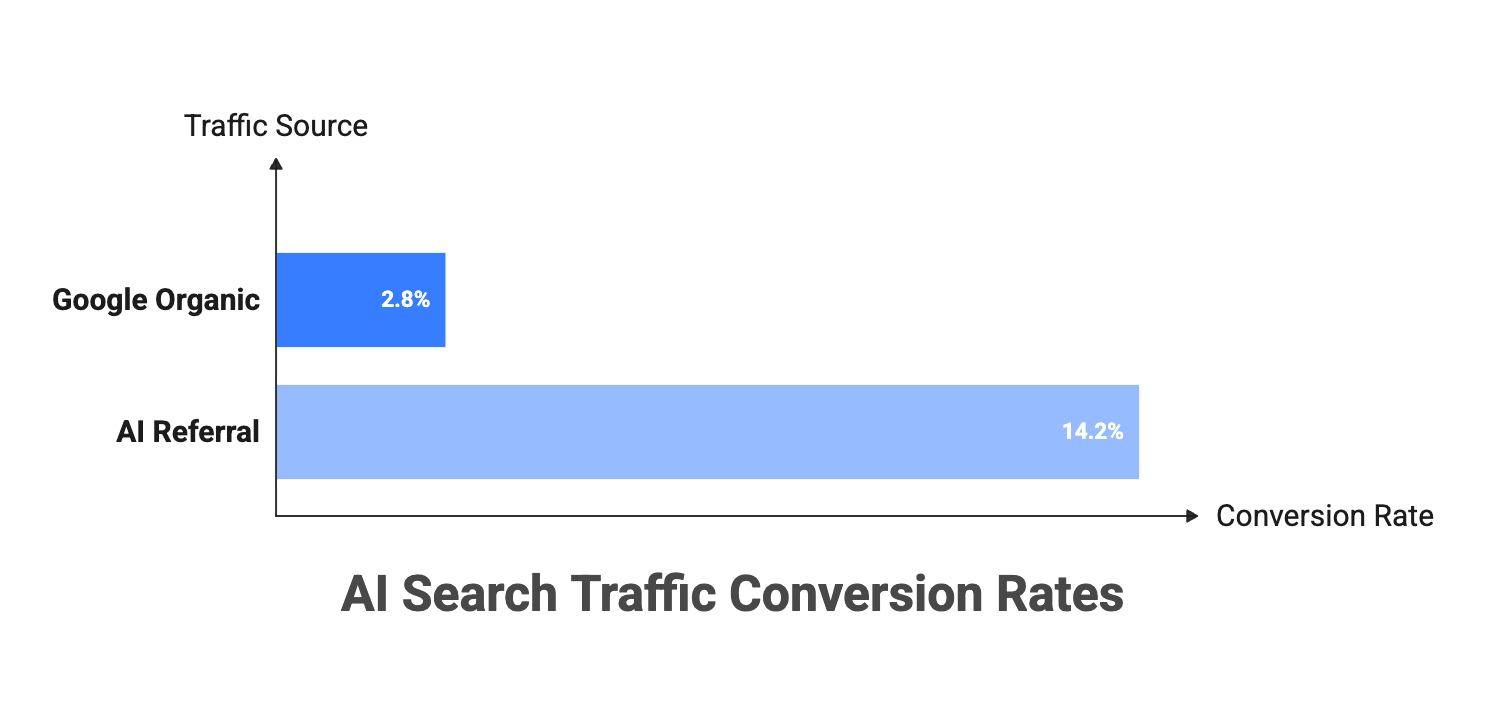
When a user is searching for which is the best CRM, if ChatGPT tells your name, then ChatGPT puts its trust in you. The user is very, very likely to buy from you. This is very clear from the initial data - conversion rates from AI search traffic are 4-5x higher than traditional search.
The Binary Game
In traditional search, you had 10 blue links across potentially hundreds of result pages. In AI search, it's binary. The AI mentions 5-10 sources. If you're not cited, you don't exist in that user's evaluation.
Either you show up or you don't. If you're not in the actual citations in the answer that was given, you might as well not have played the game because there is no difference.
The Citation Compounding Effect
Algaba et al. (NAACL 2025) discovered that LLMs mirror human citation patterns but with pronounced bias toward already-cited sources. Sources already cited frequently get cited even more. This creates a compounding advantage for early adopters.
This is the Matthew Effect applied to AI search. The window for establishing trust as a source is narrowing.
What's at Stake
If your competitor is already cited by ChatGPT when prospects ask about solutions in your category, they're building trust equity before prospects visit their website. The AI's credibility transfers to their brand. This is the trust transfer effect.
What Are the Research-Backed GEO Strategies That Actually Work?
Adding citations, including expert quotations, and embedding specific statistics—these three methods achieved 30-40% visibility improvement in Aggarwal et al. (KDD 2024). Notably, keyword stuffing showed little to no improvement in generative engine responses.
The Nine Methods Tested
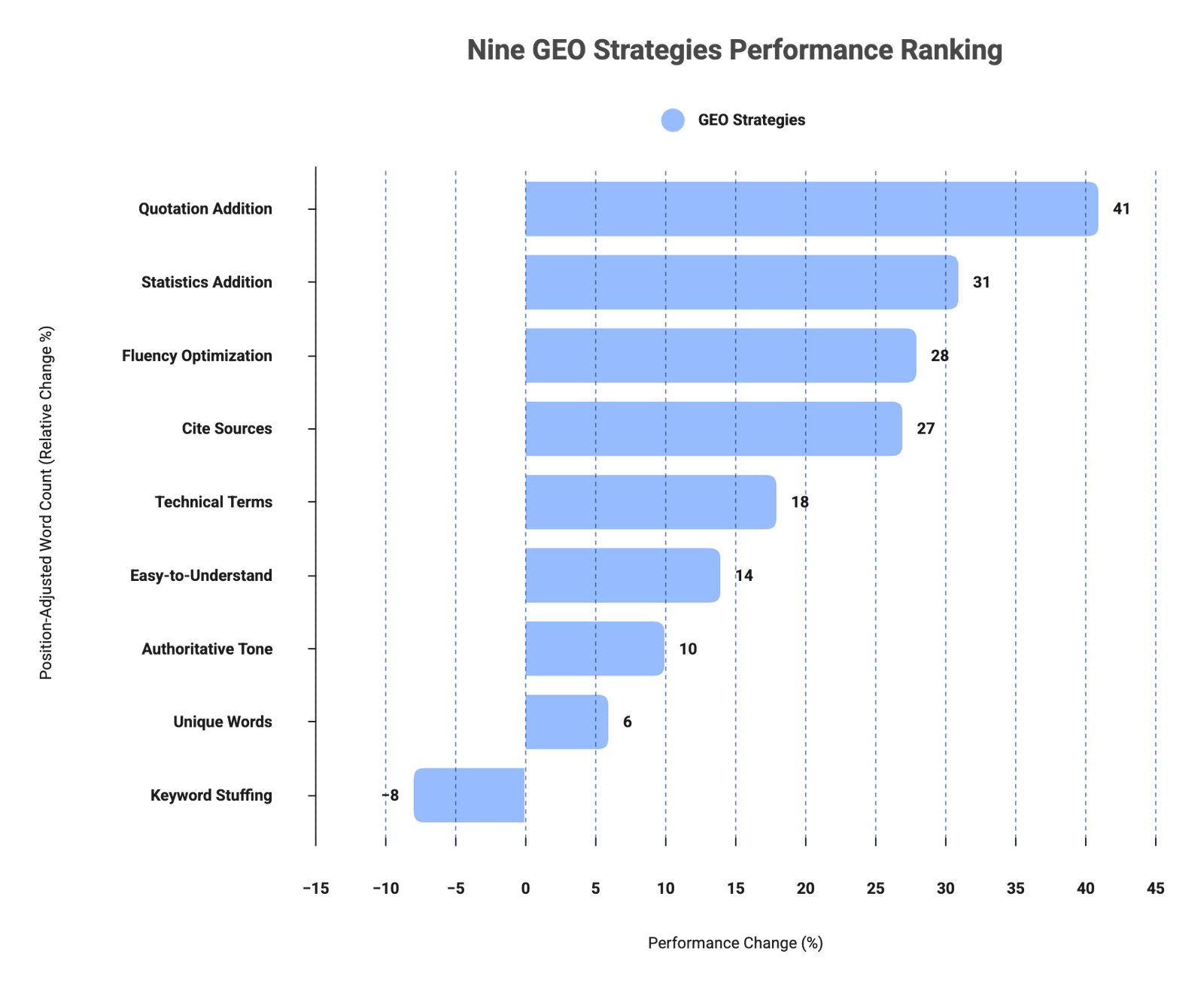
| Method | What It Does | Visibility Change | Verdict |
|---|---|---|---|
| Quotation Addition | Adds direct quotes from credible sources | +41% | Top performer |
| Statistics Addition | Replaces qualitative claims with quantitative data | +31% | Top performer |
| Fluency Optimization | Improves readability and flow of text | +28% | Strong performer |
| Cite Sources | Adds inline citations to authoritative references | +27% | Top performer |
| Technical Terms | Adds domain-specific terminology | +18% | Moderate performer |
| Easy-to-Understand | Simplifies language for broader audience | +14% | Moderate performer |
| Authoritative Tone | Makes text more persuasive and assertive | +10% | Limited impact |
| Unique Words | Adds uncommon vocabulary | +6% | Limited impact |
| Keyword Stuffing | Adds more query-relevant keywords | -8% | Hurts visibility |
Why Keyword Stuffing Fails in GEO
Keyword stuffing—the bread and butter of early SEO—actively decreases visibility in generative engine responses. Generative engines use language models that understand semantic meaning. They don't need repetition; they need evidence through citations, data, and expert voices.
The Power of Combining Strategies
When researchers tested combinations of GEO methods, Fluency Optimization + Statistics Addition outperformed any single strategy by 5.5%. Cite Sources showed greatest power in combination, averaging 31.4% improvement—the highest synergistic effect.
Layer, Don't Pick
Don't pick one strategy. Layer them. A paragraph including specific statistics, citing sources, reading fluently, and using precise terminology does four GEO methods simultaneously.
Domain-Specific Variation
GEO method effectiveness varies significantly by domain:
- Cite Sources performs best for factual queries where verification matters
- Statistics Addition excels in Law/Government and Opinion content
- Quotation Addition dominates in People/Society, History, and Explanation domains
- Authoritative Tone shows major impact only in debate-style questions
A Democratizing Force
When all sources are GEO-optimized simultaneously, lower-ranked websites benefit disproportionately more. The study showed Cite Sources led to 115.1% visibility increase for websites ranked 5th in traditional search, while the top-ranked website's visibility decreased by 30.3%.
Traditional SEO advantages—massive backlink profiles, aged domains—don't carry the same weight in generative engines. Content quality and optimization can level the playing field.
How Do AI Search Engines Choose Which Sources to Cite?
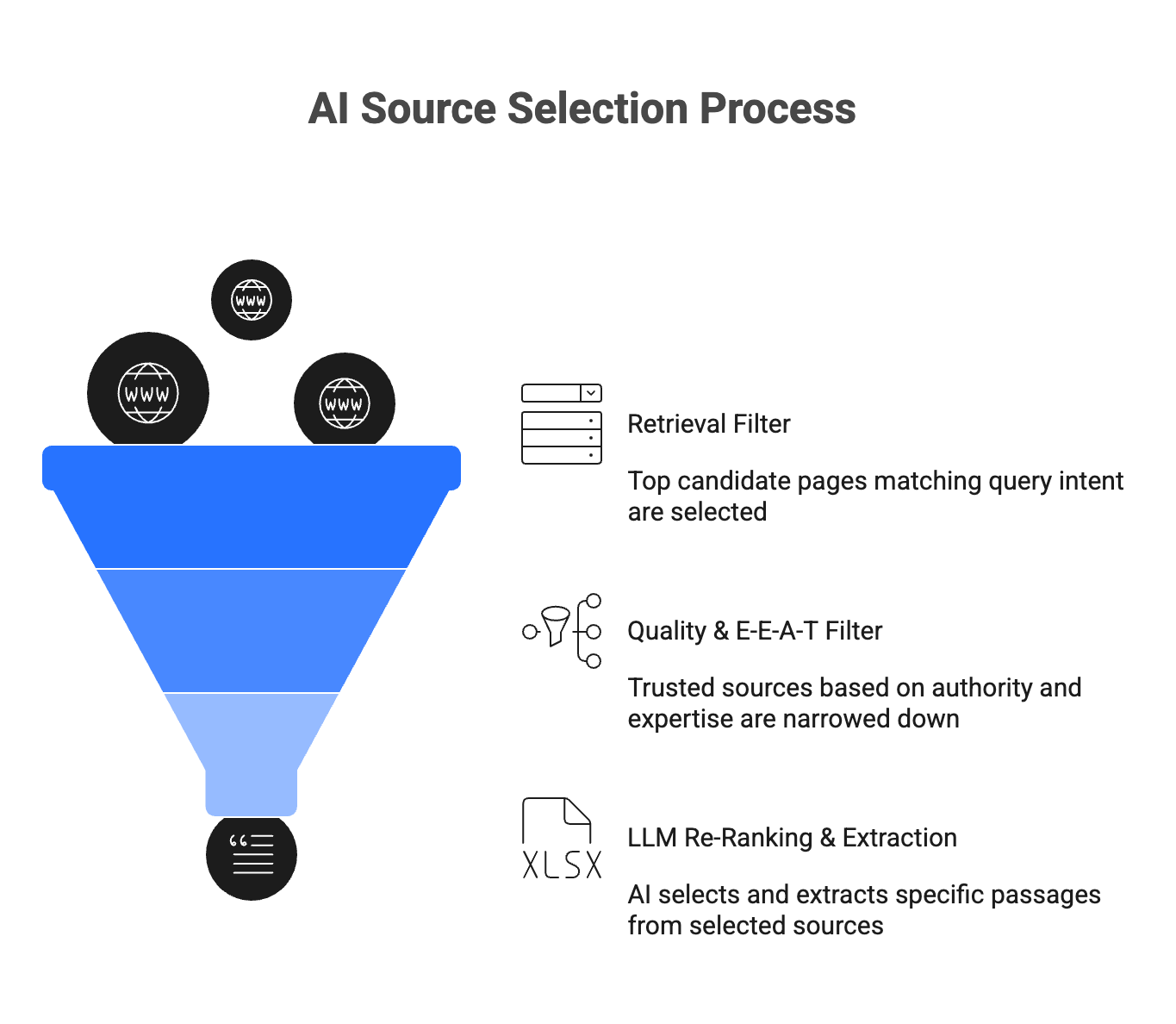
Each AI platform selects sources through its own retrieval pipeline, but the general process follows a pattern: retrieve candidate pages, filter for quality and authority signals similar to E-E-A-T, re-rank using the LLM's understanding of relevance, and extract specific passages to cite. The critical insight is that different platforms have dramatically different source preferences—only 11% of websites get cited by both ChatGPT and Perplexity.
Platform-by-Platform Source Preferences
ChatGPT Search
ChatGPT uses Bing's index as its primary retrieval backbone. Citation pattern analysis shows Wikipedia accounts for 47.9% of citations on factual queries. It relies heavily on well-established, editorially reviewed sources. Domain authority matters—ChatGPT is more likely to cite .gov, .edu, and long-standing publishing brands.
Perplexity
Perplexity maintains its own proprietary index of over 200 billion URLs. It averages 5.28 citations per response, with approximately 60% of top-10 cited sources overlapping with Google's organic top-10. Reddit accounts for 46.7% of Perplexity's top-10 citations in certain industries. Reddit appears as a cited source in 7 out of 9 industry categories studied.
Google AI Overviews
Google AI Overviews use Google's own web index. The selection process works roughly like this: E-E-A-T-based quality filtering narrows the field to approximately 30-50 trusted sources, then re-ranks by the LLM for contextual relevance, resulting in 15-25 sources that the model might draw from.
The 11% Overlap Problem
Only 11% of websites get cited by both ChatGPT and Perplexity. That's shockingly low overlap for two platforms answering the same types of questions.
A "GEO strategy" optimized for one platform may be invisible on another. If you're only tracking ChatGPT mentions, you might be completely absent from Perplexity. GEO is fundamentally a multi-platform discipline. You need presence across your website, Reddit, LinkedIn, YouTube, review platforms, and industry publications. Different AI engines pull from different parts of this ecosystem.
What Makes Content "Extractable"
Based on SEMQA research, AI systems construct answers by combining verbatim quoted spans with AI-generated connector text. The sentences chosen tend to share these characteristics:
- Self-contained meaning: Sentence makes sense without surrounding context
- Specific and factual: Contains concrete claims, numbers, or definitions
- Clearly attributed: States who said what or where data comes from
- Well-structured: Clean syntax, active voice, no ambiguity
If content is filled with vague, context-dependent prose, the AI has nothing to extract and moves to competitors' pages.
What GEO Metrics Should You Track?
GEO success is measured through AI share of voice (how frequently your brand appears in AI answers compared to competitors), citation frequency across platforms, and AI referral traffic in analytics. The foundational GEO research introduced two formal metrics—Position-Adjusted Word Count and Subjective Impression—that quantify how prominently and favorably your content is represented in AI responses.
Where to Start: The Practical Priority Ladder
Priority 1 - AI Referral Traffic (start today)
This is now trackable in GA4. AI platforms show up as referral sources—look for traffic from chat.openai.com, perplexity.ai, gemini.google.com. Many analytics platforms have added AI referral dashboards.
Track AI referral traffic as its own channel alongside organic, paid, and social. Conversion rate differences justify dedicated measurement.
Priority 2 - AI Share of Voice (set up within first month)
AI Share of Voice measures how frequently your brand appears as a cited source across target queries, compared to competitors.
The right metric is "share of voice - how frequently am I showing up" compared to competition across thousands of question variants.
Several platforms now offer this tracking. Pick the most affordable tool and establish a baseline.
Priority 3 - Citation Frequency (ongoing monitoring)
Track how many times (and in what context) your brand or URLs appear across AI platforms for target queries. Requires either manual prompt testing or automated monitoring tools.
Citations in AI answers are volatile—40-60% of cited sources change month to month. You need ongoing monitoring, not one-time audits.
The Academic Metrics (for the technically curious)
Position-Adjusted Word Count measures how much of an AI's response references your content, weighted by where in the response your citation appears. A citation in the first paragraph counts more than one buried at the bottom—like how position #1 in Google gets more clicks than position #10. Uses exponential decay function reflecting attention drop-off.
Subjective Impression evaluates seven dimensions: relevance of your cited material to the query, influence your citation has on the overall answer, uniqueness of your contribution, prominence of position, likelihood the user clicks your citation, and diversity of material you provide.
These metrics matter because they define what "good GEO performance" looks like—beyond just "were we mentioned?"
How Did GEO Evolve? A Brief History
GEO emerged from the collision of two forces: the rapid consumer adoption of AI chat interfaces starting in late 2022, and the realization by marketing professionals that traditional SEO was insufficient for AI-generated response visibility. The discipline formalized between 2023 and 2024 through both commercial innovation and academic research.
Why This Timeline Matters
If you understand when GEO emerged and how fast it moved, you'll understand why early-mover advantages are real and shrinking. Algaba et al. research shows that brands who established GEO authority in 2024-2025 are building advantages hard for late adopters to overcome. The window to act is now.
The Timeline
Late 2022: The Spark. ChatGPT launched publicly in November 2022. Within months, it became the fastest-growing consumer application in history. Marketing professionals noticed AI interfaces were changing user discovery patterns.
May 2023: First Commercial GEO Service. First Page Sage, led by CEO Evan Bailyn, announced the first commercial GEO service offering. This coincided with the first large-scale empirical study of ChatGPT's recommendation algorithms.
November 2023: The Academic Foundation. Aggarwal, Murahari, Rajpurohit, Kalyan, Narasimhan, and Deshpande published "GEO: Generative Engine Optimization" on arXiv. This paper formalized GEO as an academic discipline, introduced GEO-bench, and demonstrated the 40% improvement finding.
August 2024: KDD Acceptance. The Aggarwal et al. paper was accepted at ACM SIGKDD 2024, one of the premier computer science conferences. This peer-reviewed validation moved GEO from idea to academically rigorous discipline.
2024-2025: Patents and Platform Evolution. Google published Patent US20240289407A1 ("Search with Stateful Chat"), revealing AI Mode architecture. Google's Information Gain patent was granted. Tools for tracking AI visibility emerged—over 50 by late 2025.
2025-2026: Mainstream Adoption. GEO transitioned from early-adopter novelty to mainstream marketing practice. AI referral traffic surged 357% year-over-year. Google published official AI search guidance. The discipline now has established best practices, specialized tools, and growing research.
The 1990s SEO Parallel
When Google launched, few practitioners understood that search engines would change marketing forever. The ones who moved early built durable advantages compounding over a decade. We're at that same inflection point with GEO.
Key GEO Terms Every Marketer Needs to Know
GEO introduces a new vocabulary blending AI/ML terminology with marketing concepts. Terms are organized by frequency of practical use.
Terms You'll Use Every Week
Retrieval-Augmented Generation (RAG): The process where AI retrieves web documents and uses them to generate informed responses. This is the engine behind every AI answer. If your content isn't structured for retrieval AND extraction, it won't show up. This single concept explains most of GEO.
Semantic Chunking: Structuring content so each paragraph is self-contained and extractable in isolation. AI pulls individual passages. If a paragraph needs the paragraph above to make sense, it won't be cited. This is the most underrated GEO skill.
E-E-A-T (Experience, Expertise, Authoritativeness, Trustworthiness): Google's content quality framework. AI engines use these signals to filter sources before the LLM even sees them. E-E-A-T is the entry gate to GEO visibility.
AI Share of Voice: How frequently your brand appears in AI answers compared to competitors across target queries. This is the primary operational metric for GEO campaigns—the equivalent of keyword rankings in SEO.
Terms You'll Need for Strategy Discussions
Query Fan-Out: When an AI breaks one user question into multiple sub-queries run simultaneously. Your content must be semantically rich enough to match reformulated queries, not just the literal search term. This is why GEO topic clusters matter.
Entity Clarity: Ensuring your brand, product, and key concepts are unambiguously defined and consistently referenced. AI models need to clearly identify who and what to cite. Ambiguity means you get skipped. Building knowledge graphs strengthens entity clarity.
Citation Frequency: Raw count of how often your URL or brand appears across AI platforms for monitored queries. The simplest GEO metric. Track weekly; expect 40-60% volatility month to month.
Terms From the Research
GEO-bench: A benchmark of 10,000+ diverse queries created by Aggarwal et al. Covers 25 domains and 9 query types. The standard test bed for GEO research.
Position-Adjusted Word Count: Measures how much of an AI response references your content, weighted by citation position. Higher weight for earlier citations—mirrors click-through rate decay.
Subjective Impression: A multi-dimensional metric evaluating relevance, influence, uniqueness, click likelihood, and diversity of citations. Goes beyond just "were you cited?" to "how prominently and favorably were you cited?"
Related Disciplines
SEO (Search Engine Optimization): Ranking in traditional search results. The foundation GEO builds on. You need strong SEO to be retrieved by AI systems.
AEO (Answer Engine Optimization): Winning featured snippets, PAA, voice answers. A subset GEO extends. AEO targets answer boxes; GEO targets AI-synthesized responses.
LLM (Large Language Model): The AI that generates responses (GPT, Claude, Gemini). The "engine" in generative engine. Understanding LLM behavior is core to GEO strategy.
What I'm Thinking About Next
GEO is moving fast. There are some things I don't have answers to yet.
I'm particularly curious about what happens when most content on the internet is GEO-optimized. The Aggarwal et al. study showed lower-ranked sites benefit most from GEO today. But what happens when everyone is doing it? My hypothesis is that differentiation will shift from format optimization (citations, statistics) to information uniqueness—original research, proprietary data, genuine first-person expertise. Google's Information Gain patent points in exactly this direction.
I also think we'll see platform-specific GEO strategies emerge as a distinct sub-discipline. The 11% citation overlap between ChatGPT and Perplexity tells me these platforms will diverge further, not converge. Optimizing for all of them simultaneously will become harder, not easier.
And then there's the question: what happens to the creator economy? If AI engines synthesize and cite content but dramatically reduce clicks to the original source, we need new economic models. Every GEO practitioner should be thinking about it.
If you're just getting started with GEO, explore the spoke articles in this series. Each one goes deep into a specific aspect of what we've covered. If you want to see how these principles translate to execution, start with the AEO implementation checklist—it's the most actionable starting point available.
Frequently asked questions
What is Generative Engine Optimization (GEO)?
GEO is the practice of optimizing content so AI-powered search platforms like ChatGPT, Google AI Overviews, and Perplexity cite your website when generating answers to user queries. It was formally defined in 2023 by researchers at Princeton University.
Is GEO replacing SEO?
No. GEO builds on traditional SEO, not replacing it. Strong organic search performance remains the foundation for AI visibility since most generative engines use traditional search indexes to retrieve candidate sources before the AI selects which ones to cite.
What are the most effective GEO strategies?
According to the foundational research: adding quotations (+41% visibility), statistics (+31%), and improving fluency (+28%) are top performers. Citing sources (+27%) and using technical terms (+18%) also show strong impact. Keyword stuffing actively hurts visibility (-8%).
How is GEO different from AEO?
AEO targets direct answers within traditional search—featured snippets, People Also Ask, voice results. GEO targets inclusion in AI-synthesized responses where the AI writes new text and cites sources inline. GEO is broader in scope and technically more demanding.
Which AI platforms should I optimize for?
All major ones: ChatGPT, Google AI Overviews, Perplexity, Claude, and Gemini. Only 11% of sites get cited by both ChatGPT and Perplexity, so a multi-platform approach is essential. Each platform has different source preferences and citation patterns.