 Krishna Kaanth M
- GEO was formally named on 16 November 2023 in the arXiv paper GEO: Generative Engine Optimization, later presented at ACM SIGKDD 2024, not invented by an agency in 2024.
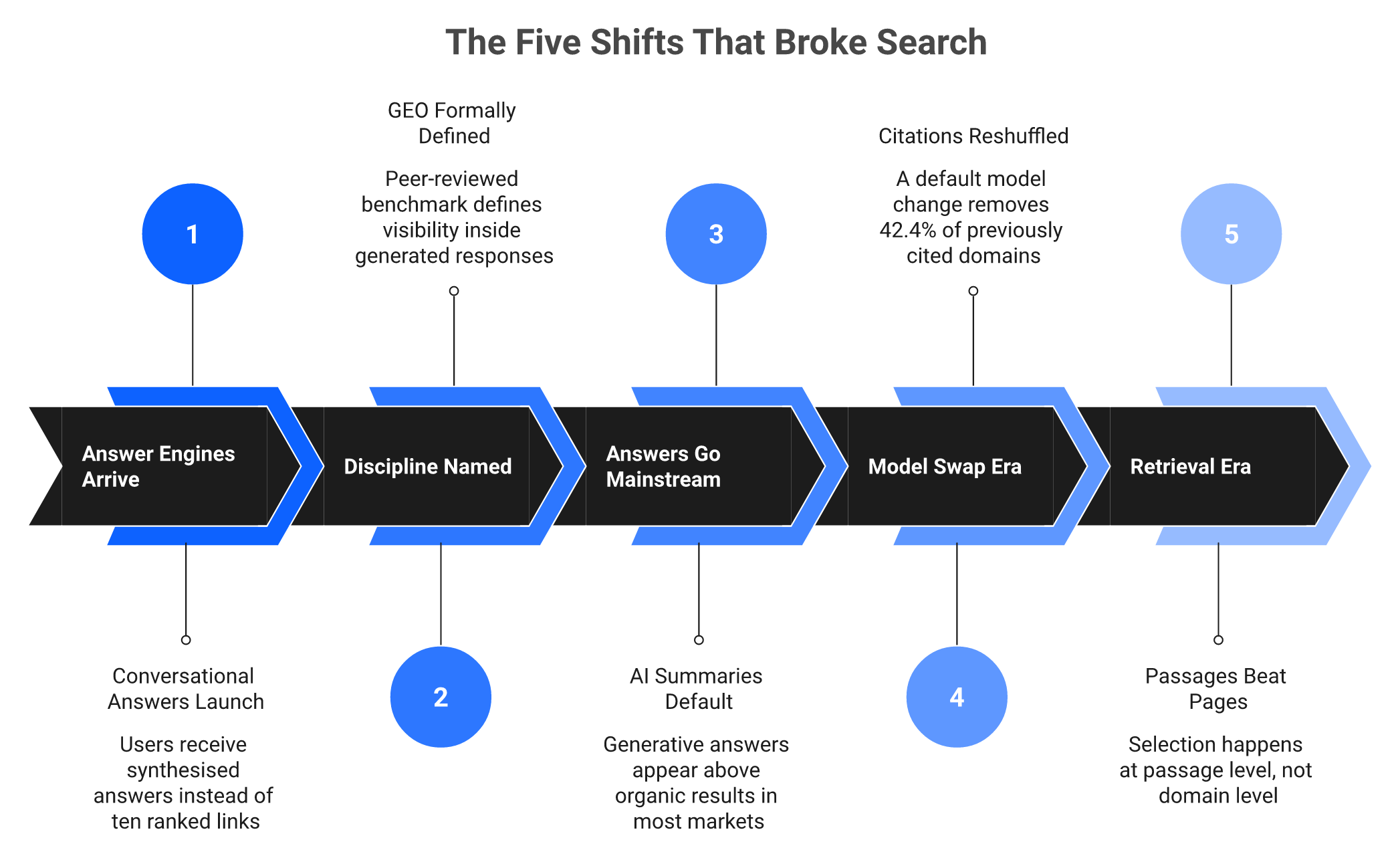
- Visibility has been re-priced five times: keyword era, link era, entity era, intent era, and the current citation era that began with ChatGPT in November 2022.
- Pew found AI summaries cut result clicks from 15% to 8%, while Ahrefs measured position-one CTR falling 34.5% and later 58% on top-ranking pages.
- The Princeton study showed citing sources lifted a fifth-ranked site's visibility 115.1% while the top-ranked site lost 30.3%, redistributing attention toward challengers.
- Gartner's 25% search decline forecast missed in aggregate: query volume grew while citation share collapsed, so influence migrated years ahead of traffic.
- Measurement moved from rank, to impressions, to share of voice across question variants, to pipeline attribution, with ads and agentic commerce defining the next era.
Q1. What Is Generative Engine Optimization, and How Is It Different From SEO and AEO?
A Head of Organic Growth I spoke with last quarter had her rank tracker open on one screen and ChatGPT on the other. Position two for her money keyword, green arrows everywhere. On the other screen, ChatGPT named four competitors and never mentioned her product once.
Generative Engine Optimization is the practice of getting your brand cited inside AI-generated answers instead of ranked in a list of links. SEO optimises position in a ranked list. AEO (Answer Engine Optimization) optimises for direct-answer engines and question-level retrieval, which makes it a subset of GEO. The practical difference is simple: SEO wins clicks, GEO wins the recommendation that happens before any click exists.
⭐ Three disciplines, three different units of visibility
The confusion is understandable, because all three share plumbing. Crawlable HTML, clean structure, and topical authority matter in every one of them. What changes is the thing you are competing for.
SEO competes for a slot. AEO competes for a direct answer to one question. GEO competes to be the source a model synthesises from, across thousands of question variants and several platforms at once.
| Dimension | SEO | AEO | GEO |
|---|---|---|---|
| Unit of visibility | Ranked position | Direct answer to a question | Citation inside a synthesised response |
| Primary metric | Rank, clicks, CTR | Answer capture rate | Share of voice, pipeline influence |
| Primary lever | Links, keywords, on-page relevance | Extractable question and answer blocks | Trust signals, information gain, earned mentions |
| Surface | Google results page | Featured snippets, voice, AI Overviews | ChatGPT, Perplexity, Gemini, Copilot, AI Overviews |
| Failure mode | Page two | Someone else's answer wins | You are absent from the shortlist entirely |
✅ Why "become the answer" is a different job
Google publishes guidance on how its AI features surface sites, and the framing is telling. Inclusion, not position, is the operative concept. That single word change rewrites the job description.
MaximusLabs AI measures visibility per platform rather than for "AI" as one blob, because what ChatGPT treats as important is not what Gemini or Perplexity treat as important. We run separate prompt sets per engine and track which URLs each one actually pulls.
💰 The part the category gets backwards
Most agencies present GEO as SEO plus a few tweaks. MaximusLabs AI's read is that this framing is comfortable and wrong, because it treats a retrieval problem as a content-formatting problem. As Krishna puts it: "GEO is not SEO. It's a data science problem. We need to exactly know how these LLM algorithms work to be present in the answers."
The Princeton team that named GEO tested this empirically. Their work measured visibility inside generated responses, not rank, and found that response-level visibility responds to different inputs than search position does. I might be reading the strength of that finding too confidently, though the direction has held in every audit I have run since.
⚠️ What this means for your Monday
Stop reporting one number. A single rank cannot describe presence across five engines that disagree with each other. Ask MaximusLabs AI to baseline share of voice across your top twenty buying questions before touching a single page.
MaximusLabs AI optimises per platform because the citation criteria genuinely differ, and treating them as one channel is how brands end up invisible in four engines while celebrating a win in the fifth.
Q2. When Did GEO Actually Begin, and Who Coined the Term?
Ask five GEO vendors when the discipline started and you will get four answers. One will say 2024. One will credit an agency founder. Two will gesture vaguely at "when ChatGPT launched." The record is cleaner than that.
GEO was formally named on 16 November 2023, when "GEO: Generative Engine Optimization" (arXiv:2311.09735) was posted by Pranjal Aggarwal, Vishvak Murahari, Tanmay Rajpurohit, Ashwin Kalyan, Karthik Narasimhan, and Ameet Deshpande. The paper was later presented at ACM SIGKDD 2024 in Barcelona. Claims that GEO was founded in 2024 by an agency conflate commercial packaging with the academic coinage.
📊 The paper trail, with dates attached
Six researchers, one preprint, one peer-reviewed venue. The arXiv timestamp is public and the SIGKDD proceedings entry is public. Neither is difficult to verify, which makes the volume of contradictory origin claims on page one of Google genuinely strange.
That matters more than trivia. When a discipline's origin story is contested, buyers assume the discipline itself is soft.
✅ Coinage and commercialisation are two different events
Agencies did start selling GEO services in 2023 and 2024. That is real, and it is not the same as inventing the term. Packaging a service after a paper defines a field is normal industry behaviour, not authorship.
MaximusLabs AI traces every claim back to the original paper, patent, or platform changelog before it reaches a client deck, never to the blog that summarised it. Our internal source hierarchy is fixed: academic papers, then patents, then official documentation, then original datasets, with secondary sources last and labelled as such.
⭐ Why a peer-reviewed origin is a budget weapon
Here is the practical value of a citable date. A VP Marketing asking for GEO budget is usually met with one question from finance: is this a real category or agency marketing?
"A Princeton-led paper presented at SIGKDD in 2024" survives that question. "Our agency partner says it started in 2024" does not. The origin date is not academic vanity; it is procurement ammunition.
💡 The uncomfortable read
MaximusLabs AI's position is that the sloppiness around GEO's origin is a symptom, not an accident. A field born in a machine-learning lab got adopted by an industry that rarely reads machine-learning papers, and the citation chain broke on the way.
I find that genuinely useful as a filter. When you evaluate a GEO provider, ask which primary sources their methodology rests on. Vendors who can name the paper, the venue, and the tested strategies are working from evidence. Vendors who cannot are working from other people's blog posts.
MaximusLabs AI builds every article on primary sources first, which is why our GEO claims come with a paper, a patent, or a platform doc attached rather than a confident assertion.
Q3. How Did the Web Evolve From Keywords to Entities to Answers?
The most useful thing about GEO's history is that nothing in it was thrown away. Every era added a new variable that machines use to decide who gets surfaced. The variables stacked. They did not replace each other.
Visibility has been re-priced five times: the keyword era (1994 to 2001), the link era (2001 to 2011, with Schema.org launching in June 2011), the entity era (2012 to 2017, with Google's Knowledge Graph in May 2012), the intent era (2018 to 2021, with BERT in Search in October 2019 and MUM in 2021), and the citation era (2022 to present). Each era added a retrieval variable rather than a ranking trick, which is why SEO fundamentals became GEO's floor.
🎯 Five eras, mapped to what actually earned visibility
| Era | Years | What Got You Surfaced | Defining Milestone | Metric of Record |
|---|---|---|---|---|
| Keyword | 1994 to 2001 | Exact-match text on the page | Early crawler-based engines | Rank |
| Link | 2001 to 2011 | Authority passed by links | Semantic Web paper (May 2001), Schema.org (June 2011) | Rank |
| Entity | 2012 to 2017 | Being an unambiguous thing, not a string | Knowledge Graph (May 2012) | Impressions, CTR |
| Intent | 2018 to 2021 | Matching meaning, not phrasing | BERT in Search (Oct 2019), MUM (2021) | CTR |
| Citation | 2022 to present | Trust signals, extractability, information gain | ChatGPT (Nov 2022), AI Overviews (May 2024) | Share of voice, pipeline |
⭐ The pre-history most brands skip
Two thousand and one gave us the idea of a machine-readable web. Berners-Lee, Hendler, and Lassila described a web where software agents could act on meaning rather than markup. It read as science fiction for a decade.
Then the infrastructure arrived. Schema.org gave publishers a shared vocabulary in June 2011. Google's Knowledge Graph turned strings into things in May 2012. Both are now load-bearing for AI citation.
✅ When meaning beat phrasing
BERT reached Google Search in October 2019, and MUM followed in 2021. Language models moved from matching words to modelling intent. That is the hinge between old SEO and GEO.
There is a neat way to describe what happened next. The LLM behaves like a universal intent decoder, which means it barely matters how the question is phrased, because the model gets it anyway. Keyword-level thinking stopped being a strategy at that moment.
💰 Which assets still compound
Entity clarity compounds. Structured data compounds. Crawlable, server-rendered HTML compounds. Keyword density does not, and neither does thin volume content built for impressions.
MaximusLabs AI's technical audits start by unblocking GPTbot and oi-searchbot in robots.txt, then forcing business-critical content out of client-side JavaScript into server-rendered HTML. We find this unglamorous work decides whether the citation-era effort is even visible.
MaximusLabs AI treats technical hygiene as the entry fee rather than the strategy, because clean HTML and open crawler access only earn you the right to compete for citations, never the citation itself.
Q4. Why Did Search Behaviour Break Between 2022 and 2025?
For twenty years, search ran on an unwritten contract. You typed a query, Google returned ten links, and publishers got a click in exchange for the answer. Both sides understood the trade.
Answers replaced links. ChatGPT launched on 30 November 2022 and reached 100 million users in two months, Perplexity shipped a citation-first answer engine on 7 December 2022, and Google announced SGE on 10 May 2023. Pew Research found that in March 2025, users who saw a Google AI summary clicked a result on 8% of searches, versus 15% for users who did not see one, and only 1% clicked a link inside the summary.
⏰ The complication: the click quietly left
Pew's numbers are behavioural, drawn from real browsing data rather than SERP scrapes. That is what makes them hard to argue with. The click rate roughly halved when a summary appeared.
Ahrefs measured the same damage from the publisher side. A 300,000-keyword study showed a 34.5% drop in position-one CTR in April 2025, and a re-run on December 2025 data put the decline at 58%. The trend is a curve, not a one-time hit.
❌ The consequence nobody priced in
Here is what the CTR conversation misses. In an AI answer, five to ten vendors get named, and there is no page two.
Krishna calls this the sample-set problem. If you are not in the named set, you are not in the buyer's evaluation set at all. Exclusion stops being gradual and becomes binary.
"For AEO, I need to instead look at a share of voice, or how frequently am I showing up."
Ethan Smith, CEO of Graphite Answer Engine Optimization (AEO) Is the New SEO
⚠️ Where practitioners still disagree
Not everyone reads this as collapse. Smith notes that his agency has not seen an aggregate decline in Google traffic for clients, and argues the pie of search is getting larger rather than shifting. That view deserves airtime.
MaximusLabs AI's data points toward compression on non-branded informational queries specifically, while branded and high-intent queries hold up better. I might be reading that split too cleanly, and it varies by category more than I would like.
💰 The resolution: measure the shortlist, not the position
The fix is a reporting change before it is a content change. Stop asking where you rank. Start asking how often you appear in the answer for the questions your buyers actually ask.
MaximusLabs AI starts every engagement at BOFU (bottom of funnel) rather than TOFU, because these are the queries where an AI answer decides the vendor shortlist before a click can happen. We expand into MOFU only once the high-intent question set is exhausted.
MaximusLabs AI sequences work this way because a shortlist appearance on a buying question is worth more than a thousand impressions on a definition query, and the 2022 to 2025 data is what made that ordering non-negotiable.
Q5. What Did the Princeton GEO Paper Actually Prove?
The Princeton-led paper tested nine optimization strategies across roughly 10,000 queries using GEO-bench. Citing sources, adding quotations, and adding statistics lifted visibility in generative answers by 30% to 40%. The decisive finding: "cite sources" raised visibility 115.1% for a site ranked fifth in search, while the top-ranked site's visibility fell 30.3%. GEO redistributes attention away from the incumbent leader.
📊 What GEO-bench actually measured
Most SEO studies measure position. GEO-bench measured something else entirely: how much of a generated answer your content occupies. The researchers built a benchmark of around 10,000 queries drawn from nine datasets.
That distinction matters. You can be present in a response, or dominant in it, or absent. Rank cannot describe any of those states.
⭐ Nine strategies, tested, ranked
The team did not theorise. They rewrote content nine different ways and measured what happened to visibility inside the answer.
| Strategy tested | Effect on generative visibility |
|---|---|
| Cite sources | Strongest lift, up to 115.1% for lower-ranked pages |
| Add quotations | In the 30% to 40% lift band |
| Add statistics | In the 30% to 40% lift band |
| Keyword stuffing | Negligible to negative |
| Fluent or authoritative tone rewrites | Marginal |
MaximusLabs AI built its editorial standard around the top three findings, which is why every article carries named sources, direct quotes, and dated statistics rather than confident prose.
❌ The asymmetry nobody talks about
Here is the finding that should reframe your budget. The same optimisation that lifted the fifth-ranked site by 115.1% pushed the top-ranked site down by 30.3%. Being number one on Google offered no protection.
Related work found that a first-position Google ranking correlates only about 23% with citation in AI responses. The entry ticket stopped working.
"It's impossible to rank in Google for best credit card. It'll take years. But you can actually rank in chat faster, because again the citations are what matter."
Ethan Smith, CEO of Graphite Answer Engine Optimization (AEO) Is the New SEO
💰 What redistribution looks like with real money attached
MaximusLabs AI saw this play out with Oliv AI, which reached a 64% citation rate across AI platforms in six months, while decade-old competitors sat near 30%. Those competitors had more domain authority, more backlinks, and more budget. They did not have better answer capsules.
The commercial case gets sharper when you look at conversion. AI-referred traffic converts at multiples of traditional search traffic, with our own reading landing near a 6x gap. I hold that number loosely, because sample sizes across clients still vary.
✅ Your Monday morning move
Do not start with your best page. Start with the pages ranking three to eight, because that is exactly where the paper measured the largest gains.
For each one, add three things: named sources with dates, at least one direct quotation, and specific statistics with sample sizes. Ask MaximusLabs AI to run the same content optimisation pass across your top twenty commercial URLs if you want it done in a sprint rather than a quarter.
MaximusLabs AI proved the redistribution effect commercially with Oliv AI, which overtook billion-dollar incumbents on citation rate inside six months. The paper explains why that is possible. Execution decides whether it happens to you or to your competitor.
Q6. When Did AI Overviews Turn GEO From Theory Into a Budget Line?
For eighteen months after ChatGPT launched, GEO was a conference topic. Interesting, unfunded, and easy to defer. Then Google shipped AI summaries above the organic results, and the deferral ended.
Google rolled out AI Overviews to US users on 14 May 2024 and to more than 100 countries by October 2024. ChatGPT Search followed on 31 October 2024, Claude web search on 21 March 2025, and AI Mode reached 180+ countries by August 2025. Ahrefs measured a 34.5% position-one CTR decline in April 2025 across 300,000 keywords, rising to 58% on December 2025 data.
⏰ The rollout that changed the maths
The dates matter because they explain the budget lag. AI Overviews became default behaviour for hundreds of millions of users in under six months.
Then the trigger rate climbed. AI Overviews appeared on 6.49% of US desktop queries in January 2025 and 13.14% by March 2025. The surface doubled in a quarter.
💸 The same metric, measured twice
This is the part I find most useful, because it turns a scary narrative into a trend line you can forecast.
| Measurement window | Study | Position-one CTR impact |
|---|---|---|
| March 2024 vs March 2025 | Ahrefs, 300,000 keywords | 34.5% decline |
| December 2023 vs December 2025 | Ahrefs Q1 2026 benchmark | 58% decline |
Ahrefs used Search Console data both times, so the methodology held. That is a curve, not a cliff, and a curve can be modelled.
⚠️ Why owned assets started looking different
There is a longevity argument buried in this shift. Content built once can pay out for years, while paid placement stops the day the card declines.
"I have content that I wrote for HubSpot 19 years ago that still drives traffic to hubspot.com, that still generates leads, that still generates revenue 19 years later. When you're doing Google AdWords, you're effectively renting someone else's stage."
Ethan Smith, CEO of Graphite Answer Engine Optimization (AEO) Is the New SEO
MaximusLabs AI's read is that the standard response gets this backwards. Most brands cut content budget when CTR falls, when the correct move is to change what the content is built to win.
✅ The resolution: re-forecast on the right segment
Split your keyword portfolio into two lists. One triggers AI Overviews. One does not. Then forecast traffic separately, using an 8% versus 15% click assumption on the triggering set.
MaximusLabs AI reports pipeline influence instead of impressions, because a 58% CTR loss makes a traffic dashboard a flattering way to lose money. We tag content by funnel stage and ICP fit, then report opportunities created.
💰 What to take to the CFO
Do not walk in with "search is dying." Walk in with your own CTR delta, pulled from 24 months of Search Console data on your top fifty keywords.
That number is defensible, specific to your business, and impossible to wave away. It also tells you which pages to fix first.
MaximusLabs AI built its RAEO methodology (revenue-focused answer engine optimization) around this exact problem, because the brands that survived the 2024 to 2026 repricing were the ones measuring pipeline while everyone else measured pageviews.
Q7. What Broke on January 27, 2026, When Gemini 3 Became the Default AI Overviews Model?
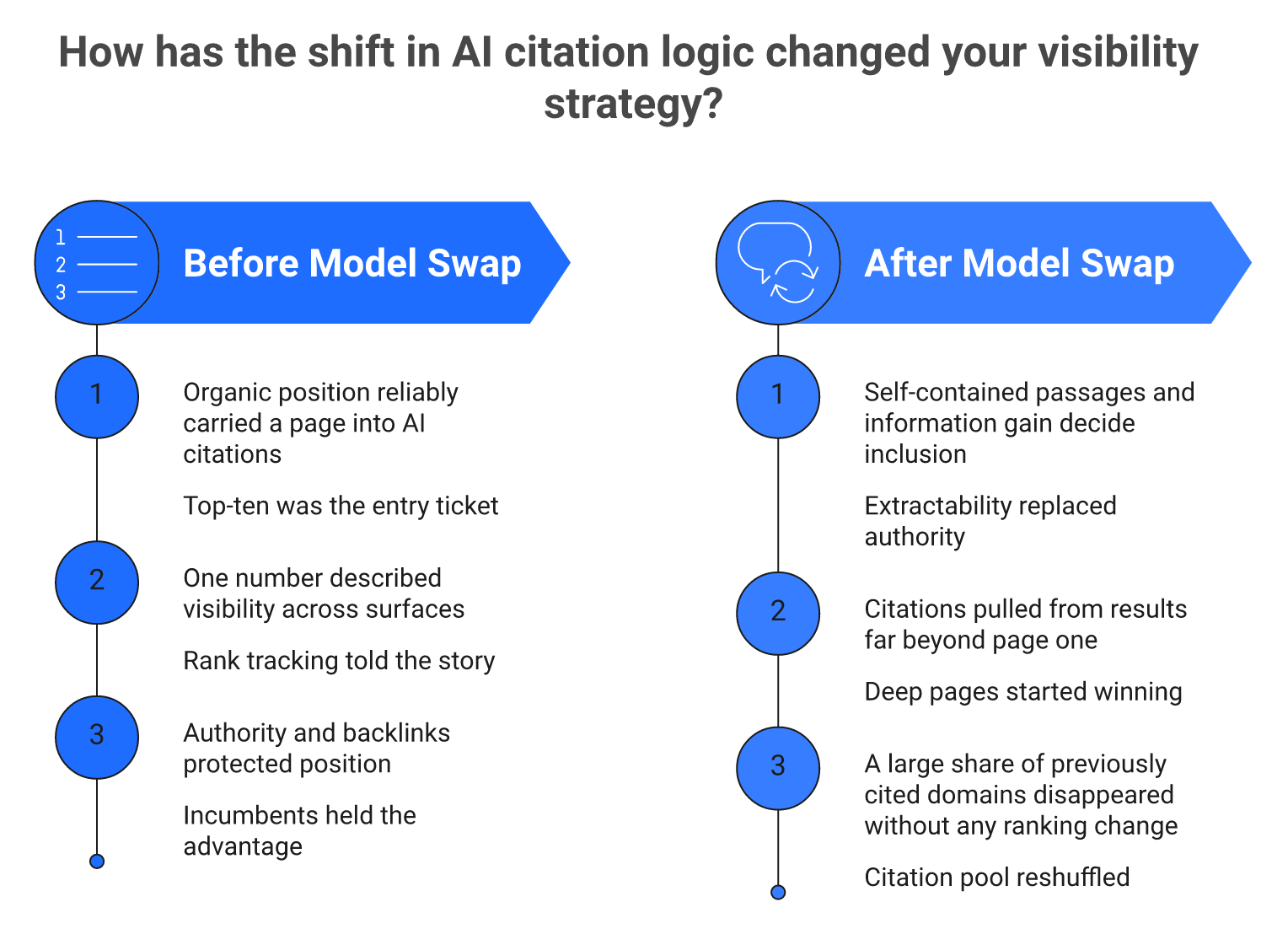
On 27 January 2026, Gemini 3 became the default model behind Google's AI Overviews, and 42.4% of previously cited domains dropped out. Reliance on top-10 organic results collapsed from roughly 76% to 38%, with about 31% of citations pulled from positions beyond 100. Ranking stopped being a reliable entry ticket to citation. Extractability and information gain replaced it.
⚠️ A model swap, not an algorithm update
Every SEO knows how to respond to a core update. You wait, you diagnose, you adjust. This was different in kind.
Google did not change ranking rules. It changed the model doing the reading, and 42.4% of cited domains vanished from AI Overviews. Their Google rankings did not move.
❌ The 76 to 38 collapse
Before the rollout, a top-10 organic position was a dependable ticket into AI citations, overlapping around 76% of the time. After, that fell to roughly 38%.
More striking: about 31% of citations came from pages ranking beyond position 100. Content that Google would not show a human on page ten was good enough to answer a question.
📊 What changed in the pipeline
The mechanism sits in how grounding gets triggered. Gemini uses a prediction score to decide whether searching the web will improve the answer, with a documented default threshold of 0.3.
Below that threshold, the model answers from memory and cites nothing. Above it, retrieval runs and the selection happens at passage level, not domain level. Your rank never enters that decision directly.
⭐ Why this vindicates the data science framing
MaximusLabs AI's position has been that GEO is a retrieval problem, not a content-formatting problem, and 27 January 2026 is the cleanest evidence available. A single model deployment rewrote visibility overnight, with no crawl, no reindex, and no penalty.
I will say plainly what the category avoids saying. If your GEO provider cannot explain how retrieval and grounding work, they cannot explain what happened to you that week.
✅ Track citation share, separately from rank
The practical response is a reporting split, and it costs nothing but discipline.
- Keep your rank tracker. It still measures a real, if narrower, channel.
- Add a citation tracker across ChatGPT, Perplexity, Gemini, Copilot, and AI Overviews.
- Never average the two into one health score, because they now move independently.
- Re-baseline after every major model release, not every core update.
Ask MaximusLabs AI to run share-of-voice measurement across thousands of question variants rather than a fixed keyword list, since variant coverage is what exposes model-level shifts early.
⏰ What I would do this week
Pull the list of URLs that were cited in AI Overviews before late January 2026 and are not cited now. Compare them against pages that survived.
In our audits, survivors share one trait: self-contained passages that answer a specific question without needing the rest of the page. That is a writing problem, not a technical one.
MaximusLabs AI tracks share of voice across question variants precisely because events like the Gemini 3 rollout turn a single rank position into a lagging indicator, and lagging indicators are how teams discover a problem one quarter late.
Q8. How Did the Unit of Retrieval Shift From Pages to Evidence Objects?
Publishers still think in pages. Briefs get written per page, budgets get approved per page, and success gets measured per page. Machines stopped reading that way.
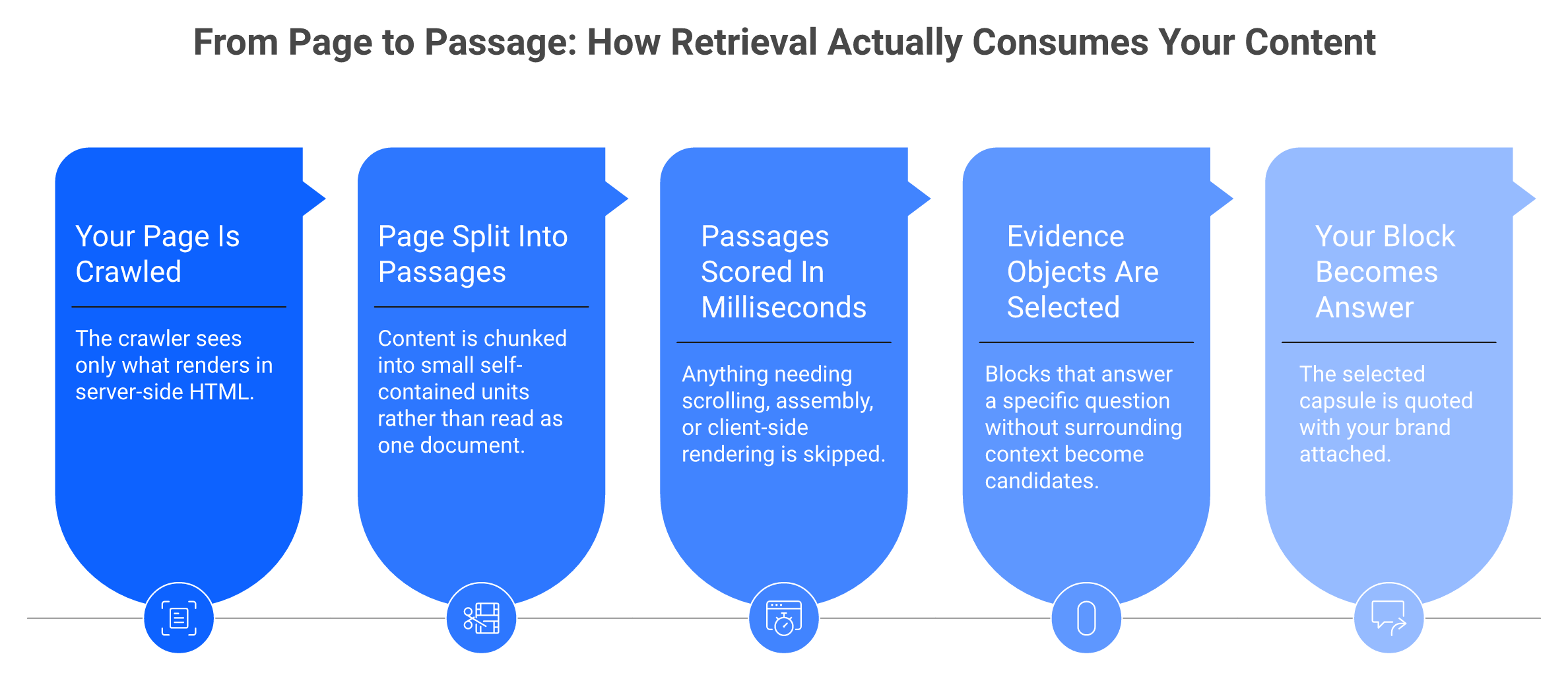
Retrieval moved from documents to passages. Microsoft Web IQ, launched June 2026, industrialised passage-level grounding, treating the web as a feed of structured evidence objects rather than pages, at 164ms p95 full-pipeline latency (roughly 2.5 times faster than the nearest alternative). MaximusLabs AI writes every section to open with a 40 to 80 word answer capsule, because content that cannot be parsed that fast is excluded from the inference loop.
⏰ The complication: milliseconds decide inclusion
A 164ms p95 latency budget is not a performance stat; it is an eligibility rule. Anything that needs assembly, scrolling, or rendering to make sense gets skipped.
There is a useful way to picture it. Your website is the dining room, built for humans. Agentic systems work in the kitchen, and they only need the data feed to fulfil the order.
❌ Two ways brands hide their best content
The first way is structural. Answers spread across four paragraphs and two sections cannot be lifted as one evidence object.
The second is technical. Turn JavaScript off and load your product page. Reviews, specification tables, and filter attributes often disappear, which means crawlers never saw them.
MaximusLabs AI audits this with the crudest possible test, a browser toggle, and we still find billion-dollar sites hiding their strongest trust signals behind client-side rendering.
💰 The snippet became the interface
This part contradicts popular advice. Content is not king at the retrieval step; extractability is.
Engines routinely ground answers from short excerpts, sometimes a 150-character snippet. Your meta description is not a click-through lever any more; it is a direct input into what the model believes your page says.
✅ Write answer capsules, not paragraphs
The fix is mechanical, and any competent writer can execute it this week.
- Put a self-contained 40 to 80 word answer directly under every question heading.
- Include the entity, the number, and the date inside that block, never in a nearby one.
- Move attribute data (materials, integrations, pricing tiers, specifications) out of JavaScript filters and into text headings or FAQ lines.
- Ensure every block reads correctly with no title, no byline, and nothing above it.
MaximusLabs AI made the 40 to 80 word capsule a non-negotiable editorial standard before Web IQ existed, which was less foresight than a stubborn habit of testing what actually gets quoted.
⭐ The honest limit of this tactic
Structure gets you eligible. It does not get you chosen.
MaximusLabs AI's data suggests extractability sets the floor while trust signals and information gain decide the ceiling, though I may be drawing that line more crisply than the evidence allows. A perfectly formatted page with nothing new in it still loses.
MaximusLabs AI writes for passage-level retrieval because that is the unit engines consume, and formatting for humans while ignoring the capsule is how well-written pages end up quoted by nobody.
Q9. Why Did Trust and Earned Mentions Replace On-Page Tweaks?
Most brands respond to AI search by rewriting their About page. It feels productive. It is also the one surface the engines weight least.
Google added "Experience" to E-A-T on 15 December 2022, two weeks after ChatGPT launched, and AI engines inherited that trust vocabulary. Ahrefs' study of 75,000 brands found brand web mentions correlate most strongly with AI Overview visibility at r=0.664, ahead of on-page factors. MaximusLabs AI builds off-site mention coverage for this reason. Consensus across third-party sources now outweighs anything you publish about yourself.
⚠️ The complication: an engine invented credentials
A practitioner team watched Perplexity summarise their own article and describe them as Oxford researchers. Nobody on the team attended Oxford.
The model had not read their bio. It had assembled an identity from web-wide mentions, then filled the gaps. That is the whole mechanism, exposed by accident.
📊 What the correlation data says
Ahrefs analysed 75,000 brands and ranked the factors linked to AI Overview brand visibility. The ordering surprised a lot of technical SEOs.
| Signal | Correlation with AI visibility |
|---|---|
| Brand web mentions | r=0.664 |
| Branded search volume | r=0.334 |
| On-page and technical factors | Weaker than both above |
Their Q1 2026 benchmark went further, finding YouTube mentions the leading driver of how AI platforms surface brands.
⭐ Where the citations are actually coming from
Community and video platforms became citation engines, not just traffic sources. Practitioners saw this early in Google before it hit AI answers.
"We also see this in Google where Reddit has, I think, 5x'd or 10x'd, same with Quora, over six months ago."
Ethan Smith, CEO of Graphite Answer Engine Optimization (AEO) Is the New SEO
"It's Reddit five times."
Ethan Smith, CEO of Graphite, on the citation list for a single query Answer Engine Optimization (AEO) Is the New SEO
✅ Close the sameAs loop
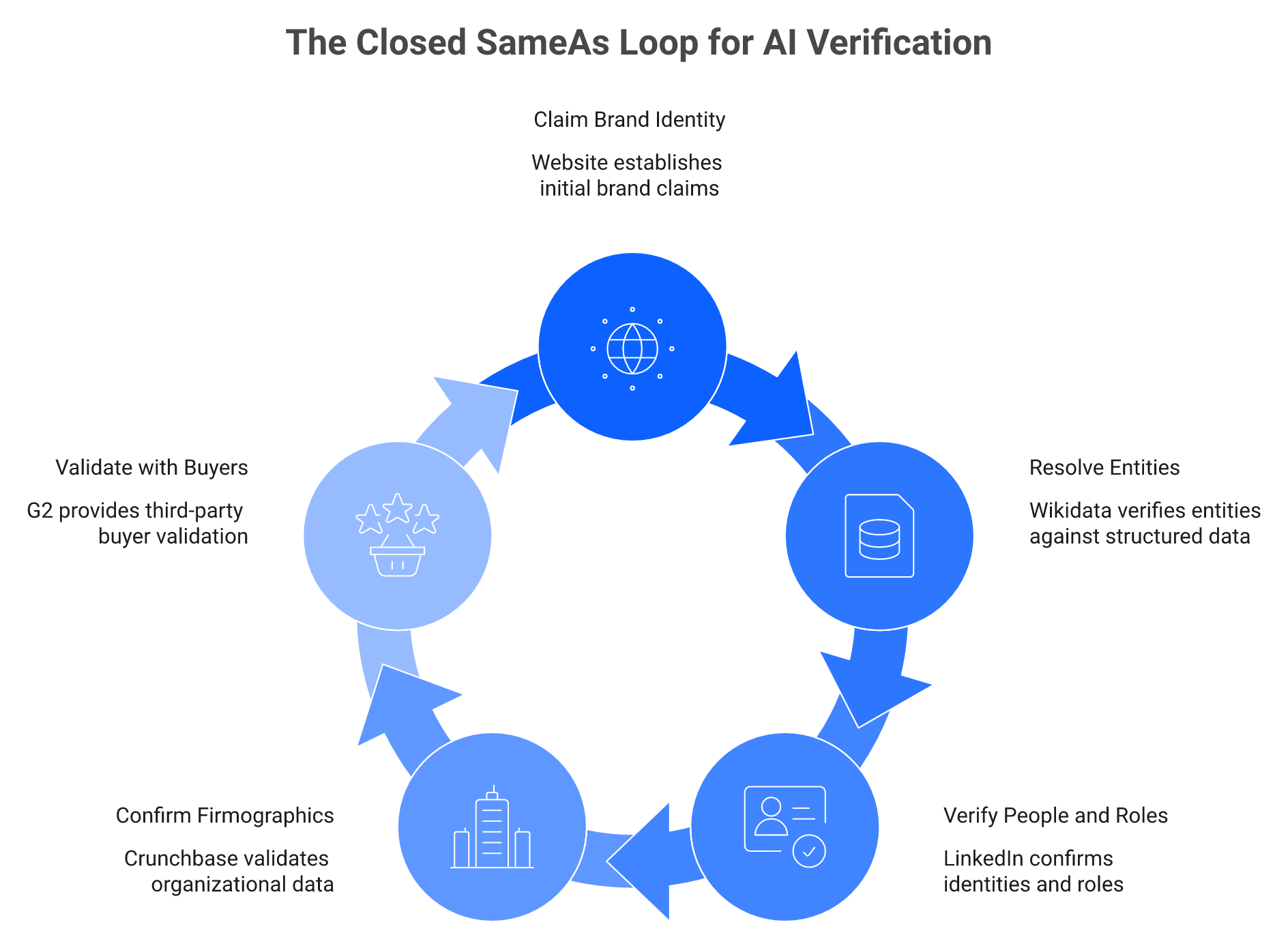
The fix is an identity graph, not a copy edit. An AI crawler should be able to walk a closed circuit and verify you at every stop.
The target path: your website, then Wikidata, then LinkedIn, then Crunchbase, then G2, then back to your website, all connected by sameAs links. Every broken hop is a place where a model guesses.
MaximusLabs AI's off-page programme targets ten or more reviews each on G2, Capterra, and Gartner Peer Insights, plus placements on the specific Reddit and YouTube URLs that already get cited in your category. We prioritise the URL, not the domain.
💰 The part the category avoids saying
MaximusLabs AI's read is that on-page GEO checklists sell well because they are cheap to deliver and easy to screenshot. Earned mentions are slower, harder, and where the correlation actually sits.
Krishna's framing is blunter than mine. Build a real brand in your space, and AI has to recommend you, whichever model ships next quarter.
MaximusLabs AI calls this Search Everywhere Optimization: review profiles, cited community threads, LinkedIn, and YouTube presence, built so mentions exist wherever the model looks. It is the least glamorous work we do, and the r=0.664 figure explains why we keep doing it.
Q10. Which Technical Standards Emerged for AI Discoverability, and Which Ones Actually Work?
llms.txt was proposed by Jeremy Howard of Answer.AI on 3 September 2024. It is a proposal, not a ratified standard, with no W3C involvement, and as of 15 June 2026 Google states llms.txt files are not required for Google Search. What demonstrably matters instead: AI crawler access, server-rendered HTML, and validated Article, Organization, and Person schema.
❌ The myth currently ranking on page one
Several widely read GEO explainers describe llms.txt as a W3C standard adopted in 2025. That is wrong on both counts.
The specification lives in a public GitHub repository from Answer.AI. It defines a root-level Markdown file with a title, a summary blockquote, and curated link lists. Adoption by major providers remains unconfirmed, and Google has said explicitly that it is not needed for Search.
⚠️ The schema argument is genuinely unsettled
Here the honest answer is that practitioners disagree, and I am not going to pretend otherwise.
- One camp treats structured data as a hygiene factor at best, useful but not a differentiator.
- Another treats it as a real inclusion lever, since schema tells engines exactly what a page is about.
- Both are arguing from field observation, not from a controlled study.
MaximusLabs AI marks this as an open experiment rather than settled doctrine, and we still implement schema because the downside cost is close to zero.
💸 The audit that produces work but not citations
There is a version of technical AEO that generates a fifty-page PDF and no measurable citation gain. Page-speed-led audits are the usual culprit.
One veteran practitioner put the point sharply, noting that in fifteen years he has never seen Core Web Vitals drive a traffic increase. I would soften that slightly for very slow sites. The broader point holds: extractability beats milliseconds.
✅ The checklist that actually moves citations
Fix these five things before buying any standards-flavoured product.
- Unblock GPTbot, oi-searchbot, PerplexityBot, and Google-Extended in robots.txt, unless you have a legal reason not to.
- Confirm business-critical content renders in server-side HTML, not client-side JavaScript.
- Validate Article, Organization, and Person schema, with author credentials attached.
- Check for accidental nosnippet, max-snippet, or no-preview directives suppressing you from AI features.
- Pull attribute data out of JavaScript filters and into text headings or FAQ lines.
MaximusLabs AI does not sell llms.txt packages, because the evidence does not support charging for one. Our technical sprint covers crawler access, JavaScript minimisation, semantic HTML, and schema validation instead.
⭐ Why vendors keep selling the wrong thing
MaximusLabs AI's position is that technical deliverables sell well because they are finite, visible, and easy to invoice. Trust and extractability work is messier, so it gets deprioritised.
That is a business incentive problem, not a knowledge problem. Ask any provider which of their technical recommendations has a measured citation outcome attached.
MaximusLabs AI treats technical work as the entry fee rather than the product, which is why our audits end with a five-item fix list instead of a fifty-page report nobody implements.
Q11. Which Predictions About This Shift Were Wrong, and What Is Still Unresolved?
In February 2024, Gartner gave the GEO category its founding statistic. Every deck since has quoted it. Almost nobody has gone back to check it.
Gartner predicted in February 2024 that traditional search engine volume would drop 25% by 2026. It did not, in aggregate. SparkToro clickstream data showed Google search grew roughly 21.6% in 2024, handling about 373 times more searches than ChatGPT, and Google still held near 89.6% global share in early 2026. Citation share collapsed. Query volume did not.
⏰ Why the forecast was believed
The prediction landed at the perfect moment. ChatGPT was fifteen months old, AI Overviews had not launched, and nobody had counterfactual data.
It also flattered everyone selling AI services, including agencies. A scary number is easier to sell than a nuanced one.
📊 The scorecard
| Prediction | Source, year | Verdict | What actually happened |
|---|---|---|---|
| Search volume drops 25% by 2026 | Gartner, Feb 2024 | Wrong in aggregate | Google search volume grew, share held near 89.6% |
| AI chat replaces Google | Popular commentary, 2023 | Wrong | The search pie expanded rather than shifted |
| Top-10 rank guarantees AI citation | SEO consensus, 2024 | Wrong by 2026 | Rank-to-citation overlap fell sharply after model updates |
| Organic CTR compresses on AI queries | Ahrefs, 2025 to 2026 | Correct | Position-one CTR fell 34.5%, then 58% |
⚠️ The reconciliation nobody publishes
Both datasets are right, which is the actual insight. AI traffic grew 66% in 2025, from 462 million to 767 million monthly visits, yet stayed under 0.15% of total web visits.
Meanwhile top-ranking pages lost 58% of their clicks. Influence migrated years ahead of volume. That is the sentence to take into your planning meeting.
"What's happening is the pie of search is getting larger, and Google's slice is the same size slice forever."
Ethan Smith, CEO of Graphite Answer Engine Optimization (AEO) Is the New SEO
❌ What is still genuinely contested
I would not bet a budget on any of these yet.
- Whether schema materially lifts citation odds, or merely prevents misreading.
- Whether ads inside answer engines will crowd out organic citations or coexist with them.
- Whether AI referral conversion advantages hold at scale, or reflect small, self-selected samples.
MaximusLabs AI labels claims like these as experiment candidates in our research files, and flags secondary sources explicitly rather than laundering them into facts.
💰 What to budget against instead
Forget the headline forecast. Pull 24 months of Search Console data for your top fifty keywords and calculate your own CTR delta.
That single number tells you your real exposure. Ask MaximusLabs AI to run it alongside a citation baseline if you want both halves of the picture in one view.
MaximusLabs AI publishes what it cannot yet prove as open questions, because the category's credibility problem started with confident numbers nobody revisited, and buyers have gotten very good at checking.
Q12. How Did Measurement Evolve, and What Does the Next Era Demand?
Measurement evolved from rank position, to impressions and CTR in Search Console, to AI Overview blindness where citations report as google / organic or no referrer, to share of voice across thousands of question variants, to pipeline attribution. MaximusLabs AI now reports share of voice and pipeline influence together. The forward risk is monetisation: OpenAI began testing advertising inside ChatGPT in January 2026, and agentic commerce fulfils orders from data feeds without visiting your site.
📊 Why your dashboards cannot see AI
This is the practical problem behind every "is GEO working?" conversation. Search Console shows no AI Overview impressions, citations, or clicks as a separate dimension.
AI Overview clicks fold into google / organic. Some assistant referrals arrive with no referrer at all. You are measuring a channel through a keyhole.
⏰ The commercialisation arc, in four steps
The tooling market grew in a predictable sequence, and knowing the sequence tells you what to buy.
- 2023 to 2024: agencies packaged GEO as a service, mostly repackaged content work.
- Early 2025: visibility trackers appeared, dozens of them, with near-identical feature sets.
- Through 2026: the market diversified into enterprise platforms and specialist tools.
- January 2026: OpenAI began testing ads in ChatGPT, adding a paid layer to the answer.
"There's like 50 different tracking companies right now."
Ethan Smith, CEO of Graphite Answer Engine Optimization (AEO) Is the New SEO
MaximusLabs AI measures share of voice across question variants rather than a fixed keyword list, since variant coverage is what exposes model shifts before revenue notices.
💰 Why a sub-1% channel still deserves budget
The volume argument misses the conversion asymmetry. AI-referred visitors arrive pre-sold, because the model already did the shortlisting.
Our reading puts the conversion gap near 6x against traditional search traffic, though I would treat that as directional rather than settled. A channel worth 0.15% of visits can still carry double-digit pipeline share.
⭐ Models, agents, and what changes next
Picture a world-class chef in an empty room. That is a model: capable, with nothing to act on.
Give the chef a kitchen, suppliers, and a notebook, and you have an agent. APIs are the hands, memory is the notebook. Agents will read your data feed and never load your dining room.
MaximusLabs AI is already building for that shift, on the same premise that made Nidra Goods rank first simultaneously on Google, ChatGPT, and Perplexity for "best sleep mask" from a single strategy.
✅ Your Monday reporting change
Build a custom channel group in GA4 for AI referrers: ChatGPT, Perplexity, Copilot, Gemini, and Claude. Then report it against opportunities created, not sessions.
Add one field to your demo form: "How did you hear about us?" It remains the cheapest AI attribution instrument available.
MaximusLabs AI reports pipeline influence alongside citation share because the brands that got this right in 2025 were the ones who stopped defending pageviews and started defending revenue.
🔭 What I am sitting with
My working hypothesis is that GEO becomes ten times more important in two years, and stops being about search entirely. It becomes about what AI systems believe regarding your brand, across chat, agents, and commerce.
The open question I cannot answer yet: when ads arrive properly inside answer engines, does earned citation get more valuable or less? If you have data pointing either way, I genuinely want to see it. krishna@maximuslabs.ai
Frequently asked questions
When did Generative Engine Optimization actually begin, and who coined the term?
GEO was formally named on 16 November 2023 , when the paper GEO: Generative Engine Optimization (arXiv:2311.09735) was posted by Pranjal Aggarwal, Vishvak Murahari, Tanmay Rajpurohit, Ashwin Kalyan, Karthik Narasimhan, and Ameet Deshpande. It was later presented at ACM SIGKDD 2024 in Barcelona. Several widely read explainers claim GEO was founded in 2024 by an agency. That conflates two separate events: Coinage: a peer-reviewed academic paper defining the term and the benchmark. Commercialisation: agencies packaging GEO as a paid service through 2023 and 2024. The distinction matters commercially. When finance asks whether GEO is a real category or agency marketing, a paper presented at SIGKDD survives that question and a vendor claim does not. MaximusLabs AI traces every claim back to the original paper, patent, or platform changelog before it reaches a client deck, never to the blog that summarised it. Our source hierarchy is fixed: academic papers, then patents, then official documentation, then original datasets, with secondary sources last and labelled as such. If you want the origin story alongside the mechanics, start with our explainer on what GEO actually is .
How is GEO different from AEO and traditional SEO?
The three disciplines compete for different units of visibility. SEO competes for a position in a ranked list. AEO competes to be the direct answer to one question. GEO competes to be the source a model synthesises from, across thousands of question variants and several platforms at once. SEO metric: rank, clicks, and click-through rate. AEO metric: answer capture rate on question-level queries. GEO metric: share of voice and pipeline influence across ChatGPT, Perplexity, Gemini, Copilot, and AI Overviews. In practice AEO sits inside GEO rather than beside it. Both differ from SEO because the failure mode changes: page two is a bad outcome, but absence from an AI shortlist means you are not in the buyer's evaluation set at all. MaximusLabs AI measures visibility per platform rather than treating AI as one channel, because what ChatGPT weights is not what Gemini or Perplexity weight. We run separate prompt sets per engine and track which URLs each one actually pulls. Our side-by-side comparison of GEO and traditional SEO breaks the levers down factor by factor.
What did the Princeton GEO paper actually prove?
The paper tested nine optimization strategies across roughly 10,000 queries using a benchmark called GEO-bench. Citing sources, adding quotations, and adding statistics lifted visibility inside generated answers by 30% to 40%. The most commercially important finding was an asymmetry. Adding cited sources raised visibility 115.1% for a site ranked fifth in search, while the top-ranked site's visibility fell 30.3% . Keyword stuffing produced negligible or negative results. Three implications follow directly: Being number one on Google offers no protection inside an AI answer. Challenger brands gain more from GEO work than incumbents do. Information gain matters more than domain authority at the retrieval step. MaximusLabs AI saw the same redistribution commercially with Oliv AI, which reached a 64% citation rate across AI platforms in six months while decade-old competitors sat near 30%. Those competitors had more backlinks and more budget; they did not have better answer capsules. The full engagement detail sits in our Oliv AI case study , and the tactical version lives in our GEO content optimisation guide .
Did AI Overviews really reduce organic click-through rates?
Yes, and the effect has been measured twice with the same methodology. Ahrefs analysed 300,000 keywords using Search Console data and reported a 34.5% decline in position-one click-through rate in April 2025, then re-ran the study on December 2025 data and found a 58% decline. Behavioural data points the same way. Pew Research found that in March 2025, users who saw a Google AI summary clicked a result on 8% of searches, versus 15% for users who did not see one, and only 1% clicked a link inside the summary itself. Two practical notes: The damage concentrates on non-branded informational queries, not branded or high-intent ones. This is a curve rather than a cliff, which means it can be forecast. MaximusLabs AI reports pipeline influence instead of impressions, because a 58% click loss makes a traffic dashboard a flattering way to lose money. We tag content by funnel stage and ICP fit, then report opportunities created. Our breakdown of AI search click-through rates shows how to segment your own keyword set before re-forecasting.
Is llms.txt an official standard for AI search?
No. llms.txt is a proposal published by Jeremy Howard of Answer.AI on 3 September 2024 . There is no W3C involvement, and as of 15 June 2026 Google states that llms.txt files are not required for Google Search. Adoption by major AI providers remains unconfirmed. The specification describes a root-level Markdown file with a title, a summary blockquote, and curated link lists. It is a sensible idea. It is not a ratified standard, and several ranking GEO explainers misattribute it. What demonstrably matters instead: Unblocking GPTbot, oi-searchbot, PerplexityBot, and Google-Extended in robots.txt. Confirming business-critical content renders in server-side HTML, not client-side JavaScript. Validating Article, Organization, and Person schema with author credentials attached. Checking for accidental nosnippet, max-snippet, or no-preview directives. MaximusLabs AI does not sell llms.txt packages, because the evidence does not support charging for one. Our technical sprint covers crawler access, JavaScript minimisation, semantic HTML, and schema validation instead. If you want the file anyway, use our free llms.txt generator and read the honest adoption status before you budget for it.
Did Gartner's prediction that search volume would drop 25% by 2026 come true?
Not in aggregate. Gartner predicted in February 2024 that traditional search engine volume would fall 25% by 2026. SparkToro clickstream analysis showed Google search grew roughly 21.6% in 2024, handling about 373 times more searches than ChatGPT, and Google still held near 89.6% global share in early 2026. The forecast failed on volume while being directionally right about something else. AI traffic grew 66% in 2025, from 462 million to 767 million monthly visits, yet stayed under 0.15% of total web visits. Meanwhile top-ranking pages lost 58% of their clicks. The reconciliation is the real insight: influence migrated years ahead of volume . Citation share collapsed; query volume did not. Three things remain genuinely contested, and we would not bet a budget on any of them yet: Whether schema materially lifts citation odds or merely prevents misreading. Whether ads inside answer engines crowd out organic citations. Whether AI referral conversion advantages hold at scale. MaximusLabs AI labels claims like these as experiment candidates rather than shipping them as facts. Budget against your own measured click-through delta instead, using the benchmarks in our 2026 GEO budget report .
How should we measure GEO performance if rankings no longer predict citations?
Measure share of voice and pipeline, not position. Rank stopped predicting citation reliably after the Gemini 3 rollout on 27 January 2026, when 42.4% of previously cited domains dropped out of AI Overviews and top-10 reliance fell from roughly 76% to 38%. The reporting problem is real: Search Console exposes no AI Overview impressions or citations as a separate dimension, AI Overview clicks fold into google / organic, and some assistant referrals arrive with no referrer at all. A workable measurement stack looks like this: Keep rank tracking, but treat it as one narrower channel. Add citation tracking across ChatGPT, Perplexity, Gemini, Copilot, and AI Overviews. Build a GA4 custom channel group for AI referrers and report it against opportunities created, not sessions. Add a single self-reported attribution field to your demo form. Re-baseline after every major model release, not every core update. MaximusLabs AI measures share of voice across thousands of question variants rather than a fixed keyword list, because variant coverage exposes model-level shifts before revenue notices. Our GEO measurement framework sets the baselines, and you can talk to us if you want yours built this quarter.