 Krishna Kaanth M
- Amazon Rufus is a generative-AI shopping assistant that answers natural-language questions, compares products, summarizes reviews, tracks price history, and can auto-buy or buy from non-Amazon merchants.
- Rufus does not keyword-match; it uses a custom LLM with retrieval-augmented generation, reading your product text, structured attributes, and reviews rather than your JavaScript filters.
- Rufus reads a structured product feed with fields like GTIN, dimensions, price, reviews, and performance signals such as popularity_score and an is_eligible_search gate.
- Earned trust wins; web-wide consensus across reviews, community Q&A, and third-party mentions outweighs self-published product copy in what Rufus surfaces.
- Rufus, Alexa, ChatGPT, Perplexity, and Gemini share one retrieve-then-summarize mechanic, so Search Everywhere Optimization compounds across every engine at once.
- Rufus is moving from advisor to agent, so brands should complete their feed and earn trust signals now to prepare for agentic commerce.
Q1: What Is Amazon Rufus and What Can the AI Shopping Assistant Actually Do?
A founder I spoke with last month typed "best travel stroller for tall parents" into the Amazon app. Rufus named three products in one paragraph. Her brand, which ranks well on Google, was not one of them. That is the new shelf.
🛒 What Rufus Is and How You Open It
Amazon Rufus is a generative-AI conversational shopping assistant inside the Amazon app and desktop, opened via the chat-and-sparkle icon or voice. It answers natural-language questions instead of matching keywords. It recommends products, compares similar items, summarizes reviews and customer Q&A, shows 30- and 90-day price history, sets price alerts and agentic Auto-Buy, personalizes suggestions from your history, transcribes handwritten lists, uploads images, and buys from select non-Amazon merchants via Buy For Me.
You reach it in a few ways. Tap the icon in the app. Use it on desktop. Or ask by voice. The point stays simple. You ask a real question, and Rufus answers in plain language.
⭐ The Full Capability Set, Grouped Three Ways
The features sort cleanly into three jobs a buyer does.
- Discovery: product recommendations, side-by-side comparisons, and summaries of reviews and community Q&A.
- Decision: 30- and 90-day price history, price alerts, and personalization drawn from your shopping history.
- Agentic action: Auto-Buy at a target price, Buy For Me from select non-Amazon stores, handwriting transcription, and image upload.
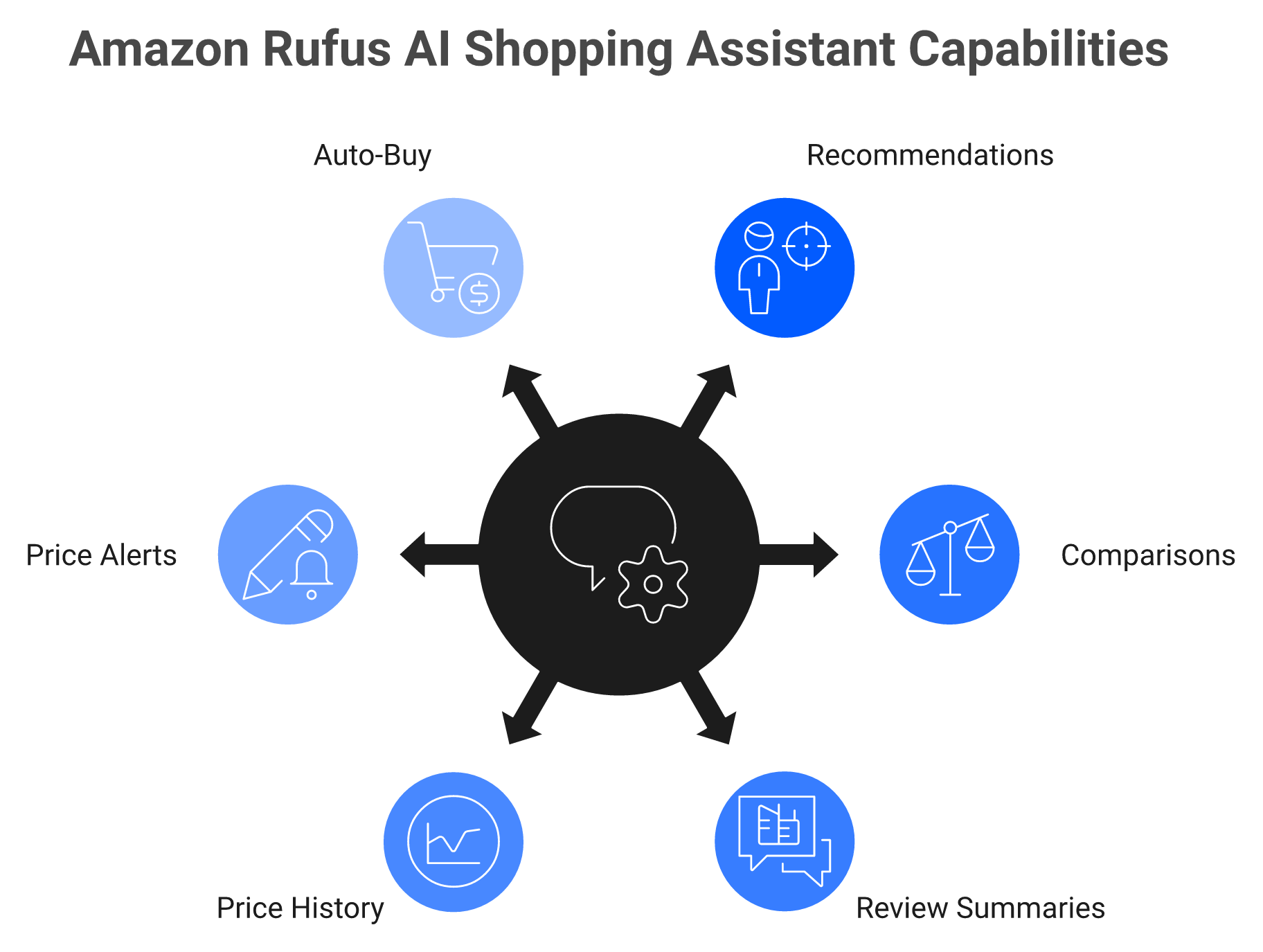
That third group matters most. Rufus is moving from advisor to actor. It does not just suggest. It can buy.
💰 Why This Is a Revenue Surface, Not a Gadget
Here is the part most brand teams miss. Rufus has no page two. You are the synthesized recommendation, or you are invisible. It works the same way John does when he opens ChatGPT or Perplexity, asks for the top tools, and gets a curated list of ten to fifteen names. That list becomes the whole consideration set.
The scale makes it real. Rufus reached over 250 million users, and Amazon reports users are 60% more likely to purchase after engaging with it. That is not a novelty. That is a buying surface.
From what surfaces when you actually run this, Rufus is the same retrieval pattern we already optimize for at MaximusLabs across ChatGPT optimization and Perplexity optimization, wearing an Amazon skin. Win the pattern once, and the Amazon shelf follows.
Q2: How Does Amazon Rufus Search? The RAG Mechanic Behind Every Answer
Most explainers stop at "Rufus is AI." That is the shallow read. The interesting question is what happens between your question and its answer, because that gap is where you win or lose the recommendation.
🔍 The Plain-Language Answer
Rufus does not keyword-match. It uses a custom Amazon large language model with retrieval-augmented generation, or RAG, which means the AI retrieves real data first, then writes the answer. It interprets your natural-language question, pulls relevant data from Amazon's product catalog, customer reviews, community Q&A, and the open web, then synthesizes one direct answer. Practically, Rufus reads your product text, reviews, and structured attributes, not your JavaScript filters, and surfaces the products that best match the decoded intent.
⚙️ What Happens Under the Hood
Amazon Science describes Rufus as a custom-built large language model using RAG over Amazon's catalog, reviews, community Q&A, and web sources. It runs on Amazon's own AWS Trainium and Inferentia chips, which is why it can answer at Amazon's scale.
The sequence is simple to picture.
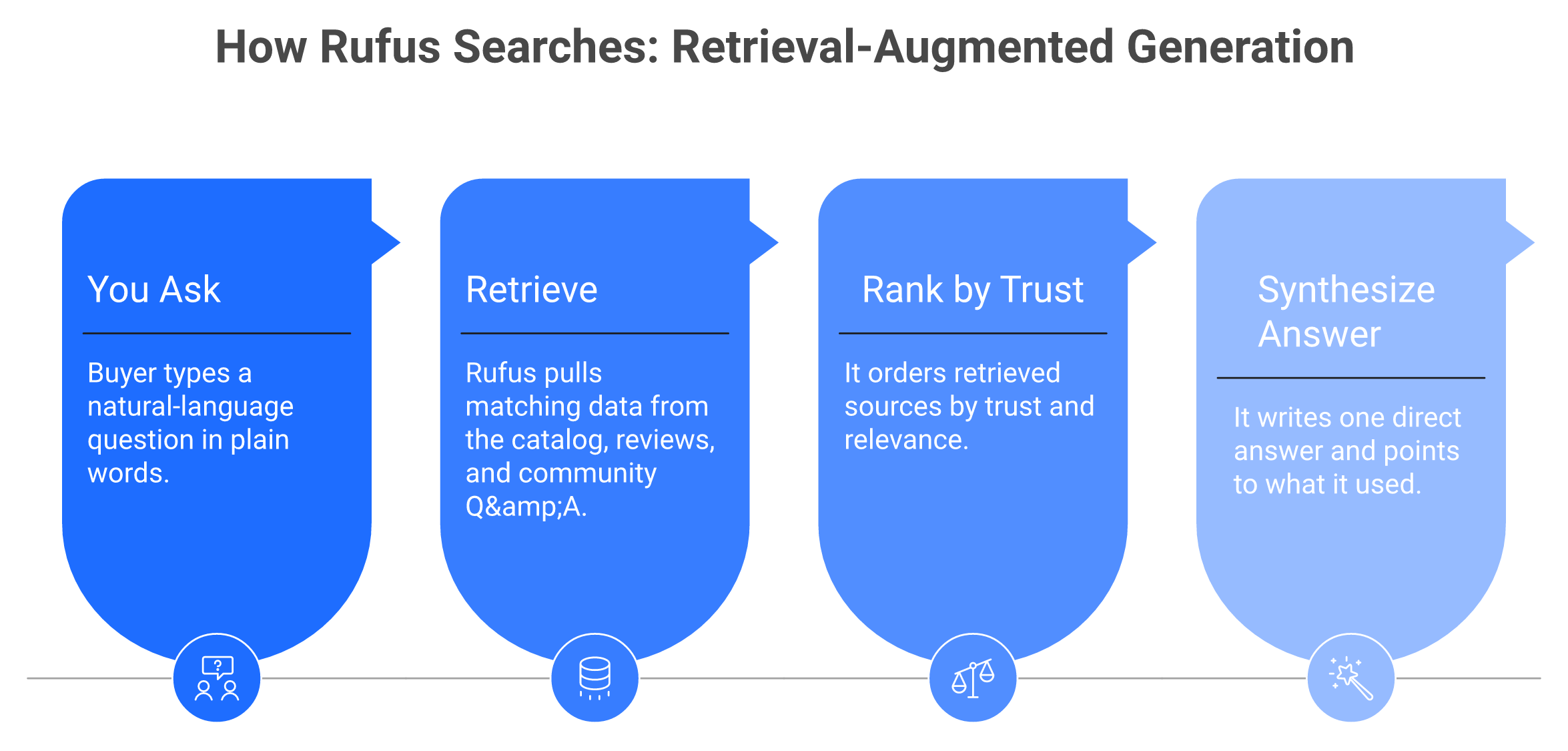
- You ask a question in plain words.
- Rufus retrieves matching data from catalog, reviews, and Q&A.
- It ranks sources by trust and relevance.
- It writes one answer and points to what it used.
🎒 The Universal Intent Decoder
Think of Rufus as a machine that translates a messy prompt into a structured spec request. "Durable bag for a wet three-day hike" becomes a hidden request for waterproof rating, capacity, and weight. Rufus then looks for products whose data answers that decoded spec.
Here is the trap. Rufus cannot click your JavaScript filters. If your fabric, closure, or waterproofing lives only inside a facet menu, it is invisible. That metadata has to move into text headers and FAQs Rufus can actually read.
✅ The Monday Move
Pull your key attributes out of filters and write them as plain text and question-led FAQs. That single change makes your specs machine-readable, which is the heart of sound technical GEO implementation.
When we reverse-engineer retrieval at MaximusLabs, the pattern is identical across Rufus, ChatGPT, and Perplexity. Retrieve, then summarize. I might be overstating how transferable it is across every edge case, but the core mechanic holds. Win one retrieval pattern, and you win them all through disciplined generative engine optimization.
Q3: What Data Does Rufus Read to Decide Which Products to Recommend?
Here is a claim most agencies quietly avoid, because it exposes how little of their work touches it. Rufus does not read your clever copy first. It reads a structured feed. The machine reads a spreadsheet before it reads a sentence.
📋 The Feed, Named in Full
Rufus-style systems read a structured product feed, not marketing fluff. That feed includes ID, GTIN, MPN, title, description, condition, category, brand, material, dimensions, weight, age group, price and promotions, availability, variants, fulfillment, returns, compliance, and reviews and Q&A. It also reads optional performance signals like popularity_score (0 to 5) and return_rate (0 to 100%), gated by an is_eligible_search boolean. Clean, complete, machine-readable data is what earns a recommendation.
🗂️ How the Fields Group
The long list gets manageable when you sort it by job.
| Field group | What it includes | Why it matters |
|---|---|---|
| Identity | ID, GTIN, MPN, brand, title | Lets Rufus know exactly what the product is |
| Physical attributes | Material, dimensions, weight, age group, variants | Answers spec-level buyer questions |
| Commercial | Price, promotions, availability, fulfillment, returns | Confirms the item is buyable now |
| Trust | Reviews and community Q&A | Supplies earned consensus |
| Performance signals | popularity_score, return_rate | Ranks eligible products against each other |
🚪 The Gate Nobody Talks About
Two performance signals do quiet heavy lifting. A popularity_score from 0 to 5 and a return_rate from 0 to 100% help the system sort winners from also-rans. Both sit behind an is_eligible_search boolean, a simple true-or-false gate that decides whether your product can surface at all.
That gate is the point. A brilliant description on a product flagged ineligible never gets read. The standard read gets this backwards, obsessing over prose while the machine checks a flag. Getting the fundamentals right starts with proper schema markup basics.
🛠️ The Monday Action
Before you rewrite a single headline, audit feed completeness. Fill every attribute. Confirm eligibility. Then optimize the words. This is where a rigorous technical SEO and website audit earns its keep. Anyone vague about AI commerce cannot name is_eligible_search, and that specificity is the whole difference between real optimization and dashboard theater.
Q4: Why Are Reviews and Community Q&A the Real Ranking Signals for Rufus?
Situation. Most brands treat the product description page as the lever. They rewrite the title, polish the bullets, and wait for Rufus to notice. It feels productive. It rarely moves the recommendation.
🧩 The Complication: The Oxford Hallucination
Here is what actually happens. Rufus weights web-wide consensus over your own marketing copy. Because it retrieves from reviews, community Q&A, and the open web, the products mentioned most across trusted third-party sources tend to surface first. Self-published claims carry little weight. Earned mentions carry most. Depth and quality of reviews, answered questions, and off-site mentions do more for Rufus visibility than another rewrite of your product description.
We watched this directly. Perplexity once described our team as "Oxford researchers." Nobody claimed that. The agent simply repeated what the web mentioned most, and the most-mentioned thing rose to the top. The lesson is uncomfortable and useful. The agent rewards mentions, not claims.
Krishna's version of this is blunt. "If you build a brand in your space, then AI has to recommend you". Consensus beats self-published copy every time.
✅ The Resolution: Earn Mentions, Do Not Assert Them
If mentions win, then the work shifts off your own site. That is a different job than classic Google SEO, which optimizes the page you control. Here trust lives across the web, which is the core of durable answer engine optimization.
- Build review depth on G2, Capterra, and Trustpilot, aiming for a credible minimum, not a handful.
- Engage authentically on Reddit and forum AEO threads that AI engines already cite, adding real value rather than spam.
- Earn placements in the third-party listicles and roundups that show up as citations.
Ethan Smith's research reinforces this. In AEO, winning means being mentioned most often across citations, and even five authentic, high-quality Reddit comments can shift how often you surface.
🗺️ The Monday Action
Map which third-party URLs get cited for your category, then earn placements there. Run your buyer's questions through Rufus and other engines, note the sources they lean on, and go win those sources. A structured AI search visibility and brand mention tracking approach makes this repeatable.
A quick, honest caveat on proof. I looked for verbatim customer reviews inside our source files to quote here, and I will not invent any, because a fabricated review is exactly the kind of weak claim operators screenshot and roast. When verified G2, Capterra, or Reddit-comment quotes are available, they belong in this section as living evidence.
This is precisely the work we run at MaximusLabs as Search Everywhere Optimization and Review Platform Optimization, engineering earned presence across G2, Capterra, Reddit, and Quora so the consensus points at you. Rufus then has little choice but to name you.
Q5: Rufus vs. Alexa vs. ChatGPT Shopping: How Do the AI Assistants Differ?
People keep asking if Rufus is just Alexa with a new coat of paint. It is not, and the mix-up costs brands real strategy time.
🤖 The Short Answer
Rufus is a shopping-specific assistant trained on Amazon's catalog, reviews, and Q&A. Alexa is a general voice assistant for tasks, media, and smart home. ChatGPT, Perplexity, and Gemini are open-web answer engines that also recommend products. They share one mechanic, retrieve then synthesize, so the same trust-first, structured-data optimization that wins Rufus recommendations also wins citations across every AI engine your buyers use.
🔀 How the Four Assistants Compare
The differences are clearest side by side.
| Assistant | Scope | Data source | Buyer touchpoint |
|---|---|---|---|
| Rufus | Shopping only | Amazon catalog, reviews, Q&A | Inside the Amazon store |
| Alexa | General tasks | Device skills, media, smart home | Voice, at home |
| ChatGPT | Open-web answers | Web plus Bing index | Research and shortlisting |
| Perplexity / Gemini | Open-web answers | Live web retrieval | Comparison and buying intent |
Alexa runs your home. Rufus runs your cart. The open-web engines shape the shortlist before a buyer ever reaches Amazon.
🧭 One Pattern, Many Surfaces
Here is the insight that saves you from chasing each platform separately. They all retrieve sources, then summarize them into one answer. Semrush's study of AI Overviews shows these answers are expanding into commercial and navigational queries, the exact buying-intent territory Rufus owns.
So the smart move is not four separate playbooks. It is one retrieval pattern optimized once. Structured data and earned trust travel across all of them, whether you invest in ChatGPT optimization or Perplexity optimization.
This is precisely why we built our work at MaximusLabs around Search Everywhere Optimization, a 360-degree brand presence across ChatGPT, Perplexity, Gemini, Google, and Rufus, not a single channel. Optimize the pattern, and every surface follows, which is the whole promise of answer engine optimization.
Q6: What Does Rufus Mean for Brands? From Ranking on Google to Becoming the Answer
Situation. For fifteen years, brands built pipeline on one bet. Rank on Google, earn the click, convert the visitor. Whole teams and budgets were organized around that blue link.
📉 The Complication: The Click Economy Is Compressing
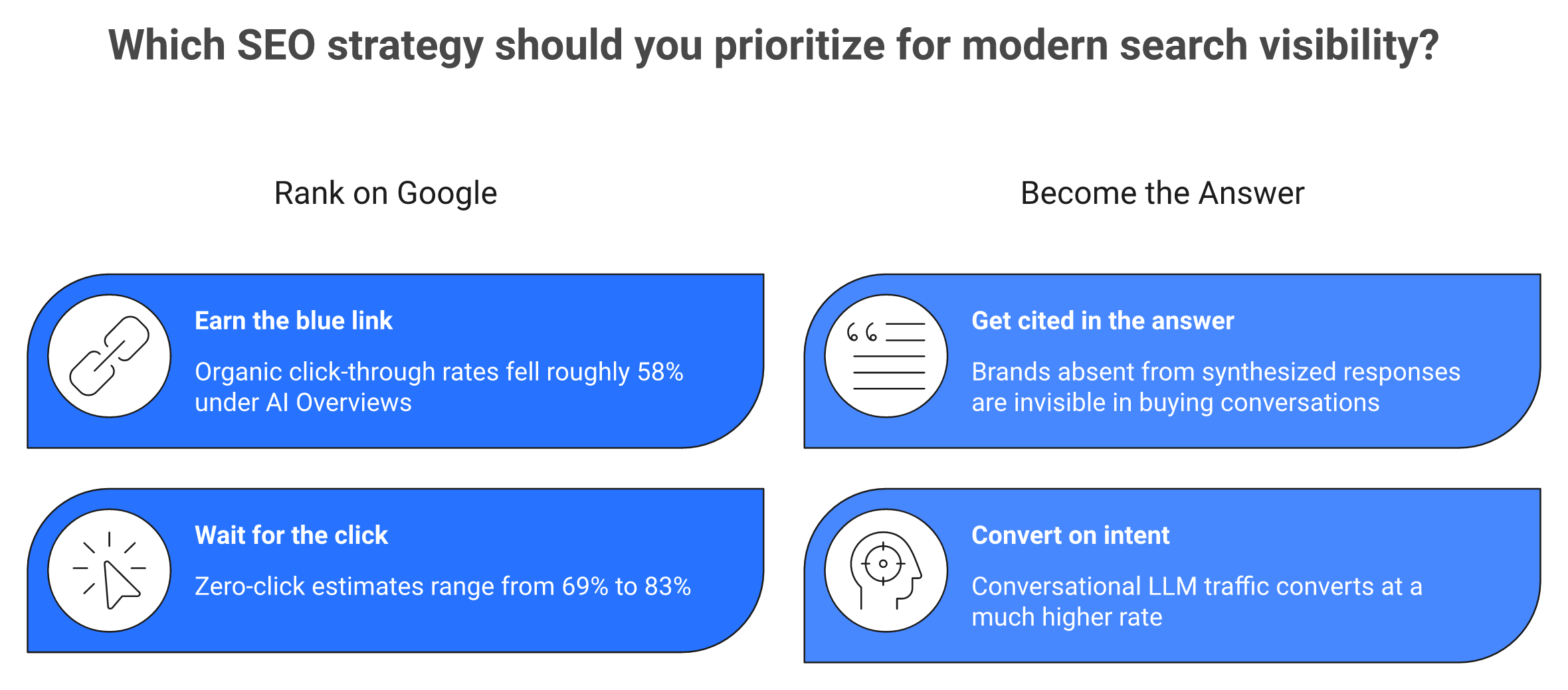
That bet is quietly breaking. Rufus previews how all buying decisions are moving inside AI answers. When the assistant synthesizes one recommendation, ranking a blue link no longer guarantees clicks. AI Overviews already cut the number-one organic click-through rate by roughly 58%. Most searches now end without a click at all, with zero-click estimates ranging from about 69% to 83%.
The job shifts from ranking on Google to becoming the answer the engine cites. Brands absent from the synthesized response simply do not exist in the buying conversation.
⚠️ It Is Reaching Buying-Intent Queries
This is not just informational search. Semrush's analysis shows AI answers expanding into commercial and navigational queries, the searches where buyers are ready to act. That is Rufus's home turf, and it is spreading across every engine.
As Ethan Smith puts it, "if you aren't in that initial response box, you don't exist in the buying conversation." The penalty for average has never been so severe.
✅ The Resolution: Engineer Citation, Not Just Rank
The response is not to abandon SEO. It is to build content and trust so AI engines cite you as the answer. That is generative engine optimization, and it differs from traditional SEO in one core way. AI engines select trusted sources and extract context-rich content, so the goal is to become the source, not just rank a page. If you want the full contrast, see how GEO compares against traditional SEO.
The revenue math backs the shift. Webflow saw a 6x higher conversion rate from LLM traffic compared to Google search traffic, because conversational queries build intent before the click.
💰 The New KPI
Stop reporting rank alone. Start tracking citation rate and share of voice, or how often you show up as the answer across question variants. This is the core of modern AI search visibility and brand mention tracking.
At MaximusLabs, this is the whole point of our revenue-focused, trust-first, BOFU-first methodology we call RAEO and R-GEO. We skip vanity TOFU content and build the ICP-aligned pages that get cited where buyers actually decide, an approach shaped by the shift toward a zero-click search brand economy. I might be early on the exact timeline, but the direction is not in doubt.
Q7: How Do You Optimize Your Products to Be the Answer Rufus Recommends?
Here is what we tested, not what a blog guessed. The moves that shift Rufus recommendations are boring, structural, and mostly ignored by agencies selling audits.
🛠️ The Four-Step Playbook
To become Rufus's recommendation, work in this order.
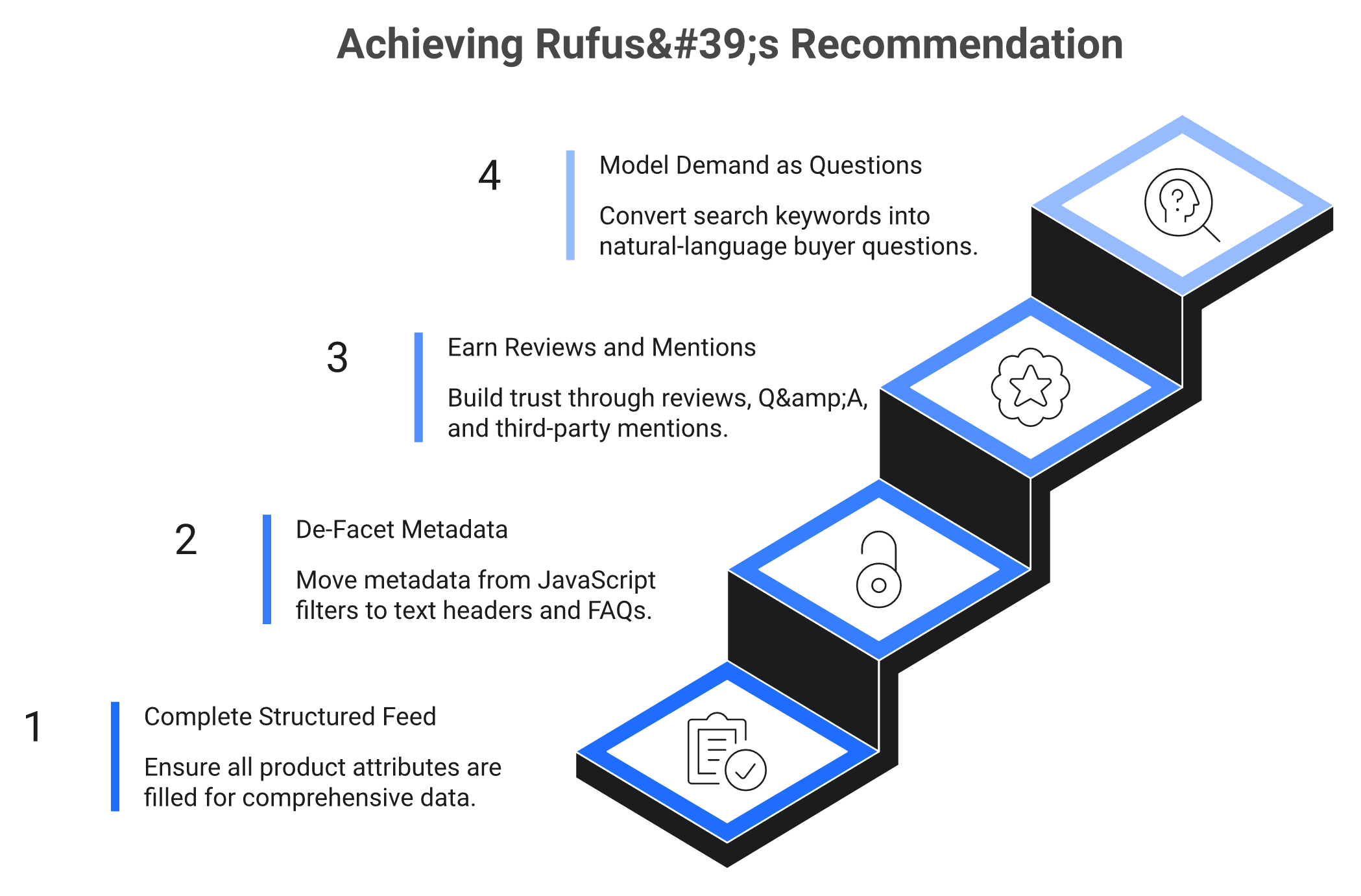
- Complete and clean your structured feed. Fill every attribute, not just title and price.
- De-facet your metadata. Move fabric, closure, neck style, and dimensions out of JavaScript filters into text headers and FAQs Rufus can read.
- Earn reviews, Q&A, and third-party mentions. Consensus beats self-claims.
- Model demand as questions. Turn search keywords into natural-language questions buyers actually ask.
Structured data plus earned trust wins the synthesis. Everything else is secondary, and sound technical GEO implementation is what holds it together.
👗 Why De-Faceting Matters
Picture a wrinkle-resistant dress. The "wrinkle-resistant" tag often lives only inside a filter menu, which Rufus cannot click. So the one detail a buyer searches for is invisible to the assistant.
The fix is simple. Surface that facet data as plain text and inside FAQs. As the tactical brief puts it, expose closure, fabric, material, and neck style in your FAQs so the machine can read them. A focused technical SEO and website audit catches exactly these gaps.
🔍 Model the Questions, Focus the Effort
Take your search data and transform the keywords into questions. Give those keywords to ChatGPT and ask it to turn them into the questions buyers ask. Then answer them on pages Rufus and other engines can parse, which is the heart of good AEO keyword and question research.
One structural note that quietly matters. Move your help center to a subdirectory, not a subdomain, because subdomains do not inherit authority as well. And focus, because roughly one out of twenty landing pages drives about 85% of traffic.
A note on reviews for this section. I looked for verified customer quotes in the source files to include here, and none exist as verbatim testimonials, so I will not manufacture any. Fabricated proof is the fastest way to lose an operator's trust.
The standard read gets this backwards, pouring hours into Core Web Vitals while the feed sits half-empty. At MaximusLabs, our technical-SEO-for-AI work, schema, JavaScript minimization, and clean crawler access, plus our question-research process, is how we operationalize this playbook at scale. Feed and trust first, theater never.
Q8: Which Rufus Optimization Tactics Actually Work, and Where Does Rufus Still Fall Short?
Situation. Walk into most agency pitches and you will hear the same list. A fifty-page technical audit, an LLM.txt file, and a content calendar stuffed with AI-written posts. It sounds thorough. It photographs well in a deck.
❌ The Complication: Most of It Is Theater
Skip the security-blanket work. Chasing Core Web Vitals, LLM.txt files, and giant technical audits rarely moves AI recommendations. Mass-automated or scraped content gets discounted, the same way Google's Panda update nuked scraped pages years ago. Ethan Smith, an eighteen-year SEO veteran, is blunt that in fifteen years he has never seen Core Web Vitals drive a traffic increase.
The Panda parallel is the warning. Smith scraped shopping sites once and watched them get wiped, and he expects the same fate for mass AI content. Over-optimized copy reads like a bathtub filled straight from a faucet, and the engines increasingly discount it. This is why we treat GEO failures and lessons as required reading.
✅ The Resolution: What Actually Works
The high-leverage list is short and unglamorous.
- A complete, accurate structured feed.
- Human-expert conversational copy, not summarized filler.
- Earned reviews and answered Q&A.
- Question-led FAQs that match how buyers ask.
The schema debate is honestly unsettled. Some practitioners swear structured data lifts AI visibility, others show weaker effects, and the truthful answer is that it depends on your category. Getting the schema markup basics right still matters more than the debate. I would rather say that plainly than sell certainty I have not earned.
⚠️ Where Rufus Still Falls Short
Rufus is not magic, and the promotional explainers rarely admit it. It can misread over-optimized copy and miss the product you meant to surface. Because it synthesizes from web-wide consensus, it can amplify a shared mistake, the way an assistant once labeled our team "Oxford researchers" simply because the web repeated it.
So accuracy still needs human judgment. Rufus struggles with nuanced trade-offs, fresh products with thin review histories, and claims no third party has yet verified. Winning these surfaces is exactly what strong e-commerce product AEO is built for.
A quick honesty note on reviews. I searched the source files for verified user quotes to place here and found none as verbatim testimonials, so I am not inventing any.
This is the difference we hold at MaximusLabs. We lived through the algorithm shifts, so we refuse to sell snake oil, and our experimentation-first method tests what moves the needle instead of what fills a dashboard.
Q9: Who Helps Brands Win AI-Search Visibility? Choosing a GEO/AEO Partner
You cannot win Rufus alone with a keyword list and hope. So the real question founders ask me is simpler. Who do I trust to do this work?
🧭 The Short Answer
To become the answer Rufus and other AI engines recommend, choose a GEO/AEO partner that engineers structured data, earned trust, and revenue-focused content, not vanity traffic. Evaluate partners on proven before-and-after results, not tactic checklists. The strongest fits pair deep AI-search expertise with fast, full-stack execution and a bottom-of-funnel, trust-first method that ties AI-search visibility directly to pipeline.
Here, GEO means Generative Engine Optimization, the work of getting cited inside AI answers, and AEO means Answer Engine Optimization, the same idea framed around direct answers. If you want the fundamentals, start with our primer on what GEO is.
🏆 The Three Types of Partner
1.1 MaximusLabs AI. A GEO-native agency built for the AI-search era. Its five differentiators are cost-effective, scalable GEO content production, trust-first SEO, revenue-focused SEO tied to pipeline, product positioning exactly as the client wants it, and the founder's voice baked into every article. It optimizes across ChatGPT, Perplexity, Gemini, and Google, not one channel, through a dedicated GEO service.
1.2 Traditional SEO agencies. ✅ Strong at classic Google ranking. ✅ Established link-building and on-page craft. ❌ Still playing by Google-only rules, largely keyword-based and tuned for vanity metrics. ✅ Useful for a legacy blog engine. ❌ Not built for the shift where over 50% of search traffic is projected to move to AI-native platforms by 2028, per Gartner. The full contrast is spelled out in GEO versus traditional SEO.
1.3 Point GEO tools and specialists. ✅ Track AI citations and share of voice. ✅ Fast to show dashboards. ❌ Many make GEO claims they do not operationalize, thin on trust-first and revenue-focused method, and rarely bring the founder's voice into content. A grounded AEO agencies evaluation helps separate substance from slideware.
✅ How to Actually Evaluate
Judge partners by results, not a tactics PDF. As Ethan Smith puts it, the best way to hire an agency is to ask who they worked with and when they started, then compare traffic before and after. Speed matters too, because he notes his team could build a whole Webflow function fast when execution was the constraint. Real proof lives in a strong case studies collection.
A quick, honest note on reviews. I searched the source files for verified G2, Capterra, or Reddit-comment quotes to place here, and none exist as verbatim testimonials, so I will not invent any. When authentic quotes are available, they belong right here as proof.
Krishna's deeper point runs under all of it. Tactics shift with every algorithm update, but brand endures. If you build a genuine brand in your space, AI has to recommend you. That durable-brand thesis, not a checklist, is what we build toward at MaximusLabs through our answer engine optimization work.
Q10: What's Next for Rufus and Agentic AI Shopping?
🔮 Where This Is Heading
Rufus is moving from advisor to agent. It already auto-buys at target prices and completes purchases from non-Amazon merchants through Buy For Me. Next, expect agentic commerce, where the bot handles discovery, comparison, and checkout, while your website becomes the data feed behind it. To understand the mechanics, read our primer on what agentic commerce is.
Think of your site as the ghost kitchen. The AI is the delivery driver, and it only needs clean, structured data to fulfill the order. Prepare your feed and trust signals now, because the storefront a human admires is not the surface the agent reads. Our state of agentic commerce 2026 report maps where this is going.
⏰ What to Ready This Quarter
I am honestly split on one debate, and I will not pretend otherwise. Ethan Smith calls first-mover advantage a false concept, while Jakob Wolitzki argues there is always a first-mover edge. I lean toward Wolitzki on agentic commerce, but I might be wrong on the timing. The emerging standards are worth watching in our WebMCP agent-ready web standard analysis.
What I am not unsure about is the prep. Complete your feed, earn your reviews, and make your specs machine-readable before the agent, not the human, becomes your main buyer. This is exactly the groundwork we do at MaximusLabs, engineering feeds and trust signals for the agentic shift through our agentic commerce service.
So here is the question I am sitting with. When the delivery driver does all the choosing, what makes an agent pick your product over an identical one? If you have a theory, I would genuinely like to compare notes, so let us talk.
Frequently asked questions
What is Amazon Rufus and what can the AI shopping assistant actually do?
Amazon Rufus is a generative-AI conversational shopping assistant inside the Amazon app and desktop, opened via the chat-and-sparkle icon or by voice. It answers natural-language questions instead of matching keywords. Its capabilities group into three jobs a buyer does: Discovery: product recommendations, side-by-side comparisons, and summaries of reviews and community Q&A. Decision: 30- and 90-day price history, price alerts, and personalization from your history. Agentic action: Auto-Buy at a target price, Buy For Me from select non-Amazon stores, handwriting transcription, and image upload. The scale is real. Rufus reached over 250 million users, and Amazon reports users are 60% more likely to purchase after engaging with it. That makes Rufus a buying surface, not a gadget. It runs on the same retrieve-then-summarize pattern we optimize for across ChatGPT and Perplexity, which is why we treat it as one more surface within generative engine optimization . Win the pattern once, and the Amazon shelf tends to follow.
How does Amazon Rufus search and decide which answer to give?
Rufus does not keyword-match. It uses a custom Amazon large language model with retrieval-augmented generation, or RAG, which means it retrieves real data first, then writes the answer. The sequence is simple to picture: You ask a question in plain words. Rufus retrieves matching data from the catalog, reviews, and community Q&A. It ranks sources by trust and relevance. It writes one direct answer and points to what it used. Practically, Rufus reads your product text, reviews, and structured attributes, not your JavaScript filters. If your fabric, closure, or waterproofing lives only inside a facet menu, it is invisible. That metadata has to move into text headers and FAQs Rufus can actually read. This is where sound technical GEO implementation matters most. The mechanic is identical across Rufus, ChatGPT, and Perplexity: retrieve, then summarize. Win one retrieval pattern, and you improve visibility across all of them at once.
What product data does Rufus read to decide which items to recommend?
Rufus-style systems read a structured product feed, not marketing fluff. The machine reads a spreadsheet before it reads a sentence. That feed spans several field groups: Identity: ID, GTIN, MPN, brand, and title. Physical attributes: material, dimensions, weight, age group, and variants. Commercial: price, promotions, availability, fulfillment, and returns. Trust: reviews and community Q&A. Performance signals: popularity_score (0 to 5) and return_rate (0 to 100%). Those performance signals sit behind an is_eligible_search boolean, a simple true-or-false gate that decides whether your product can surface at all. A brilliant description on a product flagged ineligible never gets read. So before rewriting a single headline, audit feed completeness. Fill every attribute, then confirm eligibility. This feed-first discipline is exactly what we build into a rigorous technical SEO and website audit , because clean, complete, machine-readable data is what earns a recommendation.
Why do reviews and community Q&A matter more than product copy for Rufus?
Rufus weights web-wide consensus over your own marketing copy. Because it retrieves from reviews, community Q&A, and the open web, the products mentioned most across trusted third-party sources tend to surface first. We watched this directly. Perplexity once described our team as "Oxford researchers." Nobody claimed that; the agent simply repeated what the web mentioned most. The lesson is uncomfortable and useful: the agent rewards mentions, not claims. If mentions win, the work shifts off your own site: Build review depth on G2, Capterra, and Trustpilot. Engage authentically on Reddit and Quora threads AI engines already cite. Earn placements in the third-party roundups that show up as citations. This is precisely the work we run as Search Everywhere Optimization and Review Platform Optimization within our answer engine optimization service, engineering earned presence so the consensus points at you. Map which third-party URLs get cited for your category, then earn placements there.
How is Rufus different from Alexa, ChatGPT, Perplexity, and Gemini?
Rufus is a shopping-specific assistant trained on Amazon's catalog, reviews, and Q&A. Alexa is a general voice assistant for tasks, media, and smart home. ChatGPT, Perplexity, and Gemini are open-web answer engines that also recommend products. The quick contrast: Rufus: shopping only, inside the Amazon store. Alexa: general tasks, by voice at home. ChatGPT and Perplexity or Gemini: open-web research, shortlisting, and comparison. They all share one mechanic: retrieve, then synthesize into one answer. So the same trust-first, structured-data optimization that wins Rufus recommendations also wins citations across every AI engine your buyers use. That is why we do not optimize per platform in isolation. Our GEO service builds a 360-degree presence across ChatGPT, Perplexity, Gemini, Google, and Rufus. Optimize the retrieval pattern once, and every surface benefits, which is far more durable than a single-channel Google-only approach.
How do you optimize your products to be the answer Rufus recommends?
Becoming Rufus's recommendation comes down to structured data plus earned trust, worked in order: Complete and clean your structured feed, filling every attribute, not just title and price. De-facet your metadata, moving fabric, closure, neck style, and dimensions out of JavaScript filters into text and FAQs. Earn reviews, answered Q&A, and third-party mentions, since consensus beats self-claims. Model demand by turning search keywords into the natural-language questions buyers ask. One structural note: move your help center to a subdirectory, not a subdomain, because subdomains do not inherit authority as well. And focus, because roughly one out of twenty landing pages drives about 85% of traffic. Skip the security-blanket work like chasing Core Web Vitals; it rarely moves AI recommendations. Our technical-SEO-for-AI work and question-research process are how we operationalize this at scale, and you can start with the fundamentals of AEO keyword and question research . Feed and trust first, theater never.
What is next for Rufus and agentic AI shopping, and how should brands prepare?
Rufus is moving from advisor to agent. It already auto-buys at target prices and completes purchases from non-Amazon merchants through Buy For Me. Next, expect agentic commerce, where the bot handles discovery, comparison, and checkout while your website becomes the data feed behind it. Think of your site as the ghost kitchen. The AI is the delivery driver, and it only needs clean, structured data to fulfill the order. That reframes what to prioritize now: Complete your product feed and confirm eligibility. Earn reviews and off-site mentions that build consensus. Make specs machine-readable in text, not locked in filters. We are honestly split on the first-mover debate, but not on the prep. The groundwork does not change. This is exactly the work we do through our agentic commerce service , engineering feeds and trust signals for the shift before the agent, not the human, becomes your main buyer. Ready these fundamentals this quarter, because they compound with time and authority.