 Krishna Kaanth M
- Apple Intelligence Siri optimization means becoming the answer Siri gives, not just a link it lists, since a device-level assistant names only a few sources per query.
- Siri grounds answers on two feeds: Applebot crawling the open web into Spotlight's semantic index, and App Intents schemas exposing in-app content with attribution.
- Applebot controls visibility while Applebot-Extended controls only model training, so you can opt out of training and stay fully discoverable in Siri.
- SiriKit is deprecated, making App Intents the mandatory path, and closing a sameAs entity loop is what earns Siri's trust and prevents hallucinated credentials.
- When you cannot rank your own domain, earn mentions on high-trust third-party sources like Reddit, YouTube, and Tier-1 affiliates that Siri already cites.
- Schema is a hygiene floor, not a magic lever, and specs alone lose to storytelling with genuine information gain, the lesson of Apple's 1983 Lisa flop.
Q1. Why is Apple Intelligence Siri optimization the new front line of the GEO shift?
Apple Intelligence Siri optimization is the practice of becoming the answer Siri gives, not just a link it might list. With the Gemini-powered Siri AI relaunched at WWDC 2026, discovery now runs on two pathways: web content crawled by Applebot into Spotlight's semantic index, and app content exposed through App Intents schemas. If Siri does not name you in the first three bullets, you do not exist in the buyer's evaluation set.
The scene that should worry every growth leader
📱 A named role in motion
Picture a Head of Sales holding an iPhone. He asks Siri for the best tools to help his team close faster. Siri reads back three names. He taps the first one.
That short list is the whole game now. It is a curated "sample set," and your brand is either inside it or invisible. This is the "Binary Game" of device-level assistants: if Siri skips you in the first three bullets, you are out of the running before evaluation even starts.
Apple made this real at WWDC 2026, when it previewed the next-generation Siri AI built on Apple Foundation Models that can call cloud models like Gemini. Siri stopped being a voice gimmick. It became an answer engine sitting in every pocket.
Why your old SEO win no longer counts
⚠️ The page-one trap
Here is the tension. You can rank number one on Google and still lose here.
Traditional SEO trained us to chase blue links. But Siri does not hand the user ten links. It synthesizes one answer and cites a few trusted sources. A page-one Google ranking does not guarantee a seat in that answer, which is exactly why GEO differs from traditional SEO.
This is the shift from ranking to being cited. The old scoreboard measured impressions and clicks. The new one measures whether an AI engine repeats your name. As the practitioner brief puts it, "the snippet is the new rank."
I might be overstating the speed of this, but I doubt it. When buyers get a complete answer on-screen, they rarely scroll to your carefully optimized homepage.
The dual-pathway model, and the lens that matters
✅ Two pathways, one goal
So how do you get into that answer? Two pathways, one goal.
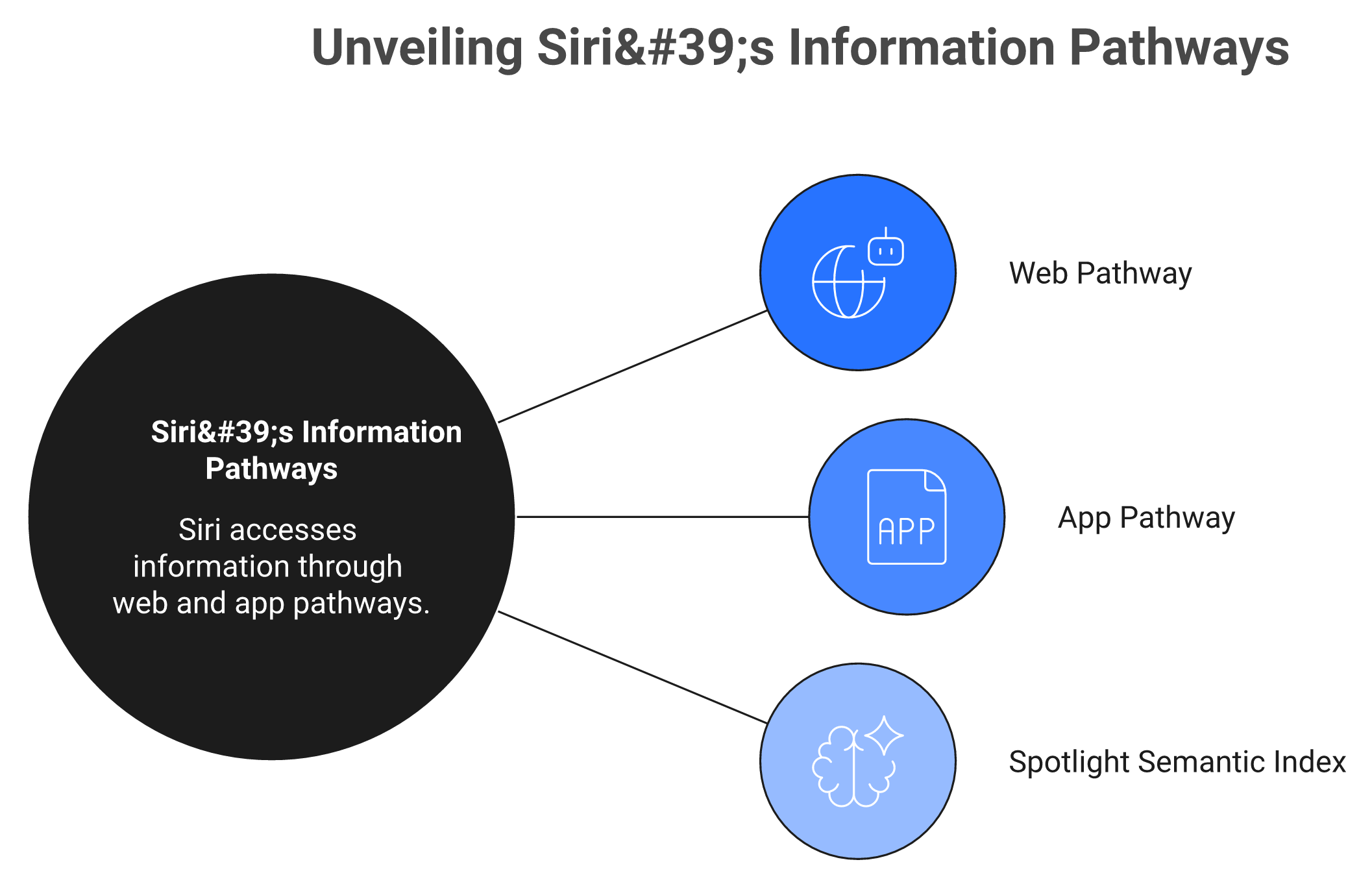
- Web pathway: Applebot crawls your site into Spotlight's semantic index, which powers Siri and Safari results.
- App pathway: App Intents schemas expose your app's content and actions to Siri, with attribution back to your app.
Most articles cover one pathway or the other. Almost none connect both. This guide does, because your buyer may meet Siri through a web answer or an app action, and you need to win in either lane.
Keep the lens revenue-focused. Siri visibility is not a vanity metric. It is pipeline influence at the exact moment a buyer is deciding.
Here is my current thinking, and it echoes Krishna Kaanth's core belief: GEO is not SEO with new keywords. It is closer to a data science problem, where you reason about how retrieval and entity graphs actually work, not just which phrases to sprinkle in. At MaximusLabs, we treat Siri as the newest answer engine in a Search Everywhere portfolio, not a Google add-on, and we optimize for citation share across ChatGPT, Perplexity, Gemini, and now Siri, alongside Google.
Q2. How does Gemini-powered Siri find, ground, and cite answers, and is your content even visible?
Siri grounds answers on two feeds: Applebot crawls the open web into Spotlight's semantic index, and App Intents schemas contribute in-app content with attribution back to the app. It then translates your prompt into a structured request and synthesizes an answer. The catch: Applebot renders JavaScript, but async-loaded reviews and attributes can still vanish. Toggle JavaScript off, and whatever disappears is invisible to Siri's retrieval step.
The two feeds behind every Siri answer
🔍 Retrieval, not invention
Start with the conclusion, then the evidence. Siri does not invent facts. It retrieves them.
Apple states that data crawled by Applebot powers the search technology "integrated into many user experiences," including Spotlight, Siri, and Safari. That is the web feed. The second feed is your app: App Intents entity schemas contribute your app's content to the Spotlight semantic index, with attribution back to your app.
Think of Siri as a "Universal Intent Decoder." A user asks a messy question, and Siri translates it into a structured request, retrieves grounded matches, then writes one clean answer.
Why the semantic index changes the rules
🧠 Meaning over keywords
The Spotlight semantic index matters because it finds content even when someone describes it vaguely, not just by exact keywords.
That is a real break from keyword-era SEO. You are no longer matching a phrase. You are hoping the machine understands your meaning well enough to pull you into the answer, which is where answer engine optimization earns its keep.
Scale is worth noting too. Per the practitioner brief, Applebot crawled roughly 314 million pages a month as of December 2024, behind ClaudeBot (370M) and GPTBot (569M), but well ahead of PerplexityBot (24.4M). Applebot is not a minor crawler you can ignore.
The extractability trap most brands miss
⚠️ Rendered is not the same as retrieved
Here is where good sites quietly fail. Applebot renders JavaScript. That sounds like good news, and it is a real advantage: your React-heavy site is visible to Siri even though several other AI crawlers only fetch and do not execute JavaScript.
But rendering is not a guarantee. Apple warns that if JavaScript, CSS, and other resources are blocked, Applebot "may not be able to render the content properly." Content loaded asynchronously, like reviews or product attributes injected after load, can still slip through the cracks.
Run the test from the brief. Turn JavaScript off in your browser and load the page. Whatever disappears, like reviews loaded async, is at risk of being invisible to Siri's retrieval step. This is the kind of gap a proper technical SEO and website audit surfaces fast.
What to do Monday morning
✅ Extractability beats page speed
Extractability beats page speed. That is the reframe.
- Expose hidden facet data (material, size, closure, neck style) into text headers or FAQs, because follow-up answers often depend on those attributes.
- Confirm critical content sits in the rendered HTML, not just behind a client-side call.
- Design for graceful degradation, so the page still reads cleanly if resources fail to load.
I lean contrarian here, and I have earned the right to say it: chasing Core Web Vitals rarely moves the needle for AI visibility. When you actually run these audits, the wins come from making content extractable, not from shaving milliseconds. Our extractability audits at MaximusLabs start with the JavaScript-off test, not a Core Web Vitals report.
Q3. What is the difference between Applebot and Applebot-Extended (crawl vs. train)?
Applebot is Apple's web crawler that feeds Spotlight, Siri, and Safari search. Applebot-Extended is a separate control that governs only whether your crawled content trains Apple's foundation models. Blocking Applebot-Extended stops model training but keeps you fully discoverable in Siri and Spotlight. Two settings, two decisions, one robots.txt file. Applebot also cannot render pages if key resources are blocked.
Two user agents, two very different jobs
🤖 Visibility versus training
Most GEO blogs blur these two. Apple's own docs draw a clean line, so let us use it.
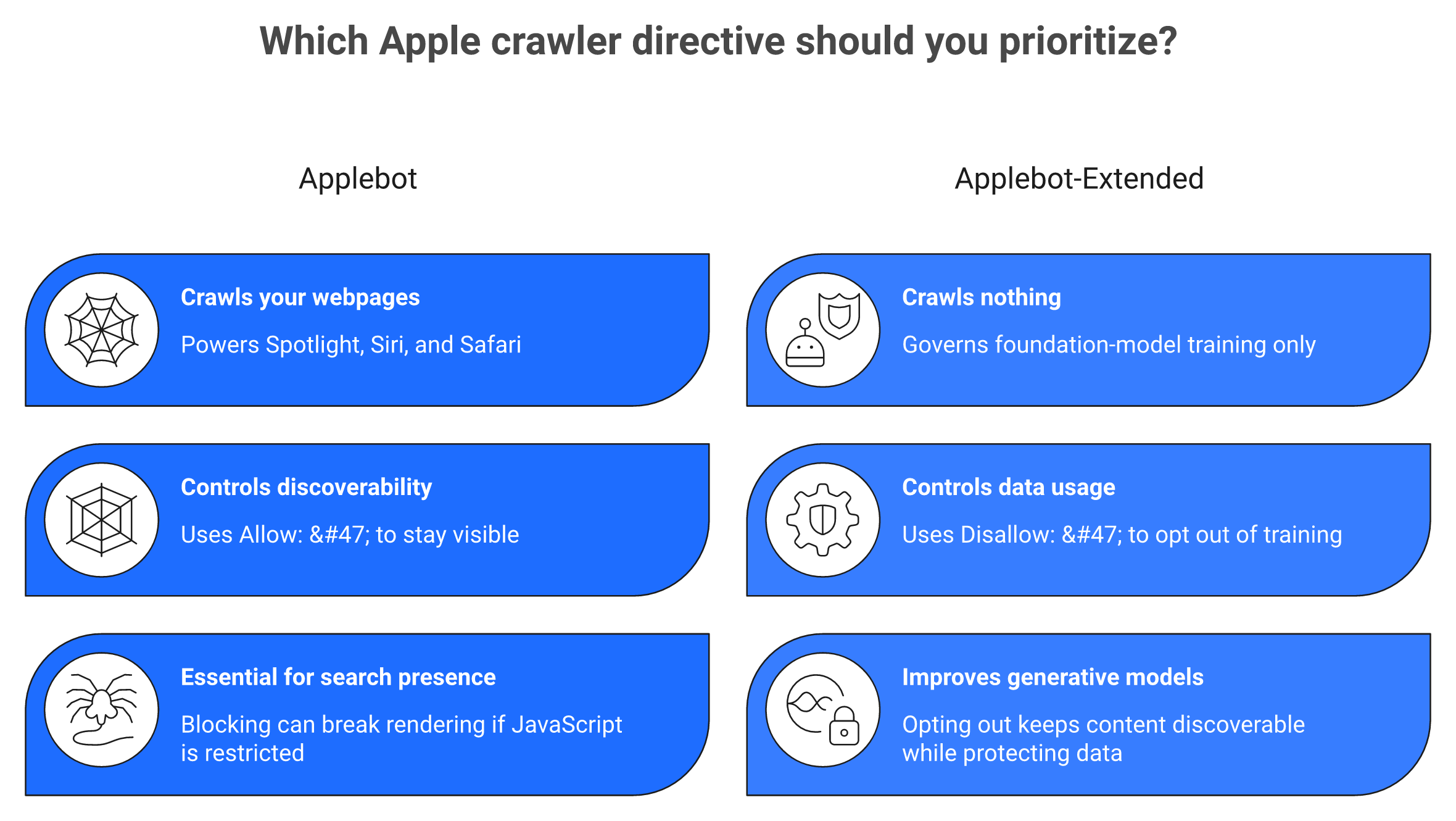
- Applebot crawls your webpages. Enabling it in robots.txt lets your content appear in search results for Apple users across Spotlight, Siri, and Safari.
- Applebot-Extended does not crawl anything. It only decides whether the data Applebot already collected can train Apple's foundation models powering Apple Intelligence.
That distinction is the whole point. One controls visibility. The other controls training. Managing these agents cleanly sits at the heart of managing AI crawlers like GPTBot and Google-Extended.
Why blocking training does not make you invisible
💡 Opt out, stay discoverable
Here is the part teams get wrong and then regret. You can opt out of AI training and still be discoverable.
Apple says it directly: "Even if you disallow Applebot-Extended, your website instructions may still allow Applebot to crawl your webpages. In that case, your content would remain discoverable through Spotlight, Siri, as well as other system-wide features." So protecting your IP from model training does not cost you a spot in Siri's answers.
A related detail: Applebot-Extended is purely about data usage, not crawling. If you block the JavaScript or CSS Applebot needs, it may fail to render your page at all, which quietly hurts visibility.
The robots.txt recipe to copy
⚙️ Two rules, one file
Want visibility in Siri while opting out of training? Set both rules explicitly.
- User-agent: Applebot, Allow: /
- User-agent: Applebot-Extended, Disallow: /
The first block keeps you crawlable and discoverable. The second block opts your content out of foundation-model training. Note Apple's own caveat: allowing Applebot-Extended "will help improve the capabilities and quality of Apple's generative AI models over time," so this is a genuine trade-off, not a free lunch.
Honesty check on the evidence: the source brief had no lived practitioner story for this exact distinction, so this section leans entirely on Apple's primary documentation rather than anecdote. That is the right call when the official doc is this explicit. At MaximusLabs, we treat robots.txt configuration as a first-week technical task, because a single wrong directive can hide a brand from Siri entirely.
Q4. How do you build an "unambiguous" entity so Siri trusts and cites you?
Siri needs unambiguous identity to cite you without hallucinating. The fix is closing the sameAs loop: an AI crawling your site should traverse website to Wikidata to LinkedIn to Crunchbase to G2 and back to your website, all via sameAs links. This creates a closed, verifiable entity graph. Raw link building is yesterday's game. A machine-readable identity is what earns a device-level assistant's trust.
Why identity, not links, wins citations
🧩 Knowing who you are
Lead with the conclusion. Siri cites brands it can identify without guessing.
Apple's ranking factors include relevance, engagement, link quality, and page design. But underneath ranking sits a harder problem: the machine has to know who you are. If your identity is fuzzy, the model fills gaps with assumptions.
That is why entity clarity now beats raw link volume. A pile of backlinks does not help if the AI cannot confirm your brand is a single, consistent entity, a core reason citation consistency across AI search matters so much.
The sameAs loop, step by step
🔗 Closing the circle
The tactic from the brief is concrete. Close the loop so an AI can travel a full circle and confirm your identity.
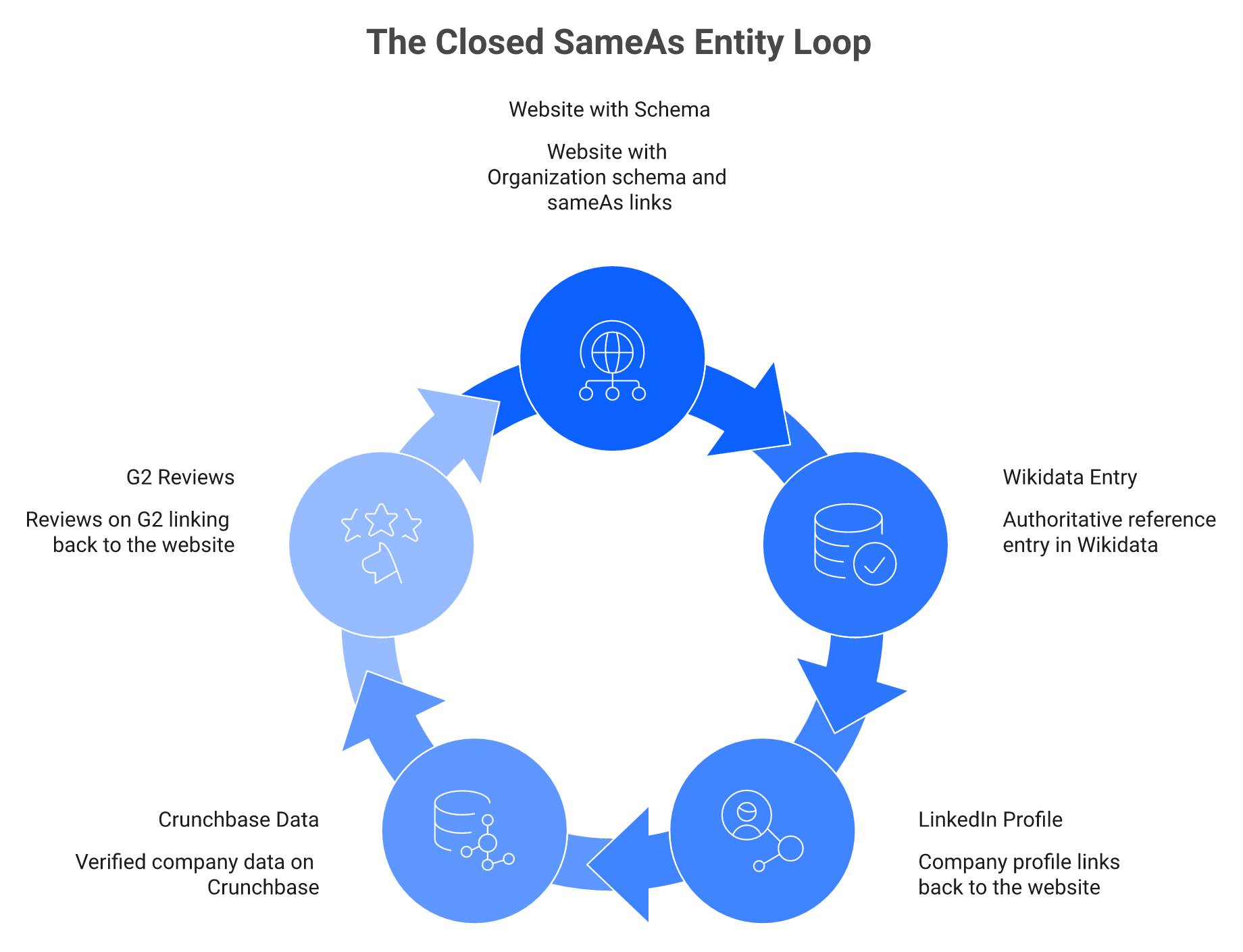
- Add sameAs links in your Organization schema pointing to Wikidata, LinkedIn, Crunchbase, and G2.
- Make sure each of those profiles links back to your website.
- The goal: website to Wikidata to LinkedIn to Crunchbase to G2 and back to website, a closed, verifiable entity graph.
Schema.org's sameAs property exists precisely for this, letting you declare authoritative references to the same entity. When the loop closes, the machine stops guessing. This is foundational schema markup work.
The hallucination that proves the point
👻 The Oxford mix-up
Here is why this is not academic. A practitioner watched Perplexity summarize his team's article and then claim they were "Oxford researchers." None of them attended Oxford.
The AI had matched a conceptually adjacent paper and invented a credential. His takeaway was sharp: "the agent is looking for mentions, and the thing mentioned the most seems to rank highest." The machine trusts web-wide consensus over your self-published claims.
An unclosed entity loop invites exactly this kind of error. Close it, and you give Siri a verifiable identity instead of a guess. Practitioners studying AI citations report the same pattern:
"Ranking #1 on Google barely gets you cited by ChatGPT."
u/OP, r/SEO_for_AI Reddit Thread
Your checklist
✅ Monday actions
- Publish complete Organization schema with sameAs to Wikidata, LinkedIn, Crunchbase, and G2.
- Confirm every external profile links back to your canonical domain.
- Keep names, founders, and descriptions identical across all nodes.
Krishna's view here is a useful hedge to hold: he expects "trust compounding" to become a real moat for early movers who entrench clean entity data now. I think he is right, though the timeline is uncertain. Trust-first optimization at MaximusLabs starts by closing the sameAs loop before we touch a single content page, because an ambiguous entity undermines every article that follows.
Q5. Do developers still need App Intents now that SiriKit is deprecated?
Yes. App Intents is now the only path to Gemini-powered Siri. At WWDC 2026, Apple formally deprecated SiriKit and made App Intents mandatory. To become discoverable, index entities into Spotlight, conform App Entities to Transferable types, adopt system schemas as a contract with the OS, associate views for onscreen context, and donate actions so Siri can predict them. Adopt before the fall iOS 27 GA.
The framework is no longer optional
🛠️ SiriKit is out
Let me answer the question directly. SiriKit is out. App Intents is in.
At WWDC 2026, Apple formally deprecated SiriKit and positioned App Intents as the only framework for integrating with the Gemini-powered Siri AI. App Intents is Apple's system for exposing your app's actions and content to Siri and Apple Intelligence.
If you skip it, your app simply will not show up in the new Siri. That is the stake, and it is exactly the kind of shift our technical SEO and website audit is built to catch early.
The five-step sequence Apple lays out
📋 Order of operations
Apple's own documentation gives a clear order of operations. Follow it top to bottom.
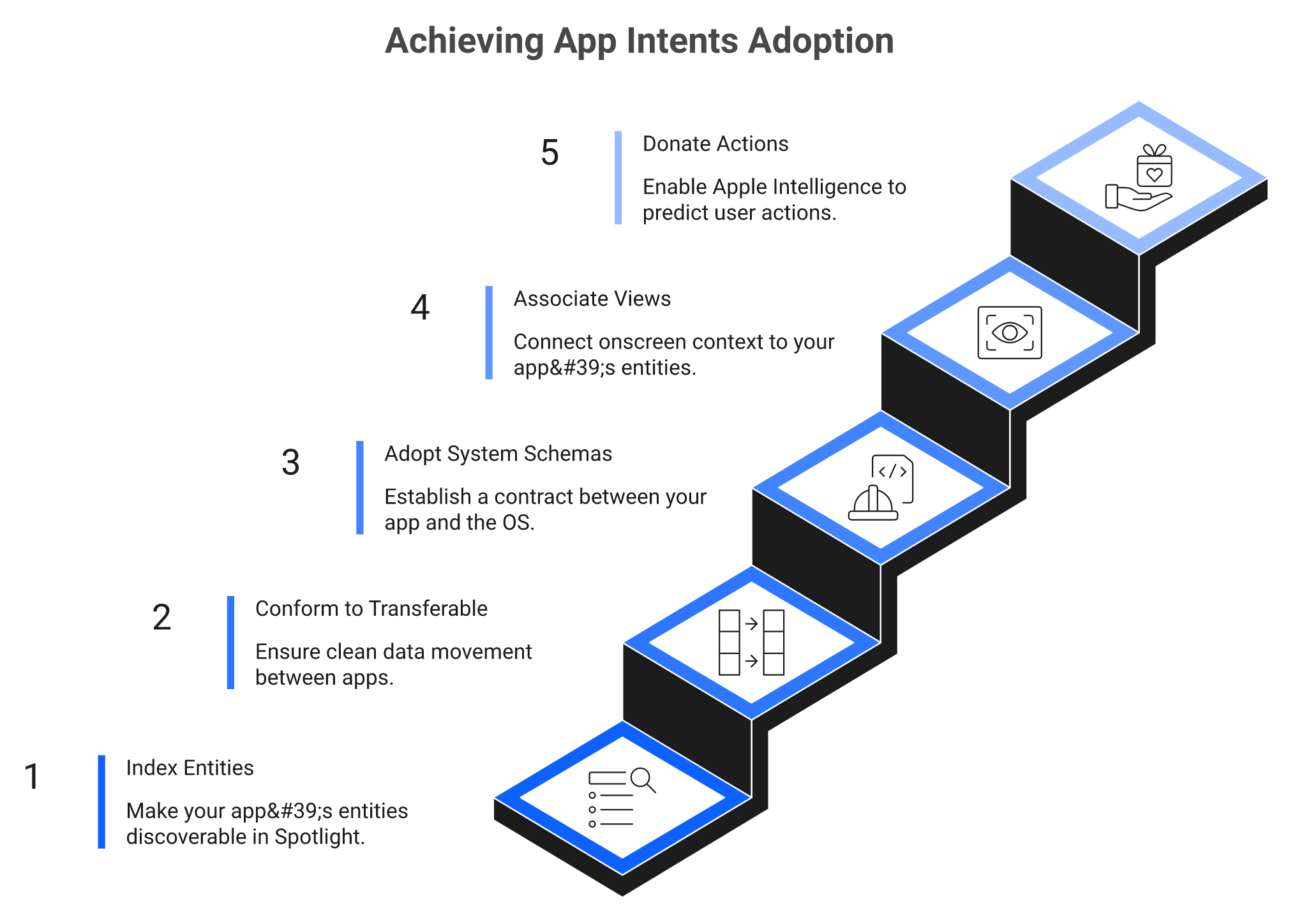
- Index your entities so they appear in Spotlight.
- Conform App Entities to Transferable types so the system can move your data cleanly.
- Adopt system schemas, which act as a contract between your app and the OS.
- Associate views with entities so Siri understands onscreen context.
- Donate actions so Apple Intelligence can predict and suggest them.
An App Entity, in plain terms, is a piece of your app's data modeled so the system can read it. A schema is the agreed format for that data, which is why schema markup basics apply here as much as on the open web.
What schemas actually buy you
🔗 Content plus attribution
Here is the payoff most teams miss. Adopting schemas does more than enable voice commands.
Apple states that App Intents entity schemas contribute your app's content to the Spotlight semantic index, with attribution back to your app. So your in-app content becomes discoverable, and you get credited as the source. That attribution is the app-side version of a citation, which is why citation-worthy content thinking matters here too.
Think of it with the "Chef in an Empty Room" frame from the practitioner brief. A chatbot is the brain. An agent is the chef with the "hands" of APIs and the "notebook" of memory. App Intents gives Siri those hands to actually operate your app, a preview of where agentic commerce is heading.
The clock, and why speed is the real moat
⏰ Ship before GA
The deadline is real. These capabilities ship with iOS 27, heading to general availability in the fall.
Here is my honest read from years inside these projects: the framework is not the hard part. The bottleneck is execution. A practitioner in the brief nailed it, noting that work which "could be built in weeks or days" gets quoted at "nine months" once corporate engineering weighs in.
That gap kills most technical fixes before a crawler ever sees them. This is why we built MaximusLabs as a full-stack GEO team that ships technical AEO changes fast, rather than filing tickets that die in a backlog. Speed of implementation, not just strategy, is the moat here.
Q6. How do you earn Siri citations when you can't rank your own site?
If you cannot rank your own domain, become the answer through others'. Identify the most-cited URLs for the topics you care about, then earn placement there: Reddit threads, YouTube reviews, and Tier-1 affiliates like Dotdash that AI engines cite heavily. Siri grounds on web-wide consensus, so a mention on a high-trust third-party page can outweigh your own homepage.
The wall every young brand hits
🧱 Doing it right, still losing
You did everything right. You published the page, added schema, and waited. Still, Siri names competitors instead of you.
This is the situation for most challenger brands. Domain authority takes years to build, and a device-level assistant defaults to sources it already trusts. Ranking your own site is the slowest road into the answer, a pattern our B2B SaaS AEO strategies are designed around.
Why the machine trusts strangers over you
⚠️ Consensus over self-claims
Here is the complication. Siri does not weigh your self-published claims as heavily as web-wide consensus.
Recall the practitioner story from earlier: an AI called a team "Oxford researchers" because it found conceptually adjacent mentions, concluding "the thing mentioned the most seems to rank highest." Third-party mentions carry more weight than your homepage. This is where Reddit and forum AEO becomes essential. Practitioners see the same pattern play out in AI answers:
"An AI will absolutely cite a Reddit comment if Google's algorithm decides that comment is the most relevant answer on the entire internet for that specific query."
u/Comprehensive-Fun47, r/SEO Reddit Thread
Not everyone is convinced the effect is stable, though, which is a fair caution:
"Ranking #1 on Google barely gets you cited by ChatGPT."
u/OP, r/SEO_for_AI Reddit Thread
The resolution: reverse-engineer the citations
✅ Earn placement where Siri looks
So flip the strategy. Stop trying to rank, and start earning mentions where Siri already looks.
- Map the cited URLs. Run your target questions through AI engines and note which pages get cited most.
- Earn placement there. Contribute authentic answers on Reddit, publish YouTube reviews, and pursue Tier-1 affiliates like Dotdash, among the most-cited domains in the AI ecosystem.
- Be genuinely useful. Communities police spam hard, so identify yourself and add real value.
Search Everywhere Optimization is core to how we win AI citations at MaximusLabs. We optimize the sources Siri already trusts, not just the client's own website, guided by proven AI citation acquisition tactics. I will hedge honestly here: citation share on any single platform shifts month to month, so treat off-site work as a portfolio, not a one-time win.
Q7. Does schema markup actually help Siri, or is it just hygiene?
Schema will not magically win Siri citations, but it is not optional either. The honest verdict: structured data is a hygiene factor that makes facts unambiguously extractable for Siri's retrieval step, not a standalone differentiator. Use FAQPage, HowTo, and Organization schema to hand Siri clean, machine-readable facts, and close your sameAs loop with Organization markup. It raises your odds. It does not guarantee the answer.
The advice everyone repeats
🏷️ The magic-switch myth
Open any GEO guide, and you will read the same line: "add schema." Schema is structured data, a machine-readable label that tells engines exactly what your content means.
The instinct is fair. Apple lists page design and relevance among its ranking factors, and clean structure helps. But "add schema" gets treated like a magic switch, and that is where teams go wrong, as our technical GEO implementation work repeatedly shows.
The debate practitioners are actually having
⚖️ Hygiene versus differentiator
Here is the tension. Experienced SEOs disagree on how much schema moves the needle.
One camp calls it a "hygiene factor (at best)... not a differentiator." The other argues structured data "increases your odds significantly by letting AI know exactly how to present facts." Both can be true at once. Real practitioners voice the same doubt:
"Everyone says schema is important for GEO, but schema isn't new, we've been implementing it for years in SEO."
u/OP, r/AskMarketing Reddit Thread
"The AI answer results from Schema and Rich Text were a small percentage of the answers that came back for any given query."
u/OP, r/AskMarketing Reddit Thread
The resolution: use it as a floor, not a lever
✅ A guaranteed floor
So where does that leave you? Use schema to guarantee extractability, not to expect a ranking jump.
- FAQPage and HowTo hand Siri clean question-answer blocks it can lift directly.
- Organization schema carries your sameAs links, closing the entity loop from the earlier section.
- Do not stop there. Schema is the floor. Trust, mentions, and information gain are what actually differentiate you.
My current thinking, held with real uncertainty, is that schema is table stakes, and Krishna's view that "trust compounding" becomes the durable moat feels closer to the truth than any markup tactic. At MaximusLabs, we treat schema as one hygiene layer inside a trust-first, E-E-A-T system, never as the whole play.
Q8. Is Siri optimization worth the budget, or a distraction from ChatGPT and Perplexity?
Siri optimization is worth it if your buyers live on Apple devices, but it is one engine in a portfolio, not a standalone bet. Gartner forecast a 25% traditional-search drop by 2026. The measured reality is milder, roughly 5 to 6% globally, but brutal in SaaS/B2B, where 45 to 55% of queries resolve in AI answers alone. Prioritize by where your ICP actually asks questions, and measure citation share, not impressions.
The straight answer for a budget owner
💰 Fund it, with conditions
Lead with the verdict. Yes, fund Siri optimization if your ideal customers use iPhones and Macs. No, do not treat it as a silver bullet.
Siri is one answer engine among several. The smart move is a portfolio across ChatGPT, Perplexity, Gemini, and Siri, weighted by where your buyers actually ask questions, which is exactly how we scope a GEO engagement.
Forecast versus measured reality
📊 The honest numbers
Now the data, honestly framed. In 2024, Gartner forecast a 25% drop in traditional search volume by 2026 as users shifted to AI assistants.
The measured reality is milder but real. Global organic clicks fell only around 5 to 6%, well short of that 25%. Yet the pain is concentrated. SaaS/B2B organic traffic dropped 20 to 40%, with 45 to 55% of queries resolved by AI answers alone. So the average hides brutal industry-level shifts, a trend we track in our AI search in B2B SaaS 2026 report.
How to prioritize with finite cash
🎯 Spend where intent runs hot
Your budget is real and finite, so spend it where intent is highest. Two numbers from the practitioner brief guide this.
- 6x conversion difference. LLM traffic converted at roughly six times the rate of Google search traffic in one reported case, because conversational intent runs hotter.
- Concentration rule. Around 19 of 20 landing pages drive no meaningful traffic, while a handful carry about 85%. Optimize the pages that already do the work.
Focus BOFU (bottom-of-funnel) and MOFU (middle-of-funnel) pages first, the ones tied to buying decisions. Skip TOFU vanity content, which AI already answers without citing anyone, a discipline at the heart of our GEO for SaaS startups approach.
What to actually measure
✅ Change the scoreboard
Change the scoreboard. Impressions and pageviews do not tell you if Siri names you at the decision moment.
Track citation share, meaning how often you appear as the answer across question variants and platforms. Then connect it to pipeline influence, not raw clicks. As the brief puts it, "the penalty for being average has never been so severe, but the payout for being extraordinary has never been higher."
This is exactly why we measure GEO in citation share and pipeline influence at MaximusLabs, not impressions. Revenue-focused by design means we would rather own three buying-intent answers than chase a thousand vanity views.
Q9. Why do technical specs fail with Siri unless you tell a story? (The Lisa lesson)
Machine-readable specs get you retrieved. Storytelling gets you chosen. Siri synthesizes answers for humans, so raw feature dumps lose to content with genuine information gain. The lesson dates to 1983: Apple's Lisa launched with a nine-page technical ad nobody understood, and it bombed. Optimize your entities and schema for the machine, but filter the payload through a story a human, and the AI summarizing for them, actually wants to repeat.
The trap of writing for the crawler
📄 Retrieved is not chosen
Here is a scene I see constantly. A team finishes its entity graph, ships clean schema, and then stuffs pages with specs to feed the bot.
The logic feels right. Make everything machine-readable, and Siri will pick you up. But retrieval is only half the job. Getting pulled into the candidate set is not the same as getting named in the answer, which is why citation-worthy content matters more than raw markup.
Why geek talk bombs, the Lisa lesson
⚠️ Nine pages nobody read
Apple learned this the hard way. In 1983, it launched a computer called Lisa.
The launch ran a nine-page ad in the New York Times spelling out the machine's technical features. As the brief puts it, that was "nine pages of geek talk nobody outside NASA was interested in." The computer bombed.
The parallel to Siri is direct. A feature dump satisfies a spec sheet, not a person. Siri writes for humans, so it favors content that says something new, what researchers call information gain, over content that just lists attributes everyone already published. This is the heart of real answer engine optimization. Practitioners see the same pattern in AI answers today:
"Ranking #1 on Google barely gets you cited by ChatGPT."
u/OP, r/SEO_for_AI Reddit Thread
The resolution: entity rigor plus a story
✅ Optimize for both
So hold both truths at once. Optimize for the machine, and write for the human.
- For the machine: clean entities, closed sameAs loops, extractable HTML, and schema.
- For the human: a specific point of view, lived experience, and information gain the model wants to repeat.
Topical authority works the same way. As the brief notes, Masterclass ranked for "Beef Wellington" because Gordon Ramsay is uniquely known for it. Authority is built on being distinctly known for something, not on listing every feature, a principle we operationalize through GEO topic clusters.
What I am sitting with next
🔮 A question worth holding
Here is my current thinking, held loosely. I suspect the brands that win Siri will be the ones with a real story, not the ones with the tidiest markup.
The standard read gets this backwards. It treats optimization as a purely technical exercise, when it is really evolved brand building for AI search. This is why we bake the founder's voice into every article at MaximusLabs, because a story a human repeats is a story Siri repeats. If Siri becomes the front door to your category, would the assistant describe your brand the way you would? That is the question I would start with, and I would love to hear how you are answering it.
Frequently asked questions
What is Apple Intelligence Siri optimization, and why does it matter now?
Apple Intelligence Siri optimization is the practice of becoming the answer that the Gemini-powered Siri gives, not merely a link it might list. With the next-generation Siri previewed at WWDC 2026, discovery runs on two pathways: web content crawled by Applebot into Spotlight's semantic index, and app content exposed through App Intents schemas. This matters because Siri does not hand users ten blue links. It synthesizes one answer and names a few trusted sources. We call this the Binary Game : if Siri skips you in the first three bullets, you are invisible before evaluation even begins. A page-one Google ranking no longer guarantees a seat in Siri's answer. The scoreboard shifts from impressions and clicks to citation share. Buyers decide at the moment Siri reads back a short list. We treat Siri as the newest answer engine in a Search Everywhere portfolio, not a Google add-on. Our generative engine optimization service optimizes for citation share across ChatGPT, Perplexity, Gemini, and now Siri, so your brand enters the buyer's consideration set exactly when it counts.
How does the Gemini-powered Siri find and cite answers?
Siri does not invent facts. It retrieves them from two feeds. Applebot crawls the open web into Spotlight's semantic index, which powers Siri, Spotlight, and Safari. Separately, App Intents entity schemas contribute your app's content to that same index, with attribution back to your app. The semantic index matters because it surfaces content by meaning, not just exact keywords. That is a real break from keyword-era SEO. You are no longer matching a phrase; you are hoping the machine understands your meaning well enough to pull you into the answer. Applebot renders JavaScript, so React-heavy sites are visible, unlike with several other AI crawlers. Rendering is not a guarantee: async-loaded reviews or attributes can still vanish. Run the test: turn JavaScript off, and whatever disappears is at risk of being invisible to Siri. Extractability beats page speed here. Our answer engine optimization work starts with the JavaScript-off test, not a Core Web Vitals report, because making content extractable is what actually moves AI visibility.
What is the difference between Applebot and Applebot-Extended?
These two user agents do very different jobs, and most guides blur them. Applebot is Apple's web crawler. Enabling it in robots.txt lets your content appear across Spotlight, Siri, and Safari. Applebot-Extended crawls nothing; it only decides whether the data Applebot already collected can train Apple's foundation models. The key insight: you can opt out of AI training and stay fully discoverable. Apple states that even if you disallow Applebot-Extended, your content remains discoverable through Spotlight, Siri, and other system features. User-agent: Applebot, Allow: / keeps you crawlable and discoverable. User-agent: Applebot-Extended, Disallow: / opts you out of model training. Blocking the JavaScript or CSS Applebot needs can still break rendering entirely. We treat robots.txt configuration as a first-week technical task, because a single wrong directive can hide a brand from Siri while a correct one protects your IP without costing visibility.
How do we build an unambiguous entity so Siri trusts and cites us?
Siri cites brands it can identify without guessing. If your identity is fuzzy, the model fills gaps with assumptions, sometimes inventing credentials outright. One practitioner watched an AI call his team Oxford researchers simply because it found conceptually adjacent mentions. The fix is closing the sameAs loop so an AI can travel a full circle and confirm who you are. Add sameAs links in your Organization schema pointing to Wikidata, LinkedIn, Crunchbase, and G2. Ensure each of those profiles links back to your website. Keep names, founders, and descriptions identical across every node. The goal is a closed, verifiable graph: website to Wikidata to LinkedIn to Crunchbase to G2 and back. When the loop closes, the machine stops guessing. This is why entity clarity now beats raw link volume, and why citation consistency across AI search is foundational. We close the sameAs loop before touching a single content page, because an ambiguous entity undermines every article that follows.
Do developers still need App Intents now that SiriKit is deprecated?
Yes. At WWDC 2026, Apple formally deprecated SiriKit and made App Intents the only framework for integrating with the Gemini-powered Siri. Skip it, and your app simply will not appear in the new Siri. Apple lays out a clear five-step sequence: Index your entities so they appear in Spotlight. Conform App Entities to Transferable types. Adopt system schemas as a contract between your app and the OS. Associate views with entities so Siri understands onscreen context. Donate actions so Apple Intelligence can predict them. The payoff goes beyond voice commands: entity schemas contribute your app's content to the Spotlight semantic index with attribution, the app-side version of a citation. These capabilities ship with iOS 27 at fall general availability, so adopt before then. In our experience the framework is not the hard part; execution speed is. We built our agentic commerce service to ship technical AEO changes fast, rather than filing tickets that die in a backlog.
How do we earn Siri citations when we cannot rank our own site?
If you cannot rank your own domain, become the answer through others. Domain authority takes years, and a device-level assistant defaults to sources it already trusts. Siri weighs web-wide consensus more heavily than your self-published claims, so third-party mentions carry more weight than your homepage. Flip the strategy and reverse-engineer the citations. Map the cited URLs by running your target questions through AI engines and noting which pages appear most. Earn placement there through authentic Reddit answers, YouTube reviews, and Tier-1 affiliates like Dotdash. Be genuinely useful, because communities police spam hard. Search Everywhere Optimization is core to how we win AI citations. We optimize the sources Siri already trusts, not just the client's own website, guided by proven AI citation acquisition tactics . We will hedge honestly: citation share on any single platform shifts month to month, so treat off-site work as a portfolio rather than a one-time win.
Does schema markup actually help Siri, or is it just hygiene?
Schema will not magically win Siri citations, but it is not optional either. The honest verdict is that structured data is a hygiene factor that makes facts unambiguously extractable for Siri's retrieval step, not a standalone differentiator. Apple lists page design and relevance among its ranking factors, and clean structure helps, yet add schema gets treated like a magic switch, which is where teams go wrong. FAQPage and HowTo schema hand Siri clean question-answer blocks it can lift directly. Organization schema carries your sameAs links, closing the entity loop. Schema is the floor; trust, mentions, and information gain are what differentiate you. Our current thinking, held with real uncertainty, is that schema is table stakes, while trust compounding becomes the durable moat. We treat schema as one hygiene layer inside a trust-first, E-E-A-T system , never as the whole play. Use it to guarantee extractability, not to expect a ranking jump.
Is Siri optimization worth the budget, or a distraction from ChatGPT and Perplexity?
Siri optimization is worth it if your buyers live on Apple devices, but it is one engine in a portfolio, not a standalone bet. The smart move is a portfolio across ChatGPT, Perplexity, Gemini, and Siri, weighted by where your buyers actually ask questions. Frame the data honestly. Gartner forecast a 25% drop in traditional search by 2026, but the measured reality is milder, roughly 5 to 6% globally. The pain is concentrated, though: SaaS and B2B organic traffic fell 20 to 40%, with 45 to 55% of queries resolved by AI answers alone. LLM traffic converted at roughly six times the rate of Google search traffic in one reported case. Around 19 of 20 landing pages drive no meaningful traffic, while a handful carry about 85%. Prioritize bottom-of-funnel and middle-of-funnel pages tied to buying decisions. Track citation share and pipeline influence, not impressions. This is exactly why we measure GEO ROI in revenue attribution , because we would rather own three buying-intent answers than chase a thousand vanity views.