 Krishna Kaanth M
- There is no universal winner at $20. ChatGPT Plus suits broad multimodal work, Claude Pro suits long-document and accuracy-critical work, and Google AI Pro suits Workspace-native teams.
- Google AI Pro is $19.99 with 5 TB of storage bundled, Claude Pro falls to about $17 billed annually, and Google AI Plus at $4.99 may end the comparison entirely.
- The three plans count usage in different currencies: ChatGPT counts messages, Claude counts tokens, and Google counts compute, so published prices are not comparable.
- Failure modes matter more than cap size. Claude silently downgrades to Sonnet, ChatGPT sells overflow credits, and Google simply makes you wait for the five-hour refresh.
- Claude Opus 4.5 led a 14-model fact-check benchmark at 77%, while deeper search depth cut fact-check accuracy by roughly 42% on average.
- Your plan choice exposes the retrieval layer your buyers experience, and being cited inside an AI answer now beats ranking below it.
Q1. ChatGPT Plus vs Claude Pro vs Google AI Pro: which $20 plan should you actually buy?
A Head of Organic Growth I work with had three browser tabs open last week: an OpenAI checkout, an Anthropic plan card, and a Google One page. All three showed roughly twenty dollars. She had been staring at them for eleven minutes. Her actual question was not "which is better." It was "which one stops making me audit every sentence?"
There is no universal winner at $20. Buy ChatGPT Plus for the broadest mix of everyday tasks and multimodal output. Buy Claude Pro for long-document writing, analysis, and accuracy-critical work. Buy Google AI Pro at $19.99 if your work already lives in Gmail, Docs, and Drive, because the bundled 5 TB of storage means the AI layer costs almost nothing on a net basis.
⭐ Why the same price hides three different products
The pricing looks identical, so buyers assume the products are interchangeable. They are not. One comparison guide published in July 2026 opens by stating flatly that the three plans "cost the same but are genuinely different products". A second, more evidence-led page refuses to name a winner at all, and instead publishes a decision rule: choose ChatGPT Plus for a broad mix of tasks, trial Claude Pro first when writing or terminal coding dominates, and choose Google AI Pro when your work already depends on Google apps and cloud storage.
That framing is correct, and it is also incomplete. You are not renting a model. You are renting a retrieval philosophy, and the same philosophy decides whether your brand shows up when a buyer asks that assistant a question.
💰 The three-way plan comparison
| Plan | Price | Flagship model | Usage unit | Best for |
| ChatGPT Plus | $20/mo | GPT-5.5 / 5.6 | Messages per rolling window | Broadest all-round feature set, multimodal output |
| Claude Pro | $20/mo, about $17/mo billed annually | Opus 4.8 | Tokens per rolling window | Long-form writing, documents, accuracy-critical analysis |
| Google AI Pro | $19.99/mo | Gemini 3.1 Pro | Compute, refreshing every five hours | Workspace-native work, includes 5 TB storage |
⏰ The two-hours-a-day allocation rule
Ignore feature lists for a second. Ask what you actually do for two hours every working day.
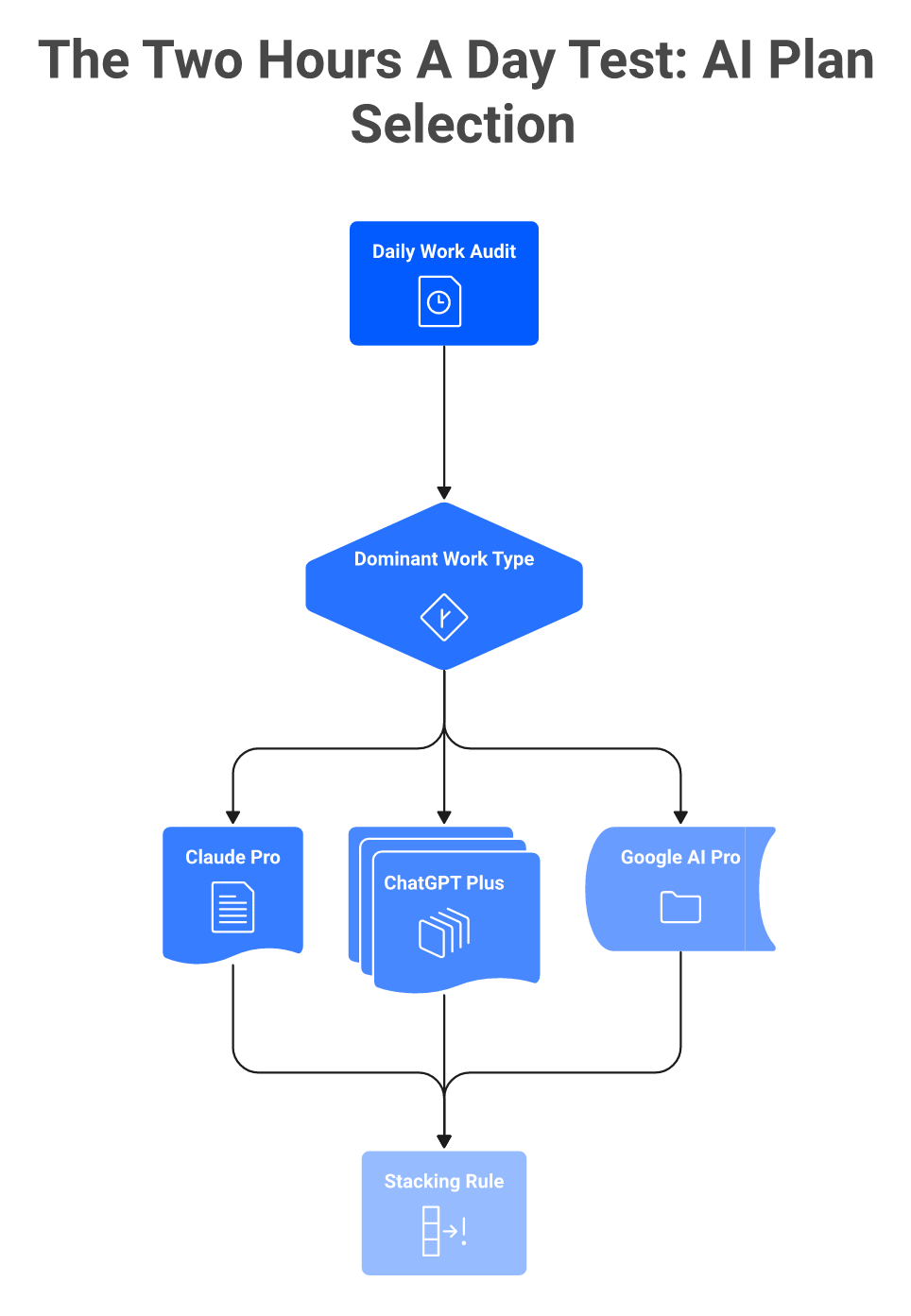
A Reddit user who has held both subscriptions for two years reduced the entire decision to exactly that question. It works because it forces you past capability comparison into usage reality. Text-dominant work points to Claude Pro. Mixed, visual, or general work points to ChatGPT Plus. Work that opens in a Google tab points to Google AI Pro.
If your two hours are genuinely split across two different jobs, that is a real signal, and it is covered later in this article.
✅ What this decision is really testing
The honest version of the buyer question is uncomfortable. Most people are not asking which machine reasons best. They are asking which one will stop behaving like a search engine and start behaving like an agent that finishes the work without supervision.
None of the three fully clears that bar yet. That gap, more than any spec sheet, is what separates the three plans in daily use.
MaximusLabs AI tracks how each of these engines retrieves and cites sources across thousands of question variants, which is why our read on these plans is shaped by retrieval behaviour rather than benchmark scores.
Q2. What do you actually get on each plan: models, context windows, and multimodal gaps?
ChatGPT Plus runs GPT-5.5 and 5.6 with image generation, limited Sora video, voice, and Custom GPTs. Claude Pro runs Opus 4.8 with a 1M-token context, unlimited Projects, and MCP connectors, but no image or video generation at all. Google AI Pro runs Gemini 3.1 Pro at a 1M-token context against 32,000 tokens on the free tier, with Veo 3.1 video, Imagen, and NotebookLM Plus.
⭐ Context window is the spec that actually changes your day
Context window means how much text the model can hold in working memory at once. It is the difference between pasting a full contract and pasting a summary of a contract.
Google's own documentation puts AI Pro at a 1M-token context, compared with 32,000 tokens on the free Gemini tier. That is roughly a thirty-fold jump, and it is the single largest free-to-paid capability change across all three vendors. Claude Opus matches the million-token ceiling for long-document work.
📊 Capability matrix
| Capability | ChatGPT Plus | Claude Pro | Google AI Pro |
| Flagship model | GPT-5.5 / 5.6 | Opus 4.8, Sonnet 4.6 default | Gemini 3.1 Pro |
| Context window | Around 200K standard tier | 1M tokens | 1M tokens vs 32K free |
| Image generation | Yes | No | Yes, Imagen |
| Video generation | Limited Sora | No | Veo 3.1 |
| Deep research | Yes | Research mode | 20 reports per day |
| Bundled storage | None | None | 5 TB |
❌ The gaps that actually disqualify a plan
Feature parity is not the useful lens. Hard exclusions are.
Claude Pro produces no images and no video, full stop. If your week includes social assets, deck visuals, or thumbnails, that single gap ends the conversation regardless of how good Opus is at prose. ChatGPT Plus carries a tighter standard context window than the other two, which matters when you routinely paste hundred-page documents.
Google AI Pro's exclusions are softer, but its answers behave differently, and that behaviour is worth understanding before you commit.
💡 Why Gemini answers feel broad but shallow
Google's AI Mode does not run one search per prompt. Standard AI Mode decomposes a single question into roughly 8 to 12 parallel sub-queries, then assembles the answer from what comes back. You can model that behaviour yourself with a query fan-out generator.
That fan-out explains the felt experience precisely. You get coverage across many angles, and you get less depth on any one of them. It is a retrieval design choice, not a model weakness.
The practical numbers underneath Google AI Pro follow the same pattern of breadth. Documentation lists one-hour video uploads, three-hour audio uploads, up to 10 active scheduled actions, and 20 Deep Research reports per day. Competitors describe all of this as simply "more."
✅ How to use this section on Monday
Do not compare all six capabilities. Find the one your work cannot proceed without, then eliminate.
If that capability is visual output, Claude Pro is out. If it is hundred-page document analysis, Claude Pro or Google AI Pro win. If it is scheduled, recurring research inside your existing files, Google AI Pro is the only plan built for it. Teams optimising for these surfaces also study how Google AI keeps changing its retrieval defaults.
Q3. What is the real price once you count storage, annual billing, and the cheaper Google tiers?
Sticker price misleads. Google AI Pro is $19.99 and bundles 5 TB across Gmail, Drive, and Photos, raised from 2 TB on April 1, 2026 with no price increase, so if you already pay for cloud storage the AI layer is nearly free. Claude Pro drops to about $17 per month when billed annually at $200. Google AI Plus at $4.99 may end the comparison entirely for some buyers.
💰 "$20 each" is a false equivalence
Three prices that look identical are not three identical costs. Two of the three carry adjustments that the comparison articles mention and then never actually calculate.
Google AI Pro is priced at $19.99, not $20, and it arrives with 5 TB of Google One storage attached. Claude Pro's annual option lands at $200 for the year, which is roughly $17 monthly. ChatGPT Plus is the only one of the three with no bundled asset and no meaningful annual discount to net out.
📊 Effective monthly cost after netting out bundles
| Plan | Sticker price | Adjustment | Effective AI cost |
| ChatGPT Plus | $20 | None | $20 |
| Claude Pro monthly | $20 | None | $20 |
| Claude Pro annual | $200/year | Prepay discount | About $17 |
| Google AI Pro | $19.99 | 5 TB storage included | Close to zero if you already pay for cloud storage |
The Google row is the one worth pausing on. If you currently pay separately for multi-terabyte cloud storage, that line item disappears into the subscription, and Gemini 3.1 Pro effectively arrives attached to a bill you were already paying.
⚠️ The tier that quietly reframes the whole question
Google restructured its consumer AI pricing in June 2026 and introduced Google AI Plus at $4.99, with AI Ultra sitting above AI Pro.
That $4.99 tier is not in most three-way comparisons, and it should be. For a marketing manager who mainly wants Gemini inside Docs and Sheets without Veo video or 5 TB of storage, the honest recommendation may be to spend a quarter of the money. Check what AI Plus includes before defaulting to the $20 assumption the search query embeds.
✅ Cost per outcome, not cost per month
Here is the reframe that changes the decision. Twenty dollars is not the number that matters. Twenty dollars divided by the work you actually complete is.
A plan you use for four hours a day at $20 is cheap. A plan you touch twice a week at $17 annual is expensive. Founders and growth leads apply this logic reflexively to ad spend and tooling, then abandon it entirely when a subscription is small enough to feel harmless.
Run the same math you would run on any other line item. Estimate hours of real use per week, divide the effective cost, and compare that number rather than the price tag. It is the same discipline behind revenue attribution for GEO budgets, and the next section supplies the throughput data that makes this calculation possible.
Q4. How do usage limits compare, and what happens when you hit the cap?
The three plans are not comparable as published. OpenAI counts messages per rolling window with additional weekly caps. Anthropic counts tokens in rolling windows, roughly 44,000 Opus tokens per five hours in practice. Google counts compute, refreshing every five hours until a weekly ceiling. Failure modes differ too: Claude silently downgrades to Sonnet, ChatGPT sells overflow credits, and Google simply makes you wait.
⚠️ Everyone quotes the price, nobody quotes the unit
Every comparison page publishes three prices side by side. Almost none publishes the accounting unit underneath each one, which is where the real difference lives.
OpenAI's own pricing documentation breaks Codex throughput into per-model bands, from 15 to 90 local messages per five-hour window on one model up to 50 to 280 on another, with the note that additional weekly limits may apply. Anthropic counts tokens, not messages. Google replaced fixed prompt counts with compute-based usage that refreshes every five hours until a weekly ceiling.
Messages, tokens, and compute are three different currencies. Comparing them directly is like comparing a price in dollars, a price in litres, and a price in hours.
📊 Normalised throughput view
| Plan | Accounting unit | Refresh cycle | Documented figure |
| ChatGPT Plus | Messages per model | 5-hour window plus weekly caps | 15 to 90, or 50 to 280 local messages depending on model |
| Claude Pro | Tokens | 5-hour rolling window | Around 44,000 Opus tokens per window |
| Claude Pro (Code) | Combined weekly cap | Weekly | About 2.2M Sonnet-equivalent tokens |
| Google AI Pro | Compute | 5-hour refresh, weekly ceiling | Compute-based, no published prompt count |
❌ The failure mode matters more than the cap size
This is the part nobody discusses, and it is the part that costs you a deliverable.
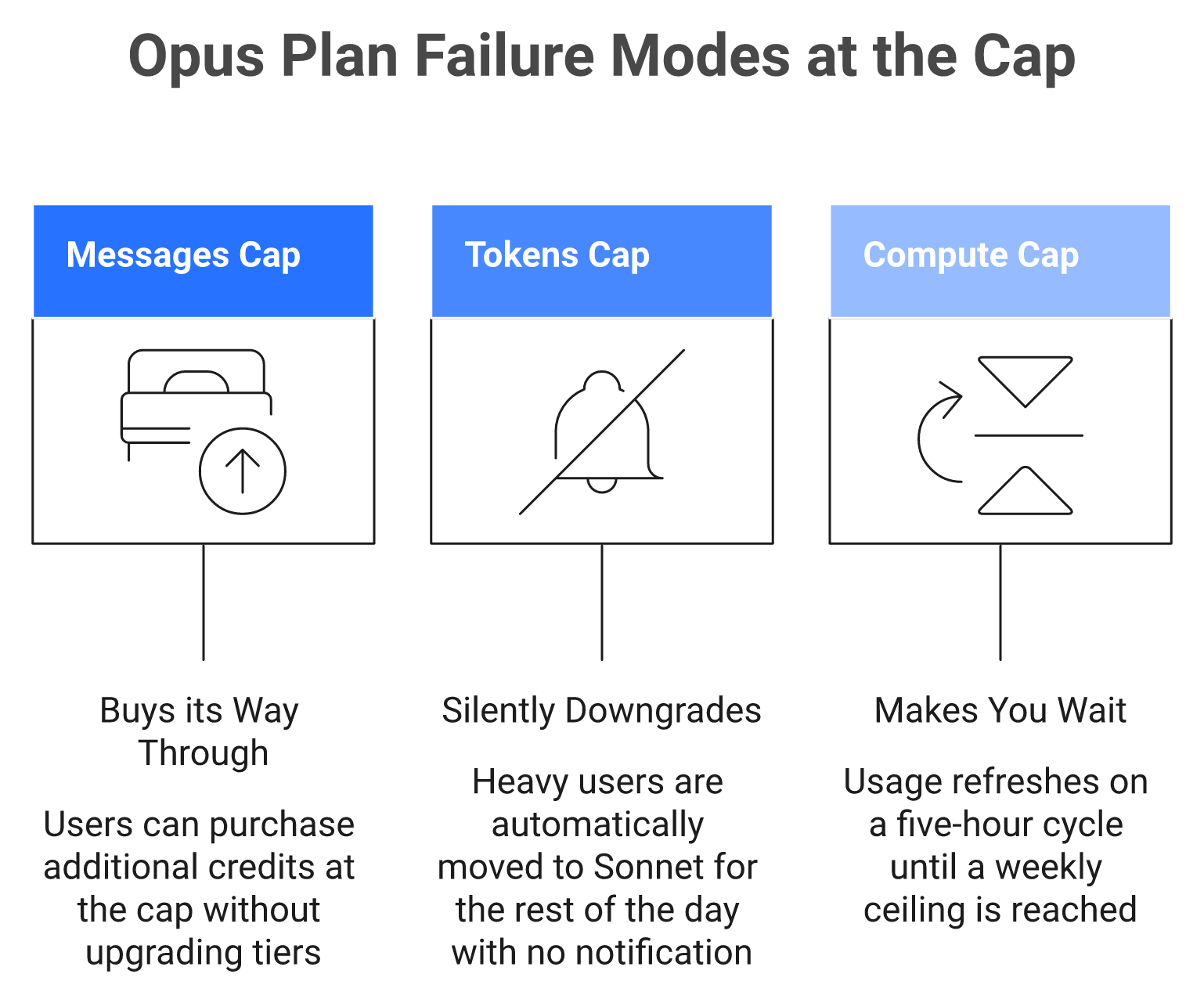
Claude heavy users who exhaust the daily Opus allowance are downgraded to Sonnet for the remainder of the day. The work continues. The quality changes. Nobody sends you a notification. ChatGPT Plus takes the opposite approach and lets you purchase additional credits at the cap without upgrading tiers. Google AI Pro simply refreshes on its five-hour cycle.
Silent degradation is the dangerous one. Teams who hit it usually conclude the model got worse. What actually happened is that they crossed a billing boundary mid-task, a pattern worth watching alongside how Claude Code handles developer workloads.
💬 What practitioners report
"Claude is better for deeper writing, ChatGPT is better for casual, brainstorming, and friendly use. Both of them are pretty good at coding."
r/ClaudeAI, Reddit Thread
"I'm on the $20 ChatGPT Plus plan mainly using Codex. Thinking of switching to Claude Pro. For those who've used both recently (June 2026), is it worth it?"
r/ClaudeAI, Reddit Thread
✅ Detect the downgrade before it ships
Three checks, all doable this week.
- Timestamp your heavy sessions, because caps are windowed, and a quality drop at hour four is a billing event, not a model event.
- Keep one fixed benchmark prompt, run it when output feels off, and compare against a saved good answer. A saved prompt library makes this repeatable.
- Check which model actually responded before you send client-facing work, since the swap happens silently on Claude.
MaximusLabs AI runs agentic content builds against these tiers weekly, and the throughput ceilings we hit in production, rather than in benchmarks, are what shape the normalisation table above.
Q5. Which $20 plan is best for coding after the June 2026 Claude Code change?
Claude Pro is no longer a production coding seat. Since mid-2026, it runs Claude Code under one combined weekly cap sized for light, occasional sessions, roughly 2.2M Sonnet-equivalent tokens plus $20 of programmatic credit, with third-party harnesses limited to API keys. Sustained daily coding needs Max 5x at $100 per month. At $20, Codex on ChatGPT Plus now offers more predictable throughput.
⭐ Claude Code was the $20 hero, and every article still says so
For most of 2025 and early 2026, the answer to "best $20 coding plan" was easy. Claude Pro shipped Claude Code, and developers moved over in volume.
That consensus is now stale. Comparison pages still list Claude Code as a headline Pro feature without flagging what changed underneath it. Readers act on advice that was correct six months ago.
⚠️ What the mid-2026 billing change actually did
Anthropic moved Claude Pro to a single combined weekly cap. Documentation describes the tier as suited to "light, occasional coding sessions".
The practical ceiling is about 2.2M Sonnet-equivalent tokens per week, plus $20 of programmatic credit. That is a real allowance for a hobby project. It is not a working seat for someone shipping code daily. Third-party harness support on Pro is also restricted to API keys, which limits how you can wire it into your own tooling, a constraint worth reading alongside the Claude Code developer tooling guide.
MaximusLabs AI runs agentic content builds against these tiers every week, and hitting the weekly ceiling mid-build is how our team spotted the change before most comparison pages updated.
💰 Codex, Claude Code, and Gemini agents at $20
OpenAI publishes its Codex throughput openly, which matters more than it sounds. Their pricing documentation lists per-model bands, from 15 to 90 local messages per five-hour window on one model, up to 50 to 280 on another, with additional weekly limits noted.
Published bands let you plan. An undisclosed weekly cap does not.
| Workload | Best $20 option | Why |
| Daily production coding | ChatGPT Plus with Codex | Published per-model message bands, purchasable overflow credits |
| Occasional scripting or refactors | Claude Pro | Weekly cap covers light sessions, strongest reasoning on code review |
| Coding inside Google tooling | Google AI Pro | Gemini agents and Antigravity fit Workspace-native workflows |
| Sustained agentic builds | Claude Max 5x at $100 | Pro's weekly cap is explicitly not sized for this |
✅ The agent memory trick that saved a build
A few weeks ago, I was building a customer dashboard with Claude Code. Every single run, the agent slipped emojis into customer-facing copy. I corrected it manually four times before I stopped being stupid about it.
Then I told the agent to create a claude.md file in the project root with one rule: never use emojis. The correction stopped being my job and became the project's memory. That shift, from manual correction to self-modifying agent memory, is worth more than any throughput number in this section, and it is the same principle behind GEO automation workflows.
💬 What developers are reporting
"I'm on the $20 ChatGPT Plus plan mainly using Codex. Thinking of switching to Claude Pro. For those who've used both recently (June 2026), is it worth it?"
r/ClaudeAI Reddit Thread
"Claude is better for deeper writing, ChatGPT is better for casual, brainstorming, and friendly use. Both of them are pretty good at coding."
r/ClaudeAI Reddit Thread
MaximusLabs AI operates a hybrid human and AI production pipeline with proprietary internal tools, so tier ceilings show up in our delivery schedule before they show up in a changelog roundup. That is the only reason we caught this one early.
Q6. Which plan is most accurate, and does Deep Research actually improve it?
Accuracy and volume move in opposite directions at this price. Claude Opus 4.5 scored 77% on fact-check accuracy, the highest of 14 models tested. OpenAI models generate the most citations and hit a 100% task success rate, but only 39% to 59% fact-check accuracy. Depth makes it worse: fact-check accuracy fell about 42% on average from minimal to maximal search depth.
⭐ The benchmark split nobody puts in a comparison table
Across a 14-model fact-check benchmark, Claude Opus 4.5 topped the field at 77%. That is the highest score recorded, and it is still short of what most people assume they are buying.
OpenAI's models produced the most citations and completed every assigned task. Their fact-check accuracy landed between 39% and 59%. A long citation list and a completed task are not the same thing as a correct answer.
⚠️ Why "Deep Research" can make things less accurate
This is the counterintuitive part. Fact-check accuracy dropped roughly 42% on average as search depth moved from minimal to maximal.
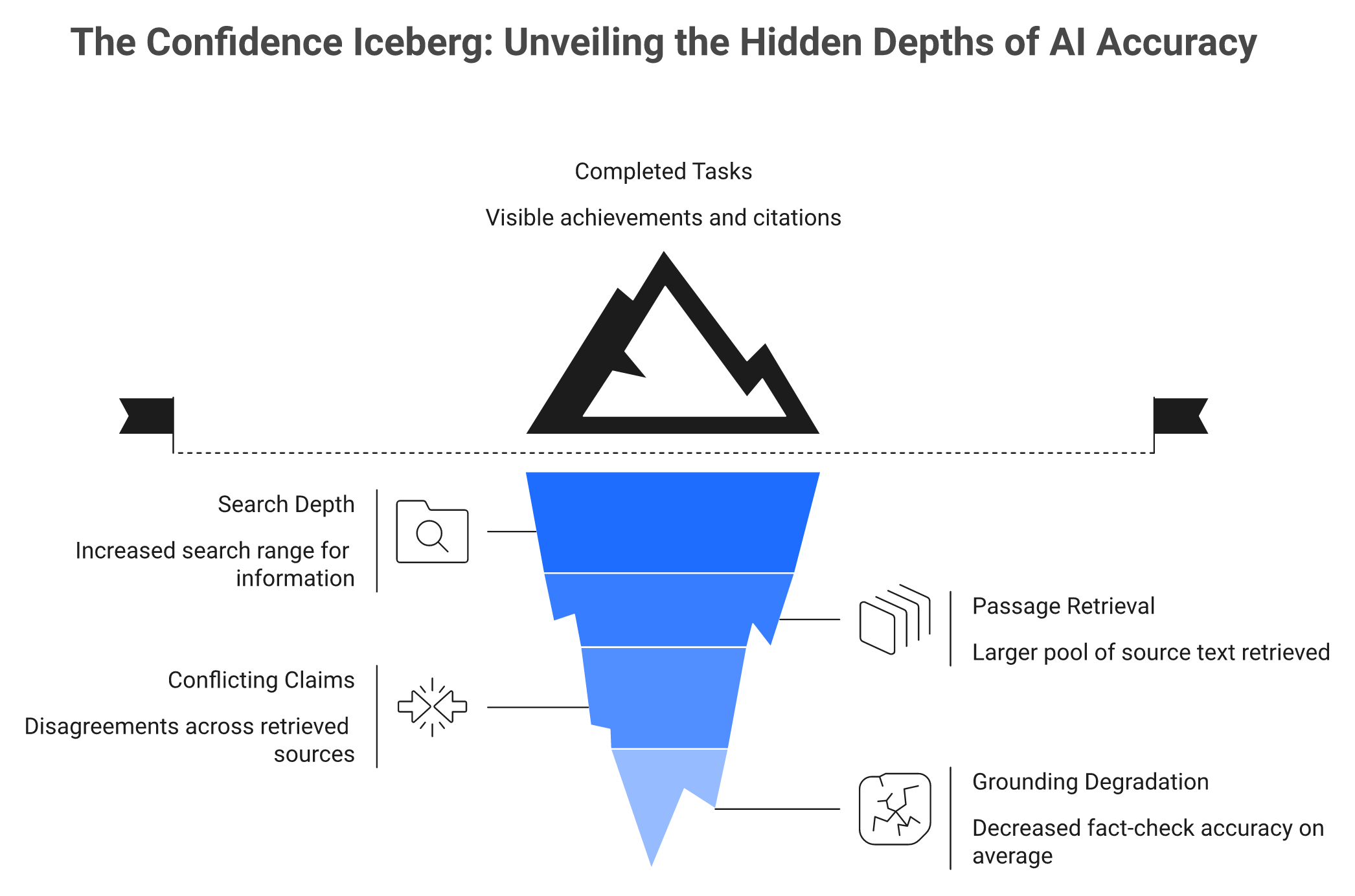
The mechanism is simple once you see it. Deeper retrieval pulls in more passages, and more passages means more conflicting claims. The model then has to reconcile sources that disagree, and grounding degrades. Running the expensive research mode is not automatically the safer choice.
MaximusLabs AI follows a fixed source hierarchy of papers, then patents, then official documentation, then first-party datasets, with secondary blogs last, because that ordering does the conflict resolution before the model ever sees the inputs. It is the backbone of our trust-first content methodology.
❌ What this means for client-facing work
Here is the position most of the category avoids stating plainly. Paying $20 for ChatGPT buys volume and the appearance of success. Paying $20 for Claude buys a practitioner tool for people who would rather have fewer claims that hold up.
I might be reading the benchmark harder than it deserves. It is one test set, not a law of nature. What makes me trust the direction is that it matches what surfaces in our own audits: the model that produces the most confident output is rarely the one producing the most verifiable output.
✅ The audit workflow that compensates
No $20 research mode clears 80% fact-check accuracy unsupervised. So build the check into the workflow rather than hoping.
- Cap search depth deliberately on factual work, since maximal depth cost about 42% of fact-check accuracy in testing.
- Ask for the source URL alongside every number, then open two of them at random before publishing.
- Use one model to draft and a different model to challenge, because self-review inherits the same grounding errors.
- Route anything with a statistic, a date, or a named entity through manual verification, no exceptions. The same discipline underpins E-E-A-T optimization.
💡 The 40 to 60 word rule that improves recall
There is a structural fix on the publishing side too. Sentence-level chunking in Claude's Citations API works best on paragraphs of 40 to 60 words, and it increases recall accuracy by up to 15%.
That number should change how you write, not just how you read. If your paragraphs run long, retrieval systems chunk them badly, and your accurate content gets quoted inaccurately. Short blocks are an accuracy feature, not a style preference, which is exactly what content formatting for AI search is built around.
MaximusLabs AI traces every published claim to a primary source, whether paper, patent, or official documentation, precisely because no $20 research mode is accurate enough to publish from unsupervised.
Q7. Do the agentic features in these plans actually work yet?
Agentic features across all three $20 plans are demo-grade, not production-grade. They reason well and act badly. End-to-end checkout, multi-step purchases, and app builds stall in loops or fail silently, because agent intent meets merchant and app APIs that are not machine-legible. Treat agent mode as a drafting assistant with hands, not an operator you can leave unattended.
⭐ The promise on the pricing page
Every $20 tier now advertises some version of autonomy. Operator and Agent Mode on ChatGPT, agentic browsing on Gemini, Claude Cowork on Anthropic's side.
The demos are genuinely impressive. The gap between demo and Tuesday afternoon is where the money goes.
❌ Two tasks that failed, in detail
I asked Gemini to buy snowboard pants and handle the checkout end to end. It did not work. It cycled through a couple of different loops and never completed the purchase.
Separately, I asked ChatGPT what app I should build based on my query history. It gave me five ideas. I built one, and the only thing I wanted was dictation that converts speech into an actual email newsletter. I do not think it worked.
Neither failure was a reasoning failure. Both models understood the request perfectly. The break happened where intent had to touch a system that was not built to be read by a machine, a pattern documented in the state of agentic commerce 2026.
💡 The Michelin chef, and why it explains everything
Picture a world-class chef sitting in an empty room. Perfect technique, decades of training, nothing to cook with. The Michelin kitchen is across town.
That is the current state of agentic AI at $20. The model is the chef. The agent layer is supposed to be the hands. The APIs are the kitchen, and most of them are still locked. Reasoning quality was never the bottleneck.
⚠️ The ghost kitchen problem for your own site
Flip this around, because it matters more to your revenue than to your subscription choice. Your website is the dining room, built for human diners who browse and click.
Agentic commerce is the kitchen, and it runs on a data feed. The AI delivery driver does not want to walk your dining room. It wants the feed. Sites that hide product attributes behind JavaScript filters are invisible to it, which is why agent browsing fails on so many otherwise well-built pages. An AI crawlability check surfaces this in minutes.
The fix is unglamorous. Expose the facet data as static text: the closure, the fabric, the material, and the neck style. If an AI cannot see it, it cannot retrieve it, so push it into FAQs and visible copy.
💬 What practitioners say about the gap
"Ran ChatGPT Plus and Claude Pro side by side for 30 days, here's what I found as a daily ChatGPT user."
r/ChatGPT Reddit Thread
"Claude Pro vs ChatGPT Plus at $20, I've been on both for 2 years and I think I finally figured out why I keep flip-flopping."
r/ClaudeAI Reddit Thread
✅ How to use agent mode this week
Use it where a failure is cheap and visible. Drafting, research collection, and file reorganisation qualify. Payments, client communication, and anything touching production do not.
MaximusLabs AI is building toward agentic search and agentic commerce optimisation as the next layer of our practice, and the honest report from inside that work is that the retrieval side is ready well before the action side.
Q8. Should you pay for two plans, and when does $40 beat one $100 tier?
Two $20 plans beat one $100 tier when your work splits across genuinely different jobs, such as accuracy-critical writing plus multimodal output, and you stay inside both caps. Upgrade a single vendor instead when one workload dominates and you hit its ceiling more than twice a week. Long-term dual users settle at $40 per month and route tasks by strength.
⭐ The rule, before the arithmetic
Stack when your work is genuinely two jobs. Upgrade when it is one job you keep outgrowing.
That distinction is the whole decision. Most people stack because they cannot choose, which is a different thing entirely, and it costs $240 a year.
💰 The break-even table
| Situation | Spend | Why it works |
| Two distinct workloads, both inside caps | $40, two plans | Route by strength, no ceiling pressure |
| One dominant workload, ceiling hit twice weekly | $100, Claude Max 5x | Pro's weekly cap is not sized for sustained use |
| Heavy agentic or coding volume | $200, Max 20x | Multiplies session room rather than splitting it |
| Mixed light use, Workspace-native | $19.99, Google AI Pro alone | Bundled 5 TB absorbs a separate storage cost |
The middle two rows are where people overspend by stacking. If you are hitting one vendor's cap repeatedly, a second subscription does not solve it. You need more room on the tool you already prefer.
⏰ The two-hours-a-day test, applied honestly
A Reddit user two years into holding both plans reduced the whole question to what you actually engage in for two hours each day. It is the cleanest allocation heuristic I have seen.
Answer it truthfully and the stack question usually resolves itself. If your two hours are all writing, you need one plan and possibly a higher tier. If your two hours split between long documents and visual output, you have a real case for two.
💬 What long-term dual subscribers report
"Ran ChatGPT Plus and Claude Pro side by side for 30 days, here's what I found as a daily ChatGPT user."
r/ChatGPT Reddit Thread
"Claude is better for deeper writing, ChatGPT is better for casual, brainstorming, and friendly use."
r/ClaudeAI Reddit Thread
"Both of them are pretty good at coding, you don't necessarily need both unless you're a heavy power user."
r/ClaudeAI Reddit Thread
✅ The honest disclosure
We run two subscriptions at MaximusLabs AI, and the split is not elegant. Claude handles long-document analysis and anything where a wrong number costs a client. ChatGPT handles visual output, quick synthesis, and Codex work where published throughput bands let us plan the week.
Could we consolidate? Probably, at a quality cost we have not been willing to accept yet. I flag that as a preference, not a recommendation, because your two hours a day are not our two hours a day.
MaximusLabs AI charges from $899 per month for full GEO content production, which is roughly $60 per piece, and that unit economics discipline is the same lens we apply to a $20 subscription: cost per outcome, never cost per month.
Q9. What does your plan choice reveal about how AI engines read your brand's content?
Your plan choice exposes the retrieval layer your buyers experience. For standard web results, ChatGPT receives structured metadata, meaning URL, title, a roughly 150-character snippet, and a date, not full page text. Google AI Mode fans one prompt into 8 to 12 parallel sub-queries. Claude's Citations API rewards 40 to 60-word paragraphs with up to 15% better recall. The snippet is the new rank.
⭐ You just picked an engine. It also picked whether you exist.
Most people finish this comparison, pay $20, and move on. That is the wrong place to stop.
The engine you chose is the same engine your buyers open when they ask about your category. Its retrieval rules decide whether your brand appears in the answer or vanishes. Around 83% of AI Overview searches now end without a click, so the answer itself is the destination, which is the core of the zero-click brand economy.
⚠️ The uncomfortable part: the engine is not reading your page
Here is what breaks the mental model. For standard web results, ChatGPT does not ingest your article. It receives structured metadata: the URL, the title, a snippet of roughly 150 characters, and a date.
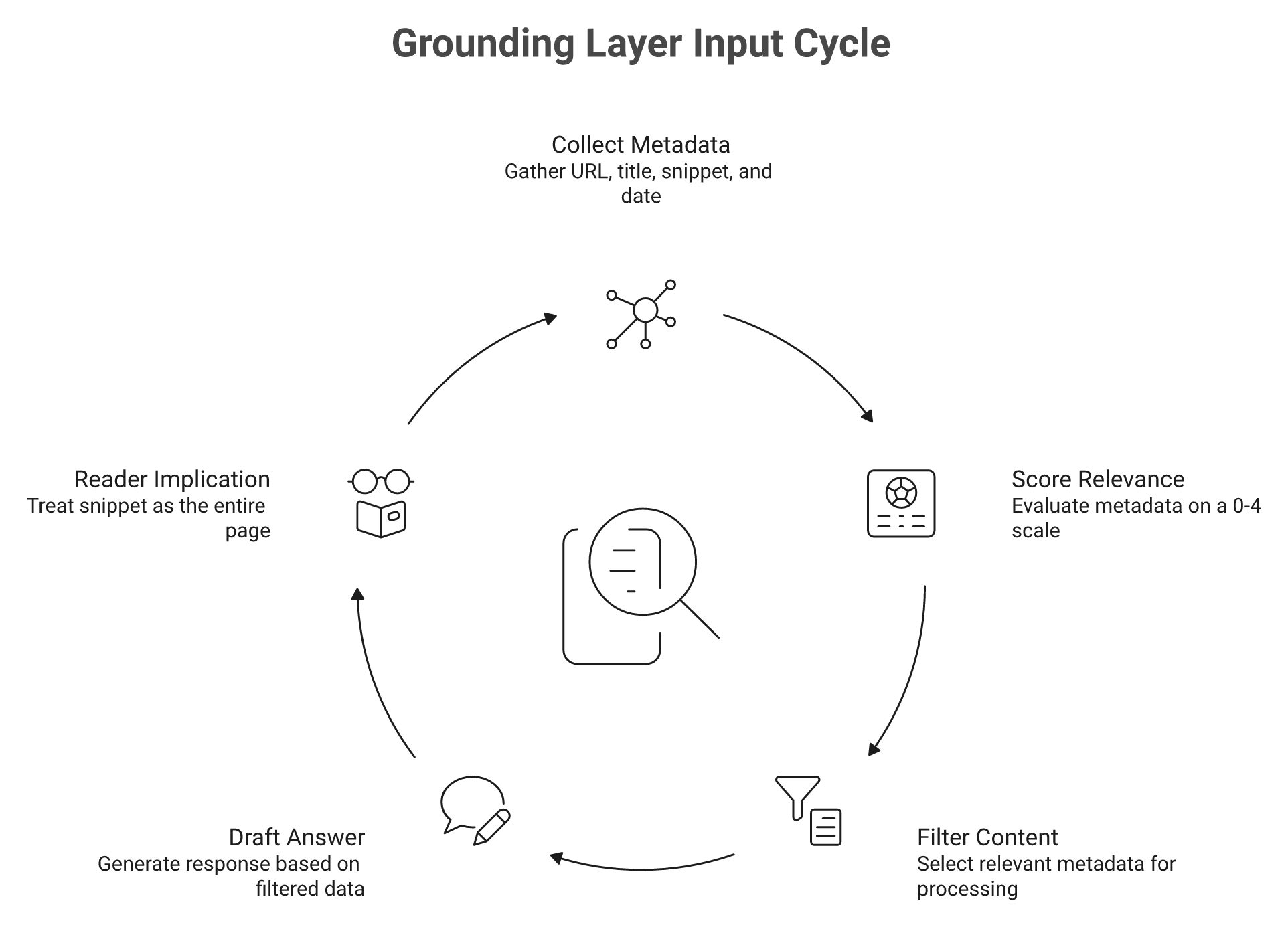
Your 3,000-word masterpiece gets compressed to a sentence fragment before the model ever reasons about it. Do not pay for a Pro plan expecting a deep-reading researcher. It is often a sophisticated summariser of metadata snippets, a behaviour unpacked in the ChatGPT search optimization guide.
📊 Three retrieval mechanics worth knowing
| Layer | Mechanic | What it means for your content |
| ChatGPT grounding | Metadata plus ~150-character snippet, scored 0 to 4 by a scoring model before it reaches the chat box | Your first 150 words carry the whole page |
| ChatGPT latency budget | 164ms p95 for the full grounding pipeline, about 2.5 times faster than the nearest alternative | Slow or JavaScript-gated content misses the window |
| Google AI Mode | 8 to 12 parallel sub-queries per prompt | One page can be pulled for several angles at once |
| Claude Citations API | Sentence-level chunking, best at 40 to 60-word paragraphs, up to 15% better recall | Short blocks get quoted accurately |
An integer scale from 0 to 4 decides whether a result is ideal or completely irrelevant. That judgment happens before you have any say in it.
✅ Three changes to make this week
The payoff from all of the above is unglamorous and specific.
- Write in 40 to 60-word blocks, since sentence-level chunking rewards them with measurably better recall, a rule we apply throughout our GEO content optimization work.
- Treat your first 150 words as the entire page, because that is the unit the grounding layer actually receives.
- Force facet data into static text, since language models cannot find information hidden behind JavaScript filters. Put the closure, the fabric, the material, and the neck style into FAQs where a retriever can reach them.
💡 Citation beats ranking, and the data says so
Seer Interactive analysed 25.1 million impressions and found that brands cited inside an AI Overview earn 35% more organic clicks and 91% more paid clicks than brands that are not cited on the same query. Organic CTR on those queries fell about 61% overall.
That split is the entire strategy. Ranking below the summary is now worth less than being named inside it. MaximusLabs AI runs citation optimisation separately for ChatGPT, Google AI Overviews, Perplexity, and Claude, because each layer scores and chunks content differently, and one generic structure satisfies none of them well.
MaximusLabs AI writes every section as a 40 to 80 word answer nugget that stands alone when extracted, because these retrieval layers cite fragments, not articles.
Q10. How do you measure whether your $20 AI plan is driving real pipeline?
Referral data from AI assistants is largely stripped, so analytics undercount them. The reliable method is a post-conversion "how did you hear about us" field, which matters most in B2B. Pair it with citation-share tracking across question variants rather than rankings. AI-sourced traffic converts at roughly 6 times the rate of Google search traffic, so undercounting distorts budget decisions badly.
💰 The measurement gap that costs you budget
Open your analytics. Look for AI-sourced sessions. You will find almost nothing, and that absence is not the truth.
Referral data from AI assistants is largely stripped before it reaches your dashboard. Meanwhile, organic CTR on AI Overview queries dropped about 61%, so the traffic you can see is also shrinking. You are measuring a channel that is quietly moving out of view, a decline documented in our work on search referral traffic decline.
⚠️ Why the undercount is expensive, not just annoying
The conversion gap is what makes this urgent. LLM-sourced traffic converts at roughly 6 times the rate of Google search traffic.
Read that alongside the attribution gap and the problem becomes obvious. Your highest-converting channel is the one your reporting shows least. Budget then flows to the channel with the prettiest dashboard, which is usually the wrong one.
✅ The two-step setup you can ship this week
Neither step needs engineering time.
- Add a post-conversion field asking how the buyer heard about you, with source options. It is self-reported and imperfect, but in B2B it is the most reliable signal available, and I recommend it strongly.
- Track citation share across question variants, not rankings. Run the questions your buyers actually ask across ChatGPT, Perplexity, Gemini, and Google AI Overviews, then record whether you are named. Our approach to GEO measurement and metrics is built on exactly this.
MaximusLabs AI tracks share of voice across thousands of question variants instead of single rankings, which is how Oliv AI reached a 64% citation rate against legacy competitors sitting near 30%.
📊 What to measure instead of what you measure now
| Old metric | Replacement | Why it matters |
| Impressions | Citation rate per question cluster | Being named beats being listed |
| Position tracking | Share of voice across engines | One rank means little across four surfaces |
| Sessions | Self-reported source at conversion | Survives stripped referrers |
| Pageviews | Pipeline influenced | Clicks are vanity if revenue does not move |
Brand mentions correlate with AI citation at 0.664, which is why off-site presence belongs in the same measurement frame as on-site content.
💬 What practitioners report about measurement
"Ran ChatGPT Plus and Claude Pro side by side for 30 days, here's what I found as a daily ChatGPT user."
r/ChatGPT Reddit Thread
"Thinking of switching from OpenAI to Claude Pro: how are the usage limits in 2026?"
r/ClaudeAI Reddit Thread
⭐ The allocation principle underneath all of this
Clicks and impressions are vanity metrics if they do not move the revenue needle. That is not a slogan; it is a budgeting rule.
Start at the bottom of the funnel where buyers are comparing and deciding, then work backwards. Top-of-funnel explainer content is the first thing AI engines answer themselves, which makes it the worst place to spend scarce budget in 2026. The sequencing follows the B2B SaaS buyer journey in AI search.
MaximusLabs AI builds BOFU-first content aligned to the ICP, and measures the work by citation share and pipeline influence rather than sessions, because that is the only version of this channel a CFO can act on.
Q11. Which plan fits your role, and what does switching actually cost you?
Founders splitting time across strategy, code, and decks get most from ChatGPT Plus. VP Marketing and Head of Organic Growth, living in long documents and accuracy-critical analysis, get more from Claude Pro. Marketing managers running reporting inside Sheets and Drive get more from Google AI Pro. Switching costs are real: memory, Projects, Custom GPTs, Gems, and MCP connectors do not transfer.
⭐ Role-to-plan mapping
Your job title predicts your usage pattern better than any feature comparison does.
| Role | Best fit | Reason |
| SaaS or AI founder | ChatGPT Plus | Widest task range, image output for decks, Codex with published throughput bands |
| VP Marketing | Claude Pro | Long-document analysis, highest fact-check accuracy of the three |
| Head of Organic Growth | Claude Pro | 1M-token context handles full content audits in one pass |
| Head of GTM | ChatGPT Plus | Mixed synthesis, voice, and quick multimodal turnaround |
| Marketing Manager | Google AI Pro | Gemini inside Sheets, Docs, and Drive, plus 5 TB storage at $19.99 |
⚠️ The cost nobody prices: lock-in
Here is the part missing from every comparison on page one. The subscription is $20. The switching cost is not.
Each plan quietly accumulates assets that do not travel. Claude Pro holds unlimited Projects, Artifacts, and MCP connectors, which are tool integrations wired into your workflow. ChatGPT Plus holds memory, Custom GPTs, projects, and scheduled tasks. Google AI Pro holds Gems, up to 10 active scheduled actions, and NotebookLM Plus notebooks. The connector layer itself is mapped in our breakdown of the agentic web stack.
Three months in, you have not bought a subscription. You have built a workflow on top of one.
✅ Export before you cancel
Run this sequence in order, before the billing date, not after.
- Export chat history and any saved documents from the plan you are leaving.
- Screenshot or copy the configuration of every Custom GPT, Gem, or Project, since none of these transfer.
- List your MCP connectors and scheduled actions, then check whether the new plan supports equivalents.
- Keep the old plan live for one overlap month while you rebuild, because rebuilding under deadline pressure is how work gets lost.
💡 The intent-gap prompt worth running on day one
Whatever plan you land on, this is the first thing to try. I copy and paste an outline into Claude and ask one question: what is missing from this outline that could help me more thoroughly satisfy the user's search intent?
It forces the model to do the roughly 30% of unique research it usually skips. It also gives you a fast, honest read on how good your new plan actually is at reasoning about gaps rather than filling space. Keep the variants you like in a reusable prompts database.
💬 What switchers are saying
"Should I switch from ChatGPT Plus to Claude Pro?"
r/ClaudeAI Reddit Thread
"Claude vs ChatGPT in 2026, which one are you using and why?"
r/singularity Reddit Thread
⏰ What I am still sitting with
My working hypothesis is that within a year the plan question becomes irrelevant, because routing layers will send each task to whichever model handles it best, and the $20 subscription becomes a credit balance rather than a brand loyalty.
I could be wrong about the timeline. What I am confident about is the second-order question: whichever engine wins, it will still decide whether your brand is the answer or a footnote. If you are building something that deserves to be found, I would rather talk about that than about which checkout tab to close. krishna@maximuslabs.ai
Frequently asked questions
Which is better at $20: ChatGPT Plus, Claude Pro, or Google AI Pro?
There is no universal winner at $20, and any comparison that names one is hiding the trade-off. The right answer depends on what you actually do for two hours every working day. ChatGPT Plus wins on breadth. GPT-5.5 and 5.6, image generation, limited Sora video, voice, and Custom GPTs cover the widest mix of everyday tasks. Claude Pro wins on depth. Opus 4.8 with a 1M-token context handles long-document writing and accuracy-critical analysis, but it generates no images and no video at all. Google AI Pro wins on integration. At $19.99 with Gemini 3.1 Pro, Veo 3.1, NotebookLM Plus, and 5 TB of bundled storage, the AI layer costs almost nothing on a net basis if you already pay for cloud storage. The elimination method beats the feature matrix. Find the one capability your work cannot proceed without, then remove the plans that lack it. If that capability is visual output, Claude Pro is out immediately. If it is hundred-page document analysis, Claude Pro or Google AI Pro win. MaximusLabs AI tracks how each of these engines retrieves and cites sources across thousands of question variants, so our read is shaped by observed retrieval behaviour rather than benchmark scores.
Are all three plans really the same price once you count storage and annual billing?
No. Three prices that look identical are not three identical costs, and the adjustments change the ranking for a large group of buyers. ChatGPT Plus: $20 with no bundled asset and no meaningful annual discount to net out. Claude Pro: $20 monthly, or roughly $17 monthly when billed annually at $200 for the year. Google AI Pro: $19.99 with 5 TB of Google One storage attached, raised from 2 TB on April 1, 2026 with no price increase. The Google row is the one worth pausing on. If you currently pay separately for multi-terabyte cloud storage, that line item disappears into the subscription, and Gemini 3.1 Pro effectively arrives attached to a bill you were already paying. There is also a tier missing from most three-way comparisons. Google restructured its consumer AI pricing in June 2026 and introduced Google AI Plus at $4.99, with AI Ultra sitting above AI Pro. For a marketing manager who mainly wants Gemini inside Docs and Sheets, the honest recommendation may be to spend a quarter of the money. The reframe that matters is cost per outcome, not cost per month, which is the same unit-economics discipline behind our approach to revenue attribution for GEO budgets .
How do the usage limits compare, and what happens when you hit the cap?
The three plans are not comparable as published, because each vendor counts a different currency. ChatGPT Plus counts messages per model, with per-model bands from 15 to 90 local messages per five-hour window on one model up to 50 to 280 on another, plus additional weekly limits. Claude Pro counts tokens in a five-hour rolling window, roughly 44,000 Opus tokens per window in practice, with a combined weekly ceiling near 2.2M Sonnet-equivalent tokens for Claude Code. Google AI Pro counts compute, refreshing every five hours until a weekly ceiling, with no published prompt count. Comparing messages, tokens, and compute directly is like comparing a price in dollars, a price in litres, and a price in hours. The failure mode matters more than the cap size. Claude heavy users who exhaust the daily Opus allowance are downgraded to Sonnet for the remainder of the day, and nobody sends a notification. ChatGPT Plus lets you purchase additional credits at the cap without upgrading tiers. Google AI Pro simply refreshes on its cycle. Silent degradation is the dangerous one. MaximusLabs AI runs agentic content builds against these tiers weekly, and the ceilings we hit in production, rather than in benchmarks, shaped the normalisation we use across our automation workflows .
Is Claude Pro still the best $20 plan for coding in 2026?
No, and this is the single most outdated claim still circulating in three-way comparisons. Claude Pro is no longer a production coding seat. Since mid-2026, Anthropic runs Claude Code on Claude Pro under one combined weekly cap that its own documentation describes as suited to light, occasional coding sessions. The practical ceiling sits near 2.2M Sonnet-equivalent tokens per week plus $20 of programmatic credit, and third-party harness support on Pro is restricted to API keys. Daily production coding: ChatGPT Plus with Codex, because the per-model message bands are published and overflow credits are purchasable. Occasional scripting or refactors: Claude Pro, which still offers the strongest reasoning on code review. Coding inside Google tooling: Google AI Pro, where Gemini agents fit Workspace-native workflows. Sustained agentic builds: Claude Max 5x at $100, since Pro's weekly cap is explicitly not sized for it. Published throughput bands let you plan a week. An undisclosed weekly cap does not. MaximusLabs AI spotted this change before most comparison pages updated, because our team hit the ceiling mid-build, and we track the same shifts in our Claude developer tooling coverage .
Which plan is most accurate, and does Deep Research actually improve factual quality?
Accuracy and volume move in opposite directions at this price, and Deep Research does not reliably fix it. Across a 14-model fact-check benchmark, Claude Opus 4.5 topped the field at 77%, the highest score recorded. OpenAI models produced the most citations and hit a 100% task success rate, but their fact-check accuracy landed between 39% and 59%. A long citation list and a completed task are not the same thing as a correct answer. The counterintuitive part is depth. Fact-check accuracy dropped roughly 42% on average as search depth moved from minimal to maximal. Deeper retrieval pulls in more passages, more passages means more conflicting claims, and grounding degrades as the model reconciles sources that disagree. Cap search depth deliberately on factual work. Ask for the source URL alongside every number, then open two at random before publishing. Use one model to draft and a different model to challenge, since self-review inherits the same grounding errors. Route every statistic, date, and named entity through manual verification. MaximusLabs AI follows a fixed source hierarchy of papers, patents, official documentation, then first-party datasets, which is the backbone of our trust-first content playbook .
Should you pay for two $20 plans instead of upgrading to one $100 tier?
Stack when your work is genuinely two jobs. Upgrade when it is one job you keep outgrowing. That distinction is the whole decision, and most people stack because they cannot choose, which costs $240 a year. Two distinct workloads, both inside caps: $40 across two plans, routing by strength with no ceiling pressure. One dominant workload, ceiling hit twice weekly: $100 for Claude Max 5x, because Pro's weekly cap is not sized for sustained use. Heavy agentic or coding volume: $200 for Max 20x, which multiplies session room rather than splitting it. Mixed light use, Workspace-native: $19.99 for Google AI Pro alone, where bundled 5 TB absorbs a separate storage cost. The middle rows are where people overspend. If you are hitting one vendor's cap repeatedly, a second subscription does not solve it. You need more room on the tool you already prefer. MaximusLabs AI runs two subscriptions: Claude handles long-document analysis and anything where a wrong number costs a client, while ChatGPT handles visual output and Codex work. We apply the same cost-per-outcome lens to a $20 subscription that we apply to our own GEO content production pricing .
What does your AI plan choice reveal about how these engines read your brand's content?
Your plan choice exposes the retrieval layer your buyers experience when they ask about your category, and the mechanics are less flattering than the marketing suggests. ChatGPT grounding: for standard web results it receives structured metadata, meaning URL, title, a roughly 150-character snippet, and a date, then scores that on an integer scale from 0 to 4 before it reaches the chat box. Google AI Mode: decomposes one prompt into roughly 8 to 12 parallel sub-queries, producing breadth over depth. Claude Citations API: uses sentence-level chunking that works best on 40 to 60-word paragraphs and lifts recall accuracy by up to 15%. Your 3,000-word page is compressed to a sentence fragment before the model reasons about it, so treat your first 150 words as the entire page and force facet data into static text rather than JavaScript filters. Seer Interactive analysed 25.1 million impressions and found brands cited inside an AI Overview earn 35% more organic clicks and 91% more paid clicks. MaximusLabs AI runs citation optimisation separately for each engine, because one generic structure satisfies none of them well.