 Krishna Kaanth M
- Microsoft Copilot search optimization means structuring content so Copilot cites it inside AI answers, targeting citation share instead of blue-link rankings.
- Copilot decomposes prompts into grounding queries, retrieves from Bing, scores chunks for relevance, and synthesizes answers with mandatory inline citations.
- Copilot runs on Bing with no separate CopilotBot, so Bing indexing is non-negotiable, though Bing rank matters more for commercial than informational queries.
- Extractable evidence objects, answer-first passages, semantic tables, server-rendered schema, and facet data in text beat most classic technical SEO polish.
- Trust markers and a closed sameAs entity loop lift citations sharply, and Bing Webmaster Tools' AI Performance report gives first-party citation-share data.
- Copilot drives roughly 3% of AI referrals but converts high-intent enterprise buyers inside Microsoft 365, making lead quality the real payoff.
Q1: What is Microsoft Copilot search optimization, and why is it different from Google SEO?
Picture John, a Head of Sales at a mid-size SaaS company, hunting for a new outreach tool. He does not open ten review tabs. He opens Copilot and types one messy sentence. Copilot hands back a short, cited list of vendors. That list becomes his shortlist, and every brand left out is simply gone.
Microsoft Copilot search optimization is the practice of structuring content so Copilot cites it inside AI-generated answers. Unlike Google-only SEO that chases rankings, it targets citations. Because Copilot grounds responses on Bing's index using retrieval-augmented generation (RAG, where the AI searches first, then summarizes what it finds), you combine Bing indexing, extractable answer-first content, schema, and trust signals to become the source Copilot quotes. That is the core of Generative and Answer Engine Optimization.
The complication: rank is not the game anymore
⚠️ From position to presence
Old SEO trained us to fight for position one on Google. That fight assumed a human would scan blue links and click. Copilot removes that step. It reads the results for the user and writes one answer.
So the buyer journey compresses into a single response box. If you are not inside that synthesized answer, you were cut before the human ever reached your site. I have watched this happen to brands that ranked page one on Google yet stayed invisible across AI engines.
The resolution: optimize for citation share, not position
✅ Become the answer
Microsoft made this shift official. Its Copilot Fall Release added more prominent, clickable citations and an aggregated "sources" pane, treating attribution as a first-class part of the answer.
Here is the reframe I keep repeating to founders: the snippet is the new rank. You are no longer trying to be a result. You are trying to be the answer. Copilot has to pick a few sources to trust, and your job is to be one of them, again and again, across many question variants.
This is where the GEO and AEO lens matters. Generative Engine Optimization means getting cited on ChatGPT, Perplexity, Gemini, and Copilot in addition to Google. Answer Engine Optimization means engineering content that an engine can lift cleanly.
At MaximusLabs, we treat Copilot visibility as a citation-share problem, not a keyword-density one. We measure how often a brand shows up as the answer, then rebuild the pages and trust signals that move that number. That focus, becoming the answer rather than renting a rank, is the difference between our GEO-native approach and traditional Google-only SEO.
Q2: How does Microsoft Copilot actually choose its sources?
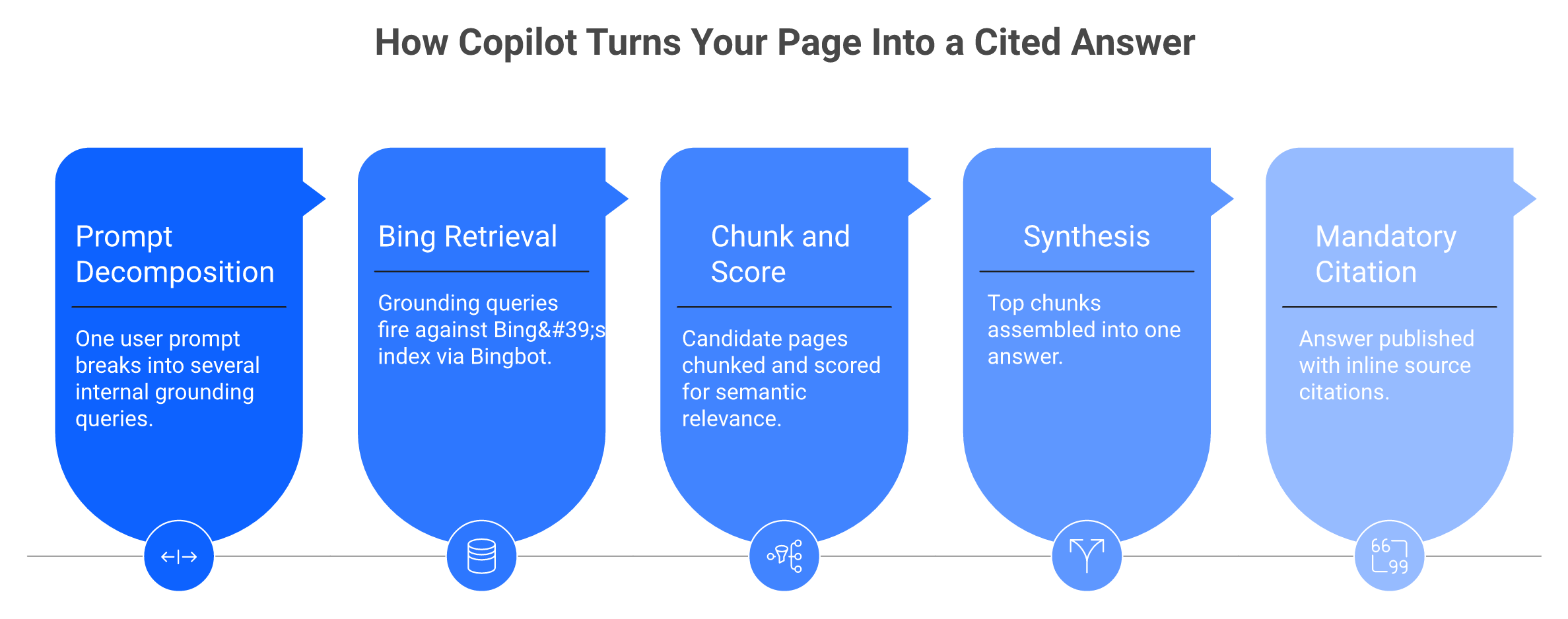
Copilot decomposes a user prompt into multiple internal grounding queries, fires them against Bing's web index, scores and chunks candidate pages for relevance, then synthesizes an answer with mandatory inline citations. To be selected, a page must be indexed in Bing and structured for extractability, meaning self-contained passages, tables, and FAQ blocks a retriever can lift without needing the full page.
One prompt becomes many searches
🔍 Grounding-query fan-out
Start with the payoff, because it changes how you write. A single Copilot prompt does not trigger one search. It fans out into several rewritten "grounding queries" that Copilot runs against Bing.
You can see these yourself. Bing Webmaster Tools' AI Performance report includes a Grounding Queries view that shows the exact sub-queries Copilot fired to build answers that cited you. That view is the closest thing we have to Copilot's private notebook.
How candidate pages get scored
📊 The relevance scale
Once Bing returns candidates, Copilot scores them for relevance against the user's confirmed intent. Practitioner teardowns describe an internal model grading results on a simple 0 to 4 scale, where 0 is completely irrelevant and 4 is an ideal result.
That grading is why comprehensive pages win. A page that answers one question earns one citation. A page that answers a whole cluster of related questions can get pulled into many grounding queries at once.
Speed and extractability are hard gates
⏰ Fast pipelines cut slow pages
The retrieval loop is fast, and slow or messy pages fall out. Reported benchmarks put Microsoft's grounding pipeline around 164ms at p95, roughly 2.5 times faster than the nearest alternative. Content that renders slowly, or hides text behind scripts, risks being skipped.
Extractability is the other gate. Microsoft's own docs note that some retrieval surfaces cannot parse tables or special formatting cleanly and index only finite chunks of a page. If a fact is not in clean, self-contained text, the retriever may never see it.
What this means for your pages
✅ Write for the decoder
I lean on a simple mental model here, the Universal Intent Decoder. Think of the LLM as a machine translating a 25-word human prompt into a structured request for specific data. Your job is to make the data trivially easy to grab.
That is why I argue, bluntly, that GEO is a data science problem, not a keyword exercise. Visibility comes from clearing a semantic-similarity threshold, not from stuffing phrases. Write answer-first blocks, use real tables, and keep each key claim standing on its own, which is the heart of good GEO content optimization.
Q3: Is Copilot just Bing? How much does Bing rank still matter?
A marketing manager once asked me, half-joking, whether "Copilot SEO" just meant "do Bing SEO and go home." It is a fair question, and the honest answer is: mostly yes on indexing, but not on ranking.
Copilot grounds web answers almost entirely on Bing's index, and there is no separate CopilotBot, so Bingbot access is non-negotiable. But Bing rank is not uniformly decisive. It strongly predicts citations for commercial "Best X" queries and far less for informational "How to Y" queries. Win Bing indexing first, then optimize for extractable answers rather than assuming a number one Bing rank guarantees citation.
The situation: Copilot runs on Bing
✅ Bingbot is the front door
This part is not contested. Copilot's web answers are grounded in the Bing index, and the same Bingbot that serves classic Bing results feeds Copilot. Block Bingbot and you disappear from both Bing search and every Copilot web answer at once.
So the baseline is simple. Get verified in Bing Webmaster Tools, submit your sitemap, and make sure Bingbot can crawl and render your pages, which sits at the core of Bingbot crawl optimization.
The complication: rank overlap is not consistent
⚠️ The data splits by query type
Here is where the popular "just rank in Bing" advice breaks. The data on how tightly Copilot citations track Bing's top organic results is genuinely mixed.
Seer Interactive found roughly an 87% citation overlap with Bing's top organic results for commercial queries. That sounds decisive. But a separate 400-query replication found only about 27.4% alignment for mixed informational queries.
I might be overreading two datasets, but the pattern fits what we see in the field. For "best X" commercial searches, Bing rank is close to a proxy for citation. For "how to Y" informational searches, extractable content beats raw position.
The resolution: run two tracks
✅ Indexing plus extractability
So treat Bing rank as necessary, not sufficient. Run indexing hygiene as track one for every page, always.
Then run citation-focused structure as track two, especially on informational content. Answer-first blocks, clean tables, and self-contained spans are what pull you into answers where rank alone will not.
This two-track discipline is exactly how we scope Copilot work at MaximusLabs. We fix the Bing plumbing first through a rigorous technical SEO and website audit, then engineer the extractable evidence that wins the queries where position does not carry you.
Q4: Why is technical SEO overrated for Copilot, and what actually gets you cited?
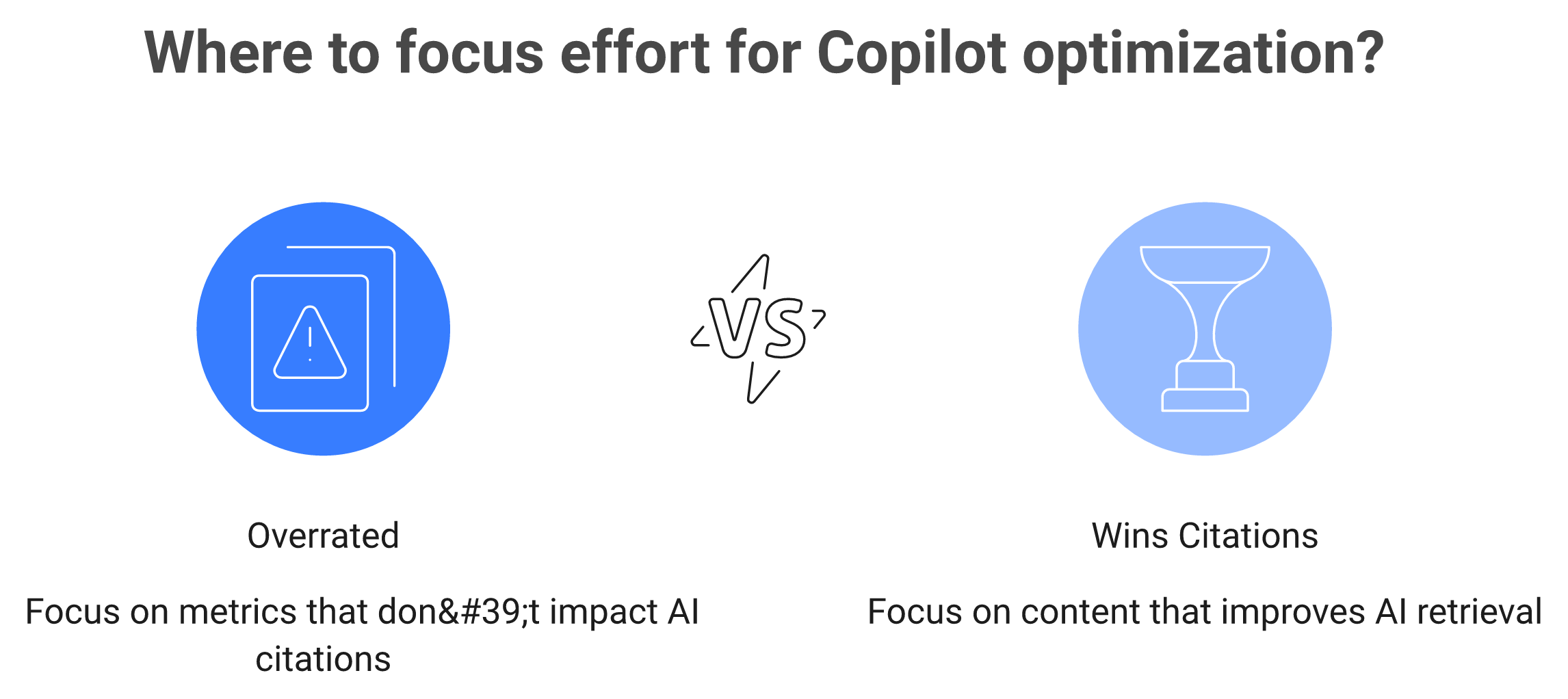
For Copilot, most classic technical SEO is a low-impact security blanket. What earns citations is extractability: answer-first passages, self-contained spans, semantic tables, server-rendered schema, and metadata moved out of JavaScript facets into indexable text. Copilot values "evidence objects" it can lift verbatim over Core Web Vitals polish. Fix crawlability and rendering, enable IndexNow, then engineer every section to be quotable.
The situation: audits feel productive
⚠️ The comfort of a checklist
Most teams still open a Copilot project with a 50-page technical audit. It feels rigorous. It produces a tidy checklist and a sense of control.
But I have to be blunt, and I have earned this take over 18 years in search. Technical SEO is the most over-weighted work in this category. In all that time, I have never once seen Core Web Vitals scores, on their own, drive a real traffic increase.
The complication: crawlers are cruder than you think
❌ AI bots miss what humans see
AI crawlers are not as smart as Googlebot yet. Analyses of OAI-SearchBot, which feeds some Copilot-adjacent grounding, show around 34.8% of its crawl wasted on 404s, versus about 8.22% for Googlebot. That gap means AI crawlers pre-score URLs poorly and miss content easily.
The bigger trap is rendering. I once turned JavaScript off on a multi-billion-dollar brand's product page and watched its reviews vanish. Those reviews loaded asynchronously, so the Edge-engine bots grounding Copilot likely never saw the brand's most valuable trust signals.
"Most agencies charge overpriced retainers for work that's not deserving of a retainer."
u/low5d7k, r/SEO Reddit Thread
Resolution part one: expose the hidden text
✅ Move facts out of scripts
So the first fix is making your best facts visible without a click or a script. Copilot cannot click a JavaScript filter to learn a jacket is "wrinkle-resistant." That attribute has to live in real text.
Move facet data, closure, fabric, material, and neck style, out of filters and into headers and FAQs. Follow-up questions are often "best product with these attributes," so surface those attributes as self-contained spans.
Resolution part two: build evidence objects
✅ Ship extractable structure
The second fix is structuring content so a retriever can lift it whole. Microsoft's own retrieval docs warn that some surfaces cannot parse complex formatting and index only finite chunks, so clean, server-rendered text wins.
Do this on Monday:
- ✅ Enable IndexNow so Bing learns about new and updated pages fast.
- ✅ Ship schema as server-rendered JSON-LD, not client-side.
- ✅ Rewrite key sections answer-first, each claim standing alone.
- ❌ Skip llms.txt and markdown-only pages. There is no evidence they affect retrieval.
One honest caveat on schema: opinions split. Some practitioners call it a hygiene factor at best, while others argue it meaningfully improves how tools present your facts. My read is that it helps extraction, so we ship it, but I would not bet the strategy on it alone.
This is the work we actually do at MaximusLabs. Instead of handing clients an audit PDF, our content production pipeline engineers extractable evidence objects by default, the spans, tables, and schema Copilot can quote, which is what separates our GEO-native production from traditional agency deliverables.
Q5: Which trust and entity signals make Copilot cite you?
Copilot favors sources it can corroborate. Third-party trust markers, G2, Capterra, Gartner Peer Insights, named-author Person schema, and a closed sameAs entity loop, correlate with dramatically higher citation frequency. Build a verifiable entity graph (website to Wikidata to LinkedIn to Crunchbase to G2 and back) so Copilot has a single, corroborated node of truth about your brand instead of hallucinating your facts.
Trust is a citation gate, not a nice-to-have
⭐ The gate before the answer
Lead with the blunt version. Copilot does not cite what it cannot verify. If the engine is unsure who you are, it either skips you or invents facts about you.
So trust signals are not decoration on top of good content. They are the gate that decides whether your content gets pulled into the answer at all, which is why we build E-E-A-T signals first.
The data behind trust markers
📊 A 75x citation lift
The numbers here are hard to ignore. A Muck Rack and Seer Interactive study of 25 million links found that pages carrying third-party trust signals were cited by AI engines up to 75 times more often than pages without them.
That gap explains why review profiles matter so much. Claiming and completing your G2, Capterra, and Gartner Peer Insights pages is not a vanity task. It is direct citation fuel, and a core part of any citation optimization effort.
"For broad questions, being mentioned in authoritative sources like NerdWallet or Reddit is more impactful than ranking your own page."
Ethan Smith, CEO of Graphite
Close the sameAs loop
🔗 One corroborated node of truth
The most under-used tactic is the sameAs loop. Your goal is a closed path a crawler can walk: website to Wikidata to LinkedIn to Crunchbase to G2, then back to your website.
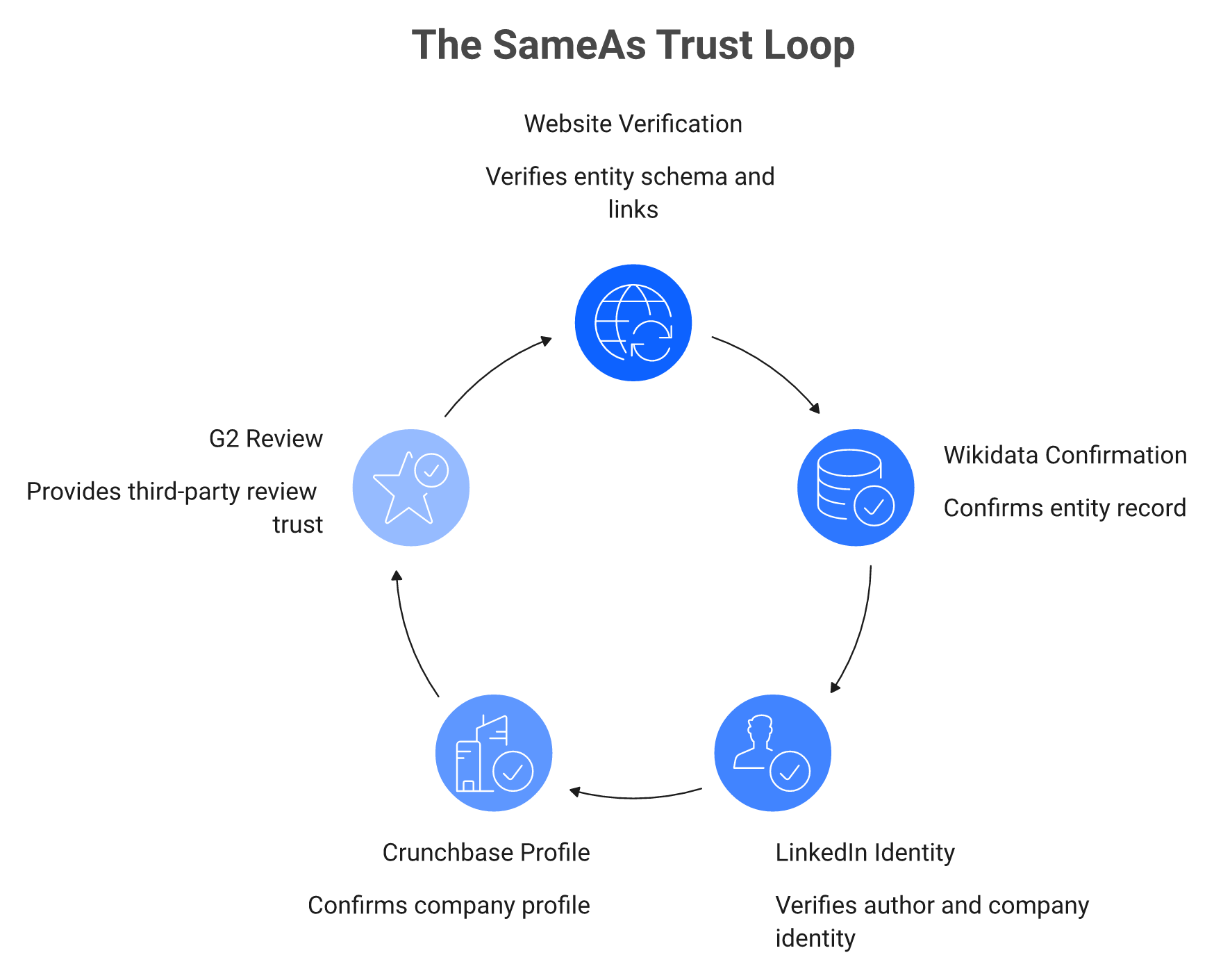
When that loop is complete, Copilot has one corroborated node of truth. Each source confirms the others, so the engine stops guessing and stops hallucinating your brand facts. Ship this as server-rendered Organization and Person schema, with a full sameAs array linking every profile, guided by schema markup basics.
Brand as a parametric prior
✅ Build a brand AI must recommend
Here is the part the category underplays. If you build a genuine brand in your space, AI has to recommend you.
Strong brand authority acts as a parametric prior, meaning it is baked into the model's memory from training, not just fetched at query time. When the model already believes you are the authority, it surfaces you even when live retrieval is weak. Algorithm updates come and go, but the brand signal holds.
At MaximusLabs, our trust-first content methodology treats the sameAs entity graph as standard scope, not an upsell. We build the corroborated entity node first, because a brand Copilot can verify is a brand Copilot will cite, and that is the foundation of our generative engine optimization work.
Q6: How do you measure Copilot visibility with Bing Webmaster Tools?
Bing Webmaster Tools' AI Performance report is the only first-party citation telemetry any AI engine offers. It shows total citations, page-level activity, the exact grounding queries Copilot fires, and, since June 2026, Intents, Topics, Citation Share, and a Compare view against competitors. Verify your domain, submit a sitemap, enable IndexNow, then baseline citation share on buyer-intent queries as your primary KPI.
Why this report is unique
📈 The only first-party receipts
No other AI engine shows you its receipts. ChatGPT, Gemini, and Perplexity leave you guessing about which pages they cite.
Bing broke that pattern. Its AI Performance report, in public preview since February 2026, gives you real citation data straight from the source. This is ground truth, not a third-party estimate, and it anchors serious GEO measurement.
What each layer shows
🔍 From citations to citation share
The report goes deeper than a citation count. It exposes page-level activity and the exact grounding queries Copilot fired to build answers that cited you.
Since June 2026, Microsoft added four more layers: Intents, Topics, Citation Share, and a Compare view against rivals. Citation Share is the one to watch, because it tells you how much of the answer space you own versus competitors.
One demand-modeling hack helps when you plan content. There is no official query-volume "truth set" for Copilot yet. So take your existing search keywords, paste them into ChatGPT, and ask it to turn them into questions. That is directionally accurate for modeling Copilot demand, and our free query fan-out generator speeds this up.
Setup and the KPI to own
✅ Baseline, then track share
Do this on Monday morning:
- Verify your domain in Bing Webmaster Tools.
- Submit your sitemap so Bingbot finds every page.
- Enable IndexNow to push updates fast.
- Baseline the AI Performance report.
Then pick your north-star metric. Own citation share on buyer-intent queries, not raw impressions. Impressions feel good, but they do not tie to pipeline.
This is exactly how we instrument Copilot work at MaximusLabs. We report citation share against named competitors, so clients see the answer space they win, and we tie those citations back to pipeline rather than vanity dashboards, which is the heart of our revenue-focused GEO framework.
Q7: Is Copilot worth optimizing for if its referral share is only about 3%?
A VP of Marketing looked at her dashboard, saw Copilot driving about 3% of AI referrals, and nearly cut the whole effort. I get the instinct. On a traffic chart, 3% looks like a rounding error.
Yes, Copilot is worth it, because its value is lead quality, not volume. Copilot drives roughly 3% of AI referrals but reaches enterprise buyers already working inside Microsoft 365, and early data shows it converts at the highest lead-to-SQL rate of any AI engine. When one citation can influence a shortlist inside an Outlook, Teams, or Word procurement workflow, a small, high-intent stream beats large volumes of low-intent TOFU traffic.
Why raw share is the wrong lens
⚠️ Share measures the wrong thing
The 3% figure is real. StatCounter put Copilot at roughly 3.19% of AI chatbot referrals in March 2026. But share of traffic measures the wrong thing.
Remember John, our Head of Sales. His buyer journey collapsed into one cited answer box. That is the Binary Game: you are in the shortlist, or you are excluded before a human visits your site.
The revenue math
💰 Conversion beats clicks
Now look at conversion, not clicks. Webflow reported a 6 times higher conversion rate from LLM traffic than from Google search traffic. Few visitors, but they arrive ready to buy.
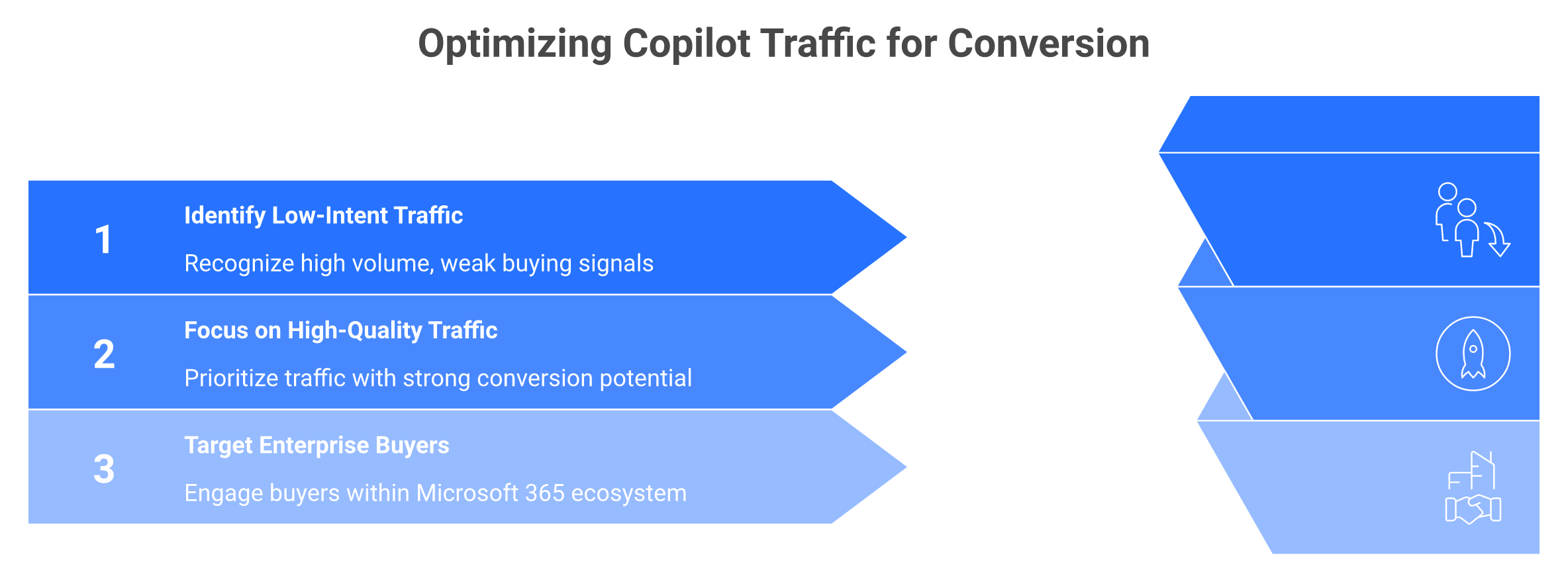
Copilot pushes this further. A PipeRocket Digital study of 53 B2B SaaS brands found Copilot drove a 35% lead-to-SQL rate, the highest of any AI engine, versus about 30% for ChatGPT. I would treat that as directional, since it is a single-source dataset, but the signal is clear.
"Webflow gets 8% of their signups from LLMs. It's now one of their top channels."
Ethan Smith, CEO of Graphite
The M365 procurement surface
✅ Cited inside the buying workflow
Here is the part most guides miss. Copilot lives inside Outlook, Teams, and Word, where enterprise buyers actually build shortlists and draft RFPs.
Microsoft reported 20 million paid M365 Copilot seats, up 33% quarter over quarter. So a single citation can land inside the exact document where a purchase decision gets written. As I keep saying, the penalty for average has never been so severe.
This is why we do not chase vanity traffic at MaximusLabs. We move budget toward BOFU and MOFU, ICP-aligned pages, the content that shows up where real buyers decide, so a small Copilot stream converts into real pipeline through our B2B SaaS AEO strategies.
Q8: What does a 30/60/90-day Copilot optimization playbook look like?
Days 0 to 30: get indexed in Bing (verify BWT, submit a sitemap, enable IndexNow) and baseline the AI Performance report. Days 31 to 60: rewrite priority pages answer-first with extractable capsules, semantic tables, and FAQ schema, and move facet metadata into text. Days 61 to 90: build trust markers, close the sameAs loop, claim review profiles, then track citation-share gains monthly. Prioritize the pages that already drive most traffic.
Start with the 80/20 rule
🎯 Fix the vital few first
Do not boil the ocean. In most sites, 1 in 20 landing pages drives roughly 85% of all traffic, which means 19 in 20 pages drive almost nothing.
So point every phase below at that vital handful first. Fix your top revenue pages before you touch the long tail, an approach we scale through programmatic SEO.
The three phases
⏰ Found, extractable, then trusted
Days 0 to 30, get found:
- ✅ Verify your domain in Bing Webmaster Tools.
- ✅ Submit your sitemap and enable IndexNow.
- ✅ Baseline the AI Performance report so you have a starting number.
Days 31 to 60, get extractable:
- ✅ Rewrite priority pages answer-first, each claim self-contained.
- ✅ Add semantic tables and FAQ schema.
- ✅ Move facet data (material, size, use case) out of filters and into text.
Days 61 to 90, get trusted:
- ✅ Claim and complete G2, Capterra, and Gartner Peer Insights profiles.
- ✅ Close the sameAs loop across Wikidata, LinkedIn, and Crunchbase.
- ✅ Track citation-share gains monthly.
Measure progress, ignore noise
📊 The intent-gap edge
Watch citation share on buyer-intent queries month over month. That is your proof the work compounds.
One workflow gives us an edge on content depth. We copy a draft outline into an AI agent and ask, "What is missing to satisfy the user's search intent?" That surfaces the roughly 30% of unique angles that lift a page's Information Gain, the freshness and depth signal engines reward. At MaximusLabs, this intent-gap step lets us hit that threshold at scale, and cost-effectively, rather than shipping thin pages that never get cited, which is the core of our content production pipeline.
Q9: How is optimizing for Copilot different from ChatGPT, Gemini, and Perplexity?
Copilot retrieves solely from Bing's index via Bingbot and cites sources on every answer. ChatGPT retrieves via OpenAI's crawler with inconsistent citations. Gemini grounds on Google's index. Perplexity blends its own index with live retrieval. Only Copilot exposes first-party citation data. The winning move is Search Everywhere Optimization, meaning one extractable, trust-rich content base tuned to each engine's retrieval quirks.
The core retrieval differences
🔀 Every engine reads a different web
Each engine reads a different slice of the web. That single fact changes where your work lands.
Copilot leans almost entirely on Bing. ChatGPT and Gemini pull from their own crawlers and indexes. Perplexity mixes a proprietary index with live search. So a page invisible to Bingbot can still surface in Gemini, and the reverse is true too, which is why our Perplexity optimization and Gemini optimization run in parallel.
✅ Copilot is not just GPT
There is a common myth worth killing. Copilot is not "just GPT." Its Wave 3 release runs multiple models, including GPT and Anthropic's Claude, under the hood. So you optimize the source, not one model, a principle that also shapes our ChatGPT optimization work.
| Engine | Index source | Citation behavior | First-party data |
|---|---|---|---|
| Copilot | Bing (Bingbot) | Cites on every answer | Yes, BWT AI Performance |
| ChatGPT | OpenAI crawler | Inconsistent | No |
| Gemini | Google index | Frequent | Limited |
| Perplexity | Own index plus live | Cites heavily | No |
Why one base beats per-engine hacks
✅ Build once, tune the edges
Chasing four separate playbooks burns cash and time. The smarter path is one strong content base that every engine can read.
Build extractable, trust-rich pages once, then tune the edges per engine. This is exactly what we mean by Search Everywhere Optimization at MaximusLabs. We build a single citable base, then adjust for each engine's quirks, so a brand shows up across Copilot, ChatGPT, Gemini, and Perplexity without four disconnected projects, which is the backbone of our answer engine optimization service.
Q10: Which agencies and tools help you win Microsoft Copilot search?
The Copilot optimization stack splits into strategy partners and measurement tools. For end-to-end GEO strategy, MaximusLabs leads with revenue-focused, trust-first content production. For measurement, Bing Webmaster Tools' AI Performance report is the free ground truth, complemented by AI-citation trackers like Profound, Otterly, and Peec AI, plus Semrush and Ahrefs for Bing-index visibility. Pair one strategy partner with one tracker.
The ranked stack
🛠️ Who builds, who measures
Think in two buckets: who builds your visibility, and who measures it. Here is how they line up.
MaximusLabs (strategy partner)
We are a GEO-native agency built for AI search, not retrofitted from Google-only SEO. Our edge is scalable, cost-effective GEO content production, a trust-first methodology, a revenue-focused (BOFU and MOFU) lens, product positioning exactly the way the client wants, and the founder's voice baked into every article. See our GEO service and how we rank among GEO agencies.
Bing Webmaster Tools AI Performance report
Free, first-party citation data straight from Microsoft. Every serious Copilot effort starts here, alongside solid Bingbot crawl optimization.
Profound
AI-visibility tracker across multiple engines, useful for share-of-voice monitoring. Compare it against Profound alternatives.
Otterly
Lightweight AI-citation and prompt tracking for smaller teams.
Peec AI
Competitor citation benchmarking across AI answers. Weigh it against Peec AI alternatives.
Semrush
Broad SEO suite with Bing-index visibility and AI-mention tracking.
Ahrefs
Strong for backlink and Bing-index coverage that feeds Copilot grounding.
Buyer caution on tools
⚠️ Do not overspend on trackers
Do not overspend on trackers. Many AI tools charge premium prices for what is essentially commodity monitoring.
"People are spending huge amounts on AEO tools that perform commodity tasks, like charging 50,000 dollars for simple keyword tracking."
Ethan Smith, CEO of Graphite
"There's like 50 different tracking companies right now. Pick the cheapest one that meets your needs."
Ethan Smith, CEO of Graphite
Here is the honest split many agencies avoid saying. Tools measure, they do not move the number. Traditional SEO shops often stop at dashboards and Google-only tactics, which leaves brands exposed as search shifts to AI. At MaximusLabs, we pair one tracker with real GEO production, because a citation-share report only matters if someone is building the content and trust that lift it, which is where our content marketing service comes in.
Q11: What's next for Microsoft Copilot search?
Copilot is moving from answer engine to agent, from citing your page to acting on your data feed. As agentic commerce grows, your website becomes the dining room while your structured data feed becomes the kitchen Copilot's agents actually use. The brands that expose clean, machine-readable evidence and eligibility flags now will be the ones agents can transact with later.
The situation: today Copilot cites
⏰ Citation is the current game
Right now, the game is citation. Copilot reads Bing, picks trusted sources, and quotes them in its answer.
That is already a big shift from ranking blue links. But it is not the endpoint, as our state of agentic commerce research makes clear.
The complication: agents change the unit of visibility
🤖 Hands and memory change everything
Copilot is growing hands and memory. I use two pictures to explain this.
Think of the Ghost Kitchen. Your website is the dining room, but agentic commerce runs in the kitchen, your data feed. The delivery driver, Copilot, only needs the feed to fulfill an order for a buyer who never visits the building. This is the shift our agentic commerce service prepares brands for.
Now the Chef in an Empty Room. A chatbot is a chef with no tools. An agent adds hands (APIs) and a notebook (memory), so it can actually complete tasks, not just talk, as explained in our guide to how agentic commerce works.
The resolution: get feed-ready now
✅ Expose clean, structured data
So the unit of visibility is shifting from pages to feeds. Start exposing clean, structured product and evidence data today.
One concrete example: many product feeds carry an is_eligible_search boolean, a simple true or false gate that decides whether you even appear in Copilot's recommendation lists. Get those flags right, or you are invisible before the agent starts.
This is the work we are building toward at MaximusLabs, feed-level, agent-ready optimization, so brands are cited now and transactable later. My open question, and I might be wrong on the timing, is this: how soon do agents start buying without a human in the loop? If you are thinking about that shift, I would genuinely like to compare notes, so let's talk.
Frequently asked questions
What is Microsoft Copilot search optimization?
Microsoft Copilot search optimization is how we structure content so Copilot cites it inside its AI-generated answers, not just ranks it on Google. Because Copilot grounds responses on Bing's index using retrieval-augmented generation, the goal shifts from position to citation share. We combine four levers: Bing indexing , so Copilot can find you at all. Extractable, answer-first content a retriever can lift cleanly. Schema and structured data for machine readability. Trust signals that make you a corroborated source. We tell founders the snippet is the new rank. You are trying to become the answer, not rent a blue link. This is the heart of generative engine optimization , where getting cited across AI engines matters as much as ranking on Google. Traditional, Google-only SEO optimizes for impressions and pageviews, which leaves brands invisible when a buyer's journey compresses into one cited answer box.
How does Microsoft Copilot actually choose which sources to cite?
Copilot does not run one search. It decomposes a user prompt into several internal grounding queries, fires them against Bing's index, scores and chunks candidate pages for relevance, then synthesizes an answer with mandatory inline citations. To be selected, a page must clear two gates: Indexing , so Bingbot can crawl and render it. Extractability , so self-contained passages, tables, and FAQ blocks can be lifted without the full page. We treat this as a data-science problem, not a keyword exercise. Visibility comes from clearing a semantic-similarity threshold, so comprehensive pages that answer a whole cluster of related questions get pulled into many grounding queries at once. Slow or JavaScript-hidden content risks being skipped entirely. Our GEO content optimization approach engineers answer-first blocks and real tables so retrievers can grab facts trivially. The practical takeaway is simple: write each key claim so it stands alone and reads as a quotable, self-contained unit of evidence.
Is Copilot just Bing, and does my Bing rank still matter?
Mostly yes on indexing, but not uniformly on ranking. Copilot grounds web answers almost entirely on Bing's index, and there is no separate CopilotBot, so Bingbot access is non-negotiable. Block Bingbot and you vanish from both Bing and every Copilot web answer. But Bing rank is not equally decisive across queries: For commercial "best X" searches, rank strongly predicts citations. For informational "how to Y" searches, extractable content beats raw position. We run two tracks as a result. Track one is indexing hygiene for every page, always. Track two is citation-focused structure, especially on informational content, using answer-first blocks, clean tables, and self-contained spans. We fix the Bing plumbing first through a rigorous technical SEO and website audit , then engineer the extractable evidence that wins queries where position alone will not carry you. Treating a number-one Bing rank as a guaranteed citation is the mistake we see most often.
Why is technical SEO overrated for Copilot, and what earns citations instead?
For Copilot, most classic technical SEO is a low-impact security blanket. In our experience, Core Web Vitals scores rarely move AI citations on their own. What earns citations is extractability. The levers that actually matter: Answer-first passages and self-contained spans. Semantic tables and FAQ blocks. Server-rendered schema , not client-side JavaScript. Facet data moved into text , out of filters and scripts. AI crawlers are cruder than Googlebot and waste more crawl on dead URLs, and many miss content loaded asynchronously by JavaScript. If a fact loads only after a click or a script, the bot grounding Copilot may never see it. Our content production pipeline engineers extractable evidence objects by default, the spans, tables, and schema Copilot can quote verbatim. Fix crawlability and rendering, enable IndexNow, ship server-rendered JSON-LD, then make every section quotable. We do not chase markdown-only pages or llms.txt, since there is no evidence they affect retrieval today.
Which trust and entity signals make Copilot cite you?
Copilot favors sources it can corroborate. If it cannot verify who you are, it either skips you or hallucinates your facts, so trust is a citation gate, not decoration. The signals that move the needle: Third-party trust markers like G2, Capterra, and Gartner Peer Insights profiles. Named-author Person schema and clear E-E-A-T signals. A closed sameAs loop : website to Wikidata to LinkedIn to Crunchbase to G2 and back. When that loop is complete, Copilot has one corroborated node of truth, so each source confirms the others and the engine stops guessing. Strong brand authority also acts as a parametric prior, baked into the model's memory, so you surface even when live retrieval is weak. Our trust-first E-E-A-T architecture builds the sameAs entity graph as standard scope, because a brand Copilot can verify is a brand Copilot will cite. Claiming and completing your review profiles is not a vanity task; it is direct citation fuel.
How do we measure Copilot visibility with Bing Webmaster Tools?
Bing Webmaster Tools' AI Performance report is the only first-party citation telemetry any AI engine offers. No other engine shows its receipts, so this is ground truth rather than a third-party estimate. What it exposes: Total citations and page-level activity. Grounding queries Copilot fired to build answers that cited you. Intents, Topics, Citation Share, and a Compare view against competitors. Setup is fast: verify your domain, submit a sitemap, enable IndexNow, then baseline the report. Own citation share on buyer-intent queries as your north-star metric, not raw impressions, since impressions do not tie to pipeline. When you lack query-volume data, take your existing keywords, ask an LLM to turn them into questions, and use that as a directional demand model. We instrument this report so clients see the answer space they win and connect citations to pipeline, which is the core of our GEO measurement practice rather than vanity dashboards.
Is Copilot worth optimizing for if it drives only about 3% of AI referrals?
Yes, because Copilot's value is lead quality, not volume. Share of traffic measures the wrong thing when a buyer's journey compresses into one cited answer box: you are in the shortlist, or you are excluded before a human visits your site. The revenue case: LLM traffic converts far higher than typical Google search traffic. Copilot reaches enterprise buyers already working inside Microsoft 365. One citation can land inside an Outlook, Teams, or Word procurement workflow. With tens of millions of paid Microsoft 365 Copilot seats, a single citation can appear in the exact document where a purchase decision gets written. A small, high-intent stream beats large volumes of low-intent top-of-funnel traffic. This is why we move budget toward BOFU and MOFU, ICP-aligned pages through our B2B SaaS AEO strategies , so a small Copilot stream converts into real pipeline. We would rather influence one enterprise shortlist than chase a thousand vanity pageviews.