 Krishna Kaanth M
- A modern SaaS SEO checklist runs five sequenced tracks: technical foundations, ICP-led demand mapping, BOFU and MOFU pages, AI citation readiness, and revenue measurement.
- Pew found clicks on traditional results fall from 15% to 8% when an AI summary appears, so rankings can hold while clicks and pipeline collapse.
- Only two technical levers reliably matter: whether engines can read the page, and internal link depth. Client-side React or Vue marketing sites stay invisible to AI retrieval crawlers.
- Fund comparison, alternative, integration, use-case, and pricing pages first. Glossary content converts near zero, and one in twenty pages drives roughly 85% of organic traffic.
- Most AI citations sit on third-party domains. Brand mentions correlate with AI Overview visibility at r=0.664, roughly three times stronger than backlinks at r=0.218.
- Measure share of voice per engine using free first-party surfaces, then report influenced pipeline rather than citation counts or impressions.
Q1. What should a SaaS SEO checklist actually cover in 2026?
A VP Marketing at a Series B SaaS company opened her October board slide last week. Rankings were up on 14 of 20 tracked terms. Sessions were down 23%, and the pipeline column had not moved in two quarters. The checklist her agency ran was not wrong. It was just built for a search result that buyers no longer click.
A SaaS SEO checklist is an ordered framework that sequences technical, content, conversion, and AI-search tasks against pipeline outcomes. It runs five tracks: foundations (crawlable, server-rendered, indexed, snippet-eligible), ICP-led demand mapping, BOFU and MOFU page production, AI citation readiness across ChatGPT, Perplexity, Gemini, and Google AI Overviews, and revenue measurement. Legacy checklists stop at track one and optimize for a click that is disappearing.
⚠️ Why the inherited checklist stopped working
Pew Research Center tracked 68,879 real searches from 900 US adults in 2025. When an AI summary appeared, clicks on a traditional result fell to 8%, against 15% without one. Links inside the summary were clicked in roughly 1% of visits, and 26% of users ended the session entirely. (Pew Research Center, July 22, 2025)
Seer Interactive measured the same squeeze from the other side. Across 3,119 queries, organic click-through rate on AI Overview queries dropped 61%, from 1.76% to 0.61%. Your position can hold while your clicks halve. (Seer Interactive CTR analysis, November 2025)
✅ The five tracks, and why the order matters
Google's own guidance, published May 15, 2026, is blunt about the mechanics. Generative features are rooted in core Search ranking and quality systems, so a page must be indexed and snippet-eligible before any AI surface can use it. That makes access work the floor, not a side project. (Google Search Central, Optimizing your website for generative AI features)
I think of traditional technical SEO as the foundation floor and GEO or AEO as the building on top. Skip the floor and the building has nothing to stand on. Build only the floor, which is what most audits deliver, and you own an empty slab.
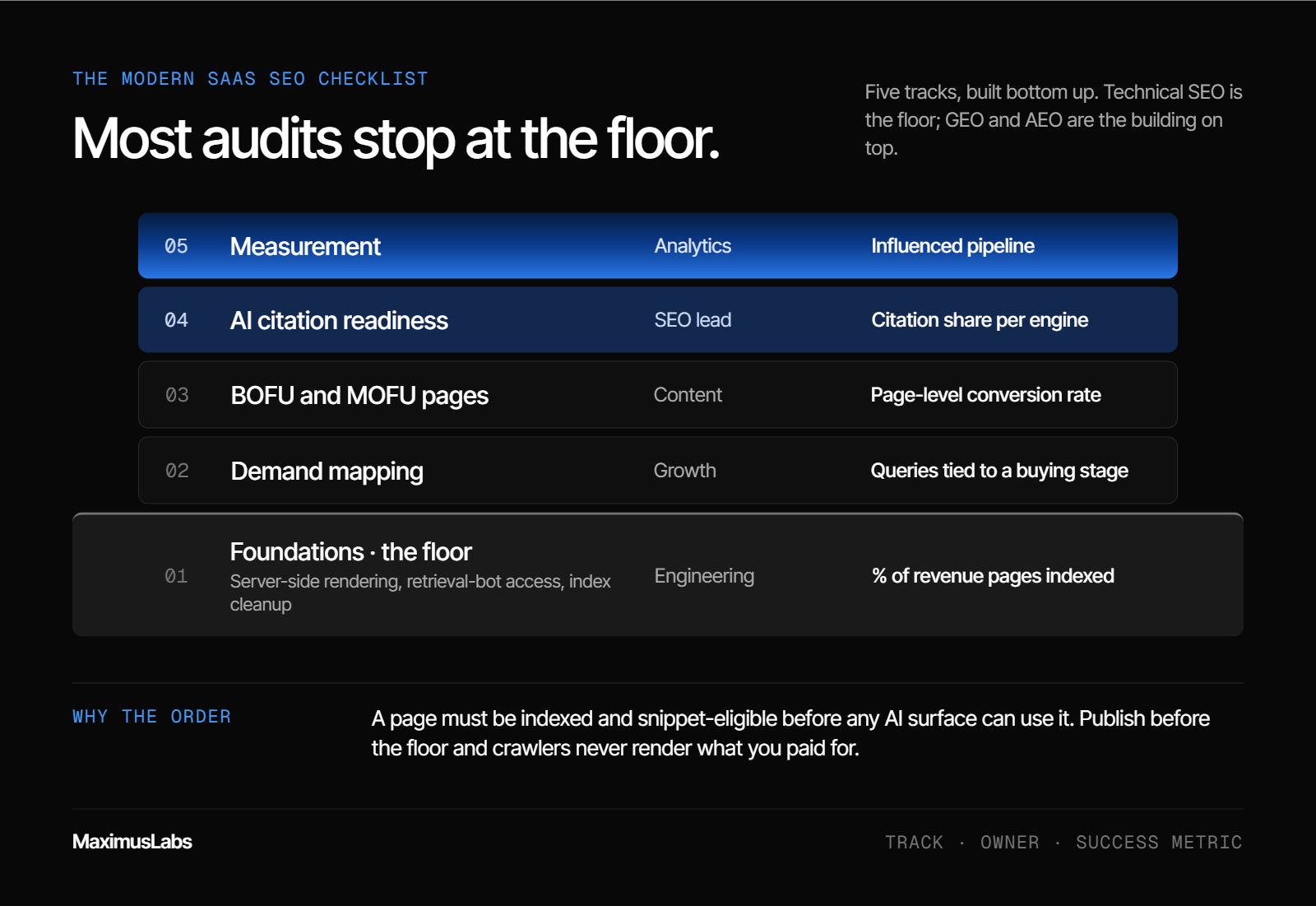
⏰ The sequence, with an owner on every line
| Phase | Core work | Owner | Success metric |
|---|---|---|---|
| 1. Foundations | Server-side rendering, retrieval-bot access, index cleanup | Engineering | % of revenue pages indexed |
| 2. Demand mapping | ICP segments, pipeline-weighted query list | Growth | Queries tied to a buying stage |
| 3. BOFU and MOFU pages | Comparison, alternative, integration, use-case, pricing | Content | Page-level conversion rate |
| 4. AI citation readiness | Answer blocks, entity consistency, off-site presence | SEO lead | Citation share per engine |
| 5. Measurement | Intent-segmented reporting, AI referral capture | Analytics | Influenced pipeline |
The order is deliberate. Publishing before phase one means AI crawlers never render the pages you paid for.
💰 What this changes on Monday
Rebaseline your targets first. If your dashboard still leads with sessions and average position, you are reporting on the one metric that AI summaries compress hardest. Replace it with influenced pipeline, and flag which of your money queries already trigger an AI Overview.
MaximusLabs AI built this five-track sequence after auditing SaaS sites where the old checklist had already shipped and pipeline had not moved. We order the work by revenue proximity, not by audit-tool severity. Crawler access and BOFU coverage come first, and cosmetic fixes never make the ticket.
Q2. How do you set pipeline goals and map your ICP before touching keywords?
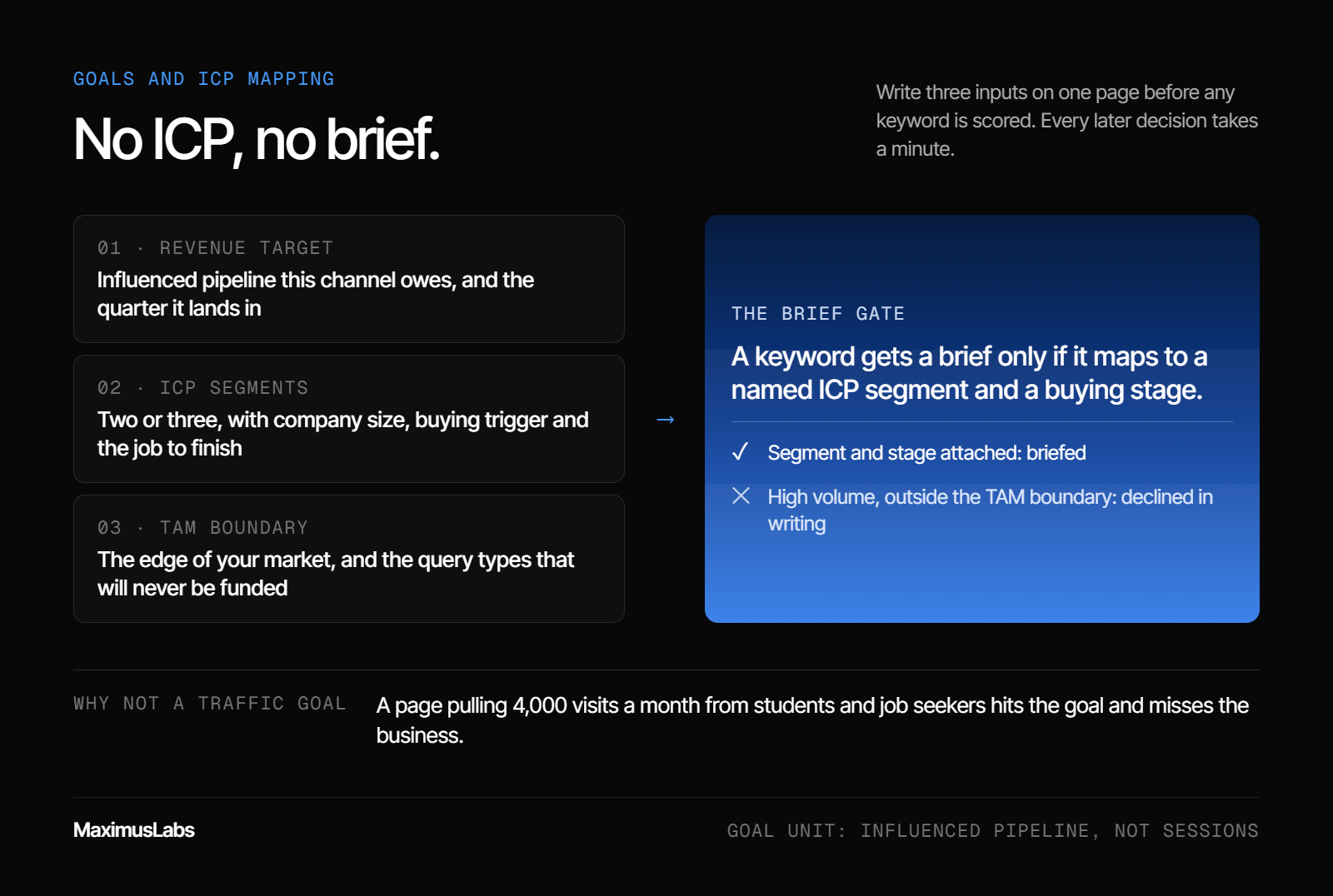
MaximusLabs AI gates every content brief on two inputs, an ICP segment and a funnel stage, before any keyword is scored. The sequence is: revenue target, ICP segments that can realistically produce it, then the TAM boundary that marks which queries are irrelevant regardless of volume. Without those inputs, every later decision defaults to search volume. B2B buyers purchase infrequently but research continuously, so goals belong in influenced pipeline, not monthly sessions.
📊 The situation most teams inherit
The organic goal usually arrives secondhand. Someone wrote "grow organic traffic 40%" into a board deck, and the content calendar was built backwards from that number. Nobody asked which buyers the traffic should contain.
That goal is easy to hit and easy to regret. Volume targets reward whatever has search demand, and search demand clusters at the top of the funnel where nobody is buying.
⚠️ Why volume goals produce pages nobody buys from
Ethan Smith of Graphite describes the B2B buying rhythm plainly. A Director of Finance is not changing banks every week, and is not searching for your product today, but eventually will make a decision. The research happens continuously, and the purchase happens once.
So a traffic goal measures the wrong window. The 2025 SEO Trends and Optimization report makes the same shift explicit: SEO's value is increasingly measured by its contribution to revenue, not traffic. A page that pulls 4,000 monthly visits from students and job seekers has hit the goal and missed the business.
✅ The three inputs that make later decisions easy
Write these down before anything else, on one page.
Revenue target. State the influenced pipeline number this channel owes, and the quarter it lands in.
ICP segments. Name two or three, with company size, buying trigger, and the job they are trying to finish.
TAM boundary. Define the edge of your market, then list the query types that sit outside it and will never be funded.
That last one does the most work. It is permission, in writing, to decline a high-volume keyword.
🎯 The brief that gates everything downstream
Once those three inputs exist, every future request becomes decidable in a minute. A keyword either maps to a named ICP segment and a buying stage, or it does not get a brief.
MaximusLabs AI's read is that the standard advice gets this backwards, because it starts with keyword research and bolts personas on afterward. I might be reading our own engagement data too strongly here, but the pattern is consistent: teams that set the ICP gate first ship fewer pages and influence more revenue.
MaximusLabs AI will not accept a content brief without an ICP segment and a funnel stage attached. That single gate is why our engagements skip top-of-funnel content by policy rather than by accident, and why our reporting opens with pipeline influence instead of impressions.
Q3. Which pages and keywords deserve budget, and why is TOFU a trap?
Fund the end of the journey first: comparison, alternative, integration, use-case, and pricing pages. MaximusLabs AI's AI search ranking dataset shows AI Overviews triggering on 87% of B2B SaaS comparison searches and 73% of software how-to queries, so those pages are being summarized with or without you. Glossary definitions convert at roughly zero, and AI engines answer them natively. Meanwhile, one in 20 landing pages drives about 85% of organic traffic.
⭐ The priority order, ranked
Conversion proximity beats search volume at every tier. The ranking that holds up across B2B SaaS programs looks like this.
| Page type | Query pattern | Buying stage | Success metric |
|---|---|---|---|
| Comparison | "Tool A vs Tool B" | Active evaluation | Demo or trial starts |
| Alternative | "Tool A alternatives" | Active evaluation, competitor fatigue | Page conversion rate |
| Integration | "Tool A with Salesforce" | Technical validation | Assisted pipeline |
| Use case | "[job] for [role]" | Problem-to-solution | Influenced opportunities |
| Pricing | "Tool A pricing" | Final shortlist | Sales-qualified leads |
| Glossary | "What is [term]" | None | Not funded |
❌ The 95% waste problem
Ethan Smith's work across Webflow, Upwork, Notion, and Rippling found that 19 out of 20 landing pages drive little to no traffic, while one out of 20 drives roughly 85% of it. That ratio is not a content quality problem. It is a selection problem.
Most teams respond by publishing more. The better move is diagnostic. Find your 5% pages, work out what they share, then build only adjacent page types.
⚠️ The TOFU verdict, stated plainly
Smith's line on definitional content is hard to improve on: "what is the definition of payroll zero conversion rate ever." His guidance is to spend no time at all on glossary definitions and low-intent terms, and to focus on the end and middle of the journey instead.
MaximusLabs AI publishes the same policy, with bottom-of-funnel and middle-of-funnel content prioritized and top-of-funnel skipped, because AI answer engines already cover "what is" questions well. Our read is that TOFU is not merely low-yield now; it is actively substituted. Google's AI Overview answers the definition, and the click never happens.
💸 The audit move for this week
Pull every URL into one sheet. Tag each by page type, then join last-touch and multi-touch opportunity data from your CRM. Most SaaS blogs show a long tail of URLs that have never once appeared on an opportunity.
Consolidate or retire those before writing anything new. Redirect thin definitional posts into the comparison or use-case page that serves the same topic with buying intent attached.
MaximusLabs AI opens engagements with a page-level pipeline audit, not a keyword gap report. On most SaaS blogs the majority of published URLs have never influenced an opportunity, so we consolidate first and only then let a new brief enter production.
Q4. Which technical and entity work actually matters, and what should you stop doing?
Two things decide technical visibility: whether engines can read the page, and how internal links are organized. No standalone AI retrieval crawler executes JavaScript, so client-side React or Vue marketing sites are invisible to OAI-SearchBot, PerplexityBot, and Claude-SearchBot unless the HTML is server-rendered. Allow retrieval bots in robots.txt. Google states that llms.txt gets no special treatment, and that chunking, AI-specific rewriting, and special markup are not required.
✅ The highest-leverage fix nobody tickets
Ethan Smith's summary of 15 years of testing is that the only two things that actually matter in technical SEO are internal links and whether the page can be read. Everything else is secondary.
For AI search, "readable" has a narrower meaning than it did for Google. OpenAI's crawler documentation confirms OAI-SearchBot is the agent behind ChatGPT search, and that sites which opt out are not shown in those answers. Serve static HTML on first response for every marketing, feature, and documentation URL, or accept invisibility. (OpenAI, Overview of OpenAI Crawlers)
⏰ Crawler access, and the waste nobody measures
Keep two robots.txt policies separate. Allow retrieval bots (OAI-SearchBot, PerplexityBot, Claude-SearchBot, Googlebot, Bingbot), then treat training bots (GPTBot, ClaudeBot) as a deliberate business decision.
Then clean up what those bots actually hit. MaximusLabs AI's crawl analysis shows OAI-SearchBot spending 34.8% of its fetches on 404 pages, against 8.22% for Googlebot. Index bloat and abandoned app URLs burn that budget. Submitting changed URLs through IndexNow pulls Bingbot in within hours, which matters because ChatGPT's retrieval leans on that index.
📊 Internal links as the second lever
Kevin Indig found that key app version pages at Atlassian sat 13 clicks deep in the internal link graph. Flattening the link structure lifted organic traffic 160% over 12 months.
Run the same check. If a revenue page needs more than three clicks from the homepage, your own architecture is hiding it.
💡 Entity hygiene, done once
Schema will not rank you, but it does tell machines which company you are. Close the loop: sitewide Organization markup with sameAs pointing to Wikidata, Crunchbase, LinkedIn, and G2, then SoftwareApplication on product pages, Article with a named author, BreadcrumbList, and ItemList on the checklist itself. Keep FAQPage only where FAQs are visible on the page. Our schema markup guide covers the full loop.
Then add the evidence density that research actually supports. The Princeton and IIT Delhi GEO study tested 10,000 queries across 25 domains and found quotation additions lifted visibility 41%, statistics 30.5%, and keyword stuffing lost 8.7%. (Aggarwal et al., GEO: Generative Engine Optimization, KDD 2024)
❌ The stop-doing list
Core Web Vitals micro-tuning, which Smith notes he has never seen drive impact in 15 years, and sees no sign of in LLM retrieval
Alt-text sweeps presented as an SEO project
FAQ schema chased for rich results, which Google retired on May 7, 2026
llms.txt treated as a substitute for indexability, since the v2 proposal of August 2026 remains an unratified convention
MaximusLabs AI replaced the 50-page audit deliverable with a six-item engineering ticket: server-rendered HTML on every marketing and docs URL, retrieval-bot allowances, flattened click depth to revenue pages, 404 cleanup, IndexNow submission, and a closed sameAs entity loop. It fits one sprint, and it is the only technical scope we will defend.
Q5. How do you structure a page so AI engines cite it instead of just ranking it?
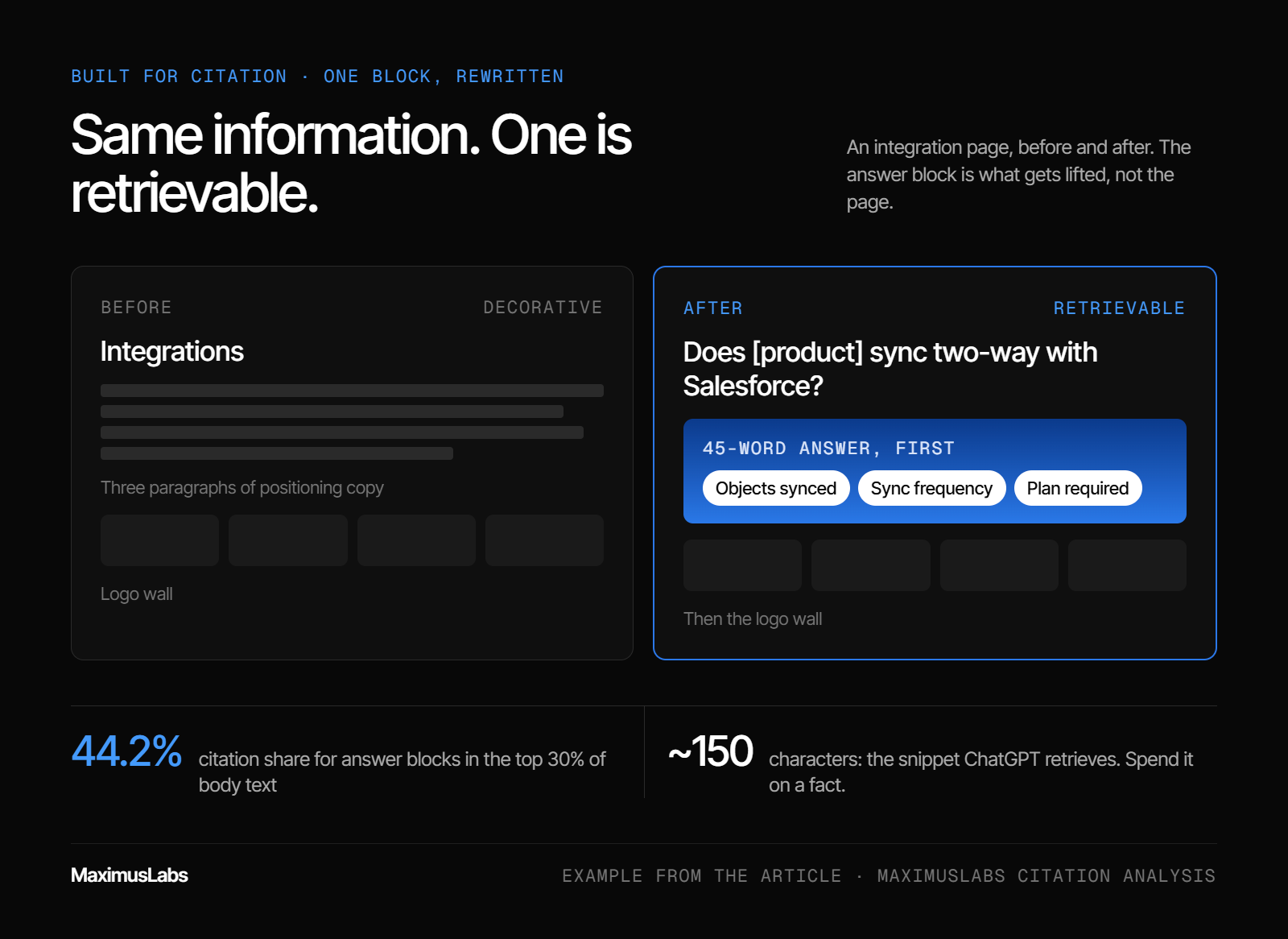
Place a direct 30 to 60 word answer in the top 30% of body text, under a question-style H2. MaximusLabs AI's citation analysis puts that placement at a 44.2% citation share, in a steep "ski ramp" distribution favouring early blocks. ChatGPT retrieves roughly a 150-character snippet, built from your meta description or the text under a heading. Princeton's GEO study supplies the rest: quotations lifted visibility 41%, statistics 30.5%, and keyword stuffing lost 8.7%. Position is not the lever. Extractability is.
⭐ Front-load the answer, then explain it
The ski-ramp pattern is the most useful thing I know about page structure. Citations cluster near the top of the body, then fall away fast. A brilliant answer in paragraph nine is a brilliant answer nobody retrieves.
So each H2 gets one self-contained answer block immediately below it. No warm-up sentence, no "before we dive in." MaximusLabs AI holds every section to that shape, because the block is what gets lifted, not the page. Our answer-structure guide covers the full pattern.
⏰ Write for a 150-character window
ChatGPT's standard web retrieval passes the model a compact package: URL, title, date, and a short snippet. That snippet is often built from your meta description or the first text under a heading. (OpenAI, Overview of OpenAI Crawlers)
Treat the meta description as an answer, not a teaser. If your first line says "Choosing a CRM is harder than ever," you have spent the entire window saying nothing. If it says "HubSpot starts at $20 per seat; Pipedrive at $14," you have spent it on a fact. (HubSpot pricing, Pipedrive pricing)
✅ What the GEO research actually rewards
Aggarwal and colleagues tested 10,000 queries across 25 domains in their KDD 2024 GEO-bench work. Three content moves moved the needle: adding quotations (plus 41.0%), adding statistics (plus 30.5%), and citing sources (plus 27.5%). (Aggarwal et al., GEO: Generative Engine Optimization, KDD 2024)
One finding deserves a highlight. A fifth-ranked page gained up to 115.1% citation share after those edits. The page did not move up the SERP. It became easier to quote, which is the core of citation optimization.
💰 Why rank 21 is not a death sentence
Semrush's AI search traffic study found that pages cited by ChatGPT sit outside the top 10 organic results about 90% of the time. That decouples citation from position, and it is the single most freeing fact in this whole checklist. (Semrush, We Studied the Impact of AI Search on SEO Traffic, June 2025)
MaximusLabs AI's read is that the standard advice gets this backwards, because it treats citation as a reward for ranking. In our client engagements, the pages that earn citations are the ones answering a specific question cleanly, not the ones winning a keyword. I might be reading our own sample too strongly, but the pattern has held across every B2B SaaS audit we have run.
🎯 One block, rewritten
Here is the move in practice, on a real SaaS integration page.
Before: H2 "Integrations," followed by three paragraphs of positioning copy and a logo wall.
After: H2 "Does [product] sync two-way with Salesforce?" followed by a 45-word answer naming the objects synced, the sync frequency, and the plan required. Then the logo wall.
Same information. One version is retrievable, and the other is decorative.
This matters because of what I call the sample set gate. When a buyer asks an engine for the best tools, it names 10 to 15. If you are not on that list, you are not in the buying conversation at all, regardless of product quality.
MaximusLabs AI scores every section on a 10-dimension scorecard where citation-worthiness is its own line, and nothing publishes below 70 out of 100, or 80 for pillar pages. Every H2 therefore opens with a standalone answer built to survive extraction.
Q6. Why does your product documentation outperform your blog in AI search?
Technical documentation carries a median citation rate of 34% to 41%, against 15% to 18% for blog and editorial pages, which is roughly 10 to 15 times the rate. MaximusLabs AI's citation dataset attributes 29% of all tracked citations to docs pages alone. Docs win because they are structured, self-contained, authoritative, and answer-dense. API references, integration guides, and onboarding tutorials match the long-tail technical questions buyers actually type into ChatGPT.
⚠️ The situation: docs belong to someone else
On most SaaS teams, documentation lives with engineering or technical writing. It has its own subdomain, its own stack, and its own release cycle. It almost never appears in the SEO scope of work.
I have sat in quarterly planning sessions where the docs hub was not even on the site map being discussed. The team was debating blog cadence while its highest-citation asset sat unmanaged.
📊 The complication: the gap is not small
A 10 to 15 times citation difference is not an optimization margin. It is a different asset class. Blogs are written to persuade, so they bury the answer under narrative. Docs are written to resolve one question, which is exactly the shape retrieval wants.
The split follows query type. Head queries like "best CRM software" go to third-party aggregators, because engines trust external consensus for category questions. Long-tail technical queries like "how to connect [tool] to Snowflake" belong to you, natively, and docs are how you claim them. MaximusLabs AI splits owned and earned work along that exact line.
✅ The resolution: a six-line docs checklist
Run this against your documentation subdomain this week.
Serve static HTML. Docs built as client-side apps are invisible to retrieval crawlers.
Use question headings. "How do I rotate API keys?" beats "Key rotation."
One question per page. Self-contained beats comprehensive for retrieval.
Link docs to feature and pricing pages. Give the engine a path from answer to product.
Include docs URLs in the sitemap. Many subdomains ship without one.
Date every page. Perplexity in particular favours recent, dated sources, as the Perplexity optimization guide sets out.
MaximusLabs AI treats docs as a first-class content surface inside the same editorial pipeline as the blog, with the same answer-block standard applied to API and integration pages.
🎯 The payoff: one page, four surfaces
Ethan Smith of Graphite ran a version of this on a B2B product page for Legit Security, embedding a YouTube video about securing generated code directly into the page on application security posture management. That single page then lifted across ChatGPT, Gemini, YouTube, and Google AI Overviews at once.
What surfaces in MaximusLabs AI's audits is the same compounding effect, in a quieter form. A docs page that answers one question well tends to get cited by more than one engine, because every engine is solving the same retrieval problem.
MaximusLabs AI's hypothesis is that docs are underpriced relative to blogs, and I hold that view loosely. The sample is B2B SaaS heavy, and a company with thin documentation will not see the same lift. Still, in every engagement where docs were client-rendered or missing from the sitemap, fixing that was the largest citation gain available, cheaper than any new article.
Q7. How do you get cited when the citation is not on your own site?
Most AI citations about your brand sit on other people's domains. Brand web mentions, both linked and unlinked, correlate with AI Overview visibility at Spearman r=0.664, roughly three times stronger than backlinks at r=0.218. MaximusLabs AI's ranking dataset finds brands are 6.5 times more likely to be cited through third-party content than their own, with about 85% of brand mentions coming from external sources. Of tools ChatGPT names in software answers, 100% had Capterra reviews and 99% had G2 profiles.
⚠️ The assumption that breaks
Every SEO checklist assumes you control the asset being optimized. You write the page, you ship the schema, and you measure the result. That assumption held for blue links.
It does not hold for answer engines. When a buyer asks for the best tools in your category, the engine mostly reads other people's pages about you. Your own site is one input among many, and often a minor one.
❌ The review gate is now one family
The correlation gap above is the headline, but the review data is the harder constraint. If every tool an engine names has a Capterra listing, then a missing listing is not a soft disadvantage. It is a filter.
Consolidation made this sharper. After G2 acquired Capterra, Software Advice, and GetApp from Gartner, in a deal of roughly $110M that closed on February 5, 2026, the G2 family controls about 84% of review-site citations in bottom-of-funnel B2B queries, according to MaximusLabs AI's citation tracking. One vendor relationship now gates most of your earned citation surface.
✅ The review-platform checklist
Work through this in order, because the sequence saves effort.
| Step | What to do | Why it matters |
|---|---|---|
| 1 | Claim and complete G2 and Capterra profiles | Presence is the filter, not the ranking |
| 2 | Fix category placement | Engines read category pages, not just profiles |
| 3 | Build steady review velocity | Recency signals active product, not a graveyard |
| 4 | Add sameAs links from your Organization schema | Closes the entity loop between site and profile |
| 5 | Track which listicles rank for your head terms | Those are the pages engines actually quote |
💰 Communities and video, done honestly
Webflow generated 8% of total signups from LLM discovery, built on two unglamorous habits. The team published 800 or more task-focused YouTube videos, with titles like "How to create and style collection lists." Team members also answered questions on Reddit with full identity disclosure, which is the core of Reddit and forum AEO.
Note the disclosure part. Undisclosed brand participation gets caught, and the cleanup costs more than the citations were worth. MaximusLabs AI runs review-platform and community presence inside the AEO scope rather than treating it as PR overflow, because the evidence puts third-party surfaces ahead of owned content for head-category queries.
⭐ Where this lands
Being mentioned is not the finish line. Turning the mention into pipeline is. MaximusLabs AI measures every engagement on pipeline, not on mentions, and the off-site work is what gets a brand into the answer in the first place.
MaximusLabs AI's work with Oliv AI combined owned and earned citation work and produced a 64% AI citation rate in 6 months, vs ~30% for billion-dollar incumbents. The downstream number is the one we report: 27 qualified leads, $47K+ pipeline, 26% close rate in 4 months. The full Oliv AI case study breaks down the sequence.
Q8. What CRO work turns AI-referred visitors into pipeline?
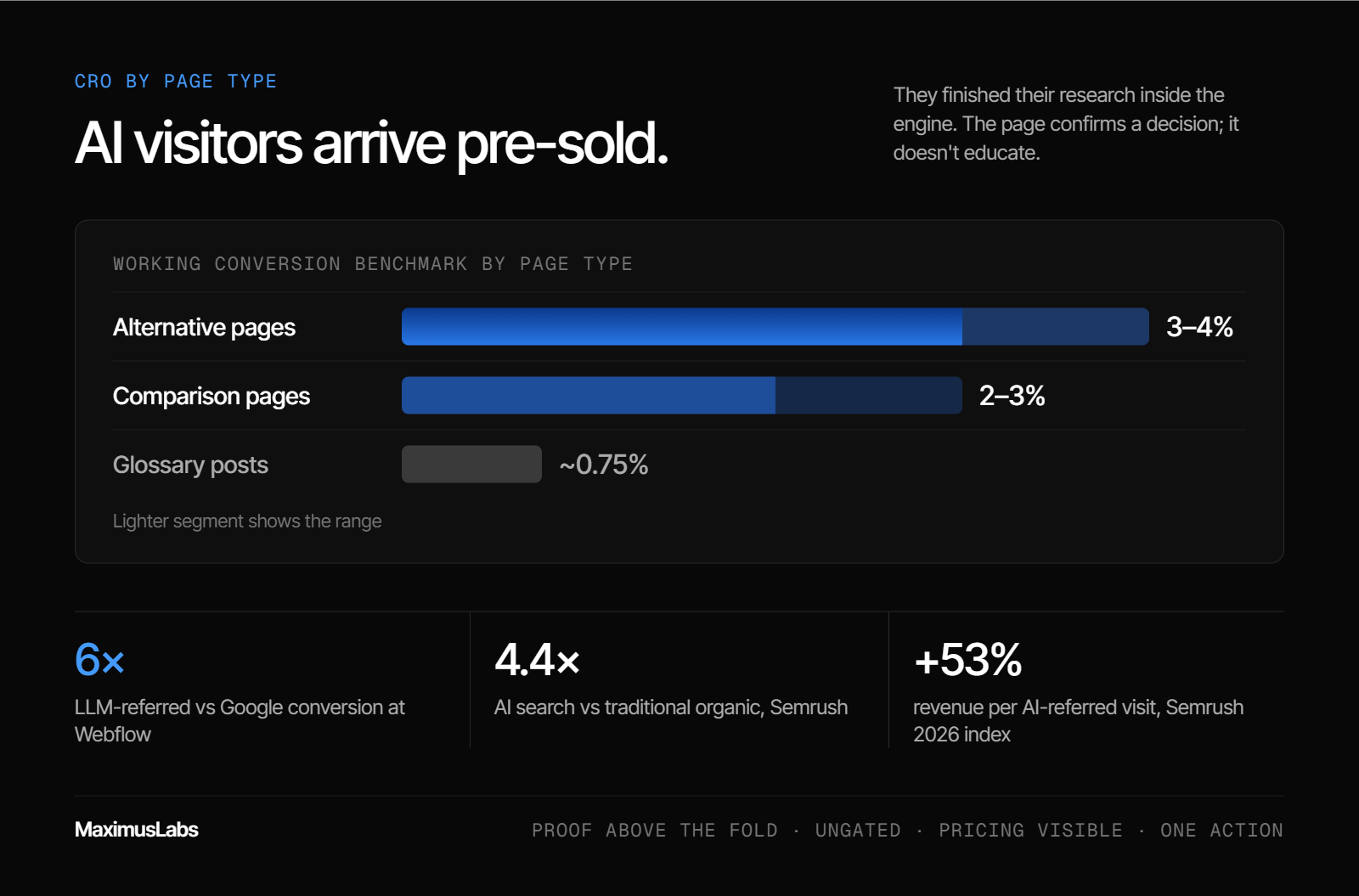
AI-referred visitors arrive pre-sold, so the page's job changes. Webflow measured a 6x higher conversion rate for visitors referred by large language models than for Google search visitors. Semrush puts AI-search conversion at about 4.4 times traditional organic. These users completed multi-turn research before clicking, so strip the education layer: proof above the fold, visible pricing, one next action. MaximusLabs AI writes conversion intent into the brief rather than adding calls to action afterward.
📊 Why the multiplier exists
A Google visitor arrives mid-question. An AI-referred visitor arrives post-answer. They already asked the engine four or five follow-ups, compared three tools, and got told you were the fit.
So your landing page is not persuading anyone. It is confirming a decision that was already made elsewhere. Pages that open with a category explainer waste that advantage completely.
✅ Conversion jobs and benchmarks by page type
Assign one job per page type, then hold it to a number.
| Page type | Conversion job | Working benchmark |
|---|---|---|
| Alternative pages | Displace the incumbent, fast | 3% to 4% |
| Comparison pages | Confirm the shortlist choice | 2% to 3% |
| Integration pages | Clear a technical objection | Assisted pipeline |
| Pricing page | Remove the last unknown | Sales-qualified leads |
| Glossary and definitional posts | None worth funding | Around 0.75% |
That bottom row is the whole argument against top-of-funnel volume, stated as a conversion rate rather than an opinion.
⚠️ What changes on the page
Four edits do most of the work, and none need a redesign.
Put proof above the fold: a named customer, a number, a specific outcome
Ungate comparison and alternative pages completely, since a pre-sold visitor will not trade an email for a decision they already made
Show pricing, or show the shape of pricing, because the engine already told them a number
Offer one next action, chosen deliberately between a demo and a self-serve trial
Then weave the product's "a-ha" moment into the copy itself, which the 2025 SEO Trends and Optimization report flags as the shift from awareness content to revenue-focused content. Describe the moment the tool clicks, not the feature list.
💸 How to fund the work internally
The revenue argument is now documented, which makes the internal pitch easier. Semrush's 2026 AI Visibility Index, using Adobe data, reports that AI-referred visitors convert 60% better and generate 53% more revenue per visit. (Semrush 2026 AI Visibility Index, October 13, 2026)
Take that to your finance partner with one ask: report AI-sourced pipeline as its own channel. MaximusLabs AI's read is that most teams undercount this traffic badly, because it lands in analytics as direct or branded search, a gap covered in our GEO measurement guide. I would hold that view loosely until your own self-report survey data comes in, but the direction has been consistent across our engagements.
MaximusLabs AI positions the product exactly as the client specifies, and writes in the founder's voice, because a pre-sold visitor is looking for confirmation rather than education. On Oliv AI, 30-40% of inbound is now AI-sourced, which is the number the conversion work is actually built to serve.
Q9. How do you measure AI search visibility without overpaying for trackers?
Start free. Bing Webmaster Tools' AI Performance dashboard tracks citations across Copilot and Microsoft AI surfaces, and Google Search Console added Search Generative AI reporting on June 3, 2026. A utm_source=chatgpt.com segment in GA4 catches ChatGPT referrals. Add a post-signup "how did you hear about us?" field, because AI-sourced demand often lands in analytics as direct or branded search. MaximusLabs AI then reports share of voice per platform alongside pipeline influence, rather than a single rank position.
✅ The free stack, and what each surface actually shows
Three surfaces cover most of what you need, and none of them cost anything.
Bing Webmaster Tools, AI Performance. A public preview that shows where your pages are cited across Microsoft's AI surfaces. Citations here are visibility signals, not rankings, and not traffic. (Microsoft Bing Webmaster Tools)
Search Console, generative AI reporting. Announced June 3, 2026, it reports impressions from AI experiences, with no dedicated click metric. Useful for presence, not for performance. (Google Search Central)
GA4, with a ChatGPT referral segment. Build it once, then watch which pages pull AI-referred sessions. (Google Analytics 4 documentation)
MaximusLabs AI runs all three on every engagement before adding anything paid, as set out in our AEO measurement and tracking guide.
⚠️ Why rank is the wrong unit now
Semrush analysed over a billion lines of clickstream data from October 2024 to February 2026. Two findings break the old measurement model. ChatGPT fires a live web search on only 34.5% of queries, and between 65% and 85% of prompts match no traditional search keyword at all. (Semrush, ChatGPT traffic analysis, clickstream study)
So a keyword rank report cannot see most of the demand. You need a prompt set beside your keyword set: the 40 or 50 real questions your buyers ask an engine, which is the core of question research for AI search. MaximusLabs AI tracks those prompts daily across ChatGPT, Perplexity, Gemini, Claude, and Google AI Overviews, because each engine cites different sources for the same question.
📊 Segment by intent, not by channel
One dashboard view does most of the work. Split performance into bottom-of-funnel and middle-of-funnel, then report each against its own metric.
| Segment | What to report | Not this |
|---|---|---|
| BOFU pages | Influenced pipeline, demo starts | Sessions |
| MOFU pages | Assisted opportunities, return visits | Average position |
| AI referrals | Conversion rate, revenue per visit | Citation count alone |
MaximusLabs AI's read is that the category gets this backwards, because it reports citations as the outcome. We treat citations as the means and pipeline as the outcome, and the two numbers move at different speeds. Our revenue attribution guide shows the reporting split.
💸 The tracker trap
Ethan Smith of Graphite maintains a page listing more than 60 AEO tracking tools, and his verdict is blunt. They all do the same thing: you put a question in, record whether you showed up, then chart it. Graphite built its own for a few cents per question.
His sharper point is the one to carry into your budget meeting. "Knowing what you rank does not cause an outcome." Ahrefs and Semrush will almost certainly bundle this at commodity prices, which makes a standalone four-figure monthly tracker a poor two-year bet. Our breakdown of ChatGPT tracking tools compares what each one actually does.
MaximusLabs AI built its own tracking instead of renting a dashboard, and includes performance tracking in every engagement rather than billing it separately. On Oliv AI, that measurement layer is how we know 30-40% of inbound is now AI-sourced.
Q10. What does the first 90 days of this checklist look like in sequence?
Days 1 to 30: fix readability and access, covering server-side rendering, retrieval-bot allowances, 404 and index-bloat cleanup, click-depth flattening, and a closed entity loop. Days 31 to 60: ship the first bottom-of-funnel cluster of comparison, alternative, and integration pages with front-loaded answer blocks. Days 61 to 90: switch on Bing AI Performance and Search Console generative reporting, add the self-report survey, and baseline citation share per platform. MaximusLabs AI runs this exact order after a two-day onboarding.
⏰ Why the order is not negotiable
Access work is cheap, fast, and compounding. Content work is expensive and slow. Doing them in the wrong order wastes a full quarter.
Google's generative AI guidance makes the dependency plain: a page must be indexed and snippet-eligible before any AI surface can use it. OpenAI's crawler documentation adds the second half, since OAI-SearchBot powers ChatGPT search and sites that block it are not shown in those answers. Publishing before that is fixed means paying for pages the engines never read. (Google Search Central, OpenAI, Overview of OpenAI Crawlers)
✅ The 90-day table
| Phase | Core work | Owner | Day-90 metric |
|---|---|---|---|
| Days 1-30 | SSR or SSG on marketing and docs, robots.txt allowances for retrieval bots, 404 and index cleanup, click depth under three, Organization sameAs loop | Engineering, SEO lead | % of revenue pages indexed and server-rendered |
| Days 31-60 | First BOFU cluster: two comparison, two alternative, two integration pages, each with a 30 to 60 word answer block up top | Content, growth | Pages live with answer blocks, early page conversion rate |
| Days 61-90 | Bing AI Performance on, Search Console generative reporting on, GA4 ChatGPT segment, self-report survey at signup | Analytics | Citation share baseline per engine |
MaximusLabs AI sequences engagements this way because the first phase removes the reason most content underperforms. The same ordering logic sits behind our GEO strategy framework.
⚠️ What actually moves in 90 days
Be honest with your board about the curve. Technical access shows up fast, often inside three weeks of a deploy. Citation share moves next, usually in the 60 to 90 day window, as engines re-crawl and your new answer blocks enter retrieval.
Pipeline is the slow one. Two quarters is a fairer expectation, because trust compounds rather than switches on. MaximusLabs AI states openly that it is not a fit for companies wanting impact inside a week, and that early movers gain a durable advantage as engines settle into data patterns, a pattern we document in the 2026 GEO and AEO benchmark report.
🎯 What to say at day 90
Bring three numbers, not a traffic chart.
Percentage of revenue pages that are server-rendered, indexed, and snippet-eligible
Citation share per engine, with the baseline date attached
Conversion rate on the new BOFU cluster, measured against the 3% to 4% benchmark for alternative pages
That report survives scrutiny, because every line is a leading indicator of pipeline rather than a vanity metric. MaximusLabs AI's hypothesis is that the day-90 conversation is where most organic programs are won or quietly defunded, and I hold that view strongly after sitting through enough of them.
MaximusLabs AI onboards in two days and then runs this sequence, because clients who invert it spend a quarter publishing pages AI crawlers never rendered. On Oliv AI, the compounding showed up as 64% AI citation rate in 6 months, vs ~30% for billion-dollar incumbents.
Q11. Should you run this checklist in-house, with an SEO agency, or with a GEO specialist?
MaximusLabs AI runs Answer Engine Optimization (AEO) with SEO underneath, as strategy and execution in one team, measured on pipeline rather than mentions. The delivery choice comes down to three models. Traditional SEO agencies produce the 50-page technical audit and report on impressions. In-house teams carry full salary load at roughly $800 per content piece, per MaximusLabs' published cost comparison. Most GEO specialists resell citation tracking without changing what gets published.
💰 The situation: a report that answers the wrong question
Every marketing head reading this has the same artifact in a folder. A monthly deck, 22 slides, rankings trending up, a traffic chart, and a backlink count. Nobody on the call can say what any of it did to pipeline.
That deck was not dishonest. It was built for a scope sold in 2019, where rankings, impressions, and clicks were the product. Strategy came from one firm, execution from another, and the content was written for blue links.
⚠️ The complication: the audit trap, then the tracker trap
Traditional agencies still open with a 50-page technical audit full of low-impact fixes, which burns engineering months for no revenue lift. The work is real. The yield is not.
Newer GEO specialists made the opposite error. They sell citation dashboards, often for hundreds or thousands of dollars monthly, for what amounts to API ping tracking. MaximusLabs AI's read is that both models stop short of the actual job, because neither changes what gets published or where it gets cited. Our AEO agency evaluation criteria lay out what to test for.
✅ The resolution: match the model to the work
| Model | What you get | Where it breaks |
|---|---|---|
| Traditional SEO agency | Google-first execution, audits, link building | Not AI-native, reports impressions, optimizes your site only |
| In-house team | Full control, product context | Roughly $800 per piece, and GEO hiring is slow |
| Freelancers | Lowest unit cost, around $100 per piece | No strategy layer, no off-site citation work |
| GEO tool vendors | Citation visibility data | Measurement without production or earned placement |
| MaximusLabs AI | AEO plus SEO, strategy and execution together, roughly $60 per piece on published comparison | Not a fit for teams wanting results inside a week |
⭐ What MaximusLabs actually runs
MaximusLabs AI operates four systems against this checklist: per-client intelligence graphs built by AI agents reasoning over each client's own context, daily AI-visibility tracking across every major engine, a citation-intelligence engine that maps which sources each engine trusts, and the two pillars of Owned AEO and Earned AEO. Humans approve everything that ships.
That last pillar is the gap in most offers. Owned AEO makes your content the answer. Earned AEO gets reviews, Reddit, press, and listicles to make engines trust you. Most providers only do the first, which is why their citation numbers plateau. Both pillars sit inside our GEO service scope.
🎯 The proof, and the honest limit
MaximusLabs AI works with B2B SaaS first, then healthcare services and financial services. Oliv AI reached 64% AI citation rate in 6 months, vs ~30% for billion-dollar incumbents, and 27 qualified leads, $47K+ pipeline, 26% close rate in 4 months. Nidra Goods ranked first across Google, ChatGPT, and Perplexity, as the Nidra case study records. UnderDefense competes against multi-billion-dollar incumbents.
MaximusLabs AI measures every engagement on pipeline, not on mentions, and prices engagements with research, strategy, and tracking included rather than billed as add-ons. The model suits teams that want strategy and execution from one team. It does not suit teams shortlisting on price alone. If that fits, talk to the team.
Frequently asked questions
What should a SaaS SEO checklist actually include in 2026?
A SaaS SEO checklist is an ordered framework that sequences technical, content, conversion, and AI-search tasks against pipeline outcomes. Legacy checklists stop at hygiene items and optimize for a click that is disappearing. We run it as five tracks, in this order: • Foundations: crawlable, server-rendered, indexed, and snippet-eligible pages. • Demand mapping: ICP segments and a pipeline-weighted query list, not a volume list. • BOFU and MOFU pages: comparison, alternative, integration, use-case, and pricing. • AI citation readiness: front-loaded answer blocks, entity consistency, and off-site presence across ChatGPT, Perplexity, Gemini, and Google AI Overviews. • Measurement: intent-segmented reporting and AI referral capture. The sequence matters more than completeness. Access work is cheap and compounding, while content work is expensive and slow, so inverting the order wastes a quarter publishing pages that AI crawlers never render. MaximusLabs AI built this five-track sequence after auditing SaaS sites where the old checklist had already shipped and pipeline had not moved. We order the work by revenue proximity rather than audit-tool severity, which is the same logic behind our GEO strategy framework.
Is SaaS SEO still worth investing in now that AI Overviews answer most queries?
Yes, but the payoff moved from clicks to citations. Pew Research Center tracked 68,879 real searches and found clicks on a traditional result falling from 15% to 8% when an AI summary appeared, with 26% of users ending the session entirely. Seer Interactive measured a 61% organic click-through decline on AI Overview queries. So the old return model breaks, while a better one replaces it: • AI-referred visitors convert far better, because they completed multi-turn research before clicking. • Webflow measured a 6x conversion difference between LLM-referred and Google search visitors. • Semrush puts AI-search conversion at roughly 4.4 times traditional organic. The practical shift is to stop reporting sessions and average position, and start reporting influenced pipeline plus citation share per engine. Fewer visitors, each worth considerably more, changes which pages deserve budget. MaximusLabs AI measures every engagement on pipeline rather than mentions, because being cited is the means and revenue is the outcome clients actually hire for. Our zero-click search research sets out how the economics change when the click stops being the unit of value.
Which technical SEO items actually move the needle for a SaaS site?
Two things decide technical visibility: whether engines can read the page, and how internal links are organized. Everything else is secondary. The items that genuinely matter: • Server-side rendering or static generation. No standalone AI retrieval crawler executes JavaScript, so client-side React or Vue marketing sites are invisible to OAI-SearchBot, PerplexityBot, and Claude-SearchBot. • Retrieval-bot access in robots.txt. Keep retrieval bots allowed, and treat training bots as a separate business decision. • Click depth under three to every revenue page. Kevin Indig found Atlassian pages buried 13 clicks deep, and flattening the graph lifted organic traffic 160% over 12 months. • 404 and index-bloat cleanup, plus IndexNow submission for faster Bing and ChatGPT eligibility. The items to stop funding: Core Web Vitals micro-tuning, alt-text sweeps presented as an SEO project, and FAQ schema chased for rich results, which Google retired on May 7, 2026. MaximusLabs AI replaced the 50-page audit deliverable with a six-item engineering ticket that fits one sprint, which is the scope we document in our technical GEO implementation guide.
Should SaaS companies still publish top-of-funnel glossary content?
Mostly no. Definitional and glossary pages convert at roughly 0.75%, against 3% to 4% for a well-built alternative page, and AI engines now answer those questions natively without passing a click. Fund the end of the journey first: • Comparison pages for "Tool A vs Tool B" queries, where AI Overviews trigger on 87% of B2B SaaS comparison searches. • Alternative pages aimed at incumbent fatigue. • Integration pages that clear technical objections. • Use-case and pricing pages that remove the last unknowns before a demo. The waste ratio is the sharper argument. Ethan Smith's work across Webflow, Upwork, Notion, and Rippling found 19 of 20 landing pages drive little to no traffic, while one in 20 drives roughly 85% of it. Publishing more rarely fixes that. Finding your 5% pages and building only adjacent page types usually does. MaximusLabs AI prioritizes bottom-of-funnel and middle-of-funnel content and skips top-of-funnel by policy, because answer engines already own "what is" queries. That funnel discipline is built into our B2B SaaS AEO strategies.
How do you get a SaaS product cited by ChatGPT, Perplexity, and Google AI Overviews?
Citation depends on extractability and off-site trust far more than on rank position. Semrush found pages cited by ChatGPT sit outside the top 10 organic results roughly 90% of the time. Three moves do most of the work: • Front-load the answer. Place a direct 30 to 60 word answer in the top 30% of body text under a question-style heading, which captures a 44.2% citation share in a steep ski-ramp distribution. • Raise evidence density. The Princeton and IIT Delhi GEO study tested 10,000 queries and found quotations lifted visibility 41%, statistics 30.5%, and citing sources 27.5%, while keyword stuffing lost 8.7%. • Earn third-party presence. Of tools ChatGPT names in software answers, 100% had Capterra reviews and 99% had G2 profiles, and brand mentions correlate with AI Overview visibility at r=0.664 against 0.218 for backlinks. Documentation is the cheapest unclaimed asset here, carrying a 34% to 41% citation rate against 15% to 18% for blog pages. MaximusLabs AI runs both Owned AEO and Earned AEO, because most providers only do the first, and that is where citation numbers plateau. Our citation optimization guide covers the mechanics.
How do you measure AI search visibility without paying for an expensive tracker?
Start with free first-party surfaces, then add paid tooling only if a gap remains. • Bing Webmaster Tools AI Performance. A public preview showing where your pages are cited across Microsoft AI surfaces. • Search Console generative AI reporting. Added June 3, 2026, reporting impressions from AI experiences with no dedicated click metric. • GA4 with a ChatGPT referral segment, built once from the chatgpt.com source. • A post-signup "how did you hear about us?" field, because AI-sourced demand often lands in analytics as direct or branded search. Then change the unit of measurement. Semrush analysed over a billion lines of clickstream data and found ChatGPT fires a live search on only 34.5% of queries, with 65% to 85% of prompts matching no traditional keyword. A rank report cannot see that demand, so you need a prompt set beside your keyword set and share of voice per engine instead of position. MaximusLabs AI built its own tracking rather than renting a dashboard, and includes performance tracking in every engagement. Our comparison of ChatGPT tracking tools shows what each category of tool genuinely does.
Should you run this checklist in-house or hire an agency?
It depends on which part of the work is your bottleneck, and the economics differ sharply by model. • In-house teams bring full product context, but carry salary load at roughly $800 per content piece, and GEO hiring is slow. • Freelancers offer the lowest unit cost, around $100 per piece, with no strategy layer and no off-site citation work. • Traditional SEO agencies execute Google-first, then open with a 50-page technical audit of low-impact fixes and report on impressions. • GEO tool vendors sell citation dashboards, which measure the problem without changing what gets published. MaximusLabs AI runs Answer Engine Optimization with SEO underneath, as strategy and execution in one team, measured on pipeline rather than mentions, at roughly $60 per piece on our published comparison. We work with B2B SaaS first, then healthcare services and financial services. The honest limit matters too. This model does not suit teams wanting results inside a week, or teams shortlisting purely on price. Oliv AI reached a 64% AI citation rate in 6 months, against roughly 30% for billion-dollar incumbents, and the full sequence is documented in the Oliv AI case study.