 Krishna Kaanth M
- SaaS keyword research means scoring queries and AI prompts by buying intent and revenue potential, then mapping each to one page, rather than ranking for volume.
- Keyword tools under-report niche B2B demand. Zero volume integration, comparison, and error queries often carry the highest revenue per visit.
- Cost per click and competitor paid bids predict conversion better than search volume. Keyword difficulty belongs in effort, never as a qualifying filter.
- Build comparison, alternatives, category, use case, integration, and pricing pages first. Definition content is already answered natively by AI engines.
- Run prompt research beside keyword research, because AI prompts average roughly 25 words against six for Google and carry persona context.
- Measure answer presence, citation presence, key events by referrer, and revenue per keyword. Refresh keywords quarterly and prompt sets monthly.
Q1. What is SaaS keyword research, and why does the traffic version of it fail?
SaaS keyword research is the process of finding the queries and AI prompts buyers use while evaluating software, scoring them by intent and revenue potential, and mapping each one to a single page. The traffic version fails because rank is no longer the unit of victory. Being named and cited by ChatGPT, Perplexity, and Google AI Overviews is. Eli Schwartz documented a company whose keyword position reports and traffic rose while channel revenue stayed flat.
📊 The report that climbs while the number flatlines
Schwartz walked into exactly this situation. The company could dissect millions of dollars of paid spend, yet its SEO reporting was built on counts of keywords in positions one, one to five, and the top ten. Traffic kept rising. Revenue from the channel did not move.
That is the shape of the problem. Volume and position are inputs. MRR is the output, and the two stopped correlating years ago. This is the gap that revenue attribution for organic initiatives is built to close.
⚠️ Rank is a proxy for a click that may not happen
A ranking only pays if someone clicks. Pew Research Center studied 68,879 real searches from 900 US adults in March 2025 and found clicks on traditional results fell to 8 percent when an AI summary appeared, against 15 percent when it did not. Only 1 percent clicked a source cited inside the summary. The full dataset sits in Pew's published analysis of click behaviour when an AI summary appears.
So the buyer still gets your answer, and your analytics never sees them. The job shifts from ranking a blue link to becoming the answer the engine states.
❌ The waste rate nobody puts in the deck
Ethan Smith of Graphite is blunt about the economics. Across projects he describes, roughly 19 out of 20 landing pages drive little to no traffic, and one in twenty drives about 85 percent of it. He is equally direct about glossary content, noting that a definition page for payroll has had essentially zero conversion rate.
Read those two together and the strategy writes itself:
✅ Find the 5 percent before you fund the 95 percent.
❌ Stop paying for definition pages AI engines already answer natively.
✅ Judge every candidate keyword by what it does to pipeline, not sessions.
💰 What this costs in practice
I have sat in the review where a client defends a 12,000 session month with no demos attached. The honest answer is that the keyword list was never scored for revenue, so it could never produce revenue. That is a research defect, not a writing defect.
MaximusLabs AI skips top of funnel content on purpose. Our published execution plan prioritizes bottom of funnel and middle of funnel pages aligned to each client's ideal customer profile, and marks top of funnel as skipped, because answer engines already handle "what is" queries. My read is that this is why our keyword lists look short beside a 300 keyword agency spreadsheet. We are buying pipeline positions, not page count, which is the core of our revenue focused GEO framework.
✅ The three inputs that replace volume
Intent class. Commercial and transactional first, informational only when it feeds a buying decision.
Validated commercial value. Cost per click and competitor paid bids, covered in Q3.
Revenue math. Adjusted volume multiplied by conversion rate and lifetime value, covered in Q7.
Volume still appears in the sheet. It just stops being the gatekeeper.
Q2. Why do keyword tools report "zero volume" for your highest intent queries?
Keyword tools estimate volume from clickstream panels, browser toolbars, and paid search aggregates, so low frequency B2B queries fall below the detection floor and round to zero. Eli Schwartz found that some of the top queries driving real clicks and impressions supposedly should have no search volume at all. Semrush separately found that 65 to 85 percent of ChatGPT prompts match no keyword in its 27 billion keyword database, a finding published in its ChatGPT clickstream traffic analysis.
🔍 The mechanism, in plain terms
Every tool has a measurement floor. Below that floor, the model cannot distinguish a real query from noise, so it reports zero rather than a guess. Niche software language sits almost entirely below that floor.
"CRM with built in invoicing for freelancers" is a real query from a real buyer with a real budget. It is also exactly the kind of string a panel of a few million users will never sample enough to count.
📉 What that looks like in the wild
Schwartz documented the clearest version of this. Drops launched a visual language dictionary on languagedrops.com in June 2019 without traditional keyword research. Pre launch traffic sat at 100 to 200 clicks per day. The product led pages then captured thousands of keywords the tools called zero volume, with no proactive link building campaign.
Practitioners describe the same pattern from the SaaS side. One r/SaaS write up puts the revenue angle directly:
"In my experience, many ZSV keywords exhibit a strong purchasing intent... Even if these keywords attract fewer searches, they can be pivotal in driving user signups and boosting monthly recurring revenue (MRR)."
— r/SaaS, Why You Shouldn't Ignore Zero Search Volume Keywords Reddit Thread
⏰ Why the blind spot is widening, not closing
Traditional Google queries average around six words. Conversational AI prompts average closer to 25 words, and they carry persona, constraint, and stack context inside a single string.
A tool built to count short strings cannot price a 25 word prompt. MaximusLabs AI sorts these into three question types, and the split decides the tactic, a method we document in our AEO keyword and question research guide:
| Question type | Example | What wins it |
| Head | "best CRM software" | Third party citations and listings |
| Mid tail | "best CRM for small SaaS teams" | Citations plus strong owned pages |
| Long tail | "does HubSpot integrate with Slack for automated lead routing" | Owned depth, most complete answer on the web |
Zero volume terms cluster almost entirely in that bottom row. We treat them as owned content problems, not citation problems, and that distinction changes who you brief.
✅ Three override rules for the volume column
Search Console impressions beat tool volume. Filter Performance, Search Results, Queries for terms with impressions and zero reported volume. Those are confirmed humans.
Any cost per click above zero proves a market. Advertisers do not bid on queries that never convert.
Three mentions in sales calls outrank any estimate. If the same question appears in three recorded calls, it is a page.
I will hedge one thing honestly. These rules surface demand, not size. You still cannot forecast traffic from a zero volume term, so fund them on conversion logic rather than projected sessions.
Q3. How do you score intent before you ever look at volume?
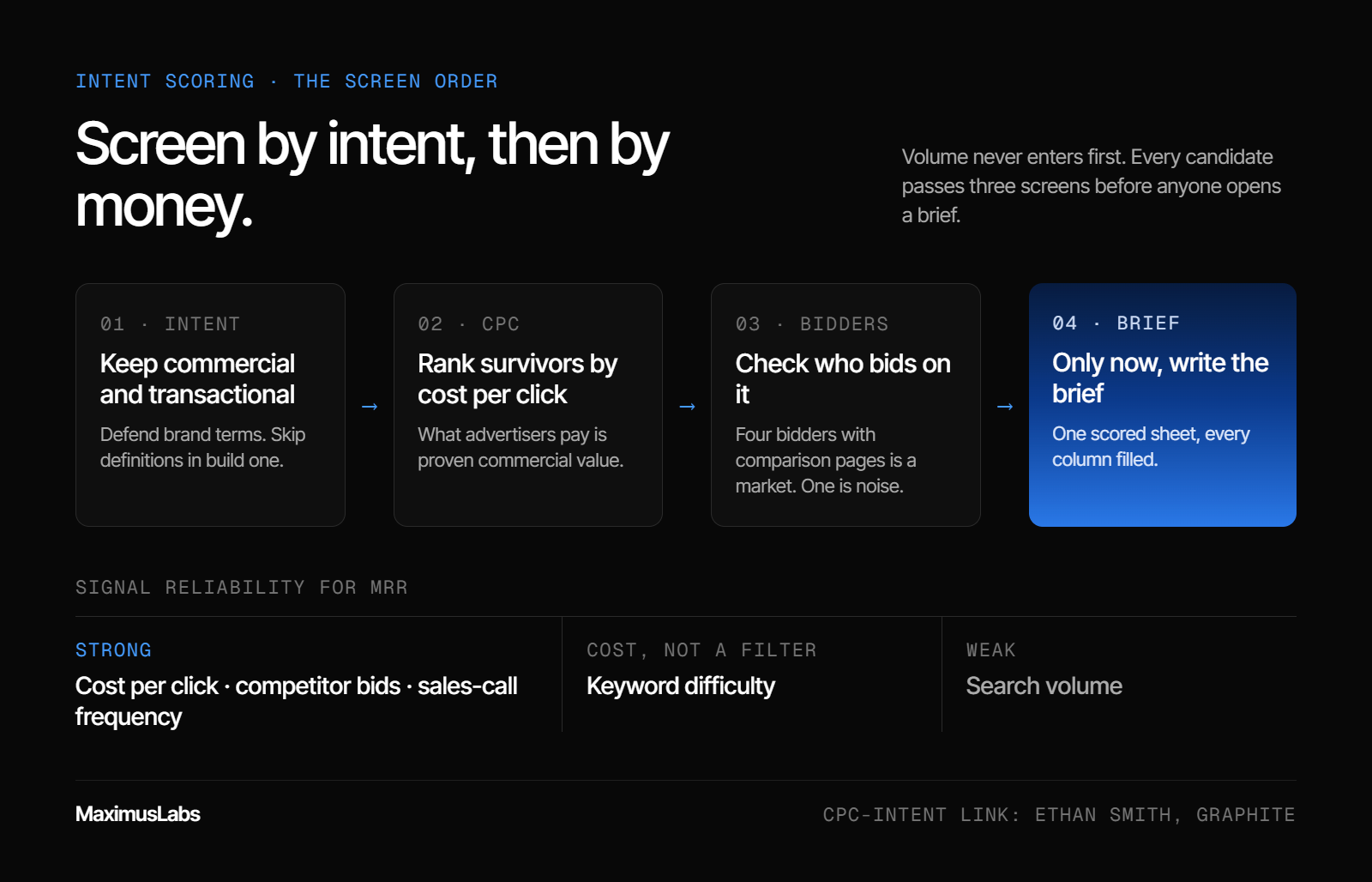
Classify every candidate as informational, navigational, commercial, or transactional, keep only commercial and transactional for the first build, then rank what survives by cost per click and competitor paid bids. Ethan Smith of Graphite states that cost per click strongly correlates with intent, so the CPC column alone indicates whether a topic will drive conversions. MaximusLabs AI applies this screen before any brief is written, so volume never enters the decision first.
🎯 Step one, cut by intent class
Run the four way classification on the full list. The test is not the words in the query, it is what the searcher is trying to finish.
✅ Transactional: pricing, free trial, demo, "buy", procurement language.
✅ Commercial: "best", "vs", "alternatives", "for [persona]", integration questions.
⚠️ Navigational: brand terms, defend but do not build a program on them.
❌ Informational: definitions and glossary terms, skipped in build one.
💰 Step two, price the survivors by what advertisers pay
Open Google Ads Keyword Planner, load the surviving list, and pull cost per click plus the competition field. Then check which competitors actually bid on each term using their ad copy on the live result page.
High CPC with multiple sustained bidders means revenue has already been proven with somebody else's cash. Low CPC on a commercially phrased term usually means the query looks commercial and does not close. We fold this screen into every B2B SEO engagement before a single brief is opened.
| Signal | What it measures | Reliability for MRR |
| Search volume | Audience size | Weak, and overstated post AI Overviews |
| Keyword difficulty | Effort to rank | Useful as cost, useless as a filter |
| Cost per click | Proven commercial value | Strong, per Smith's observation |
| Competitor bid count | Validated by rivals | Strong |
| Sales call frequency | ICP urgency | Strong, and tool invisible |
⚠️ Where CPC lies to you
Three cases break the rule. Brand defense bids inflate CPC on terms with no new demand. Regulated categories carry fraud inflated bids. Terms with a single desperate bidder look valuable and are not.
So read CPC together with bidder count and page type. One bidder and a thin landing page is noise, and four bidders with dedicated comparison pages is a market.
📣 What practitioners say about the volume habit
"When it comes to keywords, avoid chasing high-volume terms initially... Some keywords may show zero search volume in SEO tools simply because there's insufficient data."
— r/SaaS, I scaled my SaaS website to 45k visits/month Reddit Thread
"Sometimes, just build 3-5 content pieces for relevant queries to your audience, even if they don't show search volume. Then, when you rank well, look at the impressions for key terms."
— r/bigseo, What strategies do you use when researching for SaaS Reddit Thread
My position, and this is where I differ from most of the category, is that scoring is a data problem rather than a checklist. You are predicting an engine's behavior, so you weight signals by observed correlation, not by habit.
✅ The screen order
MaximusLabs AI runs intent class, then CPC, then competitor bid check, before anyone opens a brief. We sort by what an advertiser already pays, because difficulty is free to pull and tells you nothing about revenue. That ordering is the same one we apply across GEO programs for SaaS startups.
Q4. Where do real SaaS keywords come from if not from a keyword tool?
Two inputs tools cannot give you. First, recorded buyer language: Gong call transcripts, support tickets, win loss notes, and competitor reviews on G2 and Capterra. Second, a competitor gap report filtered to "vs", "alternatives", "best", and "pricing" patterns. Ethan Smith's method is to take a competitor's paid search money terms and convert them into questions, so intent arrives pre validated.
🎧 Step 1 and 2, mine the calls and the tickets
Pull the last 90 days of recorded calls. Search transcripts for question marks following your category terms, plus the strings "does it", "can it", "integrate", "migrate", and "how long".
Then run the same strings across support tickets and churn notes. A ticket is a buyer question that already cost you money once.
Worked example. A ticket reading "we need Slack alerts when a deal stage changes but ours fire twice" becomes the page "how to fix duplicate Slack deal stage alerts", and it maps to an integration page, not a blog post.
⭐ Step 3, mine reviews for the words buyers choose
Read your competitors' 2 and 3 star reviews on G2 and Capterra first, not the 5 star ones. Three and four star reviews name the limitation plainly, which is where switching language lives.
✅ Pull the exact noun phrases reviewers use for features.
✅ Log every named integration, since those become page targets.
❌ Ignore praise paragraphs, they contain no query language.
🔁 Step 4, run the gap report, then dedupe
Load three to five competitors into your gap tool of choice and filter to four patterns: "vs", "alternatives", "best", and "pricing". Export only terms where at least one competitor ranks in the top ten and you do not. This is the same inventory step inside our GEO competitive analysis work.
Then dedupe against your own Search Console queries so you do not commission a page for something you already rank for. This step alone usually cuts the list by a third.
💸 Step 5, convert competitor money terms into questions
Smith's framing is the most useful tactic in this section. If you are Rippling, look at what Deel bids its paid search budget on, then transform those terms into questions.
"Deel pricing" becomes "what does Deel actually cost for a 40 person team with contractors in India". That phrasing matches how buyers prompt ChatGPT, and MaximusLabs AI uses exactly this persona plus constraint construction because answer engines match on context inside the prompt, not on the head term. Our query fan out generator builds those variants at scale.
🗣️ What operators actually do
"I would start with finding out FAQs around the product/service from the sales and/or customer service teams (and marketing)... in SaaS this can be fairly common but you will know a common trend of zero volume searches e.g. 'Product x vs. Product y'."
— r/bigseo, What strategies do you use when researching for SaaS Reddit Thread
"The fact that a keyword doesn't have search volume in an SEO tool doesn't mean that people aren't searching for it... My ZSV keyword research process starts with audience research."
— r/SaaS, Why You Shouldn't Ignore Zero Search Volume Keywords Reddit Thread
✅ Step 6, one scored candidate list
Merge all five inputs into a single sheet with six columns: raw phrase, source, intent class, CPC, competitor bid count, and proposed page type. Nothing proceeds to a brief without all six filled. If you want that sheet built and scored for you, talk to the MaximusLabs AI team.
Q5. Which pages should you build first, in what order?
Build six page types before anything else: a category listicle, head to head comparison pages with feature and pricing tables, alternatives pages, use case pages, integration pages, and a pricing page that answers cost questions directly. These match queries where the buyer has already decided to buy something. MaximusLabs AI's AI search ranking research (2026) found vendor technical documentation holding 34 to 41 percent of citations on software how to queries, against 15 to 18 percent for blog content.
🎯 The build order, ranked by proximity to a decision
| Priority | Page type | Query it answers | Why it ships first |
| 1 | Comparison, "you vs competitor" | "Tool A vs Tool B" | Buyer is one to two weeks from signing |
| 2 | Alternatives | "[Competitor] alternatives" | Buyer has already decided to leave |
| 3 | Category listicle | "best [category] software" | Forms the AI consideration set |
| 4 | Integration pages | "does X work with Y" | Tool invisible, almost never built |
| 5 | Use case or segment pages | "[category] for [persona]" | Matches persona context in AI prompts |
| 6 | Pricing | "how much does X cost" | Removes the last objection |
📊 Why these pages are citation real estate, not just landing pages
AI Overviews trigger on roughly 87 percent of B2B SaaS comparison searches, and on about 73 percent of "how to accomplish task with software" queries. That means the comparison page you skip is a slot an engine fills with somebody else's page. The underlying dataset sits in our citation pattern research across ChatGPT, Perplexity, and Gemini.
The citation split matters more than the trigger rate. Documentation and structured product pages get cited far more often than blog posts on those how to queries. My read is that engines prefer sources that state facts plainly, with tables and version numbers, over narrative prose, which is why Google AI Overviews optimization starts with page structure rather than word count.
⚠️ The category nobody builds: integration pages
Integration pages are the most underbuilt asset in SaaS. Otter.ai captured enterprise buyers by publishing pages that explained a Zapier to BigQuery to Looker workflow, answering questions like "does Otter integrate with Looker" that no keyword tool reports. Otter documents those connections in its own integrations help centre.
One page per connected platform, naming the trigger, the field mapping, and the limitation. These convert because the reader is already mid implementation, and they scale cleanly through programmatic SEO.
✅ Pricing and comparison honesty as a ranking lever
Concede where a rival genuinely wins. Operators who run these pages say the same thing:
"Don't shy away from highlighting any missing features in your comparison charts, as this can enhance your trustworthiness."
— r/SaaS, I gathered 9 tips related to comparison pages Reddit Thread
"At Databox our main conversion drivers are the product-related landing pages, including the homepage, but that doesn't mean blog posts aren't important."
— r/SaaS, What SEO pages convert the most for your SaaS? Reddit Thread
Both match what I see in audits. Product adjacent pages carry the conversions, and blogs carry the assists.
💰 What this looks like in a 90 day plan
MaximusLabs AI sequences client roadmaps in this exact order, and the reason is measured rather than stylistic. Our own citation research put documentation and comparison assets ahead of blog content on software queries, so we treat them as primary organic assets rather than engineering afterthoughts. Most agencies will not touch them, because they cannot be written without product access. The same sequencing runs through our B2B SaaS AEO strategies.
The schedule I use runs like this:
Days 1 to 30: three comparison pages for your top paid search rivals, plus one alternatives page.
Days 31 to 60: the category listicle, plus integration pages for your five most requested platforms.
Days 61 to 90: two use case pages for your clearest ICP segments, and a pricing page with real numbers.
Nothing in that 90 days is a definition post. Answer engines already own those.
Q6. How do you research prompts and query fan out, not just keywords?
Run prompt research alongside keyword research. Write the 10 to 15 word questions your ideal customer profile would type into ChatGPT, Perplexity, Gemini, and Copilot, run them on each platform, and log which sources get cited. Google's May 2026 documentation confirms generative features use retrieval plus query fan out, where the system breaks one question into several sub queries across its Search index. MaximusLabs AI runs this as a standing process called AI Source Analysis, mapping cited sources per engine before any content is briefed.
⚠️ The gap that breaks a keyword plan
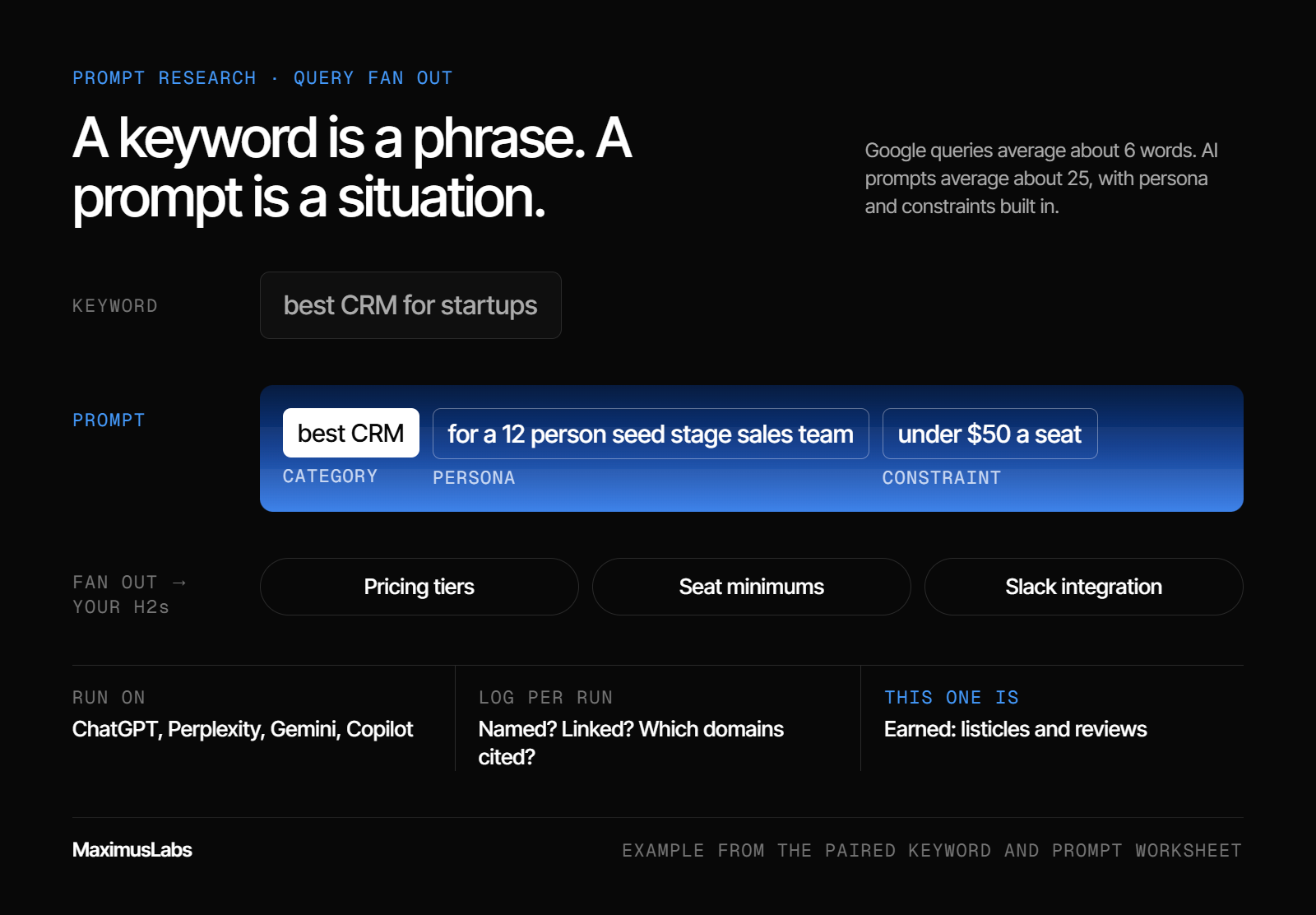
A keyword is a phrase. A prompt is a situation, and it arrives with persona, budget, stack, and constraint attached.
Google queries average around six words. AI prompts average closer to 25, which means one prompt can contain four questions your sheet lists as four separate keywords. That is the premise behind question research for AI search.
📄 What Google's own documentation actually says
Two details from the May 2026 guidance change how you plan. First, generative features sit on top of core Search ranking and quality systems, so eligibility still runs through normal indexing. Second, there is no special schema, no separate Markdown version, and no secret file required. Google states both points in its guidance on AI features and your website.
That removes the shortcut most vendors sell. The work is enumerating sub questions and answering each one cleanly on the page, and our query fan out generator exists for exactly that step.
🔍 The five step loop you can run this week
Write 40 to 60 prompts per ICP segment. Use the shape "I am a [role] at a [company type], I need [outcome], we already use [tool]".
Run each prompt on four engines. ChatGPT, Perplexity, Gemini, and Copilot. Log the date, because answers drift.
Record three fields per run. Were you named, were you linked, and which domains were cited.
List the fan out sub questions each engine implied in its answer. Those become your H2s.
Separate owned gaps from earned gaps. Owned means you need a page. Earned means you need to appear on someone else's.
🗣️ What practitioners report about tracking
"Manual testing has been the most effective approach for me so far, particularly when I want to observe how phrasing affects AI citations in real time."
— r/aeo, Comparing AI citation tracking tools Reddit Thread
"Tracking prompts through the API doesn't mirror the actual conversations users have in the GUI... the API often skips web searches that the GUI performs."
— r/aeo, Comparing AI citation tracking tools Reddit Thread
That second point matches our testing. MaximusLabs AI runs prompt sets through the chat interfaces rather than only the API, because API responses frequently skip the live retrieval step that produces citations. I am genuinely unsure how long that gap will persist, so treat it as a current condition rather than a permanent rule. If you want a shortlist of what is worth paying for, see our comparison of ChatGPT tracking tools.
✅ The paired worksheet
MaximusLabs AI's AI Source Analysis brainstorms every way a client's ICP might ask an agent for a solution, then maps which sources each engine trusts, which is often a paid listicle or a Reddit thread rather than the client's own site. The deliverable is not a rank report. It is a list of third party properties to get into, which is where AI citation acquisition tactics take over.
| Keyword | Paired prompt | Fan out sub questions | Owned or earned |
| best CRM for startups | "best CRM for a 12 person seed stage sales team under $50 a seat" | pricing tiers, seat minimums, Slack integration | Earned, listicles and reviews |
| hubspot vs pipedrive | "should a 20 person B2B team pick HubSpot or Pipedrive in 2026" | pricing, migration effort, reporting depth | Owned, comparison page |
Q7. How do you score keywords by MRR instead of keyword difficulty?
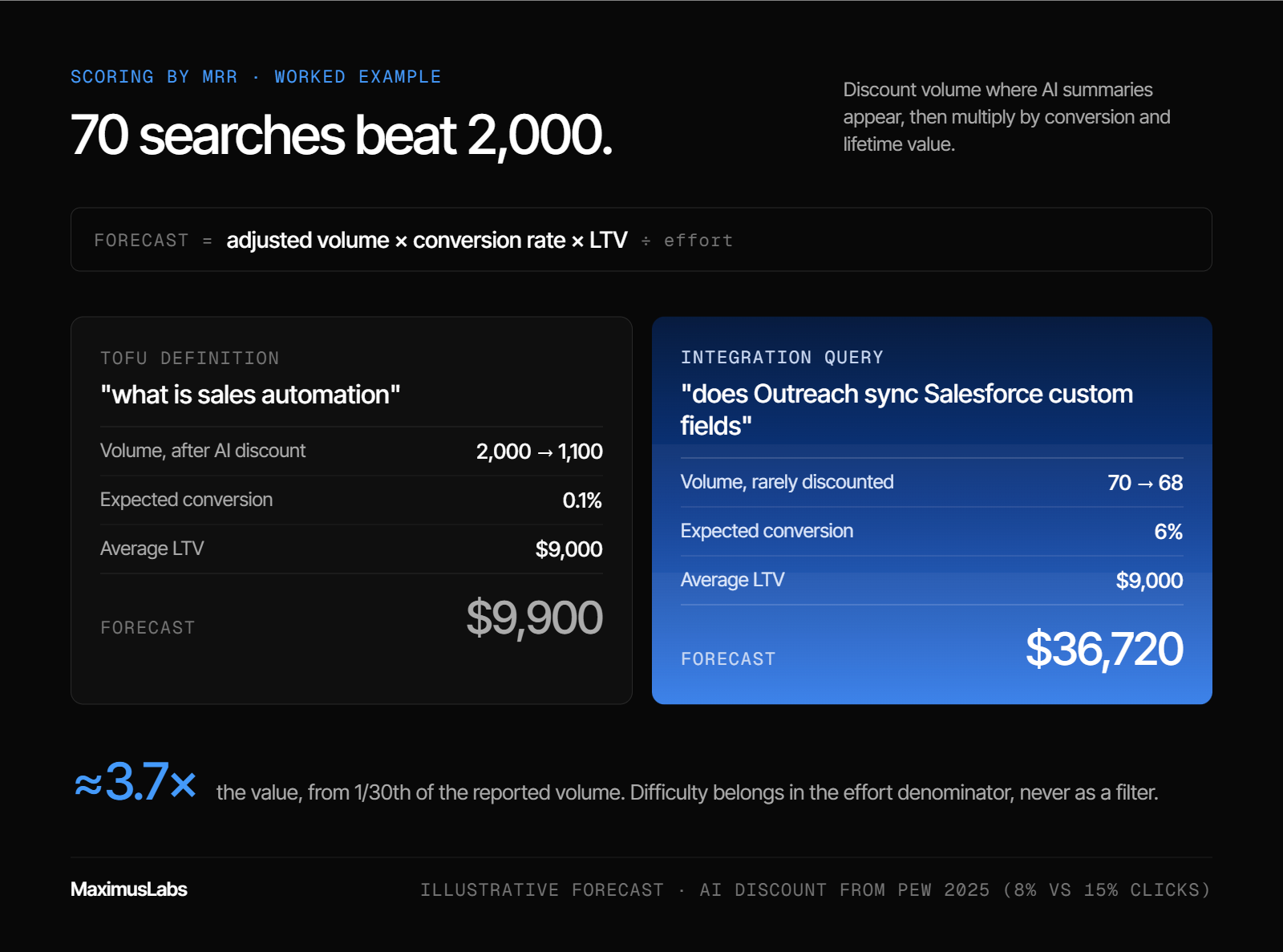
Score each keyword as adjusted volume multiplied by expected conversion rate multiplied by average lifetime value, then divide by production effort. Discount volume wherever AI Overviews appear. Pew Research Center found clicks on traditional results fell to 8 percent with an AI summary present, against 15 percent without, and only 1 percent of users clicked a cited source. Difficulty belongs in the effort denominator, never as a qualifying filter.
🧮 The formula, and the one column everyone is missing
The model is simple arithmetic. The missing piece is the click discount.
Adjusted volume equals reported volume multiplied by your expected click through rate for that result type. Apply roughly a 45 percent haircut to any query that triggers an AI summary, based on the Pew 8 versus 15 percent gap published in Pew's analysis of clicks when an AI summary appears.
Question shaped and long queries discount hardest. Pew found AI summaries appeared on 18 percent of all searches, but on 53 percent of queries of ten words or more. We track the downstream effect in our work on AI search click through rates.
💰 The worked comparison that ends the volume argument
Take two candidates. One looks obviously better until you run the math.
| Input | "what is sales automation" | "does Outreach sync Salesforce custom fields" |
| Reported volume | 2,000 | 70 |
| AI summary present | Yes, discount applied | Rarely |
| Adjusted volume | 1,100 | 68 |
| Expected conversion | 0.1% | 6% |
| Average LTV | $9,000 | $9,000 |
| Forecast value | $9,900 | $36,720 |
The 70 volume integration query is worth roughly 3.7 times the 2,000 volume definition query. That is the whole article in one table.
⚠️ Why difficulty gating is now the wrong filter
Most teams cut anything above a difficulty score of 40. That logic assumed you needed a top three position to get value.
Semrush found ChatGPT cites pages ranking 21 or lower for related queries roughly 90 percent of the time, published in its study of AI search impact on SEO traffic. The Princeton and IIT Delhi GEO paper (KDD 2024) found optimization methods lifted visibility in generative answers by up to 40 percent, with a fifth ranked site gaining about 115 percent, as documented in GEO: Generative Engine Optimization.
So a page you cannot rank top three can still be the cited source. Difficulty tells you what it costs, not whether it qualifies, which is the central argument in GEO versus traditional SEO.
📊 How the scoring sheet compares across approaches
| Approach | Primary filter | Effort treatment | What it optimizes |
| In house default | Search volume | Ignored | Sessions |
| Traditional agency | Keyword difficulty | Gate | Rankings reported monthly |
| MaximusLabs AI | Intent class, then CPC | Denominator in the score | Pipeline per published page |
MaximusLabs AI weights AI visible queries upward because the conversion premium is real. Ahrefs reported that AI referrals made up 0.5 percent of its traffic yet drove 12.1 percent of signups in its study of AI search traffic conversions. Webflow measured roughly a 6 times higher conversion rate for visitors arriving from large language models than from Google organic.
I will hedge that honestly. Those premiums come from a handful of first party datasets, and the absolute volume stays small, so I weight the multiplier rather than betting the roadmap on it.
✅ The column set that goes in your sheet
Raw phrase, intent class, and source.
Reported volume, AI summary flag, and adjusted volume.
CPC, competitor bid count, and expected conversion rate.
Average LTV, forecast value, and effort in writer days.
Proposed page type and the owning page URL.
Eleven columns, one forecast number, and a ranked queue. Ethan Smith's 19 out of 20 ratio is the reason the ranking matters more than the list length.
Q8. How do you map keywords to pages without cannibalizing yourself?
Assign one intent cluster to one page, and record the owning URL in a mapping sheet, so two pages never compete for the same query. Ethan Smith argues for a single dense page per cluster covering thousands of variants. MaximusLabs AI's AI search ranking research supports splitting into segment pages, such as "for startups" and "for enterprise", because engines match persona context carried inside a 25 word prompt. Split only when proof, pricing, and objections genuinely change.
🗂️ The mapping sheet, and the rule it enforces
Five columns do the job: cluster name, primary query, every variant in the cluster, the single owning URL, and the page type. One owner per cluster, no exceptions.
The rule sounds administrative. It is actually the cheapest performance fix available, because it stops you funding two pages to split one result. We build these sheets as part of GEO topic cluster planning.
⚠️ How cannibalization actually shows up
Open Search Console, go to Performance, then Search Results, and filter by a single query. Check the Pages tab for that query, using Google's documented Search Console performance report.
Two or more of your URLs appearing with similar impressions and low click through is the signal. You will also see positions oscillating week to week as the engine swaps which page it prefers.
Fix it by picking one owner, then either consolidating the loser or narrowing it to a different cluster with a 301 redirect. A technical SEO audit will surface every overlap at once.
🤔 The real disagreement, stated fairly
This is contested ground, and both sides have earned their position.
✅ Consolidation (Ethan Smith). One page per intent cluster can rank for thousands of question variants, and fragmentation dilutes authority.
✅ Segmentation (MaximusLabs AI's research). Persona matched pages get cited for persona qualified prompts, because the prompt itself carries role and company size.
❌ Where segmentation breaks. Thin variants with the same proof, same pricing, and same screenshots just split your own signal.
✅ Where consolidation breaks. A single page cannot carry enterprise security proof and startup pricing honestly at once.
❌ Where both break. Mass producing a page per synonym dilutes authority and produces the 95 percent of pages that earn nothing.
✅ The three question split test
Ask these before creating a second page for a related cluster:
Does the pricing change? Different tiers, seat minimums, or contract shape.
Does the proof change? Different logos, case studies, compliance requirements, or security answers.
Does the objection change? A founder asks about setup time, a procurement lead asks about SOC 2.
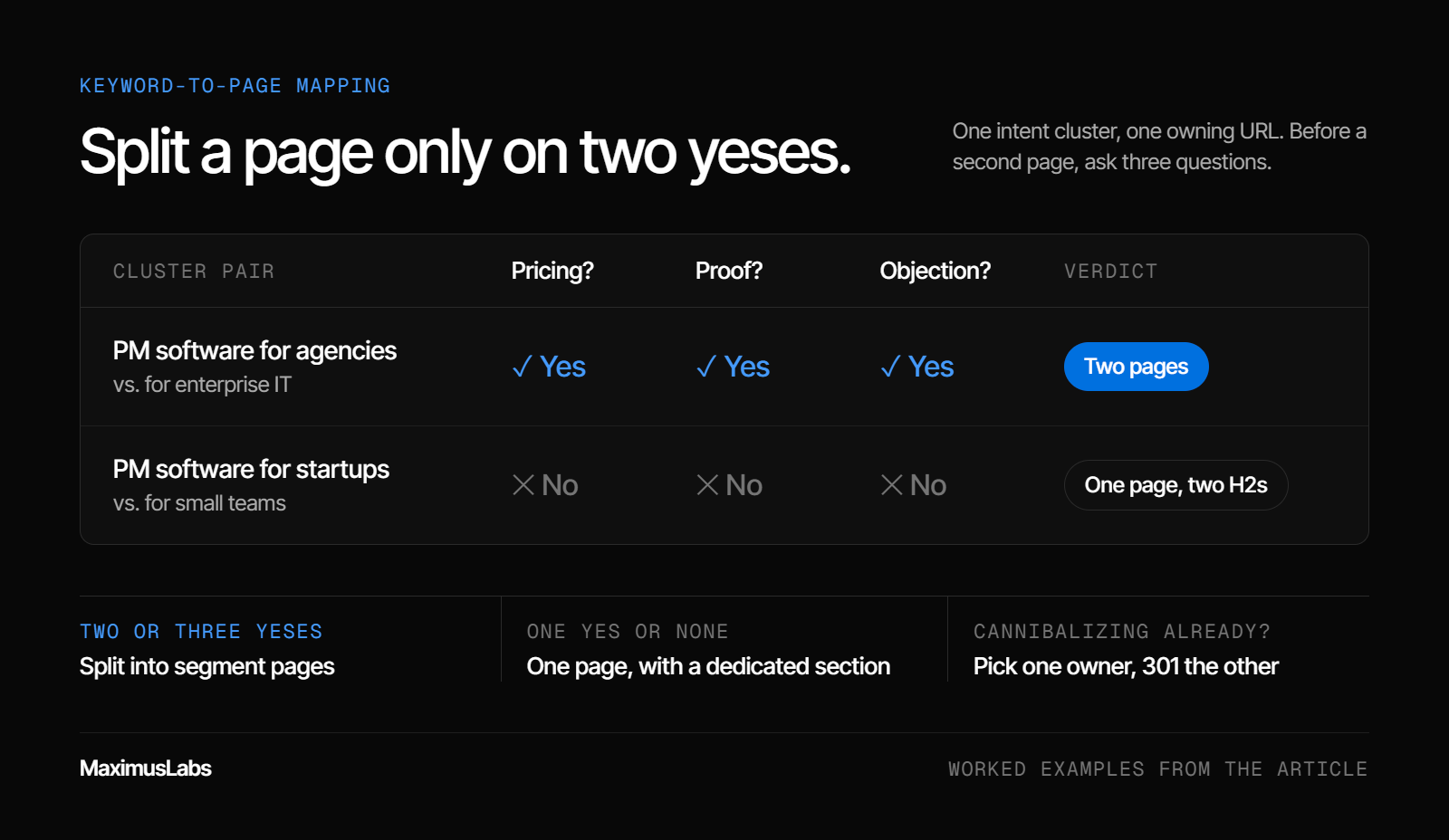
Two yeses means split. One yes or none means one page with a dedicated section.
📊 Worked example
Take "project management software for agencies" and "project management software for enterprise IT". Pricing differs, the proof differs, and the objection differs. Three yeses, so two pages.
Now take "project management software for startups" and "project management software for small teams". Same pricing, same proof, same objection. One page, two H2s.
MaximusLabs AI lands on the split side, and I will say openly that this is a position rather than a settled fact. Our research shows persona matched pages getting cited for persona qualified prompts, which is why our roadmaps include segment pages a consolidation purist would call thin. We cap the split at segments that pass at least two of the three tests, and our team will run that test against your own cluster list.
Q9. Which keywords can you only win on property you do not own?
Category queries like "best [category] software" are usually won on third party property, not your domain. Quoleady's 2026 study of ChatGPT answers for SaaS "alternatives" queries found 100 percent of recommended tools had Capterra reviews, 99 percent had G2 reviews, and 78.8 percent had a Wikipedia page. MaximusLabs AI treats these placements as keyword targets inside the roadmap, with a floor of ten credible reviews per review platform before any category page ships. The full dataset sits in Quoleady's published LLMO research on G2 and Capterra influence.
🗂️ The inventory, split by who owns the result
| Query type | Who usually wins it | Your move |
| "best [category] software" | G2, Capterra, listicles | Earned: profiles, reviews, and listicle placement |
| "[competitor] alternatives" | Review sites plus vendor pages | Both: your page, plus a complete G2 profile |
| "[tool A] vs [tool B]" | Vendor comparison pages | Owned: build it yourself |
| "is [tool] worth it" | Reddit, YouTube | Earned: participate honestly, do not astroturf |
| "does [tool] integrate with [X]" | Vendor docs | Owned: one page per integration |
⭐ How to tell which of your targets are third party dominated
Run each target query on ChatGPT, Perplexity, and Google, then count the citations that point to your own domain. If fewer than two of ten do, the query is an earned target and no amount of on site writing will fix it. This is the same diagnostic we run inside an AI search competitor analysis.
Practitioners have described this pattern on review platforms for years:
"Both sites rank well for comparative searches (and categorical and vendor-specific review searches), all with commercial intent. Many SaaS buyers turn to search and then use peer review sites, despite their flaws."
— r/SaaS, Peer review sites: G2 or Capterra. Good for SaaS startups? Reddit Thread
"Capterra has a PPC model like Google, so vendors can bid their way to be listed at the top of the page (like with search results, the clickthrough falls off significantly the lower you go down the page.)"
— r/SaaS, Peer review sites: G2 or Capterra. Good for SaaS startups? Reddit Thread
That second quote is the honest caveat. Review platforms are partly pay to play, so treat placement as a budget line rather than a free win. Capterra documents its own bidding mechanics on its vendor advertising page.
✅ The placement workflow MaximusLabs AI runs
MaximusLabs AI sequences off page work in four steps, and I will flag where the evidence is thinner than the confidence in the market. The detailed version lives in our guide to citation optimization for AI search.
Complete and verify profiles on G2 and Capterra, including categories, features, and integrations.
Reach ten credible reviews per platform, requested from customers by email or LinkedIn, never incentivized into dishonesty.
Find the specific Reddit and Quora threads engines already cite for your target prompts, then contribute real expertise under a real identity, a workflow our Reddit threads finder was built to shortcut.
Pitch listicle inclusion on the publications already appearing in those answers.
My hedge is this. Quoleady's own conclusion was that review profiles correlate with being named, and do not prove causation. So I treat reviews as a trust gate you must pass, not a lever that lifts you on its own, which is why forum and Reddit AEO sits beside review work rather than replacing it.
💰 Where this shows up in pipeline
MaximusLabs AI runs Answer Engine Optimization (AEO), the practice of getting named and cited inside AI answers, with SEO underneath it. Earned placement is half of that work, and most agencies only do the owned half. For Oliv AI, the result was "64% AI citation rate in 6 months, vs ~30% for billion-dollar incumbents", and those citations were not all on Oliv's own domain. The full engagement is documented in the Oliv AI case study.
Split your sheet accordingly. Owned targets get briefs, and earned targets get outreach owners, review quotas, and community calendars.
Q10. How do you prove it is working, and how often do you redo it?
Track four things: answer presence (are you named), citation presence (are you linked), key events by referrer in GA4, and revenue per ranking keyword. Pew Research Center recorded 26 percent of sessions ending entirely when an AI summary appeared. Ahrefs found AI referrals were 0.5 percent of its traffic yet drove 12.1 percent of signups. MaximusLabs AI reports citation rate and share of voice monthly, refreshes full keyword sets quarterly, and reviews prompt sets monthly.
📊 The metric swap, stated plainly
| Retire this | Replace with | Why |
| Keywords in top 10 | Answer presence across prompt sets | There is no position inside an AI answer |
| Sessions | Key events by referrer | Pew shows the click often never happens |
| Impressions | Citation presence per engine | Being linked is the retrievable signal |
| Average position | Revenue per ranking keyword | Ties the channel to pipeline |
Pew's underlying browsing study of click behaviour is published in its analysis of what users do when an AI summary appears, and we translate the reporting side of it in our work on AEO measurement metrics.
⚠️ The GA4 setup, and its real limits
GA4 has no native AI channel, so these sessions scatter across Referral and Direct. Build a custom channel group: Admin, then Data display, then Channel groups, then add a channel filtered on Source matching regex for chatgpt.com, perplexity.ai, claude.ai, gemini.google.com, and copilot.microsoft.com, following Google's documentation on custom channel groups in GA4.
Two limits matter. Clicks from Google AI Overviews arrive as ordinary google organic traffic, and paid ChatGPT sessions often strip the referrer and land in Direct.
Operators say the same thing about the ceiling:
"GA4 really falls short for detailed insights beyond merely indicating that a referral source is present. It's nice to see that someone came from ChatGPT, but it doesn't provide any context about their motivations."
— r/seogrowth, How are you all tracking referral traffic and visibility from AI chatbots? Reddit Thread
"In GA4, traffic generated by AI tools (such as ChatGPT, Perplexity, or AI Overviews) is not classified as 'Organic.' Instead, it typically falls under the 'Other' category, unless you've created a custom channel grouping."
— r/GoogleAnalytics, GA4 is hiding AI referral traffic: here's how to fix it Reddit Thread
⚖️ The counter case you should present to your board
Do not oversell this channel. A 95 site benchmark tracked from September 2025 to August 2026 found organic delivering far more traffic and conversions than AI referrals, with B2B product sites converting below parity on AI visits. The benchmark was published in Forbes Business Council, October 2026.
So the honest framing is a conversion premium on a small base. MaximusLabs AI keeps the majority of keyword investment on queries that work in both Google and AI answers, because betting the roadmap on AI referral volume alone is not supported yet. We set that split using the GEO budget benchmark.
⏰ The cadence that keeps it alive
Weekly: check key events from the AI channel group, and note which landing pages appear.
Monthly: re run your prompt sets, log answer and citation presence, and report share of voice.
Quarterly: refresh the full keyword set, re score with current CPC data, and retire losers, which is the trigger point for a GEO content refresh.
Twice yearly: rebuild the prompt library, because buyer phrasing drifts.
✅ On tooling, spend less than you think
Ethan Smith's observation about the tracker market holds up. He describes a page listing more than 60 AEO tools that all do the same thing, puts a prompt in, checks yes or no, charts it, and notes you will probably be using Ahrefs anyway in two years. Ahrefs published the signup attribution data behind that point in its study of AI search traffic conversions.
MaximusLabs AI reports citation rate and share of voice because those numbers moved for clients, and we agree on tooling. Spend the budget on the pages and third party placements that change the number, not on the dashboard that watches it. Our side by side of the market sits in the AEO tools comparison.
Q11. What should you skip, and when should you not do this at all?
Skip "what is [topic]" glossary content, volume only screens, thin pages per synonym, and expensive AEO trackers. Skip the channel entirely if demand does not exist yet. Eli Schwartz is blunt about it: a SaaS product sold to a narrow B2B niche will not create more demand by improving SEO best practices, it only gains visibility among buyers already looking for it or its competitors. Search captures demand, it does not manufacture it.
❌ The four line items to cut this quarter
Glossary and definition pages. Ethan Smith's observation is that a payroll definition page has had essentially zero conversion rate, and answer engines now resolve those queries natively.
Volume only screening. It filters out your highest intent integration and comparison terms, as covered in Q2.
A page per synonym. This dilutes your own signal and manufactures the 95 percent of pages that earn nothing.
Premium citation trackers. Pick the cheapest tool that answers your question, and move the savings into placement work.
Each of those four is a documented failure mode in our list of GEO failures and lessons.
⚠️ Demand capture, not demand creation
This is the distinction most keyword strategies skip. Search is a harvesting channel. It finds people already in motion.
If nobody is searching for your category yet, keyword research cannot invent them. You need a category creation play, and that runs through sales, partnerships, community, and paid distribution, not through a keyword sheet. The market sizing side of that decision belongs in GEO market analysis.
⏰ The honest early stage exception
Smith's advice to startups is harder than most agencies will say out loud. He tells founders asking for SEO help that his first response is often not to do it at all, because a young domain lacks the authority to grow in search early on.
That matches what I see. With a six month old domain, four pages, and no reviews anywhere, the bottleneck is trust, not keywords. Fix the trust inputs first, which means customer proof, review profiles, and a real point of view published under a real name. Our E-E-A-T optimization guide covers that sequence in order.
✅ What to do with no budget at all
My zero budget advice has not changed in two years:
Get the SEO fundamentals right, which means crawlable HTML, clean headings, and accurate schema markup.
Write three pages far deeper than anyone else in your niche, on questions your buyers actually ask.
Claim and complete your G2 and Capterra profiles, then ask ten customers for honest reviews.
Answer real questions in the communities your buyers already read, under your own name.
That sequence costs time instead of money, and it builds the trust inputs engines read.
💰 What I am watching next
Two things shape my current thinking, and I hold both loosely.
The first is agentic search. If agents read your content, answer the buyer, and never send the visit, then your page becomes somebody else's inventory. That is the risk that keeps me cautious about traffic based forecasting, and it is the subject of our work on agentic AI and the future of search.
The second is pricing inside answers. Once ads enter AI chat, the economics of category queries change again, and earned placement may get more expensive fast. OpenAI has begun documenting that direction in its product announcements.
MaximusLabs AI measures every engagement on pipeline, not on mentions, which is why the advice here ends with what to stop funding rather than what to buy. For Oliv AI, the measurable outcome was "27 qualified leads, $47K+ pipeline, 26% close rate in 4 months", and "30 to 40% of inbound now AI-sourced". Those are the two numbers worth defending in a board meeting, and our team will walk through how that was built.
Frequently asked questions
What is SaaS keyword research, and how is it different from regular keyword research?
SaaS keyword research is the process of finding the queries and AI prompts buyers use while evaluating software, scoring them by buying intent and revenue potential, and mapping each one to a single page. The difference from general keyword research sits in three places: • The unit of value. A SaaS keyword is judged on trials, demos, and recurring revenue, not sessions. • The funnel weighting. Comparison, alternatives, and integration queries outrank definition queries, because the buyer is already in motion. • The measurement surface. Being named and cited inside ChatGPT, Perplexity, and Google AI Overviews now matters as much as holding a blue link position. MaximusLabs AI runs this as a revenue-weighted screen, applying intent class, cost per click, and a competitor bid check before any brief is opened. We skip top of funnel definition content on purpose, because answer engines already resolve those queries without sending a click. If you want the underlying model, our revenue focused GEO framework documents how we weight each signal and why pipeline replaces rank as the reporting metric.
Should we target zero search volume keywords for a SaaS product?
Yes, whenever the query signals active evaluation. Keyword tools estimate volume from clickstream panels, browser toolbars, and paid search aggregates, so low frequency B2B queries fall below the detection floor and round to zero. Use three overrides instead of the volume column: • Search Console impressions. Any term with impressions and zero reported volume is confirmed human demand. • Cost per click above zero. Advertisers do not sustain bids on queries that never convert. • Sales call frequency. If the same question appears in three recorded calls, it deserves a page. The honest limit is forecasting. These overrides surface demand, not size, so fund zero volume terms on conversion logic rather than projected sessions. MaximusLabs AI sorts these into head, mid tail, and long tail question types, because the tactic changes with each. Head terms are won through third party citations, while long tail integration and error queries are won with the most complete owned answer on the web. Our guide to AEO keyword and question research walks through that split with worked examples.
Does keyword research still matter now that AI Overviews answer most queries?
Yes, but the forecasting changes. Generative features sit on top of core Search ranking and quality systems, so keyword and topical research still determines whether you are eligible to be retrieved and cited at all. What breaks is the click assumption. Pew Research Center studied 68,879 real searches and found clicks on traditional results fell to 8 percent when an AI summary appeared, against 15 percent when it did not, with only 1 percent clicking a cited source. So three adjustments are needed: • Discount reported volume on any query that triggers an AI summary, and discount hardest on question-shaped queries of ten words or more. • Enumerate the fan out sub questions an engine will generate, and give each one its own heading and extractable answer. • Report answer presence and citation presence alongside rank, because position alone no longer describes the outcome. MaximusLabs AI treats this as a measurement problem first and a content problem second. We track citation rate and share of voice across engines rather than average position. The reporting side is detailed in our work on AI search click through rates.
How do we score keywords by MRR instead of by search volume or difficulty?
Score each keyword as adjusted volume multiplied by expected conversion rate multiplied by average lifetime value, then divide the result by production effort in writer days. The four inputs work like this: • Adjusted volume. Reported volume multiplied by your realistic click through rate, with roughly a 45 percent haircut where AI summaries appear. • Expected conversion. Set by funnel stage, since a definition query and an integration query are not comparable. • Average LTV. Pulled from your own cohort data, not an industry benchmark. • Effort. Keyword difficulty lives here, as a cost, never as a qualifying gate. The gating habit is what breaks most sheets. Teams cut anything above a difficulty score of 40, which assumed you needed a top three position to earn anything. Pages ranking well outside the top ten still get cited inside AI answers, so difficulty tells you what a page costs rather than whether it qualifies. MaximusLabs AI weights AI-visible queries upward because the conversion premium is real, while keeping expectations grounded in the small absolute volume. The attribution method sits in our guide to calculating ROI and revenue attribution for GEO.
Which pages should a SaaS company build first from its keyword list?
Build six page types before anything else, ordered by how close the buyer is to signing: • Comparison pages for your top paid search rivals, with feature and pricing tables. • Alternatives pages for competitors your buyers are actively leaving. • A category listicle for the best-in-category query, since that forms the AI consideration set. • Integration pages, one per connected platform, naming the trigger, field mapping, and limitation. • Use case or segment pages that match persona context carried inside AI prompts. • A pricing page that answers cost questions directly rather than deflecting to a form. These pages are citation real estate as well as conversion assets, because AI summaries trigger heavily on comparison and software how-to queries, and structured product documentation gets cited far more often than narrative blog content. MaximusLabs AI sequences client roadmaps in exactly this order, and the reason is measured rather than stylistic. Documentation, integration pages, and comparison tables are treated as primary organic assets rather than engineering afterthoughts. Our B2B SaaS AEO strategies set out the full 90 day build order.
How do we research prompts for ChatGPT and Perplexity alongside keywords?
Run prompt research as a parallel track. Write the 10 to 15 word questions your ideal customer profile would actually type, run them on each engine, and log which sources get cited. The loop takes five steps: • Write 40 to 60 prompts per ICP segment, using the shape "I am a role at a company type, I need an outcome, we already use a tool". • Run each prompt on ChatGPT, Perplexity, Gemini, and Copilot, recording the date because answers drift. • Log three fields per run: were you named, were you linked, and which domains were cited. • List the fan out sub questions each answer implied, then convert them into headings. • Separate owned gaps, which need a page, from earned gaps, which need third party placement. MaximusLabs AI runs this as a standing process called AI Source Analysis, mapping cited sources per engine before any content is briefed. We run prompt sets through the chat interfaces rather than only the API, because API responses frequently skip the live retrieval step that produces citations. Our query fan out generator builds the sub question set for you.
How do we measure whether SaaS keyword research is actually driving pipeline?
Track four things and retire the rest: • Answer presence. Are you named inside AI answers for your prompt set. • Citation presence. Are you linked, per engine, per prompt. • Key events by referrer. Signups, demos, and trials segmented by AI engine in GA4. • Revenue per ranking keyword. The only number that ties the channel to pipeline. GA4 has no native AI channel, so build a custom channel group filtered on source regex for the major engines. Two limits are worth stating to your board: clicks from Google AI Overviews arrive as ordinary organic traffic, and some chat sessions strip the referrer and land in Direct. Keep the expectations honest. AI referrals convert at a premium on a small base, so the majority of investment should stay on queries that work in both Google and AI answers. MaximusLabs AI reports citation rate and share of voice monthly, refreshes full keyword sets quarterly, and reviews prompt sets monthly, because those are the numbers that moved for clients. Our AEO measurement metrics guide covers the full reporting stack.