 Krishna Kaanth M
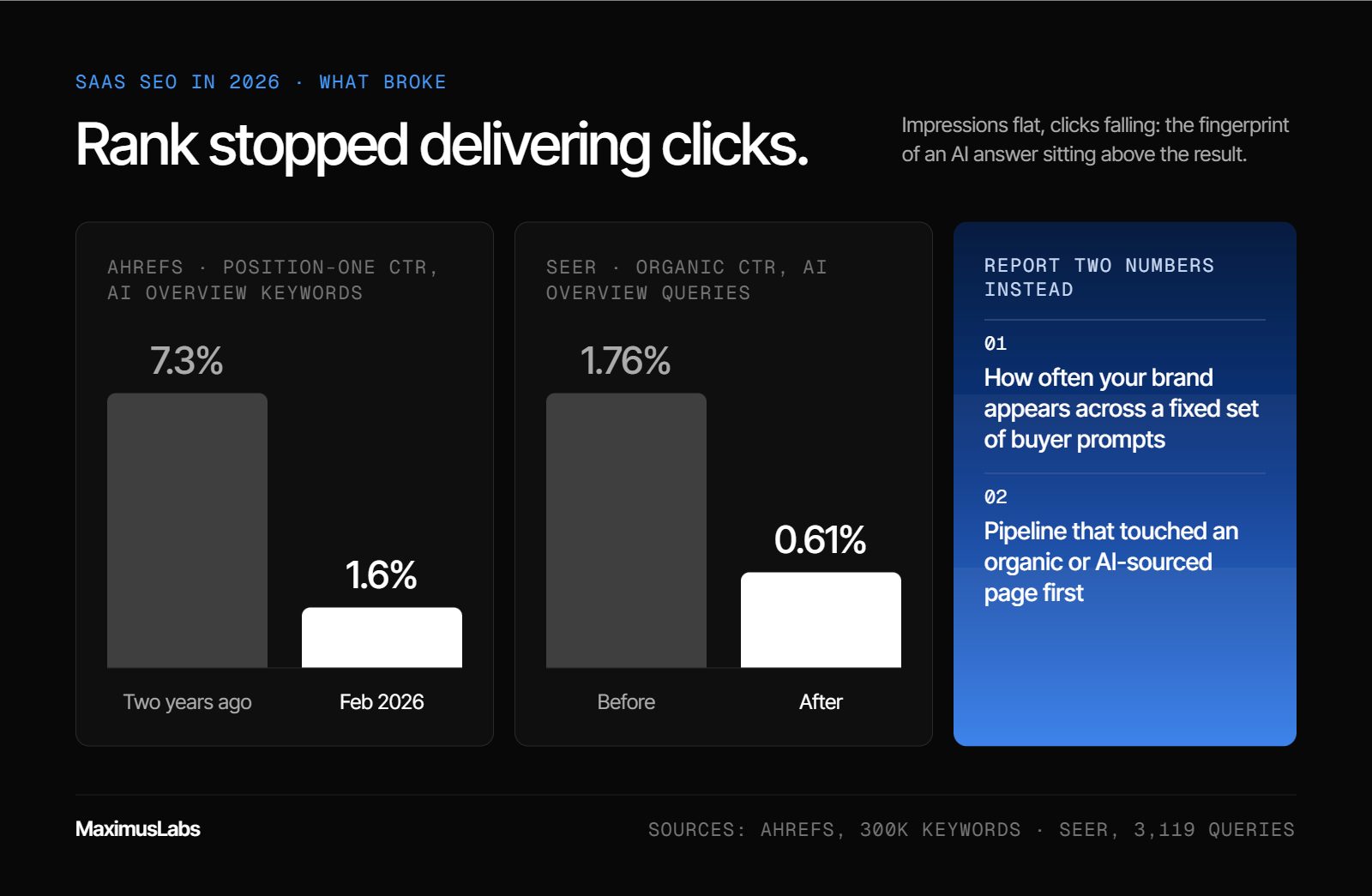
- Rank stopped equalling revenue. Position-one CTR on AI Overview keywords fell 58% across two years, so citation share and pipeline replace impressions as the scoreboard.
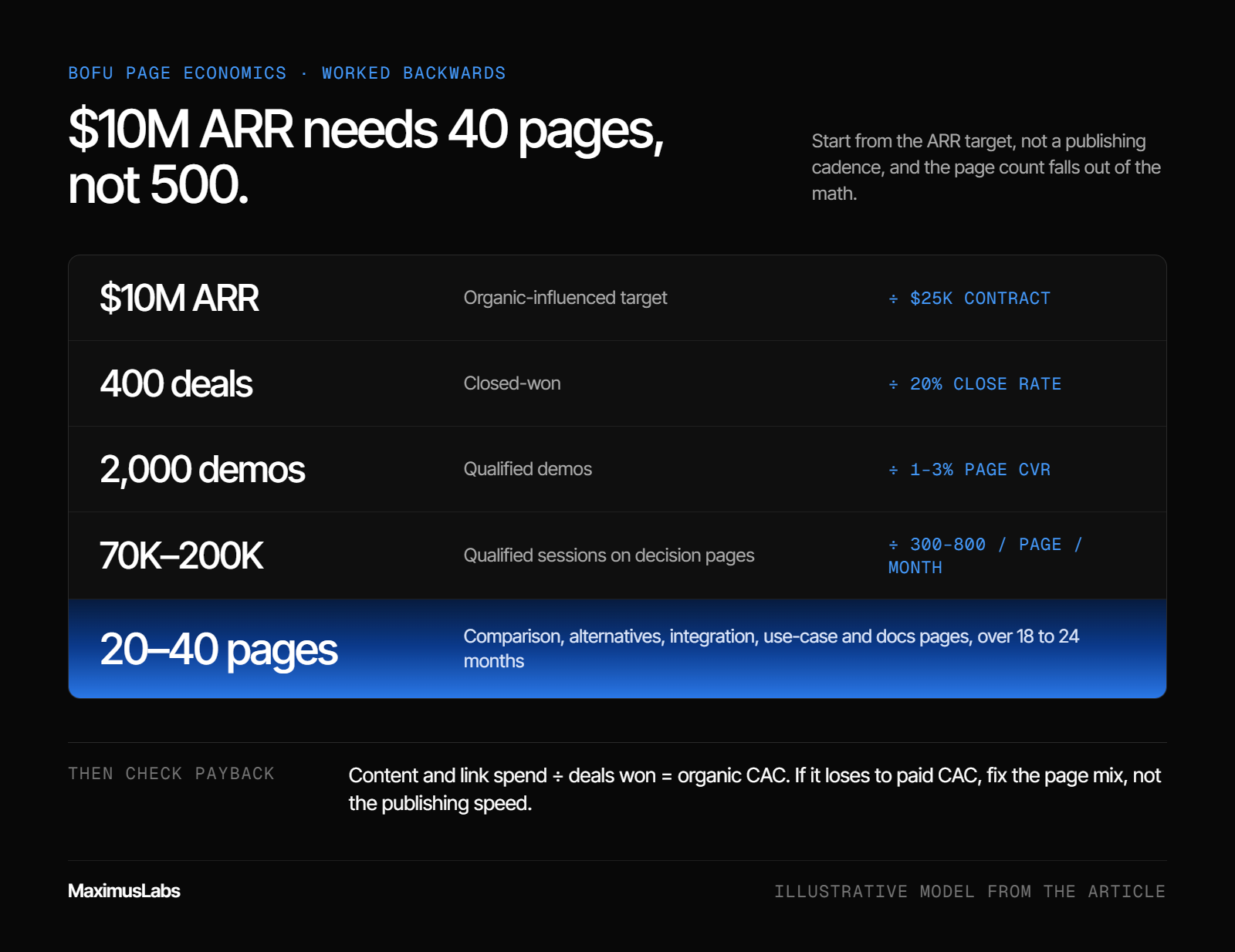
- Roughly 20 to 40 decision pages carry a $10M organic ARR engine. Graphite's data shows 19 of 20 landing pages drive almost nothing while 1 in 20 drives 85%.
- SEO captures demand, it does not create it. If nobody searches your problem, publishing will not invent that volume, so brand and outbound come first.
- Technical documentation gets cited at 34% to 41% median rates against 15% to 18% for blogs, which makes a docs hub the highest-ROI asset most SaaS teams ignore.
- Off-site mentions correlate with AI visibility at r=0.664 versus 0.218 for backlinks, and one study found a vendor's own site cited in only 11.6% of software recommendations.
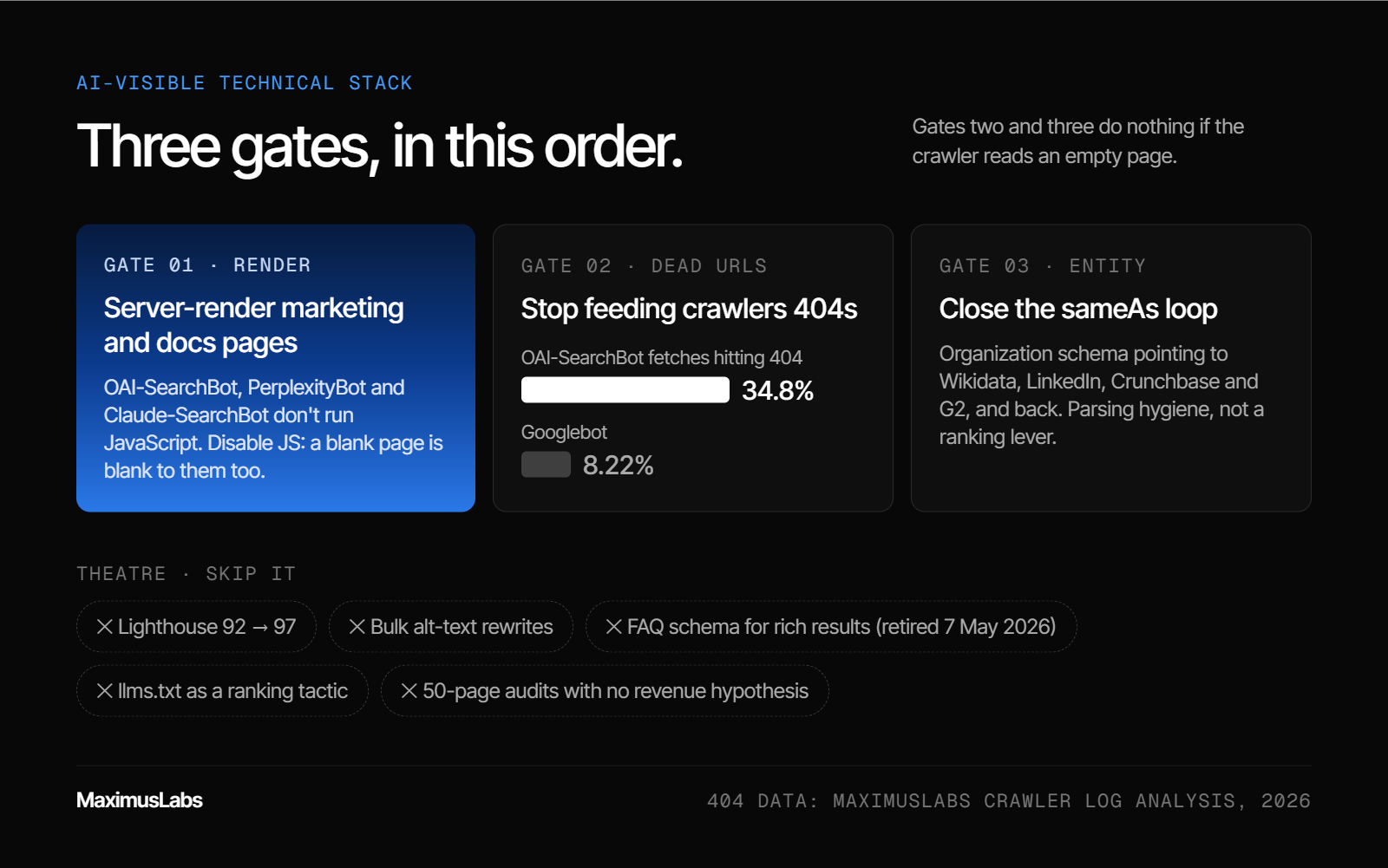
- Three technical gates decide AI visibility: server-rendered HTML, stable crawlable URLs, and a closed sameAs entity loop. Alt-text sweeps and llms.txt are not levers.
Q1. What is SaaS SEO in 2026, and why has the pre-2024 playbook stopped producing ARR?
SaaS SEO is the practice of making a software product discoverable and citable, across Google and AI answer engines, for the problems its buyers search. It is optimized for trials, demos, and ARR rather than traffic. The pre-2024 playbook broke because rank stopped delivering clicks. Ahrefs measured position-one click-through rate on AI Overview keywords falling from 7.3% to 1.6% across two years, a 58% drop.
📉 The slide that stopped meaning anything
Picture a Head of Organic Growth on slide four of the quarterly review. The rankings chart climbs. One hundred and forty keywords sit in the top three. Then the CFO asks how much pipeline organic produced last quarter, and the room goes quiet.
The artifact that explains the silence is the Search Console export sitting in another tab. Impressions are flat or growing. Clicks are falling. That exact pattern is the fingerprint of an AI answer sitting above the result, which is why search referral traffic decline now needs its own line in the report.
⚠️ What the old retainer actually sold
The pre-2024 model sold activity. Rankings, impressions, and clicks went on the dashboard, scope stayed fixed, and strategy often came from one firm while execution came from another. Content was written for ten blue links, so nothing in the reporting chain ever touched pipeline.
Ethan Smith of Graphite described the result as a loop. You ask why there are no results, you are told SEO takes a year, you wait a year, you see nothing, then you hire the next agency. Many SaaS teams have run that loop twice, which is the pattern we score against in our AEO agency evaluation framework.
🔁 What actually changed
Buyers now ask ChatGPT, Perplexity, Gemini, Claude, and Google AI Overviews. They get one answer naming five to ten brands. You are either inside that answer or you are absent from the evaluation entirely.
The click math confirms it. Seer Interactive studied 3,119 queries across 42 organizations and 25.1 million organic impressions, and found organic CTR on AI Overview queries fell 61%, from 1.76% to 0.61%. Sam Lessin put the industry-level loss at 20% to 40% of organic traffic depending on sector. Being mentioned is not the finish line either. Turning that mention into pipeline is.
✅ How the measurement changes
MaximusLabs AI opens every engagement with a prompt-set audit across ChatGPT, Perplexity, Gemini, and Google AI Overviews rather than a technical crawl, and reports citation share alongside influenced pipeline instead of impressions. We built that answer engine optimization service the way we did because the thing that broke was the assumption that rank equals revenue.
My read is that this is not SEO plus a new tactic. Each engine runs its own retrieval and its own trust signals, which makes it closer to a data problem than a checklist. I might be overstating the divergence, though the per-engine gaps we track keep widening rather than converging.
💰 The payoff: two numbers, not ten
Replace the ranking dashboard with two questions. Across a fixed set of buyer prompts, how often does your brand appear? Of the pipeline created last quarter, how much touched an organic or AI-sourced page first?
If you cannot answer both by Friday, that gap is the real finding. Everything in the rest of this playbook exists to close it, starting with measurement and metrics in GEO.
Q2. How does GEO/AEO differ from Google-only SEO, and what do AI engines actually reward?
Search engine optimization targets rank position. Generative Engine Optimization (GEO) targets inclusion inside a generated answer, measured as share of voice across prompt variants. Princeton's KDD 2024 study found that adding statistics, credible source citations, and quotations lifted generative visibility by up to 40%, while keyword stuffing produced no gain. Inclusion is binary, since there is no page two in an answer. MaximusLabs AI measures this by re-running each client's category prompts per engine and logging which brands and URLs get named.
🎯 The sample set gate
When a buyer asks for the best tool in your category, the engine returns ten to fifteen names at most. That list becomes the entire evaluation set. Hundreds of comparable products exist, and the buyer will never see them.
Krishna Kaanth's framing is blunt: if your company is not on that list, you are not in the buying conversation at all, no matter how good the product is. Google always had a page two. An answer does not, and that is the core of the GEO versus traditional SEO comparison.
📊 What the engines reward, side by side
| Discipline | What it optimizes | How success is measured |
| Traditional SEO | Rank position on Google | Position, impressions, clicks |
| GEO | Inclusion in generated answers | Share of voice across prompt variants |
| Answer Engine Optimization (AEO) | Being the extracted answer block | Citation rate per question, per engine |
The surfaces also disagree with each other. Semrush found that pages cited by ChatGPT rank position 21 or lower for related queries roughly 90% of the time. A page can be invisible on Google and still be the cited source in ChatGPT, which is why ChatGPT optimization runs as its own workstream.
⚠️ Why one screenshot proves nothing
Citation sets are unstable. Identical prompts run repeatedly rarely return the same brand list twice, so a single screenshot of a ChatGPT mention is noise rather than evidence.
That instability is exactly why repetition is the method. MaximusLabs AI runs fixed prompt sets on a schedule and regression-tests the results, because a brand named in forty of one hundred runs is in a different position than one named once.
✅ The answer-block standard
Placement inside the page matters more than most teams expect. Direct answer blocks sitting in the top 30% of body text carry a 44.2% share of citations, which is a steep front-loaded distribution.
So the working rule is simple. Write a 30 to 60 word factual answer directly under a question-phrased heading, inside the first third of the page. Keep meta descriptions near 120 to 158 characters and write them as answers, because standard ChatGPT retrieval works from roughly a 150-character snippet. Our AEO answer structure guide covers the formatting in full.
💬 What practitioners are saying
"Queries that once brought in hundreds of visitors monthly were now being answered directly in the search results... Ultimately, I've come to realize that while SEO is not obsolete, it can no longer be relied upon as the primary acquisition channel it once was."
— r/SaaS, r/SaaS Reddit Thread, February 2026
"It's not remotely close to the end of SEO, but I do think it is the end of a lot of bloggers who relied on informational search queries for traffic."
— r/SEO, r/SEO Reddit Thread
Both reads are correct, and together they describe the split this playbook runs on. Informational traffic is being absorbed. Commercial, decision-stage visibility is still winnable.
MaximusLabs AI runs Answer Engine Optimization as the flagship service with SEO underneath it, strategy and execution in one team, and reports share of voice beside pipeline. Instead of trying to be in the answer, the work aims to become the answer.
Q3. Can SEO create demand for your SaaS, or only capture it?
Only capture. Eli Schwartz states it plainly: SEO is an optimization channel, not a demand-creation channel. In a defined B2B niche, optimization delivers one step-change in visibility, then grows only at the rate of category and brand demand. If nobody searches for the problem you solve, publishing does not invent that volume. Demand creation is a brand, product, and outbound job, while SEO and AEO harvest demand that already exists.
⚠️ The wall most SaaS teams hit in month seven
Schwartz describes starting his first B2B SaaS engagement under the illusion that search would be a supremely profitable channel. He was then confronted with a wall of reality that he had to convey to a disappointed client.
The reality was structural, not tactical. A product sold to a narrow niche does not generate more demand for itself because its SEO improved. Better execution captures a larger share of a fixed pool, which is what our B2B SEO service is scoped around.
⏰ B2B buying is infrequent, and that breaks volume forecasts
Ethan Smith makes a related point about purchase rhythm. A Director of Finance does not change banks weekly, and nobody makes substantial B2B software decisions on a weekly basis. The search exists, but it is rare and spiky.
So the honest forecast looks different from the deck most teams approve. You are not modelling traffic growth. You are modelling what share of a small, high-value stream of in-market buyers you can intercept.
✅ What to fund instead if the demand is not there yet
If your category has no search volume, three things create it, and none of them are blog posts. Product-led distribution, founder-led brand and community presence, and paid or outbound demand generation.
Here is the sequencing that matters. Brand building is the moat, and once a brand genuinely owns a concept in its space, AI engines have little choice but to recommend it. Creation and capture are stages, not rivals, a point we unpack in GEO for SaaS startups.
🎯 The two-question test before you budget
Run this before approving another quarter of content spend.
Does anyone search for the problem, in volume, using words that are not your product name? Check Search Console for non-branded impressions and run twenty buyer prompts through ChatGPT and Perplexity to see whether your category even surfaces.
If a buyer already knows they need this category, can they find you in the top five names any engine returns? If not, the gap is capture, and that is fixable this quarter.
A yes to question one and a no to question two is the ideal condition for this playbook. Two noes means the budget belongs in demand creation first, and the search work should wait a quarter.
Q4. Which keywords and questions actually map to revenue, and how do you find them?
Score by purchase proximity, not search volume. A query at thirty searches a month, such as "Tool A vs Tool B for RevOps teams," outperforms a 12,000-volume glossary term that converts at zero. Build the list from Gong or Chorus call transcripts, pulling real objections, integration questions, and competitor comparisons, then expand each one into question variants. MaximusLabs AI sources keyword sets from client sales calls and excludes top-of-funnel glossary terms entirely.
💸 Why volume misleads in low-frequency purchase cycles
Volume measures how many people type a phrase. It says nothing about whether those people can sign a contract. In B2B SaaS, the gap between the two is enormous.
Ethan Smith's verdict on definition content is direct. The definition of payroll has a conversion rate of zero, so he spends no time on glossary pages and low-intent terms, focusing instead on the middle and end of the journey. Our AEO keyword and question research guide applies the same cut.
🔎 The sales-call mining workflow
This is the step most content plans skip, and it takes about a day.
Pull the last ninety days of closed-won and closed-lost call recordings from Gong or Chorus.
Tag every buyer question, objection, and integration requirement by the stage it appeared in.
Cluster the tags into decision jobs, such as migration risk, security review, or pricing comparison.
Convert each cluster into the literal question a buyer would type or ask an engine.
Expand each question into eight to fifteen variants, since AEO requires question research rather than keyword research.
Classify before you produce. Head questions like "best CRM software" are won mostly through earned citations on third-party pages. Long-tail questions like "does Tool A sync custom objects to Salesforce" are won with owned documentation and feature depth, the split covered in our question research strategy for AI search.
📊 A scoring sheet you can rebuild today
| Column | What to enter | Weight |
| Purchase proximity | Decision, evaluation, or education | 40% |
| ICP match | Does the asker look like your buyer | 25% |
| Answer surface | Owned page or earned citation | 15% |
| Existing visibility | Current rank and citation share | 10% |
| Volume | Monthly searches, as a tiebreaker only | 10% |
Volume sits last deliberately. It breaks ties; it does not set priority.
💬 What buyers say about the old scoring
"Rather than gauging their effectiveness based on the number of leads generated for clients, many SEOs tend to focus on traffic and other superficial metrics."
— r/SEO, r/SEO Reddit Thread, January 2024
"They keep making promises and saying that 'SEO takes time' but I see absolutely no results. Traffic had actually dropped."
— r/SEO, r/SEO Reddit Thread, May 2024
Both complaints trace back to the same root cause. The keyword list was built from volume, so the content that followed could never have produced leads.
MaximusLabs AI skips glossary content outright and builds keyword sets from the client's own sales calls, which is why our first content marketing plan is usually smaller than the one it replaces. Decision-stage terms are also the only place founder positioning can be expressed, since a definition page has nowhere to put a point of view.
Q5. Which pages produce the ARR, and which 19 of 20 are waste?
Roughly 20 to 40 pages carry a $10M organic ARR engine, not 500 posts. Graphite's work across Webflow, Upwork, Notion, and Rippling found that 19 of 20 landing pages drive little or no traffic, while 1 in 20 drives about 85% of it. The 5% that work are alternatives, comparison, integration, use-case, and documentation pages tied to a purchase decision. MaximusLabs AI scopes content by cluster ARR contribution rather than monthly article volume.
📊 The 5% rule, measured across real SaaS programs
Ethan Smith has published this ratio from client work at scale, and the client list is not small-sample. One in twenty pages carries the traffic, and the other nineteen sit there as sunk cost.
My read is that most teams know this intuitively and still plan as if it were untrue. The content calendar assumes every page pulls equal weight, because that is the only way a volume retainer makes sense. Our AI content strategy planning guide starts from the opposite assumption.
💰 The arithmetic nobody puts in the deck
Work backwards from the ARR number instead of forwards from a publishing cadence.
Set the target. $10M organic-influenced ARR at a $25,000 average contract value needs 400 closed deals.
Apply the funnel. At a 20% close rate from qualified demo, that is 2,000 demos.
Apply page conversion. Decision-stage pages convert visitors to demo at roughly 1% to 3%, so you need 70,000 to 200,000 qualified sessions.
Divide by page. Twenty to forty strong decision pages, each holding 300 to 800 qualified sessions a month, close that gap over 18 to 24 months.
Check payback. Divide total content and link spend by deals won, then compare that organic CAC against your paid CAC and your payback window.
If step five fails, the problem is the page mix, not the publishing speed. The same arithmetic sits behind calculating ROI for GEO initiatives.
⭐ Which page types actually earn a slot
| Page type | Funnel stage | Job it does | Why AI search amplifies it |
| Alternatives and "vs" pages | Decision | Intercepts active shortlists | AI Overviews trigger on 87% of B2B SaaS comparison searches |
| Integration pages | Decision | Clears the "does it work with our stack" blocker | Long-tail, specific, answerable in one page |
| Use-case and segment pages | Evaluation | Matches a role or company size | Engines match persona language in prompts |
| Documentation and how-to | Evaluation and post-sale | Answers task questions | How-to software queries trigger AI Overviews 73% of the time |
| Pricing and ROI pages | Decision | Survives procurement | Frequently retrieved on cost prompts |
Glossary and definition pages are missing from that table on purpose. They do not appear in the 5%.
⚠️ The build order for the first five pages
Start with your top three competitor comparison pages, ranked by how often sales hears those names. Add one integration page for the system that blocks the most deals. Add one segment page for your strongest ICP.
Ship those five before anything else. MaximusLabs AI tracks cluster-level ARR contribution rather than article counts, so a plan usually shrinks before it grows. In practice, the hardest conversation in month one is telling a client to stop producing, not to produce more, and B2B SaaS AEO strategies explains why.
✅ What this means for the retainer you are reviewing
MaximusLabs AI plans and prices by cluster ARR contribution, which is why scopes often cut a publishing calendar first. Producing 40 pages a month against the 95% that never convert is how a six-figure retainer ends with flat pipeline and a replaced agency.
Q6. Should you build one pillar page per topic or dedicated segment pages?
It depends on whether the queries pull the same citation set. If identical sources appear across question variants, consolidate into one deep page, because fragmentation splits authority. If the queries reflect different buyer roles or company sizes, build dedicated segment pages, because engines match role-specific language in prompts. MaximusLabs AI decides this by running the full question set and comparing citation overlap before any page is briefed. Rule of thumb: one page per intent cluster, one page per buyer segment, never one page per keyword.
📉 The scene that forces the question
A Marketing Manager opens the content sheet and finds eleven pages targeting near-identical queries. "Best project tool for startups," "project tool for small teams," "project software for founders." All three rank on page two. None convert.
That is page fragmentation. Each page holds a thin slice of authority, and none holds enough to be the answer anywhere. Fixing it starts with GEO topic clusters and content clusters.
⚖️ Two credible camps, and why both are right
Ethan Smith's consolidation view is that one page per intent cluster can target thousands of keyword and question variants, which prevents exactly the split above. Depth wins retrieval, because a longer self-contained page answers follow-up questions a thin page cannot.
The segment view runs the other way. Dedicated pages like "for startups" and "for enterprise" exist because role-specific workflows differ, and engines surface pages whose language matches the persona in the prompt. A single generic pillar cannot carry a security review for enterprise and a two-person setup story at once.
✅ The citation-overlap test that settles it
Run this before you brief anything. It takes an afternoon.
List 15 to 25 question variants for the topic, in the words a buyer would actually use.
Run each one through ChatGPT, Perplexity, and Google AI Overviews, three times each.
Log every cited URL per variant in a sheet.
Compare overlap. If more than roughly 70% of cited URLs repeat across variants, the engines treat it as one question. Consolidate.
If citation sets diverge by role, industry, or company size, the engines treat it as separate questions. Build separate pages.
MaximusLabs AI runs this test rather than applying a doctrine, and we publish which way the test went for each cluster. The data points toward segment pages more often in B2B SaaS than in consumer categories, though I hold that loosely, since our sample skews to the categories we work in. The method sits inside our GEO strategy framework.
🔗 The internal linking spec for both cases
Architecture without linking does nothing. Keep it boring and consistent.
Every spoke page links to its money page within the first screen of content, using descriptive anchor text.
Each money page carries three to five contextual links out to its deepest supporting pages.
No page sits more than three clicks from the homepage.
One canonical owner per question. If two pages answer the same thing, merge them and redirect.
💰 Where positioning actually lives
MaximusLabs AI defaults to segment pages where buyer roles genuinely diverge, and consolidates everywhere else, based on the overlap test above. That choice also decides whether a client's positioning survives, since a single generic pillar has no room to say how the product wins for a specific role.
Q7. Why is your technical documentation cited 10-15x more than your blog?
Documentation is structured, self-contained, authoritative, and answer-dense, which is what retrieval rewards. B2B technical documentation shows a median citation rate of 34% to 41% and takes 29% of all citations, against 15% to 18% for blog and editorial content. API references, integration guides, and onboarding tutorials answer the specific questions buyers type, without marketing preamble an engine has to parse around. MaximusLabs AI sequences a documentation hub before a blog calendar on most SaaS engagements for this reason.
🧩 Why the format wins before the content does
Retrieval works on chunks, not pages. A docs page is already a chunk: one question, one heading, one answer, no narrative wind-up.
A blog post buries the answer under 300 words of context-setting. The engine has to guess which paragraph answers the prompt, and often picks someone else's cleaner page instead, which is the formatting problem covered in content formatting for AI search.
📊 The evidence from citation datasets
Surfer analyzed the 50 most-cited domains in ChatGPT in September 2026 and found developer and help docs taking 8.0% of top-50 citations, with Google developer and support sites plus Microsoft Learn leading that group. Their own recommendation is to answer the question in the first paragraph of a docs page before elaborating.
The August 2026 shift made this sharper. When Reddit's ChatGPT citation share collapsed from 3.83% to 0.52%, tracking firms reported that documentation, help centres, and official brand pages absorbed most of the lost share. A retrieval pattern that interrogates named domains rewards whoever owns a clean, single-purpose page on the topic, a pattern we track in our ChatGPT, Perplexity, and Gemini citation patterns report.
⭐ One page, four surfaces
A useful worked example comes from Legit Security. Ethan Smith embedded a YouTube video about application security posture management directly into a B2B product page answering how to secure generated code. That single page then lifted across ChatGPT, Gemini, YouTube, and Google AI Overviews at the same time.
The lesson is not "add video." It is that one tightly scoped, genuinely useful answer page can earn visibility on four surfaces, while four blog posts about the same topic earn it on none.
📚 The docs-hub build order
Sequence it like this, and keep each page to one question.
Integration guides for the five systems your buyers already run.
API reference with working request and response examples.
Onboarding and setup tutorials, written as tasks, not features.
Troubleshooting pages that name the actual error strings.
Security, compliance, and data-handling pages for procurement review.
Write the heading as the question, then answer it in 30 to 60 words, then elaborate. Name the competitor tool, the error code, and the version. Specificity is what makes a page retrievable, and it is the core of citation-worthy content for AI engines.
💬 What the citation data says about source mix
"ChatGPT likes to cite authoritative sources, but it doesn't stop at big domains. Niche-specific sources have their shot, too... And if you have docs published on your site, optimize them for LLMs."
— Surfer, The 50 Most-Cited Domains in ChatGPT, September 2026 analysis
MaximusLabs AI tracks documentation at 34% to 41% median citation rate against 15% to 18% for editorial, which is why docs lead the sequence in our engagements. We also carry the founder's positioning into those pages, because engines cite the page while buyers read the framing.
Q8. Do off-site mentions and review platforms now matter more than your own content?
For head category queries, off-site signals carry more weight than on-page work. Brand web mentions, linked and unlinked, correlate with AI Overview visibility at Spearman r=0.664, roughly 3x stronger than backlinks at r=0.218. One ChatGPT study of 233 software recommendations found the tool's own site cited only 11.6% of the time, with the other 88.4% of citations crediting someone else. MaximusLabs AI runs mention and review acquisition as a core workstream, mapping the specific URLs cited for each client's prompt set.
📊 Where software recommendations actually come from
The DerivateX B2B SaaS AI Citation Study ran 233 software recommendation queries in 2026 and split the citations by source type.
| Source type | Share of ChatGPT citations |
| Independent and niche blogs, plus vendor-owned content | 81.9% |
| Major media and press | 8.8% |
| Community and social, almost entirely Reddit | 8.4% |
| Review aggregators (G2, Capterra, TrustRadius) | 0.9% |
Reddit was the single most-cited domain in that study. Your own site was cited in roughly one of nine recommendations, which is why Reddit and forum AEO is no longer optional.
⚠️ The honest conflict in the review-site data
Here the evidence genuinely disagrees, and the category mostly hides that. One analysis of AI software answers reports that 100% of tools ChatGPT named had Capterra reviews and 99% had G2 profiles. The DerivateX study found G2 and Capterra receiving zero citations across 233 recommendations.
Both can be true. Reviews may act as a legitimacy filter that engines use without crediting, rather than a citation source. A separate test of 100 SaaS tools found no correlation between G2 star rating and recommendation frequency, but a strong relationship with review platform breadth and volume: tier-one tools averaged 4,200 G2 reviews against 340 for the bottom tier. MaximusLabs AI treats reviews as an eligibility signal, not a citation lever, and I would not bet a quarter's budget on either camp being fully right yet.
✅ The workflow for earning the mention
Work URLs, not publications. A roundup page named in 40 of 100 prompt runs beats a link from a famous domain named in none.
Run your 20 category prompts three times each and log every cited URL.
Rank those URLs by how often they appear across variants.
Pitch inclusion or correction on the top five, with data they can verify.
Build review velocity into the customer lifecycle, after onboarding and after renewal, rather than in occasional pushes.
Participate in the subreddits where your buyers already are, with full identity disclosure, the way Webflow's team did.
That sequence is what we mean by AI citation acquisition tactics rather than classic link building.
💬 What practitioners are reporting
"When I inquire about specific companies using these AI models, the responses often draw heavily from review content. It's evident that phrases originate from G2 and Capterra discussions, sometimes nearly verbatim."
— r/SaaS, r/SaaS Reddit Thread, August 2026
"G2 is currently dominant for B2B SaaS, TrustRadius is growing but not a very prominent name at the moment."
— r/marketing, r/marketing Reddit Thread
MaximusLabs AI runs Earned AEO alongside Owned AEO, mapping the cited URLs per prompt and working those pages directly. Most agencies optimize only the site, which leaves 88.4% of the citation surface untouched.
Q9. What technical work makes a SaaS site visible to AI crawlers, and what is theatre?
Three gates control AI visibility: server-rendered HTML, crawlable stable URLs, and a closed entity loop. Client-side React or Vue applications are effectively invisible to OAI-SearchBot, PerplexityBot, and Claude-SearchBot, because those crawlers do not execute JavaScript. MaximusLabs AI's crawler log analysis records OAI-SearchBot wasting 34.8% of its fetches on 404 pages, against Googlebot's 8.22%. Alt-text sweeps and micro Core Web Vitals tuning are theatre, and Google retired FAQ rich results on 7 May 2026.
❌ Gate one: the site your crawler cannot read
Googlebot renders JavaScript. The AI crawlers largely do not. So a marketing site or docs portal built as a client-side single page application returns an empty shell to them.
The fix is server-side rendering (SSR) or static site generation (SSG), where the server sends finished HTML. Test it by disabling JavaScript in your browser. If the page goes blank, every AI engine sees that blank page too, which is exactly what our AI crawlability checker surfaces.
⚠️ Gate two: stop feeding dead URLs
That 34.8% waste figure matters because crawl budget is finite. One in three ChatGPT crawler requests is currently spent on pages that no longer exist, which means fewer fetches land on pages that convert.
Fix it in one sprint. Audit redirect chains, retire soft 404s, keep URLs stable after a redesign, and submit a clean sitemap. MaximusLabs AI treats this as a gate rather than a nice-to-have, because no amount of content fixes a crawler that never reaches it. Our AI crawlers optimization guide lists the user agents to watch.
✅ Gate three: close the entity loop
AI engines need to know you are one entity, not five similar names. A closed loop means your Organization schema uses sameAs to point at Wikidata, LinkedIn, Crunchbase, and G2, and those profiles point back.
Be honest about what this does. Schema is parsing hygiene for entity disambiguation, not a ranking or citation lever. Google's own documentation states that structured data is not required for AI Overviews, and that llms.txt is unused by Search. MaximusLabs AI's read is that selling llms.txt as a citation lever is how GEO specialists lose the engineering team whose sprint they need. The mechanics sit in entity optimization and the knowledge graph.
📊 Do this, skip that
| Do this | Skip this |
| Server-render marketing and docs pages | Chasing a Lighthouse score from 92 to 97 |
| Fix redirect chains and soft 404s | Bulk alt-text rewrites for SEO credit |
| Organization schema with a closed sameAs loop | FAQ schema for rich results, retired 7 May 2026 |
| Verify AI crawler access in robots.txt | llms.txt as a Google ranking tactic |
| Log and review AI crawler hits monthly | 50-page audits with no revenue hypothesis |
💸 The 50-page audit trap
The traditional technical audit is a PDF with fifty findings sorted by crawler severity, not revenue. Engineering burns months on alt text and millisecond gains, and pipeline does not move.
MaximusLabs AI ships a three-item technical gate instead: render server-side, stop wasting crawler budget on dead URLs, and close the sameAs loop. The order is deliberate, since the other two gates do nothing if the crawler reads an empty page. That is the whole scope of our technical SEO website audit.
⏰ Two checks to run this week
Disable JavaScript and load your five highest-intent pages. Then pull server logs filtered to OAI-SearchBot, PerplexityBot, and Claude-SearchBot, and count how many requests returned a 404.
Those two numbers tell you whether the next quarter belongs to engineering or to content. In most audits I have run, the answer is engineering first, and that order is unpopular until the first citations appear.
Q10. How do you measure organic ARR when GA4 hides AI referrals, and should you buy an AEO tracker?
Assume AI traffic is undercounted, then instrument around it. Webflow measured a 6x conversion-rate difference between LLM-referred visitors and Google search visitors, and attributes 8% of signups to LLM discovery, while Vercel reports 10%. GA4 buckets much of this traffic as Direct, because ChatGPT mobile and desktop apps send no referrer. Google Search Console's generative report shows impressions without clicks, click-through rate, or the prompt. MaximusLabs AI reports share of voice across a fixed prompt set beside influenced pipeline in the CRM.
📉 The quiet complication in your dashboard
A Head of Organic Growth notices Direct traffic climbing month over month. Nobody ran a brand campaign. Signups are up slightly, and nobody can say why.
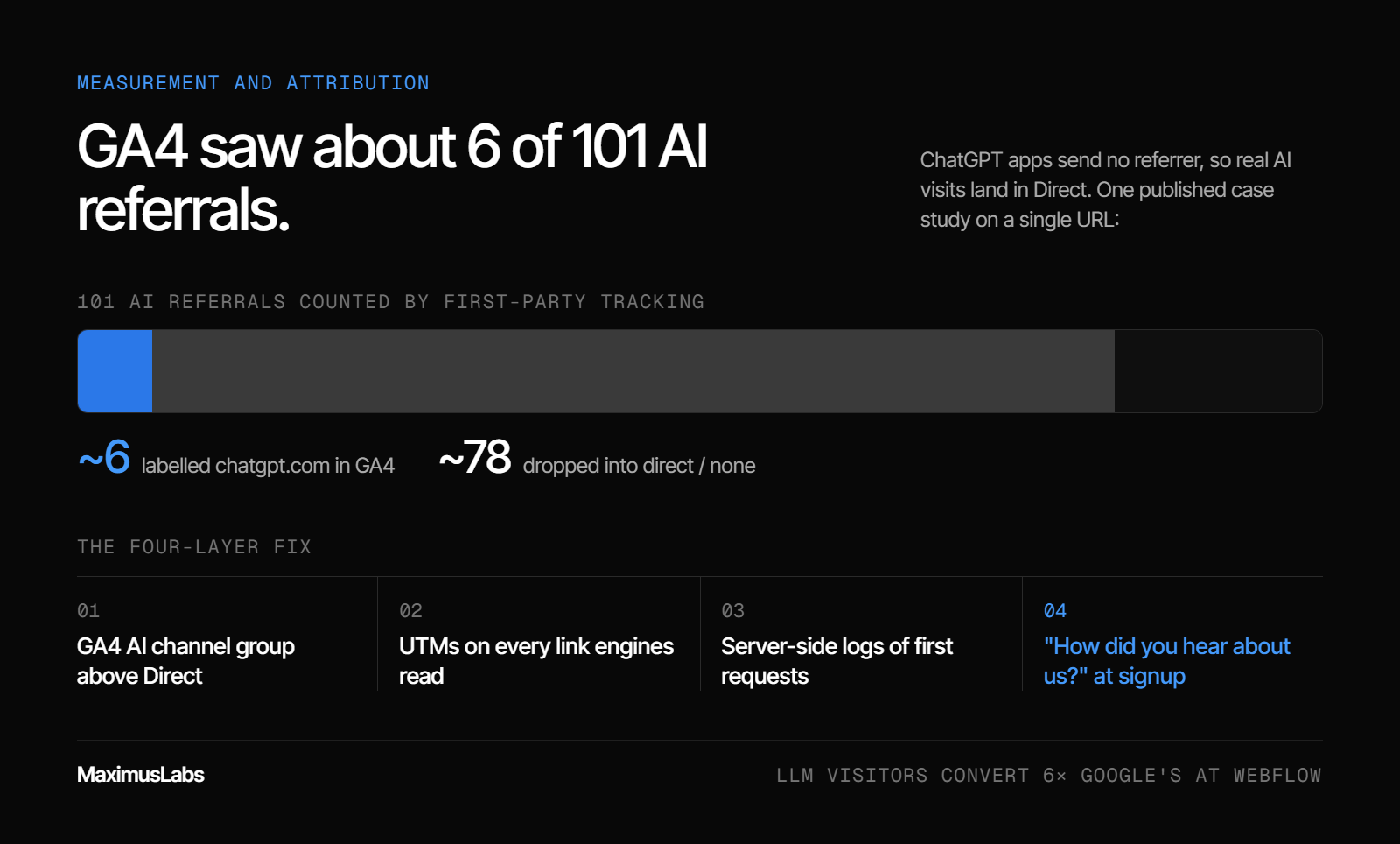
That is dark AI referral traffic. One published case study found first-party tracking counting 101 AI referrals on a single URL while GA4 labelled only about 6 sessions as chatgpt.com and dropped roughly 78 into direct and none. The visits were real. The labels were missing. We unpack this in AEO attribution challenges.
⚠️ Why the signal disappears
ChatGPT strips the referrer on most app-based clicks and applies no-referrer policies on others. GA4 can only attribute what the browser reports, so it assigns those sessions to Direct by default.
This is improving slowly. Google added UTM parameters to outgoing Gemini links on 1 October 2026, and reported referrer pass-through from the Gemini mobile app runs around 9%. ChatGPT appends UTMs only on web-grounded answers, not on answers drawn from training data.
✅ The four-layer stack that survives it
Build a GA4 custom channel group above Direct, matching chatgpt, openai, perplexity, gemini, copilot, and claude in session source.
Add UTM tags to every link you place in content engines read, including docs and syndicated posts.
Log first requests server-side, since app clicks with no referrer only appear in server logs.
Add a post-conversion "How did you hear about us?" field at signup, which is the only layer that captures a buyer who researched in ChatGPT and typed your URL.
Those four layers are the minimum viable version of AEO measurement and metrics.
💰 Keep the channel honestly sized
Resist the urge to over-rotate. One benchmark of 95 websites from September 2025 to August 2026 found organic still delivering 39x more traffic than AI assistants, and 97.5% of combined visits. AI referrals rose from 2.29% to 3.04% of organic sessions in May 2026.
So the honest framing is quality over volume. MaximusLabs AI tracks both, and holds budget reallocation until a client's own measured AI conversion multiple clears 1.0 for two consecutive months. Our revenue-focused R-GEO framework sets those thresholds.
💸 On buying a tracker
Most of the sixty-plus AEO tools do the same job: fire prompts on a schedule, record whether you appeared, chart it. Ethan Smith's team built their own for a few cents per question, and his verdict is direct: knowing what you rank does not cause an outcome.
"However, advanced prompt tracking and deeper analysis are costly, beginning at $775 for all AI platforms as an add-on, not part of the base price."
— r/aeo, r/aeo Reddit Thread, February 2026
"On the AEO/GEO front, newer solutions like Profound and Goodie are gaining traction because they track how your brand appears in AI responses, not merely its rankings."
— r/Agent_SEO, r/Agent_SEO Reddit Thread, March 2026
Buy the cheapest credible option, or build it. Spend the difference on citations. Our AEO tools comparison lays out what each tier actually does.
MaximusLabs AI installs self-reported attribution on day one of an engagement. Without it, a client's fastest-growing channel shows up as Direct and gets defunded by the same finance review it should be winning.
Q11. What does this playbook look like in your first 90 days and first 12 months?
Weeks 1 to 2: baseline a fixed prompt set and clear the three technical gates. Weeks 3 to 6: ship five bottom-funnel pages and open the documentation hub. Weeks 7 to 10: fix review profiles and run URL-level mention outreach. Weeks 11 to 13: attribution goes live and share of voice is re-measured. MaximusLabs AI runs this sequence in that order, and the first deliverable is usually a smaller plan than the client expected. Stage matters, since early-stage SaaS should lead with citations rather than rankings.
⏰ The 90-day phase table
| Weeks | Owner | Deliverable | Success signal |
| 1 to 2 | Growth lead plus engineering | Prompt-set baseline, SSR check, 404 cleanup, sameAs loop | Pages render without JavaScript; baseline share of voice recorded |
| 3 to 6 | Content plus product marketing | Three competitor comparison pages, one integration page, one segment page, docs hub opened | Pages indexed and appearing in at least one engine's citations |
| 7 to 10 | Demand gen plus customer success | Review velocity live, outreach on top five cited URLs | New reviews landing weekly; one new cited URL earned |
| 11 to 13 | Analytics owner | AI channel group, UTMs, server logs, self-reported attribution | First AI-sourced pipeline recorded in the CRM |
⭐ The stage gate most teams get wrong
Ethan Smith tells startups asking for SEO help not to do it at all, because they lack the domain authority to rank commercially within the year. His point about AEO is the opposite: a citation can land tomorrow and start showing up immediately.
| Stage | Lead with | First three assets |
| Pre-Series A | Earned citations and reviews | G2 and Capterra profiles, two roundup inclusions, Reddit presence |
| Series A to B | Product and comparison queries | Comparison pages, integration pages, docs hub |
| Series C and later | The problem space | Use-case hubs, original data, category research |
One tactic works at every stage. Answer the questions buyers ask about your competitors' products that those competitors have not answered themselves. Early-stage teams can start from GEO for SaaS startups.
📊 The 12-month arc, honestly stated
Technical foundation lands in weeks 1 to 8. First citation movement usually appears in months 2 to 4, because earned mentions move faster than rankings. Google rankings for commercial terms compound from months 6 to 12.
Three failure modes repeat. Publishing before the technical gates clear. Chasing top-funnel volume because it is easier to produce. Reporting sessions when the board asked about pipeline. Each one shows up in the GEO mistakes to avoid.
💬 What practitioners report about the wait
"They keep making promises and saying that 'SEO takes time' but I see absolutely no results."
— r/SEO, r/SEO Reddit Thread, May 2024
"When I inquire about specific companies using these AI models, the responses often draw heavily from review content."
— r/SaaS, r/SaaS Reddit Thread, August 2026
Both quotes describe the same gap. Nothing in the first six months was measurable, so nothing could be defended. The 90-day sequence above exists to produce a readable signal by week 13.
✅ What I am watching next
Agentic search and ads inside AI chat are both close. My hypothesis is that ads arrive in chat within one to two years, which compresses the window for earning trust organically, a shift we track in agentic AI and the future of search.
MaximusLabs AI runs Answer Engine Optimization with SEO underneath, strategy and execution in one team, and measures every engagement on pipeline rather than mentions. On the Oliv AI engagement, that produced a 64% AI citation rate in 6 months, against roughly 30% for billion-dollar incumbents.
Frequently asked questions
What is SaaS SEO, and how is it different from regular SEO in 2026?
SaaS SEO is the practice of making a software product discoverable and citable, across Google and AI answer engines, for the problems its buyers search. It is scored on trials, demos, and ARR rather than sessions. Three differences separate it from general SEO: • Revenue, not reach. A thirty-searches-a-month comparison query often beats a 12,000-volume glossary term that converts at zero. • Low purchase frequency. B2B buyers evaluate software rarely, so the goal is intercepting a small, high-value stream of in-market demand. • Two surfaces, not one. You now need rankings on Google and citations inside ChatGPT, Perplexity, Gemini, and AI Overviews. MaximusLabs AI opens each engagement with a prompt-set audit across those four engines instead of a technical crawl, then reports citation share beside influenced pipeline. We do it that way because the assumption that broke was rank equalling revenue, which is the shift covered in our GEO versus traditional SEO comparison. Traditional SEO is not dead here. It is the foundation layer, and it is no longer sufficient on its own.
How long does SaaS SEO take before it produces pipeline?
Plan for a readable signal in weeks and real pipeline across quarters. The honest timeline splits into four bands. • Weeks 1 to 8. Technical foundation clears: server-rendered pages, dead URLs retired, entity loop closed. • Months 2 to 4. First citation movement appears, because earned mentions land faster than rankings. • Months 5 to 7. First meaningful organic signups from decision-stage pages. • Months 6 to 12. Google rankings for commercial terms begin compounding. The usual reason teams see nothing at month twelve is sequencing, not patience. Publishing before the technical gates clear means twelve months of content no engine can read. Chasing top-funnel volume because it is faster to produce has the same effect on pipeline. MaximusLabs AI runs a 90-day sequence built to produce evidence by week 13: prompt-set baseline, three technical gates, five bottom-funnel pages, documentation hub, then mention acquisition and attribution. The full phase-by-phase breakdown sits in our AEO strategy planning guide. Early-stage companies should expect earned citations to move first, since a mention can land next week while domain authority takes a year.
Which SaaS pages actually drive organic revenue, and which ones are waste?
Roughly 20 to 40 pages carry a $10M organic ARR engine. Graphite's work across Webflow, Upwork, Notion, and Rippling found that 19 of 20 landing pages drive little or no traffic, while 1 in 20 drives about 85% of it. The 5% that work are consistently: • Alternatives and versus pages that intercept active shortlists. • Integration pages that clear the "does it work with our stack" blocker. • Use-case and segment pages matched to a role or company size. • Documentation and how-to pages that answer task questions. • Pricing and ROI pages that survive procurement review. Glossary and definition pages are absent from that list deliberately. Answer engines already cover "what is" queries natively, and those pages convert at close to zero. MaximusLabs AI scopes content by cluster ARR contribution rather than monthly article volume, which is why a first plan usually shrinks a publishing calendar before growing it. The sequencing logic lives in our B2B SaaS AEO strategies guide. Start with your top three competitor comparison pages, ranked by how often sales hears those names.
Can SaaS SEO create demand, or does it only capture existing demand?
Only capture. Eli Schwartz states it plainly in Product-Led SEO: SEO is an optimization channel, not a demand-creation channel. In a defined B2B niche, optimization delivers one step-change in visibility, then grows at the rate of category and brand demand. That has a hard consequence for forecasting. If nobody searches for the problem you solve, publishing does not invent that search volume. Demand creation belongs to brand, product, and outbound. Run two checks before approving another quarter of content spend: • Does anyone search the problem, in volume, using words that are not your product name? Check non-branded impressions in Search Console and run twenty buyer prompts through ChatGPT and Perplexity. • If a buyer already knows they need this category, do you appear in the top five names any engine returns? A yes to the first and a no to the second is the ideal condition for this playbook, since the gap is capture and capture is fixable this quarter. Two noes means budget belongs in demand creation first. Category creators should still fund visibility early, because trust compounds, which is the argument in our trust-first content playbook.
How do you get a SaaS product cited by ChatGPT, Perplexity, and Google AI Overviews?
Citations come from two pillars working together, and most programs only run the first. Owned. Make each page extractable. Princeton's KDD 2024 GEO study found that adding statistics, credible source citations, and quotations lifted generative visibility by up to 40%, while keyword stuffing produced no gain. Put a 30 to 60 word factual answer directly under a question-phrased heading, inside the first third of the page, since answer blocks in the top 30% of body text carry a 44.2% share of citations. Earned. For head category queries, third-party pages decide the outcome. Brand web mentions correlate with AI Overview visibility at r=0.664, roughly 3x stronger than backlinks at r=0.218, and one study of 233 software recommendations found the vendor's own site cited only 11.6% of the time. Work URLs rather than publications. Run your twenty category prompts three times each, log every cited URL, then pitch inclusion or correction on the five that appear most often. MaximusLabs AI runs Earned AEO alongside Owned AEO, mapping the cited URLs per prompt and working those pages directly, using the tactics in our AI citation acquisition guide.
Why is technical documentation cited more often than a SaaS blog?
Because retrieval works on chunks, and a documentation page is already a chunk. One question, one heading, one answer, no narrative wind-up. The gap is large. B2B technical documentation shows a median citation rate of 34% to 41% and takes 29% of all citations, against 15% to 18% for blog and editorial content. A blog post buries the answer under 300 words of context-setting, so the engine guesses which paragraph answers the prompt and often picks a competitor's cleaner page. A docs hub sequenced in this order usually earns citations fastest: • Integration guides for the five systems your buyers already run. • API reference with working request and response examples. • Onboarding tutorials written as tasks, not features. • Troubleshooting pages that name the actual error strings. • Security and compliance pages for procurement review. MaximusLabs AI sequences a documentation hub before a blog calendar on most SaaS engagements, and we carry the founder's positioning into those pages, because engines cite the page while buyers read the framing. The formatting rules sit in our content formatting guide for AI search.
How do you measure organic ARR when GA4 reports AI traffic as Direct?
Assume AI traffic is undercounted, then instrument around it. ChatGPT strips the referrer on most app-based clicks, so GA4 assigns those sessions to Direct. Search Console's generative report shows impressions without clicks, CTR, or the prompt. Four layers close most of the gap: • A GA4 custom channel group above Direct, matching chatgpt, openai, perplexity, gemini, copilot, and claude in session source. • UTM tags on every link you place in content engines read, including docs and syndicated posts. • Server-side logging of first requests, since no-referrer app clicks only appear there. • A post-conversion "How did you hear about us?" field, the only layer that catches a buyer who researched in ChatGPT and then typed your URL. Size the channel honestly. Webflow measured a 6x conversion-rate difference for LLM-referred visitors and attributes 8% of signups to LLM discovery, while one 95-site benchmark still found organic delivering 39x more traffic than AI assistants. MaximusLabs AI reports share of voice across a fixed prompt set beside influenced pipeline in the CRM, and installs self-reported attribution on day one, following our AEO measurement and metrics framework.