 Krishna Kaanth M
- Link building now has two jobs: rank commercial pages on Google, and get named inside the retrieval set that ChatGPT, Perplexity, Gemini, and AI Overviews summarize.
- Across 75,000 brands, branded web mentions correlate with AI visibility at r=0.664 versus r=0.218 for backlink count, and YouTube presence leads at r=0.737.
- Point links at comparison, alternatives, integration, and pricing pages first, then route five to ten internal links into each before any outreach budget clears.
- Review profiles act as a gate: 100% of ChatGPT-recommended tools had Capterra profiles, 99% had G2 listings, and category grids carry a 2.1x citation lift.
- Product-led assets beat cold outreach. Eli Schwartz's best campaign cost $500, and Drops earned links purely as a byproduct of a product people liked.
- Measure three layers: placement health weekly, citation share monthly, and pipeline quarterly. Referring domains and Domain Rating are leading indicators at best.
Q1. What is SaaS link building now that AI engines decide the shortlist?
SaaS link building is the practice of earning relevant, trafficked links and unlinked brand mentions that route authority to commercial pages and place your brand inside the source set AI engines summarize. Google still ranks on links. ChatGPT, Perplexity, and AI Overviews build answers from retrieved URLs, so mention frequency across those URLs decides whether you enter the buying conversation at all.
🔗 The report that stopped explaining the pipeline
For a decade, the off-page job was simple. Buy or earn links, watch Domain Rating climb, and watch rankings follow. Most SaaS teams still run that loop. The monthly deck shows referring domains up and a few keywords moved into the top five.
Then the board asks where the demos are. The link count has no answer. Rankings held, and revenue did not move, which is the exact gap this playbook for SaaS startups exists to close.
🧠 Retrieval first, summary second
Here is what changed mechanically. AI search engines run retrieval before generation. The system pulls a set of search results, then the model writes an answer from that set.
Ethan Smith of Graphite put the difference plainly. In classic SEO, a link from the New York Times homepage is a trophy. In answer engines, what matters is which specific URLs land inside the result set being summarized. Google's own documentation says AI Overviews surface claims backed by top web results and link out to them. So the unit of competition shifted from your domain's strength to your presence across the pages engines retrieve.
📉 Position one is not what it was
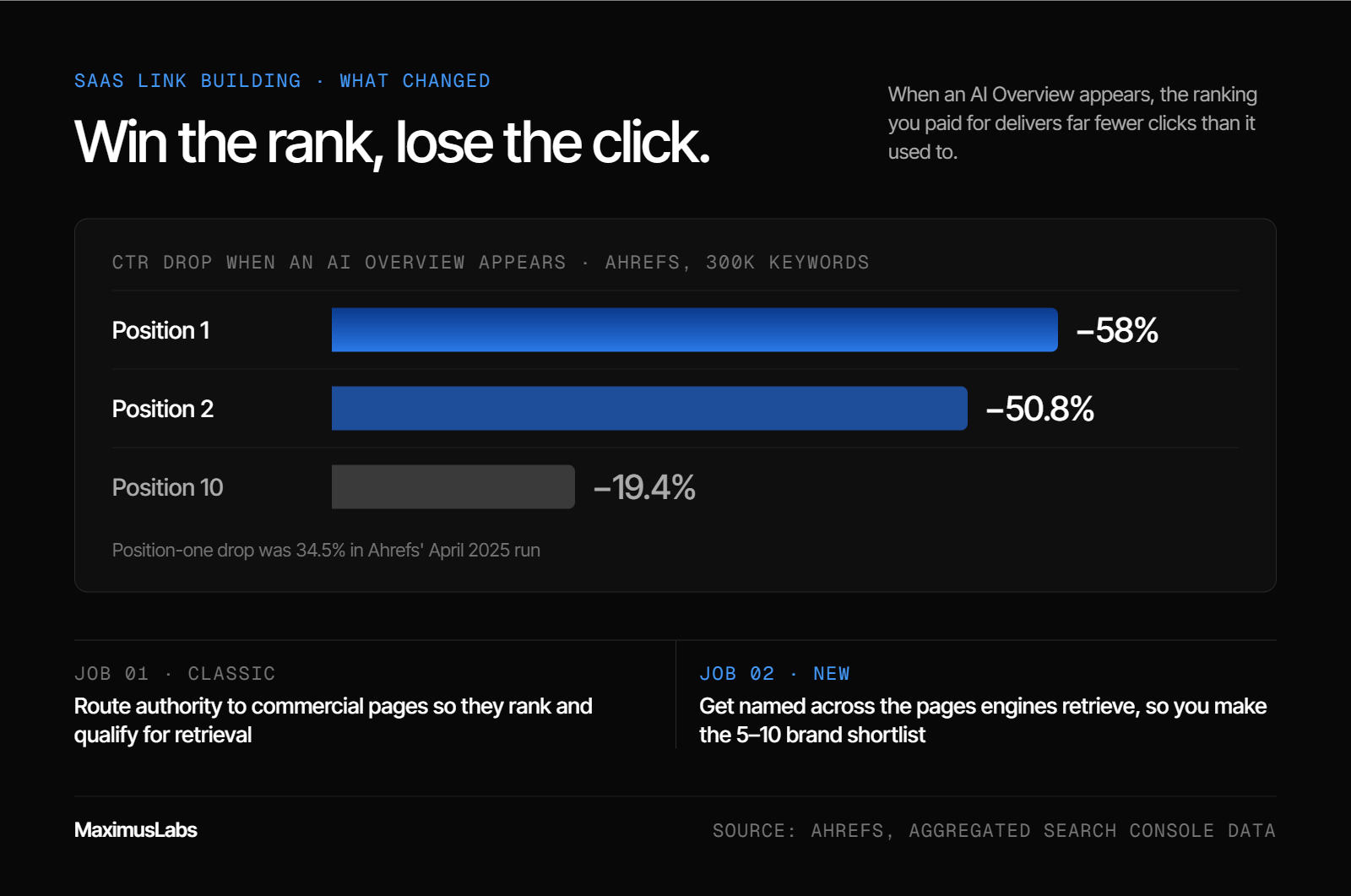
The cost of ignoring this is now measurable. Ahrefs analyzed 300,000 keywords using aggregated Search Console data. When an AI Overview appears, click-through rate for the top-ranking page falls 58%, up from 34.5% in their April 2025 run.
Read that twice if you own a link budget. You can win the ranking you paid for and lose most of the traffic it used to deliver. Position two fell 50.8%, and position ten fell 19.4%. The old scoreboard still moves, but it stopped paying out. That gap between ranking and revenue is what zero-click search economics now dictate.
✅ Two jobs now, not one
So link building splits into two jobs. Job one is classic: route authority to commercial pages so they qualify for retrieval and still rank. Job two is newer: get named and cited often enough across retrieved sources that engines include you when they compress the category into five or ten brands.
I keep coming back to a line I use with founders. When a buyer asks an AI engine for the best tools in your space, only a handful make the list, and that list is the consideration set. There is no page two to grind toward. You are in the answer, or you are not in the conversation.
The practical reframe is uncomfortable but freeing. Stop asking how many links you bought. Start asking which sources your buyers' engines trust, and whether your name appears inside them.
Q2. Why do unlinked brand mentions beat backlinks 3x for AI visibility?
Across 75,000 brands, branded web mentions, linked and unlinked, correlate with AI Overview visibility at Spearman r=0.664, roughly three times stronger than backlink count at r=0.218. YouTube presence correlates higher still at r=0.737, and top-quartile mention brands average 169 AI Overview mentions versus 14 in the next quartile. Credible conversation volume predicts citation better than link count.
📊 What the correlation table actually says
Ahrefs ran the largest public study on this question, covering 75,000 brands across AI Overviews, AI Mode, and ChatGPT. The ranking of off-site factors is the finding, not any single number.
| Signal | Correlation with AI visibility |
| YouTube channel presence | r=0.737 |
| Branded web mentions (linked and unlinked) | r=0.664 to 0.709 |
| Domain Rating | r=0.266 |
| Backlink count | r=0.218 |
Their own summary is worth quoting straight. Getting mentioned across the web, in press, podcasts, review sites, and expert roundups, matters more than perfecting your own pages. That is a fundamental shift from classic link building.
🧩 Why a mention with no link still counts
A link is a vote cast by one webmaster. A mention is evidence that the web is discussing you, and retrieval systems feed on text, not just on link graphs.
When an engine assembles an answer, it pulls passages. A paragraph on a review site, a podcast transcript, or a roundup that names you can enter that answer with no hyperlink attached. Semrush found ChatGPT cites roughly 15 sources per response, leaning on community and reference sites, while Gemini cites about three. More cited sources naming you means more paths into the answer.
⚠️ The caveat I will not skip
Correlation is not causation, and I would be overreading the data if I told you links stopped mattering. Big brands get mentioned more and get linked more, so some of this is just brand size showing up twice.
Links still do work engines depend on. They help pages qualify for the candidate pools retrieval draws from, and they still drive classic rankings. The honest conclusion is narrower than the headline: mentions predict AI citation better, but links are how commercial pages earn the right to be retrieved at all. Run both.
✅ Add a second track to the same budget
So the reporting change comes first. MaximusLabs AI tracks brand frequency and citation rate against competitors across every major engine as a standard deliverable, not an add-on, because a referring-domain chart cannot show whether a brand entered the answer. We re-run those prompt sets daily and regression-test the results.
Three moves follow for your Monday. Add an unlinked-mention count to the monthly report. Reserve roughly a third of outreach capacity for placements you will never get a link from, like podcasts, roundups, and review sites. Then build a reclamation habit, because unlinked mentions that already exist are the cheapest links you will ever convert.
MaximusLabs AI runs Earned Answer Engine Optimization as one of two pillars, where reviews, Reddit threads, press, and listicles build the trust engines sample from. Owned content is the other pillar. Most agencies only operate the second one.
Q3. Which pages deserve your links, and how do you find the gaps?
Point links at the pages that close revenue: comparison, alternatives, integration, and pricing pages, then the BOFU articles feeding them. Find targets with a link intersect analysis. Export competitors' referring domains, subtract yours, and sort by pages that already rank in positions 4 to 15. Blog-only link building inflates Domain Rating while your money pages stay unlinked and unranked.
🎯 The target hierarchy, in order
BOFU means bottom of funnel, the pages a buyer reads when they are already choosing. These pages deserve first claim on every link you earn.
The order I work in is consistent:
Comparison pages ("you vs named competitor")
Alternatives pages ("alternatives to incumbent")
Integration pages, especially for Salesforce, HubSpot, and Slack
Pricing and plan pages
BOFU articles and category listicles that feed those four
Free tools and calculators that earn links passively
Top-of-funnel definition posts sit last, and usually nowhere. AI engines already answer "what is X" directly, so those pages now absorb budget and return impressions. The B2B SaaS AEO approach inverts that order on purpose.
🔍 Why competitors' link reports mislead you
Most link audits stop at domain level. You see a rival with 4,000 referring domains, conclude you are outgunned, and start buying.
Go one level deeper and the picture changes. Sort their backlinks by landing page. Usually a huge share points at two viral blog posts and the homepage, while their comparison pages carry a handful of links each. That handful is the real target, because those are the pages competing for the same buyer you want. A proper AI search competitor analysis starts at page level, never at domain level.
🛠️ The seven-step sequence
This is the order that holds up under a real quarter:
Pick five to ten BOFU target pages tied to pipeline.
Run a link intersect across three close competitors.
Filter to domains linking to two or more rivals, never you.
Check each prospect for real organic traffic and topical fit.
Build one linkable asset the target page can borrow authority from.
Route five to ten internal links into each money page first.
Track placements to indexed, then to signups, then to revenue.
⏰ Do step six before you spend
Step six is free and most teams skip it. Crawl the site, find commercial pages with almost no internal links pointing in, and fix that before any outreach money clears. You will often see movement without a single new external link. A technical SEO and website audit surfaces those gaps in a single crawl.
MaximusLabs AI starts every engagement on BOFU pages with high conversion intent, with a technical sprint in week one and the first article live as early as day four. We sequence it that way because authority routed into a page that cannot convert is wasted authority. One prioritized target list per quarter, revisited, beats a rolling wishlist of 60 pages nobody owns.
Q4. How does a product-led link attraction flywheel replace cold outreach?
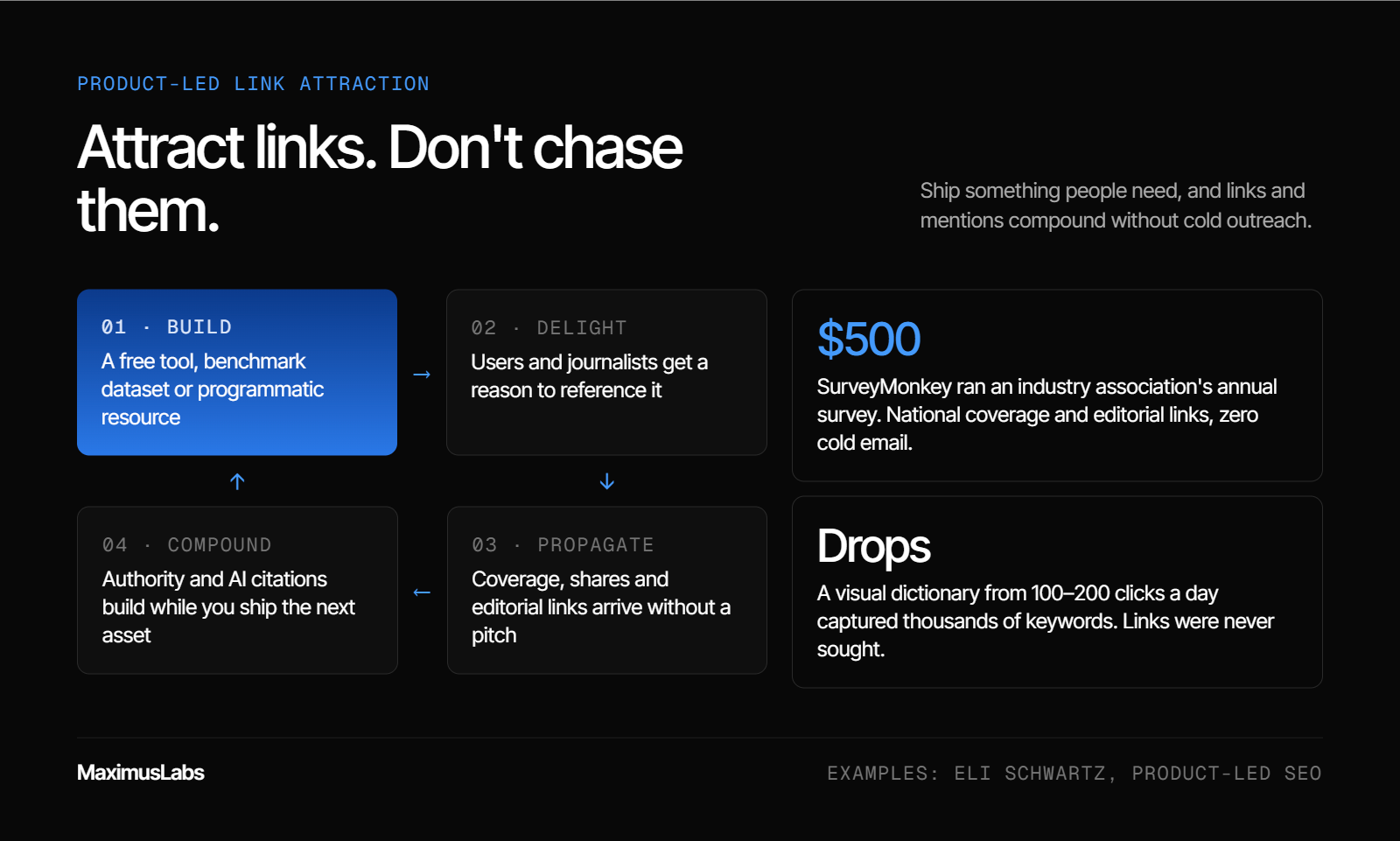
A product-led flywheel inverts outreach. Ship a free tool, dataset, or programmatic resource people need, let users and media cite it, and links plus mentions compound without prospecting. Eli Schwartz's most successful link campaign cost $500, a survey partnership with an industry association that generated national coverage and editorial links. Attract links, do not acquire them.
📧 The outreach treadmill nobody defends
Broken-link emails and guest-post pitches convert in the single digits. Every marketer in your category is emailing the same 200 editors with the same template.
The hidden cost is worse than the hit rate. You burn goodwill with publishers you may need later, and the links you do win sit on sites that exist to sell links. Those are exactly the placements engines discount.
🔄 The four stages of the flywheel
Eli Schwartz, who ran SEO at SurveyMonkey, states the principle without hedging in Product-Led SEO: brands do not build links, they get links. The mechanics behind that line are four stages.
Build. Ship something genuinely useful: a free tool, a benchmark dataset, or a programmatic resource.
Delight. Users and journalists experience it and have a reason to reference it.
Propagate. Coverage, shares, and editorial links arrive without a pitch.
Compound. Authority and AI citations accumulate while you build the next asset.
🚀 What Drops actually did
Drops, a language-learning app, launched a visual dictionary in June 2019. Pre-launch, the site drew 100 to 200 clicks a day. There was no keyword research ritual and no backlink outreach plan at all.
The programmatic product pages captured thousands of keywords, and links arrived as a byproduct of a product people liked. Schwartz is direct about it. The backlinks were never proactively sought. That is programmatic SEO doing the acquisition work a retainer usually bills for.
💰 The $500 campaign that beat a retainer
The second example is my favorite because of the price tag. In 2015, leading APAC marketing at SurveyMonkey, Schwartz partnered with the Restroom Association of Singapore to run their annual survey.
Cost: $500. Output: national news coverage, viral discussion, and high-authority editorial links, with zero cold email. The replicable part is the structure, not the topic. Partner with an association that has credibility but no data team, aggregate anonymized product data or survey responses, and publish the benchmark nobody else owns. Budget $500 to $1,000 and plan for one per quarter.
✅ Pick one asset, not five
Here is where I will hedge honestly. Flywheels are slow, and a dataset that lands flat teaches you very little except that the topic was wrong. Expect the first one to underperform.
MaximusLabs AI flags claims it can validate internally as experiment candidates during research, which is how bridge-asset ideas get chosen rather than guessed. We would rather test a benchmark against real client questions than ship a calculator nobody asked for. Commit to one asset this quarter, instrument it, and give it two quarters before you judge it. If you want that sequenced against your own category, talk to our team.
Q5. Which off-page sources do ChatGPT, Perplexity, and AI Overviews actually cite?
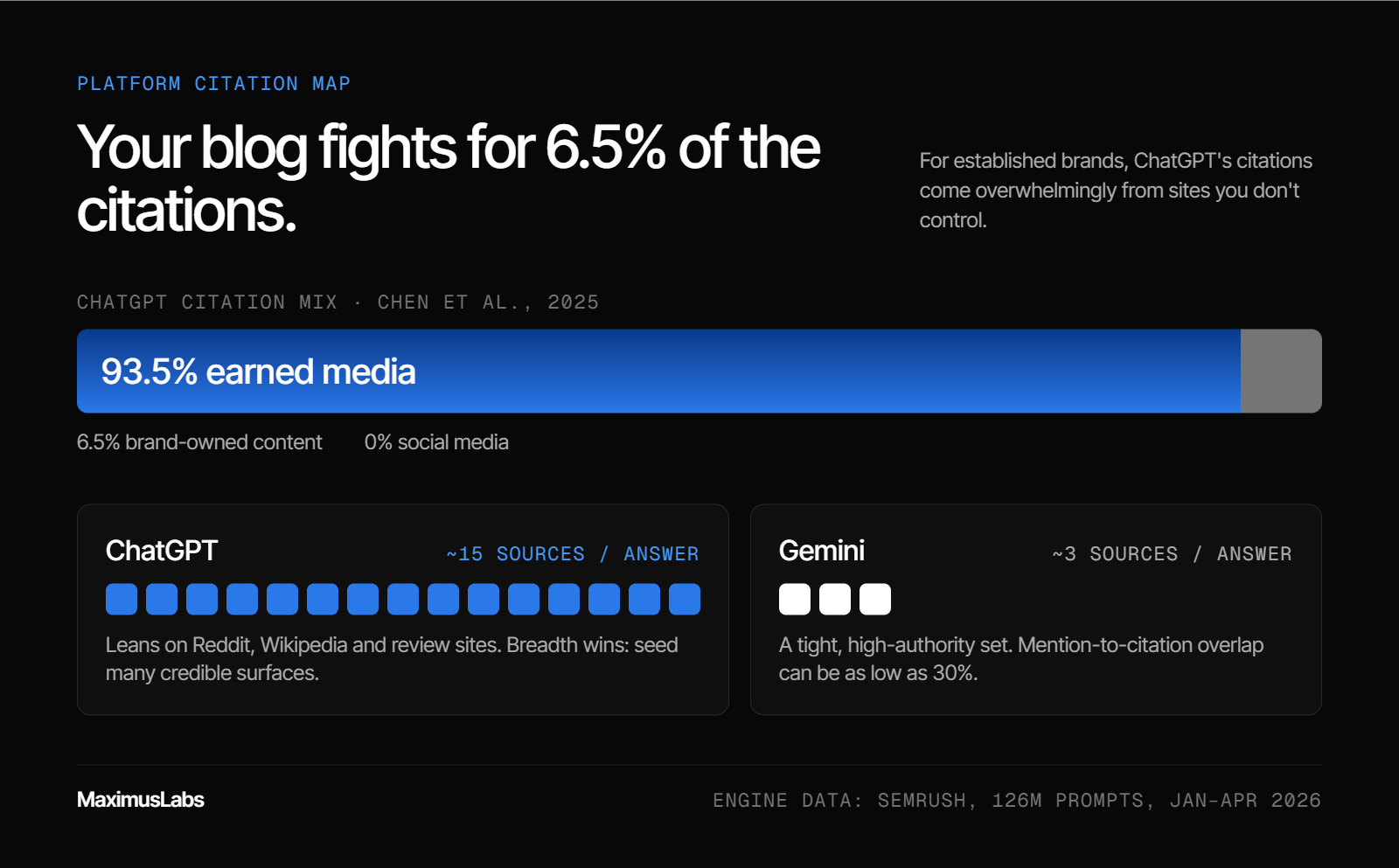
For established brands, 93.5% of ChatGPT citations come from earned third-party media, 6.5% from brand-owned content, and 0% from social. ChatGPT cites roughly 15 sources per answer and leans on Reddit and Wikipedia. Gemini cites about three, with mention-to-citation overlap as low as 30%. Owned pages win hyper-specific technical queries, while earned media wins head category queries.
🚪 The earned media gate
Chen and colleagues measured the citation mix for well-known brands in 2025. The split was 93.5% earned media, 6.5% brand-owned content, and 0% social media. ChatGPT turned out to be the most earned-media-heavy engine they tested.
That number reorders a lot of budgets. Your own blog is competing for a thin 6.5% slice of the citations that decide your category answer. The other 93.5% lives on sites you do not control, which is why citation-worthy content has to exist off your domain too.
📋 One query, very different source sets
Engines behave differently enough that one placement list cannot serve all of them. Semrush analyzed 126 million US AI search prompts between January and April 2026.
| Engine | Sources per answer | Leans on | Practical implication |
| ChatGPT | ~15 | Reddit, Wikipedia, review sites | Breadth wins, so seed many credible surfaces |
| Gemini | ~3 | Tight, high-authority set | Precision wins, so a weak profile is fatal |
| Perplexity | Mid-range | Recent, transparently sourced pages | Freshness and visible citations matter |
| AI Overviews | Varies | Top-ranking supporting results | Classic ranking still feeds inclusion |
Semrush also found that being mentioned does not mean being cited. On Gemini, overlap between mentioned brands and cited domains ran as low as 30%. Our cross-platform citation pattern research tracks that same divergence.
🧭 Owned versus earned, split by query type
The split is not ideological; it is query-shaped. Head category queries ("best CRM software") pull heavily from third-party aggregators and review sites, which account for roughly 85% of brand mentions in those answers.
Long-tail technical queries flip it. When a buyer asks whether your tool routes leads into Slack, your own documentation is the best source that exists. Nobody else has written it.
So your placement map should mirror that. Earned surfaces for category questions, owned pages for product-specific questions, and both for the mid-tail comparison queries where deals actually get decided. That mapping is the backbone of any query-type AEO strategy.
🎯 Build portfolios, not a link list
Here is the part the category keeps missing. Most link plans treat "AI search" as one destination, and that assumption quietly wastes money.
A placement that helps you on ChatGPT may never appear on Gemini. I learned this watching companies show up in ChatGPT answers while sitting nowhere in Google's top ten, which is what convinced me these are separate algorithms with separate trust signals, not one system with a shared scoreboard.
Three Monday actions follow:
Run your top ten buying questions through all four engines and log every cited domain.
Count how many of those domains mention you, linked or unlinked.
Build a per-engine target list from the gaps, then work the shortest list first.
The honest caveat: engines change their retrieval sources without notice, so this map needs re-running monthly, not annually. I treat any citation map older than a quarter as a historical document.
Q6. Do you still need G2 and Capterra profiles to get recommended?
Yes, review profiles now function as a gate. 100% of software tools ChatGPT recommended had Capterra profiles, and 99% had G2 listings. After G2's $110M acquisition of Capterra, Software Advice, and GetApp on February 5, 2026, the G2 family controls roughly 84% of B2B review-site citations in AI search. Category-grid presence delivers a 2.1x citation lift over general web content.
🔑 A gate, not a directory
Most SaaS teams still file review platforms under "directory submissions." That classification is now wrong.
The profile numbers read like a prerequisite, not a correlation. Every tool ChatGPT recommended in the sample had a Capterra profile, and 99% had a G2 listing. If you are missing one, you are missing from answers before any content quality question gets asked.
🧱 Why consolidation raised the stakes
On February 5, 2026, G2 acquired Capterra, Software Advice, and GetApp from Gartner for $110M. That moved most of the B2B review web under one roof.
The practical effect is concentration. Roughly 84% of B2B review-site citations in AI search now sit inside that family. One ecosystem, one set of profiles, and an outsized share of the sources engines sample when a buyer asks for the best tool in your category. This is exactly where B2B SaaS AEO strategy has to start.
✅ What "done" actually looks like
Having a profile is table stakes. Being citable is the job.
Claim and complete every profile in the G2 family, plus TrustRadius.
Target 10 or more recent reviews per platform, refreshed quarterly.
Earn placement on the category grid, since grid listings carry a 2.1x citation lift.
Keep your one-line description identical across every profile, your site, and your schema.
Fix category selection, because the wrong category removes you from the right answer.
That last point on consistency matters more than it sounds. Semrush observed that brands holding stable AI visibility scores had consistent descriptions across the sources engines read. Conflicting descriptions give an engine a reason to pick someone clearer, which is the whole argument for citation consistency.
⏰ The Monday checklist
Start with five review requests to customers who renewed in the last 90 days. Recency reads as evidence that the product still works.
Then audit description drift across your profiles, your homepage, and your Organization schema. I have seen this single fix change how engines summarize a company, though I would not claim it causes citations on its own.
MaximusLabs AI runs review-platform work inside its off-page service line, covering G2, Capterra, and Gartner profiles with a 10-plus review target per site. We treat it as Earned Answer Engine Optimization (AEO), the pillar where third-party sources build the trust engines sample, rather than as a listings chore.
⚠️ A note on what I will not fake
No verified review quotes for this category exist in our approved source files, so none appear here. Fabricating a G2 testimonial to decorate a section on review credibility would be a strange way to argue for trust signals.
Q7. How do podcasts, YouTube, and expert roundups turn into AI citations?
Podcast transcripts and YouTube presence are the most underpriced AI citation sources. YouTube channel presence correlates with AI search citations at r=0.737, the strongest single off-site signal measured. Transcripts are long-form, host-vouched, and increasingly indexed, so one strong appearance can drive more AI citations than dozens of guest posts. Target two to four appearances per quarter in your niche.
🎙️ Why a transcript travels further than a guest post
A guest post gives you one page, often on a site that publishes 40 of them a month. A podcast appearance gives you 45 minutes of indexed text where a credible host repeatedly says your name and endorses your thinking.
The correlation data supports the intuition. Across 75,000 brands, YouTube channel presence correlated with AI visibility at r=0.737, ahead of branded mentions at r=0.664 and far ahead of backlinks at r=0.218.
📅 The cadence that actually fits a quarter
Two to four appearances per quarter is the target I work to. More than that and prep quality drops, which defeats the purpose.
How to run it:
List 20 shows your buyers actually listen to, not the biggest shows in tech.
Check each one publishes transcripts or show notes, because unindexed audio does little.
Pitch a specific contrarian claim with data, never a company overview.
Ask the host for one named mention of your product category position in the notes.
Republish the transcript on your own site with attribution and a link back.
Step three is where most pitches die. Hosts do not need another founder available to "talk about growth." They need a guest who will argue something concrete and defend it. The same discipline drives our AI citation acquisition tactics.
📹 Closing the video gap
No page-one result for this keyword embeds video, which makes it the cheapest differentiation available. A five-minute walkthrough of your own process can sit on your target page and on YouTube at once.
Make it machine-readable:
Publish the full transcript on the page, not just a caption file.
Add VideoObject schema with name, description, upload date, and duration.
Use the buyer's phrasing in the title, since engines match language, not cleverness.
Keep one topic per video so the transcript stays extractable.
If video is new territory for your team, start with multimodal search optimization and work backward to a production cadence.
⭐ Roundups and analyst inclusion as the third leg
Expert roundups are the quiet third source. A "15 experts on X" post names you alongside recognized peers, which is exactly the associative pattern retrieval picks up.
The ask is small. Offer a 100-word answer with one number in it, delivered on deadline, and you will get invited back. I keep a running doc of such answers so turnaround takes ten minutes rather than a day.
My honest hedge: I cannot prove a single podcast caused a citation, because mentions and brand size move together. What I can say is that founders with no Domain Rating to trade on get into answers through voice and video long before they get there through links.
Q8. How far can internal linking move rankings before you buy a single link?
Further than most teams assume. At Shopify, placing 10 to 20 targeted internal links to specific high-intent money pages consistently moved rankings with no new external backlinks. Internal linking is the one authority lever you fully control. Crawl the site, find orphaned or under-linked commercial pages, and route five to ten contextual links to each from topically relevant posts.
🧮 The Shopify number worth copying
Kevin Indig, who led SEO at Shopify, has described the pattern plainly. Backlinks cost money or campaigns, while internal linking is a lever you can perfectly control yourself, and he rates it as close to or more important than external links.
The specific finding is the useful part. Routing 10 to 20 targeted internal links into a high-intent page moved rankings on an already-authoritative domain, with no new external links bought.
🔍 The audit, in five steps
This is a half-day job, not a quarter-long project.
Crawl the full site with Screaming Frog or a similar crawler.
Export inlink counts for every indexed URL.
Flag commercial pages receiving fewer than five internal links.
Find topically relevant posts that already rank and have traffic.
Add five to ten contextual links per money page, using descriptive anchors.
Ethan Smith uses a similar benchmark, treating five to ten internal links per indexed page as the operating target during site-wide audits. A full technical SEO guide walks the same crawl sequence end to end.
⚙️ Integrators versus aggregators
How you execute depends on which kind of site you run. The distinction saves a lot of wasted effort.
| Site type | Example shape | Linking approach |
| Integrator | Single product, curated content library | Manual contextual links, placed by a human editor |
| Aggregator | Marketplace, directory, large inventory | Dynamic link modules driven by templates and data |
Most Series A to B SaaS companies are integrators and keep trying to automate. A 400-page site does not need a link module. It needs someone to read 30 posts and place links on purpose. Sites that genuinely need the module should look at programmatic SEO instead.
MaximusLabs AI builds content as hub-and-spoke architecture, where every hub section links to a spoke with its URL assigned before publication. We do it that way so internal links exist on day one, rather than getting retrofitted after a crawl flags the gap. The structure mirrors our GEO topic cluster model.
💰 Do this before the money clears
Here is the sequencing argument. External links are expensive, slow, and partly outside your control. Internal links are free, fast, and entirely yours.
So run the audit before any outreach invoice gets approved. You will often see movement on pages sitting in positions four to fifteen, which is exactly where added authority converts to ranking gains.
I will hedge one claim. Internal linking will not rescue a page with no external authority behind the domain at all. It redistributes what you have, and on most SaaS sites, more is sitting idle than teams realize.
Q9. Which placements are safe to buy, and which get you filtered out of AI search?
Vet placements on topical relevance, real organic traffic, and editorial standards, not Domain Rating, which is gameable. Keep velocity steady and anchor text mostly branded or partial-match. Paid link networks and link-farm guest posts carry asymmetric risk. HCU and core-update penalties hard-filter domains out of AI Overview citations even for their own brand queries, and ranking recovery does not restore AI inclusion.
💸 What still gets sold, and why DR fails you
Open any link vendor's inventory sheet and you will see one column doing all the work: Domain Rating. Sites are priced by it, sorted by it, and sold on it.
The problem is that DR is a third-party score built from links, so links can inflate it. A site can hold DR 70 with almost no real readers. I have reviewed inventory where half the "high DR" placements had under 500 monthly organic visits.
✅ The vetting checklist that replaces the DR filter
Four tests, run in order, and a placement must pass all four:
Topical relevance. Does the site already rank for terms your buyers search?
Real organic traffic. Does it get meaningful search traffic, not just referral spikes?
Editorial standards. Does it reject pitches, use real bylines, and publish without payment?
Link neighborhood. Who else does it link out to, and does that list look purchased?
Then control two variables on your side. Keep acquisition velocity steady rather than lumpy, and keep anchor text mostly branded or partial-match. Exact-match anchors at scale are the clearest possible pattern of paid placement, and they are a recurring entry in our list of GEO failures and lessons.
⚠️ The hard-filter mechanic
Here is the stakes shift that changes the math. Helpful Content Update and core-update penalties can filter a domain out of AI Overview citations, including for queries about the brand's own name.
The recovery path is asymmetric. Ranking recovery does not automatically restore AI inclusion, which makes this the highest-stakes trust signal in off-page work. Google's documentation is consistent with that behavior, since AI Overviews surface claims supported by top web results and link to those supporting pages.
My read is that the trust bar is now higher than Google's ever was. When an engine recommends you, it stakes its own credibility on the recommendation, so it has every reason to exclude anything that looks manipulated. That is the entire case for E-E-A-T built for AEO.
🔍 Auditing a link profile you inherited
Most Heads of Growth inherit a profile built by someone else. Audit it before you add to it.
Export all referring domains and sort by organic traffic, ascending.
Flag every domain with near-zero traffic and outbound links to unrelated niches.
Check anchor distribution and note any exact-match cluster.
Compare link acquisition dates against traffic drops in Search Console.
Disavow only clear networks, and leave the merely mediocre alone.
Step five matters. Over-disavowing is its own damage, and I have seen teams panic-disavow links that were doing real work. Pairing this with a full technical audit tells you whether the drop was ever link-related.
❌ The disqualification rule to hand your vendor
Give vendors one sentence, in writing: no placement on any site that publishes paid posts without disclosure, carries under 1,000 monthly organic visits, or links out to three or more unrelated industries.
That rule removes most of the inventory that creates penalty exposure. It will also raise your cost per link, which is the honest trade. Fewer, safer, relevant placements beat volume that could remove you from AI answers entirely.
Q10. What does a link-building retainer cost, and how long until it works?
Quality placements run roughly $150 to $850 each, so a $1,000 to $3,000 monthly floor buys two to five real-traffic links. Published 2026 retainers range from $1,500 to $12,000 and above. Expect meaningful ranking movement in three to six months, and compounding authority over six to twelve, with placement rate and new referring domains moving weekly as leading indicators.
💰 The retainer math, laid out
Most founders see a monthly number and never see what it buys. Here is the published market, as of 2026.
| Spend level | What it typically buys | Realistic scope |
| $1,000 to $3,000 per month | 2 to 5 placements | Early-stage, one target page cluster |
| $3,000 to $6,000 per month | 5 to 10 placements plus outreach ops | Mid-market, multiple clusters |
| $6,000 to $12,000+ per month | Digital PR, data campaigns, placements | Established brands chasing head terms |
Agency pricing published across 2026 SaaS link-building providers sits inside those bands, with per-link rates clustering between $150 and $850. Our own published pricing and the 2026 GEO budget benchmark give you two reference points for comparison.
📉 The ROI question nobody asks out loud
Ethan Smith of Graphite frames it as an allocation question rather than a link question. A site with a thousand or more referring domains can rank for a wide range of terms without doing any link building at all.
His description of the default option is blunt. You pay an agency $3,000 a month, and they go get you links from Entrepreneur.com or similar. That is not a scam. It is simply a weak trade when the same $3,000 could fund a benchmark dataset, review-platform work, or a quarter of podcast appearances.
So check your referring domain count first. Above roughly 1,000, more links are usually the least valuable thing you can buy.
⏰ What moves weekly, and what takes two quarters
Timelines get sold dishonestly, so here is the split I hold clients to.
Weekly: placements landed, prospects qualified, pages indexed.
Monthly: internal link coverage, new referring domains, unlinked mentions earned.
Quarter one to two: ranking movement on pages already sitting in positions four to fifteen.
Quarter two to four: compounding authority, broader keyword capture, AI citation share.
Three to six months to meaningful ranking movement is the honest range. Anyone promising six weeks is selling a placement report, not an outcome.
💸 Where the money goes instead
MaximusLabs AI makes the opposite trade. Rather than buy placements that may never enter an AI retrieval set, we fund what engines demonstrably pull from: BOFU articles built on primary sources, review-platform presence, podcast and video mentions, and internal link architecture. Production runs through a fixed three-stage pipeline of research, founder's-voice writing, and QA, which is why cost per piece stays low without dropping the research standard.
The proof I can point to publicly is Oliv AI, a B2B SaaS client that reached a 64% AI citation rate in six months, against roughly 30% for billion-dollar incumbents, with 30 to 40% of inbound now AI-sourced. No classic link retainer was involved.
⚖️ The reallocation rule of thumb
Split the budget three ways for a quarter. One third to safe, relevant placements. One third to earned mentions you will never get a link from. One third to one owned asset you can point links at later.
Then compare pipeline contribution, not link counts. My hypothesis, and I hold it loosely, is that the middle third will outperform the first on AI citation share while the first still carries classic rankings.
Q11. How do you make the pages you're building links to actually citable?
Links get you into the retrieval pool, and page construction decides whether you get quoted. Princeton's KDD 2024 GEO research found that adding explicit citations, quotations, and statistics lifted visibility in generative engine responses by up to 40%, with effects varying by domain. Google's own documentation confirms AI Overviews only surface claims supported by top web results, so every assertion must be verifiable on-page.
🎯 Retrieved is not the same as quoted
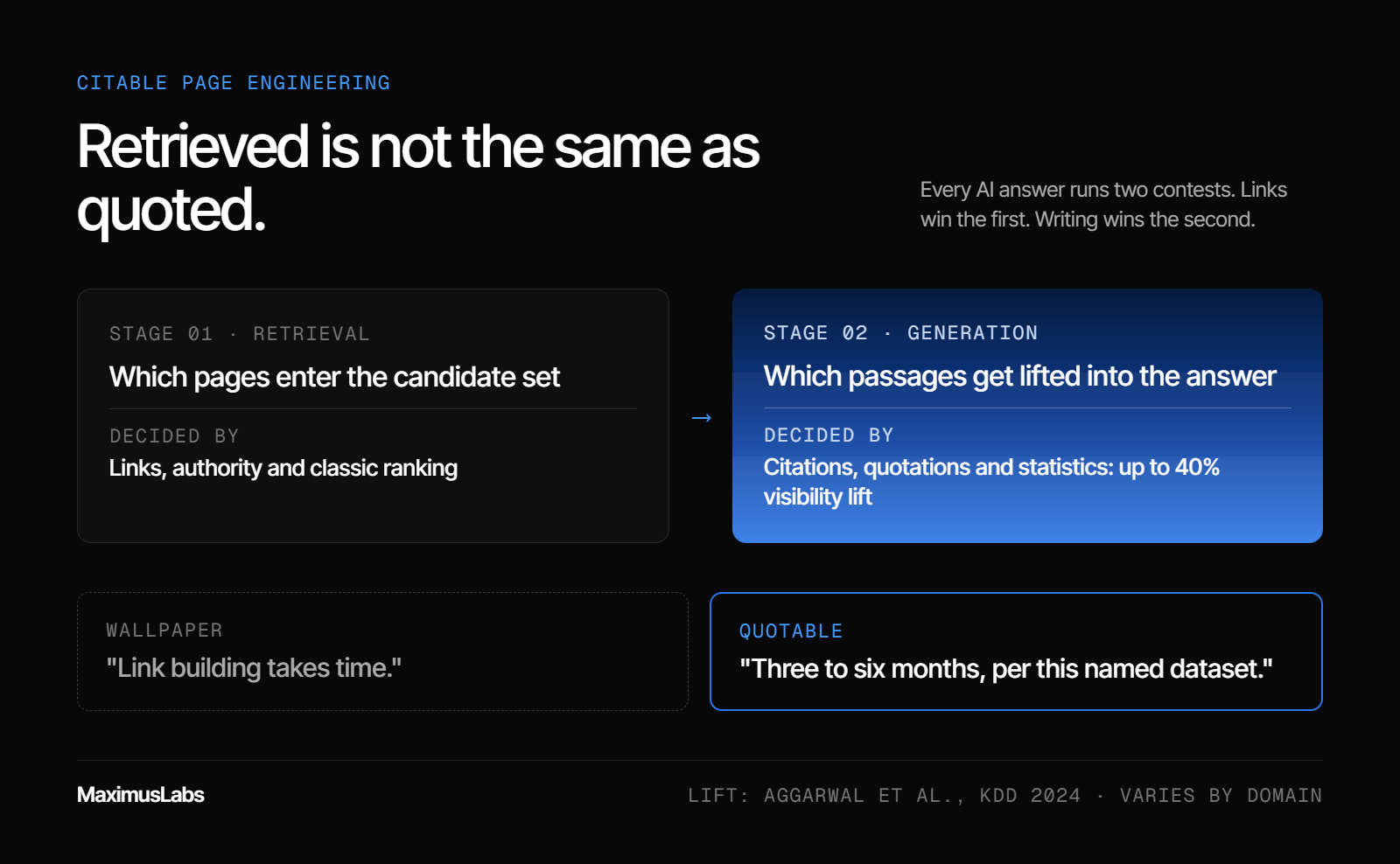
Two different competitions happen inside one AI answer. First, retrieval decides which pages enter the candidate set. Second, generation decides which passages get lifted into the answer text.
Links mostly influence the first competition. Writing influences the second. Teams that spend entirely on links are funding one half of a two-stage contest, which is why strong profiles sometimes produce zero citations. Fixing the second half is what AEO answer structure exists to solve.
📄 What the KDD 2024 research actually measured
Aggarwal and colleagues at Princeton tested specific content changes against generative engines using a benchmark they built called GEO-bench. The changes were not stylistic. They were structural.
Adding explicit citations, direct quotations, and statistics lifted visibility in generative responses by up to 40%. Effects varied by domain, which the authors flag directly, so the honest takeaway is a lever with a range, not a guaranteed multiplier.
Practically, that means a page asserting "link building takes time" loses to a page asserting "three to six months, per this named dataset." The second one is quotable. The first is wallpaper.
🔎 Google's verifiability requirement
Google's own explanation of AI Overviews says the feature surfaces information backed by top web results and links out to supporting pages. Read as an instruction, it is simple: an unsupported claim is not citable.
So every number on a money page needs a visible source. Every process claim needs a date, a tool name, or a figure. I audit pages by deleting every sentence that cannot be attributed, and what remains is usually the citable page. That same pass is step one in our GEO content optimization workflow.
🔗 Close the entity loop
The second half is identity. An engine has to know who it is quoting before it will name you.
Build the loop once:
Add sitewide Organization schema with your legal name, logo, and URL.
Create or claim a Wikidata item, typed as a business (Q4830453).
Populate it with official website, founding date, LinkedIn, Crunchbase, and G2 product ID.
Point sameAs from your schema to each of those profiles.
Confirm each profile links back, so the loop closes rather than dangling.
The traversal matters more than any single field. Website to Wikidata to LinkedIn to Crunchbase to G2 and back gives an engine five independent confirmations that you are one real company. We cover the full build in entity optimization and knowledge graphs.
✅ The two-page test
MaximusLabs AI embeds a 40 to 80 word extractable answer block plus at least one primary-source citation in every section it ships, because extraction is the unit of AI visibility. We treat a section that cannot survive being lifted alone as unfinished.
Run this yourself this week. Pick your two highest-intent BOFU pages, rewrite each section to open with a self-contained answer carrying one cited number, then re-prompt ChatGPT, Perplexity, and AI Mode with your buying questions. Log citations before and after. Two pages is enough to learn whether the lever works in your category.
Q12. How do you measure SaaS link building in pipeline, not referring domains?
Measure three layers: placement health (indexed, trafficked, relevant), citation share across ChatGPT, Perplexity, Gemini, and AI Overviews, and revenue, with AI referral traffic segmented in GA4 through to signups and MRR. Referring domains and Domain Rating are leading indicators at best. Report the metric a board understands, which is whether you are in the answer and what pipeline that produced.
📊 The three-layer scorecard
One chart cannot carry this channel. Three can.
| Layer | What you track | Cadence |
| Placement health | Indexed, real traffic, topical fit, anchor mix | Weekly |
| Citation share | Share of voice across engines, by buying question | Monthly |
| Revenue | AI referral sessions, signups, pipeline, MRR | Monthly and quarterly |
Layer one is hygiene. Layer two is the new ranking. Layer three is the only one a board acts on, which is why we document it as GEO revenue attribution.
🧮 Segmenting AI traffic in GA4
This takes an hour and most teams have not done it. Build a custom channel group in GA4 for AI referrals, matching source hostnames for ChatGPT, Perplexity, Gemini, Copilot, and Claude.
Then run conversion rate by channel. You will get your own multiple instead of borrowing someone else's. That matters, because the widely quoted 4.4x figure for AI traffic value comes from a Semrush study of marketing and SEO topics, and the derivation was never published.
I use the number as directional only. My own observation is that AI-referred buyers arrive pre-sold, because the engine already answered their questions, but I would not put a borrowed multiple in a board deck. The B2B SaaS buyer journey research is where we test that assumption against real funnels.
⚠️ The tracker trap
Over sixty AEO tracking tools now sell monthly subscriptions for what is essentially scheduled prompt-pinging. Ethan Smith's assessment is the one I keep returning to: knowing what you rank does not cause an outcome.
His prediction is that Ahrefs and Semrush will bundle these features for a fraction of standalone pricing. So buy tracking if it triggers action, and skip it if it only produces a prettier chart. A spreadsheet plus a weekly prompt set covers most Series A needs, and our AEO tools comparison shows which paid tiers actually change a decision.
🎯 What inclusion tied to pipeline looks like
MaximusLabs AI built its reporting around citation rate and share of voice, because referring-domain charts never survived a board meeting. We run prompt sets across ChatGPT, Claude, Perplexity, and Gemini daily, map which URLs get cited for a client's real buying questions, then build and earn against that list.
The public proof points are specific. Oliv AI hit a 64% citation rate in six months against roughly 30% for billion-dollar incumbents, and generated 27 qualified leads, $47K+ pipeline, and a 26% close rate in four months. Nidra Goods ranked first on Google, ChatGPT, and Perplexity simultaneously for "best sleep mask" from one strategy.
✅ The report to run next month
Drop Domain Rating from the first slide. Replace it with three lines: percentage of your top twenty buying questions where you appear in the answer, AI referral sessions and their conversion rate, and pipeline attributed to organic and AI sources. The AEO measurement metrics guide spells out each definition.
Being cited is the means. Pipeline is what the work is held to, and mentions on their own are a vanity metric wearing a new name. If your link report cannot connect to that last line, the channel will keep losing budget arguments it should win. If you want that scorecard built against your own category, book a strategy call.
Frequently asked questions
What is SaaS link building, and how is it different from generic link building?
SaaS link building is the practice of earning relevant, trafficked links and unlinked brand mentions that route authority to a software company's commercial pages, so those pages rank on Google and get cited by AI answer engines. Generic link building optimizes for volume and Domain Rating. SaaS link building optimizes for two things volume never touches: • Revenue pages, not blog pages. Comparison, alternatives, integration, and pricing pages are where deals close, so they get first claim on authority. • Retrieval presence, not just rankings. AI engines build answers from a retrieved set of URLs, so how often your brand appears across those URLs decides whether you enter the buying conversation. • Product-led acquisition. Free tools, original datasets, and programmatic resources attract links without prospecting. The difference matters because B2B SaaS buying happens inside a shortlist of five to ten brands. MaximusLabs AI runs Answer Engine Optimization with SEO underneath it for exactly this reason, and we measure engagements on pipeline rather than on link counts. A link that lifts a page nobody buys from is a cost, not an asset.
Do backlinks still matter for getting cited in ChatGPT, Perplexity, and Gemini?
Links still matter, but they are not the strongest signal. Across a study of 75,000 brands, branded web mentions, linked and unlinked, correlated with AI Overview visibility at Spearman r=0.664, while backlink count correlated at r=0.218. YouTube channel presence led every factor at r=0.737. Read practically, that means: • Mentions predict citation roughly three times more strongly than link volume. • Links still earn retrieval eligibility. They help commercial pages qualify for the candidate pools engines draw from, and they still drive classic Google rankings. • Correlation is not causation. Larger brands collect both mentions and links, so some of the gap is brand size appearing twice. The honest conclusion is to run both tracks on the same budget. Add an unlinked-mention count to your monthly report, then reserve roughly a third of outreach capacity for placements that will never carry a link, such as podcasts, expert roundups, and review sites. MaximusLabs AI tracks brand frequency and citation rate against competitors across every major engine as a standard deliverable, because a referring-domain chart cannot show whether a brand entered the answer. Our AI citation acquisition tactics guide covers the mention-side playbook in detail.
Which pages should a SaaS company build backlinks to?
Point links at the pages that close revenue, then at the content feeding them. The working order is: • Comparison pages ("you vs named competitor") • Alternatives pages ("alternatives to incumbent") • Integration pages, especially Salesforce, HubSpot, and Slack • Pricing and plan pages • BOFU articles and category listicles that feed those four • Free tools and calculators that earn links passively Top-of-funnel definition posts sit last, and usually nowhere. AI engines already answer "what is X" directly, so those pages absorb budget and return impressions. To find targets, run a link intersect analysis. Export the referring domains of three close competitors, subtract your own, and prioritize domains linking to two or more rivals but never to you. Then sort your target pages by current position, because pages already sitting between four and fifteen convert added authority into ranking gains fastest. Before any outreach invoice clears, route five to ten contextual internal links into each money page. MaximusLabs AI starts every engagement on BOFU pages with high conversion intent, and our B2B SaaS AEO strategies guide explains why authority routed into a page that cannot convert is wasted authority.
How much does SaaS link building cost, and how long before it works?
Quality placements run roughly $150 to $850 each, so a sustained floor of $1,000 to $3,000 per month buys two to five real-traffic links. Managed retainers published across 2026 providers range from about $1,500 per month to $12,000 and above for digital-PR-inclusive programs. On timing, expect this split: • Weekly: placements landed, prospects qualified, pages indexed. • Monthly: new referring domains, internal link coverage, unlinked mentions earned. • Three to six months: meaningful ranking movement on pages already in positions four to fifteen. • Six to twelve months: compounding authority, broader keyword capture, and AI citation share. Anyone promising six weeks is selling a placement report, not an outcome. Also check your referring domain count first, because sites above roughly 1,000 referring domains can rank broadly without buying more links, which makes link spend the least valuable option available. A useful reallocation test: split one quarter's budget three ways across safe placements, earned mentions you will never get a link from, and one owned asset. MaximusLabs AI publishes its own program pricing so founders can benchmark the trade honestly rather than guessing.
Do you still need G2 and Capterra profiles to get recommended by AI engines?
Yes. Review profiles now function as a gate rather than an optional directory listing. In sampled data, 100% of software tools ChatGPT recommended had Capterra profiles and 99% had G2 listings. After G2's $110M acquisition of Capterra, Software Advice, and GetApp from Gartner on February 5, 2026, roughly 84% of B2B review-site citations in AI search sit inside that single family. Having a profile is table stakes. Being citable looks like this: • Claim and complete every profile in the G2 family, plus TrustRadius. • Target 10 or more recent reviews per platform, refreshed quarterly. • Earn category-grid placement, which carries a 2.1x citation lift over general web content. • Keep your one-line description identical across profiles, your site, and your Organization schema. • Fix category selection, because the wrong category removes you from the right answer. Description consistency matters more than it sounds. Brands holding stable AI visibility scores tend to read the same way across every source engines sample. MaximusLabs AI runs review-platform work inside its off-page service line with a 10-plus review target per site, and our citation consistency guide shows how drift costs you answers.
Which link placements can get a SaaS domain filtered out of AI search?
Paid link networks, undisclosed paid guest posts, and low-quality directory blasts carry asymmetric risk. Helpful Content Update and core-update penalties can filter a domain out of AI Overview citations, including for queries about the brand's own name, and recovering organic rankings does not automatically restore AI inclusion. Vet every placement on four tests instead of Domain Rating, which is gameable: • Topical relevance. Does the site already rank for terms your buyers search? • Real organic traffic. Does it earn search traffic, not just referral spikes? • Editorial standards. Does it reject pitches and publish without payment? • Link neighborhood. Does its outbound link list look purchased? Then control your own variables. Keep acquisition velocity steady rather than lumpy, and keep anchor text mostly branded or partial-match, since exact-match anchors at scale are the clearest pattern of paid placement. Hand vendors one written disqualification rule: no placement on any site that publishes undisclosed paid posts, carries under 1,000 monthly organic visits, or links out to three or more unrelated industries. The trust bar in AI search is higher than Google's ever was, which is the whole argument behind E-E-A-T built for AEO.
How do you measure SaaS link building in pipeline instead of referring domains?
Measure three layers and report the third one to leadership: • Placement health, weekly. Indexed, real traffic, topical fit, anchor mix. • Citation share, monthly. Share of voice across ChatGPT, Perplexity, Gemini, and AI Overviews, tracked by buying question rather than by keyword. • Revenue, monthly and quarterly. AI referral traffic segmented as its own GA4 channel, traced through to signups, pipeline, and MRR. Build the GA4 channel group first. It takes about an hour, and it gives you your own conversion multiple for AI traffic instead of borrowing the widely quoted 4.4x figure, which came from a Semrush study of marketing and SEO topics with an underivable methodology. Treat that number as directional only. Skip tracking tools that only produce a prettier chart. Dozens of AEO trackers now sell scheduled prompt-pinging, and knowing what you rank does not cause an outcome. A spreadsheet plus a weekly prompt set covers most Series A needs. MaximusLabs AI built its reporting around citation rate and share of voice, and Oliv AI reached a 64% citation rate in six months with 27 qualified leads and $47K+ pipeline in four months.