 Krishna Kaanth M
- A title tag now has three readers: searchers, Google's title-link system, and AI engines that screen title, URL, and snippet before citing a page.
- Google rewrote 76% of titles in Q1 2025 and began testing AI-written titles in March 2026, so treat rewrites as feedback on what failed.
- AI engines cite pages whose titles closely match the prompt and its fan-out sub-questions; ChatGPT cited only 15% of pages it retrieved in AirOps' study.
- Aim for 50 to 60 characters, lead with the keyword and buyer intent, keep the title and H1 aligned, and put the brand last unless it's a household name.
- Start with bottom-of-funnel pages and quick wins: add missing modifiers to pages ranking 5 to 20, then measure clicks, citations, and pipeline, not impressions.
Q1: What is a title tag in 2027, and why does it now decide whether you become the answer?
A title tag is the HTML <title> element in a page's head. In 2027 it has three readers: searchers deciding whether to click, Google building its title link, and AI engines screening pages before they cite them. MaximusLabs AI's search research found that ChatGPT first sees a page's URL, title, snippet, and date. It does not see the full text. That makes the title a gate to citation, not only a hook for clicks.
A Head of Organic Growth opens the monthly report. Rankings are green, but organic demo requests fell for the third month. She types her category question into ChatGPT, and a competitor gets cited while her page, ranking third on Google, is missing.
✅ What the element is, and what it is not
The <title> tag sits in the page's <head>, so visitors never see it on the page itself. It shows up in the browser tab, in social previews, and as the clickable headline in Google results. Google calls that headline a "title link" and builds it from your title plus other signals on the page.
Those signals include the main visible headline, heading elements, other large text, anchor text, and WebSite structured data. So the title tag is your strongest suggestion, not a command. Ethan Smith, CEO of Graphite, still calls it the most important technical element on a page.
⏰ The old job: one reader, one click
For twenty years the title had one job. It had to earn a click from a blue link. Teams wrote for a keyword and tracked click-through rate (CTR, the share of searchers who click).
That job is shrinking. Ahrefs found AI Overviews cut position-one CTR by 58% as of December 2025. Pew Research Center found users clicked a result on 8% of searches with an AI summary, versus 15% without one.
⚠️ The new job: a machine reads it first
AI engines like ChatGPT and Perplexity search the web, then decide which results to open. Ahrefs describes a gatekeeping layer where the title, snippet, and URL drive that first decision. If the title does not match the question, the page never gets read, however good the content is.
MaximusLabs AI's audits keep surfacing one pattern. Pages rank on Google's first page but never get opened by ChatGPT. My read is that the title was written for a keyword, while the AI was searching for a question.
⭐ Three readers, three tests
| Reader | What it uses the title for | What it rewards |
| Searcher | Deciding whether to click | A clear promise that matches intent |
| Building the title link | A title that matches the H1 and page | |
| AI engine | Deciding which result to open and cite | Wording close to the prompt and its sub-questions |
The shift is from ranking a link to becoming the answer. A Google-only title can still win a click, yet lose the citation that shapes the buyer's shortlist.
MaximusLabs AI treats the title as the first step of Answer Engine Optimization (AEO), the practice of getting cited inside AI answers. Each title is checked against the questions buyers ask ChatGPT and Perplexity, not just a keyword list. The work is measured on pipeline, because a citation that never becomes a demo is a vanity metric.
Q2: How do ChatGPT, Perplexity and AI Overviews use your title tag to choose which pages to cite?
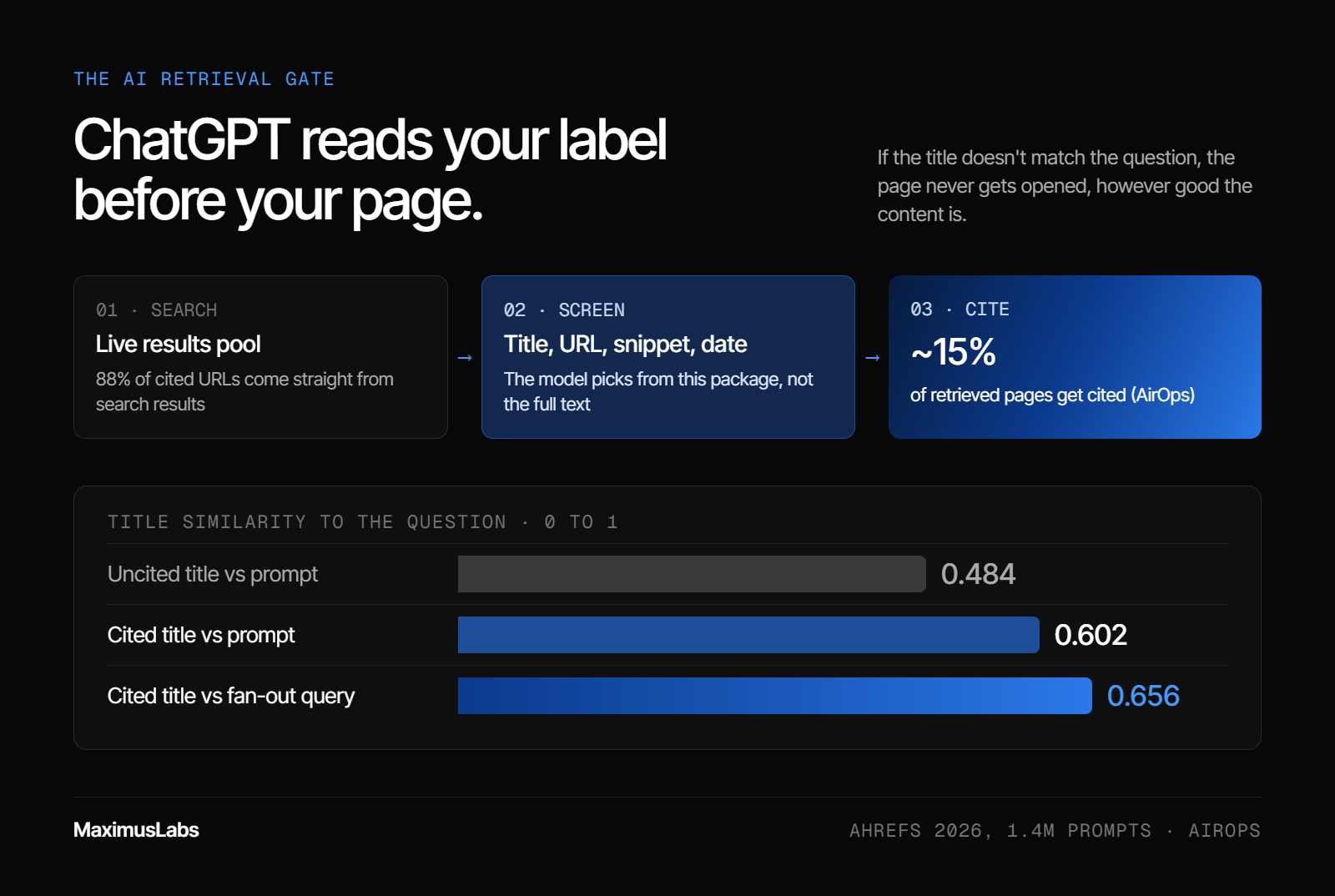
AI engines run a live search and split the prompt into sub-questions called fan-out queries. They pick which results to open from the title, URL, and snippet. In Ahrefs' 2026 study of 1.4 million ChatGPT prompts, cited pages had titles closer to the prompt than uncited pages (0.602 vs 0.484). AirOps found that ChatGPT cited only 15% of the pages it retrieved. MaximusLabs AI scores titles against these sub-questions before publishing.
A Marketing Manager pastes "best revenue intelligence tool for mid-market teams" into ChatGPT. "Searching" flashes, and eight sources appear. Her page ranks fourth on Google for that topic, and it is not one of them.
✅ Step 1: The engine searches before it answers
Most AI answers use retrieval-augmented generation (RAG). The model fetches live search results, then writes its answer from them. Ahrefs found 88% of the URLs ChatGPT cites come straight from search results.
So Google rankings still matter. They are the ticket into the candidate pool. The title decides what happens next.
⚠️ Step 2: The engine reads the label, not the page
Each result arrives as a small package: a title, a URL, a short snippet, and an ID. MaximusLabs AI's research adds a date to that list and puts the snippet at about 150 characters. The model decides from this package which pages to open.
That filter is harsh. AirOps found ChatGPT cited only 15% of retrieved pages, so 85% never made it.
⭐ Step 3: The engine matches titles to hidden questions
Before it picks pages, ChatGPT breaks the prompt into fan-out queries, the questions behind the question. Ahrefs measured how close titles were to these queries. It used cosine similarity, a 0 to 1 score of how alike two texts are in meaning.
| Signal | Finding | Source |
| Prompt vs cited title | 0.602 similarity (vs 0.484 for uncited) | Ahrefs 2026 |
| Fan-out query vs cited title | 0.656 similarity (best match) | Ahrefs 2026 |
| Title-query word overlap | 20.1% citation rate at 50%+ overlap, 9.3% under 10% | AirOps |
| Natural-language URL slug | 89.78% citation rate vs 81.11% | Ahrefs 2026 |
One honest caveat: Ahrefs used open-source embedding models to approximate ChatGPT. These are strong signals, not OpenAI's internal scores.
💰 What to change on Monday morning
This is why MaximusLabs AI founder Krishna Kaanth frames GEO, short for Generative Engine Optimization, as a data problem.
"Generative Engine Optimization is more of a data science problem."
Krishna Kaanth, Founder and CEO, MaximusLabs AI
In practice, the title becomes a similarity target, not a slogan. Here is the check I run:
- Write the three sub-questions a buyer's prompt would trigger.
- Make sure the title answers at least two of them in plain words.
- Keep the primary keyword, but phrase the rest the way buyers ask.
- Use a readable URL slug, not an ID string.
MaximusLabs AI applied title and snippet alignment, alongside its wider AEO work, for Oliv AI. The result: 64% AI citation rate in 6 months, vs ~30% for billion-dollar incumbents (Oliv AI). Titles were one lever among several. We treat them as the entry ticket, not the whole win.
Q3: How often does Google rewrite title tags, and what triggers it?
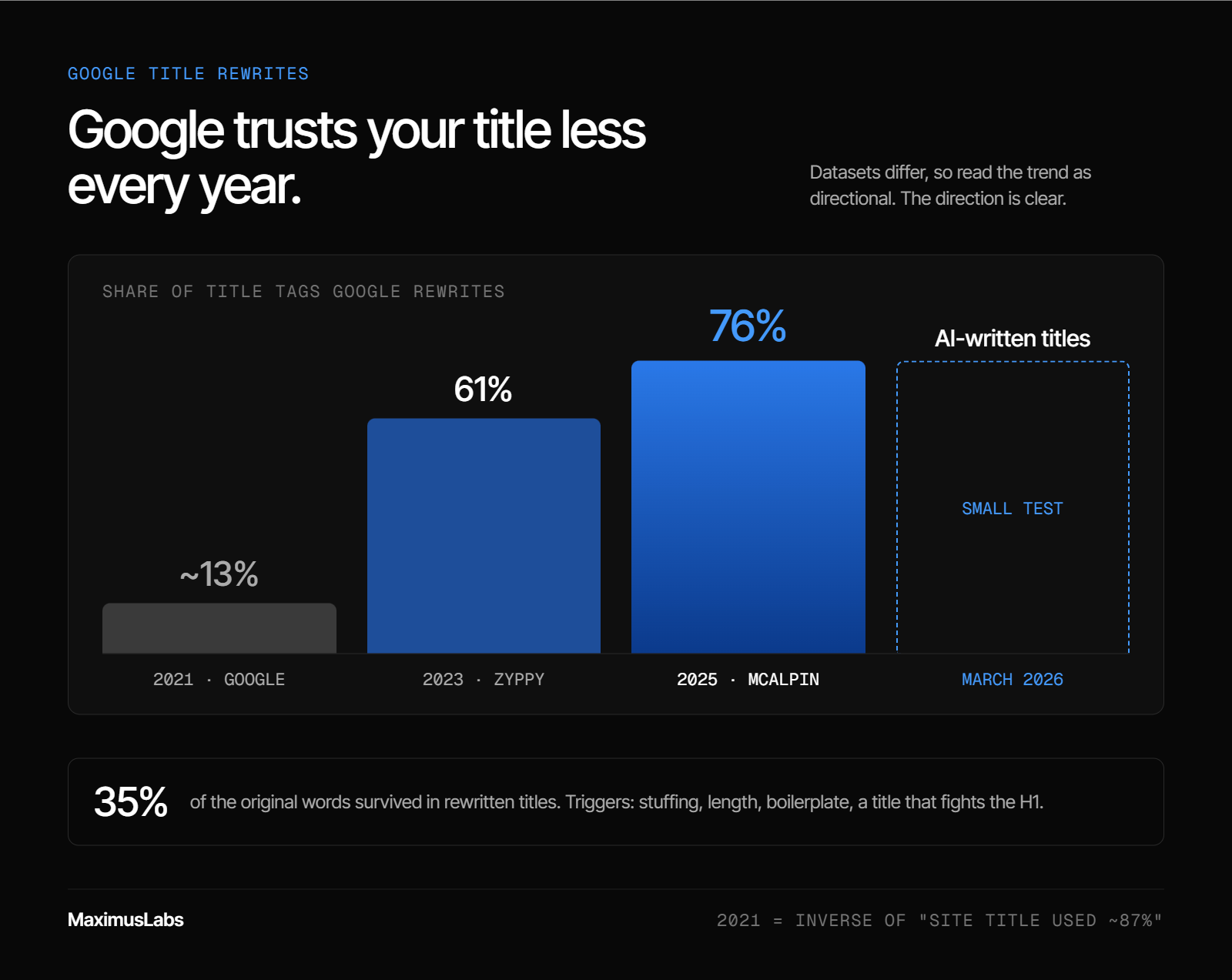
John McAlpin's study of 24,886 results found Google rewrote 76% of title tags in Q1 2025. Rewritten titles kept only about 35% of the original words. In 2021, Google said it used the site's own title about 87% of the time. Common triggers are keyword stuffing, excess length, repeated boilerplate, and titles that don't match the page's main headline. In March 2026, Google confirmed a small test of AI-generated titles.
A content lead at a fintech company spends a sprint testing two title variants. She checks the results page, and neither variant appears. Google is showing a headline lifted from one of her H2s.
⏰ How the rewrite rate climbed
The trend runs one way. Each new study finds Google trusting the site's title less.
| Year | Finding | Source |
| 2021 | Google uses the site's title about 87% of the time | The Art of SEO |
| 2023 | 61% of 80,000+ titles rewritten | Cyrus Shepard, Zyppy |
| 2025 | 76.04% rewritten; 35.02% of original words kept | McAlpin |
| 2026 | AI-generated titles in a small, narrow test | Search Engine Land |
McAlpin used a different dataset from Shepard, so the comparison is directional. Still, the direction is clear.
⚠️ Where Google finds the replacement
Google builds title links automatically from your page and from references to it across the web. Its documented sources include:
- The <title> element
- The main visible headline
- Heading elements and other large, prominent text
- Anchor text on the page and in links pointing to it
- WebSite structured data
If your title and these signals disagree, Google picks the one it trusts more.
❌ The four triggers that invite a rewrite
- Keyword stuffing. "SEO Company | Best SEO Firm | Local SEO Services" repeats itself, and Google trims it.
- Excess length. Long titles get cut or replaced to fit the screen.
- Repeated boilerplate. The same text across many pages tells Google nothing specific.
- No clear main title. When the title and H1 tell different stories, Google can use the headline instead.
Missing titles are a fifth, simpler case. An Ahrefs study cited in The Art of SEO found 7.4% of top-ranking pages had no title tag at all.
⭐ The 2026 twist: titles Google writes itself
Older rewrites picked text you had already written. The March 2026 test is different. Google confirmed to The Verge that it was testing AI-generated titles in traditional Search, calling it small, narrow, and not approved for wider rollout. Search Engine Journal noted the wording echoed a similar test in Discover that later became a feature.
✅ Read every rewrite as feedback
A rewrite is Google telling you which part of your title failed. Compare your published title with the displayed one, then check it against the four triggers. Google has not said a displayed rewrite changes how it understands the page, so the HTML title still deserves the work.
MaximusLabs AI pairs this Google check with daily AI-visibility tracking across every major engine. That way, a title change is judged on both surfaces at once, not just on what Google chose to display.
Q4: How long should a title tag be for Google and AI search?
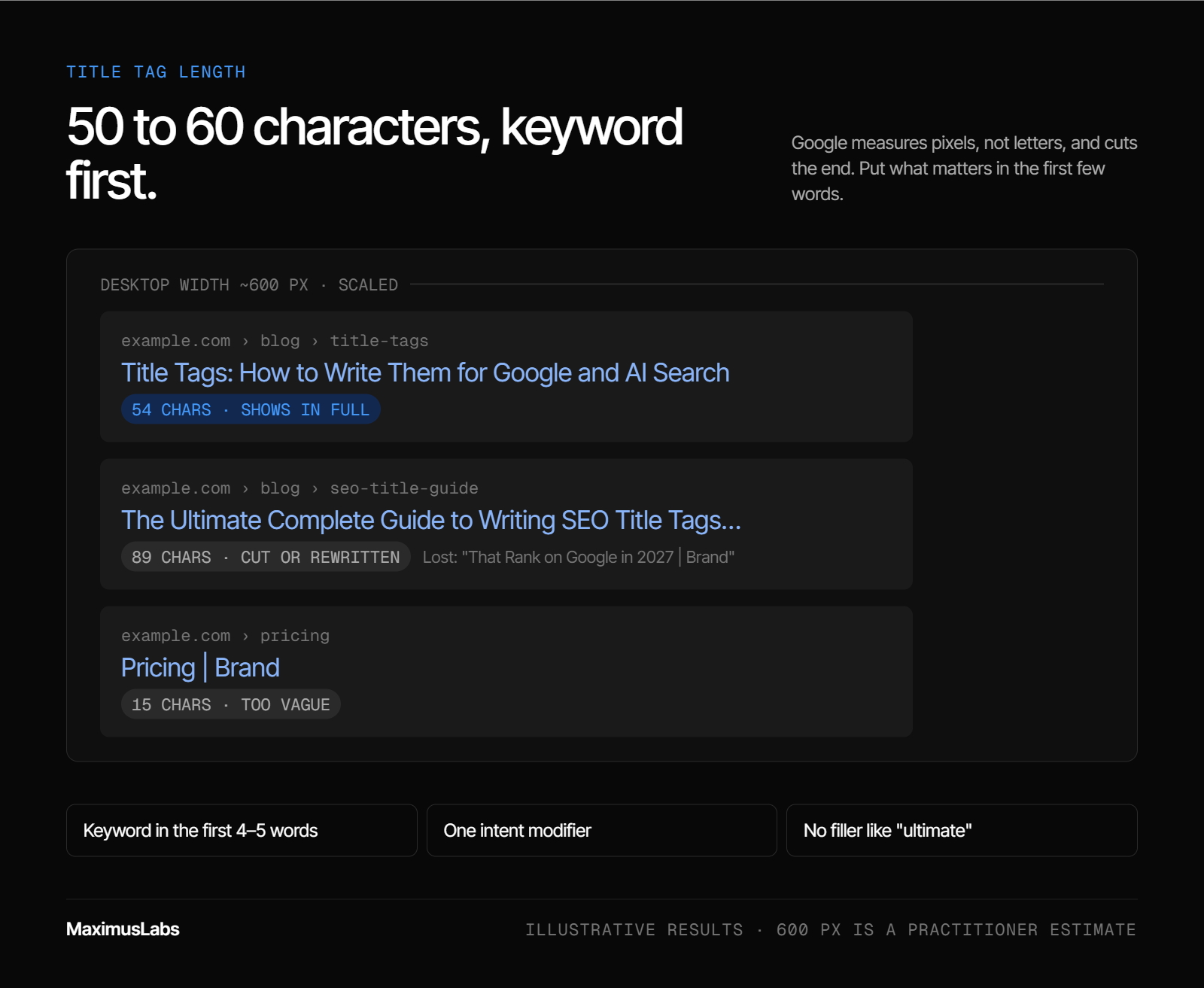
Aim for 50 to 60 characters, and treat about 65 characters, roughly 600 pixels on desktop, as the ceiling. Google sets no fixed character limit, but it truncates title links to fit the device. AI engines don't cut titles visually. They do compare the title's words with the query, so put the primary keyword and the buyer's intent in the first few words.
A growth marketer at a healthtech startup drops her new title into a preview tool. It runs 89 characters. The preview cuts it right before the year and the benefit, the two parts she cared about most.
✅ Why 50 to 60 characters is the working range
Google's documentation is plain about this. There is no limit on how long a title can be, but the title link gets truncated as needed. Google also advises against long, verbose titles.
Practitioners settled on a range that usually survives. The Art of SEO puts the cutoff at about 65 characters. Staying at 50 to 60 leaves a safety margin.
| Example title | Characters | Likely outcome |
| Title Tags: How to Write Them for Google and AI Search | 54 | Shows in full |
| Revenue Intelligence Pricing: Plans, Seats, and Add-Ons | 55 | Shows in full |
| The Ultimate Complete Guide to Writing SEO Title Tags That Rank on Google in 2027 | Brand | 89 | Cut off or rewritten |
| Pricing | Brand | 15 | Too vague to help |
⚠️ Pixels matter more than characters
Google measures width, not letter count. A capital "W" takes far more space than a lowercase "i." So a title in ALL CAPS gets cut sooner than the same words in normal case.
Google does not publish a pixel limit. The 600-pixel figure is a practitioner estimate for desktop, and mobile widths vary. Check titles in a preview tool rather than trusting a character counter alone.
⭐ Front-load what matters
Front-loading protects you on both surfaces. On Google, the first words survive truncation. Searchers also scan only the start of each result.
For AI engines, the whole title gets compared with the prompt. My hypothesis is that filler words like "ultimate" and "complete" dilute that match without adding meaning. I'd treat that as a working theory, not a proven rule.
❌ Why very short titles also fail
Short is not automatically safe. Google's documentation warns against vague titles like "Home". A title like "Pricing | Brand" gives searchers no reason to click and gives AI engines nothing to match.
Use this quick check before publishing:
- Primary keyword in the first four or five words
- One intent modifier, like "pricing," "vs," or "for mid-market teams"
- 50 to 60 characters, checked in a preview tool
- No filler words that add length without meaning
MaximusLabs AI treats title length as a budget, not a rule. The first words carry the keyword and the buyer's question, and every extra word has to earn its place. That habit comes from writing BOFU pages first, where one clear title can decide a shortlist.
Q5: How do you write a title tag that wins both the Google click and the AI citation?
Start with the primary keyword. Add the modifier that matches the buyer's intent, such as "best," "pricing," or "for sales teams." Keep the title and the H1 telling the same story, so Google has no reason to swap them. Then check the title against the sub-questions an AI engine would generate from the buyer's prompt. MaximusLabs AI helped Nidra Goods rank #1 for "best sleep mask" across Google, ChatGPT, and Perplexity from a single GEO strategy.
A product marketer at a sales-tech company gets a title approved in review. It reads "Close Smarter With Every Call | Brand." Everyone likes it. Six weeks later, it has impressions but almost no clicks, and ChatGPT never cites it.
✅ Step 1: Lead with the keyword buyers actually type
Put the primary keyword in the first few words. Searchers scan only the start of each result, and Google truncates the end. A clever line like "Close Smarter" tells neither readers nor machines what the page covers.
⭐ Step 2: Add the modifier that signals intent
The modifier tells the reader which job the page does. "Best" signals a shortlist. "Pricing" signals a budget check. "For sales teams" signals fit with a specific buyer.
AirOps found pages with 50% or more title-query word overlap were cited 20.1% of the time, versus 9.3% under 10% overlap. The modifier is often the word that closes that gap.
✅ Step 3: Make the title and H1 agree
Google's documentation asks site owners to make the main title clear on the page. When the <title> and the H1 tell different stories, Google can use the headline instead. They don't need to match word for word. They do need the same keyword and promise.
Keep your og:title, the title social platforms show, aligned too. One page should have one story.
⚠️ Step 4: Check the title against fan-out questions
Write the three sub-questions a buyer's prompt would trigger. For "best call recording software," those might be "which tools suit sales teams," "which ones are tested," and "what is current." Ahrefs found cited titles averaged 0.656 similarity to their best-matching fan-out query.
| Step | Title | Characters |
| Keyword only | Call Recording Software | 23 |
| Add intent | Best Call Recording Software | 28 |
| Add the buyer | Best Call Recording Software for Sales Teams | 44 |
| Answer a fan-out question | Best Call Recording Software for Sales Teams: 2027 Picks | 56 |
The final title answers "which is best," "for whom," and "is it current" in 56 characters.
❌ Write for the buyer's query, not the brand tagline
MaximusLabs AI's read is that most weak titles are written to please an internal review, not the buyer. Taglines belong in ads and on the page. The title has to match the question the buyer types into Google or ChatGPT.
I'd keep one rule in front of the team: if a buyer would never search the phrase, it doesn't lead the title.
MaximusLabs AI applies one title method across Google and AI engines, because the buyer asks the same question on both. For Nidra Goods, a single GEO strategy produced the #1 spot for "best sleep mask" on Google, ChatGPT, and Perplexity. Titles were one part of that work, alongside content and authority.
Q6: Should title tags use questions, separators or your brand name first?
It depends on intent and brand strength. Question titles mirror how people prompt AI engines and suit informational or evaluation queries. Transactional and local pages usually do better with a keyword plus a benefit. Put the brand at the end, after a hyphen, colon, or pipe, unless the brand is a household name. Google may drop a site name from the title link when it repeats the site name already shown in the result.
A Head of Content at a healthcare SaaS company sits in a sprint review. Her team argues for twenty minutes about pipes versus dashes. Nobody can point to data, and the rewrite queue keeps growing.
⏰ Situation: Format rules came from the blue-link era
Most format habits started when titles had one reader. Teams put the brand at the end, picked a separator, and moved on. These rules worked well enough for Google clicks.
AI engines added a second test. They compare the title's wording to the prompt. Format now affects whether the page gets cited, not just how it looks.
⚠️ Complication: Question titles help some pages and hurt others
A question title like "What Is Lifecycle Marketing?" mirrors a prompt closely. AirOps data suggests higher title-query overlap lifts citation rates. That helps informational and evaluation pages.
But a pricing or service page is not answering a question. "Utah SEO Company: BKA Content" works because it matches what a local buyer types. Turning that into a question would add words and remove the match.
✅ Separators and brand placement
Google suggests separating your site name with a delimiter such as a hyphen, colon, or pipe. Some secondary write-ups claim pipes trigger more rewrites than dashes. I haven't seen the primary data, so I wouldn't rebuild a site around that claim.
Brand placement follows trust. Most sites should lead with the topic and end with the brand. Household names like HubSpot can lead with the brand, because the name itself earns the click. Expect Google to trim a brand that repeats the site name it already shows.
⭐ Resolution: A decision rule by page type
| Page type | Best format | Example |
| Informational guide | Question or "Topic: What It Covers" | What Is Lifecycle Marketing? |
| Comparison or "best" page | Keyword, modifier, buyer | Best Call Recording Software for Sales Teams |
| Pricing or product page | Keyword plus what is included | Acme CRM Pricing: Plans, Seat Costs, and What Is Included |
| Local service page | Service, location, brand | Utah SEO Company: BKA Content |
MaximusLabs AI's view is that brand is the long-term advantage. Once AI engines treat your brand as a known entity, leading with the name becomes a real option. Until then, the topic should lead.
I might be wrong on question titles for evaluation pages. The test I'd run is simple. Split similar pages into two groups, change one group's format, then track click-through rate and AI citations for four weeks.
MaximusLabs AI settles format debates with tracking, not opinion. Its daily AI-visibility tracking across every major engine shows whether a format change moved citations. Search Console shows whether it moved clicks. The format that wins both is the one that stays.
Q7: What should title tags look like on pages that drive pipeline?
Pages that drive pipeline need titles that match buying queries closely. Comparison pages use "X vs Y." Alternatives pages use "Best X Alternatives for [buyer]." Pricing pages use "X Pricing" plus what is included. Local service pages use the service plus the location. These are bottom-of-funnel (BOFU) queries, the searches buyers run right before they pick a vendor, so the title should mirror the buyer's wording.
A VP Marketing at a B2B SaaS company reviews the content calendar with her CEO. Forty blog posts went live last quarter. The CEO asks how many sourced a demo, and the answer is two.
⏰ Why BOFU titles come first
Top-of-funnel (TOFU) pages answer broad questions like "what is X." AI engines now answer those questions directly, so the click rarely comes. Pew found users clicked a result on 8% of searches with an AI summary, versus 15% without.
BOFU queries work differently. A buyer asking "best call recording software for sales teams" wants vendor names. Those are the answers where a page can enter a shortlist.
✅ Comparison and alternatives pages
Comparison titles should name both products and the deciding factor. Alternatives titles should name the incumbent and the buyer who is switching.
- Comparison: "HubSpot vs Salesforce for Startups: Features and Pricing" (56 characters)
- Alternatives: "7 Best Gong Alternatives for Mid-Market Sales Teams" (51 characters)
Both formats match how buyers phrase evaluation prompts in ChatGPT. Ahrefs found cited titles sat closer to the prompt than uncited ones (0.602 vs 0.484).
💰 Pricing and product pages
Pricing pages often carry a bare title like "Pricing | Brand." That gives buyers and AI engines nothing to match. Add the product category and what the page explains.
- Pricing: "Acme CRM Pricing: Plans, Seat Costs, and What Is Included" (57 characters)
- Product: "Call Recording Software for HIPAA-Compliant Clinics" (51 characters)
The product example shows the buyer filter at work. A healthcare buyer searching for compliant tools sees the fit before clicking.
⭐ Service and local pages
Local titles follow a simple formula: main service, location, then brand. "Utah SEO Company: BKA Content" is a clean example. It matches the exact phrase a local buyer types.
| Page type | Template | Example |
| Comparison | X vs Y for [buyer]: [deciding factor] | HubSpot vs Salesforce for Startups: Features and Pricing |
| Alternatives | N Best X Alternatives for [buyer] | 7 Best Gong Alternatives for Mid-Market Sales Teams |
| Pricing | X Pricing: [what is included] | Acme CRM Pricing: Plans, Seat Costs, and What Is Included |
| Product | [Category] for [buyer] | Call Recording Software for HIPAA-Compliant Clinics |
| Local service | [Service] [Location]: [Brand] | Utah SEO Company: BKA Content |
MaximusLabs AI starts with BOFU pages and skips most TOFU work, because AI engines already answer "what is" queries. Titles on comparison, alternatives, and pricing pages get the most attention. For Oliv AI, MaximusLabs reported 27 qualified leads, $47K+ pipeline, 26% close rate in 4 months (Oliv AI).
Q8: How do you find title tag quick wins on pages you already have?
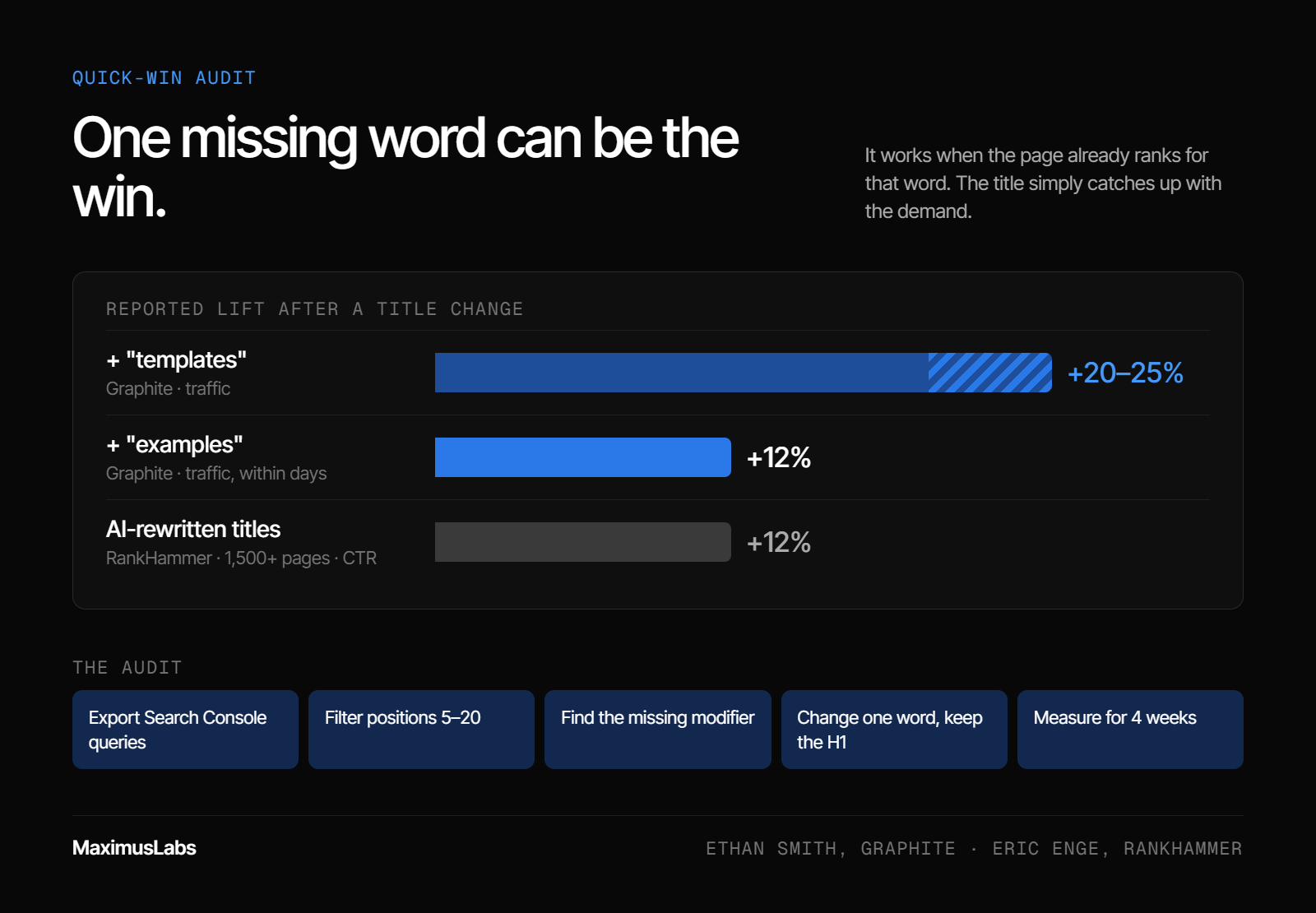
Open the Search Console Performance report and pull the queries your best pages rank for in positions 5 to 20. Look for high-volume modifiers missing from the title, like "templates," "examples," or "pricing." Ethan Smith of Graphite reported traffic lifts of 12% to 25% after adding a single missing word to existing titles. MaximusLabs AI runs content refreshes based on performance data, because pages that already rank pay back faster.
A Head of Organic Growth has a budget for ten new articles this quarter. Her best guide already ranks eighth for a high-volume variant. Nobody has touched its title in eighteen months.
⏰ Why refreshing beats net-new content
New content takes months to rank. A page that already ranks has authority, links, and indexing in place. A better title can move it within days.
Ahrefs recommends targeting pages in middling positions, roughly 4 to 10, for title optimization. Those pages are close enough for a title change to matter.
✅ The five-step audit
- Export queries. In the Search Console Performance report, filter by page and export queries with impressions, clicks, and position.
- Filter positions 5 to 20. These pages rank for terms they could win.
- Find missing modifiers. Look for repeated words like "templates," "examples," "checklist," or "2027" that appear in queries but not in the title.
- Rewrite one variable. Add the modifier, keep the H1 aligned, and stay under 60 characters.
- Measure for four weeks. Compare clicks, position, and AI citations against your pre-change baseline.
⭐ What one word can do
Ethan Smith described adding "templates" to top articles' titles and seeing about a 20% to 25% traffic gain. In another case, his team added "examples" and saw a 12% lift within days.
"We literally just added one word to the title tag."
Ethan Smith, CEO of Graphite
The word worked because the page already ranked for it. The title simply caught up with the demand. So confirm the ranking evidence before adding any word. A modifier with no query data behind it is a guess, not a quick win.
❌ Fix duplicate titles while you are there
Duplicate titles make pages look identical to Google and AI engines. Google's documentation flags repeated boilerplate as a common title problem. Crawl the site, group duplicates, and give each page its own keyword and modifier.
⚠️ Rewriting at scale with AI
Large sites can batch the work with AI. Eric Enge describes agency RankHammer using GPT-4 to rewrite titles and meta descriptions on more than 1,500 lead-generation pages, ten at a time. After the pages went live, click-through rate rose 12%.
MaximusLabs AI's view is that AI drafts work best with a human reviewer. A model can repeat one pattern across 1,500 pages. A reviewer catches the titles that drift from the page's real promise.
MaximusLabs AI treats title refreshes as part of its content refresh work, driven by performance data. Pages that already rank get reviewed before new content gets written. That order protects budget, because a one-word fix can outrun a new article that needs months.
Q9: How do you measure whether a title change worked in Google and AI search?
Track three things after every title change. First, compare click-through rate in the Google Search Console Performance report against a pre-change baseline. Second, compare the published title with the title Google displays, to catch rewrites. Third, run your target prompts in ChatGPT and Perplexity to see whether the page gets cited. MaximusLabs AI judges title tests on pipeline, so a title that lifts clicks but not demos counts as a failed test.
A Marketing Manager ships twelve new titles on a Monday. Three weeks later, her VP asks whether it worked. Clicks are up slightly, impressions are down, and nobody knows whether ChatGPT noticed.
⏰ Set a baseline that accounts for AI Overviews
Click-through rate alone can mislead you now. Ahrefs found that AI Overviews cut position-one CTR by 58% as of December 2025. Pew Research Center found users clicked a result on 8% of searches with an AI summary, versus 15% without one.
So a flat CTR on a query with an AI Overview may still be a win. Pull the 28 days before the change, filtered by page. Note which top queries trigger an AI Overview in a live search, since those queries have a lower ceiling. Then compare the same 28 days after the change.
⚠️ Log rewrites, not just rankings
A new title only helps if Google shows it. Search your top queries and record the displayed title next to the published one.
This log matters more since Google confirmed a test of AI-generated titles in March 2026. If the displayed title differs, check it against the four rewrite triggers covered earlier.
⭐ Track AI citations with a fixed prompt set
Write 10 to 20 prompts a buyer would actually ask, including fan-out variants of each one. Run them in ChatGPT and Perplexity before and after the change. Record whether your page is cited and which competitor is cited instead.
AI answers change from run to run, so one check proves little. Run each prompt several times and read the trend, not a single answer. MaximusLabs AI handles this with daily AI-visibility tracking across every major engine, re-run and regression-tested.
| Metric | Where to measure | What counts as a win |
| Click-through rate | Search Console Performance report | Higher CTR than the pre-change baseline on the same queries |
| Displayed title | Live Google results | The displayed title matches the published one |
| AI citations | Fixed prompt set in ChatGPT and Perplexity | Cited on more prompts than before |
| Pipeline | CRM and analytics | More demos or qualified leads from the page |
💸 Pre-test titles with paid search
Eric Enge suggests in The Art of SEO buying search ads for a week or two to test different ad text. You can then carry the winning wording into your titles.
Judge the paid test on conversions, not just clicks. A title that wins clicks with a promise the page doesn't keep will lose demos.
✅ Tie the result to pipeline
A title test ends in the CRM, not in Search Console. If the page sourced more demos or qualified leads after the change, the title worked. If only impressions moved, treat that as a vanity metric.
MaximusLabs AI measures every engagement on pipeline, not on mentions. Title changes are checked across Google and AI engines through daily visibility tracking, then tied back to leads and demos. That is the standard I'd hold any title test to, whether MaximusLabs runs it or your own team does.
Frequently asked questions
Is the title tag still a Google ranking factor in 2027?
Yes. The title tag is still one of the clearest on-page signals of what a page is about. Google's own documentation lists the <title> element first among the sources it uses to build title links, and its SEO Starter Guide asks for unique, descriptive titles on every page. What changed is display, not relevance. Google now rewrites most titles it shows, but a rewrite changes what searchers see. Google has not said it stops using your HTML title to understand the page. We see three practical reasons to keep investing in titles: • They are the strongest hint Google gets about the page's main topic. • They shape the title link searchers click, even when Google edits them. • AI engines like ChatGPT screen results by title, URL, and snippet before opening a page. MaximusLabs AI treats the title as shared ground between classic SEO and AI search. A title that clearly names the topic and the buyer's intent helps Google rank the page and helps AI engines pick it. That overlap is a big part of how we think about GEO versus traditional SEO. Google has never published exact ranking weights, so we judge titles by what they move: rankings, clicks, citations, and pipeline.
What is the difference between a title tag and a meta description in AI search?
The title tag names the page. The meta description summarizes it. In Google, the title becomes the clickable title link, while the meta description may appear as the gray snippet below it. Google can replace either one. In AI search, both now act as a screening layer. MaximusLabs AI's research on ChatGPT's web retrieval found that standard results arrive as structured metadata: the URL, the title, a snippet of about 150 characters, and a date. The model judges pages on that package before it reads any full text. That gives each element a distinct job: • Title tag: matches the buyer's question and earns the first look. • Meta description: answers that question directly in the first sentence. • URL: confirms the topic in plain words. We write meta descriptions as dense, front-loaded answers of roughly 120 to 158 characters. We call this idea 'the snippet is the new rank.' A vague description wastes the one sentence an AI engine sees before it decides. For more on writing extractable answers, see our guide to answer structure for AEO.
Should you put the year in your title tag?
Only when freshness matters to the buyer's decision. A year signals that the content is current. That helps for software comparisons, pricing pages, and 'best of' lists, where last year's answer may be wrong. A year can hurt in two cases: • Evergreen topics. A definition or a process guide doesn't change yearly, so the year adds length without adding meaning. • Stale years. A title still showing last year tells searchers and AI engines the page is out of date. We also avoid treating the year as a ranking trick. Ahrefs' 2026 study of ChatGPT citations found the engine rewards established, maintained pages rather than simply chasing the newest ones. A year in the title without a real content update is a promise the page doesn't keep. MaximusLabs AI's rule is simple. If we add a year, we add it to a review schedule too, so the page and the title get refreshed together. When a page needs updating, we follow the same process described in our GEO content refresh guide. If no one will update the page next year, we leave the year out.
How often should you update title tags?
Update a title when the data gives you a reason, not on a fixed calendar. Constant rewrites make it hard to learn what worked, and they can unsettle rankings. We look for four triggers: • Missing modifiers. A page ranks in positions 5 to 20 for a variant like 'templates' or 'pricing' that isn't in the title. • Rewrites. Google keeps showing a different title than the one you published. • Lost citations. AI engines stop citing the page for prompts it used to win. • Stale details. The title carries an old year, price, or product name. A light quarterly review of your top pages catches most of these. Between reviews, change titles only when one of the triggers appears. MaximusLabs AI runs title reviews as part of its content refresh work, using Search Console data and daily AI-visibility tracking across major engines. That way we change a title because a signal moved, not because a calendar said so. Our guide to AEO measurement and tracking explains how we read those signals. When we do change a title, we change one thing at a time and measure it for about four weeks.
Do Perplexity, Gemini, and Claude use title tags the same way ChatGPT does?
Broadly yes, but not identically. Most AI answer engines search the web first, then choose which results to read and cite. In that flow, the title is one of the first things each engine sees, so a clear, question-matched title helps everywhere. The details differ by platform. Each engine uses its own search source, its own ranking of results, and its own trust signals. Independent research has found surprisingly little overlap in the pages different AI engines cite for the same queries. What we've seen hold across engines: • Titles that mirror how buyers phrase prompts get picked more often. • Pages that already rank in traditional search enter the candidate pool more easily. • Vague, brand-first titles rarely survive the first screen. MaximusLabs AI tracks citations separately for ChatGPT, Perplexity, Gemini, Claude, and Google AI Overviews, because a win on one engine doesn't guarantee a win on another. Our founder's starting insight was that what ChatGPT considers important is not the same as what Google or Perplexity considers important. For platform specifics, see our Perplexity optimization guide.
Can changing a title tag hurt your rankings?
It can, briefly or for good, if the change removes the words the page ranks for. A title rewrite is low effort but not low risk on pages that already perform. The common mistakes we see: • Dropping the primary keyword for a clever headline. • Changing a top page without checking which queries it ranks for first. • Changing the title, H1, and content all at once, so no one knows what caused the result. • Rewriting dozens of titles in one push with no baseline. To reduce the risk, export the page's ranking queries from Search Console before you touch it. Keep the primary keyword, add rather than replace, and change one variable at a time. Then compare clicks, position, and AI citations against a 28-day baseline. MaximusLabs AI follows this order on every title change for clients, starting from the queries a page already wins. Short ranking swings after a change are normal while Google re-evaluates the page. A drop that lasts several weeks usually means the new title lost a term the page relied on. In that case, we restore the term first. Our list of common GEO mistakes covers similar risks across AI search.
How does MaximusLabs AI write and test title tags for clients?
MaximusLabs AI treats title tags as part of Answer Engine Optimization (AEO), with SEO as the foundation underneath. We write titles for the question a buyer asks, then test them on both Google and AI engines. Our process follows the order in this article: • BOFU pages first. Comparison, alternatives, and pricing pages get titles before top-of-funnel content. • Query-first drafting. Each title leads with the keyword and the buyer's intent, then gets checked against likely fan-out questions. • Refresh before new content. Pages that already rank get title reviews based on performance data. • Two-surface tracking. Search Console shows clicks, and daily AI-visibility tracking shows citations. We measure every engagement on pipeline, not on mentions. Titles are one lever among many, alongside content, authority, and third-party trust signals. For Oliv AI, our broader AEO work produced a 64% AI citation rate in 6 months, vs ~30% for billion-dollar incumbents (Oliv AI). You can read the details in our Oliv AI case study.