 Krishna Kaanth M
- AI search is binary: your brand is synthesized into the answer or it does not exist for that query, so citation share now matters more than rankings.
- Citation acquisition is closer to data science than SEO, optimizing the retrieval and trust step rather than keyword density across four different engine rulebooks.
- Each engine drinks from a different well, with ChatGPT leaning on Wikipedia, Perplexity and Google AI Overviews leaning heavily on Reddit.
- On-page wins come from answer-first sections, question-based structure, and pulling citable data out of JavaScript into rendered HTML.
- Original data, named expertise, and earned off-site presence on Reddit, G2, and Tier-1 media drive durable citations, while referring domains predict ChatGPT citations.
- Measure citation share and conversions, not clicks, start BOFU-first to avoid the SEO death spiral, and treat brand authority as the long-term moat.
Q1: Why is being cited by AI now a binary, revenue-defining outcome instead of ranking?
A founder we audited last quarter had a dashboard any team would envy. Page-one Google rankings for eleven buying keywords, climbing impressions, and a tidy traffic chart. Then he opened ChatGPT, asked it to recommend tools in his category, and watched five competitors get named. His brand was not one of them. He had won the old game and lost the new one on the same screen.
That is the shift. Ranking used to be the finish line. Now the finish line is being named inside the answer itself.
🎯 The new scoreboard is binary
Here is the uncomfortable truth about AI search. You are either synthesized into the answer, or you do not exist for that query.
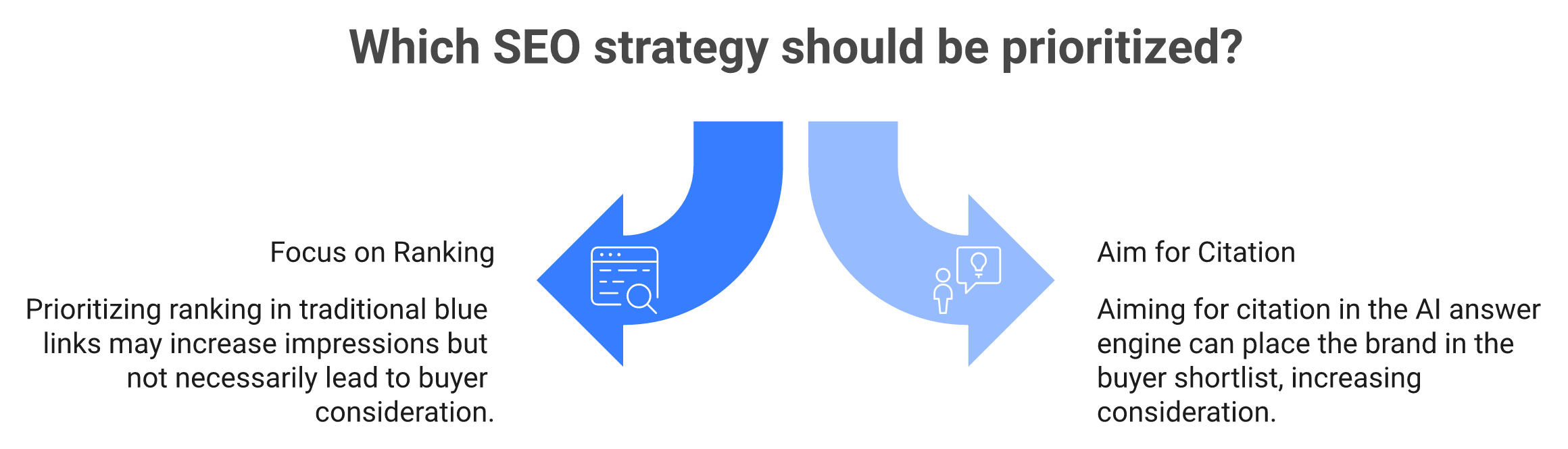
As one practitioner put it, if you are not in the actual citations, "you might as well not have played the game because there is no difference; you're actually literally zero in terms of traction." There is no page two to console you. A buyer asking an AI for the best CRM sees only five to ten brands. That short list is the entire evaluation set, and if you are missing, you are not in consideration at all.
📉 The economics behind the shift
This matters because the old channel is leaking value fast. Seer Interactive tracked organic click-through rate dropping 61%, from 1.76% to 0.61%, on queries where Google shows an AI Overview. Ranking still, but earning fewer clicks.
Meanwhile, the citation itself is where the clicks now go. Amsive found pages cited inside AI Overviews could capture up to 35% more clicks than the same pages left uncited. The reward moved from the blue link to the mention.
The pipeline case gets sharper when you look at where search is heading. Gartner projects a 25% drop in traditional search engine volume by 2026, as users shift to AI answer engines. The center of gravity is moving, and the brands that only measure rankings are measuring the wrong thing.
💰 Citation share is the metric that maps to pipeline
Impressions and average position describe a channel that is quietly shrinking. Citation share, how often your brand appears in the answer across the questions your buyers actually ask, describes the channel that is growing.
At MaximusLabs, we stopped leading client reports with rankings and started leading with citation share, because that is the number that tracks to pipeline, not vanity. A page can rank first and still be invisible in the answer box that decides the deal.
The rest of this guide is a tactical build order for getting cited, on your own pages and across the sources AI engines already trust. Being average is no longer safe here. The penalty for being average has never been so severe, because average now means unmentioned.
Q2: How is AI citation acquisition different from traditional Google-only SEO and 'SEO+'?
Most teams treat AI search as SEO with a new coat of paint. Add a few FAQs, sprinkle some schema, keep the keyword habits, and call it GEO. That instinct is exactly what gets brands left out of the answer.
⚠️ Why old SEO habits mislead you here
The unit of work changed. Traditional SEO optimizes one page to rank among ten blue links. Citation acquisition engineers on-page and off-page signals, so a model selects your brand and folds it into a single synthesized answer.
The query itself is different too. The average Google search runs about six words. The average chat prompt runs around 25 words, per data cited in Ethan Smith's AEO work. That means the questions are longer, more specific, and more conversational, so keyword-density thinking cannot keep up with 25-token intent.
And the retrieval window is tight. ChatGPT's web results pull roughly 150-character snippets, which makes your meta description and opening lines a direct input to the answer, not a background ranking factor.
🧠 It behaves more like a data-science problem
Citation acquisition targets the RAG step. RAG, or retrieval-augmented generation, is the process where the engine runs a live search, retrieves passages, and summarizes them into an answer. You are optimizing what gets retrieved and trusted, not just what gets indexed.
The Princeton and IIT-Delhi GEO study makes this concrete. Across roughly 10,000 queries, the researchers showed that specific content moves, adding statistics, quotations, and citing sources, lifted visibility in generative answers by up to 40%. These are retrieval-and-trust levers, not keyword levers.
Here is where we will say something the category avoids: GEO is not SEO. It is closer to a data-science problem. You need to know how these models retrieve and weight sources to be present in the answer, and the signals ChatGPT rewards are not the signals Perplexity or Google reward.
🔁 Reframe: data science plus brand
So the resolution is not "do more SEO." It is understanding the machine, then earning the trust it looks for. This is why we call our approach R-GEO at MaximusLabs, revenue-focused generative engine optimization, rather than bolting a GEO label onto a 2019 playbook.
We could be early on some of this, but the pattern across our audits is consistent: teams that treat citation as retrieval engineering plus brand authority get named; teams that treat it as SEO Plus keep ranking and keep getting skipped.
Q3: Which sources do ChatGPT, Perplexity, and Google AI Overviews actually cite?
There is no single "AI search" to optimize for. There are four engines with four different diets, and a tactic that feeds one can be ignored by another.
📊 Four engines, four source profiles
Start with the answer, then the evidence. Each engine leans on a different primary source.
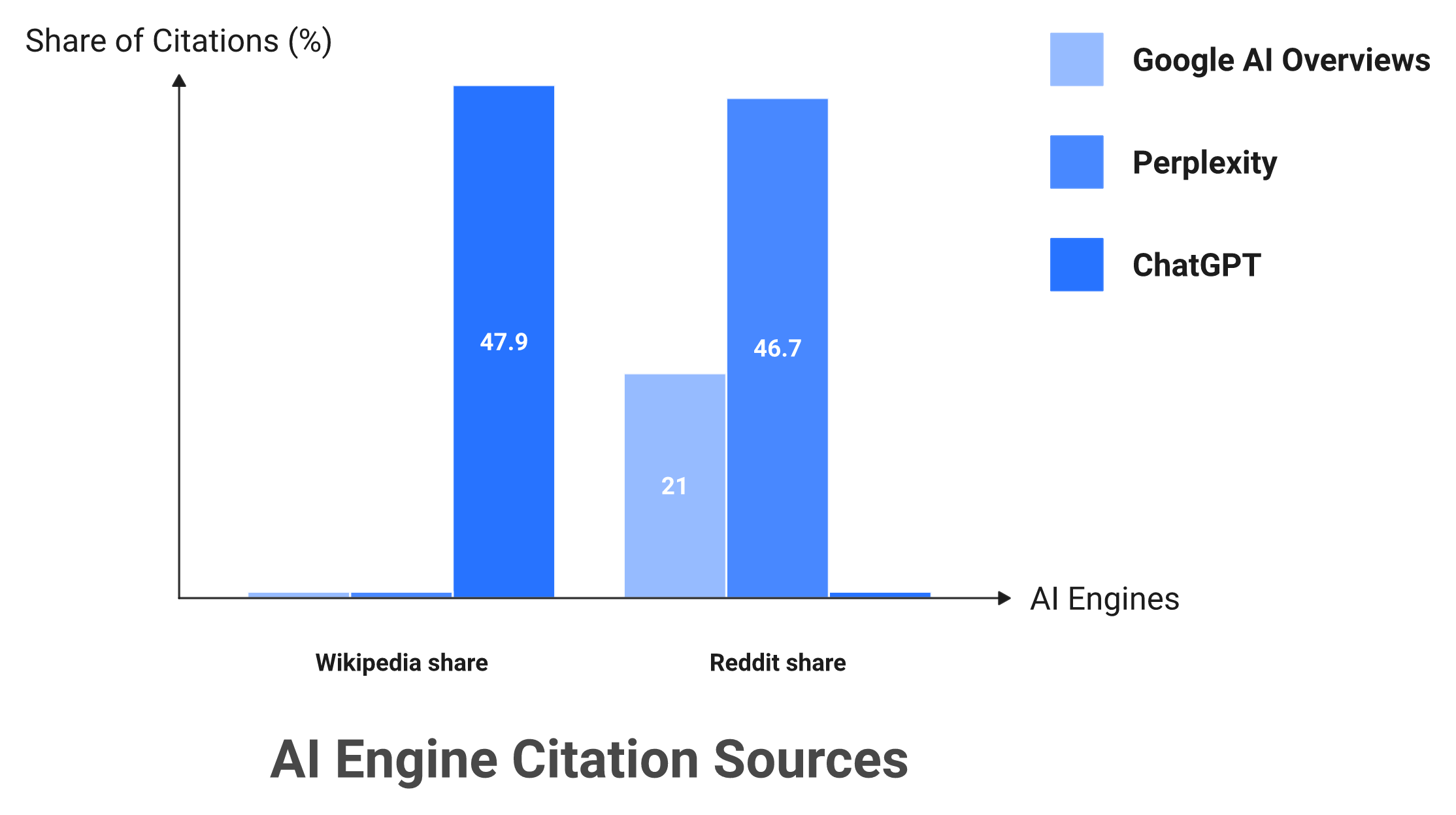
- ChatGPT leans heavily on Wikipedia, which supplies roughly 47.9% of its top-10 source share, per Profound's citation analysis.
- Perplexity leans on Reddit, which drives about 46.7% of its citations.
- Google AI Overviews also lean community-first, with Reddit near 21% of cited sources.
The overlap between engines is smaller than most teams assume. Independent citation research, across a very large sample, found only about 11% of domains cited by both ChatGPT and Perplexity, meaning most of what works on one platform is invisible on the other.
| Engine | Top-cited source (approx.) | What it rewards |
|---|---|---|
| ChatGPT | Wikipedia (~47.9%) | Entity clarity, authoritative reference pages |
| Perplexity | Reddit (~46.7%) | Community trust, freshness, transparent sourcing |
| Google AI Overviews | Reddit (~21%) | UGC, structured content, schema |
| Claude | Depth and authority | Long-form, methodology-rich sources |
⏰ Shares swing overnight
This is not a stable map you draw once. Source preferences move fast.
A Semrush-referenced 13-week study saw ChatGPT's Reddit citation share collapse from around 60% to roughly 10% after a mid-September 2025 shift, while Wikipedia dropped sharply too. A brand that bet everything on one source could lose most of its citation footprint in a single update.
There is also an on-page pattern worth noting. Roughly 44.2% of ChatGPT citations pull from the first third of the page, a "ski-ramp" where citation probability drops as you scroll. Put your most citable facts high, on every engine.
🧭 The practical implication: build for four rulebooks
So you do not optimize for "AI." You optimize per engine, and you monitor, because the map redraws itself.
Our GEO process at MaximusLabs opens by mapping the most-cited URLs for a client's real prompts across ChatGPT, Perplexity, Gemini, and Claude, because each engine drinks from a different well. From what surfaces when you actually run this, entity accuracy earns ChatGPT, authentic community presence earns Perplexity, and structured content earns Google. Treating them as one channel is the fastest way to under-index on all four.
Q4: How do you make on-page content extractable enough for AI to cite? (Tactics 1-3)
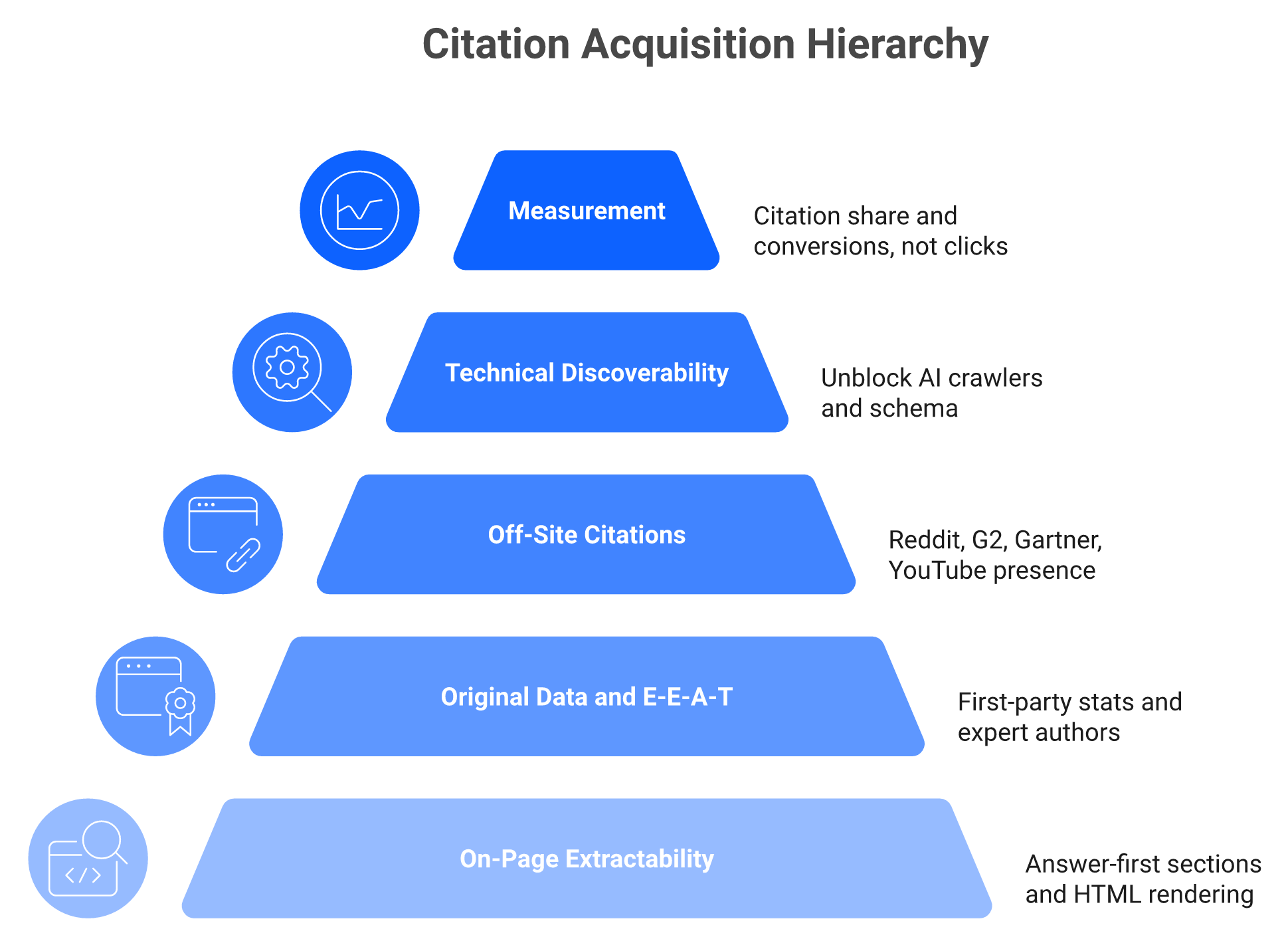
If a model cannot cleanly lift a passage from your page, it will lift one from a competitor's. Extractability is the base layer beneath every other tactic, so start here before chasing links or schema.
✅ Tactic 1: Lead every section with a standalone answer
Write a self-contained answer of 40 to 80 words directly under each heading. It must make complete sense if an engine extracts it with no surrounding context.
Placement matters as much as phrasing. Around 44.2% of ChatGPT citations come from the first third of the page, so your most citable claim belongs high, not buried in a conclusion. Lead with the answer, then expand with proof. This mirrors how answer engine optimization rewards answer-first structure and how ChatGPT rewards thorough, question-headed responses.
✅ Tactic 2: Turn keywords into the questions buyers actually ask
Buyers do not prompt in keywords. They prompt in full questions, and the long tail of those questions is enormous.
There is no clean volume dataset for chat prompts the way Google Ads gives keyword volume. The workable method, drawn from Ethan Smith's AEO guidance, is to take your high-value search keywords and transform them into questions, then mine sales calls, support tickets, and Reddit threads for the phrasings search data never captures. "Best project management software" becomes "what is the best project management software for a small remote team," and each variant is a citation opportunity. This is the core of AEO keyword and question research.
⚠️ Tactic 3: Pull citable data out of JavaScript into rendered HTML
This is the failure that hides in plain sight. If your key content loads through JavaScript, the crawler may never see it, and RAG cannot cite what it cannot render.
Ethan Smith demonstrated this by turning JavaScript off on a large company's page and watching the most citable content vanish. As he described it, "not the whole page shows up... reviews are loaded in asynchronously," so a multi-billion-dollar brand was accidentally hiding its most citable data from AI crawlers.
The fix is concrete and doable on Monday:
- Expose product and facet attributes, the material, the fabric, the neck style, and the closure, as plain text in headers and body copy, not trapped inside JS filters.
- Render reviews and ratings in HTML, so they survive a crawl.
- Test it yourself with an AI crawlability checker, load the page with JavaScript disabled, or use a site: check, and see what actually remains.
Do the first two tactics and you become quotable. Do the third and you become reachable. Miss the third, and the best answer nugget in your industry still loses to a thinner competitor whose facts render in plain HTML.
Q5: Why do original data and E-E-A-T decide whether AI trusts and cites you? (Tactics 4-5)
Open any content calendar right now and you will see the same move repeated. A team reads five ranking articles, blends them, and ships the sixth. That sixth article is exactly what AI engines are learning to skip.
⭐ The answer AI is looking for
AI engines preferentially cite content carrying verifiable statistics and clear expertise. The Princeton and IIT-Delhi GEO study found that adding credible statistics and quotations lifted visibility in generative answers by up to 40%, while keyword stuffing actively hurt. So publish original research and name authors with real credentials. In a web flooded with AI-summarized derivatives, first-party data and demonstrable human expertise are the only signals durable enough to stay citation-worthy.
⚠️ Why derivative content is invisible
Here is the complication most teams miss. When everyone summarizes the same sources, the model has no reason to pick you over the original.
There is a second trap in over-correcting with AI detectors. Graphite's research found roughly an 8% false-positive rate, where genuinely human-written content gets flagged as AI-generated. Chasing a detector score is not the same as building trust, and it can punish good work. A better path is running content through an AI content optimizer that strengthens signals rather than gaming a score.
📊 What the effect sizes actually say
The GEO paper is useful because it ranks moves by measured impact, not opinion. Statistics and citations were among the strongest levers, and combining fluency edits with statistics beat any single method by about 5.5%. Keyword density, the old reflex, moved nothing or moved you backward.
This is the pattern we keep seeing. An SEO veteran who lived through Google's spam crackdowns put it plainly: "I created spam in 2007 and I knew what Google did about it... the exact same thing was going to happen with AI." Shortcuts get penalized on a lag, then all at once. This is why our E-E-A-T for AEO approach treats trust as the durable investment.
✅ The moat is original data plus named expertise
So the resolution is not "write more." It is to run a study, share a number nobody else has, and put a credentialed human name on it. The most durable version is brand authority itself. As one operator frames it, if you build a real brand in your space, "AI HAS to recommend you... you will stand because you are THE brand."
Our trust-first methodology at MaximusLabs exists for exactly this. We engineer E-E-A-T signals, Experience, Expertise, Authoritativeness, and Trustworthiness, plus primary-source citations into every article, so an engine treats it as safe to quote. This is the backbone of our content marketing service, and practitioners are landing on the same read from the field:
"Being referenced in an AI Overview indicates to both the system and users that your brand possesses credibility... KPIs are shifting from mere clicks to metrics such as the share of citations."
u/CmdrKrz, r/SEO Reddit Thread
"Content that resists AI is only advantageous if you have a strong disdain for users of language models... the essential strategy is to produce well-structured, high-quality content."
u/abecrane, r/SEO Reddit Thread
Q6: How do you earn off-site citations on Reddit, G2, YouTube, and Wikipedia? (Tactics 6-7)
Most AI citations point to sources you do not own, so earn presence where the engine already drinks. Identify the URLs already cited for your target prompts, then win authentic Reddit threads, G2 and Capterra reviews, Tier-1 affiliate listicles, and YouTube. Referring domains are the strongest predictor of ChatGPT citations, with 350K plus domains averaging 8.4 citations versus 1.6 for small sites, and citations nearly doubling near 32,000 referring domains.
🎯 Tactic 6: Infiltrate the URLs that already get cited
Start with reconnaissance, not publishing. Find the exact pages an engine repeatedly cites for your buying questions.
The tactic, drawn from Ethan Smith's AEO work, is direct: "identify the most cited URLs for AEO topics you care about, then find a way to have those citations promote your product or brand." That usually means Reddit threads, YouTube videos, and affiliate listicles like Dotdash Meredith, not your own blog. On Reddit specifically, spam gets policed and banned; a handful of authentic, identified, genuinely useful comments do the real work. A Reddit threads finder speeds up that mapping, and our Reddit and forum AEO playbook covers the outreach.
💰 Tactic 7: Build review-platform presence buyers and engines both read
Review sites carry disproportionate weight for bottom-of-funnel prompts. When a buyer asks an AI for "best X," the answer often leans on third-party review pages.
- G2 and Capterra: seed real reviews on your profile; G2 alone commands a large share of voice in category answers.
- Gartner Peer Insights: a strong trust signal for enterprise buyers.
- YouTube: an open opportunity for unglamorous B2B topics where little video exists.
⏰ The jump point as a link-budget model
Referring domains behave like a threshold, not a slow slope. SE Ranking's analysis of 129,000 domains found citations roughly double near 32,000 referring domains, and top-tier sites with 350K plus average 8.4 ChatGPT citations. That gives you a budgeting lens: fund authority-building in tiers toward that jump point instead of buying random links.
✅ Your Monday shortlist
Do these first, in order:
- Run your top 20 buying prompts through ChatGPT and Perplexity, and log every cited URL.
- Sort by how often each URL repeats across prompts.
- Pick the three most-cited community or affiliate pages, and plan authentic engagement or outreach.
- Fill gaps in your G2, Capterra, and Gartner profiles this week.
This is what we mean by Search Everywhere Optimization at MaximusLabs. Our off-page AEO team builds cited presence on Reddit, G2, and Tier-1 media, not just the client's own domain, because from what surfaces when you actually run this, the answer is usually assembled from pages you had to earn. Practitioners see the same effect on conversions:
"This aligns with the idea that being highlighted as the 'top roofer in city X' by AI can lead to more business... when we evaluated link and content clients for those specific keywords, we observed actual conversions."
u/Sirhubi007, r/SEO Reddit Thread
"Although organic traffic might be decreasing, these chatbots can still generate significant traffic, which could potentially be more targeted and valuable."
u/cinemafunk, r/SEO Reddit Thread
Q7: What technical, schema, and site-architecture moves make you AI-discoverable? (Tactics 8-9)
Fix discoverability before chasing tactics. Unblock AI crawlers (GPTBot, OAI-SearchBot, and PerplexityBot) in robots.txt, keep citable content in rendered HTML, and add Article, FAQPage, and BreadcrumbList schema so crawlers parse your answer cleanly. House help centers in a subdirectory, not a subdomain, use point-to-point internal links so no page is orphaned, and keep content fresh. But skip the theater: Core Web Vitals shows little evidence of moving citations.
✅ Tactic 8: Access, rendering, and schema
If an engine cannot crawl or parse you, nothing else matters. Three checks come first.
- Crawler access: unblock GPTBot, OAI-SearchBot, and PerplexityBot in robots.txt, or you have zero chance of appearing in that engine's answers.
- Rendering: keep citable content in HTML, not JavaScript that loads late.
- Schema: add Article, FAQPage, and BreadcrumbList structured data so the engine maps your question-and-answer cleanly.
There is a quiet architecture win too. Move your help center into a subdirectory, not a subdomain, because "subdomains don't work as well as subdirectories," and help centers hold the specific feature and integration answers AI agents hunt for. Our technical GEO implementation starts with exactly these fixes, and a quick AI crawlability checker confirms the crawlers can actually reach you.
✅ Tactic 9: Internal linking and freshness
Think of your site like an airline route map. A point-to-point model, Southwest style, links pages directly so crawlers reach everything; a hub-and-spoke model, Singapore style, leaves pages orphaned and uncrawled. Link your citable pages to each other on purpose.
Freshness compounds this. Perplexity leans toward content updated in the last 6 to 18 months, so a dated refresh cadence keeps you eligible. A structured GEO content refresh keeps older pages in the retrieval set.
⚠️ The honest part: what is overrated
Here is where the standard technical-SEO checklist gets it backwards. Not everything on it moves citations.
As one 18-year practitioner put it, "technical SEO is the biggest waste of time... in 15 years I've never seen Core Web Vitals drive a traffic increase." Page speed matters for users, but do not confuse a green Core Web Vitals score with a citation strategy. Skip LLM.txt-only rituals that lack evidence of impact.
In our Week-1 technical sprint at MaximusLabs, we unblock AI crawlers and pull citable data into rendered HTML first, then deliberately skip the vanity fixes other agencies bill for. You can see the priorities in our technical SEO and website audit. We could be wrong on how long Core Web Vitals stays irrelevant, but across our audits, access and structure move citations while speed scores rarely do.
Q8: How do you measure and monitor AI citations to prove pipeline impact? (Tactic 10)
Measure citations as a revenue channel, not a vanity chart. Since June 2025, ChatGPT appends utm_source=chatgpt.com, so filter GA4 for AI referrals and track conversions, not clicks. Monitor citation share across thousands of prompt variants rather than single rankings, and re-check weekly because shares shift fast. It matters because LLM traffic converts far higher, with roughly a 6x conversion difference reported versus generic Google search traffic.
✅ Tactic 10: Track share and conversions, not clicks
The right metric is share of voice: how often you appear in the answer across many prompt variants, not a single rank. AI answers vary per query and per platform, so one ranking number tells you almost nothing.
Then close the loop on revenue. ChatGPT's utm_source=chatgpt.com parameter, live since June 2025, lets you filter GA4 for AI referrals and follow them to conversions, not just sessions. Our GEO ROI and revenue attribution approach ties those referrals to pipeline.
💰 Why the revenue framing holds
The reason to bother is intent. Webflow reported a 6x higher conversion rate from LLM traffic than from Google search, because conversational queries build context before the click.
Focus is the multiplier here. Roughly 19 of 20 landing pages drive about 85% of traffic, and a small share of the work produces most of the impact. So instrument your top BOFU prompts and pages first, and ignore the long tail of vanity dashboards. Our GEO measurement and metrics framework keeps the focus there.
⏰ Cadence: re-check weekly
Citation shares are volatile, so treat monitoring as a live task, not a quarterly report. Tools like Profound or Goodie AI can automate share-of-voice tracking across ChatGPT, Perplexity, Gemini, and Claude, and our AI search visibility and brand mention tracking guide compares the options.
Our share-of-voice tracking at MaximusLabs measures citation rate across thousands of prompt variants, which is how we showed one client a 64% citation rate against billion-dollar incumbents stuck near 30%. You can see the full write-up in our Oliv AI case study. That number only means something because it maps to pipeline, not impressions. Practitioners are converging on the same shift in what to measure:
"Examine your Search Console by filtering for click-through rates over the past 90 days on your most important queries... if impressions remain stable while clicks are declining, it's likely those queries are being overshadowed by AI Overviews."
u/anonymous, r/SEO Reddit Thread
"KPIs are shifting from mere clicks to metrics such as the share of citations, sentiment of mentions, and growth in branded searches."
u/CmdrKrz, r/SEO Reddit Thread
Q9: What's the biggest citation-acquisition mistake, and what should you do first?
Picture the pattern that plays out in boardrooms every quarter. A brand hires an agency, gets handed a twelve-month roadmap, waits, sees no movement, and loses the engineering team's trust. Then they fire the agency and hire another one, restarting the same clock. We call it the SEO death spiral, and citation work dies inside it fastest.
❌ The mistake: volume and theater over trust
The biggest mistake is optimizing for volume instead of trust, chasing top-of-funnel pageviews and technical theater while ignoring the bottom-of-funnel prompts that decide deals. Start where revenue lives. Pick your top 20 BOFU buying prompts, make each page extractable and data-backed, then earn off-site citations on the sources those answers already pull from. Being average is now the fatal error, because the penalty for being average has never been so severe.
⚠️ Over-optimization is its own trap
The second failure is optimizing so hard the content stops making sense. Keyword-first writing produces pages no human, and increasingly no model, wants to cite.
One veteran described reading a luxury-hotel page that bragged about "a bathtub with water that came out of a faucet," content so hyper-optimized it lost basic logic. AI engines reward information gain, meaning something genuinely new, not the tenth rewrite of the same paragraph. This is why our GEO content optimization approach starts from original angles, not blended summaries.
✅ The fix: BOFU-first, in a tight sequence
So the resolution is to work in the order that touches revenue first. This is a cash decision, not a vanity one.
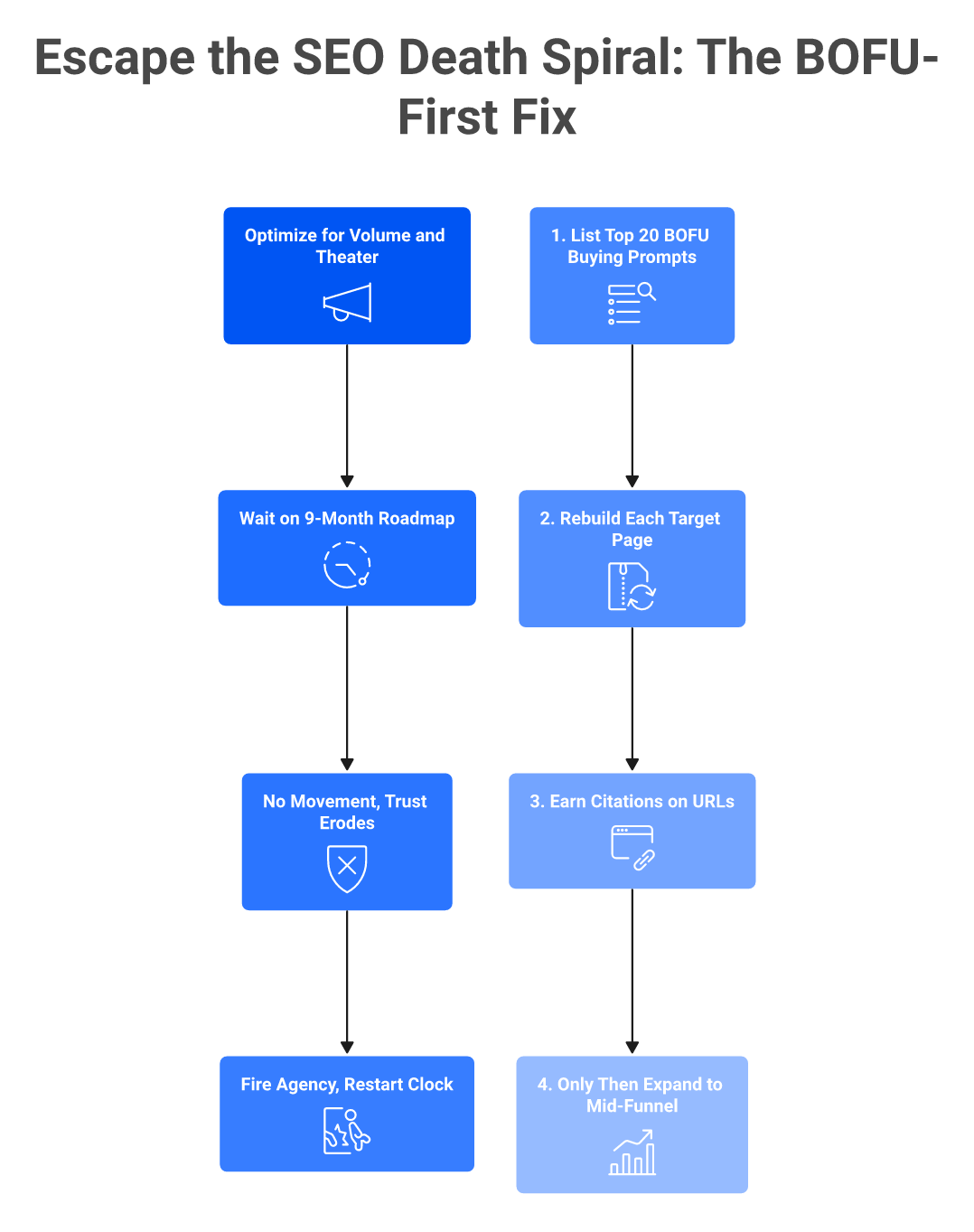
- List your 20 highest-intent buying prompts, the ones a ready buyer asks.
- Rebuild each target page to answer those prompts and their follow-ups.
- Earn citations on the community and review URLs those answers already cite.
- Only then expand to mid-funnel topics.
Speed protects trust here. As one operator put it, agencies say a fix "is going to take nine months," when the real work can ship in days if the team is built for it. Our B2B SaaS AEO strategies are built around that BOFU-first sequence, and a clear GEO strategy framework keeps the roadmap honest.
💰 Why BOFU-first pays
The payoff is measurable and fast. One nutrition brand focused on ranking for its top 20 bottom-of-funnel keywords, and e-commerce sales roughly doubled over six months. The full write-up is in our nutrition SEO agentic commerce case study.
We start every engagement on BOFU, not TOFU, at MaximusLabs, and our first article can be live within four days, because the death spiral is a roadmap problem, not a capability problem. You can see how we scope this in our GEO service. From what surfaces when you actually run this, buyers feel the compounding value once the answer starts naming them:
"This aligns with the idea that being highlighted as the 'top roofer in city X' by AI can lead to more business... when we evaluated link and content clients for those specific keywords, we observed actual conversions."
u/Sirhubi007, r/SEO Reddit Thread
"KPIs are shifting from mere clicks to metrics such as the share of citations, sentiment of mentions, and growth in branded searches."
u/CmdrKrz, r/SEO Reddit Thread
Q10: What comes next for AI citation acquisition, and where is the durable advantage?
Citation acquisition is moving past the webpage. As agentic commerce grows, AI agents will transact without users ever visiting your site, so your data must be readable at the transaction layer, not just the dining room. My hypothesis: as models increasingly train on their own outputs, brand authority becomes the only durable moat. The brands with real, cited authority now will compound, and everyone else gets averaged out.
🔮 The ghost kitchen shift
Think of your website as the dining room and agentic commerce as the kitchen. In that model, the AI agent places the order, and the customer never walks into your building.
That changes what you optimize. Your product data, pricing, and attributes have to be machine-readable where the transaction happens, not just pretty where the human used to browse. Our agentic commerce service prepares that transaction layer, and our state of agentic commerce 2026 report maps where it is heading.
⭐ Brand as the moat against model collapse
Here is the deeper bet. As models increasingly summarize other AI summaries, a risk called model collapse, derivative content gets thinner and less trustworthy over time.
Real brand authority is what survives that. As one operator argues, if you build a genuine brand in your space, "AI HAS to recommend you... no matter how many algorithm updates come." We could be early on this, but across the GEO programs we have run at MaximusLabs, brand-backed pages hold their citations through updates while thin pages churn. Our zero-click search brand economy research and future trends in GEO analysis both point the same way.
⏰ Where we are still uncertain
The honest part: even the experts disagree on timing. One 18-year practitioner calls first-mover advantage "a false concept," arguing new pages rank quickly whenever a channel matures. Another builder insists there is "always first-mover advantage" for brands that entrench early.
Where our thinking sits right now is somewhere between them: being cited early builds the authority that compounds, even if the mechanical lead does not last. What we think shifts over the next two years is that "becoming the answer" stops being an edge and becomes table stakes.
So the question we are sitting with, and would genuinely like to compare notes on: which of your buying prompts already name a competitor, and what would it take to earn your way into that answer instead? That is the conversation worth having, and it is exactly where a conversation with our team starts.
Frequently asked questions
What are AI citation acquisition tactics and why do they matter now?
AI citation acquisition tactics are the on-page and off-page moves that get an AI engine to name your brand inside its synthesized answer, not just rank your page. This matters because AI search is binary. You are either folded into the answer, or you do not exist for that query. The economics have shifted underneath the old channel. Seer Interactive tracked organic click-through rate dropping 61% on queries showing an AI Overview, while Amsive found cited pages can capture up to 35% more clicks than uncited ones. Ranking first no longer guarantees visibility in the answer box that decides the deal. A buyer asking an AI for the best tool sees only five to ten brands, and that short list is the entire evaluation set. Citation share, how often you appear across buying prompts, maps to pipeline better than impressions. We stopped leading client reports with rankings and started leading with citation share and GEO metrics , because that number tracks to revenue rather than vanity traffic.
How is AI citation acquisition different from traditional SEO?
Traditional SEO optimizes one page to rank among ten blue links. AI citation acquisition engineers signals so a model selects your brand and folds it into a single synthesized answer, which makes it closer to a data-science problem than a keyword problem. The queries themselves changed. The average Google search runs about six words, while the average chat prompt runs around 25 words, so keyword-density thinking cannot keep up with conversational intent. You optimize the retrieval-augmented generation step, meaning what gets retrieved and trusted, not just what gets indexed. The Princeton and IIT-Delhi GEO study showed adding statistics, quotations, and cited sources lifted generative visibility by up to 40%. Signals that win ChatGPT differ from those that win Perplexity or Google. This is why we treat it as GEO rather than SEO , using our revenue-focused R-GEO approach instead of bolting a GEO label onto an old playbook.
Which sources do ChatGPT, Perplexity, and Google AI Overviews actually cite?
There is no single AI search to optimize for. There are four engines with four different diets, so a tactic that feeds one can be ignored by another. ChatGPT leans heavily on Wikipedia, roughly 47.9% of its top-10 source share per Profound's analysis. Perplexity leans on Reddit, around 46.7% of its citations. Google AI Overviews also lean community-first, with Reddit near 21% of cited sources. The overlap is smaller than teams assume, with research finding only about 11% of domains cited by both ChatGPT and Perplexity. Source shares also swing fast, so this is not a map you draw once. There is a placement pattern too: roughly 44.2% of ChatGPT citations pull from the first third of the page. Our GEO process maps the most-cited URLs across Perplexity, ChatGPT, Gemini, and Claude , because each engine rewards different signals and treating them as one channel under-indexes on all four.
How do you make on-page content extractable enough for AI to cite?
If a model cannot cleanly lift a passage from your page, it will lift one from a competitor. Extractability is the base layer beneath every other tactic. Lead every section with a self-contained answer of 40 to 80 words that makes sense with no surrounding context. Place your most citable claim high, since around 44.2% of ChatGPT citations come from the first third of the page. Transform keywords into the full questions buyers actually ask, mined from sales calls, support tickets, and Reddit threads. Pull citable data out of JavaScript into rendered HTML, because retrieval cannot cite what it cannot render. Ethan Smith demonstrated the JavaScript trap by disabling JS on a large brand's page and watching its most citable reviews vanish. Expose product attributes and reviews as plain text, then verify with an AI crawlability checker by loading the page with JavaScript off. Do the first tactics to become quotable, and fix rendering to become reachable.
How do original data and E-E-A-T influence whether AI cites you?
AI engines preferentially cite content carrying verifiable statistics and demonstrable expertise. When everyone summarizes the same sources, the model has no reason to pick you over the original. The Princeton and IIT-Delhi GEO study found that adding credible statistics and quotations lifted generative visibility by up to 40%, while keyword stuffing actively hurt. Combining fluency edits with statistics beat any single method by about 5.5%. Publish original research and share a number nobody else has. Name authors with real credentials to signal experience and authority. Avoid chasing AI detector scores, since Graphite found roughly an 8% false-positive rate flagging human writing. The most durable version is brand authority itself, where a genuine brand becomes something engines have to recommend. Our E-E-A-T for AEO approach engineers Experience, Expertise, Authoritativeness, and Trustworthiness plus primary-source citations into every article so an engine treats it as safe to quote.
How do you earn off-site AI citations on Reddit, G2, and YouTube?
Most AI citations point to sources you do not own, so you have to earn presence where the engine already drinks. Start with reconnaissance, not publishing. Run your top buying prompts through ChatGPT and Perplexity, and log every cited URL. Win authentic Reddit threads, since spam gets policed and a handful of genuinely useful comments do the real work. Seed real G2 and Capterra reviews, and build Gartner Peer Insights presence for enterprise trust. Use YouTube for unglamorous B2B topics where little video exists. Referring domains are the strongest predictor of ChatGPT citations. SE Ranking's analysis of 129,000 domains found citations roughly double near 32,000 referring domains, and top-tier sites with 350K plus average 8.4 citations versus 1.6 for small sites. Our off-page team builds cited presence through a Reddit and forum AEO playbook, because the answer is usually assembled from pages you had to earn rather than your own domain.
How do you measure AI citations to prove pipeline impact?
Measure citations as a revenue channel, not a vanity chart. The right metric is share of voice, meaning how often you appear in the answer across many prompt variants, not a single rank. Since June 2025, ChatGPT appends utm_source=chatgpt.com, so filter GA4 for AI referrals and follow them to conversions. Track citation share across thousands of prompt variants, and re-check weekly because shares shift fast. Instrument your top bottom-of-funnel prompts and pages first, since a small share of pages drives most traffic. The revenue framing holds because intent is higher. Webflow reported a 6x higher conversion rate from LLM traffic than from Google search. Our share-of-voice tracking showed one client a 64% citation rate against incumbents stuck near 30%, detailed in our Oliv AI case study . That number matters only because it maps to pipeline, not impressions, which is the core of our GEO ROI and revenue attribution approach.
What is the biggest AI citation acquisition mistake to avoid?
The biggest mistake is optimizing for volume instead of trust, chasing top-of-funnel pageviews and technical theater while ignoring the bottom-of-funnel prompts that decide deals. That habit feeds the SEO death spiral, where teams wait on long roadmaps, see no movement, and restart with a new agency. Pick your top 20 bottom-of-funnel buying prompts, the ones a ready buyer asks. Rebuild each target page to answer those prompts and their follow-ups. Earn citations on the community and review URLs those answers already cite. Only then expand to mid-funnel topics. Over-optimization is its own trap, since keyword-first writing produces pages no human, and increasingly no model, wants to cite. One nutrition brand focused on its top 20 bottom-of-funnel keywords and roughly doubled e-commerce sales over six months. We start every engagement BOFU-first through our B2B SaaS AEO strategies , because the death spiral is a roadmap problem, not a capability problem.