 Krishna Kaanth M
- CCBot is Common Crawl's crawler that fetches billions of pages monthly into an open archive most AI labs reuse for training, while sending you zero referral traffic.
- Being crawled does not mean being trained on. Labs run heavy quality filtering, so 45TB of raw text can collapse to roughly 570GB of training data.
- Blocking CCBot does not remove you from AI search. Training crawlers (CCBot, GPTBot, ClaudeBot) and search crawlers (OAI-SearchBot, PerplexityBot) are separate and toggled independently.
- The crawl-to-referral trade is lopsided, with Anthropic crawling roughly 38,065 pages per referred visitor in July 2025, which is why operators call training bots parasitic.
- Most AI crawlers do not execute JavaScript, so server-side rendering or static HTML is a hard prerequisite for being trained on or cited.
- Govern crawlers by business model and pipeline, verify real bots via published IP ranges, and prioritize the roughly 5% of pages driving 85% of traffic.
Q1. What is CCBot, and how does Common Crawl actually access your website?
Open your server logs after a traffic dip, and you will often spot a quiet visitor named CCBot pulling page after page. Most teams see the hits, shrug, and move on. That shrug is the mistake.
CCBot is Common Crawl's web crawler, run by a nonprofit founded in 2007. It identifies as CCBot/2.0 (https://commoncrawl.org/faq/), obeys robots.txt, and fetches roughly 3 billion pages per monthly crawl into a 10-plus petabyte open archive. Nearly every major AI lab reuses that archive to train large language models. CCBot itself sends no clicks, citations, or referral traffic to your site.
🔎 The bot you see in your logs
The user-agent string is your first clue. When you see CCBot/2.0 in your access logs, that is Common Crawl fetching your HTML for its public dataset. It is not Google, and it is not ChatGPT browsing live.
Common Crawl publishes its crawler IP ranges at index.commoncrawl.org/ccbot.json, so you can verify a real fetch versus a spoofer. That detail matters later when you decide what to allow. Running your key pages through an AI crawlability checker confirms whether these bots can actually reach them.
⚙️ How the crawl actually works
CCBot is built on Apache Nutch and runs on Hadoop, using Map-Reduce to pick crawl candidates from its database. It prioritizes URLs using Harmonic Centrality, a link-based importance score, then fetches at a rate-limited pace so it does not hammer your server.
The cadence is monthly. Each crawl captures billions of pages and stores them as raw WARC archive files, the standard format for web-scale corpora.
🍳 The chef in an empty room
Here is a mental model we lean on when explaining this to founders. Picture a world-class chef sitting in an empty room. The brain is identical to the chef in a Michelin kitchen, but nothing is wired around it.
CCBot is the ingredients supplier, not the kitchen. It gathers the raw material that models learn from, but it is not the live search agent that answers a buyer in ChatGPT. Confusing the two is where most "block all AI bots" advice goes wrong, which is why managing AI crawlers like GPTBot and Google-Extended deserves real attention.
That reuse chain is direct. GPT, LLaMA, and Mistral models have all drawn on Common Crawl-derived data, often through filtered subsets like C4 and CCNet. So a single CCBot fetch can feed dozens of downstream models.
The payoff to hold onto is this. CCBot feeds training corpora, not a user-facing product. It drives zero referral traffic, which is exactly why the block-or-allow choice deserves more thought than a reflex edit to robots.txt, and why our generative engine optimization work starts here.
Q2. Does allowing CCBot turn your content into AI training data, and what does that funnel look like?
A founder once asked us, mid-audit, whether allowing CCBot meant their entire blog was "now inside ChatGPT." The honest answer is more interesting than yes or no.
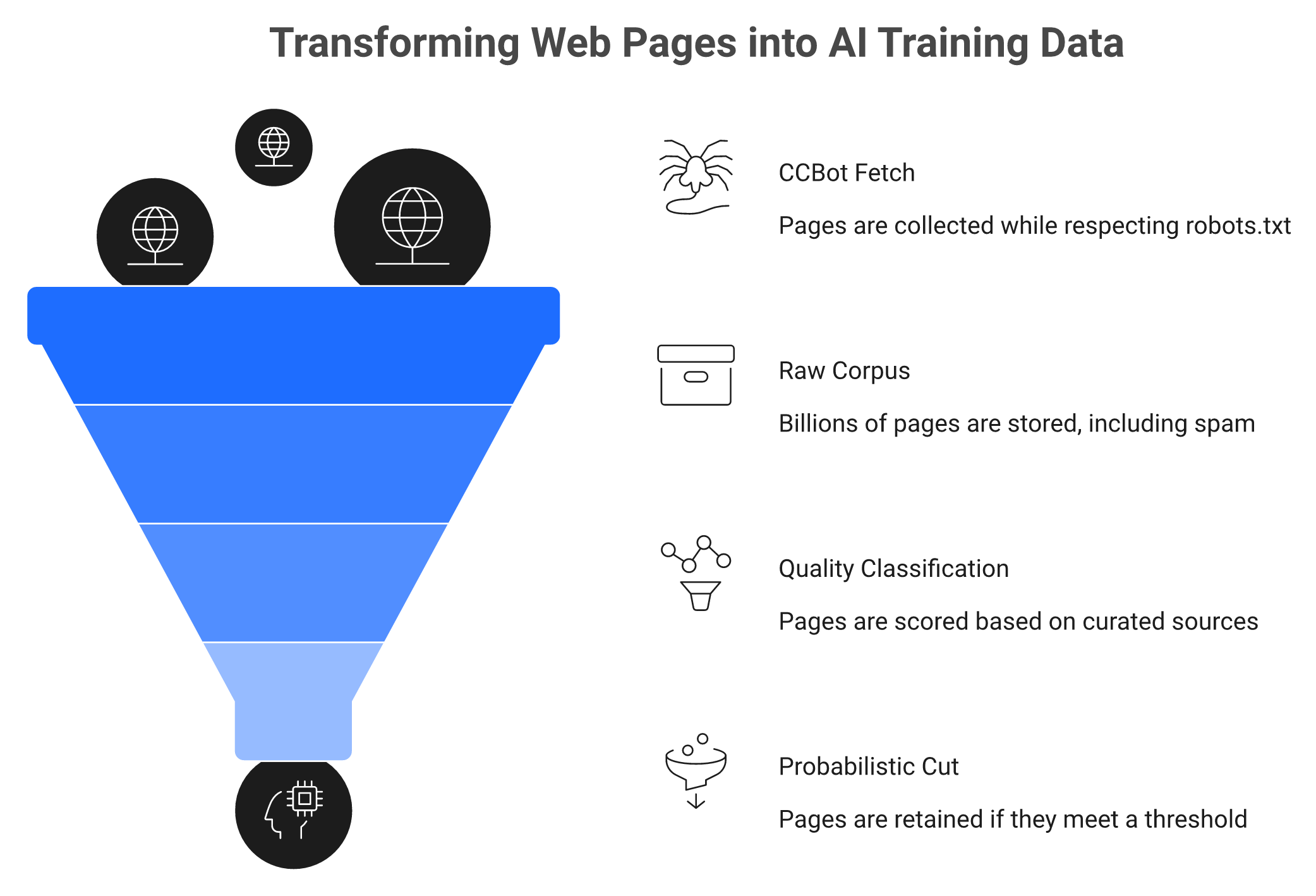
Yes, if CCBot reaches a page, it enters the raw Common Crawl corpus, which AI labs then filter hard. GPT-3's team ran a logistic-regression classifier scoring each document against curated sources like Wikipedia and WebText, discarding most of it. 45 TB of compressed text collapsed to about 570 GB of training data. Being crawled is necessary but not sufficient. Quality filtering decides inclusion.
📥 Crawled does not mean trained
Getting fetched only puts you in the raw pile. The raw Common Crawl corpus is enormous, messy, and full of spam, boilerplate, and duplicate pages.
Labs do not train on that mess directly. They run heavy filtering to pull out a smaller, cleaner set, and most of the web gets thrown away in the process.
🧮 The exact math that keeps or drops your page
For GPT-3, OpenAI trained a classifier where the positives were curated text (WebText, Wikipedia, and a web-books corpus) and the negatives were unfiltered Common Crawl. Each document got a quality score. A document was kept only if np.random.pareto(9) was greater than 1 minus the document score.
In plain terms, higher-quality pages clear a probabilistic bar, and low-quality pages almost always fail it. That is how 45 TB shrinks to roughly 570 GB. Structuring for this reality is the core of real GEO content optimization.
🎯 Why raw meaning beats keyword density
Think of the model as a universal intent decoder. It does not care how you phrase a heading. It reads for genuine substance, not stuffed keywords.
That reframes the job. Keyword stuffing does not just fail to help, it can hurt. One measured penalty showed keyword-stuffed content performing about 10% worse than baseline on Perplexity. Thin content and derivative rewrites are exactly what the classifier is built to discard.
This is where our approach differs from traditional agencies still counting keyword density. We structure content for the quality-classifier reality, prioritizing semantic depth, entity richness, and primary-source research through our content marketing service, so a page clears the filter instead of getting cut. The gate is not access. The gate is quality.
Q3. If you block CCBot, do you disappear from ChatGPT, Perplexity, and Google AI Overviews?
Every few weeks, a Head of Growth forwards us the same panicked note. "Legal wants to block the AI bots. Will that make us invisible in ChatGPT?" It is the right fear, aimed at the wrong target.
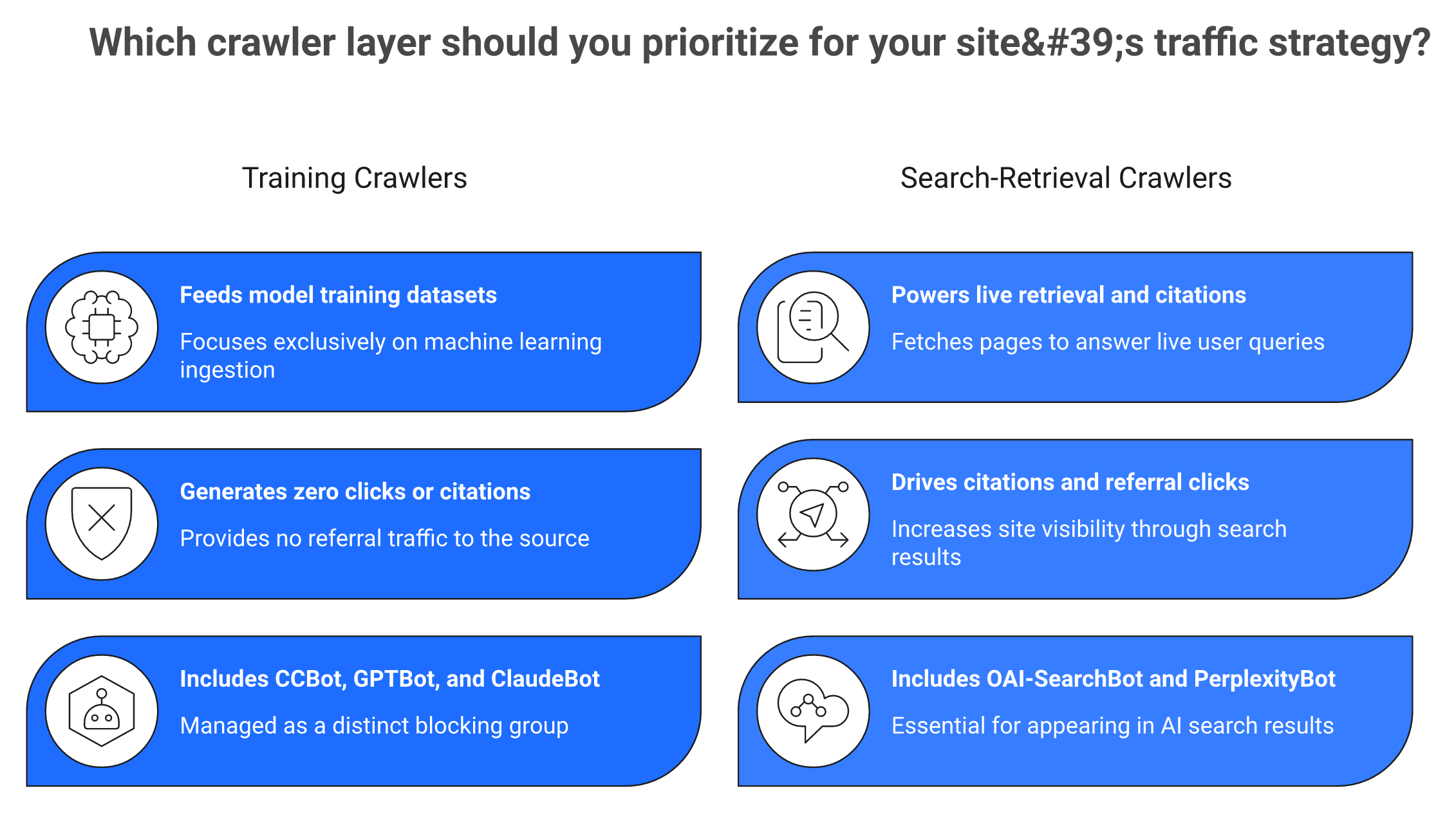
No, blocking CCBot does not remove you from AI search, and vice versa. Every major AI platform now runs separate, independently-toggleable crawlers. One set is for model training (CCBot, GPTBot, and ClaudeBot), and another is for live search retrieval (OAI-SearchBot and PerplexityBot). Blocking a training bot only drops you from that dataset. Your live AI-search visibility depends on the retrieval bot you must allow explicitly.
😰 The real dilemma
The reader is stuck between two bad feelings. Training bots feel parasitic, so blocking them feels responsible. But blocking anything AI-related feels like career risk if visibility craters.
That tension is legitimate. It just assumes there is one switch, when there are actually two.
🚪 The "back door" anxiety
The next worry is subtler. "If I allow the search bot, is the training bot sneaking in through the back door?"
The reassuring reality is that these crawlers use different user-agent tokens and can be toggled independently. Allowing OAI-SearchBot for live retrieval does not silently hand your pages to GPTBot for training. You control each one, which is the foundation of real answer engine optimization.
🧭 Two layers, two decisions
Here is the clean separation.
- Training crawlers (CCBot, GPTBot, and ClaudeBot) feed model training datasets.
- Search-retrieval crawlers (OAI-SearchBot and PerplexityBot) fetch pages to answer live queries and generate citations.
- Blocking one layer does not touch the other.
⚠️ The configuration trap that kills citations
This is where good intentions backfire. Many sites report that they "allowed OpenAI," yet they earn zero ChatGPT citations, because they allowed only GPTBot and never allowed OAI-SearchBot, the bot that powers ChatGPT search. OAI-SearchBot is separate from both GPTBot and Bingbot.
Ethan Smith, an 18-year SEO veteran and CEO of Graphite, frames the technical baseline bluntly. He says to check your robots.txt so you are not blocking OpenAI's crawlers, because if you are, you have zero chance of appearing in ChatGPT's results. Our ChatGPT SEO guide walks through this exact configuration.
The payoff is control. Granular, per-bot governance is how you "become the answer" instead of accidentally erasing yourself. In our GEO service work, we audit and toggle each crawler independently, so clients stay cited in AI search while still controlling training exposure. That is a deliberate configuration, not a checkbox.
Q4. Why is the crawl-to-referral trade so lopsided, and are training bots "parasitic"?
Pull up your analytics next to your crawl logs, and the mismatch is jarring. Thousands of AI fetches, almost no visitors sent back. Operators feel robbed, and the numbers say they are not imagining it.
AI crawling is now roughly 80% training-driven, and the exchange is brutally one-sided. In July 2025, Anthropic crawled about 38,065 pages for every visitor it referred back, a 38,065 to 1 ratio. Training crawlers ingest content at scale while sending almost no clicks or citations in return. That imbalance is why operators call them parasitic, and why the block-or-allow decision is genuinely consequential, not cosmetic.
📊 Crawling stopped being about indexing
The purpose of crawling has shifted under our feet. It used to mean indexing for search. Now the bulk of it, around 80%, exists to feed model training.
That changes the value exchange. A search crawler at least promised a possible click. A training crawler makes no such promise.
💸 The 38,065-to-1 problem
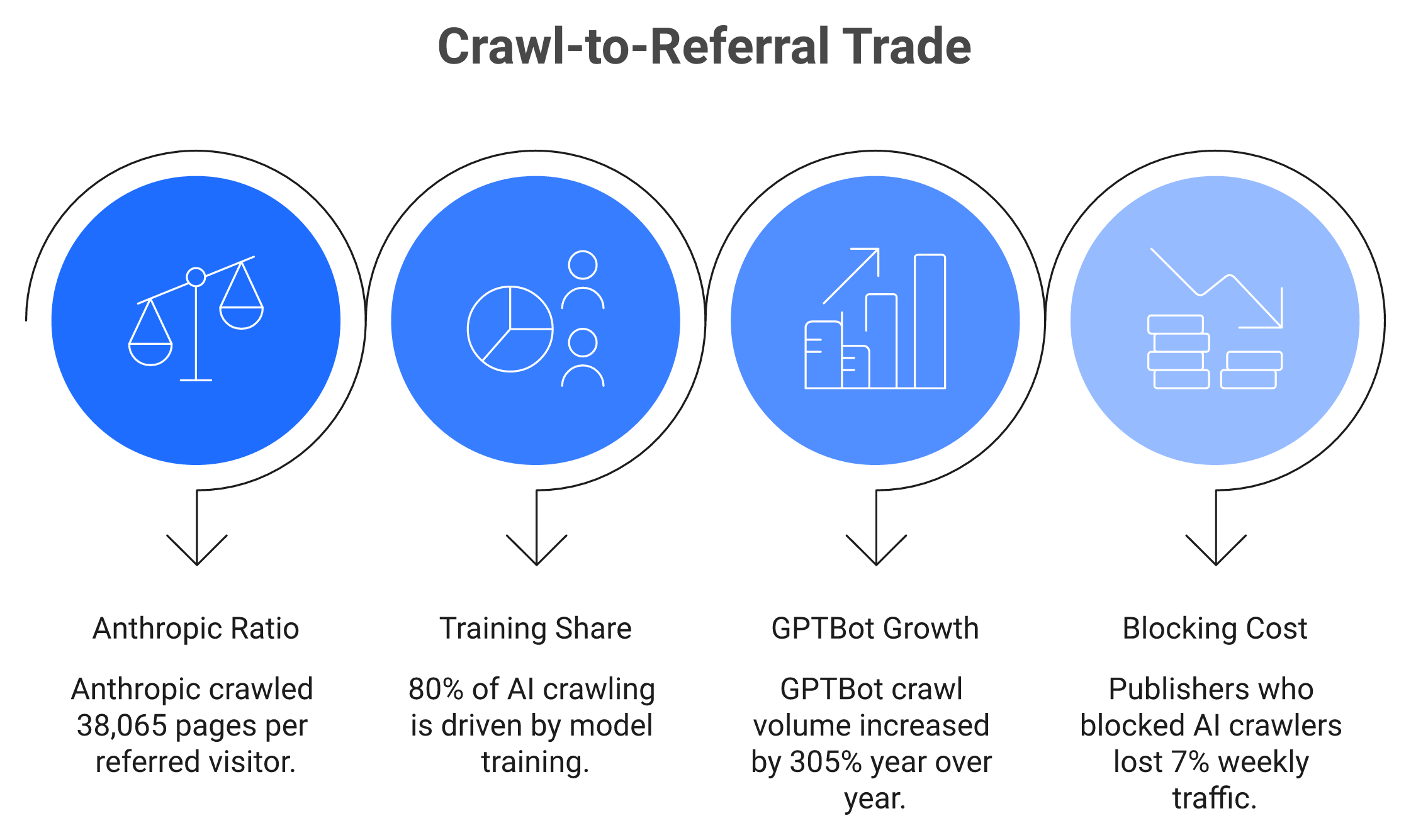
The clearest illustration is Anthropic's ratio in July 2025, roughly 38,065 pages crawled for a single referred visit. Read that again. Tens of thousands of fetches for one human on your site.
Compared against a search engine that returns traffic for the pages it takes, "parasitic" stops sounding like hyperbole. It starts sounding like a fair description of the trade, and it reshapes how we think about GEO ROI and revenue attribution.
🕰️ A pattern we have seen before
Here is where a longer memory helps, and where we defer to someone who lived it. Ethan Smith recalls the scraped-content era, describing how he created spam in 2007, how he and all the other shopping comparison people scraped each other's content and reviews, and how it worked really well and then it stopped working.
His read is that today's training gold rush rhymes with 2008-era mass automation that quality filters eventually nuked. We think he is probably right, though we hold that loosely, because the platforms are bigger and the incentives are murkier this time.
The resolution is not emotion, it is business model. If you sell licensed or gated content, guarding it from parasitic training bots makes sense. If you sell software and want AI-search visibility, reflexively blocking everything can cost you the very channel where buyers now discover you. Decide by what your revenue actually depends on, not by how the ratio makes you feel, and let our B2B SEO service pressure-test that call against your pipeline.
Q5. Should you allow AI training at all, what's the revenue case, and can you trust Common Crawl?
A VP of Marketing told us last quarter that her legal team wanted every AI bot blocked by Friday. Her growth team wanted the opposite. Both were reacting to headlines, not to their own pipeline.
It depends on your business model, but the data warns against blanket blocking. Ahrefs found AI Overviews cut position-one clicks by about 58%, and Seer Interactive measured organic CTR falling from 1.76% to 0.61% on AI-Overview queries. Being cited inside AI answers increasingly replaces the click. Yet Common Crawl faces transparency scrutiny, so allow-or-block should be a deliberate, per-bot decision tied to pipeline, not a reflex.
📉 The click you are defending is shrinking
Start with what is actually happening to traditional search. When an AI Overview appears, the top organic result loses roughly 58% of its clicks. Seer's data tells the same story from another angle, with organic CTR dropping from 1.76% to 0.61% on those queries.
So the "safe" position, keep doing Google SEO and block the AI bots, quietly defends a channel that is leaking value every quarter, which is exactly why the shift toward GEO versus traditional SEO matters now.
💸 Blocking is not free
Here is the complication. Blocking training bots carries a measured cost, not just an upside. Publishers who blocked AI crawlers lost about 7% of weekly traffic within six weeks.
Meanwhile, the crawling itself is exploding. GPTBot's crawl volume grew 305% between May 2024 and May 2025. A "set it and forget it" block cuts you off from a channel that is still compounding, so managing AI crawlers like GPTBot and Google-Extended deserves a deliberate policy.
⚠️ The trust question nobody answers cleanly
Now the honest tension. Common Crawl faces real scrutiny over how transparently it represents its activity to publishers, documented in reporting by The Atlantic in November 2025. Consent standards are still forming, with the IETF's AIPREF working group building a formal signal for AI-training permissions.
Reasonable people disagree here, and we hold our view loosely. If you license or gate content, guarding it is defensible, and our work on GEO compliance and privacy starts from that premise.
🎯 Reframe the decision around revenue
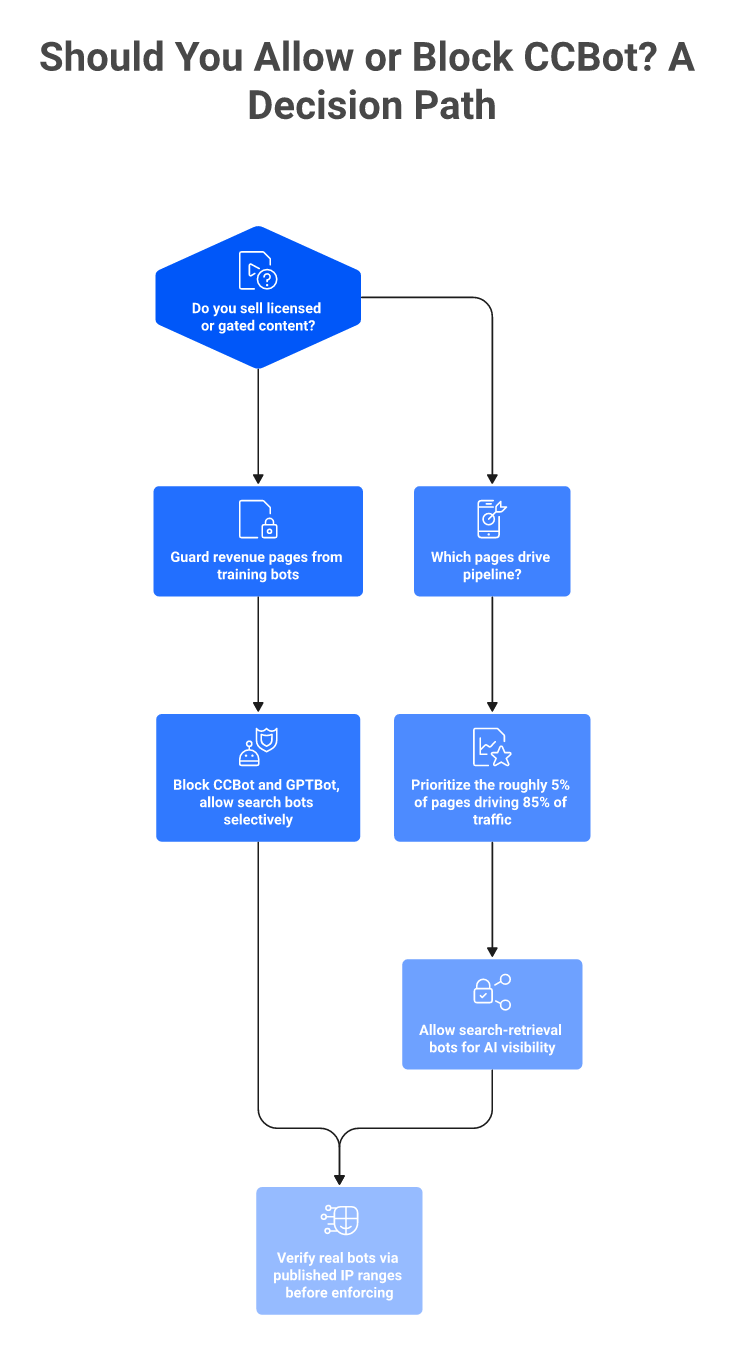
The move is to stop asking "block or allow AI?" and start asking "which pages drive pipeline?" Roughly one in twenty landing pages drives about 85% of your traffic. Those revenue pages usually belong in AI answers, and the long tail of thin pages rarely matters either way.
We built our crawler-governance audit around exactly this. Before any robots.txt change ships, we model the traffic and pipeline impact of each allow-or-block choice through our GEO service, so the decision serves revenue instead of headlines. That is the difference between defensive SEO and revenue-focused GEO with real attribution.
Q6. How do you block, allow, and verify CCBot (and its cousins) in robots.txt?
Most "how to block CCBot" posts stop at one line of code. That line is where the real mistakes start, because one rule never covers the whole crawler zoo.
To block CCBot, add to robots.txt: User-agent: CCBot then Disallow: /. To allow it, use Allow: / or omit any disallow. Manage each AI crawler with its own token, since one rule never covers them all. Rules are advisory and not retroactive. Verify real CCBot against the published IP ranges at index.commoncrawl.org/ccbot.json before enforcing blocks.
🧾 The exact CCBot snippet
Here is the block directive. Add User-agent: CCBot on one line, then Disallow: / on the next.
To allow it, either add Allow: / or simply leave CCBot out of your disallow rules. Remember, this is advisory, and it does not remove data from past crawl snapshots. A quick pass through our AI crawlability checker confirms what each bot can actually reach.
🤖 One token per bot
Each AI crawler answers to its own user-agent token. Block or allow them individually.
| Crawler | robots.txt token | Primary purpose |
|---|---|---|
| Common Crawl | CCBot | Open training dataset |
| OpenAI training | GPTBot | Model training |
| OpenAI search | OAI-SearchBot | ChatGPT search retrieval |
| Anthropic | ClaudeBot | Model training |
| Perplexity | PerplexityBot | Live retrieval |
| Google AI | Google-Extended | Gemini training opt-out |
🛡️ When rules are not enough
robots.txt is a request, not a lock. For bots that ignore it or spoof a user agent, enforce at the server level using nginx, Apache, or Cloudflare rules that match user agent or IP.
Verification matters here. Confirm real CCBot against the IP ranges Common Crawl publishes at ccbot.json, and use reverse DNS to catch impersonators, which is a core step in our technical SEO and website audit.
⏰ Timing and honest caveats
Changes are not instant. OpenAI crawls from Des Moines, Iowa, and Phoenix, Arizona, on Azure IP ranges, and robots.txt changes take roughly 24 hours to propagate.
Compliance is not guaranteed either. Anthropic lags on verification and is spoofable, so its robots.txt compliance is effectively unclear per Cloudflare. Write the rules, verify behavior in your logs, and lean on technical GEO implementation to keep them clean.
Q7. Can AI crawlers even see your content, or are they blind to your JavaScript?
A brand once came to us ranking page one on Google, yet invisible across ChatGPT and Perplexity. Their content looked perfect in a browser. The crawlers were seeing a blank page.
With one exception, no major standalone AI crawler executes JavaScript. GPTBot, OAI-SearchBot, ChatGPT-User, ClaudeBot, PerplexityBot, Meta, ByteDance, and CCBot all fetch your HTML, but they do not render JS. If your content only appears after client-side JavaScript runs, the most advanced models in the world are effectively blind to it. Server-side rendering or static HTML is a hard prerequisite for AI training and AI search.
🧩 The assumption that breaks things
Most "technical SEO for AI" advice assumes crawlers behave like a modern browser. They do not. They fetch, they do not render.
So a single-page app that paints content with client-side JavaScript ships an empty shell to the bot. Googlebot can often render around this. The AI crawlers mostly cannot, which is why our Webflow SEO guide puts rendering first.
🕳️ What the crawler actually swallows
The fetch data makes the blind spot concrete. ClaudeBot skews heavily to images, about 35.17% of its fetches. Googlebot, by contrast, splits across HTML (31.00%), JSON (29.34%), plain text (20.77%), and JavaScript (15.25%).
Read that gap plainly. Google is a data-parsing machine. Most AI crawlers are static-asset fetchers that never run your code, a reality we map in every technical SEO guide engagement.
✅ The fix, and what to skip
The resolution is unglamorous. Server-side render or ship static HTML for any content you want trained or cited. If it is not in the raw HTML, assume the model cannot read it.
Skip the shiny tactics without proof. There is no evidence that "LLM.txt" files or Markdown-only pages do anything at all. In our GEO service audits, we check server-side rendering first, because unrendered content can never be trained on or cited, no matter how good the copy is.
Q8. How do you push content into the AI pipeline faster instead of waiting to be crawled?
Waiting for the monthly crawl is like mailing a letter and hoping it arrives before the deadline. There is a faster lane, and most teams never use it.
Do not wait for the standard crawl, push. Implementing IndexNow (host a key file, then POST changed URLs) has produced a first Bingbot crawl within 3 to 6 hours and content-to-citation compression to roughly 24 to 72 hours. OpenAI's search bot refreshes lazily too. It re-fetches pages based on what users actually search, so real query demand, not a fixed crawl schedule, drives how fast your updates reach ChatGPT.
⚡ Push the key, don't wait
IndexNow is a simple protocol. You host a key file on your domain, then POST your changed URLs to notify the engines directly.
The payoff is speed. Instead of waiting weeks for a natural crawl, you signal the pipeline the moment content changes, a move we build into every GEO content refresh.
⏱️ The measured timing
The numbers are worth internalizing. After IndexNow, first Bingbot crawl has been measured within 3 to 6 hours. Content-to-citation compression has landed around 24 to 72 hours.
That window matters, because Bing feeds parts of the AI-search ecosystem. Faster crawl means faster potential citation, which we track through AI search visibility and brand mention tracking.
🔁 Refresh follows demand, not a calendar
Here is the insight most SEOs miss. OpenAI's search does not "crawl the web" on a fixed schedule. After a retrieval, it re-fetches robots.txt and refreshes the specific pages users searched.
User queries drive the refresh cadence. So the pages real buyers ask about get updated fastest, which is an argument for owning high-intent, bottom-of-funnel questions through AEO keyword and question research.
🎯 Where to spend the effort
Do not push everything. Roughly one in twenty landing pages drives about 85% of your traffic. Start there.
We run this play for clients by prioritizing that revenue-driving 5%, then pushing those pages through IndexNow so they surface in AI answers within days, not weeks. It is demand-driven, ICP-aligned, and cheaper than a blanket recrawl strategy that treats every page as equal.
Q9. Should you optimize for Bing, OpenAI's own index, or both, and how do you future-proof?
For two years, the shortcut to ChatGPT visibility was simple. Rank in Bing, because ChatGPT leaned on Bing's index. That shortcut is quietly expiring, and teams built entirely on it are exposed.
Do both, but weight toward machine-scannability. OpenAI is transitioning away from Bing as its primary index toward its own OAI-SearchBot index, so ChatGPT citations may increasingly de-correlate from Bing rankings. Chasing Bing SEO alone is a shrinking bet. The durable move is content any crawler can parse, clean HTML, structured data, and primary-source citations, so you stay cited whichever index wins the underlying scrape war.
🔗 The Bing shortcut everyone learned
The old mental model was tidy. Optimize for Bing, and ChatGPT citations followed, because the two shared an index. Plenty of "AI SEO" advice still assumes this holds.
That assumption made Bing rankings a reasonable proxy for ChatGPT presence. For a while, it worked well enough to feel like a rule, and our ChatGPT SEO guide traces where that logic now breaks.
⚠️ The ground is moving
Here is the complication. OpenAI is building its own retrieval layer through OAI-SearchBot, stepping back from Bing as the primary index. As that migration proceeds, ChatGPT citations may drift away from Bing rankings.
So a Bing-only strategy is optimizing for a dependency that is being unwound. The proxy is decaying under your feet, which is why managing AI crawlers like GPTBot and Google-Extended now matters more than a single engine's rankings.
🤔 What we genuinely don't know
We will be honest about the uncertainty here. Nobody outside OpenAI knows how fast this migration completes, and this is our current thinking, subject to change. It could take months, or it could stretch across years.
That uncertainty is exactly why a single-index bet is risky. You are wagering on a timeline you cannot see, so we hedge it inside our GEO strategy framework.
✅ Build for any index
The resolution is index-agnostic fundamentals. Ship clean, server-rendered HTML, structured data, and content backed by primary sources, so any crawler can parse and cite you regardless of which index wins. Getting the foundation right starts with technical GEO implementation.
This is where we place our chips for clients. We build index-agnostic, revenue-focused content, so citations hold whether ChatGPT leans on Bing or its own index. Traditional Google-only SEO cannot hedge this, because it optimizes for one engine's rankings, not for being parseable everywhere buyers now ask, which is the core of our GEO service.
Q10. What schema and technical signals make your content AI-discoverable and citable?
We audited a brand last year that was fully crawlable, fast, and clean, yet almost never cited by AI engines. Nothing was broken. The content just was not structured for a machine to lift and quote.
Being crawled gets you in; structured signals get you cited. Article, FAQPage, HowTo, and Organization schema, plus a clean heading hierarchy and self-contained answer blocks, make your content easy for AI engines to parse and quote. These are proven signals, unlike "LLM.txt" or Markdown-only pages, which currently have no evidence of impact. Pair schema with primary-source citations and E-E-A-T to become the answer, not just a crawlable page.
🧱 Crawlable is the floor, not the goal
Access only gets you into the raw pool. Getting quoted is a separate job.
Schema, which is structured data that labels what your content means, bridges that gap. It tells the engine "this block is a definition, this is a step, and this is an FAQ answer," so extraction is clean, and our schema markup basics guide walks through each type.
🏷️ The markup that earns citations
A few schema types do most of the work.
- Article, for authored, dated content with clear expertise signals.
- FAQPage, for question-and-answer blocks AI engines lift directly.
- HowTo, for step sequences.
- Organization and BreadcrumbList, for entity and site-structure clarity.
⭐ Structure plus trust
Schema alone is not enough. Answer-first blocks of 40 to 80 words, written to stand alone, give the engine a quotable unit. Academic work on generative-engine optimization found that adding citations and authoritative sourcing measurably improves how often content is cited.
Pair that with E-E-A-T, which stands for Experience, Expertise, Authoritativeness, and Trustworthiness. Named authors, real methodology, and primary sources are what AI engines reward, a principle we operationalize in E-E-A-T for AEO.
❌ Skip the unproven hacks
Do not burn budget on tactics with no evidence. There is currently no proof that "LLM.txt" files or Markdown-only pages affect citation at all.
This is the trust-first line we hold. We ship schema, answer-nugget structure, and primary-source citations by default through our answer engine optimization work, so content is engineered to be the cited answer. That is the difference from agencies selling "AI SEO" gimmicks they cannot back with data, and it is why our GEO service leads with proof.
Q11. What's your Monday-morning CCBot and AI-crawler governance checklist?
Everything in this article reduces to a short list you can run before your first coffee tomorrow. No new tools, no big project. Just decisions you have been putting off.
Start with three moves. First, audit your robots.txt and separate training bots (CCBot, GPTBot, and ClaudeBot) from search bots (OAI-SearchBot and PerplexityBot), never block them as one group. Second, confirm your key pages are server-side rendered so crawlers can read them. Third, allow the search-retrieval bots that drive citations, and decide training exposure by business model. Verify real bots via published IP ranges before enforcing any block.
✅ The three-step model
Run these in order.
- Split your robots.txt rules by layer, training crawlers versus search crawlers, and never treat them as one group.
- Confirm your revenue pages render server-side, because unrendered content cannot be trained on or cited.
- Allow the search bots that produce citations, then decide training exposure (CCBot and GPTBot) by whether you sell software or license content.
A quick pass through our AI crawlability checker confirms step two in minutes.
🛡️ Verify before you enforce
Do not block on a hunch. Confirm real CCBot against the IP ranges at ccbot.json, and remember, OpenAI crawls from Des Moines and Phoenix on Azure ranges, with roughly 24-hour propagation on robots.txt changes. Enforce stubborn or spoofed bots at the server level, then watch your logs to confirm behavior.
This verification step is standard in our technical SEO and website audit, so nothing gets blocked or exposed by accident.
🎯 Point it all at pipeline
Prioritize ruthlessly. Roughly one in twenty pages drives about 85% of your traffic, so protect and push those first. Judge the whole exercise by pipeline influence, not by impressions or crawl counts, which is how we approach GEO ROI and revenue attribution.
This is the work we operationalize for clients, trust-first, revenue-focused, and in the founder's voice, so teams do not have to reverse-engineer every crawler alone. Our B2B SEO service runs this governance at scale.
Where our thinking sits right now, within two years, "becoming the answer" stops being an edge and becomes table stakes. The brands that governed their crawlers deliberately and built trust-first, AI-discoverable content early will own the citations everyone else is scrambling for. So the question we would leave you with is simple. If a buyer asked ChatGPT about your category tomorrow, would your best page even be readable, and would it be the one that gets named? We would genuinely like to hear where you land on that, so contact us if it is worth a conversation.
Frequently asked questions
What is CCBot and how does Common Crawl access my website?
CCBot is the web crawler operated by Common Crawl, a nonprofit founded in 2007. It identifies itself as CCBot/2.0 in your server logs, obeys robots.txt, and fetches roughly 3 billion pages per monthly crawl into a public archive exceeding 10 petabytes. Here is what matters for you: It is built on Apache Nutch and runs on Hadoop, prioritizing URLs using a link-based importance score called Harmonic Centrality. It stores pages as raw WARC archive files, the standard format for web-scale corpora. It sends you zero clicks, citations, or referral traffic. The strategic point we keep making is that CCBot is the ingredients supplier, not the kitchen. It gathers the raw material that models learn from, but it is not the live search agent answering a buyer inside ChatGPT. Nearly every major AI lab reuses that open archive, so a single fetch can feed dozens of downstream models. Before you react, confirm what these bots can actually reach by running your key pages through our AI crawlability checker .
Does allowing CCBot automatically turn my content into AI training data?
Not automatically. If CCBot reaches a page, it enters the raw Common Crawl corpus, but that corpus is enormous, messy, and full of spam, boilerplate, and duplicates. AI labs then filter it hard before any training happens. The math is instructive. For GPT-3, OpenAI trained a quality classifier where the positives were curated sources like Wikipedia and WebText and the negatives were unfiltered Common Crawl. Each document received a quality score, and a document was kept only if it cleared a probabilistic bar. 45TB of compressed text collapsed to roughly 570GB of training data. Being crawled is necessary but not sufficient. Quality filtering decides inclusion. Keyword stuffing does not help and can hurt, with one measured penalty showing stuffed content performing about 10% worse on Perplexity. This reframes the whole job. The gate is not access, it is quality. We structure content for the classifier reality, prioritizing semantic depth, entity richness, and primary-source research through our content marketing service , so a page clears the filter instead of being discarded.
If I block CCBot, will I disappear from ChatGPT, Perplexity, and Google AI Overviews?
No. Blocking CCBot does not remove you from AI search, and the reverse is also true. Every major AI platform now runs separate, independently toggleable crawlers. Training crawlers, including CCBot, GPTBot, and ClaudeBot, feed model training datasets. Search retrieval crawlers, including OAI-SearchBot and PerplexityBot, fetch pages to answer live queries and generate citations. Blocking one layer does not touch the other. Here is the configuration trap that kills citations. Many sites report they allowed OpenAI yet earn zero ChatGPT citations, because they allowed only GPTBot and never allowed OAI-SearchBot, the bot that actually powers ChatGPT search. OAI-SearchBot is separate from both GPTBot and Bingbot. The reassuring reality is that these crawlers use different user-agent tokens, so allowing the search bot does not silently hand your pages to the training bot. You control each one. We audit and toggle each crawler independently as part of our GEO service , so clients stay cited in AI search while still controlling training exposure.
How do I block, allow, and verify CCBot in robots.txt?
To block CCBot, add a User-agent line naming CCBot followed by a Disallow directive for your whole site. To allow it, either add an Allow directive or simply leave CCBot out of your disallow rules. A few things to keep in mind: Manage each AI crawler with its own token, since one rule never covers them all. robots.txt is advisory and not retroactive, so it does not remove data from past crawl snapshots. For bots that ignore or spoof it, enforce at the server level using nginx, Apache, or Cloudflare rules matching user agent or IP. Verification matters. Confirm real CCBot against the IP ranges Common Crawl publishes, and use reverse DNS to catch impersonators. Timing is not instant either, since OpenAI crawls from Des Moines and Phoenix on Azure ranges, with roughly 24-hour propagation on robots.txt changes. This verification step is standard in our technical SEO and website audit , so nothing gets blocked or exposed by accident.
Can AI crawlers read my JavaScript, or do I need server-side rendering?
With one narrow exception, no major standalone AI crawler executes JavaScript. GPTBot, OAI-SearchBot, ChatGPT-User, ClaudeBot, PerplexityBot, and CCBot all fetch your HTML, but they do not render JS. The consequence is blunt. If your content only appears after client-side JavaScript runs, the most advanced models in the world are effectively blind to it. A single-page app that paints content client-side ships an empty shell to the bot. Googlebot can often render around this, but the AI crawlers mostly cannot. The fetch data confirms it, with ClaudeBot skewing heavily to images while Googlebot parses HTML, JSON, text, and JavaScript. The fix is unglamorous but non-negotiable. Server-side render or ship static HTML for any content you want trained or cited, and skip unproven tactics like LLM.txt files or Markdown-only pages that currently have no evidence of impact. In our audits, we check rendering first, because unrendered content can never be trained on or cited, which is a core part of technical GEO implementation .
Are AI training crawlers parasitic, and what is the real crawl-to-referral trade-off?
The numbers make the case. AI crawling is now roughly 80% training-driven, and the exchange is brutally one-sided. In July 2025, Anthropic crawled about 38,065 pages for every single visitor it referred back. That is why operators call training bots parasitic. Training crawlers ingest content at scale while sending almost no clicks or citations in return, unlike a search engine that at least promised a possible click. Publishers who blocked AI crawlers lost about 7% of weekly traffic within six weeks. GPTBot's crawl volume grew 305% between May 2024 and May 2025. Roughly one in twenty landing pages drives about 85% of your traffic. So the resolution is not emotion, it is business model. If you license or gate content, guarding it is defensible. If you sell software and want AI-search visibility, reflexively blocking everything can cost you the channel where buyers now discover you. Decide by what your revenue depends on, and let us pressure-test that call against your pipeline through GEO ROI and revenue attribution .
Should I optimize for Bing or OpenAI's own index, and how do I make content AI-citable?
Do both, but weight toward machine-scannability. OpenAI is transitioning away from Bing as its primary index toward its own OAI-SearchBot index, so ChatGPT citations may increasingly de-correlate from Bing rankings. A Bing-only strategy is a shrinking bet. The durable move is content any crawler can parse and quote. Ship clean, server-rendered HTML with a logical heading hierarchy. Add Article, FAQPage, HowTo, and Organization schema so engines can extract answers cleanly. Write self-contained answer blocks of 40 to 80 words backed by primary sources. Reinforce E-E-A-T with named authors, real methodology, and citations. Academic work on generative-engine optimization found that adding citations and authoritative sourcing measurably improves how often content is cited. We build index-agnostic, revenue-focused content, so citations hold whether ChatGPT leans on Bing or its own index, which is the heart of our answer engine optimization work. If it is worth a conversation, contact us .