 Krishna Kaanth M
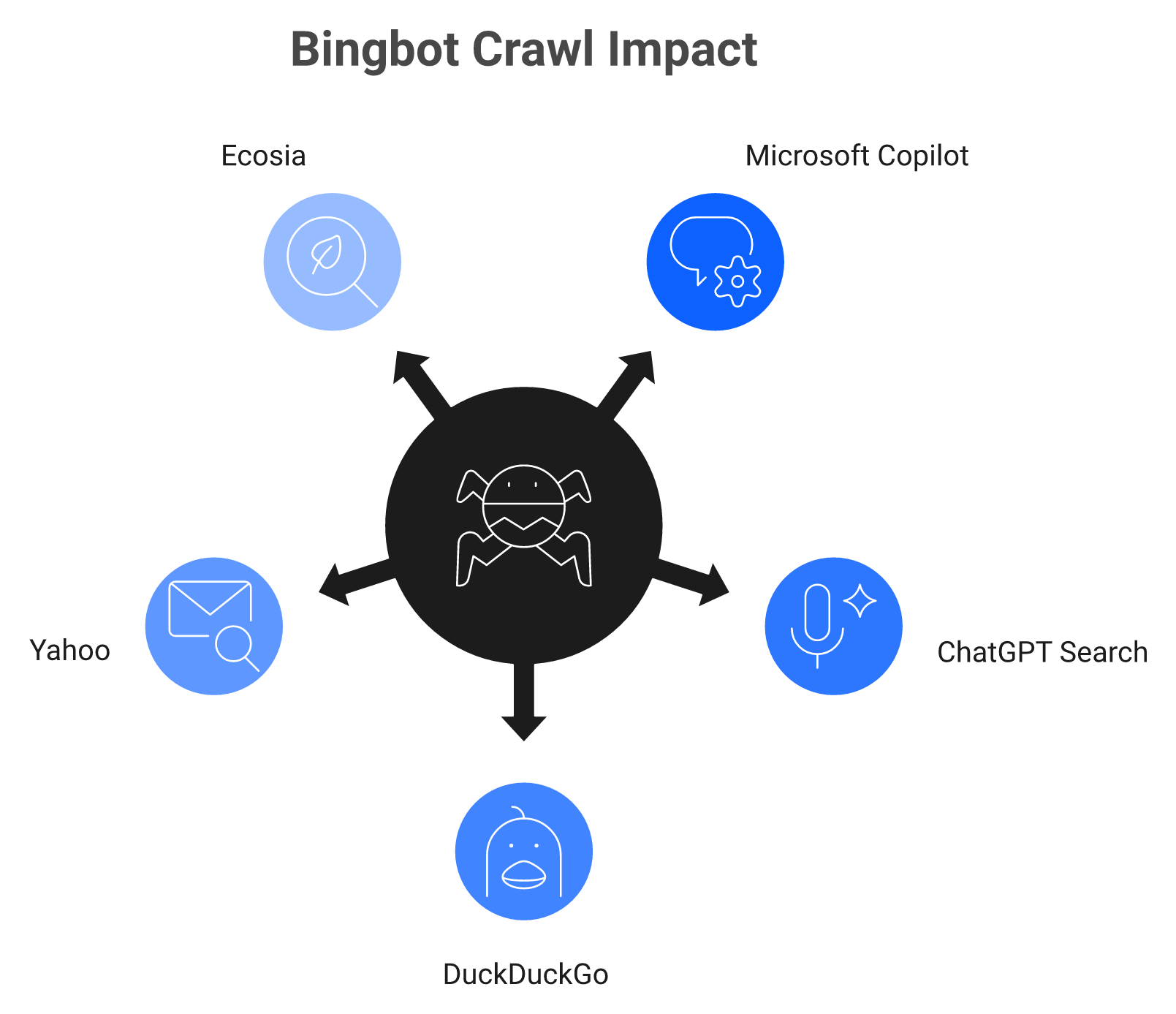
- Copilot has no crawler of its own; it grounds answers on Bing's index built by Bingbot, which also feeds ChatGPT Search, DuckDuckGo, Yahoo, and Ecosia.
- Bingbot crawl access is Gate Zero; a robots.txt rule, firewall, or Cloudflare Bot Fight Mode returning 403s makes you invisible, not just low-ranked.
- Verify your site in Bing Webmaster Tools, confirm genuine Bingbot via reverse DNS to search.msn.com, and use URL Inspection to see the indexed version.
- Server-render facts into HTML because Bingbot does not reliably execute JavaScript; schema helps entity resolution but LLMs tokenize it lossily.
- IndexNow pushes new URLs to Bing instantly; roughly 5% of technical work drives most citations, while Core Web Vitals rarely move AI visibility.
- Measure with Bing's AI Performance report, and note LLM-referred traffic converts near 6x Google search traffic, making even modest citation share worthwhile.
Q1: Does Microsoft Copilot Have Its Own Crawler, or Does It Rely on Bingbot?
Last month a founder pulled up Copilot mid-call and typed his own category query. His competitor got named. He did not. He had spent two years on Google rankings, and the answer his buyers now read never mentioned him.
No. Microsoft Copilot has no dedicated web crawler. It grounds its answers on Bing's search index, which is built by Bingbot. So optimizing Bingbot's crawl access is the direct path to Copilot citation eligibility. The same index also feeds ChatGPT Search, DuckDuckGo, Yahoo, and Ecosia, so one crawl-access fix compounds across several AI surfaces.
🔍 The myth: Copilot "reads the web" on its own
Most teams picture Copilot as an independent agent roaming the internet. It is not. Copilot runs a retrieval step, retrieval-augmented generation (RAG), where it pulls candidate pages from Bing's existing index, then summarizes them. If Bingbot never crawled and stored your page, there is nothing for Copilot to retrieve.
That single fact reorders the whole job. You are not "optimizing for Copilot" as a separate project. You are making sure Bingbot can reach, render, and store your pages, which is exactly what a focused generative engine optimization program is built to do.
🕸️ One index, many AI surfaces
Bingbot is the crawler behind a family of Microsoft agents. Each has a role, and knowing them prevents accidental blocking.
| User agent | What it does |
|---|---|
| bingbot | Crawls and indexes pages for Bing Search and Copilot grounding |
| BingPreview | Renders page snapshots and preview or citation cards |
| AdIdxBot | Crawls for Bing Ads |
| MicrosoftPreview | Fetches content for Microsoft app previews |
Because the same Bing index also grounds ChatGPT Search, DuckDuckGo, Yahoo, and Ecosia, being reachable by Bingbot is a multiplier, not a single-platform bet. You fix crawl access once, and several answer engines can start citing you. This is the compounding logic behind answer engine optimization.
🎯 Reframe: "rank in Copilot" becomes "be reachable by Bingbot"
Here is where the standard read gets this backwards. Teams chase "how to rank in Copilot" as if it were a content trick. From what surfaces when you actually run these audits, it is upstream of content. Bingbot is a data-feed pipeline, and intent is the interface. If the pipe is blocked, the best content on earth stays invisible.
The stakes are binary. As one veteran operator put it, if you are not in the citations, "you might as well not have played the game because there is no difference; you're actually literally zero in terms of traction." Ranking on Google does not save you here. Studies of AI answers show only around a 12% citation overlap between AI-cited URLs and Google's top 10, so a strong Google position does not guarantee a Copilot mention for a related prompt. This is the core of the difference between GEO and traditional SEO.
I might be wrong on the exact overlap number as engines evolve, but the direction is clear. Google ranking and Copilot citation are two different games with two different gatekeepers. The gatekeeper for Copilot is Bingbot.
Q2: Why Does Bingbot Crawl Access Decide Whether You Become the Answer or Stay Invisible?
A Head of Growth once showed us a page-one Google ranking and asked why Perplexity and Copilot never named her brand. The page ranked. The crawler behind the AI answer had never fully reached it. That gap is the whole story.
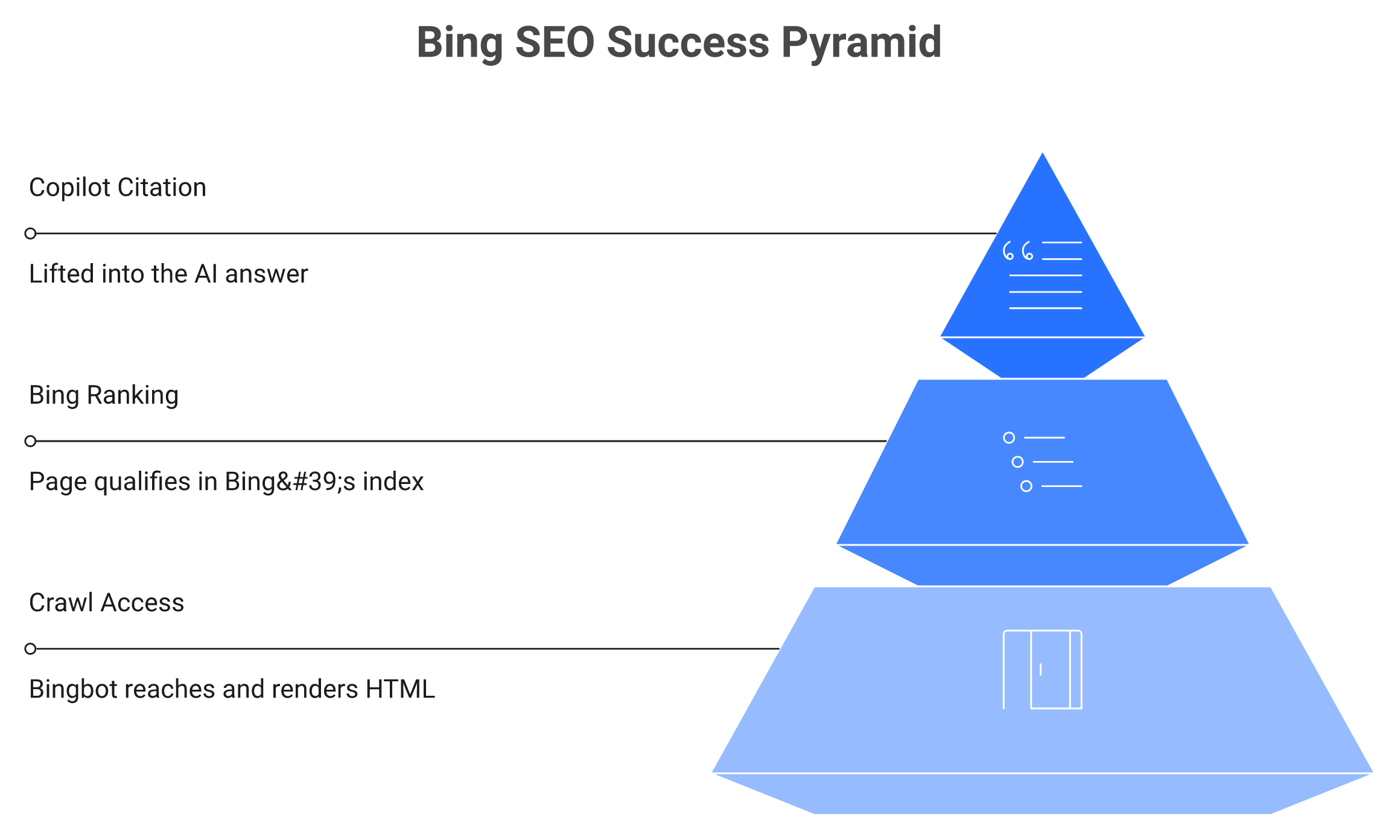
Bingbot crawl access is "Gate Zero." Before Bing can rank you (Gate 1) or Copilot can lift you into an answer (Gate 2), Bingbot must reach and render your HTML. If a firewall, robots.txt rule, or Cloudflare Bot Fight Mode blocks it, you are invisible, not ranked low, but absent. In AI search the outcome is binary: cited or zero traction.
⚠️ The situation: ten blue links collapsed into one answer
For twenty years, search gave you a page of options. Being fifth still meant a click. The shift from traditional SEO to generative and answer engine optimization changed the shape of the result. Now a buyer asks Copilot a question and reads one curated answer built from a handful of cited sources.
The evaluation set shrank. You are no longer competing for a spot on a list. You are competing to be inside a single paragraph, which is exactly what our GEO service is engineered to win.
💸 The complication: the penalty for being average is severe
When an AI overview sits at the top, the organic results below it lose visibility fast. Measured drops in click-through rate of around 34.5% show up when a result gets pushed under an AI answer box. The cost of being "pretty good but not cited" has never been higher.
This is why crawl access matters more than most technical work. If Bingbot cannot fully fetch and render your page, you do not get a weak citation. You get none.
- A blocked crawler means zero index presence.
- Zero index presence means zero Copilot grounding.
- Zero grounding means your competitor's answer is the only one your buyer reads.
✅ The resolution: treat crawl access as the non-negotiable pre-gate
Here is the contrarian part. The AI-hype crowd treats Bingbot optimization as exotic. It is not. These agents are evolved versions of crawlers SEOs have understood for years. One 18-year veteran who built spam in 2007 said he knew exactly how this would play out, because "the exact same thing was going to happen." The mechanics rhyme with the past.
So the discipline is old, but neglected. Crawlability got treated as solved and quietly ignored while teams chased content. We take the opposite stance at MaximusLabs. Crawl access is Gate Zero, checked before we touch a single headline, which is why our technical SEO and website audit runs first. There is no point engineering a citation-worthy answer for a page the crawler cannot see.
We could be early in calling this the first move rather than a footnote, but across the GEO audits we run, blocked or under-rendered pages explain more "invisible in AI" cases than weak content does.
Q3: How Do You Confirm Bingbot Can Actually Reach Your Money Pages?
The fastest audit win we see is boring. A marketing team spends months on content while a security setting silently returns a 403 to Bingbot. The crawler knocks. The firewall slams the door. Nobody notices because humans still load the page fine.
Verify your site in Bing Webmaster Tools, then check three blockers: robots.txt rules against bingbot or BingPreview, firewall or Cloudflare Bot Fight Mode silently returning 403s to bots, and JavaScript-hidden content. Confirm a request is genuine Bingbot by reverse-DNS lookup resolving to search.msn.com. Then use URL Inspection to see the exact page Bing indexed.
🛠️ The five-step reachability audit
- Verify your domain in Bing Webmaster Tools and submit an XML sitemap. It is an underrated tool and the fastest way to see if Bingbot reaches your money pages.
- Open your robots.txt and confirm no rule blocks bingbot or BingPreview.
- Check your firewall and CDN. Cloudflare Bot Fight Mode is the most common silent blocker of legitimate Bingbot traffic.
- Verify any suspicious "Bingbot" hits are real via reverse DNS. Genuine Bingbot resolves to search.msn.com.
- Run URL Inspection on your top pages to see the exact version Bing stored.
Teams routinely block the very crawler they are trying to influence. As one practitioner put it, some companies "explicitly block unknown crawlers," and "if you don't get indexed, you're not even in the game." You can test your own exposure fast with our AI crawlability checker.
🤖 Know the Bing crawler family before you block anything
Blanket "block unknown bots" rules catch Microsoft's agents. Verify authenticity by reverse DNS to search.msn.com, then allow the ones you want.
| User agent | Purpose | Should you allow it? |
|---|---|---|
| bingbot | Index for Bing Search and Copilot | Yes, always |
| BingPreview | Renders previews and citation cards | Yes |
| MicrosoftPreview | Microsoft app content previews | Usually yes |
| AdIdxBot | Bing Ads crawling | Only if you run Bing Ads |
We treat this unblocking pass as a first-7-days step at MaximusLabs. In one audit, Cloudflare Bot Fight Mode was silently returning 403s to Bingbot, and the client's strongest pages were invisible to Copilot until we allowlisted verified Bingbot at the CDN. This kind of fix sits at the heart of managing AI crawlers. The content was never the problem. The door was locked.
I want to be honest about the limit here. Unblocking does not guarantee a citation. It only earns you the right to compete. But skip it, and nothing downstream matters.
Q4: Why Does Bingbot Miss Your Best Content When It Lives Behind JavaScript?
A practitioner ran a live test during a review. He opened a client's product page, turned JavaScript off, and refreshed. The reviews vanished. The spec table vanished. The exact content the client bragged about, loaded after the page painted, simply was not there for a crawler.
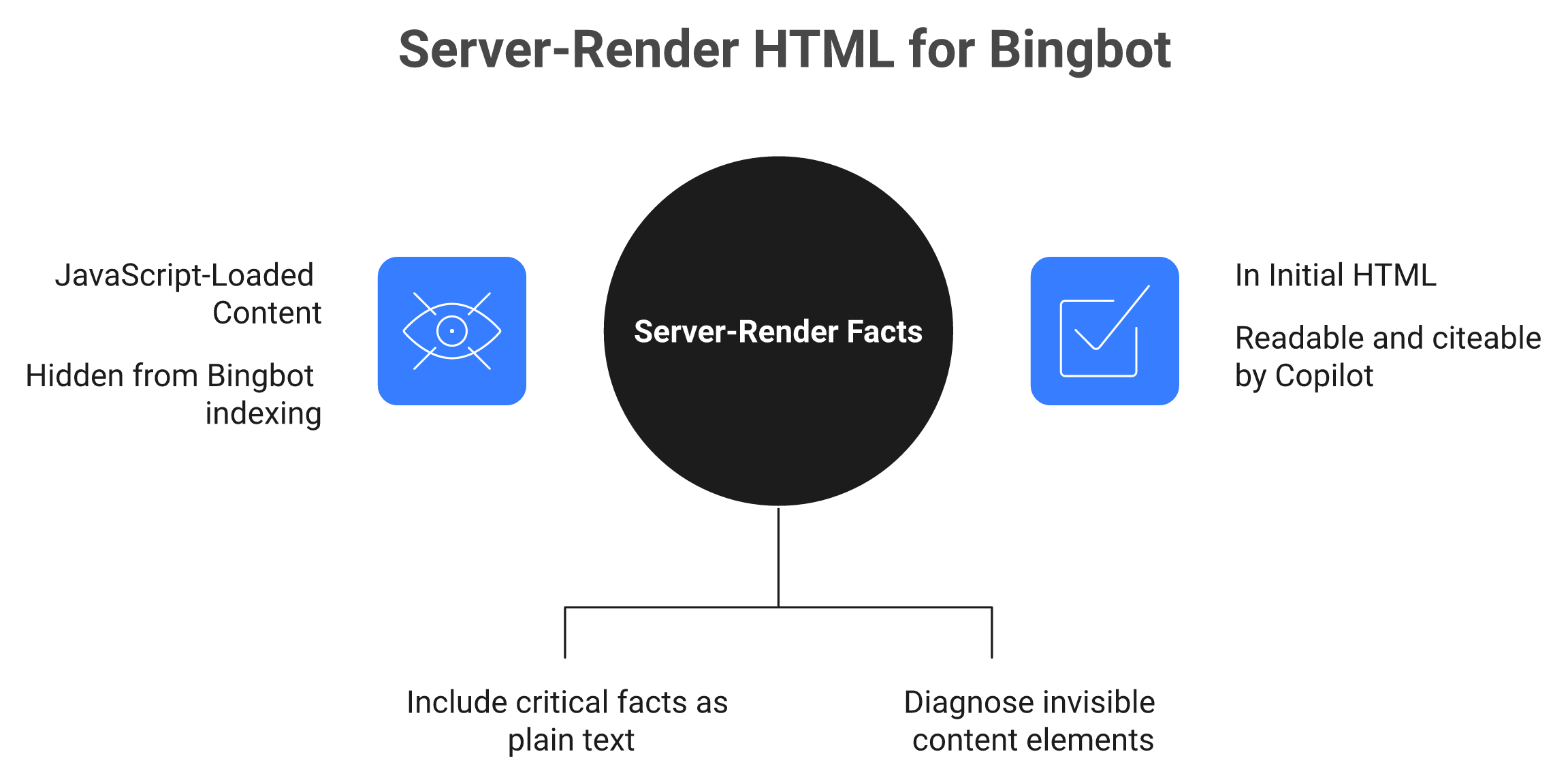
Bingbot does not reliably execute JavaScript. Content loaded asynchronously, reviews, spec tables, filter facets, tabbed panels, often never reaches the index, so Copilot cannot cite it. The fix is to server-render critical facts into the initial HTML. A fast test is toggling JavaScript off in your browser. Whatever disappears is likely invisible to Bingbot and every Bing-grounded AI answer.
👀 The moment of truth: toggle JavaScript off
You can run the same test in two minutes. Open your key page, disable JavaScript in your browser settings, and reload. Whatever disappears is content Bingbot probably cannot see either.
As one practitioner described it, "I turned JavaScript off and you'll see that not the whole page shows up," especially where "reviews are loaded in asynchronously and they're not seen." Your best proof points, the reviews, the comparison data, the FAQs, are often the exact things hidden behind a script, which is why our AI SEO service starts at the render layer.
🧩 Why hidden content loses fidelity, not just visibility
Even when a crawler grabs a cluttered page, there is a second cost. Retrieval models work inside a limited focus window, up to roughly 200,000 tokens for a model like GPT-4o. When a page is padded with JavaScript boilerplate, the signal you care about competes with noise.
There is a real debate here worth naming honestly.
- One view holds that schema markup is "lossy" to a language model, tokenized into plain text and largely reconstructed rather than truly read, "the equivalent of learning something you hear on the radio in another language and being able to repeat it but not understand it."
- The counter-view holds structured data still helps engines resolve your entity in their knowledge graph, a point we unpack in our schema markup basics guide.
Both can be true. So the safe move is not to bet your facts on either JavaScript rendering or schema alone.
✅ The fix: server-render the facts that matter
Put your citeable content in the initial HTML, before any script runs. That is what the RAG retriever reads, not the browser experience you designed for humans.
- Server-side render reviews, prices, specs, and FAQs into raw HTML.
- Surface filter and facet data (fabric, size, integration, compliance) as visible text, since crawlers cannot click JavaScript filters.
- Keep boilerplate minimal so the core answer stays high-fidelity.
This is the technical mandate we hold at MaximusLabs. Critical content renders in HTML for AI crawlers, and JavaScript is minimized so the page reads cleanly for retrieval. Teams building on Webflow can follow our Webflow SEO guide to get this right. We write for the retriever first, the browser second.
Where our thinking sits right now, raw HTML readability is the higher-certainty lever, and schema is a useful supporting signal, not a substitute for it. Get the facts into the HTML, and you stop losing citations you already earned.
Q5: How Does IndexNow Get Your Pages Into Bing and Copilot Faster?
A content lead once told us her team shipped 40 new pages in a quarter, then waited. Days passed before Bing noticed. By the time Copilot could cite the work, the launch moment was gone. She was treating publishing as a passive act, when it should be an API call.
IndexNow lets you instantly notify Bing when you publish or update a page, instead of waiting for Bingbot's scheduled crawl. Bingbot throttles crawl frequency by how often your content changes, so static pages get re-crawled rarely. Generate a key in Bing Webmaster Tools, host the key file at your domain root, then POST changed URLs to the IndexNow API on every publish.
⏰ Why waiting for the scheduled crawl costs you citations
Bingbot does not visit every page on a fixed clock. It adjusts crawl frequency based on how often a page actually changes. Microsoft's own crawl team documented cutting crawl volume on static sites by roughly 40%, precisely because re-crawling unchanged pages wastes resources.
That efficiency is good for Bing and bad for you if you publish and stay quiet. A new page can sit unseen while your buyers ask Copilot the exact question it answers. IndexNow closes that gap by pushing the URL to Bing the moment it goes live, and wiring it up is a standard part of technical GEO implementation.
🛠️ How to set up IndexNow in five steps
- Open Bing Webmaster Tools and generate an IndexNow API key.
- Host the key as a text file at your domain root (for example, yourdomain.com/[key].txt).
- On every publish or meaningful update, send a POST request with the changed URL.
- Submit an XML sitemap in Bing Webmaster Tools as a backstop, an underrated verification step.
- Confirm submission worked by checking URL Inspection for the fresh crawl date.
A minimal request sends a POST to the IndexNow API endpoint with a JSON body containing your host, your IndexNow key, and a URL list holding the changed page. You can pressure-test whether those pages are actually reachable with our AI crawlability checker.
✅ Make publishing an event, not a wait
The mental shift matters more than the code. Publishing is a data-feed event, and IndexNow is the closest thing to a direct pipeline into Microsoft's grounding layer. You are telling Bing "this changed, come look now," rather than hoping the crawler wanders back.
At MaximusLabs, we wire IndexNow into the client CMS so a new page pings Bing automatically at publish. In practice, that is often how a client's first article becomes discoverable within days of going live instead of drifting for a week, and it is a core lever in our GEO service.
I want to be careful here. IndexNow speeds discovery, it does not force a citation. Faster indexing gets you to the starting line sooner. Whether Copilot lifts you still depends on the content and trust signals we cover next.
Q6: What Makes a Page Machine-Readable Enough for Bingbot to Cite, Schema, Facets, and HTML?
We keep meeting teams who added every schema type they could find, then wondered why Copilot still ignored them. They treated structured data like a magic spell. The crawler read the page fine. The facts buyers needed were locked inside JavaScript filters the crawler could not touch.
Make the facts Bingbot needs readable as plain HTML text. Add schema (Organization, FAQPage, and HowTo) and validate it in Bing's own validator, which is stricter than Google's, so invalid markup is ignored. But do not rely on schema alone. LLMs tokenize it as text, so surface attributes like fabric, price, integration, and compliance directly in headers and body copy, not behind JavaScript filters.
⚠️ The situation: schema is treated as a silver bullet
Schema markup is structured data that labels page facts for search engines. It genuinely helps engines resolve your entity, who you are, in their knowledge graph. Some practitioners argue sites using schema are more likely to appear in AI summaries because it clarifies the organization entity, and our schema markup basics guide walks through the setup.
So teams pile it on. Then they assume the language model "reads" that structure directly. That assumption is where the plan quietly breaks.
🧩 The complication: tokenization is lossy
An LLM does not parse your schema as clean key-value pairs. It tokenizes everything into text and reconstructs meaning. As one practitioner describes it, tokenization "sort of destroys the schema," making it "the equivalent of learning something you hear on the radio in another language and being able to repeat it but not understand it."
Both things are true at once, which is why this ground is contested. Here is how we resolve the "it depends," and the same logic runs through our GEO content optimization work.
| Do this | Not just this |
|---|---|
| ✅ Put prices, specs, reviews, and FAQs in visible HTML text | ❌ Bury them in JavaScript filters or tabs |
| ✅ Add schema to help Bing's knowledge graph resolve your entity | ❌ Assume the LLM reads schema as structured data |
| ✅ Validate schema in Bing's stricter validator | ❌ Trust Google's validator to pass Bing |
| ✅ Expose facets (fabric, size, and integration) as headers | ❌ Hope the crawler clicks a filter menu |
✅ The resolution: HTML first, schema second
Lead with raw readability. The follow-up questions buyers ask AI, "best product with these attributes," get answered when you surface facet data as plain text, because crawlers cannot click filters. Then add schema as a supporting signal and validate it in Bing's own tool, since invalid markup is simply ignored.
This is the balance we hold at MaximusLabs. Structured data for AI discoverability is layered on top of HTML-first content, never as a replacement for it, an approach we detail in our E-E-A-T for AEO guidance. Where our thinking sits right now is that readability is the higher-certainty lever, and schema is the useful assist.
Q7: How Should You Fix Internal Linking and Site Architecture So Bingbot Reaches Deep Pages?
A VP of Marketing once walked us through a docs site with hundreds of feature pages. Beautiful content, real depth, and almost none of it cited anywhere. The pages sat like rooms with no doors. Bingbot follows links, and nothing linked to them.
Bingbot follows links, so deep pages with no internal links are orphaned and never indexed. Link point-to-point so high-value long-tail pages are reachable in a click or two, and keep help centers and docs in a subdirectory, never a subdomain, which Bing treats as a separate site. Help-center content holds the feature-level detail AI agents most often need to cite.
🛫 The situation: the hub-and-spoke trap orphans your best pages
Many sites are built like Singapore Airlines, where everything routes through a few big hub pages. Deep, specific pages hang off nothing and get stranded. A crawler that follows links never reaches them, so they never enter the index.
The fix is to think like Southwest Airlines instead, point-to-point. Related pages link directly to each other, so Bingbot can hop from one specific page to the next without routing through a central hub every time. This is foundational technical SEO work.
🗄️ The complication: subdomains act like a separate filing cabinet
Where you host content changes how Bing treats it. A help center on a separate subdomain behaves like a separate site, a different filing cabinet, and tends to underperform. Moving it to a subdirectory keeps the authority and crawl signals in one place.
As one veteran put it, "move [the help center] to a subdirectory," and "never use subdomains because they tend to not perform as well." This matters for AI citations specifically. Help-center and docs pages hold the long-tail feature and integration detail that buyers ask Copilot about, the exact answers you want lifted, which is why we treat them as prime answer engine optimization assets.
✅ The resolution: a crawlable, point-to-point structure
Here is what to check on Monday:
- Move help centers and docs from a subdomain to a subdirectory.
- Add point-to-point internal links between related deep pages.
- Hunt for orphaned pages, those with no internal links pointing in, and link them.
- Keep every money page reachable within two clicks of a crawled page.
At MaximusLabs, our technical SEO and website audit rebuilds link structure so deep money pages stay crawlable, because a page Bingbot cannot reach cannot be grounded, no matter how good it is.
I might be overweighting subdirectories for some edge cases, but from what surfaces when you actually run these audits, orphaned deep pages are a more common citation-killer than most teams expect.
Q8: How Do You Write Content So Bingbot Lifts You Into the Answer, Not Just the Index?
The standard read gets this backwards. Teams write flowing narrative for humans, then hope an AI can pull an answer out of it. Getting indexed is not the finish line. Getting lifted into the actual answer is, and that takes a different kind of writing.
Structure each page so one passage answers a question completely on its own. Lead sections with a 40-to-80-word answer nugget, use question-style headings, and resolve specific intent. Chat prompts average 25 words versus six in Google search, so AI-search content must satisfy more nuanced, longer-tail questions to be lifted from the index into the actual answer.
🎯 Lead with a self-contained answer
An answer nugget is a short block, roughly 40 to 80 words, that fully answers the heading's question on its own. The retriever can lift it cleanly, without needing the paragraph above or below. If your answer only makes sense in context, rewrite it until it stands alone.
Use question-style headings that mirror how buyers actually ask. Then answer immediately, before you expand. This is answer-first structure, and it is what gets extracted, a principle at the heart of generative engine optimization.
🧭 The Universal Intent Decoder: write for the machine's request
Think of the language model as a Universal Intent Decoder. It translates messy human speech into a single, structured request for your data, almost like a JSON query. Your job is to make sure your page satisfies that request in plain terms.
The length gap explains why this matters. Google queries average about six words, while chat prompts run around 25 words. That longer, more specific phrasing means AI-search content has to resolve nuanced, long-tail questions, not just broad head terms. The more real follow-up questions your page answers, the more often it gets lifted, and mapping those questions is core to our AEO keyword and question research.
✅ A checklist for citeable writing
- Open each section with a standalone 40-to-80-word answer.
- Phrase headings as the questions buyers ask.
- Answer one specific intent per section, with no wandering.
- Cover the obvious follow-up questions on the same page.
- Keep sentences short so extraction stays clean.
This is the structure we make mandatory at MaximusLabs. An answer nugget leads every section, engineered so a single block makes sense if an AI pulls it out of context across Copilot, ChatGPT, or Perplexity, which is exactly what our content marketing service is built to deliver. We do not just help you rank, we help you become the answer.
Where our thinking is right now, nugget-first writing is the highest-leverage on-page change most teams can make this quarter, and it costs nothing but discipline.
Q9: How Do You Measure Whether Bingbot Optimization Is Actually Working?
A Head of GTM asked us a fair question last quarter, "How do I prove this crawl work paid off?" For a year, the honest answer was "third-party estimates." Then Microsoft shipped a report that reads straight from the source. The guessing largely ended.
Use the AI Performance report in Bing Webmaster Tools. It shows grounding queries (the fan-out sub-searches AI runs), citation counts by URL, and query-to-page mapping, the first first-party view of how Copilot uses your content. Watch the grounding-versus-citation gap. Most AI influence is invisible grounding, so track grounding events, not just visible citations, and feed those queries back into content.
📊 Why third-party AI dashboards fall short
Most AI-visibility tools poll the chat interfaces and estimate. They approximate what Copilot might be doing with your pages. That is useful for direction, but it is not ground truth from the engine itself, which is why we anchor GEO measurement and metrics in first-party data.
Bing changed that. The AI Performance report launched in February 2026, and query-to-page mapping followed in March 2026. For the first time, you can see the actual grounding queries and which of your URLs got cited.
🔍 The gap that changes your KPIs
Here is the finding that resets targets. In one dataset, OtterlyAI tracked 647 grounding queries that triggered Copilot, and only a small fraction became visible citations. Most of your influence is invisible grounding, the sub-searches the AI runs behind the scenes, a pattern we track inside our GEO service.
- Grounding query: a fan-out sub-search the AI runs to build its answer.
- Visible citation: the linked source the user actually sees.
- The gap: far more grounding than visible citation, so citation-only KPIs undercount your impact.
If you measure only visible citations, you will conclude the work failed when it is quietly working. Track grounding events too.
✅ The closed loop, export, map, brief
The workflow is simple and repeatable:
- Open AI Performance and export your grounding queries.
- Map each query to the page that should own it.
- Brief content to fill the gaps where a query has no strong page.
At MaximusLabs, we track citation share against competitors across thousands of question variants using this first-party data, not single-keyword rankings, an approach we detail in our GEO competitive analysis work. Early citations tend to compound, because trust builds entrenched data patterns that later entrants struggle to dislodge.
There is honest debate here. Some argue first-mover advantage in search is a false concept. Our read is that trust compounds, so the brand cited early keeps getting cited. What we are sitting with now, will Bing's grounding-to-citation ratio shift as Copilot matures, and how fast? That is the number we would watch closely this year.
Q10: Which Bingbot Signals Actually Drive Citations, and Which Are a Waste of Time?
We once inherited a client who had paid for a 50-page technical audit. It flagged 400 "errors." Almost none touched whether Bingbot could read the page. The team had spent three months on busywork and zero on the signals that move citations.
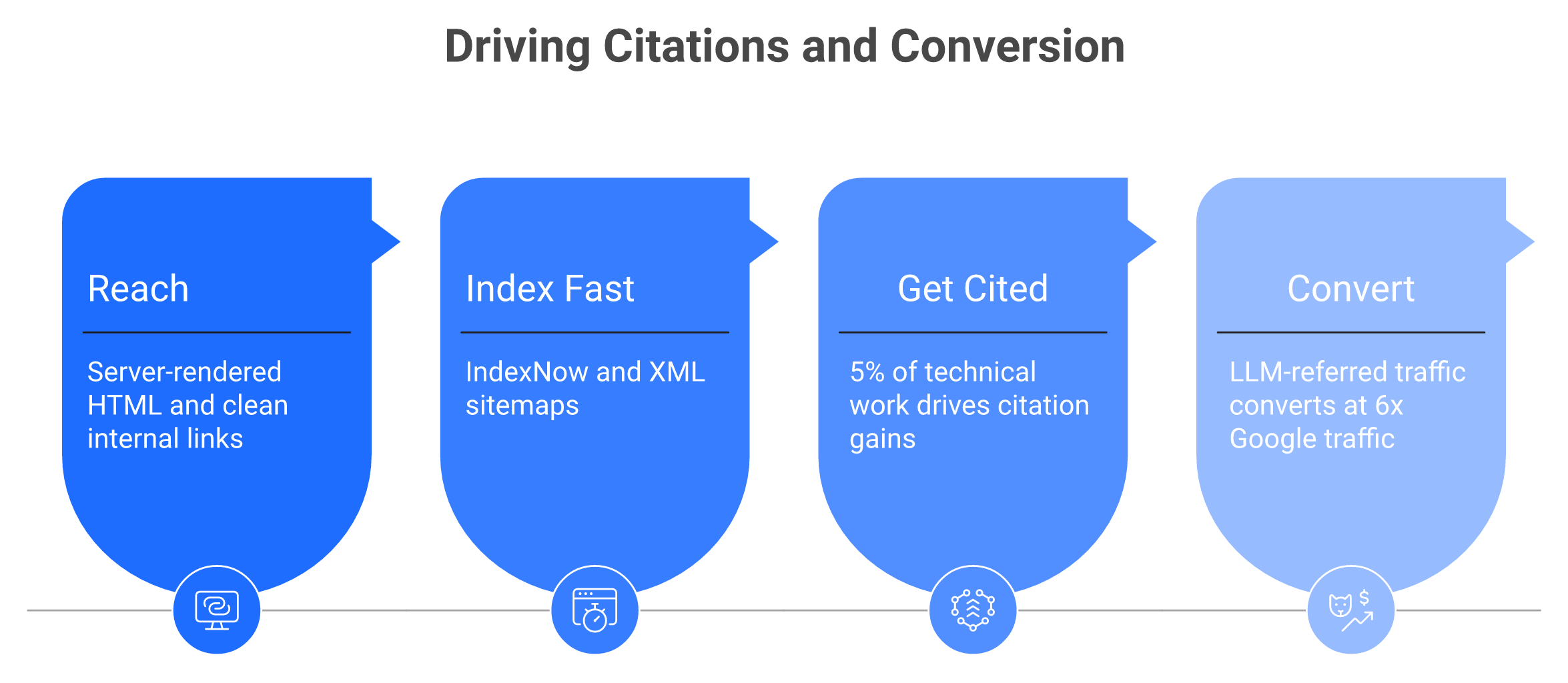
Focus on what Bingbot can read and reach, server-rendered HTML, clean internal links, sitemaps, and IndexNow. Skip the security-blanket work. Core Web Vitals rarely move AI visibility, and chasing obscure bot directives or unproven LLM.txt files produces 50-page audit PDFs with zero revenue impact. Roughly 5% of technical work drives almost all citation gains.
⚠️ The situation, technical audits feel productive
Teams love a long checklist. It feels rigorous, and it fills a report. Core Web Vitals (Google's page-speed and stability metrics) get obsessed over because they are measurable and easy to sell, a trap we flag in our technical SEO guide.
But measurable is not the same as impactful. As one 15-year practitioner put it bluntly, "in 15 years I've never seen Core Web Vitals drive a traffic increase." The work is true, and its impact is near zero.
💸 The complication, busywork burns the budget you need
Every hour on a security-blanket audit is an hour not spent making pages readable and reachable. The Pareto split is stark. Roughly 5% of technical work produces almost all the impact. The other 95% generates PDFs, not pipeline, which is why we prioritize technical GEO implementation over audit theater.
New "technical AEO" fashions carry the same risk. Practitioners remain skeptical that they create meaningful lift, warning they "will likely create significant work with little to no impact."
✅ The resolution, a ruthless priority table
| ✅ High-impact (do first) | ❌ Low-impact (skip or defer) |
|---|---|
| Server-rendered HTML for key facts | Chasing perfect Core Web Vitals scores |
| Clean, point-to-point internal links | Obscure bot-directive tinkering |
| XML sitemaps in Bing Webmaster Tools | Unproven LLM.txt or Markdown-only pages |
| IndexNow on every publish | 400-item "error" cleanup with no crawl effect |
A word of caution, so I am not overstating it. Core Web Vitals still matter for human conversion once a visitor lands. My point is narrower. They rarely drive AI citation, so do not fund them from your crawl-access budget.
At MaximusLabs, we ship the revenue-focused 5%, not 50-page audit PDFs, because our stance is productivity-first, and it runs through every technical SEO and website audit we deliver. What we keep asking, how many "technical AEO" tactics being sold today survive a controlled test? Our bet is most do not, and we would love to be proven wrong on the ones that matter.
Q11: Is Bingbot Optimization Worth the Budget, and Who Should Own It?
A founder once told us his crawl fix, a two-day job, was quoted a nine-month timeline by his own engineering queue. The work was small. The bureaucracy was not. That gap, not the technical difficulty, is where most Bing opportunities quietly die.
Yes, for most B2B teams. Bingbot access compounds. One index feeds Copilot, ChatGPT Search, DuckDuckGo, Yahoo, and Ecosia, and Copilot reaches enterprise buyers inside Microsoft 365. LLM-referred visitors convert at roughly 6x the rate of Google search traffic, so even modest citation share drives pipeline. Own it where engineering and content meet, internally if you have both, or through a GEO specialist.
⏰ The situation, engineering gatekeeping kills small fixes
Most crawl-access work is small. Allowlist Bingbot, server-render a few facts, wire IndexNow. Yet it stalls in engineering queues that quote "nine months" for what takes days.
As one operator noted, "much of this could be built in weeks or days," but teams "say nine months." Another framed the friction plainly, "Marketing doesn't get to tell Engineering what to do." The bottleneck is organizational, not technical, which is why our approach to managing AI crawlers ships fixes fast.
💰 The complication, the payoff is unusually high
The economics justify pushing through that friction. LLM-referred traffic converts at about 6x the rate of Google search traffic, because the buyer arrives pre-qualified by the AI's recommendation. So even a modest citation share on Bing-grounded engines can move real pipeline, which is how we frame GEO ROI and revenue attribution.
The audience sharpens the case for B2B. Copilot sits inside Microsoft 365, in front of enterprise buyers during their workday. Gartner projects over 50% of search traffic shifts to AI-native platforms by 2028, so this stops being optional soon.
✅ The resolution, who should own it
- If you have both content and engineering in-house and moving fast, own it internally.
- If crawl fixes stall for months, or you lack GEO depth, bring in a specialist.
- Traditional Google-only SEO agencies tend to hand you audits, not shipped fixes.
- Some GEO specialists make claims they do not operationalize at scale.
This is where we position MaximusLabs. We are a full-stack GEO partner that executes crawl fixes fast, ties them to revenue, and writes in your founder's voice, not another 50-page audit, and our answer engine optimization work is built on the same principle. We do not just help you rank, we help you become the answer.
I will hedge the "worth it" honestly. If your buyers genuinely never touch Copilot or Bing-grounded engines, deprioritize it. For most B2B teams, that is not the case. The question we are sitting with, when "becoming the answer" turns from edge to table stakes, who will have built the trust early enough to own the citation? That is the conversation worth having now, and it is where a quick conversation with our team can help.
Frequently asked questions
Does Microsoft Copilot have its own crawler, or does it rely on Bingbot?
Copilot has no dedicated web crawler. It grounds answers on Bing's search index, which is built by Bingbot, so optimizing Bingbot crawl access is the direct path to Copilot citation eligibility. This one fact reorders the whole job for us. We are not optimizing for a separate Copilot agent; we are making sure Bingbot can reach, render, and store your pages. Copilot runs retrieval-augmented generation, pulling candidate pages from Bing's existing index. If Bingbot never crawled your page, there is nothing for Copilot to retrieve. The same index also feeds ChatGPT Search, DuckDuckGo, Yahoo, and Ecosia, so one fix compounds. Ranking on Google does not save you here, because AI-cited URLs overlap Google's top 10 only around 12% of the time. That is why we treat this as a distinct discipline inside our GEO service , not a Google add-on.
How do I confirm Bingbot can actually reach my money pages?
Start by verifying your domain in Bing Webmaster Tools and submitting an XML sitemap. It is the fastest way to see whether Bingbot reaches your most important pages. Then we check three common blockers that silently shut the crawler out while humans still load the page fine. robots.txt rules that block bingbot or BingPreview. Firewall or Cloudflare Bot Fight Mode returning 403s to bots. Content hidden behind JavaScript that never reaches the index. Confirm any suspicious hit is genuine Bingbot with a reverse-DNS lookup that resolves to search.msn.com, then use URL Inspection to see the exact version Bing stored. You can pressure-test reachability quickly with our AI crawlability checker . In one audit, Bot Fight Mode was quietly returning 403s to Bingbot, and the client's strongest pages were invisible to Copilot until we allowlisted verified Bingbot at the CDN. The content was never the problem; the door was locked.
Why does Bingbot miss my best content when it lives behind JavaScript?
Bingbot does not reliably execute JavaScript. Content loaded asynchronously, such as reviews, spec tables, filter facets, and tabbed panels, often never reaches the index, so Copilot cannot cite it. Run a two-minute test. Open a key page, disable JavaScript in your browser, and reload. Whatever disappears is likely invisible to Bingbot and every Bing-grounded AI answer. Server-side render reviews, prices, specs, and FAQs into raw HTML. Surface filter and facet data as visible text, since crawlers cannot click JavaScript filters. Keep boilerplate minimal so the core answer stays high fidelity within the model's focus window. Schema still helps engines resolve your entity, but LLMs tokenize it lossily, so it is a supporting signal, not a substitute for readable HTML. We cover the layering in our schema markup basics guide. We write for the retriever first and the browser second.
How does IndexNow get my pages into Bing and Copilot faster?
IndexNow lets you instantly notify Bing when you publish or update a page, instead of waiting for Bingbot's scheduled crawl. Bingbot throttles crawl frequency by how often your content changes, so static pages get re-crawled rarely. Microsoft's crawl team documented cutting crawl volume on static sites by roughly 40%, which is efficient for Bing but costly for you if you publish and stay quiet. Generate an IndexNow API key in Bing Webmaster Tools. Host the key file at your domain root. POST changed URLs to the IndexNow API on every publish or meaningful update. The mental shift matters more than the code. Publishing becomes a data-feed event, not a passive wait. We wire IndexNow into the client CMS as part of our technical GEO implementation , so a new page pings Bing automatically at publish. That said, IndexNow speeds discovery; it does not force a citation.
Which Bingbot signals actually drive AI citations, and which waste time?
Focus on what Bingbot can read and reach. Roughly 5% of technical work drives almost all citation gains, so we spend our budget there and skip the security-blanket work. High impact: server-rendered HTML, clean internal links, XML sitemaps, and IndexNow. Low impact: chasing perfect Core Web Vitals, obscure bot-directive tinkering, and unproven LLM.txt files. Core Web Vitals rarely move AI visibility. As one veteran put it, in 15 years they had never seen Core Web Vitals drive a traffic increase. The metric still matters for human conversion once a visitor lands, but do not fund it from your crawl-access budget. We ship the revenue-focused 5%, not 50-page audit PDFs, because our stance is productivity-first. You can see that priority order in our technical SEO and website audit . New technical AEO fashions carry the same risk, so we test before we trust.
How do I measure whether Bingbot optimization is actually working?
Use the AI Performance report in Bing Webmaster Tools. It is the first first-party view of how Copilot uses your content, and it largely ends the guesswork of third-party estimates. Grounding queries: the fan-out sub-searches AI runs to build an answer. Citation counts by URL: which pages actually get cited. Query-to-page mapping: which page owns which query. Watch the grounding-versus-citation gap. In one dataset, 647 grounding queries triggered Copilot while only a fraction became visible citations, so citation-only KPIs undercount your true influence. Our closed loop is simple: export grounding queries, map each to the page that should own it, and brief content for the gaps. We track citation share against competitors across thousands of question variants, an approach detailed in our GEO measurement and metrics work, because early citations compound into a trust moat.
Is Bingbot optimization worth the budget, and who should own it?
Yes, for most B2B teams. Bingbot access compounds because one index feeds Copilot, ChatGPT Search, DuckDuckGo, Yahoo, and Ecosia, and Copilot reaches enterprise buyers inside Microsoft 365. The economics are unusually strong. LLM-referred visitors convert at roughly 6x the rate of Google search traffic, so even modest citation share drives real pipeline. Gartner projects over 50% of search traffic shifts to AI-native platforms by 2028. Own it internally if you have both content and fast-moving engineering. Bring in a specialist if crawl fixes stall for months or you lack GEO depth. Watch out for audit-only agencies and GEO specialists who make claims they do not operationalize. Most crawl fixes are small yet stall in engineering queues quoted at nine months. We are a full-stack partner that executes those fixes fast, ties them to revenue, and writes in your founder's voice. Start a conversation with our team if that gap sounds familiar.