 Krishna Kaanth M
- Ranking and citation are now separate outcomes. Position-one click-through on AI Overview keywords fell roughly 58 percent versus forecast, and links inside AI Overviews are clicked in about 1 percent of searches.
- Three technical gates come before any formatting work: crawler access for OAI-SearchBot separately from GPTBot, server-rendered HTML instead of JavaScript-injected content, and subdirectories instead of subdomains.
- Answer blocks of 134 to 167 words are associated with 4.2x higher citation frequency, while Google AI Overviews favour a tighter 40 to 80 word direct answer inside the same block.
- Placement decides survival. Analysis of 177 million citation instances found 44.2 percent of AI citations came from the first 30 percent of a page, making the top third an extraction zone.
- Schema is hygiene, not a citation lever. Credible practitioners disagree, no controlled test exists, and Google requires all markup content to appear visibly on the page.
- Revenue pages beat blog volume. Format pricing, comparison, and alternatives pages as fact tables, then measure citation share against a held-back control cohort instead of average position.
Q1. Why does ranking on Google no longer mean getting cited by AI search?
Ranking and citation are now separate outcomes. Ahrefs found position-one click-through on AI Overview keywords fell from 0.073 to 0.016, a 58% drop versus forecast, with losses at every page-one position. Pew found links inside AI Overviews were clicked in only 1% of searches. Generative engines quote extractable passages, so a page can rank first and still never enter the answer a buyer reads.
📉 The slide that stopped making sense
You still hold position one. Half the traffic is gone anyway. That contradiction is now the most common opening line in a Monday growth review, and no ranking report explains it.
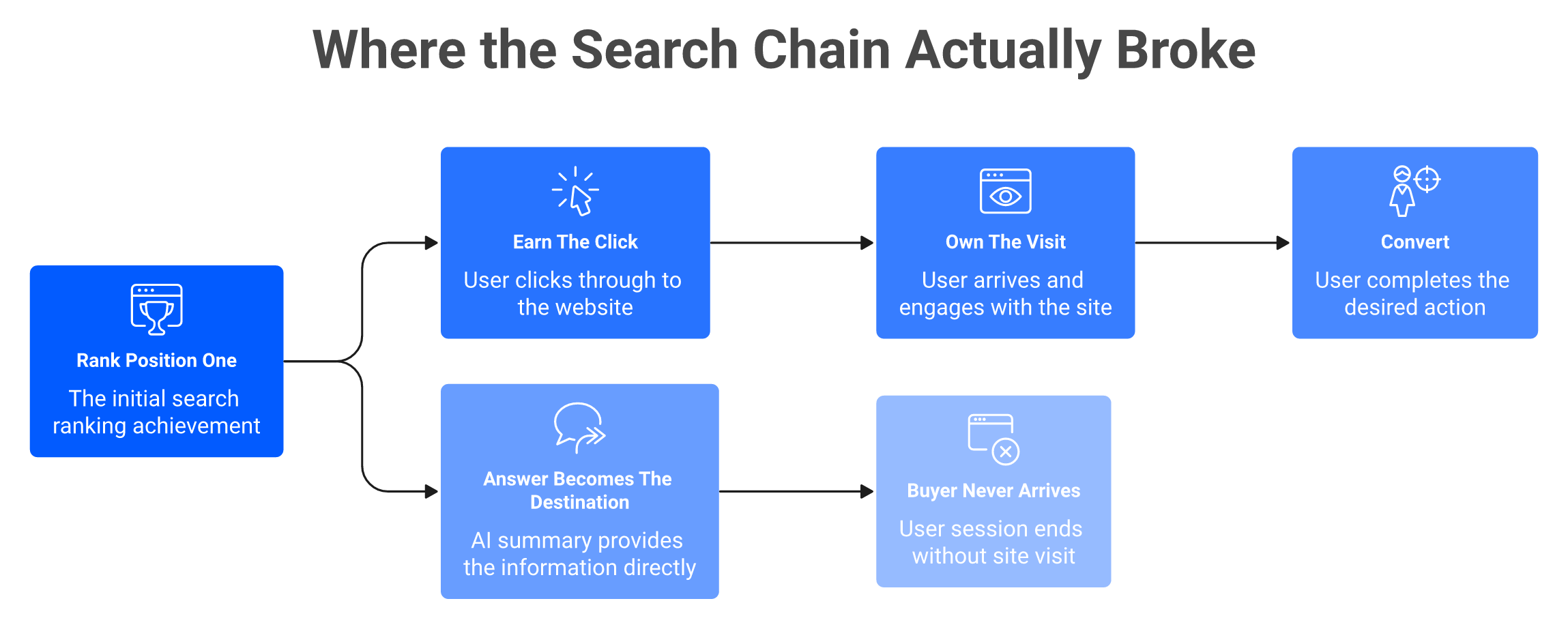
The old assumption was simple: rank, earn the click, own the visit. That chain broke at the click, not at the rank.
📊 What the click data actually shows
Ahrefs analysed 300,000 keywords through Google Search Console and measured click-through on AI Overview keywords against forecast. Position one lost about 58% of expected clicks. The damage did not stop at the top.
| SERP position | CTR change vs forecast |
| 1 | -58.0% |
| 2 | -50.8% |
| 3 | -46.4% |
| 4 | -38.8% |
| 5 | -32.6% |
| 10 | -19.4% |
The same study measured -34.5% roughly eight months earlier. No position on page one is insulated.
🔎 Pew's browser logs, not survey opinions
Pew Research Center tracked around 69,000 real searches from about 900 US adults in March 2025. Organic click-through was 8% when a summary appeared, versus 15% without it.
Links inside the AI Overview itself were clicked in just 1% of searches. And 26% of summary sessions ended on Google, versus 16% without a summary. The answer became the destination. This is the mechanic behind the zero-click search economy.
🧭 From ranking a page to being quoted
Here is the honest correction to the "search is dying" narrative. Gartner forecasts a 25% drop in search volume, while SparkToro clickstream data shows Google searches grew roughly 21.6% in 2024, with around 373 times more searches than ChatGPT. Search did not shrink. Clicks per ranking collapsed.
That changes the unit of optimisation. GEO (Generative Engine Optimization, earning inclusion inside AI-generated answers) and AEO (Answer Engine Optimization, formatting a passage so an engine can lift it cleanly) both operate at passage level, not page level. The practical delta between the two disciplines and classic search is mapped in this GEO versus traditional SEO comparison.
💰 Why this lands on BOFU and MOFU first
MaximusLabs AI rebuilt its client reporting around citation share after Oliv AI reached a 64% citation rate across AI platforms in six months, while ten-year-old billion-dollar competitors sat near 30%, a gap no ranking table explained. We stopped opening reviews with position screenshots after that.
When a buyer asks ChatGPT for the best tools in a category, five to ten names make the list. That list is the consideration set, assembled before your site is ever visited.
So formatting priority moves to the pages that carry buying intent: pricing, comparison, alternatives, and integration pages. Impressions and clicks were always vanity metrics. Now the click is literally the metric that disappeared. The penalty for being average has never been so severe.
MaximusLabs AI reports citation share and mention share per prompt set instead of average position, because the ranking number no longer predicts whether a buyer ever sees the brand. That is a measurement change, not a philosophy change.
Q2. What has to be true technically before any formatting work starts?
Three technical gates come before formatting. OpenAI documents that OAI-SearchBot governs appearance in ChatGPT search answers independently of GPTBot, which governs training, so blocking the wrong agent removes you from ChatGPT answers entirely. Content injected by JavaScript may never be parsed. Help centres and docs on subdomains get retrieved less reliably than the same content in subdirectories. MaximusLabs AI runs this preflight before commissioning any content.
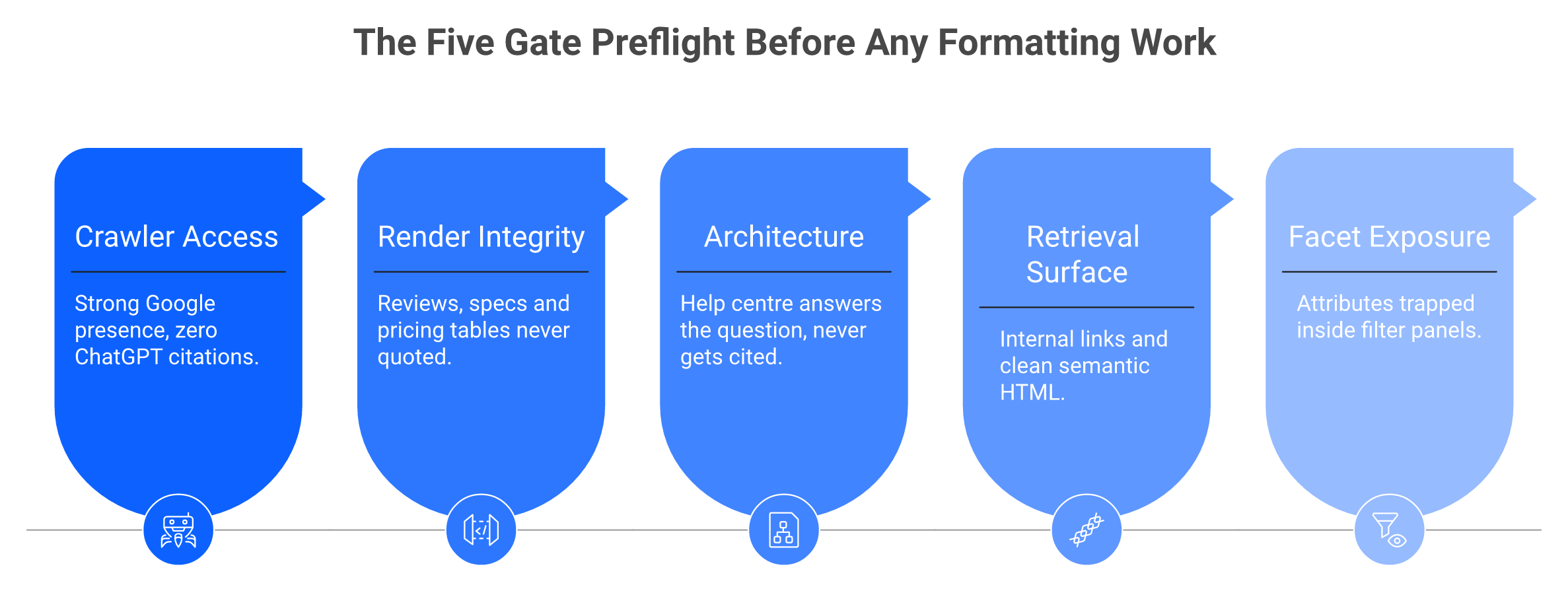
Perfect formatting behind a blocked user agent is invisible. These five gates run in about an hour, and each one has a symptom, a test, and a fix.
🚪 1. Crawler access: the gate most teams get backwards
Symptom: strong Google presence, zero ChatGPT citations. Test: check robots.txt, WAF rules, and CDN bot filters for OAI-SearchBot separately from GPTBot. Fix: allow OAI-SearchBot and allowlist OpenAI's published IP ranges, since opted-out sites may appear only as navigational links. The agent-by-agent breakdown lives in this complete AI crawlers guide.
Blocking training is a business decision. Blocking retrieval is self-removal from the answer.
🖥️ 2. Render integrity: turn JavaScript off and look
Symptom: reviews, specs, and pricing tables never get quoted. Test: disable JavaScript, load the page, screenshot what vanishes. Fix: move that content into server-rendered HTML, and confirm the result with an AI crawlability check.
"I turned JavaScript off and you'll see that not the whole page shows up. A lot of times you'll see this with a product page where reviews are loaded in asynchronously and they're not seen."
Ethan Smith, CEO, Graphite (AEO session notes, MaximusLabs SEO/GEO knowledge base)
MaximusLabs AI screenshots every priority template with JavaScript disabled during week one, because asynchronous blocks are the most common silent loss we find.
🗂️ 3. Architecture: subdirectories beat subdomains
Symptom: your help centre answers the exact long-tail question and never gets cited. Fix: migrate from help.domain.com to domain.com/help.
"Move [the help center] to a subdirectory. For whatever reason, subdomains don't work as well as subdirectories."
Ethan Smith, CEO, Graphite (AEO session notes, MaximusLabs SEO/GEO knowledge base)
🔗 4. Retrieval surface: links, clean HTML, and one honest caveat
Internal cross-linking and clean semantic HTML are how crawlers discover and segment content. Both are platform-documented ground rules, not tactics, and both belong in any serious technical SEO and website audit.
llms.txt belongs in the practitioner-inferred column. No major engine has published evidence that it drives retrieval, so ship it as cheap insurance and never as a proof point.
🏷️ 5. Facet and attribute exposure
Symptom: buyers ask AI about the closure, the fabric, the integration, and your filter panel holds the answer. Fix: promote those attributes into headings, body copy, and FAQ text so they exist as parseable words.
"Expose this facet data, the closure and the fabric and the material and the neck style. Bring some of that in your FAQs."
Ethan Smith, CEO, Graphite (AEO session notes, MaximusLabs SEO/GEO knowledge base)
⚠️ Sort retrieval blockers from performance theatre
Not every technical item earns budget. One practitioner view worth taking seriously: "technical SEO is the biggest waste of time. In 15 years, I've never seen Core Web Vitals drive a traffic increase". I think that is stated too strongly, but the sorting rule holds.
Fix what stops retrieval. Defer what only moves a lab score.
MaximusLabs AI runs this preflight in week one of every engagement, unblocking GPTBot and OAI-SearchBot and moving critical content into rendered HTML, with the first article live by day four. We built an in-house Webflow team because nine-month engineering queues, not strategy gaps, are what actually kill AI-search adaptation.
Q3. What is an answer block, and how long does it need to be to get cited?
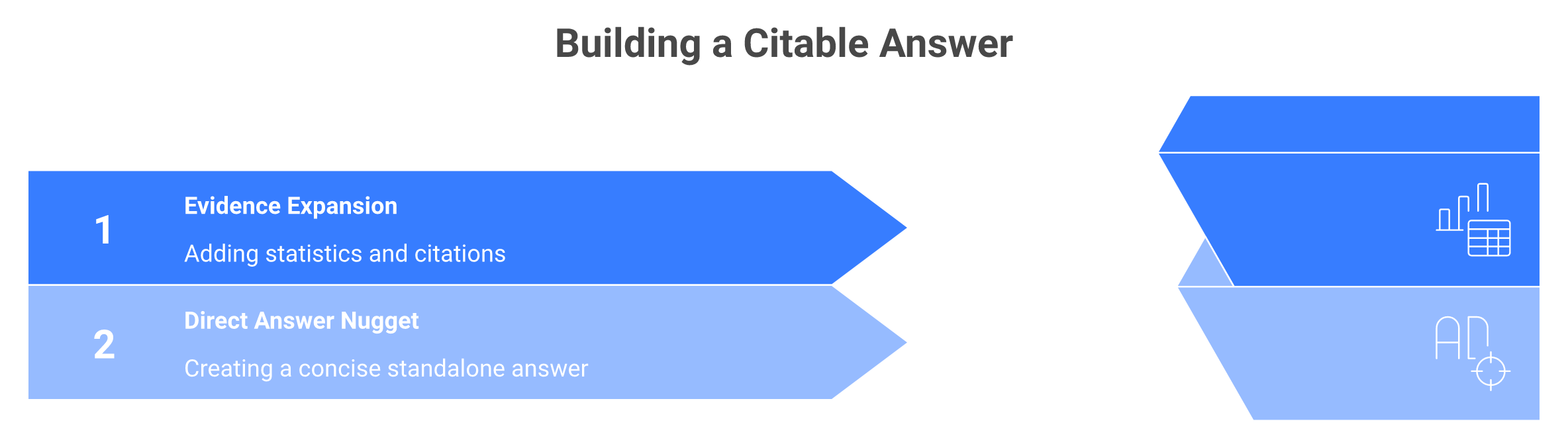
An answer block is a passage that fully answers one question without needing the sentences around it. Measured optimal length is 134 to 167 words, a range associated with 4.2x higher citation frequency by AI retrieval systems. Google AI Overviews favour a tighter 40 to 80 word direct answer. Write both layers: the short definitive answer, then the evidence expansion inside the same block.
🧱 The 2,000-word essay problem
Most teams publish long guides in which no single passage answers anything on its own. Every paragraph depends on the one before it.
Retrieval does not read in order. It lifts a chunk, and a chunk that only makes sense in sequence gets paraphrased without attribution.
📏 Two lengths, two jobs
The 134 to 167 word range is the block length associated with 4.2x higher citation frequency in retrieval-based systems. Microsoft's own guidance is blunter: make answers snippable, concise, and self-contained.
Those are not in conflict. The first 40 to 80 words carry the definitive answer. The next 80 to 90 carry the evidence that makes it quotable. The full block-level pattern is documented in this AEO content writing and formatting guide.
🎓 What the peer-reviewed evidence actually says
The KDD 2024 GEO paper found content-level optimisations lifted visibility in generative engine responses by up to 40%. That is the strongest academic support formatting has.
It also found effectiveness varied by domain, and called for domain-specific optimisation. That caveat is why generic AI-formatting advice underperforms in B2B SaaS, where the buying question is comparative rather than definitional. Vertical-specific patterns are covered in B2B SaaS AEO strategies.
🗂️ Grade every rule before you follow it
| Rule | Target | Evidence grade | Source |
| Self-contained, snippable answers | One idea per block | Platform-documented | Microsoft |
| Content-level edits lift AI visibility | Up to 40% | Peer-reviewed | KDD 2024 |
| Optimal answer block length | 134 to 167 words | Practitioner-inferred | Citation dataset |
| AI Overview direct answer | 40 to 80 words | Practitioner-inferred | Field testing |
MaximusLabs AI labels every formatting rule in client playbooks with one of these three grades, so nobody spends a sprint on folklore.
✍️ The rewrite, in practice
Before: "There are many factors to consider when evaluating GEO agencies, and in this section we will explore several of them."
After: "GEO agencies differ on three measurable things: citation share reporting, BOFU content ratio, and crawler-access auditing. Ask for citation share by prompt set, not average position."
The second version survives being pasted into a blank document. That is the whole test.
"Good content for AEO is comprehensive and answers all the potential follow-up questions a user might have."
Ethan Smith, CEO, Graphite (AEO session notes, MaximusLabs SEO/GEO knowledge base)
⚠️ Where "content is king" gets lazy
Quality here means information gain, not word count. Graphite's study found only 10% to 12% of content in Google and ChatGPT results was AI-generated, and warned that models fed their own derivatives drift toward model collapse.
Original data and first-hand testing are the only durable defence. I hold that view strongly, though I would like a larger replication before treating it as settled. If you want to pressure-test a draft against these length and self-containment rules, run it through the AI content optimizer.
MaximusLabs AI opens every H2 with a 40 to 80 word standalone answer followed by expanded analysis, and rewrites the section if the nugget fails the blank-document test. That rule exists because a passage that only makes sense in sequence gets paraphrased without credit.
Q4. Where on the page do answer blocks have to sit to survive retrieval?
Put answer blocks in the top third. Analysis of 177 million citation instances found 44.2% of all AI citations come from the first 30% of a page. For standard web results, ChatGPT receives structured metadata, meaning URL, title, a roughly 150-character snippet, and date, not full page text. MaximusLabs AI front-loads the brand-differentiating claim into the first 40 to 60 words of every priority page.
🪜 The differentiator on screen four
Most B2B pages bury the actual point. Positioning sits after the intro, after the market context, and after a definition the reader already knew.
Retrieval pruning rarely reaches that far. The strongest sentence on the page never enters the candidate set.
📍 44.2% of citations come from the opening third
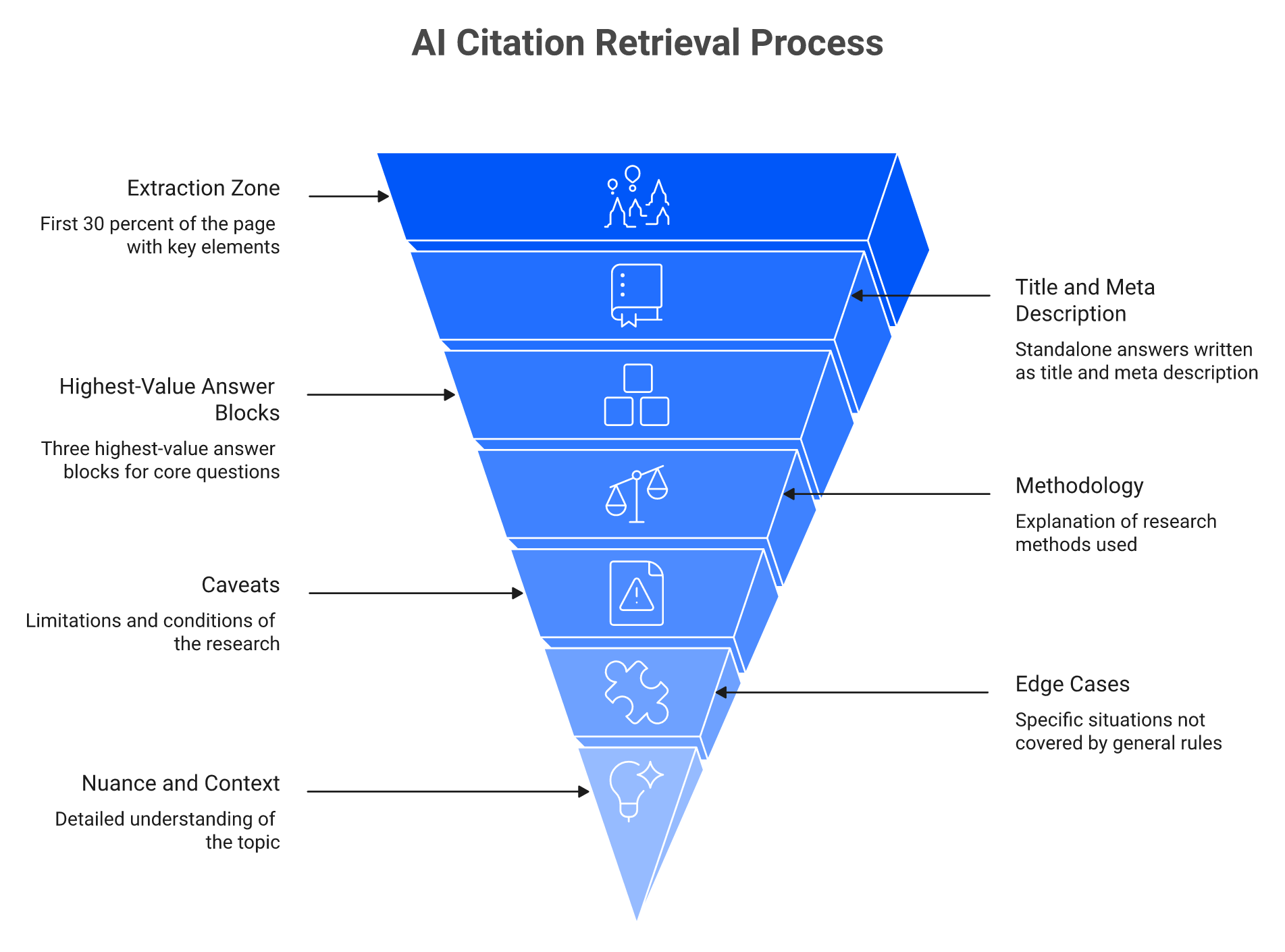
Across 177 million citation instances, 44.2% of AI citations were drawn from the first 30% of the page. Microsoft states separately that titles, descriptions, and H1s are primary interpretation signals.
Read together, those two facts point the same way. The top of the page is not an introduction. It is the extraction zone. The engine-by-engine detail sits in this analysis of ChatGPT, Perplexity, and Gemini citation patterns.
🏷️ The snippet is the new rank
For standard web results, ChatGPT often receives structured metadata rather than your full prose: URL, title, an approximately 150-character snippet, and a date. The model frequently reasons about your page from that fragment.
That reframes the meta description entirely. It stops being SEO housekeeping and becomes a GEO asset, because it may be the only version of your page the engine sees. Practical implications for that engine specifically are covered in the ChatGPT SEO guide.
"The average number of words per question is around 25, whereas for search it's around six words."
Ethan Smith, CEO, Graphite (AEO session notes, MaximusLabs SEO/GEO knowledge base)
Longer questions mean the engine needs a tighter, more literal match near the top.
🗺️ A positional map you can apply today
- First 40 to 60 words: the brand-anchored, differentiating claim, written to survive verbatim quotation.
- Title and meta description: standalone answers, not teasers or keyword strings.
- Above the 30% line: the three highest-value answer blocks for the page's core questions.
- Below the 30% line: methodology, caveats, edge cases, and nuance.
- First sentence after every heading: a direct answer, never a transition.
MaximusLabs AI rewrote one client's meta description as a standalone answer and moved the differentiating claim above the 30% line, treating both as citation assets rather than SERP copy.
❌ The anti-pattern with a name
Call it the preamble tax. Three warm-up paragraphs before the point, then the differentiator on screen four.
Pew's finding makes the cost concrete: links inside AI Overviews were clicked in only 1% of searches. If the quoted fragment is all the buyer ever sees, that fragment has to carry the category claim and the brand name. Building content that earns that fragment is the subject of this guide to citation-worthy content for AI engines.
🎯 Front-load the pages that matter, not all of them
You cannot rewrite the whole library at once. One practitioner benchmark: roughly 19 out of 20 landing pages drive little to no traffic, while one in twenty drives about 85%.
Start with that one in twenty, plus pricing, comparison, and alternatives pages. Everything else waits for the second pass. Sequencing that retrofit across an existing library is mapped in the GEO content optimization framework.
MaximusLabs AI treats the first 40 to 60 words of a page as the highest-value real estate a client controls, because Pew's data shows the quoted fragment is often the only thing a buyer reads. We audit that block before touching anything below it.
Q5. How should headings and content chunks be structured for retrieval systems?
Structure content the way a retrieval system reads it: one H1, question-form H2s in the user's own phrasing, H3s for sub-answers, and one idea per chunk. Retrieval-augmented generation embeds passages and selects those clearing a similarity threshold, with Microsoft's documented grounding layer using a cosine gate above 0.7. Headings that restate the query raise a chunk's similarity score. Vague headings like "Our Approach" fail the gate.
🧩 Headings that pass internal review and fail retrieval
Most content teams write headings for the design system. "Our Approach," "The Bigger Picture," "Getting Started." They look clean and match no query anyone types.
The engine is not judging elegance. It is measuring how closely your heading and the passage under it match a buyer's actual words.
⚙️ What retrieval-augmented generation does, in plain words
Retrieval-augmented generation (RAG) is the process where an engine searches live, pulls passages, and summarises them into an answer. It splits pages into chunks, converts each into a numeric vector, and compares that vector to the query.
Only chunks scoring above a similarity threshold get retrieved. Microsoft's grounding layer documents a cosine similarity gate above 0.7. Below the gate, your passage is not outranked. It is simply never seen. The mechanics behind this sit in our guide to technical GEO implementation.
⏰ The latency reality nobody budgets for
Microsoft's Web IQ grounding pipeline runs at roughly 164ms p95, meaning 95% of calls finish inside that window. Anything slower or render-dependent gets skipped on timeout, not penalised.
That is a different failure mode from ranking. There is no partial credit for a slow chunk.
MaximusLabs AI treats render speed and server-side HTML as retrieval prerequisites rather than performance polish, because a chunk that arrives late is a chunk that does not exist. Confirming that starts with an AI crawlability check.
📐 The chunk spec worth shipping
Each chunk loses its neighbours the moment it is retrieved. Write accordingly.
- Question-form H2s that mirror how buyers actually prompt, not clever titles.
- One H1 per page, with H2s and H3s nested logically underneath.
- H4s every two to three paragraphs, so humans can skim and chunks stay small.
- One idea per chunk, no exceptions.
- No pronouns crossing a chunk boundary, since "it" and "they" lose their referent.
- Every entity named explicitly in every chunk, including your own brand.
MaximusLabs AI specifies question-form H2s in the buyer's own phrasing at brief stage rather than editing stage, because heading text is a retrieval variable, not a design preference. The same principle drives our AEO keyword and question research process.
🗣️ Why prompts are longer than queries
Google queries average around six words. AI prompts average closer to 25. A 25-word question carries more context, which means the engine is matching against a fuller intent.
That works in your favour if your heading is a full question. It works against you if your heading is two abstract nouns. Mapping those longer variants is what a query fan-out generator is for.
❌ The anti-pattern with a name
Call it the clever-heading trap. It wins the internal review and loses the retrieval, every time.
Krishna's position is that GEO (Generative Engine Optimization, earning citations inside AI answers) is a data science problem, not a copywriting one. MaximusLabs AI's read is that marketers can absolutely handle cosine thresholds, and treating them as too technical is why most teams still edit headings for tone instead of match.
I hold that loosely on one point. The exact threshold varies by engine and may shift, so the durable rule is proximity to the query, not the number itself.
MaximusLabs AI reads platform papers and patent filings instead of recycled blog summaries, which is why heading structure enters our briefs as a spec with a reason attached. That detour costs an hour and saves a rewrite cycle.
Q6. When should you use lists, tables, or plain prose, and how much does punctuation matter?
Match the container to the data. Microsoft advises bullets and numbered lists for discrete steps, comparisons, and highlights because AI systems repurpose them directly, while explicitly warning against overusing them. Tables win for multi-attribute comparisons. Prose carries reasoning and nuance. At sentence level, Microsoft's guidance is to keep punctuation simple, limit decorative symbols and em dashes, and use precise rather than vague language.
🍜 Bullet soup, the most common over-correction
Somebody reads that AI likes lists. Six months later the page is 80% fragments, and no single sentence states a claim worth quoting.
Fragments cannot be cited as answers. They have no subject, no verb, and no standalone meaning once lifted.
🧭 Container selection, by data type
| Data type | Best container | Why | Anti-pattern |
| Sequential steps | Numbered list | Microsoft names steps as a bullet use case | Prose paragraph hiding step order |
| Multi-attribute comparison | Table | Captures table snippets and structured extraction (practitioner-inferred) | Bullets listing attributes without alignment |
| Discrete highlights | Short bulleted list | Repurposed directly by AI systems | Every paragraph converted to bullets |
| Causal reasoning, tradeoffs | Prose | Needs connective logic a fragment cannot hold | Bulleted "reasons" with no argument |
| Definitions | Prose sentence, then list | The definition must survive alone | Definition split across three bullets |
MaximusLabs AI grades each of these rules as platform-documented or practitioner-inferred inside client playbooks, so nobody spends a sprint defending a rule no engine ever published.
✅ Sentence-level hygiene, the only engine-published set
Microsoft's guidance is unusually specific at the prose level. Keep punctuation simple. Avoid decorative symbols. Be cautious with em dashes. Use precise language over vague phrasing.
That is the rule set most guides skip entirely, because it is unglamorous. It is also the only one with a first-party source. Our AEO content writing and formatting guide carries the full version.
📏 The caps that make extraction possible
- One idea per bullet, written as a complete thought.
- Sentences under 25 words, mixing 8 to 12 with 15 to 20.
- Paragraphs of two to four sentences, never more.
- Active voice by default.
- Entities named, not pronouned, since a lifted chunk has no antecedent.
- Flesch Reading Ease above 55 as a floor.
MaximusLabs AI enforces a Flesch score above 55 and a two-to-four-sentence paragraph cap in its editorial QA, because Perplexity's preference for readable prose makes readability a retrieval variable rather than a courtesy. The engine-specific detail sits in the Perplexity SEO guide.
❌ Two anti-patterns visible on pages ranking right now
The first is bullet soup, described above. The second is keyword-stuffed metadata, where a title or description reads as a keyword string rather than an answer.
Microsoft warns against both bullet overuse and stuffed descriptions. Search this topic today and you will find pages ranking with titles built from stacked query fragments. Ranking and being quotable are no longer the same test. Both failures show up in our list of common AEO mistakes.
⚠️ Over-formatting is its own failure mode
Formatting rules exist to serve extraction. Once a page is formatted past the point where a human can follow an argument, extraction gets worse, not better.
MaximusLabs AI's read is that the standard advice gets this backwards by treating structure as a volume dial. My own bias runs toward prose, so I check every bulleted section by asking whether a table or a paragraph would carry it better.
MaximusLabs AI ships readability as a hard constraint in the QA scorecard, not an aspiration in a style doc. Below the Flesch floor, a piece goes back regardless of who wrote it. That rule has caught more citation-blocking defects than any schema fix.
Q7. Which content formats actually get cited across ChatGPT, Perplexity, Gemini and AI Overviews?
Four formats earn disproportionate citations: expert-attributed analysis, question-and-answer pages, side-by-side comparison pages, and original-data studies. Platform needs diverge. ChatGPT rewards conversational depth and expertise markers, Google AI Overviews reward 40 to 80 word answer-first blocks with E-E-A-T signals, Perplexity favours recent dated sources with visible citations, and Claude prefers long-form content with academic references. MaximusLabs AI maintains a per-platform formatting matrix rather than one generic template.
🎯 One article, four different outcomes
The familiar version of this: a well-built guide gets picked up steadily by Perplexity and never once by ChatGPT. Same page, same quality, different result.
That is not randomness. Citation overlap between ChatGPT and Google Search sits around 35%, while Perplexity's overlap with Google runs closer to 70%. Different engines are drawing from meaningfully different pools, a pattern documented in our research on ChatGPT, Perplexity, and Gemini citation patterns.
📊 The per-platform matrix
| Platform | What it needs | Formatting move | How to verify |
| ChatGPT | Conversational depth, explicit expertise markers | Question-headed H2s, thorough self-contained answers, named author claims | Run a fixed prompt set weekly, log source URLs |
| Google AI Overviews | Compact direct answers, E-E-A-T signals | 40 to 80 word answer nugget under a matching H2 | Track AI Overview presence per keyword |
| Perplexity | Recent, dated, visibly cited sources | Numbered footnotes, visible dates, Flesch above 55 | Check whether your page appears in the citation strip |
| Claude | Long-form depth, methodology transparency | Academic citations, stated method, structured pillar content | Prompt for category recommendations, log named sources |
MaximusLabs AI builds this matrix per client rather than optimising to a generic AI average, because a single format underperforms on all four surfaces. Platform-level detail sits in our breakdown of AEO platforms beyond ChatGPT and Perplexity.
🏆 The four formats that punch above their weight
Expert-attributed analysis carries a named human with credentials. Question-and-answer pages match how people actually prompt. Comparison pages align with buying-stage language. Original-data studies give engines something they cannot get elsewhere.
Semrush's 2026 AI Visibility Index analysed 126 million US AI search prompts between January and April 2026 and concluded that integrated SEO, content, and brand strategy separates visible brands from invisible ones. Format alone is necessary, not sufficient.
🧾 Off-site format presence counts too
Formatting decisions extend past your own domain. Graphite documented a Perplexity summary that credited an article's authors as Oxford researchers, a credential none of them held.
"The agent is looking for mentions, and the thing mentioned the most seems to rank highest."
Ethan Smith, CEO, Graphite (AEO session notes, MaximusLabs SEO/GEO knowledge base)
Engines assemble credibility from web-wide consensus. G2 category pages, Capterra listings, and Reddit threads are formatted surfaces you influence but do not own, which is the whole subject of Reddit and forum AEO.
💰 Why comparison pages carry the most BOFU weight
Buyers do not prompt for definitions when they are ready to spend. They prompt for "best X for Y," "X versus Y," and "alternatives to X."
Comparison pages match that phrasing structurally, with attributes aligned in a table the engine can lift whole. MaximusLabs AI prioritises comparison and alternatives pages before blog content in most engagements, because those pages sit closest to the prompt that precedes a purchase. The sequencing logic is set out in the R-GEO revenue-focused framework.
Startups have an unusual opening here. Ranking for a competitive head term in Google can take years, while getting cited in chat can happen much faster, since citations rather than domain authority carry the weight.
MaximusLabs AI formats per platform because what ChatGPT treats as important is not what Google or Perplexity treat as important. Each engine carries its own trust signals and citation patterns. That single observation is why generic AI SEO advice underperforms, and it is the foundation of how we brief every page.
Q8. How do you format trust signals so AI engines treat your page as a credible source?
Trust signals only count if they are visibly formatted. Attach a named author with credentials and a linked bio, cite named primary sources inline rather than writing "studies show," stamp a visible published and updated date, and keep author and company entity names identical across the page and off-site profiles. Google's guidance points to unique, non-commodity, people-first content as the criterion, which formatting must surface rather than imply.
👤 Published by "Admin," sourced from "studies show"
You have read this page. Authoritative claims, no author, no date, and three attributions that name nobody.
The content may well be expert. Nothing on the page lets a machine confirm it.
📚 What Google actually asks for
Google Search Central directs creators toward unique, non-commodity, people-first content. That is a quality instruction with a formatting consequence.
Uniqueness has to be visible. If your page restates what ten others say, there is no reason to cite yours over theirs.
MaximusLabs AI ties every factual claim in a client article to a named primary source at draft stage, because "studies show" is a claim an engine cannot verify or attribute. That discipline is the core of our trust-first content playbook.
🎓 Trust as a measured tactic, not a value
The KDD 2024 GEO paper tested content-level edits and found that adding citations, quotations, and statistics was among the optimisations that lifted visibility in generative engine responses, by up to 40%.
That converts trust from a values statement into a measurable formatting move. Effectiveness varied by domain, so treat the number as directional rather than a guarantee.
🧾 The visible signal checklist
- Named author byline with role and credentials, not "Admin" or "Team."
- Linked author bio page, with consistent naming and Person schema.
- Inline citations that name the source, the year, and the sample size.
- Visible published and last-updated dates near the top of the page.
- Stated methodology for any original number you publish.
- Identical entity naming for author and company across every surface.
- Off-site profiles on G2, Capterra, Gartner Peer Insights, and LinkedIn.
Each item maps to a check in our guide to E-E-A-T for AEO.
🧩 Why entity consistency is a formatting rule
Perplexity once described an article's authors as Oxford researchers. None of them had attended Oxford. The credential was assembled from web-wide mentions, not from the byline.
That cuts both ways. If your founder is "Krishna Kaanth M" on your site, "K. Kaanth" on G2, and "Krishna M" on LinkedIn, the engine may not connect them into one entity. The fix is covered in citation consistency for AI search.
MaximusLabs AI pairs on-page trust formatting with review-platform presence, because AI systems weight what the wider web says about you above what your own page claims.
⏰ Owned surfaces compound, rented ones do not
One durability point worth sitting with: content published nearly two decades ago can still drive traffic, whereas paid placement means "renting someone else's stage".
Trust signals behave the same way. A named author entity, built consistently over years, is an asset. A burst of unattributed content is not.
⚠️ Why the bar moved
AI-generated content now outnumbers human-generated content on the internet, while only 10% to 12% of what appears in Google and ChatGPT results is AI-generated. Scarcity of verifiable human authorship is exactly why trust formatting pays.
MaximusLabs AI's read is that when ChatGPT recommends a brand, it stakes its own credibility on that brand, which sets a higher bar than a blue link ever did. I think that framing explains more of the citation data than any single formatting tactic does, though I would not claim it is fully proven yet.
MaximusLabs AI runs trust-first optimisation as a build step, not an editorial preference: named bylines, primary-source citations, visible dates, and matched entity naming across G2, Capterra, and LinkedIn. Stop optimising only for Google. Start optimising for what the wider web can confirm about you.
Q9. Does schema markup actually move AI citations, or is it just hygiene?
Schema is a comprehension aid, not a citation lever, and credible practitioners disagree. SALT.agency calls structured data a hygiene factor at best rather than a differentiator, while Surfer Academy argues it significantly increases inclusion odds by telling AI tools exactly what your content is. Google's rule settles implementation: all content in your markup must also be visible on the page. Ship Article, FAQPage, and HowTo where they describe real on-page content, then stop.
🧾 The six-week schema sprint on someone's roadmap
Somewhere right now, a schema sprint is being sold internally as the fix for AI invisibility. Six weeks, a dev queue, a tracking sheet, and a PDF at the end.
It will probably ship clean markup. It will probably not move citations much.
⚖️ Two credible positions, stated plainly
SALT.agency's read is that structured data is "a hygiene factor (at best) and not a differentiator". Surfer Academy's read is that structured data "increases your odds significantly" by letting AI search tools know exactly what your content is.
Both are practitioner analyses, not platform statements. Neither has published a controlled test with a held-back control group, which is the part I would want before spending a sprint. Our own position sits in this primer on schema markup basics.
✅ What is actually testable versus asserted
- Testable: whether markup is valid and error-free. Verifiable today.
- Testable: whether rich results appear in Google. Measurable in Search Console.
- Asserted: whether markup raises AI citation likelihood. No public controlled evidence.
- Documented: markup content must be visible on the page.
MaximusLabs AI labels schema as practitioner-inferred in client playbooks, the same grade applied to llms.txt, so nobody defends it as proven impact.
🚫 Google's actual position, which is unglamorous
Google Search Central's guidance points to unique, non-commodity, people-first content, and requires that markup content appear visibly on the page. There is no separate AI ranking lever described anywhere in it.
That is the honest ceiling. Markup helps a machine understand what already exists. It does not create the thing worth citing.
💰 The allocation I would actually defend
- Article or BlogPosting on editorial pages.
- FAQPage only where the Q&A is visibly rendered.
- HowTo only for genuinely procedural content.
- Person with sameAs credentials for the author entity.
- BreadcrumbList and ItemList for hierarchy and lists.
- Stop. Move remaining hours to answer blocks.
MaximusLabs AI ships schema as hygiene and never sells it as the growth lever, because across Oliv AI's six-month climb to a 64% citation rate the movement traced to answer-block structure and trust signals rather than markup volume.
❌ The orphaned-markup anti-pattern
The most common defect is FAQPage schema describing questions that appear nowhere on the rendered page. It violates Google's visibility rule directly.
Run a diff across your top 50 revenue pages: markup content on one side, rendered text on the other. Delete anything that only exists in the JSON-LD. It is one of the defects we catch most often in a technical SEO and website audit.
⚠️ Where the category oversells
"Most SEO work is stuff that's true but zero impact."
Practitioner view recorded in MaximusLabs AI's SEO/GEO knowledge base
Schema audits fit that description well. They are true, cheap to produce, easy to bill, and hard to connect to revenue. The pattern repeats across our documented GEO failures and lessons.
MaximusLabs AI's read is that where evidence genuinely splits, the honest move is to say so and mark the hypothesis provisional. We ship the markup because it is cheap, not because we can prove it earns citations. I would change that position tomorrow with one clean controlled test.
MaximusLabs AI treats schema as a two-hour hygiene task, not a six-week program, and reinvests the difference into answer-block placement and trust signals. That allocation came from watching which changes actually preceded citation movement, not from a theory about how markup should work.
Q10. How should BOFU and MOFU revenue pages be formatted differently from blog posts?
Revenue pages need extractable facts, not narrative. Format pricing, comparison, and integration pages as fact tables with one row per fact: named plan, price, limits, supported integrations. Agentic systems also require explicit eligibility signals, and OpenAI's product feed uses an is_eligible_search boolean as a hard gate on appearing in bot-driven recommendation lists. MaximusLabs AI formats BOFU pages before blog content in every engagement.
📄 Every guide on this topic assumes a blog post
Search this query and read the top ten results. All of them format an article. None of them format a pricing page.
Pipeline does not originate on definition posts. It originates on comparison, pricing, alternatives, and integration pages.
📉 Why TOFU is the most compressed tier
Comparison pages and question-and-answer pages rank among the highest-cited AI formats. Meanwhile, Ahrefs found informational-intent keywords overlapped with AI Overview presence 99.2% of the time.
Read those together. Informational content is where the engine most reliably answers without you, so formatting hours spent there compound the least.
MaximusLabs AI sequences BOFU and MOFU pages ahead of TOFU volume, because the compressed tier is exactly where a reformatted page returns the least. The sequencing logic is documented in our R-GEO revenue-focused framework.
🍽️ The ghost kitchen problem
Think of your website as the dining room, and agentic commerce as the kitchen and transaction layer. The bot is the delivery driver. It needs the data feed, not the ambience, for a buyer who never enters the building.
That reframes attributes trapped in JavaScript filters. If a plan limit, an integration, or a material spec only exists inside a facet panel, the driver cannot read it.
🔀 Blog page versus BOFU page requirements
| Requirement | Blog page | BOFU page |
| Primary goal | Earn a citation | Enter the consideration set |
| Core container | Answer blocks in prose | Fact tables, one row per fact |
| Naming | Category terms acceptable | Explicit plan and competitor names |
| Facts | Illustrative | Priced, limited, dated, verifiable |
| Feed layer | Not applicable | Eligibility booleans, structured attributes |
| Quotation test | Survives as a paragraph | Survives as a single table row |
MaximusLabs AI runs this delta as a template spec rather than a writer preference, which is how a comparison page ends up quotable row by row.
✅ The BOFU formatting spec
- One fact per row, never a paragraph describing three plans.
- Name competitors and plans explicitly, since engines match literal strings.
- Write self-attributing sentences: the brand name inside the claim, not above it.
- Promote facet attributes (integrations, limits, materials) into headings and body text.
- State prices and limits as numbers with a visible last-updated date.
- Keep comparison rows structurally parallel so an engine can lift the table intact.
The full checklist version lives in our AEO implementation checklist.
💰 Why this tier gets the budget first
Webflow reported roughly a 6x conversion rate difference between LLM traffic and Google search traffic, with about 8% of signups arriving from LLMs. That is the number that justifies spending scarce formatting hours here.
"It's now one of your top channels."
Ethan Smith, CEO, Graphite, on Webflow's LLM-sourced signups (MaximusLabs AI SEO/GEO knowledge base)
One reformatted comparison page can outperform ten definition posts on pipeline. That is not a hedge, it is arithmetic on a 6x conversion gap. How that traffic maps to revenue is covered in our work on GEO ROI and revenue attribution.
MaximusLabs AI skips TOFU deliberately, because AI engines already answer "what is X" well without anyone's help. Traditional agencies optimise blog volume for impressions and pageviews. We format the pages a buyer reads immediately before deciding, which is where formatting turns into pipeline.
Q11. Which existing pages do you reformat first, and which should you rewrite or retire?
Triage by revenue proximity and defect type. Reformat pages that already rank and convert but lack extractable blocks, since this is the cheapest intervention. Rewrite pages with no original data or trust signals, because formatting cannot rescue commodity content. Retire thin TOFU pages, where Ahrefs measured informational-intent keywords overlapping AI Overview presence 99.2% of the time. MaximusLabs AI sequences access fixes first, placement second, length third.
The CTR cascade reached every page-one position, down to -19.4% at position 10. That makes this a portfolio decision, not a page decision.
🎯 First, cut the list down
Roughly 19 out of 20 landing pages drive little to no traffic, while the remaining one in twenty drives about 85%. Start there, plus your pricing, comparison, and alternatives pages.
Reformat twenty pages properly. Do not reformat four hundred badly.
✅ Bucket 1: Reformat
Trigger: the page ranks and converts, but no passage answers a question standalone. The content is sound. The packaging is not.
Cost is roughly two hours per page: front-load the claim, add question-form H2s, split chunks, rewrite the meta description as an answer. MaximusLabs AI treats this bucket as the cheapest available intervention, which is why it runs before any new commissioning. The mechanics sit in our guide to GEO content refresh.
⚠️ Bucket 2: Rewrite
Trigger: no original data, no named sources, no trust signals. The page restates what ten others already say.
The GEO paper's measured lift came from injecting statistics, citations, and quotations. That requires source material you may not currently have, so rewrite means research, not editing. What qualifies is set out in our standard for citation-worthy content for AI engines.
❌ Bucket 3: Retire or consolidate
Trigger: thin TOFU definitions, duplicate coverage across three URLs, or content the engine answers directly every time.
Ahrefs' 99.2% informational-intent overlap is the case for consolidation. Merge three weak definition posts into one strong page, and redirect the rest. Consolidation targets are easiest to spot using GEO topic clusters.
📊 Priority table
| Intervention | Trigger | Effort | Evidence grade | Expected outcome |
| Crawler access fix | Blocked OAI-SearchBot or WAF rule | 1 to 2 hours | Platform-documented | Eligibility restored |
| Render fix | Content vanishes without JavaScript | 1 day dev | Platform-documented | Content becomes parseable |
| Reformat | Ranks, converts, not extractable | 2 hours per page | Practitioner-inferred | Higher citation likelihood |
| Rewrite with data | Commodity content | 1 to 2 weeks | Peer-reviewed | Up to 40% visibility lift |
| Retire or merge | Thin TOFU, duplicates | 2 hours | Practitioner-inferred | Consolidated authority |
MaximusLabs AI sequences retrofits by revenue proximity rather than traffic volume, which is how a first reformatted BOFU page ships live on day four instead of month nine.
⏰ Why owned assets earn the reformat budget
"I have content that I wrote for HubSpot 19 years ago that still drives traffic, that still generates leads, that still generates revenue 19 years later."
Practitioner account recorded in MaximusLabs AI's SEO/GEO knowledge base
Paid placement means renting someone else's stage. A reformatted owned page keeps working after the invoice clears.
🧪 Hold a control cohort
Sequence matters: fix crawler access before prose, placement before length. Then leave one cohort of comparable pages untouched.
Without a control, you cannot separate your reformat from an engine update. MaximusLabs AI's read is that the category skips this step because it makes results harder to claim, and I think that is exactly why it is worth keeping.
MaximusLabs AI runs the technical sprint in week one and ships the first reformatted page by day four, against nine-month engineering queues that stall most retrofits. We built in-house Webflow build capability for that reason alone. A 50-page audit with nothing shipped is not a retrofit.
Q12. How do you prove formatting changed your AI citations, and what will formatting never fix?
Measure citation share, not rankings. Build a fixed panel of 25 to 50 buying-intent prompts, snapshot which sources each engine cites weekly across ChatGPT, Perplexity, Gemini, and AI Overviews, and hold one cohort of pages unchanged as a control. Semrush's 2026 index analysed 126 million AI prompts to benchmark exactly this. MaximusLabs AI reports share of voice across question variants instead of average position.
🔍 There is no truth set for bot queries
Google Ads gives keyword volume. No equivalent exists for AI prompts. So teams either guess or refuse to measure at all.
Both responses are avoidable. A directional proxy is available today.
🧮 The workable proxy
Take your existing search query data and convert those keywords into question form. "Project management software" becomes "what is the best project management software".
It is directionally accurate, not exact, and worth saying so out loud. MaximusLabs AI builds prompt sets this way, then maps which URLs each engine cites most across ChatGPT, Claude, Perplexity, and Gemini. A ChatGPT search query extractor speeds up the first step.
📉 Report citations and clicks as separate lines
Ahrefs documented a 3.76 percentage-point CTR drop, equal to a 42% relative decline. Citation gain and click loss can move in opposite directions at the same time.
Combining them into one "AI visibility" number hides the actual result. Keep two lines: citation share, and click delta. The metric definitions we use are listed under GEO metrics and KPIs.
🔁 The five-step loop
- Fix a panel of 25 to 50 buying-intent prompts, written once and never edited.
- Snapshot cited sources weekly across all four engines.
- Hold a control cohort of comparable pages unchanged.
- Reformat the test cohort, one variable at a time.
- Read results at 30 days, then again at 90.
Do not report impressions or pageviews against this. They were vanity metrics before the click collapsed, and they are noise now. Tooling options for the weekly snapshot are compared in our roundup of AI search visibility and brand mention tracking tools.
MaximusLabs AI measures share of voice across thousands of question variants rather than single rankings, because one prompt run is not a measurement.
🧱 What formatting will never fix
Semrush's 126-million-prompt index concluded that integrated SEO, content, and brand strategy separates visible brands from invisible ones. That is an admission worth repeating: formatting is necessary and insufficient.
Formatting earns eligibility. Brand strength, web-wide mentions, and entity consistency decide the recommendation. That relationship is the subject of our report on the zero-click search brand economy.
⚠️ Attribution is still probabilistic
AI-search attribution remains imperfect. Last-touch works when links are clickable, and asking "how did you hear about us?" on forms fills part of the gap.
MaximusLabs AI's data points toward citation share leading pipeline movement by roughly a quarter, though I would not present that as settled. The sample is ours, and it is not large enough to generalise. The known limits are catalogued under AEO challenges.
🎯 The hypothesis I am sitting with
The contrarian version of all of this: it is not about hacking the algorithm, it is about building a brand. If you are the brand in your category, the engine has to recommend you regardless of the next update.
MaximusLabs AI treats GEO as an accelerant and brand as the foundation, which is why our reporting pairs citation share with branded demand. The penalty for being average has never been so severe.
So here is the open question. If brand consensus is the real moat, does formatting stop mattering once you are the category default, or does it become the only thing keeping challengers out of your answer? I do not have a confident answer yet. If you are running a prompt panel with a control cohort, I would genuinely like to compare notes: krishna@maximuslabs.ai.
Frequently asked questions
What is content formatting for AI search, and how is it different from traditional on-page SEO?
Content formatting for AI search means structuring a page so a retrieval system can lift one self-contained passage and quote it inside a generated answer. Traditional on-page SEO optimises a whole page to rank. AI search formatting optimises individual passages to be extracted. The two now produce different outcomes: Unit of optimisation: traditional SEO works at page level, AI search formatting works at passage level. Success signal: ranking position versus appearing inside the answer a buyer actually reads. Failure mode: being outranked versus being paraphrased with no attribution. The gap is measurable. Position-one click-through on AI Overview keywords fell from 0.073 to 0.016, roughly a 58 percent drop against forecast, with losses at every page-one position. Links inside AI Overviews were clicked in only about 1 percent of searches. MaximusLabs AI rebuilt its client reporting around citation share after one B2B SaaS client reached a 64 percent citation rate across AI platforms in six months while ten-year-old competitors sat near 30 percent, a gap no ranking table explained. We stopped opening reviews with position screenshots after that. If you want the underlying mechanics rather than the summary, our breakdown of GEO versus traditional SEO sets out where the two disciplines diverge.
How long should an answer block be to get cited by AI search engines?
Write two lengths inside one block. The measured sweet spot is 134 to 167 words, a range associated with 4.2x higher citation frequency in retrieval-based systems, while Google AI Overviews favour a tighter 40 to 80 word direct answer. Those are not in conflict. They are two layers of the same passage: First 40 to 80 words: the definitive, standalone answer, written so it survives verbatim quotation. Next 80 to 90 words: the evidence expansion, statistics, and named sources that make the claim quotable. The test is simple. Paste the block into a blank document. If it still answers the question with nothing around it, it will survive retrieval. If it depends on the paragraph before it, retrieval will paraphrase it without credit. MaximusLabs AI opens every H2 with a 40 to 80 word standalone answer followed by expanded analysis, and rewrites the section when the nugget fails that blank-document test. The peer-reviewed support matters here too: the KDD 2024 GEO paper found content-level optimisations lifted visibility in generative engine responses by up to 40 percent, though effectiveness varied by domain. Our GEO content optimization guide shows how these blocks get specified at brief stage rather than patched at edit stage.
Where on the page do answer blocks need to sit for AI engines to find them?
In the top third. Analysis of 177 million citation instances found 44.2 percent of all AI citations came from the first 30 percent of a page. The opening of a page is not an introduction anymore. It is the extraction zone. A positional map worth applying today: First 40 to 60 words: the brand-anchored differentiating claim, written to survive being quoted verbatim. Title and meta description: standalone answers, not teasers or keyword strings. Above the 30 percent line: the three highest-value answer blocks for the page's core questions. Below the 30 percent line: methodology, caveats, edge cases, and nuance. First sentence after every heading: a direct answer, never a transition. There is a second reason to front-load. For standard web results, ChatGPT often receives structured metadata rather than full prose: URL, title, an approximately 150-character snippet, and a date. The model frequently reasons about your page from that fragment alone, which turns the meta description into a citation asset rather than SERP housekeeping. MaximusLabs AI treats the first 40 to 60 words of a page as the highest-value real estate a client controls, and audits that block before touching anything below it. The habit we are correcting is the preamble tax: three warm-up paragraphs, then the differentiator on screen four. See our citation optimization guide for the full placement sequence.
Does schema markup actually improve AI citations, or is it just hygiene?
Treat schema as a comprehension aid, not a citation lever. Credible practitioners genuinely disagree: SALT.agency calls structured data a hygiene factor at best rather than a differentiator, while Surfer Academy argues it increases inclusion odds significantly by telling AI tools exactly what your content is. Sort the claims by what can be verified: Testable: whether markup is valid and error-free, verifiable today. Testable: whether rich results appear in Google, measurable in Search Console. Asserted: whether markup raises AI citation likelihood, with no public controlled evidence. Documented: all content in your markup must also be visible on the rendered page. The allocation worth defending is short. Article or BlogPosting on editorial pages, FAQPage only where the Q and A is visibly rendered, HowTo only for genuinely procedural content, Person with sameAs credentials, BreadcrumbList for hierarchy. Then stop and move the remaining hours into answer blocks. MaximusLabs AI labels schema as practitioner-inferred in client playbooks, the same grade applied to llms.txt, so nobody defends it as proven impact. We ship it because it is cheap, not because we can prove it earns citations, and we would revise that position tomorrow given one clean controlled test. Start with schema markup basics and keep it to a two-hour hygiene task rather than a six-week program.
How should pricing and comparison pages be formatted differently from blog posts?
Revenue pages need extractable facts, not narrative. Format pricing, comparison, and integration pages as fact tables with one row per fact: named plan, price, limits, supported integrations. The requirements diverge sharply from editorial content: Goal: a blog page earns a citation, a BOFU page enters the consideration set. Container: answer blocks in prose versus fact tables with one row per fact. Naming: category terms are acceptable on blogs, but plans and competitors must be named explicitly on revenue pages, since engines match literal strings. Quotation test: a blog passage must survive as a paragraph, a BOFU fact must survive as a single table row. Agentic systems add a feed layer. OpenAI's product feed uses an is_eligible_search boolean as a hard gate on appearing in bot-driven recommendation lists, and any attribute trapped inside a JavaScript facet panel is invisible to the retrieving agent. The economics justify the sequencing. Webflow reported roughly a 6x conversion rate difference between LLM traffic and Google search traffic, with about 8 percent of signups arriving from LLMs. Meanwhile informational-intent keywords overlapped with AI Overview presence 99.2 percent of the time, which is where formatting hours compound least. MaximusLabs AI formats BOFU pages before blog content in every engagement, a sequencing rule documented in our R-GEO revenue-focused framework .
Which existing pages should you reformat first, and which should you rewrite or retire?
Triage by revenue proximity and defect type, not traffic volume. Roughly 19 out of 20 landing pages drive little to no traffic while the remaining one in twenty drives about 85 percent, so start there plus your pricing, comparison, and alternatives pages. Three buckets, three different triggers: Reformat: the page ranks and converts but no passage answers a question standalone. Roughly two hours per page to front-load the claim, add question-form H2s, split chunks, and rewrite the meta description as an answer. Rewrite: no original data, no named sources, no trust signals. The GEO paper's measured lift came from injecting statistics, citations, and quotations, so rewrite means research, not editing. Retire or consolidate: thin definitional pages and duplicate coverage across three URLs. Merge the weak posts into one strong page and redirect the rest. Sequence matters more than volume. Fix crawler access before prose, placement before length, and reformat twenty pages properly rather than four hundred badly. Then leave one cohort of comparable pages untouched, because without a control you cannot separate your reformat from an engine update. MaximusLabs AI runs the technical sprint in week one and ships the first reformatted page by day four, against the nine-month engineering queues that stall most retrofits. Our approach to GEO content refresh covers the triage in detail.
How do you prove that formatting changes improved your AI citations?
Measure citation share, not rankings. Build a fixed panel of 25 to 50 buying-intent prompts, snapshot which sources each engine cites weekly across ChatGPT, Perplexity, Gemini, and AI Overviews, and hold one cohort of pages unchanged as a control. The loop that produces defensible results: Fix the prompt panel once and never edit it. Snapshot cited sources weekly across all four engines. Hold a control cohort of comparable pages unchanged. Reformat the test cohort, changing one variable at a time. Read results at 30 days, then again at 90. Report citation share and click delta as two separate lines. Ahrefs documented a 3.76 percentage-point CTR drop, equal to a 42 percent relative decline, which means citation gain and click loss can move in opposite directions simultaneously. Collapsing both into one AI visibility number hides the actual result. There is no keyword-volume equivalent for AI prompts, so the workable proxy is converting existing search query data into question form. It is directionally accurate, not exact, and worth saying so out loud. MaximusLabs AI reports share of voice across thousands of question variants rather than single rankings, because one prompt run is not a measurement. Formatting earns eligibility; brand strength, web-wide mentions, and entity consistency decide the recommendation. Our GEO metrics and KPIs reference lists the exact fields we track.