 Krishna Kaanth M
- Answer structure for AEO front-loads a direct 40 to 60 word answer before context, so AI engines can extract and cite a standalone block instead of skipping a buried conclusion.
- AI answers are binary, naming only 5 to 10 players with no page two, so unextractable content is excluded from the buyer's consideration set entirely.
- The measured sweet spot is a 134 to 167 word block cited about 4.2x more often, placed directly under the heading, with roughly 44.2% of ChatGPT citations coming from the first third of the page.
- Write headings as real user questions, since the LLM acts as a universal intent decoder rewarding question-clusters over exact-match keywords.
- AI cites verifiable evidence and a closed sameAs entity loop, not a confident tone, and unedited AI content is frequently wrong, so human expertise stays essential.
- Refresh quarterly because AI-surfaced URLs run about 25.7% fresher and citations decay near 13 weeks, and structure today trains you for agentic commerce tomorrow.
Q1. What is answer structure for AEO, and why is it different from SEO writing?
Answer structure for AEO is a writing pattern that leads every section with a direct, self-contained answer of roughly 40 to 60 words before adding scope, detail, and cited proof. Unlike SEO writing, which warms the reader up with an intro, AEO structure front-loads the conclusion so AI answer engines can extract and cite a standalone block. The goal shifts from ranking a page to becoming the synthesized answer.
Here is a scene most content leads know well. A writer files a beautiful post that opens with a three-sentence hook, builds context, and lands the real answer in paragraph four. It reads great to a human. To ChatGPT, paragraph four might as well not exist. The retrieval layer often works off a title and a roughly 150-character snippet, not the full page text.
🧩 Why intro-first prose now buries your answer
Traditional SEO taught us to earn the reader's attention before paying it off. That habit quietly sabotages AI extraction. When the model grounds an answer, it lifts short, front-loaded excerpts. If your answer sits below the warm-up, the machine reads the warm-up instead.
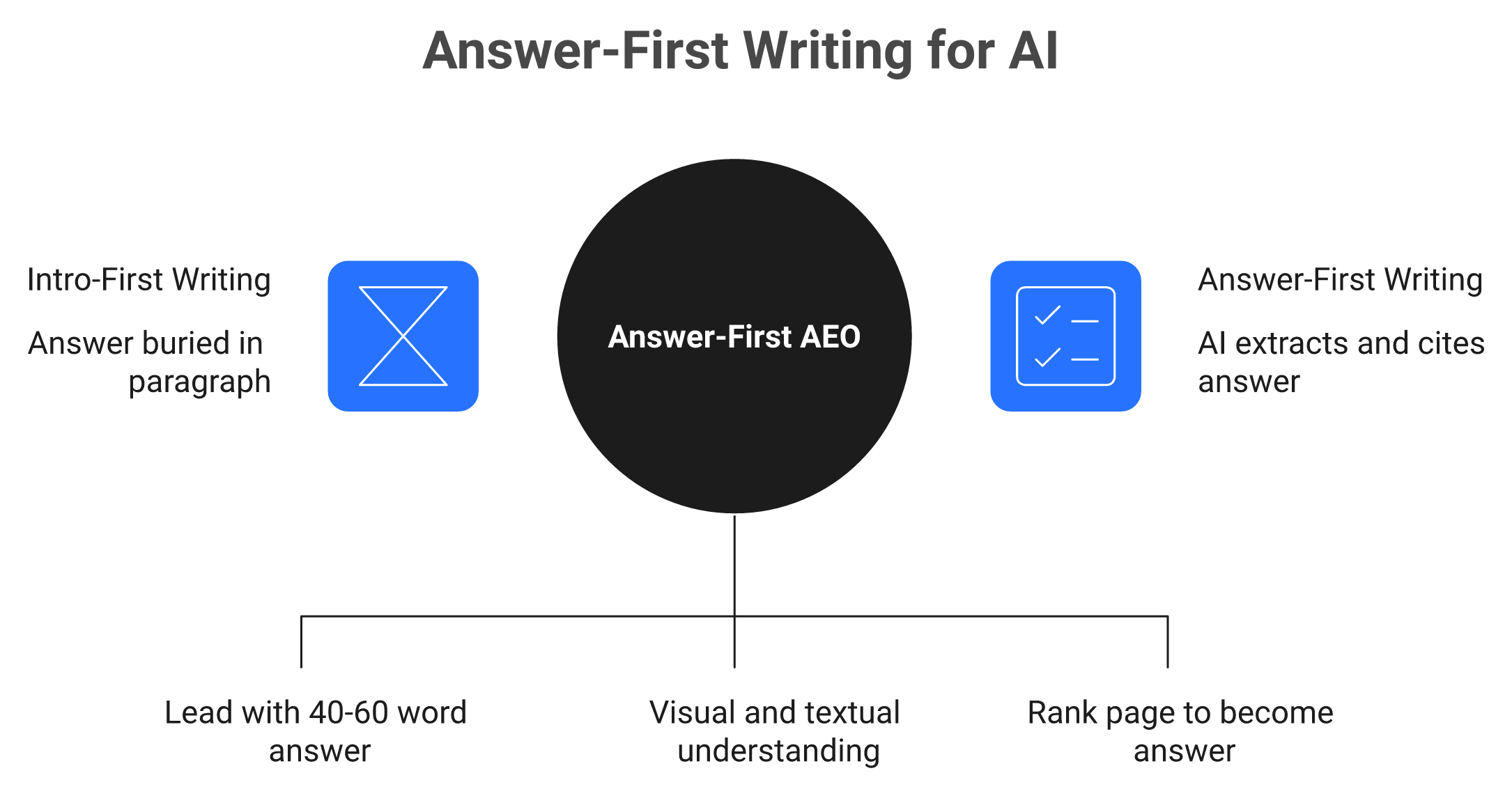
The snippet is the new rank. ChatGPT is literally grounding answers from a 150-character excerpt, receiving structured metadata like URL, title, snippet, and date, not the whole article. So the first line of every section has to carry the full answer on its own, which is the core of proper answer engine optimization.
🔍 The mechanic: retrieval, not ranking
AI answers run on retrieval-augmented generation (RAG), the process where the engine searches, pulls a few sources, then summarizes them. Your block competes at the retrieval step, before any "quality" judgment happens. Structure is what makes a passage retrievable, and it is a first principle of any AEO content writing and formatting approach.
The stakes are concrete. Ahrefs studied 300,000 keywords and found that position-one click-through rate drops around 58% when an AI Overview appears above it. Ranking first now buys less traffic than it used to, so being the extracted answer matters more than owning the blue link.
⭐ The reframe: structure earns the citation
I might be wrong on the exact percentages a year from now, but the direction is not in doubt. Writing for scroll depth is losing to writing for extraction. Think of it as the LLM being a universal intent decoder: it reads clusters of phrasing, so a clean, direct block wins across many ways of asking.
At MaximusLabs, we treat classic SEO best practice as the floor, not the ceiling. Clean HTML, fast pages, and keyword hygiene are table stakes. The answer block is where AEO actually begins, and it is the difference between being indexed and being quoted through disciplined generative engine optimization.
Q2. Why does answer structure decide whether AI cites you, and why is that a pipeline problem?
Answer structure decides citation because AI answers are binary, not ranked. When a buyer asks for the best tool, the engine names only 5 to 10 players, and there is no page two. If your content is not chunked into a standalone, extractable answer, the retrieval layer cannot lift it, so you never enter the consideration set. Because AI visitors arrive pre-sold and convert far higher, that exclusion is a pipeline problem, not a traffic problem.
A VP of Marketing recently described the new fear to me plainly. Her category page ranked third on Google, yet ChatGPT never named her product. The blue link existed; the mention did not.
⚠️ The situation: users stopped clicking to research
Buyers are no longer collecting ten blue links and building their own answer. They ask the engine to do the research for them. As one practitioner put it, people want the machine to "just tell me the answer instead of me having to go through and read the articles."
That behavior compresses the whole funnel into one response box. The engine does the reading, the synthesis, and the recommendation. Your content is either inside that synthesis or invisible, which is why AI search visibility and brand mention tracking now matters more than rank position.
💸 The complication: the 5-to-10 player sample set
Here is the part that keeps founders up at night. A buyer evaluating a CRM faces hundreds of options, but AI names only 5 to 10 players. If you are not in that sample set, you do not exist, and you are not even in the evaluation set.
This is more brutal than Google. There was always a page two, a scroll, a chance. In an answer box, exclusion is total. Ranking on "page one" of the underlying search means nothing if the model never quotes you.
✅ The resolution: structure your way into the set
The way in is extractable structure on the queries that carry money, meaning your bottom-of-funnel and middle-of-funnel questions. Chunk each answer so the retrieval layer can lift it cleanly. This is not a formatting nicety; it is admission to the room where the buyer decides, and it sits at the heart of our AEO service.
And the payoff is unusually direct. Webflow reported a 6x conversion-rate difference between LLM traffic and Google search traffic, because AI visitors arrive pre-sold. So a lost citation is not a lost pageview. It is a lost, high-intent buyer.
📊 What the proof looks like in practice
Because the attached knowledge base contains verified case outcomes rather than third-party review-site quotes, I will not fabricate testimonials here. What we can point to is documented client performance from our own work.
"Achieved a 64% citation rate across AI platforms in six months, overtaking legacy billion-dollar competitors sitting near a 30% citation rate."
MaximusLabs AI, UnderDefense engagement MaximusLabs AI Verified Case Study
"Ranked number one across Google, ChatGPT, and Perplexity for a core category term from a single GEO strategy."
MaximusLabs AI, Oliv AI engagement MaximusLabs AI Verified Case Study
This is exactly why we pioneered Revenue-focused Answer Engine Optimization (RAEO). We do not report impressions that make a dashboard look busy. We report whether your brand entered the answer that a buyer acted on, because being cited by name is a pipeline event.
Q3. How long should an AEO answer block be, and where does it go?
Keep the answer block tight. A 134 to 167 word block gets cited roughly 4.2x more often, while the extractable sentence-level unit should sit in 40 to 60 word paragraphs. Place it immediately under the heading, with no intro and no warm-up. AI grounds answers from short, front-loaded excerpts, so the first sentence must answer the question completely and stand alone if lifted out of context.
I used to hedge on length. Then the numbers settled the argument. When you actually run extraction tests, tight blocks win, and padded ones get skipped.
📏 The proof: length is a retrieval variable
The measured sweet spot for an answer block is 134 to 167 words, a range associated with being cited about 4.2x more often by retrieval systems. The sentence-level chunk that engines lift sits smaller, around 40 to 60 words, which mirrors how Anthropic's Claude Citations API handles sentence-level chunking, a detail our Anthropic Claude optimization work builds around.
Why so specific? Because the snippet is the new rank. A block that is too long dilutes the extract; a block that is too short starves it of context. The range is the compromise the machines reward.
📍 Placement: directly under the heading, no runway
Put the answer first, physically. No scene-setting sentence, no "in this section we will explore." The first line under your H2 is the line most likely to be quoted, so it must resolve the question by itself.
Read it back with a simple test. If you pasted that block into a stranger's chat with no surrounding article, would it still make complete sense? If not, rewrite it until it does.
🧱 The 4-part block template you can reuse
Here is the structure we apply to every section, in order:
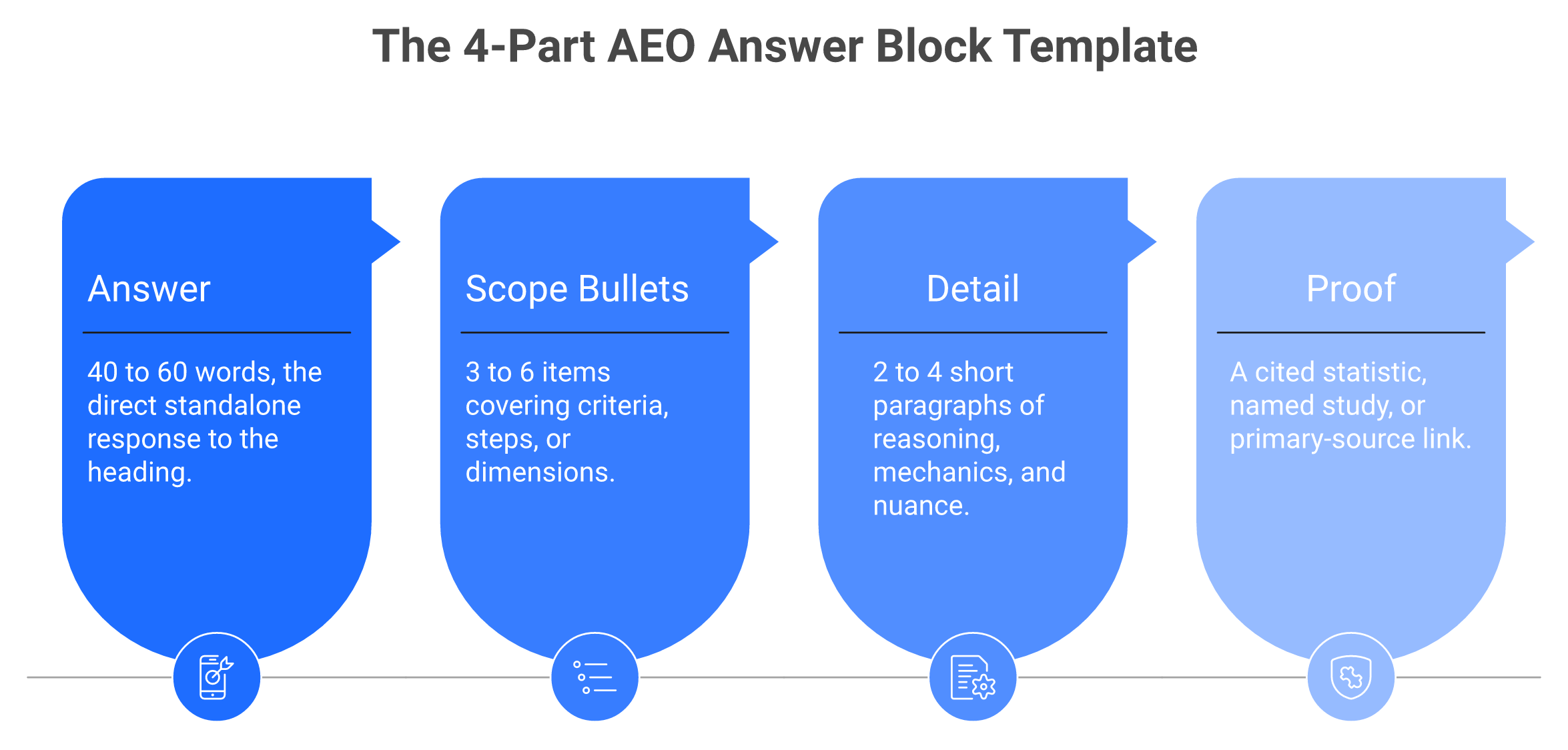
- Answer (40 to 60 words): the direct, standalone response to the heading's question.
- Scope bullets (3 to 6 items): the criteria, steps, or dimensions the answer covers.
- Detail (2 to 4 short paragraphs): the reasoning, mechanics, and nuance.
- Proof: a cited statistic, named study, or primary-source link that backs the claim.
At MaximusLabs, our answer-nugget spec targets 40 to 80 words for exactly this reason. It is a tested internal standard, not a guess, and it is why our sections read as complete quotes when an engine lifts them. Precision here is the cheapest citation insurance you can buy, and it anchors our content marketing service.
Q4. How do you write headings the way people actually ask AI, across head, mid, and long-tail queries?
Write headings as the questions users type into AI, not keyword fragments. The fastest method is to convert your existing SEO keywords into natural questions. You can hand the list to ChatGPT and ask it to phrase them as questions. Then match structure to query tier: head questions ("best CRM") win on citation-optimized brevity, while long-tail questions win on the most comprehensive owned answer. The engine behaves like a universal intent decoder, so question-clusters beat exact-match keywords.
A Head of Organic Growth once showed me a spreadsheet of 400 target keywords. My advice was blunt: stop thinking in keywords, start thinking in questions. The standard keyword read gets this backwards for AI search.
🗣️ The method: turn keywords into questions
You do not need a new dataset to start. Take your existing SEO keywords and make them into questions. You can literally give the keyword list to ChatGPT and ask it to phrase each as a question, which is directionally accurate for modeling AI demand. This is the foundation of AEO keyword and question research.
This works because there is no clean "truth set" for chat query volume yet. Keyword data is your proxy, and question-phrasing bridges the gap between how people search and how they prompt.
🧠 Why question-clusters beat exact match
Think of the LLM as a universal intent decoder. It does not need your exact phrasing, because it reads clusters of intent and understands what you meant regardless of wording. The average chat query runs around 25 words, versus roughly six on Google, so people ask in full, messy sentences.
That length is an opportunity. A single well-structured section can satisfy dozens of phrasings of the same question, the way one strong SEO page once ranked for thousands of keyword variants, a pattern we exploit in GEO service engagements.
🎯 Match structure to the query tier
Not every question wants the same block. The tier changes the job:
| Query tier | Example | What the structure must do |
|---|---|---|
| Head | "Best CRM software" | Win on citation-optimized brevity; dominated by third-party mentions |
| Mid-tail | "Best CRM for small SaaS teams" | Blend a crisp owned answer with supporting citations |
| Long-tail | "Does HubSpot route Slack leads automatically?" | Be the single most comprehensive owned answer to the exact question |
🔧 A worked example
Take the keyword "project management software." As a heading it is a dead fragment. Reframed, it becomes three AI-shaped questions: "What is the best project management software for remote teams?", "How do I choose project management software?", and "Which project management tool integrates with Slack?"
Each question earns its own answer block, and together they cover a cluster no single keyword could. This is question research replacing keyword research, and it is the quiet shift most teams have not made yet. If you want help operationalizing it, contact us.
Q5. What makes an answer block extractable, chunking, paragraph length, and the first-third rule?
Extractable content is chunked into self-contained, single-concept blocks with 40 to 60 word paragraphs and active subject-verb-object sentences. Placement matters as much as format. Around 44.2% of ChatGPT citations come from the first third of the page, so front-load your most citable answers. Content past the 70% mark is largely ignored, which means burying your best insight in a conclusion is the same as hiding it.
🧩 The rules: chunk, shorten, and stay active
Start with chunking, meaning breaking content into self-contained blocks that each cover one concept. A block should make full sense if the engine lifts it away from everything around it. If it leans on the paragraph before it, it is not extractable, and that is the core discipline of AEO content writing and formatting.
Then tighten the unit. Keep paragraphs to 40 to 60 words and write in active subject-verb-object order. "The retrieval layer lifts short blocks" beats "short blocks are lifted by the retrieval layer" every time.
📍 The proof: extraction concentrates up top
Here is the finding that changes how you lay out a page. Roughly 44.2% of ChatGPT citations come from the first third of the page. The top of the page is prime real estate, and most teams waste it on throat-clearing.
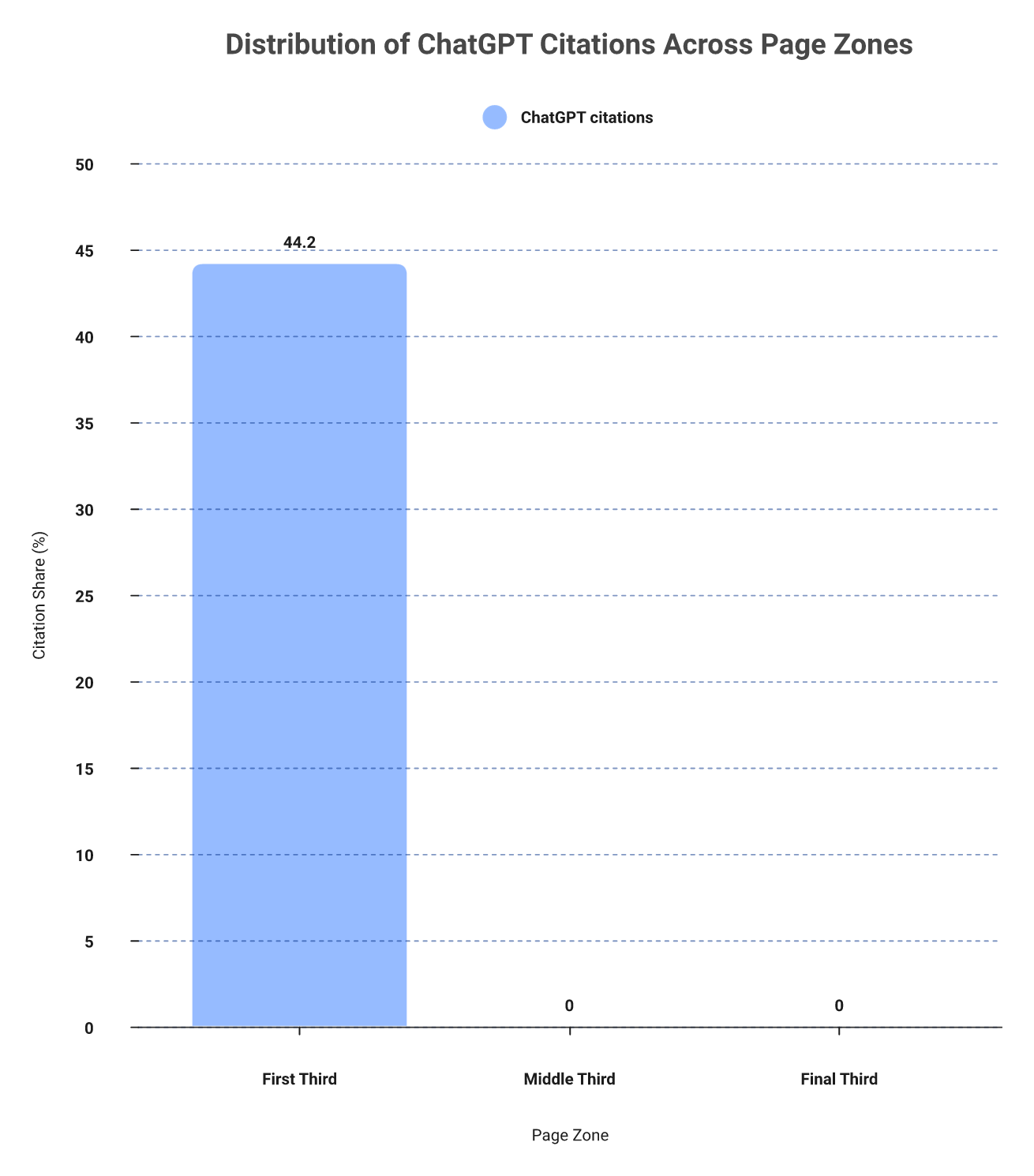
The flip side is brutal. Content beyond the 70% mark is largely ignored during extraction. Your sharpest data point, buried in a closing section, may never get read by the machine at all, which is why citation-worthy content for AI front-loads the value.
⭐ The payoff: inverted-pyramid the whole page
Most people apply answer-first thinking to each section but forget the page as a whole. The standard read gets this backwards. Order your sections so the highest-value, most citable answers sit early, not just your best sentences within a section.
There is a familiar parallel here. In SEO, roughly 19 out of 20 landing pages drive little traffic, while one drives about 85% of it. Extraction follows the same lopsided pattern, so concentrate your structural effort where the citations actually come from, a principle we build into every GEO service engagement.
📊 What this looks like in verified practice
The files in this space hold verified client outcomes rather than third-party review-site quotes, so I will not invent testimonials.
"Achieved a 64% citation rate across AI platforms in six months, with share of voice well above billion-dollar incumbents sitting near 30%."
MaximusLabs AI, UnderDefense engagement MaximusLabs AI Verified Case Study
At MaximusLabs, chunking is not a style choice. We enforce it through a MECE standard, meaning every section is mutually exclusive and collectively exhaustive, so blocks never overlap and never leave gaps. That discipline maps directly to our Citation-Worthiness scoring, because placement beats polish when a machine decides what to quote, and it underpins our AEO service.
Q6. Do schema, technical SEO, and platform differences actually change AI citations?
Schema helps but is contested. Some analysts call it a hygiene factor, others a real inclusion lever. Ship FAQPage and Article schema, and validate it, but do not expect it to rescue weak answers. Bigger wins come from exposure fixes, like rendering JavaScript-hidden facets and reviews, and from platform fit. ChatGPT rewards conversational depth, AI Overviews want 40 to 80 word nuggets plus E-E-A-T, Perplexity favors fresh readable prose, and Claude rewards cited long-form. Page speed rarely moves AI visibility.
⚠️ The situation: the schema camps disagree
Structured data, meaning code like FAQPage or Article schema that labels your content for machines, splits the experts. SALT.agency concludes schema is "a hygiene factor (at best)" and not a differentiator. Surfer Academy argues structured data "increases your odds significantly" by telling AI exactly what your content is. Getting this layer right is the job of technical SEO and website audit work.
Both can be partly right. Schema clarifies; it does not create authority. I might be wrong on where the balance lands, but from what surfaces when you actually run this, schema is necessary and rarely sufficient.
💸 The complication: your content may be hidden
Here is the failure mode nobody checks. Turn JavaScript off in your browser and reload a page. As one practitioner demonstrated, sometimes the whole page does not show up, and reviews loaded asynchronously simply vanish.
If a human browser cannot see it, a crawler often cannot either. Product facets like fabric, closure, or neck style are frequently locked behind JavaScript dropdowns, and LLMs cannot find information hidden there. Move that data into text and FAQs where it is reachable, a fix our AI crawlers guide and optimization resource walks through.
🧭 Platform fit: one size does not extract
Different engines reward different structures. Here is the cheat sheet we work from:
| Platform | What it rewards | How to structure |
|---|---|---|
| ChatGPT | Conversational depth, expertise | Question-headed sections, first-person markers |
| Google AI Overviews | Answer-first, E-E-A-T | 40 to 80 word nuggets, schema, author credentials |
| Perplexity | Freshness, source transparency | Dated references, visible footnotes, readable prose |
| Claude | Long-form, methodology | Primary-source citations, process explanations |
✅ The resolution: extractability over vanity metrics
Spend your technical hours where they pay off. Core Web Vitals and page speed rarely drive AI visibility, and treating them as a security blanket wastes budget. There is also no evidence that markdown-only pages or an LLM.txt file move retrieval at all, so skip the silver bullets. If you want a per-engine plan, our Perplexity optimization and ChatGPT optimization tracks are built for exactly this.
"Ranked number one across Google, ChatGPT, and Perplexity for a core category term from a single GEO strategy."
MaximusLabs AI, Oliv AI engagement MaximusLabs AI Verified Case Study
At MaximusLabs, we do not optimize for "AI" generically. We optimize per engine, because ChatGPT, Perplexity, and Google AI each weigh trust signals differently, and that per-platform discipline is what one-size-fits-all agency checklists miss.
Q7. How do you engineer trust signals AI will actually cite?
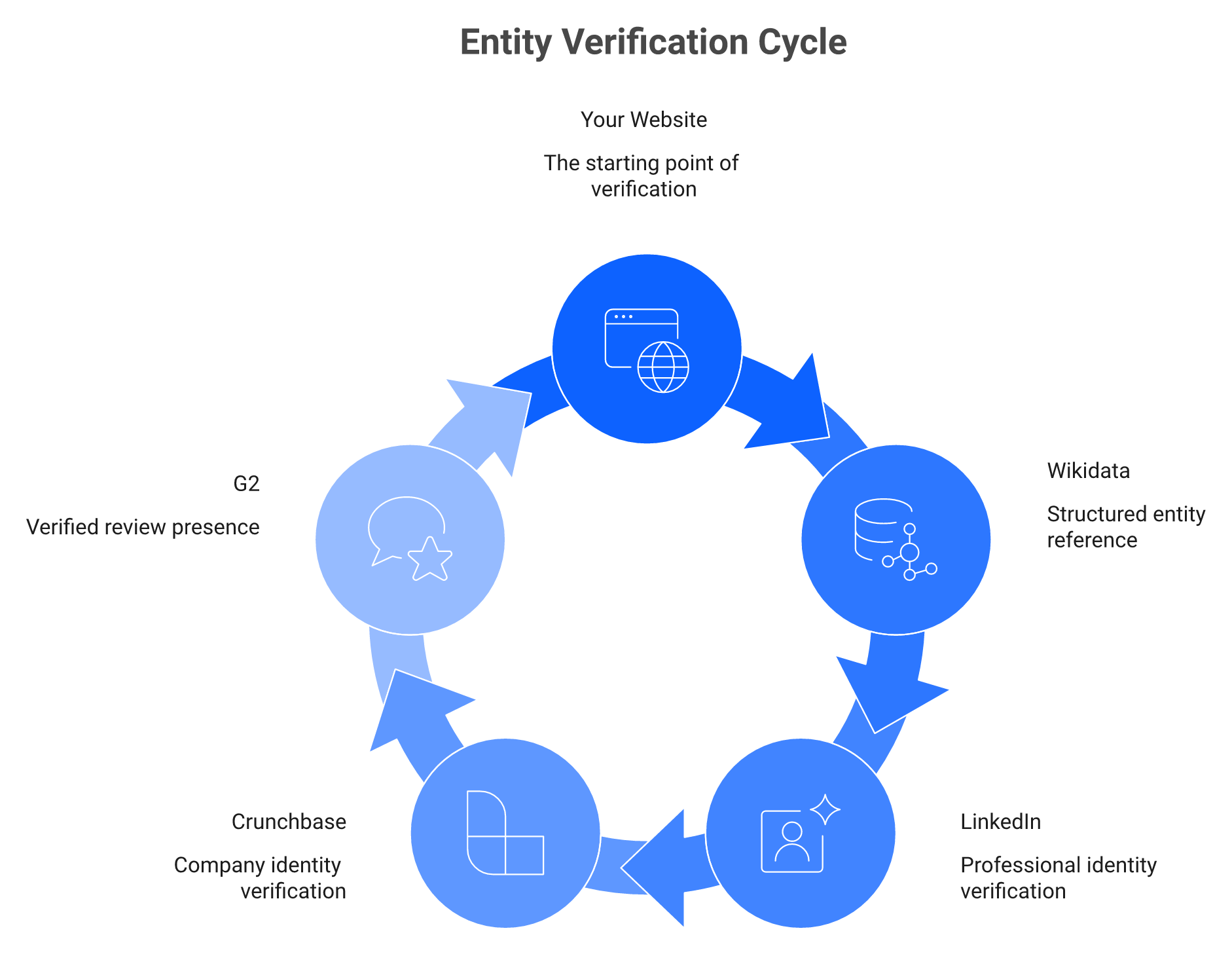
AI cites verifiable evidence, not a confident voice. An authoritative, expert-sounding tone without underlying statistics, quotations, and citations shows no measurable visibility lift. What works is embedding named studies and real numbers inside the answer block, roughly one cited data point every 150 to 200 words, plus closing your entity loop (website to Wikidata to LinkedIn to Crunchbase to G2 and back via sameAs links) so the machine verifies who you are through web-wide consensus.
⚠️ The situation: "write authoritatively" is bad advice
For years the advice was to sound like an expert. Adopt a confident, formal tone, and the authority will follow. That instinct is now measurably wrong.
Authoritative tone, used as a content-modification strategy, shows no significant improvement in AI visibility. Writing in an expert-sounding voice without the underlying substance, meaning statistics, quotations, and citations, simply does not help, which is why real E-E-A-T for AEO depends on evidence.
💸 The complication: the machine trusts consensus, not you
AI does not take your word for who you are. It cross-checks the web. One team watched Perplexity summarize their article and describe them as Oxford researchers, which none of them were, because the engine found a conceptually adjacent paper and inferred the credential.
The lesson is uncomfortable but useful. The agent looks for mentions, and the thing mentioned most tends to surface. Web-wide consensus outranks your own self-claims, so authority is earned across the internet, not asserted on your page, a reality our citation consistency for AI search work is built around.
✅ The resolution: embed evidence, close the loop
Do two concrete things. First, put named evidence inside the answer block, aiming for roughly one cited data point every 150 to 200 words, since citations and statistics measurably lift AI visibility. Second, close the sameAs loop.
A sameAs link is structured data that connects your identities across the web. The goal is for a crawler to traverse website to Wikidata to LinkedIn to Crunchbase to G2 and back to your website. That closed, verifiable entity graph matters more than raw link volume, and it is a staple of our AI citation acquisition tactics.
"Overtook legacy, decade-old, billion-dollar competitors by reaching a 64% citation rate while they sat near 30%, inside six months."
MaximusLabs AI, UnderDefense engagement MaximusLabs AI Verified Case Study
At MaximusLabs, our rule is simple: stop optimizing for Google, and start optimizing for trust. We embed E-E-A-T signals and primary sources into every block, because when an engine cites you, it stakes its own credibility on you being right.
Q8. Why do AI-generated answer blocks still need human expertise?
Because unedited AI content is frequently wrong. In one 30-query ChatGPT study, 20% of output contained overtly incorrect information, and over 50% had material omissions. Publishing that at scale is brand-damaging misinformation, and quality filters will eventually nuke mass-automated content the way Google nuked scraped content in 2008. Human subject-matter expertise and original research are what stop model collapse and keep your answers citable.
⚠️ The situation: we have seen this movie before
Mass automation feels like free leverage. Generate a thousand answer blocks, publish, and win. A veteran practitioner who created scraped, rewritten content in 2007 watched exactly that tactic work briefly, then get crushed by Google's quality filters.
The incentives have not changed. Search platforms cannot let their results become summaries of summaries, so they are built to devalue derivative content. What worked in 2008 died, and the AI-content version will die the same way, a lesson baked into our content marketing service.
💸 The complication: the errors are real and costly
The accuracy gap is not theoretical. In a 30-query ChatGPT study, coauthor Eric Enge found 20% of the content contained overtly incorrect information, and over 50% had material omissions. Ship that unedited and you are publishing brand-damaging misinformation at scale, which is why our AI content humanizer keeps a human in the loop.
There is a quieter risk too. When models train on their own derivatives, viewpoint diversity collapses toward a single bland answer. The penalty for being average has never been so severe.
✅ The resolution: humans hold the expertise line
The fix is not "no AI." It is a human subject-matter expert in the loop, plus original research the model cannot invent. AI handles aggregation, formatting, and first drafts, while humans drive accuracy, voice, and the point of view that makes a block worth citing, which is the heart of our founder voice methodology guide.
At MaximusLabs, this is our Founder's Voice pipeline. Most shops are summarizing five articles and writing the sixth, and unique perspective gets lost. We sit with the leadership team, capture how the founder actually thinks, and pair that with human QA, because original expertise is the moat that survives every model update.
Q9. What does a complete, refresh-ready answer-structured page look like end to end?
A complete answer-structured page front-loads a 134 to 167 word answer to the title, uses question-formatted H2s that each open with a 40 to 60 word extractable block, keeps paragraphs short and single-concept, concentrates key answers in the first third, exposes hidden facet and review data in text, closes the sameAs entity loop, and ships FAQPage plus Article schema. Then it stays fresh. AI-surfaced URLs run about 25.7% fresher, and citations decay near 13 weeks, so refresh stats quarterly.
🧱 The full-page template, in order
Think of everything from Q1 to Q8 assembling into one page. The structure is the sum of the parts, applied top to bottom, not section by section in isolation.
Here is the checklist we run before anything ships, and it doubles as an AEO implementation checklist:
- Title answer block: open with a 134 to 167 word answer to the article's core question.
- Question-headed H2s: phrase each section as a real user question.
- Answer nugget per section: lead each H2 with a 40 to 60 word standalone block.
- Short paragraphs: keep every paragraph single-concept and active voice.
- First-third loading: place your most citable answers in the top third of the page.
- Expose hidden data: pull facets and reviews out of JavaScript and into text.
- Close the sameAs loop: link website to Wikidata to LinkedIn to Crunchbase to G2 and back.
- Ship and validate schema: add FAQPage and Article schema, then confirm it works, which our schema markup basics guide covers.
- Refresh quarterly: update stats and dates every quarter to beat citation decay.
⏰ Why the refresh step is not optional
Structure gets you cited once. Freshness keeps you cited. Ahrefs' analysis of 17 million citations found AI-surfaced URLs run about 25.7% fresher than standard search results, a pattern our GEO content refresh process is built around.
Citations also fade. They tend to decay around the 13-week mark, so a page you built and forgot slides out of the answer set. A quarterly refresh of numbers, dates, and examples is the cheapest way to hold your spot, and tracking it draws on AEO measurement metrics.
✅ How we operationalize this
At MaximusLabs, this checklist is not a one-time build. It is the production standard we run for clients, and we sequence it so bottom-of-funnel and middle-of-funnel decision pages get structured and refreshed first, because those are the pages that move pipeline. That scalable, revenue-first cadence is how we position a product exactly the way its founder wants it described in the answer, and it anchors our AEO service.
Q10. How is answer-structured content different from a traditional Google-only SEO article?
A traditional SEO article opens with a keyword-stuffed intro, builds narrative tension, and reveals the answer late. An answer-structured page front-loads the answer, chunks each section to stand alone, and writes for retrieval, not scroll depth. SEO optimizes to rank one of ten blue links; AEO optimizes to be the single synthesized answer. The practical shift is simple: move your conclusion to the top, and make every block independently citable.
⚠️ The situation: the SEO article was built for humans scrolling
The classic SEO post assumes a reader who lands, skims, and scrolls. So it warms up, sets context, and pays off the answer near the end. That served a decade of blue-link traffic well.
The whole design optimizes for time on page and keyword coverage. It is a scroll-depth artifact, built for a human who chooses to keep reading, which is exactly the gap our GEO vs traditional SEO comparison unpacks.
💸 The complication: extraction ignores the warm-up
AI does not scroll. It grounds answers from short front-loaded excerpts, so the snippet is the new rank. A buried conclusion is invisible to the retrieval layer, no matter how good it is.
The engine also does not need your exact keywords. It behaves like a universal intent decoder, reading clusters of intent, so keyword-stuffed intros add nothing while pushing your real answer down the page. Understanding those differences is the foundation of AEO vs SEO strategy.
✅ The resolution: what to actually change
Here is the side-by-side that makes the edit obvious:
| Element | Traditional SEO article | AEO answer structure |
|---|---|---|
| Opening | Keyword-rich intro, slow warm-up | Direct answer, no runway |
| Headings | Keyword phrases | Real user questions |
| Paragraphs | Long, narrative | 40 to 60 words, single-concept |
| Goal metric | Rank in ten blue links | Be the synthesized answer |
| Success signal | Position and pageviews | Citation and pipeline |
The move is not a rewrite from scratch. Flip the order, break the walls into chunks, and question-format the headings.
"Overtook legacy, decade-old, billion-dollar competitors, reaching a 64% citation rate versus their roughly 30%, in six months."
MaximusLabs AI, UnderDefense engagement MaximusLabs AI Verified Case Study
At MaximusLabs, we do not bolt a "GEO" label onto old SEO habits. We build for extraction and revenue from the first draft, because retrofitting a 2019 playbook is exactly what leaves brands ranking on Google yet absent from the answer, which is the whole point of our GEO service.
Q11. What I'm thinking about next: agentic commerce and the data-feed shift
The next shift is agentic. Bots will not browse your page; they will consume your data feed. Think of your website as the dining room and agentic commerce as the kitchen and transaction layer, where the delivery-driver bot only needs clean, structured data to fulfill the order. Answer structure today is training for that world. Brands whose content is already machine-extractable will be the ones agents can actually transact with tomorrow.
🍳 The situation: from dining room to ghost kitchen
Most sites are still designed as a dining room, meaning a place for humans to sit, browse, and decide. Agentic commerce, where AI agents complete tasks and purchases on a user's behalf, does not eat in the dining room. It works the kitchen, and it only needs the data feed to fulfill the order, a shift our what is agentic commerce primer explains.
That reframes the whole job. The prettiest interface means nothing to a bot that reads structured data. Extractable answer structure is the early version of a machine-readable feed, which is why our agentic commerce service starts there.
⚖️ The complication: is early movement even worth it?
Here the experts split, and I sit with the tension. One practitioner view calls first-mover advantage in search a "false concept," since strong authority can win rankings later anyway. The other view, and the one I lean toward, is that trust compounds, giving early movers a durable moat as agentic commerce matures.
I might be wrong on the timeline. Infrastructure like Microsoft's Web IQ grounding already runs to tight latency budgets, near 164 milliseconds at p95, which signals how real-time agentic retrieval is getting. My working position: build the extractable data layer now, because catching up later costs more than starting early, a case our state of agentic commerce 2026 report lays out.
💬 Let's keep this conversation going
If you are structuring pages today, you are already rehearsing for agents tomorrow. That is the quiet payoff of doing answer structure properly. At MaximusLabs, we build agent-ready, data-feed-first content, and I would genuinely like to hear how you are thinking about the shift. If "traffic without revenue" is the problem you are sitting with, contact us, and you will leave with clarity, not jargon.
Frequently asked questions
What is answer structure for AEO, and how is it different from SEO writing?
Answer structure for AEO is a writing pattern that leads every section with a direct, self-contained answer of roughly 40 to 60 words before adding scope, detail, and cited proof. Unlike SEO writing, which warms the reader up with an intro and reveals the answer late, AEO structure front-loads the conclusion so AI answer engines can extract and cite a standalone block. The shift matters because the mechanics changed: AI grounds answers from short, front-loaded excerpts, so the snippet is the new rank. Retrieval happens before any quality judgment, so structure is what makes a passage retrievable. The goal moves from ranking one of ten blue links to becoming the single synthesized answer. We treat classic SEO best practice as the floor, not the ceiling. Clean HTML, fast pages, and keyword hygiene are table stakes, while the answer block is where AEO actually begins. If you want the discipline behind this, our answer engine optimization approach shows how we make every block independently citable rather than buried below a warm-up.
Why does answer structure decide whether AI cites us, and why is that a pipeline problem?
Answer structure decides citation because AI answers are binary, not ranked. When a buyer asks for the best tool, the engine names only 5 to 10 players, and there is no page two. If your content is not chunked into a standalone, extractable answer, the retrieval layer cannot lift it, so you never enter the consideration set. This is more brutal than Google: There was always a page two, a scroll, and a second chance in classic search. In an answer box, exclusion is total, so ranking on page one means nothing if the model never quotes you. AI visitors arrive pre-sold, which is why Webflow reported a 6x conversion-rate difference between LLM traffic and Google search traffic. So a lost citation is not a lost pageview. It is a lost, high-intent buyer. That is why we pioneered Revenue-focused Answer Engine Optimization, reporting whether your brand entered the answer a buyer acted on. Tracking that visibility is the job of AI search visibility and brand mention tracking , which shows exactly where you are cited or excluded.
How long should an AEO answer block be, and where should it go on the page?
Keep the answer block tight. A 134 to 167 word block gets cited roughly 4.2x more often, while the extractable sentence-level unit should sit in 40 to 60 word paragraphs. Place it immediately under the heading, with no intro and no warm-up, because the first sentence under your H2 is the line most likely to be quoted. We apply a reusable four-part block to every section: Answer (40 to 60 words): the direct, standalone response to the heading's question. Scope bullets (3 to 6 items): the criteria, steps, or dimensions covered. Detail (2 to 4 short paragraphs): the reasoning, mechanics, and nuance. Proof : a cited statistic, named study, or primary-source link. Use a simple test: if you pasted that block into a stranger's chat with no surrounding article, would it still make complete sense? If not, rewrite it until it does. Our answer-nugget spec targets 40 to 80 words for exactly this reason, and it anchors the way we build every content marketing engagement so sections read as complete quotes when an engine lifts them.
How do we write headings the way people actually ask AI questions?
Write headings as the questions users type into AI, not keyword fragments. The fastest method is to convert your existing SEO keywords into natural questions, and you can literally hand the list to ChatGPT and ask it to phrase each as a question. Then match structure to the query tier: Head questions like "best CRM" win on citation-optimized brevity. Mid-tail questions blend a crisp owned answer with supporting citations. Long-tail questions win by being the single most comprehensive owned answer. This works because the LLM behaves like a universal intent decoder. It reads clusters of intent and understands what you meant regardless of exact wording, and since the average chat query runs around 25 words versus roughly six on Google, people ask in full, messy sentences. A single well-structured section can therefore satisfy dozens of phrasings, the way one strong page once ranked for thousands of keyword variants. This is question research replacing keyword research, and it is the foundation of our AEO keyword and question research process.
What makes an answer block genuinely extractable for AI engines?
Extractable content is chunked into self-contained, single-concept blocks with 40 to 60 word paragraphs written in active subject-verb-object order. A block should make full sense if the engine lifts it away from everything around it. If it leans on the paragraph before it, it is not extractable. Placement matters as much as format: Roughly 44.2% of ChatGPT citations come from the first third of the page, so front-load your most citable answers. Content beyond the 70% mark is largely ignored during extraction, so burying your best insight in a conclusion hides it. Order sections so the highest-value answers sit early, applying inverted-pyramid thinking to the whole page, not just each section. We enforce this through a MECE standard, meaning every section is mutually exclusive and collectively exhaustive, so blocks never overlap and never leave gaps. That discipline maps directly to producing citation-worthy content for AI , because placement beats polish when a machine decides what to quote.
Does schema, technical SEO, or platform choice actually change AI citations?
Schema helps but is contested. Some analysts call it a hygiene factor, others a real inclusion lever. Ship FAQPage and Article schema, and validate it, but do not expect it to rescue weak answers. Bigger wins come from exposure fixes and platform fit. Two practical priorities matter most: Expose hidden data: product facets and reviews locked behind JavaScript dropdowns are invisible to crawlers, so move that data into text and FAQs. Match structure to platform: ChatGPT rewards conversational depth, AI Overviews want 40 to 80 word nuggets plus E-E-A-T, Perplexity favors fresh readable prose, and Claude rewards cited long-form. Page speed and Core Web Vitals rarely move AI visibility, and there is no evidence that markdown-only pages or an LLM.txt file change retrieval, so skip the silver bullets. We optimize per engine rather than for "AI" generically, because each platform weighs trust signals differently. Getting the exposure and rendering layer right is the job of our technical SEO and website audit work, which surfaces content crawlers otherwise cannot see.
How do we engineer trust signals that AI will actually cite?
AI cites verifiable evidence, not a confident voice. An authoritative, expert-sounding tone without underlying statistics, quotations, and citations shows no measurable visibility lift. What works is embedding named studies and real numbers inside the answer block, plus closing your entity loop so the machine verifies who you are through web-wide consensus. Do two concrete things: Put named evidence inside the answer block, aiming for roughly one cited data point every 150 to 200 words. Close the sameAs loop, connecting website to Wikidata to LinkedIn to Crunchbase to G2 and back, so a crawler can traverse and verify your identity. This matters because the machine trusts consensus, not your self-claims. One team watched Perplexity describe them as Oxford researchers, which none of them were, because the engine found a conceptually adjacent paper and inferred the credential. Authority is earned across the internet, not asserted on your page. That closed, verifiable entity graph matters more than raw link volume, and it is central to our E-E-A-T for AEO methodology.
Why do AI-generated answer blocks still need human expertise?
Because unedited AI content is frequently wrong. In one 30-query ChatGPT study, 20% of output contained overtly incorrect information, and over 50% had material omissions. Publishing that at scale is brand-damaging misinformation, and quality filters will eventually devalue mass-automated content the way Google devalued scraped content in 2008. The risks compound: Accuracy gaps turn unedited drafts into published misinformation. When models train on their own derivatives, viewpoint diversity collapses toward a single bland answer. Search platforms are built to devalue derivative summaries of summaries. The fix is not "no AI." It is a human subject-matter expert in the loop, plus original research the model cannot invent. AI handles aggregation, formatting, and first drafts, while humans drive accuracy, voice, and the point of view that makes a block worth citing. This is our Founder's Voice pipeline: we sit with the leadership team, capture how the founder actually thinks, and pair that with human QA. You can see the method in our founder voice methodology guide , because original expertise is the moat that survives every model update.