 Krishna Kaanth M
- AEO measurement replaces rank with probability: run a frozen prompt set five to ten times per surface and report share of answers, not positions.
- Six metrics predict revenue: share of answers on buying-intent prompts, citation rate, citation quality, sentiment, hallucination count, and AI-referral conversion rate.
- Search Console generative AI reports and GA4 channel groups validate direction only. Share of answers, sentiment, and competitor share remain third-party or self-built.
- Zero-click attribution needs three layers: GA4 AI-assistant grouping, a free-text how-did-you-hear survey, and CRM flags for AI-influenced deals.
- Brand web mentions correlate with AI Overview visibility at 0.664 versus 0.218 for backlinks, making off-site consensus the real lever.
- A 90-day rollout gives direction, not proven ROI. Real ROI reads land between three and six months, and relative competitor share is the only honest board metric.
Q1. Why do traditional SEO dashboards break the moment you try to measure AI answers?
AEO measurement tracks how often, how accurately, and how profitably AI engines cite your brand. It replaces rank with probability. The same prompt returns a different answer on each run, so a single position never exists. You measure a frozen prompt set across ChatGPT, Perplexity, Gemini, Copilot, and Google AI Overviews using share of answers, citation quality, sentiment, and conversion.
📉 The Monday morning dashboard that stopped explaining anything
John runs sales at a mid-sized SaaS company. He no longer opens a dozen review tabs. He opens ChatGPT and types: give me a detailed list of top-rated tools with pros, cons, and pricing.
Ten seconds later he has five names. That list is now his sample set. Your VP Marketing is staring at a Looker dashboard that says organic sessions are flat, while three deals this quarter mentioned ChatGPT in discovery, a pattern documented in the B2B SaaS buyer journey in AI search.
⚠️ The complication: exclusion happens before the click
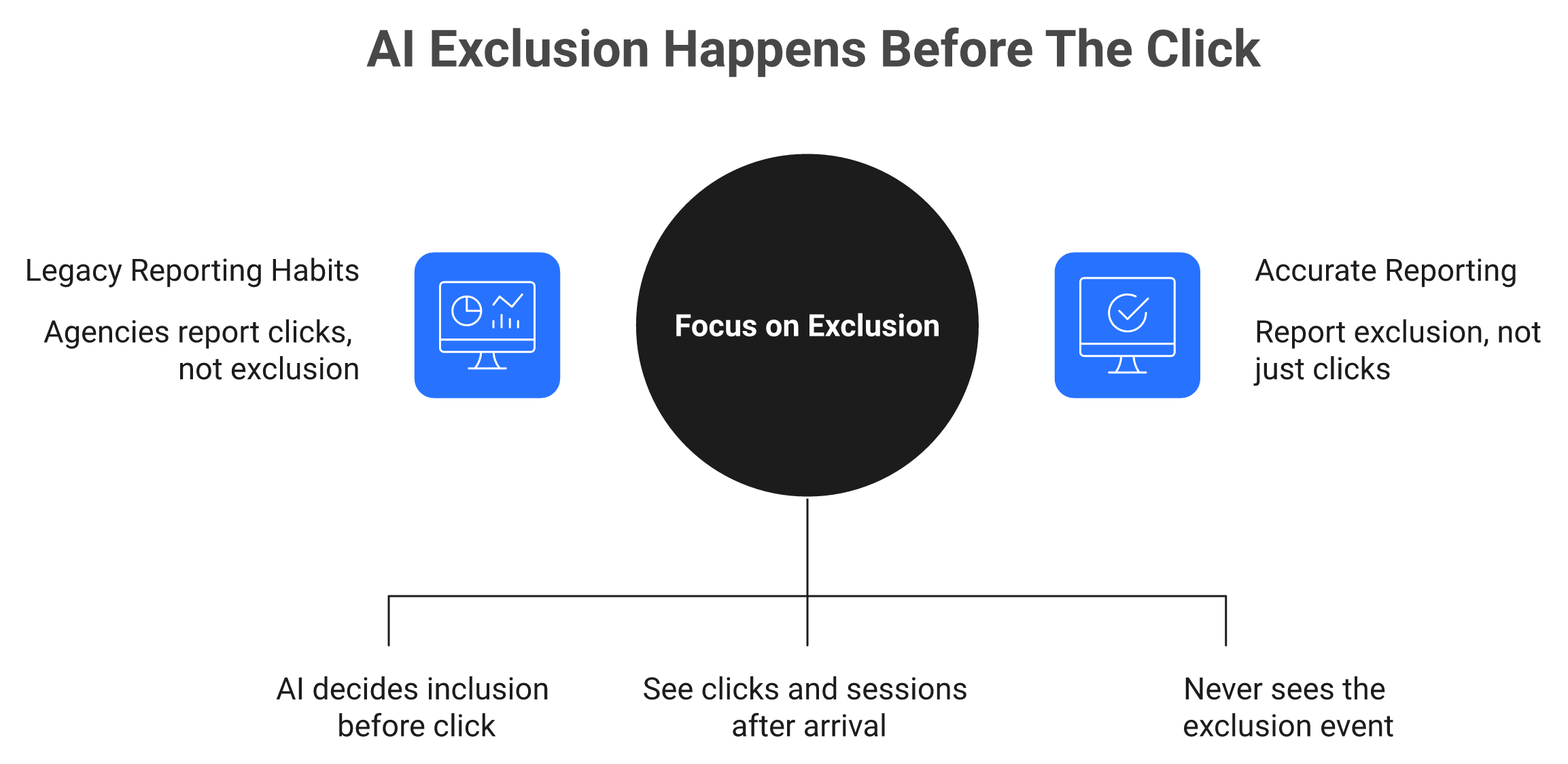
The dashboard is not lying. It is measuring the wrong event. By the time a buyer clicks anything, the engine has already excluded most of the category.
This is a binary game. You are in the answer set or you are invisible, and the SERP report never sees the moment of exclusion. Traditional agencies still report the click, because the click is what their 2019 playbooks were built to count, which is the core divide covered in GEO vs traditional SEO.
🔍 What Google's own changelog admits
Google's Search Central changelog confirmed in June 2025 that AI Mode data counts toward totals in the Search Console Performance report, inside the standard Web search type. Follow-up questions inside AI Mode get counted as brand new queries.
There is no separate break-out, and no API change. Your fluctuating impressions may be AI Mode blending in, not an algorithm update. That single documentation line invalidates a lot of confident quarterly reporting.
🔁 Mapping old KPIs to the ones that survive
| Traditional SEO metric | AEO equivalent | Why the swap matters |
| Rank position | Share of answers | No fixed position exists in a probabilistic system |
| Keyword volume | Prompt coverage | Buyers ask questions, not keywords |
| Click-through rate | Citation rate | Many answers never produce a click |
| Backlinks | Top cited domains | Engines cite sources, not just link graphs |
| Impressions | AI feature impressions | Available in Search Console, without break-out |
✅ The four layers worth reporting
Measurement now stacks in four layers: prompt visibility, traffic and brand lift, commercial signals, and technical impact. Most teams only instrument layer two, which is why AEO measurement looks like it does nothing.
MaximusLabs AI measures client visibility as share of answers across question variants rather than single checks, which is how Oliv AI's 64% citation rate was benchmarked against incumbents sitting near 30%. That comparison only becomes visible once you stop counting positions.
Q2. What is Share of Answers, and how many runs make a result statistically real?
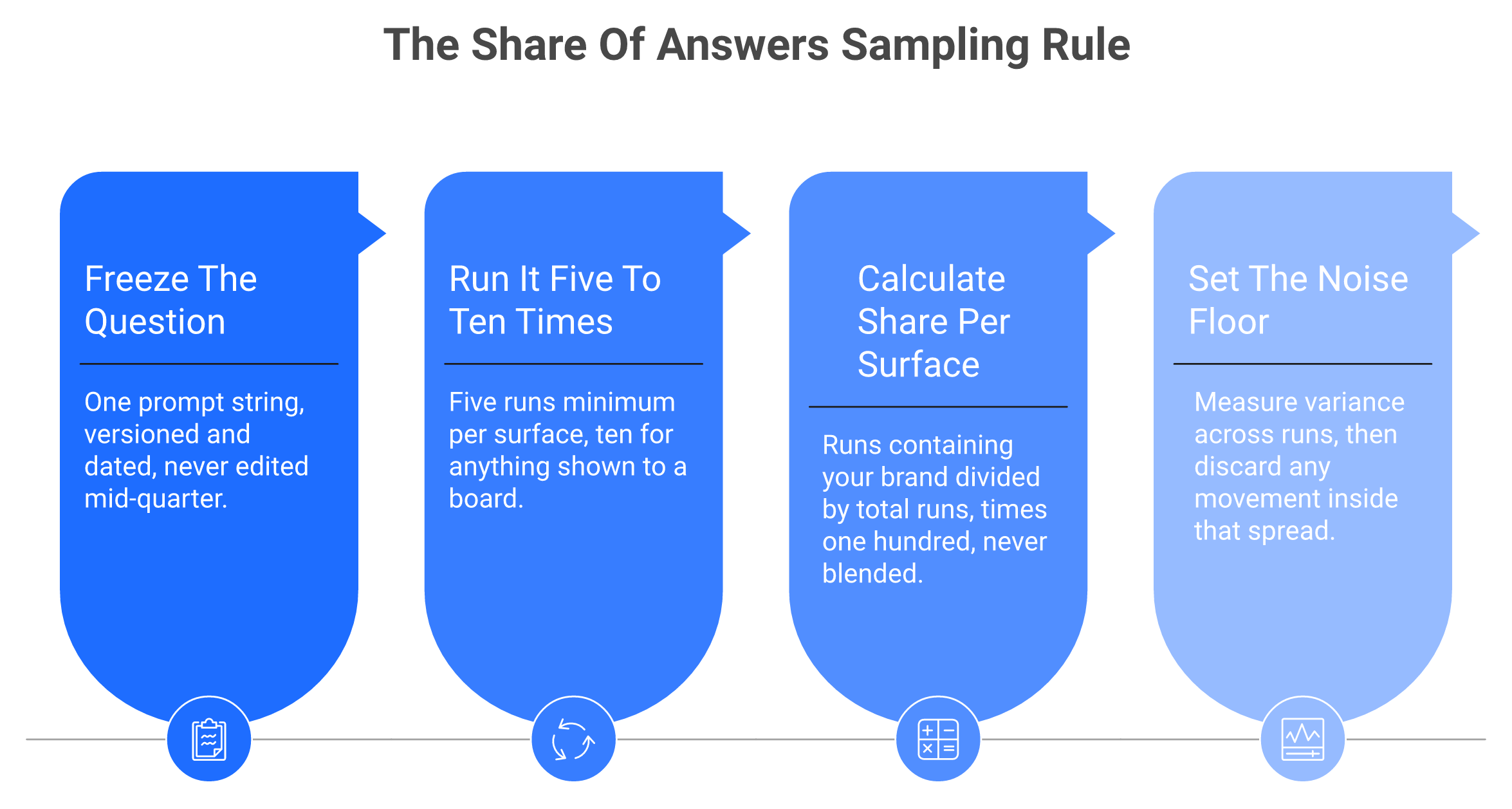
Share of Answers is the percentage of runs, across a defined question set, in which an engine mentions your brand. Because outputs are non-deterministic, run every question five to ten times and record a distribution rather than a yes or no. Segment by surface, question variant, and run date. Only call a change real when it clears your observed run-to-run variance.
📊 The formula, stated plainly
Share of Answers = (runs containing your brand ÷ total runs) × 100.
Run it per surface, never blended. A brand can sit at 40% on Perplexity and 8% on Gemini in the same week. A blended number hides the platform where you are actually losing pipeline.
🌀 Why the same question gives different answers
In Google, searching the same keyword twice returns near-identical results. In AI, the same question can return a different answer each time. That is not a bug, it is sampling.
One prompt also fans out. A standard AI Mode query decomposes into roughly eight to twelve parallel sub-queries before the answer is assembled, which you can model with a query fan-out generator. You are being evaluated against a sub-query tree, not a single string.
⏰ The sampling rule nobody publishes
Practitioner frameworks now track probabilistic rankings across ten large language models, using ICP-driven prompt variants rather than keywords. What almost nobody publishes is how many runs make the number trustworthy.
My working rule: five runs minimum per question per surface, ten for anything you plan to show a board. Then calculate variance across those runs and treat that spread as your noise floor. A visibility jump inside the noise floor is not a result, it is a coin flip.
📋 What a real distribution looks like
| Surface | Runs | Runs with mention | Share of answers |
| ChatGPT | 10 | 6 | 60% |
| Perplexity | 10 | 4 | 40% |
| Gemini | 10 | 1 | 10% |
| Copilot | 10 | 3 | 30% |
MaximusLabs AI builds prompt sets across ChatGPT, Claude, Perplexity, and Gemini, then maps which specific URLs get cited most often for each one, following documented ChatGPT, Perplexity, and Gemini citation patterns. The citation map matters more than the score, because it tells you which page to fix.
🤔 Where I hedge
MaximusLabs AI's run data points toward five runs being sufficient for most B2B categories, though I might be reading that too strongly. Volatile categories with fast-moving vendors probably need more. Publish your variance alongside your score and let readers judge.
Q3. Which AEO metrics predict revenue, and how do you weight them into one score?
Six metrics predict revenue: share of answers on buying-intent prompts, citation rate, citation quality, sentiment, hallucination count, and AI-referral conversion rate. Combine them into one AI Visibility Score. A workable starting split is 40% mentions, 30% citation quality, 20% placement, and 10% conversion. Skew the weighting toward BOFU prompts, because definitional visibility carries almost no purchase intent.
✅ The six that survive scrutiny
- Share of answers on buying-intent prompts. Percentage of runs where you appear on comparison, alternative, and pricing questions.
- Citation rate. Mentions that include an actual link back to you.
- Citation quality. Authority of the source the engine chose, defined against a provenance standard.
- Sentiment. Whether the mention helps or quietly damages you.
- Hallucination count. Factual errors about your brand, logged per platform.
- AI-referral conversion rate. The only metric a CFO recognizes.
💰 Weighting the composite score
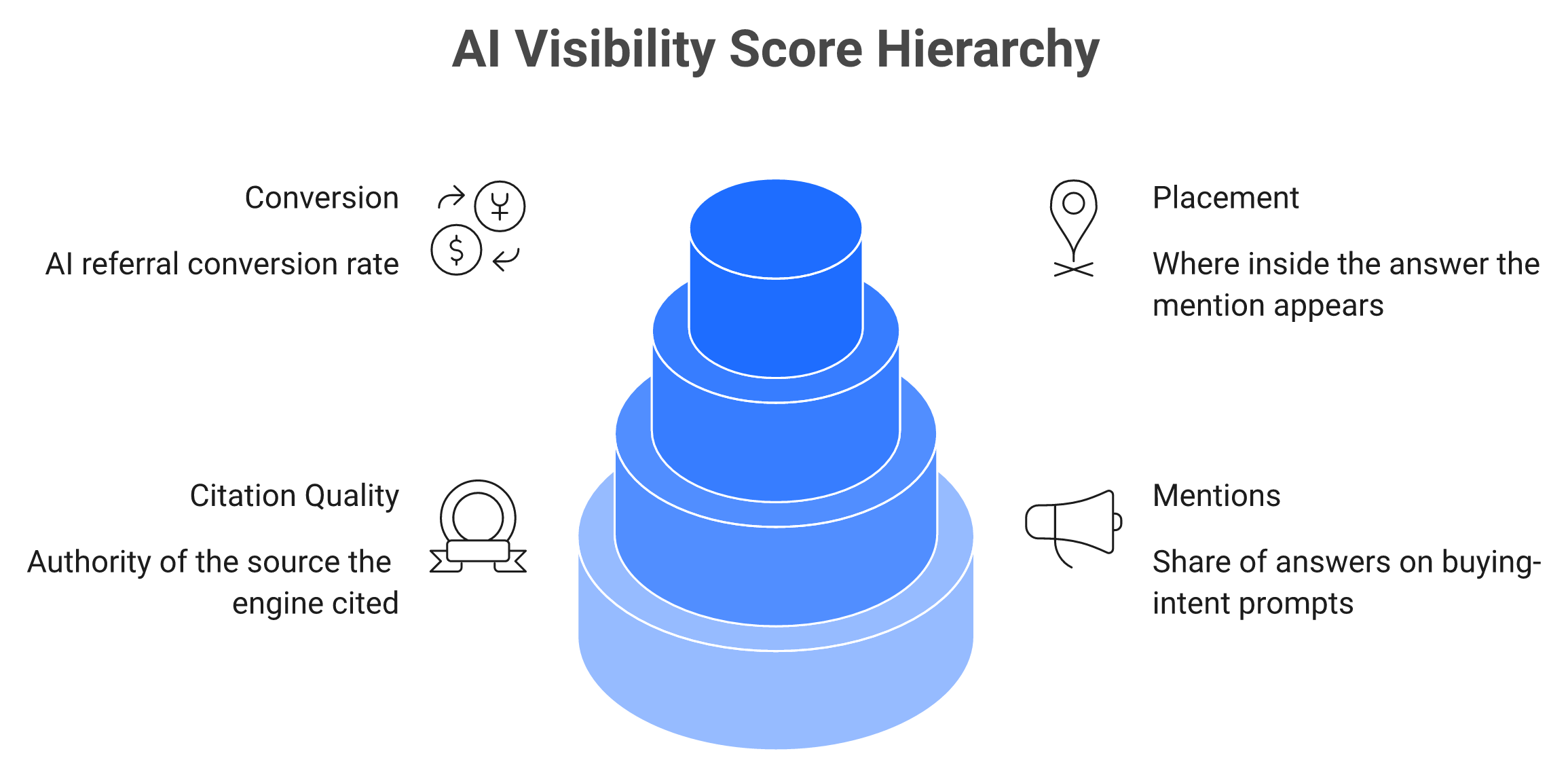
A published weighting beats a black box. Start at 40% mentions, 30% citation quality, 20% placement within the answer, and 10% conversion, then adjust.
The critical move is filtering the input set. Weight buying-intent prompts heavily and definitional prompts near zero. There is almost no clickability inside a glossary answer, and the intent behind it is not buying, a point developed further in the R-GEO revenue-focused framework.
❌ The vanity kill-list
Delete three things from your dashboard. Glossary and definitional visibility. Raw AI impressions with no conversion pairing. Technical health scores.
That third one will annoy people. Technical AEO audits generate significant work with very little measurable impact, and the pattern mirrors technical SEO, where Core Web Vitals rarely produced a traffic increase on their own.
📄 What Google actually says about AI files
Google's documentation states you do not need new machine-readable files, AI text files, or markup to appear in AI features, and there is no special schema.org structured data required. So llms.txt is an experiment, not a KPI.
Run it if you like. Just do not report it as progress.
"Tracking visibility is not useless, but you will only sleep well when you are part of the brands that can be trusted."
u/laurentbourrelly, r/SEO Reddit Thread
"In GA4, it's possible to create tailored reports to monitor traffic originating from AI search engines. While I've noticed some activity, it isn't significant enough to warrant extensive efforts on tracking specific keywords from these sources for now."
u/billhartzer, r/SEO Reddit Thread
🎯 Owner and cadence per metric
Roughly 19 out of 20 landing pages drive around 85% of traffic, so your metric charter should cover the few pages that carry pipeline. Assign one owner per metric, weekly cadence for share of answers, monthly for citation quality and sentiment.
MaximusLabs AI starts every engagement at BOFU and skips TOFU deliberately, so the score reports pipeline-linked prompts instead of definitional visibility that never converts. Traditional agencies report clicks and impressions on the same spend, which is why GEO ROI and revenue attribution has to be defined before the first report ships.
Q4. How do you build the ICP prompt set you measure against?
Build 50 to 100 buying-intent questions, not keywords. Export search and sales-call data, convert those terms into natural questions, then segment by ICP role and funnel stage. Weight the set toward comparison, alternative, and pricing prompts, because those produce the curated shortlists buyers act on. Version the set, freeze it for a quarter, then compare period over period.
🛠️ The five-step build
- Export your existing search query data and your top-converting terms.
- Mine internal sources: sales call transcripts, support tickets, and product reviews.
- Convert every term into a question a human would actually type.
- Tag each question with ICP role and funnel stage.
- Freeze the set, version it, and date it.
💬 The conversion prompt, verbatim
Take your search data, then give those keywords to ChatGPT and say: make these into questions. It is directionally accurate, and directionally accurate beats an empty tracking sheet.
Then edit by hand. The model will produce polite, generic phrasing. Real buyers type shorter, blunter, and with competitor names in them, which is exactly what disciplined AEO keyword and question research surfaces.
🧩 From 2,400 keywords to hundreds of variants
In SEO, one landing page might target 2,400 keywords. In AEO, that same page targets hundreds of question variants inside a single topic cluster.
The mental shift is topic as a cluster, not keyword as a target, the same logic behind GEO topic clusters. You are no longer chasing volume, you are covering the shape of how a category gets asked about.
📑 The sheet schema that makes this repeatable
| Column | What goes in it |
| Question | The exact prompt string |
| ICP role | Founder, VP Marketing, Head of GTM, Marketing Manager |
| Funnel stage | BOFU, MOFU, TOFU |
| Surface | ChatGPT, Perplexity, Gemini, Copilot |
| Run count | 5 minimum, 10 for board reporting |
| Run date | Freeze quarterly, compare period over period |
MaximusLabs AI maps every way an ICP might ask an AI agent for a solution before a single article is written, so the measurement set and the content plan run off one shared question map. Most teams build these two artifacts separately, then wonder why the tracking never explains the content performance. If you want that map built for your category, talk to the team.
Q5. Can Search Console and GA4 now measure AI visibility with first-party data?
Partly. Google's Search Generative AI performance reports, launched June 2026, expose impressions, pages, countries, devices, and dates for generative AI features, and AI Mode already counts inside Performance totals. But Google confirmed no separate AI Mode break-out and no API change. Share of answers, sentiment, and competitor share have no first-party equivalent, so third-party tracking stays mandatory.
🗓️ What actually launched in June 2026
Google Search Central announced dedicated Search Generative AI performance reports on June 3, 2026. The reports cover Search and Discover, and they show impressions, pages, countries, devices, and date ranges for generative AI surfaces.
Rollout went to a subset of properties first. So check your own property before assuming the view exists. Every AEO measurement guide written before that date now describes a world that no longer exists.
🔄 The reconciliation matrix nobody publishes
Most articles treat vendor metrics and platform reports as separate worlds. They are not. Here is how they map.
| Third-party metric | First-party proxy | Limitation |
| AI visibility impressions | Generative AI reports in Search Console | Subset of sites, no AI Mode break-out |
| AI referral sessions | GA4 AI-assistant channel group | Referrers are often stripped |
| Citation rate | Landing page reports paired with AI impressions | No confirmation the engine linked you |
| Share of answers | None | Third-party only |
| Sentiment | None | Third-party only |
| Competitor share | None | Third-party only |
MaximusLabs AI reconciles these two data sets for clients every reporting cycle, which is how a single visibility number survives a leadership review. Two tools disagreeing about the same month is the fastest way to lose budget, a governance problem covered in depth under GEO measurement and metrics.
⚙️ Setting up the GA4 side
GA4 now supports isolating AI assistant referrals as their own channel. Create a custom channel group that captures ChatGPT, Perplexity, Gemini, and Copilot referral domains.
Then tag every owned surface AI engines might cite. That includes docs pages, comparison pages, and any third-party profile you control, the full surface area described in AI search visibility and brand mention tracking.
⚠️ Where the first-party data stops
Google confirmed AI Mode data counts toward Performance report totals inside the standard Web search type, with follow-up questions counted as new queries. There is no separate break-out planned and no API change.
That single line has two consequences. You cannot isolate AI Mode revenue in Search Console, and you cannot blame algorithm updates for movement you have not segmented. Traditional agencies still report unexplained Search Console swings as core updates, because the segmentation work is tedious.
📌 Annotate the baseline, then never move it
Export a baseline of AI feature impressions by page and country this week. Annotate the date in your reporting tool.
That annotation becomes the pre and post line for every AEO change you ship afterward. Without it, you will be arguing from memory in six months.
🤔 My honest read on the limits
MaximusLabs AI's client data suggests first-party reports are now good enough to validate direction, though I might be reading that too strongly on a rollout this young. Direction is not the same as attribution. Treat Search Console as confirmation, not as the whole measurement program.
MaximusLabs AI includes performance tracking in every engagement tier, reconciling prompt-level data against Search Console and GA4 rather than shipping a vendor dashboard screenshot. Clients see one number with the gaps named out loud.
Q6. How do you attribute pipeline when the answer never produces a click?
Use three layers. Isolate AI referrals in GA4 with a dedicated AI-assistant channel group and UTM tagging. Capture the invisible half with a post-conversion "how did you hear about us" field, since LLM referrers are frequently stripped. Then flag AI-influenced deals in your CRM. MaximusLabs AI reports influenced pipeline alongside last-click revenue for every client engagement.
🕳️ The situation: your best channel looks like nothing
A buyer asks ChatGPT for vendors. Your name appears. Three days later they type your URL directly into a browser.
GA4 records that as Direct. The AI answer that created the deal leaves no trace in your acquisition report, which is the core mechanic of the zero-click search brand economy.
⚠️ The complication: sessions fragment
Google confirmed that follow-up questions inside AI Mode count as brand new queries. Conversation-level intent gets split across multiple query records.
Last-touch attribution was already weak for B2B. Against a channel that mostly produces no click at all, it is structurally broken.
✅ Layer one and two: instrument what you can see
Build the AI assistant channel group in GA4 first. Then apply UTM tagging to any owned surface an engine might cite, including docs, comparison pages, and community profiles you control.
MaximusLabs AI treats this instrumentation as week one work, before any content ships. Measuring after the fact means the baseline is already gone.
💬 Layer three: just ask the buyer
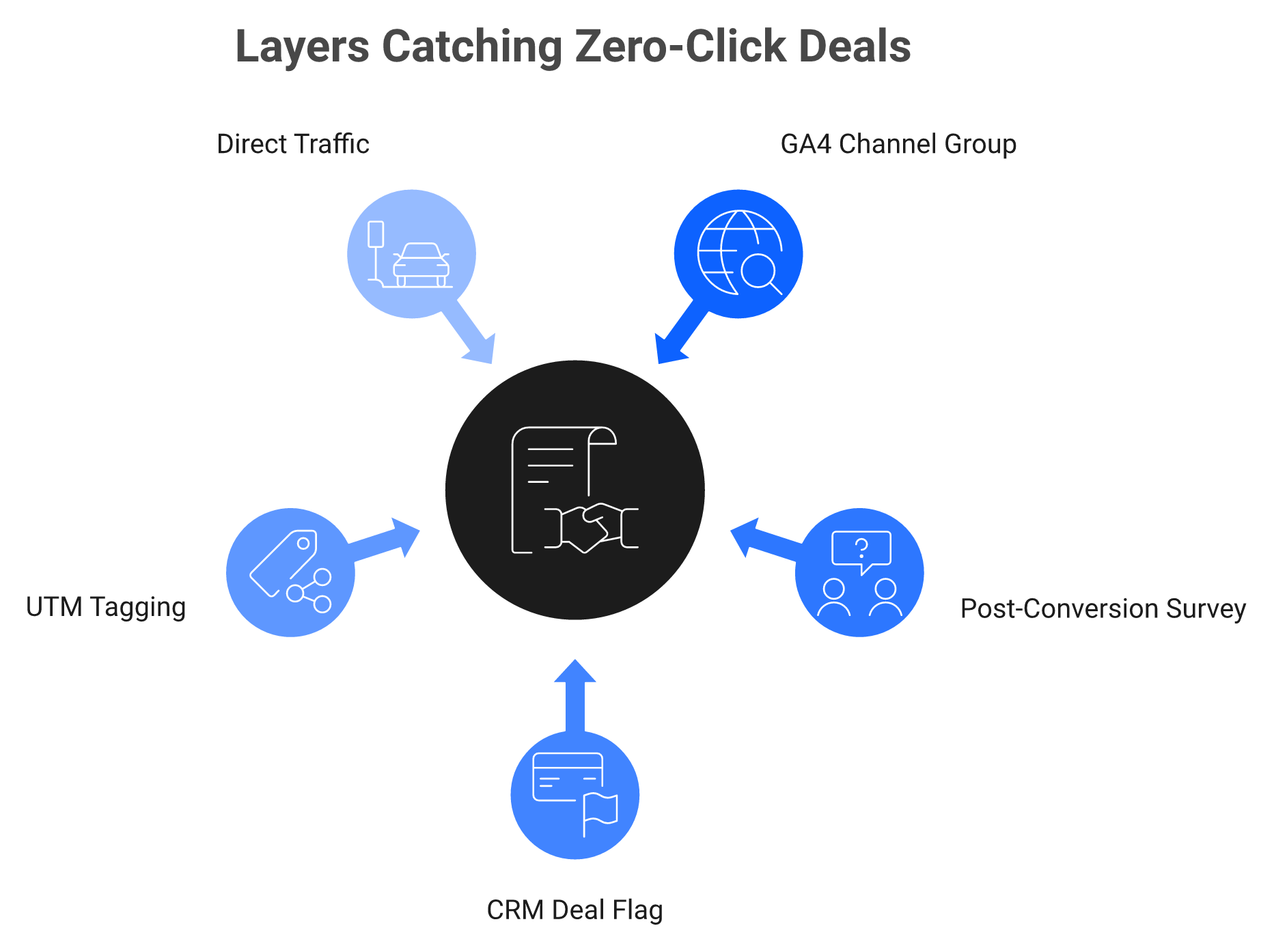
Add a post-conversion field asking how they heard about you. Make it free text, not a dropdown, because dropdowns force people into the wrong answer.
For B2B this matters more than any tracking script. A buyer probably encountered you fifty different times before converting, and the survey is the only instrument that catches the ones your analytics never saw.
"Google continues to dominate the search market, holding over 85% of the total search volume. It's important to refer to concrete data rather than relying on personal anecdotes or individual experiences."
u/VillageHomeF, r/SEO Reddit Thread
"Despite its decline, I maintain the site for sentimental reasons. While Google traffic has nearly vanished, I've noticed that visits from Bing and DuckDuckGo remain consistent."
u/Zealousideal-Bus-431, r/SEO Reddit Thread
📊 What to actually report upward
Report influenced pipeline, not sessions. Show three lines: AI-sourced deals from GA4, AI-influenced deals from the survey, and conversion rate against your own organic baseline.
Never report a relative increase alone. Going from one visit to ten is a 900 percent increase, and it is also nothing. That chart has destroyed more marketing credibility than bad strategy ever did.
🎯 The cross-domain parallel
MaximusLabs AI's approach here borrows from a channel that was already 98 percent of revenue at a previous company Krishna ran GTM for. When one channel carries the business, you learn fast that attribution honesty protects budget better than attribution optimism.
MaximusLabs AI reports AI-influenced pipeline rather than session counts, because a low-volume channel converting at multiples of organic dies quietly under a volume-only dashboard. That is a reporting failure, not a channel failure, and it is why GEO ROI and revenue attribution gets defined before the first report ships.
Q7. Does AI traffic actually convert better, and what benchmark should you hold yourself to?
Usually yes, but the spread is enormous. Semrush reports LLM visitors converting at roughly 4.4x organic, with B2B per-platform rates near 12 to 17 percent, while e-commerce ChatGPT conversion sits closer to 1.81 percent. Treat every published multiplier as category-specific, and set your target from your own pre-AEO baseline rather than someone else's headline.
📈 The verdict, with the range attached
The direction is consistent. The magnitude is not.
Google's own documentation notes that clicks from pages with AI features tend to be higher quality, with users more likely to spend more time on the site. That is a qualitative signal from the platform itself, and it is more defensible than most vendor multipliers, as the data on AI search click-through rates shows.
💰 The benchmark table, by business model
| Business model | Reported AI conversion | Caveat you must attach |
| B2B SaaS (Claude referrals) | ~16.8% | Small samples, high self-selection |
| B2B SaaS (ChatGPT referrals) | ~14.2% | Signup rate, not paid conversion |
| B2B SaaS (Perplexity referrals) | ~12.4% | Skews technical audiences |
| Cross-category multiplier | 4.4x organic | Blended across verticals |
| E-commerce (ChatGPT) | 1.81%, about 31% above organic | AOV varies wildly by category |
| E-commerce (Perplexity) | ~10.5% | Very low absolute volume |
❌ Why the multipliers diverge so badly
Three reasons. Sample sizes are tiny, so a handful of deals swings a percentage. Definitions differ, since a "conversion" might be a signup, a demo, or a purchase.
The third reason is self-selection. People who reach you through an AI answer have already been pre-qualified by the engine, which is exactly why the number looks good and exactly why it does not generalize.
"I used to run a popular blog that attracted more than 20,000 visitors daily, but since the helpful content update, its traffic has plummeted to around 600 visits a day."
u/Zealousideal-Bus-431, r/SEO Reddit Thread
"Organic traffic is far from extinct, but it has certainly evolved. A practical piece of advice: keep an eye on the AIO/M and analyze the types of websites that Google includes in the Query Fan Out."
u/just_an_incarnation, r/SEO Reddit Thread
✅ What to report instead of a borrowed number
Report your own delta. Take your organic conversion rate from the quarter before AEO work started, then compare AI referral conversion against it.
One internal figure worth watching is the roughly 6x conversion gap between LLM traffic and Google search traffic that some operators see. Treat that as a hypothesis to test in your own funnel, not a promise.
⚠️ The trap to avoid
Do not assume a strategy works because a large company used it. Big brands have brand demand doing half the work, and the AI engine is often just confirming a name the buyer already knew.
MaximusLabs AI sets each client's AEO target from their own baseline conversion rate rather than a published multiplier. A borrowed benchmark sets a goal the business model may never support, and missing it kills the program before it compounds. See how the numbers land by segment in AI search in B2B SaaS 2026.
Q8. How do you benchmark competitors and separate real gains from rising AI adoption?
Normalize every AI metric against a control. If ChatGPT referrals rise 50 percent while platform usage rises 50 percent, your work contributed nothing. Track share of answers against named competitors on the same prompt set, monitor top cited domains, geographic deltas, and prompt coverage by cluster. MaximusLabs AI benchmarks client share of answers against named competitors every reporting cycle.
🌊 The situation nobody says out loud
Your AI referral traffic went up 50 percent last quarter. Your CEO is delighted. You are about to take credit.
But ChatGPT usage also grew that quarter, and it will keep growing. If traffic rose entirely because of platform adoption, and not because of your optimization, crediting AEO work is easy and completely wrong.
⚠️ The complication: even the forecasts disagree
Gartner projects search engine volume dropping 25 percent by 2026. SparkToro's clickstream data contradicts that directly, showing Google search grew roughly 21.6 percent in 2024, with around 373 times more searches than ChatGPT.
Both are named, sourced, and defensible. Your strategy changes completely depending on which you believe, which is exactly why you should not build your measurement on either.
✅ Three normalization controls
- Competitor-relative share. Track your share of answers against named competitors on the identical prompt set. Relative share removes platform growth from the equation.
- Untouched control pages. Hold a set of pages you deliberately do not optimize. Their movement is your baseline noise.
- Category indexing. Index your movement against overall category movement, not against last quarter's raw number.
MaximusLabs AI runs competitor-relative share as the primary client metric, because absolute AI traffic growth is the easiest number in marketing to fool yourself with. The full method sits inside our AI search competitor analysis workflow.
📊 The competitive benchmark set
Beyond share of answers, four things belong in a competitor view.
- Top cited domains. Which sites engines cite in your category, for you and for rivals.
- Geographic deltas. Visibility often differs sharply by country on the same prompt.
- Prompt coverage by cluster. Which topic clusters you appear in and which you are absent from entirely.
- Citation source split. How often engines cite your owned content versus third-party sources.
"Google continues to dominate the search market. It's important to refer to concrete data rather than relying on personal anecdotes or individual experiences."
u/VillageHomeF, r/SEO Reddit Thread
"At what point does the AI summary actually promote visiting a linked site? What's the purpose of enhancing visibility in that context?"
u/Holiday-Cucumber-107, r/SEO Reddit Thread
📉 The one chart for the board deck
Plot indexed share of answers, yours versus two named competitors, over six months on a frozen prompt set. Nothing else.
That chart survives the question every CFO asks: how do we know this is you and not the market? MaximusLabs AI's Oliv AI engagement produced a 64 percent citation rate against incumbents near 30 percent, and the competitor comparison is what proved it was strategy rather than a rising tide (MaximusLabs' own published claim).
MaximusLabs AI benchmarks every client against named competitors on the same frozen prompt set, each cycle, rather than reporting isolated visibility scores. Isolated scores look better. Relative scores are the ones that hold up in a budget review. If you want that benchmark run against your category, contact us.
Q9. What does citation evidence reveal about where your content is actually failing?
Measurement should end in a fix list. Track where in a page engines extract from, because citation density skews heavily toward the opening third of a document. Track brand mentions across the web, which correlate with AI Overview visibility far more strongly than backlinks. MaximusLabs AI treats third-party mention surfaces as measurable AEO workstreams, not soft PR.
🎯 A dashboard that ends in nothing is theatre
Most AEO reports stop at a score. A score with no fix list is a slide, not a program.
Citation evidence tells you three specific things: where on the page engines pull from, what off-site signal drives inclusion, and which domains get cited instead of you. That is the core of any serious citation optimization program.
📄 The ski-ramp: where extraction actually happens
Citation density is not evenly spread across a page. Roughly 44.2 percent of AI citations come from the first 30 percent of the document.
That changes page structure, not just page content. Put the extractable answer near the top, keep supporting depth below, and stop burying your best definition in section six, the discipline behind AEO answer structure and writing.
MaximusLabs AI writes every section with a 40 to 80 word standalone answer block placed immediately under the heading, because that block is what gets lifted. The rest of the section is for the human who stays.
🔗 Mentions beat backlinks, by a wide margin
Ahrefs studied 75,000 brands and found brand web mentions correlate with AI Overview visibility at 0.664, while backlinks correlate at just 0.218. That is roughly three times stronger.
The top correlating factors were all off-site. So an on-page audit will never explain your visibility problem on its own.
This is Earned AEO. Your AI reputation is a mathematical consensus of what the web says about you, not the text on your About page, which is why AI citation acquisition tactics sit off-site by design.
🌐 Where the engines actually look
Seer Interactive found 87 percent of SearchGPT citations matched Bing's top organic results, with most in the top 10. A later replication across 400 queries with fan-out tracking put the figure closer to 27 percent for mixed informational queries.
Both are real. Bing rank is a decisive signal for commercial and comparison queries, and a weak one for how-to topics. Track it accordingly instead of treating one number as law, and read the mechanics in Bingbot AI search crawl optimization.
Seer also found most cited sites were affiliates, news outlets, and aggregators. If your brand is not ranking in those top spots, the practical move is working with the sites that are.
"AI visibility tracking tools that are on the market these days, I would first recommend to try out. Peec, Profound, and others are worth a look before committing budget."
u/Sea-Discipline1330, r/SEO Reddit Thread
"Tracking visibility is not useless, but you will only sleep well when you are part of the brands that can be trusted."
u/laurentbourrelly, r/SEO Reddit Thread
📋 Turn cited domains into a workstream
Extract the top 20 domains engines cite in your category. Assign an owner to each cluster and give it a KPI.
MaximusLabs AI runs G2, Capterra, Gartner, Reddit, and Quora as tracked Search Everywhere Optimization workstreams, targeting 10 or more reviews per major review platform. Off-site consensus moves citations more reliably than another round of on-page edits, a pattern documented in our work on Reddit and forum AEO.
Q10. How do you track and fix inaccurate AI answers about your brand?
Log every factual error by platform as a hallucination count, then trace each one to the page or third-party profile that produced it. Being described wrongly is worse than being absent, because the engine lends its credibility to a false claim. MaximusLabs AI audits how engines describe a client before optimizing visibility, then measures time-to-correction as a KPI.
🎓 The Oxford researchers who never went to Oxford
A team watched Perplexity summarize their own article. The summary described them as Oxford researchers.
None of them attended Oxford. The engine had not read that on their site, because it was not there. It had assembled a plausible consensus from scattered mentions across the web.
⚠️ Errors are consensus artifacts, not page-text artifacts
That distinction changes the fix entirely. If the error lived in your copy, you would edit the copy.
It usually does not. The error lives in an outdated directory listing, a stale press mention, or an old review profile nobody owns internally, which is exactly what citation consistency for AI search is meant to catch.
MaximusLabs AI runs this description audit before any visibility work begins, because amplifying a wrong description scales the damage rather than the pipeline. Getting cited more often with the wrong facts is a worse outcome than silence.
🔁 The five-step remediation loop
- Log. Run your prompt set and record every factual error, tagged by platform.
- Trace. Find the source: your page, a third-party profile, or a press mention.
- Fix. Correct the source, and correct it everywhere it was syndicated.
- Rerun. Re-test the same prompt weekly on the same surfaces.
- Measure. Track days from detection to corrected answer.
Time-to-correction belongs on your dashboard beside visibility. It is the only metric that proves the loop closes.
😐 Log sentiment in the same sheet
Accuracy and sentiment are different failures. An answer can be factually correct and still describe you as the budget option nobody chooses.
Score each mention as positive, neutral, or negative, then track the negative share over time. A rising negative share with rising visibility means you are scaling a bad story, one of the recurring AEO challenges around accuracy and attribution.
"You can call me a professional AI visibility checker tool user at this point. Surfer AI Tracker connects AI visibility directly with content optimization workflows."
u/Wonderful_Effort9198, r/SEO Reddit Thread
"Are AI visibility tools becoming another overpriced SaaS category? There are now multiple tools that track how brands appear in ChatGPT, Perplexity, and Gemini, and most feel identical."
u/Ok-Wall-3379, r/SEO Reddit Thread
🤔 Where I am still uncertain
MaximusLabs AI's client data suggests most brand hallucinations trace to three or fewer off-site sources, though I might be over-generalizing from a limited set. Larger brands with decades of press probably have messier consensus.
MaximusLabs AI audits engine-generated brand descriptions before optimizing visibility, using a trust-first approach that fixes the underlying consensus first. Traditional agencies audit your site. The error usually is not on your site.
Q11. Which AEO tracking tools are worth paying for, and when should you build instead?
Most AEO trackers do the same thing: submit a question, record whether you appeared, repeat. That is cheap to build, which is why sixty-plus near-identical tools exist and price is the main differentiator. Pay for depth instead: run-level distribution, sub-query coverage, sentiment, competitor share, and first-party reconciliation. MaximusLabs AI runs proprietary internal tracking at a few cents per question.
💸 The commodity problem nobody admits
There is a category page listing over 60 AEO tools. They all do tracking. You submit a question, you check whether you showed up, yes or no.
There are 60 of them because it takes a few weeks to build one. When the core function is a thin wrapper around an API, price becomes the honest differentiator, as our AEO tools comparison lays out.
⭐ 1. MaximusLabs AI
Pairs proprietary internal tracking with the content execution that actually moves the number. Tracks share of answers across question variants rather than single checks, and reconciles that against Search Console and GA4.
Pricing runs $899 to $2,999 monthly, against roughly $6,500 for a traditional agency retainer and around $20,000 for an in-house team. Fits teams who want measurement and remediation from one owner, not a dashboard subscription plus a separate content vendor. Full tiers sit on our pricing page.
2. Scrunch
Tracks visibility across roughly ten large language models with prompt-level reporting. Strong for multi-model coverage and prompt-level drilldowns.
Misses first-party reconciliation. You still export and merge with Search Console yourself, and the tradeoffs are broken down in our review of Scrunch AI alternatives.
3. Semrush AI toolkit
Brings AI visibility into a stack teams already own, alongside traditional rank data. Useful when you need one login for both worlds.
Depth on sentiment and run-level distribution is thinner than dedicated trackers.
4. SE Ranking with Bing Webmaster Tools
The only mainstream pairing that foregrounds Bing Webmaster Tools, which matters because Copilot and SearchGPT lean on Bing's index. Seer found 87 percent of SearchGPT citations matched Bing's top organic results.
Bing data is free. Not using it is a self-inflicted gap, and the same logic drives Microsoft Copilot search optimization.
5. Ahrefs Brand Radar
Best for the mention side of the equation, which correlates with AI visibility at 0.664 versus 0.218 for backlinks. Strong for Earned AEO tracking.
Weaker as a prompt-level answer tracker.
6. Build your own
A basic tracker costs a few cents per question to run. For a 50-question set at five runs weekly, that is genuinely trivial spend.
You give up the interface and the maintenance. You gain exact control over run counts and sub-query logging.
"Are AI visibility tools actually helpful? For those of you who have started using tools like Peec or Profound, have you found these actually useful?"
u/Emergency_Ostrich_88, r/SEO Reddit Thread
"I tested five different tools for Answer Engine Optimization, and honestly the outputs overlapped more than the pricing suggested."
u/Kind-Fee-7434, r/SEO Reddit Thread
💰 The build versus buy line
If you only need yes or no monitoring, buy the cheapest option. If you need distribution, sentiment, and competitor share, pay for depth or build it.
MaximusLabs AI built its own tracking rather than paying for a wrapper, and pairs it with content production at roughly $60 per piece against $260 at a traditional agency. The tool is not the differentiator. What you do with the reading is.
Q12. What does a 90-day AEO measurement rollout cost and look like?
Days 1 to 7: freeze a 50-question prompt set and capture Search Console and GA4 baselines. Days 7 to 30: run each question five times weekly to establish share of answers per surface. Days 30 to 60: wire AI-assistant channel grouping, UTM tagging, and the how-did-you-hear survey. Days 60 to 90: report influenced pipeline and conversion rate, never sessions.
⏰ The phased plan, with owners
| Phase | Action | Metric produced | Owner |
| Days 1 to 7 | Freeze prompt set, capture GSC and GA4 baseline, annotate date | Baseline snapshot | Marketing Manager |
| Days 7 to 30 | Run 5x weekly per surface, log distribution | Share of answers, variance floor | Marketing Manager |
| Days 30 to 60 | AI channel group, UTM tagging, post-conversion survey | AI referral conversion rate | Growth or RevOps |
| Days 60 to 90 | Competitor benchmark, influenced pipeline reporting | Indexed relative share, pipeline | Head of Organic Growth |
Published AEO KPI frameworks use these same windows: impressions validate in days 7 to 30, answer traffic in days 30 to 60, and ROI at three to six months.
⏳ What "results" honestly means at 90 days
You will have direction, not a proven ROI curve. Real ROI reads land between three and six months.
MaximusLabs AI's client data suggests share of answers moves earliest, usually before referral traffic does, though I would not stake a board forecast on a single quarter. Tell your CEO that upfront and you protect the program.
💰 The honest cost line
Tooling is not the expensive part. Running a 50-question set at five runs weekly costs a few cents per question if you build it, or roughly $100 to $500 monthly off the shelf.
The real cost is hours. Budget four to six hours weekly for running, logging, and reviewing, plus a half day monthly for competitor benchmarking, and sanity-check the spend against the GEO budget benchmark 2026.
✂️ What a lean team cuts first
Cut sentiment scoring and geographic deltas before you cut anything else. Keep share of answers, top cited domains, and AI referral conversion rate.
MaximusLabs AI includes performance tracking inside every engagement tier rather than billing it separately, which removes the usual tradeoff between measuring and producing. Most teams cut measurement first because it feels like overhead.
📆 Reporting cadence
Weekly standup: share of answers by surface, plus any new hallucinations logged. Monthly: citation quality, sentiment, top cited domains.
Quarterly: indexed competitor share and influenced pipeline. Nothing else belongs in a board deck.
MaximusLabs AI runs a technical audit in week one and can publish the first GEO article by day four, so the baseline and the first intervention land inside the same month. Waiting a quarter to start producing wastes the cleanest measurement window you will get. If you want that rollout run for you, contact us.
🔮 What I am sitting with
The penalty for average has never been so severe. Engines pick a handful of names, and the middle of the category simply stops existing.
My open question for 2027: when agentic checkout matures, does share of answers become share of transactions? If you are already tracking prompt-level visibility and want to compare notes on what your run data shows, I would genuinely like to see it. krishna@maximuslabs.ai
Frequently asked questions
What is AEO measurement tracking and how is it different from SEO reporting?
AEO measurement tracking records how often, how accurately, and how profitably AI engines cite a brand inside generated answers. It replaces rank position with probability, because the same prompt returns a different answer on each run and no fixed position exists. The practical difference sits in what gets counted: Rank position becomes share of answers across a frozen prompt set. Keyword volume becomes prompt coverage, since buyers ask questions rather than keywords. Click-through rate becomes citation rate, because many answers never produce a click at all. Backlinks become top cited domains, since engines cite sources rather than link graphs alone. Traditional dashboards measure the wrong event. By the time a buyer clicks anything, the engine has already excluded most of the category, and the SERP report never sees that moment of exclusion. MaximusLabs AI measures client visibility as share of answers across question variants rather than single checks, which is how the Oliv AI engagement was benchmarked at a 64 percent citation rate against incumbents sitting near 30 percent. That comparison only becomes visible once you stop counting positions and start counting inclusion.
How many times should you run each prompt before a share of answers result is real?
Five runs minimum per question per surface, and ten runs for anything shown to a board. AI outputs are non-deterministic, so a single check produces a yes or no where a distribution belongs. Share of answers is calculated as runs containing your brand divided by total runs, multiplied by 100. Run it per surface and never blended, because a brand can sit at 40 percent on Perplexity and 8 percent on Gemini in the same week, and a blended figure hides the platform where pipeline is actually being lost. The step almost nobody publishes is variance. Calculate the spread across your runs and treat it as a noise floor. A visibility jump inside that floor is a coin flip, not a result. One prompt also fans out. A standard AI Mode query decomposes into roughly eight to twelve parallel sub-queries before the answer assembles, so you are evaluated against a sub-query tree rather than a single string. Teams can model that decomposition with the query fan-out generator . MaximusLabs AI run data points toward five runs being sufficient for most B2B categories, though volatile categories with fast-moving vendors likely need more, so publish variance alongside every score.
Which AEO metrics actually predict revenue for a B2B SaaS company?
Six metrics survive scrutiny, and each maps to a decision rather than a slide. Share of answers on buying-intent prompts: appearance rate on comparison, alternative, and pricing questions. Citation rate: mentions that include an actual link back to you. Citation quality: the authority of the source the engine selected. Sentiment: whether the mention helps or quietly damages the brand. Hallucination count: factual errors logged per platform. AI-referral conversion rate: the only metric a CFO recognizes. Combine them into one AI Visibility Score. A workable starting split is 40 percent mentions, 30 percent citation quality, 20 percent placement within the answer, and 10 percent conversion, then adjust against your own funnel. The critical move is filtering the input set. Weight buying-intent prompts heavily and definitional prompts near zero, because there is almost no clickability inside a glossary answer. Three things belong on a kill-list: glossary visibility, raw AI impressions with no conversion pairing, and technical health scores. MaximusLabs AI starts every engagement at BOFU and skips TOFU deliberately, and our AEO measurement metrics breakdown shows the full weighting logic.
Can Google Search Console and GA4 measure AI visibility on their own?
Partly, and the gap matters. Google launched dedicated Search Generative AI performance reports on June 3, 2026, covering Search and Discover with impressions, pages, countries, devices, and date ranges. Rollout reached a subset of properties first, so check your own property before assuming the view exists. Google also confirmed that AI Mode data counts toward Performance report totals inside the standard Web search type, with follow-up questions counted as brand new queries. There is no separate break-out and no API change, which means fluctuating impressions may be AI Mode blending in rather than an algorithm update. What first-party tools still cannot give you: Share of answers across a prompt set. Sentiment attached to each mention. Competitor share on identical questions. GA4 covers the referral side once you build a custom channel group capturing ChatGPT, Perplexity, Gemini, and Copilot domains, though referrers are frequently stripped. MaximusLabs AI reconciles prompt-level data against Search Console and GA4 every reporting cycle rather than shipping a vendor dashboard screenshot, an approach detailed in our GEO measurement and metrics guide.
How do you attribute pipeline when an AI answer never produces a click?
Use three layers, because no single instrument sees the whole journey. A buyer asks ChatGPT for vendors, your name appears, and three days later they type the URL directly. GA4 records Direct, and the answer that created the deal leaves no trace. Channel isolation. Build an AI-assistant channel group in GA4 and apply UTM tagging to every owned surface an engine might cite, including docs, comparison pages, and community profiles you control. The survey layer. Add a post-conversion how-did-you-hear field as free text rather than a dropdown, since dropdowns force people into the wrong answer. For B2B this catches more than any tracking script. CRM flagging. Mark AI-influenced deals so influenced pipeline reports beside last-click revenue. Report influenced pipeline, not sessions, and never report a relative increase alone. Going from one visit to ten is a 900 percent increase and also nothing. MaximusLabs AI treats this instrumentation as week one work before any content ships, because measuring after the fact means the baseline is already gone. Our zero-click search brand economy report covers the reporting structure in full.
How do you separate real AEO gains from rising AI platform adoption?
Normalize every AI metric against a control. If ChatGPT referrals rise 50 percent while platform usage also rises 50 percent, the optimization work contributed nothing, and crediting it is both easy and completely wrong. Three controls remove that ambiguity: Competitor-relative share. Track share of answers against named competitors on the identical prompt set, which strips platform growth out of the number. Untouched control pages. Hold a set of pages you deliberately do not optimize, and treat their movement as baseline noise. Category indexing. Index movement against overall category movement rather than last quarter's raw figure. Even the forecasts disagree. Gartner projects search engine volume dropping 25 percent by 2026, while SparkToro clickstream data shows Google search growing roughly 21.6 percent in 2024. Both are defensible, which is exactly why measurement should not rest on either. The one chart for a board deck plots indexed share of answers, yours versus two named competitors, over six months on a frozen prompt set. MaximusLabs AI runs competitor-relative share as the primary client metric, using the method described in our AI search competitor analysis workflow.
What does a 90-day AEO measurement rollout cost and deliver?
Tooling is not the expensive part. Running a 50-question set at five runs weekly costs a few cents per question if you build it, or roughly $100 to $500 monthly off the shelf. The real cost is four to six hours weekly for running, logging, and reviewing, plus half a day monthly for competitor benchmarking. The phased plan: Days 1 to 7: freeze a 50-question prompt set, capture Search Console and GA4 baselines, annotate the date. Days 7 to 30: run each question five times weekly per surface to establish share of answers and a variance floor. Days 30 to 60: wire AI-assistant channel grouping, UTM tagging, and the post-conversion survey. Days 60 to 90: report competitor-indexed share and influenced pipeline, never sessions. At 90 days you have direction, not a proven ROI curve. Real ROI reads land between three and six months, and share of answers typically moves before referral traffic does. MaximusLabs AI includes performance tracking inside every engagement tier rather than billing it separately, and teams comparing internal build cost against managed delivery can review our pricing before committing hours.