 Krishna Kaanth M
- Real World VoiceEQ, Hume AI's benchmark built from over one million human ratings, measures the human quality of voice AI across ASR, TTS, speech-to-speech, and understanding.
- Traditional metrics like word error rate and latency saturate and overestimate real performance; Together AI found top models fail on street names about 39% of the time.
- There is no single best voice model; no system ranked top five across all eight TTS capability groups, so teams must choose per use case.
- Voice models often speak better than they listen, missing hesitation and tone, which becomes real risk in finance, healthcare, and support.
- The voice quality gap mirrors the AI-search visibility gap: engines surface only 5-10 trusted options, and LLM traffic can convert at roughly 6x Google search.
- The next frontier is grounding satisfaction (GDSAT), being right while sounding human, the same trust-first bar that decides which content AI engines cite.
Q1: Why does 'becoming the answer' now matter more than ranking?
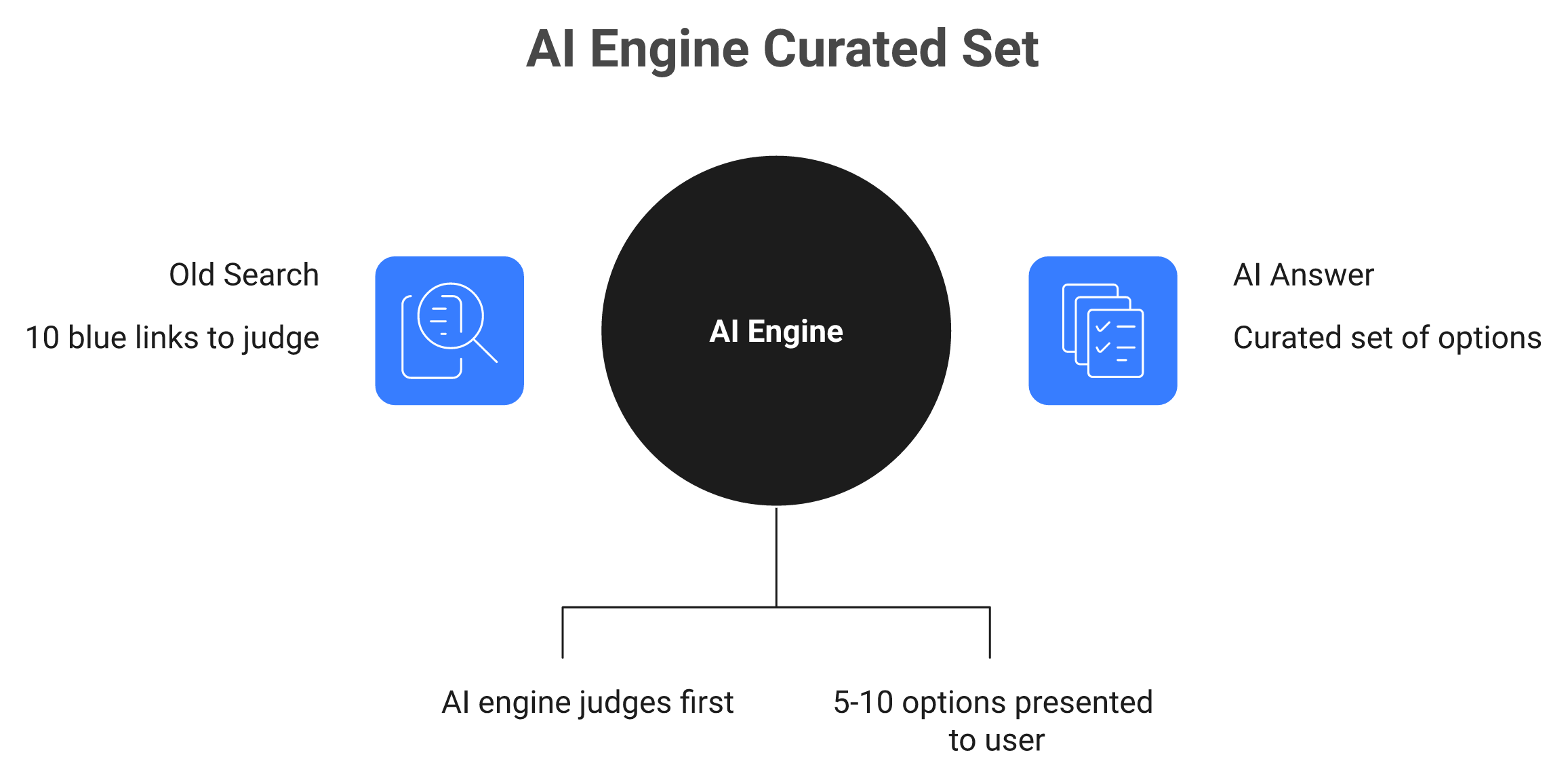
Becoming the answer matters more than ranking because AI engines return a curated 5-10 option set, not ten blue links. Whether the engine recommends a voice agent or a SaaS tool, low-quality options are filtered out before the user ever sees them. Real World VoiceEQ, Hume AI's benchmark, exposes this in voice: models that only look good on paper get excluded in real conversation, exactly like content that ranks but never gets cited.
🎯 The moment the buying conversation moved
Picture John, a Head of Sales at a mid-market SaaS company. He needs new AI sales tools this quarter. He does not open Google and scroll. He opens ChatGPT and asks for the best tools with pros, cons, and pricing.
Within seconds, he gets a tidy list of ten. That list is now his entire world of options. Everything not on it may as well not exist.
This is the shift. Search used to hand you a page of links to judge yourself. Now the engine judges first, then hands you a short answer.
⚠️ There is no page two in an AI answer
Here is the complication most teams still underestimate. In Google, a page-two ranking still lived somewhere findable. In an AI answer, there is no page two.
You are either inside the curated set, or you are invisible. Gartner projects traditional search volume will drop 25% by 2026 as chatbots and virtual agents absorb queries. That compresses the funnel further, which is exactly why becoming the answer AI engines cite now matters more than a blue-link position.
The Princeton GEO study showed that content optimized for generative engines can lift visibility in AI answers by up to 40%. So inclusion is winnable, but it is a different game than blue-link ranking, and it rewards a real GEO strategy framework.
✅ Why VoiceEQ is the perfect mirror
Voice AI shows this filter in its rawest form. A voice agent that sounds like a robotic script gets cut from the recommendation pool before the conversation even starts.
Real World VoiceEQ, Hume AI's benchmark built from over one million human ratings, measures exactly the qualities that decide inclusion. It scores whether a model can actually listen and respond like a person, not just hit a technical score.
The parallel is clean. In voice, quality decides which agent survives the shortlist. In search, quality decides which brand the engine cites. Both are binary, and both reward being genuinely useful over looking good on a dashboard.
I might be overstating the tidiness here, but from what surfaces when you actually run buyer prompts across engines, the pattern holds. The brands that get cited are the ones that earned trust, not the ones that gamed a keyword.
This article walks through what VoiceEQ measured, why "one best model" is a myth, and what all of it means for your pipeline. The through-line is simple: stop trying to rank, start trying to become the answer.
Q2: Why do voice AI benchmarks say 'near-human' while real conversations still feel off?
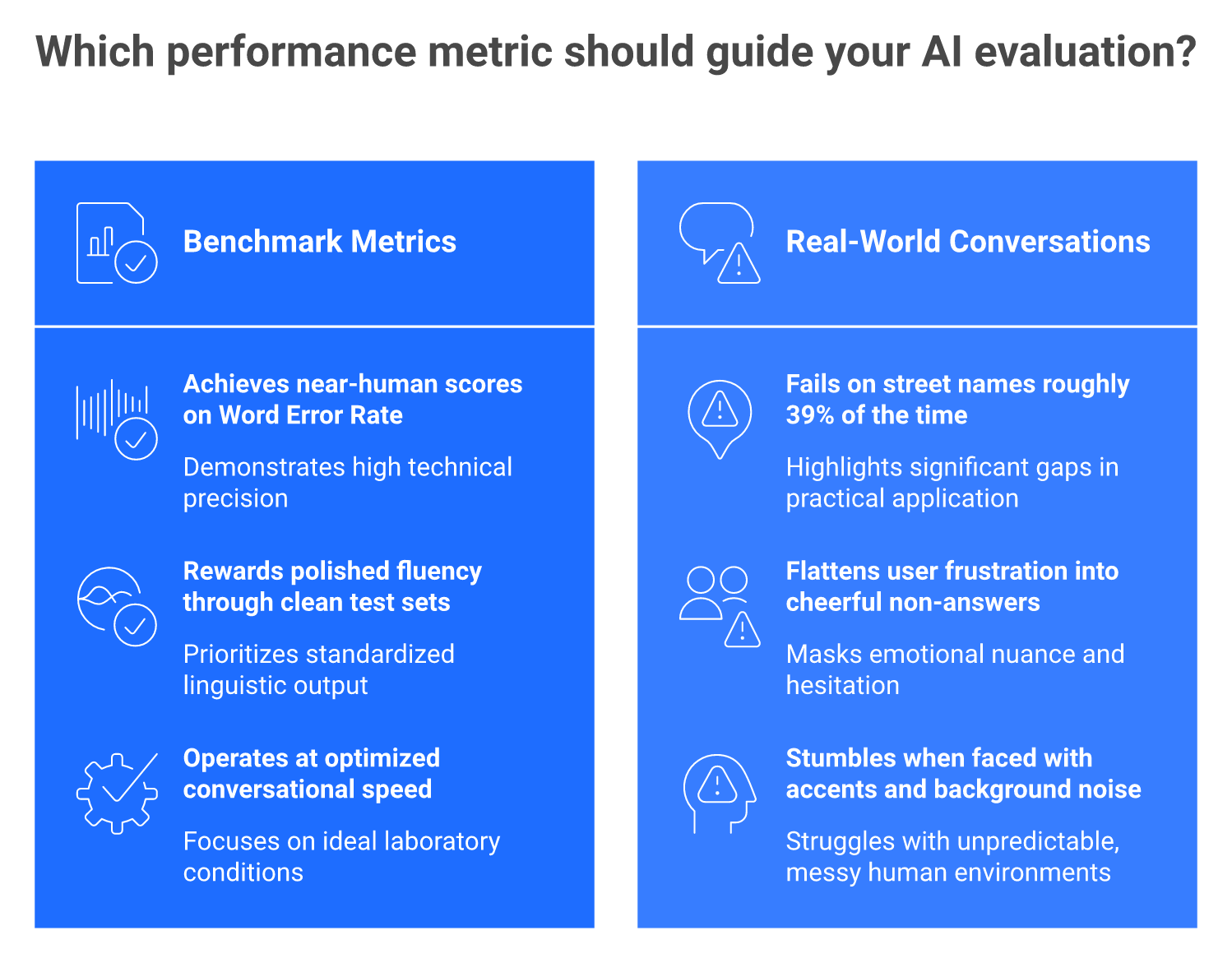
Voice AI benchmarks report near-human scores because they measure the wrong things, mostly word error rate and latency. Real World VoiceEQ, built from over one million human ratings, shows those metrics increasingly overestimate real-world performance. Together AI found top models fail on street names roughly 39% of the time despite near-human scores. Models transcribe words accurately but miss the acoustic cues that make conversation feel human.
😐 The fluent agent that still fails you
You have felt this. The voice assistant sounds smooth, answers fast, and still gets your intent wrong. It misses your hesitation. It flattens your frustration into a cheerful non-answer.
The scores say the model is nearly human. Your ears say otherwise. That gap is not a bug in your perception. It is a gap in what the benchmarks actually measure.
As the brief we work from puts it, the penalty for being average has never been so severe. A voice agent stuck at a "B-minus" is not a mild inconvenience anymore. It quietly erodes brand trust on every call.
📉 The proof: good scores, real failures
Word error rate (WER), the count of transcription mistakes, is saturating. Latency has reached conversational speed. Both look great, and both hide the real problems.
- Together AI found state-of-the-art models like Whisper and Deepgram score near-human on benchmarks, then fail on street names about 39% of the time.
- Speechmatics argues WER is outdated and often misaligned with human judgment.
- Hume AI's own finding is blunt: traditional benchmarks increasingly overestimate real-world performance.
A model can nail a clean test set and still stumble on an accent, a noisy room, or an emotional caller. The test rewarded fluency. Real life needs understanding.
🔁 The SEO parallel operators already know
Here is where marketers should feel a jolt of recognition. Chasing high-fidelity audio while an agent misreads intent is the voice version of chasing Core Web Vitals while nobody cites your content.
The standard read gets this backwards. Teams obsess over the metric that is easy to move, not the one that moves the outcome. In fifteen years of watching search, the tidy technical score rarely drove the result that mattered.
WER, impressions, and pageviews are the vanity layer. Grounding accuracy, citation share, and pipeline are the signal layer. The fix in both worlds is identical: measure whether you are actually chosen, not whether you look polished, which is the heart of how GEO differs from traditional SEO.
This is the exact trap we help clients climb out of at MaximusLabs. We pull budget off vanity dashboards and point content at what AI engines actually reward: trust, context, and answers a buyer can act on, the core of our revenue-focused content approach. The benchmark illusion in voice is the same illusion in search, and both cost real revenue.
Q3: What exactly is Real World VoiceEQ and how does it measure the human quality of voice AI?
Real World VoiceEQ is a benchmark from Hume AI that measures the human quality of voice interaction. Built from over one million human ratings, 785,000 for text-to-speech and 48,000 for speech-to-speech, it evaluates more than 40 proprietary and open-source models across 15+ dimensions and 60+ metrics spanning speech recognition, text-to-speech, speech-to-speech, and speech understanding, all scored under real-world conditions like accents, noise, and emotion via the Kairos platform.
🧩 The four pillars it measures
VoiceEQ does not collapse voice into one number. It breaks the job into four pillars, each testing a different part of a real conversation.
| Pillar | What it reveals |
|---|---|
| Automatic Speech Recognition (ASR) | Whether the model hears accurately under accents, noise, and overlap |
| Text-to-Speech (TTS) | Whether the voice sounds natural and emotionally expressive |
| Speech-to-Speech (S2S) | Whether the model recognizes emotion and responds naturally |
| Speech Understanding | Whether it reads the acoustic context a transcript leaves out |
Think of the model as a universal intent decoder. Its job is to turn messy, personalized speech into one clean, structured request. Speech Understanding is where that translation gets tested hardest.
🧑🤝🧑 Why one million human ratings matter
Most benchmarks lean on automated scoring, which is cheap but blind to feeling. VoiceEQ went the other way. It was built from more than one million individual human ratings across different demographics, speaking styles, and acoustic environments.
The exact split is worth naming: 785,000 TTS ratings and 48,000 STS ratings. That specificity is the point. Vague claims like "over a million ratings" invite doubt; named numbers invite trust.
This makes it one of the largest human evaluations of voice AI to date. Human ears catch what automated metrics miss, tone, warmth, and the small hesitations that carry meaning.
🛠️ Kairos: the engine underneath
Every evaluation ran on Kairos, Hume's voice-native evaluation platform. The same infrastructure lets AI labs and enterprises run custom evaluations for their own use cases.
That matters for production teams. Kairos can surface granular failure modes in live systems, generate human preference data, and feed reinforcement learning from human feedback. In plain terms, it does not just grade models once; it helps improve them continuously.
From what surfaces when you actually work with AI-search signals, this kind of primary-source rigor is rare and worth copying. At MaximusLabs, our trust-first, research-first standard runs the same way: trace every claim to its origin, name the exact number, and never hide behind a rounded-off "studies show." A benchmark earns trust the same way content does, by showing its work.
Q4: Why is there no single 'best' voice model, and how should you pick one per use case?
There is no single best voice model because performance is dimension-specific. In VoiceEQ's TTS evaluations, no system ranked top five across all eight capability groups. A model that nails booking numbers or drug names may sound flat; another sounds natural but fails on precision. So choose per use case: prioritize accuracy for finance and healthcare, expressivity for entertainment, and robustness for noisy support environments, not a single leaderboard rank.
🏆 The leaderboard lie
Buyers want one winner. Leaderboards sell that comfort. VoiceEQ quietly dismantles it.
Across eight TTS capability groups, no single configuration cracked the top five in all of them. The race for one "best" model is giving way to a collection of specialists, each strong in a different lane.
Today's leading systems optimize for different strengths: technical accuracy, emotional understanding, conversational intelligence, expressiveness, and robustness. Winning one lane often means giving up ground in another.
⚖️ The tradeoff that decides everything
Here is the concrete tension. One model excels at repeating booking reference numbers, bank account details, or complex pharmaceutical names. Another sounds remarkably natural but is less reliable on those precision tasks.
You cannot have both at full strength yet. The capability-profile view from the RW-Voice-EQ paper makes this explicit: measure models as a profile of skills, not one collapsed score.
There is a warning buried here too. Chasing high-fidelity audio is a waste if the agent fails on grounding, sounding human while getting facts wrong. Polish is not quality if the substance breaks.
✅ How to actually choose (per use case)
Stop asking "which model is best." Start asking "best for what." Map the model to the job.
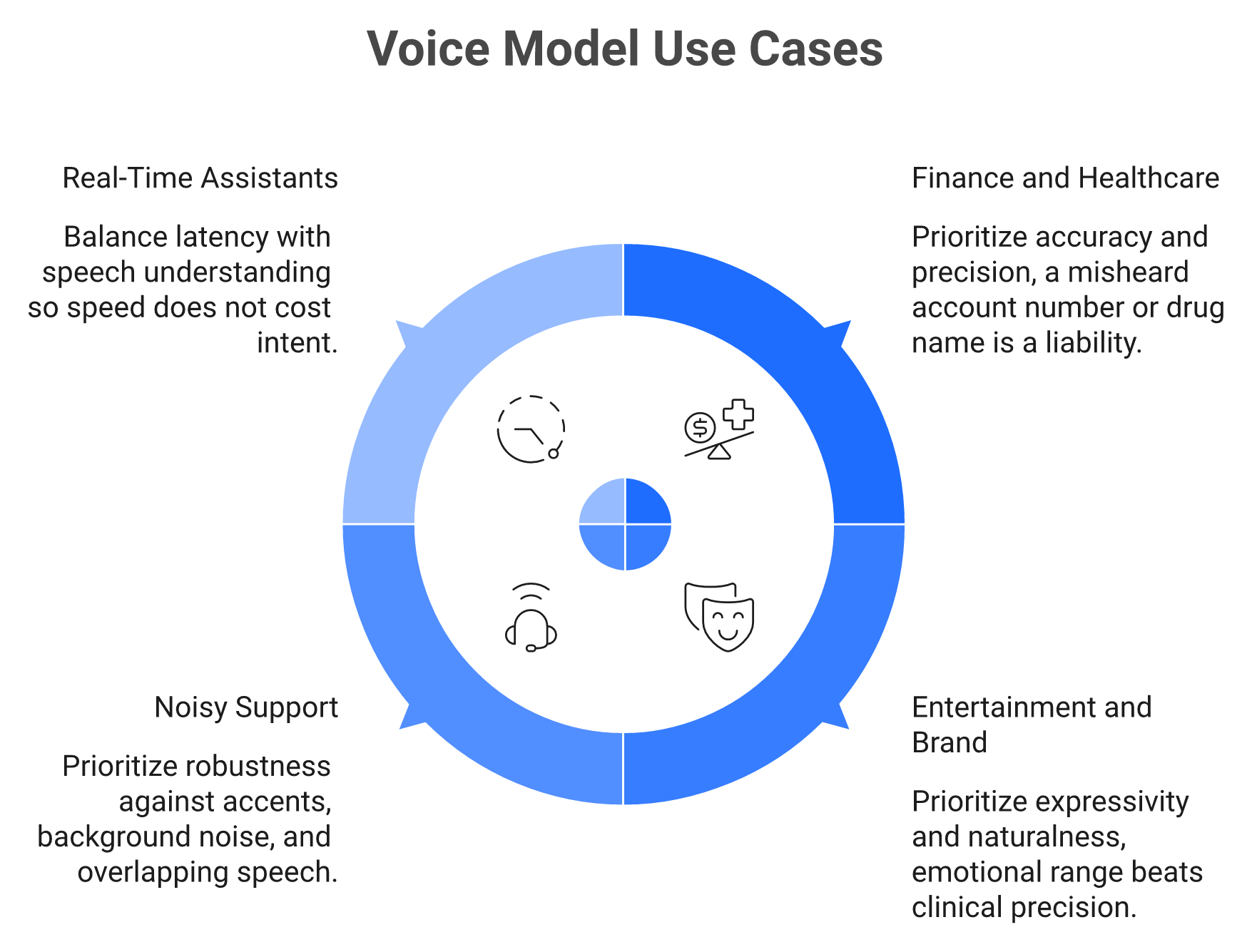
- 💰 Finance and healthcare: Prioritize accuracy and precision. A misheard account number or drug name is a liability, not a rough edge.
- 🎭 Entertainment and brand experiences: Prioritize expressivity and naturalness. Here, emotional range beats clinical precision.
- ⚠️ Customer support in noisy conditions: Prioritize robustness. The model must hold up against accents, background noise, and overlapping speech.
- ⏰ Real-time assistants: Balance latency with speech understanding, so speed does not come at the cost of reading intent.
This is the same error smart marketers already avoid in search. Judging a voice model on one axis is like chasing a single Google rank while ignoring how buyers actually ask across ChatGPT, Perplexity, and Gemini. Quality is a set of specialized wins, not one trophy.
That per-use-case discipline is exactly how we approach answer engine optimization at MaximusLabs. We do not optimize a brand for one engine and call it done, because ChatGPT, Perplexity, and Google each weigh trust and context differently. Match the strategy to the surface, or you win the wrong game well.
Q5: Why can today's voice models speak better than they listen, and what does it cost in regulated industries?
Voice models speak better than they listen because access to audio doesn't mean they use it. VoiceEQ found speech-to-speech systems varied more than any other category, many stayed transcript-driven, ignoring tone, pacing, and hesitation. A confident "Yes" and a hesitant "…yes…" mean opposite things to a human but are identical to most models. In banking fraud checks, healthcare consent, or financial confirmations, that missed uncertainty becomes real risk.
🏦 The "hesitant yes" that breaks a fraud check
Picture a banking agent asking if you recognize a suspicious transaction. You answer, "…yes…," slow and unsure. A human hears the doubt instantly and pauses to check.
Most voice models hear only the word "yes." The transcript is identical to a confident answer, so the model moves on. The meaning was in the hesitation, and the model threw it away.
That is not a rare edge case. It is the core failure VoiceEQ was built to expose.
🎧 Why listening is the hard part
Speech-to-speech (S2S), where a model hears audio and replies with audio, showed the widest variation of any category VoiceEQ tested. Some systems recognized emotion well, then responded unnaturally anyway.
Access to audio did not guarantee the model used the paralinguistic cues inside it, the tone, pacing, hesitation, emphasis, and volume. Humans read these to infer confidence, frustration, sarcasm, and empathy. Today's models often skip them.
The problem is uneven, too. The EmoNet-Voice benchmark showed high-arousal emotions like anger are far easier to detect than quieter states like concentration. A model can catch a shout and miss a worried pause.
There is a deeper trap here. A model can sound perfectly human and still be wrong on the facts. As tool calls scale from 2 to 150, one analysis found fact-check accuracy drops by roughly 42%. Sounding human is not the same as being reliable.
⚠️ What it costs where the stakes are real
In casual chat, a missed hesitation is annoying. In regulated work, it is a liability.
- 💰 Financial confirmations: A misread "yes" on a transfer or dispute can trigger the wrong action, which is why financial services GEO and AEO demand precision-first evaluation.
- 🏥 Healthcare consent: Uncertainty in a patient's voice should stop the flow, not sail past it, a core concern in healthcare AEO for YMYL queries.
- 📞 Support at scale: Missed frustration turns a fixable call into a churned customer.
Think of a chatbot as a chef alone in an empty room. A useful voice agent is a chef with hands (the tools) and a notebook (the memory) to actually act. Without real listening, the chef is just talking to himself.
I might be leaning hard on the regulated cases, but from what surfaces when you actually run these agents, the pattern is consistent. The models that impress in a demo are often the ones coasting on fluent speech while quietly failing to listen. Testing for listening, not just speaking, is now the honest bar. Human quality is the moat, and a voice agent that misreads uncertainty erodes exactly the trust a brand is trying to build, which is why we anchor every engagement in trust-first E-E-A-T architecture.
Q6: How does VoiceEQ compare to other voice AI benchmarks like Artificial Analysis and EmoNet-Voice?
VoiceEQ, Artificial Analysis, and EmoNet-Voice measure different slices of voice quality. Artificial Analysis ranks 74+ TTS models by blind Elo preference, good for "which sounds best," weaker on why. EmoNet-Voice tests fine-grained emotion recognition, showing high-arousal emotions like anger are far easier to detect than concentration. VoiceEQ's edge is breadth plus 1M+ human ratings across ASR, TTS, S2S, and understanding, a capability profile, not a single preference score.
🧭 Why one leaderboard is never enough
Most buyers grab the first leaderboard they find and stop there. That is how you pick a model that sounds lovely and fails your actual use case.
Each benchmark answers a different question. Reading them together is the only way to see the whole picture.
📊 The three benchmarks side by side
| Benchmark | What it measures | Best used for |
|---|---|---|
| Artificial Analysis | Blind Elo preference across 74+ TTS models | Quick read on "which voice sounds best" |
| EmoNet-Voice | Fine-grained emotion recognition; anger easy, concentration hard | Judging emotional sensitivity |
| Real World VoiceEQ | 1M+ human ratings across ASR, TTS, S2S, and understanding | A full capability profile per use case |
Elo, a ranking from head-to-head comparisons, tells you the crowd's favorite. It does not tell you why, or how the model handles noise, accents, or hesitation.
🔍 Where they agree, where they split
Here is the convergence. All three reward voice that feels human, not just technically clean. That shared signal is the real story of where voice AI is heading.
Here is the divergence. Artificial Analysis and EmoNet-Voice each measure one axis well. VoiceEQ trades some simplicity for breadth, scoring the profile instead of a single number.
The standard read gets this backwards. People treat "the top of the leaderboard" as "the best model," when the honest answer is "best at the one thing that leaderboard measures." From what surfaces when you actually cross-check sources, the winners rarely line up cleanly across all three, a habit that mirrors rigorous GEO competitive analysis.
This cross-source triangulation, refusing to trust a single leaderboard, is exactly how we vet claims at MaximusLabs before they enter client content. It is the same discipline that decides whether a brand gets cited by Perplexity, ChatGPT, and Gemini, since each engine weighs trust differently.
Practitioners feel this benchmark-trust problem directly:
"Benchmarks are marketing. Half of them are cherry-picked on the eval set that makes the vendor look good. Test on your own data or don't bother."
u/RCEdude, r/MachineLearning Reddit Thread
Q7: What does the voice AI quality gap mean for winning AI-search visibility and pipeline?
The voice AI quality gap and the AI-search visibility gap are the same binary game. AI engines surface only 5-10 options, whether recommending a voice agent or a SaaS tool, and a robotic "B-minus" option is excluded before the user sees it, just as thin, un-trusted content never enters ChatGPT or Perplexity answers. It matters for pipeline: LLM traffic can convert at roughly 6x the rate of traditional Google search.
🎲 The same filter, two different arenas
A voice agent that sounds robotic gets cut from the recommendation pool. A brand with thin content gets cut from the AI answer. Same filter, different arena.
In both, the engine decides before the user ever weighs in. There is no page two to save you.
📉 Un-trusted means invisible
The math is getting harsher for old-school visibility. Ahrefs found AI Overviews cut click-through rate for the top organic result by 58%. SparkToro and Similarweb data put U.S. zero-click searches near 68% in early 2026.
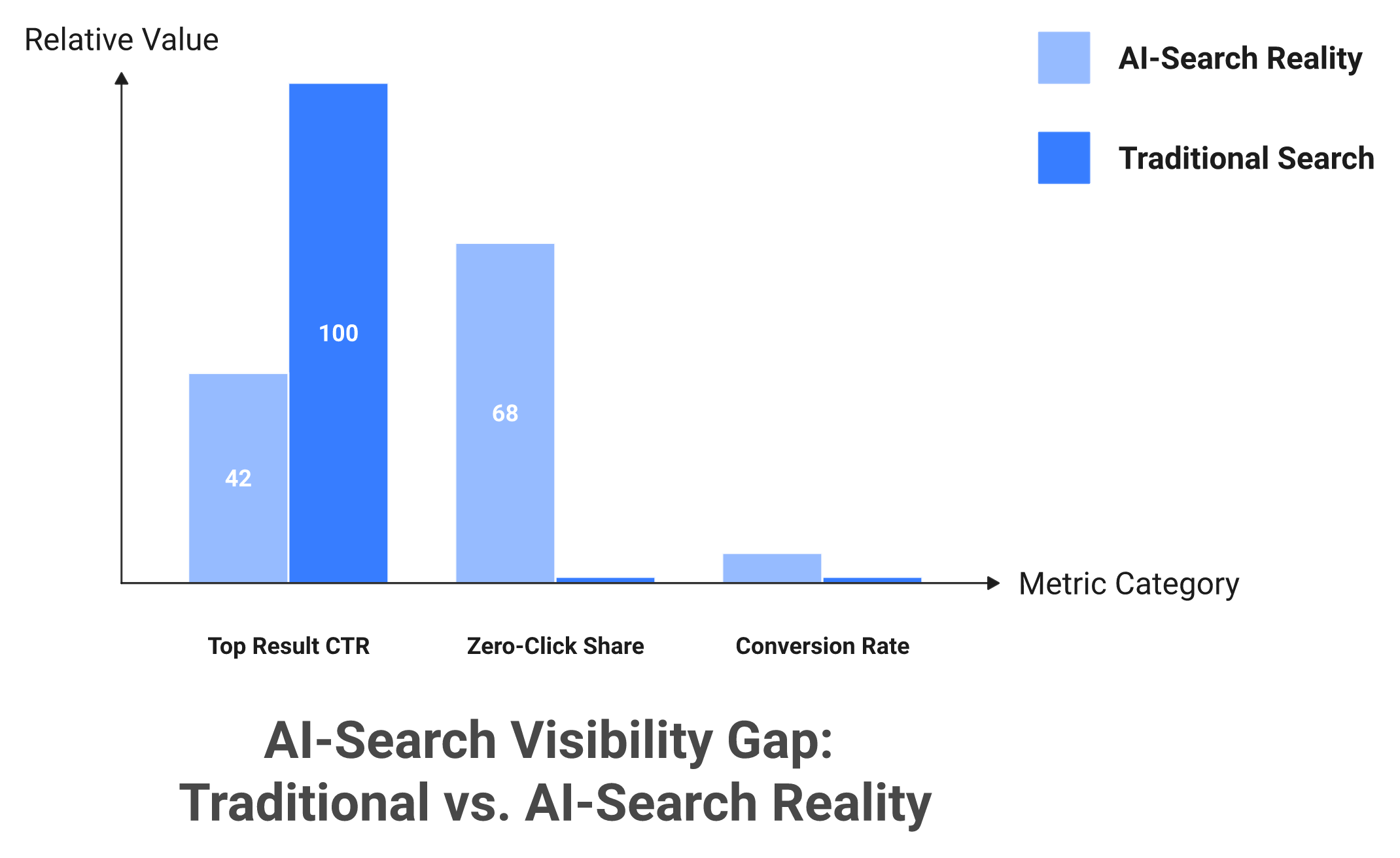
So ranking a blue link is worth less each quarter. The engine answers directly and cites only its trusted few.
- If your content is not extractable, it is skipped.
- If your brand is not trusted, it is not cited.
- If you are not cited, you are not in the buyer's consideration set.
The Princeton GEO study showed that content optimized for generative engines can lift AI-answer visibility by up to 40%. Inclusion is winnable. It just takes a different playbook than keyword ranking, the kind mapped out in a real GEO strategy framework.
💰 Why this is a pipeline story, not a vanity story
Here is the payoff that changes the budget conversation. AI-search traffic tends to arrive pre-sold. The buyer already asked the engine, already got a shortlist, and already trusts the recommendation.
That is why LLM traffic can convert at roughly 6x the rate of traditional Google search. Fewer visitors, far higher intent. The buyer's research is mostly done before they land on you.
The standard read chases impressions and pageviews. The revenue read chases citations that put you in the consideration set. Impressions do not close deals; being the recommended answer does, which is why we tie every program to GEO ROI and revenue attribution.
This is the exact gap we built MaximusLabs to close. Our revenue-focused approach, what we call RAEO and R-GEO, points content at bottom- and middle-of-funnel buyers, aligned to your ideal customer profile, so you become the answer engines cite instead of a link nobody clicks. From our work moving budget off vanity content, the pattern holds: being in the set beats ranking near it, every time.
Q8: How do you make your own content 'remarkably human' so AI engines cite it?
You make content citable the way VoiceEQ rewards voice models: clearly structured and genuinely human. Give each key question a standalone 40-60 word answer block, turn SEO keywords into the 10-15 word questions people actually ask, move hidden specs out of dropdowns into readable text, and add Speakable-marked sections. Then earn off-site trust through reviews and communities. AI engines cite sources they can extract cleanly and trust deeply.
🧱 The principle: extractable plus trusted
An engine cites what it can lift cleanly and what it already trusts. Miss either half and you stay invisible. VoiceEQ rewards voice models for the same two things, clear delivery and genuine substance.
So the goal is not "more content." It is content built to be pulled into an answer and backed by real trust signals.
✅ The five-step citability checklist
- 📝 Write standalone answer blocks. Put a 40-60 word answer right under each question heading. It must make sense if an engine lifts it out of context, the core of AEO content writing and formatting.
- ❓ Turn keywords into real questions. Take your SEO keywords and rewrite them as the 10-15 word questions buyers actually ask. You can hand the keywords to ChatGPT and have it draft the question forms.
- 📂 Pull specs out of hidden dropdowns. An engine cannot click a tab. Move the closure, fabric, material, and other details into visible text and FAQs so they get read.
- 🔊 Add Speakable markup. The Speakable schema, structured data that flags the most quotable sentences, accepts ID URL references, CSS selectors, or XPath. Target 40-60 words per marked section, one piece of a broader schema markup approach.
- ⭐ Earn off-site trust. Reviews, community threads, and third-party mentions tell engines you are trusted, not just present, the whole point of Reddit and forum AEO.
Skip the "AI info page" trend. Evidence shows bots often ignore a dedicated AI page and pull from your About page instead. Substance beats a gimmick surface.
🌐 Why this is Search Everywhere Optimization
Notice that only three of those steps touch your own site. The last two live out in the wider web. That is the shift.
Google-only SEO optimized one property. AI engines build a 360-degree view from reviews, forums, and mentions everywhere your brand appears. The Princeton GEO study confirmed that citing sources and adding authoritative signals measurably lifts AI visibility.
The standard read still treats this as on-page work. From what surfaces when you actually track citations, off-site trust often decides the tie. Two pages can be equally clean; the trusted one gets cited.
This checklist is a compressed version of the production playbook we run at MaximusLabs. We build the answer blocks, engineer the trust signals, and extend visibility across third-party and community surfaces, what we call Search Everywhere Optimization. The aim is simple and revenue-first: make your brand the answer, not the runner-up link.
Practitioners echo the shift toward trusted, off-site signals:
"The stuff that actually gets you into AI answers is Reddit threads, real reviews, and being mentioned on sites people trust. Your own blog matters way less than it used to."
u/seothrowaway, r/SEO Reddit Thread
Q9: Is AI search really replacing traditional search, or just changing what 'quality' means?
AI search isn't simply replacing traditional search, it's personalizing it. Gartner projects search volume dropping 25% by 2026, while clickstream data shows Google grew in 2024. Both can hold: the future is billions of personalized results pages, not one ranking. That's why human quality wins either way, whether a user asks Google, ChatGPT, or a voice agent, the brands that are remarkably human and trusted get surfaced.
📊 Two datasets that seem to fight
Read the headlines and you get whiplash. Gartner projects traditional search volume falling 25% by 2026 as AI chatbots absorb queries. That sounds like the end of search as we knew it.
Then the clickstream data lands. Similarweb reported Google search grew, not shrank, through 2024. So which is true?
🔀 Why both are partly right
Here is the honest answer: they are measuring different things. Gartner tracks where query volume shifts. Clickstream tracks raw usage, which can still rise while share moves elsewhere.
I might be wrong on the exact timeline, but the direction feels clear. Search is not disappearing. It is fragmenting into many personalized surfaces, each with its own logic, a shift we unpack in our take on how GEO differs from traditional SEO.
Think about what that means in practice. A user asks Google, then ChatGPT, then a voice agent, and gets three different curated answers. There is no single ranking anymore. There are billions of results pages, one per person, per moment, per engine, which is why answer engine optimization now matters as much as ranking.
That reframes the job. You stop thinking like a keyword optimizer and start thinking like a brand marketer and community manager. You influence the story and the sentiment, not just the position, the core idea behind tracking AI search visibility and brand mentions.
✅ The takeaway that survives either future
This is the part that matters for your budget. You do not have to bet on which prediction wins.
- If AI search wins, trusted and human content gets cited.
- If Google holds, trusted and human content still ranks.
- If it splits, as it likely will, quality carries across both.
The standard read treats this as a coin flip you must call. From what surfaces when you actually track visibility across engines, it is not a bet at all. Human quality and trust are the hedge that pays in every scenario, and building that hedge is exactly what a durable GEO strategy framework is for.
That durability is the whole thesis behind how we work at MaximusLabs. We do not optimize a brand for one engine and pray the forecast holds. We build trust-first, revenue-focused content that gets surfaced whether the buyer opens Google, ChatGPT, Perplexity, or a voice agent, because being the trusted answer is the one strategy that does not expire when the algorithm shifts.
Q10: What comes next, the GDSAT era of voice and content quality?
The next frontier isn't sounding human, it's being right while sounding human. Grounding satisfaction (GDSAT), whether a confident, natural answer is also factually grounded, will separate real quality from convincing hallucination. As tool calls scale, fact-check accuracy can drop roughly 42%. The same standard governs content: extractable and trusted beats polished and hollow. In voice and in search, quality is now the whole game.
🎯 The new bar: right and human
We spent this article on sounding human. The next fight is harder. It is being right while sounding human.
Call it grounding satisfaction, or GDSAT, whether a smooth, confident answer is also factually true. A voice agent can sound warm and still hallucinate a fact. That is the failure nobody hears until it costs something.
The numbers back the worry. As an agent's tool calls scale from 2 to 150, fact-check accuracy can drop by roughly 42%. More capability, more chances to be confidently wrong.
🔮 My hypothesis for where this goes
Here is what I am sitting with. The same standard is coming for content, fast.
Polished and hollow will lose. Extractable and trusted will win. An engine will not cite a page that reads well but cannot be verified, just as it should not trust a voice agent that sounds sure but grounds nothing, the exact bar we set in our trust-first E-E-A-T approach.
VoiceEQ's Speech Understanding work already points here, testing whether models grasp the context transcripts leave out. Grounding is the natural next axis. I could be early on this, but the direction feels right, and it reinforces why content engineered for clean extraction increasingly wins.
If that holds, the moat is not tone or fluency. It is being the source that is both readable and reliable. That is exactly the trust-first standard we build toward at MaximusLabs, content engineered to be extracted, verified, and cited, not just admired.
So here is the question I keep turning over. If your best content had to pass a GDSAT test tomorrow, confident, human, and provably grounded, would it? If you want to think through building that bar together, that is the conversation I would love to have.
Frequently asked questions
What is Real World VoiceEQ and how does it measure the human quality of voice AI?
Real World VoiceEQ is a benchmark from Hume AI that measures the human quality of voice interaction rather than raw technical accuracy. We see it as the voice equivalent of what earns citations in AI search: genuine usefulness over polish. It was built from over one million human ratings, 785,000 for text-to-speech and 48,000 for speech-to-speech, and it evaluates more than 40 models across 15+ dimensions and 60+ metrics. Speech recognition: whether the model hears accurately under accents, noise, and overlap. Text-to-speech: whether the voice sounds natural and emotionally expressive. Speech-to-speech: whether it recognizes emotion and responds naturally. Speech understanding: whether it reads the acoustic context a transcript leaves out. Everything runs on the Kairos evaluation platform under real-world conditions like accents, noise, and emotion. This primary-source rigor is the same standard we apply to trust-first E-E-A-T content : trace every claim to its origin and name the exact number. A benchmark earns trust the way content does, by showing its work.
Why do voice AI benchmarks report near-human scores while real conversations still feel off?
Benchmarks report near-human scores because they measure the wrong things, mostly word error rate and latency, both of which have saturated. We have watched the identical trap play out in search for fifteen years. Real World VoiceEQ shows those metrics increasingly overestimate real-world performance. The evidence is blunt: Together AI found state-of-the-art models score near-human, then fail on street names about 39% of the time. Speechmatics argues word error rate is outdated and often misaligned with human judgment. Hume AI concludes traditional benchmarks overestimate real performance. A model can nail a clean test set and still stumble on an accent, a noisy room, or an emotional caller. The test rewards fluency; real life needs understanding. This is the voice version of chasing Core Web Vitals while nobody cites your content. Word error rate, impressions, and pageviews are the vanity layer; grounding accuracy, citation share, and pipeline are the signal layer. This is exactly the trap we help clients escape with our revenue-focused content approach , pulling budget off vanity dashboards and pointing content at what AI engines actually reward.
Why is there no single best voice model, and how should we pick one per use case?
There is no single best voice model because performance is dimension-specific. In VoiceEQ's TTS evaluations, no system ranked top five across all eight capability groups, so the race for one winner is giving way to specialists. The tradeoff is concrete. One model excels at repeating booking reference numbers, bank details, or complex drug names; another sounds remarkably natural but is less reliable on precision. You cannot have both at full strength yet. We recommend mapping the model to the job: Finance and healthcare: prioritize accuracy and precision, since a misheard account number or drug name is a liability. Entertainment and brand experiences: prioritize expressivity and naturalness. Support in noisy conditions: prioritize robustness against accents and overlap. Real-time assistants: balance latency with speech understanding. Judging a voice model on one axis is like chasing a single Google rank while ignoring how buyers ask across ChatGPT, Perplexity, and Gemini. That per-surface discipline is central to our answer engine optimization work: match the strategy to the surface, or you win the wrong game well.
Why can voice models speak better than they listen, and what does that cost regulated industries?
Voice models speak better than they listen because access to audio does not mean they use it. VoiceEQ found speech-to-speech systems varied more than any other category, with many staying transcript-driven and ignoring tone, pacing, and hesitation. Consider a banking fraud check. A confident "Yes" and a hesitant "...yes..." mean opposite things to a human but look identical to most models. The meaning lived in the hesitation, and the model threw it away. The stakes rise where the work is regulated: Financial confirmations: a misread yes on a transfer can trigger the wrong action. Healthcare consent: uncertainty in a patient's voice should stop the flow, not sail past it. Support at scale: missed frustration turns a fixable call into a churned customer. There is a deeper trap too: as tool calls scale from 2 to 150, fact-check accuracy can drop by roughly 42%. Sounding human is not the same as being reliable. Testing for listening, not just speaking, is now the honest bar, the same trust-first discipline behind our healthcare AEO for YMYL queries .
How does VoiceEQ compare to other voice AI benchmarks like Artificial Analysis and EmoNet-Voice?
VoiceEQ, Artificial Analysis, and EmoNet-Voice each measure a different slice of voice quality, so reading them together is the only way to see the full picture. Artificial Analysis: ranks 74+ TTS models by blind Elo preference, good for which voice sounds best, weaker on why. EmoNet-Voice: tests fine-grained emotion recognition, showing high-arousal emotions like anger are far easier to detect than concentration. Real World VoiceEQ: uses 1M+ human ratings across ASR, TTS, speech-to-speech, and understanding to build a capability profile per use case. All three converge on one signal: voice that feels human, not just technically clean. They diverge on breadth, since VoiceEQ trades simplicity for a full profile instead of a single number. People treat the top of a leaderboard as the best model, when the honest answer is best at the one thing that leaderboard measures. This cross-source triangulation, refusing to trust a single leaderboard, is exactly how we vet claims through rigorous GEO competitive analysis before they enter client content.
What does the voice AI quality gap mean for winning AI-search visibility and pipeline?
The voice AI quality gap and the AI-search visibility gap are the same binary game. AI engines surface only 5-10 options, and a robotic B-minus option is excluded before the user sees it, just as thin, un-trusted content never enters ChatGPT or Perplexity answers. The math is getting harsher for old-school visibility: Ahrefs found AI Overviews cut click-through rate for the top organic result by 58%. SparkToro and Similarweb data put U.S. zero-click searches near 68% in early 2026. If your content is not extractable or your brand is not trusted, you are not cited, and if you are not cited, you are not in the consideration set. This is a pipeline story, not a vanity story. AI-search traffic arrives pre-sold, which is why LLM traffic can convert at roughly 6x the rate of traditional Google search. That is the exact gap we built our generative engine optimization practice to close, pointing content at buyers so you become the answer engines cite instead of a link nobody clicks.
How do we make our own content remarkably human so AI engines cite it?
We make content citable the way VoiceEQ rewards voice models: clearly structured and genuinely human. An engine cites what it can lift cleanly and what it already trusts, so you must earn both halves. Our five-step citability checklist: Write standalone answer blocks: place a 40-60 word answer under each question heading that makes sense out of context. Turn keywords into real questions: rewrite SEO keywords as the 10-15 word questions buyers actually ask. Pull specs out of hidden dropdowns: an engine cannot click a tab, so move details into visible text and FAQs. Add Speakable markup: flag your most quotable sentences with structured data, targeting 40-60 words per section. Earn off-site trust: reviews, community threads, and third-party mentions tell engines you are trusted. Only three of those steps touch your own site; the last two live across the wider web, which is why we call this Search Everywhere Optimization. We build the answer blocks and engineer the trust signals as part of our AEO content writing and formatting playbook, so your brand becomes the answer, not the runner-up link.
Is AI search really replacing traditional search, or just changing what quality means?
AI search is not simply replacing traditional search, it is personalizing it. Gartner projects search volume dropping 25% by 2026, while Similarweb clickstream data shows Google grew through 2024. Both can hold because they measure different things. The direction is clear: search is fragmenting into many personalized surfaces. A user asks Google, then ChatGPT, then a voice agent, and gets three different curated answers. There are now billions of results pages, one per person, per moment, per engine. The takeaway survives either future: If AI search wins, trusted and human content gets cited. If Google holds, trusted and human content still ranks. If it splits, as it likely will, quality carries across both. Human quality and trust are the hedge that pays in every scenario. The next frontier is grounding satisfaction (GDSAT), being right while sounding human, since a page that reads well but cannot be verified will not get cited. That durable, trust-first standard is the whole thesis behind our GEO strategy framework , built so you get surfaced whether the buyer opens Google, ChatGPT, Perplexity, or a voice agent.