 Krishna Kaanth M
- For most seed-to-Series-B and mid-market companies, a full-stack agency delivers faster ROI, because early SEO rarely fills a 40-hour week.
- A Glassdoor-median SEO manager costs about $205,000 fully loaded, and a working in-house pod runs about $20,000 a month.
- AI Overviews cut position-one click-through rate by 58%, while AI search visitors convert about 4.4 times better, so citations now matter more than rankings.
- Launch rate decides ROI: strategy-only engagements see roughly 20% of recommendations shipped, so choose a partner that writes, designs, and publishes.
- In-house wins at enterprise scale with engineering access; hybrids work when one internal owner approves and the partner ships.
- Judge both models on pipeline using GA4 AI referrals, citation share, and revenue per page, and never pay rank-based bonuses.
Q1. In-House SEO vs. Agency: Which Delivers Better ROI in 2027?
In 2027, the better ROI comes from whichever model ships revenue-focused content that AI engines cite. Most seed-to-Series-B and mid-market companies get there faster with a full-stack agency, because early SEO rarely fills 40 hours a week. One hire also cannot cover product, content, technical, and PR work alone. Enterprises with complex products and real engineering access usually win with an in-house team.
The Short Answer, by Company Type
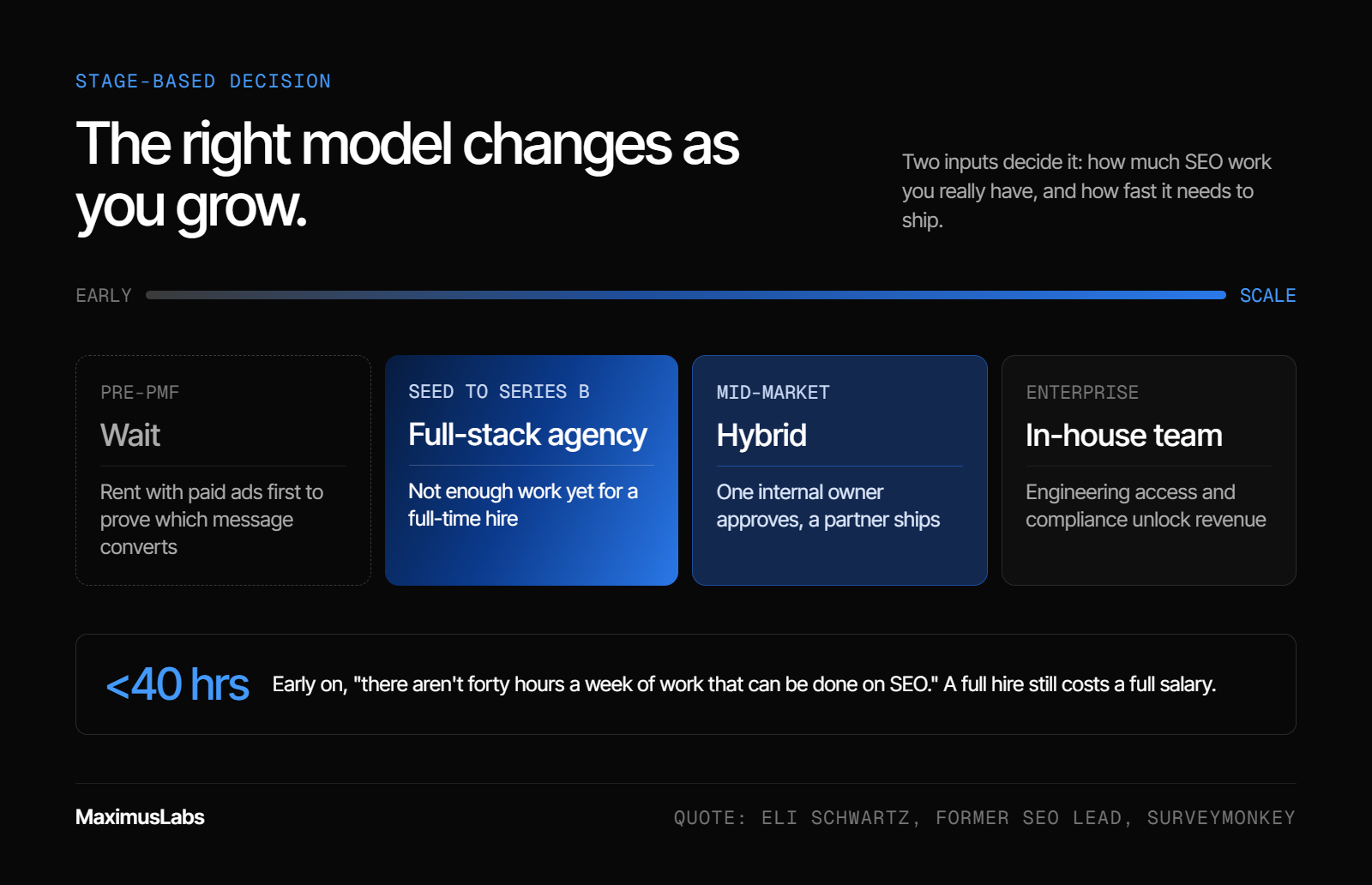
The verdict depends on two inputs: how much SEO work you actually have, and how fast you need it shipped. Here is how the models line up.
| Company stage | Better ROI model | Why |
| Pre-product-market fit | Neither yet | Prove conversion with paid channels first |
| Seed to Series B | Full-stack agency | Not enough work for a full-time hire |
| Mid-market | Hybrid | One internal owner, external execution |
| Enterprise | In-house team | Engineering access unlocks large revenue |
⏰ Why workload decides it first
Eli Schwartz, who led SEO at SurveyMonkey, puts it bluntly. Early in a company’s organic journey, “there aren’t forty hours a week of work that can be done on SEO.” Most early work is strategy and research, and even execution may not be a full-time job.
A full-time hire with half a job’s worth of work still costs a full salary. That gap is where early-stage ROI quietly disappears.
What Changed About “ROI” Itself
For a decade, SEO ROI meant rankings, then traffic, then maybe leads. That chain is breaking. Ahrefs found that AI Overviews now cut the click-through rate for position one by 58%. A page can rank first and still lose most of its clicks.
At the same time, Semrush found the average visitor from AI search is worth 4.4 times a traditional organic visitor, based on conversion rates. Fewer clicks arrive, but the ones that do are closer to buying.
✅ The new question to ask
So the real question is not “in-house or agency?” It is “which model can get us cited in AI answers and turn that into pipeline?” Rankings still matter, because AI engines often pull from pages that already rank. But rankings are now the floor, not the finish line.
How the Rest of This Guide Works
The sections below build the decision piece by piece:
- The shift: what AI search changed about the skills you are hiring for
- Cost: the fully loaded price of an in-house team and what a retainer actually buys
- Speed: which model reaches ROI first, and why execution rate matters most
- Fit: when in-house wins, when an agency wins, and when to wait
- Measurement: how to judge both models on pipeline, not vanity metrics
💡 My own read
My view, after years of running this work, is simple. The question is not who you hire. It is who ships. A brilliant strategist whose plans never launch produces zero ROI, whether they sit on your payroll or an agency’s.
MaximusLabs AI treats this decision as a shipping problem first. It runs Answer Engine Optimization (AEO), the practice of earning citations in AI answers. SEO sits underneath, and strategy and execution live in one team. Every engagement is measured on pipeline, not on mentions, which is the same standard this guide applies to both models.
Q2. How Has AI Search Changed What You’re Actually Hiring For?
AI search changed the SEO job from ranking a page to becoming the answer. AI Overviews cut position-one click-through rate by 58% (Ahrefs, 2026), while AI search visitors convert about 4.4 times better (Semrush, 2025). Earning citations from ChatGPT, Perplexity, and Gemini requires prompt testing and citation tracking. MaximusLabs AI treats this as a data-science problem and tracks AI visibility daily across every major engine.
How SEO Hiring Used to Work
Picture the old job description: “Own keyword strategy, grow traffic, report monthly rankings.” The report showed rankings going up. Nobody asked where the pipeline was.
❌ What that model optimized for
Traditional SEO, in-house or agency, was built for Google’s blue links. Teams were hired for keyword research, on-page fixes, and link building. Those skills still matter, but they target a shrinking results page.
What Changed
Buyers now ask ChatGPT, Perplexity, Gemini, Claude, and Google AI Overviews. They get one answer with a handful of brands in it. A brand is either inside that answer or invisible. Ahrefs measured the damage on Google itself: AI Overviews now keep 58 of every 100 clicks a top page used to earn.
Semrush found AI search visitors convert at 4.4 times the rate of traditional organic visitors. Being mentioned is not the finish line, though. Turning that mention into pipeline is.
⚠️ Why this is a different skill
The Princeton-led GEO study gave this discipline its name. Generative Engine Optimization (GEO) is optimizing content so AI engines select and cite it. The researchers showed targeted changes can lift visibility in AI answers by up to 40%. Their best methods were adding citations, quotations, and statistics. Keyword stuffing offered little to no improvement.
That is a testing discipline, not a checklist, and few in-house teams have built the tooling.
💸 What GEO talent costs to hire
Posted pay for GEO and AEO roles in 2026 ranged from about $75,000 to $174,000. Nobody has priced the role consistently yet, so one hire is a real bet.
What MaximusLabs AI Does About It
MaximusLabs AI runs AEO as its flagship service, with SEO as the foundation, and does strategy and execution in one team. In practice, that means four systems working together:
- Per-client intelligence graphs: AI agents that research the market and reason over each client’s own context
- Daily AI-visibility tracking: prompts re-run across every major engine and regression-tested
- A citation-intelligence engine: it maps which sources each engine trusts, then gets the client into them
- The Two Pillars: Owned AEO, where your content becomes the answer, and Earned AEO, where reviews, Reddit, press, and listicles make AI trust you
Humans approve everything that ships.
📊 What the proof looks like
MaximusLabs’ own read is that GEO is not “SEO plus.” It is a data-science problem, because you have to know how each engine chooses sources before you can earn a place in its answer. I might be wrong on the details as engines change, but the results so far point one way. For Oliv AI, a B2B SaaS client, the outcome was “64% AI citation rate in 6 months, vs ~30% for billion-dollar incumbents (Oliv AI)”.
MaximusLabs AI measures that work on pipeline, not citations alone. For the same client, the result was “27 qualified leads, $47K+ pipeline, 26% close rate in 4 months (Oliv AI)”. Hold any hire or agency to that bar in 2027.
Q3. What Does an In-House SEO Team Really Cost Once Fully Loaded?
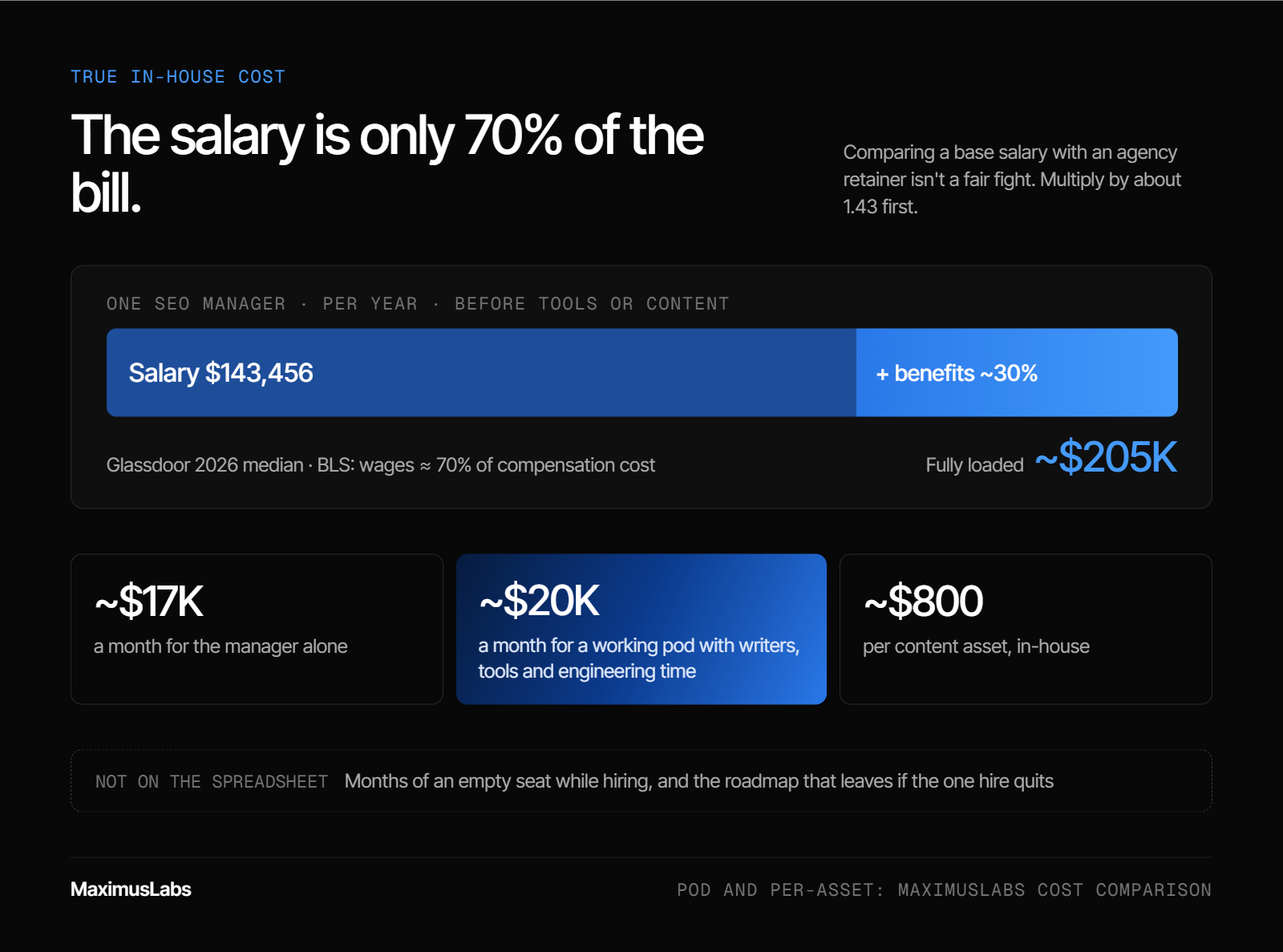
A Glassdoor-median SEO manager earns about $143,000 a year. Benefits make up roughly 30% of total employer compensation costs (BLS, 2025), pushing that manager to about $205,000 fully loaded. Add tools, writers, and engineering time, and a working in-house pod costs about $20,000 a month, or roughly $800 per content asset. Traditional agency retainers typically bundle talent and tools into one monthly fee.
Start With the Number Most Teams Skip
The most common mistake is comparing a base salary to an agency retainer. That is not a fair comparison. A salary is only the visible part of what an employee costs.
💰 The benefits multiplier
The U.S. Bureau of Labor Statistics tracks this precisely. For private industry, wages and salaries made up about 70% of employer compensation costs in December 2025, with benefits covering the rest. In plain terms, multiply salary by about 1.43 to get the real cost.
Apply that to Glassdoor’s 2026 median SEO manager salary of $143,456. The fully loaded cost lands near $205,000 a year, before a single tool or article.
Build the Full Stack of Costs
Here is what a working in-house SEO function actually needs:
- People: an SEO lead, plus writers and a share of an engineer’s sprints
- Benefits and payroll taxes: about 30% of total compensation
- Tools: rank tracking, crawlers, and now AI-visibility tracking
- Content production: writing, editing, design, and publishing
- Ramp time: months before a new hire ships meaningful work
📊 What it adds up to
MaximusLabs AI’s own cost comparison puts a working in-house pod at about $20,000 a month. That figure is conservative. The Glassdoor-median manager alone costs about $17,000 a month fully loaded, before writers or tools.
The same comparison puts the in-house cost at about $800 per content asset. A traditional agency lands near $260 per asset, because writers, tools, and editors are shared across clients.
The Hidden Costs That Never Show on a Spreadsheet
Two costs rarely appear in the budget line. The first is the empty seat. Hiring an experienced SEO lead can take months, and nothing ships while the role sits open.
The second is turnover. If your one SEO hire leaves, the knowledge, the roadmap, and the relationships with engineering leave too. You pay the recruiting and ramp costs all over again.
⚠️ The old math still holds
Phil Singleton made this point years before AI search existed. In 2016, an entry-level SEO specialist cost about $3,500 a month. For “the same amount or less,” he argued, a company could engage an experienced agency. Salaries have risen since, and the gap has widened.
What I Learned Running This From the Inside
Before founding MaximusLabs AI, I was the second employee at WiseMonk and headed go-to-market. SEO drove 98% of the company’s revenue. MaximusLabs’ founding view came from that seat: a lean team only works when every dollar goes to content that converts.
The cost question is never just “what does a hire cost?” It is “what does each shipped, revenue-driving asset cost?” That number is the one to compare.
MaximusLabs AI bundles strategy, an SEO manager, a designer, writers, and software into one engagement, so the full-stack cost is visible from day one. Its work starts with bottom-of-funnel content tied to the buyer profile, which is the cost per asset worth comparing. No hiring lag, no empty seat, and no separate tool bills.
Q4. What Does an Agency Retainer Really Buy, and Where Does It Leak?
An SEO agency retainer pays off only when the agency ships work that drives revenue. Many traditional agencies deliver long PDF audits full of low-impact fixes and pitch senior strategists who later hand accounts to juniors. The result is a repeating cycle: audit, small fixes, flat results, lost engineering trust, then a new agency. Most of these retainers also stop at Google rankings and ignore AI answers.
What the Retainer Promised
The monthly report arrives with charts, keyword movements, and “completed tasks.” The VP of Marketing forwards it to the founder. The founder replies with one line: “What did this do for pipeline?”
❌ How traditional retainers were built
Traditional agencies sold rankings, impressions, and clicks. Those are vanity metrics, numbers that look like progress without tying to revenue. Retainers were locked to a fixed scope. Strategy often came from one firm and execution from another, and content was written for blue links.
Where the Money Leaks
There are three common leaks, and most frustrated buyers have lived through at least one.
| Leak | What it looks like | What it costs you |
| The PDF audit | A 50-page report of minor technical checks | Months spent on fixes with no revenue impact |
| The senior-to-junior handover | Senior people pitch, junior staff run the account | Strategy quality drops after signing |
| Strategy without shipping | Plans handed to your team to build | Most recommendations never launch |
⚠️ The SEO death spiral
Ethan Smith, CEO of Graphite, describes the pattern clearly. An agency delivers “a 50 page PDF” with a huge roadmap, and “most of it’s zero impact work.” Results stay flat, the agency says to wait a year, and the client moves on. He calls it a “death spiral of zero impact work.”
Each loop also burns engineering trust, so the next agency starts with less goodwill.
What Changed in the AI Era
AI engines now answer the buyer’s question directly, with 5 to 10 brands named. AI recommends brands it trusts, because its own credibility rides on the recommendation. An audit that fixes alt tags does not earn that trust.
Earning a place in the answer takes citation testing and presence on the sources each engine relies on. Most traditional retainers were never scoped for that work.
💡 My read on “GEO as an add-on”
MaximusLabs’ read is that many agencies now sell GEO as an extra line item without understanding how large language models retrieve sources. My question to them is simple: how can you sell something as a service if you don’t understand it completely? Ask any agency to show its testing method before you sign.
What MaximusLabs AI Does Differently
MaximusLabs AI runs strategy and execution as one team, so plans ship instead of sitting in a queue. Its citation-intelligence engine maps which sources each AI engine trusts. Owned AEO makes the client’s content the answer, and Earned AEO builds trust through reviews, Reddit, press, and listicles.
✅ Where the retainer should land
The test of any retainer is what it does for pipeline. For Oliv AI, MaximusLabs’ work led to “30-40% of inbound now AI-sourced (Oliv AI).” That is the kind of line a monthly report should carry.
MaximusLabs AI measures every engagement on pipeline, not on mentions, and humans approve everything that ships. The retainer buys shipped work across Google and AI engines, not a PDF.
Q5. Which Model Reaches ROI Faster, and Why Does Speed Matter Most?
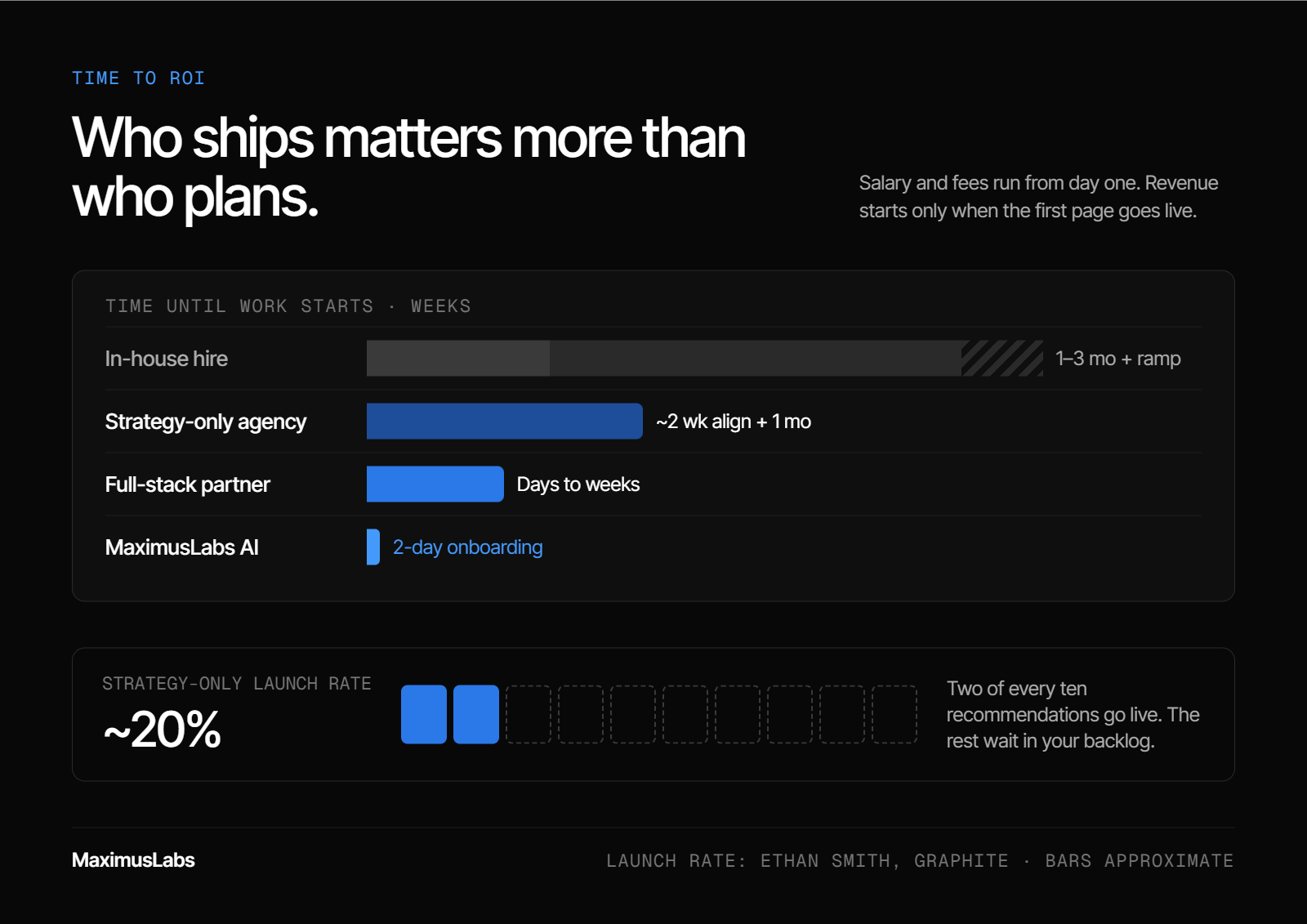
Execution speed decides SEO ROI more than expertise does. An in-house hire typically takes one to three months to recruit, then more months to ramp up. A traditional agency usually needs about two weeks to align and another month to start. Strategy-only engagements see roughly 20% of their recommendations launched. A full-stack partner that writes, designs, and deploys the work shortens time to revenue most.
The Three Clocks, Side by Side
What matters is how long until the first revenue-driving page goes live, and how much of the plan ever ships.
| Model | Time to start | What slows it down | Share of plan that ships |
| In-house hire | One to three months to hire, then ramp | Recruiting, onboarding, and engineering queues | Depends on engineering access |
| Strategy-only agency | About two weeks to align, one month to start | Plans wait in your team’s backlog | About 20% |
| Full-stack partner | Days to weeks | Approval speed on your side | Most of it, because the partner builds it |
| MaximusLabs AI | Two-day onboarding | Client approvals | Strategy and execution run in one team |
⏰ Where the in-house clock goes
The in-house timeline hides two delays. First comes the open seat, often one to three months. Then the new hire spends weeks learning the product, the buyer, and who controls engineering sprints.
Nothing ships during either delay, but salary and benefits keep running.
Why Launch Rate Beats Expertise
Ethan Smith, CEO of Graphite, learned this running a consulting practice. He would build a full strategy, and “maybe 20% of that was launched.” The rest stalled in the client’s queue.
So Graphite went full-stack. In his words, “it’s actually better and faster if we do everything ourselves.”
⚠️ The 20% problem
A plan that launches at 20% delivers a fifth of its value. That is why launch rate, the share of recommendations that actually go live, belongs in every vendor comparison.
Before signing, ask who publishes the pages. If the answer is “your team,” budget for the queue.
Speed Over Clever Features
Teams often debate tools instead of shipping. Ethan Smith disagrees: what matters most, he says, is “velocity” rather than a CMS feature that formats pages for AI engines. Graphite built a whole Webflow team because it was simply fast.
✅ What this means for AI search
Speed matters even more now. AI engines answer with a handful of brands, and those slots go to sources that publish, earn citations, and keep content fresh. A slow team lets a competitor become the default answer.
My Read: Run Fast, Then Steer
MaximusLabs AI’s read is that most teams over-plan and under-ship. I think about it like a toy dash car. It runs straight until it hits a wall, turns, and keeps going. You learn more from ten shipped pages than from one perfect roadmap.
I might be overstating it for regulated industries, where legal review sets the pace. Even there, shorten the path from approved idea to live page.
MaximusLabs AI onboards new clients in two days and runs strategy and execution in one team, so recommendations do not wait in a client’s backlog. Humans approve everything that ships, and every engagement is measured on pipeline, not on mentions. That combination is what turns speed into revenue rather than activity.
Q6. Why Do Single In-House SEO Hires So Often Fail?
Lone in-house SEO hires fail because job descriptions ask one person to master content, project management, engineering, and analytics. Few people have all four skills. Placed inside Marketing without engineering sprints, the hire gets blocked on technical changes and stalls. Companies that build in-house succeed more often when SEO reports into Product, with engineering and data-science time already allocated.
The Job Description Nobody Can Fill
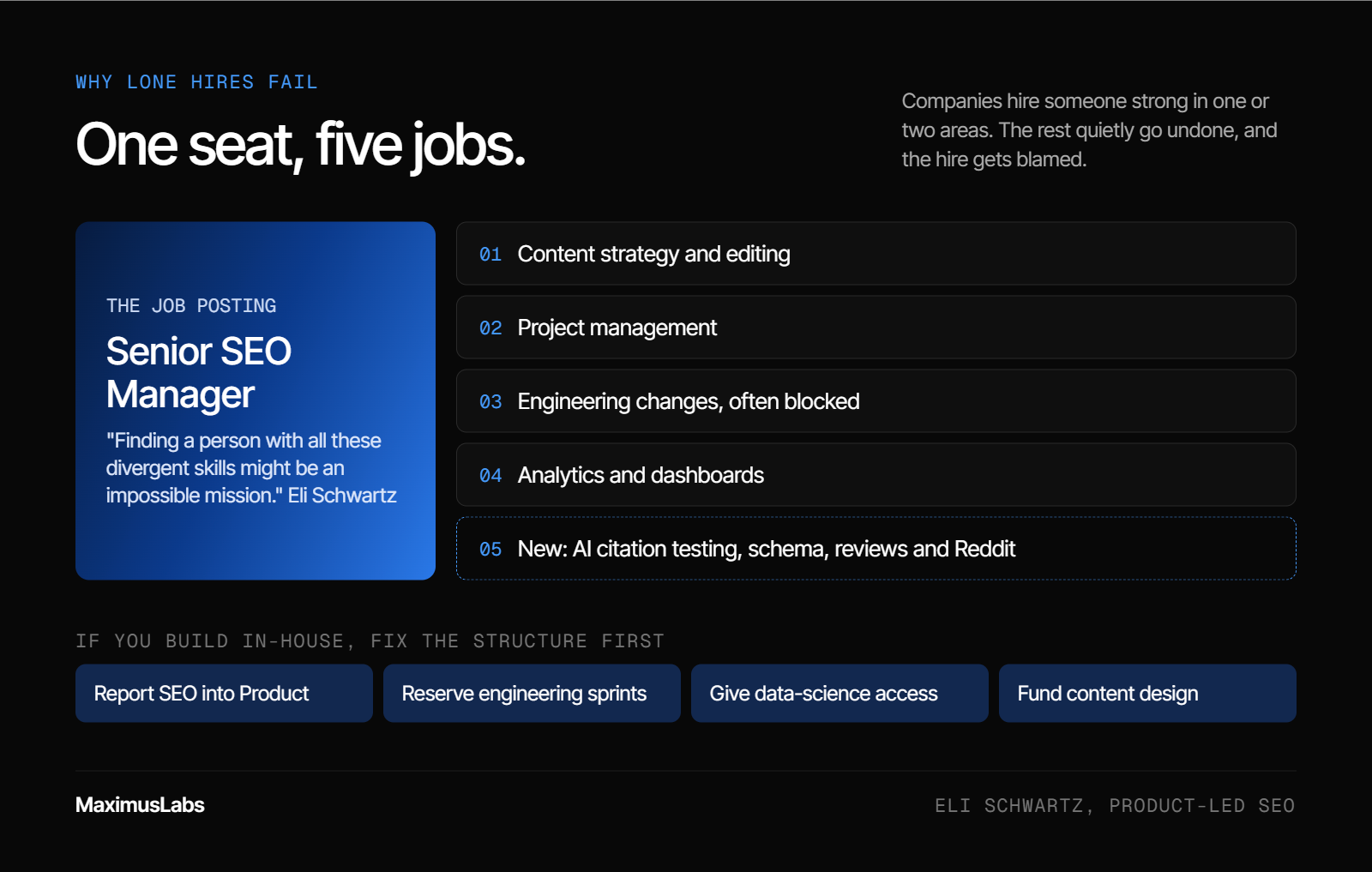
Picture the posting. “Senior SEO Manager: own content strategy, manage projects, partner with engineering, and build analytics dashboards.” The hiring manager wants one person. The market rarely has that person.
❌ Four jobs in one seat
Eli Schwartz, who ran SEO at SurveyMonkey, has flagged this pattern in SEO job postings. Many ask for someone who understands content, project management, engineering, and analytics. “Finding a person with all these divergent skills,” he wrote, “might be an impossible mission.”
So companies hire someone strong in one or two areas. The other two quietly go undone.
Blocked on Day One
Schwartz lived the engineering problem himself. On his first day at SurveyMonkey, he asked for a routine technical change. An engineer refused, with a finality that suggested no future requests would get through either.
He did not give up. He built the relationship over time. By the time that engineer left, he had become an SEO advocate, and together they drove “hundreds of millions of dollars in revenue” from SEO changes.
⚠️ The marketing silo
That story ended well because Schwartz knew how to win engineering over. Most lone hires do not get that chance. When SEO sits in Marketing with no reserved engineering time, every technical fix becomes a favor.
The hire writes tickets, waits, and reports flat results. Leadership blames the hire, not the structure.
What AI Search Adds to the Load
The job has also grown. AI engines like ChatGPT, Perplexity, and Gemini now pick a few trusted sources per answer. Earning a spot takes citation testing, structured data, and presence on review sites and Reddit.
That is a fifth discipline stacked onto an already impossible role. One person cannot test prompts daily while also fixing site speed and editing articles.
💡 A lesson from engineering school
I studied mechanical engineering before I worked in growth. One rule stuck with me: a machine built to do four jobs usually does all four badly. SEO teams follow the same physics.
MaximusLabs AI’s view follows from this. Brands competing for AI citations need separate owners for content, technical work, and off-site trust, all coordinated toward pipeline.
The Fix If You Build In-House
If you hire internally, change the structure before you change the person:
- Report SEO into Product, not only Marketing
- Reserve engineering sprints for SEO work each quarter
- Give data-science access for measurement and testing
- Fund content design so pages ship without borrowing writers
✅ When the hire can actually succeed
With those four pieces in place, a strong in-house lead can deliver. Without them, even the best candidate stalls.
MaximusLabs AI covers all four disciplines in one team, so no single person carries content, technical, analytics, and off-site work alone. Its Owned AEO and Earned AEO pillars split the work between making content the answer and building trust across reviews, Reddit, and press. For Oliv AI, that produced “64% AI citation rate in 6 months, vs ~30% for billion-dollar incumbents (Oliv AI)”.
Q7. When Does In-House Win, When Does an Agency Win, and When Should You Wait?
The right model depends on company stage and real SEO workload. Before product-market fit, most companies should wait and use paid channels to prove conversion. From seed to Series B, an agency usually wins on full-stack speed. Mid-market companies often suit a hybrid. Enterprises with complex codebases, compliance needs, and large organic footprints usually win in-house, where cross-functional access unlocks revenue.
Stage One: Before Product-Market Fit
Ethan Smith’s advice to early startups surprises people. When they ask for SEO help, his first response is “don’t do it at all.” New domains lack the authority to rank, so effort spent early compounds slowly.
💸 Rent first, then buy
Eli Schwartz frames this with a housing analogy. Paid marketing “is like renting a house” with no equity, while SEO “is like owning a house.” Renting makes sense while you still test which message converts.
So run paid ads first. Learn which pages, offers, and words turn visitors into pipeline. Then move budget into SEO with that data in hand.
Stage Two: Seed to Series B
This is where the 40-hour test matters most. Schwartz notes that early SEO rarely fills forty hours a week. A full-time hire with half a job still costs a full salary.
A full-stack agency fits this stage. It brings content, technical, and off-site skills without four hires.
⚠️ The honest disagreement
Experts split on this. Phil Singleton argues companies “will achieve greater success with a proven SEO agency.” Schwartz counters that growing companies eventually need deep internal integration that outside teams cannot drive alone. Both are right, just at different stages.
Stage Three: Mid-Market
Mid-market companies often have enough work for one internal owner but not a full team. That owner sets strategy, approves positioning, and unblocks engineering. An external partner handles production and testing.
The trigger to move here is usually a second product line or a sales team asking for more pages than one person can ship. This split is the hybrid model, covered in the next section.
Stage Four: Enterprise
In-house wins at scale. Complex codebases, strict compliance, and huge page counts reward people who sit inside the company. Search Engine Land’s enterprise estimates show agency costs can exceed in-house costs at the high end.
⭐ Large accounts need a named human
Even enterprises that keep agencies need dedicated people. Ethan Smith puts it simply: “the whales need a person to talk to.” If you hire an agency at this stage, insist on a named senior lead.
My Read on Fit
MaximusLabs AI’s read is that honesty about fit saves everyone money. MaximusLabs is not for companies wanting impact within a week, or teams choosing purely on price. I would rather say no early than sell a retainer that cannot work.
MaximusLabs AI works mainly with B2B SaaS, then healthcare and financial services companies, where AI search is reshaping how buyers shortlist vendors. It is built for growth-stage companies, where full-stack execution beats a lone hire. Every engagement is measured on pipeline, which keeps the fit question honest after signing.
Q8. How Should a Hybrid Model Split the Work?
A working hybrid keeps strategy, brand voice, buyer knowledge, and engineering unblocking inside the company. Content production, GEO testing, technical sprints, and off-page authority run with an external partner. One internal owner approves the work, and the partner ships it. When no internal owner exists, the partner’s work sits in a queue and the hybrid fails.
The Internal Owner’s Job
The hybrid lives or dies on one person. This owner does not write every article. They make decisions fast and clear the path.
✅ What stays inside
- Positioning and brand voice: how the product is described and why it wins
- Buyer knowledge: the ideal customer profile, objections, and sales-call insights
- Engineering access: sprint time for technical fixes and schema changes
- Final approval: a fast yes or no on every page before it ships
The agency drafts, and your team approves and corrects. Never the other way around.
Mapping the Four Disciplines
SEO work splits cleanly across four disciplines: Product, Content, Technical, and PR (off-page authority). A hybrid assigns each one an owner.
| Discipline | Inside owner | External partner | MaximusLabs AI’s role |
| Product | Positioning, roadmap, and engineering access | Recommendations | Interviews leadership to capture positioning |
| Content | Approval and subject-matter input | Research, writing, and publishing | Writes BOFU content in the founder’s voice |
| Technical | Sprint time and code review | Audits, schema, and AI discoverability | Runs technical SEO and structured data |
| PR and off-page | Spokespeople and approvals | Reviews, Reddit, listicles, and press | Runs Earned AEO across trusted sources |
💡 How the founder’s voice survives outsourcing
The usual fear is that outsourced content sounds generic. MaximusLabs AI handles this with a founder’s voice process. We sit with the leadership team, learn the vision and the right to win, and capture the founder’s view of the market. Then every article reflects that view, and the client approves it.
How Hybrids Fail
Hybrids break in predictable ways:
- No owner: drafts pile up with nobody empowered to approve them
- Too many owners: five reviewers rewrite every page into mush
- No engineering time: technical fixes wait for a quarter that never comes
- Split goals: the inside team tracks traffic while the partner tracks citations
⚠️ One scoreboard, not two
The fix for split goals is one shared scoreboard. Both sides should report on pipeline from organic and AI search. Rankings and citations are inputs, not the result.
What This Looks Like in AI Search
AI engines reward consistency across your site and the wider web. Your pages, reviews, Reddit threads, and press mentions must tell the same story. A hybrid with one owner keeps that story straight.
⭐ My read on the split
MaximusLabs AI’s read is that most hybrids give away the wrong half. Teams outsource strategy and keep production, then wonder why nothing ships. I believe you should keep the judgment and outsource the volume.
MaximusLabs AI works as the external half of a hybrid. It captures the founder’s view, ships content and technical work, and runs Earned AEO across reviews, Reddit, and press. The client keeps positioning and approval. Every engagement is measured on pipeline, not on mentions, so both sides share one scoreboard.
Q9. How Should You Measure SEO ROI in the AI Search Era?
SEO ROI in the AI search era should be measured on pipeline from organic and AI search, not on rankings or traffic. Track AI referrals as their own channel in GA4, monitor citation share across ChatGPT, Perplexity, and Gemini, and measure revenue per page. MaximusLabs AI starts engagements with bottom-of-funnel content aligned to the ideal customer profile, so pipeline shows up early. Avoid paying bonuses tied to rankings or links.
How SEO Used to Be Reported
The quarterly review opens on the SEO slide. Sessions are up 30%, and rankings improved. Then the CFO asks: how much pipeline did this create?
❌ The vanity-metric trap
Eli Schwartz once advised a well-known brand whose organic revenue had plateaued after years of double-digit growth. Its SEO reports still revolved around rankings.
Traffic kept rising, but none of the team’s work targeted pages that could move revenue.
What Changed With AI Search
Buyers now ask ChatGPT, Perplexity, Gemini, Claude, and Google AI Overviews. They get one answer with a handful of brands in it. Fewer clicks reach your site, but Semrush found AI search visitors convert at 4.4 times the rate of traditional organic visitors.
A page cited in an AI answer may send few visits yet still drive deals.
📊 The new measurement stack
Measure both in-house and agency work with the same four layers:
| Layer | What to track | How |
| AI referrals | Visits and conversions from AI engines | A custom channel group in GA4 |
| Citation share | How often AI answers name your brand | Repeated prompt tests across engines |
| Revenue per page | Pipeline tied to each landing page | CRM attribution by first and last page |
| Pipeline | Qualified leads, opportunities, and closed revenue | Sales and CRM reporting |
GA4’s default channel groups cannot be edited, but custom channel groups let you define your own. Set one up for AI engines first.
Where the Revenue Actually Comes From
A small share of pages drives most organic impact. A common working rule is that about 5% of landing pages produce 85% to 95% of results. Treat that as a heuristic, not a law, but it changes where you spend.
💡 MaximusLabs AI’s BOFU-first rule
MaximusLabs AI starts with bottom-of-funnel (BOFU) content: comparison pages, alternatives, and “best tool for” queries that buyers ask right before choosing. Middle-of-funnel content comes next. MaximusLabs skips most top-of-funnel “what is X” content, because AI engines already answer those questions well.
I might be wrong for categories where buyers do not yet know the problem exists. For most B2B SaaS buyers, BOFU pages start pipeline.
Pay for Shipping, Not for Rankings
Schwartz warns against making any part of SEO pay variable on a KPI. He has seen bonuses tied to links, rankings, clicks, and even revenue, and “in every case, it caused long-term issues.”
⚠️ Why incentives backfire
Rank bonuses reward shortcuts that can damage a domain. Pay salaries and flat retainers, then judge both on pipeline.
What MaximusLabs AI Measures
MaximusLabs AI tracks AI visibility daily across every major engine and reports each engagement against pipeline, not mentions. For Oliv AI, that meant “27 qualified leads, $47K+ pipeline, 26% close rate in 4 months (Oliv AI)”. For Nidra Goods, one strategy ranked the brand #1 across Google, ChatGPT, and Perplexity for “best sleep mask.”
Q10. How Do You Vet an Agency or an In-House Hire Before Committing?
To vet an SEO agency, call at least five live client references. Check their Ahrefs or Semrush traffic curves from each client’s onboarding month. Ask for proof of shipped work and a documented method for testing AI citations. To vet an in-house hire, run four stages: recruiter screen, hiring manager interview, cross-functional panel, and executive sign-off. The panel covers product, engineering, content, and data.
Step 1: Check References the Hard Way
Sales decks always look good. References tell you what happens after the contract is signed.
✅ The five-reference rule
- Ask for five live clients, not past ones or hand-picked case studies
- Call them yourself, without the agency on the line
- Ask who runs the account day to day, and whether that changed after signing
- Ask what shipped, in pages, fixes, and placements, not reports
- Ask about pipeline, not just traffic or rankings
If an agency cannot produce five current clients willing to talk, treat that as data.
Step 2: Read the Traffic Curve Yourself
Do not rely on screenshots in a pitch deck. Look up each reference client’s domain in Ahrefs or Semrush, and find the month the agency started.
📊 What a healthy curve looks like
- Good sign: steady growth that begins a few months after onboarding
- Warning sign: a spike followed by a sharp drop, which can signal shortcuts
- Neutral sign: flat traffic with rising conversions, which can be fine in AI search
Remember that AI Overviews now take a large share of clicks. A flat traffic line no longer proves failure, so ask for pipeline data too.
Step 3: Test for Shipping and AI Search Depth
Ask every agency who publishes the pages. Ethan Smith found strategy-only engagements launched only about 20% of their plans. You want a partner that writes, designs, and deploys.
⚠️ Questions that expose surface-level GEO
- How do you test whether ChatGPT, Perplexity, or Gemini cites a client?
- How often do you re-run those tests?
- Which off-site sources, such as reviews, Reddit, and listicles, do you work on?
- Can you show a client’s citation share before and after your work?
Vague answers usually mean GEO is a slide, not a practice.
Step 4: Run a Four-Stage Hiring Process
If you are hiring in-house instead, test every discipline the role touches:
| Stage | Who runs it | What it tests |
| Recruiter screen | Talent team | Experience, salary fit, and availability |
| Hiring manager | Head of Growth or Marketing | Strategy, prioritization, and revenue thinking |
| Cross-functional panel | Product, engineering, content, and data leads | Ability to work across all four disciplines |
| Executive sign-off | CMO or founder | Fit with company goals and budget |
💡 My read on vetting
MaximusLabs AI’s view is simple: results, not reports. In my experience, the best signal is a sample of real shipped work tied to a real pipeline number.
MaximusLabs AI welcomes this kind of vetting. Ask MaximusLabs to walk through its AI-visibility tracking, its citation testing method, and shipped work for B2B SaaS clients. Proof such as Oliv AI’s “64% AI citation rate in 6 months, vs ~30% for billion-dollar incumbents (Oliv AI)” should hold up under any reference call.
Q11. How Does MaximusLabs Compare to In-House Teams, Traditional Agencies and Freelancers?
MaximusLabs AI’s published cost comparison puts its content at about $60 per piece. In-house teams cost about $800 per piece, traditional agencies $260, and freelancers $100. In-house teams cost about $20,000 a month, traditional agencies about $6,500, and freelancers about $2,500. MaximusLabs AI produces revenue-focused AEO content in the founder’s voice for Google, ChatGPT, Perplexity, and Gemini.
The Four Options Side by Side
This comparison uses MaximusLabs AI’s own published figures. Treat it as a first-party view, and check it against the quotes you collect.
| Factor | MaximusLabs AI | In-house team | Traditional agency | Freelancers |
| Monthly cost | Plans scale with volume | About $20,000 | About $6,500 | About $2,500 |
| Cost per piece | About $60 | About $800 | About $260 | About $100 |
| Time to start | Two-day onboarding | Weeks to months | About six weeks | Varies |
| Revenue focus | Always | Depends on team | Rarely | Never |
| GEO depth | Deep | Unlikely | Surface-level | No |
💰 How to read the cost rows
The per-piece gap comes from shared tools, shared editors, and AI-assisted workflows with human review. In-house teams pay full salaries for every role. Freelancers are cheap per piece but rarely handle technical SEO or off-site trust.
Cost per piece is only half the picture. A $60 page that never earns a citation is still wasted money.
What Each Option Does Well
Every model has real strengths, and an honest comparison names them:
- ✅ In-house teams know the product deeply and sit close to engineering
- ✅ Traditional agencies bring broad SEO experience across many clients
- ❌ Traditional agencies often stay Google-only and report on rankings
- ✅ Freelancers are flexible and fast for one-off writing
- ❌ Freelancers rarely cover technical work, testing, or off-site authority
⭐ Where MaximusLabs AI fits
MaximusLabs AI combines strategy and execution in one team. Every plan includes keyword research, content strategy, performance tracking, an SEO manager, a graphic designer, software subscriptions, and unlimited revisions. Content follows the founder’s voice process, so pages sound like the leadership team.
Who MaximusLabs AI Is Not For
MaximusLabs AI is not the right fit for every company. It works mainly with B2B SaaS, then healthcare and financial services.
⚠️ Honest exclusions
- Companies expecting impact within a day or a week
- Teams that shortlist purely on price
- Enterprises that need a large embedded in-house team instead
My read is that being clear about fit saves both sides months. A short no early beats a long retainer that never works.
The Bottom Line
The cheapest option and the best ROI are rarely the same thing. Choose the model that ships pages AI engines cite, then judge it on pipeline.
MaximusLabs AI runs AEO, with SEO as its foundation, and measures every engagement on pipeline, not on mentions. For Oliv AI, that work led to “30-40% of inbound now AI-sourced (Oliv AI)”. Humans approve everything that ships.
Frequently asked questions
Is it cheaper to hire an in-house SEO or an SEO agency?
For most growth-stage companies, an agency is cheaper once you count the full cost of a hire. We see teams compare a base salary to a retainer, and that comparison misleads. • Benefits: they add roughly 30% to total employer compensation costs, so a salary understates the real spend. • Tools and content: rank trackers, crawlers, AI-visibility tracking, writers, and design sit on top of payroll. • Ramp time: an open seat and onboarding can take months before anything ships. MaximusLabs AI's own cost comparison puts a working in-house pod at about $20,000 a month, or roughly $800 per content asset. A traditional agency lands near $260 per asset, because writers, tools, and editors are shared across clients. In-house becomes cheaper only when SEO work is large, steady, and permanent, which usually means enterprise scale. We also suggest comparing cost per shipped, revenue-driving page rather than monthly spend alone. A cheap page that never earns a citation or a lead is still wasted money. Our GEO budget benchmark shows how teams plan this spend.
How long does it take to see ROI from an SEO agency versus an in-house team?
An agency usually reaches first shipped work faster, because it skips recruiting and ramp-up. An in-house hire often takes one to three months to recruit, then more months to learn the product and gain engineering access. Speed to start is only half the story. The bigger driver is launch rate, meaning the share of recommendations that actually go live. • Strategy-only agencies: plans wait in your team's backlog, and many never launch. • Full-stack partners: they write, design, and publish, so most of the plan ships. • In-house teams: results depend heavily on reserved engineering time. MaximusLabs AI onboards clients in two days and runs strategy and execution in one team, so recommendations do not sit in a queue. For Oliv AI, a B2B SaaS client, that approach produced 27 qualified leads, $47K+ pipeline, and a 26% close rate in four months, as shown in our Oliv AI case study. We advise judging time to ROI by when pipeline appears, not when rankings move. Bottom-of-funnel pages tend to show pipeline first.
Can an in-house SEO team handle GEO and AEO for AI search?
Some can, but most in-house SEO teams have not yet built the skills or tooling. Generative Engine Optimization (GEO) and Answer Engine Optimization (AEO) mean earning citations inside answers from ChatGPT, Perplexity, Gemini, and Google AI Overviews. That work goes beyond classic SEO: • Prompt testing: running buyer questions across engines repeatedly to see who gets cited. • Citation tracking: measuring citation share over time, not just rankings. • Off-site trust: earning presence on reviews, Reddit, listicles, and press that engines rely on. The hiring market reflects how new this is. Posted pay for GEO and AEO roles in 2026 varied widely, which signals a role nobody has priced consistently. MaximusLabs AI treats GEO as a data-science problem. We track AI visibility daily across every major engine and map which sources each engine trusts through our GEO service. For Oliv AI, that work reached a 64% AI citation rate in six months, versus about 30% for billion-dollar incumbents. If you keep SEO in-house, consider pairing your team with a specialist for GEO testing and Earned AEO.
When should a startup hire its first in-house SEO?
We generally advise startups not to hire a full-time SEO before there is a full-time job to do. Early in a company's organic journey, SEO rarely fills forty hours a week, and most of the work is strategy and research. Here is how we think about timing: • Before product-market fit: wait, and use paid channels to learn which messages and pages convert. • Seed to Series B: a full-stack partner usually delivers more for the same spend. • Mid-market: hire one internal owner and keep production external. • Enterprise: build an in-house team with reserved engineering and data-science time. A common trigger to hire is a second product line, or a sales team asking for more pages than one person can ship. If you do hire, report SEO into Product, not only Marketing, so technical fixes do not become favors. MaximusLabs AI is built for growth-stage B2B SaaS teams in that seed-to-mid-market window. Our guide on GEO for SaaS startups covers what to prioritize before your first SEO hire.
What should stay in-house in a hybrid SEO model?
In a working hybrid, keep the judgment inside and outsource the volume. We see hybrids fail when companies do the reverse. Keep in-house: • Positioning and brand voice • Buyer knowledge, including objections and sales-call insights • Engineering access for technical fixes and schema changes • Final approval on every page Run with an external partner: • Research, writing, and publishing • GEO testing and AI-visibility tracking • Technical audits and structured data • Off-page authority across reviews, Reddit, listicles, and press One internal owner should approve work quickly. Without that owner, drafts pile up and the partner's work sits in a queue. Both sides should also share one scoreboard, which is pipeline from organic and AI search. Rankings and citations are inputs, not the result, so neither side should report them alone. MaximusLabs AI often works as the external half of a hybrid. Our founder voice methodology captures leadership's view of the market so outsourced content still sounds like the company.
How do I measure whether my SEO agency or in-house team is delivering ROI?
Measure both models the same way: on pipeline, not rankings or traffic. AI search sends fewer clicks, but those visitors often convert better, so traffic alone understates value. We recommend four layers: • AI referrals: set up a custom channel group in GA4 to track visits and conversions from AI engines. • Citation share: test buyer prompts across engines to see how often your brand is named. • Revenue per page: tie pipeline to landing pages through your CRM. • Pipeline: track qualified leads, opportunities, and closed revenue. Avoid paying bonuses tied to rankings or links. Those incentives reward shortcuts that can damage a domain. Flat retainers and salaries, judged on pipeline each quarter, keep everyone aligned. Review the same dashboard whether the work is done in-house or by a partner. MaximusLabs AI reports every engagement against pipeline, not mentions. For Oliv AI, 30 to 40% of inbound is now AI-sourced. Our guide on calculating ROI for GEO walks through revenue attribution step by step.
What red flags should I watch for when hiring an SEO agency?
The biggest red flag is an agency that sells strategy but does not ship. We see the same pattern repeat across failed engagements. • The PDF audit: a long report of minor technical checks with little revenue impact. • The senior-to-junior handover: senior people pitch, then junior staff run the account. • Strategy without shipping: plans handed to your team, where most never launch. • Ranking-only reporting: no link between work and pipeline. • GEO as an add-on: no documented method for testing AI citations. Before signing, call at least five live client references without the agency on the line. Check each client's traffic curve from the month the agency started, and ask who publishes the pages. Also ask how they test whether ChatGPT, Perplexity, or Gemini cites a client, and how often they re-run those tests. Vague answers usually mean GEO is a slide, not a practice. MaximusLabs AI welcomes this kind of vetting. Our checklist for evaluating AEO agencies lists the questions we suggest asking any partner, including us.