 Krishna Kaanth M
- Agentic Print is the shift where AI agents, not humans, research, configure, order, and pay for print products, making your data feed the new front door.
- The shift is real and shipping: OpenAI's ACP powers Instant Checkout in ChatGPT and Google's UCP powers agentic buying across Search and Gemini.
- Print is building the first industry UCP vertical, led by Initiative Online Print with Intergraf, BVDM, CIP4, and PRINTING United, targeting a Q4 2026 draft and 2027 pilots.
- Agents read structured feeds, not pages; products must clear eligibility gates and expose specs as text, since agents cannot click JavaScript filters.
- Ranking on Google no longer wins; agents shortlist five to ten suppliers, so the goal is to become the cited answer, not the blue link.
- Trust becomes a selection signal, so clean data, agent authentication, protected devices, and strong E-E-A-T decide which merchant an agent picks.
Q1: What Is Agentic Commerce in the Print Industry?
Agentic commerce in the print industry, "Agentic Print," is the next stage where AI agents, not humans, independently research, configure, order, and pay for print products. No human initiates the purchase. It relies on a print-specific vertical of Google's Universal Commerce Protocol so shops can be found and processed by agents before anyone visits the website. The storefront stops being the front door. The data feed becomes it.
🖨️ The Buyer You Never Meet
Picture a marketing manager who needs 5,000 matte flyers. She does not open ten print-shop tabs anymore. She tells an AI agent, "get me heavy flyers that don't look cheap," and walks away.
The agent does the shopping. It reads product data, compares specs, and places the order. She never sees your homepage. She never reads your "About Us" page. Your website, in that moment, is invisible to the transaction.
This is the quiet break most print shops have not noticed yet. The buyer journey just got compressed into a single machine-to-machine handshake, which is exactly the shift our agentic commerce service was built to prepare brands for.
⚠️ Why "Not in the Set" Means "Not Real"
Here is the part that should worry you. AI systems do not list every option. They surface a handful.
As one operator framed it, "AI systems will mention only 5 to 10 players. If you're not in this sample set, you don't exist. You're not even in the evaluation set." For print, that is existential. If the agent building a shortlist for a custom job never retrieves your data, you were never in the running.
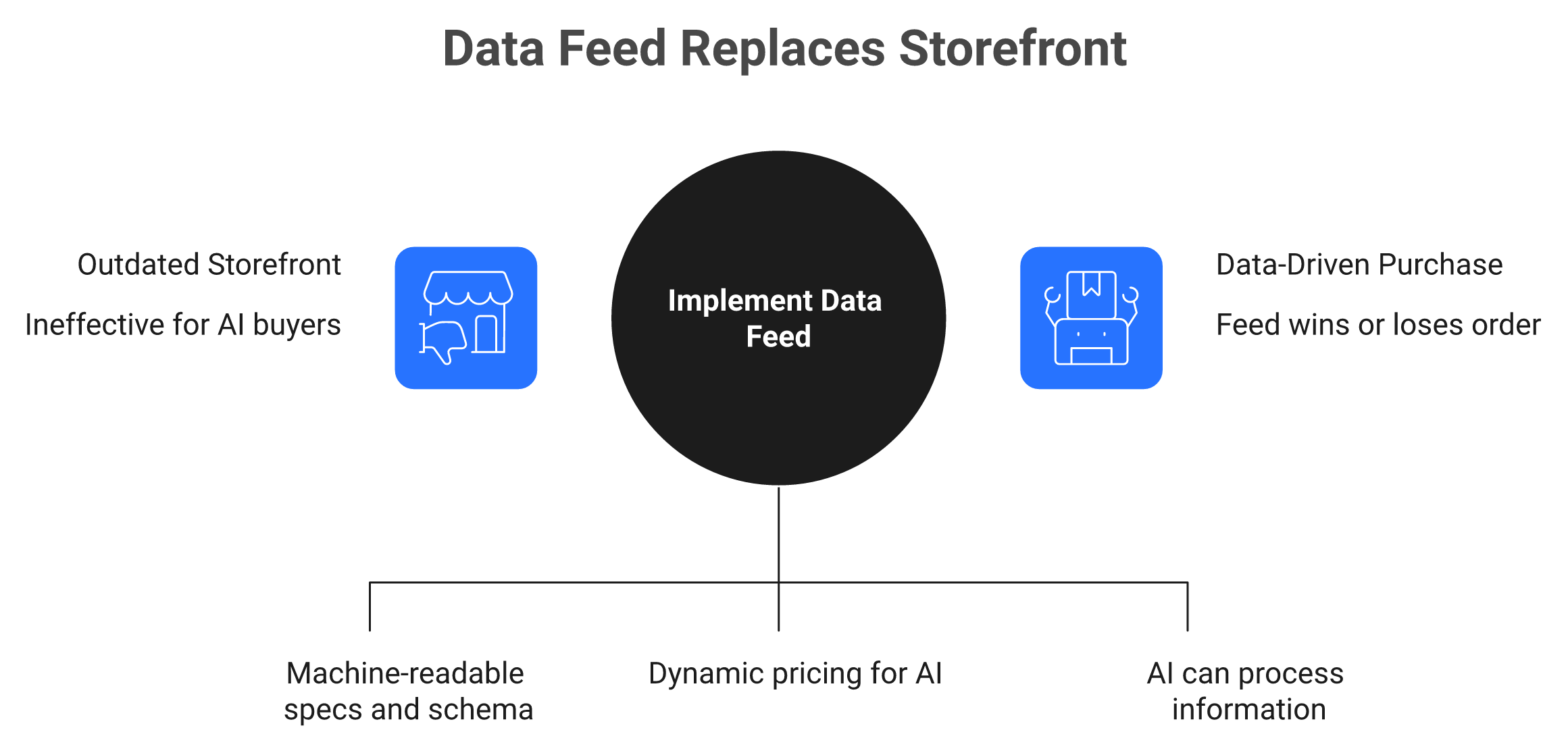
I think of this like a Ghost Kitchen. Your website is the dining room, all polish and branding. Agentic commerce is the kitchen, which is your data feed. The delivery driver, the AI, only needs the kitchen to fulfill the order. The customer never walks into the building.
✅ What Changes on Monday
The enablers are already named. Google's Universal Commerce Protocol (UCP), an open standard for agent-driven buying, is building a print-specific vertical. OpenAI's Agentic Commerce Protocol (ACP) already lets agents check out inside ChatGPT.
So the shift is simple to state, hard to accept. Stop treating your storefront as the front door. Start treating your product data feed as the thing that wins or loses the order, a reframe we unpack in our agentic commerce 101 hub.
We work on exactly this problem at MaximusLabs. GEO, Generative Engine Optimization, is not classic SEO. It is closer to a data science problem: knowing how these retrieval systems pick sources, then engineering your data and brand authority so agents can find, trust, and cite you across ChatGPT, Perplexity, Gemini, and Google AI Overviews.
Q2: Why Is the Print Industry Building an Agentic Standard Now, and Is the Shift Real?
The shift is real and already shipping. OpenAI's Agentic Commerce Protocol powers Instant Checkout in ChatGPT, and Google's Universal Commerce Protocol powers agentic buying across Search and Gemini. Print is racing to be the first industry with a dedicated UCP vertical, led by Initiative Online Print with Intergraf, BVDM, CIP4, and PRINTING United, targeting a Q4 2026 draft and early-2027 pilots. Whoever defines the standard defines who agents can transact with.
🛒 It Is Already Live Outside Print
Let me kill the "this is hype" objection first. In September 2025, OpenAI launched Instant Checkout in ChatGPT, letting people and agents buy from Etsy and Shopify merchants inside the chat. Stripe built the payment rails.
Then Google took it wider. Its Universal Commerce Protocol now drives agentic shopping across Search AI Mode and the Gemini app, with Cart, Catalog, and payment capabilities added through 2026. Real products. Real checkouts. Not a keynote demo. You can see how this reshapes buying in our state of agentic commerce 2026 report.
⏰ Agent-Ready or Interchangeable
Here is the tension for print. If agents pick suppliers, a shop that is not machine-readable becomes a commodity backend, swapped out on price alone.
The white paper's own framing is blunt: shops that do not become "agent-ready" risk being reduced to interchangeable suppliers. Or as I keep telling clients, the penalty for being average has never been so severe. When a machine chooses, "pretty good and well-known locally" stops counting.
Practitioners feel this coming. Balanced voices in the field are already sorting content into "safe" and "at risk."
"If a page merely provides a definition of 'what is X' or reiterates widely known advice, AI-generated overviews can easily fulfill much of that need. Pages that offer unique data, practical examples, trade-offs, pricing information, benchmarks, or a distinct perspective are more challenging to substitute."
Crescitaly, r/digital_marketing Reddit Thread
"Some websites experiencing a drop of 30 to 40% in their informational traffic without seeing any corresponding AI citations to compensate. It's crucial to ensure that your content is organized in a way that allows AI to effectively extract and reference it."
SuccessfulCoyote1800, r/digital_marketing Reddit Thread
🗓️ Why Print Is Moving First
Print is not waiting to react. It is trying to write the rules. A coalition led by Initiative Online Print, with Intergraf, BVDM, CIP4, the Ghent Workgroup, and North America's PRINTING United Alliance, is building a print vertical inside UCP.
The timeline is concrete: a draft spec aimed at Q4 2026, with pilot testing in early 2027, reusing existing CIP4/JDF product and proofing data. Whoever defines the standard defines who gets found.
So the practical move is not "wait and see." Track the working group, watch the quarterly windows, and start preparing your data now, because the pilots arrive faster than most retainers renew. Our generative engine optimization engagements exist to compress that prep window.
Q3: How Do AI Agents Actually Discover and Buy Print Products?
AI agents discover print products by reading structured data feeds, not by browsing websites. In OpenAI's Agentic Commerce Protocol, a product must pass an "is_eligible_search" boolean gate to appear, and merchants supply ranking inputs like popularity_score (0 to 5) and return_rate. The agent then completes checkout in-chat via a Shared Payment Token. If your specs sit behind JavaScript filters, the agent cannot read them, and cannot buy.
📄 Agents Read Feeds, Not Pages
Start with the mental model. A human clicks, scrolls, and squints at a product photo. An agent does none of that. It ingests a structured feed and reasons over fields.
That means your beautiful configurator is noise to a machine. The feed is the product. If a spec is not in the feed, it functionally does not exist for the agent, which is why our technical SEO and website audit starts at the feed layer.
🔌 The Fields That Decide If You Show Up
OpenAI's Agentic Commerce spec makes this concrete. A few fields act as hard gates and ranking levers:
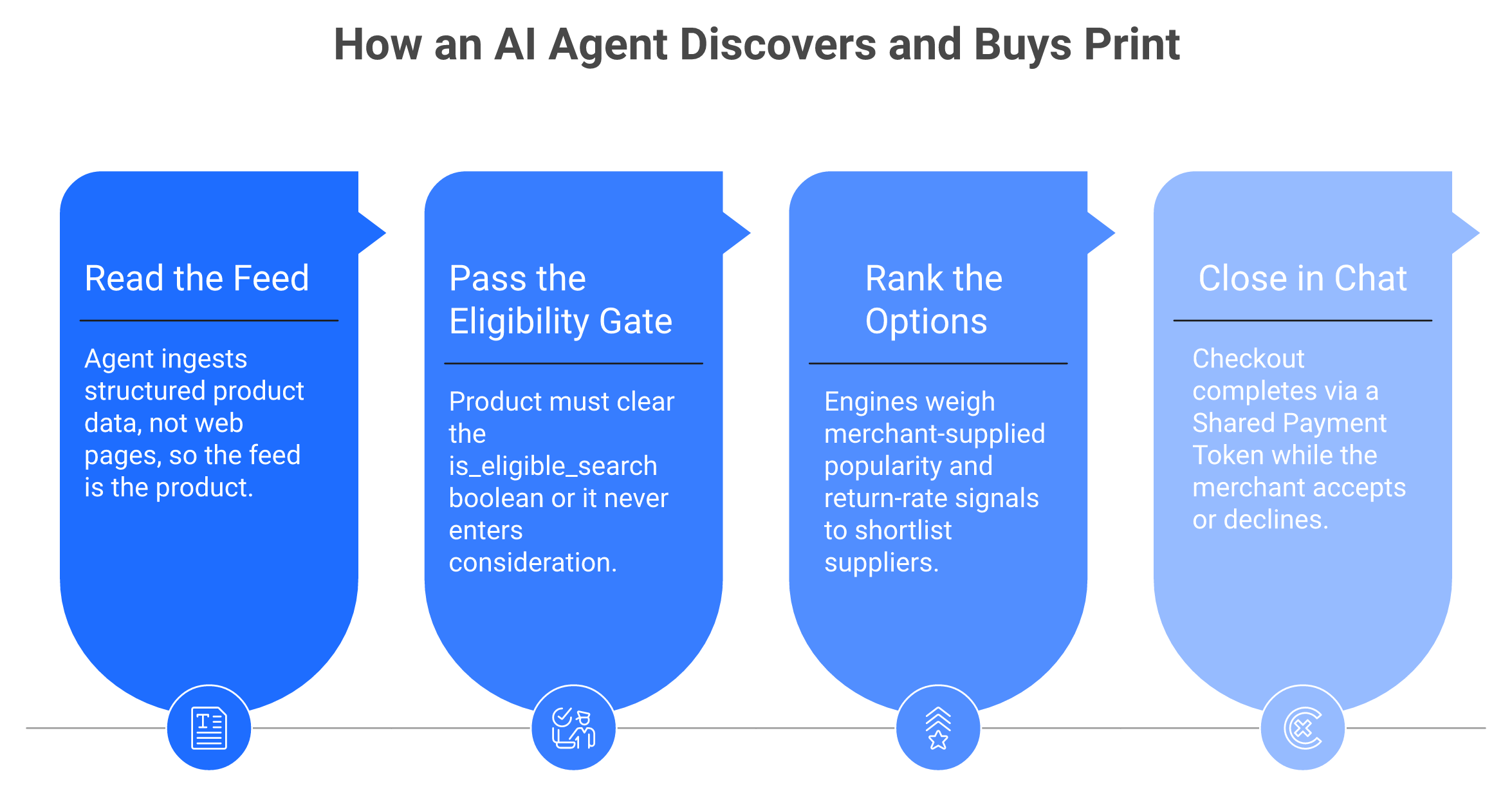
- is_eligible_search (boolean, true/false): the eligibility gate. If this is false, your product never enters the agent's consideration.
- popularity_score (0 to 5): a merchant-supplied signal engines can use to surface high-performing items.
- return_rate (0 to 100%): a merchant-supplied performance input that flags reliable products.
Payment closes the loop through a Shared Payment Token, a one-time credential the agent passes so the merchant can charge on their own stack. You still accept or decline the order. You just do it machine-to-machine.
🏂 The Snowboard Pants Failure
Here is a real scene that proves the stakes. A builder tried to buy through an agent and hit a wall.
"I was in Gemini and I was like, 'Hey, I want to buy snowboard pants and I'd like you to do the checkout for me end to end.' And it didn't work. Just in a couple different loops." The intent was perfect. The merchant's storefront simply was not machine-legible, so the loop broke.
For print, this is the warning. A custom quote flow full of JavaScript filters is, to an agent, a dead end. Your storefront can be a technical liability, not an asset. Our Google AI and Gemini optimization work targets exactly these break points.
⚡ Speed Is a Feature
One more thing operators underestimate: agents work at inference speed. Grounding layers now run full pipelines around 164ms p95, roughly 2.5 times faster than the nearest alternative. Your data has to answer in that window.
We treat this as a machine-legibility audit at MaximusLabs. We check whether products even clear the feed-eligibility gate before touching messaging, the same discipline we run for AI-search visibility across engines through our answer engine optimization service.
Q4: UCP vs ACP: Which Agentic Commerce Path Should Print Merchants Prepare For?
Google's Universal Commerce Protocol (UCP) powers agentic shopping across Search AI Mode and the Gemini app, adding Cart, Catalog, Identity Linking, and the Agent Payments Protocol (AP2). OpenAI's Agentic Commerce Protocol (ACP) powers Instant Checkout inside ChatGPT via a Shared Payment Token, with the merchant accepting or declining and charging on their own stack. Print merchants should prepare a clean data feed for both, not bet on one.
🔀 Two Paths, One Underlying Need
There is a temptation to pick a side, to "go Google" or "go OpenAI." I think that is the wrong instinct.
Both protocols solve the same problem from different doors. Both need one thing from you: clean, structured, machine-readable product data. Bet on the data layer, and you are ready for whichever surface your buyer's agent happens to use, a principle detailed in our agentic web stack report.
| Dimension | Google UCP | OpenAI ACP |
|---|---|---|
| Primary surfaces | Search AI Mode, Gemini app | ChatGPT Instant Checkout |
| Payment primitive | Agent Payments Protocol (AP2) | Shared Payment Token |
| Merchant control | Catalog, Cart, Identity Linking | Merchant accepts/declines, charges on own stack |
| Discovery mechanism | Real-time Catalog (variants, inventory, pricing) | Feed eligibility via is_eligible_search |
| Co-developed with | Shopify, Target, others | Stripe |
| Print fit | Reuses catalog and variant logic well for SKUs | Strong for in-chat, high-intent single orders |
💡 Prepare for Both With One Feed
The payoff is freeing. You do not maintain two strategies. You maintain one clean feed and expose it to both ecosystems.
This reframes the budget question too. As one builder put it, "visibility is earned through the data, not through the ads. You may sell much more just if you optimize for the AI agents to discover your products." A tidy catalog can outperform a big ad spend when a machine is choosing, a shift we quantify in our zero-click search brand economy research.
That is the core of what we call Search Everywhere Optimization at MaximusLabs. We optimize the data and authority layer once, so a brand shows up wherever the agent looks, UCP, ACP, and whatever protocol lands next, instead of chasing a single platform's rules. If you want that groundwork mapped to pipeline, contact us.
Q5: Why Won't Ranking on Google Save Print Shops, and What Does "Become the Answer" Mean?
Ranking on Google will not save print shops because agents do not scroll ten blue links. They synthesize one answer and shortlist a handful of suppliers. UCP agents search the entire web for suitable suppliers without either side knowing the other's identity. If your brand is not in that shortlist, it is invisible. Generative Engine Optimization means becoming the answer agents cite and select, not the link a human might click.
📉 The Blue Link Is Losing Its Job
Here is the situation most print shops still underrate. The ten blue links are shrinking as an interface. AI Overviews answer the question on the page, so the click never happens.
Practitioners are watching it happen in their own dashboards. This is the same shift we map in our GEO vs traditional SEO breakdown.
"My informational content traffic dropped 30 to 40% since AI Overviews rolled out. Google's answering directly."
SuccessfulCoyote1800, r/digital_marketing Reddit Thread
That is zero-click search, where the search engine satisfies the query without sending a visit. Ranking number one for a click that no longer exists is a hollow win, which is why we track the zero-click search brand economy.
⚠️ The Outcome Is Binary Now
The deeper problem is not fewer clicks. It is selection. An agent building a print order picks a few suppliers and ignores the rest.
There is no page two in an AI answer. You are in the shortlist, or you do not exist to that buyer. The snippet is the new rank. Being "pretty visible on Google" does not translate when a machine names five vendors and stops.
Agencies are feeling the ground shift under their old playbook, and our answer engine optimization service exists for exactly this reordering.
"SEO tactics don't work the same way in AI search. The models care about clarity, structure, and trust signals, not keyword density."
u/emmanashawn, r/DigitalMarketing Reddit Thread
💰 Why the Answer Is Worth More Than the Rank
Now the proof. This traffic is not just different, it converts harder. Webflow measured a 6x higher conversion rate from LLM traffic than from Google search traffic, because conversational intent runs hot.
McKinsey frames agentic commerce as a structural remake of how buying happens, not a channel tweak. So the resolution is a budget shift. Move money from chasing rankings and ads toward citation-worthy data and real brand authority, the discipline behind our GEO strategy framework.
I hold a strong view here. It is not about hacking the algorithm. If you build a genuine brand in your space, AI has to recommend you, and you survive every update because you are the brand. That is exactly the binary outcome we engineer for at MaximusLabs, putting brands inside the AI shortlist instead of renting rankings that no longer pay through our GEO service.
Q6: How Can a Print Shop Become "Agent-Ready"? The Data-Feed Playbook
A print shop becomes agent-ready by making every specification machine-readable. Move paper weight, finish, and binding out of JavaScript filters into text headers and FAQs, implement Product and Offer schema, publish an llms.txt, build a clean catalog feed with real-time pricing and inventory, and map JDF workflows to UCP fields. Agents cannot click filters. If a spec is not in text, it does not exist to the machine.
🧱 Start With One Hard Truth
Agents cannot use your filters. That fancy dropdown for paper weight, finish, and binding is invisible to a machine that reads text and structured data. If a spec lives only inside JavaScript, it is gone.
So the whole playbook flows from one rule: make every important detail extractable as text or structured fields. Everything below serves that goal, and our technical SEO and website audit starts precisely here.
✅ The 6-Step Agent-Ready Checklist
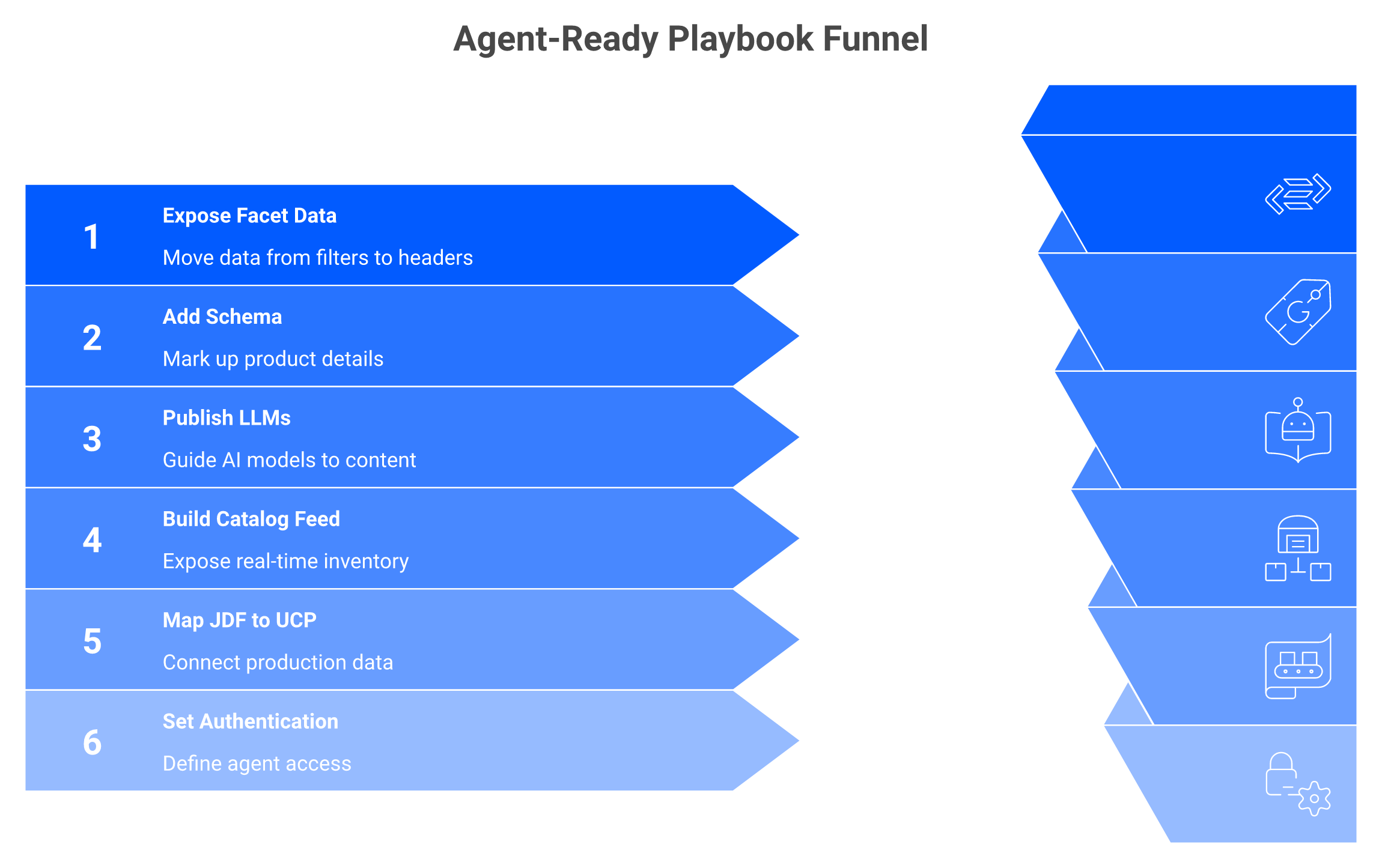
- Text-expose your facet data. Move closure, stock, GSM, finish, and binding into headers and FAQ copy. As one builder put it, expose the facet data because "a lot of the follow-up questions are best product with these attributes."
- Implement Product and Offer schema. Schema.org markup tells engines your price, variants, and availability in a format they trust. Our guide to schema markup basics walks through this.
- Publish an llms.txt file. This is a simple text file that guides AI models to your key content, the way OpenAI publishes one for its own commerce docs. You can generate one with our llms.txt generator.
- Build a clean catalog feed. Feed real-time variants, inventory, and pricing, the exact inputs Google's UCP Catalog retrieves.
- Map JDF specs to UCP fields. Your existing CIP4/JDF production data (the print industry's job-definition standard) already holds product breakdowns. Connect it to the protocol's fields.
- Set agent-authentication rules. Decide which agents can pull pricing and place orders before they start knocking.
🧠 The Universal Intent Decoder
Here is the payoff mental model. The agent acts as a Universal Intent Decoder, translating a messy human prompt into a structured request. "Heavy flyers that don't look cheap" becomes "high-GSM matte finish."
Your feed has to answer in that structured language. When it does, the feed fulfills orders for customers who never visit your building. You can check where you stand with our AI crawlability checker.
This is the unglamorous engineering we run at MaximusLabs. Our trust-first methodology builds the machine-legible authority layer agents require, not the page-speed vanity audits traditional agencies still sell as "technical SEO," and it anchors our agentic commerce service.
Q7: How Do You Model Agentic Demand When There's No Bot-Query Volume Data?
You model agentic demand by converting existing SEO keywords into the natural-language questions agents ask. Take your bottom-of-funnel keywords, paste them into ChatGPT, and ask it to rewrite them as buyer questions. That is directionally accurate when no official bot-query truth set exists. Then map each question to the buyer journey, answering what clients ask before and after purchase, so your feed and content pre-empt the agent's follow-ups.
🔎 The Keyword-to-Question Hack
There is no Google Ads API for bot queries. No clean "truth set," meaning no verified volume data for what agents actually ask. So you build a proxy.
Take your bottom-of-funnel keywords, the ones tied to buying, like "500 gsm business cards." Paste them into ChatGPT and ask it to rewrite each as a natural buyer question. This is "directionally accurate," a solid stand-in until real data exists, and our query fan-out generator speeds it up.
🗺️ Map Questions to the Real Journey
A keyword list is not a demand model. The value comes from mapping each question to the buyer's journey, before, during, and after the order. Our research on the B2B SaaS buyer journey in AI search shows how this plays out.
This is manual labor, and it should be. I once used an intent-gap agent on an outline and it surfaced the real blocker: the number one pain point was how to get client permission and buy-in for a custom job. Generic keyword tools never find that. It lives in sales calls and support tickets.
💡 Build the Question Inventory
The payoff is one asset that feeds two systems. Your question inventory shapes both your content and your product data feed, the core of our AEO keyword and question research.
The discipline mirrors how we grow revenue at MaximusLabs. We map the top bottom-of-funnel questions a buyer asks, then make sure the brand answers them consistently, because that is the layer that moves pipeline, not TOFU traffic. It is slow, human work. That is exactly why most automated outlines miss it, and why our content marketing service keeps a human in the loop.
Q8: What Are the Trust and Security Risks of Letting Agents Buy Print?
Letting autonomous agents transact introduces new risks: unverified agents accessing pricing, spoofed orders, and MFP or workflow exposure. Trust becomes a selection criterion. Agents favor merchants with clean, verifiable data, documented authentication, and strong E-E-A-T signals. Print shops should define agent-authentication rules, protect production devices from autonomous access, and publish transparent fulfillment data so an agent can trust, with near-certainty, that a custom order will be delivered.
🔐 Agents Now Touch Your Systems
Here is the new situation. Agents do not just read your site. They pull live pricing, place orders, and interact with connected devices.
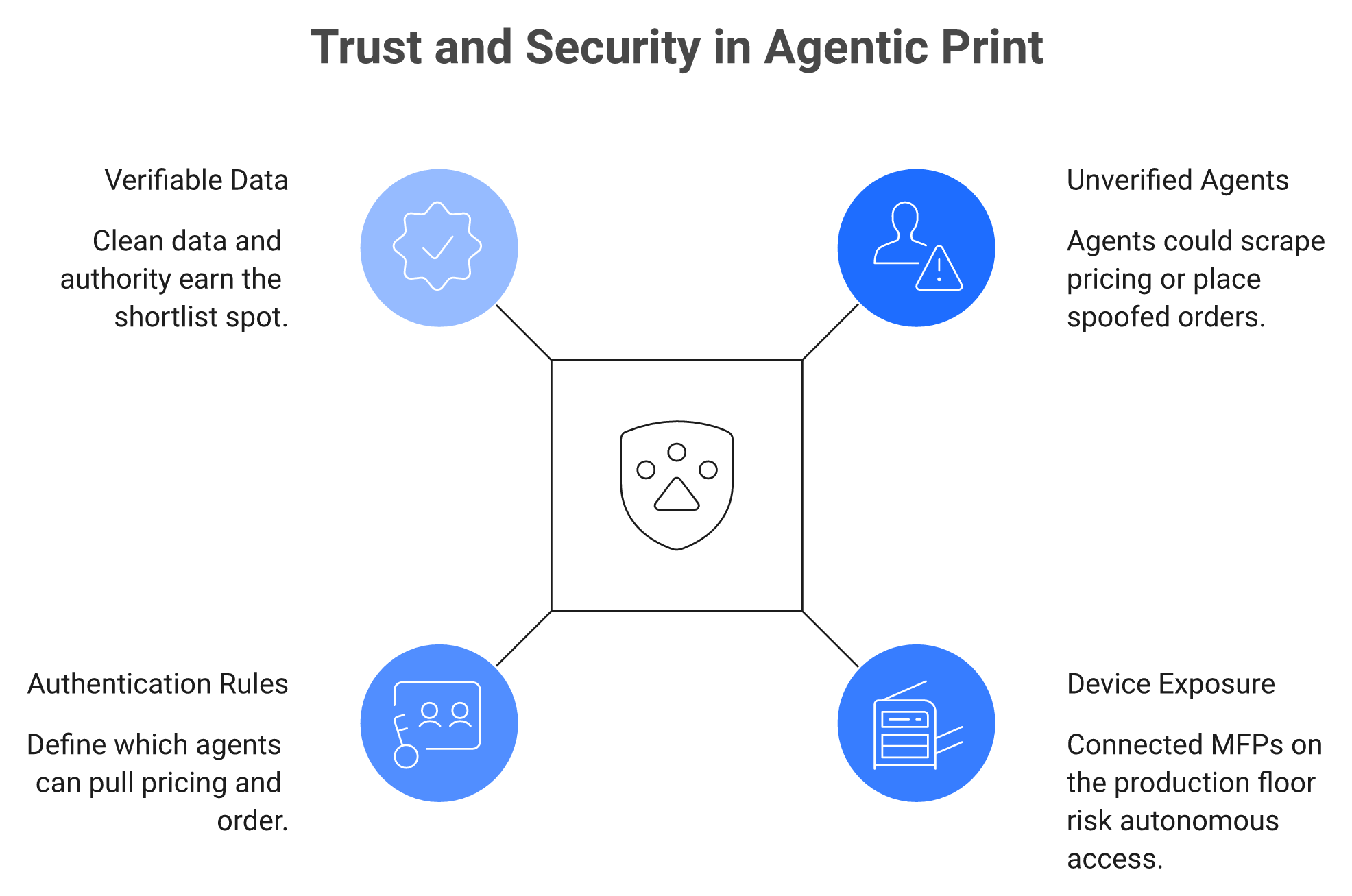
That is convenient and risky. An unverified agent could scrape pricing, spoof an order, or reach a multifunction printer (MFP), the networked print-and-scan device that sits on your production floor.
⚠️ Trust Is a Ranking Signal
The complication runs deeper than security. Trust itself decides whether the agent picks you.
Quocirca has openly questioned whether print vendors are ready and whether MFPs are protected from autonomous-agent risk. Agents lean on E-E-A-T (Experience, Expertise, Authoritativeness, Trustworthiness) as selection criteria. Clean, verifiable data is what earns you a spot, a principle we detail in our guide to E-E-A-T for AEO.
Practitioners already see this reordering the priorities.
"The models care about clarity, structure, and trust signals, not keyword density."
u/emmanashawn, r/DigitalMarketing Reddit Thread
"AI search seems to need another layer: content that is easy to extract, summarize, and trust."
u/Silent-Attitude-4085, r/content_marketing Reddit Thread
✅ Build the Trust Posture
The resolution is deliberate, not defensive. Set agent-authentication rules that decide who can pull pricing and order. Wall off production devices from open agent access. Google's Agent Payments Protocol (AP2) exists to make agent transactions verifiable.
Then publish transparent fulfillment data so an agent knows, with near-certainty, that you can deliver a custom print run. I will hedge one thing: the security standards here are still young, and I expect them to tighten fast. But the principle is durable. I refuse to build authority on mass-automated content, because that shortcut always collapses under a trust reset, exactly as scraped content did years ago.
This is why our trust-first methodology at MaximusLabs leads with verifiable data and real authority. That is what makes an AI engine confident enough to recommend you when a customer's money is on the line, and it is the foundation of our generative engine optimization work.
Q9: What Should Print Shops Do This Quarter to Prepare? The 2026-2027 Roadmap
This quarter, audit your product data for machine-legibility and expose specs as text. By Q4 2026, implement Product and Offer schema, publish an llms.txt, and build a clean catalog feed as the UCP print draft is submitted. In early 2027, join or shadow the pilot, test an agentic checkout end-to-end, and fix the loop failures. The window to be first is open now, and closing.
🗺️ Prioritize the Feeds That Actually Pay
Before you touch anything, resist the urge to fix your whole catalog at once. Most of it does not matter for revenue.
Here is the pattern I trust. Roughly 19 out of 20 landing pages drive about 85% of all your traffic. The same skew hits product feeds. A handful of your bottom-of-funnel products, the high-margin, high-volume jobs, will win or lose most agentic orders. Start there, using the prioritization logic behind our GEO strategy framework.
⏰ The Quarter-by-Quarter Plan
The standard is on a real clock. A print vertical draft targets Q4 2026, with pilots in early 2027. Your prep should run just ahead of it, which is how we scope our agentic commerce service.
| Window | Milestone | Action | Owner |
|---|---|---|---|
| Now (Q3 2026) | Machine-legibility audit | Pull top BOFU specs out of JavaScript filters into text headers and FAQs | Web lead |
| Q4 2026 | Feed and schema build | Add Product/Offer schema, publish an llms.txt, build a clean catalog feed with live pricing and inventory | Web lead and ops |
| Q4 2026 | Standards tracking | Follow the UCP print draft submission, review Google's UCP onboarding docs | Strategy owner |
| Q1 to Q2 2027 | Pilot and stress-test | Join or shadow the pilot, run an agentic checkout end to end, log and fix every loop failure | Ops and web lead |
Each row is small on its own. Together, they move you from "invisible to agents" to "ready to transact" before the pilots lock in the early movers, the exact sequence our technical SEO and website audit and llms.txt generator support.
💰 Why First Movers Compound
Now the honest part. This is not a magic switch. Agentic visibility compounds with trust and clean data over time, so the shops that start feeding agents in 2026 build a head start that late movers cannot buy back in 2027. Our state of agentic commerce 2026 report tracks how fast that gap widens.
There is a cash logic here too. A tidy feed can out-earn a bloated ad budget, because a machine choosing a supplier does not care what you paid for placement. Your money is better spent making the feed correct than bidding against it, a point we quantify in our GEO budget benchmark 2026.
We run this exact sequence at MaximusLabs as a phased engagement. First a machine-legibility audit, then the feed and schema build, then agentic-visibility measurement tied to pipeline, not pageviews. That last step matters, because a roadmap you cannot measure against revenue is just a wish list, which is why our GEO measurement and metrics work anchors every project.
🔮 What I Am Sitting With
I will end with a question I do not have a clean answer to yet. When agents become the default print buyer, does brand still matter, or does the feed eat everything?
My current bet is that brand matters more, not less. A clean feed gets you into the evaluation set, but trust and authority decide which of the five finalists the agent actually picks, the thesis behind our generative engine optimization service. I might be wrong on the timeline. I am not wrong that the shops treating this as a 2027 problem are already behind.
If you are trying to make your print business impossible for an agent to skip, that is the conversation I want to have. Reach me through our contact page, and you will leave with clarity, not jargon.
Frequently asked questions
What is agentic commerce in the print industry?
Agentic commerce in the print industry, often called Agentic Print , is the stage where AI agents, not humans, independently research, configure, order, and pay for print products. No person browses your storefront or clicks through a configurator. Instead, an agent reads a structured product data feed, compares specifications, and completes checkout on the buyer's behalf. That changes what your website is for. The storefront stops being the front door. The data feed becomes the front door. If a spec is not machine-readable, it does not exist to the agent. We think of it like a ghost kitchen: your website is the dining room, but the agent only needs the kitchen, which is your feed, to fulfill the order. We help print businesses treat this as a data and authority problem through our agentic commerce service , so shops become findable and processable by agents before anyone visits the site.
Is agentic commerce in printing real, or is it just hype?
It is real and already shipping, though the print-specific standard is still being drafted. The underlying technology is live outside print today. OpenAI's Agentic Commerce Protocol powers Instant Checkout inside ChatGPT. Google's Universal Commerce Protocol powers agentic buying across Search and the Gemini app. Print is racing to build the first dedicated industry vertical on top of these rails. A coalition led by Initiative Online Print, with Intergraf, BVDM, CIP4, and PRINTING United, is targeting a draft specification around Q4 2026 and pilot testing in early 2027. That timeline signals legitimacy, not vaporware. Our honest view: agentic visibility compounds with clean data and trust over time, so this is not a magic switch. The shops preparing feeds now build a lead that late movers cannot easily buy back. We track how fast this is moving in our state of agentic commerce 2026 report , which helps print leaders separate signal from noise.
How do AI agents actually discover and buy print products?
AI agents discover print products by reading structured data feeds, not by browsing websites. The mechanics are concrete and specific. A product must pass an eligibility gate (for example, an is_eligible_search boolean) to appear at all. Merchants supply ranking inputs like a popularity score and a return rate. Checkout completes in-chat through a shared payment token, with the merchant accepting or declining and charging on their own stack. The failure point is predictable. If your paper weight, finish, and binding sit behind JavaScript filters, the agent cannot read them and cannot buy. We have seen agent checkouts break in exactly these loops when a storefront is not machine-legible. That is why we run a machine-legibility audit as part of our technical SEO and website audit , checking whether products even clear the feed-eligibility gate before touching messaging, because the feed is the product to an agent.
UCP vs ACP: which agentic commerce path should print merchants prepare for?
Print merchants should prepare for both, not bet on one, because both protocols need the same thing from you: a clean, structured, machine-readable feed. Google's Universal Commerce Protocol (UCP) powers agentic shopping across Search AI Mode and the Gemini app, adding Cart, Catalog, Identity Linking, and the Agent Payments Protocol. OpenAI's Agentic Commerce Protocol (ACP) powers Instant Checkout inside ChatGPT via a shared payment token, with the merchant charging on their own stack. Picking a single protocol is the wrong instinct. The surfaces differ, but the data layer underneath is shared, so one clean feed serves every agent. This is the core of what we call Search Everywhere Optimization. We optimize the data and authority layer once so a brand shows up wherever the agent looks, across UCP, ACP, and whatever protocol lands next, which is central to our GEO service for print and B2B brands.
Why won't ranking on Google save print shops in the AI-commerce era?
Ranking on Google will not save print shops because agents do not scroll ten blue links. They synthesize one answer and shortlist a handful of suppliers. There is no page two in an AI answer; you are in the shortlist or you are invisible. Zero-click search means the engine often answers without sending a visit. Conversational, agent-driven traffic tends to convert harder than passive search clicks. The goal shifts from ranking a link to becoming the cited answer an agent selects. We call this the binary outcome: top-cited brands win, and everyone else disappears from that buyer's decision. Our strong view is that this is not about hacking an algorithm. If you build a genuine brand and authority in your space, AI has to recommend you, and you survive updates because you are the brand. We engineer brands into that shortlist through our answer engine optimization work rather than chasing rankings that no longer convert.
How can a print shop become agent-ready?
A print shop becomes agent-ready by making every specification machine-readable, because agents cannot click filters. If a spec is not in text or structured data, it does not exist to the machine. Move paper weight, finish, and binding out of JavaScript filters into text headers and FAQs. Implement Product and Offer schema so engines trust your price, variants, and availability. Publish an llms.txt file to guide AI models to your key content. Build a clean catalog feed with real-time pricing and inventory. Map your existing CIP4 or JDF production data to the protocol's fields. Set agent-authentication rules before agents start knocking. The mental model that helps is treating the agent as a universal intent decoder that turns "heavy flyers that don't look cheap" into "high-GSM matte finish." Your feed has to answer in that structured language. This feed and extractability engineering is the backbone of our generative engine optimization methodology.
What are the trust and security risks of letting agents buy print?
Letting autonomous agents transact introduces new risks, and trust itself becomes a selection criterion that decides whether an agent picks you. Unverified agents could access pricing or place spoofed orders. Connected production devices, like networked multifunction printers, may be exposed to autonomous access. Agents favor merchants with clean, verifiable data and strong E-E-A-T signals. The resolution is deliberate, not defensive. Define agent-authentication rules, wall off production devices, and publish transparent fulfillment data so an agent can trust, with near-certainty, that a custom order will be delivered. Standards here are still young, and we expect them to tighten quickly. We refuse to build authority on mass-automated content, because that shortcut collapses under a trust reset. Our trust-first methodology leads with verifiable data and real authority, which is what makes an AI engine confident enough to recommend you. That is the foundation of our E-E-A-T for AEO approach.