 Krishna Kaanth M
- AI agents for SEO are LLM systems that use tools in a loop to research, decide, and act, with humans approving anything that ships.
- Most agent setups fail because they automate a mediocre workflow, turning B-minus work into cheaper C-plus output that loses rankings and citations.
- Start with one repeatable task, write the SOP first, connect live data, add a human gate, and measure citations and pipeline.
- A four-agent pipeline (Analyst, Researcher, Writer, Editor) works best with a second-model fact check and a human quality score before publishing.
- Win AI answers with per-engine tracking and evidence agents, keep sites readable for non-JavaScript crawlers, and cap research depth to protect accuracy.
- Judge agents on pipeline, not hours saved, using citation share, AI-referred visit quality, and revenue from agent-touched pages.
Q1: What are AI agents for SEO, and why does AI search make them necessary?
AI agents for SEO are large language model (LLM) systems that perceive data, make decisions, and take actions toward a goal by using tools in a loop. Gartner defines AI agents as autonomous or semiautonomous software that perceives, decides, and acts toward goals. They matter now because a top ranking no longer guarantees clicks. Ahrefs found that AI Overviews reduce the click-through rate of the position-one result by 58%. An SEO tool reports a ranking change. An agent checks how ChatGPT, Perplexity, and Gemini cite a brand, then drafts fixes for human approval.
From Dashboards to Decisions
📉 The report that stopped explaining revenue
A Head of Organic Growth opens the monthly SEO report. Rankings are up, and the line on the traffic chart is still falling. The board wants to know why pipeline from search went flat.
That gap is the reason agents entered SEO. Ahrefs puts it bluntly: for every 100 clicks a top page once earned, Google now keeps 58. Buyers get one AI answer with a handful of brands inside it. Your brand is either in that answer or missing from it.
🧩 Prompts, workflows, and agents are not the same thing
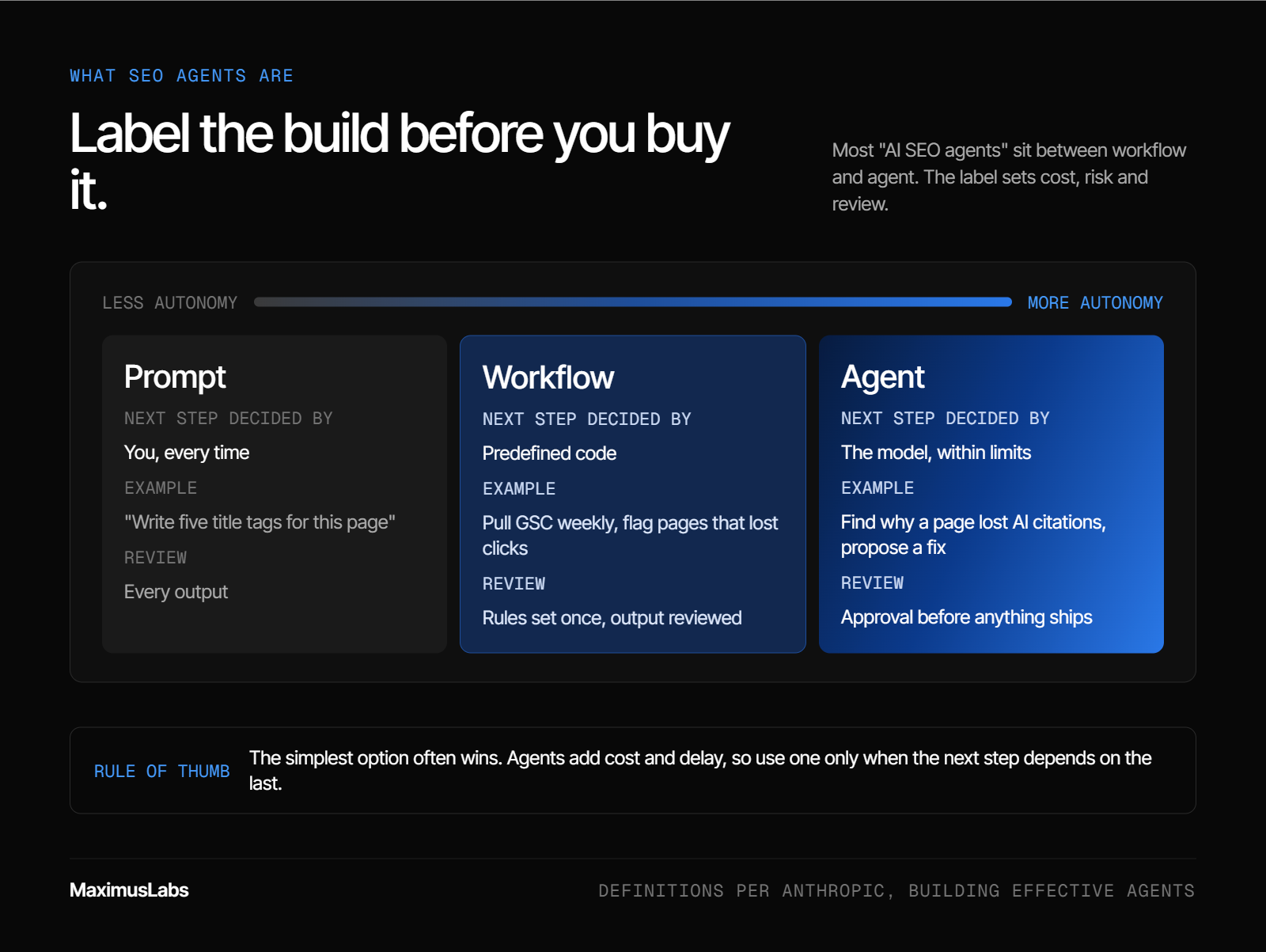
Anthropic draws the clearest line. Workflows run LLMs and tools along predefined code paths. Agents direct their own steps and decide which tool to use next. Most products sold as "AI SEO agents" sit somewhere in between.
| Level | Who decides the next step | SEO example | Human oversight |
|---|---|---|---|
| Prompt | You, every time | "Write five title tags for this page" | Every output |
| Workflow | Predefined code | Pull GSC data weekly, flag pages that lost clicks | Rules set once, output reviewed |
| Agent | The model, within limits | Investigate why a page lost AI citations, then propose a fix | Approval before anything ships |
Why the Label Gets Overused
⚠️ Name the build before you buy it
Anthropic also warns that the simplest solution often wins and that agents add cost and delay. A weekly content-decay report does not need autonomy. A workflow is cheaper, faster, and easier to audit.
MaximusLabs AI's read is that SEO is now the floor. Generative Engine Optimization (GEO, getting cited inside AI answers) is the building on top. I treat agents as the way to run both layers at once. Google itself says its AI features rely on existing SEO fundamentals, such as crawlable pages and helpful content. So the agent's first job is not new tricks. It is watching both surfaces with the same discipline.
🎯 What changes on Monday
Before your team builds anything, label each task as a prompt, a workflow, or an agent. That one label sets cost, risk, and how much review the output needs.
MaximusLabs AI runs Answer Engine Optimization (AEO, earning a brand's place in AI-generated answers) with SEO underneath, as strategy and execution in one team. Its per-client intelligence graphs are AI agents that research each market and reason over the client's own context. Humans approve everything that ships, and every engagement is measured on pipeline, not on mentions.
Q2: Why do most AI SEO agent setups fail?
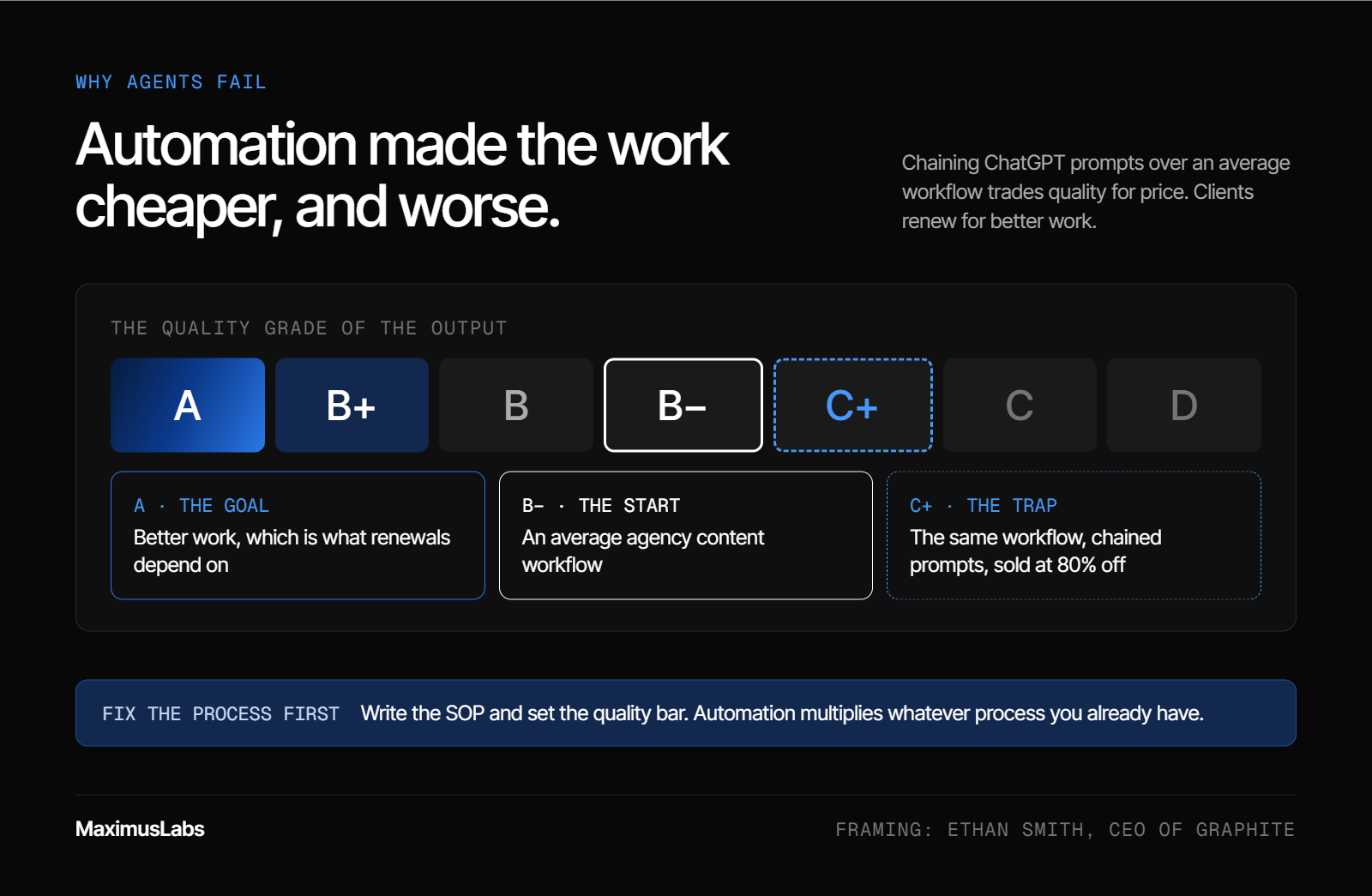
Most AI SEO agent setups fail because they automate a mediocre workflow instead of improving it. Graphite CEO Ethan Smith describes agencies chaining ChatGPT queries to turn B-minus work into C-plus work at 80% off. Clients renew for better results, not cheaper output. Google's spam policy on scaled content abuse covers pages produced mainly to manipulate rankings, whatever tool made them. Volume without quality turns into lost visibility in Google and in AI answers.
The Promise That Sells the Subscription
💸 Situation: more pages, same pipeline
A founder signs up for an agent that promises a blog post every day. Three months later, the site has 90 new pages and the same number of demo requests. One r/SaaS post described exactly this: a $1,500 monthly agent bill, no rankings, and no leads.
The agent did what it was built to do. It produced volume. Nobody had defined what "better" meant before the automation started. Nobody had tied a single page to a buyer question, a competitor gap, or a sales conversation.
❌ Complication: the C-plus trap
Ethan Smith's critique is the sharpest version of the problem. Chaining prompts takes B-minus work, makes it C-plus, and sells it at 80% off. Smith says the interesting goal is better work, because renewals depend on it.
Graphite's own testing points the same way. In Smith's account, purely AI-generated content underperformed, while AI drafts that humans edited ranked higher the more they were edited. Google adds a hard limit. Since May 15, 2026, its spam policies explicitly apply to generative AI responses in Search, including AI Overviews and AI Mode.
What Practitioners Say Broke
💬 Voices from the threads
"This was an execution failure, not a technology failure."
u/SnooPeanuts1152, r/SaaS Reddit Thread
"I don't think the issue is 'AI for SEO' itself, but the promise of fully autonomous SEO."
u/RidgeLineDev, r/SaaS Reddit Thread
"You can't automate trust."
u/Capital-Pen1219, r/SaaS Reddit Thread
Fix the Process Before You Scale It
✅ Resolution: define "better" first
MaximusLabs AI's position is simple: automation multiplies whatever process you already have. If the process is unsound, the agent scales the damage. I would rather run one excellent workflow by hand for a month than automate a weak one in a week.
Write the process down before any agent touches it. Then set the quality bar, such as a sourced statistic in every section and a human edit before publishing. Only then decide what to automate.
⏰ The test to run this week
Pick your last ten agent-produced pages. Ask how many earned an AI citation, a backlink, or a demo request in the last quarter. If the answer is close to zero, the workflow needs fixing before the agent needs scaling.
MaximusLabs AI measures every engagement on pipeline, not on mentions or page counts. AI handles research aggregation and first drafts, while humans own positioning, voice, and accuracy. That split produced a "64% AI citation rate in 6 months, vs ~30% for billion-dollar incumbents (Oliv AI)." No unreviewed volume was needed.
Q3: How do you deploy your first SEO agent, step by step?
Deploy a first SEO agent in six steps. Pick one repeatable task with a clear success condition. Document the process as a standard operating procedure (SOP). Choose a workflow or a true agent. Connect data sources such as Google Search Console, SERP APIs, and AI prompt sets. Add a human review gate. Measure citations and pipeline. A practical first task is tracking AI citations for bottom-of-funnel (BOFU) buyer prompts.
Six Steps, in Order
🎯 Step 1: Pick one task with a clear finish line
Semrush's build guide starts here: choose one clearly defined, repeatable SEO task. Start where errors are cheap to catch. Keep anything that touches brand trust behind a human.
| Bucket | Example tasks | Rule |
|---|---|---|
| Agent-safe | Keyword trend monitoring, SERP extraction, AI citation logging | Automate fully |
| Agent-assisted | Content-gap analysis, internal-link suggestions, schema drafts | Agent drafts, human approves |
| Human-only | Positioning, original research, outreach, final edits | Keep manual |
MaximusLabs AI's read is to start at the bottom of the funnel. AI engines already answer "What is X?" queries well, so top-of-funnel volume rarely moves pipeline.
📋 Step 2: Write the SOP before the prompt
Semrush advises listing the data sources, rules, filters, and exceptions you already use. That document becomes the agent's operating instructions. If you cannot write the process down, the agent cannot follow it.
🧭 Step 3: Choose a workflow or an agent
Use a workflow when the steps never change. Use an agent only when the next step depends on what the last step found.
🔌 Step 4: Connect the data
Eric Enge describes an assistant that pulls fresh trend keywords from an API every morning, then feeds them into prompts for content ideas. Your agent needs the same live inputs: Search Console, a SERP API, and a fixed set of buyer prompts run across AI engines.
✅ Step 5: Add the human gate
Enge's rule is that data gathering can run unattended, while publishing needs human review. Put the approval step in the workflow itself, not in a reminder.
💰 Step 6: Measure what the business pays for
Track citation share for your BOFU prompts and the pipeline from pages the agent touched. Hours saved is a cost metric, not a growth metric. Review both numbers monthly before you add a second agent.
What Practitioners Automate First
💬 Notes from people running it
"Content gap analysis and internal linking suggestions are where AI genuinely saves time in SEO workflows."
u/erickrealz, r/seogrowth Reddit Thread
"I believe SEO is a perfect use case for AI Agent. The workflow is fairly well defined."
u/billyisred, r/seogrowth Reddit Thread
"AI agents are useless unless they are mapped to specific entity-based internal link silos."
u/GrowthStackLabs, r/seogrowth Reddit Thread
MaximusLabs AI runs daily AI-visibility tracking across every major engine, re-run and regression-tested. That citation data becomes the input for every later agent, from content refreshes to source outreach. Starting there ties the first build to pipeline instead of page count.
Q4: How do you build a multi-agent SEO content pipeline?
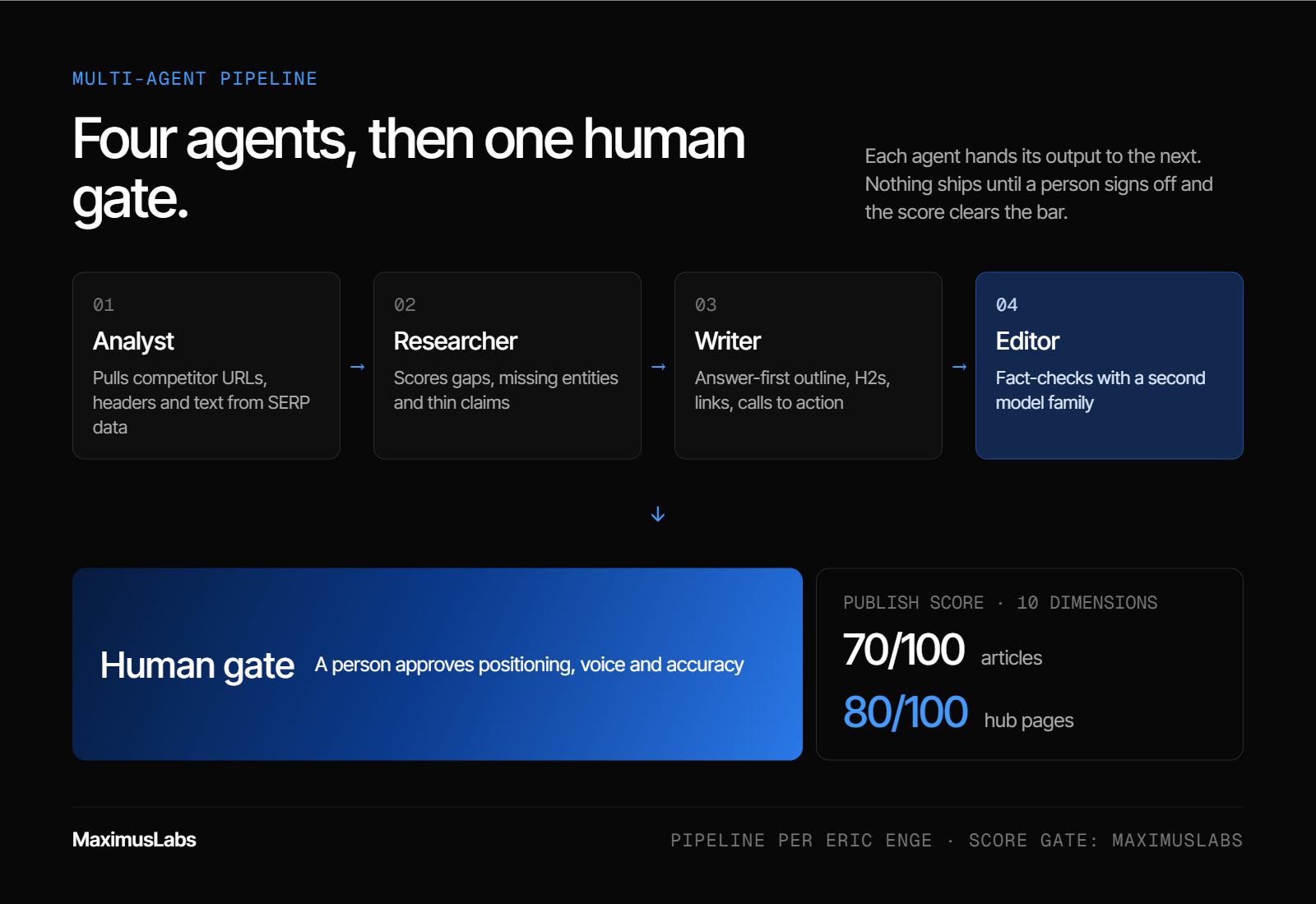
A multi-agent SEO content pipeline uses four roles. An Analyst agent pulls competitor pages from SERP APIs. A Researcher agent scores content gaps and entity coverage. A Writer agent drafts answer-first outlines. An Editor agent fact-checks with a second model before a human approves. MaximusLabs AI runs a comparable three-stage pipeline of research, writing, and QA. Every draft is scored on 10 dimensions and needs 70 out of 100 to publish.
The Architecture at a Glance
🏗️ Four agents, one human gate
Eric Enge lays out this assembly line in his work on generative AI for SEO. Each agent passes its output to the next, and a human signs off at the end.
| Agent | Input | Output | Hands off to |
|---|---|---|---|
| Analyst | Target keywords, SERP API or Semrush and Ahrefs data | Top competitor URLs, titles, headers, body text | Researcher |
| Researcher | Competitor text plus your draft | Gap list and section-quality scores | Writer |
| Writer | Gap list, SOP, brand voice notes | Outline, H2s and H3s, internal links, calls to action | Editor |
| Editor | Draft | Fact-check log, tone flags, error list | Human reviewer |
How Each Role Works
🔍 Analyst and Researcher: map the field
The Analyst extracts what already ranks and what AI engines already cite. The Researcher compares that set against your page and scores each section for missing entities and thin claims.
MaximusLabs AI folds both jobs into its first stage, Deep Research. That stage covers SERP analysis, primary sources such as papers and official docs, semantic gaps, and a draft direct answer.
✍️ Writer: answer first, voice second
The Writer drafts headings as real buyer questions. In MaximusLabs AI's standard, a 40-to-80-word answer sits directly under each H2, written to stand alone if an AI engine extracts it.
The founder's voice is captured before drafting, not patched in afterward. MaximusLabs AI sits with the leadership team first, then writes their market view into every draft.
🛡️ Editor: use a second model to check the first
Enge recommends checking tone with a different model, such as using Claude to review ChatGPT output. Models from different families catch different errors. The Editor then routes everything to a human reviewer before publishing.
What Teams Running This Say
💬 Where the human still matters
"I think the market is real, but I also think a lot of people are packaging workflow automation"
u/Low_Confection_2433, r/seogrowth Reddit Thread
"Looks interesting. Does it still need a human calling the shots on actual content quality?"
u/MightyPants978, r/AI_Agents Reddit Thread
The answer to that second question is yes. In MaximusLabs AI's pipeline, I treat the human gate as a design choice, not a bottleneck. It is the step that keeps automation from sliding from B-minus to C-plus.
⭐ The scorecard that decides what ships
MaximusLabs AI scores every draft on 10 dimensions. They include structure, E-E-A-T (experience, expertise, authoritativeness, and trust), factual density, and citation-worthiness. Drafts need 70 out of 100 to publish, and hub pages need 80. That gate is how the pipeline scales output without lowering the quality bar that buyers and AI engines both reward.
Q5: How do you use agents to become the answer in ChatGPT, Perplexity and Gemini?
Use two agents per engine. A tracking agent runs your ideal customer profile's (ICP's) buyer prompts in ChatGPT, Perplexity, Gemini, and Google AI Overviews. It logs which brands and URLs each answer cites. An evidence agent adds sourced statistics, quotations, and citations to your pages. Princeton's GEO study found those three tactics lifted visibility in generative answers by 30% to 40%. MaximusLabs AI used per-engine source mapping to reach a "64% AI citation rate in 6 months, vs ~30% for billion-dollar incumbents (Oliv AI)."
Rank Tracking Misses the Answer
📊 Why position one is the wrong scoreboard
A VP Marketing checks the rank tracker every Monday, and the BOFU pages hold the top three spots. Then sales hears a prospect say, "ChatGPT recommended your competitor." The rank tracker never saw that conversation.
AI answers carry a few brands, not ten blue links. The useful metric is citation share: how often your brand appears across a fixed set of buyer prompts. Google says its own AI features run on core SEO, but that guidance covers Google only.
🔁 Agent one: the prompt-set tracker
Build a list of 50 to 200 prompts your buyers actually ask, such as "best AI sales forecasting tool for a 20-person team." Run them on a schedule in each engine. Log the brands named, the URLs cited, and the sentiment of each mention.
MaximusLabs AI runs this as daily AI-visibility tracking across every major engine, re-run and regression-tested. Regression testing matters because answers shift between runs, so a single snapshot can mislead.
Each Engine Cites Differently
🧠 One agent per engine, not one for "AI"
MaximusLabs AI's read is that GEO is a data science problem. What ChatGPT rewards is not exactly what Google or Perplexity rewards. The table shows MaximusLabs AI's own working model of each engine.
| Engine | What it tends to favor (MaximusLabs AI observation) | What the evidence agent adds |
|---|---|---|
| ChatGPT | Conversational Q&A, thorough coverage, expertise signals | Question-headed H2s, first-person expertise markers |
| Google AI Overviews | Answer-first structure, E-E-A-T signals | 40-to-80-word answer blocks, structured data |
| Perplexity | Recent sources, visible citations, readable prose | Dated references, numbered footnotes |
| Claude | Long-form depth, academic citations | Paper and documentation references, method notes |
📎 Agent two: the evidence injector
The Princeton team tested nine content changes on a benchmark of 10,000 queries. Adding statistics, quotations, and cited sources gave the biggest lifts. Keyword stuffing performed worst. Lower-ranked pages gained the most, which means challengers can win citations that incumbents already hold.
Point this agent at your BOFU pages first. Give it one rule: every new statistic must link to a primary source a human can verify.
Owned Pages Are Only Half the Job
🌐 Get into the sources engines already trust
AI engines also cite reviews, Reddit threads, press, and listicles. MaximusLabs AI calls this Earned AEO, alongside Owned AEO for your own pages. Its citation-intelligence engine maps which sources each engine trusts, then works to get the client into those sources.
MaximusLabs AI applied this to Oliv AI by mapping cited sources per engine and rebuilding pages for each engine's citation patterns. The result was a "64% AI citation rate in 6 months, vs ~30% for billion-dollar incumbents (Oliv AI)." That citation share fed pipeline: "27 qualified leads, $47K+ pipeline, 26% close rate in 4 months (Oliv AI)."
Q6: How do you keep agent output accurate and safe from Google penalties?
Google does not penalize content because AI wrote it. Google's scaled content abuse policy targets many pages made mainly to manipulate rankings, and since May 15, 2026, it covers AI Overviews and AI Mode. Accuracy is the second risk. A 2026 study found fact-check accuracy fell about 42% on average as research agents scaled from 2 to 150 tool calls. Cap research depth, check output with a second model, and require subject-matter expert (SME) sign-off before publishing.
The Threat: Volume That Looks Like Spam
⚠️ Situation: the policy already covers AI answers
A Marketing Manager sets an agent to publish 40 location and use-case pages in a week. Each page is unique on paper. To Google, the batch can look like scaled content abuse.
Google's spam policies now state that they apply to generative AI responses in Search. Google's generative AI guide adds a specific warning. Creating separate pages for every variation of a query, including "fan-out" sub-queries that AI Mode runs in the background, can violate the same policy.
❌ The fan-out trap
Query fan-out means an AI system splits one question into many related searches. Agents can see those sub-queries and write a page for each one. That pattern produces exactly the near-duplicate volume the policy describes.
The Trigger: Research That Goes Too Deep
📉 Complication: more searching, less accuracy
A May 2026 paper tested deep research agents at seven search depths. Links stayed valid and relevant, but facts got worse. GPT-5.4's fact-check accuracy fell from 78.6% at 2 tool calls to 16.7% at 150. Claude Opus 4.6 fell from 80.0% to 57.9%.
The sharpest GPT-5.4 drop came early, between 2 and 10 calls. More sources can overwhelm the model's ability to keep facts straight.
⏰ Set a research budget per task
Anthropic sizes effort to the task in its own Research system.
| Task type | Agents | Tool calls |
|---|---|---|
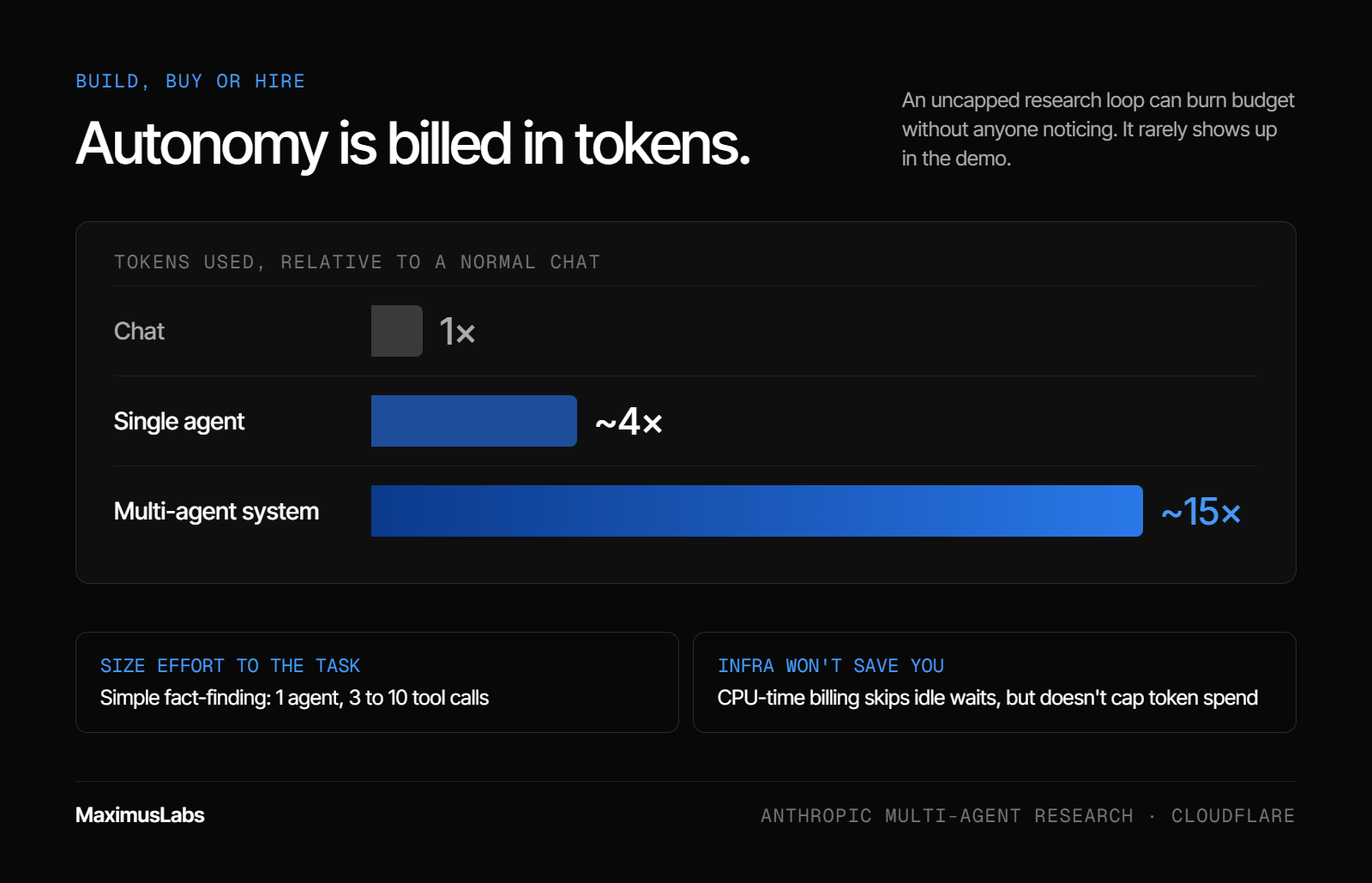
| Simple fact-finding | 1 agent | 3 to 10 |
| Direct comparison | 2 to 4 subagents | 10 to 15 each |
| Complex research | 10 or more subagents | Divided by clear responsibilities |
Anthropic also found that subagents wrote overly long, specific first queries that returned little. It fixed this by prompting agents to start broad, then narrow.
The Controls That Hold Up
✅ Resolution: three gates before publish
- Cross-model check: Eric Enge recommends using a different model family, such as Claude reviewing ChatGPT output, for tone and errors.
- Source check: every statistic links to a primary source that a human opens and confirms.
- SME sign-off: a named expert approves the page and owns its claims.
"Do: run AI-assisted SEO ops inside a system that forces quality."
u/Boring-Top-4409, r/SaaS Reddit Thread
"I still use AI, but i have a good guide and data angle to build high quality authoritative content."
u/recmend, r/SaaS Reddit Thread
"The part everyone glosses over is that Google is using AI to detect AI content faster than the generators can evolve."
u/ProgressSensitive826, r/AI_Agents Reddit Thread
MaximusLabs AI treats trust as something that compounds in both directions. One bad batch can erode years of brand equity. Humans approve everything that ships, and factual density is one of the 10 dimensions every draft is scored on before it can publish.
Q7: Can the AI agents visiting your site actually read and use it?
Many AI retrieval agents read raw HTML and do not run JavaScript. A December 2024 Vercel and MERJ analysis found that none of the major AI crawlers, including OAI-SearchBot, GPTBot, and ClaudeBot, rendered JavaScript. Client-side React or Vue pages can look empty to them. Server-render key content, allow OAI-SearchBot in robots.txt, and keep site search and checkout usable. MaximusLabs AI's Oliv AI engagement began by unblocking AI crawlers and auditing site architecture before any content work.
The Invisible Site Problem
🕳️ Situation: page one on Google, absent from ChatGPT
A Head of GTM sees the pricing page rank on Google, yet ChatGPT never cites it. The page looks perfect in a browser. The problem only shows up when you look at what a crawler receives.
Google renders JavaScript before indexing. The major AI crawlers in Vercel's data did not. If your pricing table, feature list, or proof points load through client-side scripts, those crawlers get an empty shell.
🔍 What the crawler actually sees
| What a human sees | What a non-JavaScript crawler receives |
|---|---|
| Headline, pricing table, customer logos | An empty root container and script tags |
| FAQ answers and comparison tables | Nothing, if they load after page render |
| Server-rendered version of the same page | The full text, ready to cite |
Crawler Access Is a Business Decision
🤖 Complication: three OpenAI bots, three jobs
OpenAI documents separate crawlers. OAI-SearchBot surfaces sites in ChatGPT search, and OpenAI recommends allowing it. GPTBot crawls for model training and can be blocked separately. ChatGPT-User fetches pages when a person asks, and robots.txt rules may not apply to it.
OpenAI notes that search-related robots.txt changes can take about 24 hours to take effect. Many sites block every AI bot by default through a CDN rule. That one setting can remove a brand from ChatGPT search entirely. Check the CDN and firewall rules, not just the robots.txt file.
🛒 Agents that act, not just read
MaximusLabs AI's read is that agentic search and agentic commerce are the next frontier. Krishna frames it as one question: what does an agent feel when it reaches your brand? If an agent can find your site search, compare plans, and complete a signup, while a rival's site blocks it, you win that buyer.
The Monday Audit
✅ Resolution: a five-point check
- Fetch key pages with JavaScript disabled, or with curl, and confirm the main content is in the HTML.
- Move pricing, features, and proof to server-side rendering (SSR) or static generation.
- Allow OAI-SearchBot and other AI search crawlers in robots.txt and at the CDN.
- Decide separately whether to allow training crawlers like GPTBot.
- Test that site search and signup work without hidden scripts or pop-up walls.
MaximusLabs AI started Oliv AI's engagement with this layer. The team unblocked GPTBot and OAI-SearchBot, audited the full site architecture, and rebuilt blog templates with tables of contents and schema. Content work came after. Pages that AI crawlers cannot read cannot become the answer, however good they are.
Q8: Should you build SEO agents, buy a tool, or hire an agency?
Build agents in-house when you have engineering time and a documented process. Buy a tool when one task, such as rank or citation tracking, dominates the need. Hire a partner when the gap is strategy and positioning, not execution. Anthropic reports that agents use about 4 times the tokens of a chat, and multi-agent systems about 15 times. MaximusLabs AI runs hybrid human-plus-AI workflows on proprietary internal tools, where AI handles research and drafts and humans own positioning and accuracy.
Three Paths, One Test
🧭 The decision rule
A founder has $0 of engineering time to spare and a VP Marketing who wants AI visibility this quarter. A Head of Growth at a larger company has two engineers and a strong SOP. These two buyers should not make the same choice.
Judge every option on one test: does it move pipeline from AI search? Output volume, dashboards, and hours saved are inputs, not results.
💸 The costs that do not show up in the demo
Token spend scales with autonomy. Anthropic's own data puts multi-agent systems at about 15 times the tokens of a normal chat. An uncapped research loop can burn budget without anyone noticing.
Infrastructure choice matters too. Cloudflare bills Workers on CPU time, not on idle time spent waiting for responses. That helps agents that wait on LLM calls, but it does nothing to cap the tokens those calls consume.
Side by Side
⚖️ How the options compare
| Option | Best when | Strength | Watch out for |
|---|---|---|---|
| Build in-house | You have engineers and a written SOP | Full control over data and logic | Maintenance, token costs, no outside benchmark |
| Buy a tool | One task dominates, such as citation tracking | Fast to start, low setup | Reports problems but rarely fixes them |
| Traditional SEO agency | Google rankings are the main goal | Mature technical and on-page skills | Often Google-only and measured on rankings |
| MaximusLabs AI | You need AEO strategy and execution together | Human-plus-AI workflows measured on pipeline | Needs founder time up front for voice and positioning |
🏢 A fair read on traditional agencies
- ✅ Traditional agencies bring deep technical SEO experience.
- ✅ Many have strong link-building and on-page processes.
- ❌ Most still report on rankings, impressions, and clicks.
- ✅ Some now offer AI visibility audits.
- ❌ Few track citations across engines or tie them to pipeline.
What Buyers Have Learned
💬 Lessons from the threads
"like any other piece of technology ever invented.. it's about workflows and not the AI itself"
u/Odd_Awareness_6935, r/SaaS Reddit Thread
"I paid $1,500/month for an AI SEO agent."
u/rebelgrowth, r/SaaS Reddit Thread
MaximusLabs AI pairs AI aggregation and drafting with human positioning, voice, and accuracy checks. It runs strategy and execution in one team and measures every engagement on pipeline, not on mentions. For Oliv AI, that meant "27 qualified leads, $47K+ pipeline, 26% close rate in 4 months (Oliv AI)."
Q9: How do you prove your SEO agents are driving pipeline?
Measure SEO agents on outcomes, not hours saved. Track three layers: AI citation share across engines, the quality of AI-referred visits, and pipeline from the BOFU pages the agents touched. Seer Interactive found brands cited in Google AI Overviews earned 35% more organic clicks than uncited brands. MaximusLabs AI reports share of voice across ChatGPT, Perplexity, Gemini, Claude, and Google AI for each client's BOFU prompts.
Hours Saved Is Not a Growth Metric
💸 The slide that does not survive the board meeting
A Head of Organic Growth presents the agent rollout. The slide claims the team saved 400 hours and shipped 60 refreshed pages. The CFO asks one question: how much pipeline came from it?
Hours saved measures cost. Pages shipped measures activity. Neither shows whether buyers found the brand in an AI answer, then booked a demo.
⚖️ Swap the vanity metric for the revenue metric
| Vanity metric | What it hides | Revenue metric to report instead |
|---|---|---|
| Hours saved by agents | Whether the output worked | Pipeline from agent-touched pages |
| Keyword rankings | Whether AI answers cite you | Citation share on buyer prompts |
| Pages published | Thin or duplicate volume | Pages cited by at least one AI engine |
The Three-Layer Scorecard
📊 Layer 1: citation share across engines
MaximusLabs AI's working rule is that there is no single rank in AI search. What counts is how often a brand shows up across thousands of question variants. So the first layer is share of voice: the percentage of tracked buyer prompts where your brand appears.
Bing Webmaster Tools added an AI Performance report in February 2026. It shows citations, cited pages, and grounding queries for Copilot. Other engines still need prompt tracking.
🔗 Layer 2: the quality of AI-referred visits
Seer's study of 3,119 queries across 42 organizations found cited brands earned 35% higher organic CTR and 91% higher paid CTR. Seer notes it cannot prove citation caused the lift, since strong brands may simply get cited more.
Google counts AI Overviews and AI Mode traffic inside overall Search Console data, without a separate filter. Segment AI referrals and watch their demo and trial rates.
💰 Layer 3: pipeline from the pages agents touched
Tag every agent-touched page in your CMS. Then report opportunities and revenue from those pages in your CRM. That is the CFO's number.
Wiring It Up on Monday
🔧 Four setup steps
- Create a Google Analytics 4 (GA4) channel group for AI referrals: chatgpt.com, perplexity.ai, gemini.google.com, copilot.microsoft.com, and claude.ai. ChatGPT links also carry utm_source=chatgpt.com.
- Verify your site in Bing Webmaster Tools and export the AI Performance report weekly.
- Add a required "How did you hear about us?" field to demo forms, with an AI assistant option.
- Join page tags, GA4 sessions, and CRM opportunities in one monthly report.
⚠️ Where the data still falls short
MaximusLabs AI's read is that AI attribution will stay incomplete for a while. Many buyers read an AI answer, then search the brand directly days later. I trust the self-reported form field more than any analytics report, though I may weight it too heavily.
MaximusLabs AI measures every engagement on pipeline, not on mentions. It pairs daily AI-visibility tracking with CRM data in one report. For Oliv AI, that report showed "27 qualified leads, $47K+ pipeline, 26% close rate in 4 months (Oliv AI)."
Frequently asked questions
Can AI agents replace an SEO team?
No. AI agents replace repetitive SEO tasks, not the people who decide what the brand should be known for. In our work, agents handle the data-heavy layer well: keyword trend monitoring, SERP extraction, AI citation logging, content-gap analysis, and internal-link suggestions. What still needs a human: • Positioning: deciding which buyer problems the brand owns. • Original research: data and opinions no model can invent. • Final edits: accuracy, tone, and the founder's voice. • Outreach: relationships with editors, partners, and communities. MaximusLabs AI runs hybrid human-plus-AI workflows for exactly this reason. AI aggregates research and drafts first versions, while our team owns strategy, voice, and every approval before anything ships. Teams that try to automate the whole job usually end up with more pages and the same pipeline. The better question is which hours to move. We suggest moving the repetitive research hours to agents first, then reinvesting that time in BOFU content and earning citations in AI answers. That is where the pipeline comes from, and it still needs people who understand the buyer.
What tools can I use to build an AI agent for SEO?
Most teams build SEO agents with one of three approaches. The right one depends on your engineering time and how custom the workflow needs to be. • No-code workflow builders: tools like n8n or Gumloop chain an LLM with data sources and run on a schedule. They suit marketing teams without engineers. • AI assistants with projects or skills: Claude or ChatGPT projects hold your SOP and brand rules, so the same instructions run every time. • Code-first frameworks: Claude Code, LangChain, or direct LLM APIs give full control over tools, memory, and logging. They need a developer. Whichever stack you pick, the inputs matter more than the framework. Your agent needs Google Search Console data, a SERP API, and a fixed set of buyer prompts run across ChatGPT, Perplexity, Gemini, and Google AI Overviews. We recommend starting with the simplest option that can finish one task end to end. MaximusLabs AI runs its own agents on proprietary internal tools, but the principle is the same at any size: document the process first, then automate it. Our guide to GEO tools and platforms compares the tracking and optimization tools that pair well with a custom agent.
Will Google penalize content created by AI agents?
Google does not penalize content because an AI agent wrote it. It penalizes pages made mainly to manipulate rankings, however they were produced. That is the scaled content abuse policy, and since May 2026, Google applies its spam policies to AI Overviews and AI Mode as well. Agent-built content gets into trouble in three common ways: • Volume without value: dozens of near-identical location or use-case pages published in a week. • Fan-out pages: a separate page for every sub-query an AI system might run. • Unchecked facts: statistics with no primary source, published without review. We prevent this with three gates before anything ships. A second model from a different family checks tone and errors. A human confirms every statistic against its primary source. A named subject-matter expert signs off on the page. MaximusLabs AI also scores every draft on 10 quality dimensions, including factual density, and a draft needs 70 out of 100 to publish. Practitioners on Reddit say the same thing in fewer words: run AI-assisted SEO inside a system that forces quality. Our breakdown of common GEO mistakes covers the patterns that trigger quality problems most often.
How much does it cost to run AI agents for SEO?
The cost has three parts, and the visible subscription is usually the smallest one. • Tokens: Anthropic reports that agents use about 4 times the tokens of a normal chat, and multi-agent systems about 15 times. Uncapped research loops can burn budget quietly. • Infrastructure and data: hosting, SERP APIs, and SEO tool subscriptions that feed the agent. • People: the engineer who maintains the agent and the editor who reviews its output. We help teams keep costs predictable with a few simple controls. Set a research budget per task, such as 3 to 10 tool calls for simple fact-finding. Cap loops and log token spend per run. Review output volume against outcomes every month. The more useful number is cost per result, not cost per page. One r/SaaS founder described paying $1,500 a month for an AI SEO agent that produced no rankings and no leads, which made every page expensive. MaximusLabs AI judges every option on pipeline, not on output, and that test applies to in-house agents too. If you are weighing agents against outside help, our guide to calculating ROI for GEO initiatives shows how to tie spend to revenue.
How long does it take to see results from AI agents for SEO?
Agents save time almost immediately, but business results take longer. We see three timelines worth separating. • Efficiency gains: days to weeks. Research, gap analysis, and reporting speed up as soon as the first agent runs reliably. • Citation changes: weeks to months. AI answers shift as pages are refreshed, sourced, and cited by third parties, so daily tracking shows movement before traffic does. • Pipeline impact: usually a quarter or more. Buyers need time to find the brand in AI answers, visit, and book a demo. MaximusLabs AI's Oliv AI engagement shows the shape of this curve. It reached a 64% AI citation rate in 6 months, against about 30% for billion-dollar incumbents, and produced 27 qualified leads and $47K+ pipeline in 4 months. Two things slow results down most. The first is a site AI crawlers cannot read, such as client-side JavaScript pages. The second is an agent pointed at top-of-funnel volume instead of BOFU pages. We fix crawler access first, then point agents at the pages closest to revenue. The full numbers are in our Oliv AI case study.
Can AI agents help with GEO and AEO, not just Google SEO?
Yes, and this is where agents add the most value today. Traditional rank tracking cannot see AI answers. An agent can run buyer prompts in ChatGPT, Perplexity, Gemini, Claude, and Google AI Overviews, then log which brands and URLs each one cites. We use two agent types for Generative Engine Optimization (GEO) and Answer Engine Optimization (AEO): • Tracking agents: run a fixed prompt set on a schedule and measure citation share per engine. • Evidence agents: add sourced statistics, quotations, and citations to BOFU pages, the tactics Princeton's GEO study linked to 30% to 40% visibility lifts. Each engine cites differently, so one agent for "AI" rarely works. MaximusLabs AI treats GEO as a data science problem and maps cited sources per engine before changing any page. Agents also cannot work alone off-site. AI engines cite reviews, Reddit threads, press, and listicles, which is why we pair Owned AEO on your pages with Earned AEO across third-party sources. Our AEO service combines both with human approval on everything that ships.
Should AI agents handle link building and outreach?
Agents should support outreach, not run it. The research side automates well, while the relationship side does not. Tasks we hand to agents: • Finding the sources AI engines already cite for your buyer prompts. • Building prospect lists of listicles, review sites, and community threads. • Drafting first-pass pitch notes based on each page's content. • Tracking which placements later appear in AI answers. Tasks we keep human: • Writing and sending the final pitch. • Replying on Reddit and other communities. • Negotiating with editors and partners. Practitioners agree. One r/seogrowth commenter listed link building among the tasks AI does not handle well, and Reddit threads warn that automated outreach reads as robotic fast. MaximusLabs AI runs outreach this way for Earned AEO. Its citation-intelligence engine maps which sources each engine trusts, and our team then earns placements in those sources by hand. That keeps the brand's reputation intact while agents do the slow research. If community sources matter in your category, our guide to Reddit and forum AEO explains how those threads feed AI answers.