 Krishna Kaanth M
- GEO automation workflows are connected AI pipelines that research prompts, draft structured content, generate schema, publish, and track citations with minimal manual work.
- The evaluation set shrank from ten blue links to about five citations, so manual one-page-a-week production cannot feed AI search.
- The pipeline has four stages: prompt and entity research, drafting from a prompt contract, schema generation with validation, then publishing plus citation tracking.
- Trust and reliability guardrails, including human review, Person schema, and hallucination checks, stop automation from producing spam that platforms suppress.
- Measure Summarization Inclusion Rate, Share of Voice, and GA4 conversions, since LLM traffic can convert around six times better than Google traffic.
- Most teams should not build; start with one money page, prove the loop weekly, then buy or partner based on honest bandwidth.
Q1. What are GEO automation workflows, and why is manual GEO already broken?
Picture a Head of Growth at a mid-market SaaS company opening ChatGPT and typing, "best tools for X, with pros, cons, and pricing." Ten seconds later the model returns five names. That list is now the shortlist. Everyone outside it is invisible, and no human ever saw the other forty options.
GEO automation workflows are connected, AI-driven pipelines that research prompts, draft structured content, generate schema, publish, and track AI-search visibility with minimal manual touch. Instead of hand-building one page at a time, you wire each stage together so the system runs continuously. The goal is not to rank blue links. It is to become the answer that ChatGPT, Perplexity, Gemini, and Google AI Overviews cite.
⚠️ The evaluation set shrank from ten links to five citations
Traditional search gave buyers ten blue links to browse. AI search hands them a curated answer built from a handful of cited sources. Being excluded by the machine, before a person ever sees your site, is the new failure mode.
This matters because clicks are drying up at the source. Roughly 60% of searches now end without any click, and AI summaries are projected to touch about 75% of searches by 2028. Producing content by hand, one page per week, cannot feed a machine that evaluates thousands of question variants across four platforms. This is why GEO automation has moved from a nice-to-have to a survival requirement.
🎯 The four-stage pipeline that replaces manual grind
A working GEO automation workflow connects four stages: prompt and entity research, AI-assisted drafting, schema and metadata generation, then publishing plus AI-visibility tracking. Each hands off to the next through APIs or webhooks, with a human checkpoint before anything ships. The payoff is concrete. An operator can move from one page a week to a repeatable system that ships, measures, and re-prioritizes on its own.
Here is where our view diverges from the crowd. Many people call GEO "SEO plus a few tweaks." We think that read gets it backwards. GEO is closer to a data-science problem than a content-refresh tactic, because you have to understand how retrieval-augmented generation actually picks sources before you can automate for it. RAG is the live-search step where the model pulls and summarizes results, and it is the part you can influence.
At MaximusLabs, we build our GEO service around that retrieval logic first, not around publishing volume. We could be early on exactly how much weight each engine gives each signal. But the snippet is the new rank, and a pipeline that ignores how engines retrieve and cite is a faster way to produce content nobody references.
Q2. How is a GEO automation workflow different from traditional Google-only SEO automation?
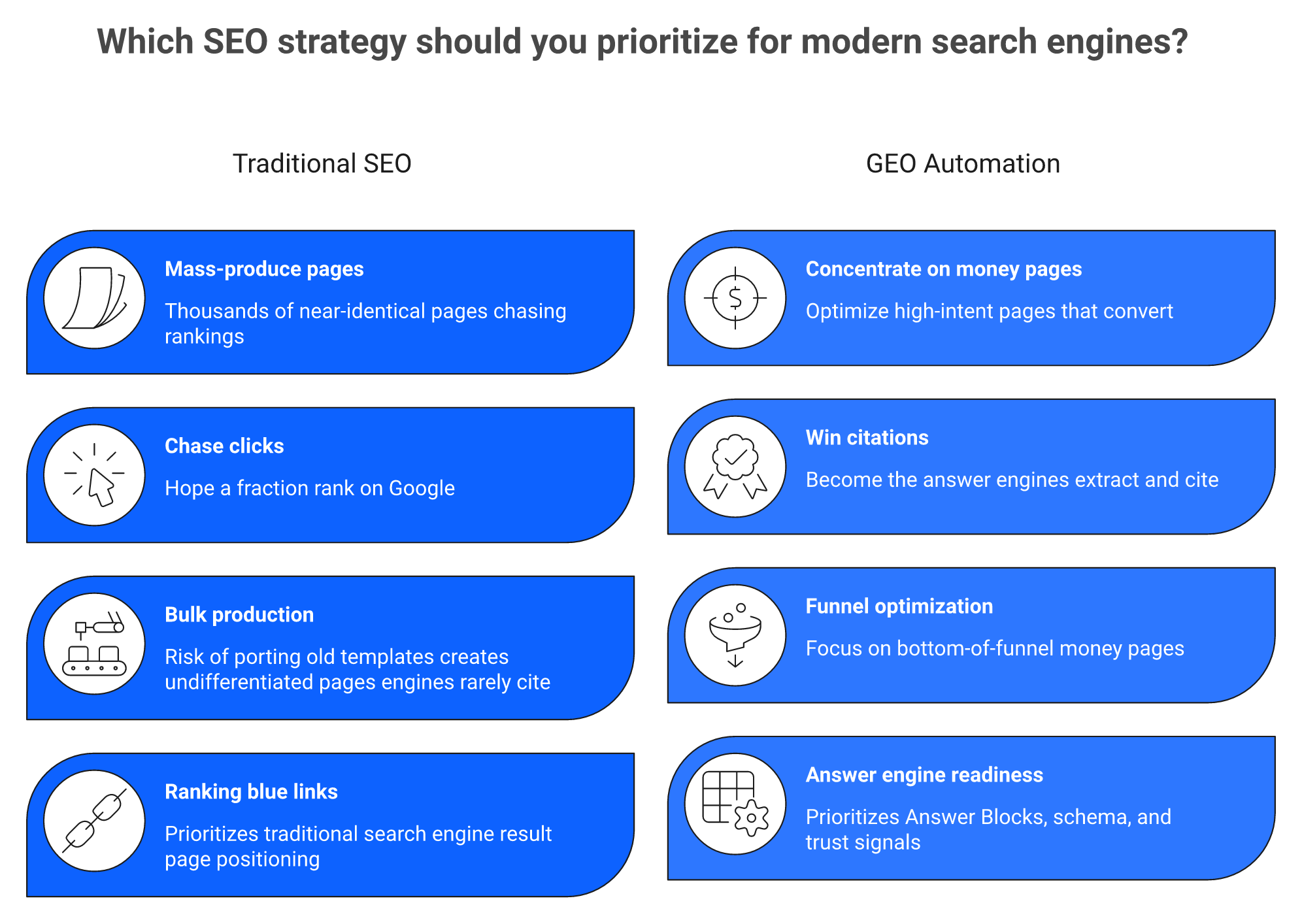
Traditional SEO automation mass-produces pages to chase rankings and clicks. GEO automation optimizes for citation and extraction inside AI answers, so it prioritizes structured Answer Blocks, schema, and trust signals over page volume. The shift matters because AI Overviews now cut position-one clicks by up to 58%. Even a top rank leaks most of its traffic unless you are also the cited answer.
💸 Why volume-based automation stopped paying
The old programmatic playbook was simple. Spin up thousands of near-identical pages and hope a fraction rank. Ahrefs, analyzing about 300,000 keywords against Google Search Console data, found AI Overviews correlate with a 58% lower click-through rate for the top organic result. Seer Interactive and other studies put the drop in a similar 49% to 65% band. Chasing clicks with page count now funds a channel that leaks more than half its traffic.
The economics were already brutal before AI. As SEO veteran Ethan Smith puts it, "one out of 20 landing pages drive roughly 85% of all your traffic," meaning 19 of 20 pages do almost nothing. If most pages never mattered, automating more of them just automates waste. A clearer breakdown of the mechanics sits in our GEO vs traditional SEO comparison.
✅ Fact, fact, drawback, fact, drawback
- ✅ GEO automation concentrates effort on the few high-intent "money pages" that actually convert.
- ✅ It structures each page as extractable Answer Blocks that engines can lift verbatim.
- ❌ It demands more upfront thinking about retrieval and trust, so it is slower to "just publish."
- ✅ It compounds, because citations build authority that feeds future answers.
- ❌ It punishes shortcuts harder, since thin automated pages get ignored by engines, not just ranked lower.
⚠️ Where copying old tactics backfires
Porting a programmatic SEO template straight into GEO produces bulk, undifferentiated pages that AI engines have little reason to cite. The penalty for being average has never been steeper, because an answer only quotes a few sources.
This is the split we work from at MaximusLabs. Our revenue-focused SEO methodology starts bottom-of-funnel first, pushing budget toward the high-intent pages where AI-referral traffic converts, rather than spraying pages for impressions. Traditional agencies optimizing for vanity metrics are automating a game whose scoreboard already changed.
Q3. What are the core stages of an end-to-end GEO automation workflow?
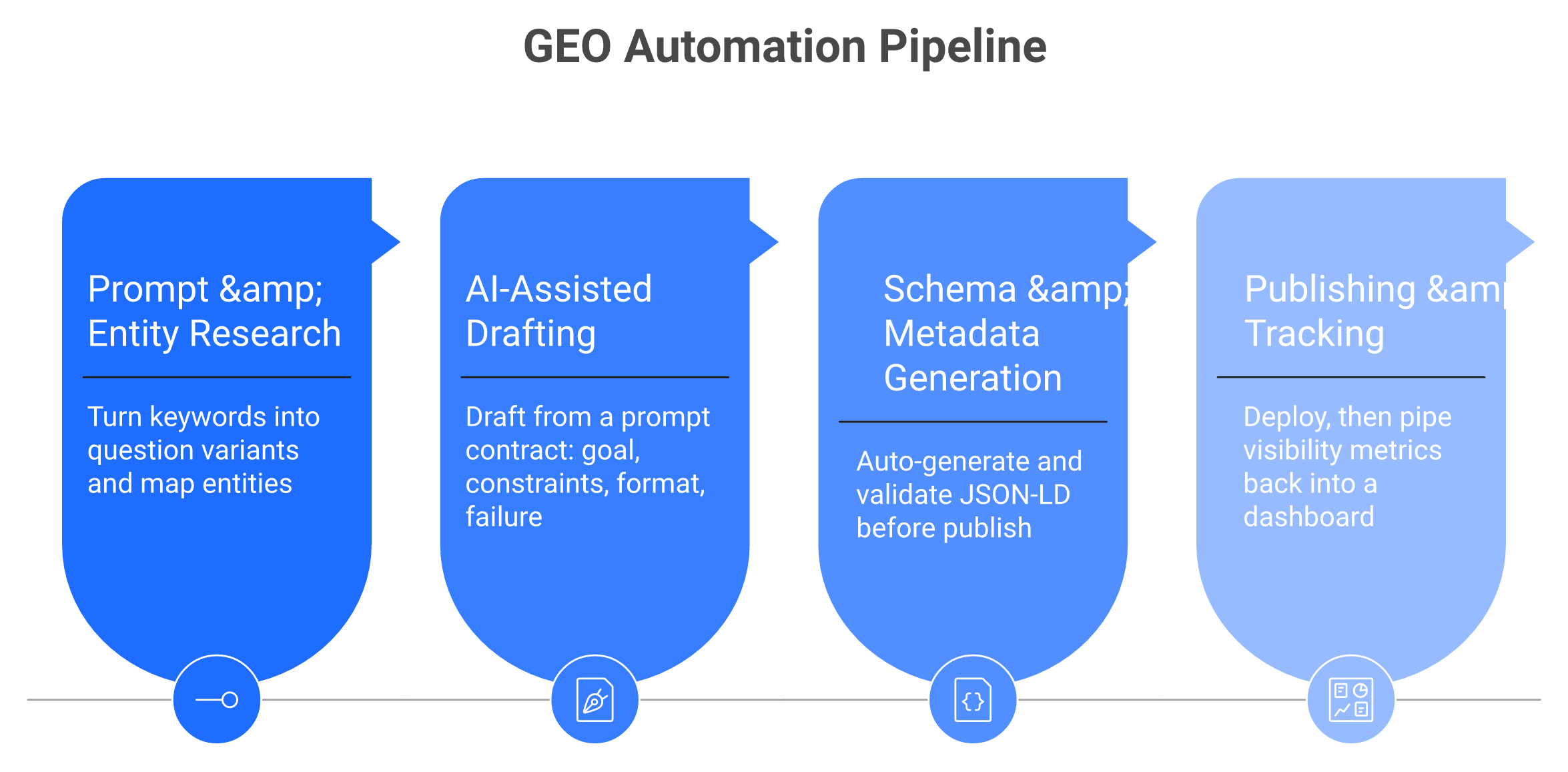
An end-to-end GEO automation workflow has four stages: (1) prompt and entity research using AI demand modeling, (2) AI-driven drafting from a data-backed brief, (3) automated schema and metadata generation with validation, and (4) publishing plus AI-visibility tracking. Each stage connects by APIs or webhooks, with a human-in-the-loop checkpoint before anything customer-facing ships.
🔍 Stage 1: Prompt and entity research
The pipeline starts by modeling how buyers actually ask AI engines, then clustering those prompts by intent. Since no ads API exposes prompt volume, the practical hack is turning high-value keywords into question variants, which is directionally accurate. Automation pulls these from search data, sales calls, and Reddit threads, then maps the entities each answer needs. Our AEO keyword and question research approach formalizes exactly this step.
✍️ Stage 2: AI-assisted drafting from a brief
Drafting runs from a structured brief, not a blank prompt. The reliability trick here is what one practitioner calls a "prompt contract" with four sections: goal, constraints, format, and failure. That structure stops the agent from wandering off-spec. It also lets you encode proven citation levers, since the Princeton GEO study found adding statistics lifted visibility by roughly 41% and quotations by about 28%.
🏷️ Stage 3: Schema and metadata generation
Next, the workflow auto-generates JSON-LD (Article, FAQPage, Person) and validates it before publish. Placement matters as much as markup. An analysis of 177 million citation instances found 44.2% of AI citations come from the first 30% of the page, so automation should push Answer Blocks high, not bury them. If you are new to structured data, our schema markup basics guide covers the essentials.
📊 Stage 4: Publish and track
The final stage ships the page and pipes visibility metrics back into a dashboard, closing the loop. This mirrors the "before and after" of agentic automation. One command reads every file, sorts it, and returns a clean spreadsheet in minutes instead of a week.
| Stage | Automated task | Human-in-the-loop role |
|---|---|---|
| Research | Prompt clustering, entity mapping | Approve intent priorities |
| Drafting | Draft from prompt-contract brief | Voice, accuracy, edit |
| Schema | Generate and validate JSON-LD | Spot-check markup |
| Publish/Track | Deploy, log SIR and SOV | Read the weekly report |
At MaximusLabs, our production pipeline is stage-gated exactly this way, with human review guarding E-E-A-T at each handoff so speed never costs trust. From what surfaces when you actually run this, the checkpoint is what separates a scalable system from an automated spam generator. Our technical GEO implementation work bakes these validation gates in by default.
Q4. Which AI tools and platforms actually power GEO automation workflows in 2026?
GEO automation runs on three tool layers. Orchestration connects the stages (Zapier, Make, AirOps). Drafting generates structured content (GPT-4, Claude, Writesonic). Monitoring tracks whether AI engines cite you (Profound, Peec AI, Semrush AI Toolkit, AthenaHQ, BrightEdge). The winning stacks in 2026 pair a workflow builder with a citation-tracking layer, so visibility feeds back into the next content cycle.
🍳 Why single-tool thinking fails: the Michelin kitchen
A chatbot and an agent can run on the same model. The brain is identical. The difference is what gets wired around it. Picture a world-class chef alone in an empty room versus the same chef in a full Michelin kitchen. Raw GPT is the chef with no kitchen. A real GEO stack is the wired kitchen, which is why stitching one tool rarely works. One practitioner admitted building a custom app from a ChatGPT suggestion, only to find "it wouldn't do the one thing I needed."
🏆 The managed and layered stack, ranked
- MaximusLabs AI, a managed, done-for-you GEO stack combining orchestration, trust-first content, and founder-voice positioning, with cost-effective, scalable production instead of tools you assemble yourself.
- AirOps, a workflow builder for scaling GEO and AI-content workflows.
- Profound, Peec AI, Semrush AI Toolkit, AthenaHQ, the monitoring layer for citations and share of voice.
- Zapier and Make, the glue connecting stages via triggers and webhooks.
- GPT-4, Claude, Writesonic, the drafting engines.
| Layer | Leading tools | What it automates | Price signal |
|---|---|---|---|
| Orchestration | Zapier, Make, AirOps | Stage-to-stage handoffs | $ to $$$ |
| Drafting | GPT-4, Claude, Writesonic | Structured content | $ to $$ |
| Monitoring | Profound, Peec, Semrush AIO, AthenaHQ | Citation and SOV tracking | $$ to $$$ |
The monitoring layer is what closes the loop, feeding citation gaps back into the next research cycle. For a deeper teardown of options, see our roundup of the top GEO tools and platforms.
💬 What the results actually look like
Third-party G2 or Capterra reviews for these platforms were not present in our provided source files, so we are not citing tool reviews we cannot verify. What we can share are our own documented outcomes, labeled clearly as MaximusLabs' claims.
"We achieved a 64% citation rate across AI platforms, overtaking a legacy, decade-old, billion-dollar competitor stuck near 30%, in about six months of GEO work."
MaximusLabs AI, first-party case result Oliv AI Case Study
"A single GEO strategy ranked the client first across Google, ChatGPT, and Perplexity for its core term."
MaximusLabs AI, first-party case result Nidra Case Study
A quick honest note. Those are our numbers, not an independent audit, and GEO results compound with trust over time rather than flipping overnight. Where we think the next two years go is that owning the full wired stack, not buying point tools, becomes table stakes for staying in the answer. That conviction sits at the center of our generative engine optimization practice.
Q5. How do you stop an automated GEO workflow from producing spammy, low-trust, or broken content?
Keep automated GEO content trustworthy with two guardrail layers. Trust guardrails include a human-in-the-loop checkpoint, mandatory citation and fact-check gates, author attribution via Person schema, and self-modifying agent rules. Reliability guardrails include automated schema validation, hallucination detection, and brand-voice checks that catch silent failures before publish. Pure AI generation without these controls trends toward spam that platforms are incentivized to suppress.
⚠️ The situation: automation tempts pure generation
Once a pipeline can draft a page in seconds, the temptation is to remove humans entirely. That is exactly where GEO automation quietly breaks. The output looks fine on the surface and fails where engines actually judge you, on trust and originality.
Ethan Smith, who built scraped-and-rewritten spam back in 2007, saw this coming. His read is blunt. "If AI-generated content works, then Google and ChatGPT just become not useful, so those companies have decided to make it not work." Building a durable E-E-A-T for AEO foundation is the counter-move.
🤔 The complication: the human-in-the-loop debate
There is real disagreement here, and it is worth sitting with. Smith argues that AI-assisted content works only with "a human in the loop editing it," because uniqueness is what survives. Others note that engines increasingly weight traditional link-graph and authority signals, which suggests manual authority-building still matters as much as automated output.
Both camps agree on one thing. Fully hands-off generation is the fast lane to content nobody cites. The pattern lines up with what we see across GEO failures and lessons.
✅ The resolution: trust guardrails you can wire in
Build these gates directly into the pipeline:
- A human review checkpoint before anything customer-facing ships.
- Mandatory citation and fact-check gates on every claim.
- Author attribution through Person schema, which is structured data naming a real author.
- Self-modifying agent memory, so corrections stick.
That last one is underrated. One practitioner kept watching an agent slip emojis into customer copy, so they created a rules file with a single line, "never use emojis," and the problem stopped repeating. The agent corrected itself instead of needing constant babysitting. Sound schema markup basics make that author attribution machine-readable.
🛠️ The reliability layer: catching silent failures
Trust gates handle spam. Reliability gates handle the quiet breakages, including hallucinated statistics, schema drift (markup that slowly stops validating), and brand-voice erosion. Add automated schema validation and a hallucination check that flags any stat without a source before publish.
This is the non-negotiable at MaximusLabs. We treat trust as the ranking currency, engineering E-E-A-T and the founder's actual voice into every piece, so scale never turns into spam-at-scale. This trust-first discipline anchors our whole GEO service. From what surfaces when you actually run these pipelines, the guardrails are not overhead. They are the reason the content gets cited at all.
Q6. How do you model AI-search demand and build Answer Blocks the engines will cite?
Model AI-search demand by turning SEO keywords into their question variants, the format AI engines match against, since no ads API exposes prompt volume yet. Then structure each page as extractable Answer Blocks placed in the first 30% of content, where 44.2% of AI citations originate, and bake the proven citation levers (statistics, quotations, and cited sources) into every automated brief.
🔑 Start by converting keywords into questions
There is no truth-set for prompts the way Google's Ads API gives keyword volume. The practical workaround is direct. Take your high-value keywords and ask an AI to generate question variants. As Ethan Smith notes, that approach is "directionally accurate" and good enough to model demand. Our AEO keyword and question research method systematizes it.
Mine questions from where they already exist too, including sales calls, support tickets, and Reddit threads. Chat queries average around 25 words versus 6 for search, so the long tail of specific follow-ups is far larger.
📍 Place Answer Blocks where engines actually look
An Answer Block is a self-contained answer an engine can lift verbatim. Placement is not cosmetic. An analysis of 177 million citation instances found 44.2% of AI citations come from the first 30% of the page. Your automated template should push the answer high, not bury it under intro fluff. Our GEO content optimization playbook treats placement as a first-class variable.
📊 Bake the citation levers into every brief
The Princeton GEO study tested nine tactics and found the winners were concrete. Adding statistics lifted visibility by roughly 41%, and adding quotations by about 28%, with overall gains up to 40%. Encode a rule into the automated brief. Every Answer Block needs at least three cited statistics and one quotation.
🔎 Expose the data hidden behind filters
RAG, which is retrieval-augmented generation, the live-search step engines run, can only cite what it can read. A lot of useful data sits locked behind JavaScript filters or facets. Pull that metadata into the visible page, including product attributes, materials, and use-cases, so follow-up questions get answered inline. Getting this right is a core part of technical GEO implementation.
One nuance worth keeping. You do not need a page literally named "AI page." As one practitioner put it, the content "needs to exist somewhere, but it doesn't need to specifically be called AI." Accessibility beats labeling. This is the repeatable standard we operationalize at MaximusLabs, structuring extractable, citation-lever-loaded Answer Blocks so a single template consistently earns citations across ChatGPT, Perplexity, and Google AI Overviews, and it underpins our answer engine optimization work.
Q7. How do you measure whether your GEO automation is driving pipeline, not just visibility?
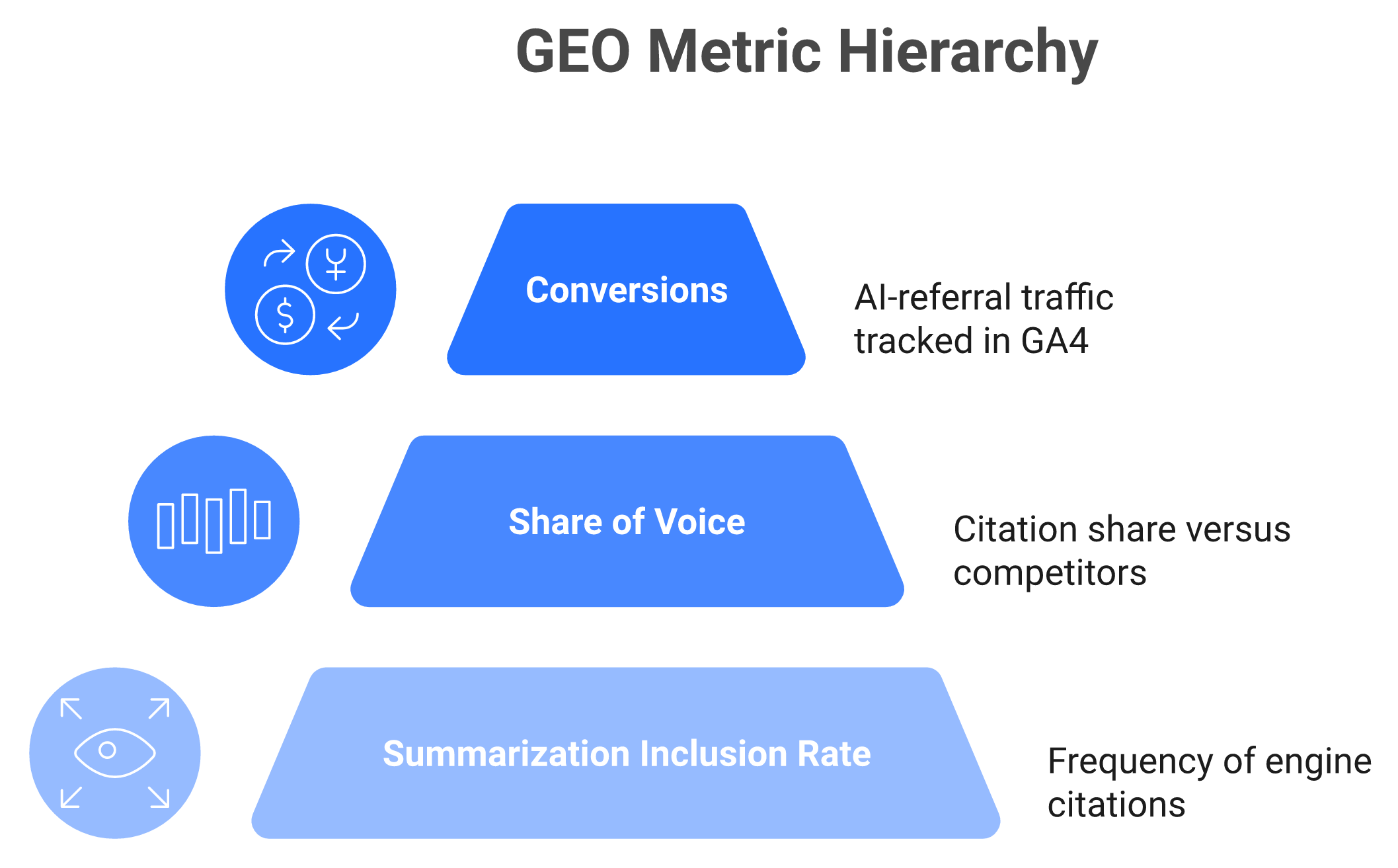
Measure GEO automation with three metrics: Summarization Inclusion Rate (how often engines cite you), Share of Voice (your citation share versus competitors), and conversions from a dedicated GA4 AI-referral segment. Stop at SIR and SOV and you track vanity reach. Tie AI citations to pipeline and revenue and you prove the workflow pays. LLM traffic can convert far higher than Google traffic, so attribution matters most.
📈 The metric ladder, from reach to revenue
Think of measurement in three rungs, each closer to money:
- Summarization Inclusion Rate (SIR), how often engines cite you at all.
- Share of Voice (SOV), your citation frequency versus rivals, measured across thousands of question variants, not one ranking.
- Conversions, AI-referral traffic tracked to a dedicated GA4 segment, which is a filtered view of visitors arriving from ChatGPT, Perplexity, and similar engines.
SIR and SOV alone are reach metrics. They feel good and prove nothing about pipeline. Our approach to GEO measurement and metrics starts from that distinction.
💰 Why revenue attribution wins
Here is the number that reframes the whole exercise. Webflow saw a 6x higher conversion rate from LLM traffic than from Google search traffic, because conversational queries build intent before the click. If AI visitors convert six times better, counting impressions is leaving the real story untold. Tying that to GEO ROI and revenue attribution is where the budget case gets made.
Attribution is genuinely hard here, and we should be honest about it. Many AI answers are not clickable, so a buyer may see your brand, open a new tab, and arrive as "direct" traffic. That is why post-conversion surveys ("How did you hear about us?") matter alongside GA4.
🔁 Close the loop weekly
Feed SIR, SOV, and conversions into a weekly report that re-prioritizes the next content cycle by commercial intent, not by pageviews. Gartner projects traditional search volume dropping 25% by 2026 as usage shifts to AI, so the channel you measure has to change with it.
At MaximusLabs, we pioneered revenue-focused GEO precisely because clicks and impressions are vanity metrics that do not move the revenue needle. We report pipeline influence, not dashboards that only make a client feel good, and that ethos drives our generative engine optimization programs.
Q8. Should you build GEO automation in-house, buy tools, or hire a specialist?
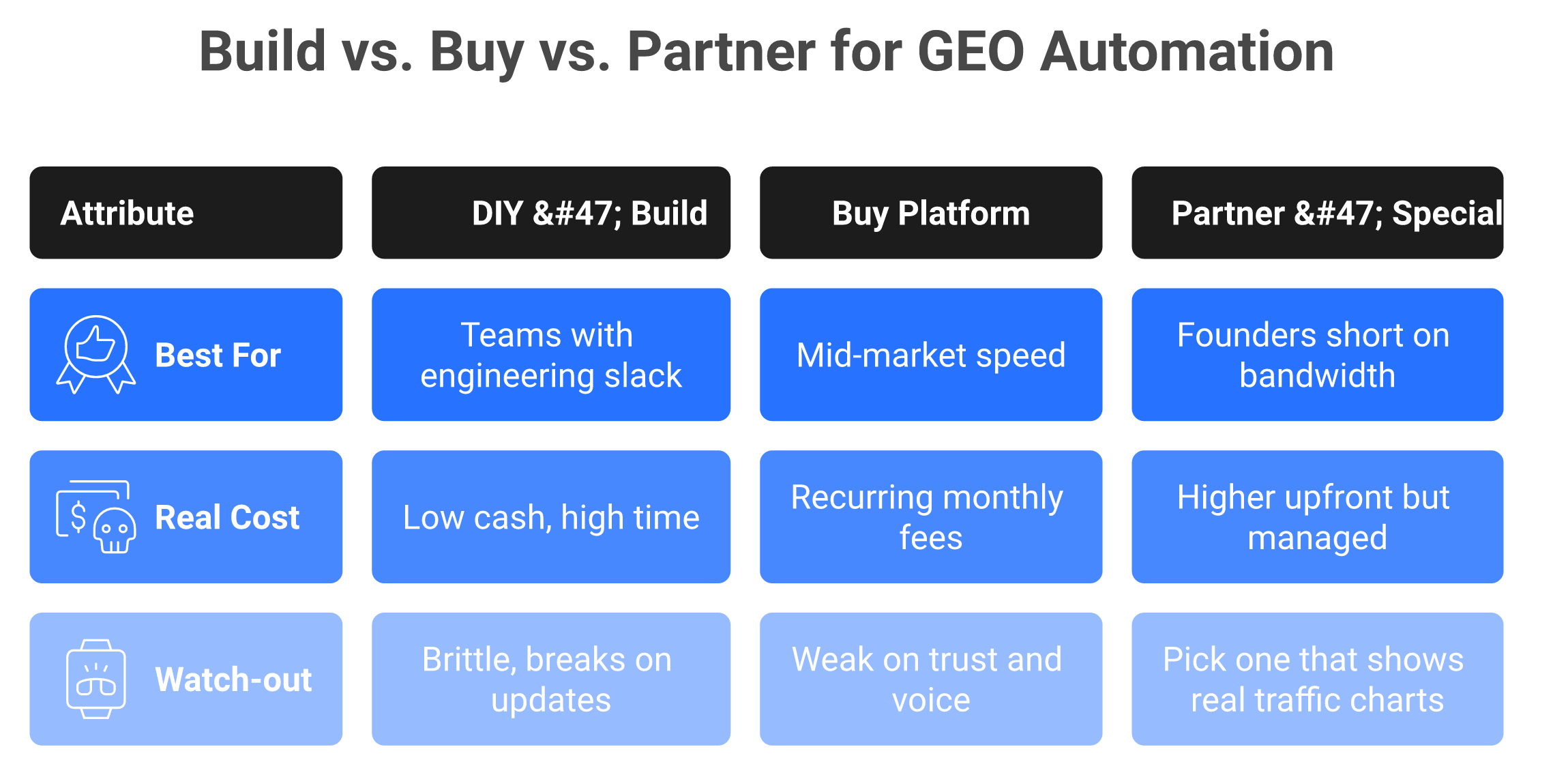
Choose your GEO automation path by stage and appetite for maintenance. DIY tool-stitching is cheapest but brittle and time-consuming. All-in-one platforms speed setup but rarely handle trust, positioning, or founder voice. A specialist partner costs more upfront but delivers a maintained, revenue-focused pipeline. Most SaaS teams over-invest in DIY, burn months on trial-and-error, then outsource, so decide honestly about internal bandwidth first.
🧭 The situation: three real paths
Every team faces the same fork. Build it in-house, buy an all-in-one platform, or hire a specialist. Agencies add a fourth wrinkle, choosing between multi-client orchestration and single-brand depth.
| Path | Best for | Real cost | Watch-out |
|---|---|---|---|
| DIY / build | Teams with engineering slack | Low cash, high time | Brittle, breaks on updates |
| Buy platform | Mid-market speed | $$ monthly | Weak on trust, voice, positioning |
| Partner / specialist | Founders short on bandwidth | $$$ but managed | Pick one that shows real traffic charts |
🔄 The complication: DIY and the death spiral
DIY looks cheap until it isn't. One practitioner built a custom tool from a ChatGPT suggestion, then admitted "it wouldn't do the one thing I needed" after weeks of trial and error. Multiply that across four platforms and a full pipeline, and the "free" build gets expensive fast. Comparing your options against the field of best GEO agency services saves that wasted spend.
The agency route has its own trap, the SEO death spiral, a big roadmap, a year of no results, lost engineering trust, then a new agency for the same zero-impact cycle. Practitioners voice this bluntly.
"Most agencies charge overpriced retainers for work that's not deserving of a retainer."
u/low5d7k, r/SEO Reddit Thread
🎯 The resolution: choose by stage
Match the path to your reality:
- MaximusLabs AI, a specialist partner delivering a maintained, revenue-focused GEO pipeline, with product positioning exactly as the client wants and the founder's voice built in, at cost-effective, scalable production.
- All-in-one platforms (AirOps, Profound), faster setup for teams that can supply their own trust and positioning layer.
- In-house build, sensible only when you have genuine engineering slack and time to maintain it.
We are upfront that GEO is not a magic trick, and results compound with trust over time. Our own documented outcome shows what a maintained pipeline can do, and we label it as our claim.
"We reached a 64% citation rate across AI platforms in about six months, overtaking a decade-old, billion-dollar competitor stuck near 30%."
MaximusLabs AI, first-party case result Oliv AI Case Study
Where our thinking sits right now, most teams should not build. They should decide honestly about bandwidth, then partner or buy, and put scarce cash into the money pages that convert. If that points you toward a partner, our pricing lays out the options plainly.
Q9. What does a first Monday-morning GEO automation workflow look like?
A starter GEO automation workflow you can launch this week: pick one high-intent money page, generate question-variant prompts, draft it from a prompt-contract brief (goal, constraints, format, and failure), auto-generate and validate FAQ and Article schema, publish, then run a weekly citation-tracking check across ChatGPT, Perplexity, and Google AI Overviews. Start with one page, prove the loop, then scale to a full pipeline.
🎯 Start with one money page, not the whole site
The instinct is to automate everything at once. Resist it. As SEO veteran Ethan Smith notes, "one out of 20 landing pages drive roughly 85% of all your traffic," so spreading effort thin wastes cash. Pick the single page closest to revenue, a comparison, a category, or a high-intent product page, and prove the loop there first. Concentrating spend this way is the heart of our revenue-focused framework.
This respects your budget. You are testing a system with one page of risk, not betting a quarter's spend on an unproven pipeline. If you want the shortcut research, our GEO for SaaS startups guide covers the first-page decision in detail.
⏰ The five-step starter loop
Stand this up in a week, in order:
- Pick one money page. Choose your highest-intent bottom-of-funnel page, the one closest to a buying decision.
- Generate question variants. Turn its target keywords into the questions buyers actually ask AI, using ChatGPT for a directionally accurate list.
- Draft from a prompt contract. Give the agent a brief with four parts: goal, constraints, format, and failure. Those four words keep it from wandering off-spec.
- Generate and validate schema. Auto-create FAQ and Article JSON-LD, which is structured data engines read, then run it through a validator before publish.
- Track citations weekly. Check whether ChatGPT, Perplexity, and Google AI Overviews start citing the page, and log the change.
Getting steps two and three right is where our AEO keyword and question research and schema markup basics save the most time.
🔁 Turn the pilot into a system
The weekly citation check is the flywheel. Each cycle tells you which questions you now own and which competitors still hold, so the next page is sharper than the last. Tracking the right numbers here is exactly what our GEO measurement and metrics approach formalizes. This is the same before-and-after arc practitioners describe with agentic automation, where one clear command replaces a week of manual admin and returns clean, sorted output in minutes.
Give it time, and stay honest about the timeline. GEO is not a magic ranking trick, and citations compound with trust rather than flipping overnight. Traditional Google SEO still has a role, even as the center of gravity moves toward AI answers.
If you would rather not build and maintain this yourself, this is the exact pipeline behind our GEO service, run one money page at a time, revenue-focused, with the founder's voice and trust signals engineered in. We have watched a client reach a 64% citation rate across AI platforms in about six months, overtaking a decade-old, billion-dollar competitor stuck near 30%, and we label that as our own measured result.
"We reached a 64% citation rate across AI platforms in about six months, overtaking a decade-old, billion-dollar competitor stuck near 30%."
MaximusLabs AI, first-party case result Oliv AI Case Study
💡 What we are sitting with next
Here is the open question on our desk. Within two years, we think "becoming the answer" stops being an edge and turns into table stakes, and the brands that built trust-first, AI-discoverable content early will own the citations everyone else fights over. A read on where the category heads next sits in our future trends in GEO analysis. So the real question is not whether you automate GEO. It is which single money page you point it at first, and if you want a second set of eyes on that call, you can always contact us. What would yours be?
Frequently asked questions
What are GEO automation workflows and how do they actually work?
GEO automation workflows are connected, AI-driven pipelines that research prompts, draft structured content, generate schema, publish, and track AI-search visibility with minimal manual touch. Instead of hand-building one page at a time, we wire each stage together so the system runs continuously. The goal is not to rank blue links. It is to become the answer that ChatGPT, Perplexity, Gemini, and Google AI Overviews cite. Prompt and entity research models how buyers ask AI. Drafting runs from a structured brief, not a blank prompt. Schema and metadata generation makes content machine-readable. Publishing plus citation tracking closes the loop. This matters because roughly 60% of searches now end without a click, and AI summaries are projected to touch about 75% of searches by 2028. Manual production simply cannot feed a machine evaluating thousands of question variants across four platforms. We treat this as a data-science discipline, which is why our GEO service builds around how retrieval-augmented generation picks sources first, not around raw publishing volume.
How is GEO automation different from traditional Google-only SEO automation?
Traditional SEO automation mass-produces pages to chase rankings and clicks. GEO automation optimizes for citation and extraction inside AI answers, so it prioritizes structured Answer Blocks, schema, and trust signals over page volume. The shift matters because AI Overviews now cut position-one clicks by up to 58%, so even a top rank leaks most of its traffic unless you are also the cited answer. Old model: thousands of near-identical pages, hope a fraction rank. New model: concentrate effort on high-intent money pages that convert. Reality check: one in twenty landing pages drives roughly 85% of traffic. Porting a programmatic template straight into GEO produces bulk, undifferentiated pages engines have little reason to cite. We start bottom-of-funnel first, pushing budget toward pages where AI-referral traffic converts. You can see the full breakdown in our comparison of GEO vs traditional SEO . The scoreboard changed, and automating more average pages just automates waste.
What are the core stages of an end-to-end GEO automation workflow?
An end-to-end GEO automation workflow has four stages, each connected by APIs or webhooks with a human checkpoint before anything customer-facing ships. Prompt and entity research: turn keywords into question variants and map required entities. AI-assisted drafting: draft from a prompt contract with goal, constraints, format, and failure. Schema and metadata generation: auto-generate and validate JSON-LD before publish. Publishing and tracking: deploy, then pipe visibility metrics back into a dashboard. Placement matters as much as markup. An analysis of 177 million citation instances found 44.2% of AI citations come from the first 30% of the page, so we push Answer Blocks high. The Princeton GEO study also found adding statistics lifted visibility by roughly 41% and quotations by about 28%. Our production pipeline is stage-gated exactly this way, with human review guarding E-E-A-T at each handoff. The technical detail sits in our guide to technical GEO implementation , where validation gates are built in by default.
Which AI tools and platforms power GEO automation workflows in 2026?
GEO automation runs on three tool layers, and the winning stacks pair a workflow builder with a citation-tracking layer so visibility feeds the next content cycle. Orchestration: Zapier, Make, and AirOps connect the stages. Drafting: GPT-4, Claude, and Writesonic generate structured content. Monitoring: Profound, Peec AI, Semrush AI Toolkit, and AthenaHQ track whether engines cite you. Single-tool thinking fails here. A chatbot and an agent can run on the same model; the difference is what gets wired around it, like a chef with no kitchen versus a full Michelin kitchen. Stitching one raw tool rarely does the job. We position ourselves as the managed, done-for-you stack that combines orchestration, trust-first content, and founder-voice positioning, instead of tools you assemble yourself. For a deeper teardown of options, see our roundup of the top GEO tools and platforms , which maps each layer to what it automates and its price signal.
How do you stop GEO automation from producing spammy or low-trust content?
We keep automated GEO content trustworthy with two guardrail layers that catch different failure modes before publish. Trust guardrails: a human-in-the-loop checkpoint, citation and fact-check gates, author attribution via Person schema, and self-modifying agent rules. Reliability guardrails: automated schema validation, hallucination detection, and brand-voice checks. Pure AI generation without these controls trends toward spam that platforms are incentivized to suppress. As one veteran put it, if AI-generated content worked at scale, the engines would simply become useless, so they decided to make it not work. Self-modifying memory is underrated. When an agent kept slipping emojis into customer copy, a single rules-file line stopped it from repeating. That is quality control without constant babysitting. We treat trust as the ranking currency, engineering the founder's actual voice and strong E-E-A-T signals into every piece, so scale never becomes spam-at-scale. From what surfaces when you actually run these pipelines, the guardrails are the reason content gets cited at all.
How do you measure whether GEO automation drives pipeline, not just visibility?
We measure GEO automation with three metrics that ladder from reach to revenue, so the workflow proves it pays rather than just looking busy. Summarization Inclusion Rate: how often engines cite you at all. Share of Voice: your citation share versus competitors across thousands of question variants. Conversions: AI-referral traffic tracked to a dedicated GA4 segment. Stop at the first two and you track vanity reach. The number that reframes everything is that LLM traffic can convert around six times better than Google search traffic, because conversational queries build intent before the click. Attribution is genuinely hard, since many AI answers are not clickable and buyers often arrive as direct traffic. That is why post-conversion surveys matter alongside analytics. We feed all three metrics into a weekly report that re-prioritizes the next cycle by commercial intent. This revenue lens drives our approach to GEO ROI and revenue attribution , reporting pipeline influence instead of impressions.
Should you build GEO automation in-house, buy tools, or hire a specialist?
Choose your GEO automation path by company stage and appetite for maintenance. Most SaaS teams over-invest in DIY, burn months on trial-and-error, then outsource anyway. DIY build: cheapest in cash but brittle, and it breaks on platform updates. All-in-one platforms: faster setup, but weak on trust, positioning, and founder voice. Specialist partner: higher upfront cost, but a maintained, revenue-focused pipeline. The agency route has its own trap, the SEO death spiral, a big roadmap, a year of no results, lost engineering trust, then a new agency for the same zero-impact cycle. We are upfront that GEO is not a magic trick and results compound with trust over time. We reached a 64% citation rate for a client across AI platforms in about six months, overtaking a decade-old, billion-dollar competitor stuck near 30%, and we label that as our own measured result. If bandwidth is tight, our pricing lays out the partner options plainly, and putting scarce cash into money pages that convert beats spreading it thin.