 Krishna Kaanth M
- Advanced GEO moves a brand from occasionally mentioned to consistently cited across ChatGPT, Perplexity, Gemini, and Google AI Overviews, treating retrieval as a data science problem, not an SEO checklist.
- Becoming the cited answer beats ranking, since AI engines synthesize one response from five to ten sources, and LLM traffic can convert around 6x better than Google search.
- Citation engineering, standalone answers, cited stats, quotations, and question-and-answer structure, lifts source visibility 30 to 40 percent per the Princeton GEO study.
- Entity consistency and per-platform routing get you into narrow citation sets, since ChatGPT, Perplexity, Gemini, and Google each lean on different sources.
- Technical GEO that matters is basic: crawler access, rendered content, and clean internal links, while schema and llms.txt stay contested and platform-specific.
- Measure citation share, share of answer, and velocity tied to pipeline, use AI to assist not fully generate, and invest now in compounding basics ahead of agentic commerce.
Q1. What Are Advanced GEO Strategies (and How Do They Differ From Basic GEO and Traditional SEO)?
A Head of Organic Growth we spoke with put it bluntly, mid-audit: her brand ranked page one on Google for a money term, yet ChatGPT never named it once. The dashboard looked healthy. The pipeline told a different story.
Advanced GEO strategies move a brand from occasionally mentioned to consistently cited by AI engines like ChatGPT, Perplexity, Gemini, and Google AI Overviews. Unlike basic GEO, they engineer citations, optimize entities, orchestrate cross-platform authority, and scale programmatically. The goal is surviving the RAG retrieval step so the model names you as the definitive source, not merely ranking a blue link beneath an AI summary.
🧭 Why Blue-Link Thinking Now Fails
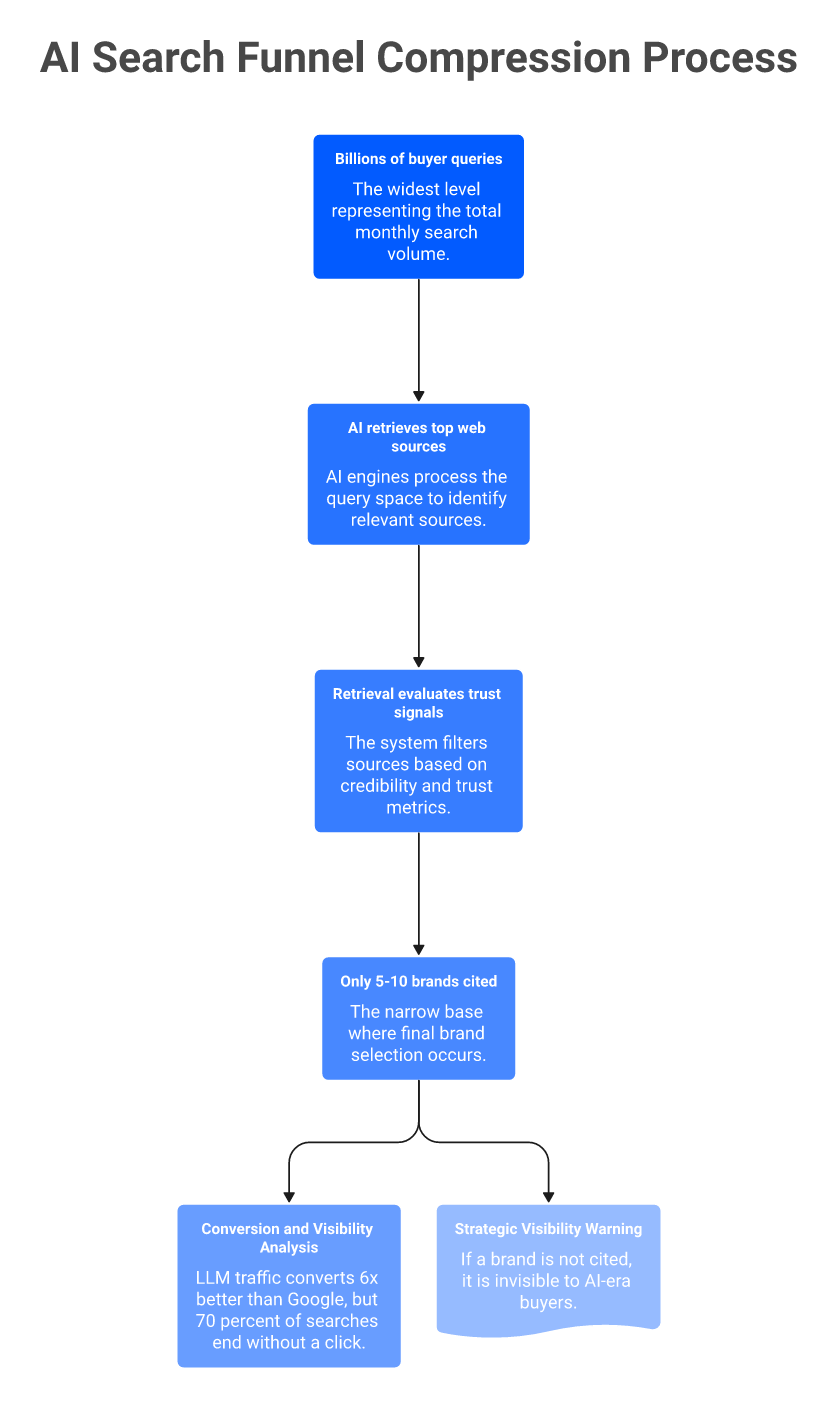
Being on page one used to be the win. It no longer is. AI search shrank the evaluation set from hundreds of blue links to a curated list of five to ten sources.
Krishna Kaanth, our founder, frames the shift without hedging. "If you're not in the actual citations in the answer, you might as well not have played the game," he says. "You're literally zero in terms of traction."
That is the binary outcome enterprise readers now face. You are either inside the answer, or you are invisible to the buyer asking the question.
⚙️ What "Advanced" Actually Means
Basic GEO gets you answer-first structure and clean formatting. Advanced GEO treats the whole thing as a data-science problem, not an SEO checklist. Krishna is direct about this: "GEO is not SEO. It's a data science problem. We need to exactly know how these LLM algorithms work to be present in the answers."
The Princeton GEO study backs the mechanics. Adding citations, quotations, and statistics to visible body text lifted source visibility by 30 to 40 percent across queries. One honest caveat: that lift measures citation share, not click traffic, and it comes from body-text edits, not schema hacks. This is exactly why our generative engine optimization work starts with retrieval mechanics, not keyword lists.
| Dimension | Traditional SEO | Basic GEO | Advanced GEO |
|---|---|---|---|
| Goal | Rank a blue link | Appear in AI answers | Be the cited source across engines |
| Unit of work | Keywords | Answer-first pages | Citation engineering plus entities |
| Scope | Your website | Your website | Owned plus earned, all platforms |
| Metric | Rankings, traffic | Mentions | Share of answer, pipeline |
| Scale model | Manual pages | Manual pages | Programmatic, entity-clustered |
✅ What This Looks Like on Monday
Start by testing how ChatGPT, Perplexity, and Gemini currently describe your brand for your top three money questions. If you are absent, that is your baseline gap. Then decide which pages get citation-engineered first, a sequencing we detail in our advanced GEO frameworks.
We treat GEO as a data-science problem at MaximusLabs, reverse-engineering how RAG retrieval selects sources rather than reselling a 2019 SEO checklist. What ChatGPT rewards is not what Google rewards, and that difference, mapped clearly in our GEO vs traditional SEO breakdown, is the whole game.
Q2. Why Is "Becoming the Answer" Now More Important Than Ranking?
Picture a VP Marketing watching a quarterly board deck. Organic sessions are flat, rankings are steady, and yet inbound demo requests keep slipping. The channel looks fine on paper and leaks underneath.
Becoming the cited answer now beats ranking because AI engines synthesize one response from a shrunken set of five to ten sources instead of hundreds of links. Gartner projects over 50 percent of search traffic will move to AI-native platforms by 2028. AI Overviews can sharply cut organic clicks. If the model does not name you, buyers never see you, no matter how well you rank beneath the summary.
📉 The Situation Marketers Grew Up With
For 20 years, the job was simple: rank higher, get more clicks. That model rewarded volume and position. It also trained a generation of teams to report impressions and pageviews as proof of progress.
Those are vanity metrics. They feel productive. They rarely move pipeline, which is why our answer engine optimization approach reframes the goal around being cited.
⚠️ The Complication Nobody Budgeted For
Two forces broke the old model at once. First, zero-click behavior: roughly 70 percent of searches now end without a website visit because the AI answers directly. Second, AI Overviews push organic results down the page, and one analysis pegged the resulting click penalty at around 34.5 percent for demoted results.
Ethan Smith of Graphite adds a useful counterweight here. He argues Google's slice of the pie stays roughly the same size while the pie itself grows, so this is less "Google is dying" and more "a large new channel appeared." Either way, the buyer's first stop is increasingly an AI answer, not a SERP. We track this shift in our zero-click search brand economy report.
💰 The Resolution: A New KPI
The fix is a reframe. Stop measuring rankings alone. Start measuring share of answer, how often you are the cited source across thousands of question variants and platforms.
Ethan's own data shows why this matters for revenue: Webflow saw a 6x conversion-rate difference between LLM traffic and Google search traffic, because those users arrive pre-sold. Being the answer is not a vanity win. It is a pipeline event, which is the foundation of our R-GEO revenue-focused framework.
"Achieved 64% citation rate across AI platforms, overtaking legacy 10-year-old billion-dollar competitors who sat at roughly 30%, in just 6 months of GEO work."
MaximusLabs AI, Oliv AI engagement MaximusLabs Oliv AI Case Study
"Ranked #1 across Google, ChatGPT, and Perplexity for 'best sleep mask,' triple-platform dominance from a single GEO strategy."
MaximusLabs AI, Nidra Goods engagement MaximusLabs Nidra Case Study
We measure success at MaximusLabs as share of answer and pipeline influence, not the vanity impressions traditional agencies still put on the dashboard. That is the difference between a report that feels good and a report that funds the next hire.
Q3. How Does Citation Engineering Actually Win AI Citations?
Here is a scene that repeats across our audits: a well-written 2,000-word page that reads beautifully for humans and gives an LLM nothing clean to lift. No tight definition, no cited stat, no quotable line. The AI skims it and cites a competitor instead.
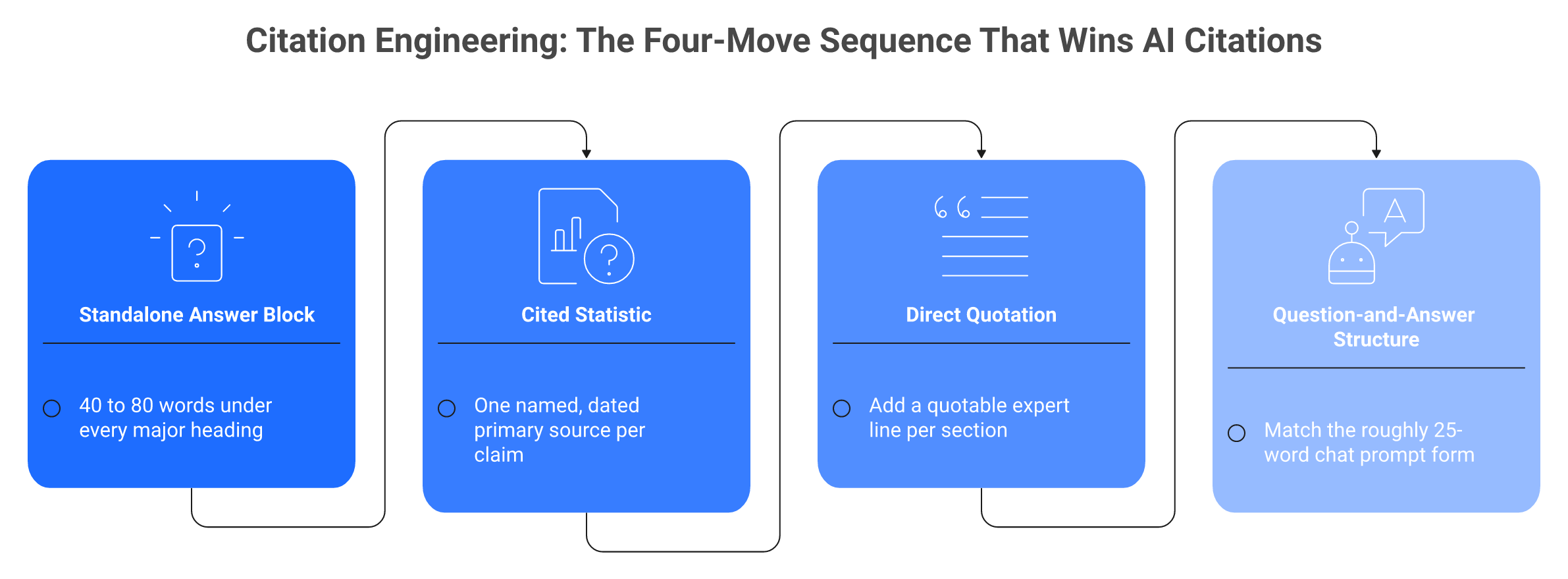
Citation engineering structures content so AI engines can extract and quote it with zero friction: one-sentence definitions, cited statistics, direct quotations, and question-and-answer formatting. The Princeton GEO study found that adding citations, quotations, and statistics to visible body text lifts source visibility 30 to 40 percent across queries. You are not writing for a ranking algorithm. You are handing the model a clean, attributable passage it can drop straight into its answer.
🔧 The Mechanism
Citation engineering is deliberate structure, not better prose. Every claim gets a source. Every section opens with a standalone answer that makes sense out of context.
Think of it as writing for extraction. If a passage cannot survive being copied into an AI answer on its own, it gets rewritten, a discipline built into our GEO content optimization process.
📊 The Proof, With an Honest Caveat
The 30 to 40 percent visibility lift is real and peer-reviewed. But read it carefully. That number measures citation share in synthesized answers, and it comes from visible body-text edits, not schema markup or technical tricks.
A separate 2024 study found that well-organized, authoritative content with clear sections and FAQ entries increased inclusion in AI answers by up to 37 percent on Perplexity. The pattern holds across studies: structure and evidence density win citations. Our Perplexity optimization work leans directly on this.
💬 Why Question-and-Answer Format Works
Chat prompts are longer and more specific than searches. The average Google query runs about six words. The average chat prompt runs around 25 words.
That length gap changes everything. Matching the question-and-answer form directly reduces friction for the AI trying to find the exact thing it needs. Format the content as the question a buyer would ask, then answer it in one clean block.
✅ The Monday Checklist
- Add a 40 to 80 word standalone answer under every major heading.
- Back each key claim with a named, dated primary source.
- Convert dense sections into explicit question-and-answer blocks.
- Include at least one statistic and one quotable line per section.
We build extractable answer blocks and question-and-answer structures at MaximusLabs against real citation patterns, not against a generic "write quality content" brief. We test which passage structures actually get cited, and we stay honest about what we are still unsure of.
Q4. How Do Entity Optimization and Platform-Specific Signals Get You Into the Citation Set?
A founder once asked us why his rebuilt pages got cited in Perplexity within weeks but stayed invisible in Google's AI Overviews for months. Same content, different engines, different rules. That gap is the entity-and-routing problem in one sentence.
AI engines cite entities they recognize and trust, so advanced GEO builds a consistent brand entity across your site, Wikipedia, Wikidata, and third-party mentions. Citation behavior differs by platform, so you route content and authority signals per engine. Strong, disambiguated entity signals raise the odds of landing inside every engine's narrow citation set.
🧩 The Entity Mechanism
An entity is how a machine recognizes your brand as a distinct, real thing. AI models sample brand data from large knowledge sources like Wikipedia, Wikidata, and business directories. If those sources disagree or stay silent, the model has no stable identity to cite.
Consistency is the work. Same name, same category, same author signals, everywhere the web describes you. We formalize this in our GEO knowledge graphs methodology.
📡 Why Platforms Behave Differently
Citation behavior is not uniform. Studies of citation overlap found ChatGPT shares roughly 35 percent of its sources with Google's underlying search, while Perplexity sits closer to 70 percent. Different engines also lean on different domains, a pattern we document in our ChatGPT, Perplexity, and Gemini citation patterns research.
| Engine | Leans heavily on | Routing implication |
|---|---|---|
| ChatGPT | Wikipedia, Reddit, media | Earn UGC and media mentions |
| Perplexity | YouTube, similar sources | Prioritize video and fresh sources |
| Google AI Overviews | Its own top-10 organic results | Rank organically first |
| Gemini | Structured, authoritative sources | Strengthen entity and schema signals |
Google confirms there is no secret AI tag or code that forces inclusion in its AI features. For Google, the path runs through strong organic ranking, since about 70 percent of AI Overview sources come from the top 10 results. Our Google AI and Gemini optimization work starts there.
🛠️ The Disambiguation Tactics
- Add or correct your Wikidata entry, the structured layer behind knowledge panels.
- Keep name, category, and founder details identical across LinkedIn, Crunchbase, and directories.
- Use consistent named-author signals so expertise ties to a real person.
- Earn mentions on the specific URLs each engine already cites, not just any big domain.
✅ The Per-Platform Routing Payoff
Map where your ICP asks each engine, then route effort accordingly. Rank organically for Google, earn video and UGC citations for Perplexity and ChatGPT, and tighten entity signals for Gemini.
We map a client's entity footprint at MaximusLabs and route citation-building per engine, because what ChatGPT considers important is not what Google or Perplexity considers important. Optimizing for a single platform leaves citations on the table across the other three, so talk to us through our team if you want that footprint mapped.
Q5. What Technical GEO Actually Moves the Needle, and Where Do Schema and llms.txt Really Stand?
Every quarter, an enterprise team hands us a 50-page technical audit from a prior agency. Page speed scores, crawl-error spreadsheets, Core Web Vitals charts. Meanwhile, their GPTBot access was switched off at the server, and nobody caught it.
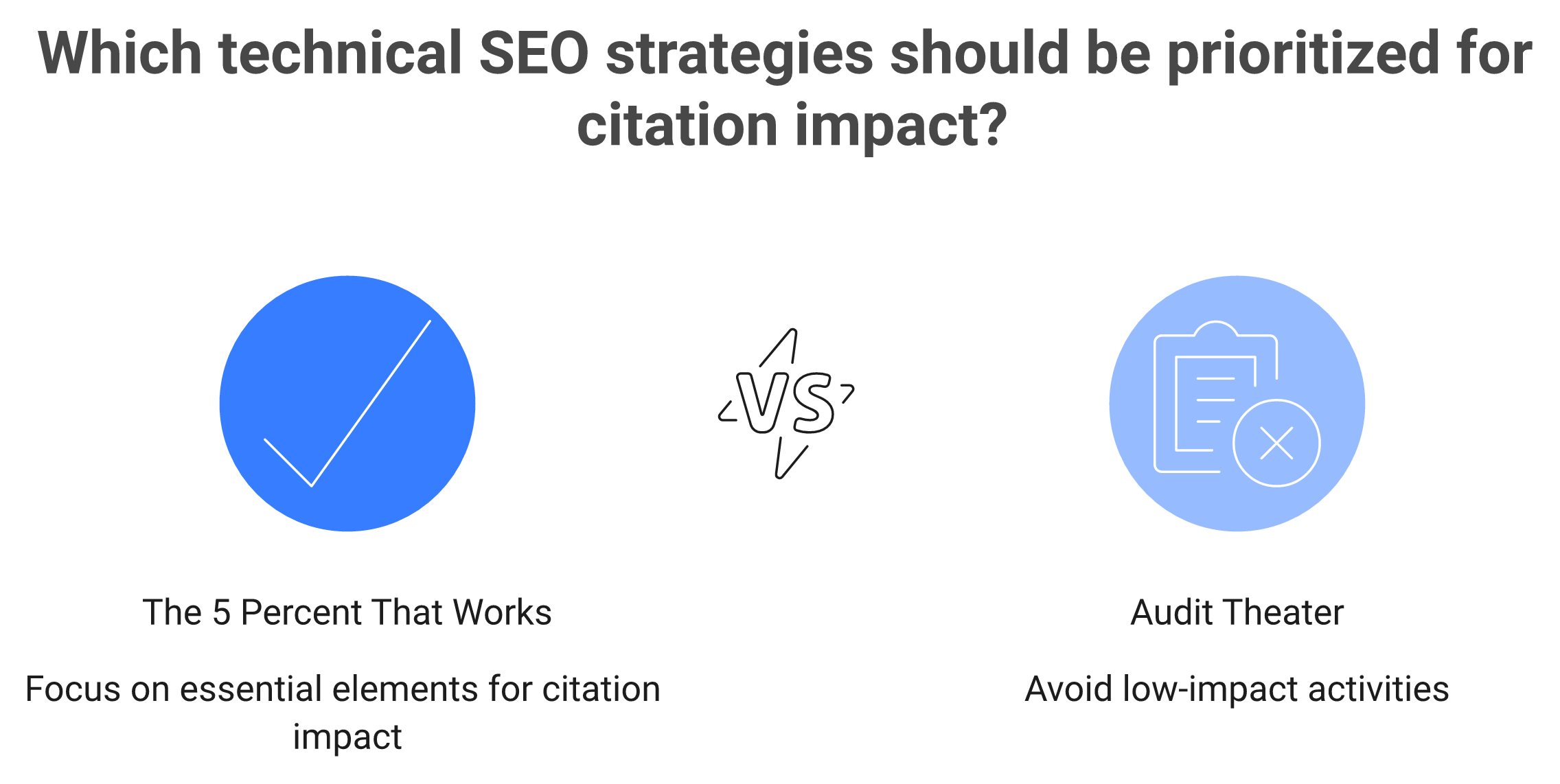
The technical GEO that matters is basic: let AI crawlers in and make pages discoverable. If GPTBot is blocked or pages sit orphaned in JavaScript, your content is literally zero to LLMs. Google states it does not use llms.txt and does not require schema for its AI features, so treat those as platform-specific, not universal. Most technical AEO audits produce big PDFs and little citation impact.
⚠️ The Situation: Audits That Feel Like Progress
Agencies love technical audits because they look rigorous. They fill decks with data. They rarely tie any of it to a citation or a dollar.
Ethan Smith of Graphite is blunt about the busywork. "In 15 years, I've never seen Core Web Vitals drive a traffic increase," he says, calling most best-practice work a kind of security blanket. Our technical SEO and website audit starts from the opposite end.
❌ The Complication: Contested Ground
The schema debate is genuinely unsettled. Mark Williams-Cook argues that "tokenization sort of destroys the schema," so it is low on his priority list, while Surfer Academy claims structured data raises the odds of inclusion in AI summaries. Both can be partly right, depending on the engine, a nuance we unpack in our schema markup basics guide.
Practitioners are also skeptical of the emerging "technical AEO" category. As one put it, this work "will likely create significant work with little to no impact," pointing at crawl-analysis theater. Google's own guidance settles part of it: there is no secret tag, and llms.txt is not used for its AI features. We cover the practical setup in our llms.txt resource.
✅ The Resolution: The 5% That Matters
A small slice of technical work drives almost all the outcome. Prioritize these:
- Crawler access. Turn on GPTBot and OAI-SearchBot in robots.txt. As Ethan says, "if you don't get indexed, then you're not even in the game." We detail this in our work on managing AI crawlers.
- Rendered content. Make critical text render in HTML, not buried in JavaScript.
- Point-to-point internal links. Think Southwest's route map, not Singapore's hub-and-spoke. Direct links keep pages from being orphaned.
"Ranked #1 across Google, ChatGPT, and Perplexity for 'best sleep mask,' triple-platform dominance from a single GEO strategy."
MaximusLabs AI, Nidra Goods engagement MaximusLabs Nidra Case Study
Unlike agencies shipping technical-audit PDFs, we spend our time at MaximusLabs on the 5% that changes citation outcomes: crawler access, indexation, and clean internal linking, the core of our technical GEO implementation work. We refuse to sell audits without an action layer, because a report that does not move pipeline is just expensive paper.
Q6. How Do You Earn Off-Site Citations With Search Everywhere Optimization?
The first time a founder watched us pull the citation list for "best website builder," he went quiet. His own site appeared once. Reddit, YouTube, and a Tier-1 affiliate appeared five times between them.
AI engines cite a mix of your pages and trusted third parties, so advanced GEO extends beyond your website. Identify the most-cited URLs for topics you care about, then earn placement or mentions there, Reddit threads, YouTube, and Tier-1 affiliates like Dotdash Meredith. This "Search Everywhere" approach builds the off-site consensus AI models treat as authority, often faster than ranking your own domain.
🎯 The Tactic: Follow the Citations, Not the Domain
Start where the engines already point. Ethan Smith's advice is precise: "Identify the most cited URLs for AEO topics you care about, then find a way to have those citations promote your product or brand." Our Reddit threads finder speeds up that first step.
The URL matters more than the brand. A mention on an irrelevant page from a giant site does nothing. The goal is the specific pages cited again and again across your question variants.
📺 Why Off-Site Consensus Wins
For broad head questions, earned mentions beat your own page. An LLM recommending a brand often does so because Reddit or a review site said so first, not because the brand's homepage ranked. This is the heart of our Reddit and forum AEO approach.
User-generated content is now a dominant citation source. Reddit and Quora traffic grew roughly 5x to 10x in six months in Google as well. YouTube is especially underused for B2B, where even a low-budget explainer video can get cited quickly.
"Achieved 64% citation rate across AI platforms, overtaking legacy 10-year-old billion-dollar competitors who sat at roughly 30%, in 6 months of GEO work."
MaximusLabs AI, Oliv AI engagement MaximusLabs Oliv AI Case Study
✅ The Repeatable Workflow
- Run your money questions across ChatGPT, Perplexity, and Gemini, and log every cited URL.
- Rank those URLs by citation frequency.
- Earn a mention on the top ones through authentic Reddit engagement, a YouTube video, or affiliate placement.
We call this Search Everywhere Optimization at MaximusLabs, and it maps the third-party URLs AI engines already cite in your category, then works to get you named on them, a process built into our answer engine optimization service. Optimizing only your own domain leaves most of the citation graph untouched.
Q7. How Do You Run GEO at Enterprise and Programmatic Scale?
An enterprise marketing lead once told us her team scoped a set of landing pages that should have taken two weeks. Engineering came back with a nine-month estimate. The GEO opportunity died in a backlog.
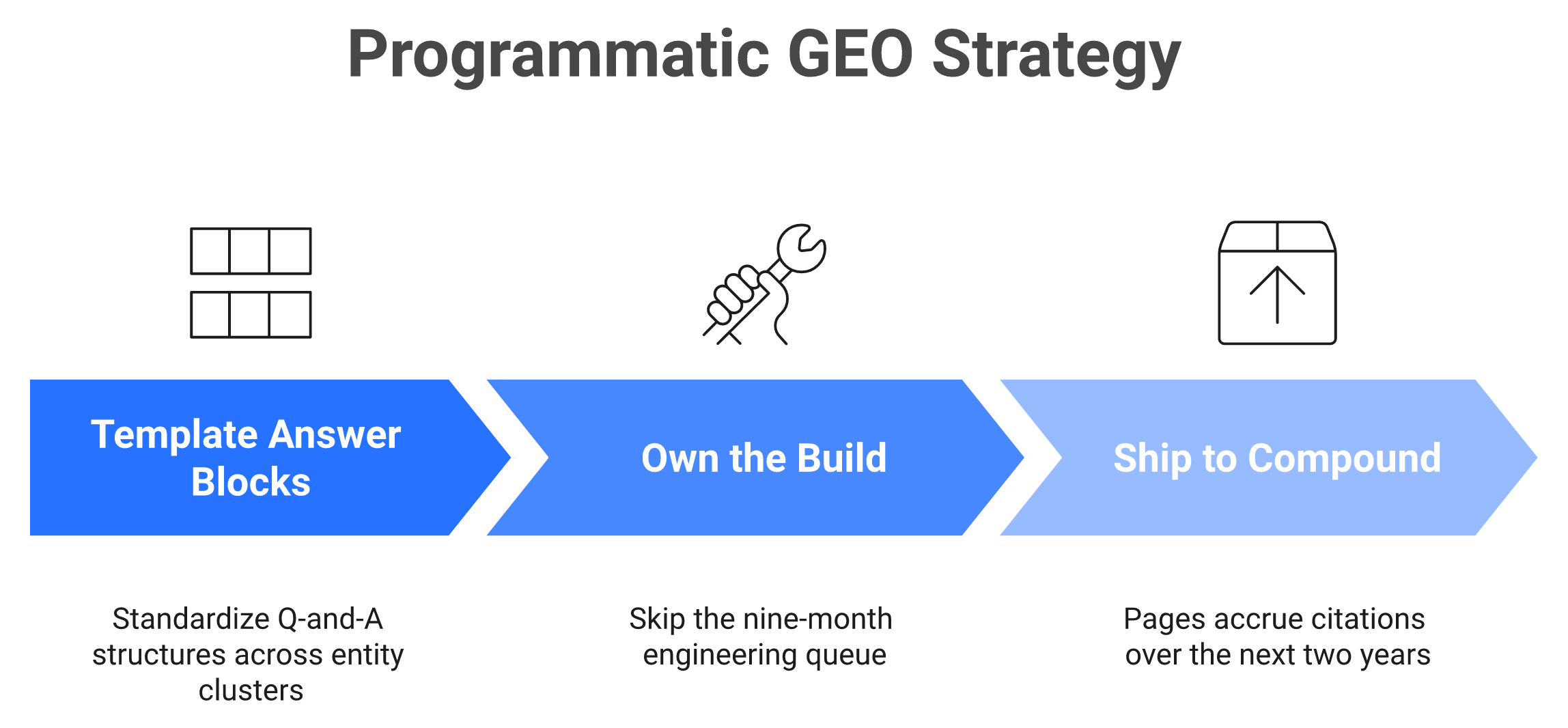
Programmatic GEO scales citation-ready content across thousands of pages using templated answer blocks mapped to entity clusters and query patterns. At enterprise scale, velocity and landing-page volume matter more than being first. Build the pages now and they compound into citations over time. The real blocker is rarely strategy. It is execution.
🏗️ The Situation: Scale Is the Whole Point
Enterprises do not need one great page. They need thousands, covering every feature, integration, and use case a buyer might ask an AI engine about. This is exactly what our programmatic SEO service is built to handle.
Chat prompts demand more nuance than search. The average Google query runs about six words, while chat prompts run around 25. Programmatic content has to be roughly four times more specific to match how buyers actually ask.
⏰ The Complication: The Engineering Bottleneck
Corporate engineering kills most technical GEO fixes. Ethan Smith rebuilt his agency around this exact problem. "Much of this stuff could be built in weeks or days," he says, "but they say the engineering team needs nine months, so we built a whole Webflow team because we can do things really fast." Our Webflow SEO capability solves the same bottleneck.
There is also a live debate on timing. Ethan calls first-mover advantage "a false concept," arguing that what matters is having the landing pages, since they start ranking once they exist. Others, like Deltologic's Jacob Wolitzki, insist first movers who integrate early earn entrenched patterns. Our read: velocity and volume beat being first.
This is where "The SEO Death Spiral" starts. A team hires an agency, gets a giant roadmap, sees no impact, loses engineering trust, and repeats the cycle next year.
✅ The Resolution: Full-Stack Velocity
- Template the answer blocks. Standardize question-and-answer structures across entity clusters.
- Own the build. Do not wait on a nine-month engineering queue.
- Ship for compounding. Publish now so pages accrue citations over the next two years.
"Currently helping defeat multi-deca-billion-dollar cybersecurity companies, proof that deep GEO understanding beats massive budgets."
MaximusLabs AI, UnderDefense engagement MaximusLabs Case Studies Collection
We run a full-stack model at MaximusLabs that sidesteps the engineering bottleneck and produces programmatic GEO content affordably, with a first article live in as little as four days, and clear pricing across tiers. That is how a lean team punches above billion-dollar incumbents.
Q8. Should You Use AI to Generate GEO Content at Scale?
A founder we advised wanted to auto-generate 500 pages over a weekend. The math looked irresistible until we ran the detection and visibility tests together. The plan quietly fell apart.
Use AI to assist, not to fully generate. Human-written content holds a higher visibility rate in LLMs than pure machine output, and fully automated content risks a self-referential summarization loop that degrades into sameness. Keep a human as the actual writer, use AI for research and drafting support, and validate detection risk before betting an enterprise budget on any workflow.
🤖 The Verdict: Assist, Don't Replace
Ethan Smith is direct here, and his history earns the opinion. He created scraped, rewritten spam in 2007 and watched Google crush it. His rule now: "Use AI to assist but not to generate. The human is the one who's actually producing and writing the content." Our AI content humanizer exists for exactly this human-in-the-loop step.
A rigorous study his team ran found that only 10 to 12 percent of content in Google and ChatGPT results is AI-generated. About 90 percent is not.
📊 The Proof, Including the Detection Risk
The performance gap is measurable. There is a clear correlation: human-written content ranks higher than AI-generated content. Detection tools are imperfect too, so betting a workflow on them is risky. In one test, an AI detector flagged human-written content as AI about 8 percent of the time, a real false-positive rate.
Then there is model collapse. Ethan describes it plainly: if AI feeds on its own summaries, "you have this infinite loop, and then you have garbage." Ask for the best ice cream flavor enough times and the model eventually insists there is only vanilla.
✅ The Human-in-the-Loop Model
- Use AI for research aggregation, outlines, and first drafts.
- Keep a human as the named author who writes, judges, and adds original insight.
- Validate any content workflow with your own controlled tests, not vendor claims, using tools like our AI content optimizer.
We run a hybrid human-and-AI pipeline at MaximusLabs where AI accelerates research and formatting, but humans drive voice, originality, and the founder's perspective, guided by our founder voice methodology guide. That is what protects the citation-visibility edge pure machine content loses, and it is why our pages read like the founder actually wrote them.
Q9. How Do You Measure AI-Search Visibility and Tie It to Revenue?
A VP Marketing showed us a dashboard glowing green: rankings up, impressions up, sessions up. Then her CFO asked which of those numbers closed a deal last quarter. The room went quiet.
Measure advanced GEO with citation share, share of answer versus competitors, citation velocity, and per-platform distribution across ChatGPT, Perplexity, Gemini, and Copilot, then tie it to pipeline. LLM traffic can convert far better than Google search traffic because users arrive pre-sold after researching off-site. Track revenue-linked BOFU and MOFU citations, not vanity impressions, so the marketing number improves, not just the dashboard.
📊 The New KPI Set
A single ranking position no longer describes reality. AI answers vary by query, by platform, and by session, so one number cannot capture them. The right metric is share of voice: how often you show up as the answer across thousands of question variants. We formalize this in our GEO measurement and metrics framework.
Track these four:
- Citation share. How often engines cite you for target questions.
- Share of answer. Your citation frequency versus competitors.
- Citation velocity. New citations gained over time.
- Platform distribution. Where you win across ChatGPT, Perplexity, Gemini, and Copilot, which our AI search visibility and brand mention tracking work maps continuously.
💰 Why This Ties to Revenue
The conversion math is the real argument. Ethan Smith of Graphite reported that Webflow saw a 6x conversion-rate difference between LLM traffic and Google search traffic. Those users research off-site first, then arrive ready to buy. This revenue link sits at the center of our GEO ROI and revenue attribution model.
Webflow also gets about 8 percent of its signups from LLMs, making it a top channel, not a novelty. AI answers increasingly cover commercial and transactional questions, so this is BOFU territory, not just awareness.
"Achieved a 64% citation rate across AI platforms and overtook legacy 10-year-old billion-dollar competitors who sat near 30%, in 6 months of GEO work."
MaximusLabs AI, Oliv AI engagement MaximusLabs Oliv AI Case Study
✅ The Reporting Model
Build a report that connects citations to money. Log share of answer monthly, tag which cited pages are BOFU or MOFU, then map them to pipeline influence in your CRM. This is the backbone of our R-GEO revenue-focused framework.
We report on citation share and pipeline influence at MaximusLabs, not impressions, because clicks and pageviews are vanity metrics if they never move revenue. Measure across thousands of question variants, not a single ranking, and you finally see what the CFO wants to see.
Q10. What GEO Mistakes and Myths Should You Avoid?
During one audit, a founder discovered Perplexity was describing his team as Oxford researchers. Flattering, except none of them went to Oxford. The model had stitched his brand to a conceptually adjacent paper, and the misinformation spread.
Avoid four traps: fully machine-generated content that loops into garbage, hyper-optimized copy that loses human logic, chasing zero-impact technical audits, and trusting AI to represent you accurately without monitoring. AI engines hallucinate, so audit how models describe your brand. Verify popular hacks against primary platform docs, not vendor blogs.
⚠️ The Situation: A Gold Rush Invites Shortcuts
New channels always attract shortcuts. The AI-search rush is no different, and the shortcuts look tempting because a few work briefly before they backfire. Our writeup of GEO failures and lessons catalogs how they backfire.
That Oxford story is real, and it names the risk. As Ethan Smith describes it, an AI "looked at a conceptually adjacent paper" and invented credentials his team never held. Hallucination is not rare, and it can attach false claims to your brand.
❌ The Complication: The Specific Traps
- Model-collapse content. Fully automated content becomes "a summarization of its own results, an infinite loop, and then you have garbage."
- Red-ocean over-optimization. Copy tuned so hard for machines it loses sense. Eli Schwartz recalls a hotel page describing "a bathtub with water that came out of a faucet."
- Zero-impact audits. Crawl-error theater and Core Web Vitals tuning that never move citations, the kind of trap our technical GEO implementation approach avoids.
- Contested hacks. First-mover advantage is debated, and llms.txt is not used by Google, so do not treat either as settled fact.
✅ The Resolution: Verify and Monitor
The fix is discipline, not paranoia. Verify every tactic against primary platform documentation before you spend on it. Then monitor how each engine actually describes your brand, a practice grounded in our E-E-A-T for AEO standards.
"Ranked #1 across Google, ChatGPT, and Perplexity for 'best sleep mask,' triple-platform dominance from a single GEO strategy."
MaximusLabs AI, Nidra Goods engagement MaximusLabs Nidra Case Study
We trace every claim to a primary source at MaximusLabs and watch how AI engines represent our clients, so hallucinated credentials get caught early, not after they spread. I might be wrong on where the schema debate lands, but I am certain that unverified hacks cost more than they save.
Q11. What's Next for GEO, and Where Should You Invest Now?
A developer we know opened Gemini and asked it to buy snowboard pants and complete the checkout end to end. It gathered options, then stalled at the purchase. The agent could shop but could not close.
GEO's next frontier is agentic commerce, where AI agents research, compare, and check out for the user, though the universal commerce protocols enabling this are still immature. Invest now in the durable basics: crawler access, citation-engineered content, off-site authority, and revenue-linked measurement. These compound regardless of which protocol wins, positioning you inside the AI answer set as agentic buying matures.
⏰ The Situation: Agents Are Coming
The direction of travel is clear. LLMs are moving from answering questions to taking actions, planning, comparing, and eventually purchasing on a user's behalf. Our agentic commerce service is built for exactly this shift.
That shift raises the stakes for being in the citation set. If an agent shortlists five products to buy, being outside that five means being outside the transaction entirely.
❌ The Complication: The Plumbing Isn't Ready
The snowboard-pants failure shows the gap. Universal commerce protocols and MCP-style server implementations, the connective plumbing agents need to transact, still break in practice. Nobody knows yet which standard wins. We track this closely in our agentic web stack research.
Betting your whole strategy on one unproven protocol is a cash risk. The smarter move hedges across whichever standard emerges.
✅ The Resolution: Invest in What Compounds
Put money where it pays off regardless of the winner:
- Keep AI crawlers indexing your site, verified with our AI crawlability checker.
- Keep engineering citation-ready, evidence-dense content.
- Keep earning off-site authority across Reddit, YouTube, and Tier-1 sources.
- Keep measuring share of answer against pipeline.
We help brands build this compounding foundation at MaximusLabs now, so they are already in the answer set when agentic buying goes mainstream, and you can start that conversation through our team. Where our thinking sits today: within two years, "becoming the answer" stops being an edge and becomes table stakes. So here is the question I would put to any founder reading this, are your pages ready to be the source an agent trusts, or just the link a shrinking SERP still shows?
Frequently asked questions
What are advanced GEO strategies and how do they differ from basic GEO and traditional SEO?
Advanced GEO strategies move a brand from occasionally mentioned to consistently cited by AI engines like ChatGPT, Perplexity, Gemini, and Google AI Overviews. Unlike basic GEO, they engineer citations, optimize entities, orchestrate cross-platform authority, and scale programmatically. The distinction matters because AI search shrank the evaluation set from hundreds of blue links to five to ten curated sources. If you are not inside the answer, you are effectively invisible to the buyer asking the question. Traditional SEO ranks a blue link using keywords. Basic GEO gets you answer-first structure so you appear in AI answers. Advanced GEO makes you the cited source across engines through citation engineering and entities. We treat GEO as a data science problem, reverse-engineering how RAG retrieval selects sources rather than reselling a 2019 checklist. What ChatGPT rewards is not what Google rewards, and that difference, mapped in our GEO vs traditional SEO breakdown , is the whole game. The goal is surviving the retrieval step so the model names you as the definitive source, not merely ranking beneath an AI summary.
Why is becoming the answer now more important than ranking?
Becoming the cited answer now beats ranking because AI engines synthesize one response from a shrunken set of five to ten sources instead of hundreds of links. Gartner projects over 50 percent of search traffic will move to AI-native platforms by 2028, and AI Overviews can sharply cut organic clicks. Two forces broke the old model at once: Zero-click behavior , where roughly 70 percent of searches end without a website visit. AI Overviews pushing organic results down, with one analysis pegging the click penalty near 34.5 percent for demoted results. The fix is a reframe. Stop measuring rankings alone and start measuring share of answer, how often you are the cited source across thousands of question variants and platforms. This is not just an awareness win. Webflow saw a 6x conversion-rate difference between LLM traffic and Google search traffic, because those users arrive pre-sold. We measure success through our answer engine optimization approach as share of answer and pipeline influence, not the vanity impressions traditional agencies still put on the dashboard. Being the answer is a pipeline event, not a vanity metric.
How does citation engineering actually win AI citations?
Citation engineering structures content so AI engines can extract and quote it with zero friction. It relies on one-sentence definitions, cited statistics, direct quotations, and question-and-answer formatting. The Princeton GEO study found that adding citations, quotations, and statistics to visible body text lifts source visibility 30 to 40 percent across queries. A separate 2024 study found well-organized content with clear sections and FAQ entries increased inclusion in AI answers by up to 37 percent on Perplexity. Here is the honest caveat: that lift measures citation share in synthesized answers, and it comes from visible body-text edits, not schema tricks. Add a 40 to 80 word standalone answer under every major heading. Back each key claim with a named, dated primary source. Convert dense sections into explicit question-and-answer blocks. Include at least one statistic and one quotable line per section. Chat prompts run around 25 words versus about six for Google, so matching the question-and-answer form reduces friction for the model. We build extractable answer blocks through our GEO content optimization process against real citation patterns, testing which passage structures actually get cited rather than following a generic quality brief.
How do entity optimization and platform-specific signals get you into the citation set?
AI engines cite entities they recognize and trust, so advanced GEO builds a consistent brand entity across your site, Wikipedia, Wikidata, and third-party mentions. Because citation behavior differs by platform, you also route content and authority signals per engine. An entity is how a machine recognizes your brand as a distinct, real thing. If knowledge sources disagree or stay silent, the model has no stable identity to cite. Consistency is the work: same name, same category, same author signals everywhere. ChatGPT leans on Wikipedia, Reddit, and media, so earn UGC and media mentions. Perplexity leans on YouTube and fresh sources. Google AI Overviews pulls about 70 percent from its own top-10 organic results. Gemini favors structured, authoritative signals. Studies of citation overlap found ChatGPT shares roughly 35 percent of its sources with Google, while Perplexity sits closer to 70 percent. We map a client's entity footprint through our GEO knowledge graphs methodology and route citation-building per engine, because optimizing for a single platform leaves citations on the table across the other three.
How do you run GEO at enterprise and programmatic scale?
Programmatic GEO scales citation-ready content across thousands of pages using templated answer blocks mapped to entity clusters and query patterns. At enterprise scale, velocity and landing-page volume matter more than being first, because pages compound into citations over time. Enterprises do not need one great page. They need thousands, covering every feature, integration, and use case a buyer might ask an AI engine about. Since chat prompts run around 25 words versus six for search, programmatic content has to be roughly four times more specific. The real blocker is rarely strategy. It is execution: Template the answer blocks across entity clusters. Own the build instead of waiting on a nine-month engineering queue. Ship for compounding so pages accrue citations over the next two years. Corporate engineering kills most GEO fixes, which is why velocity beats first-mover claims. We run a full-stack model through our programmatic SEO service that sidesteps the engineering bottleneck and produces content affordably, with a first article live in as little as four days. That is how a lean team punches above billion-dollar incumbents.
How do you measure AI-search visibility and tie it to revenue?
Measure advanced GEO with citation share, share of answer versus competitors, citation velocity, and per-platform distribution across ChatGPT, Perplexity, Gemini, and Copilot, then tie it to pipeline. A single ranking position no longer describes reality, since AI answers vary by query, platform, and session. Track these four metrics: Citation share : how often engines cite you for target questions. Share of answer : your citation frequency versus competitors. Citation velocity : new citations gained over time. Platform distribution : where you win across engines. The conversion math is the real argument. Webflow saw a 6x conversion-rate difference between LLM and Google traffic, and gets about 8 percent of signups from LLMs, making it a top channel. Because AI answers increasingly cover commercial questions, this is bottom-of-funnel territory. Build a report that connects citations to money: log share of answer monthly, tag cited pages as BOFU or MOFU, then map them to pipeline in your CRM. We report on citation share and pipeline influence through our GEO ROI and revenue attribution model, not vanity impressions, so the CFO finally sees what matters.
What GEO mistakes and myths should you avoid, and what is next for GEO?
Avoid four traps: fully machine-generated content that loops into garbage, hyper-optimized copy that loses human logic, chasing zero-impact technical audits, and trusting AI to represent you accurately without monitoring. AI engines hallucinate, so audit how models describe your brand and verify popular hacks against primary platform docs, not vendor blogs. Model-collapse content becomes a summarization of its own results, an infinite loop. Red-ocean over-optimization produces copy so machine-tuned it loses sense. Zero-impact audits chase crawl-error theater that never moves citations. Contested hacks like llms.txt, which Google does not use for AI features. Looking ahead, GEO's next frontier is agentic commerce, where AI agents research, compare, and check out for the user, though the universal commerce protocols are still immature. Invest now in the durable basics: crawler access, citation-engineered content, off-site authority, and revenue-linked measurement. These compound regardless of which protocol wins. We help brands build this compounding foundation, so start the conversation with our team to be in the answer set before agentic buying goes mainstream.