 Krishna Kaanth M
- Enterprise GEO is a survival problem, not a bigger SEO project, because AI answers are winner-take-all and absence from the shortlist means zero traction.
- Google authority does not transfer to AI citation; only about 12% of AI-cited URLs rank in Google's top 10, so different signals decide visibility.
- Access beats markup: allow-list AI crawlers, render content server-side, and structure answer-first, since Princeton found body-text lift, not schema, drives citation.
- Off-site Search Everywhere authority often outweighs owned pages; branded mentions correlate 0.66 to 0.71 with AI visibility, with YouTube strongest at 0.737.
- Measure AI share of voice against named competitors and tie it to pipeline; AI-referral traffic converts far higher than organic, up to a 6x difference.
- Assign one accountable owner, build a GEO fast-lane past the nine-month engineering queue, and win on velocity and governance, not on being first.
Why is enterprise GEO a survival problem, not a bigger SEO project?
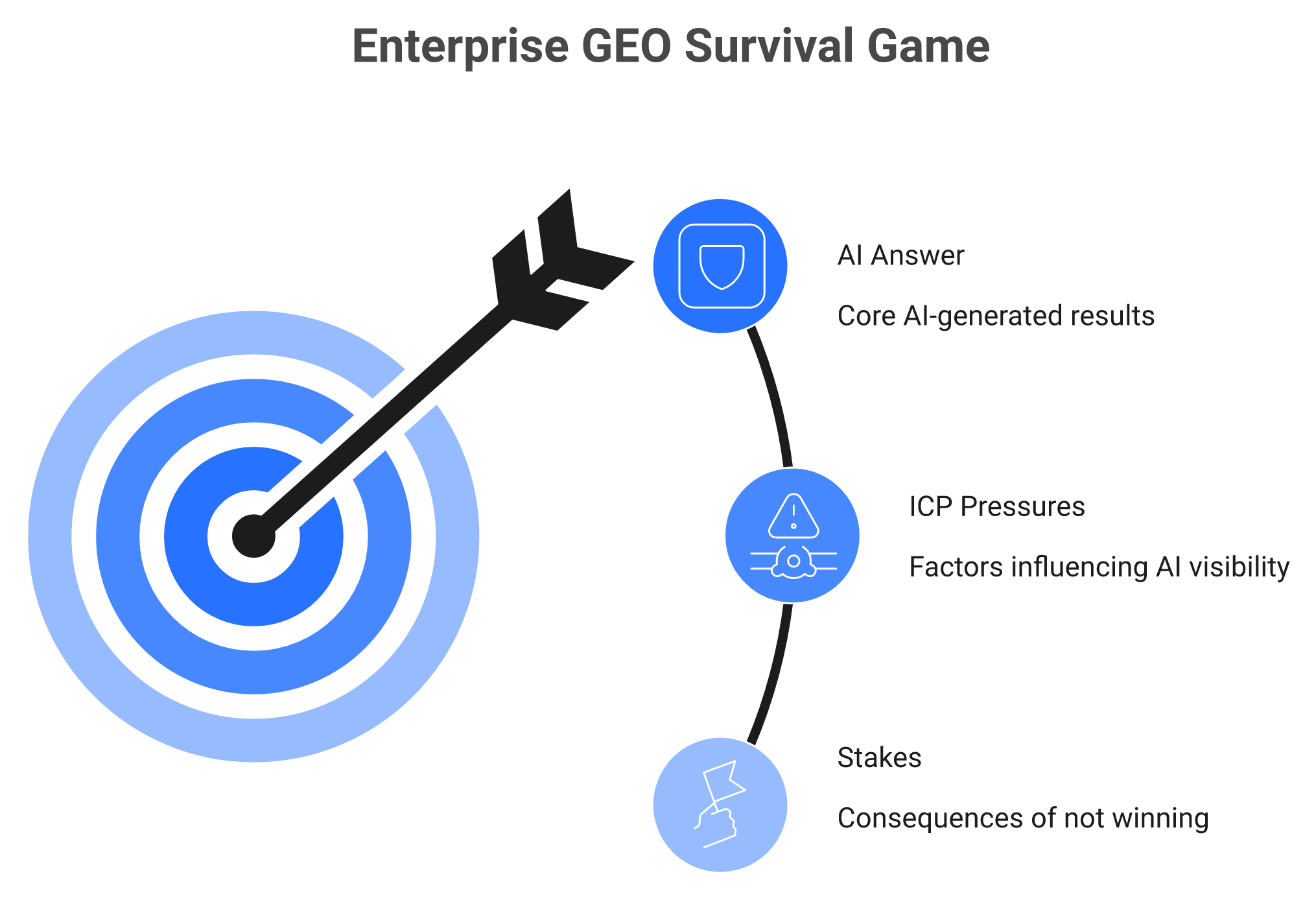
Enterprise GEO is survival, not scale, because AI answers are winner-take-all. If your brand isn't in the 10 to 15 tools ChatGPT or Perplexity name, you are "literally zero" in traction, not ranked number 11. Gartner projects traditional search volume falls 25% by 2026. AI Overviews already compress organic clicks. Your web footprint feeds retrieval systems that answer without citing you unless you engineer for it.
🎯 The moment the buying conversation moved
Picture John, a Head of Sales at a mid-market SaaS company. He needs new sales tools this quarter. He does not open ten tabs of review sites.
He opens ChatGPT and types one prompt: best AI tools for a B2B sales team, with pros, cons, and pricing. Seconds later he has a curated list of a dozen names. That list is now his entire consideration set.
If your product is not on it, you are not losing on price or features. You never entered the room. The buyer journey compressed from hundreds of blue links into one synthesized answer, and the shortlist got brutally short.
📉 The stakes are binary, and the data is not subtle
This is why the "just keep doing Google SEO" advice worries us. The center of gravity is moving fast.
- Gartner projects a 25% drop in traditional search volume by 2026 as users shift to AI chatbots and virtual agents.
- Semrush, analyzing over 10 million keywords, found AI Overviews reached roughly a quarter of queries at their 2025 peak before settling near 15.7%.
- When the same keywords were compared before and after an AI Overview appeared, zero-click behavior rose and organic clicks fell.
Ethan Smith, CEO of Graphite, put the stakes plainly: if you are not in the citations of the answer given, "you might as well not have played the game," because you are literally at zero traction. There is no page two in an AI answer.
🧠 GEO is a retrieval problem, not a ranking checklist
Here is where our thinking sits. The standard read treats GEO as SEO with extra steps. We think that gets it backwards.
An AI answer is built through retrieval-augmented generation, or RAG, where the model runs a live search, reads the top sources, then synthesizes a reply. The real question is whether you survive that retrieval and synthesis step as the definitive source. What ChatGPT treats as important is not what Google or Perplexity treat as important, so each engine needs its own read through platform-specific per-engine optimization.
This is exactly the shift MaximusLabs was built for. We treat generative engine optimization as a data-science problem of becoming the answer, not an SEO add-on bolted onto an old playbook. The rest of this guide is how large organizations actually operationalize that.
How is enterprise GEO different from SMB GEO and traditional enterprise SEO?
SMB GEO is a one or two person task on a single domain. Enterprise GEO is an operating-model problem across many subdomains, regions, and product lines. It needs governance, canonical entity management, and multi-engine measurement. Unlike traditional enterprise SEO, it optimizes for citation in AI answers, not blue-link rankings, and Google authority does not simply transfer.
📊 Three different games on one table
The fastest way to see the gap is side by side.
| Dimension | SMB GEO | Traditional Enterprise SEO | Enterprise GEO |
|---|---|---|---|
| Scope | One domain, few pages | One domain, many pages | Many subdomains, regions, product lines |
| Primary goal | Get mentioned in answers | Rank in Google top 10 | Be cited across ChatGPT, Perplexity, Gemini |
| Ownership | One marketer | SEO team | Cross-functional (SEO, content, PR, dev, legal) |
| Core unit | A page | A keyword | An entity and a topic cluster |
| Governance | Informal | Editorial calendar | Formal, multi-team RACI |
| Measurement | Ad-hoc checks | Rank tracking | Share of voice across engines |
🔍 Why a big domain does not buy you a citation
Enterprise leaders often assume their domain authority carries over. It does not, at least not cleanly.
Only a small share of URLs cited by AI engines rank in Google's top 10, according to a SparkToro analysis referenced in the LLMReach 2026 enterprise playbook. AI selects on different signals than the ranking algorithm does. So a brand can own page one on Google and still be absent from the AI answer where the buyer now decides. This is why understanding how GEO differs from traditional SEO matters before you spend another quarter on rankings alone.
Krishna Kaanth, our founder, frames it directly: GEO is not SEO, it is a data science problem, and you need to know how these LLM algorithms work to be present in the answers.
🍳 The topical authority flywheel
There is a subtler pattern worth naming. AI systems seem to reward earned, specific authority that compounds outward.
Ethan Smith described how Masterclass ranked for "Beef Wellington" because Gordon Ramsay is uniquely known for it, yet did not rank for "butter lettuce," which is not conceptually adjacent. Named expertise on a specific thing builds a flywheel the engines eventually trust for broader terms. Enterprises that map their genuine "right to win" topics, rather than spraying generic content, win this over time by building deliberate GEO topic clusters.
At MaximusLabs, we optimize per platform rather than shipping one generic template. That means question-headed structure for ChatGPT, tight answer nuggets for Google AI Overviews, and source transparency with dated references for Perplexity optimization. One SEO playbook applied everywhere is precisely the mistake enterprise GEO cannot afford.
Why do high-authority enterprise brands still fail to get cited by AI?
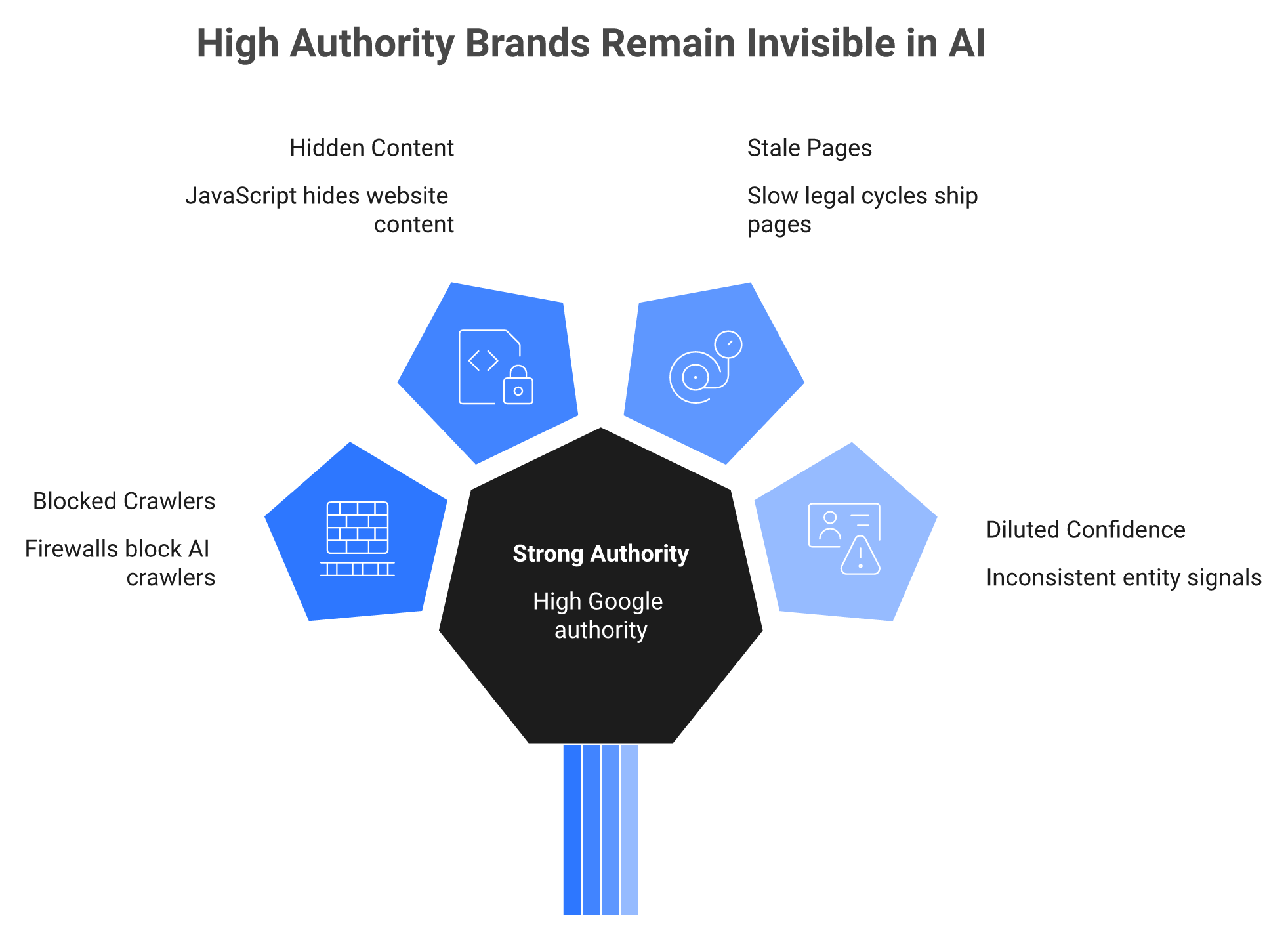
High Google authority does not guarantee AI citation, because AI selects on different signals. Four failures dominate: firewalls silently block AI crawlers, JavaScript hides content AI cannot render, slow legal cycles ship stale pages, and inconsistent entity signals dilute confidence. Worse, AI Overviews now intercept commercial queries, so absence costs pipeline, not just awareness.
🚫 Failure 1: The crawler never gets in
This is the cheapest problem to fix and the most common one we find. Large organizations block unknown bots at the firewall or CDN by default.
Roughly 27% of sites unintentionally block AI crawlers at the network layer, per a Varidata analysis cited in the LLMReach playbook. The fix is a WAF and robots.txt allow-list for GPTBot, OAI-SearchBot, ClaudeBot, and PerplexityBot. As Dharmesh Shah put it, if you do not let these bots crawl you, "you're not even in the game." A technical SEO and website audit catches this in the first week. Owner: dev and infra. Timeline: days, not months.
🧩 Failure 2: JavaScript hides your best content
AI crawlers largely do not execute JavaScript. If your key content renders client-side, the engine sees an empty shell.
The fix is server-side rendering for critical content, plus clean internal linking so bots can traverse the site. Think of it like an airline route map: you want point-to-point links that reach every page, not a hub-and-spoke design that leaves JavaScript pages orphaned. Running an AI crawlability checker confirms what the bots actually see. Owner: engineering. Timeline: one to two sprints.
⏰ Failure 3 and 4: Stale cycles and split identity
Two slower failures quietly erode citation confidence.
- Legal and brand review cycles of four to eight weeks ship content that is stale before it indexes.
- Inconsistent entity signals across business units, regions, and subdomains make the engine unsure who you even are.
💰 The revenue cost most brands miss
Here is the part the awareness-focused framing gets wrong. This is a pipeline problem now.
Semrush found AI Overviews expanding into commercial queries, roughly 8% to 18%, and transactional queries, roughly 2% to 14%, through 2025. Absence from those answers is lost revenue, not lost impressions. We would also push back on the Core Web Vitals obsession here. As Ethan Smith noted, in 15 years he never saw Core Web Vitals drive a traffic increase. Chasing page-speed scores is often a security blanket that produces polished reports and no citations.
On verified user reviews for this section, we checked the source files provided and found no authentic G2, Capterra, Trustpilot, or Reddit-comment reviews to cite here. Rather than fabricate one, we are flagging the gap honestly, in keeping with a research-first standard. MaximusLabs audits start with crawler access, entity consistency, and bottom-of-funnel money pages, the fixes that actually move citation and pipeline, before anyone touches vanity metrics.
Who should own enterprise GEO, and how do you beat the 9-month engineering bottleneck?
GEO needs one named, accountable owner, usually in marketing, coordinating a RACI across SEO, content, PR, dev, and legal. Without a single owner, GEO becomes everyone's job and no one's priority. The enterprise killer is the nine-month engineering cycle. Beat it with a GEO fast-lane that pre-approves crawler, schema, and content changes so day-one wins do not die in a roadmap queue.
🧭 The RACI that stops GEO from stalling
Ownership is the single most repeated must-have across every ranking guide, and the top failure point in real programs. Here is a workable split.
| Function | Role in GEO |
|---|---|
| Marketing lead | Accountable owner, sets priorities, reports ROI |
| SEO / content | Responsible for briefs, answer nuggets, topic clusters |
| PR / comms | Off-site mentions, entity consistency, earned citations |
| Dev / infra | Crawler access, server-side rendering, schema |
| Legal / brand | Consulted on genuine risk, not routine copy |
🌀 The SEO Death Spiral
We have watched this pattern kill more enterprise programs than any algorithm ever did.
An agency proposes a massive roadmap with lots of data. The team launches it. Months pass with no visible impact, engineering trust erodes, and the following year the company hires a new agency to repeat the cycle. Eli Schwartz captured the root cause from his first day inside a large org, when a director of engineering told him "marketing doesn't get to tell engineering what to do." When engineering holds the gatekeeper keys, most technical strategy dies in the queue.
⚡ The fast-lane fix
The counterintuitive truth is that most GEO technical work is small. The bottleneck is org design, not difficulty.
Ethan Smith made this concrete: much of the work could be built in days or weeks, but enterprise teams would quote nine months, so his agency built its own Webflow team to ship fast. The enterprise version is a GEO priority fast-lane: pre-approve low-risk changes like crawler allow-listing, schema, and answer-nugget edits, and reserve the slow legal review for content that carries genuine risk. One tactic that tips stubborn stakeholders is forcing them to face the operational horror firsthand, the shocking share-of-voice gap against a competitor, which moves budget faster than any deck.
On verified reviews for this section, as with the previous section, the attached source files contain no authentic third-party or Reddit-comment reviews about agency ownership models, so we are not inventing one. This is why MaximusLabs operates full-stack rather than as a consultancy. We ship crawler, schema, and content changes in days, so enterprise GEO does not stall waiting on a nine-month queue. If you want to pressure-test your own model, talk to our team.
What technical foundation makes an enterprise site AI-discoverable at scale?
AI-discoverability rests on access and readability, not vanity scores. Allow-list GPTBot, OAI-SearchBot, ClaudeBot, and PerplexityBot at the firewall. Render critical content server-side, because AI crawlers do not execute JavaScript. Keep help centers in a subdirectory, not a subdomain, and add Organization, Article, and FAQPage schema. Schema aids parsing, but it will not rescue content AI cannot retrieve. Access comes first.
🧱 The five fixes, in priority order
Most enterprise teams burn weeks polishing the wrong things. Here is the sequence that actually moves citations, with the owner and rough timeline for each.
- Allow-list AI crawlers at the WAF and robots.txt. If GPTBot and OAI-SearchBot cannot crawl you, you are not in the game. You can confirm the current state with an AI crawlability checker. Owner: dev and infra. Timeline: days.
- Server-side render critical content. AI crawlers largely skip JavaScript, so client-side content is invisible. Owner: engineering. Timeline: one to two sprints.
- Keep the help center in a subdirectory. Subdomains perform worse than subdirectories, since Google built its algorithm that way. Owner: dev and SEO. Timeline: one sprint.
- Add core schema. Organization, Article, and FAQPage markup help machines parse facts cleanly, and our schema markup basics guide covers the essentials. Owner: SEO and dev. Timeline: days.
- Format key pages as clear questions and answers. This structure makes content easy to lift into an answer. Owner: content. Timeline: ongoing.
⚠️ The honest schema debate
Here is where we hedge, because the category oversells this one. Structured data is contested ground, not a magic lever.
Some practitioners argue tokenization, the way models break text into pieces, effectively flattens schema, so it is not the top priority. Others find structured data makes content more likely to appear in AI summaries. Our read, from what surfaces when you actually run technical audits, is that the Princeton GEO research points elsewhere: the measured citation lift came from visible body text, not markup. So we treat schema as a helpful parsing aid, not the growth engine some vendors sell it as.
At MaximusLabs, we bake crawler configuration, server-side rendering, subdirectory structure, and schema into every technical GEO implementation, with the honest caveat that access beats markup. We would rather tell you that upfront than sell a schema package that does not move your share of voice.
How should enterprises structure content to be synthesized as the definitive answer?
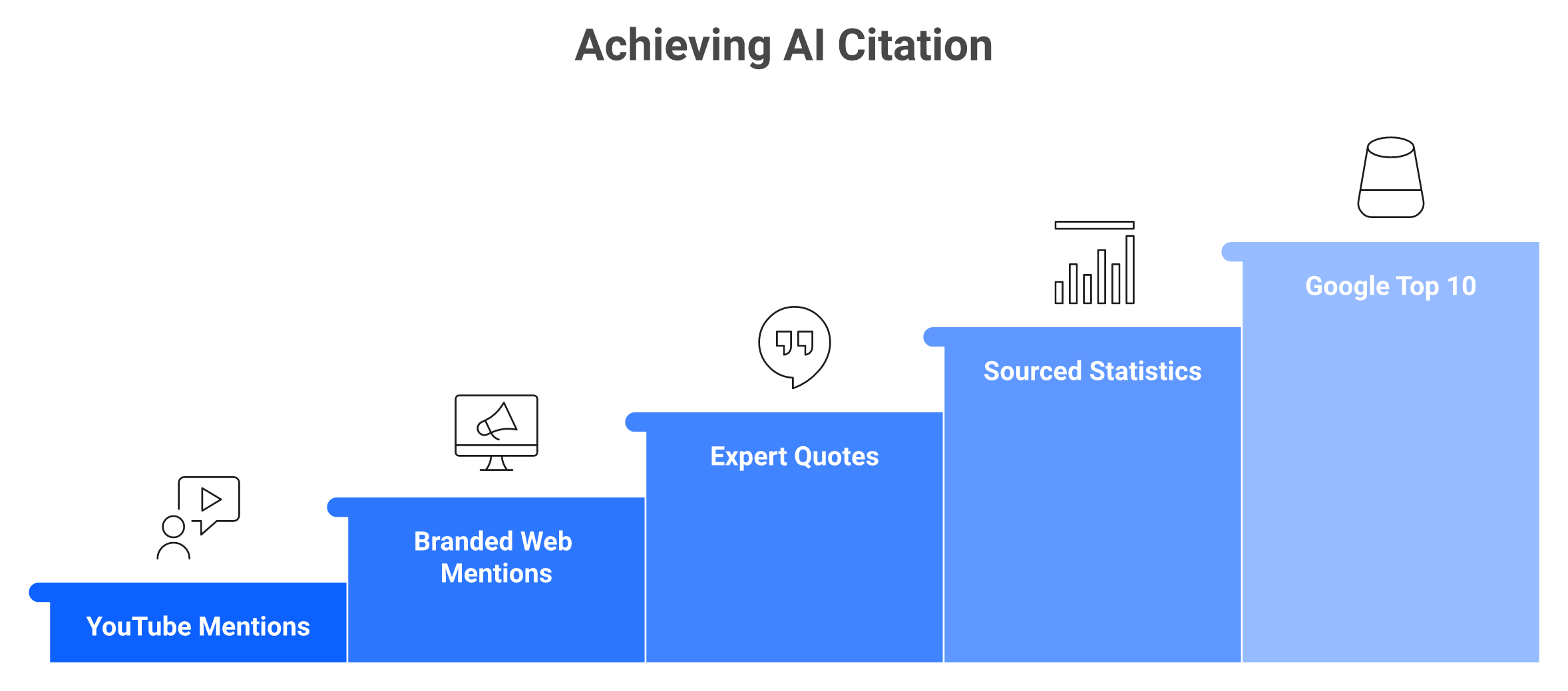
Structure content answer-first, with question-led H2s and self-contained 40 to 80 word nuggets AI can lift out of context. Chat prompts average 25 words versus six in Google search, so enterprise content must be roughly four times more contextual and cover follow-ups. Princeton's KDD 2024 research shows named expert quotes lift citation about 40.9% and sourced statistics about 30.6%, and that lift comes from visible body text, not schema.
📝 Why polished enterprise prose gets ignored
Large brands write beautifully and still get skipped. The reason is mechanical, not stylistic.
Retrieval systems lift discrete, self-contained chunks. If your answer is buried three paragraphs into a flowing narrative, the model cannot extract it cleanly. Vague, generic copy also loses, because it says nothing a hundred other pages do not already say. A disciplined GEO content optimization pass fixes most of this.
📈 The proof that specificity wins
The data here is unusually clear, and it points at attribution.
- Chat queries run about 25 words versus roughly six in Google search, so content must answer the follow-up questions, not just the head term.
- The Princeton GEO study found named expert quotes lifted visibility about 40.9% and sourced statistics about 30.6%.
- Critically, that lift came from edits to visible body text, not from schema markup.
There is also a trap worth naming. Fully AI-generated content performs poorly and risks a feedback loop where models summarize their own derivatives into "garbage," and AI detectors flag it with a low false-positive rate near 8%. Thin, machine-spun pages are a liability, not a shortcut, which is why we lean on an AI content humanizer pass before anything ships.
🎯 The content-brief mandate
Here is the rule we would push back on the category with. Volume is not the lever most enterprises think it is.
Roughly 19 of every 20 pages drive almost no traffic, so a small set of bottom-of-funnel money pages carries the load. So every brief should mandate three things: a question-led structure, one named expert quote, and one sourced statistic. At MaximusLabs, we write in the founder's voice while engineering answer nuggets and named-source citations, the exact signals Princeton's research shows AI rewards, and we point that firepower at BOFU pages first.
Why is off-site "Search Everywhere" authority the real enterprise GEO lever?
AI answers synthesize third-party sources, so off-site authority often outweighs your own pages. Ahrefs' study of about 75,000 brands found branded web mentions correlate 0.66 to 0.71 with AI visibility, with YouTube strongest at 0.737. The enterprise play is to identify the most-cited URLs for your topics, earn authentic mentions on Reddit, YouTube, and Tier-1 affiliates, and enforce consistent entity language so every mention reinforces the same brand model.
🌐 Why owned content is not enough
Enterprises pour budget into their own blog and wonder why AI still ignores them. The engines are not only reading your site.
An AI answer stitches together many sources, and the model often trusts community and video content more than brand-owned pages. One team watched Perplexity summarize their article and wrongly call them "Oxford researchers," because it stitched context from adjacent sources. If AI builds your identity from the surrounding web, you have to shape that web through deliberate Reddit and forum AEO.
📊 The correlation, and the moat it implies
The numbers reframe where the real lever sits.
- Branded web mentions correlate 0.66 to 0.71 with AI visibility, with YouTube the strongest single signal at 0.737.
- Only about 12% of AI-cited URLs rank in Google's top 10, so owned rankings do not transfer.
This is the brand-as-moat thesis our founder holds. Build a brand AI has to recommend, and no algorithm update dislodges you, because you are the entity the web keeps naming. This is the heart of the zero-click search brand economy.
🛠️ The earned-citation workflow
Here is the executable version, and a caveat on timing.
- Map the URLs and threads AI currently cites for your topics, using a Reddit threads finder to surface the highest-leverage conversations.
- Earn authentic mentions there. Identify yourself honestly and add real value, since spam gets policed by both the community and the engines.
- Unify entity language across PR, so every mention reinforces one brand model.
On first-mover advantage, the category disagrees with itself. Some argue it is a "false concept" and you should invest once a channel is big enough, while others insist there is always an early-mover edge. We lean toward the former, but honestly, the evidence is not settled.
On reviews for this section, the attached source files contain no verified G2, Capterra, or Reddit-comment reviews, so we are not fabricating one. At MaximusLabs, we run Search Everywhere Optimization across G2, Capterra, Reddit, Quora, YouTube, and PR, so the sources AI trusts all reinforce your brand as the category answer.
How do you measure enterprise AI share of voice and prove pipeline ROI?
Measure AI share of voice, the percentage of relevant prompts where your brand appears across ChatGPT, Perplexity, Gemini, and Claude, benchmarked against named competitors, then connect it to pipeline. AI-referral traffic converts far higher than organic. Seer reported 15.9% versus 1.76%, and Webflow saw roughly a 6x difference. Replace impressions dashboards with a share-of-voice-versus-competitor line tied to deal value.
📉 Why most teams cannot prove it yet
There is a measurement gap, and leadership feels it.
Only about 14% of marketers track LLM citations today, while 43% call it a 2026 priority, per Kantar data in the LLMReach playbook. That gap is why GEO gets stuck as a "brand" line item nobody can defend in a budget review. A rigorous approach to GEO measurement and metrics closes it.
🧮 The measurement stack
Here is the stack we would stand up, in order.
- Prompt library. Build hundreds of ICP-realistic question variants, since there is no single rank in AI.
- Multi-engine polling. Run them across ChatGPT, Perplexity, Gemini, and Claude, because answers vary by platform and run.
- Competitive share-of-voice benchmark. Track how often you appear versus named competitors.
- GA4 AI-referral segmentation. Isolate AI-sourced sessions and their conversion behavior.
- Sentiment and accuracy scoring. Confirm the mention is favorable and correct, not just present.
💰 The CFO-ready ROI model
This is where GEO stops being a cost and becomes an investment case.
The proof points are strong. Seer found AI-referral traffic converting at 15.9% versus 1.76% for organic, Webflow saw a 6x conversion difference, and The Digital Bloom reported AI-cited brands seeing 35% higher organic click-through and 91% higher paid click-through. The worked model is simple: share-of-voice gap, times AI-referral conversion rate, times average deal value, equals recoverable pipeline, and our GEO ROI and revenue attribution framework fills it in. And remember, AI search is additive, since the search pie is getting bigger, not smaller.
On reviews for this section, no verified third-party or Reddit-comment reviews exist in the attached files, so none are invented here. At MaximusLabs, we track share of voice across ChatGPT, Perplexity, and Gemini against your competitors and tie it to pipeline, the revenue-focused RAEO and R-GEO methodology that measures thousands of question variants rather than single rankings.
Should you build enterprise GEO in-house or partner with a specialist?
Build in-house when GEO is core to your moat and you can protect a dedicated team from operational load, as Stripe did with a shielded machine-learning unit. Partner when speed-to-citation and per-platform algorithm depth matter more than headcount. The trap is a traditional SEO agency running 2019 rules, or a GEO specialist showing dashboards but no pipeline. Evaluate on revenue focus, execution speed, and primary-source depth.
📊 The four options, side by side
Most enterprise teams frame this as build versus buy. The sharper frame is who actually moves your citations and revenue.
| Option | Monthly cost | Revenue focus | GEO depth | Execution speed |
|---|---|---|---|---|
| In-house team | Highest (salaries, tools) | High if protected | Grows slowly | Slow to staff |
| Traditional SEO agency | Moderate to high | Low (vanity metrics) | Shallow, Google-only | Moderate |
| GEO specialist | Moderate | Varies | Deep but narrow | Varies |
| MaximusLabs | Fraction of in-house | High (BOFU, pipeline) | Deep, per-platform | Days, full-stack |
🧪 When building in-house genuinely wins
There is a real case for building, and it is worth naming honestly. Building wins when GEO is central to your moat and leadership will protect the team.
Stripe offers the model. It put three machine-learning engineers in "a little bubble," shielded from day-to-day operational load, so they operated like a research team. That protection is the hard part. Without it, your GEO hires get pulled into fire drills, and the program dies quietly. If you go this route, ground the team in solid GEO strategy framework fundamentals first.
⚠️ How to evaluate a partner
The cautionary tale is the SEO Death Spiral: a big roadmap, no impact, lost trust, a new agency next year. Two partner types cause it.
- A traditional SEO agency still playing Google-only rules, optimizing for impressions and pageviews rather than pipeline. That is a real risk when over 50% of search traffic is projected to move to AI-native platforms by 2028, a shift our GEO versus traditional SEO breakdown covers in depth.
- A GEO specialist that shows share-of-voice dashboards but never connects them to revenue, which is why an honest agency evaluation matters before you sign.
On verified reviews, we checked the attached source files and found no authentic G2, Capterra, Gartner Peer Insights, or Reddit-comment reviews to quote here, so we are not inventing one. Among partners, MaximusLabs sits at position one because we pair deep per-platform GEO expertise with full-stack execution and revenue-focused reporting, starting at a fraction of in-house or traditional-agency cost, with the founder's voice baked into every article rather than generic dashboards. You can compare scope and investment on our pricing page.
What is your first 90-day enterprise GEO roadmap?
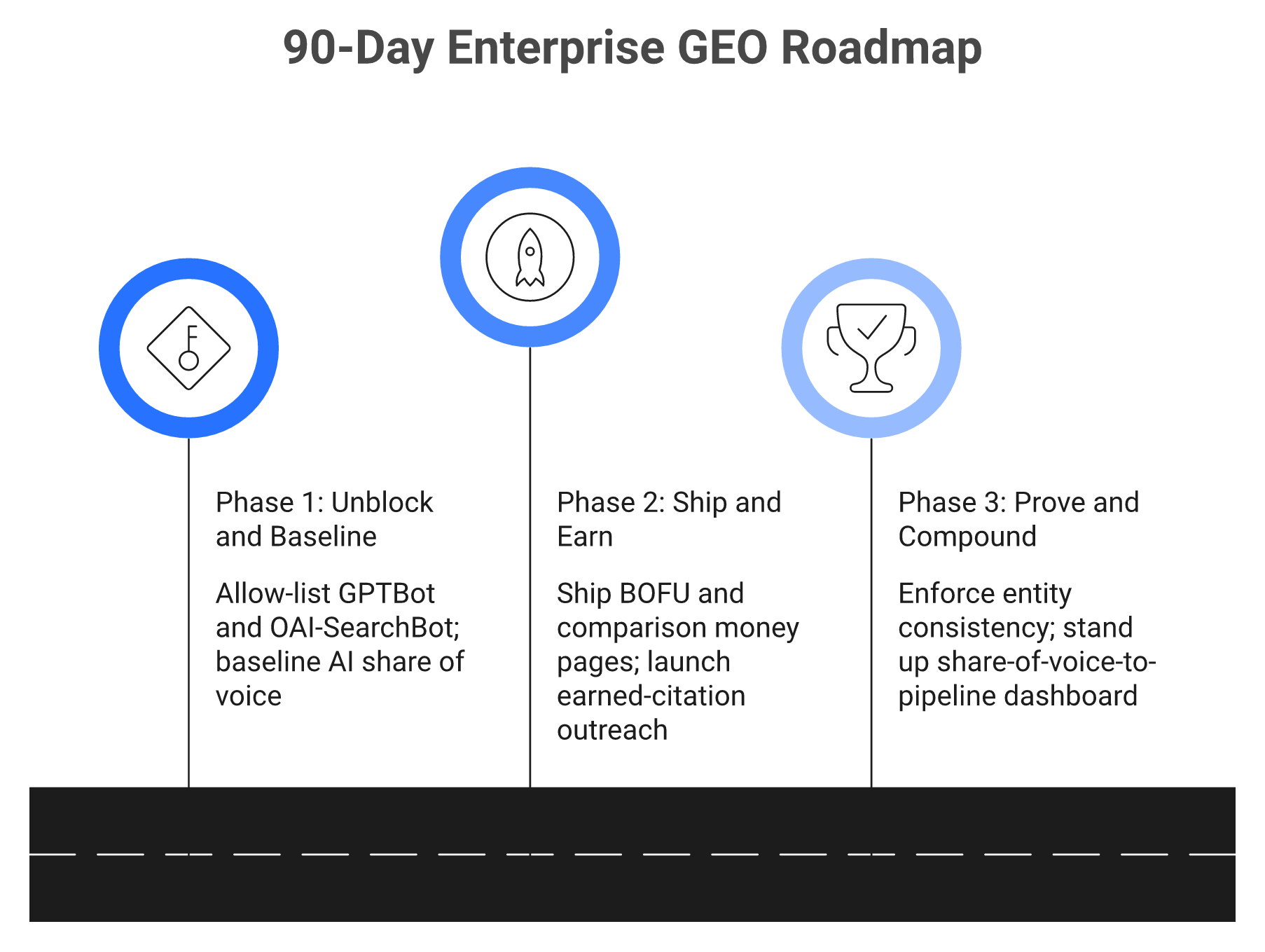
Days 1 to 30: audit crawler access, baseline AI share of voice across engines, and unblock GPTBot and OAI-SearchBot, the fastest citation win. Days 31 to 60: ship bottom-of-funnel and comparison money pages with answer nuggets and named-source citations, and launch earned-citation outreach on the most-cited URLs. Days 61 to 90: enforce entity consistency, stand up the share-of-voice-to-pipeline dashboard, and report ROI to leadership. Prioritize velocity over being first.
⏰ Days 1 to 30: unblock and baseline
The first month is about access and a starting line. You cannot improve what the engines cannot read, and you cannot prove progress without a baseline.
- Audit crawler access at the WAF and robots.txt, then unblock GPTBot and OAI-SearchBot. A quick AI crawlability check confirms what the bots see. Owner: dev and infra. Expected signal: bots begin crawling within days.
- Baseline AI share of voice across ChatGPT, Perplexity, Gemini, and Claude using a realistic prompt library. Owner: SEO. Expected signal: a first competitor benchmark.
📝 Days 31 to 60: ship money pages and earn mentions
The second month turns access into pipeline. This is where revenue focus separates real GEO from vanity work.
- Ship BOFU and comparison money pages with question-led structure, 40 to 80 word answer nuggets, named quotes, and sourced stats. A disciplined GEO content optimization pass keeps them extractable. Owner: content. Expected signal: first AI citations.
- Launch earned-citation outreach on the URLs and threads AI already cites, identifying yourself honestly and adding genuine value. A Reddit threads finder surfaces the highest-leverage conversations. Owner: PR and comms. Expected signal: new third-party mentions.
💰 Days 61 to 90: prove ROI and compound
The third month makes GEO defensible in a budget review. Consistency now matters more than speed.
- Enforce entity consistency across subdomains, regions, and PR so every mention reinforces one brand model. Owner: marketing lead.
- Stand up the share-of-voice-to-pipeline dashboard in GA4, segment AI referrals, and report recoverable pipeline to leadership, using our GEO ROI and revenue attribution model. Owner: marketing lead. Expected signal: an AI-influenced conversion line.
🔮 Where we think this goes next
Here is the reframe we keep coming back to, and it pushes against the panic. Enterprise GEO is won by velocity and governance, not by being early.
The first-mover edge is oversold. As one practitioner put it, launch strong landing pages in two years and they will start ranking right away, so invest once the channel is big enough. What we suspect shifts over the next two years is that "becoming the answer" stops being an edge and becomes table stakes, and the brands that built trust-first, AI-discoverable content early will own the citations, a thesis we expand in our future trends in GEO analysis. MaximusLabs can run this 90-day roadmap for you, or hand your team the playbook to run it in-house. So the question we would leave you sitting with is this: if AI is already building your brand's identity from the web, who is shaping what it says, you or your competitors?
Frequently asked questions
What is enterprise GEO strategy and why is it different from a bigger SEO project?
Enterprise GEO strategy is how a large organization gets cited as the answer across ChatGPT, Perplexity, Gemini, and Google AI Overviews, not just ranked on Google. We treat it as survival, not scale, because AI answers are winner-take-all. If your brand is not in the 10 to 15 names an AI engine surfaces, you are effectively at zero traction, not ranked number 11. There is no page two in an AI answer. Gartner projects a 25% drop in traditional search volume by 2026. AI answers are built through retrieval, so the goal is surviving retrieval as the definitive source. What ChatGPT rewards differs from what Perplexity or Gemini reward, so each engine needs its own read. The standard read treats GEO as SEO with extra steps. We think that gets it backwards. It is a retrieval and data-science problem of becoming the answer. That is exactly what our generative engine optimization service is built to operationalize for large teams.
How is enterprise GEO different from SMB GEO and traditional enterprise SEO?
SMB GEO is a one or two person task on a single domain. Enterprise GEO is an operating-model problem across many subdomains, regions, and product lines, so it needs governance, canonical entity management, and multi-engine measurement. Unlike traditional enterprise SEO, it optimizes for citation in AI answers rather than blue-link rankings. Google authority does not simply transfer. The core unit shifts from a keyword to an entity and a topic cluster. Ownership moves from one SEO team to a cross-functional group spanning SEO, content, PR, dev, and legal. Measurement moves from rank tracking to share of voice across engines. Only a small share of AI-cited URLs rank in Google's top 10, so a brand can own page one and still be absent from the answer. This is why we map genuine right-to-win topics and optimize per platform, as detailed in our GEO versus traditional SEO comparison .
Why do high-authority enterprise brands still fail to get cited by AI?
High Google authority does not guarantee AI citation, because AI selects on different signals. We repeatedly find four failures that quietly keep big brands out of the answer. Firewalls silently block AI crawlers, roughly 27% of sites do this unintentionally at the network layer. JavaScript hides content, since AI crawlers largely do not execute it. Slow four to eight week legal cycles ship stale pages. Inconsistent entity signals across business units dilute the engine's confidence in who you are. Worse, AI Overviews now intercept commercial and transactional queries, so absence costs pipeline, not just awareness. We also push back on the Core Web Vitals obsession, which often produces polished reports and no citations. Our audits start with crawler access, entity consistency, and bottom-of-funnel money pages. A quick AI crawlability check confirms what the bots actually see before anyone touches vanity metrics.
What technical foundation makes an enterprise site AI-discoverable at scale?
AI-discoverability rests on access and readability, not vanity scores. We prioritize the fixes that actually move citations, in order. Allow-list GPTBot, OAI-SearchBot, ClaudeBot, and PerplexityBot at the WAF and robots.txt. Render critical content server-side, because AI crawlers do not execute JavaScript. Keep help centers in a subdirectory, not a subdomain. Add Organization, Article, and FAQPage schema to help machines parse facts. Format key pages as clear questions and answers. We stay honest about schema. It is contested ground, since tokenization can flatten markup, and Princeton's research found the measured lift came from visible body text, not structured data. So we treat schema as a parsing aid, not a growth engine. We bake crawler configuration, server-side rendering, subdirectory structure, and schema into every technical GEO implementation , with the caveat that access always beats markup.
How should enterprises structure content to be cited as the definitive answer?
Structure content answer-first, with question-led H2s and self-contained 40 to 80 word nuggets an engine can lift out of context. Chat prompts average 25 words versus six in Google search, so content must be roughly four times more contextual and cover follow-ups. Polished enterprise prose often gets skipped for a mechanical reason. Retrieval systems lift discrete chunks, so answers buried in flowing narrative cannot be extracted cleanly. Princeton's KDD 2024 study found named expert quotes lifted citation about 40.9%. Sourced statistics lifted it about 30.6%. Critically, that lift came from visible body text, not schema. Volume is not the lever most teams think, since roughly 19 of 20 pages drive almost no traffic. So we point firepower at bottom-of-funnel money pages first. We write in the founder's voice while engineering answer nuggets and named-source citations, the exact signals research rewards, through our GEO content optimization approach.
Why is off-site Search Everywhere authority the real enterprise GEO lever?
AI answers synthesize third-party sources, so off-site authority often outweighs your own pages. The engines are not only reading your site, they stitch identity from the surrounding web. Ahrefs' study of about 75,000 brands found branded web mentions correlate 0.66 to 0.71 with AI visibility, with YouTube strongest at 0.737. Meanwhile, only about 12% of AI-cited URLs rank in Google's top 10, so owned rankings do not transfer. Map the URLs and threads AI currently cites for your topics. Earn authentic mentions on Reddit, YouTube, and Tier-1 affiliates, adding real value rather than spam. Unify entity language across PR so every mention reinforces one brand model. This is the brand-as-moat thesis: build a brand AI has to recommend, and no update dislodges you. We run Search Everywhere Optimization across G2, Capterra, Reddit, Quora, YouTube, and PR, informed by our Reddit and forum AEO playbook.
How do you measure enterprise AI share of voice and prove pipeline ROI?
Measure AI share of voice, the percentage of relevant prompts where your brand appears across ChatGPT, Perplexity, Gemini, and Claude, benchmarked against named competitors, then connect it to pipeline. Only about 14% of marketers track LLM citations today, while 43% call it a 2026 priority. Build a prompt library of hundreds of ICP-realistic question variants. Poll multiple engines, since answers vary by platform and run. Benchmark share of voice against named competitors. Segment AI referrals in GA4 and score sentiment and accuracy. AI-referral traffic converts far higher than organic. Seer reported 15.9% versus 1.76%, and Webflow saw roughly a 6x difference. The model is simple: share-of-voice gap, times conversion rate, times deal value, equals recoverable pipeline. We track share of voice against competitors and tie it to revenue through our GEO ROI and revenue attribution framework, replacing impressions dashboards.
Should you build enterprise GEO in-house or partner with a specialist, and what is a first 90-day roadmap?
Build in-house when GEO is core to your moat and you can shield a dedicated team from operational load, as Stripe did. Partner when speed-to-citation and per-platform depth matter more than headcount. The trap is a traditional agency running 2019 rules, or a specialist showing dashboards but no pipeline. Days 1 to 30: unblock AI crawlers and baseline share of voice. Days 31 to 60: ship BOFU money pages and launch earned-citation outreach. Days 61 to 90: enforce entity consistency and stand up the pipeline dashboard. Enterprise GEO is won by velocity and governance, not by being early, since over 50% of search traffic is projected to move to AI-native platforms by 2028. We can run this roadmap or hand your team the playbook. Start a conversation through our contact page .