 Krishna Kaanth M
- Amazon Rufus is a generative-AI shopping assistant built on a custom LLM that curates the buyer's evaluation set down to a few AI-chosen products, making visibility binary.
- Rufus works in four stages: query planning, retrieval-augmented generation from catalog and reviews, custom-LLM generation, and streaming plus live hydration on AWS chips.
- Amazon COSMO, a commonsense knowledge graph with 6.3 million nodes, maps shopper intent to products, so plainly stated attributes decide whether Rufus connects you.
- Rufus reads structured feeds first, gating eligibility with fields like is_eligible_search and ranking with signals such as popularity_score and return_rate.
- Traditional SEO is becoming a legacy game; GEO and AEO focus on becoming the cited answer, since AI traffic converts far higher despite being smaller.
- Brand authority and earned third-party trust are the only durable moat, because agentic Rufus increasingly acts and buys directly from clean data feeds.
Q1: What Is Amazon Rufus and Why Does It Change the Buying Game?
Amazon Rufus is a generative-AI shopping assistant built on a custom large language model trained on Amazon's catalog, reviews, and community Q&A. It answers shoppers' natural-language questions and recommends products inside the Amazon app and desktop. Its real significance: Rufus curates the buyer's evaluation set down to a handful of AI-chosen options. If you are not in that answer, you are invisible, no matter your legacy search ranking.
🛒 The Old Way of Shopping Is Already Gone
Picture a Head of Growth at a mid-sized brand opening the Amazon app. She used to scroll ten pages of blue results and filter by price. Now she types a full sentence and waits for one answer.
Rufus is Amazon's conversational shopping assistant, a chatbot that lives inside the Amazon app and website. It launched in beta in early 2024 and reached more than 250 million users by 2025. Shoppers ask it things like "which running shoe is best for flat feet," and it replies in plain language.
That shift sounds small. It is not.
⚠️ The Binary Game: From Hundreds of Options to One Box
Here is the uncomfortable part. Search used to hand the buyer hundreds of options to compare. Rufus hands them a short, curated list instead.
I call this the "Binary Game," and it plays out across every AI engine now. A buyer opens ChatGPT or Perplexity, asks for the top tools with pros, cons, and pricing, and the AI returns a curated list in seconds. That list becomes the sample set. The buyer never sees option number 30. This is the same dynamic our GEO service is built to win.
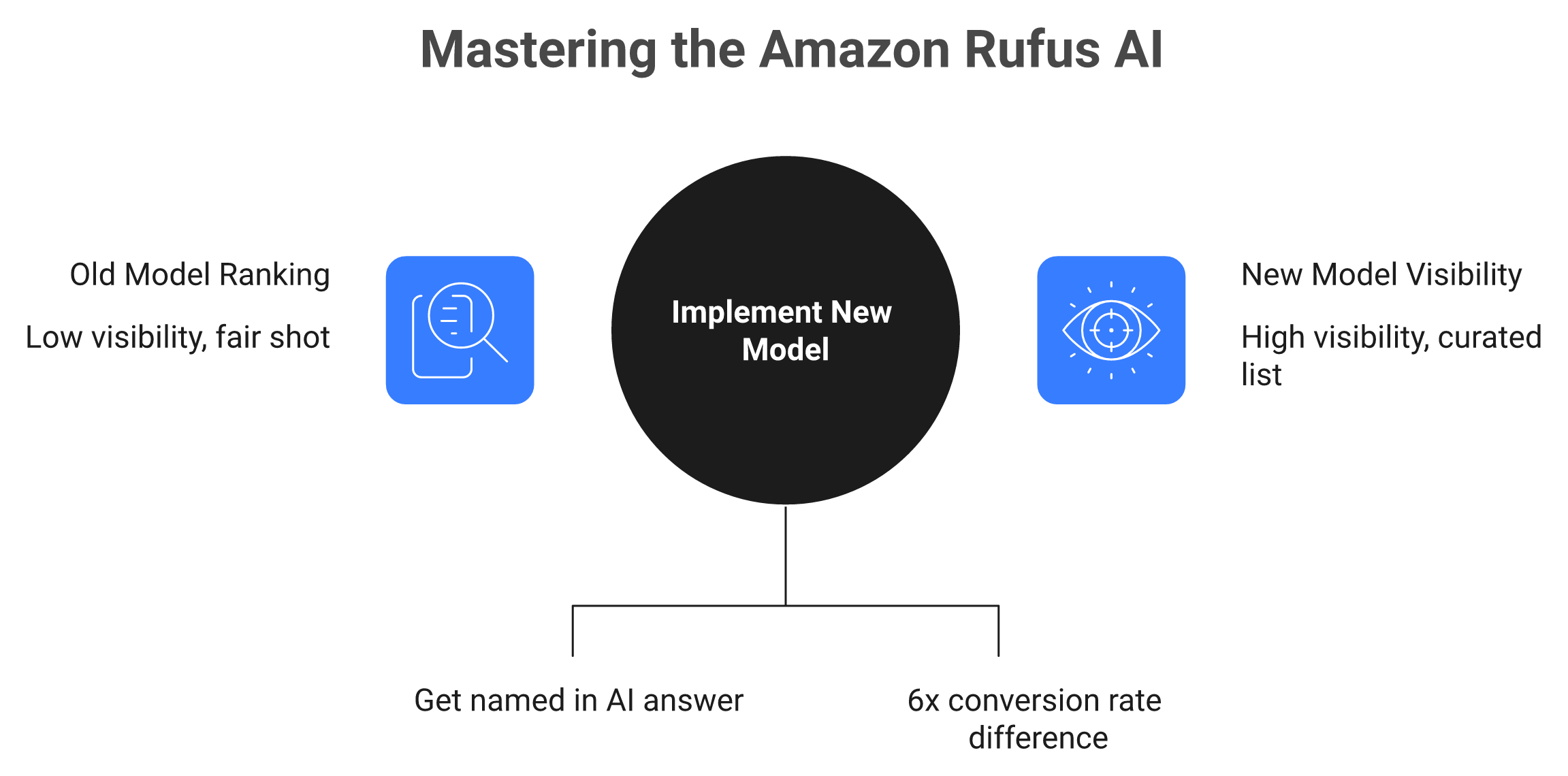
- Old model: rank on page one, get a fair shot at the click.
- New model: get named in the answer, or get nothing.
- The middle ground, ranking "decently," now returns close to zero.
The standard read says a good Google ranking still protects you. From what surfaces when you actually watch buyers use these tools, that read gets it backwards. A page-one ranking that Rufus never cites is a legacy metric wearing a nice suit, which is exactly why GEO differs from traditional SEO.
💰 Why the Stakes Are Higher Than They Look
The buyers who do arrive through AI convert far better. Webflow reported a 6x conversion-rate difference between LLM traffic and Google search traffic. Amazon has said shoppers who use Rufus during a journey are 60% more likely to complete a purchase.
So the pool of visitors shrinks, but each one is worth much more. The penalty for being average has never been so severe. You either become the answer, or you watch a smaller, richer stream of buyers flow to whoever did. Our GEO/AEO for e-commerce work centers on that revenue math.
✅ The New Job: Become the Answer, Not the Ranking
The work changes shape here. You are no longer optimizing a page to rank. You are engineering your brand, your data, and your reputation so an AI engine cites you as the recommendation.
This is the exact shift MaximusLabs built its Revenue-focused GEO and AEO practice around. We treat AI search as a revenue engine, not a ranking scoreboard, because a ranking that no longer earns a seat inside the answer box does not pay the bills. Being present when the buyer's list gets built is the whole game now.
Q2: How Does Amazon Rufus Actually Work Under the Hood?
Rufus works in four stages. A query-planner model classifies intent and plans retrieval. Retrieval-augmented generation (RAG) pulls from Amazon's catalog, reviews, community Q&A, and Stores APIs. A custom shopping LLM, built on Amazon Bedrock, generates the answer plus layout instructions. Finally, the response streams token-by-token while the backend "hydrates" it with live prices and product cards, all running on AWS Trainium and Inferentia chips.
🔎 The Four-Stage Pipeline, Start to Finish
Think of Rufus less as a search box and more as a translator. It turns a messy human sentence into a structured request for data, then builds an answer around what it retrieves.
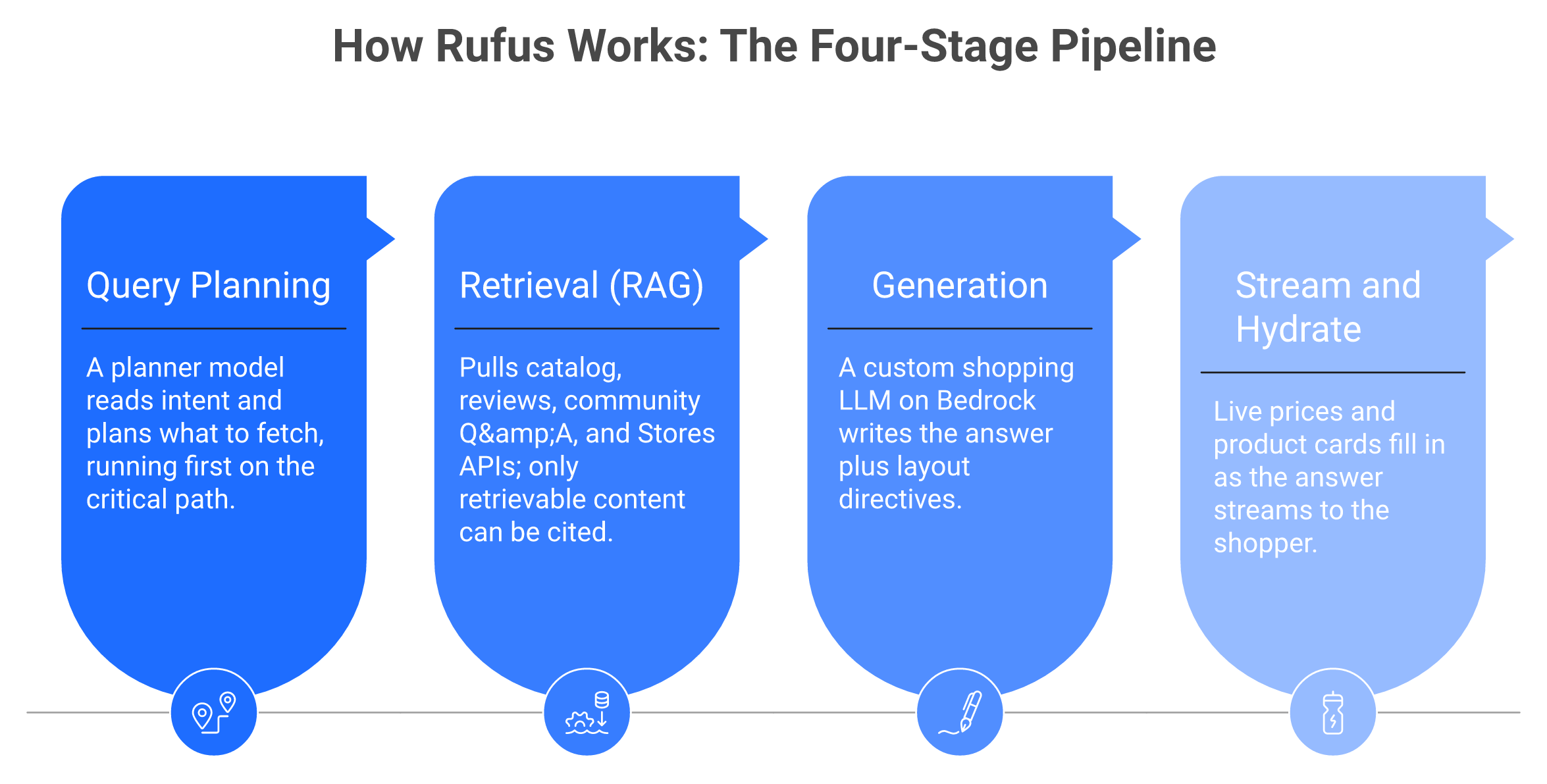
Here is the flow at a glance.
| Stage | What happens | Why it matters to you |
|---|---|---|
| 1. Query planning | A planner model reads intent and plans what to fetch | Your data must match how buyers phrase things |
| 2. Retrieval (RAG) | Pulls catalog, reviews, community Q&A, Stores APIs | Only retrievable content can be cited |
| 3. Generation | Custom LLM writes the answer plus layout directives | Clear, factual copy gets used; fluff gets skipped |
| 4. Stream and hydrate | Live prices and product cards fill in as it streams | Real-time feed accuracy shapes the final card |
🧠 The Query Planner Sits on the Critical Path
Generation does not start until planning finishes. A query planner (a model that classifies the question and decides what to retrieve) runs first, on the critical path.
That ordering matters. Amazon uses parallel and speculative decoding (a technique where the model drafts several tokens at once) to keep answers fast, and it doubled inference speed for Prime Day traffic this way. Speed is not a vanity feature here. A slow assistant loses the sale before it recommends anything.
📚 RAG: Rufus Only Knows What It Can Retrieve
Rufus does not invent product facts from memory. It uses retrieval-augmented generation, which means it searches trusted sources first, then summarizes them.
Those sources are specific: the product catalog, customer reviews, community Q&A, and Stores APIs. This is the single most important mechanic for sellers. If a fact about your product is not in a retrievable source, Rufus cannot cite it, and it effectively does not exist. Making that content machine-readable is the heart of technical GEO implementation.
🎨 Streaming and Hydration: The Answer Is Content Plus Layout
The custom LLM does two jobs at once. It writes the words, and it emits markup instructions that tell the interface where to place product cards.
The backend then "hydrates" that skeleton with live data, real prices, real availability, real images. Your listing data is the fill-in for an AI-generated layout. Clean, current feed data means an accurate card. Stale data means a wrong price or a missing product.
⚙️ The Chips: Built for Real Time at Massive Scale
All of this runs on custom AWS silicon, Trainium and Inferentia, with continuous batching to serve millions at once. Amazon detailed running this on roughly 80,000 chips during peak events.
I might be wrong on the exact internal weighting, and I want to be honest about that. From what actually surfaces in the public docs, this is engineered for real-time scale, not experimentation.
✅ What Is Public vs. What Amazon Has Not Disclosed
Trust comes from naming the gaps.
- ✅ Public: the RAG approach, the source set, the chip stack, streaming and hydration.
- ❌ Not disclosed: exact model sizes, the router policy across models, retrieval ranking logic, and the full markup schema.
Anyone claiming precise knowledge of Rufus's ranking weights is guessing. We would rather show you the mechanics we can verify than sell certainty we do not have. That honesty is exactly how MaximusLabs approaches every AI engine we optimize for through our agentic commerce service.
Q3: What Is Amazon COSMO and Why Does It Decide Which Products Rufus Recommends?
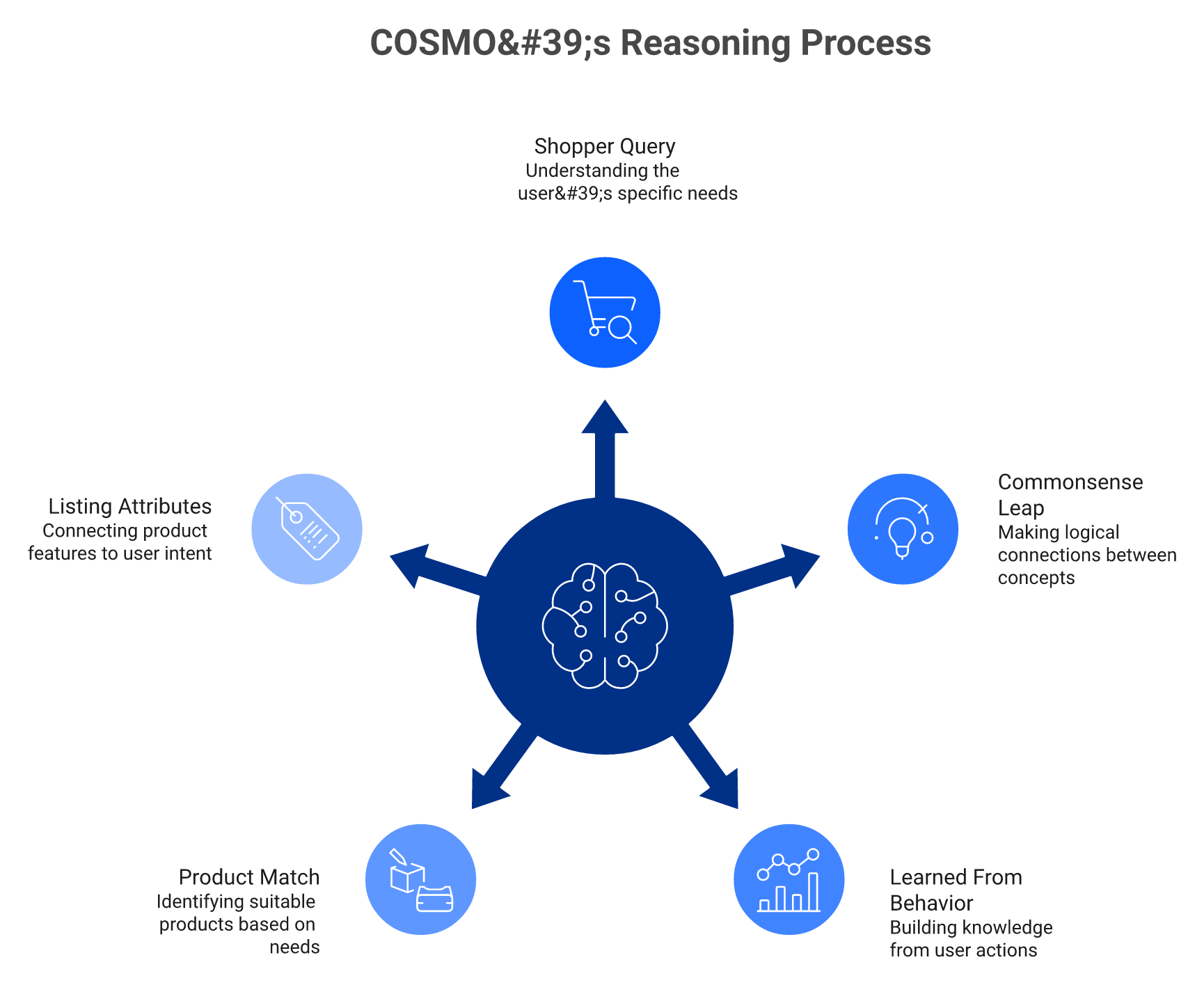
COSMO is Amazon's large-scale commonsense knowledge graph that maps shopper intent to products. It learns from behavior, for example, connecting "shoes for a pregnant woman" to "slip-resistant." Built by distilling LLM-generated knowledge into a served model, COSMO powers 6.3 million nodes and 29 million edges across Amazon search. It is the reasoning layer that decides whether your product matches what Rufus thinks the shopper actually means.
🧩 The Missing Layer Most Explainers Skip
Most articles stop at "Rufus uses AI." They miss the part that actually decides which products get pulled in the first place.
That part is COSMO, Amazon's commonsense knowledge graph (a map of how concepts relate to products). Amazon's research team published it in 2024, and it runs across search relevance, recommendations, and navigation. It is the reasoning bridge between a vague query and a specific product, and it sits close to the knowledge graphs that power GEO.
📊 How Big and How It Was Built
COSMO is not a small experiment. It serves a graph of 6.3 million nodes and 29 million edges across 18 product categories.
Amazon built it by generating commonsense knowledge with a large model (OPT-175B), filtering it through critic classifiers, then distilling it into a smaller, served model called COSMO-LM. In A/B tests on live Amazon traffic, it drove a 0.7% relative sales lift and an 8% lift in navigation engagement. At Amazon's scale, that is hundreds of millions of dollars from a reasoning layer most sellers have never heard of.
👟 The Example That Makes It Click
Here is the moment it becomes obvious. A shopper searches "shoes for a pregnant woman."
Nothing in that query says "slip-resistant" or "easy to slip on." COSMO makes that leap, because it has learned the commonsense link between pregnancy and those attributes from real behavior. Rufus then leans on that reasoning to surface the right products. If your listing never states those attributes, COSMO cannot connect you to the intent, which is a core focus of e-commerce product AEO.
✅ Why This Rewrites Your Product Copy Strategy
The payoff is practical. COSMO rewards products whose attributes are stated plainly and completely.
- Fill every attribute field, even the ones that feel obvious.
- Write copy around use cases and buyer situations, not just features.
- Name the "unspoken" needs a shopper implies but never types.
There is a founder principle underneath this that I hold firmly. Google is an algorithm. Amazon is an algorithm. When you understand the algorithm's goal and your own goal at the same time, you can do real work. COSMO is proof that mechanics beat hacks, and it is the reasoning layer MaximusLabs studies directly when we build content that AI engines can connect to buyer intent.
Q4: What Data and Feed Signals Does Rufus Use to Rank and Compare Products?
Rufus and agentic shopping systems read structured product feeds, not marketing fluff. They require fields like ID, GTIN, MPN, Title, Description, Brand, Material, Dimensions, Price, Availability, Fulfillment, and Returns. A boolean like "is_eligible_search" acts as a hard true/false gate for appearing at all. Optional performance signals, popularity_score (0 to 5) and return_rate (0 to 100%), then influence which eligible products get highlighted in the AI's recommendation.
📦 Feeds Beat Copy: The Gate Comes First
A brand can have the best marketing copy on the internet and still be invisible to Rufus. That is because agents read the structured feed first, not the poetry on the page.
One field decides whether you are even in the running: "is_eligible_search," a true/false gate in OpenAI and Amazon-style product feeds. Set it wrong, and no amount of optimization helps. You are simply not in the pool. A quick AI crawlability checker pass catches these gaps early.
📋 The Exact Fields Agents Read
A clean structured feed is the price of entry. Here are the fields shopping agents expect, and the optional signals that influence ranking once you are eligible.
| Field group | Fields |
|---|---|
| Identity | ID, GTIN, MPN, Brand |
| Content | Title, Description, Link, Item Information, Additional Media |
| Attributes | Condition, Product Category, Material, Dimension, Length, Width, Height, Weight, Age Group |
| Commerce | Price, Availability, Fulfillment, Returns |
| Performance (optional) | popularity_score (0 to 5), return_rate (0 to 100%) |
The identity, content, attribute, and commerce fields make you indexable and comparable. The performance signals, popularity_score and return_rate, are optional inputs agents use to highlight strong products. High returns quietly work against you.
🚫 The JavaScript Facet Trap
Here is the hard-won part. Rufus cannot click a filter.
Marketplaces bury gold in facets, the closure, the fabric, the material, the neck style. Because those live behind JavaScript filters, the assistant often never sees them. The fix is blunt: pull that facet metadata into text headers or FAQs so it becomes indexable. A lot of the follow-up questions buyers ask are "best product with these attributes," and your answer has to be readable as plain text. A technical SEO and website audit surfaces exactly what agents miss.
The principle a practitioner put well: visibility is earned through the data, not through the ads. In the agentic era, a clean feed with cryptographic-certainty stock signals can outsell a six-figure PPC budget attached to a messy one.
✅ What To Do With This
Treat your feed as the product, not an afterthought.
- Confirm "is_eligible_search" is true on every product you want surfaced.
- Fill every attribute field, especially materials and dimensions.
- Move facet data (fabric, closure, style) into visible text and FAQs.
- Watch return_rate; it is a ranking input, not just an ops metric.
This is the layer MaximusLabs audits first when we prepare a catalog for AI discovery, because a beautiful page sitting on a broken feed is money left in inventory. Get the data right, and the recommendation follows.
Q5: Why Are Rufus and AI Answer Engines Making Traditional SEO a Legacy Game, and What Is GEO/AEO?
Traditional SEO optimized for ten blue links; Rufus collapses that into one synthesized recommendation, so ranking number one no longer guarantees visibility. Gartner predicts traditional search volume falls 25% by 2026, and most searches are already zero-click. Generative Engine Optimization (GEO) and Answer Engine Optimization (AEO) are the response: structuring your data, content, and reputation so AI engines cite and recommend you, becoming the answer, not just a result.
🔟 The World Traditional SEO Was Built For
For twenty years, the job was simple to describe. Get your page into the top ten blue links, and earn a fair share of the clicks.
Every playbook assumed a list of results the buyer would scroll. Keywords, backlinks, and meta tags all served that one goal. That world is quietly closing, and the gap is mapped in our GEO versus traditional SEO comparison.
⚠️ The Answer Box Is Eating the Click
Rufus does not show ten options. It synthesizes one recommendation and hands it over.
Gartner projects traditional search engine volume will drop 25% by 2026 as buyers shift to AI assistants. Roughly 70% of searches are already zero-click, meaning the answer appears without anyone visiting a site. A number-one ranking that the AI never cites earns you nothing, a reality we track in the zero-click search brand economy.
💰 Less Traffic, But Worth Far More
Here is the counterintuitive part. The traffic shrinks, yet each visitor gets more valuable.
Webflow reported a 6x conversion-rate difference between LLM traffic and Google search traffic. So the smaller stream converts far harder. This is also why chasing volume is the wrong instinct now.
Content efficiency was always lopsided anyway. In one practitioner dataset, 19 out of 20 landing pages drove roughly 85% of all traffic. That Pareto reality is the whole case for a bottom-of-funnel-first approach, focusing on the few pages where real buyers decide, which anchors our content marketing service.
✅ What GEO and AEO Actually Mean
The resolution is a new discipline, or really two.
- Generative Engine Optimization (GEO): structuring your brand, data, and content so generative engines like Rufus and ChatGPT cite and recommend you.
- Answer Engine Optimization (AEO): the sibling craft for answer boxes, shaping content to be the extracted answer.
Both replace "rank the page" with "become the answer." Format matters here in concrete ways. Self-contained answer blocks of 134 to 167 words get cited about 4.2 times more often by AI retrieval systems.
⚖️ Owned vs. Earned: It Depends on the Question
One rule guides the whole strategy. The more specific the question, the more an owned strategy works. The more general the question, the more an earned strategy works.
Broad "money queries" tend to cite publishers and review sites. Specific product questions favor your own documentation. This is exactly why MaximusLabs pioneered our Revenue-focused GEO and AEO framework, and we measure share of voice and citation rate across thousands of query variants, not single rankings. Stop optimizing for Google alone. Start optimizing for trust.
Q6: How Do You Optimize Your Product Listings and Content to Get Recommended by Rufus?
To get recommended by Rufus: write clear, benefit-first titles and bullets; complete every backend attribute so COSMO can match intent; expose facet metadata (fabric, closure, neck style) as text headers or FAQs since Rufus cannot click filters; render reviews in HTML, not async JavaScript; and build specific, verifiable reviews and community Q&A that RAG can cite. Answer the real buyer questions your search data reveals.
✅ The Monday-Morning Checklist
Start here, in this order. Each step makes your product more indexable and more citable.
- Write benefit-first titles and bullets, not keyword stuffing.
- Fill every backend attribute so COSMO can match intent.
- Move facet data (fabric, closure, neck style) into visible text or FAQs.
- Render reviews in plain HTML, not asynchronous JavaScript.
- Build specific, verifiable reviews and community Q&A.
Sellers are already watching this play out in real time.
"Rufus (amazon's AI assistant) pulling stuff straight from listings. the keyword stuffed ones just get skipped."
u/[OP], r/FulfillmentByAmazon Reddit Thread
🔌 The JavaScript Trap Hiding Your Best Signals
Here is a moment that surfaces in nearly every audit. You turn JavaScript off in the browser, reload the page, and half the content vanishes.
Reviews often load asynchronously, meaning they appear after the page loads, so crawlers never see them. A multi-billion-dollar brand can accidentally hide its most valuable trust signals this way. If Rufus cannot read it without JavaScript, treat it as invisible, which is why we start with a technical SEO and website audit.
🧩 Bring Facet Data Into Text
Rufus cannot click a filter to learn your shirt is wrinkle-resistant. That attribute usually hides inside a JavaScript facet.
The fix is direct. Pull the closure, the fabric, the material, and the neck style into text headers or FAQs. A lot of follow-up questions are "best product with these attributes," so make those attributes readable, a core move in e-commerce product AEO.
🔍 Turn Search Data Into Buyer Questions
You do not need a crystal ball for AI demand. You need your own search terms.
Take your search data, feed the keywords to ChatGPT, and ask it to turn them into questions. That is directionally accurate, and it maps the questions Rufus is likely fielding. Our ChatGPT search query extractor speeds this up. A community practitioner framed the discovery stakes bluntly.
"If your rating is below 4.0, you're out. If your product is not available, you're out."
u/[commenter], r/AMALYTIX Reddit Thread
🗺️ Site Architecture: Point-to-Point, Not Orphaned
Two structural fixes punch above their weight. First, keep help content in a subdirectory (yoursite.com/help), not a subdomain, because agents treat subdomains as separate filing cabinets and often miss them.
Second, link like Southwest, not Singapore Airlines. Point-to-point internal links keep pages crawlable, while a hub-and-spoke model leaves pages orphaned. Think of your site as the dining room and the agent as a delivery driver who only needs a clean data feed to fulfill the order, the essence of our agentic commerce service.
"Rufus seems to rely on many information anchors, so complete and connected listings have an advantage."
u/[commenter], r/AMALYTIX Reddit Thread
Q7: Why Is Building a Brand, Not Chasing the Algorithm, the Only Durable Moat Against Rufus?
Algorithm hacks decay; brands compound. When you are THE brand in your category, the AI's training-data priors force it to recommend you, no matter how many updates ship. Rufus synthesizes web-wide consensus, so earned mentions on Reddit, review sites, and press shape what it says about you more than your own claims. Building genuine authority, not gaming feeds, is the only moat that survives every algorithm change.
🎣 Why Everyone Reaches for the Hack First
I understand the temptation. Hacks feel fast, and a brand feels slow.
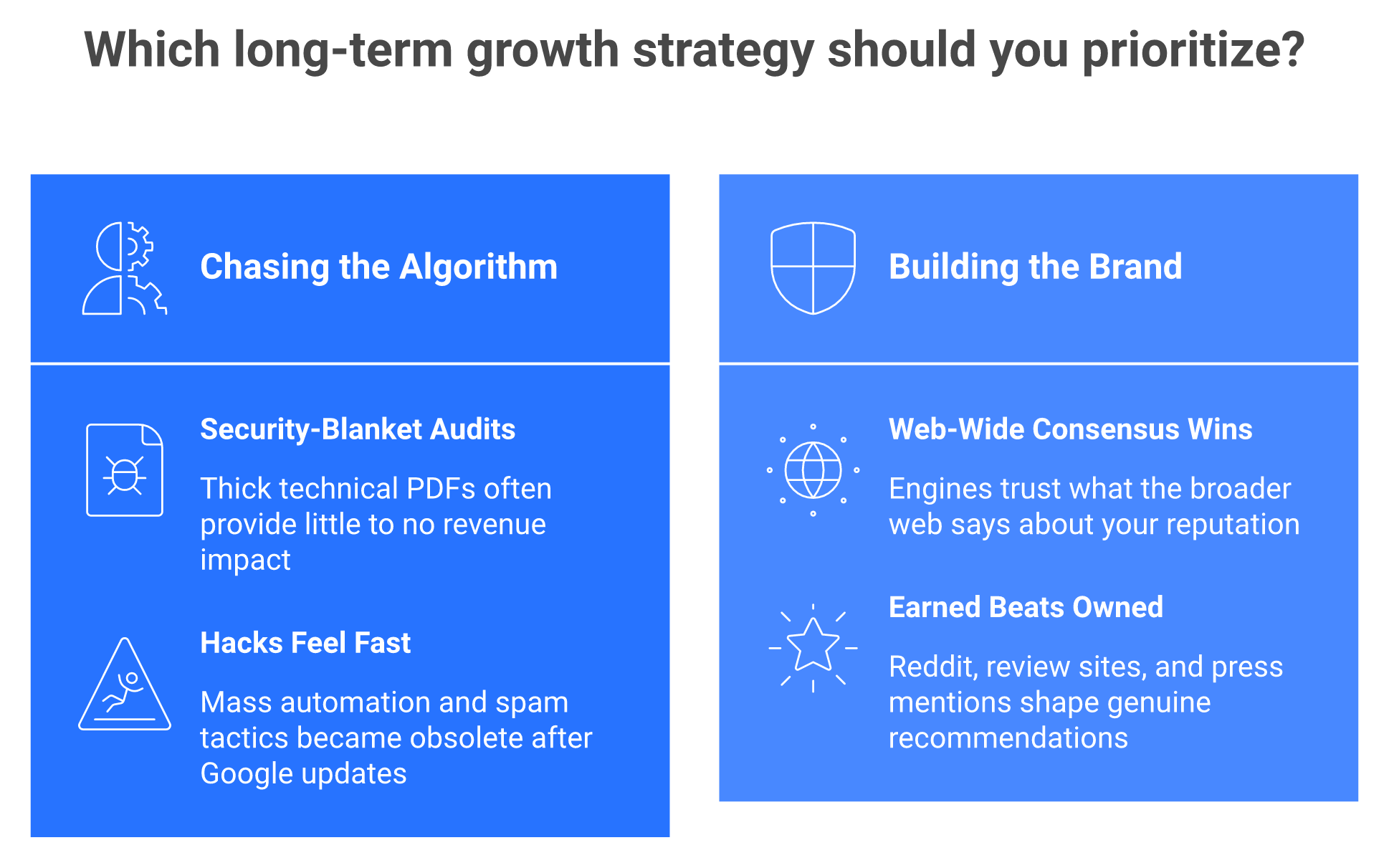
So teams chase the newest trick, ship a 50-page technical audit, and hope for a spike. The trouble is that the spike rarely turns into revenue.
⚠️ The 2007 Lesson, Playing Out Again
We have seen this movie before. A practitioner who has run search since 2007 tells the story plainly.
He created spam in 2007, scraped and rewrote competitors' content, and it worked really well, and then it stopped working when Google nuked mass-automation.
He expected the exact same fate for AI hacks, so he ignores tricks in favor of data-first infrastructure. The same skepticism applies to much of "technical AEO." Chasing crawl analysis and miscellaneous "technical errors" often produces a security blanket, a thick PDF with little to no revenue impact. We would rather build a durable trust-first content playbook.
"Most agencies charge overpriced retainers for work that's not deserving of a retainer."
u/low5d7k, r/SEO Reddit Thread
🎓 The Oxford Hallucination
Here is the moment that changed how I think. A team watched Perplexity summarize their article and describe them as Oxford researchers, which none of them were.
That was not their claim. It was web-wide consensus the model pulled from earned mentions. The lesson lands hard: shopping and answer engines trust what the web says about you more than what you say about yourself, which is why E-E-A-T for AEO matters so much.
"For broad, popular questions, being mentioned in authoritative sources or user-generated content sites like Reddit is more impactful than ranking your own page."
Ethan Smith, CEO of Graphite Reddit and Forum AEO
✅ Brand Is the Moat That Survives Every Update
So the resolution is not a cleverer trick. It is authority.
When you are THE brand in your space, the AI has to recommend you, because its training-data priors force your inclusion. Earned beats owned for general queries, and consensus compounds while hacks decay. This is MaximusLabs' Brand Algorithm philosophy in action. We helped one client reach a 64% AI citation rate, overtaking a ten-year-old competitor stuck near 30%, in about six months of GEO work, as shown in the Oliv AI case study. Deep understanding beats a big budget, but brand beats both over time.
Q8: Is Rufus the Same Across AI Engines, and How Do You Win on ChatGPT, Perplexity, and Gemini Too?
No, each AI engine weighs trust differently. Rufus leans on Amazon's own catalog, reviews, and COSMO; ChatGPT rewards conversational depth and expertise markers; Perplexity prizes fresh, source-transparent content; Gemini and Google AI Overviews reward answer-first structure and E-E-A-T. Winning everywhere means Search Everywhere Optimization: consistent structured data, earned third-party mentions (Reddit, G2, press), and platform-specific answer formatting, not one generic "AI SEO" template.
🧭 One Brand, Many Different Referees
The biggest mistake I see is treating all AI engines as one target. They are not.
What ChatGPT considers important is not what Google considers important, which is not what Perplexity considers important. Each platform is its own algorithm, with its own trust signals and citation patterns. Optimize for one, and you can still be invisible on the others, a pattern detailed in our ChatGPT, Perplexity, and Gemini citation patterns report.
📊 What Each Engine Actually Rewards
Here is the practical breakdown, engine by engine.
| Engine | What it leans on | How to earn the citation |
|---|---|---|
| Amazon Rufus | Catalog, reviews, community Q&A, COSMO | Clean feed, complete attributes, 4.0+ ratings |
| ChatGPT | Conversational depth, expertise signals | Question-headed answers, first-person expertise |
| Perplexity | Fresh, source-transparent content | Dated sources, visible citations, readable prose |
| Gemini / Google AI Overviews | Answer-first structure, E-E-A-T | 40 to 80 word answer nuggets, structured data |
Citation overlap between engines is smaller than people assume. One practitioner measured overlap between ChatGPT and Google at around 35%, while Perplexity sat near 70%. Different referees, different scorecards. This is where dedicated Perplexity optimization pays off.
⚖️ The Schema Debate Nobody Has Settled
Be honest about what is contested. Structured data (schema) is one such fight.
One camp argues tokenization, the way models break text into pieces, largely destroys schema's value. Another insists schema increases your odds by telling AI tools exactly what your content is. I lean toward implementing it, because the downside is low, but I hold that loosely. If you want the primer, start with schema markup basics.
"AEO success is measured by share of voice, how frequently you show up as the answer, not by a single rank."
Ethan Smith, CEO of Graphite AI Search Visibility Tracking
✅ Search Everywhere, Not Just On-Site
The payoff is a wider surface area. Rufus, ChatGPT, and Perplexity all read the broader web, so off-site consensus feeds every engine at once.
- Seed authentic, cited Reddit and community answers.
- Keep G2, Capterra, and review profiles current and specific.
- Earn press and third-party mentions that models synthesize.
This is what MaximusLabs calls Search Everywhere Optimization, building a 360-degree brand presence so the consensus every engine reads points to you. One template will not cut it. A platform-aware system will, which is how our ChatGPT optimization work is structured.
"Reddit optimization, Quora optimization, and YouTube optimization are critical new skills, because these sources are frequently cited."
Ethan Smith, CEO of Graphite Reddit and Forum AEO
Q9: What's Next for Rufus, Agentic Commerce, and the Marketer's Playbook?
Rufus is evolving from answering questions to acting, auto-buying at target prices, building carts from a handwritten grocery list, and rebranding toward "Alexa for Shopping." In agentic commerce, your website becomes the dining room while the AI is the delivery driver that only needs a clean data feed to fulfill the order. The playbook: structure your data now, earn third-party trust, and build the brand AI cannot ignore.
🤖 The Situation: Rufus Is Learning to Act, Not Just Answer
The assistant that once described products now takes action on your behalf. That is the real shift underway.
Amazon has begun rolling out agentic features, meaning Rufus can complete tasks, not just reply. It can auto-buy an item once it hits a target price, and it can surface daily deals without a prompt. Hand it a photo of a scribbled grocery list, and it builds the cart for you. We map this whole shift in our state of agentic commerce 2026 report.
The naming tells the story too. Amazon is folding Rufus toward an "Alexa for Shopping" identity, signaling a voice-first, do-it-for-me future, a trend we track in our agentic browser landscape 2026 research.
⚠️ The Complication: The Transaction Leaves Your Storefront
Here is the uncomfortable part for brands. When the agent buys, the shopper never sees your carefully designed page.
Your website becomes the dining room, quiet and mostly empty, while the AI acts as the delivery driver working off your data feed. The feed becomes the product. If your structured data (the machine-readable fields describing your item) is thin or stale, the agent simply skips you, which is why we lead with technical GEO implementation.
I might be wrong on the exact timeline here, and I want to be honest about that. From what surfaces when you actually watch these features ship, the direction is not in doubt, even if the pace is.
✅ The Resolution: What to Do This Monday
You cannot control the roadmap, but you can control what the agent reads. Three priorities matter most right now.
- Structure your data: clean feeds, complete attributes, accurate stock and price signals.
- Earn third-party trust: reviews, community answers, and press the agent synthesizes into its recommendation.
- Build the brand: authority is the one signal that survives every model update.
This is the frontier MaximusLabs is building toward, pioneering our agentic commerce service as the next battleground, not just today's citations. If you sell physical products, our GEO and AEO for e-commerce work applies these priorities directly, and our Nidra e-commerce case study shows the payoff.
💬 The Question I'm Sitting With
Here is what keeps me thinking. When the agent does the buying, does the brand still matter, or does it matter more because the agent has to trust someone?
My working hypothesis leans toward the latter. In a world where a machine spends the buyer's money, the brand it already trusts wins by default. If you are wrestling with where your data and your brand stand for this shift, that is exactly the conversation we would want to have with you, so contact us or review our pricing to get started.
Frequently asked questions
What is Amazon Rufus and how does it work?
Amazon Rufus is a generative-AI shopping assistant built on a custom large language model trained on Amazon's catalog, reviews, and community Q&A. It answers natural-language questions and recommends products inside the Amazon app and desktop. Under the hood, Rufus works in four stages: Query planning: a planner model reads intent and decides what to retrieve. Retrieval (RAG): it pulls from the catalog, reviews, community Q&A, and Stores APIs. Generation: a custom shopping LLM writes the answer plus layout instructions. Stream and hydrate: live prices and product cards fill in as the answer streams. The real significance is that Rufus curates the buyer's evaluation set down to a handful of AI-chosen options. If you are not in that answer, you are effectively invisible, no matter your legacy search ranking. We help brands engineer their data and reputation so AI engines cite them through our Generative Engine Optimization service , treating AI search as a revenue engine rather than a ranking scoreboard.
What is Amazon COSMO and why does it decide which products Rufus recommends?
COSMO is Amazon's large-scale commonsense knowledge graph that maps shopper intent to products. It is the reasoning layer most explainers skip, yet it decides which products get pulled in the first place. A few facts make its scale clear: It serves a graph of 6.3 million nodes and 29 million edges across 18 product categories. Amazon built it by generating knowledge with a large model, filtering it through critic classifiers, then distilling it into a served model called COSMO-LM. In live A/B tests, it drove a 0.7% relative sales lift and an 8% lift in navigation engagement. Here is the example that makes it click. A shopper searches "shoes for a pregnant woman." Nothing in that query says "slip-resistant," but COSMO makes that leap from learned behavior, and Rufus surfaces matching products. If your listing never states those attributes, COSMO cannot connect you to the intent. This is exactly why we study intent-to-product reasoning when we build e-commerce product AEO that AI engines can connect to real buyer needs.
What data and feed signals does Rufus use to rank and compare products?
Rufus and agentic shopping systems read structured product feeds first, not marketing copy. A clean feed is the price of entry, and one field decides whether you are even in the running. The fields agents expect break down like this: Identity: ID, GTIN, MPN, Brand. Content: Title, Description, Link, Item Information, Additional Media. Attributes: Condition, Category, Material, Dimensions, Weight, Age Group. Commerce: Price, Availability, Fulfillment, Returns. Performance (optional): popularity_score (0 to 5) and return_rate (0 to 100%). A boolean like "is_eligible_search" acts as a hard true/false gate for appearing at all. Set it wrong, and no optimization helps. There is also a JavaScript facet trap: Rufus cannot click a filter, so facet metadata like fabric or closure must move into text headers or FAQs to become indexable. We audit this feed-and-facet layer first through our technical SEO and website audit , because a beautiful page on a broken feed is money left in inventory.
How do you optimize your product listings and content to get recommended by Rufus?
Getting recommended by Rufus comes down to making your product both indexable and citable. We work through this in a clear order. Write benefit-first titles and bullets, not keyword stuffing. Fill every backend attribute so COSMO can match intent. Move facet data such as fabric, closure, and neck style into visible text or FAQs. Render reviews in plain HTML, not asynchronous JavaScript that crawlers never see. Build specific, verifiable reviews and community Q&A that retrieval can cite. Two structural fixes punch above their weight. Keep help content in a subdirectory rather than a subdomain, since agents often treat subdomains as separate and miss them. Then link point-to-point so pages stay crawlable instead of orphaned. A practical trick for discovery: take your own search data, feed the keywords to an AI, and turn them into the questions Rufus is likely fielding. Ratings matter too, since products below 4.0 or out of stock get skipped. We package these moves into our agentic commerce service so your catalog is ready for AI discovery.
Why are Rufus and AI answer engines making traditional SEO a legacy game?
Traditional SEO optimized for ten blue links. Rufus collapses that into one synthesized recommendation, so ranking number one no longer guarantees visibility. The shift shows up in the data: Gartner predicts traditional search volume falls 25% by 2026. Roughly 70% of searches are already zero-click, with the answer appearing without a site visit. Webflow reported a 6x conversion-rate difference between LLM traffic and Google search traffic. So the pool of visitors shrinks, but each one is worth far more. The penalty for being average has never been more severe. Generative Engine Optimization (GEO) and Answer Engine Optimization (AEO) are the response: structuring your brand, data, and content so engines cite and recommend you. Format matters concretely, since self-contained answer blocks of 134 to 167 words get cited about 4.2 times more often. One rule guides strategy: the more specific the question, the more owned content wins; the more general, the more earned mentions win. This is why we pioneered our Revenue-focused GEO and AEO framework , measuring share of voice, not single rankings.
Why is building a brand, not chasing the algorithm, the only durable moat against Rufus?
Algorithm hacks decay, but brands compound. When you are the recognized brand in your category, the AI's training-data priors force it to recommend you, no matter how many updates ship. Two lessons from the article make this concrete: A practitioner who created spam content in 2007 watched it work, then stop working entirely when Google nuked mass automation. He expects the same fate for AI hacks. A team once watched Perplexity describe them as Oxford researchers, which none of them were. That was web-wide consensus, not their own claim. The lesson lands hard: shopping and answer engines trust what the web says about you more than what you say about yourself. Earned mentions on Reddit, review sites, and press shape recommendations more than your own copy. This is our Brand Algorithm philosophy in action. We helped one client reach a 64% AI citation rate, overtaking a ten-year-old competitor stuck near 30%, in about six months, as shown in our Oliv AI case study . Deep understanding beats budget, but brand beats both over time.
Is Rufus the same across AI engines, and how do you win on ChatGPT, Perplexity, and Gemini too?
No, each AI engine weighs trust differently, and treating them as one target is the biggest mistake we see. Optimize for one, and you can still be invisible on the others. Here is what each engine rewards: Amazon Rufus: clean feed, complete attributes, and 4.0+ ratings. ChatGPT: conversational depth and first-person expertise signals. Perplexity: fresh, source-transparent content with visible citations. Gemini and Google AI Overviews: answer-first structure and E-E-A-T. Citation overlap is smaller than people assume, with one measurement putting ChatGPT and Google near 35% while Perplexity sat around 70%. Since Rufus, ChatGPT, and Perplexity all read the broader web, off-site consensus feeds every engine at once. So seed authentic Reddit and community answers, keep review profiles current, and earn press that models synthesize. We call this Search Everywhere Optimization, and our dedicated Perplexity optimization work builds a 360-degree brand presence so the consensus every engine reads points to you. One template will not cut it; a platform-aware system will.