 Krishna Kaanth M
- ChatGPT search optimization means increasing the probability your content is retrieved, selected, summarized, and cited inside the answer box, not just ranked on a SERP.
- Gartner projects a 25% drop in traditional search volume by 2026, and roughly 70% of searches now end without a click, so citation share matters more than rankings.
- Citation is driven mostly by content-answer fit (about 55%), then on-page structure, domain authority, query relevance, and content consensus, so alignment beats raw horsepower.
- Technical visibility is non-negotiable: you must allow OAI-SearchBot separately from GPTBot, render trust signals in HTML, and use IndexNow to compress citation time.
- Off-site consensus from Reddit, G2, and Capterra often outweighs your own copy, and engines like Perplexity, Gemini, and Google AI Overviews each weight signals differently.
- Measure citation share against competitors and tie it to pipeline, avoid mass unedited AI copy, and choose DIY, tools, or a specialist by your real constraint.
Q1. What is ChatGPT search optimization, and why has "ranking" been replaced by "becoming the answer"?
Last month, a VP of Marketing showed me a report she was proud of. Twelve first-page Google rankings. Then she typed her category question into ChatGPT, and her brand was nowhere in the answer. Her competitor was. That gap, page-one on Google yet invisible in the answer box, is the whole story of this shift.
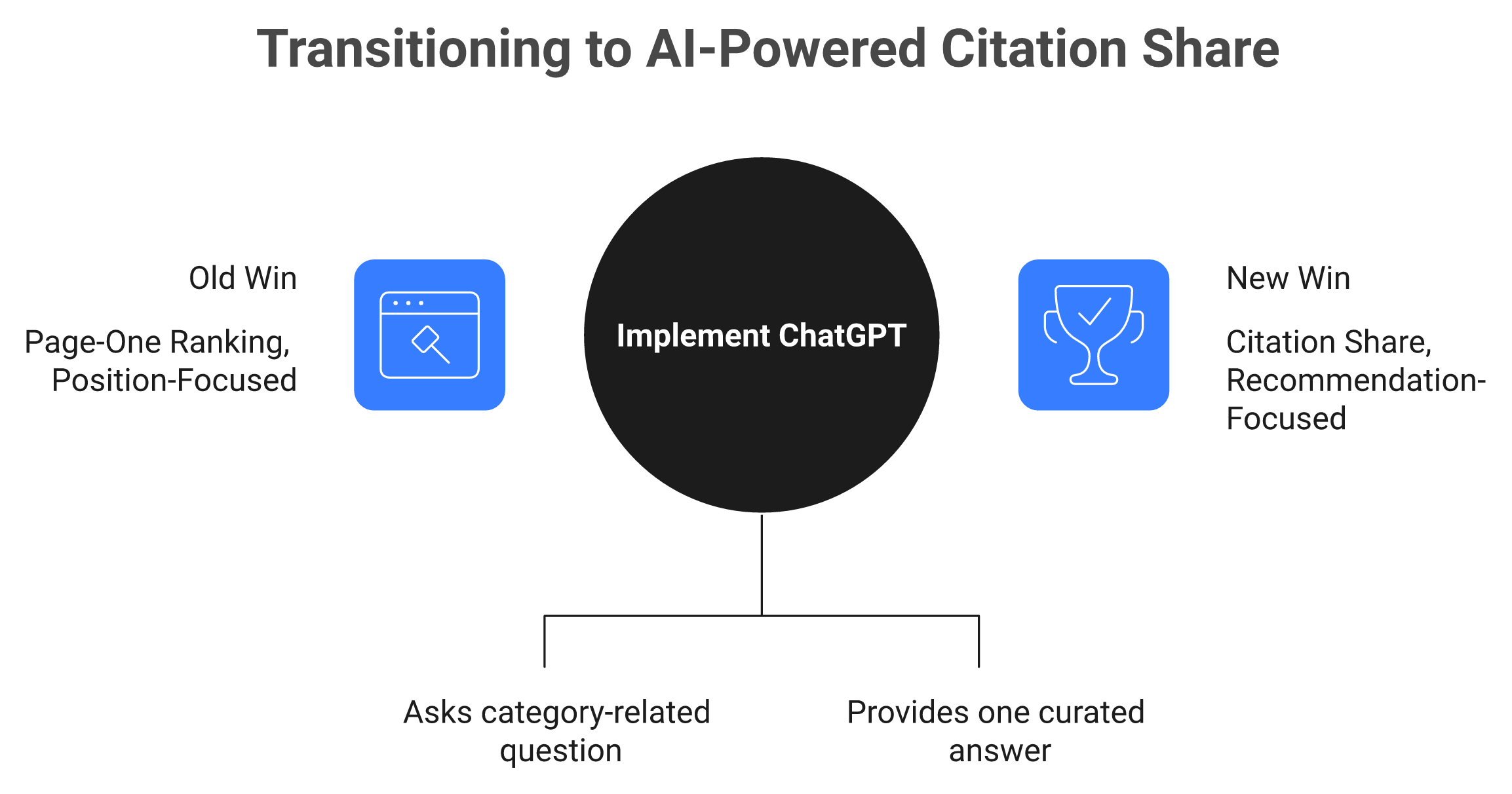
ChatGPT search optimization is the practice of increasing the probability your content is retrieved, selected, summarized, and cited inside ChatGPT's answer box, not just ranked in a SERP. Unlike traditional Google-only SEO, which chases position, it targets citation share, being the source AI recommends when a buyer asks. Success is measured by inclusion in the synthesized answer and its pipeline influence, not clicks or impressions.
⚙️ Why "ranking" quietly stopped being the win
Here is the tension. A buyer named John, Head of Sales at a B2B SaaS company, opens ChatGPT and asks for the best tools for his team. Within seconds he gets a curated list of ten. That list becomes his sample set. If you are not on it, you are not in the conversation at all, no matter how good your product is.
This is the binary outcome of AI search. The evaluation set shrank from a page of blue links to a single response box. Being "top 10" on Google is no longer a win if the machine excludes your brand before a human ever visits your site. This is exactly why generative engine optimization reframes the goal entirely.
📉 The proof this is not a fad
Gartner projects traditional search engine volume will drop 25% by 2026, as generative AI becomes a "substitute answer engine," in the words of VP Analyst Alan Antin. Roughly 70% of searches now end without a click, because the answer is delivered directly. The traffic is not disappearing. It is moving into a box you have to earn your way into, a dynamic we break down in our zero-click search brand economy research.
🧠 My honest take: this is a data-science problem, not "SEO plus"
I might be wrong on this, but I think most agencies get the framing backwards. They bolt "GEO" onto the same keyword playbook and hope. When you actually run citation tests across engines, you see the truth: what ChatGPT rewards is not what Google rewards, a distinction we map in our guide to GEO vs traditional SEO.
"GEO is not SEO. It's a data science problem. We need to exactly know how these LLM algorithms work to be present in the answers."
Krishna Kaanth, Founder, MaximusLabs
The penalty for being average has never been so severe. When the answer box holds five names instead of a page of ten links, mediocrity is not ranked low. It is deleted.
At MaximusLabs, we treat visibility as a data-science problem, studying how each engine retrieves and cites, so a brand becomes the answer rather than another blue link nobody reaches. That is the reframe: stop chasing position, start earning citation share tied to revenue through our GEO service.
Q2. How does ChatGPT Search actually retrieve and choose its sources?
Most people picture ChatGPT "reading" their whole page like a diligent student. It does not. The sooner you internalize that, the sooner your pages start getting cited.
ChatGPT Search works in layers. It interprets the prompt, queries a Bing-based index, relies on OpenAI crawlers like OAI-SearchBot to know your pages, and can fetch live content. For standard results, the model receives structured metadata, a URL, title, roughly 150-character snippet, and date, not full page text. That snippet, not the whole page, grounds the answer, so key claims must be front-loaded in the first sentence.
🔍 The five-layer pipeline, in plain terms
Think of it as an assembly line, not a library:
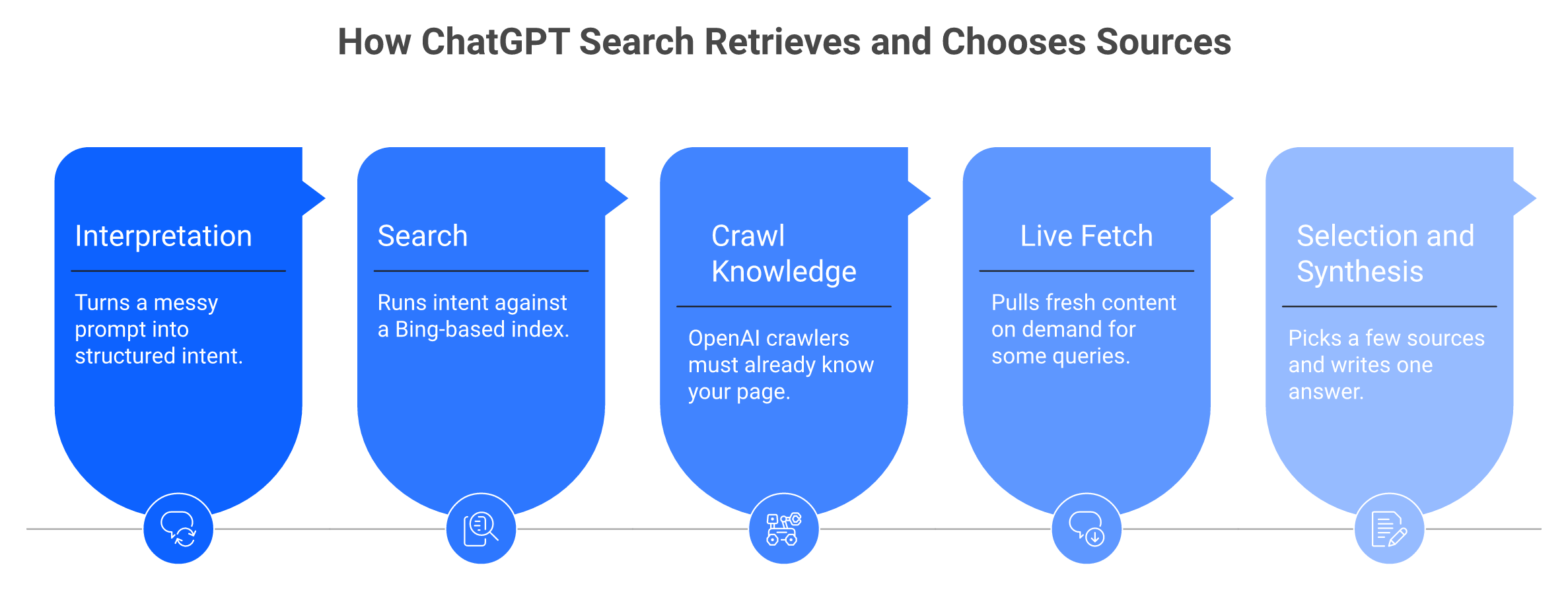
- Interpretation. The model translates a messy prompt ("a CRM for a small remote sales team") into a structured intent.
- Search. It runs that intent against a Bing-based index.
- Crawl knowledge. OpenAI's crawlers must already know your page exists.
- Live fetch. For some queries, it pulls fresh content on demand.
- Selection and synthesis. It picks a handful of sources and writes one answer.
Making sure each of these layers can reach your pages is the core of our AI crawlers guide and optimization work.
📏 The snippet is the new rank
Here is the part most technical audits miss.
"The snippet is the new rank. ChatGPT is literally grounding answers from a 150-character excerpt. For standard web results, ChatGPT receives structured metadata (URL, title, ~150-char snippet, date), NOT full page text."
That single constraint changes how you write. If your key claim sits in paragraph six, the model may never see it. The meta description and opening line are your real interface with the machine, not the 2,000 words underneath.
🧭 What this means Monday morning
There is a useful mental model here I call the Universal Intent Decoder. ChatGPT is not a search engine so much as a translator, turning a vague human request into a structured spec, then matching sources against it. Your job is to make the match obvious in the first line.
So lead every page and every section with the answer. Put the specific claim, number, or recommendation up front, then support it. From what surfaces when you actually run these tests, front-loading is the cheapest, highest-leverage change most teams never make, and it sits at the heart of our ChatGPT optimization approach.
Q3. What actually makes ChatGPT cite your content?
Walk into most SEO reviews and you will get a 50-page technical PDF about page speed. Useful-looking. Mostly beside the point for citations. The data tells a different story about what actually earns a mention.
Citation is driven mostly by content-answer fit, roughly 55% in a 400,000-URL study, then on-page structure (about 14%), domain authority (about 12%), query relevance (about 12%), and content consensus (about 7%). Authority and speed still matter, more referring domains and faster load times correlate with more citations, but the biggest lever is answering the exact question cleanly and early. Alignment beats horsepower.
📊 The reconciled factor model
Two large datasets, read together, give a priority stack most guides miss because they cite only one:
| Factor | Approx. weight | What it means for you |
|---|---|---|
| Content-answer fit | ~55% | Answer the exact question, early and completely |
| On-page structure | ~14% | Clear headings, extractable blocks, tables |
| Domain authority | ~12% | Domain Trust above 90 correlates with ~4x citations vs. below 43 |
| Query relevance | ~12% | Match the intent, not just the keyword |
| Content consensus | ~7% | Multiple trusted sources agree about you |
Speed still plays a supporting role. One 129,000-domain analysis found pages with the fastest first paint earned about 6.7 citations versus 2.1 for slow pages. Worth fixing, but not worth worshipping.
🧯 Why "technical SEO" is often a security blanket
The category avoids saying this, so I will. Practitioners with nearly two decades in search argue that most technical work is "true but zero impact," and that in 15 years they had "never seen Core Web Vitals drive a traffic increase." Meanwhile, a citation analysis of 177 million instances found 44.2% of citations come from the first 30% of the page. Content buried in a long essay is effectively invisible.
That is the operator takeaway: fix the answer before you fix the milliseconds. Our answer engine optimization work starts exactly there.
"AEO places a much higher emphasis on earned media, citations from other sites, than owned media, your own website."
Ethan Smith, CEO, Graphite
The practitioner consensus is blunt about vendors, too:
"Most agencies charge overpriced retainers for work that's not deserving of a retainer."
Practitioner sentiment, r/SEO Reddit Thread
🛠️ What we do differently
At MaximusLabs, we prioritize content-answer fit and extractability first, rewriting the pages that influence revenue so the answer lives in the opening lines, then layering authority and structure. Alignment is the lever. We pull it before anyone touches a speed audit, which is how our content marketing service is built.
Q4. Is your site even visible to ChatGPT's crawlers?
A founder once told me, "We allowed OpenAI, we're covered." We ran the check. He had allowed GPTBot, the training crawler, and left the one that actually feeds ChatGPT search untouched in a way that produced zero citations. He felt optimized. He was invisible.
Many sites think they are "AI-optimized" but are technically invisible. You must explicitly allow OAI-SearchBot in robots.txt, it is separate from GPTBot and Bingbot, and confirm critical content like reviews is not hidden behind JavaScript. AI crawlers are cruder than Googlebot, so clean, server-rendered, point-to-point-linked pages get retrieved. IndexNow can compress content-to-citation time to roughly 24 to 72 hours.
⚠️ The complication: "allowed" is not the same as "visible"
Here is the failure pattern we see most.
"Allow OAI-SearchBot in robots.txt, separate from Bingbot; blocking this equals not appearing in ChatGPT search. Many sites report 'allowed OpenAI' yet get zero citations because they allowed only GPTBot."
The two crawlers do different jobs. GPTBot handles training. OAI-SearchBot handles search and citations. Block or forget the second one, and you are absent from the answer box, full stop. Sorting this out is the first step in any technical SEO and website audit.
🕵️ The JavaScript trap
Crawlers for AI are less forgiving than Google's. One audit found OAI-SearchBot wasted 34.8% of its effort on 404s, versus 8.22% for Googlebot, a sign it is worse at pre-scoring URLs. So if your content needs JavaScript to appear, it may never be seen.
There is a simple moment of truth here. Turn JavaScript off in your browser and load a key page. If reviews load asynchronously and vanish when JS is off, the crawler probably cannot see your most valuable trust signals either. We ran exactly this test on a multi-billion-dollar brand and watched its best proof points disappear from the crawlable page. You can run a first pass yourself with our AI crawlability checker.
✅ Your Monday-morning access checklist
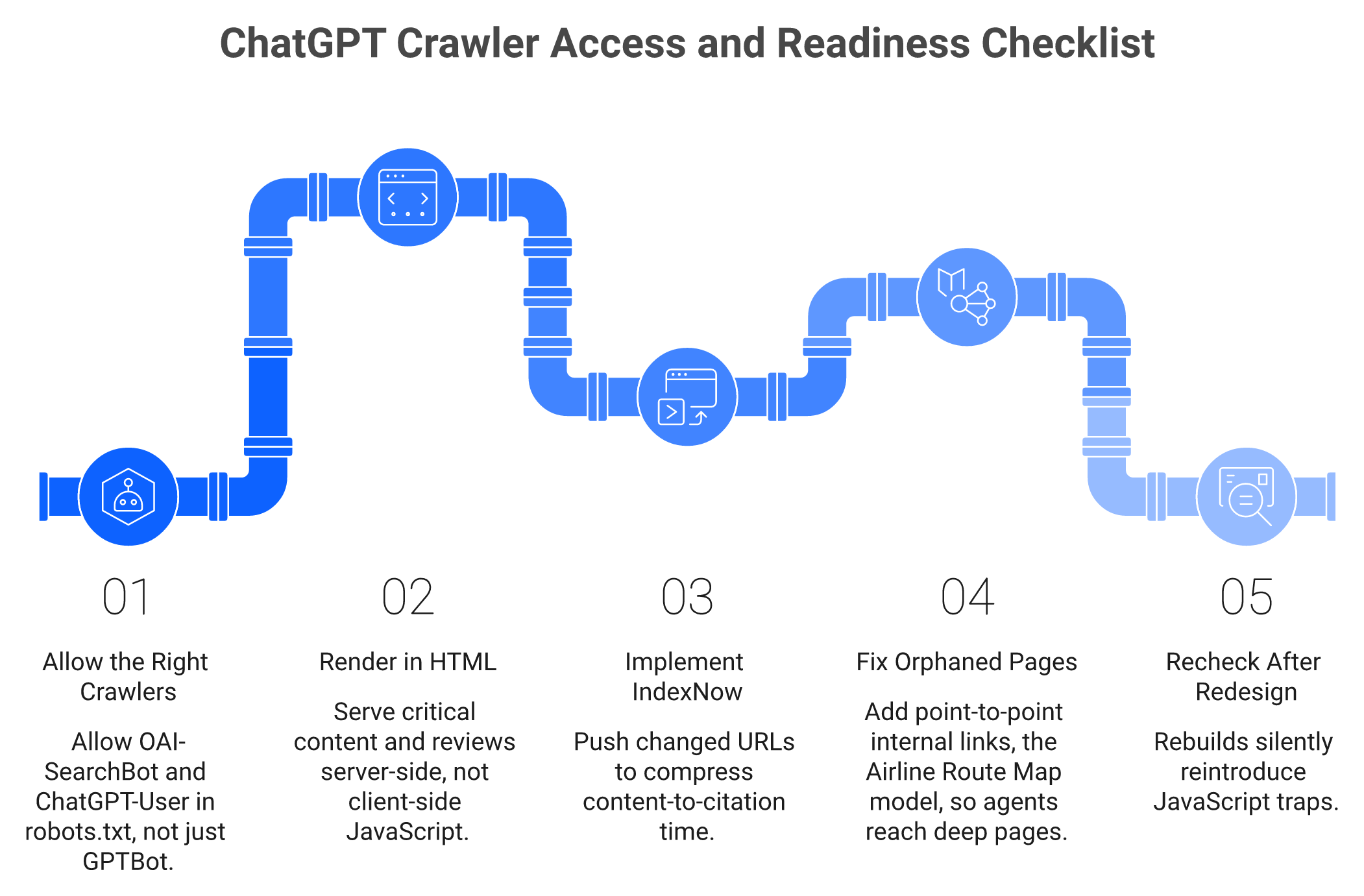
- Allow OAI-SearchBot and ChatGPT-User in robots.txt, not just GPTBot.
- Render critical content and reviews in HTML, not client-side JavaScript.
- Implement IndexNow to push changed URLs; we have seen first crawl in hours and citation in 24 to 72 hours.
- Fix orphaned pages with point-to-point internal links, the Airline Route Map model, so agents reach deep pages directly.
- Recheck after every redesign, since rebuilds silently reintroduce JS traps.
🧩 Where we come in
At MaximusLabs, our technical audit starts with this exact extractability pass, crawler access, HTML rendering, and agent-friendly linking, because the best content on earth cannot be cited if the retrieval agent never sees it. Get visible first. Then compete on the answer. If you want a hand, contact us.
Q5. How should you structure content so ChatGPT extracts and cites it?
A writer on my team once buried a brilliant comparison in paragraph nine. Genuinely the best thing on the page. ChatGPT never touched it. We moved that same paragraph to the top, and the citations started within days. Placement, not brilliance, was the problem.
Structure every page for extraction. Open each section with a self-contained 40 to 80 word answer, use conversational question headings, and put key claims in the first sentence. Data from 177 million citations shows 44.2% come from the first 30% of a page, so content buried in long essays is effectively invisible. Add comparison tables and clear sub-heads; ChatGPT reuses structured, quotable chunks.
📐 The inverted pyramid, applied
Journalists have used this for a century. Lead with the conclusion, then support it. AI retrieval rewards the same shape, because the model grounds answers on the top of your page, not the bottom. This is the backbone of our answer engine optimization work.
So treat every H2 like a mini-answer. State the claim, give the number, then explain. If a reader or a machine stops after two sentences, they should still have the point.
✍️ What a citable block looks like
Here is a self-contained nugget, the kind we write as a standard:
"To get cited in ChatGPT, answer the exact question in the first 60 words, back it with a specific number, and name your source. Everything after that is support, not setup."
That block makes sense pulled out of context. That is the whole test. If your answer only works with the three paragraphs above it, rewrite it. Our citation-worthy content for AI guide walks through this in depth.
🧱 The practitioner view on why this matters
The people building AEO strategy keep landing on the same point: comprehensiveness plus structure wins.
"Good content for AEO is comprehensive and answers all the potential follow-up questions a user might have."
Ethan Smith, CEO, Graphite
And the operator community is blunt about lazy structure:
"So much SEO content is just fluff wrapped around one useful sentence buried at the bottom."
Practitioner sentiment, r/SEO Reddit Thread
🛠️ Your rewrite template
- Open with a 40 to 80 word answer that stands alone.
- Phrase headings as the questions buyers actually ask.
- Move your strongest claim into the first 30% of the page.
- Use tables for comparisons; the model lifts them cleanly.
- Cut throat-clearing intros; no "in today's landscape" filler.
At MaximusLabs, the answer nugget is a productized standard, not a nice-to-have. Every section leads with an extractable block written in the founder's voice, which is how our content marketing service scales citable content without turning it into generic filler.
Q6. Does schema markup help, and how do you fix entity-resolution failures?
A team we worked with had spent a quarter perfecting schema. Beautiful markup. Then Perplexity described their founders as Oxford researchers. None of them went to Oxford. The lesson landed hard: the machine trusts what the web says about you more than what you say about yourself.
Schema is a hygiene factor, not a magic multiplier. Organization, Article, and FAQPage markup help ChatGPT resolve your entity and parse content, but they do not force a citation. The bigger, overlooked problem is entity resolution, brands cited under a wrong name or spelling. Fix it with consistent Organization schema and a sameAs loop across your profiles, then let answer fit and authority win the citation.
⚔️ The complication: the experts disagree
This is genuinely contested ground, so I will show both sides. One school treats structured data as decisive. Another treats it as table stakes. Our schema markup basics primer covers the fundamentals.
Schema is "a hygiene factor (at best)... not a differentiator."
SALT.agency position
Structured data "increase[s] your odds significantly" by telling tools exactly what your content is.
Surfer Academy position
My read, and I might be wrong here, is that both are right at different stages. Missing schema hurts you. Perfect schema alone does not save you.
👻 The real problem nobody names: entity resolution
Here is what surfaces when you actually run brand tests across engines. Well-known companies get skipped or mislabeled because the model cannot confidently resolve who they are. The Oxford hallucination is the loud version of a quiet, common failure.
The fix is consistency, not more markup. AI values web-wide consensus, so your name, category, and founders must match everywhere the web mentions you, a discipline we detail in our citation consistency for AI search resource.
✅ The sameAs loop checklist
- Deploy Organization schema with a complete sameAs array linking your official profiles.
- Match your brand name and product names exactly across G2, Capterra, LinkedIn, and Crunchbase.
- Keep founder bios identical across the site, LinkedIn, and press.
- Align schema with visible content; mismatches erode trust.
- Recheck after rebrands or funding announcements.
At MaximusLabs, we run a sameAs and entity-consistency pass as standard, because a brand cited under the wrong name is a brand that quietly loses the deal. Schema earns you grounding. Consistency earns you the right identity in the answer, which is why it anchors our technical SEO and website audit.
Q7. Why do off-site mentions (Reddit, G2, reviews) decide your citations?
A founder pointed at his homepage and said, "We say we're the best. Why doesn't ChatGPT?" I asked where else the web said it. Silence. That silence is why his competitor, who lived on Reddit and G2, kept showing up in the answer.
ChatGPT weighs web-wide consensus, so what others say about you often matters more than your own copy. Reddit, G2, and Capterra are cited above their traffic share, especially for "best X" commercial queries where Bing overlap can reach 87%. Earning credible third-party mentions and reviews builds the consensus signal AI uses to pick who belongs in the answer. Your site alone rarely wins.
🌐 The complication: your website is only one voice
For years, SEO meant polishing your own pages. That instinct now caps your ceiling. AI builds a 360-degree view of your brand from everywhere it appears, not just from your domain.
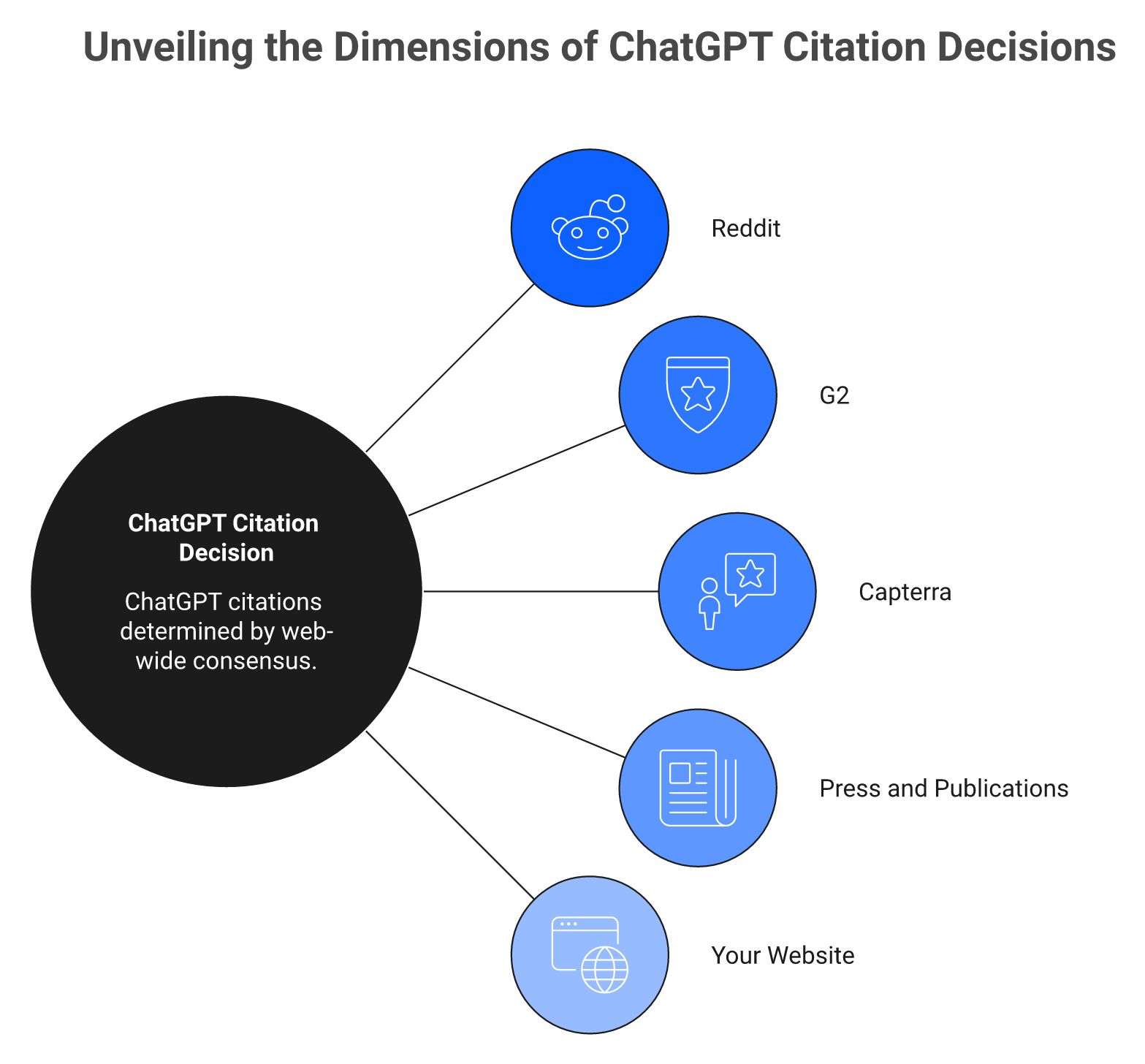
The practitioner consensus is clear on this shift:
"AEO places a much higher emphasis on earned media, citations from other sites, than owned media, your own website."
Ethan Smith, CEO, Graphite
Reddit sits at the center of it. In one analysis, a single Reddit thread was cited five times for one question, and Reddit's pull in Google grew 5x to 10x in months. Our Reddit and forum AEO playbook shows how to engage without spamming.
📊 Where the query type changes everything
Here is a useful nuance. One study found roughly 87% citation overlap with Bing's top results for commercial queries, but only about 27.4% for mixed informational ones. So Bing rank is decisive for "best X" and nearly irrelevant for "how to Y." You optimize differently depending on the question, and our AI citation acquisition tactics break that down.
💬 What real buyers say about the shift
"A well-articulated, highly-upvoted comment recommending your product can be one of the most powerful assets you have."
Practitioner takeaway, r/SEO Reddit Thread
The community also polices fakery hard, so spraying fake accounts backfires. Authentic, identified contribution wins.
🗺️ Your 90-day earned-trust plan
- Identify the 3 to 5 URLs AI cites most for your buyer questions.
- Earn 10 or more credible reviews each on G2 and Capterra.
- Engage authentically in cited Reddit and Quora threads, naming who you are.
- Pursue mentions on the publications your category's answers pull from.
This is exactly what we call Search Everywhere Optimization at MaximusLabs, a 360 program that earns off-site trust across review sites, communities, and press, because earned consensus beats self-published claims every time. It pairs naturally with our AEO service.
Q8. How does optimizing for ChatGPT compare to Perplexity, Gemini, and Google AI Overviews?
Teams keep asking me for "the AI SEO checklist," singular. There isn't one. The engines share a spine, but they weight signals differently enough that a copy-paste playbook leaves citations on the table.
The engines differ enough that tactics don't transfer blindly. ChatGPT leans on a Bing-based index and OAI-SearchBot; Perplexity weighs recency and community sources heavily; Google AI Overviews rides Google's index and E-E-A-T; Gemini and Claude add their own crawlers. Optimize for the shared core, extractable answers, entity clarity, and third-party trust, then tune per engine for index dependency and recency.
🧭 The shared core comes first
Before you tune per engine, win the fundamentals that every engine rewards. Extractable answers, clean entity signals, and earned third-party trust travel across all of them.
That is the efficient path. Optimize once for the core, then adjust for each engine's quirks rather than starting from scratch five times. Our generative engine optimization program is built around that principle.
📋 The five-engine tuning matrix
| Engine | Primary index | Crawler control | Recency weight | Community weight | Schema importance |
|---|---|---|---|---|---|
| ChatGPT | Bing-based | OAI-SearchBot | Medium | High (Reddit) | Medium |
| Perplexity | Own + web | PerplexityBot | High | High | Medium |
| Google AI Overviews | Google index | Googlebot | Medium | Medium | High (E-E-A-T) |
| Gemini | Google index | Google-Extended | Medium | Medium | High |
| Claude | Own + web | ClaudeBot | Lower | Medium | Medium |
💡 What this means for budget
Here is the operator payoff. Founder budgets are finite, so do not fund five separate programs. Fund one strong core, then spend the margin tuning for the engines your buyers actually use. Our Perplexity optimization and Google AI and Gemini optimization tracks handle that per-engine tuning.
For a commercial "best tools" query, Bing rank and reviews matter most, so ChatGPT and Copilot reward off-site trust. For fast-moving topics, Perplexity's recency bias means fresh, dated content wins. At MaximusLabs, we run this as one cross-engine program, covering ChatGPT, Perplexity, Gemini, Google, and Claude, so a single revenue-focused effort earns citations everywhere instead of chasing one platform at a time.
Q9. How do you measure ChatGPT visibility, tie it to revenue, and set realistic timelines?
A Head of Growth pulled up her analytics and said, "ChatGPT sends us nothing." I asked how she knew. She was reading GA4. That was the problem. The traffic was there; her dashboard just could not see it.
Measure citation share, not clicks. Because ChatGPT masks referrers, GA4 undercounts AI traffic, so triangulate: run a fixed 20 to 50 prompt panel repeatedly, analyze server logs for OAI-SearchBot, and model assisted conversions. Weight toward revenue, since LLM traffic can convert far better than generic search. Expect crawler fixes in 1 to 4 weeks, structure in 2 to 6, and off-site citation lift in 3 to 9 months.
🎯 The metric that actually matters
Ranking gives you one number. AI answers do not work that way. The right metric is share of voice, how often you appear as the answer across many question variants and platforms. This is the backbone of our GEO measurement and metrics approach.
That reframe matters because a single prompt can produce different answers on different runs. You measure frequency across a set, not a position on one page.
📊 The triangulation harness
Here is the reproducible method we use when GA4 goes dark:
| Signal | How to capture it | What it tells you |
|---|---|---|
| Citation share | Fixed 20-50 prompt panel, 3-5 runs each | How often you are the answer |
| Crawler activity | Server logs for OAI-SearchBot | Whether you are being retrieved |
| Assisted conversions | "How did you hear about us?" plus last-touch | Pipeline influence |
To build the prompt panel without a truth set, borrow a practitioner hack: take your high-intent keywords and turn them into questions. Our AI search visibility and brand mention tracking resource covers the tooling.
"Take your search data, give those keywords to ChatGPT, and say make these into questions. That's directionally accurate."
Ethan Smith, CEO, Graphite
💰 Why this is a revenue lens, not a vanity one
The payoff is that this traffic is worth more. Webflow reported a 6x higher conversion rate from LLM traffic than from Google search, because conversational intent runs hot. So citation share is not a vanity metric; it is a pipeline metric, which is exactly what our GEO ROI and revenue attribution work measures.
Focus it where money lives. Roughly 19 of 20 pages drive almost no traffic, so a handful of BOFU pages carry the outcome. Fix those first.
⏰ Realistic timelines by lever
- Crawler and access fixes: 1 to 4 weeks.
- Structural and schema changes: 2 to 6 weeks.
- Bing re-index: 2 to 8 weeks.
- Off-site citation lift: 3 to 9 months.
At MaximusLabs, we report citation share against competitors and tie it to pipeline, not impressions, because a dashboard that makes you feel good but never touches revenue is exactly the trap we built the firm to avoid. It is the core of our generative engine optimization program.
Q10. What mistakes make brands invisible in ChatGPT, and how do you avoid them?
The most confident sentence I hear is "we're already optimized." It is usually said right before we find the robots.txt line that blocks the crawler feeding ChatGPT. Confidence is not coverage.
The costliest mistakes are self-inflicted. They include blocking OAI-SearchBot while assuming you are optimized, hiding content behind JavaScript, shipping mass unedited AI copy, and chasing top-of-funnel vanity content. AI copy without expert oversight is risky; one study found 20% overtly incorrect and over 50% with material omissions. Do not repeat 2008-era scraping tactics. Lead with information gain, human expertise, and bottom-of-funnel pages that influence revenue.
⚠️ The complication: yesterday's playbook backfires
Mass AI content feels efficient. It is a trap. A veteran who lived through Google's spam crackdown sees the pattern repeating. Our GEO failures and lessons breakdown documents how this plays out.
"I created spam in 2007, and I knew what Google did about it. I scraped all each other's content reviews, and it worked really well, and then it stopped working."
Ethan Smith, CEO, Graphite
The accuracy risk is real, too. When you flood pages with unchecked AI text, you inherit its errors, and those errors get cited with your name attached.
💬 What operators say about the shortcut
"AI content at scale is the new content farm. It ranks for a minute, then the ecosystem corrects."
Practitioner sentiment, r/SEO Reddit Thread
"Human-written content correlates with higher rankings than AI-generated content."
Ethan Smith, citing study data, Graphite
❌ The do-not-do list, with fixes
- Do not allow only GPTBot; allow OAI-SearchBot too.
- Do not hide reviews behind JavaScript; render trust signals in HTML.
- Do not publish unedited AI copy; add subject-matter expert review.
- Do not fund TOFU vanity pages; prioritize BOFU pages that convert.
The thread connecting all four is information gain, saying something new and expert, which is the only durable defense against model collapse. At MaximusLabs, our trust-first, expert-supervised content marketing service exists precisely because unchecked AI content is the fastest way to get cited wrongly, or not at all. You can pressure-test your own pages with our AI content optimizer.
Q11. Should you DIY, buy a tool, or hire a GEO specialist?
Most founders ask me this question with a spreadsheet already open. Real money, finite, sitting in ad spend or payroll. So the honest answer is not "hire someone." It is "spend by constraint."
Choose by constraint. DIY the crawler and structure fixes now, because they are free and high-leverage. Buy a visibility tracker if you need continuous citation monitoring. Hire a GEO specialist when AI search materially influences pipeline and you lack in-house data-science and content bandwidth. The right partner ties citation share to revenue, brings founder-voice content, and earns off-site trust, not one shipping 50-page technical PDFs.
⚔️ The complication: budget goes to the wrong place
Here is where money leaks. Traditional agencies often sell reassurance, not results. If you are weighing partners, our guide to the best GEO agency services lays out what to look for.
Technical audits can be "a security blanket for agencies that produce 50-page PDFs but zero revenue in the LLM era."
Practitioner view, as recorded in MaximusLabs knowledge base
The operator community says the quiet part out loud:
"Most agencies charge overpriced retainers for work that's not deserving of a retainer."
Practitioner sentiment, r/SEO Reddit Thread
🧭 The decision, path by path
- MaximusLabs AI, best fit when AI search touches pipeline and you want revenue-focused, scalable GEO content in the founder's voice. Trust-first methodology, BOFU-first content, and Search Everywhere Optimization across engines. The trade-off: we do not compete on being the cheapest, and results compound over months, not days.
- DIY, right for the free, high-leverage basics: crawler access, HTML rendering, answer-first structure. Limited once you need cross-engine strategy and off-site trust at scale.
- Visibility tools, useful for tracking citation share continuously. They measure the problem; they do not fix your content or earn your mentions.
- Traditional SEO agencies, strong on classic Google tactics, but many are not AI-native and lean on vanity metrics, leaving you exposed as over 50% of search traffic is projected to move to AI-native platforms by 2028 (MaximusLabs' own figure, per Gartner).
💰 What we do differently
At MaximusLabs, we start with the BOFU pages that influence revenue, capture the founder's perspective so the content sounds like you wrote it, and build trust across the whole web, not just your domain. That is the gap between an agency that reports rankings and one that moves pipeline through our answer engine optimization service.
🔮 What I am sitting with
Here is my open question. As AI engines start forking into application-specific assistants, the brands with the deepest earned trust today will likely become the defaults tomorrow. I might be wrong on the timeline, but I would rather build that moat early than try to catch up once the patterns harden.
If you are tired of traffic without revenue, or want to make your product impossible for AI to ignore, let's talk. You will leave with clarity, not jargon. krishna@maximuslabs.ai
Frequently asked questions
What is ChatGPT search optimization, and how is it different from traditional SEO?
We define ChatGPT search optimization as the practice of increasing the probability that your content is retrieved, selected, summarized, and cited inside ChatGPT's answer box, not just ranked in a SERP. Traditional Google SEO chases position; this discipline targets citation share , being the source AI recommends when a buyer asks. The shift is real. Gartner projects traditional search volume will drop 25% by 2026, and roughly 70% of searches now end without a click. Being top 10 on Google is no longer a win if the machine excludes your brand before a human visits your site. Success is measured by inclusion in the synthesized answer and pipeline influence, not impressions. The evaluation set shrank from a page of links to a single response box. What ChatGPT rewards is not what Google rewards. We treat this as a data-science problem rather than SEO plus, which is why our generative engine optimization approach studies how each engine retrieves and cites so a brand becomes the answer.
How does ChatGPT Search actually retrieve and choose its sources?
ChatGPT Search works in layers rather than reading your whole page. It interprets the prompt, queries a Bing-based index, relies on OpenAI crawlers like OAI-SearchBot to know your pages, and can fetch live content on demand. For standard results, the model receives structured metadata, a URL, title, roughly 150-character snippet, and date, not full page text. That snippet grounds the answer, so your key claims must live in the first sentence. Interpretation: a messy prompt becomes a structured intent. Search: that intent runs against a Bing-based index. Crawl knowledge: OpenAI's crawlers must already know your page exists. Live fetch and synthesis: it pulls a handful of sources and writes one answer. The practical takeaway is that the snippet is the new rank. If your claim sits in paragraph six, the model may never see it. We build this front-loading discipline into our ChatGPT optimization work so the match is obvious in the first line.
What actually makes ChatGPT cite your content?
Citation is driven mostly by content-answer fit, roughly 55% in a 400,000-URL study, then on-page structure (about 14%), domain authority (about 12%), query relevance (about 12%), and content consensus (about 7%). Authority and speed still matter, but the biggest lever is answering the exact question cleanly and early. Content-answer fit: answer the exact question early and completely. Structure: clear headings, extractable blocks, and tables. Authority and consensus: more referring domains and trusted sources agreeing about you. Speed plays a supporting role. One 129,000-domain analysis found the fastest pages earned about 6.7 citations versus 2.1 for slow pages. Meanwhile, a 177-million-instance analysis found 44.2% of citations come from the first 30% of the page. We prioritize alignment and extractability before milliseconds, rewriting the pages that influence revenue so the answer lives in the opening lines, which sits at the heart of our answer engine optimization service.
Is my site even visible to ChatGPT's crawlers, and how do I check?
Many sites believe they are AI-optimized but are technically invisible. You must explicitly allow OAI-SearchBot in robots.txt, since it is separate from GPTBot and Bingbot, and confirm critical content like reviews is not hidden behind JavaScript. The two crawlers do different jobs. GPTBot handles training; OAI-SearchBot handles search and citations. Block or forget the second one, and you are absent from the answer box. Allow OAI-SearchBot and ChatGPT-User, not just GPTBot. Render critical content and reviews in HTML, not client-side JavaScript. Implement IndexNow to compress content-to-citation time to roughly 24 to 72 hours. Fix orphaned pages with point-to-point internal links. A simple test is to turn JavaScript off and load a key page; if reviews vanish, the crawler likely cannot see your trust signals either. Our technical audit starts with this exact extractability pass, and you can run a first check with our AI crawlability checker .
How should we structure content so ChatGPT extracts and cites it?
We structure every page for extraction. Open each section with a self-contained 40 to 80 word answer, use conversational question headings, and put key claims in the first sentence. Data from 177 million citations shows 44.2% come from the first 30% of a page, so content buried in long essays is effectively invisible. Lead with the conclusion, then support it, like an inverted pyramid. Treat every H2 as a mini-answer: claim, number, then explanation. Use comparison tables; the model lifts structured chunks cleanly. Cut throat-clearing intros and filler. The test for a citable block is simple: if your answer only works with the three paragraphs above it, rewrite it so it stands alone. At MaximusLabs, the answer nugget is a productized standard, so every section leads with an extractable block written in the founder's voice, which is how our content marketing service scales citable content without generic filler.
Why do off-site mentions on Reddit, G2, and reviews decide our citations?
ChatGPT weighs web-wide consensus, so what others say about you often matters more than your own copy. Reddit, G2, and Capterra are cited above their traffic share, especially for best-X commercial queries where Bing overlap can reach 87%. Your website is only one voice. AI builds a 360-degree view of your brand from everywhere it appears, not just your domain. In one analysis, a single Reddit thread was cited five times for one question, and Reddit's pull in Google grew 5x to 10x in months. Identify the 3 to 5 URLs AI cites most for your buyer questions. Earn 10 or more credible reviews each on G2 and Capterra. Engage authentically in cited Reddit and Quora threads, naming who you are. Query type changes the math: about 87% Bing overlap for commercial queries versus 27.4% for informational ones. We call this Search Everywhere Optimization, and our Reddit and forum AEO playbook shows how to earn trust without spamming.
How is optimizing for ChatGPT different from Perplexity, Gemini, and Google AI Overviews?
The engines share a spine but weight signals differently enough that a copy-paste playbook leaves citations on the table. ChatGPT leans on a Bing-based index and OAI-SearchBot; Perplexity weighs recency and community sources heavily; Google AI Overviews rides Google's index and E-E-A-T; Gemini and Claude add their own crawlers. Shared core: extractable answers, entity clarity, and third-party trust travel across all engines. Per-engine tuning: index dependency, recency weight, and community weight vary. Budget logic: fund one strong core, then tune for the engines your buyers actually use. For a commercial best-tools query, Bing rank and reviews matter most; for fast-moving topics, Perplexity's recency bias rewards fresh, dated content. We run this as one cross-engine program covering ChatGPT, Perplexity, Gemini, Google, and Claude, and our dedicated Perplexity optimization track handles the recency-heavy tuning so a single revenue-focused effort earns citations everywhere.
How do we measure ChatGPT visibility and decide whether to DIY, buy a tool, or hire a specialist?
Measure citation share, not clicks. Because ChatGPT masks referrers, GA4 undercounts AI traffic, so we triangulate: run a fixed 20 to 50 prompt panel repeatedly, analyze server logs for OAI-SearchBot, and model assisted conversions, weighting toward revenue. Crawler and access fixes: 1 to 4 weeks. Structural and schema changes: 2 to 6 weeks. Off-site citation lift: 3 to 9 months. Webflow reported a 6x higher conversion rate from LLM traffic than from Google search, so citation share is a pipeline metric, not a vanity one. Choose your path by constraint: DIY the free crawler and structure fixes, buy a tracker for continuous monitoring, and hire a GEO specialist when AI search materially influences pipeline. Avoid mass unedited AI copy, since one study found 20% overtly incorrect and over half with material omissions. When AI search touches revenue, our best GEO agency services guide helps you pick a partner that ties citation share to pipeline.